
Crypto World
Geo launches TikTok-style debates with CLARITY Act face-off


Geo has launched a short-form video debate platform that turns opposing views into traceable claims, starting with whether crypto needs the CLARITY Act to succeed.
Summary
- Geo Debates uses four timed turns across two rounds lasting about three and a half minutes.
- Viewers can vote for the stronger argument and inspect claims made by each participant.
- Published debates and individual points are added to Geo’s searchable knowledge graph.
- The first debate examines the CLARITY Act after its 49-50 Senate cloture defeat.
Geo said in a Sep. 22 announcement that its new product combines the viewing format of short-form video apps with a permanent record of each argument, source, and contradiction raised during a debate.
The company’s first published discussion centers on a question that has divided U.S. crypto companies and policy groups: Can the industry succeed without Congress passing the Digital Asset Market Clarity Act?
Geo does not take a position on the legislation. Instead, two participants argue opposite sides of the question while viewers decide who presented the stronger case.
How Geo Debates turns videos into searchable claims
Each Geo debate begins with one claim and pairs two people who disagree over it. Participants make four alternating statements across two timed rounds, with the complete exchange lasting about three and a half minutes.
While one participant speaks, the other person’s microphone remains muted. Geo then combines the recordings into one split-screen video, adds subtitles, and publishes the exchange in a vertical feed similar to the format used by TikTok.
Alongside watching the video, users can vote for the person who made the stronger argument. Individual claims are also available for further inspection, allowing viewers to examine the points behind each participant’s position instead of judging the discussion only from a short clip.
Once published, the debate becomes an entry in Geo’s knowledge graph. Each point raised during the exchange receives a separate record attributed to the person who made it, according to the company.
Users can later challenge those points in other debates, which lets one discussion lead to additional arguments. The system also links claims to available sources, evidence and contradictions, creating a record that remains accessible after the video leaves a user’s feed.
Geo founder Yaniv Tal compared the approach with his earlier work on The Graph, a blockchain data-indexing protocol designed to let developers query open networks.
“I spent years building The Graph so anyone could query open data instead of trusting a company’s API,” Tal said.
“Geo Debates is the same instinct, pointed at argument instead of data. You get a turn, you get a clock, and your mic is dead until it’s your turn again.”
Tal said the resulting record allows users to review an argument claim by claim and see which participant made each statement. Geo classifies points as factual claims or opinions but does not rule on whether either side is correct.
Why Geo chose the CLARITY Act for its first debate
Geo selected the CLARITY Act after the bill failed to clear a crucial procedural hurdle in the U.S. Senate on Sep. 15.
The Senate’s official roll call recorded 49 votes in favor of cloture and 50 against, leaving the motion 11 votes short of the 60 needed to advance. Cloture would have opened formal debate on H.R. 3633 rather than passing the legislation into law.
As crypto.news previously reported, the House-approved proposal would establish a legal division of digital asset oversight between the Securities and Exchange Commission and the Commodity Futures Trading Commission. It also contains registration routes for crypto exchanges, brokers and dealers.
The failed vote exposed an existing split among industry executives. Supporters argue that legislation is needed to give U.S. companies rules that cannot easily change with a new administration, while critics say the industry can continue operating through agency guidance and rulemaking.
Former CFTC Chairman J. Christopher Giancarlo said federal regulators can still develop digital asset frameworks using their existing authority. Coinbase CEO Brian Armstrong also called on the SEC and CFTC to move forward after Congress failed to act, while Ripple CEO Brad Garlinghouse urged both agencies to address the legislative gap.
Other industry participants maintain that only Congress can provide durable rules defining the agencies’ responsibilities. House Financial Services Committee Chairman French Hill and House Agriculture Committee Chairman Glenn Thompson made a similar argument following the Senate vote, although they supported interim action by regulators.
The disagreement gives Geo a debate containing two clear positions without requiring the platform to endorse either one. According to the company, arguments over U.S. crypto regulation often become scattered across conference panels, social media posts and isolated video clips, leaving viewers without an organized record of the reasoning behind each position.
CLARITY Act negotiations have not formally ended
Although the cloture motion failed, H.R. 3633 remains on the Senate calendar. Republican Sen. Thom Tillis changed his vote to “no” for procedural reasons, preserving an avenue for the chamber to reconsider the motion.
Time remains a major obstacle. Before the vote, House Republican leaders had removed eight voting days from the September schedule, limiting the period available for the Senate to amend the measure and return it to the House. Earlier coverage of the calendar showed that the shortened schedule had already reduced the chances of completing the bill before the November midterm elections.
Sen. Ted Cruz described the proposal as “mostly dead” after the defeat, while Sen. John Kennedy said lawmakers could reconsider it during a lame-duck session. Any Senate amendments would require additional House approval before the bill could reach the president.
Democratic lawmakers have also left open the possibility of renewed talks. Seven senators — Kirsten Gillibrand, Mark Warner, Cory Booker, Raphael Warnock, Ruben Gallego, Angela Alsobrooks and Catherine Cortez Masto — issued a joint statement saying the vote was “not the end” of efforts to pass digital asset market-structure rules.
The group said negotiations could continue around consumer protection, national security, financial stability and ethics provisions. Their attempt to revive CLARITY Act talks followed disagreements over restrictions involving public officials’ crypto interests and the treatment of stablecoin rewards.
Why the debate matters for U.S. crypto users
For American token holders and crypto businesses, the dispute concerns which federal agency would oversee different digital assets and trading platforms.
The CLARITY Act would place digital commodities mainly under the CFTC while leaving digital securities and investment-contract offerings with the SEC. Registration, customer asset protections, and rules for market intermediaries also form part of the proposal.
Without legislation, the SEC and CFTC can continue using their current powers, but agency rules cannot settle every question covered by a statute. The agencies also cannot independently create a permanent congressional division of jurisdiction between them.
Geo’s launch debate lets viewers compare the case for legislation with arguments favoring agency-led regulation. The platform records the participants’ positions, opens their individual points for further debate, and gives viewers a public vote on which side presented the stronger case.
Founded by Tal, who previously founded The Graph, Geo describes itself as a consumer knowledge network designed to preserve claims, sources, evidence, and contradictions. The company said its system labels statements as factual or opinion but does not independently decide whether a claim is true.

Strategy has spent recent weeks rebuying 5,553 of the BTC it sold over the summer. After selling low in the summer and re-buying high this autumn, the opportunity cost of its roundtrip trade exceeds $100 million.
Despite years of promises that he’d never sell, Michael Saylor’s company sold 6,948 BTC between May and August for an average of $62,150 apiece, then repurchased 5,553 coins at an average $80,207.
In other words, Strategy ended up with the same 5,553 coins it started with, but spent $445.4 million to replace those it sold for $345.1 million.
Its rebuy was 29% more expensive, foregoing a $100.2 million investment gain for being out of the market during a BTC rally.
In addition to that realized opportunity cost, the pain for shareholders goes even deeper.
The point of the sale was essentially for media purposes — not even because the company was short on cash. Indeed, on a May 5 call with analysts, Saylor said the company would sell BTC “just to inoculate the market” and send the message for news publications that it had done so.
He told Fortune, “the skeptics and the short-sellers don’t recognize that we’re just selling a BTC derivative, and we have the option to sell the BTC.”
Saylor and CEO Phong Le appeared on numerous TV interviews and podcasts, explaining that Strategy’s initial BTC sale was for messaging purposes.
Official SEC filings for the sales claimed that proceeds funded dividends, despite the company holding plenty of cash to cover those dividends without selling BTC.
Read more: Every time Michael Saylor said he’d never sell bitcoin
Strategy’s first re-buy this year arrived during the week ending August 30, when Strategy bought 4,603 coins at $80,318 each for $369.7 million.
It was the company’s first purchase in 10 weeks, funded with newly issued stock that diluted common shareholders.
Last week, it repurchased another 950 BTC at $79,670 apiece, this time with cash instead of outright stock dilution.
Every coin came back about $18,000 more expensive than its average sale price.
Worse, the replacement is incomplete. Strategy has paid $445 million to reacquire 5,553 coins, but 1,363 coins remain missing. Today, Strategy holds 846,000 BTC, but it held 847,363 as recently on June 21.
Rebuying those missing 1,363 coins would require another $100 million at current BTC prices.
Unfortunately, nobody at Strategy is apologizing for any of this.
Saylor has been unapologetic, and Le posted on the day of Strategy’s fourth sale of the year, “This is the Digital Credit Capital Framework at work.”
He’s since told Bloomberg that it was “the right trade at the time to sell BTC.”
“It’s a two-way strategy,” he added, unfazed by criticism. “There will be times when it makes sense to sell bitcoin.”
Got a tip? Send us an email securely via Protos Leaks. For more informed news and investigations, follow us on X, Bluesky, and Google News, or subscribe to our YouTube channel.
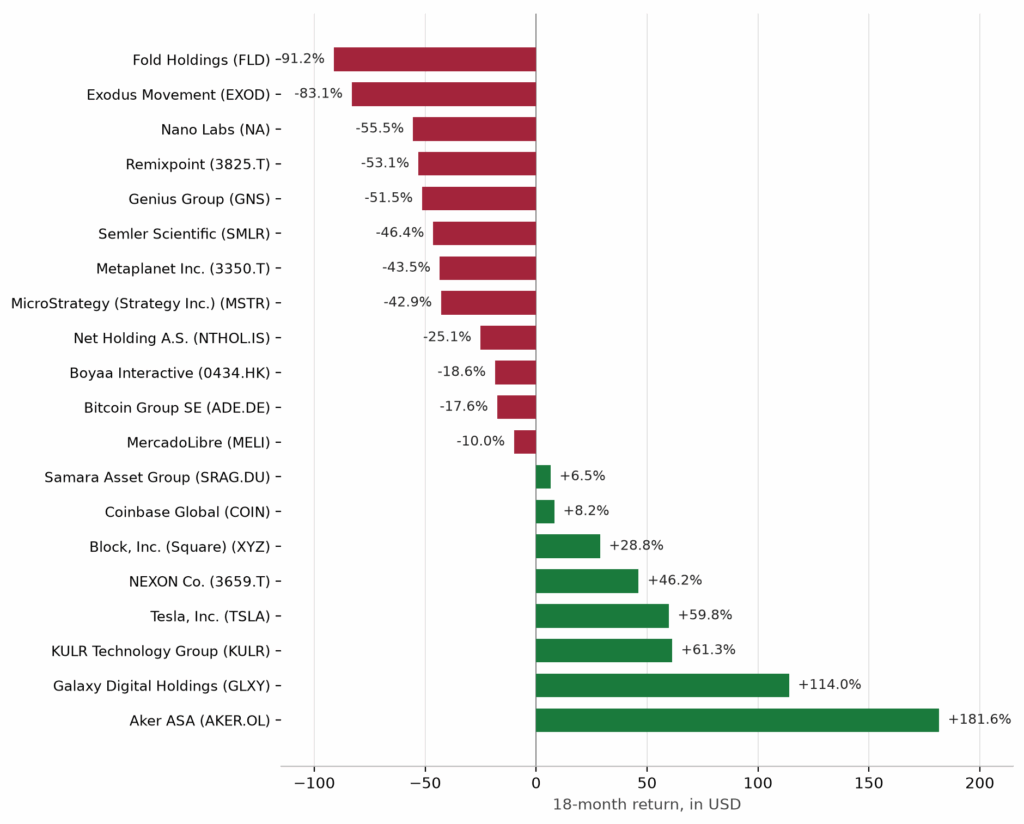
Over the past 18 months, the vast majority of publicly traded companies that pivoted to a BTC treasury strategy have lost money since their initial purchase announcement.
Globally, nearly 200 public companies hold BTC, according to monitoring service Bitcoin Treasuries, although most have small market capitalizations.
Many adopted their digital asset treasury DAT during a brief mania in the summer of 2025.
By late July 2025, every new BTC treasury stock was trading below its highest price of the year, and the median drawdown was -52%. Things have only deteriorated since.
Many stocks have now declined more than 90% to date, and some are even delisted from trading entirely.
Even Protos’ generous analysis below, charting the 20 largest BTC treasury stocks which have disproportionate positive performance among their far more numerous peers, shows 12 losses.
The top 20 bitcoin treasury stocks since March 2025
Relative to 18 months ago, the majority of non-mining BTC treasury stocks have negative returns. Mining stocks are excluded here due to their continuous acquisition of BTC through energy-intensive operations and consistent sales of BTC to pay for their power, infrastructure, and personnel.
The price of BTC itself is roughly flat, up less than 3% over the same time span, which allows the chart to speak for itself.
The median 18-month return of this cohort of 20 stocks is roughly -18%.
Five of the 20 have lost more than half their starting value, including several nearly “pure play” BTC treasuries like Remixpoint and Genius Group that planned minimal business operations aside from BTC acquisition during their initial optimism.
If someone had invested an equal amount of money into all 20 stocks 18 months ago, their portfolio would be worth less than its starting value today.
Pure play BTC treasuries
Worse, the returns would be even more negative for pure play BTC stocks, given that the best performers of the cohort — Tesla (+59.8%), Galaxy Digital (+114%), and Norwegian industrial conglomerate Aker (+181%) — have diversified business operations that aided their outperformance for reasons unrelated to BTC.
As a general rule, the more the company-focused on BTC, the worse the stock performed.
Heavily BTC-focused companies like Fold Holdings lost 91% since March 2025, Exodus Movement lost 83%, and Strategy, Semler, Metaplanet, Remixpoint, and Genius Group each lost more than 40%.
Even Michael Saylor’s $85 billion Strategy, the market leader, has shed half of its common stock price over the past year.
The biggest winner over the past 18 months, Aker ASA, is up 182% despite its BTC unit, Seetee, holding just 0.4% of Aker’s total assets.
Read more: CHART: mNAV down across bitcoin treasury companies
Recalculating since initial announcement is (slightly) better
When Protos zoomed out to personalize the returns according to the date each of the 20 companies initially announced their first BTC buy, the picture tilted slightly more positive.
MicroStrategy (now Strategy) started the trend six years ago on August 11, 2020, with a $250 million BTC purchase.
Its common stock hit a split-adjusted high of $14.54 that day, and is up over 1,000% since, the group’s largest winner.
Boyaa Interactive disclosed its first 1,100-BTC purchase on January 26, 2024, and its stock up 456% in dollar terms since.
Over in Japan, hotel operator Metaplanet approved a BTC pivot in April 2024, and its stock is up 476% in dollar terms since.
Of the 20 largest stocks, the post-announcement math splits almost evenly once currencies are converted. Exactly half of the 20 stocks have positive returns, and the median return is -15% across the cohort.
In summary, buying BTC with borrowed money and hoping the stock market would bid up the stock price has not proven to be a reliable strategy.
Although early rallies from Strategy and Metaplanet proved that there’s some speculative interest, most imitators have not been able to replicate their performances.
Protos has previously found that most new 2025 BTC treasury stocks were already down at least 50% within a few weeks of their initial announcements. The premium investors pay for these stocks has continued to fall over the past 18 months.
Got a tip? Send us an email securely via Protos Leaks. For more informed news and investigations, follow us on X, Bluesky, and Google News, or subscribe to our YouTube channel.

It’s no secret that Wall Street analysts are very bullish on Rocket Lab (NASDAQ: RKLB). The majority rate the stock a buy with an average price target of about $109 per share. This is substantially higher than where the stock is trading as of this writing, at about $64.
Rocket Lab also just posted record revenue numbers in its latest quarterly earnings. Revenue increased 62% year over year, the space company’s backlog ballooned to more than $2.3 billion, and momentum is strongly on Rocket Lab’s side. Still, I’m not quite ready to jump on board.
Missed AI’s “Act 1”? Act 2 Could Be 15x Bigger. Most investors think they missed the AI boat because they didn’t buy Nvidia in 2005. But according to our analysts, we’re only at the end of “Act 1″—the R&D phase. “Act 2” is the global rollout. Continue »
Let’s start with the bottom line. Rocket Lab isn’t close to profitable, and it looks like the prospect of becoming profitable is slipping further into the distance. The company’s second-quarter earnings report showed total operating expenses accelerating from the year prior, reaching $142 million in the quarter and $274 million halfway through the year.
Rocket Lab’s management expects cash burn to remain elevated for roughly the two years after its Neutron’s first successful flight. The Neutron inaugural launch keeps getting pushed back as well. Its original target launch was slated for 2025, but even its latest target of Q4 2026 seems likely to slip again to 2027.

Rocket Lab is also facing significant integration risk at the moment, having completed two acquisitions in 2026 and about to close another deal with Iridium Communications, which will add even more complexity.
Rocket Lab is positioning itself for immense growth in the coming years, particularly in a relatively nascent space. Still, profitability is getting pushed further out while the execution risk grows. I would like to see the company navigate these immediate issues before paying for a stock trading at an immense premium. Shares of Rocket Lab are trading at roughly 50 times its sales as of this writing.
Missed Nvidia in 2009? This Rare Signal Is Flashing Again
In 2009, a “Double Down” signal flashed for a little-known chipmaker called Nvidia. If you’d invested $5,000 then, you’d be sitting on $2,955,706 today.*
Now, for the first time in years, that same “Total Conviction” signal is flashing for a company 1/100th the size of Nvidia. It’s a key player in the $1.8 trillion space race, and with the stock recently sitting 20% off its highs, the window to get in early is closing fast.

How much of the gun-violence problem is actually a crime problem?
This is where popular understanding and facts diverge. A lot of people think that gun violence is something that is used in the commission of some other criminal act—to defend the drug trade, to rob someone’s house. In fact, the overwhelming amount of gun violence is young people arguing with each other and using guns to resolve some grievance or exact revenge. We design our system on the assumption that gun violence is a rational thing that people do to get something. It doesn’t work, because that’s not what it is. It’s kids with beefs, trapped in cycles of revenge and retaliation, who don’t have any other means of resolving their conflicts.
Somewhat controversially, considering your usual audience, you advocate for a lot more cops. Why is that?
Because America doesn’t have any police officers. It’s not controversial. It’s just a fact. European countries have twice as many cops per capita as we do. The central statistic is that as a share of GDP, Western Europe and the U.S spend about the same amount of money on public safety, but in America, the bulk of that money goes to prisons, and a little bit goes to the cops. And in Europe, a little bit goes to prisons, and a lot goes to the cops. If police can in fact prevent crime, which I believe they can, you’d rather spend more on them and promote public safety and prevent crime than spend your money after the fact locking people up under heinous circumstances for decade upon decade. Los Angeles has 8,500 police officers. Berlin has 18,000. It’s just absurd, and any American police chief you talk to, their No. 1 complaint is that their police are just completely overmatched.

Last week’s US Senate failure to advance a digital asset market structure bill could light a fire under cryptocurrency industry groups seeking to sway key congressional races in the 2026 US midterm election that‘s just 42 days away.
Senators on Sept. 15 voted 49 in favor and 50 against advancing the Digital Asset Market Clarity (CLARITY) Act, significantly reducing the chances of Congress passing the legislation with limited days in session before 2027.
While some crypto advocates haven’t ruled out the possibility of CLARITY coming up for another vote before the next session of Congress, at least one of the industry’s political action committees (PACs) isn’t taking any chances.
One PAC backed by Coinbase and Ripple Labs, Fairshake, now plans to pour $30 million into opposing Sherrod Brown in Ohio’s Senate race. Brown chaired the Senate Banking Committee when Democrats were in the majority and espoused many policies against crypto, making his potential return a challenge to another vote.
“[If Brown] wins, he might well be the deciding vote or one of the two deciding votes in a Democratic majority in the Senate,“ wrote economist Paul Krugman in a Tuesday Substack post. “And we now know that the Democratic Party is not clean as the driven snow. It is not immune to financial influence. It’s not even immune to de facto bribery from crypto.“
Steve Gannon, a partner at law firm Davis Wright Tremaine, told Cointelegraph that the CLARITY vote “provided the industry with a very clear picture of who are long-term reliable supporters and who are not,“ adding:
“It will be difficult for those who voted against Clarity to make the case that the industry should support them financially in the midterms.“
Related: CLARITY Act could get another shot during lame-duck session, policy advocate says
The former Ohio senator lost his 2024 reelection bid to Republican Bernie Moreno after Fairshake spent about $41 million opposing the Democrat. The PAC also spent more than $130 million on ads in the 2024 election cycle, offering a preview for how it might respond when faced with the threat of CLARITY not passing before the midterms.
Cointelegraph requested comments from Brown’s campaign but did not receive an immediate response.
How will the crypto industry react to CLARITY votes in the midterms?
Stand With Crypto, an initiative launched by Coinbase in 2023, warned that lawmakers who failed to advance the CLARITY Act in Congress last week could face “consequences” in the 2026 midterms based on their votes.
The organization responsible for rating politicians based on their positions on crypto could have a significant impact on the elections and on how PACs aligned with the industry use funds to target certain candidates, potentially influencing voters in an election year that could shake up control of the Senate and House of Representatives and give the market structure bill another chance of passing.
“The results of [the CLARITY Act] vote make it clear which officials are with our community, and which are against us — and we’ll make sure our advocates are ready to cast their ballots accordingly in this and future elections,” said Stand With Crypto executive director Mason Lynaugh.
As of Monday, Fairshake and its affiliate PACs Defend American Jobs and Protect Progress had not disclosed any expenditures to the Federal Election Commission (FEC) following the CLARITY vote.
FEC filings also showed no post-CLARITY spending by Fellowship, another crypto-aligned PAC funded by Cantor Fitzgerald and Anchorage Digital, or the Digital Freedom Fund, a group backed by Gemini co-founders Tyler and Cameron Winklevoss.
The OG meme coin has been on a tear lately, with its price tapping $0.10 for the first time since the beginning of June.
Analysts have spotted highly bullish signals, and some think the token could be gearing up for a rally to a new all-time high.
Realistic and Wild Predictions
DOGE has risen by almost 20% over the past week, with its market capitalization surging to roughly $15.2 billion and making it the 12th-largest cryptocurrency.
Currently, it trades just below the $0.10 psychological mark, but according to X user Cyriptoman4, it seems well positioned to attack higher levels. The analyst claimed that if DOGE decisively breaks above that zone, the upward move could continue toward the $0.1175-$0.15 region.
For their part, BSC Gems Alert claimed that the price has started forming a higher-low structure and is pushing against the upper boundary of the latest descending pattern.
“If DOGE can break and hold above $0.22, momentum could accelerate toward the higher resistance zones. The setup is simple: Breakout → Retest → Continuation,” they said.
At the same time, the analyst warned that a loss of support would invalidate the bullish setup and could trigger a pullback.
Others, like X user Bark, are much more optimistic. The analyst argued that the breakout to $1 has begun, expecting the potential explosion to happen faster than most people think.
MikybullCrypto issued a similar forecast, maintaining that the bullish move is about to kick off and setting the $1-$3 range as the bullish target.
Key Factors to Consider
Earlier this month, whales purchased more than 240 million DOGE in about a week. Many interpret such accumulations as bullish for several reasons.
First, the development reduces the tokens available on the open market, which, combined with steady or rising demand, is supposed to trigger a price pump.
Second, whales are experienced investors who make calculated moves and usually aren’t driven by pure instinct. Smaller players closely monitor their moves and might get encouraged to jump on the bandwagon, too, thus distributing fresh capital into the ecosystem.
However, some elements suggest that DOGE may be gearing up for a short-term correction. CoinGlass data shows exchange inflows have surpassed outflows over the past few days, suggesting some investors have moved from self-custody to centralized platforms. This, in turn, increases immediate selling pressure.

The post Dogecoin (DOGE) Rises to a 3-Month High: The Breakout to $1 Has Begun? appeared first on CryptoPotato.
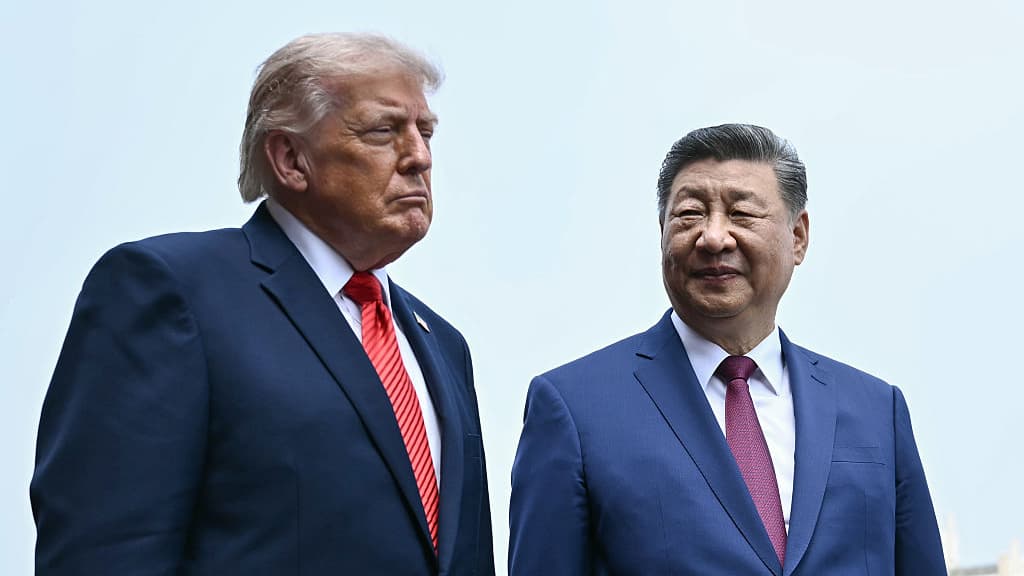
However, one major skeptic is Trump, who responded on Truth Social that “AI taking over the World, destroying Humanity, and all other things bad, is a HOAX.” Moreover, he insisted that “President Xi, of China, just announced that China will be doing absolutely nothing to stand in the way of AI, or its future.”
That characterization is misleading. China regulates AI more stringently than most other countries, and already enforces AI security guidance, ethics review requirements, and binding obligations on consumer AI services. Xi has also publicly called for legal, technical, and ethical guardrails that keep AI under human control (albeit while resisting restrictions that could impede China’s technological rise). “We should strengthen risk-awareness and ensure that AI is secure and controllable,” he told the World Artificial Intelligence Conference in Shanghai on July 17.
The hope among safety advocates is that Xi and Trump might strike a deal on AI. While Trump’s first term was anchored in antipathy to China, he posed a notably different tone in Beijing, calling Xi “a man I respect greatly” and telling him that “it’s an honor to be your friend.” Although that cordiality does not erase the national competition that makes either side hesitant to constrain its technological development, it may put narrower cooperation on the table.
Bitcoin went on a wild run on Monday, surging by over $7,000 on the heels of massive ETF inflows and topping $87,000 for the first time since late January before it finally calmed at around $86,000.
Most altcoins registered similar or even more impressive gains, including Ripple’s XRP, which flew past $1.50, and DOGE, which has neared $0.10.
BTC Hit 8-Month High
There was very little evidence last week of what would transpire in the crypto markets, starting from Friday and culminating on Monday evening, at least for now. The CLARITY Act was voted down in the US Senate, marking the first major blow against the industry. A day later, the Federal Reserve increased rates for the first time since July 2023. Both of these developments led to short-term declines for BTC, which slumped to $75,000 on a couple of occasions.
However, it reacted well on Thursday and especially on Friday. The BOJ’s decision to mimic the Fed didn’t harm bitcoin. Just the opposite; the asset rebounded to over $78,000 before it initiated another leg up that afternoon to over $80,000. It climbed to almost $82,000 on Wednesday, when the new escalation in both major wars led to a brief retracement to $80,300.
Monday, though, belonged to the bulls. BTC began its gradual ascent in the morning and culminated in the evening with a surge past $87,000 as the ETF inflows rocketed, which became an eight-month peak. After gaining $7,000 in less than 24 hours, bitcoin was due for a pullback. It dipped to $85,000 earlier today before it recovered to $86,000 as of now.
Its market cap has risen to $1.730 trillion on CMC, while its dominance over the alts stands above 59%.

XRP Above $1.50
Ethereum touched $2,800 briefly for the first time since the start of the year before it slid to $2,750. BNB tapped $800, but it’s now down to $788. Ripple’s XRP has reclaimed the key $1.50 resistance after another 4% run in the past 24 hours. Naturally, analysts have flipped bullish again, outlining some major predictions.
Dogecoin has neared $0.10 after a similar increase; ADA is close to $0.25, while NEAR has tapped $4.50. SHIB, CRO, HBAR, TAO, and PEPE have risen the most over the past day. In contrast, MORPHO, RAIN, UNI, ENA, BTW, and AAVE are in the red.
The total crypto market cap is up by over 3.5% today to $2.9 trillion on CMC.

The post XRP Reclaims Key Resistance as BTC Cools at $86K After Massive Run: Market Watch appeared first on CryptoPotato.

Six of Canada’s largest banks are exploring a Canadian-dollar tokenized deposit system designed to move money faster between financial institutions and eventually connect with other digital asset initiatives, TD Bank announced Tuesday.
Bank of Montreal, Canadian Imperial Bank of Commerce, National Bank of Canada, Royal Bank of Canada, Scotiabank and TD Bank Group form the joint venture, whose first phase focuses on moving tokenized deposits across participating banks. The joint statement said more banks could join the project later.
“The first phase of the project aims to move tokenized deposits efficiently across Canadian financial institutions with a longer-term goal to connect with other emerging digital assets initiatives,” they said.
The participating banks are collectively known as Canada’s Big Six: the dominant group in the country’s banking system, with operations spanning consumer banking, commercial lending, capital markets and wealth management.
The banks said the project aims to offer faster, more efficient and programmable payments to Canadian customers while preserving financial stability and regulatory oversight.


If you’ve ever sat up quickly or rolled over in bed abruptly and felt like the room was spinning or whirling around you when you’re actually still, you may have experienced a condition called benign paroxysmal positional vertigo (BPPV) without knowing what it was. This vestibular disorder—one that affects the inner ear—is one of the most common causes of vertigo, and it can make people feel very dizzy, unsteady, sweaty, even nauseous. Individual bouts tend to be brief—usually lasting 15 to 60 seconds at a time—but they can recur with certain head movements, make it difficult to function, and increase the risk of falling.
“The term ‘benign’ is the first part of the phrase—it does not feel benign when you experience it,” says Dr. Nedim Durakovic, an associate professor of otolaryngology and neurotology at the Washington University School of Medicine in St. Louis. Before the condition was well understood, “people thought that patients were having strokes when they had vertigo, [but] this is not the stroke form of vertigo.”
Here’s what to know about BPPV.
What causes BPPV?
With BPPV, tiny calcium carbonate crystals—called otoconia—that usually sit on hair cells in the inner ear get dislodged from where they belong and travel into one of the three semicircular canals of the inner ear. A change in head position, such as while rolling over in bed or tipping your head back in the shower, is what usually triggers BPPV symptoms.
It’s natural for these crystals to be in the ear. “They are part of your normal anatomy for your balance function,” says Dr. Gail Ishiyama, a professor in the departments of neurology and head and neck surgery and director of the Vestibular Clinical Laboratory at the UCLA School of Medicine. With BPPV, “they’re just in the wrong place, and that can cause vertigo.”
BPPV affects twice as many women as men, and it’s particularly common between the ages of 40 and 70. It can happen anytime, but head trauma or dental procedures involving drilling are two of the more common triggers, Ishiyama says.
People who have Menière’s disease (a chronic inner ear disorder), diabetes, hypertension, high cholesterol, hypothyroidism, migraine, anemia, osteoporosis, or peripheral neuropathy are particularly susceptible to BPPV, research has found. And research increasingly suggests that low vitamin D levels are a risk factor for BPPV.
How is BPPV diagnosed?
Getting the right diagnosis for BPPV isn’t always straightforward. “One of my frustrations with patients who experience this is they’ll go to the ER or they’ll get an MRI scan or a head CT scan—this whole [expensive] workup—when somebody just needed to lay them down and look at their eyes,” says Durakovic.
That, he says, is the easiest way to diagnose BPPV. Using something called the Dix-Hallpike maneuver, a health care provider will have the patient move between a seated and supine position and move their head in different directions while the provider examines their eyes. If the person’s eyes rapidly, repetitively, and involuntarily move up and down or in a twisting motion, these are signs of nystagmus, a condition involving sudden eye movements. Nystagmus often accompanies vertigo caused by BPPV, and if it does, the diagnosis is clear. If the patient doesn’t exhibit nystagmus, other diagnostic maneuvers may be used to trigger telltale symptoms.
What’s the treatment for BPPV?
The first-line treatment for BPPV uses a different maneuver called the Epley maneuver, which involves a series of specific head and body movements to remove the wayward crystals from the semicircular canal in order to relieve symptoms of vertigo. Sometimes the maneuver needs to be repeated several times, notes Durakovic. But research has found that it does the trick in more than 80% of people with BPPV.
There are other repositioning maneuvers, too, depending on which of the semi-circular canals is affected. “The positional maneuvers move the crystals along the pathway out of the canal and back to where they belong,” explains Dr. Cameron Wick, an associate professor of otolaryngology and neurotology at the Case Western Reserve University School of Medicine. If the maneuvers don’t provide immediate relief, people are advised to do them one to two times per day while they’re symptomatic, according to Wick.
In the instances when repositioning maneuvers don’t effectively relieve BPPV, the condition may resolve on its own over time. Other treatment options may include vestibular rehabilitation therapy—which is designed to treat dizziness, vertigo, and balance disorders—or surgery, which involves inserting a plug to block the part of the inner ear that crystals are flowing into.
Sometimes doctors prescribe vestibular suppressant medications, such as benzodiazepines or antihistamines, to calm the vertigo associated with BPPV. But Durakovic and Wick advise against these because they don’t address the underlying cause; they simply mask the symptoms temporarily. What’s more, these drugs are linked with an increased risk of falls when they’re used to treat dizziness.
Even when BPPV is successfully treated, recurrences occur in about 20% of people who’ve experienced it. “If you take vitamin D supplements, you’re less likely to get a recurrence of BPPV,” says Ishiyama. Staying hydrated and doing regular aerobic exercise can help, too, she says.
If, despite these measures, you find yourself experiencing recurrences of unexplained vertigo, it’s a good idea to see a neurotologist, an otolaryngologist, or a vestibular therapist to make sure that you are getting the right diagnosis.

Mariah Carey to bring Christmas tour to Manchester

Selena Gomez’s Brady Corbet Film ‘The Origin of the World’ Reportedly Recasts Lead Role With Lily McInerny

Strategy paid $100M extra to buy back the bitcoin it sold

Weekend Open Thread – Corporette.com

Weekend Open Thread: Talbots – Corporette.com

Memory prices are slowing because buyers ran out of money

Jesus prays for financial abundance for those who like and subscribe to this channel

#Money #MoneyMindset #Earning #Income #Success #Motivation #HardWork #Financial.

3 Steps To Manage Your Money | Personal Finance Basics #usa #shorts
-
 Fashion4 days ago
Weekend Open Thread: Talbots – Corporette.com
-

 Tech2 days ago
Researchers escape OpenAI Codex sandbox to run commands on host
-

 Crypto World7 days ago
Robinhood engineers charged over $50K crypto scheme
-

 Crypto World4 days ago
Circle launches Arc Studio AI agent for building onchain apps
-
 NewsBeat4 days ago
Trump says US has reached an agreement to take permanent control of Greenland’s security
-

 Crypto World2 days ago
Who Needs CLARITY Anyway? ARB Could See 70X Increase: Hodler’s Digest
-

 Crypto World4 days ago
Bitcoin price breaks channel as RSI climbs to 63
-

 Crypto World6 days ago
US Charges Robinhood Engineers Over Crypto Listing Trades
-

 Crypto World4 days ago
Trading Bitcoin on Robinhood? Why 2% Spread Has Traders Worried
-

 Crypto World7 days ago
What Is the Status of the U.S.-Iran Peace Talks? Here's What Both Sides Are Saying
-

 Tech7 days ago
Webb’s IC 348 Mosaic Includes Two-Jupiter Dwarfs, Twin Jets, and a Nursery Still Making Worlds
-

 Crypto World5 days ago
Mortgage and refinance interest rates today, Thursday, September 17, 2026
-

 Crypto World4 days ago
World Money launches in 150+ countries with Stripe
-

 Entertainment7 days ago
Big Brother Update: Melody Explodes at Drew as Illness Sweeps BB28 House
-

 Crypto World4 days ago
Silver prices recover quickly, hitting weekly high today
-

 Business2 days ago
Analog Devices (ADI) Bets $1.35 Billion on Chips that Let Machines Think for Themselves
-
 NewsBeat4 days ago
US was ‘on brink of war’ with China over false AI report of nukes moving in Middle East
-

 Tech5 days ago
GPT-6 Astra Reached the Nether in Minecraft, Lost Its Stash to a Creeper, and Farmed Potatoes for Hours
-

 Crypto World2 days ago
Coinbase, Robinhood, Circle Seen as Tokenized-Stock Winners
-

 Crypto World1 day ago
Bitcoin price holds above $81K as key catalysts line up
You must be logged in to post a comment Login