
Crypto World
Gold and Crypto Fall as Hot US Inflation Rattles Markets

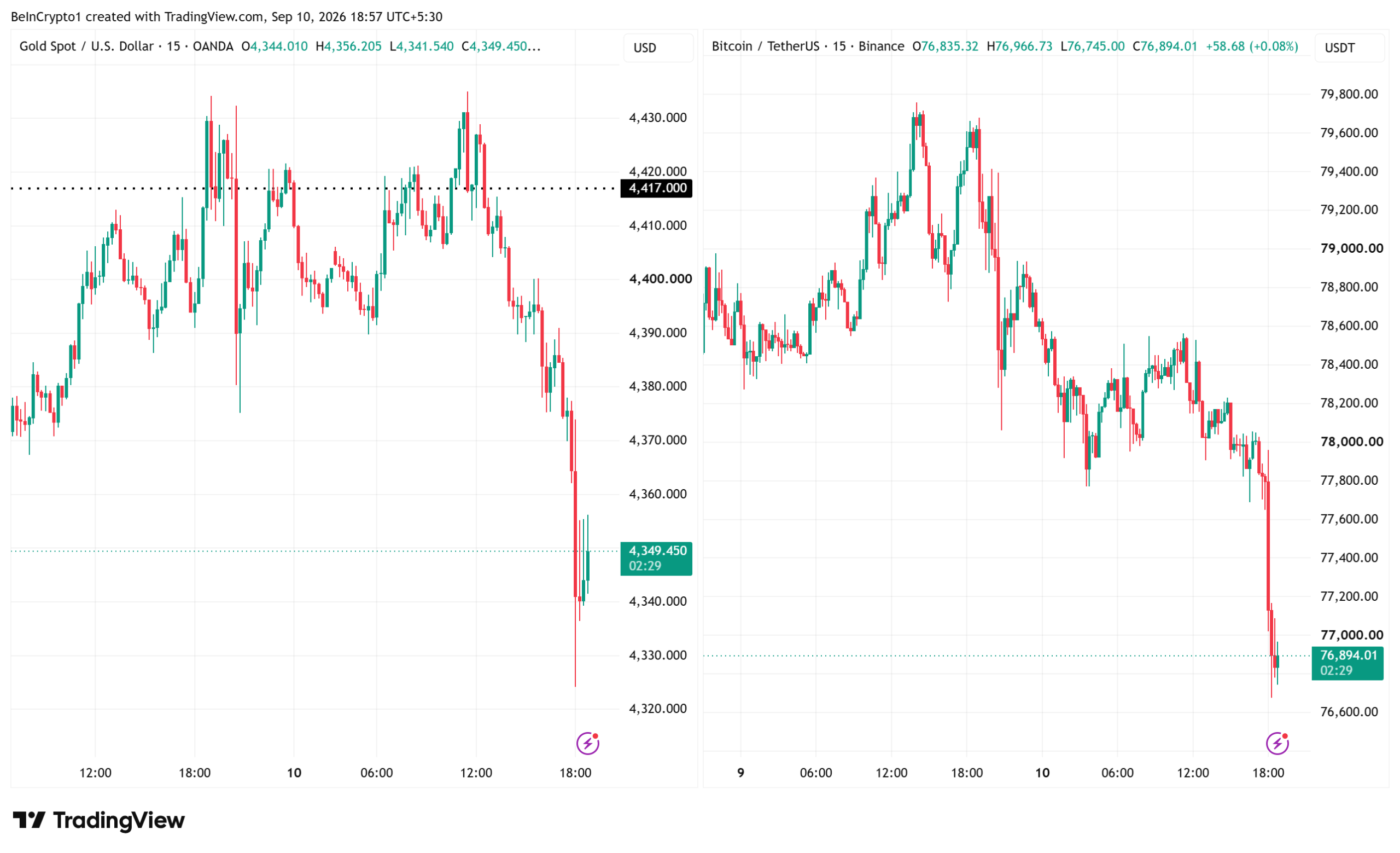
Another hot US inflation report arrived on Thursday, September 10, and all financial markets took a hit, including Gold, Bitcoin, and the S&P 500.
It seems like even traditional safe-haven assets like gold are not acting as an inflation hedge. The bond market recently delivered a reminder that inflation hedges can struggle when rising prices also mean higher interest rates.
Gold’s Inflation Trade Breaks
US producer prices rose 0.4% in August, matching forecasts. The annual rate reached 5.4%, slightly above the 5.3% expected.
Gold is supposed to benefit when inflation erodes the value of cash. Instead, spot XAU/USD fell more than 1%, dropping toward $4,350 after trading above $4,400.
For forex traders, that move hurts. A standard gold lot represents 100 ounces. A $100 drop means roughly $10,000 in losses on a one-lot long position, excluding trading costs.
The real damage came from bonds. The 10-year Treasury yield pushed above 4.9%, its highest since October 2023. The 30-year reached roughly 5.35%.
Higher yields make cash and government debt more attractive. Gold pays no yield. Bitcoin pays no yield either.

CME FedWatch pricing moved toward a 70% chance of a September rate hike after the data, up from roughly 62%.
Why Hot Inflation Hurt Gold
The detail inside the report mattered. The Bureau of Labor Statistics said: “Prices for final demand goods advanced 1.1 percent, and the index for final demand services increased 0.1 percent.”
More than three-quarters of the goods increase came from energy. That made the report look more like an energy shock than a broad inflationary surge.
The dollar also strengthened as rate-hike bets rose, adding another headwind for dollar-priced gold.
BeInCrypto had warned earlier this week that Treasury yields near 5% could start competing directly with Bitcoin and gold for institutional capital.
The next test comes Friday with US CPI (Consumer Price Index). Another hot reading would put more pressure on the Fed to hike — and test how far “inflation hedges” can fall when inflation itself becomes the problem.

The post Gold and Crypto Fall as Hot US Inflation Rattles Markets appeared first on BeInCrypto.



Crypto for Advisors: Hyperliquid and the future of finance

The latest monthly list of new buys by the best mutual funds, which comes out on Friday, puts a dazzling spotlight on Lumentum (LITE). These savvy money managers scooped up an eye-catching $13.11 billion worth of Lumentum stock. The optical and photonics giant plays a key role in powering the infrastructure behind artificial intelligence, cloud computing, and next-generation communications. Demand…
Copyright ©2026 Investor’s Business Daily, LLC. All rights reserved. 87990cbe856818d5eddac44c7b1cdeb8
Nasdaq has agreed to invest $100 million in Kraken parent Payward as the two companies expand their work on tokenized equities, market surveillance and blockchain-based settlement infrastructure.
Summary
- Nasdaq Ventures will invest $100 million in Kraken parent Payward, valuing the company at $21 billion.
- Payward will deploy Nasdaq’s market surveillance technology across its crypto, equity, futures, options and tokenized equity venues.
- Nasdaq and Payward expect Nasdaq Equity Tokens to launch in the second quarter of 2027.
- The companies began working together in March to connect regulated equity markets with blockchain networks through the xStocks ecosystem.
Nasdaq said Thursday that its strategic investment arm, Nasdaq Ventures, had agreed to make the investment as part of an expanded relationship with Payward. The deal values the privately held company at $21 billion, Bloomberg reported, citing people familiar with the matter.
The companies are working toward a second-quarter 2027 launch for Nasdaq Equity Tokens, or NETs, while Payward will deploy Nasdaq’s market surveillance technology across trading venues covering crypto, equities, tokenized equities, futures and options.
The investment builds on a partnership announced in March, when Nasdaq and Payward began developing infrastructure designed to connect regulated equity markets with blockchain networks through Payward’s xStocks ecosystem.
Nasdaq investment values Payward at $21 billion
Nasdaq Ventures invests in technology and market infrastructure that the exchange operator sees as relevant to the development of global capital markets. Its $100 million Payward investment gives the relationship a financial component alongside the companies’ existing technology work.
The reported $21 billion valuation is slightly above the $20 billion level Payward secured during an $800 million financing completed before its confidential initial public offering filing. As crypto.news previously reported, Payward’s planned IPO has since been pushed back until at least the second quarter of 2027.
Payward confidentially submitted a draft S-1 registration statement to the U.S. Securities and Exchange Commission in November 2025. The company has not publicly disclosed a proposed ticker, share price, number of shares or exchange for a potential listing.
Its latest financial results showed adjusted revenue of $508 million for the second quarter, up 17% from a year earlier. Adjusted EBITDA fell to $23 million from $80 million, while total platform transaction volume declined 18% to $310 billion.
Payward ended the quarter with 6.6 million funded accounts and $40 billion in assets on its platforms. Asset-based and other revenue represented 60% of total revenue, compared with 55% a year earlier, according to the company’s second-quarter results.
Nasdaq Equity Tokens target Q2 2027 launch
Nasdaq and Payward expect NETs to launch in the second quarter of 2027, advancing a project first announced earlier this year.
The initial partnership called for an equities transformation gateway connecting Nasdaq’s regulated market infrastructure with Payward’s xStocks system. Under the design, tokenized equities could move between permissioned financial markets and supported blockchain networks in eligible jurisdictions while retaining the rights attached to the underlying securities.
Nasdaq’s model is centered on issuer-sponsored tokens, with the company seeking to preserve issuer control, governance rights and existing market protections when shares are represented on blockchain infrastructure.
Payward’s xStocks framework provides the blockchain component of the planned system. When the partnership was announced in March, xStocks had recorded more than $25 billion in transaction volume, including over $4 billion settled onchain, and had more than 85,000 unique holders.
The platform has continued expanding since then. Payward partnered with GTN in July to take xStocks beyond U.S. equities, starting with Hong Kong-listed shares before planned expansion into markets including the UK, Europe and South Korea, subject to local regulatory approvals. At that point, xStocks had passed 500 tokenized assets and $37 billion in transaction volume.
Nasdaq said the next phase of its Payward partnership will focus on the global distribution, trading and post-trade systems needed to support NETs.
“More than $2 trillion of stock trades run through the U.S. clearing system every day,” Payward co-CEO Arjun Sethi said.
Sethi said buys and sells in the U.S. system net down by roughly 98%, leaving clearing houses to hold between $10 billion and $20 billion of collateral while trades await settlement. The move from two-day to one-day settlement in 2024 released $3 billion, he added.
“Onchain settlement removes the wait,” Sethi said. “The next phase of the collaboration is planned to advance Nasdaq Equity Tokens onto rails that do not close, with shareholder rights intact.”
Payward will use Nasdaq surveillance across trading venues
The expanded agreement gives Nasdaq another role within Payward’s trading infrastructure through its market surveillance technology.
Payward plans to deploy the system across crypto, conventional equities, tokenized equities, futures and options. Nasdaq said the technology will support market integrity and investor confidence as Payward operates across more asset classes.
Payward has spent much of 2026 expanding beyond its core spot crypto exchange business. The company completed its acquisition of Bitnomial in May, giving Kraken access to a regulated U.S. derivatives structure that includes a Futures Commission Merchant, Designated Contract Market and Derivatives Clearing Organization.
The transaction followed an agreement to buy Bitnomial for up to $550 million in cash and stock. The completed Bitnomial acquisition gave Payward control of the three Commodity Futures Trading Commission registrations needed to operate trading, brokerage and clearing services within the same group.
Kraken has separately expanded the uses available for xStocks. Eligible clients outside the United States can use selected tokenized stocks and exchange-traded funds as collateral for leveraged trades, allowing qualifying users to maintain tokenized equity exposure while supporting futures or margin positions.
Payward has acquired Backed Finance, the company behind the issuance infrastructure used for xStocks, while its wider portfolio now includes Kraken, NinjaTrader, Breakout and CF Benchmarks.
Nasdaq and Payward began tokenization work in March
The relationship between the companies started in March with plans to create a gateway between regulated equity markets and permissionless blockchain networks.
Under that framework, Payward Services was set to provide know-your-customer and anti-money laundering onboarding for users accessing Nasdaq Equity Tokens through its platform in eligible jurisdictions. Payward’s infrastructure was expected to serve as an initial settlement layer for NET transactions where the company held the necessary registrations or approvals.
Nasdaq initially said its equity token design and related distributed-ledger services would begin operating in the first half of 2027. The latest announcement narrows the expected NET launch to the second quarter.
The work comes as xStocks develops infrastructure intended to move tokenized equities beyond simple spot trading. In March, the platform introduced xChange, an onchain execution layer supporting more than 70 tokenized equities across Ethereum and Solana. At launch, the system had recorded $3.5 billion in onchain volume and $25 billion in overall trading volume.
Each supported xStock was backed 1:1 by an underlying security held in custody, while xChange used atomic settlement so a trade either completed at its quoted terms or did not execute.
Nasdaq President Tal Cohen said the expanded relationship with Payward was based on the exchange operator’s view that the company could play a role in building infrastructure for capital and assets to move across financial systems.
“This partnership advances our work on Nasdaq Equity Tokens and helps build a more connected financial system while preserving the trust, transparency and integrity that underpin capital formation,” Cohen said.
Nasdaq (NDAQ) has agreed to invest $100 million in Payward, the parent company of Kraken, through its venture arm. The investment deepens a partnership to build, distribute and trade tokenized stocks, targeting a second-quarter 2027 launch for the tokens.
The investment values Payward at $21 billion, according to Bloomberg, which first reported the deal. It expands a partnership the two firms first announced in March to develop tokenized equities, under which Kraken’s xStocks product would power a permissionless blockchain layer for Nasdaq’s issuer-sponsored equity tokens.
Payward will also adopt Nasdaq’s market surveillance technology across its crypto, equities, tokenized equities, futures and options venues.
Settlement Without the Two-Day Wait
Deutsche Börse paid $200 million for a stake that valued Payward at $13.3 billion in April, the same month Kraken began offering more than 11,000 US stocks and ETFs through its FINRA-regulated brokerage.
The exchange is moving into stocks, derivatives, and other traditional financial products beyond cryptocurrency, CNBC reported. xStocks, its tokenized-equity product, runs on public blockchains including Ethereum and Solana.
“More than $2 trillion of stock trades run through the U.S. clearing system every day. Buys and sells net down by about 98 percent, and the clearing house holds $10 billion to $20 billion of collateral against what is left while it waits a day to settle. Cutting that wait from two days to one in 2024 released $3 billion. Onchain settlement removes the wait,” said Arjun Sethi, Co-CEO of Payward.
Advancing Nasdaq Equity Tokens
Within Nasdaq, the work is led by its Digital Liquidity Networks unit, which builds always-on market infrastructure. The partnership “advances our work on Nasdaq Equity Tokens and helps build a more connected financial system while preserving the trust, transparency and integrity that underpin capital formation,” said Tal Cohen, President of Nasdaq.
Nasdaq introduced the equity-token framework earlier this year and said the tokens are designed to keep issuer control and shareholder rights intact. The next phase will develop the global distribution, trading, and post-trade capabilities behind them, the company said.
Holders of tokenized assets do not have outright ownership of the underlying shares, CNBC noted, and what such tokens confer is contested, a gap now playing out in a public dispute between Robinhood and AMC Entertainment over Robinhood’s tokenized AMC shares, which the studio calls a synthetic market that gives economic exposure without shareholder rights.
The post Nasdaq Ventures to Invest $100M in Kraken Parent Payward at $21B Valuation appeared first on CryptoPotato.
Crypto World
Kalshi launches ‘perps’ for gold and silver following CFTC approval, expanding futures offerings
Kalshi has won approval to list perpetual futures tied to precious metals gold and silver in the U.S., in the latest development as the company seeks to grow its trading offerings beyond prediction markets.
Originally filed in July, the Commodity Futures Trading Commission — which regulates derivatives contracts — approved the listing of the perpetuals this week.
The new markets for the contracts launched on Thursday on the site.
Kalshi first received approval to list perpetual futures tied to cryptocurrencies in late May, bringing the novel asset class with $90 trillion in annual volume in 2025 onshore to the U.S. for the first time. Since then, the contracts have done $44 billion in notional volume, according to the platform’s website.
Udesh Jha, chief risk officer at Kalshi Klear, the exchange’s clearing house, said the company moved to have this be their next asset to offer perpetual futures for due to high interest in the commodities.
“Metals, especially gold and silver, have a story to tell because of inflation,” he said.
That demand has been reflected in Kalshi’s commodity-related event contracts, which include metals and oil. Volume on the contracts has surpassed $400 million in trading volume in seven months, the company announced on Tuesday, half the time it took its crypto event contracts to reach the same mark.
Perpetual futures, colloquially known as “perps,” are futures-style contracts that have no expiration and do not require an investor to own the underlying asset. Instead, contracts track the price of an asset, with a funding mechanism to keep the contract in-line with the market price.
In addition to perps on precious metals, Kalshi is seeking approval for contracts tied to U.S. equities, industrial metal copper and currencies in August. The green light by the CFTC to list perps tied to precious metals is the first non-crypto related contract that has been approved.
Following the launch of perps, traditional futures exchanges like CBOE and CME Group saw their stocks tumble on fears that the new futures type could disrupt their existing business models. CME has even sued the CFTC to block the approval of perps in the U.S., under a belief that the agency improperly permitted the contracts.
But Jha said the early success of Kalshi’s perps offerings is because of its regulated nature.
“It all goes back to the regulated platform,’ he said. “Doing it the right way, a way with proper risk controls… Unregulated platforms, they have always hit a ceiling.”
Disclosure: CNBC and Kalshi have a commercial relationship that includes customer acquisition and a minority investment.
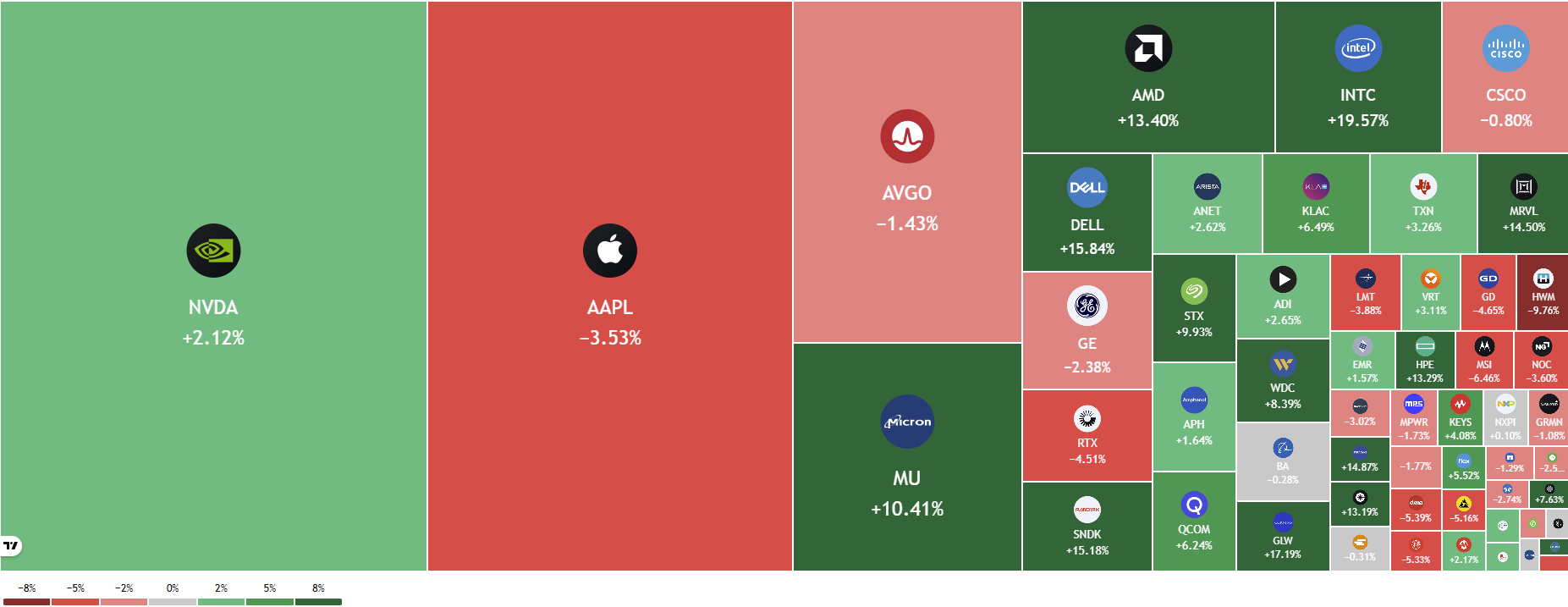
Intel Corporation (INTC) and Advanced Micro Devices (AMD) cleared multi-month resistance over the past week. Meanwhile, Nvidia (NVDA) gained just 2.12%, and Broadcom (AVGO) fell, pointing to rotation inside the AI chip trade.
Intel closed Wednesday at $106.24 and AMD at $521.10. Both eased in Thursday pre-market trading, and both still sit below their 2026 highs.

Server CPU Shortage Hands Intel and AMD Pricing Power
The rally rests on a shift in how AI workloads consume compute. Training leaned on GPUs. However, agentic systems need CPUs to coordinate tasks and move data.
Analysts now model the GPU-to-CPU ratio falling from roughly eight to one toward parity. AMD projects a $120 billion server CPU market by 2030, against a base near $30 billion.
Supply confirms the demand. Intel backlogs run beyond six months, and EPYC processors are effectively sold out for 2026. Server CPU prices have climbed 10% to 35% per quarter.
Both companies also drew their own catalysts. DigiTimes reported Intel plans a 10% CPU price increase in October. Northland upgraded the stock to Outperform with a $120 target. AMD, meanwhile, pitched a $3 trillion addressable market at the Citi Global Technology Conference, and Piper Sandler initiated coverage at Overweight.
Intel Breaks Its Downtrend and Tests $103.49
Intel remained sideways in August, just under the $95 price of its $20 billion share offering. The stock broke its descending resistance trendline on September 4.
Volume and news arrived together. Intel gained 4.5% that Friday, then 9% on September 8. A filing showing Nvidia’s Intel stake is now worth $30 billion drove the second move.
Price currently sits inside the 0.382 Fibonacci retracement at $103.49. The swing high from July 15 at $109.30 marks the next resistance.

The daily Relative Strength Index (RSI) turned first. It broke its own downtrend in early August, roughly a month before the price did. That line then held as support on August 24.
RSI now reads near 63 and rising. Notably, readings above 70 capped nothing during Intel’s April advance, when RSI peaked near 87.

AMD Clears Its Triangle and Flips $514.39 to Support
AMD traded inside a symmetrical triangle from mid-June until September 9. The stock closed at $521.10 that day and broke the upper boundary. The move cleared the previous swing high at $514.39, which should now act as support.
The $540 to $555 band is the next supply zone, sitting below the all-time high of $584.73.
AMD reported second-quarter data center revenue of $6.7 billion, up 107%. Third-quarter revenue is guided to roughly $13 billion. The stock went nowhere while earnings climbed, which compressed its multiple. Forward price-to-earnings now sits near 47, against a trailing figure above 130.

Volume has broken its own May downtrend, although it remains below the peaks set earlier in the year.
The two setups differ. Intel is attempting a reversal and still trades 25% below its 52-week high. AMD is continuing an uptrend from 11% below its high.
Money flow data had already shown institutions preferring AMD to Nvidia. Risks remain, however, with Intel Foundry losing $2.089 billion last quarter and AMD gaming revenue down 31%.
The post 2 Chip Stocks Broke Out This Week. Neither Was Nvidia appeared first on BeInCrypto.


Trezor is facing yet another security dilemma after its third-party email partner Brevo was breached, exposing Trezor users to a series of phishing emails.
The wallet maker revealed that hackers were able to access its email domain, which it’s since taken down, and is now launching an investigation.
Scammers warned Trezor newsletter subscribers of a “Critical Security Alert: STM32 Entropy Vulnerability” before trying to convince them to give up their wallet backups.
Read more: Trezor says mailing breach leaked 67K more users than first thought
Brevo is also the email provider for crypto firms BitBox, CoinTracking, Peach Bitcoin, and Blocktrainer, all of which have warned users to be wary of phishing emails.
CoinTracking phishing attempts used a fabricated breach to try and trick users, while BitBox phishing attempts warned of a microcontroller entropy bug.
Bad summer to be a Trezor partner
In August, Trezor revealed that its third-party shipping partner ShipMonk was breached, causing the details of 13,689 Trezor customers to be leaked.
The company then revealed a month later that ShipMonk’s leak actually impacted over 80,000 customers.
Trezor was also informed that ShipMonk hadn’t been sticking to a 90-day data deletion policy as promised.
Protos has reached out to Trezor for comment and will update this piece should we hear anything back.
Got a tip? Send us an email securely via Protos Leaks. For more informed news and investigations, follow us on X, Bluesky, and Google News, or subscribe to our YouTube channel.
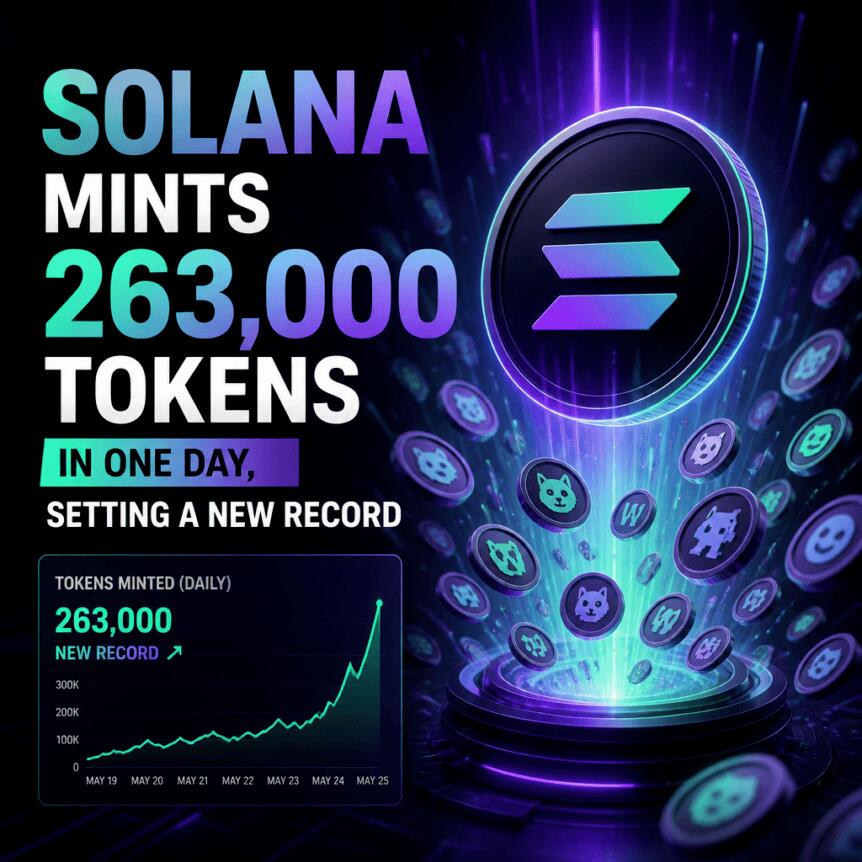
Solana has not only maintained its position as the dominant chain for retail token experiments—it is currently seeing an unusually high burst of new token creation. On Wednesday, the network recorded an all-time high in daily token issuance, with more than 263,000 new Solana Program Library (SPL) tokens minted.
That volume eclipses the scale seen during the late-2024 memecoin boom, when daily issuance was roughly in the 40,000–50,000 range. The latest jump underscores how quickly Solana’s ecosystem can shift when meme trading and launchpad activity pick up momentum.
Key takeaways
- Solscan data shows Solana minted 263,000+ new SPL tokens in a single day, a new record.
- Daily token creation in December 2024 during the memecoin cycle peaked at about 40,000–50,000 tokens.
- According to Blockworks, 40,360 tokens were issued via launchpads, with Pump.fun creating 34,184.
- DefiLlama reports Pump.fun generated $1.8 million in revenue over the past 24 hours, indicating that new token minting is being matched by monetized activity.
Record SPL token creation signals a memecoin-heavy issuance wave
The core data point comes from Solscan, which tracks newly created tokens on-chain. On Wednesday, more than 263,000 SPL tokens were minted—an all-time high for daily issuance on the network.
For readers trying to gauge whether this is “noise” or a structural shift, the comparison to December 2024 matters. During the peak of the memecoin cycle in late 2024, between 40,000 and 50,000 new tokens were issued per day. Wednesday’s total is several multiples higher than that earlier high-water mark, suggesting issuance activity has moved into a new tier.
Importantly, token minting volume alone does not guarantee market quality. Still, sustained bursts of creation typically correlate with periods when launchpad usage, speculative token demand, and retail attention align—especially in meme-driven segments.
Launchpads are driving the bulk of new tokens
Most of this issuance appears to be concentrated through established token-launch infrastructure. Blockworks’ dashboard shows that 40,360 tokens were issued through launchpads, and within that subset, the dominant share came from Pump.fun.
Blockworks reports that Pump.fun created 34,184 of those launchpad-issued tokens, accounting for the majority of launchpad-driven issuance. That concentration is notable: instead of many independent token creation paths competing evenly, a single protocol is capturing the most momentum.
In practical terms, launchpads lower the friction needed to bring tokens to market. They automate token creation and help deliver immediate liquidity and visibility—features that can speed up the “meme-to-trade” loop that retail traders tend to favor.
Pump.fun’s revenue underscores real economic pull behind the minting surge
While higher token issuance reflects technical and user behavior, the economics show whether activity is translating into fees and sustained engagement. According to DefiLlama, Pump.fun generated $1.8 million in revenue over the past 24 hours.
DefiLlama data also indicates that revenue leadership can shift even within short windows. The article notes that last Friday Pump.fun’s daily revenue was briefly overtaken by Fomo, a trading app that combines crypto trading with social feed-like features.
This matters because it suggests the market is not simply “minting for minting’s sake.” Instead, at least part of the token creation surge is being backed by monetization engines that traders interact with—potentially strengthening liquidity discovery and keeping token launches within a tighter promotional feedback loop.
Why this is more than just another memecoin headline
Solana’s record issuance should be read alongside what the ecosystem has been doing with memecoin cycles. Earlier coverage referenced in the source highlights that Pump.fun accounted for one-third of Solana’s first-quarter revenue in 2026, or $124 million out of $342 million, even as memecoin activity cooled.
That combination—meaningful contribution to revenue during a slowdown—implies that Pump.fun’s role may be larger than day-to-day memecoin volatility. If a protocol captures a substantial portion of both token creation and fees, then periods of accelerated issuance can have outsized impact on chain-level economic flows, not just token counts.
Still, uncertainty remains. A spike in minted tokens can also mean an increase in lower-quality launches, duplicates, or short-lived experiments that do not attract sustained trading. For investors and traders, the key watch items are therefore less about raw issuance and more about whether liquidity and trading interest remain strong after launch cycles pass.
In the next few sessions, market participants should monitor whether the daily token creation record persists, whether launchpad concentration continues to widen toward Pump.fun, and how competing social-trading apps perform relative to Pump.fun’s revenue. Those signals will help clarify whether Wednesday’s surge is the start of a new sustained regime—or simply a temporary peak driven by retail timing.

Ethereum trades at $2,470 as VanEck comes with a prediction news, calling the ETH base case at $11,800 by 2030. Another analyst goes further, modeling $14,135 by 2031. There’s also a number further down this piece that has nothing to do with Ethereum’s roadmap but everything to do with where early capital is rotating right now.
The bullish long-term case rests on fee revenue and staking yields, not hype. VanEck’s Matthew Sigel argues Ethereum’s path to five figures depends on Layer-2 scaling and institutional smart contract adoption, pulling value back to the mainnet. He is treating ETH less like a speculative token and more like a cash-producing settlement asset.
On the near-term side, over 116,000 ETH, or around $300 million left on exchanges in the past 48 hours, a signal traders typically read as easing sell pressure.
Zoom out and the market looks caught between two timelines: a tight consolidation this week and a five-figure valuation model for the decade. That tension is exactly where the next section starts.
Earn $50 and Enter $300K Prize Draw on EdgeX
Can Ethereum Price Hit $2,600 This Week Amid VanEck’s News?
ETH is boxed into a narrow range, having faded from a recent high near $2,550 without confirming a breakout. Support sits at $2,380–$2,430; resistance stacks up at $2,535–$2,600.
A clean weekly close above $2,540 would likely open the door toward $2,700 and, eventually, the $3,000 level analysts have flagged as the next magnet.

The base case: continued chop inside the range until volume picks a direction. The bull case: a break above $2,540 triggers momentum buying, with Tom Lee’s $10,000+ by 2027–2028 call gaining traction if it holds. The bear case: failure to hold $2,380 support reopens a retest of the low-$2,300s.
For context on how analysts are stacking targets, see this $6,000 target breakdown and the network’s upcoming protocol upgrades, both relevant to whether Ethereum’s fundamentals justify current price action.
Trade Ethereum on Bybit and Get a Chance to Win Our $1,000 USDT Airdrop
Bitcoin Hyper Targets Early Mover Upside as Ethereum Tests Key Levels
If ETH’s five-figure 2030 targets hold up, the math still favors capital already positioned. A $2,470 entry today doesn’t carry the same multiple potential as it did in 2020.
This is the trade-off long-term holders are quietly running: strong fundamentals, but diminishing asymmetric upside at this market cap. It’s why some traders are rotating a slice of capital into earlier-stage infrastructure plays instead.
Bitcoin Hyper is refining the developer experience with clearer documentation, familiar tooling, predictable APIs, and better feedback for builders. — Bitcoin Hyper (@BTC_Hyper2) September 2, 2026
The goal: make the network easier to understand, connect existing tools, and start building with less friction. 

Read the… pic.twitter.com/kAo1w7Xa06
Bitcoin Hyper ($HYPER) is positioning itself as the first Bitcoin Layer 2 with full SVM integration, claiming faster execution than Solana itself. The presale has raised $33,119,143.07 at a current token price of $0.013686, with staking APY offered.
Its core pitch: solving Bitcoin’s slow transaction speeds and lack of programmability via a decentralized canonical bridge and low-latency L2 processing, while preserving Bitcoin’s base-layer security.
Research Bitcoin Hyper directly before the funding window closes.
Discover: The Best Token Presales
The post Ethereum News: ETH Price Could Surge to $11,800 by 2030, Analysts Say appeared first on Cryptonews.

Megan Thee Stallion on Her Breakup With Klay Thompson

The 14 Best Magic Wand Vibrators For Women And Couples 2026 UK

Blue Jays Ex-Files: How deadline departures are faring in stretch run


-
 Tech2 days ago
Memory prices are slowing because buyers ran out of money
-

 Crypto World2 days ago
Bitcoin price risks $76K drop as $78K support weakens
-

 Business14 hours ago
AMD Stock Climbs After Management Lifts 2027 Data Center Outlook Toward $70 Billion in AI Sales
-

 Business13 hours ago
Micron Stock Climbs Above $1,031 as AI Memory Crunch and a $50 Billion Outlook Fuel the Rally
-

 Crypto World2 days ago
Ethereum price stalls below $2,500 as ADX drops to 11
-

 Crypto World2 days ago
Robinhood Stock: How To Take Advantage With Reduced Risk
-

 NewsBeat2 days ago
What went right this week: an ‘historic’ fall in violent crime, plus more
-

 Crypto World15 hours ago
Bitcoin price risks $70K if $78K neckline breaks
-
 Crypto World1 day ago
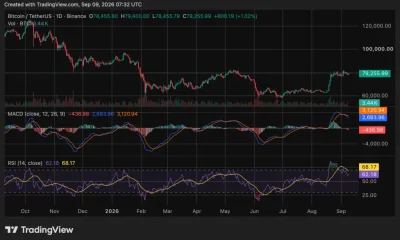
Bitcoin price holds near $79K as cycle drawdowns narrow
-
 Sports2 days ago
Phones confiscated, players sent home: Pakistan’s England tour turmoil revives memories of Mohammad Amir, Salman Butt and Mohammad Asif’s 2010 Lord’s spot-fixing scandal | Cricket News
-

 NewsBeat2 days ago
England up in reading, maths and science rankings as Scotland and Wales dip
-

 Business2 days ago
Meta debuts long-awaited personal AI agent, Muse
-
 Crypto World2 days ago
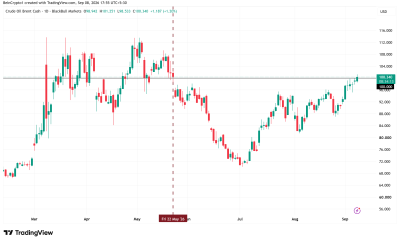
Brent Crude Oil Moves Above $100 for the First Time in 3 Months
-
 Crypto World2 days ago
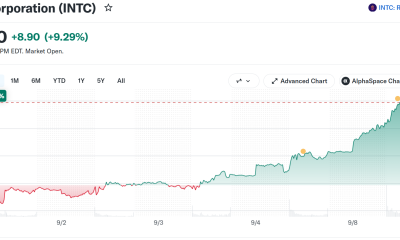
Intel Stock Jumps 9% on Chip Price Hike Report, US Stake Gains $36 Billion
-

 Crypto World2 days ago
Pump Fun and Kraken delete Hunter Biden $LAPTOP promotion
-
 Crypto World2 days ago
Visa expands stablecoin card network to 160 programs
-

 Business2 days ago
Egyptian TV Presenter Sarah Khalifa, 11 Others Sentenced To Death In Major Drug Trafficking Case In Cairo
-

 Business2 days ago
ServiceTitan, Inc. (TTAN) Q2 2027 Earnings Call Transcript
-
 Tech2 days ago
Strong Password Policy and Password Manager Guide
-
Business2 days ago
Xometry at Goldman Sachs Communacopia + Technology Conference 2026: growth, AI and Siemens
You must be logged in to post a comment Login