
Crypto World
Goliath Ventures Faces SEC, CFTC Suits Over $400M Ponzi



The US Securities and Exchange Commission (SEC) and Commodity Futures Trading Commission (CFTC) filed separate civil lawsuits against Goliath Ventures and founder Christopher Delgado over an alleged crypto Ponzi scheme that raised about $400 million.
The SEC said Goliath raised at least $425 million from more than 1,300 investors through an unregistered securities offering. Investors were told their money would be placed in crypto liquidity pools, but the agency alleged none of the funds or crypto assets were invested and Delgado diverted at least $51 million for personal use.
In a separate action, the CFTC said approximately 1,600 customers contributed at least $397 million after Goliath solicited funds for crypto trading in Bitcoin and Ether. The agency is seeking restitution, disgorgement, civil penalties, trading and registration bans, and a permanent injunction.
The actions add securities and commodities-law consequences to a criminal case that has already produced a guilty plea, allowing the agencies to seek investor compensation, penalties and market bans beyond the consequences available through Delgado’s plea.
Delgado agrees to settle SEC case
According to the SEC, Goliath promised monthly returns of 3% to 10%, generated from fees paid by traders using its liquidity pools, while guaranteeing investors’ principal. The complaint alleges the company instead used funds and crypto assets from new and existing investors to pay earlier investors and fabricated account balances and performance metrics.
The SEC said Goliath paid commissions to sales agents who recruited investors. By November 2025, the company could no longer raise money quickly enough to meet obligations, stopped making monthly distributions and collapsed, according to the agency.
Related: ‘I failed them’: Goliath Ventures CEO charged with crypto Ponzi apologizes
Delgado agreed to a bifurcated settlement, subject to court approval, that would permanently bar him from violating the securities-law provisions charged in the complaint. He would also be barred from participating in securities transactions outside personal-account activity and from associating with a broker or dealer. The court will determine disgorgement, prejudgment interest and a civil penalty.
Delgado previously pleaded guilty to conspiracy to commit wire fraud, wire fraud and money laundering. On June 30, the US Department of Justice said at least $400 million was paid to Goliath and that Delgado admitted causing at least $250 million in investor losses. He also agreed to forfeit properties, vehicles, luxury goods, bank accounts and crypto wallets traceable to the scheme.
Magazine: Japanese pension fund tips 1% in crypto, G7 urges action on NK hackers: Asia Express



CeDeFi trading platform Grvt has partnered with Ondo Finance to build a position of up to $100 million in the tokenization firm’s yield-bearing USDY product over the next 12 months.
Summary
- Grvt plans to build a $100 million position in Ondo Finance’s USDY token over the next 12 months.
- USDY returns will feed into Grvt Earn’s base rate, allowing users to access the yield without buying or managing the token directly.
- At USDY’s current APY of about 3.5%, a fully deployed $100 million position would generate roughly $3.5 million in annualized gross yield.
- The planned allocation would equal about 4.6% of USDY’s current $2.14 billion in assets under management.
According to Grvt, USDY will be integrated into Grvt Earn, where the tokenized Treasury product will become another source of returns behind the platform’s existing base yield rather than an asset users need to buy or manage directly.
Grvt plans $100 million USDY position
Under the arrangement, Grvt will hold and manage USDY on its own balance sheet, while income generated by the position will feed into the single base rate offered through Grvt Earn. The structure is designed to give users access to returns from several sources through one balance.
USDY is a tokenized secured note issued by Ondo Finance and backed primarily by short-term U.S. Treasurys, shares in Treasury-focused exchange-traded funds and bank deposits. Data cited in the announcement puts USDY’s assets under management at about $2.14 billion, with approximately 15,626 holders.
At that size, a fully deployed $100 million Grvt position would account for about 4.6% of USDY’s current assets under management. With USDY currently offering an annual percentage yield of roughly 3.5%, the allocation could produce around $3.5 million in annualized gross yield if the full amount is deployed and the rate remains at that level.
USDY accrues yield daily, and Grvt plans to combine the returns with other income already supporting Grvt Earn. Existing sources include revenue generated by the trading platform and lending activity through Aave.
Grvt CEO Hong Yea said the company designed Grvt Earn so customers could keep their capital earning returns without managing the infrastructure behind individual yield sources.
“We built Grvt Earn so users can keep their capital productive without having to manage the financial plumbing underneath it,” Yea said. “Together, we are creating a model where one balance can draw from multiple financial markets while remaining ready to trade.”
Rather than distributing USDY directly to Earn users, Grvt will manage the token on its balance sheet and incorporate the resulting returns into the product’s base rate. Users can therefore retain a single balance on the platform while Grvt handles the underlying allocation.
Yea said Ondo provides Grvt with access to the U.S. Treasury market through a tokenized product and linked the planned allocation size to the company’s expectations for using such assets in onchain financial services.
“Our target of building a USDY position toward $100 million reflects the scale at which we believe tokenized assets can support everyday onchain financial products,” he said.
Ondo Finance has expanded Treasury products onchain
The agreement adds another distribution channel for Ondo Finance, which has built several products that bring traditional securities onto blockchain networks.
USDY has previously been introduced into other decentralized finance markets. In February 2025, crypto.news reported on a campaign between Ondo and NAVI Protocol on Sui that used USDY as part of a liquidity incentive program. Participants could supply liquidity and qualify for rewards distributed in NAVX and USDY.
Ondo also operates OUSG, its tokenized short-term U.S. government Treasury product. Unlike USDY, which is structured as a yield-bearing secured note, OUSG provides qualified investors with tokenized exposure to short-duration U.S. government securities.
In May, an institutional settlement test involving JPMorgan, Mastercard, Ripple and Ondo used OUSG for a cross-border redemption on the XRP Ledger. The test moved the tokenized Treasury asset through blockchain infrastructure while JPMorgan’s Kinexys network handled the dollar payment to Ripple’s bank account in Singapore.
Ondo had previously expanded OUSG to the XRP Ledger in June 2025, allowing qualified purchasers to mint and redeem the product around the clock using Ripple’s RLUSD stablecoin for settlement. At the time, OUSG had more than $670 million in total value locked across supported networks.
The company has since expanded beyond Treasury products. In June, Ondo brought a group of tokenized U.S. stocks and ETFs to Hyperliquid’s HyperEVM, initially supporting 35 securities including SPY, QQQ, Nvidia, Tesla, Alphabet and Netflix. Its Ondo Global Markets platform had accumulated more than $970 million in total value locked and nearly $18 billion in cumulative trading volume at the time.
Tokenized Treasurys have become a major RWA segment
Grvt’s planned USDY allocation comes as U.S. government debt has become one of the largest categories in the tokenized real-world asset market.
As previously covered by crypto.news, the value of tokenized real-world assets excluding stablecoins reached roughly $31 billion to $34 billion by May 2026, compared with about $5.4 billion at the start of 2025. Tokenized U.S. Treasurys accounted for approximately $15 billion, while Ethereum hosted about 60% of tokenized RWA value.
Several large financial firms now operate products in the segment. BlackRock’s BUIDL is a tokenized money market fund distributed through Securitize, while Franklin Templeton’s BENJI represents shares in its OnChain U.S. Government Money Fund.
Franklin Templeton has also continued adding distribution routes for BENJI. In May, Kraken parent Payward agreed to integrate the product into its platform for collateral and cash-management uses, allowing eligible clients to put idle dollar balances into an onchain yield product.
A month later, Franklin Templeton added BENJI to MoonPay Trade, enabling institutional customers to exchange stablecoins including USDC and USDT for the tokenized fund through MoonPay’s onchain trading infrastructure.
Grvt expands after $19 million funding round
For Grvt, the Ondo deal follows a capital raise that gave the platform additional funding to develop its hybrid trading infrastructure.
In September 2025, Grvt raised $19 million in a Series A round for its zero-knowledge-powered decentralized exchange. The platform operates on ZKsync and combines elements of centralized trading infrastructure with onchain settlement and self-custody.
Grvt has positioned its architecture around privacy, security, and scalability for onchain financial markets. The September financing followed the development of its exchange infrastructure and was intended to support continued expansion of the platform.
More recently, Grvt released its own token as it continued building products around its trading and yield services. Grvt Earn now sits alongside that exchange infrastructure, with platform revenue and Aave lending already supplying parts of its yield before the planned USDY allocation is fully deployed.

Anthropic has agreed to pay Riot Platforms $9.1 billion over 20 years for computing capacity at the miner’s Rockdale, Texas campus, according to people familiar with the matter who spoke to Bloomberg on Monday.
Riot’s stock jumped 24% in after-hours trading following the report, a sharp reversal after shares had already closed the regular session down more than 5%.
The Deal and the Market Reaction
Riot disclosed the agreement itself earlier Monday, describing a 20-year contract to supply 191 megawatts of capacity, enough to power roughly 143,000 homes at any given moment, to an unnamed “leading frontier AI” company.
Bloomberg’s sources, who asked not to be identified because the information is private, said that the company is Anthropic. Neither Riot nor Anthropic has confirmed the identity publicly.
The stock swing was dramatic even by Riot’s volatile standards. Shares closed regular trading at $19.40, down $1.12, before climbing to $24.13 in the after-hours session, a gain of $4.73 from the close. That put the after-hours price well above Monday’s intraday range of $19.13 to $20.46 and closer to the stock’s 52-week high of $30.32.
Volume topped 17.5 million shares against a daily average near 16.8 million, and Riot’s market cap stood at roughly $7.3 billion heading into the move.
The company’s latest earnings report also landed Monday, adding another variable for traders parsing the after-hours action. Total revenue went up 14% year-over-year to $174 million, while there was a GAAP net loss of $237 million, translating to $0.68 per diluted share.
Per the report, Riot mined 1,587 BTC in the quarter, each costing $49,912 to produce, bringing its holdings to 11,380 BTC valued at about $728 million at current rates.
Miners Have Been Funding AI Expansion With Bitcoin Sales
Riot’s move into AI hosting builds on a pattern that has been building for over a year. The company sold 3,778 BTC in the first quarter of 2026 alone, worth about $289.5 million, while continuing to mine and expand its high-performance computing footprint.
That selling has continued since. In early August, on-chain trackers flagged a 381 BTC deposit from Riot to an exchange, a move typically read as a precursor to a sale.
Riot isn’t alone. Analyst Shanaka Anslem Perera wrote in July that public miners, including MARA, CleanSpark, Cango, Core Scientific, and Bitdeer, sold more than 32,000 BTC combined in the first quarter and redirected that capital toward AI infrastructure contracts worth an estimated $70 billion across the industry.
Mining Bitcoin cost roughly $80,000 per unit for much of the year, well above the asset’s price, while AI hosting contracts offered several times that return. “They did what any business would,” Perera wrote.
The exodus briefly rattled Bitcoin’s network, pushing hash rate down about 4% and breaking a five-year streak of growth, before difficulty adjustments restored profitability for the miners who stayed, and the network kept producing blocks on schedule.
The post Bitcoin Miner Riot Stock Jumps 24% After $9.1B Anthropic AI Deal appeared first on CryptoPotato.
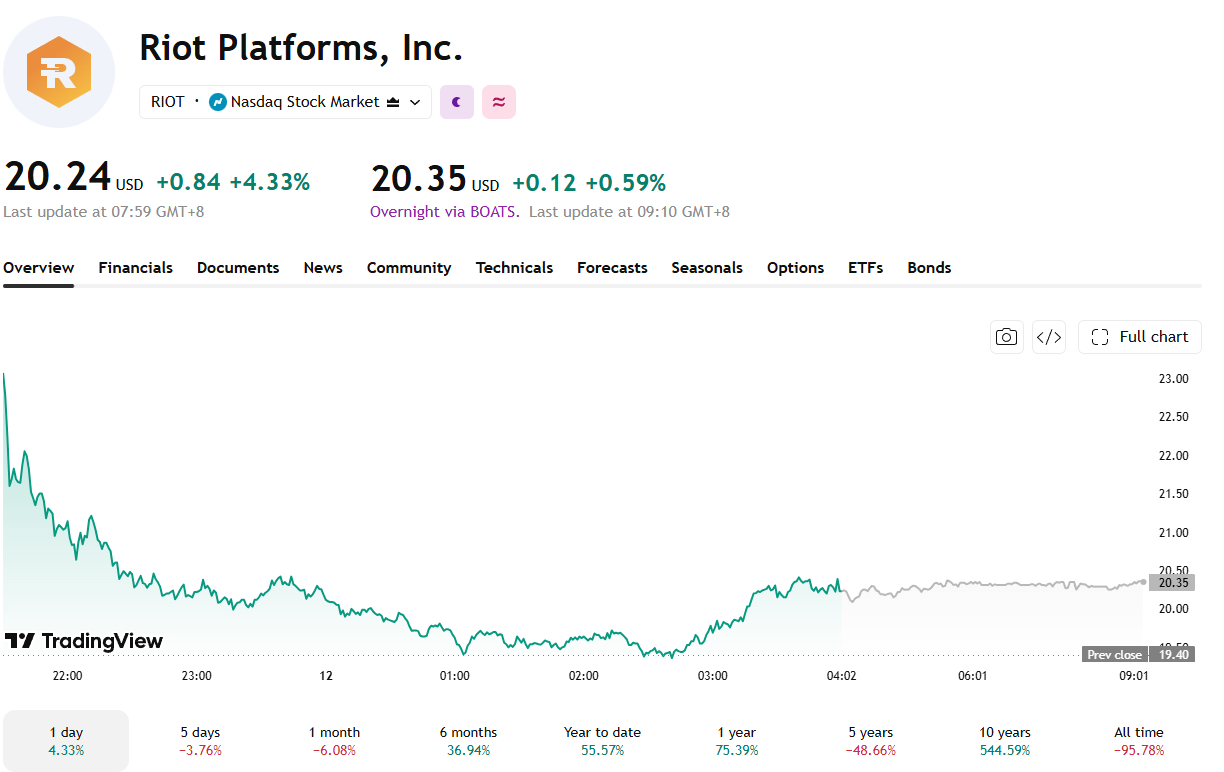
Riot Platforms’ $9.1 billion Anthropic lease sent RIOT and rival miner stocks sharply higher this week. But the rally points to a shift that could hurt Bitcoin (BTC) itself. Miners are increasingly funding AI buildouts by selling down the coin they mine.
The lease covers 191 megawatts at Riot’s Rockdale, Texas campus over 20 years, worth up to $16.1 billion with extensions. Rival miners TeraWulf, Cipher Mining, and Hut 8 rallied in sympathy the same day.
Miner Stocks Are Rallying On Power Contracts, Not Bitcoin
Riot closed Monday up 4.33%. Cipher Mining gained 5.39%, TeraWulf rose 3.40%, and Hut 8 added 3.39%. Bitcoin slipped 0.49% over the same stretch and has struggles to move beyond the $62,000 – $65,000 range. It is quite clear that the boost the these Bitcoin mining stocks has very little to do with BTC and thus is not helping the price of the underlying asset.

BeInCrypto tracked the same decoupling in July. TeraWulf, IREN, and Hut 8 surged then on AI leasing news, pulling further away from Bitcoin’s own price moves. Riot’s Anthropic deal extends that pattern.
Why The Same Shift Is A Headwind For Bitcoin
The AI pivot funding this rally is not free. Riot’s Bitcoin holdings fell from 15,680 BTC to 11,380 BTC in the second quarter, a drawdown of 4,300 coins. The company sold monthly output and treasury reserves to fund its AI buildout at Rockdale.
That pattern could matter more broadly. Miners that once held Bitcoin as a byproduct of their business are becoming net sellers of it. The proceeds are going into data center leases instead of new mining rigs.
Analysts have priced the stocks on the lease, not the ledger. Riot CEO Jason Les described the shift in the company’s second-quarter earnings statement.
“[Riot has] now executed leases totaling 241 megawatts of capacity, representing approximately $9.8 billion of long-term, contracted revenue with two of the most important companies in the AI ecosystem.”
That framing helps explain the market reaction. H.C. Wainwright raised its Riot price target to $40 from $25 on the Anthropic news. Needham lifted its target to $30. Both cited contracted megawatts rather than Bitcoin output.
It also flips the old trade of buying miner stocks for indirect Bitcoin exposure. Capital chasing Riot, TeraWulf, or Hut 8 is increasingly a bet on AI real estate. Part of that bet is funded by selling the asset those stocks used to track.
None of this means Bitcoin mining is disappearing. Riot’s mining revenue still reached $113.7 million in the second quarter even as leasing revenue grew. But the same deal that sent RIOT soaring came bundled with a steady drawdown in Bitcoin supply worth watching.
The post Riot’s Anthropic Deal Lifts Bitcoin Miner Stocks, But It’s Bad News For BTC appeared first on BeInCrypto.
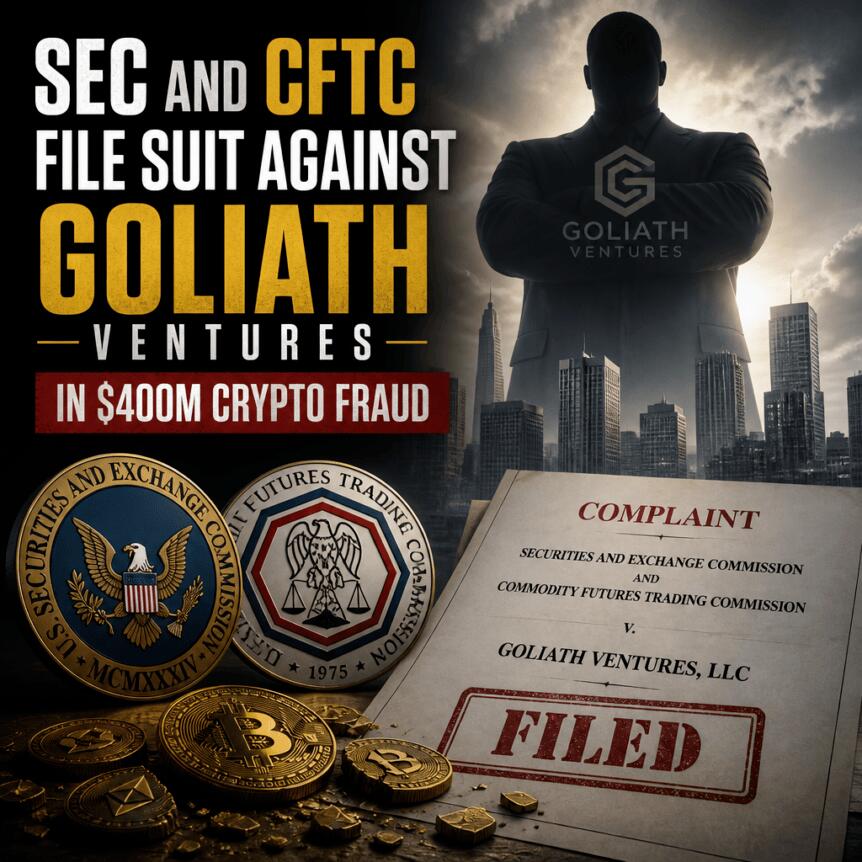
The U.S. Securities and Exchange Commission (SEC) and Commodity Futures Trading Commission (CFTC) have filed separate civil lawsuits targeting Goliath Ventures and its founder Christopher Delgado, alleging conduct consistent with a crypto Ponzi scheme that raised hundreds of millions of dollars from investors.
The SEC’s action focuses on an alleged unregistered securities offering totaling at least $425 million from more than 1,300 investors, while the CFTC says roughly 1,600 customers contributed about $397 million tied to solicitations for crypto trading in Bitcoin and Ether. The agencies are seeking remedies that include restitution, disgorgement, penalties, and permanent bans—expanding potential consequences beyond a parallel criminal case already moving through the courts.
Key takeaways
- The SEC alleges Goliath raised at least $425 million via an unregistered offering and that investor funds were not invested as promised.
- According to the SEC, Delgado allegedly diverted at least $51 million for personal use and allegedly fabricated account balances and performance reporting.
- The CFTC alleges about $397 million came from approximately 1,600 customers after solicitations connected to crypto trading in Bitcoin and Ether.
- Both civil suits add securities and commodities-law enforcement actions, potentially enabling broader investor compensation and market bans than the criminal plea alone.
- Delgado has agreed to a bifurcated settlement in the SEC case that would impose permanent bars, pending court approval and final determinations on financial penalties.
SEC: Alleged unregistered offering and diverted investor funds
In its complaint, the SEC said Goliath collected at least $425 million from more than 1,300 investors through what it characterized as an unregistered securities offering. The agency alleged that investors were told their money would be placed into crypto liquidity pools, but that “none” of the funds or crypto assets were actually invested in the manner represented.
The SEC further alleged that Delgado diverted at least $51 million for personal use. The SEC also said Goliath used funds and crypto assets from new and existing investors to make earlier payments—an arrangement the agency characterized as inconsistent with the investment strategy sold to participants.
According to the SEC, Goliath promised monthly returns ranging from 3% to 10% and guaranteed investor principal, claiming the returns were generated from fees paid by traders using its liquidity pools. The SEC alleges that, in reality, the company made payments by recycling investor money and fabricated account balances and performance metrics to support the scheme.
The SEC also alleged that commissions were paid to sales agents who recruited investors. The agency said the business eventually faltered after it could no longer raise funds quickly enough to meet obligations, stopped making monthly distributions, and collapsed—an outcome the SEC said came after the company’s operations turned unsustainable.
CFTC: Commodities-law claims tied to Bitcoin and Ether trading solicitations
Separately, the CFTC said Goliath solicited funds for crypto trading in Bitcoin and Ether, attracting approximately 1,600 customers and at least $397 million. The agency’s complaint positions the conduct within commodities and trading enforcement frameworks, seeking consequences aimed at restoring losses and preventing continued market participation.
In its civil action, the CFTC is seeking restitution, disgorgement, civil penalties, trading and registration bans, and a permanent injunction. While the SEC case centers on alleged unregistered securities and the handling of investor capital, the CFTC action reflects the regulator’s view that the underlying promotional and trading-related representations also triggered commodities-law concerns.
Delgado’s SEC settlement and what it does—and doesn’t—end
In the SEC matter, Delgado agreed to a bifurcated settlement, subject to court approval. The deal, as described by the SEC, would permanently bar him from violating the securities-law provisions charged in the complaint. It would also restrict him from participating in securities transactions outside personal-account activity and from associating with a broker or dealer.
The settlement leaves key financial components to be determined by the court, including disgorgement, prejudgment interest, and a civil penalty. In practice, this means the case can still produce significant financial exposure, even as certain legal and behavioral restrictions are agreed in principle.
Delgado is also tied to a criminal resolution. The article notes that he previously pleaded guilty to conspiracy to commit wire fraud, wire fraud, and money laundering. The U.S. Department of Justice has said that at least $400 million was paid to Goliath and that Delgado admitted causing at least $250 million in investor losses. The DOJ further stated that forfeiture was part of the agreement, covering properties, vehicles, luxury goods, bank accounts, and crypto wallets traceable to the scheme.
These developments underscore why the SEC and CFTC actions matter: civil proceedings can pursue investor-focused remedies and broader prohibitions that may not be fully addressed through a plea deal alone. Together, the cases give regulators additional tools to seek compensation, impose penalties, and limit future access to regulated markets.
Why the paired SEC and CFTC cases signal a tougher enforcement stance
Running parallel civil actions under two different federal agencies is notable because it reflects a broader pattern in crypto enforcement: regulators are increasingly willing to frame the same promotional conduct through multiple legal lenses—securities and commodities—depending on how the offering and trading-related representations are structured.
Here, the SEC’s allegations emphasize return guarantees, alleged principal protection, and promised placement into liquidity pools—elements the agency says were used to attract capital under an unregistered offering. The CFTC’s allegations, meanwhile, tie customer solicitations to Bitcoin and Ether trading, supporting its request for trading-specific bans and other restrictions.
For investors watching these cases, one practical takeaway is that “getting the money back” often depends on how quickly courts move on disgorgement, restitution, and related orders. Another is that criminal outcomes do not necessarily close the door to civil enforcement: as the regulators seek permanent injunctions and long-term participation restrictions, the civil cases can continue to shape who is barred from markets even after criminal resolution.
Next, investors and observers will likely focus on court approval of the SEC settlement terms and the final rulings on disgorgement, interest, and penalties, along with how the CFTC case progresses toward relief such as restitution and permanent bans.



Jim Cramer says investors do not need to track every market move to understand what is driving stocks. Instead, three questions can help investors read the market like a pro.
The “Mad Money” host built his framework on Tuesday around three checkpoints that sidestep noisy daily headlines. Where are bond yields headed? Where is oil trading? And, how is Nvidia performing? Cramer says these are the three main questions every investor should be asking as they look at the market.
Bonds and Oil Point to Rates and Risk
Cramer explained that when Treasury yields climb, bonds start competing harder with stocks for investor cash. That dynamic also pushes the Federal Reserve closer to tightening policy rather than easing it.
With the 30-year Treasury yield, a benchmark for long-term borrowing costs, hovering near 5.2%, Cramer said the number is too high for markets to shrug off.
“You must never forget that, as important as stocks are, the bond market is much larger and rules the roost.”
Jim Cramer, CNBC
He added that falling rates usually point to a healthier market, while rising rates tend to signal trouble ahead.
On oil, Cramer’s logic runs through inflation. Pricier crude tends to feed inflation readings, which in turn ripple into bond market pricing.
Oil has also become a gauge of geopolitical risk as investors watch the Iran conflict near the Strait of Hormuz. Still, he cautioned against overreacting to small daily swings, noting crude remains well below its recent highs.
Nvidia Is the Final Piece to Read the Market
Cramer’s final question is simple. How is Nvidia doing?
“The barometer for what might be as much as third to a half of the economy.”
Jim Cramer, CNBC
His logic ties back to artificial intelligence (AI) infrastructure spending. That capital no longer sits inside a handful of tech giants. It has fanned out across the broader economy, so Nvidia’s results now double as a read on that wider spending wave.
That shift has already helped push Wall Street records higher this year.
Cramer has repeatedly pointed investors toward simplified frameworks this earnings season. He recently flagged Eli Lilly’s stock rally using a similar approach. He favors a handful of durable signals over daily noise.
For traders overwhelmed by conflicting data, Cramer’s message is simple. Three checkpoints, not the full board, may offer the clearest read on where the market goes next.
The post Want to Read the Market Like Cramer? Ask These 3 Questions appeared first on BeInCrypto.
Cardano’s native token is among the top-performing cryptocurrencies on a monthly scale, with its price rallying by 15% within that period.
However, the bulls seem to have lost momentum, while popular analyst Ali Martinez outlined some important factors that could trigger a major short-term decline.
Going Down Again?
ADA started August on the right foot following the return of the large investors who scooped up more than 240 million coins in less than a week. Its price eventually pumped to almost $0.21 (the highest mark since early June) before retracing to the current $0.187 (per CoinGecko).
Meanwhile, Martinez believes a much more substantial plunge could be on the way. The analyst revealed that the number of whales holding between 1 million and 10 million ADA has fallen from 2,370 to 2,340, saying:
“This suggests some large holders may be taking profits or redistributing after the recent price increase.”
His second concerning signal is the formation of a death cross between Cardano’s MVRC ratio and its 7-day simple moving average. He claimed that the shift points to weakening momentum and raises the risk of a deeper correction. Last but not least, Martinez paid attention to ADA’s TD Sequential indicator, which has printed a sell signal on the asset’s daily chart.
“If these warning signs are confirmed, ADA could decline toward $0.17, the channel’s mid-range support. A further breakdown could expose the lower boundary near $0.144,” he concluded.
More Factors to Consider
Just a few days ago, the leading digital asset manager Grayscale withdrew its ETF filing for three altcoins, including Cardano’s native token. Bulls have long anticipated the launch of such a product, hoping it would boost demand and potentially lift the price, but it’s now clear they will have to wait even longer.
At the same time, there are some positive signals, too. Over the past several days, ADA exchange outflows have surpassed inflows, suggesting that investors have been shifting from centralized platforms toward self-custody, thereby reducing immediate selling pressure.

In addition, the asset’s Relative Strength Index (RSI) has dropped to 25, which means extreme oversold territory. Such levels are typically interpreted as buying opportunities, while anything above 70 is considered a warning of an incoming pullback.

The post ADA’s Rally Hits a Wall: Analyst Warns a 25% Drop Could Be Next appeared first on CryptoPotato.
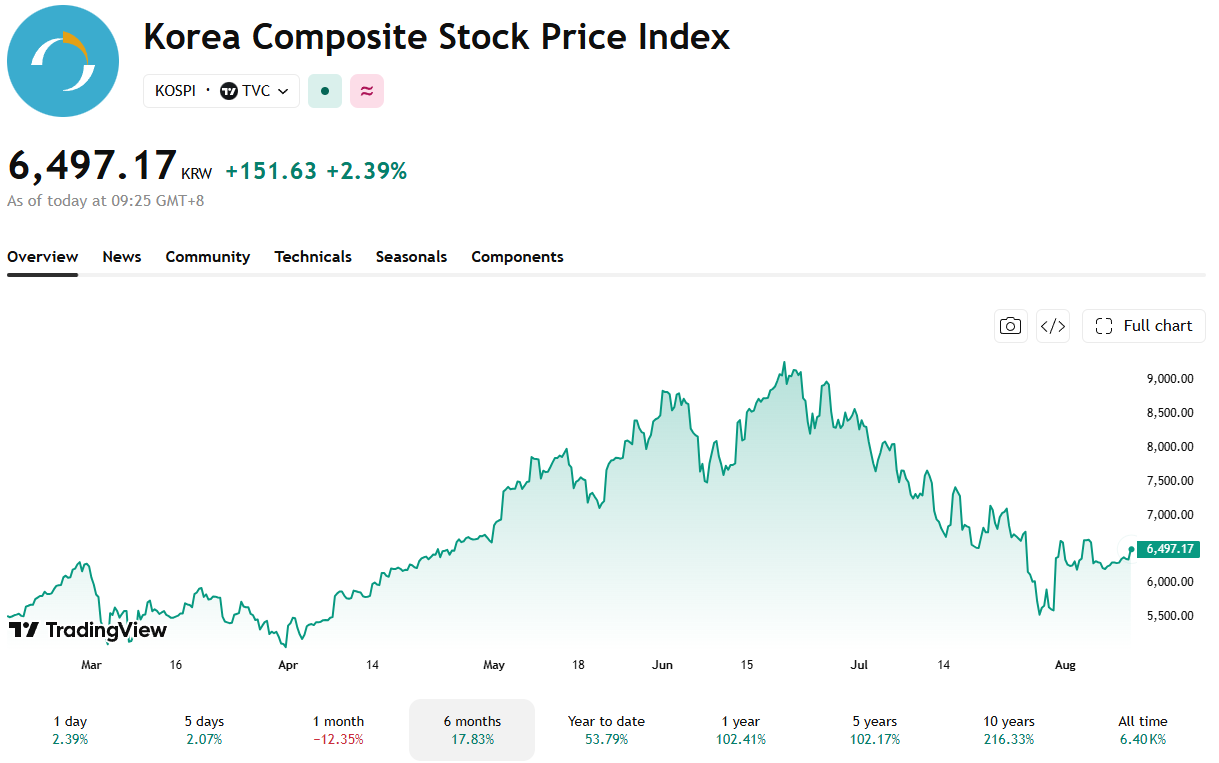
Foreign investors pulled $6.2 billion out of South Korean stocks in August. Taiwan drew $1.7 billion, ending a six week selling streak, Bloomberg-compiled data shows.
The split points to a broader pattern. Money is rotating out of Korea’s chip-heavy KOSPI toward markets seen as steadier bets on artificial intelligence (AI).
A Wider Asian Reshuffle
The Korea-Taiwan swing is part of a larger regional shift. Foreign investors sold a net $25.48 billion of Asian equities in July. It was the ninth straight month of net outflows.
Taiwan and South Korea alone lost more than the region’s entire net outflow in July. Taiwan shed $22.95 billion that month, separate from August’s swing back to inflows. Korea shed $6.26 billion in July, a July total distinct from the $6.2 billion August outflow cited above.
Inflows into India, Thailand, Indonesia and the Philippines only partly offset those July losses.

Bloomberg-compiled data also shows analysts raised Taiwan’s 12-month earnings estimates faster than Korea’s last month. It was the first time in nearly a year that Taiwan’s revision moved ahead.
“The unusually high swings in AI-related sectors are making global investors diversify.”
Herald van der Linde, head of Asia-Pacific equity strategy at HSBC, made that point in a note cited by Reuters. He said the volatility currently leaves India comparatively better placed.
Why Korea Looks Riskier to Some Investors
Hebe Chen, senior market analyst at Vantage Global Prime, pointed to Korea’s heavier leverage and speculative positioning. She said that can magnify price swings even without any shift in fundamentals.
South Korea’s KOSPI posted its biggest fall since early March, late last month. The rout was driven by a slump in leveraged bets tied to Samsung Electronics and SK Hynix. A $19 billion leveraged AI-linked ETF unraveled in the process, hitting Korean retail investors hardest.
Not every investor sees Korea as the weaker bet, though. Isaac Thong, senior investment director at Aberdeen Asian Income Fund, disagrees. He said Korea looks relatively attractive given how far its valuations have fallen against Taiwan’s.
Where the Money Is Going Instead
Indian equities logged a $1.3 billion weekly foreign buy last month, the largest since mid-2025.
Global funds are favoring markets seen as less dependent on AI capital spending than Korea or Taiwan. Thailand, Indonesia and the Philippines also logged inflows in July, though on a smaller scale than India.
Thailand pulled in $1.46 billion over the same period. Indonesia and the Philippines logged smaller gains, at $88 million and $69 million respectively.
The gap in scale matters. Together, those four markets absorbed a fraction of what Korea and Taiwan lost. Analysts describe the move as a rebalancing act, not a wholesale return to the region.
The post Korea Sheds $6.2 Billion in August as Asia Rotates Away From AI appeared first on BeInCrypto.
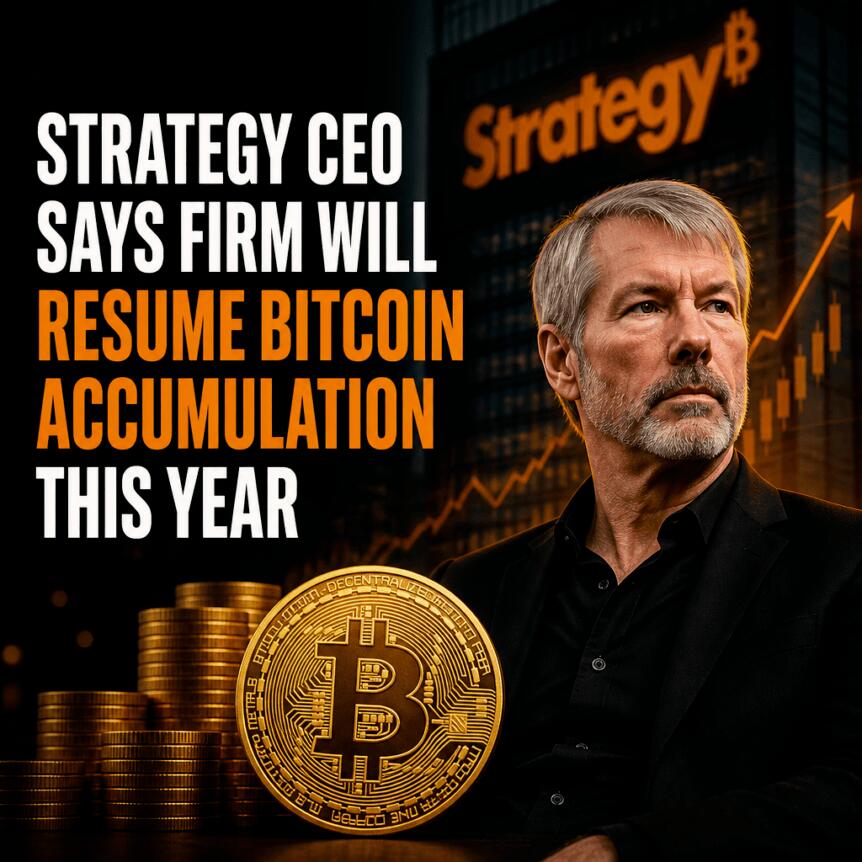
Strategy CEO Phong Le says the company plans to resume accumulating Bitcoin later this year, despite having sold portions of its BTC holdings earlier in the year—an approach that has attracted investor scrutiny.
In a Monday interview with FOX Business, Le said Strategy purchased about 175,000 Bitcoin since the start of the year while selling roughly 7,000 BTC. He characterized the net flow as “about 25 times more” buying than selling and noted that Strategy has moved from being the world’s second-largest institutional Bitcoin holder to becoming the largest.
Key takeaways
- Strategy says it will restart net Bitcoin accumulation later this year after earlier sales.
- Le reported ~175,000 BTC bought since the beginning of the year versus ~7,000 BTC sold, implying Strategy remains a major net buyer.
- Strategy has sold Bitcoin on four occasions since May, with the most recent sale totaling 1,690 BTC.
- Recent sales have been linked to shareholder payouts and balance-sheet uses, including dividends and share repurchases.
- Broader pressure is building on the corporate Bitcoin treasury model as some public companies trade below the net asset value of their BTC.
Strategy’s plan to keep buying, and why the sales matter
Le’s message is direct: despite stepping back from pure accumulation, Strategy intends to increase its BTC exposure again “throughout the course of the year.” That stance arrives after the company diverged from its long-running “never sell” narrative, even if the magnitude of selling appears small relative to its total holdings.
According to the interview, Strategy has accumulated more than 840,000 BTC overall, while still making sales on four occasions since May. The most recent disclosed sale was for 1,690 BTC.
Le’s comments help frame the trade-off Strategy is facing as a public company with ongoing obligations. The company has used proceeds from recent Bitcoin sales for purposes that extend beyond building its BTC treasury—supporting preferred stock dividends, funding share repurchases, and adding to its U.S. dollar reserve.
The tension for investors is straightforward: selling Bitcoin—even when paired with larger net buying—can be seen as a shift in the risk-management and capital allocation logic that originally attracted many BTC-focused shareholders.
From “never sell” to balancing equity and dividends
Market scrutiny has focused on Strategy’s departure from its “never sell” approach. The company’s situation underscores a challenge unique to Bitcoin-heavy treasury models when they operate under traditional public-company constraints.
As a result, Strategy’s capital decisions are not driven by Bitcoin price views alone. Instead, it must weigh requirements tied to common and preferred shareholders alongside its accumulation strategy. The implication is that even firms positioned as long-term Bitcoin holders may still periodically liquidate BTC to meet other corporate finance priorities.
Why the corporate Bitcoin treasury model is under strain
Beyond Strategy specifically, the broader economics of corporate Bitcoin treasuries have been stressed by weaker market conditions. Data cited from BitcoinTreasuries.NET indicates that public companies collectively hold more than 1.26 million BTC, while spot-exposed vehicles such as exchange-traded funds and other funds hold more than 1.6 million BTC.
The treasury model historically gained momentum during a period when corporate Bitcoin holders traded at premiums to the value of their BTC holdings. In that environment, firms could raise capital through equity or debt and then convert that financing into additional Bitcoin, according to analysis referenced from Novaque Research.
But the mechanics worsen when the market assigns a discount. When companies trade below the net asset value of their Bitcoin holdings, new capital raises can dilute existing shareholders more than they did during premium periods. That makes it harder for treasury firms to perpetuate rapid accumulation without creating downside dilution—especially if capital markets are tighter and equity valuation is less supportive.
In other words, even if the long-term thesis remains intact, the near-term path to growth may require more careful balancing between BTC buying and other corporate uses of cash, particularly when the equity story is no longer a simple premium-to-NAV loop.
What to watch next for Strategy and other BTC treasuries
Strategy says it intends to resume accumulation later this year, but investors should monitor whether future buying is funded primarily through balance-sheet decisions (including any further BTC sales) or through renewed access to capital markets. More broadly, the sustainability of corporate Bitcoin treasury expansion may increasingly depend on whether share pricing can recover toward—or at least not deeply undercut—BTC net asset values.

Coinbase has received regulatory approval in Abu Dhabi to provide investment arrangements and custody services through Abu Dhabi Global Market. The approval strengthens the company’s international expansion and establishes the emirate as its global base for tokenized securities outside the United States. The move also supports Coinbase’s broader strategy to expand regulated blockchain financial services across major international markets.
Coinbase Establishes Abu Dhabi Tokenization Hub
Coinbase secured a Financial Services Permission from the Financial Services Regulatory Authority of Abu Dhabi Global Market. Consequently, the exchange can arrange investment deals and provide regulated custody services within the financial center. The approval creates a legal framework for its tokenized securities business.
The company selected Abu Dhabi as its international tokenization hub outside the United States. Therefore, Coinbase will build blockchain-based services for traditional financial assets from the emirate. The initiative supports the wider adoption of onchain capital markets under regulated conditions.
Coinbase plans to issue tokenized securities backed by underlying company shares through the FSRA framework. Each digital security will represent an actual share under approved prospectus terms. The structure allows regulated blockchain ownership while maintaining established financial standards.
Tokenized Securities Expand Regulated Digital Asset Services
Each tokenized security will carry rights linked to its underlying share according to the approved offering documents. Eligible holders can receive shareholder rights, including voting rights, when they satisfy the applicable conditions. Dividend payments will automatically be reinvested under the structure governing the digital securities.
The platform removes the need for traditional brokerage accounts and correspondent banking relationships. Instead, users will hold tokenized securities through compatible digital wallets. Meanwhile, every transfer will undergo sanctions screening under the applicable regulatory framework.
Coinbase also retains authority to freeze or seize digital assets whenever regulatory requirements demand such action. The company said the framework balances blockchain efficiency with compliance obligations. The approval strengthens Abu Dhabi’s position as a regulated center for digital financial services.
UAE Expansion Supports Broader International Growth
Coinbase continues expanding its operations across the United Arab Emirates beyond tokenized securities. At the same time, the company is building a derivatives business in Dubai. Together, both operations will focus on blockchain-based capital markets and regulated derivatives services.
The company stated that the UAE will host two of its largest international businesses outside the United States. Meanwhile, the Abu Dhabi operation will support tokenized securities while Dubai develops derivatives offerings. The combined strategy reflects growing demand for regulated digital asset infrastructure across global financial markets.
Coinbase is also preparing to launch futures, perpetual contracts, and options for professional participants in the United Kingdom. The planned offering will cover cryptocurrencies, stocks, commodities, and foreign exchange markets. More than 170 contracts will become available, while perpetual products will support continuous trading with leverage limits reaching 50x and dated futures offering leverage up to 20x.
The approval builds on Abu Dhabi’s efforts to attract digital asset companies through clear regulatory frameworks and dedicated financial infrastructure. ADGM has introduced digital asset regulations over recent years to support blockchain businesses seeking regulated international operations. Consequently, Coinbase joins several global firms expanding regulated services from the UAE as tokenized financial markets continue developing worldwide.

Abbott Partners With Google Health For AI-Powered Glucose Monitoring

Financial Audit’s First Affair

Child vanished at Maine beach because parent was too busy scrolling on phone


-

 Fashion4 days ago
Weekend Open Thread: Mattifying Sunscreen
-

 Fashion5 days ago
Frugal Friday’s Workwear Report: Cap-Sleeve Pointelle Crewneck Sweater
-

 Sports6 days ago
Jordan Coyle & Cordiamo take Laya Arena Stakes at RDS
-

 News Videos4 days ago
Can Astrology Help Find Gold and Silver Trends? A Financial Astrology Guide
-
 Business6 days ago
US stocks: Dow closes at record on Mideast optimism; SpaceX, AMD drag Nasdaq
-

 Politics6 days ago
Reform UK And Greens Sink To Lowest Favourability Ratings To Date
-

 Business6 days ago
Supply chain issues impact Ingredion
-

 Tech4 days ago
Rinn Pharma & Biopharma to join NordicPharmaTrain network
-

 Business3 days ago
How to Start a Cleaning Business: A Step-by-Step Guide
-

 Business3 days ago
BDC Weekly Review: Private BDC Q2 Numbers Are Strong
-

 Business3 days ago
Datadog: Best Of Breed For Multiple Reasons
-

 Business7 days ago
McDonald’s (MCD) Q2 2026 earnings
-
 NewsBeat4 hours ago
Communication cards help banking customers access services or report scams
-

 Fashion7 days ago
The Bright Side of Black and White
-

 Fashion6 days ago
Suit of the Week: Me + Em
-
Sports6 days ago
Spider-Man: Brand New Day ending explained: Is Peter Parker alive?
-

 Crypto World7 days ago
Robinhood files $200M second venture fund focused on YC startups
-
 Tech5 days ago
Price Hikes May Be Coming for PC Motherboards Next
-
 Fashion7 days ago
Birthstone pendant necklaces for women by ottomanhands – 18ct gold plated
-
 Crypto World6 days ago
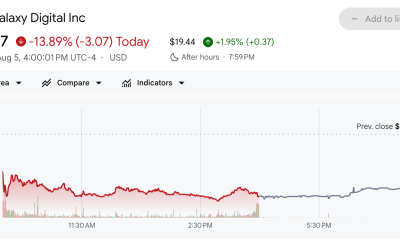
Galaxy Digital Stock Slides 14% as Crypto Prices Hit Earnings
You must be logged in to post a comment Login