
Crypto World
Helium CEO Amir Haleem quits after HNT tanks 96%



Helium’s HNT token is down 96%, and CEO Amir Haleem decided to quit yesterday. He spent over a decade talking about the reasons someone should be bullish about HNT.
Checking the chart, they would have been better off never listening to him.
Helium issued three crypto tokens, MOBILE, IOT, and HNT, to incentivize operators of its once-faddish networking devices. Over the past five years, those three tokens have declined 76%, 87%, and 96%, respectively.
Haleem announced his resignation by quote-tweeting a video by his replacement, Mario Di Dio. He’s stepping aside as chief executive of Nova Labs, the company behind Helium.
On X, some users framed his step-down to chairman as well-deserved break after a successful career. However, the price chart of his token tells an entirely different story.
Somehow, things got even worse as his reign ended, with HNT falling another 15% on the day of his goodbye.
Get out, get out, get out
The timing of the CEO changeover certainly raises eyebrows.
Two days before quitting, Haleem’s company offloaded its consumer business on June 2, 2026. Helium Mobile, the budget cellphone service that gave the project a sliver of legitimacy, went to Noble Mobile.
HNT failed to rally on the news, remaining down 30% over the past week and down 46% over the past month.
So, the sequence reads cleanly. After offloading the consumer business with no relief rally to speak of in HNT, the CEO resigned two days later.
As he left, he made sure to assure everyone that he still holds HNT.
He also left behind a project that spent years collecting controversies.
Helium raised nearly $365 million over its lifetime, with FTX as one of its backers. In 2022, the company was caught advertising Lime, Salesforce, and Nestlé as network users, even though none of them were. A Forbes investigation later found that insiders had mined close to half of all HNT in its first months.
Read more: SEC wants to settle with Ripple, drops Helium case
Gary Gensler’s SEC tried to stop Helium, Paul Atkins’ SEC settled
The Gary Gensler-led SEC eventually noticed. It sued Nova Labs in January 2025 over “materially false and misleading statements” about Lime, Nestlé, and Salesforce supposedly relying on the network, among other complaints.
After Gensler resigned and Donald Trump’s replacement, Paul Atkins, took over the SEC, that case settled abruptly by April 2025.
Nova Labs paid a mere $200,000 civil penalty over one misrepresentation charge. The SEC dismissed the rest of its complaint with prejudice under Atkins’ staggeringly crypto-accommodative “leadership.”
Haleem treated the outcome as exoneration. He called it what “might well be the shortest-lived SEC litigation on record” and the original suit “a bizarre last-minute politically-motivated move.”
He thanked the agency’s new commissioners for “restoring sanity to the commission.”
Haleem’s colorful background helps explain his tone. He lists himself as someone who likes to “build and race 90s Japanese sports cars” and launched a professional racing team during Helium’s worst-performing years.
Got a tip? Send us an email securely via Protos Leaks. For more informed news and investigations, follow us on X, Bluesky, and Google News, or subscribe to our YouTube channel.

Crypto World
China threatens retaliation against U.S. humanoid robot ban, says it ‘severely damages’ relations

A humanoid robot from Robostore joins CNBC’s Power Lunch on Dec. 30, 2025.
CNBC
BEIJING — The U.S. Federal Communications Commission has repeatedly ignored Beijing’s restrained stance on product bans, China’s commerce ministry said Thursday, threatening retaliation.
The FCC on Tuesday said due to cybersecurity concerns, it added foreign-made advanced robotic devices, including humanoids, to a list restricting imports to the U.S. The statement did not specify a country, and said retailers could still import models the FCC has previously approved.
As the FCC keeps escalating restrictions on Chinese goods, it “severely damages China-U.S. economic and trade stability,” China’s commerce ministry said in an online statement Thursday. That’s according to a CNBC translation of Mandarin.
The ministry urged the U.S. to withdraw the decision, and threatened countermeasures if it failed to do so.
“This is bad news for Chinese humanoid producers planning their IPOs in the coming months,” said Marc Einstein, a research director at Counterpoint Research. “The two major cards China can play are to further restrict rare earth sales to American companies and further restricting Chinese market access for American companies like Tesla and NVIDIA.”
The commerce ministry’s statement comes as U.S. President Donald Trump is scheduled to host Chinese President Xi Jinping in September. Tensions over the tech race have meanwhile intensified, with U.S. Treasury Secretary Scott Bessent saying the U.S. could sanction China over AI model “theft.”
Trump on Thursday indicated in public comments that the U.S. might take a more cautious stance on AI controls in order to maintain American tech leadership over China.
Chinese companies Agibot, Unitree and UBTech accounted for the top-three humanoid companies by installation market share last year, according to Counterpoint. Tesla’s Optimus ranked fifth.
Hong Kong-listed UBTech shares briefly fell more than 6% in Thursday morning trading. Unitree and Agibot have filed to go public.
Robostore, a distributor of Chinese humanoid robots in North America, has been preparing by expanding its U.S.-based capabilities, CEO Teddy Haggerty said in a statement to CNBC. He did not elaborate on details.
—CNBC’s Matthew Tan contributed to this report.

“We have stood by this member state through every conflict in which their freedoms have been imperiled, and today I remind them that it is the United States that remains the beacon of liberty for the world,” Negrea continued. “We will not be affording them the benefit of listening to their politicized drivel until they renounce their condescending and disrespectful rhetoric and behave in a manner commensurate with their seat on this council.”
The diplomatic dispute stems from France’s U.N. Mission in Geneva criticizing the United States for opposing a second term for Volker Türk, the U.N. High Commissioner for Human Rights who has held the role since 2022.
Türk secured overwhelming backing from member states on Friday, receiving 144 votes in favor of him staying on, with just 10 countries—including the United States—voting against, and 13 abstaining.
“The U.S. used to be a beacon of human rights. Not anymore. Today, it stands alongside North Korea, Nicaragua, Mali, and Russia, isolated. And the world no longer listens to it,” the French Mission said on Saturday via social media, alongside the hashtag “America Alone.”


A Moscow court has moved BitRiver founder Igor Runets from house arrest to pretrial detention as investigators examine an alleged fraud involving nearly ₽1 billion.
Summary
- Two months of pretrial detention replace Igor Runets’s house arrest in Moscow’s expanding fraud investigation.
- Nearly ₽1 billion in alleged losses involve prepaid mining equipment that investigators say never arrived.
- BitRiver’s parent faces bankruptcy proceedings tied directly to the disputed En+ mining equipment contract case.
The Zamoskvoretsky District Court approved the change on July 22 and ordered Runets to remain in custody for two months. The new charge became public on July 29 through reports based on court records and sources familiar with the investigation.
Runets faces an accusation under Part 4 of Article 159 of Russia’s Criminal Code, which covers fraud on an especially large scale. The charge remains an allegation, and no court has found him guilty.
Why the BitRiver founder was moved into custody
According to Pravo.ru, investigators allege that Fox Group, a company controlled by Runets, signed an equipment-supply contract with Infrastructure of Siberia in 2023. Infrastructure of Siberia is part of the En+ group.
The contract reportedly covered more than $8 million of cryptocurrency-mining machines. Investigators say the buyer transferred more than $7.9 million as an advance and expected delivery within 32 days. However, prosecutors allege that the equipment was not delivered and the payment was not returned.
Forbes Russia, citing RBC and case materials, identified the machines as Antminer S19k Pro units. The report said the buyer sent a formal demand for delivery or repayment before cancelling the agreement.
Investigators claim Runets “did not intend to fulfil the contract” and used the money at his discretion. That account reflects the prosecution’s position and has not been proven at trial.
The En+ dispute began as a commercial case
The dispute developed from an earlier commercial relationship between BitRiver and En+. In November 2020, the companies announced the creation of Bit+, a joint venture intended to operate cryptocurrency-mining facilities using hydropower in Russia’s Irkutsk region.
At the time, an official En+ company release described BitRiver as the operator of Russia’s largest data centre offering colocation services for Bitcoin miners. En+ was responsible for supplying electricity, while BitRiver managed mining operations.
However, the relationship later led to several civil claims. In April 2025, the Arbitration Court of the Irkutsk Region reportedly ordered Fox Group to pay Infrastructure of Siberia ₽954.4 million over the disputed advance payment.
Earlier reporting on the En+ claims said the court also restricted access to some funds and equipment during the dispute.
Runets disputed the claimant’s account in May 2025. He said the equipment “was delivered” and stated that Fox Group intended to appeal the judgment. His claim directly conflicts with the current investigative allegation that the machines never arrived.
BitRiver was already facing bankruptcy pressure
The criminal investigation comes as BitRiver and related companies face financial and insolvency proceedings.
Notably, BitRiver faced bankruptcy proceedings over unpaid debts after creditors brought claims linked to equipment, electricity and data-centre services. The process imposed restrictions on several accounts and placed the company under court-supervised financial review.
Forbes reported that Fox Group entered bankruptcy monitoring in February 2026. A court reportedly opened liquidation proceedings in late May after Infrastructure of Siberia sought repayment connected to the equipment contract.
Runets had already been placed under house arrest in late January. That earlier case concerned allegations that BitRiver-related entities concealed funds that should have been available for tax collection. Investigators later added two tax cases and combined several matters into a broader proceeding.
What happens next in the BitRiver fraud case
Runets is expected to remain in pretrial detention for two months unless an appeal changes the court’s order. Investigators may use that period to examine company records, equipment documentation, bank transfers and testimony from people connected to Fox Group and En+.
A Moscow court also froze Runets’s ownership interests in Fox Group and several BitRiver-related entities in June, according to Forbes. The restrictions may remain in place while investigators examine whether company assets relate to the alleged offence.
BitRiver remains a privately held company, and it has no verified publicly traded token linked to its operations. Therefore, no direct crypto-market reaction can be reliably attributed to Runets’s detention.
The company also remains subject to U.S. sanctions. The U.S. Treasury Department sanctioned BitRiver AG and ten Russian subsidiaries in April 2022. Treasury said cryptocurrency-mining companies could help Russia monetise its energy resources.
In related coverage, BitRiver previously claimed Russia could overtake the U.S. in Bitcoin mining. That forecast was a company claim and has not been confirmed by independent mining data.

Why is western Europe seeing so many wildfires now?
Many parts of Europe are no stranger to wildfires. “There’s always been fires in the Mediterranean, going back thousands of years,” says Thomas Elmqvist, professor at the Stockholm Resilience Center, at Stockholm University. “The difference now is that we have fires, but they are much, much larger and much, much more intense.”
A changing landscape has put regions that didn’t typically see wildfires at risk. “Across southern Europe, you have, over the last [few] decades, seen more and more abandonment of rural land…and [it’s led to] the encroachment of shrubs and bushes—a different type of landscape which is much more vulnerable to having these mega fires,” says Elmqvist.
Most of Europe is also currently experiencing a critical drought, which worsened in central-western Europe in late June. Much of the continent has seen above-average temperatures and multiple, prolonged heat waves this year. That has helped supercharge wildfires. “You get incredibly dry biomass, and it doesn’t need much to start a fire,” says Elmqvist.


Cointelegraph is committed to providing independent, high-quality journalism across the crypto, blockchain, AI, and fintech industries.
All news, reviews, and analyses are produced with full journalistic independence and integrity. For more details on our standards and processes, please read our Editorial Policy.
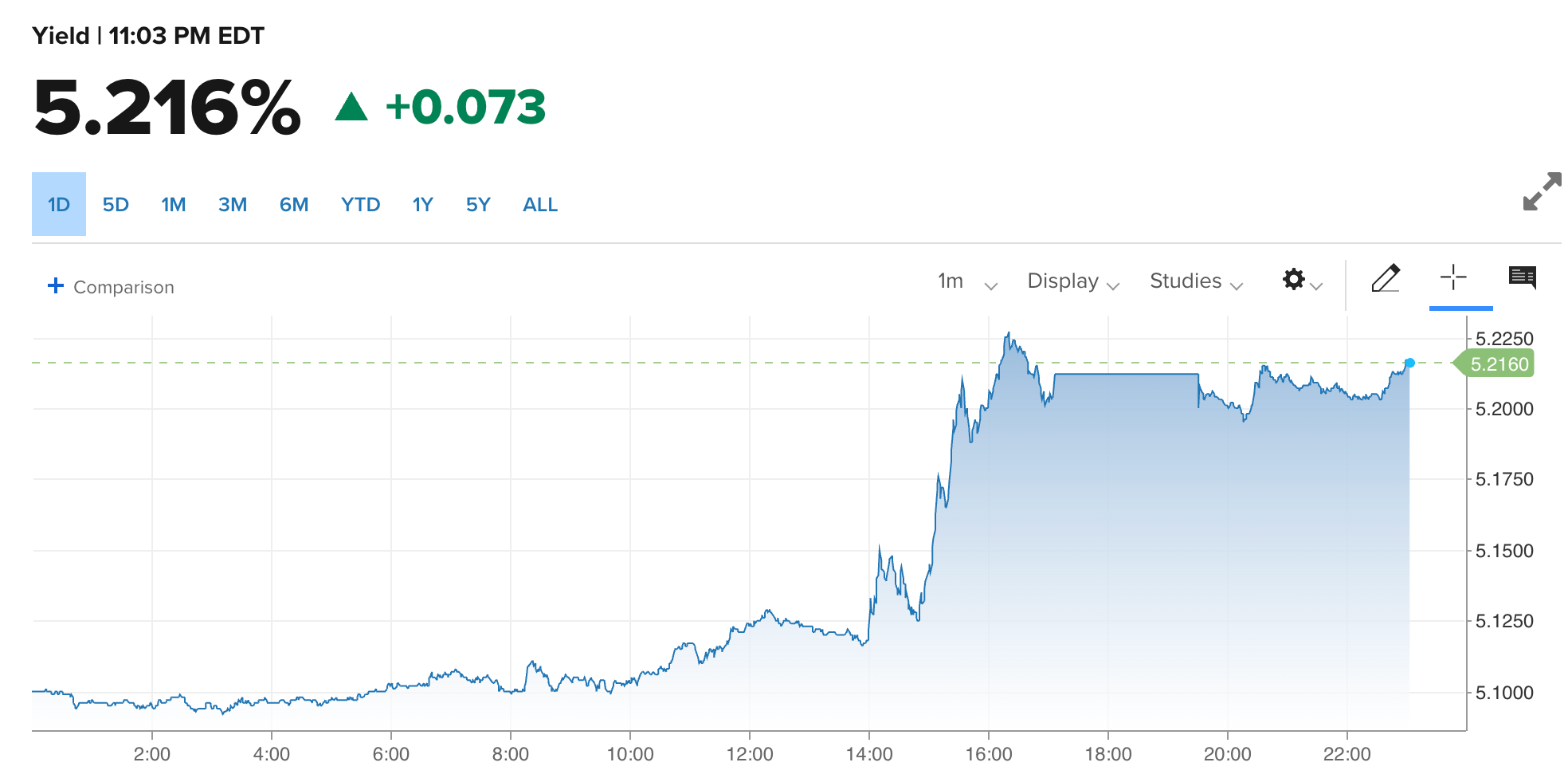
The Fed held its key rate steady on Wednesday, July 29, for a fifth straight meeting. However, the 30-year Treasury yield jumped, hitting 5.21%, its highest level since 2007.
Three Federal Open Market Committee (FOMC) members dissented and voted for a hike instead. It’s the first three-way dissent in the same direction since 2016.
Why Inaction Rattled Bond Traders
Markets wanted tough talk on inflation. Oil prices had climbed as tensions between the US and Iran flared up again. Instead, Fed Chair Kevin Warsh gave no forward guidance. He said he wanted markets to react to real data, not to Fed hints.

That vagueness, not the rate decision itself, moved the long end of the bond market. Steve Sosnick, chief strategist at Interactive Brokers, summed up traders’ frustration.
“It’s one thing to talk about fighting inflation. It’s another thing entirely to do something about it. And again, it’s not clear what he’s doing about it.”
— Sosnick
Again, it was long-term rates, not the Fed’s benchmark rate, that set mortgage costs and other borrowing costs. The 30-year fixed mortgage rate hit 6.58% last week, its highest level in nearly a year.
When investors doubt the Fed can control inflation, they demand higher yields on long-term debt. That pushes borrowing costs up, no matter what the Fed’s official rate says.
A Split Between Warsh’s Defense and Wall Street’s Doubts
Warsh pushed back on the idea that holding rates steady meant sitting still. Previously, he had said he wanted real disagreement among policymakers, and he got it.
“I asked for a good family fight, and I got one.”
— Warsh
Not everyone accepted that framing. Jai Kedia of the Cato Institute, a think tank that favors limited government, sees a deeper problem.
He argues the FOMC has no consistent framework for its decisions. Kedia wants the Fed to follow a fixed policy rule instead of letting each member decide.
Bank of America economists see Wednesday’s move as a credibility test. In a note titled “Doved and Confused,” they said the doubt could push the Fed toward a September hike, according to Reuters
Bitcoin (BTC) and gold both climbed within minutes of the announcement. Some traders read the split vote as inflation-friendly, even as long-term Treasury yields moved the other way.
The next test comes with fresh inflation and jobs data ahead of the Fed’s September meeting. Warsh will need the bond market to actually believe his “family fight” produces the right call.
The post The Fed Decided to Do Nothing and That Decision Backfired: Here’s Why appeared first on BeInCrypto.

“I remember Lindsey Graham as a man who loved people, and because he loved people, he was willing to reason with them, to respect them, and ultimately to persuade them,” Vance said.
Senate Majority Leader John Thune also spoke about his friendship with Graham, calling him “entertaining always and pretentious never.”
“It didn’t matter to Lindsey whether an issue was popular or unpopular, whether he had the full support of his colleagues or was standing alone,” Thune said. “He told things the way he saw them and he didn’t mince words.”
Graham’s remains were then carried over to the Washington National Cathedral for a funeral service Tuesday afternoon. The service is by invitation only, but, like the Capitol Rotunda ceremony, is being livestreamed to the public.
Many prominent figures are in attendance. President Donald Trump gave a speech during the service in remembrance of Graham, who went from a vocal critic of Trump and one of his opponents in the 2016 Republican presidential primary to one of the President’s closest allies in Congress.

Ethereum ETFs pulled in 37,959 ETH, roughly $71.17 million, over the seven days ending July 28, while Bitcoin ETFs shed 3,170 BTC worth $200.23 million over the same stretch.
That divergence, reported by Lookonchain using CoinGlass data, marks the third consecutive week of net ETH inflows and raises a direct question: Is this a tactical rotation or the beginning of a structural realignment in institutional crypto allocation?
July 28 Update:#Bitcoin ETFs: — Lookonchain (@lookonchain) July 28, 2026
1D NetFlow: +20 $BTC(+$1.23M)
7D NetFlow: -3,170 $BTC(-$200.23M) #Ethereum ETFs:
1D NetFlow: +11,285 $ETH(+$21.16M)
7D NetFlow: +37,959 $ETH(+$71.17M)https://t.co/lnDlgzA3OG pic.twitter.com/x3u98rNGXX
The honest answer is both, but the drivers are different, and conflating them produces the wrong trade thesis. Bitcoin ETFs hold far greater total assets, and the past three weeks represent a meaningful reversal from earlier in the year when Ethereum ETF products faced sustained outflows. The rotation is real. It is not a full-year trend.
Discover: The Best Crypto to Diversify Your Portfolio
IBIT Leads BTC Outflows While ETHA Captures Nearly All ETH Inflows
The fund-level breakdown sharpens the picture considerably. BlackRock’s IBIT, the largest spot Bitcoin ETF by assets, lost 3,511 BTC on its own last week, which exceeded the category’s entire net decline of 3,170 BTC.
Grayscale’s Bitcoin products shed another 10 BTC, and Bitwise’s BITB lost 27 BTC. Fidelity’s FBTC added 109 BTC, and ARK 21Shares’ ARKB contributed 77 BTC, providing partial offsets, but not enough to reverse the headline number.
On the Ethereum side, concentration is equally stark. BlackRock’s ETHA accounted for 37,424 of the week’s 37,959 ETH inflows, effectively the entire category’s net gain flowing through a single fund.
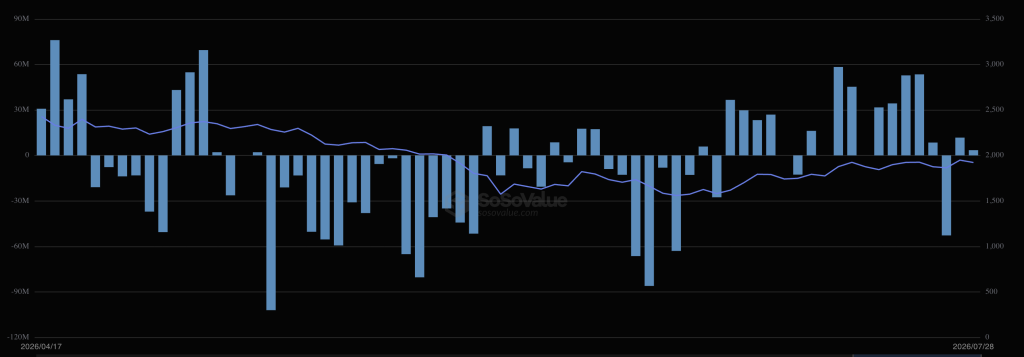
Grayscale’s ETH products added 5,515 ETH, while Fidelity’s FETH posted a 4,980 ETH outflow that nearly canceled Grayscale’s contribution. ETHA’s dominance reflects its structural position: the fund controls roughly 68% of US spot ETH ETF assets, and its fee structure significantly undercuts legacy Grayscale Ethereum products. Institutional capital routes through the cheapest, most liquid vehicle. That vehicle is currently ETHA.
Bitcoin trades near $63,900, up approximately 4% for the week despite the BTC outflows. That divergence between price and fund flows isn’t unusual; spot ETF redemptions don’t always signal directional conviction.
Bitcoin’s price pressure around the $64,000 level has been accompanied by large liquidation events, and some of the ETF outflows likely reflect institutional rebalancing rather than outright bearish positioning.
The AUM Gap Is Wide, But Fresh Capital Is Choosing Ethereum
Bitcoin ETFs hold $76.22 billion in AUM, compared with Ethereum’s $9.72 billion, a ratio of more than 7 to 1. That gap will not close in a quarter, and anyone framing this week’s flows as an imminent ETH takeover of institutional crypto allocation is overclaiming.
What the data does confirm is directional: incremental capital entering the crypto ETF 2026 landscape is increasingly weighted toward Ether.
Bitcoin ETFs have recovered just 3.3% of the $8.2 billion that left the category through mid-July. That partial recovery, combined with fresh outflows from IBIT, suggests the category has not yet stabilized.

Ethereum ETFs, by contrast, posted $103.9 million in net inflows for the week ending July 24, more than any other spot crypto ETF product that week, according to BeInCrypto. Three consecutive weeks of positive ETH inflows after a difficult stretch is not statistical noise.
The structural argument for Ethereum beyond pure ETF flows is being reinforced by corporate treasury activity. BitMine’s stock jumped 13% this week as investors rewarded its Ethereum treasury strategy, and SharpLink Gaming continued to add to its ETH holdings amid summer volatility.
That combination, ETF inflows plus direct corporate balance-sheet demand, points to something more durable than a single week’s rotation trade.
Trade Ripple XRP on Bybit and Get a Chance to Win Our $1,000 USDT Airdrop
The post Why Are Ethereum ETF Outperforming Bitcoin ETF in 2026? appeared first on Cryptonews.

XRP could one day become a $100 trillion asset, with the driver, according to market commentator xrpl_Adam, being institutional demand for the Ripple token as locked collateral.
His argument pushed back against one of the most common claims in the XRP community: that large payment flows alone could justify extremely high valuations.
Instead, he says investors should watch whether major financial firms start accepting XRP as collateral, calling that the only development that would create a structural reason for institutions to hold large amounts of the token and potentially push its price to $100 or even $1,000.
Idle Supply, Not Payment Volume, Is the Key Argument
In a July 29 thread on X, xrpl_Adam started by dismissing the often-cited comparison that because SWIFT moves roughly $5 trillion a day, XRP needs a similar valuation to matter as a bridge currency.
According to him, a bridge asset that settles in three to five seconds gets reused constantly, so turning it over 100 times means $5 trillion in daily flows only needs around $50 billion of float.
“Volume doesn’t set the price. Idle inventory does,” the analyst said.
Using XRP’s supply figure, he noted that there are about 100 billion of them in existence, with 32.4 billion held in escrow, leaving close to 62 billion tokens able to move, a figure that lines up with the 62.533 billion circulating supply cited on the CoinGecko website.
Based on that supply, if XRP were to go to $100, it would imply a market cap of about $10 trillion, while a $1,000 price would value the network at around $100 trillion.
The only force xrpl_Adam sees capable of creating the kind of long-term demand that would push XRP’s value to such levels is collateral, where the asset is pledged against trades and stays locked for the duration of those positions instead of circulating through the market. He compared this with gold, arguing that its worth comes from being held, not from being constantly transacted.
As evidence that Ripple may be moving in that direction, the market watcher pointed to Ripple’s $1.25 billion acquisition of Hidden Road, now renamed to Ripple Prime, a prime broker that decides what counts as acceptable collateral. KBRA, an SEC-registered rating agency, gave it a BBB issuer rating on April 2 and a BBB senior debt rating on July 8.
But he flagged what is missing. Neither Ripple’s published collateral schedule nor KBRA’s reports currently list XRP as eligible collateral. Furthermore, while CEO Brad Garlinghouse spoke in May about making XRP acceptable collateral, it was only as a future goal.
XRP Price Under Pressure Despite Ecosystem Progress
Ripple has been making moves recently, including launching Ripple Mint to simplify RLUSD stablecoin management for institutional clients as well as investing in compliance provider Notabene to widen RLUSD’s reach among regulated payment firms.
However, XRP has barely reflected any of those developments in its performance, with CoinGecko data showing the asset trading around $1.09, a 2% increase in 24 hours but a 5% drop over seven days, having failed to hold gains above $1.16 earlier in the week. It is also more than 70% below its July 2025 all-time high of $3.65.
The post Ripple’s XRP Could Hit $100T if Institutions Use It as Collateral: Analyst appeared first on CryptoPotato.
Bitcoin price recovered 2.8% from an intraday low of $62,850 to around $64,650 on July 29 as traders positioned for the Federal Reserve’s interest rate decision.
Summary
- Bitcoin rebounded 2.8% after buyers defended the 200-day exponential moving average near $62,850.
- $65,000–$65,200 remains the immediate resistance zone, reinforced by the 4-hour Supertrend indicator.
- Traders have purchased $2.5 billion in Bitcoin call spreads targeting a move toward $72,000.
- A rejection below $65,000 could expose $62,000–$62,500 as ETF outflows weaken spot demand.
Bitcoin price recovers before the Fed decision
According to data from crypto.news, Bitcoin (BTC) price rose from $62,850 to an intraday high near $64,775 before settling around $64,650. The recovery followed several sessions of selling across cryptocurrencies and technology stocks.
The $62,850 low aligned with Bitcoin’s 200-day EMA, making the level an important test of its broader market structure. Short-term momentum indicators had also entered oversold territory following BTC’s decline from last week’s high near $66,700.
Buyers entering around the long-term average helped trigger a rapid return toward $64,500. Short sellers who opened positions during the decline may also have contributed to the rebound by closing trades as Bitcoin moved higher.
Bitcoin’s relative strength was notable because Asian technology shares remained under pressure. SK Hynix fell sharply after its earnings missed elevated market expectations, contributing to a wider sell-off in chip and AI-linked stocks. South Korea’s Kospi dropped 6%, while pressure also spread to several US semiconductor names.
BTC had traded closely with AI-related equities during much of July. Its recovery during the latest technology rout suggests that short-term crypto selling pressure may be easing, although one session is not enough to establish a lasting decoupling.
FOMC positioning could decide the $65K breakout
The Federal Reserve’s decision is the main catalyst facing Bitcoin. Markets have mostly priced in an unchanged federal funds rate, but swap pricing indicated roughly a one-in-three chance of a 25-basis-point increase before the announcement.
Citadel Securities has argued that the Fed could raise rates to respond to persistent inflation. Such an outcome would likely strengthen the dollar and Treasury yields, creating another obstacle for Bitcoin and other risk assets.
A rate hold could reduce immediate pressure, but the market will also track the Fed’s statement and Chair Kevin Warsh’s comments. A hold accompanied by warnings about inflation could limit Bitcoin’s upside, while a softer policy outlook may help BTC clear $65,000.
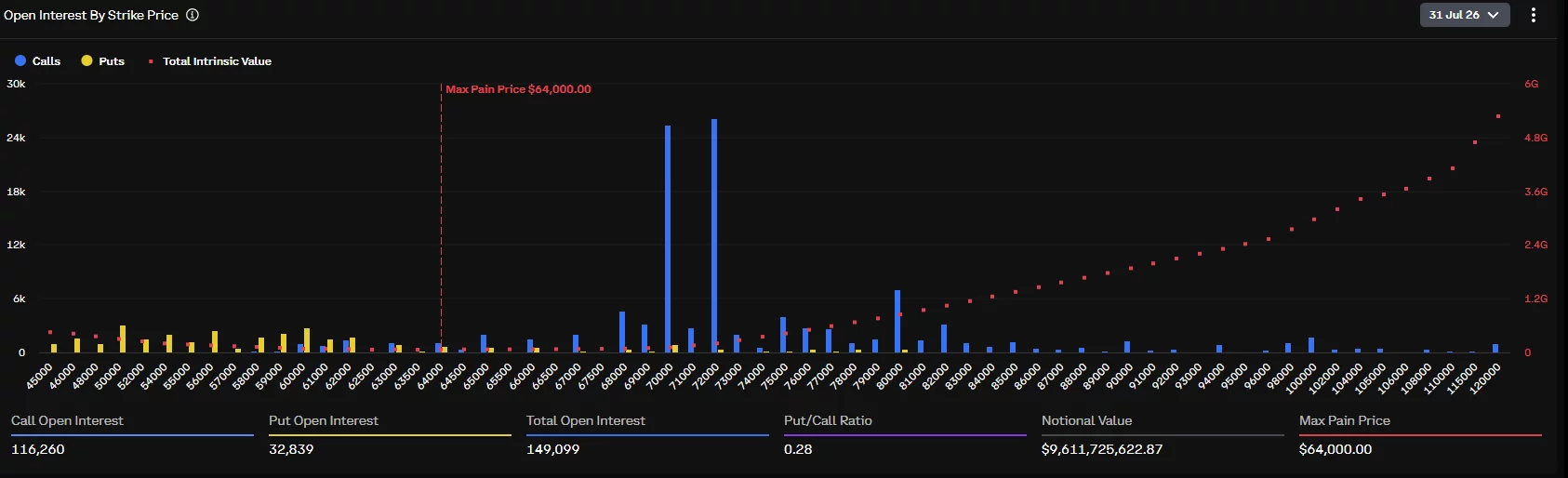
Bitcoin’s July 31 options expiry carries approximately $9.61 billion in notional open interest, with calls accounting for 116,260 BTC and max pain at $64,000.
The call-heavy positioning does not guarantee a rally. However, a break above nearby resistance could prompt dealers to rebalance their hedges and force short sellers to cover, potentially strengthening a post-FOMC move.
Bitcoin must close above $65,200
Bitcoin’s 4-hour chart shows that the recovery has not yet reversed the short-term bearish setup. BTC remains below the Supertrend resistance at approximately $65,198, making the $65,000–$65,200 range the first confirmation level for buyers.
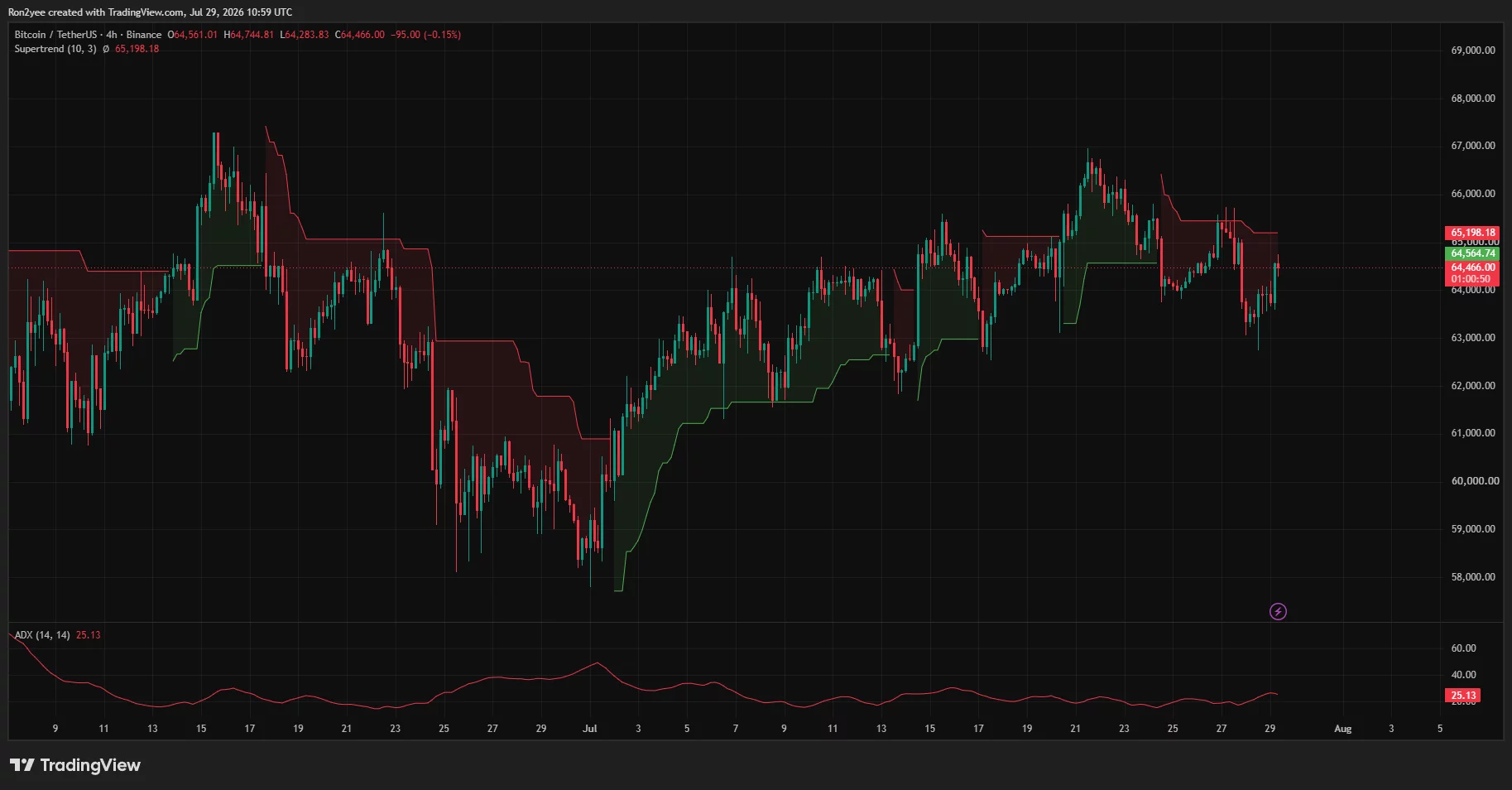
The average directional index stands at 25.13. A reading above 25 indicates that the next directional move could develop enough strength to extend, but the indicator does not determine whether that move will be bullish or bearish.
A 4-hour close above $65,200 would weaken the current sell signal and expose $65,800–$66,200. Bitcoin would then need to clear $66,700, the previous weekly high, to establish a stronger sequence of higher highs.
The daily Ichimoku chart presents another obstacle. Bitcoin is trading near the lower edge of the cloud around $64,490 and below the conversion line near $64,849. A daily close above this area would improve the short-term outlook, but the asset still needs to move through the wider cloud before confirming a sustained trend reversal.
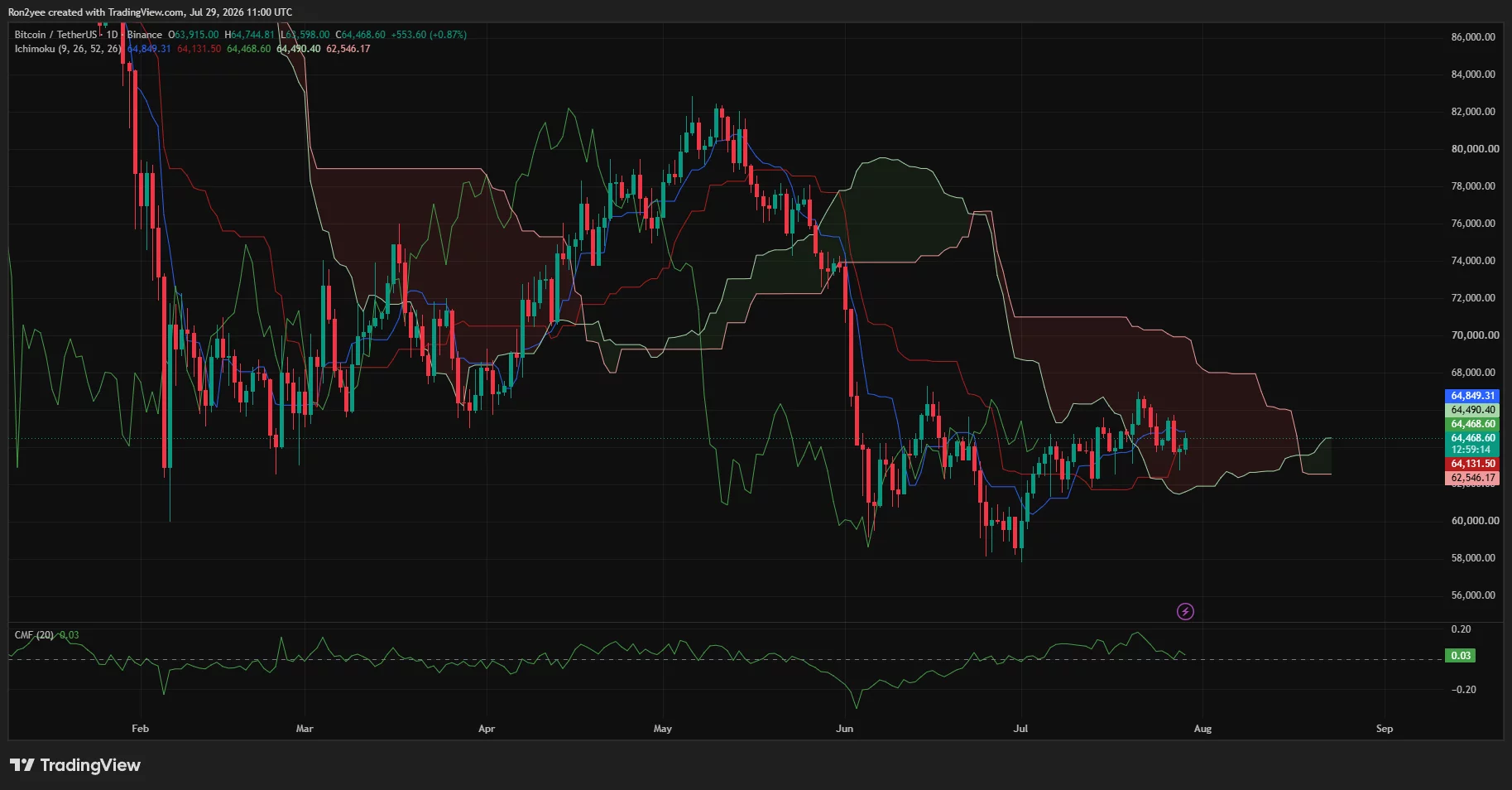
Chaikin Money Flow is positive at 0.03, showing that buying pressure has returned modestly. The reading remains close to zero, however, and does not yet point to strong accumulation.
Liquidation clusters leave BTC exposed in both directions
CoinGlass’ three-day liquidation heatmap shows a dense liquidity band around $64,400–$64,700, where Bitcoin was trading at the time of the chart. This nearby concentration may contribute to volatile price swings before and immediately after the Fed announcement.
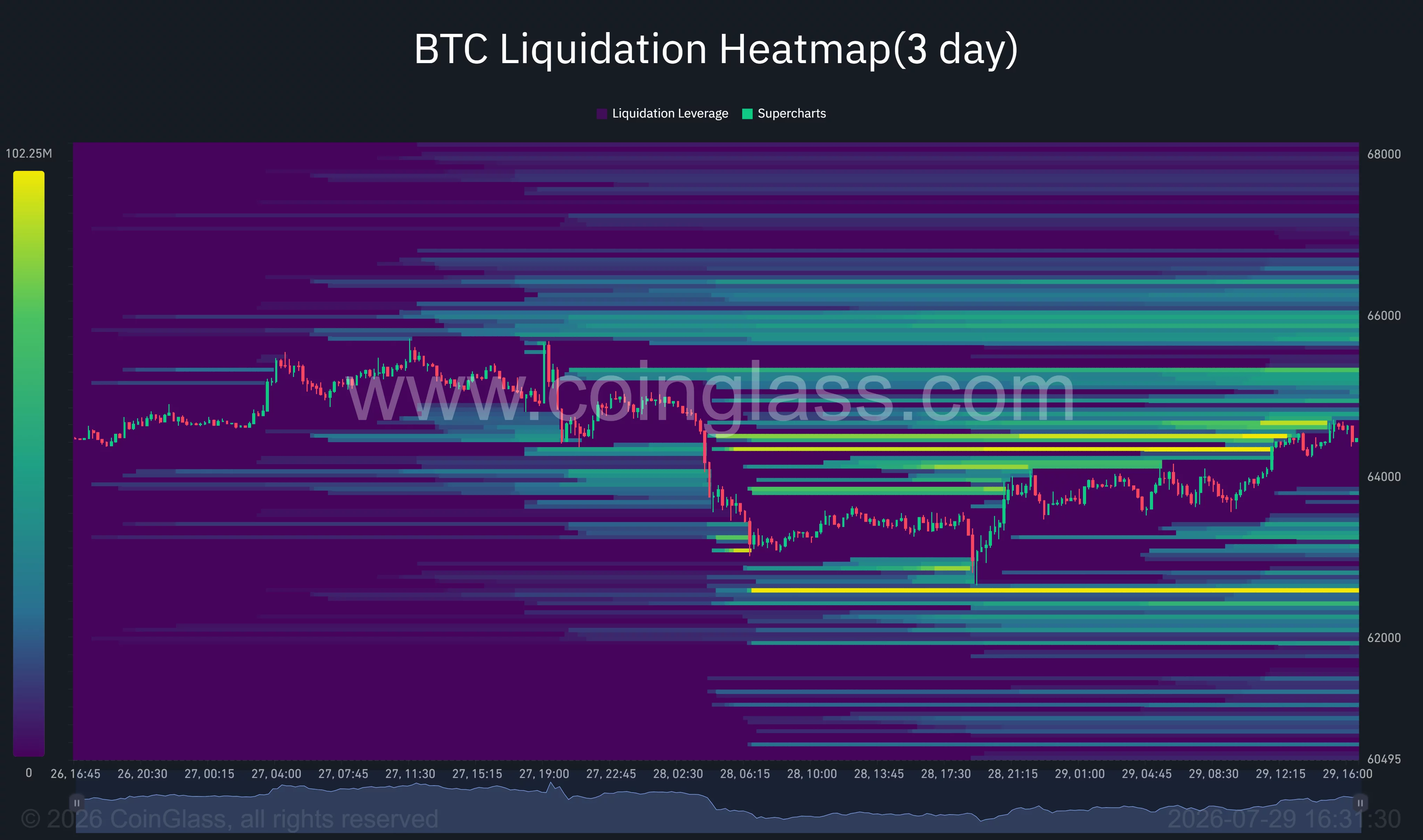
Further liquidity is visible near $65,000–$65,300, followed by a larger group of positions around $65,800–$66,200. A confirmed break above $65,200 could therefore pull Bitcoin toward these higher liquidation levels as bearish positions are forced to close.
The downside contains a similarly important concentration near $62,500. Losing $64,000 would increase the risk of another test of $63,000, followed by the $62,000–$62,500 support area.
Crypto analyst Ted Pillows also identified $65,000 as the decisive near-term level. He warned that failure to reclaim it could send Bitcoin back toward $62,000–$62,500.
Michael van de Poppe offered a more bullish assessment, describing the recovery as a “very solid bounce” and arguing that Bitcoin could continue higher if it maintains its recent strength.
ETF flows and US policy remain downside risks
US spot Bitcoin ETF demand remains an important weakness behind the current setup. More than $500 million reportedly left the products during a 4-day run of outflows, removing a source of spot demand that had supported the previous advance.
The FOMC outcome will directly affect US investors because higher rates increase the relative appeal of cash and short-term government debt. A surprise hike could also raise financing costs and reduce demand for leveraged cryptocurrency positions.
Washington’s stalled crypto legislation adds another source of uncertainty. Polymarket traders recently placed the probability of the CLARITY Act becoming law in 2026 at roughly 34%, down from higher levels earlier in July. The bill has faced disagreements over ethics restrictions and stablecoin-related provisions.
Bitcoin can push through $65,000 if the Fed avoids a hawkish surprise and buyers secure a close above $65,200. Without renewed ETF inflows, however, the move would remain dependent on derivatives positioning and short covering, leaving $62,500 exposed if the breakout fails.
Disclosure: This article does not represent investment advice. The content and materials featured on this page are for educational purposes only.

How to change your Home address in Maps on iPhone

Gwyneth Paltrow’s son Moses Martin, 20, goes public with stunning Ivy League girlfriend Campbell Fealy as he gushes: ‘I love you big time’

China threatens retaliation against U.S. humanoid robot ban, says it ‘severely damages’ relations


-

 Fashion5 days ago
Weekend Open Thread: Brooks Brothers
-
 Sports3 days ago
Commonwealth Games boxing: Jadumani Singh seals dominant 5-0 win over Pakistan’s Sumama Rehman to enter quarter-finals | Commonwealth Games News
-

 Tech3 days ago
Intel is reversing course and bringing hyper-threading back to its server chips
-

 Business8 hours ago
Why Trees Belong on the Risk Register
-

 Politics3 days ago
Luke Littler dismantles Gerwyn Price to retain title in Blackpool
-

 Crypto World4 days ago
Ripple bought a bank in pieces. The $4 billion audit
-
 Entertainment6 days ago
A New Post-Apocalyptic Gundam Anime Series Blasts Into SDCC
-

 News Videos3 days ago
BITCOIN JUST ENTERED THIS CRITICAL ZONE…
-

 Politics2 days ago
The Part of the Electric Transition Nobody Wants to Discuss
-

 Fashion6 days ago
16 Dresses for the High Summer Event
-

 Sports6 days ago
2026 3M Open leaderboard: Scottie Scheffler finds putter in Round 1, sits three back
-

 News Videos6 days ago
The Peugeot Family: How 200 Years of an “Old Money” Dynasty Died in A Boardroom
-

 Business23 hours ago
Major shareholder moves on Canyon
-

 Crypto World4 days ago
XRP Ledger adds $2.6B as RWA inflows rank second
-

 Politics4 days ago
Spain sweeps the board at 2026 World Cup with individual awards
-

 Crypto World7 days ago
Uniswap (UNI) pushes deeper into tokenized RWAs with permissioned trading pools
-
 Entertainment1 day ago
‘Stargate’ Creator’s New Sci-Fi Series Returns for Season 3 Tomorrow
-
Crypto World7 days ago
SEC Agrees to Overhaul Recordkeeping After Settling Coinbase Lawsuit Over Gensler’s Lost Texts
-

 Tech5 days ago
Anthropic launches Claude Opus 5, a cheaper AI model for coding, agents and enterprise workflows
-

 Entertainment4 days ago
Sara Gilson Killed By Husband After Viral “Pedophile” TikTok Video
You must be logged in to post a comment Login