

Crypto World
Here’s How Much 10K BTC Paid for 2 Pizzas in 2010 Is Worth Today


The Bitcoin community celebrated the 16th anniversary of “Pizza Day” on Friday, marking the first recorded commercial Bitcoin transaction, in which real-world goods were purchased with Bitcoin.
In May 2010, software developer Laszlo Hanyecz published an online post offering 10,000 BTC, which was valued at about $41 at the time, in exchange for two Papa John’s pizzas.
At current market prices, the BTC is worth more than $767 million, and at the all-time high of about $126,000 reached in October 2025, the 10,000 BTC was valued at more than $1.2 billion. Nischal Shetty, the founder of crypto exchange WazirX, said:
“Bitcoin Pizza Day is one of the most important moments in crypto history because it transformed Bitcoin from an internet experiment into a real economic network. It was actually the first proof that a decentralized digital asset could facilitate real-world commerce.”
At the time, only a “few hundred” transactions were processed on the Bitcoin network daily, and there was “almost no” Bitcoin payment infrastructure, service providers or institutional involvement, Shetty added.

Laszlo Hanyecz in 2010, with the two Papa John’s pizzas. Source: Coingecko
Hanyecz’s transaction showed that Bitcoin can be used as a medium of exchange to pay for goods and services in the real world, moving the world’s first digital currency from online experimentation to real-world utility.
Related: US lawmakers renew strategic Bitcoin reserve push with ARMA bill
Bitcoiners now have their eyes set on nation-state adoption
In 2024, nation-state adoption of Bitcoin began to capture narrative attention, with the Bitcoin community supporting initiatives like a strategic Bitcoin reserve and tax exemptions for Bitcoin payments.
The Iranian government announced in April 2026 that oil ships crossing through the Strait of Hormuz, a critical shipping waterway located in the Persian Gulf, could pay for shipping tolls in Bitcoin, US dollar stablecoins and Chinese yuan.
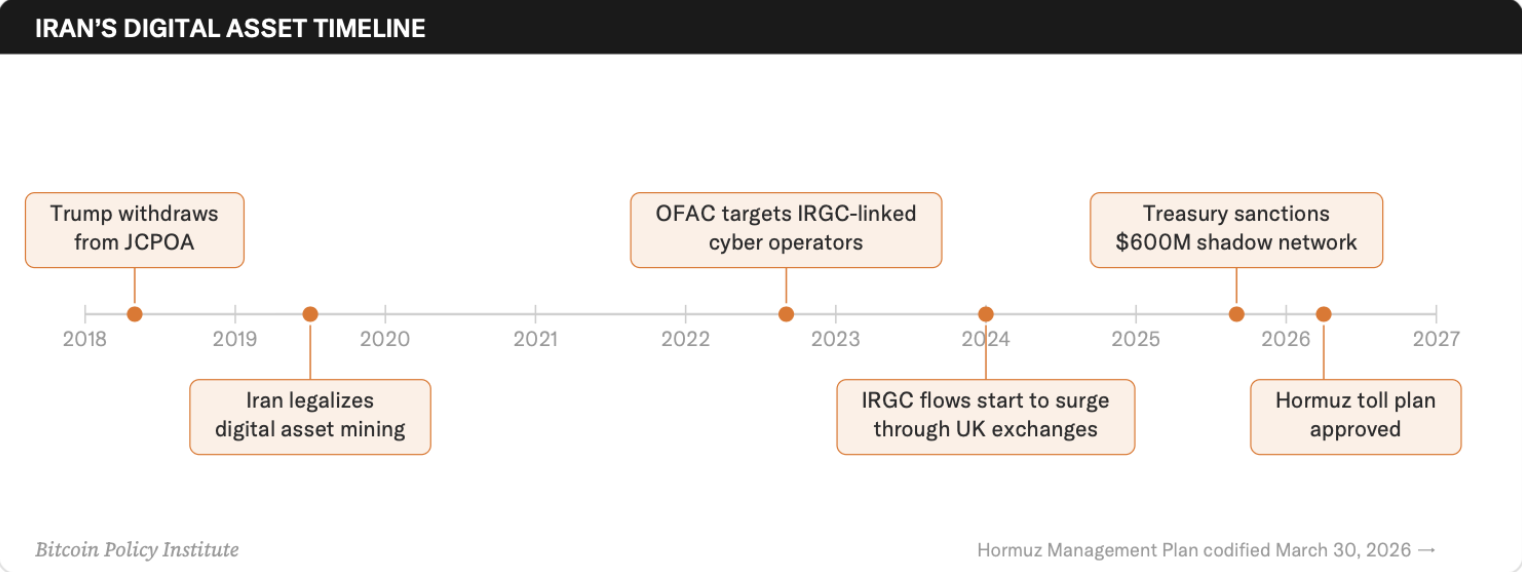
A timeline of the Iranian government’s adoption of Bitcoin and other digital assets. Source: Bitcoin Policy Institute
However, there is no onchain evidence of an oil toll being paid in BTC at the time of publication. Instead, Tether’s USDt dollar-pegged stablecoin continues to be the payment method of choice for the tolls, according to Sam Lyman, the head of research at Bitcoin Policy Institute, a digital asset advocacy organization.
Magazine: Big Questions: Can Bitcoin save you from the dreaded Cantillon Effect?



In 2025, stablecoins settled more transactions than Visa. Real-world stablecoin payments doubled to $400 billion. Visa, Mastercard, Stripe, PayPal, and Western Union all turned on stablecoin rails inside their existing products. The GENIUS Act became U.S. law. And almost no one outside crypto noticed. The most important shift in the global payments system in twenty years happened in plain sight, and it is still being misread as a crypto story.
Summary
- Stablecoin transaction volume reached levels comparable to Visa in 2025 as payment giants integrated blockchain-based settlement rails into existing products.
- Real-world stablecoin payments doubled to $400 billion last year, with most activity tied to business payments, payroll, and cross-border settlements.
- The GENIUS Act gave banks and regulated firms a legal framework to issue and integrate stablecoins, accelerating adoption across the financial sector.
The biggest story in crypto is not about crypto
Strip away the meme coins, the price predictions, the ETF flow charts, and the regulatory drama. The single most consequential thing happening in digital assets right now has nothing to do with any of it. It is not Bitcoin. It is not even speculation. It is the quiet, accelerating absorption of stablecoins into the actual plumbing of how the world moves money.
Some numbers, because the numbers are the story.
The global supply of fiat-backed stablecoins crossed $319 billion in April 2026, up from roughly $7 billion six years earlier. A forty-fold expansion in an asset class that did not meaningfully exist before 2020. Adjusted stablecoin transaction volume grew ninety-one percent in 2025 to $10.9 trillion, closing in on Visa’s $14.2 trillion. By Plasma’s accounting, total settlement volume hit $33 trillion last year, past Visa’s annual throughput. Stablecoins processed roughly twenty times the volume PayPal did. Morph’s research projects that 2026 stablecoin settlement could top $50 trillion.
The most telling figure is not the size. It is the mix. Real-world stablecoin payments, the share of activity that is not crypto trading but actual commercial movement of money, doubled in 2025 to $400 billion. Sixty percent of that was business-to-business: companies paying suppliers, settling cross-border invoices, managing treasury, and moving payroll. Stablecoins are no longer just chips at the crypto casino. They have become an operating layer of international finance.
The reason this has happened without much public attention is mostly aesthetic. Stablecoins look boring. A dollar-pegged token does not 10x. There is no narrative, no chart porn, no influencer screaming about a new all-time high. They are infrastructure, and the great rule of infrastructure is that it stays invisible until it does not. The whole point of a stablecoin is that nothing dramatic happens to it. The dramatic thing is what gets built on top.
That is now being built. Fast.
What “internet money” actually has to do
For anyone who has spent any time around crypto, the phrase “internet money” has been thrown around for a decade, usually attached to assets that turned out not to be anything of the kind. Bitcoin was supposed to be it. Then Ethereum. Then a parade of L1s. None of them quite worked as money, because money has a job description far more demanding than “store of value” or “speculative asset.” It has to be reliable in unit, accepted broadly, transferable cheaply, and usable for the boring middle ninety percent of economic life: paying rent, settling invoices, sending payroll, buying coffee.
Stablecoins fit that job description in a way no prior digital asset did. They are pegged to the dollar, so a stablecoin is not really an investment; it is just a dollar that happens to live on a blockchain. Reserves, when properly backed, sit in cash and Treasury bills, the same instruments that already underpin trust in the financial system. Transactions are near-instant, run twenty-four hours a day, settle on weekends, cross borders without correspondent banking, and cost a fraction of what wire transfers do.
What changed in 2025 and 2026 was not the technology. Stablecoins have done these things for years. What changed was that the actual companies that move money for everyone else started building stablecoins into their products as a default, not an experiment.
The list reads like a roll call of global payments. Visa runs a stablecoin settlement program that hit a $7 billion annualized run rate in late April 2026, up fifty percent from the previous quarter, and operates across nine blockchains, including Ethereum, Solana, Avalanche, Base, and Polygon. Visa’s broader Visa Direct stablecoin payout product is live in over fifty countries. Mastercard, Stripe, PayPal, Western Union, Klarna, Cloudflare, Meta, Intuit, Fiserv, and Zelle have all either launched or announced integration plans. PayPal’s own stablecoin, PYUSD, sits in their consumer app alongside fiat balances.
The shape of the change is what matters. None of these companies is making a bet on a speculative asset. They are quietly upgrading the rails their existing products run on. A Visa card customer in Bogotá does not know, and does not need to know, that the back-end settlement between the issuing bank and Visa now travels as USDC on Solana rather than as fiat through a correspondent banking chain. The user experience is unchanged. The plumbing underneath is being replaced.
The two stablecoins that run the world
The market is, for now, a duopoly. Tether’s USDT holds roughly $189.6 billion in circulation. Circle’s USDC sits at around $77.6 billion. Together, they account for well over eighty percent of the global stablecoin supply.
They are not the same product, and the difference matters more in 2026 than it did before.
USDT is the offshore stablecoin. It dominates emerging-market trading, runs the largest share of remittance corridors in Latin America, Africa, Southeast Asia, and the Middle East, and serves as the dollar substitute in countries where local currencies are volatile or banking access is poor. Tether’s reserves, increasingly weighted toward U.S. Treasury bills (a $113 billion Treasury position as of Q1 2026), have made the company one of the largest non-sovereign holders of US debt in the world. USDT’s market share is slowly shrinking as regulated alternatives emerge, but its absolute supply continues to grow.
USDC is the compliance stablecoin. It is the one U.S. bank, payment companies, and large enterprises actually want to integrate with. Circle is publicly traded, USDC is attested monthly by Deloitte, it is licensed under Europe’s MiCA framework, and it sits in the strongest position under the new U.S. GENIUS Act regime. Where USDT wins on liquidity and reach, USDC wins on the things that matter to a compliance officer: clarity of reserves, regulatory approval, and the absence of legacy controversy.
The next tier of issuers is small but growing. Sky’s USDS at $8.4 billion, the rebuilt DAI at $4.7 billion, PayPal’s PYUSD, Ripple’s RLUSD now climbing toward $1.6 billion, USDe, and various yield-bearing variants. The duopoly is not breaking up, but the long tail is starting to matter. Banks and fintechs that want to issue their own stablecoins under the new U.S. framework are building the next wave now.
What the GENIUS Act actually changed
To understand why 2025 was the inflection point, you have to understand what the GENIUS Act did, because almost every meaningful piece of the stablecoin acceleration traces back to it.
The Guiding and Establishing National Innovation for U.S. Stablecoins Act was signed into law in July 2025. It is the first comprehensive US federal framework for payment stablecoins, and it does three things that, together, changed the calculus for every serious financial institution.
First, it answered the question of what a payment stablecoin legally is. The act establishes that permitted payment stablecoins are not securities, commodities, or deposits. They are a new regulated category with their own regime, administered principally by the Office of the Comptroller of the Currency alongside the FDIC, the Federal Reserve, the Treasury, and state banking regulators. That clarity matters because the absence of a category was, for years, the single biggest reason serious institutions stayed out.
Second, it set the rules of issuance. Stablecoin issuers must hold one-to-one reserves in high-quality liquid assets, publish monthly attestations, undergo audits, and comply with anti-money-laundering and sanctions requirements. Permitted issuers are limited to insured depository institutions (banks and credit unions), subsidiaries of such institutions, and certain approved nonbank entities. In effect, the law turned stablecoin issuance into a regulated banking activity.
Third, it opened the door for banks themselves to issue. A national bank can now issue a payment stablecoin under OCC supervision. Tokenized deposits, where a bank’s actual liabilities to its customers are represented as tokens on a ledger, sit within reach. Banks that spent years watching Tether and Circle gather a sector they were structurally locked out of now have a path in.
The OCC proposed its implementing rules in late February 2026, with the comment period closing on May 1. The act’s effective date arrives at the earlier of eighteen months after enactment (January 2027) or 120 days after final regulations. Practical impact, then, takes full effect roughly from mid-2026 onward.
The first-order effect was psychological. Once U.S. law existed, the asset class became investable to a class of institutions that had been waiting on a green light. The second-order effect, which is now playing out, is the wave of bank and fintech stablecoin pilots, tokenization initiatives, and payment integrations that have hit the market since the bill was signed.
The use cases that are no longer hypothetical
Three real-world use cases are now operating at scale, and a fourth is approaching.
Cross-border B2B payments are the largest and most boring. A U.S. importer paying a Vietnamese supplier traditionally goes through correspondent banks, taking three to five days and losing three to seven percent to fees, intermediary charges, and FX spread. The same transaction in stablecoins settles in seconds for cents. Sixty percent of stablecoin payment volume in 2025 was B2B precisely because the cost-benefit is overwhelming and the regulatory exposure for a corporate treasury team has dropped sharply under the new framework.
Cross-border consumer payments and remittances are the most socially significant. In countries where banking is shallow, local currencies are weak, or capital controls are tight, stablecoins have quietly become the preferred way to receive money from abroad. A migrant worker in the Gulf sending money home to family in Lagos increasingly does so in USDT, which the recipient can hold, spend at a growing number of merchants, or convert locally. The “informal” stablecoin economy is not on most balance sheets, but Chainalysis and others have documented its scale year after year.
Card-linked stablecoin spending is the bridge between crypto-native dollars and the real economy. Companies like Rain issue Visa-network cards that draw against stablecoin balances and settle directly in stablecoins with Visa. A BVNK and YouGov survey of over 4,000 stablecoin users found that seventy-one percent said they would use a linked debit card to spend their stablecoins. The infrastructure is now there. The “spend” leg of the payments lifecycle, the one missing piece until late 2024, is closing.
AI-agent payments are the fourth use case, still emerging but worth flagging because they may end up being the largest. A new generation of protocols, the most discussed being x402, lets AI agents transact with each other directly: paying for data, GPU time, API calls, or other agent services without human approval and without traditional invoicing. The economic case requires payments that are programmable, instant, sub-cent in cost, and machine-readable. Stablecoins are the only existing form of money that meets all four. As AI commerce scales, an enormous share of it will, by necessity, run on stablecoin rails.
The framing matters here. The first three use cases describe stablecoins replacing parts of the existing payment infrastructure. The fourth describes them enabling a payment market that does not yet exist in fiat form. Both expansions are happening at once.
What can still go wrong
A piece that only described the upside would be marketing, not journalism, so here is the other side.
Stablecoins remain only as good as their reserves and their operators. The 2022 collapse of TerraUSD wiped $40 billion in three days and is the cautionary tale every regulator now writes against. Even fiat-backed stablecoins are not risk-free: USDC briefly de-pegged in March 2023 when Circle’s exposure to the failing Silicon Valley Bank surfaced. The reserves were ultimately recovered, but the episode showed that even properly backed stablecoins can wobble under banking stress. The GENIUS Act explicitly addresses some of these failure modes, but the law’s allowance for issuers to hold uninsured bank deposits as reserves has drawn warnings from the Brookings Institution and other observers who note it creates a two-way coupling between bank risk and stablecoin risk.
Banks themselves are watching stablecoin growth uneasily, because every dollar that migrates from a bank deposit into a stablecoin balance is a dollar the bank no longer has to lend. The American Bankers Association and similar groups in Europe have lobbied hard, and largely unsuccessfully so far, for tighter restrictions on stablecoin yield and on competition with deposit accounts. If deposits drain faster than legislators expect, the banking lobby will push back harder.
Geopolitical risk runs in two directions. Dollar-pegged stablecoins are extending dollar reach into corners of the world that local sovereigns would rather control, which is already producing capital controls pushback in several emerging markets. At the same time, the dominance of U.S.-dollar stablecoins (more than ninety-nine percent of fiat-backed stablecoin value is dollar-pegged) makes the asset class an instrument of dollar hegemony, which both helps and complicates the geopolitics of payments. China is pushing its own central bank digital currency in parallel. The EU has MiCA and a digital euro project on a slower timeline. The next decade of payments policy will be partly a contest between these models.
Finally, the most boring risk is the most likely. Implementation matters. The rules being written by the OCC and other regulators between now and final implementation in 2026 and 2027 will determine whether the stablecoin sector grows into a regulated, integrated piece of finance or fragments into a series of jurisdictional silos that limit the benefits of a borderless rail.
What this means in the end
The shorthand for what is happening is “stablecoins are eating payments.” That is not quite right, because payments are not a single thing being replaced. What is actually happening is that the dollar itself is being upgraded into a new technical form, one that runs on open networks, settles in seconds, costs almost nothing to move, and operates twenty-four hours a day. Stablecoins are the vehicle. The dollar is the cargo.
If you zoom out, this is a bigger development than the launch of spot Bitcoin ETFs, the CLARITY Act, or any of the other crypto stories that have dominated headlines this cycle. ETFs gave institutions a way to hold Bitcoin. Stablecoins are giving the entire global economy a new way to use dollars. Those are not comparable in scale.
What makes the shift hard to see is that it does not look like a revolution. It looks like a payment is landing in your account faster than you remember it landing before. It looks like a supplier in another country is getting paid the same day instead of the next week. It looks like a Visa card that works the same as it always did, even though the settlement underneath has fundamentally changed. It looks like nothing, until one day you realize most of the dollars in the global digital economy live on rails that did not meaningfully exist five years ago.
That is what infrastructure does. It disappears. And once it disappears, it is hard to put it back.
The internet got money. Almost no one noticed. The next decade of finance will be spent catching up.
This article is for informational purposes and does not constitute financial or investment advice. Stablecoin regulations, transaction volumes, and reserve compositions can change quickly; the figures described reflect reporting available as of mid-May 2026. Always do your own research.


While crypto Twitter argues about Bitcoin versus Ethereum, two superpowers are quietly running a different race. The United States is using dollar-backed stablecoins to extend the dollar’s reach into every corner of the digital economy. China is using its e-CNY and the mBridge platform to build an alternative settlement system that bypasses the dollar entirely. The outcome will shape the next century of global finance. And almost nobody outside policy circles is paying attention.
Summary
- The United States has used dollar-backed stablecoins and the GENIUS Act to expand the dollar’s role across global digital payments and crypto networks.
- China has accelerated cross-border use of the eCNY through mBridge and new interest-bearing wallet policies tied to its state-controlled digital currency system.
- Despite de-dollarization efforts from BRICS nations, dollar-pegged stablecoins still dominate global digital settlement activity and reinforce demand for U.S. dollar assets.
The argument that misses the actual fight
Open any crypto publication this year, and you will find some version of the same debate. Bitcoin maximalists versus Ethereum supporters. Solana versus Ethereum. Layer ones versus layer twos. The tribal warfare is loud, it is entertaining, and it is mostly beside the point.
While that argument fills the timelines, a different and far more consequential race is being run by people who do not post memes. The United States Treasury and the People’s Bank of China are competing to define what money looks like for the next century. They are doing it in plain sight, in policy documents and central bank press releases, with two completely different theories of the case.
The American theory: extend the dollar’s reach into every digital corner of the global economy by privatizing it, regulating it, and shipping it on open networks. The Chinese theory: build a sovereign digital currency under direct state control, and link it together with friendly central banks into a parallel settlement system that does not need American rails at all.
This is the real race. It will decide whether the global financial system of the 2030s and 2040s stays dollar-denominated and U.S.-administered, or whether it splits into competing blocs with different reserve assets, different settlement rails, and different rules. The stakes are not the price of a token. They are the architecture of money itself.
What the United States is actually doing
The American strategy is easier to miss because it is being run by the private sector with regulatory blessing rather than by a central bank. But the strategy is explicit, and it has been spelled out at the highest levels of the U.S. Treasury.
The instrument is the stablecoin. The framework is the GENIUS Act, signed into law in July 2025. The thesis was stated bluntly by Treasury Secretary Scott Bessent: stablecoins are a way to “extend the dollar’s reach” in decentralized finance and cross-border payments. Crypto commentator Arthur Hayes has put it more starkly. Stablecoins, in his framing, work as on-ramps that redirect offshore liquidity into U.S. Treasury bills. Every USDT or USDC in circulation requires reserves, and those reserves sit mostly in dollar-denominated assets. Tether alone now holds roughly $113 billion in U.S. Treasuries as of Q1 2026. The stablecoin sector, in aggregate, has become one of the largest non-sovereign buyers of U.S. government debt.
This is not an accident. It is the strategy. By making it easy, legal, and trusted to hold a dollar-pegged token on any blockchain in the world, the United States has effectively privatized dollar issuance and shipped it through global crypto networks. A small-business owner in Lagos who takes payment in USDT, a remittance recipient in Manila who saves in USDC, and a Lebanese citizen who holds stablecoins because the local currency is collapsing are each, without knowing it, deepening dollar penetration into their local economies. They are also indirectly financing the U.S. Treasury market.
The numbers are now large. Fiat-backed stablecoin supply crossed $319 billion in April 2026. Adjusted transaction volume hit $10.9 trillion in 2025, with some estimates putting total settlement volume past $33 trillion, more than Visa. Roughly ninety-nine percent of fiat-backed stablecoin value is pegged to the dollar. The euro, the yuan, the yen, and every other currency together account for the remaining one percent. In digital money, the dollar is not winning. It has, so far, lapped the field.
The genius of this approach, from the U.S. perspective, is that it works without the political baggage of a U.S. central bank digital currency. There is no Federal Reserve digital dollar to argue about. There is no surveillance state implication. There is only a regulated private sector building products that happen to pour offshore savings into U.S. debt and pull the global digital economy toward dollar-denominated settlement. The state does not have to build the rails. It just has to make them legal and trusted.
The GENIUS Act is the legal scaffolding. It defines payment stablecoins as a distinct regulated category, requires one-to-one reserve backing in high-quality liquid assets, opens issuance to banks under OCC supervision, and creates a U.S.-supervised path that competes structurally with foreign stablecoins. Tether’s planned U.S. domestic stablecoin launch fits this pattern. So does the Trump administration’s USD1 stablecoin, marketed openly as a “digital dollar for the world.” The U.S. is not building one digital dollar. It is building an entire ecosystem of them, each privately issued, each pushing toward the same outcome.
What China is actually doing
China is running a different play, executed by the state directly and aimed at a different goal.
The e-CNY, the digital yuan, is the world’s largest live central bank digital currency. By late 2025, cumulative transaction value had crossed $2.3 trillion. Twenty-nine pilot cities have integrated it into public transit and retail. 180 million wallets have been created. Domestic adoption still trails Alipay and WeChat Pay, but the gap is closing, and on January 1, 2026, the People’s Bank of China made a structural change that rewrote the asset’s economic logic.
Until that date, the e-CNY was classified as M0, basically digital cash, and could not earn interest. From January 1, 2026, banks are permitted to pay interest on verified digital yuan wallets, and the e-CNY is treated as a deposit-like instrument with commercial banks as counterparties. The currency is now covered by China’s national deposit insurance. In plain language: the e-CNY went from a digital substitute for paper money to a digital substitute for a bank account. The incentive to hold it just got dramatically larger.
That domestic change is half the story. The other half is happening across borders.
Project mBridge, the cross-border CBDC platform jointly developed by the People’s Bank of China, the Bank for International Settlements, and the central banks of Thailand, the UAE, and Hong Kong, processed over $55 billion in transactions by late 2025. The e-CNY accounts for more than 95 percent of mBridge settlement volume. Cross-border e-CNY activity overall reached roughly $2.38 trillion by November 2025, an 800 percent expansion since 2023. China launched its e-CNY International Operation Center in Shanghai in September 2025. Pan Gongsheng, the PBOC governor, has explicitly framed the goal as building “a more multi-polar monetary system less vulnerable to politicization.” It is a polite way of saying: a system the United States cannot weaponize.
The expansion is mapped. The PBOC’s 2026 work plan includes new cross-border pilots with Singapore, Thailand, Hong Kong, the UAE, and Saudi Arabia. A retail e-CNY pilot is now operating in Laos, where Chinese tourists can scan QR codes at participating local merchants and settle directly in digital yuan. The 15th Five-Year Plan (2026-2030) explicitly mandates active participation in international digital-currency governance. A new e-CNY measurement, management, and ecosystem framework took effect on January 1, 2026.
The pattern is consistent. China is building a digital settlement system that is sovereign, state-controlled, interest-bearing, and designed to operate at the edges of its trade and political alliances. It does not need to displace the dollar globally. It needs to offer a credible alternative for the share of the world economy that already does business inside China’s orbit, or that wants the option not to depend on U.S. payment infrastructure. That is a smaller target than “replace the dollar,” and a much more achievable one.
The paradox at the heart of the race
Here is where the story gets interesting, and where most coverage gets it wrong.
The de-dollarization push has not been a clean fight. The BRICS bloc, now expanded with Indonesia and partner status for nations from Belarus to Vietnam, represents close to forty percent of global GDP by purchasing power parity. Russia and China settle around ninety percent of their bilateral trade in rubles and yuan. The dollar’s share of BRICS trade has fallen from 79 percent in 2022 to 58 percent by mid-2025. BRICS Pay and mBridge are building a real alternative payment infrastructure. The political will to escape the dollar is the strongest it has been in decades.
And yet the dollar’s overall position has, on the most important metrics, strengthened.
The Bank for International Settlements’ 2025 Triennial Survey, the most authoritative measure of global currency usage, found the dollar was on one side of 89.2 percent of all foreign exchange transactions in April 2025, up from 88.4 percent in 2022. The renminbi’s share rose to 8.5 percent, a meaningful increase, but still a fraction of the dollar’s. The dollar’s reserve share has dropped gradually, from 72 percent in 2001 to roughly 58 percent in 2026, but the pace is erosion, not collapse.
The paradox is that stablecoins, the very instrument that lets a Russian importer or an Iranian merchant settle a transaction without touching the U.S. banking system, are themselves overwhelmingly dollar-pegged. Ninety-seven percent of the stablecoin market is denominated in dollars. So when a BRICS-aligned exporter in Brazil sells soybeans to a buyer in the UAE and they choose to settle in stablecoins to avoid U.S. correspondent banking, they are still, in effect, transacting in dollars. They have escaped American banks. They have not escaped the dollar.
This is the contradiction at the heart of the de-dollarization movement, and the unstated reason the U.S. is comfortable with stablecoins extending into hostile jurisdictions. Even the workarounds reinforce the system. As Tether’s CEO Paolo Ardoino has argued, stablecoins like USDT reinforce dollar hegemony precisely by offering a decentralized alternative that happens to be dollar-pegged. The political instinct to flee the dollar runs straight into the practical reality that no other currency offers comparable depth, liquidity, or trust.
The economist Brad Setser at the Council on Foreign Relations has flagged a related paradox. U.S. policy that tries to coerce countries into using the dollar, through tariff threats or sanctions, may actually speed up the search for alternatives. The dollar’s strength comes partly from being the path of least resistance. The moment it becomes a path of political compulsion, more actors will pay the cost of building around it.
The Trump administration’s repeated tariff threats against BRICS members for “de-dollarization” arguably did more to motivate alternative-payment-system construction than any Russian or Chinese initiative could have on its own.
So the race is not as simple as U.S. versus China. It is a contest in which the dominant power, the United States, is winning on infrastructure expansion while at the same time creating the political conditions that push counterparties to keep building alternatives. And it is one in which the challenger, China, is building a real, scaled alternative for a narrower slice of the world even as its broader currency, the renminbi, stays structurally constrained by capital controls and limited convertibility.
What the EU and the rest of the world are doing
The two-power framing of “U.S. versus China” is the loudest version of the race, but it is not complete. Two other actors matter.
The European Union has its own model, anchored by the Markets in Crypto-Assets regulation (MiCA), which has been in phased application since 2024. MiCA created a comprehensive licensing regime for stablecoin issuers operating in the EU and is widely considered the most carefully designed regulatory framework of the three. The European Central Bank is also developing a digital euro on a slower timeline, with implementation realistically running into 2027 and beyond. The euro’s share of global FX reserves has actually grown in 2025 as central banks diversify out of dollars, but the eurozone’s structural weakness, a shared currency without a shared treasury, limits how far the digital euro can carry the bloc’s monetary ambitions.
Other CBDC projects are real but smaller. The Bahamas, Jamaica, and Nigeria have launched retail CBDCs with mixed adoption. India’s UPI-linked CBDC pilot is one of the most operationally significant in the developing world. The UK and Japan are advancing slowly on their own digital currency designs. None of these projects threatens the dollar-yuan binary, but several stretch the architecture of state-backed digital money beyond the two superpowers.
The most interesting wildcard is the Global South. Stablecoins, particularly USDT, have quietly become a de facto financial layer in dozens of countries where local currencies are weak or banking is shallow. The 400 million-plus users who now rely on dollar-backed stablecoins are mostly outside the U.S., and many are in jurisdictions where their own governments would, politically, prefer they not use the dollar. The American digital-dollar empire is being built largely by people who do not live in America.
What actually matters from here
Three things to watch over the next two to three years will tell you which way this race is bending.
The first is how the e-CNY’s interest-bearing transition affects cross-border adoption. If digital yuan deposits become an attractive store of value in countries that already do significant trade with China, the dollar’s grip on those corridors weakens. If the transition is mostly a domestic event and the e-CNY remains a thin layer for cross-border trade between China and a handful of allies, the dollar holds.
The second is whether the United States can keep stablecoin expansion uncoupled from political backlash. The Hudson Institute and other Washington policy shops are openly arguing for stablecoin promotion as a counter to BRICS. That framing, useful in policy memos, becomes a liability the moment foreign governments start to see USD-pegged stablecoins as instruments of U.S. strategy rather than neutral infrastructure. The current strategy works because it does not look like a strategy. The moment it does, the political costs of using it rise sharply in target jurisdictions.
The third is the technology layer. The next decade of payments will involve programmable money, AI agents transacting on their own, tokenized real-world assets, and settlement networks that move money in seconds at near-zero cost. The system that wins those use cases at scale wins the next layer of finance. The U.S. has more developer momentum, more capital, and more open networks. China has more state coordination, more captive trade flows, and a willingness to mandate adoption that no democratic system can match. Both edges matter.
What this means in the end
The crypto industry has spent a decade explaining itself to outsiders as a fight between competing technologies. Bitcoin or Ethereum. Proof-of-work or proof-of-stake. Layer one or layer two. Those are interesting debates, and they will continue. But they are debates inside a smaller story.
The bigger story is that two states have realized digital money is now a geopolitical instrument, and they are competing to define what it looks like. The United States is using regulated private stablecoins to spread the dollar at internet speed into the global digital economy. China is using a state-issued, interest-bearing digital currency and a parallel settlement network to build an exit ramp for the share of world commerce that wants one. Every other digital money story is, in one way or another, downstream of those two strategies.
For an investor, the implication is that the assets sitting closest to that geopolitical contest, dollar stablecoin issuers, infrastructure providers, payment rails, on/off-ramp networks, will likely matter more over the next decade than the latest layer-one token battle. For a holder of any cryptocurrency, the implication is that the regulatory environment your asset operates in is being shaped by considerations far larger than crypto itself. The CLARITY Act will pass or not pass partly based on how policymakers read the U.S.-China contest. The GENIUS Act was already passed partly because of it.
For everyone else, the implication is simpler. The future of money is being decided right now, not in white papers or token launches but in central bank press releases and Treasury speeches. The next time you read a thread about whether Bitcoin or Ethereum is the future, remember that both of them will end up settling, on the margin, in dollar-pegged stablecoins or yuan-denominated CBDCs. The interesting question is not which crypto wins. It is which currency?
The race that matters is not Bitcoin versus Ethereum. It is the dollar versus the yuan, in digital form, for the architecture of how money moves for the next hundred years. And it is happening right now, while almost nobody is looking at the right scoreboard.
This article is for informational purposes and does not constitute financial or investment advice. Geopolitical and monetary policy developments evolve quickly; the figures and policy positions described reflect reporting available as of mid-May 2026. Always do your own research.
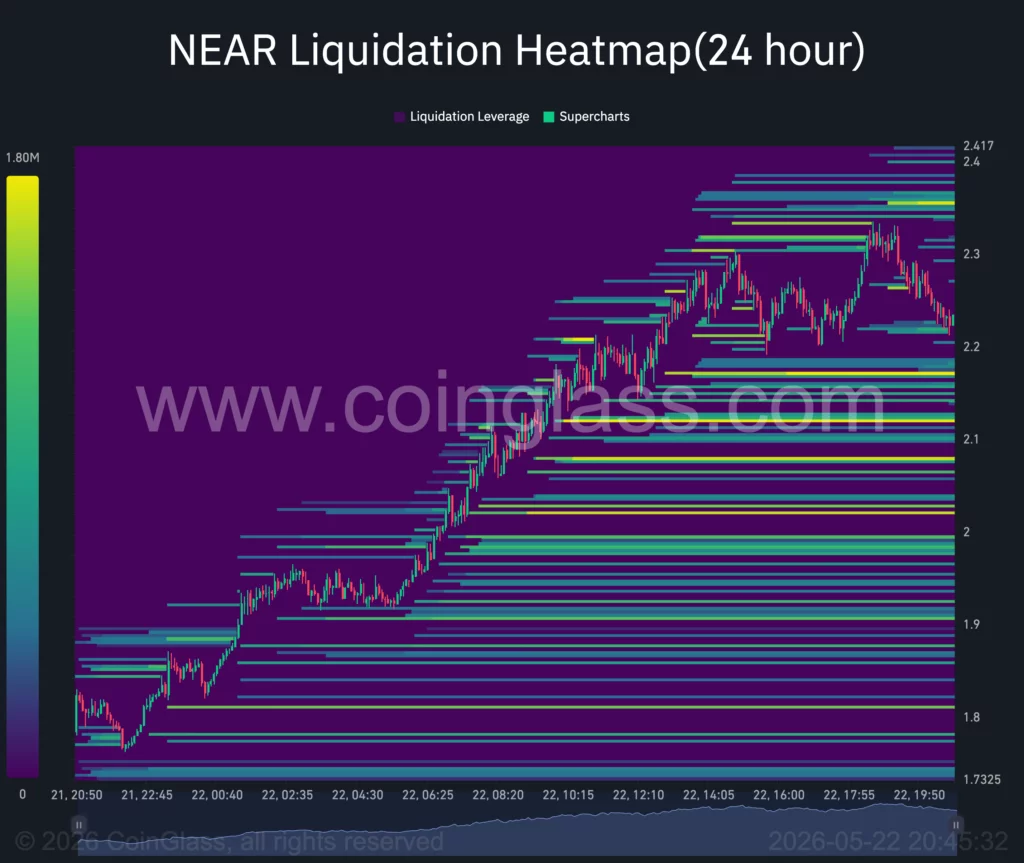
This article was updated with a liquidation heatmap from Coinglass.
NEAR Protocol has rallied more than 44% from its weekly low as AI-driven momentum, protocol upgrade optimism, and aggressive short liquidations pushed the token toward a major technical breakout.
Summary
- NEAR price surged more than 44% from its weekly low as AI narrative momentum, protocol upgrade optimism, and short liquidations fueled a breakout above key resistance levels.
- A potential golden cross between the 50-day and 200-day moving averages has strengthened bullish sentiment, with traders now watching the $3 psychological level.
- CoinGlass data showed dense liquidation clusters above $2.30, while open interest jumped over 51% amid rising leveraged positioning in NEAR futures markets.
According to data from crypto.news, NEAR Protocol (NEAR) climbed from a weekly bottom near $1.47 to an intraday high of $2.10 before extending gains toward the $2.20 region on Thursday. The move came even as Bitcoin (BTC) and Ethereum (ETH) traded within a subdued range following renewed concerns over U.S. inflation and uncertainty surrounding the Federal Reserve’s next policy decision.
A renewed wave of capital rotation into artificial intelligence-linked crypto assets has emerged as one of the key catalysts behind NEAR’s outperformance. Nvidia’s stronger-than-expected quarterly earnings earlier this week reignited speculative demand across AI infrastructure tokens, particularly projects tied to decentralized compute, AI agents, and data privacy.
Adding to the momentum, NEAR AI rolled out an automated Personally Identifiable Information anonymization framework on May 20. The feature strips sensitive user information from prompts before they interact with external large language models, addressing enterprise concerns surrounding data leakage and compliance risks.
Market participants also reacted positively to Network Upgrade 2.13, scheduled for June. The upgrade introduces post-quantum cryptographic signing alongside automated dynamic resharding through NEAR Intents. Developers say the system will allow the network to scale database shards automatically during traffic spikes, potentially reducing congestion and improving institutional-grade throughput.
At the same time, derivatives activity around NEAR accelerated sharply. Data from CoinGlass showed open interest surging more than 63% over the past 24 hours to $629 million while funding rates flipped strongly positive, signaling an aggressive build-up in leveraged long positioning.
Meanwhile, liquidation data from CoinGlass pointed to a significant short squeeze unfolding above the $2 level. Heatmap clusters showed dense liquidation zones stacked between $2.05 and $2.18, many of which were triggered as NEAR pushed through key resistance levels during the rally.
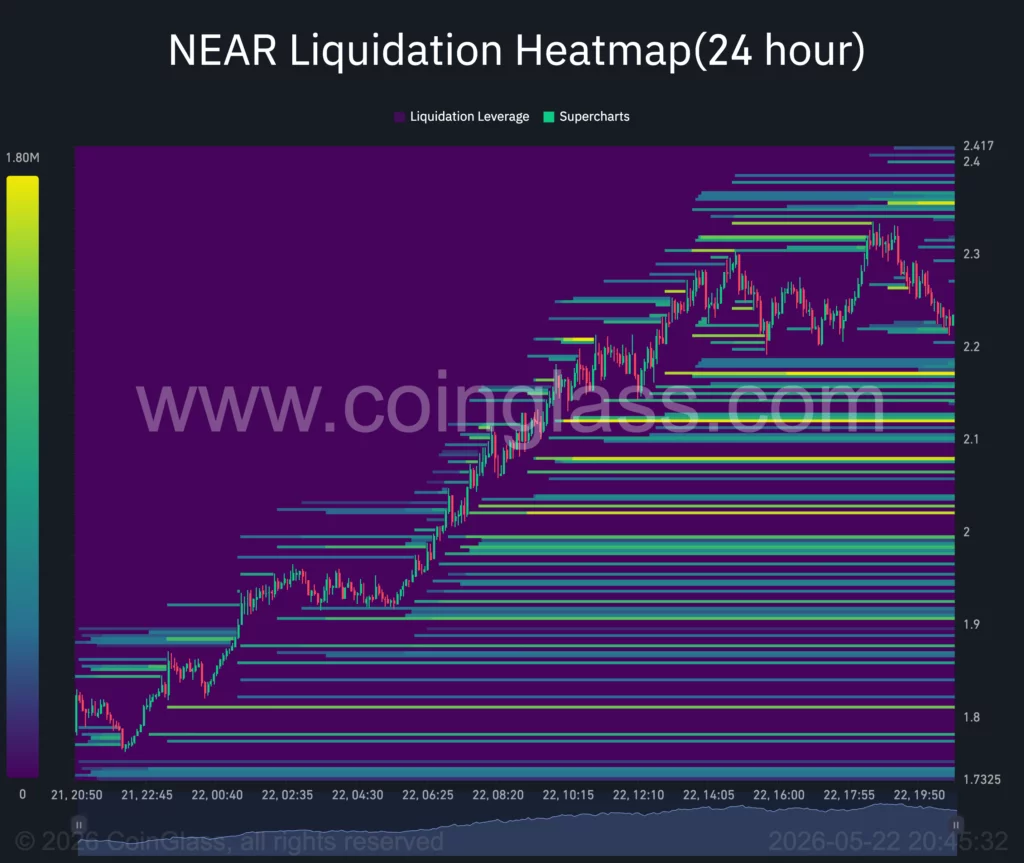
NEAR 24-hour liquidation heatmap. Source: Coinglass.
The latest move also coincided with improving sentiment across the altcoin market following continued inflows into U.S. spot Bitcoin and Ethereum ETFs earlier this week. Although macro conditions remain fragile, ETF demand has helped stabilize risk appetite after several weeks of heavy volatility tied to rising oil prices and geopolitical tensions in the Middle East.
Oil markets remained elevated after ongoing uncertainty surrounding shipping activity near the Strait of Hormuz continued to fuel inflation concerns. Higher crude prices have complicated the Federal Reserve’s path toward rate cuts, with traders now pricing in a prolonged higher-for-longer interest rate environment.
Despite those macro headwinds, several analysts believe AI-linked crypto assets may continue attracting speculative flows independently from the broader market direction. Michaël van de Poppe, founder of MN Consultancy, recently said the AI sector remains “one of the strongest narrative trades” in crypto due to rising institutional interest in decentralized compute infrastructure.
Is a golden cross setting up a larger NEAR breakout?
On the daily chart, NEAR has broken above a descending trendline that had capped price action since late January. The breakout accelerated after buyers reclaimed the Murrey Math 7/8 resistance zone near $2.14, which had previously acted as a key reversal level during multiple failed rallies earlier this year.
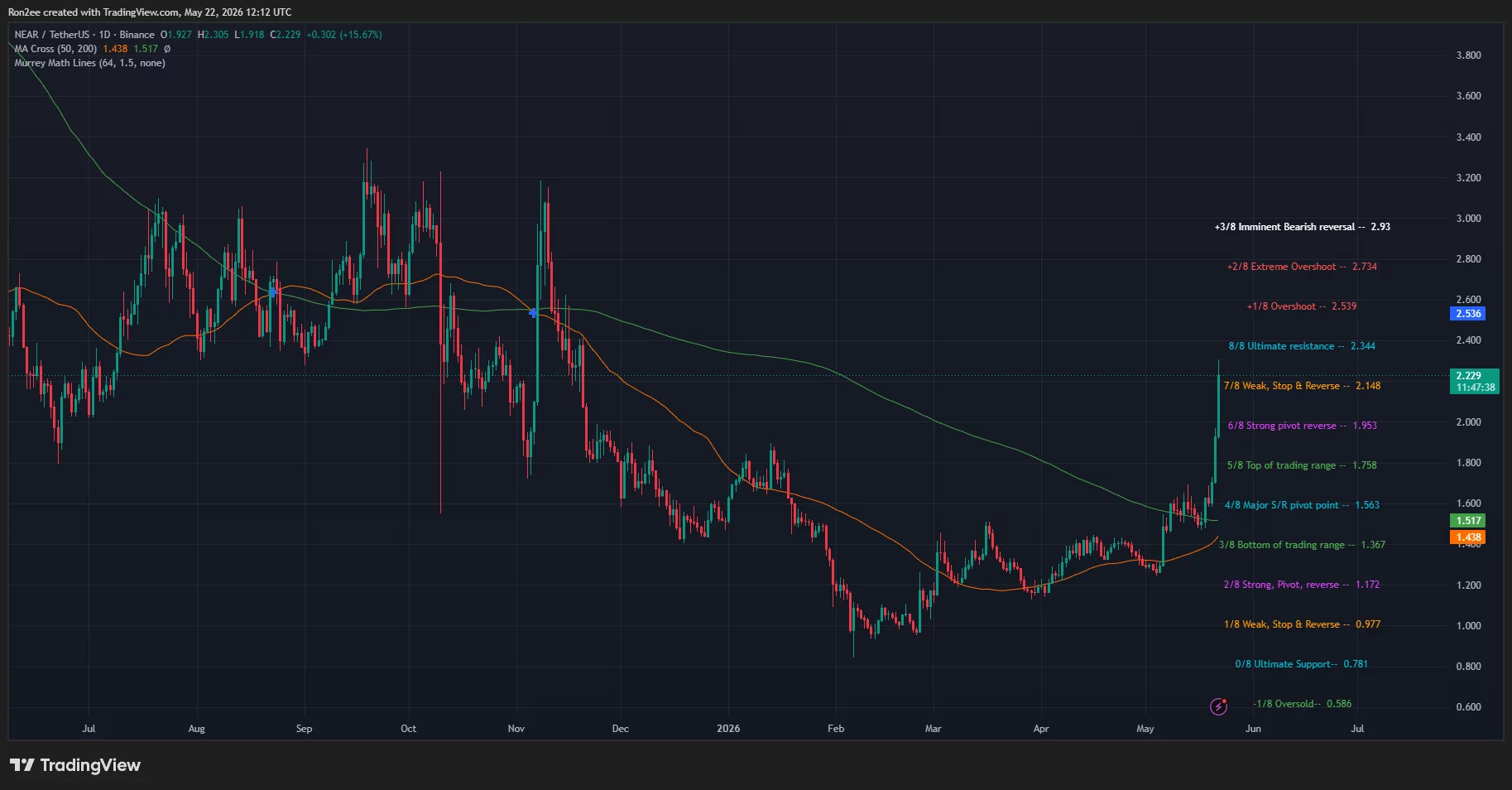
More importantly, the 50-day moving average appears close to crossing above the 200-day moving average. A confirmed golden cross would signal the first major bullish trend reversal on NEAR’s daily timeframe since late 2025.
The chart also shows NEAR reclaiming the 4/8 major support and resistance pivot at $1.56 earlier this month before rapidly advancing through the 5/8 and 6/8 Murrey Math zones. Bulls are now attempting to establish support above the 7/8 “weak stop and reverse” level around $2.14.
Should buyers maintain control above that region, the next major upside target sits near the 8/8 resistance zone around $2.34. A breakout above that level could open the door toward the +1/8 overshoot area near $2.53, followed by the +2/8 extreme overshoot level around $2.73.
From a broader structure perspective, reclaiming the psychological $3 level would require sustained momentum beyond the +3/8 reversal zone near $2.93. Notably, NEAR has not traded above $3 on a sustained basis since the sharp correction that followed the AI-token rally earlier this year.
Momentum indicators have also strengthened considerably during the latest breakout. The MACD recently flipped bullish on the daily timeframe while price continues holding firmly above the 50-day moving average, currently positioned near $1.43.
According to CoinGlass liquidation data, another sizable cluster of short liquidations remains stacked between $2.30 and $2.40. A decisive move through that area could trigger another wave of forced buybacks from overleveraged bearish traders.
At the same time, elevated funding rates suggest parts of the market may already be becoming overheated in the short term. Historically, aggressive leverage build-ups following vertical rallies often increase the probability of sharp volatility spikes or temporary pullbacks.
What could invalidate the bullish NEAR thesis?
Although the technical structure has improved significantly, several downside risks remain in play.
A rejection below the $2.14 resistance zone would weaken the immediate breakout thesis and potentially expose NEAR to a pullback toward the $1.95 support region. Losing that level could shift momentum back toward the 5/8 Murrey Math support around $1.75.
Macro conditions also remain a major risk factor for the crypto market. Another upside surprise in U.S. inflation data or further escalation in Middle East tensions could strengthen the U.S. dollar and pressure risk assets, particularly high-beta altcoins.
Meanwhile, Bitcoin’s inability to reclaim major resistance levels continues limiting broader altcoin participation. A sharp correction in BTC below key support zones could quickly erase speculative momentum across AI-linked tokens, including NEAR.
Derivatives positioning presents another concern. While rising open interest and positive funding rates initially supported the rally, excessively crowded long positioning increases liquidation risk if momentum stalls. In such scenarios, cascading long liquidations often amplify downside volatility.
For now, however, NEAR remains one of the strongest-performing large-cap altcoins in the market, with traders closely watching whether the approaching golden cross and sustained AI narrative momentum can eventually fuel a move back toward the $3 psychological level.
Disclosure: This article does not represent investment advice. The content and materials featured on this page are for educational purposes only.
Intercontinental Exchange and OKX are teaming up to list perpetual oil futures that track ICE Brent and WTI benchmarks on the crypto exchanges derivatives platform.
Summary
- ICE will license its Brent and WTI futures prices to support new perpetual oil contracts on OKX in selected markets
- The move follows ICE’s investment that valued OKX at 25 billion dollars and gave the NYSE owner a board seat
- Oil perps mirror a fast growing niche pioneered by platforms like Hyperliquid, where WTI linked perpetuals have seen volumes jump to 7.3 billion dollars
- The initiative blurs lines between traditional commodities and crypto derivatives as CME and ICE push regulators to rein in offshore oil perps while testing their own 24/7 models
The owner of the New York Stock Exchange will provide its regulated futures prices for ICE Brent crude and West Texas Intermediate as the reference curve behind the new contracts, while OKX handles the perpetual structure, crypto margin and user distribution.
The contracts will reference the same benchmarks that underlie multi trillion dollar cleared futures on ICE, according to Bloomberg, but will be listed as non expiring swaps on OKX’s venue with funding payments to keep prices aligned with the underlying oil curves.
For now the trading will be limited to jurisdictions where OKX already has permission to offer perpetual futures, which means the products are likely to launch outside the United States even as ICE markets them to institutions used to regulated commodity exposure.
That split structure allows ICE to monetise its benchmark data and deepen a 25 billion dollar strategic tie up with OKX without immediately seeking US approval for 24 hour oil perps on its own exchanges.
The deal sits on top of a broader partnership under which ICE took a minority stake in OKX, secured a board seat and agreed to license its US futures and tokenised equities markets back into the crypto exchange, which serves more than 120 million accounts.
Under that March agreement ICE plans to launch US regulated crypto futures based on OKX spot prices while OKX in turn expects to offer access to ICE’s US futures suite and New York Stock Exchange linked tokenised stocks once regulators sign off.
Will OKX and ICE’s 24/7 oil perps redraw the line between Wall Street and crypto?
Market observers see the oil perpetuals as a logical extension of that blueprint, inserting real world commodities into a crypto native leverage and funding model that retail traders already use for Bitcoin (BTC) and Ethereum (ETH) exposure on OKX’s derivatives books.
For readers tracking large cap assets, Bitcoin and Ethereum prices, liquidity conditions and derivative flows are already covered in depth on dedicated pages at crypto news, which provide context for how new products like oil perps can bleed into broader digital asset volatility and funding markets.
What does this mean for crypto and commodity regulation
The move lands in the middle of a political and regulatory fight over whether perpetual futures on US linked commodities should be allowed for American users at all, and if they are, who should host them.
CME and ICE have pushed US officials to crack down on platforms like Hyperliquid that list WTI linked perps for global users with little classical oversight, framing the issue as a question of market integrity and surveillance rather than a pure turf war.
At the same time both exchanges are nudging regulators toward a world of 24 hour trading, with ICE’s NYSE working on a tokenised securities platform funded by stablecoins and designed for round the clock access that looks very similar in structure to the crypto venues they are publicly criticising.
In that context the OKX deal reads less like a sideline experiment and more like a live test case for hybrid market structure.
ICE supplies regulated benchmarks and governance while OKX contributes the perpetual engine, user interface and experience running high leverage derivatives with up to 125 times leverage in some markets.
If regulators tolerate oil perps tied to regulated benchmarks offshore, it strengthens the case for bringing similar products onshore in a controlled way; if they clamp down, the episode will underline how far commodity regulators are willing to go to keep price discovery anchored in listed futures rather than in offshore crypto contracts.
One person familiar with the thinking told Bloomberg that a large energy trading firm put it bluntly, saying that traders “want the same benchmarks and margin offsets they already use at ICE, but with the flexibility of crypto style funding and around the clock risk management,” a view that captures the logic behind the tie up even as the regulatory path remains uncertain.
For readers looking to understand how this clash between traditional derivatives and digital assets is evolving beyond oil, detailed coverage of Bitcoin markets, Ethereum staking and the rise of perpetual futures across major coins is available on crypto news, including explainers on how funding rates, open interest and cross margining can transmit stress between commodity perps and large cap crypto contracts.
Those dynamics matter because an oil shock expressed through leveraged perps can now move through balance sheets that also hold Bitcoin or Ethereum collateral, tightening the coupling between energy and crypto in ways that macro traders and regulators will have to model rather than ignore.
“We are seeing the convergence of two infrastructures that used to live in separate universes,” said a derivatives strategist at a European prop firm who asked not to be named because they are not authorised to speak publicly. “If you clear oil futures at ICE during the day and trade perpetuals on OKX at night, that is one risk system, not two.”


Germany’s Finance Committee has rejected a proposal from the Green Party to scrap the country’s tax exemption for cryptocurrencies held longer than one year.
Summary
- Germany’s Finance Committee rejected a Green Party proposal to end the country’s one-year crypto tax exemption for long-term holders.
- CDU/CSU, AfD, and SPD lawmakers opposed the measure for different reasons, while only Die Linke backed the proposal with reservations.
- Finance Minister Lars Klingbeil has separately signaled plans to revise crypto taxation by 2027 as Germany expands oversight under EU reporting rules.
According to the committee discussions, lawmakers from multiple parties opposed the measure for different reasons, leaving Germany’s existing crypto tax framework intact even as Berlin weighs new digital asset tax rules for 2027.
Under current German law, profits from Bitcoin and other cryptocurrencies remain free from capital gains tax if investors hold the assets for more than 12 months. The rule, commonly referred to as the “Haltefrist,” has helped Germany build a reputation as one of Europe’s more favorable jurisdictions for long-term crypto investors.
The proposal from Bündnis 90/Die Grünen argued that the exemption no longer fits the modern financial market because it was originally designed for physical valuables such as gold, antiques, or foreign currency holdings rather than digital assets. Green lawmakers cited research from the Frankfurt School Blockchain Center estimating that Germany could collect up to 11.4 billion euros, or about $12.9 billion, in additional yearly revenue from crypto taxation.
At the same time, the party used a lower estimate in its own fiscal calculations, saying conservative assumptions would still generate billions in extra state revenue.
Why did German parties reject the crypto tax proposal?
Opposition to the bill extended across much of Germany’s political spectrum. Members of the CDU/CSU argued the proposal would create fresh inconsistencies because cryptocurrencies would end up taxed differently from comparable assets such as precious metals and foreign currencies.
Meanwhile, the AfD criticized the measure from a broader tax policy perspective. Party representatives said Germany should reduce taxation instead of expanding it and argued the government should focus public spending on areas including domestic security, foreign policy, and the judicial system.
The SPD took a more cautious position, saying that while the party supports tighter crypto taxation in principle, it would wait for Finance Minister Lars Klingbeil to present a formal federal proposal before backing specific legislative changes.
Klingbeil had already signaled possible reforms in April while presenting Germany’s 2027 federal budget. During that presentation, the finance minister said the government planned to “tax cryptocurrencies differently” as part of measures expected to raise an additional 2 billion euros in revenue.
Only Die Linke supported the Greens’ proposal outright, though the party also pointed to weaknesses in the draft legislation. Representatives warned that the bill lacked clear limits on offsetting crypto trading losses and said the administrative burden could significantly reduce net tax gains.
How is Germany’s crypto industry responding?
Industry groups and crypto firms have continued defending Germany’s current one-year exemption. Robin Thatcher, a Bitcoin and crypto tax accountant, said removing the rule would weaken Germany’s position as a crypto hub and discourage investment activity.
Comparisons with Austria have also entered the debate. Austria removed its crypto holding exemption in 2022 and introduced a flat 27.5% capital gains tax on digital assets regardless of holding duration.
Bitpanda co-founder Eric Demuth later criticized the Austrian model, saying in a March post on X that the changes created additional bureaucracy without delivering meaningful financial benefits to the government.
Despite the policy uncertainty, German banks have continued expanding into regulated crypto services. Earlier this year, DZ Bank received BaFin approval to launch its “meinKrypto” platform under the European Union’s Markets in Crypto-Assets Regulation framework.
The service allows customers from hundreds of cooperative banks to trade assets, including Bitcoin, Ethereum, Litecoin, and Cardano, directly through their banking applications.

In a development marking the culmination of a high-profile U.S. fraud probe tied to Celsius Network’s 2022 collapse, the criminal proceedings surrounding key former executives have officially ended. The sentencing of Roni Cohen-Pavon to time served and the closure of cases against Cohen-Pavon and former Celsius CEO Alex Mashinsky were reflected in the Southern District of New York docket on Thursday. These closures come after Mashinsky pleaded guilty and received a 12-year prison term for fraud and price manipulation, while authorities indicated Cohen-Pavon’s cooperation provided substantial assistance that likely contributed to a lenient outcome.
According to Cointelegraph, the broader 2022 Celsius collapse left users with estimated losses totaling around $5 billion. The formal wrap of the criminal phase in this matter represents a notable checkpoint for regulatory enforcement actions within the crypto lending sector and for victims seeking accountability in high-profile crypto firm failures.
Key takeaways
- The Celsius criminal docket has been formally closed following sentencing actions against Roni Cohen-Pavon (time served) and Alex Mashinsky (12-year sentence), signaling an enforcement milestone in the Celsius saga.
- Mashinsky’s plea and sentencing, alongside Cohen-Pavon’s cooperation acknowledgment, illustrate how cooperation can influence outcomes in complex crypto-related prosecutions.
- Justin Sun’s voluntary dismissal of his Bloomberg lawsuit “without prejudice” ends that particular dispute, while the broader WLFI-related defamation suit persists against him.
- The AI16Z DAO matter advances to a federal setting, with a class-action alleging market manipulation tied to the ELIZAOS rebrand on Solana, highlighting ongoing regulatory attention to AI-token projects and branding disclosures.
Closure of Celsius cases and enforcement context
The Celsius cases sit within a broader pattern of U.S. enforcement activity targeting misrepresentation and manipulation within crypto markets. Mashinsky’s conviction for fraud and price manipulation underscores prosecutors’ focus on the governance and marketing practices of crypto lenders and the potential impact on retail investors. Cohen-Pavon’s case, cited by authorities as involving “substantial assistance,” reflects a common prosecutorial approach in complex financial schemes where cooperation can shape sentencing outcomes. The public record now shows the criminal dockets related to Celsius’ 2022 collapse fully closed, a development with implications for victims, market participants, and compliance professionals monitoring enforcement trends in the sector.
The milestone reinforces the emphasis regulators place on investor protection, traceability of misstatements, and the credible disclosure of material information in crypto-enabled businesses. Institutions and exchanges assessing risk profiles may look to this closure as a reference point for due diligence and remediation practices in similar high-stakes cases, particularly where alleged fraud intersects with sophisticated financial products and tokenized offerings.
Sun vs. Bloomberg: privacy, disclosure, and data-use risk
In a separate development, Justin Sun, founder of Tron, moved to dismiss his lawsuit against Bloomberg News without prejudice, terminating the matter on Tuesday. The case, originally filed in August 2025, alleged that Bloomberg had publicly disclosed proprietary financial information related to Sun’s cryptocurrency holdings. The dispute arose after Bloomberg approached Sun’s team in February 2025 to obtain wealth data for inclusion in its Billionaires Index, with Sun contending that Bloomberg’s reporting exposed him to threats such as kidnapping and phishing.
The voluntary dismissal—compelled by a lack of ongoing docket activity—leaves open, at least for now, the possibility of later action, though no immediate resolution was announced. The episode sits at the intersection of data privacy, media reporting, and regulatory expectations around the handling of sensitive financial information related to crypto executives. It also touches on cross-border considerations, given Sun’s status as a global entrepreneur and the multinational nature of media coverage and legal proceedings in this arena.
Beyond this suit, Sun remains involved in other litigation, including a defamation case brought by World Liberty Financial, alleging that Sun’s public statements caused reputational harm. Separately, Sun has challenged actions involving WLFI tokens, signaling a broader pattern of disputes arising from tokenized holdings and corporate disclosures within crypto ecosystems.
AI16Z DAO: class-action scrutiny of AI-token markets and branding
A separate legal matter in New York has put an AI-related project under the lens of a class-action lawsuit filed in April. The suit targets the Eliza Labs team, its founder Shaw Walters, Sebastian Quinn-Watson, and the AI16z DAO, alleging market manipulation surrounding the AI16Z token, which subsequently rebranded to ELIZAOS on the Solana blockchain. The plaintiffs claim deceptive acts by leveraging the name of a prominent venture firm, resulting in a rapid expansion of the token’s market capitalization to about $2.6 billion in January 2025 before sizeable holders began liquidating.
Notably, Andreessen Horowitz (a16z) and its crypto arm were not officially affiliated with the project, according to the filing, and the lawsuit contends branding confusion contributed to market distortions. Chris Dixon of a16z Crypto referred to brand clarity concerns in a January 2025 discussion, noting the firm had urged the project to change its name due to confusion. The case proceeded to a pretrial phase, with Judge Jed Rakoff pressing questions about service of process and potential delays in bringing co-defendant Quinn-Watson to court due to his residence in Australia. All defendants have agreed to a bench trial, anticipated about five months after the court resolves a pending motion to dismiss.
Closing perspective
Taken together, these developments illustrate how enforcement dynamics, private litigation, and branding disclosures continue to shape the risk and compliance landscape for crypto firms and AI-token projects. For institutions, they underscore the importance of robust due diligence, transparent disclosures, and clear branding practices to mitigate regulatory and legal exposure as the market evolves.

Ethereum’s long-term investment case is attracting renewed scrutiny as the network maintains a commanding on-chain footprint inDeFi, stablecoins, and tokenized assets—even as ETH has fallen roughly 28% year to date in 2026. Fresh metrics from Token Terminal underscore the depth of ETH’s ecosystem, suggesting that a substantial portion of the crypto financial stack still rests on Ethereum’s settlement layer.
According to Token Terminal data, ETH continues to anchor significant on-chain activity: DeFi liquidity sits around $43 billion, stablecoins exceed $165 billion in supply, and roughly 55% of tokenized assets tracked across public blockchains are tied to Ethereum ecosystems. In the tokenized ETF space, revenue and market interest are measurable but modest in size—yet ETH dominates this niche, accounting for about 76.9% of the market share in a spread that tops $400 million in capitalization. As crypto analyst Tanaka observed, these pieces are likely to remain central to the market’s mid- to long-term narratives, with Ethereum still functioning as a pivotal settlement layer for these themes.
“These are the pieces I believe will continue to lead the market in the mid to long term. And if we look at the current data, Ethereum is still the most important settlement layer for these narratives.”
Key on-chain dynamics: staking expansion and validator demand
Ethereum’s staking activity continues to climb despite a softer price backdrop in 2026. Data indicate nearly 39.1 million ETH staked, representing about 32% of the total ETH supply and distributed across more than 896,000 active validators. The demand to participate in staking remains elevated, with over 3.49 million ETH waiting in the staking entry queue, yielding a wait time of more than 60 days. By contrast, the exit supply remains relatively small, at 7,424 ETH.
The persistent intake of ETH into staking amid price weakness signals strong long-term conviction among holders and an ongoing shift of supply into yield-bearing commitments. In practical terms, this dynamic could help support a steadier ETH supply curve over time, even in stages of price volatility, as more capital is anchored in the network’s security and governance infrastructure.
Source: Validator Queue data indicates the scale of entry demand and the notable backlog in staking opportunities, underscoring a broad market appetite for ETH exposure within the staking framework.
Accumulation behavior and the long-hold narrative
Another layer of on-chain activity points to a cautiously optimistic holder base. CryptoQuant data show a pronounced inflow into accumulation addresses on May 20, totaling about 248,400 ETH—the strongest single-day inflow recorded since January 6. Accumulation addresses are typically associated with long-term holders who favor accumulating rather than selling into weakness, a pattern that could reflect a strategic shift toward a longer horizon for ETH ownership.
While daily price action remains volatile, the surge in accumulation activity aligns with a broader narrative: even amid price declines, a segment of investors is continuing to deploy capital into ETH with a longer time horizon, potentially setting the stage for future repricing as demand re-accelerates and on-chain activity remains robust.
For readers tracking the broader ecosystem signals, this on-chain persistence dovetails with the DeFi and tokenized-asset activity highlighted by Token Terminal, reinforcing the view that ETH remains deeply embedded in the period’s structural crypto infrastructure.
Historical buy zones and model-driven signals
Industry analysts have long watched ETH’s price interactions within long-term accumulation ranges. Crypto Bullet, a respected market commentator, points to a multi-year accumulation corridor on the weekly chart spanning roughly $1,000 to $5,000. The analyst suggests that recent years represent a deliberate buildup phase by buyers before the next major cycle gains momentum, with potential for a retest into the $1,000–$1,300 area as a possible final capitulation before a new cycle expansion takes hold. On the longer horizon, Crypto Bullet projects substantial upside targets in the $7,700–$14,000 range for 2027–2029, contingent on macro conditions and continued on-chain demand.
Additionally, on-chain analyst Rei highlights a technical reading tied to a two-year simple moving average (SMA) multiplier framework popularized by Alphractal. The model compares ETH’s price against its two-year average to identify valuation regimes. Recently, ETH slid below the chart’s x1 band—the baseline fair-value zone—while price action hovered toward the lower boundary of the two-year SMA bands. Higher bands in the model (such as x1.42 and x2.65) have historically appeared during overheated bull-market phases when ETH traded well above its long-run average. Rei emphasized that history shows episodes where ETH approaches or touches the lower end of the 2Y SMA band tend to co-occur with an accumulation phase, underscoring a recurring pattern where buyers re-enter as price normalizes.
In short, the combination of ongoing staking demand, persistent accumulation, and a portfolio of technical signals paints a nuanced picture: ETH’s on-chain fundamentals remain robust even as price trends wobble, leaving room for a potential re-engagement from both retail and institutional players if macro conditions align with the accumulation pattern observed in past cycles.
What to watch next
As the ecosystem evaluates the next leg of the cycle, several potential catalysts merit close attention. Staking dynamics will continue to shape ETH’s security budget and supply trajectory, particularly if the backlog for entry tightens further or begins to clear meaningfully. On-chain accumulation trends will be a key gauge of long-term holder sentiment, while the interpretation of technical signals around the two-year SMA framework could influence short- to medium-term positioning. For investors and builders, the message is clear: ETH’s role as a gateway to DeFi liquidity, stablecoins, and tokenized assets gives the network a structural resilience that persists beyond price fluctuations.
Market watchers will want to monitor whether the long-run buy zones hold or yield to new demand drivers, and how any shifts in macro risk appetite impact the pace of accumulation and staking activity. In the near term, the confluence of rising staking interest, sustained accumulation, and the potential for renewed on-chain activity could set the stage for a more constructive phase for Ethereum in the back half of the year and into the next cycle.
Readers should stay tuned for updates on staking queue dynamics, accumulation flow patterns, and any changes to the regulatory or macro environment that could influence demand for ETH-based financial narratives.
Chainlink now secures more than $110 billion in onchain value across cross chain tokens and DeFi markets, underlining how central the oracle network has become to the infrastructure of digital assets and tokenised finance.
Summary
- Chainlink reports $110 billion in Total Value Secured, with $60 billion in cross chain tokens over CCIP and $50 billion in DeFi data feeds
- The network has enabled $30.31 trillion in cumulative transaction value and published 19.39 billion verified messages onchain as of late May 2026
- Chainlink Reserve holds 3.78 million LINK worth about $37 million, funded by protocol revenue that links TVS growth to tokenomics
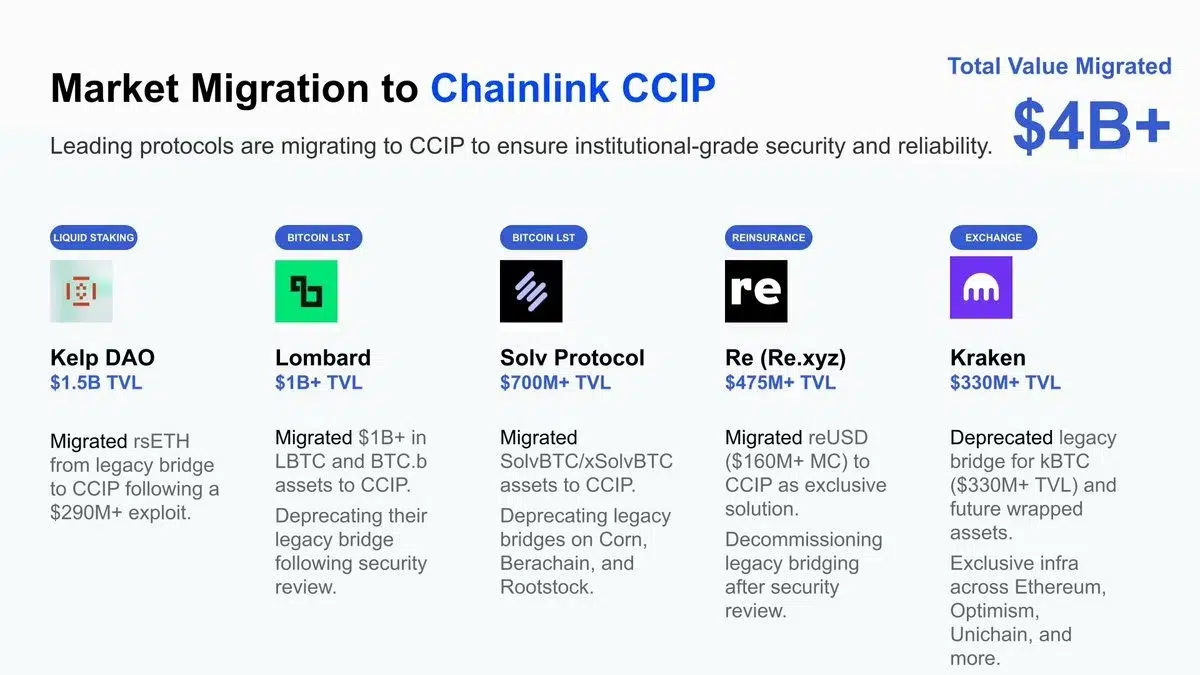
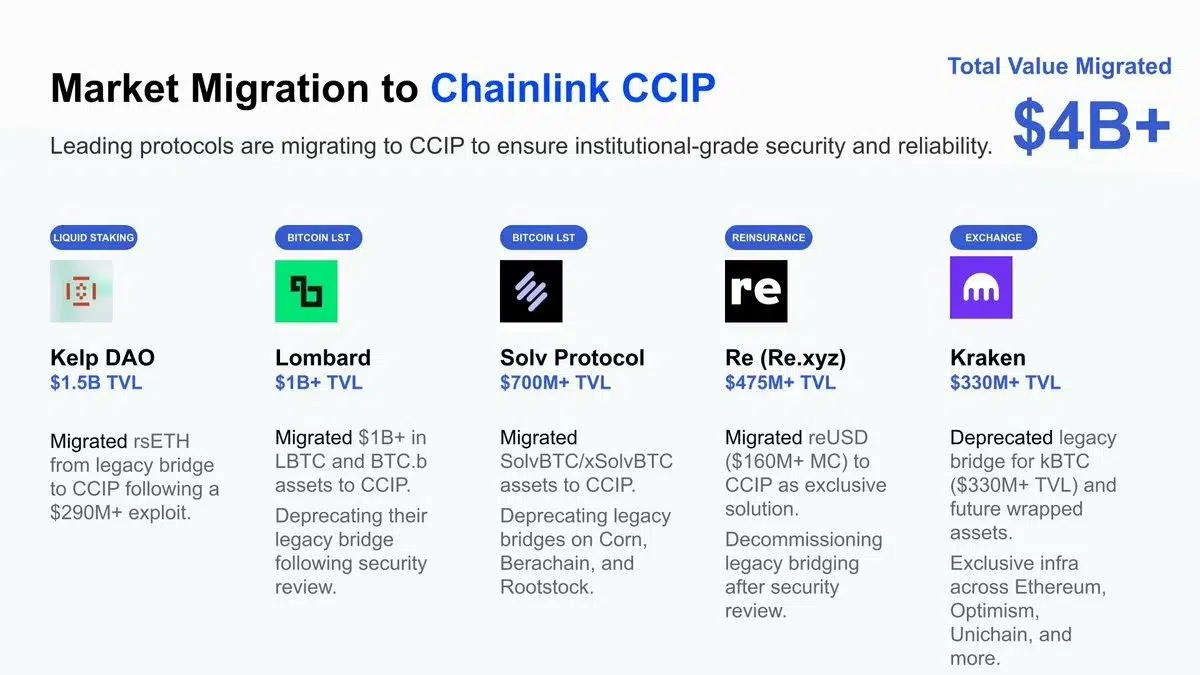
- Recent migrations from LayerZero to CCIP by Solv, Kraken and others have pushed more than $4 billion in assets onto Chainlink’s cross chain stack after a $292 million exploit
Chainlink (LINK) has pushed past $110 billion in Total Value Secured (TVS), marking a new record for the oracle network and underscoring how much of crypto’s plumbing now runs through its rails.
As of May 22, 2026, roughly $60 billion of that is tied to cross-chain tokens moving over Chainlink’s CCIP, while around $50 billion sits in DeFi data feeds that help price loans, derivatives, and stablecoins. In macro terms, that stack of value is now on par with the annual GDP of a mid-sized national economy.
Chainlink defines Total Value Secured as the dollar value of assets that rely on its services to function safely, rather than deposits locked inside its own contracts, which means TVS captures loans, derivatives, stablecoins and cross chain tokens that depend on its oracle and messaging infrastructure.
Chainlink’s own dashboard shows a narrower DeFi only view of $47.33 billion secured, which lines up with the second bucket in the headline number and underscores how much of the growth has come from cross chain flows.
Beyond the headline, Chainlink metrics show $30.31 trillion in cumulative transaction value enabled and 19.39 billion verified messages, a scale that covers everything from micro DeFi trades to institutional settlement and real world asset flows.
The public ecosystem directory lists 2,672 live integrations as of May 18 2026, ranging from consumer apps to capital markets infrastructure, with names like Swift, DTCC, Fidelity and UBS using Chainlink as a data and interoperability layer.
That footprint has kept Chainlink’s oracle market share in a band between 60 and 68 percent of category TVS over the past two years, according to several independent analyses.
How has Chainlink reached $110b in value secured
The financial side of the network shows the same expansion. The Chainlink Reserve, an onchain buffer funded by protocol revenue, holds 3.78 million LINK with a reported cost basis of $12.48 per token and an aggregate value near $37 million as of May 22 2026, after an inflow of more than 123,000 LINK on May 21 when the $110 billion milestone was confirmed.
Because the Reserve is topped up by fees from both onchain and offchain services, growth in value secured and growth in the Reserve tend to move together, linking adoption metrics to tokenomics for LINK holders.
For readers looking to track how this feeds into market structure across large cap assets, coverage of Bitcoin (BTC) pricing, Ethereum (ETH) staking and the broader perpetual futures complex is already available on crypto news, including explainers on how data feeds and cross margining shape risk in the sector.
The outstanding question for LINK investors is how much of the enterprise and cross chain activity converts into onchain fee accrual that can be captured through staking and token mechanics, versus revenue retained at the application or institutional layer, a debate that has now been running for at least two years in research from banks and specialist crypto desks.
As one research note from Galaxy framed it, Chainlink is “becoming the data and interoperability layer for onchain finance,” but valuation will ultimately depend on how aggressively that role is monetised at the token level.
Why is CCIP driving the latest surge and how does risk migrate
The fastest moving component of the $110 billion total is CCIP, which has accelerated sharply after bridge security failures pushed protocols to reconsider their cross chain stack.
A $292 million exploit at Kelp DAO’s LayerZero powered bridge in April triggered a visible migration, with projects controlling more than $3 billion in DeFi value shifting infrastructure toward Chainlink’s CCIP in the weeks that followed.
Solv Protocol moved around $700 million in tokenised Bitcoin on May 7, while Kraken announced that it would fully deprecate LayerZero and adopt CCIP as the exclusive cross chain layer for Kraken Wrapped Bitcoin and all future Kraken Wrapped Assets, a change that ultimately covers more than $4 billion in value.
CCIP already supports transfers across dozens of networks, with Coinbase using it for wrapped assets and Lido deploying it for wstETH routing, while cross chain tokens under the CCT standard now move across more than 60 chains.
That breadth matters for tokenised real world assets. BlackRock, JPMorgan and Fidelity have framed their onchain treasury, money market and commodity products as a step toward a more programmable capital market, but those instruments only function at scale if they have reliable price data and a way to move between chains without custom bridges for every deployment, a combination that makes Chainlink’s dual role as oracle and messaging layer strategically important.
Ondo Finance’s native token $ONDO has broken above $0.46 and is trading near $0.466 with a 24 hour gain above 15 percent, according to data from Gate.
Summary
- Gate shows $ONDO trading around $0.466 after briefly breaking $0.46, with its 24 hour move exceeding 15% on May 22
- The rally followed news that China’s securities regulator is cracking down on illegal cross border brokerage activity involving firms such as Tiger Brokers, Futu and Longbridge
- Traders are rotating into real world asset narratives and onchain United States stock exposure, where Ondo is a flagship RWA token backed by treasuries and other traditional instruments
- Ondo’s move comes against a backdrop of rising interest in tokenized yield products and RWA plays already tracked in crypto news coverage of RWA tokens and tokenized treasuries
Spot market shows ONDO (ONDO) testing the $0.46 level and printing around $0.466 in the latest session, putting the token more than 15% higher over 24 hours.
Why is Ondo price spiking above $0.46 today
The move stands out against recent ranges around $0.40, with Gate and other venues still showing a sub one dollar price profile while volumes deepen across centralized exchanges.
This latest leg higher coincided with headlines from Beijing. China’s Securities Regulatory Commission said it has penalized Tiger Brokers and Futu Securities International, along with Long Bridge Securities, for illegally offering mainland clients access to overseas markets without approval.
In a statement the CSRC said such “illegal cross border business operations have disrupted the market order and should be subjected to a heavy crackdown,” adding that it would continue to pursue overseas institutions that solicit mainland investors without authorization.
The regulator outlined a two year rectification period to phase out domestic services provided by those overseas brokers, while stressing that the “legitimate rights and interests of existing investors” and their assets would be safeguarded through coordination with foreign regulators.
That clampdown has pushed attention toward alternative channels for exposure to United States assets and dollar yield.
Chinese and regional traders have been watching the rise of tokenized treasuries, money market products and onchain representations of United States stocks, sectors where Ondo Finance has become one of the best known names.
Ondo’s core pitch is that it offers tokenized equivalents of low risk yield assets such as United States Treasury bonds and high grade money market funds, packaged in compliant structures that sit between traditional funds and public blockchains.
Ondo is a “quantitative financial product primarily issued in the form of a fund” that has attracted backing from major institutions, and has highlighted it as a flagship RWA token in educational material aimed at yield oriented crypto users.
Recent analysis at crypto.news has been tracking similar flows into real world asset tokens and stable yield products as investors look for onchain instruments that map directly to traditional securities.
In that context, a regulatory squeeze on unofficial cross border access to United States stocks and funds gives extra narrative fuel to tokens that package comparable exposures into blockchain native form.
How does China’s crackdown link to RWA and onchain US stocks
The CSRC’s latest statement fits into a longer effort to restrict unlicensed access routes to overseas securities.
Officials have reiterated that domestic investors should use formal channels such as Stock Connect, Qualified Domestic Institutional Investor schemes and Cross boundary Wealth Management Connect for foreign assets.
By tightening around brokerages like Tiger and Futu, Beijing is signaling it wants tighter control over how capital moves into offshore equities.
That in turn increases the appeal of structures that deliver economic exposure to foreign instruments without requiring a direct brokerage relationship, even if they sit in a regulatory grey zone for some investors.
Stablecoins and tokenized funds already serve that function in parts of Asia and Latin America.
Ondo sits inside that cluster of instruments as a token that wraps conventional yield bearing assets and brings them into venues like Gate, Bybit and others where crypto native traders can access them alongside coins such as Bitcoin (BTC) and Ethereum (ETH).
Against that backdrop, a double digit intraday gain from roughly $0.40 to $0.466 puts Ondo back in focus as a liquid proxy for RWA and tokenized yield sentiment.
The risk warning attached to local coverage remains straightforward, however, with venues reminding traders that concentrated narrative flows and regulatory headlines can accelerate both upside and drawdowns in niche tokens.


THORChain has faced criticism from crypto security researchers and investors after proposing to continue using its patched GG20 signing framework following a $10.7 million exploit tied to the system.
Summary
- THORChain faced criticism after proposing to retain its patched GG20 signing framework following a $10.7 million vault exploit.
- The protocol said automatic solvency checks halted cross-chain signing and trading within minutes, preventing additional losses after a malicious node operator reconstructed a private key.
- Separate reports from PeckShield linked a $1.3 million theft targeting THORChain co-founder JP Thor to a deepfake Zoom attack tied to rising North Korean-linked crypto hacks.
According to a post-mortem report released by THORChain on Wednesday, a malicious node operator exploited a flaw in the protocol’s GG20 threshold signature scheme and reconstructed a full private key linked to one of the network’s vaults.
The report said the exploit was made possible through “progressive key material leakage,” allowing the attacker to bypass the protections normally created by distributing signing authority across several node operators.
Within minutes of the breach, THORChain said its automatic solvency checks suspended signing and trading activity across multiple chains without requiring manual intervention. Node operators later coordinated through Discord to halt the network entirely and deploy a fix within roughly two hours.
While the protocol credited the safeguard systems for preventing additional losses, criticism emerged after governance proposal ADR-028 recommended keeping the GG20 threshold signature system in place with upgrades rather than replacing it outright.
Why are security researchers questioning the GG20 framework?
Concerns around the proposed recovery plan intensified after several crypto analysts publicly questioned the reliability of GG20-based infrastructure.
Pseudonymous crypto project analyst Bird wrote on X that the initial exploit suggested the signing stack may contain “a flaw in randomness generation or local signing isolation.” At the same time, Bird praised THORChain’s automated solvency protections for limiting the damage before more vaults could be drained.
More critical reactions followed from crypto investor JP, who argued on X that GG20 carries “many brittle assumptions” and described the framework as a “black box” that may remain difficult to secure even with repeated patches.
Under ADR-028, THORChain would first absorb losses through protocol-owned liquidity before distributing remaining losses across synth holders. The proposal also seeks to rebuild depleted liquidity reserves over time using a portion of protocol income rather than minting or selling additional THORChain tokens.
At the same time, THORChain said trading activity would remain paused until the vulnerability is fully fixed. The protocol also announced plans to slash the malicious validator node while shielding unrelated node operators that shared the compromised vault.
How does the attack fit into rising crypto security threats?
The exploit arrived as blockchain security firms continue tracking a rise in sophisticated attacks targeting crypto infrastructure and executives.
Data from DefiLlama shows crypto exploits resulted in more than $634 million in losses during April alone. Earlier this year, blockchain investigator ZachXBT was among the first to flag the THORChain exploit before the protocol publicly halted trading and signing operations.
Separately, blockchain security firm PeckShield recently disclosed that THORChain co-founder JP Thor lost roughly $1.3 million in a separate attack linked to a compromised Telegram account and a deepfake Zoom call.
In a detailed post shared on X, JP Thor said the attackers used a fake video feed impersonating a friend before triggering a malicious script that copied files from his iCloud documents folder.
He added that his MetaMask wallet, which was connected to an inactive Chrome profile and stored through iCloud Keychain, was drained without warning prompts or admin approval requests.
Security researchers have linked similar attacks this year to North Korean hacking groups that increasingly rely on deepfake video calls, malware, fake job offers, and social engineering campaigns targeting crypto executives and developer networks.
Earlier this year, blockchain analytics firm TRM and law enforcement agencies attributed the $1.5 billion Bybit theft to North Korea-linked actors.

Upgrading eGain Stock As Market Ignores Compelling Growth Catalysts (NASDAQ:EGAN)

Stablecoins are quietly becoming the internet’s money

Minor edits to AI skills can make agents go rogue


-

 Crypto World1 day ago
Blockchain.com files with SEC for U.S. IPO
-

 Fashion9 hours ago
Holiday Weekend Open Thread – Corporette.com
-

 Fashion6 days ago
On the Scene at Gucci’s Cruise Show in New York City: Mariah Carey, Kim Kardashian, Lindsay Lohan, Iman, and More!
-

 Politics7 days ago
Watch: far-right flag-fanatics run over victim, attack locals – Setup By the Left wing for your entertainment
-

 Fashion7 days ago
Trending Western Style Vests Perfect for Summer
-

 Crypto World6 days ago
Intesa Sanpaolo’s crypto holdings jump to $235M as XRP enters
-

 Fashion6 days ago
Amazon Sundays: Memorial Day Hosting
-

 Entertainment6 days ago
Off Campus Easter Eggs Explained: Characters, Stories, More
-
Business6 days ago
Australia defends property tax changes designed to fix ‘broken’ housing
-
 Crypto World4 days ago
Revolut Launches Dogecoin Debit Card Across UK and EU
-
 NewsBeat2 days ago
Charity run by Reform leader Malcolm Offord accused of ‘law breaking’ over Scottish registration
-

 Politics7 days ago
Anti-Zionists attacked in Jerusalem as ethnofascists chant race-hate
-

 Tech1 day ago
WhatsApp ads could make Irish debut after discussions with DPC
-

 Sports1 day ago
2026 CJ Cup Byron Nelson leaderboard: Brooks Koepka finds putting stroke in Round 1
-

 Business7 days ago
Tracking Berkshire Hathaway Portfolio – Q1 2026 Update
-
Politics6 days ago
Wings Over Scotland | The Land Of No Laws
-

 Crypto World13 hours ago
Space X IPO Is ‘Bad News’ for Tech Stocks: But What About Bitcoin?
-

 Politics6 days ago
Cassidy defiant as Trump's revenge campaign closes in
-

 Business6 days ago
Equinor ASA (EQNR) Shareholder/Analyst Call Prepared Remarks Transcript
-

 Crypto World21 hours ago
Trump Media’s Bitcoin Stash Shrinks Again as 2,650 BTC Lands on Crypto.com
You must be logged in to post a comment Login