

Crypto World
how CLARITY Act got stuck from both sides

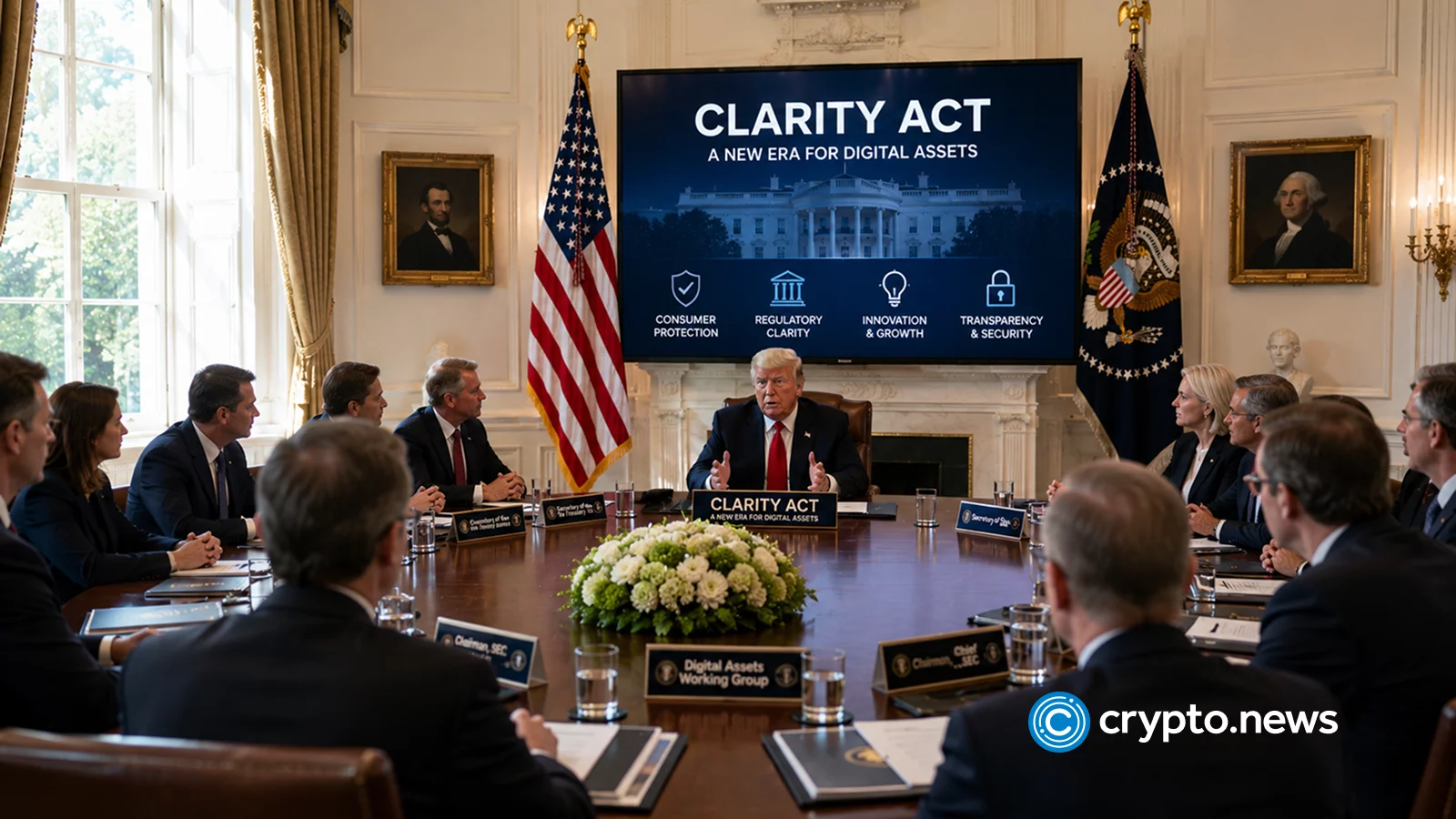
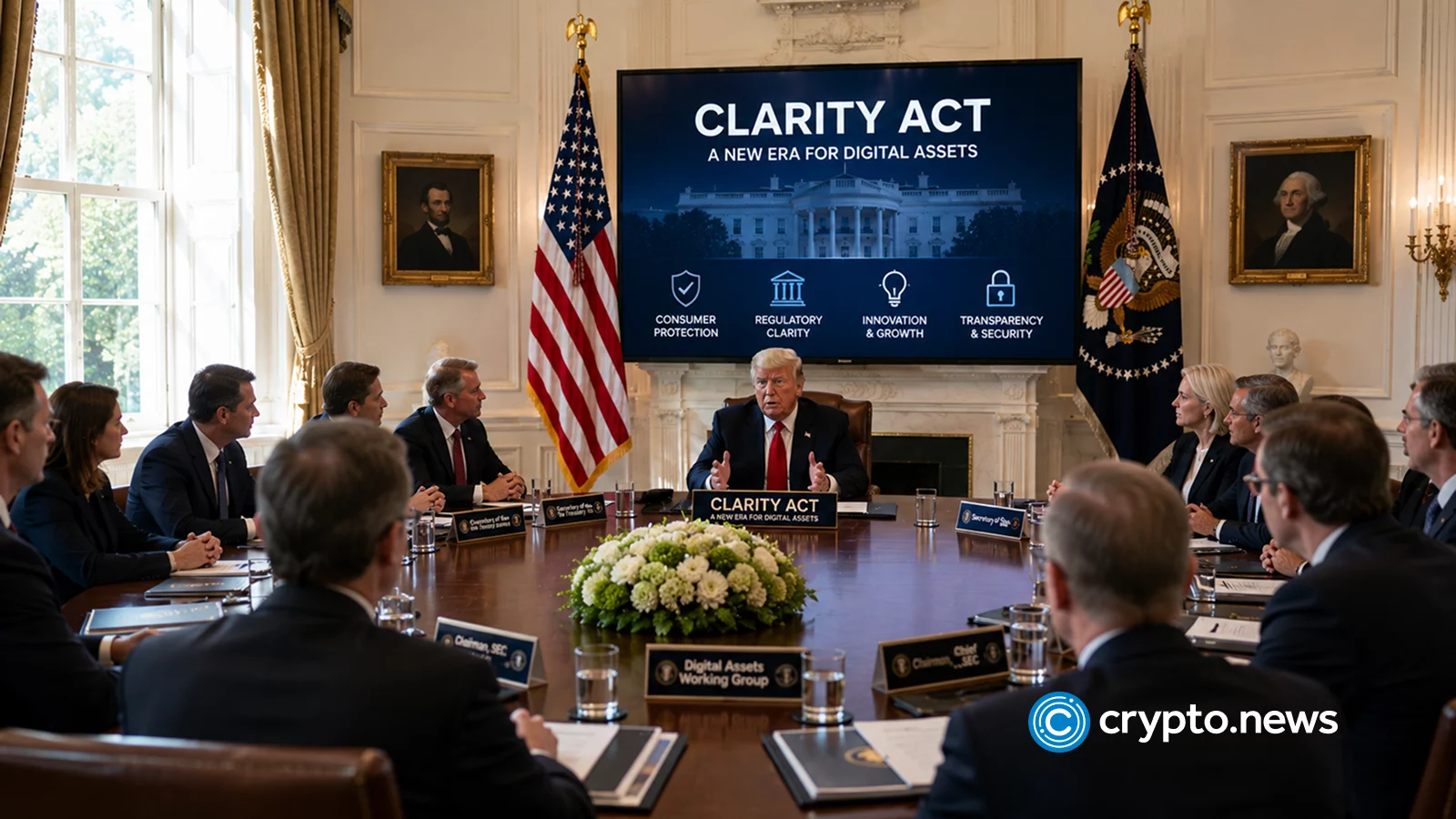
Crypto’s market structure bill cleared committee and then walked into a trap with two jaws. One fight is about the President’s crypto fortune. The other is about whether writing code makes you a money transmitter. Neither side will move, and the clock is running out.
Summary
- The CLARITY Act is no longer stuck on one dispute. It is trapped between an ethics fight and a developer-liability fight at the same time.
- The ethics fight centers on whether crypto conflict-of-interest rules should have enforcement teeth strong enough to reach the President’s crypto holdings.
- Section 604 has become its own veto point because developers think it is already too weak, while law enforcement argues it is still too broad.
- The bill’s biggest enemy may now be the calendar. With only 31 Senate session days before the August recess, unresolved disputes could push the framework beyond 2026.
A month ago the CLARITY Act looked close to inevitable. The Senate Banking Committee had advanced it 15 to 9 on May 14, two Democrats had crossed the aisle, the bill landed on the Senate Legislative Calendar on June 1, and prediction markets priced its 2026 passage near 74%. Senator Cynthia Lummis, one of its architects, called the committee vote the most consequential Senate action on crypto regulation in history. The industry allowed itself to believe the market structure bill it had wanted for years was finally going to happen.
Then the trap closed. By mid-June, Polymarket’s passage odds had fallen to roughly 48%, a coin flip, down 26 points in a month. An ethics agreement that negotiators thought they had collapsed in a closed-door meeting on a Tuesday. A second front opened almost simultaneously, with the nation’s largest law enforcement organizations mobilizing against a single section of the bill.
Two Democratic senators tied their votes to the first fight, two more tied theirs to the second, and the bill that needed seven Democratic crossovers to reach 60 suddenly faced four senators pulling in incompatible directions. With 31 Senate session days left before the August recess, CLARITY Act is stuck, and it is stuck in the worst possible way: not from a single objection that could be negotiated away, but from two unrelated poison pills lodged on opposite sides of the bill, each defended by people who will not move.
What follows lays out the trap: the two fights, why each is intractable on its own, why they are far worse together, the irony that connects them through one section of the bill, and what a two-sided stall means for whether crypto gets its framework in 2026 or starts over from nothing.
Poison pill one: the President’s crypto fortune
First, the fight most people know about, and it is intractable because it is not really about crypto at all. Democrats on the Banking Committee conditioned their support on ethics provisions restricting government officials from conflicts of interest in crypto, a demand driven directly by the business activities of President Trump’s family. The scale of those activities is the reason the demand will not go away: since returning to office, Trump and his family have generated an estimated $2.3 billion from crypto ventures, according to Reuters, spanning a personal memecoin, a family-linked venture with its own token and a dollar stablecoin, mining interests, and a media company with a crypto treasury. No previous administration has held positions remotely like these while crypto legislation moved through Congress, and the legislation itself would shape the value of several of them.
For Democrats, a market structure law written without ethics rails would mean regulating an industry in which the signing official holds billions in personal positions. Senator Ruben Gallego, one of the two Democrats who supplied the decisive committee votes, drew the line in public: the group had come close but not finished an agreement on ethics guardrails for all elected officials, and if it was not resolved by the floor vote, he was not afraid to vote no. Senator Angela Alsobrooks, the other crossover, has signaled she may need further negotiation before committing on the floor. The two votes that carried the bill out of committee are explicitly conditional, and the condition is ethics.
The White House holds its own line, and the two lines do not meet. The administration will accept rules that apply across the board, from the President down to the newest intern, but rejects anything it reads as targeting a specific officeholder. That formula sounds like room for compromise until you watch what happens when negotiators try to write it down, which is exactly what happened on the Tuesday the deal collapsed.
How the ethics deal actually collapsed
The collapse is worth getting right in detail, because it reveals why this fight resists the usual legislative solvent of splitting the difference. The closed-door meeting brought together Senators Kirsten Gillibrand, Gallego, Bernie Moreno, and Lummis, along with White House Crypto Council director Patrick Witt. It was the first ethics meeting since a bipartisan group reached a tentative framework back in May, and it was supposed to convert that framework into agreed text. It collapsed when Republicans and the White House withdrew a specific provision: language that would have let state attorneys general sue the Department of Justice over failures to enforce ethics rules tied to the President’s crypto interests.
That withdrawn provision contains the whole fight. An ethics rule without an enforcement mechanism is a statement of principle; an ethics rule that lets state AGs sue the DOJ for not enforcing it is a weapon, one that could be pointed directly at the administration’s handling of the President’s holdings. Democrats wanted the enforcement teeth precisely because a rule the DOJ can decline to enforce is, against this administration, no rule at all. The White House withdrew the teeth precisely because a mechanism letting partisan state AGs drag the DOJ into court over the President’s businesses is the targeting it said it would never accept.
Both sides are correct about what the provision does, which is why neither will yield. The enforcement teeth are the compromise and the dealbreaker at the same time, depending on which side of the table you sit. A true poison pill works this way. It is not a number to be split or a date to be moved. It is a binary, where the thing one side needs to vote yes is the precise thing the other side cannot accept, and no drafting cleverness dissolves it, because the disagreement is about the underlying reality the words describe, not the words.
This is why the conflict-of-interest fight examined in depth matters so much to the bill’s floor math. It is not just a messaging dispute around Trump’s crypto activity. It is the condition attached to the very Democratic votes that helped the bill leave committee.
Poison pill two: is writing code money transmission?
Second, the fight almost nobody outside the policy weeds is tracking, and it may be the more dangerous of the two because it pits the crypto industry’s allies against each other. Section 604 of the Senate draft is the Blockchain Regulatory Certainty Act, and its purpose is to settle a question that has hung over crypto development for a decade: is a person who writes blockchain software, but who cannot control or move users’ assets, a money transmitter subject to the full weight of financial-surveillance law? Section 604 says no. It defines a non-controlling developer or provider as one lacking the legal right or unilateral ability to control or initiate user transactions, and it limits money-transmitter treatment to parties who actually control or move assets, leaving developers who write distributed-ledger software, build self-custody tools, or support blockchain infrastructure outside that classification.
For the crypto industry, Section 604 is close to sacred. It codifies a principle the Department of Justice itself articulated in 2025, when a senior official said that merely writing code, without ill intent, is not a crime. It protects the open-source developers who build the rails without ever touching user funds, and stripping it would leave them exposed to prosecution as unlicensed money transmitters for the act of publishing software. When crypto industry heavyweights signed letters urging the Senate to pass CLARITY, the phrase they kept repeating was “with developer protections intact.” Section 604 is the protection they mean.
For law enforcement, Section 604 is a loophole. The National Sheriffs’ Association, the Fraternal Order of Police, and the National District Attorneys’ Association have mobilized against it, arguing the provision could make it harder to pursue bad actors operating on-chain, hampering investigations into money laundering and other illicit finance. Their case rests on real numbers: TRM Labs estimated illicit crypto volume reached $158 billion in 2025, up nearly 145% from the prior year, and the FBI’s 2025 report found crypto investment fraud alone generated $7.2 billion in reported losses. The police organizations worry that a statute placing developers categorically outside money-transmitter rules removes a tool they use to reach the infrastructure criminals rely on.
Why the second fight has its own veto bloc
Law enforcement’s objection would be background noise if it did not come attached to votes, and it does. Senators Mark Warner and Catherine Cortez Masto have tied their support for CLARITY Act to law enforcement’s sign-off on Section 604. That sentence is the structural problem. The bill already needs roughly seven Democrats beyond the two committee crossovers to clear the 60-vote threshold, and two of the most gettable Democrats have made their votes contingent not on ethics, the first poison pill, but on a completely separate objection that the crypto industry’s own allies consider an attack on the bill’s core protections.
The pro-crypto Democrats are not even unified among themselves: a group of five, Warner, Cortez Masto, Raphael Warnock, Alsobrooks, and Gallego, met in Warner’s office to discuss strategy before the committee markup, and they want different and partly incompatible things from the same bill. The White House sees the danger and is working the law enforcement front directly. The White House Crypto Council convened representatives from the major police and prosecutor organizations, alongside officials from the DOJ, Treasury, and FinCEN, to address the Section 604 objections, with crypto adviser Patrick Witt arguing the bill is pro-regulatory and pro-enforcement and that the developer language does not shield criminals.
Whether that lobbying succeeds is unknown, but its mere necessity tells the story: in June 2026, the administration is spending political capital persuading sheriffs, not just senators, because the sheriffs now hold a bloc of Democratic votes through Warner and Cortez Masto.
The cruel irony: one section, both directions
One detail in CLARITY’s stall is almost too neat, and most coverage misses it. Section 604 has already been cut once, and the cutting is what set up the current trap. In the frantic dealmaking before the May 14 committee vote, negotiators removed language from Section 301 of the bill that referenced the Blockchain Regulatory Certainty Act in Section 604, weakening the protections for non-custodial DeFi developers as the price of getting Gallego and Alsobrooks to yes. DeFi advocates raised alarms immediately, warning that the change could strip critical developer protections and leave open-source builders exposed to the vague standard of exercising control through agreements or understandings, which regulators could later stretch to cover governance-token voting or protocol participation.
The industry won the committee vote by partly sacrificing the developer protection it cares about most. Now watch the geometry that creates. The developer protection was already weakened to pass committee, which enraged the crypto-native DeFi camp. The remaining protection is still strong enough that law enforcement is fighting to weaken it further, which has captured Warner and Cortez Masto.
So Section 604 is simultaneously too weak for the developers who want it strengthened back and too strong for the police who want it cut more, and any move in either direction loses votes on the opposite side. Strengthen it to win back DeFi advocates and the broader developer base, and you harden the law enforcement bloc against the bill. Weaken it to satisfy the sheriffs and Warner and Cortez Masto, and you lose the developer-protection argument that is half the industry’s reason for wanting CLARITY Act at all. One section of one bill is being pulled in both directions at once, and there is no position for it that does not bleed votes somewhere.
That is why it functions as a two-sided poison pill instead of two separate problems. The ethics fight and the Section 604 fight are different disputes with different antagonists, but Section 604 itself contains a second internal poison pill, a provision that cannot be set anywhere on the dial without losing the votes the bill needs. A bill can sometimes route around one intractable clause. Routing around two, one of which is internally self-contradicting, inside 31 session days, is a different order of difficulty.
The vote math that makes it fatal
The arithmetic is where the two poison pills turn from survivable to fatal, because in a friendlier vote environment they would be neither. CLARITY Act needs 60 votes to break a filibuster. The committee vote was 15 to 9, mostly along party lines, with all 13 Republicans and just two Democrats. Reaching 60 on the floor requires roughly seven Democrats beyond those two, which means the bill must hold both committee crossovers and add five more, all from a caucus with two separate reasons to withhold support.
The two ethics-conditioned votes, Gallego and Alsobrooks, and the two enforcement-conditioned votes, Warner and Cortez Masto, are four of the most plausible Democratic yes votes, and all four are currently contingent on fights that point in incompatible directions. Satisfying the ethics bloc does nothing for the enforcement bloc, and vice versa. The bill cannot trade one group’s price for the other’s, because they are buying different things.
This is before even adding the third fight running inside the bill: the stablecoin-yield dispute between banks and crypto firms. That fight is not the central trap in this piece, but it shows how crowded the bill’s risk map has become. A market-structure bill that already had to solve the SEC-CFTC split is now carrying ethics, developer liability, law enforcement, and banking-industry pressure at the same time.
The calendar turns that difficulty into a deadline. With 31 session days before the August recess and no floor date yet announced, the bill needs floor time it has not been promised, in a Senate competing with appropriations, surveillance reauthorization, and everything else, during an election year that makes every Democratic vote to hand the administration a signing ceremony more costly as November approaches. Bill sponsors have suggested that if CLARITY Act does not pass in this window, reconsideration before 2030 is unlikely, which raises the stakes of the recess from a delay to a potential multi-year reset. Galaxy Research still estimates a 60 to 75% chance of passage in 2026 and a possible signing the week of August 3, but the prediction markets, at 48%, are pricing the two poison pills more pessimistically than the research desks, and the prediction markets moved 26 points in a month while the fundamentals deteriorated.
Why two pills are worse than twice one pill
Instinct treats two problems as additive, two fights to win instead of one. The reality is multiplicative, and understanding why explains the odds collapse. A single poison pill creates a negotiation with one axis. Both sides know what they are fighting over, the coalition that wants the bill can focus its energy on one compromise, and success requires moving one group.
Two poison pills on opposite sides create a negotiation with no stable solution, because every move to satisfy one bloc can alienate the other, and the coalition’s energy splits between two fronts that do not reinforce each other. Worse, the two fights attract different and partly opposed constituencies into the same bill: the ethics fight pulls in good-government Democrats and the White House’s defenders of presidential prerogative, while the Section 604 fight pulls in law enforcement and the open-source developer lobby, and these groups have no reason to trade with each other because they care about different sections. There is no grand bargain available, because a grand bargain requires the parties to want things they can exchange, and ethics hawks have nothing the sheriffs want.
A deeper problem: two simultaneous fights consume the one resource the bill cannot replace: time and floor attention inside a closing window. Even if each fight were individually winnable in three weeks, two fights running in parallel, each requiring leadership focus, each capable of reopening if the other’s solution disturbs the coalition, can easily consume the entire 31-day runway without either resolving. The bill does not need to lose either fight outright to die. It only needs both fights to stay unresolved when the recess arrives, and a two-front stall is far more likely to run out the clock than a one-front stall, because there are two ways to fail and they interfere with each other’s solutions.
What happens if the clock wins
At 48% odds, the failure scenario is no longer a tail risk, and it should be taken seriously instead of waved away. If neither poison pill is resolved before the August recess, the practical window for 2026 passage may close, and th e bill’s sponsors have suggested reconsideration could wait years. A reset would send the framework back to drafts in the next Congress, under unknown majorities after the midterms, with the GENIUS Act’s stablecoin rules as the only major crypto statute on the books and everything else, market structure, the SEC-CFTC jurisdiction split, the developer protections, the commodity classifications, left to agencies governing by enforcement and interpretation.
For the assets whose legal status CLARITY Act would settle, most consequentially the large non-Bitcoin tokens carrying classification overhangs, a reset means their agency-level treatment stays reversible by the next administration, which is the precise uncertainty that the statute exists to remove. That is what the bill would unlock for XRP if it passes, and why XRP remains the asset with the most riding on the outcome. If CLARITY Act stalls, XRP does not merely lose a near-term legislative catalyst. It loses the statutory certainty that ETF access alone could not provide.
A two-sided death carries its own irony: the bill would fail not because the country rejected crypto market structure, which polls as broadly bipartisan, but because two narrow and unrelated fights, one about one family’s holdings and one about the liability of software developers, occupied the same bill at the same time and neither could be settled before the calendar expired. CLARITY Act would die not from opposition to its purpose but from the geometry of its obstacles, which is a worse and more frustrating way for legislation to fail, because nobody actually voted against the thing itself.
What to watch
The next several weeks come down to a short watch list with the two pills as the axes. On the ethics front, watch whether any enforcement mechanism survives that both Democrats and the White House can accept, since the collapse centered on the state-AG-versus-DOJ provision, and watch Gallego and Alsobrooks specifically, whose public statements will move before their votes do. On the Section 604 front, watch the outcome of the White House Crypto Council’s law enforcement outreach, watch Warner and Cortez Masto for any sign the sheriffs have been satisfied, and watch the DeFi advocates for whether a strengthened developer protection re-enters the text, which would help one bloc while threatening the other.
Above both, watch the full procedural map and calendar: a floor date being scheduled at all would signal that leadership believes one or both pills are close to resolution, and continued silence on a date signals the opposite. And watch the prediction markets as a real-time gauge, since they fell from 74% to 48% as the pills hardened and will move first if either softens.
A bill caught in its own machinery
CLARITY’s stall is a specific kind of legislative tragedy, the kind where a bill with majority support and genuine momentum gets caught not by its enemies but by two unrelated disputes that happened to lodge in the same text at the same time. The ethics fight and the Section 604 fight have nothing to do with each other; one is about a President’s fortune and the other about a developer’s liability. They share only a vehicle, and that shared vehicle is now being pulled apart between them, with four senators holding votes hostage to two incompatible demands and a calendar that gives the coalition no time to satisfy both.
Cruelest of all is the symmetry. Each poison pill is defended by people with a real grievance: Democrats are right that regulating an industry while the signing official profits from it is a genuine conflict, and law enforcement is right that $158 billion in illicit volume is a real problem deserving real tools. Neither side is acting in bad faith, which is exactly why neither will fold, and a bill caught between two good-faith intractable positions is harder to save than one caught between a good-faith position and a bad-faith one.
The 48% on the prediction markets is not pessimism. It is an accurate reading of a bill that has to thread two needles pointing in opposite directions, inside a month, in an election year, and that has already watched one of the needles, Section 604, prove it cannot be threaded from either end. The clock, more than any senator, may end up casting the deciding vote.
Frequently Asked Questions
What are the two issues blocking the CLARITY Act?
Two unrelated disputes have stalled the bill. The first is an ethics fight: Democrats want provisions restricting government officials, especially President Trump and his family, from crypto conflicts of interest, after the family generated an estimated $2.3 billion from crypto ventures. The second is over Section 604, the Blockchain Regulatory Certainty Act, which protects software developers from being treated as money transmitters; law enforcement groups object that it could hamper investigations. Two Democratic senators are tied to each fight, and the demands point in incompatible directions.
What is Section 604 of the CLARITY Act?
Section 604 is the Blockchain Regulatory Certainty Act provision. It defines a non-controlling developer as one who cannot control or move user assets and limits money-transmitter treatment to parties who actually handle funds, shielding open-source developers who write blockchain software from prosecution as unlicensed money transmitters. The crypto industry considers it essential developer protection; the National Sheriffs’ Association, Fraternal Order of Police, and National District Attorneys’ Association argue it could make pursuing on-chain criminals harder.
Why did the CLARITY Act’s ethics agreement collapse?
A closed-door meeting collapsed when Republicans and the White House withdrew a provision that would have let state attorneys general sue the Department of Justice over failures to enforce ethics rules tied to the President’s crypto interests. Democrats wanted that enforcement mechanism because a rule the DOJ can decline to enforce is weak against the current administration; the White House rejected it as targeting the President. The enforcement teeth were both the compromise and the dealbreaker, which is why the meeting ended without agreement.
What are the CLARITY Act’s odds of passing in 2026?
Prediction markets price 2026 passage near 48% as of mid-June, down from 74% a month earlier, as the two poison pills hardened. Research desks are more optimistic, with Galaxy Research estimating 60 to 75% and a possible signing the week of August 3. The bill needs 60 Senate votes, roughly seven Democrats beyond the two committee crossovers, with 31 session days left before the August recess and no floor date scheduled.
Why are two problems so much harder than one for the bill?
A single dispute creates a negotiation with one axis that the bill’s coalition can focus on resolving. Two disputes on opposite sides create a negotiation with no stable solution, because satisfying one bloc can alienate the other, and the two fights attract different constituencies with nothing to trade. Section 604 makes it worse: it was already weakened once to pass committee, so it is now too weak for developers and too strong for police at the same time, meaning any move loses votes somewhere. The two fights also consume the scarce floor time the bill cannot replace.
What happens to crypto if the CLARITY Act fails in 2026?
If neither dispute resolves before the August recess, the 2026 window may close, and sponsors have suggested reconsideration could wait years. The framework would reset to drafts in the next Congress under post-midterm majorities, leaving the GENIUS Act’s stablecoin rules as the only major crypto statute and everything else, the SEC-CFTC split, developer protections, and commodity classifications, to agencies governing by enforcement and reversible interpretation. The assets most affected are the large non-Bitcoin tokens whose legal status the bill would have settled permanently.
As of June 15, 2026. Legislative status changes rapidly; verify the current state of negotiations before relying on this analysis. This article is information, not investment advice.

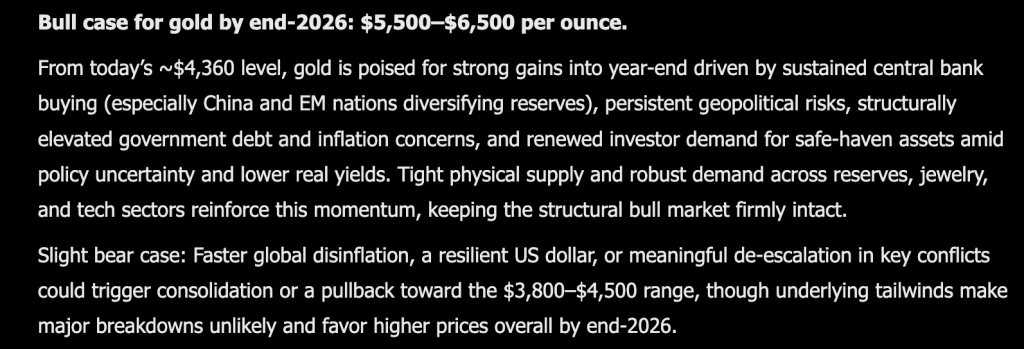
Gold price at $4,360 and Elon Musk’s Grok AI is looking at it and predicts for $5,500 to $6,500 by year end. That is a 26% to 49% move on the oldest store of value in human history, and the argument is not built on hype or cycle narratives. It is built on the kind of structural forces that do not reverse in a quarter.
The demand side of this prediction runs deeper than most people track. Central banks, particularly China and emerging market nations, are actively diversifying away from dollar reserves and buying physical gold at a pace that has no modern precedent.
That bid does not disappear when sentiment shifts, it is policy-driven and sticky. Layer on top of that the persistent geopolitical risks that keep showing no sign of resolution, structurally elevated government debt levels across every major economy, and renewed safe-haven demand from investors who have watched real yields compress.
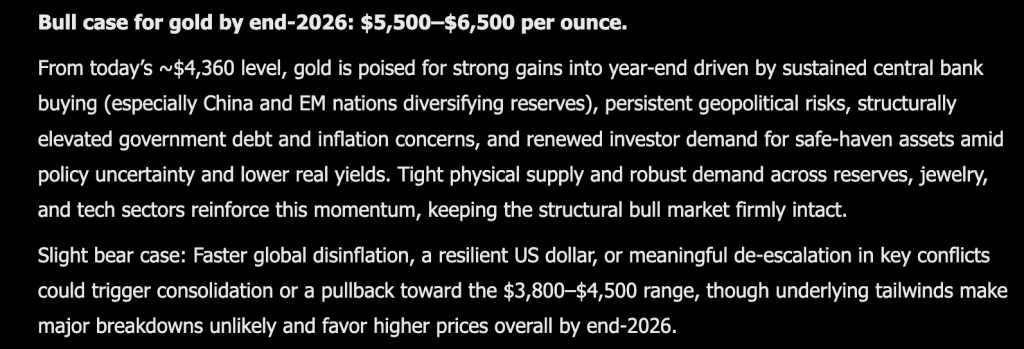
Then add tight physical supply against robust demand from reserves, jewelry, and a tech sector that actually needs the metal. Grok is not predicting a spike, it is describing a structural bull market that has momentum behind it from multiple independent directions.
The bear case is the narrowest on this entire prediction series. Faster global disinflation, a resilient dollar, or meaningful de-escalation in key geopolitical conflicts could pull gold back toward the $3,800 to $4,500 range.
The word meaningful is doing a lot of work in that sentence. The kind of peace and dollar strength required to derail this bull case is not impossible but sits well outside the base case of most macro analysts right now.

Discover: The best crypto to diversify your portfolio with
Gold Price Prediction: When The Pullback Lands Right On The Launch Pad
Gold price is at $4,367 today, up 3.65% on what looks like a decisive reclaim candle after the recent correction.
The daily chart frames the current moment perfectly. From the $3,400 base last August, gold ran to $5,500 in February, one of the cleanest trending moves on any major asset over the past year.
What followed was a textbook bull market consolidation, a series of lower highs from the peak but with the bigger uptrend structure very much intact.
The June low near $4,050 is now the most important level on the chart, because it held the line right at the same $4,000 to $4,200 zone that served as prior resistance before the big run.
Former resistance becoming support is one of the cleaner signals in technical analysis, and today’s 3.65% bounce off that floor suggests the market agrees.
For Grok’s $5,500 to $6,500 target to materialize, the obvious immediate test is the $4,600 to $4,800 zone where multiple failed recovery attempts since March have stalled.
That is the overhead supply that needs to be absorbed before the chart can make a run at the February highs and then beyond.
The bear case floor at $3,800 to $4,500 sits well below current price, which means the risk-reward from here tilts heavily in the direction Grok is pointing.
Here is What Grok AI Predicts For LiquidChain Near Future, Could be Very Bullish
Waiting at resistance for a breakout is standing in line. Someone else’s balance sheet makes that decision.
Bitcoin, Ethereum, and XRP have pressed against the same ceilings for weeks. The catalyst is always one data print away. Institutional inflows are always next quarter. Large-cap traders wait on moves they cannot control.
Early-stage infrastructure plays by different rules. Capital that registers as statistical noise at Bitcoin’s scale moves a small undiscovered project by multiples. The asymmetric return sits in one place: the gap between what a project is worth and what the market prices it at. That gap exists because nobody has found it yet. Once they do, the gap closes.
Cross-chain fragmentation has been pulling value out of DeFi since the first bridge went live. Bitcoin, Ethereum, and Solana were built as independent systems with no shared architecture and no intention to interoperate. Every transaction crossing those boundaries pays for that design decision in fees, slippage, and failed executions. Bridges were the proposed fix. They became the mechanism through which the problem charges its toll.
LiquidChain removes that toll. Three networks inside one execution layer. A single deployment reaches all of them with no cross-chain tax on any interaction.
Grok AI flagged the project as worth watching. The presale sits at $0.01454 with $835,000 raised. Execution is unproven. Adoption is unknown.
Established assets offer a predictable path toward a ceiling the market already sees. LiquidChain is an entry point that closes once the market finds it.
Explore the LiquidChain Presale
The post Elon Musk Grok AI Predicts Staggering Gold Price by End of 2026 appeared first on Cryptonews.

The United States of America and Iran shook hands on a peace deal, which is about to be officially signed on June 19. The financial and crypto markets reacted positively to the news, with Bitcoin (BTC) spiking to a multi-week high of just over $66,000.
The big question now is whether the leading digital asset can sustain its upward momentum or is gearing up for another pullback.
The Bears Remain in Charge?
BTC’s rebound has drawn significant attention, with multiple analysts speculating on the asset’s next potential move. X user Jelle described the pump as a “big victory” for the bulls, predicting that holding above the $63,000-$64,000 range is “looking rather good for relief.”
Ali Martinez noted that the price has finally broken through the $64,360 resistance level and expects a possible ascent to $67,630 “if momentum holds.”
Nonetheless, many others believe the peace news has triggered only a temporary revival, arguing that the cycle’s floor has yet to be formed. X user symbiote sees the creation of a final bottom at around $50,000, labeling that zone as a buying opportunity.
Niels believes the asset’s valuation could rise to $70,000-$72,000 in the short term, but the 4-year cycle suggests the real pain for the bulls could occur by Q3 this year. “Once BTC makes another lower high, it’ll reverse towards $55K for the cycle bottom,” they added.
Some key factors, including the recent whale behavior, reinforce the bearish outlook. As CryptoPotato reported, large investors have reduced their total holdings by over 70,000 BTC in the past month, signaling weakening confidence in the asset and perhaps preparing for a renewed correction. Moreover, their actions could influence sentiment and lead some smaller players to exit the ecosystem.
Waiting for These Events
Another popular analyst who touched upon BTC’s latest price movement and gave an interesting prediction for the near future is Ted. The X user outlined the general optimism in the space following the US-Iran peace deal and forecast that staying above $65,000 could lead to a move toward $70,000. As of the moment, though, he doesn’t see “enough real strength to confirm that scenario.”
Ted claimed that BTC’s price will depend heavily on major economic events this week, including the Federal Reserve’s interest rate decision and the possibility of further rate hikes by the Bank of Japan.
The FOMC meeting on June 17 will be the debut of Chair Kevin Warsh, and the expectations are that the benchmark will remain unchanged in the 3.5%-3.75% range. However, investors will closely monitor his speech for any hawkish or dovish signals that might hint at how the central bank plans to guide policy in the months ahead, potentially leading to heightened volatility across the entire crypto market.
The post Top Bitcoin (BTC) Price Predictions After the US-Iran Peace Rally appeared first on CryptoPotato.

NFT brand Pudgy Penguins is winding down its mobile game Pudgy Party and pausing any further development, according to an announcement from the project’s team on X. The studio says it will redirect its gaming efforts toward Pudgy World, a browser-based experience it frames as the “flagship” game within the Pudgy Penguins ecosystem.
The shift comes after Pudgy Party launched in August 2025. The team said the game exceeded 500,000 downloads on Google Play, with total downloads topping 1 million across platforms. By consolidating its roadmap behind Pudgy World, Pudgy Penguins is signaling that it wants a single gaming product designed for broader reach and longer-term scalability.
Key takeaways
- Pudgy Party is being sunset: the team says it will wind down operations and halt further development.
- Pudgy Penguins is consolidating gaming around Pudgy World, described as the ecosystem’s flagship browser experience.
- Pudgy Party hit 500,000+ downloads on Google Play and more than 1 million total downloads, despite the pivot.
- The move reflects ongoing difficulty in Web3 gaming: another project, Fishing Frenzy, is also shutting down.
Pudgy Penguins exits one mobile game to focus on a “flagship”
In its X post, the Pudgy Party team described the decision as difficult, but argued that Pudgy World holds “greater potential for scalability” and is more likely to bring new users into the Pudgy Penguins brand.
That reasoning matters for investors and players because it points to a core challenge in crypto-gaming: building a product that can sustain a player base while integrating with Web3 monetization and brand ecosystems. A mobile launch can generate early traction—as Pudgy Party did—but the team’s decision suggests that user acquisition and retention may not have translated into a durable long-term plan.
Pudgy Penguins has positioned itself beyond NFTs, pursuing initiatives across toys, gaming, licensing, and broader entertainment. The gaming consolidation therefore appears less like an abandonment of the category and more like a strategic attempt to concentrate development resources behind one experience that can serve as a stable on-ramp for the brand.
What Pudgy Party’s download numbers imply—and what they don’t
Pudgy Party’s stated reach—500,000+ downloads on Google Play and over 1 million total—signals that there was consumer interest. But a pivot after those milestones suggests that download counts alone may not be sufficient to justify ongoing development.
For readers watching Web3 gaming, the important distinction is between “top-of-funnel” adoption and “business model” sustainability. Mobile downloads can be driven by marketing, brand recognition, or viral momentum. Turning that into long-term engagement and a viable revenue structure is typically harder—especially for projects that must balance Web2-style game economics with token incentives, on-chain components, or crypto-native distribution.
Pudgy Penguins’ rationale explicitly mentions scalability and onboarding, which hints that the team believes the browser-based format or ecosystem design of Pudgy World may better support ongoing growth.
Web3 gaming’s recurring problem: product-market-business fit
Pudgy Party’s wind-down arrives during a broader wave of uncertainty in Web3 gaming. Earlier, Fishing Frenzy and its developer, Uncharted, announced they would cease operations after concluding they couldn’t establish a sustainable crypto-gaming thesis.
In an X post shared on Monday, Fishing Frenzy said it was “unable to prove our thesis on crypto gaming” and “could not find product-market-business fit.” The team said it spent the previous year testing multiple approaches and targeting different audiences without finding a path that gave them confidence to continue.
This parallel is significant: it suggests that even projects that experiment actively and iterate for extended periods may struggle to find a stable formula that combines gameplay appeal, user retention, and a monetization model that can withstand market and platform realities.
How Fishing Frenzy is shutting down—and what it’s doing with USDC and tokens
Fishing Frenzy said it will shut down its servers on June 25 at 2:00 a.m. UTC. The project also made notable changes to its token and sales mechanics: it stopped selling USDC packages and adjusted the FISH token so it is spend-only and untradable.
The team said remaining USDC in the FISH/USDC liquidity pool would be redistributed to community members and stakers. By outlining a specific redistribution plan rather than a vague “we’ll figure it out,” the project is trying to manage expectations as it exits.
These details matter because they show the practical constraints that Web3 gaming projects face when they can’t scale their business: token utility can be constrained, markets can lose liquidity, and teams may ultimately need to wind down infrastructure while addressing on-chain balances and user expectations.
NFT market backdrop: capitalization rises, but the sector is still far from prior highs
Alongside the gaming-specific developments, NFT market conditions have been fluctuating. CoinGecko data cited in the original reporting shows total NFT market capitalization climbed to nearly $1.5 billion on Monday, up from more than $1.3 billion on Friday. Still, that level remains dramatically below the sector’s 2022 peak of over $17 billion.
For builders and brand-led NFT ecosystems like Pudgy Penguins, this environment can increase pressure to demonstrate real utility. When the broader market is well below prior highs, it often becomes harder to finance development through speculative demand alone—making it more likely that teams will prune or restructure product lines to focus on what can be scaled efficiently.
At the same time, modest rebounds in market capitalization can give projects breathing room, but the trajectory of Web3 gaming may depend less on NFT prices day-to-day and more on whether games can stand alone as compelling user experiences while delivering coherent incentives.
Going forward, the key question is whether Pudgy World can deliver the scalability and new-user onboarding that Pudgy Penguins is targeting, especially in a market where other crypto games have struggled to prove long-term business fit. Readers should watch for updates on Pudgy World’s rollout and for any further clarification from Pudgy Penguins on how gaming will tie back into the broader brand beyond NFTs.
Crypto World
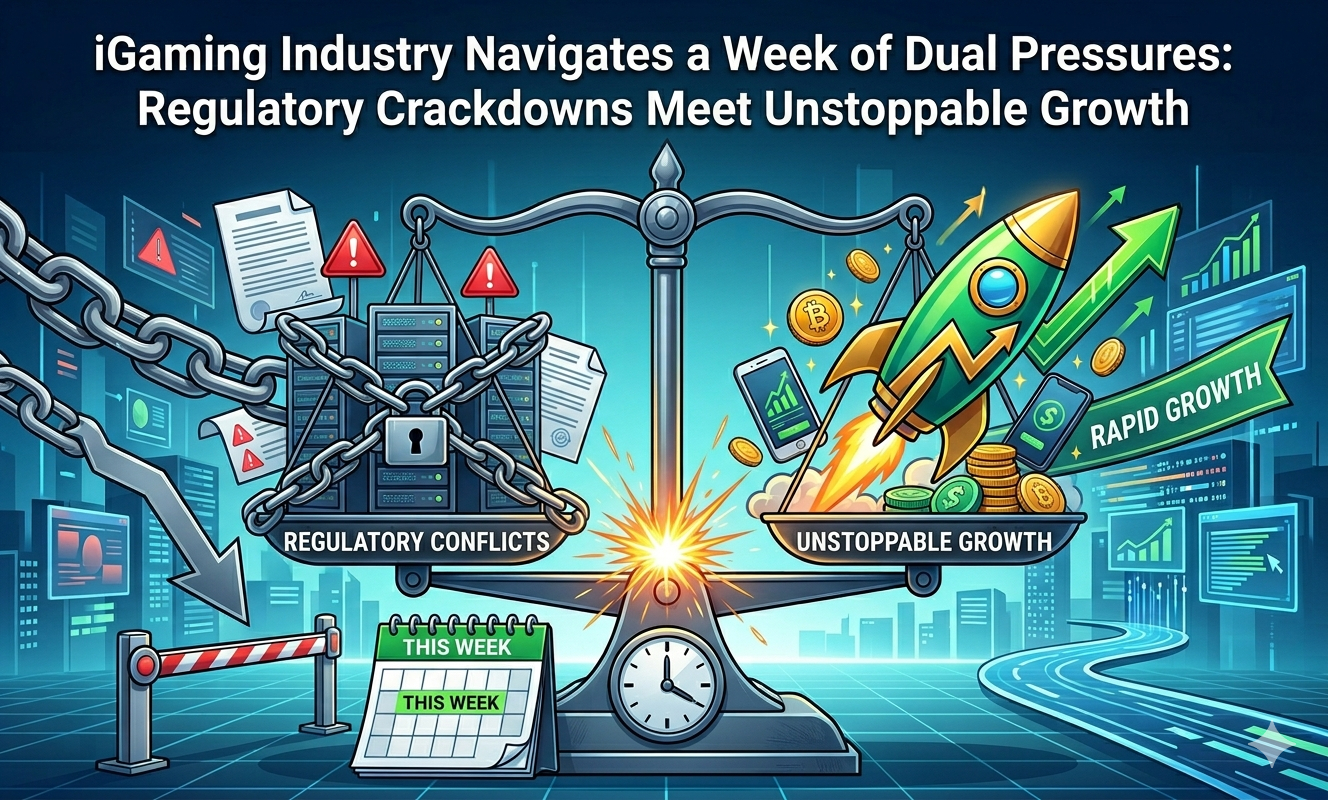
NyesteCasino.com Reports: iGaming Industry Navigates Dual Pressures of Regulation and Growth
[PRESS RELEASE – Norwich, United Kingdom, June 15th, 2026]
NyesteCasino.com, a leading iGaming analysis resource, released its latest industry overview, highlighting a week defined by intensifying regulatory scrutiny alongside continued global market expansion.
From U.S. Senate hearings and a widening circuit split to the localisation of crypto casinos and a surge in World Cup betting activity, iGaming operators have been balancing risk management with aggressive growth strategies.
Over the past week, the global iGaming sector has faced two powerful and often conflicting forces. Regulators across the United States, Europe, Southeast Asia, and South America have tightened rules around prediction markets, sweepstakes casinos, and credit card usage for deposits. At the same time, online gambling platforms, content providers, and policy advisors have accelerated product innovation and executed timely, region-specific sports marketing campaigns.
According to NyesteCasino.com’s team, these developments signal a broader structural transition across the industry—one in which compliance agility is rapidly becoming as critical to success as product quality. Despite increasing regulatory headwinds, the pace of innovation and market demand continues to point toward sustained sector growth.
Prediction Markets: Courtrooms, Congress, and Cross-Border Bans
The week started with a long-awaited US Senate Commerce Subcommittee gathering. The hearing named “No Sure Bets” took place on May 20 under Chair Marsha Blackburn, and Blackburn indicated more sessions were to come. The debate between American Gaming Association CEO Bill Miller and former Congressman Patrick McHenry quickly turned into a clash over the future of prediction markets. While Miller named the sports event contracts as backdoor betting operations bypassing the state licences, tax regulations, and integrity safeguards, McHenry talked on behalf of the Coalition for Prediction Markets and opposed him, stating that the current CFTC supervision is working perfectly.
On 22 May, a panel from the Ninth Circuit rejected the stay requests filed by both Kalshi and Polymarket, refusing to halt state enforcement proceedings in Nevada and Washington, which complicated the legal situation even more. The court ruled that a federal preemption defence under the Commodity Exchange Act cannot, on its own, establish federal jurisdiction. The ongoing disagreement in the appeals court of New Jersey, which had previously upheld a Kalshi injunction, has gained strength with this decision. Moreover, the process leading to a Supreme Court review of state jurisdiction over event contracts has accelerated even more.
Indonesia’s Ministry of Communication and Digital Affairs categorised Polymarket as an online gambling site, disregarding its crypto-based structure, and has requested a national ban on the market platform on May 25. The reason for this request was a viral contract regarding whether President Prabowo Subianto would resign before the end of his term in October 2029. The contract generated a trading volume of approximately $46,000. The number of jurisdictions where Polymarket is inaccessible is growing, exceeding 33 around the world now, including India, Brazil, and Singapore, among other new blockers.
State-Level Regulations: An Anti-Sweepstakes Bill from Tennessee
There have also been state-level restrictions in Tennessee on online gambling law. During the same week, Governor Bill Lee signed two vital bills. Senate Bill 2136 made Tennessee the ninth US state banning sweepstake casinos and dual-currency systems completely, which grants the attorney general the power to enforce it. And according to the SB 1992, the second bill signed by the governor, anyone who deliberately influences the outcome of an event whilst holding a prediction market contract will be charged with a Class E felony. It is expected that these bills will guide other state legislatures who are planning similar regulations at the moment.
Europe and Brazil: Tax Proposals, Ad Restrictions, and Credit Bans
The European Parliament held a plenary debate on May 20 on a proposed EU-level gambling levy. Budget Commissioner Piotr Serafin confirmed the Commission is actively assessing the option alongside digital services and crypto-asset levies as part of the next Multiannual Financial Framework. Proponent MEP Victor Negrescu estimated the levy could raise between €2 and €4 billion annually for education, youth, and addiction prevention programmes. Opponents from EPP and ECR blocs raised concerns over subsidiarity, competitiveness, and national tax sovereignty, with any operational package targeted for January 2028.
Belgium’s Kansspelcommissie and the Netherlands Gambling Authority separately issued formal World Cup advertising warnings to licensed operators ahead of the June 11 to July 19 FIFA tournament. France’s ANJ flagged a year-on-year rise of more than 25% in operator marketing budgets as the tournament approaches. Meanwhile, Brazil formalised rules on May 25 to close off Pix Crédito as a deposit method on regulated betting platforms, a move prompted in part by a Folha de São Paulo audit revealing that major banks including Bradesco and Banco do Brasil, were still processing credit transfers into betting accounts as recently as mid-May.
Editorial Perspective
“What this week makes clear is that the iGaming sector is entering a phase where regulatory IQ is as strategically important as product development,” said the editorial team at NyesteCasino.com. “The prediction markets debate alone spans courtrooms, congressional hearings, and international bans and it is far from resolved. Operators who can track and adapt to this multi-jurisdictional complexity while still executing on World Cup campaigns and localisation strategies will be best positioned for the second half of 2026.”
About NyesteCasino.com
NyesteCasino.com is a leading independent iGaming review and analysis platform. The editorial team tracks regulatory developments, operator news, and product releases across global markets to help players and industry professionals navigate the evolving online casino landscape. Users can learn more at nyestecasino.com.
The post NyesteCasino.com Reports: iGaming Industry Navigates Dual Pressures of Regulation and Growth appeared first on CryptoPotato.


BitMine Immersion Technologies (BMNR), the largest Ethereum-focused treasury company, continued its purchase streak after raising fresh capital through a preferred stock sale.
The firm acquired 76,881 ether (ETH) over the past week, worth roughly $136 million based on ETH’s current price, lifting Bitmine’s treasury to 5.62 million ETH.
The company also held 204 bitcoin, $502 million in cash and marketable securities and stakes in Beast Industries and Eightco Holdings, bringing total crypto, cash and investment holdings to $10.4 billion.
The latest purchase was smaller than the previous week’s 126,971 ETH acquisition, its largest weekly haul of 2026. Still, it suggests the company remains committed to accumulating ETH despite Lee’s comments last month about slowing purchases as the firm neared its goal of owning 5% of Ethereum’s supply.
“We are maintaining a somewhat elevated pace of buying as we believe this pullback in ETH prices does not reflect the strengthening of Ethereum fundamentals,” Bitmine Chairman Thomas Lee said.
Bitmine’s preferred equity debut
The purchase comes on the heels of raising $274 million by issuing preferred equity that offers 9.5% annualized dividend. The move resembles financing tools pioneered by bitcoin treasury firm Strategy (MSTR), which have increasingly turned to preferred equity and other yield-bearing securities to fund crypto purchases.


Indian AI startup Sarvam AI has reached a reported valuation of $1.5 billion after raising $234 million in the first close of its Series B round, making it the highest reported Series B valuation in India’s startup history.
The round, led by HCLTech, is expected to reach about $300 million in total. The valuation puts Sarvam at the centre of India’s push to build domestic AI infrastructure at a time when governments are growing more cautious about dependence on foreign models.
Sarvam builds large language models, speech tools, translation systems, and AI agents designed for Indian languages and local use cases. Its focus is on voice-first AI, public services, enterprise tools, and regional-language access.
The Sovereign AI Narrative
That strategy fits the broader idea of sovereign AI. In simple terms, sovereign AI means a country wants more control over the models, data, computing systems, and AI services that power its economy and government.
The concept has gained new relevance after the recent Anthropic Fable 5 and Mythos 5 controversy in the US.
Anthropic said it had to disable the models for all customers after US restrictions barred access for foreign nationals, including some foreign-national employees.
The case showed how quickly access to advanced AI systems can change when national security, export controls, or policy pressure enter the picture. For countries such as India, that risk strengthens the case for building domestic alternatives.
However, sovereign AI does not mean full independence. India still depends on global chips, cloud providers, and open-source research. Sarvam’s bet is more practical: build AI systems that work for India’s languages, rules, institutions, and scale.
That is why the funding round matters beyond valuation. It signals that investors and policymakers now see AI infrastructure as a strategic asset, rather than just another software market.
The post Sarvam AI Hits Record Series B Valuation as Sovereign AI Gains Urgency appeared first on BeInCrypto.


A key player on the fast-growing derivatives exchange Hyperliquid’s private-company trading is shutting down, pointing to consolidation in one of the industry’s hottest new markets.
Ventuals, the project behind perpetual futures tied to OpenAI and Anthropic valuations, said Monday it is winding down and that its team will join another project building within the Hyperliquid ecosystem.
The move has halted trading in the OPENAI and ANTHROPIC markets, with all positions settled automatically. Other markets will be shutting down in the coming days. The team said it generated more than $650 million in trading volume and attracted over 500,000 HYPE in community support during its run.
The shutdown comes as crypto-native trading venues increasingly push beyond digital assets into markets traditionally associated with Wall Street. Traders can now use perpetual futures to speculate on commodities, equities and private-company valuations through blockchain-based markets.
Hyperliquid has become one of the leading venues for that trend. The exchange processed roughly $234 billion in perpetual futures volume over the past month, according to DefiLlama data.
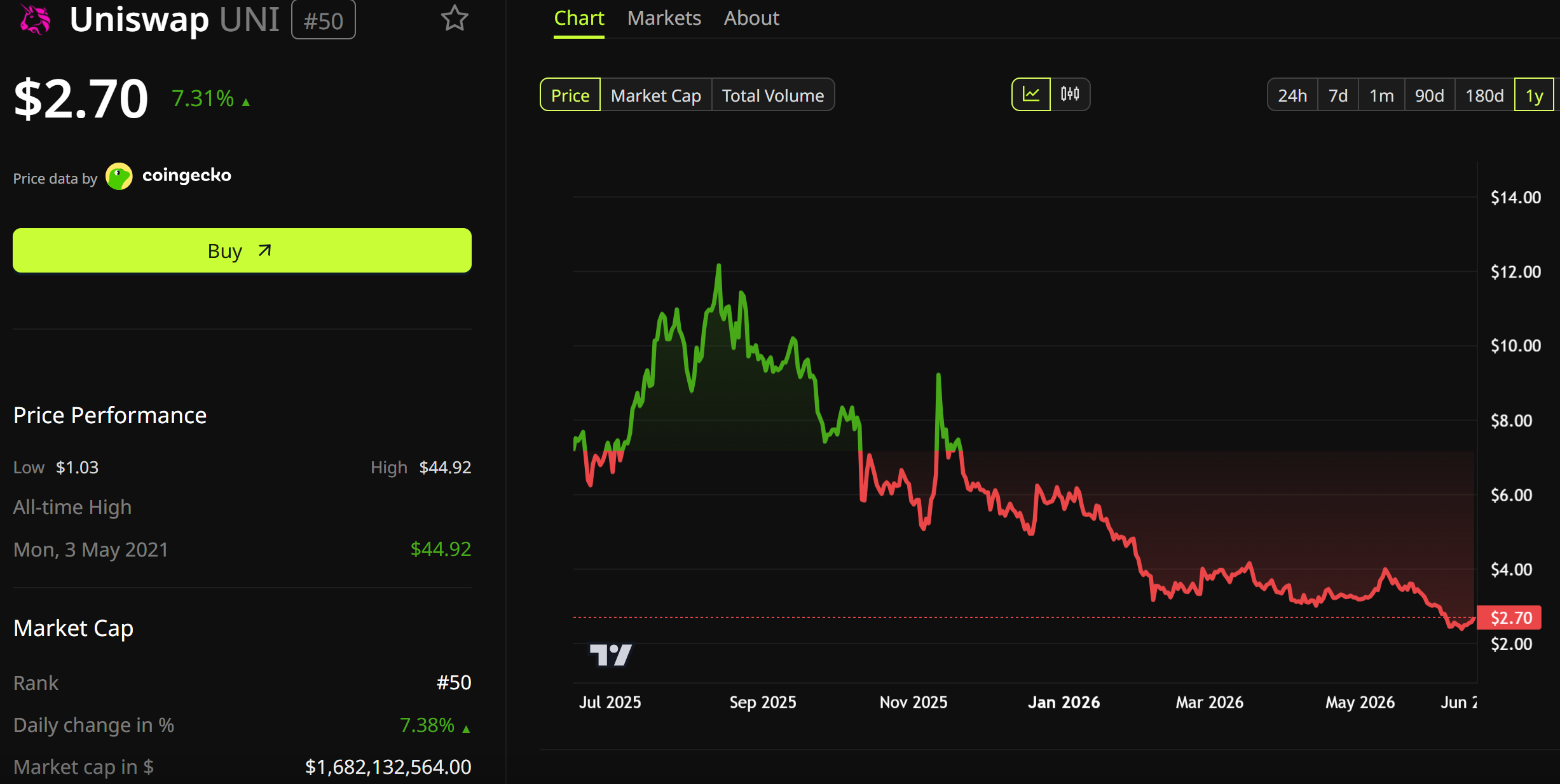
Standard Chartered has initiated coverage on Uniswap (UNI) with a $100 price forecast by the end of 2030, a roughly 40-fold jump from current levels. The bank ties the call to a projected 37-fold rise in tokenized assets entering decentralized finance (DeFi).
The forecast frames Uniswap as one of the clearest token bets on a broader shift, the convergence of traditional finance and blockchain rails as real-world assets, stablecoins, and crypto-native tokens migrate on-chain.
The $2.7 Trillion DeFi Bet
Geoffrey Kendrick, head of digital assets research at Standard Chartered, laid out the thesis in a Monday note.
He expects tokenized assets on-chain to reach $4 trillion by the end of 2028, up from $340 billion today. The bank sees the share of those assets active in DeFi climbing to 30% by 2030, from about 3.5% now.
By its math, that shift implies $2.7 trillion locked in DeFi, a 37-fold increase from today.
Standard Chartered argues the same growth would leave Uniswap liquidity pools with 37 times more on-chain assets to trade.
“I estimate that the amount of tokenized assets active in DeFi will 37x by the end of 2030” Kendrick wrote in the note.
Follow us on X to get the latest news as it happens
Why the Bank Picked Uniswap
Standard Chartered cited Uniswap’s role as an all-purpose infrastructure layer, its brand recognition, and its dominance in highly correlated pair trading.
As real-world assets move on-chain, pools can match naturally correlated tokens in ways that the bank says traditional firms cannot build on their own.
That argument is already being tested. Tokenized versions of stocks, including SpaceX, Apple, and Tesla, went live on Uniswap last week, part of more than $9.1 billion swapped in real-world asset pools across over 2.6 million transactions.
The institutional pull is visible higher up, too.
In February, BlackRock’s tokenized BUIDL fund became tradable through UniswapX, and the asset manager took a strategic stake in the Uniswap ecosystem.
The protocol’s recent UNI token burn proposal and its Unichain layer-2 network aim to tie protocol fees more directly to token value.
“If Uniswap can commercialize enough and create significant enough TradFi partnerships to scale, its market cap-to-transaction fees multiple is likely to increase, narrowing the gap with Coinbase,” the Standard Chartered executive added.
Price Still Lags the Forecast
For now, the token trades well below the bank’s roadmap. UNI’s market price sat near $2.71 on Monday, up about 8% on the day but down roughly 62% over the past year, with a market value near $1.68 billion.

That price trails the bank’s 2026 target of $6.50. Standard Chartered’s ladder then climbs to $20 in 2027, $40 in 2028, $65 in 2029, and $100 in 2030, a path it expects to outpace both Bitcoin (BTC) and Ethereum (ETH).
The UNI token price following protocol growth remains the open question.
Regulators only dropped a Uniswap probe last year, and longer-term UNI price forecasts still hinge on how quickly tokenized assets actually reach DeFi.
The post Standard Chartered Forecasts 37x Surge For This Altcoin in $2.7 Trillion DeFi Bet appeared first on BeInCrypto.

The Tom Lee-chaired former bitcoin miner turned Ethereum treasury company continues to increase its ETH holdings by purchasing over $135 million worth of the asset.
Its total holdings have skyrocketed to 5,620,754 ETH, currently valued at around $10 billion, given the asset’s price today. This means that the company, whose average entry price is around $3,450, still sits on a massive unrealized loss of well over $9 billion.
ETH Holdings Keep Rising
The press release shared from the company earlier today indicated that its total stash has grown to $10.4 billion, albeit crypto prices were slightly lower at the time. Aside from the massive ETH fortune, Bitmine owns 204 BTC, $502 million in cash and marketable securities, as well as equity stakes in Beast Industries and Eightco Holdings valued at a combined $268 million.
Tom Lee described the $135 million purchase as an “elevated pace” of buying the asset despite its most recent market pullback that sent it to $1,500 at the start of the month. The company is now 93% of the way toward owning 5% of Ethereum’s total supply.
Nevertheless, Bitmine continues to be a major ETH supporter, noting that it doesn’t believe the current market downturn rightfully reflects its position in the market.
“The Series A Preferred Stock offering is good balance sheet diversification for Bitmine. The Company’s current projected annualized staking rewards of approximately $219 million provide recurring cash flow to support the dividends related to the Series A Preferred shares,” stated Lee.
Bitmine’s Staking Venture
He added that Bitmine has become a major participant in Ethereum staking, as 4.72 million ETH tokens, or more than 83% of its total holdings, have been staked through its validator operations.
Using current staking yields, the company projects annualized staking revenue of approximately $226 million. The firm estimated that if it deploys all of its ETH through staking, its annual rewards could rise to about $270 million.
Bitmine remains the second-largest cryptocurrency holder with its $10 billion worth of ETH and 204 BTC. It trails only Strategy, which, despite a minor sale completed by the end of May, has continued its substantial accumulation with another $100 million BTC purchase announced earlier today. It now owns approximately $56 billion worth of bitcoin.
The post Bitmine Adds $135M in ETH, Closing In on 5% of Ethereum Supply appeared first on CryptoPotato.
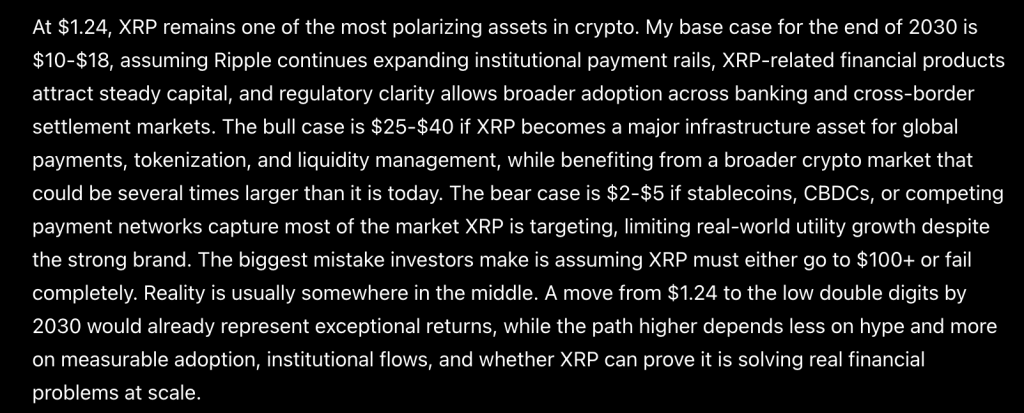
There is a line in this prediction that cuts through the noise better than any price target. The biggest mistake investors make is assuming XRP must either go to $100 plus or fail completely. Sam Altman’s ChatGPT is essentially asking the XRP community to grow up, to stop swinging between cult and obituary, and to start thinking about this asset the way you would any infrastructure play with a long runway ahead.
The base case for end of 2030 is $10 to $18 from $1.24 today, roughly an 8x to 14x over 4 years, which sounds modest until you frame it correctly.
That is the scenario where Ripple just keeps doing what it is already doing, expanding institutional payment rails, attracting steady capital into XRP-related financial products, and riding the regulatory clarity that has been slowly materializing.
No moonshot assumptions required, just execution and adoption continuing at the current pace.
The bull case at $25 to $40 is where the story gets genuinely interesting. That range implies XRP has crossed the threshold from promising network to critical global infrastructure, embedded into cross-border settlement, tokenization flows, and liquidity management at a scale that commands a serious premium.
It also assumes the broader crypto market is several times larger than today, which is not a stretch for a 4-year horizon if institutional adoption keeps compounding.
The bear case at $2 to $5 is the scenario in which stablecoins, CBDCs, or competing payment networks eat XRP’s lunch despite its brand strength, capturing the market it is targeting before it can fully claim it.

XRP Price Prediction: The Weekly Chart Has A Story To Tell Too
Pull up the weekly, and the first thing that hits you is the sheer scale of what happened in late 2024. XRP launched from under $0.70 and ran to $3.84 in a matter of weeks, one of the most violent altcoin moves in recent memory.
What followed was an equally persistent grind back down, and the weekly chart now shows price at $1.24, sitting just above the pre-breakout consolidation zone that held for most of 2023 and early 2024.
That context matters for the 2030 thesis. XRP has already proven it can reprice dramatically when conditions align.
The question ChatGPT is really asking is whether the next reprice is driven by the same speculative frenzy or by something more durable underneath.
The $1.00 to $1.30 region is now the critical zone, a range that served as resistance for years before the 2024 breakout and now sits as long-term support.
Lose it on a weekly close, and the setup gets complicated. Hold it, and you have a base that serious infrastructure tends to build from.
The RSI on the weekly is at 36.02 with the signal line just below at 35.11, nearly flat against each other, with the gap barely over 1 point.
That tight convergence after a long drift lower tells you momentum has stopped declining but has not yet found a reason to accelerate upward. It is the RSI equivalent of a held breath, compressed and waiting for a catalyst.
Given that ChatGPT’s whole argument rests on measurable adoption and institutional flows rather than hype, that compressed momentum makes sense. The chart is not pricing in $10 yet. It is simply stopping the bleeding and asking what comes next.
Here is What ChatGPT AI Predicts For LiquidChain Near Future, Could be Very Bullish
Large-cap traders are not positioning. They are standing in line.
Bitcoin, Ethereum, and XRP have been pressing against the same ceilings for weeks. The catalyst is always one print away. The institutional inflows are always next quarter. Every breakout depends on a decision made by someone else.
Early-stage infrastructure plays by different rules. Capital that disappears as noise at Bitcoin’s scale moves an undiscovered project by multiples. The return lives in the gap between what something is genuinely worth and what the market has priced it at. That gap closes the moment the project gets found.
Cross-chain fragmentation has been bleeding DeFi since the first bridge launched. Bitcoin, Ethereum, and Solana were built as separate systems with no intent to interoperate. Every transaction crossing those boundaries pays for that in fees, slippage, and failed execution. Bridges were supposed to fix it. They became the toll booth.
LiquidChain removes the toll booth entirely. Three networks inside one execution layer. One deployment. No cross-chain tax.
Copilot AI flagged it as worth watching. The presale is at $0.01454 with just over $835,000 raised.
Execution is unproven. Adoption is unknown. Established assets offer a predictable ride toward a ceiling that is already visible. LiquidChain is an entry point that disappears once the market finds it.
Explore the LiquidChain Presale
The post Sam Altman ChatGPT Predicts Explosive XRP Price by End of 2030 appeared first on Cryptonews.

Florida sues TikTok, claiming it violates state child safety law

Elon Musk Grok AI Predicts Staggering Gold Price by End of 2026

Oliver Tree & Five Others Killed After Helicopter Crash In Brazil


-

 Business1 day ago
No Jackpot Winner as $257 Million Prize Rolls Over to $269 Million Monday Draw
-

 Crypto World4 days ago
Oppenheimer backs SpaceX as $70 billion retail frenzy builds
-

 Crypto World4 days ago
Markets Rally as SpaceX IPO Looms Amid Iran Tensions and Inflation Surge
-

 Fashion3 days ago
Weekend Open Thread: Tuckernuck – Corporette.com
-
 Crypto World20 hours ago
Zimbabwe Requires Crypto Businesses to Register Annually Under New FIU Regulations
-

 Entertainment6 days ago
The Ryan Gosling True Crime Thriller On Netflix That Gets Even Stranger, Stream It Now
-
 Sports6 days ago
Bangladesh beat Australia after 20 years in ODIs, register only their second win over six-time world champions | Cricket News
-

 Tech3 days ago
NanoClaw integrates JFrog registries to secure AI agent downloads
-

 Tech3 days ago
This Week In Security: Microsoft On Microsoft, Register Your Domains, Linux On ARM, And FreeBSD Joins The File Cache Club
-

 Crypto World3 days ago
Bitget enters Argentina’s regulated crypto market through PSAV registration
-

 Politics4 days ago
Politics Home | Healey Resignation Is “Colossal Failure Of Government”, Says Former Labour Defence Secretary
-
 Tech4 days ago
Dutton Ranch star claims they ‘didn’t see any disruption’ on set following Chad Feehan’s exit from Yellowstone spinoff fueled by Taylor Sheridan clash rumors
-

 NewsBeat4 days ago
El Nino has formed in the Pacific and could set records, forecasters say
-
 Tech5 days ago
‘This is Seattle’s position on AI’: City Council votes unanimously to pause big new data centers
-
 Entertainment4 days ago
Donnie Wahlberg & More Heat Up Las Vegas at Circa’s Barry’s Downtown Prime
-

 Sports4 days ago
First Time Since 1971: Australia Register Historic Low In ODI Cricket
-
 Tech4 days ago
Opendoor Ends India Operations, Fueling a Bigger Conversation About AI and Outsourcing
-

 Politics4 days ago
Belfast burns, while Met chief points finger at Iran and Russia
-

 Business6 days ago
Thailand Ranks Second Worldwide for AI Adoption Growth, Microsoft Reports
-

 NewsBeat3 days ago
FBI searches office of Ohio voter registration group
You must be logged in to post a comment Login