
Crypto World
How Crypto Can Protect Your Privacy Online?



There are many considerations for internet users these days, one of which is privacy. Because we’ve lived through several scandals, such as Cambridge Analytica, which showed just how easily our sensitive information can be collected and misused, many of us are using the internet as cautiously as possible.
This is reflected in the rise of virtual private networks, privacy browsers, and much more. But did you know that cryptocurrency is a very valuable tool for this effort? Here are a few ways cryptocurrency helps.
How Crypto Can Protect Your Privacy Online?
Bypassing Registrations
 For many of us, the loss of privacy begins when we even sign up for various online services. Usually, we have to provide some sort of sensitive information such as our government name, email address, phone number, and much more.
These concerns are not limited to one type of platform, but appear across financial, social, and entertainment services alike, as cryptocurrency continues to simplify access and reduce friction across digital ecosystems.
This shift is particularly visible in online gambling, a multi-billion-dollar industry where user identification has become a standard part of onboarding.
Typically, you would have to register by providing your government ID, proof of address, and much more. However, using cryptocurrency, you can use online casinos without verification.
This is because many platforms that accept cryptocurrency allow players to simply connect their digital asset wallets to the platform and deposit and withdraw tokens as needed. This way, you are completely anonymous and can access your services with ease.
Privacy Cryptos
It is important to know that there is an entire category of cryptocurrencies that are built for the purposes of privacy. Tokens like Monero and Zcash fall under the category of privacy tokens, and these can be used in complete anonymity.
These tokens are near impossible to track across a blockchain, and this means no one can monitor your activities using your crypto.
Those who already use cryptocurrency or want to get into it should certainly consider privacy tokens as a tool for a privacy-centric lifestyle. Luckily, most privacy tokens can be easily obtained on various exchanges, so there’s a low barrier to entry.
Token Mixers and Address Generators
For those who don’t want to use privacy tokens for their transactions, token mixers offer another alternative. These are essentially services that scramble the origin and destination of various cryptocurrencies so that no one tracking them on the blockchain can tell where they are coming from as they are being moved.
While token mixers have faced some controversy in the past, they have nevertheless continued to be popular among two users, especially high-net-worth ones that don’t want their activities constantly broadcast on whale watching accounts.
If you fall into this category or simply want more privacy, consider the mixers. There are also address generators that create new crypto wallet addresses every time someone wants to complete a transaction, and this means that the activities can go largely undetected.
Once again, it is highly recommended for those looking to make the most of their crypto use while staying private.
Privacy-Centric Blockchains
 While traditional blockchains have focused on transparency, new options prioritize privacy and protecting user data. Tokens like Litecoin are based on blockchains that keep transactions hidden using various mechanisms.
While they are the minority of blockchains at the moment, it’s believed that more will be launched in the near future to cater to the rising demands of privacy from crypto users.
Conclusion
Cryptocurrency and privacy can be a match made in heaven if you know the right tools and processes to use.
As we have noted in this article, there are several ways you can go about using cryptocurrency to preserve your privacy, whether that is making payments, transmitting information, or signing up for services.
Look into these options, and combined with other privacy tools, you should get your wish.


The Commodity Futures Trading Commission has added a slew of crypto executives, including those from Coinbase and Ripple, to its Innovation Advisory Committee, who will shape how the regulator crafts policy.
CFTC chair Mike Selig said on Thursday that the 35 members of the committee will “ensure the CFTC’s decisions reflect market realities” and enable it to “develop clear rules of the road for the Golden Age of American Financial Markets.”
The committee launched in January, and replacing the Technology Advisory Committee, which drew on the advice of tech leaders to dissect how new technologies were impacting the derivatives markets more broadly.
Selig has signalled the CFTC will be more receptive to crypto and has started work with the Securities and Exchange Commission to coordinate on how to regulate the sector.
Crypto executives make up bulk of committee
Of the 35 members making up the committee, 20 are tied to companies involved in crypto, while at least five are involved in prediction markets.
The list includes Gemini CEO Tyler Winklevoss, Polymarket CEO Shayne Coplan, Kalshi CEO Tarek Mansour and Crypto.com CEO Kris Marszalek, in addition to executives at Nasdaq, Intercontinental Exchange, Cboe Global Markets, CME Group, Kraken and Bullish.
Also on the committee is Coinbase CEO Brian Armstrong, Ripple CEO Brad Garlinghouse, a16z Crypto partner Chris Dixon, Solana Labs CEO Anatoly Yakovenko, Uniswap CEO Hayden Adams, Blockchain.com CEO Peter Smith, Robinhood CEO Vladimir Tenev, Grayscale CEO Peter Mintzberg and Anchorage Digital CEO Nathan McCauley.

Related: US fines Paxful $4M for moving funds tied to trafficking, fraud
Executives at Paradigm, DraftKings, and the US Depository Trust and Clearing Corporation were also included.
CFTC to consider input beyond panel
The committee will advise the CFTC on the commercial, economic, and practical considerations of emerging products, platforms and business models in financial markets.
In an announcement in January, the CFTC said that it would also consider the viewpoints of regulatory bodies, academia and public interest groups in forming its policy.
Magazine: A ‘tsunami’ of wealth is headed for crypto: Nansen’s Alex Svanevik
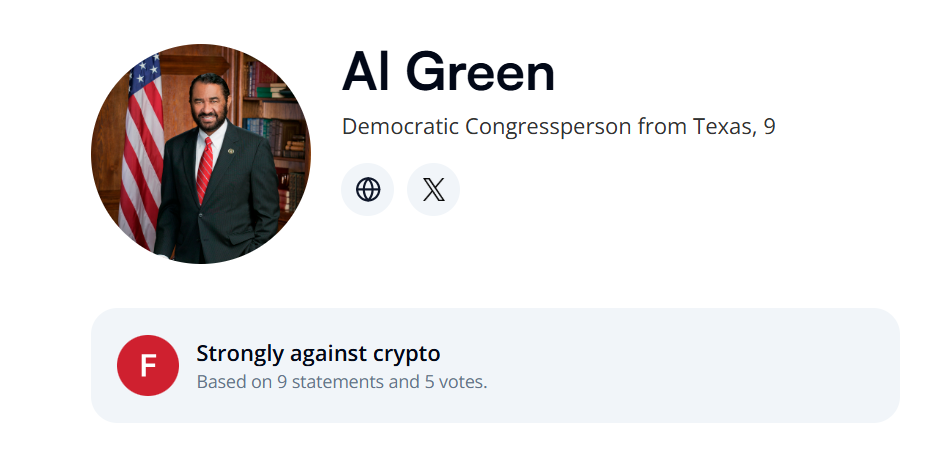
The pro-crypto political action committee (PAC) Protect Progress will reportedly spend $1.5 million opposing Texas representative Al Green in the upcoming Democratic Party primary over his past opposition to crypto.
“As a member of the Financial Services Committee, Representative Al Green has decided to try and stop American innovation in its tracks,” Protect Progress, an affiliate of the major crypto PAC Fairshake, told The Hill on Thursday.
Green, a Democrat who has represented Texas’s 9th congressional district in the House since 2005, opposed the stablecoin regulating GENIUS Act and the CLARITY Act, two crypto-focused bills that the House passed last year.
“Texas voters can no longer sit by and have representation in Congress that is actively hostile towards a growing Texas crypto community,” Protect Progress said. “We are committed to electing new members who embrace innovation, growth and wealth creation for all Americans.”
It’s the crypto lobby’s latest attempt to influence Congress ahead of the midterm elections in November. In the 2024 elections, the crypto industry emerged as one of the largest spenders, with Fairshake alone spending roughly $130 million, resulting in an influx of pro-crypto elected officials.
Super PACs raise money through donations but can’t directly fund or coordinate with political campaigns. Instead, they purchase ads and use other methods to support specific candidates.
Advocacy group says Green against crypto
Green will face off against Christian Menefee in the Democratic primary in March for the reshaped Houston-area district.
Texas will be one of the first states to hold a primary vote on March 3, along with Arkansas and North Carolina, when each party will choose its nominee, followed by the general election on Nov. 3.
Crypto advocacy organization, Stand With Crypto, which compiles previous statements and actions to rate US politicians on their crypto stances, lists Green as “strongly against crypto” based on his voting history and statements about the technology.

Menefee supports blockchain technology
Meanwhile, Stand With Crypto rated Menefee as “strongly supports crypto” based on his answers to the organization’s questionnaire, with one of his answers expressing an interest in legislation that uses the technology for real-world problems, such as combating deed fraud by recording property records on the blockchain.
Related: Trump Bitcoin adviser David Bailey wants to create a $200M PAC
“That kind of innovation could protect working families from scams and modernize outdated government systems. I’d support or introduce bills that promote practical, public-serving blockchain use cases like this,” he said.
Another Fairshake affiliate, Defend American Jobs, announced on Tuesday that it was spending $5 million to support crypto-friendly Republican Barry Moore in his bid for the US Senate. Fairshake disclosed in January that it had gathered $193 million ahead of the midterm elections.
Magazine: 2026 is the year of pragmatic privacy in crypto — Canton, Zcash and more


The Espresso Network has launched its ESP token, opening participation in securing the network and distributing a community airdrop representing 10% of total supply.
The network will eventually transition to a permissionless proof-of-stake model in a few weeks, which follows the rollout of the ESP token, used for staking, securing the network and protocol participation. The Espresso Foundation said the total supply is 3.59 billion ESP, with 10% allocated to a fully unlocked community airdrop aimed at early ecosystem participants and users of Espresso-integrated rollups.
“There were various ways of determining who was eligible,” Espresso Systems CEO and co-founder Ben Fisch told CoinDesk in an interview. “The idea here is to get the token circulating among members of our extended community, but also to reward early participation and adoption of the Espresso network.”
The foundation said additional token supply has been allocated to contributors, investors, future ecosystem incentives and long-term network sustainability, with most allocations subject to vesting.
Espresso acts as a coordination and finality layer for rollups, which operate as independent execution environments. Fisch said the network is designed specifically to serve layer-2 blockchains rather than compete with them at the execution layer.
“Layer-2s need only one thing from a layer-1, which is finality,” Fisch said. “How well a layer-1 provides services to a layer-2 is measured in two things, how secure that blockchain and how fast it can provide finality.”
“Unlike Ethereum, or any other existing layer-1s, it is designed for layer-2s,” he added. “It doesn’t compete with L2s. It’s designed for L2s.”
Espresso currently finalizes rollup blocks in about six seconds on average, compared with Ethereum’s 12-minute-plus finality window (finalizing blocks means that they become immutable). That gap, Fisch argued, has become a structural bottleneck as applications and liquidity spread across multiple rollups rather than remaining concentrated on a single chain.
“Fast finality isn’t a nice-to-have for rollups,” Fisch said. “It’s the missing piece that transforms isolated chains into a unified, composable ecosystem.”
The launch comes as the Ethereum ecosystem debates the future role of layer-2 networks, following recent comments from Ethereum co-founder Vitalik Buterin suggesting the network may eventually pivot away from an L2-centric roadmap as improvements to Ethereum’s base layer reduce the need for rollups as a scaling solution.
That debate has raised broader questions about whether layer-2 networks are extensions of Ethereum or independent blockchains in their own right, and whether infrastructure designed primarily to scale Ethereum will remain relevant as the base layer becomes faster and cheaper.
As Ethereum’s long-term scaling strategy comes under renewed scrutiny, Espresso is betting that demand for application-specific rollups, particularly from institutions and consumer platforms, will continue to grow regardless of Ethereum’s roadmap.
Read more: Espresso, project for composability between blockchains, pushes main product live
CORRECTION (Feb 12 2026, 15:55 UTC): Updates story to say the network will transition to a proof-of-stake blockchain in the next few weeks.

When given a carefully engineered prompt, Perplexity AI reveals explosive predictions for crypto’s top assets, including XRP, Cardano, and Bitcoin.
Its projections suggest all three could reach new all-time highs by the end of 2026, a timeline that could catch many investors off guard.
In the breakdown below, we explore how these forecasts line up with current technical trends, major catalysts, and what they could mean for long-term holders.
XRP ($XRP): Perplexity Says Ripple’s Vision Could Launch XRP to $8
In a recent statement, Ripple reiterated that XRP ($XRP) remains central to its mission of establishing the XRP Ledger as a global, institutional-grade payments network.

Known for near-instant settlement and minimal transaction costs, XRPL also has the potential to corner two rapidly expanding sectors: stablecoins (RLUSD) and real-world asset tokenization.
With XRP currently trading near $1.39, Perplexity projects a potential move toward $8 by the end of 2026, a gain of roughly 6x from current levels.
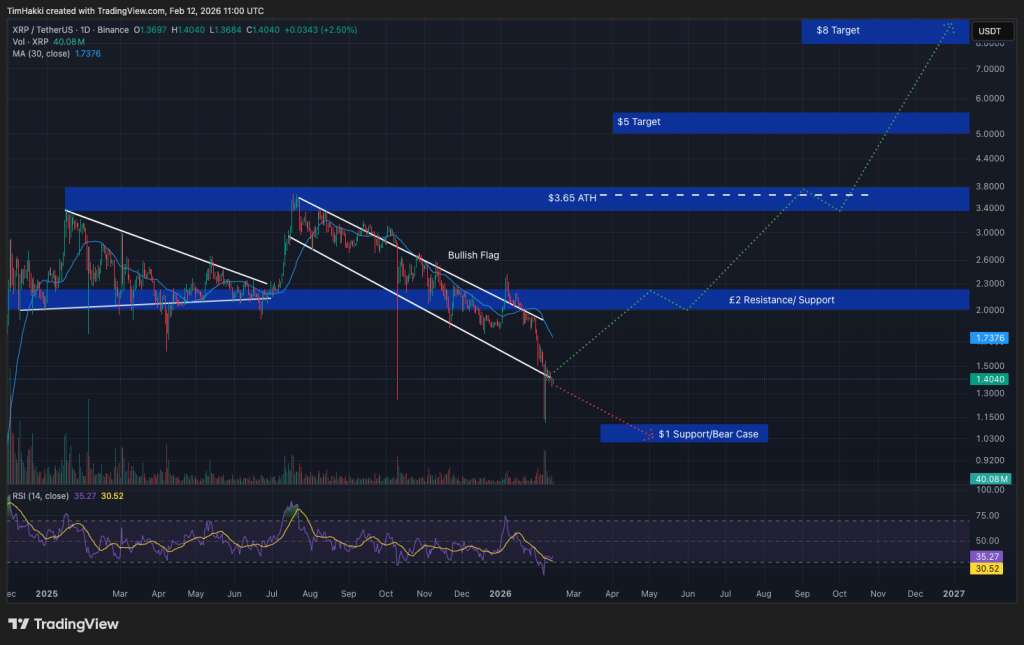
Chart data supports the possibility of a breakout. XRP’s Relative Strength Index (RSI) is at 31 after being oversold, a sign that the recent selloff is ending.
Potential catalysts ahead include new institutional inflows following the recent approval of U.S.-listed spot XRP exchange-traded funds, Ripple’s growing roster of partnerships, and U.S. lawmakers finalizing the CLARITY bill later this year.
Cardano (ADA): Perplexity Sees a 2,100% Rally on the Cards
Founded by Ethereum co-creator Charles Hoskinson, Cardano ($ADA) emphasizes peer-reviewed research, robust security, scalability, and long-term sustainability.
With a market capitalization near $10 billion and over $125 million in TVL, Cardano’s thriving ecosystem continues to support its long-term growth narrative.
According to Perplexity, ADA could surge more than 2,100%, rising from its current price around $0.27 to approximately $6 by Christmas, double its 2021 ATH of $3.09.
However, ADA is currently trading at its lowest level since October 2024. Given the volatility seen so far this year, further downside cannot be ruled out, with a potential retest of the $0.20–$0.25 support zone if the selloff continues.
Bitcoin (BTC): Perplexity Suggests $500,000 Is Possible
Bitcoin ($BTC), the original cryptocurrency and market leader by capitalization, set a new ATH of $126,080 on October 6 before falling 46% to its current price around $67,750.
Often referred to as digital gold, Bitcoin continues to draw interest from both institutions and individual investors seeking a hedge against inflation and macroeconomic uncertainty.
Bitcoin’s recent inertia was intensified by geopolitical concerns around U.S. military actions in Iran and Greenland. However, Perplexity’s analysis indicates that Bitcoin’s broader upward trend remains intact, with a 2026 price target of $250,000.
The AI points to accelerating institutional adoption and post-halving supply constraints as key factors that could drive Bitcoin to multiple new highs this cycle.
Additionally, if U.S. policymakers make good on Trump’s Executive Order to create a Strategic Bitcoin Reserve, Bitcoin’s upside potential could exceed Perplexity’s already optimistic forecasts.
Maxi Doge: Move Aside, Dogecoin, A New Meme Coin Takes Center Stage
For investors chasing higher-risk, higher-reward opportunities, the presale market offers the best opportunity to buy in early.
Maxi Doge ($MAXI) has quickly become one of the most talked-about meme coin presales of 2026, having raised $4.6 million so far.
The project stars Maxi Doge, a degen gym-bro and envious distant relative of Dogecoin who is now claiming the meme coin throne, tapping into the irreverent and competitive humor that first made meme coins a sensation.
Presale investors can currently stake MAXI tokens for yields of up to 68% APY, with rewards gradually decreasing as the staking pool grows.
The token sells for $0.0002803 in the current presale round, with price increases at each funding milestone. Purchases are supported through wallets such as MetaMask and Best Wallet.
Stay updated through Maxi Doge’s official X and Telegram pages.
Visit the Official Website Here
The post Perplexity AI Predicts the Price of XRP, Cardano and Bitcoin By the End of 2026 appeared first on Cryptonews.
Crypto World
Xiaomi’s electric SUV tops China sales in January, sells twice as many as Tesla’s Model Y
Chinese smartphone company Xiaomi launched its YU7 electric SUV in summer 2025, taking direct aim at Tesla’s Model Y.
Sopa Images | Lightrocket | Getty Images
BEIJING — Xiaomi‘s electric car venture has succeeded in dethroning Tesla in China, at least in January.
The Xiaomi YU7 SUV ranked first in China by sales last month, with 37,869 units sold, twice as many as Tesla’s 16,845 Model Y vehicles, according to data from the China Passenger Car Association.
The Model Y, which was the best-selling model in December, plunged to 20th place in January. Among new energy vehicles, it also fell from the first position to seventh over the same period.
The figures include both electric and gasoline-powered vehicles and were published late Thursday by online car sales platform Autohome.
Xiaomi started selling the YU7, its second electric car model, roughly half a year ago in the summer of 2025.
The Chinese company, best known for its smartphones, hasn’t been shy about its aim to take on Tesla. Xiaomi launched the car at a starting price that was 10,000 yuan ($1,450) below the Model Y in China. The company claimed the model beat Tesla on key metrics such as driving range on a single battery charge.

Analysts last year predicted the YU7 would take market share from the Model Y, Tesla’s best-selling car in China. In December, the Model Y ranked first in monthly sales, ahead of BYD‘s budget-priced Qin Plus car. Xiaomi’s YU7 ranked third.
Monthly sales figures can be volatile. While the YU7 did outsell the Model Y in October, the Xiaomi car did not rank first. Tesla has so far been consistently stronger in sales.
Excluding gasoline-powered cars, Tesla ranked fifth in China sales last year, while Xiaomi placed tenth. For all of 2025, BYD led China’s auto market with over 3 million vehicles sold, followed by Geely at 2.6 million, according to China Passenger Car Association data.

Subscribe now
The YU7’s strong sales in January came despite an overall slowdown in China’s electric car market in recent months.
Xiaomi’s earlier SU7 sedan has also faced scrutiny following fatal accidents involving driver-assist features and electrically-powered door handles. Beijing has since banned hidden door handles, while automakers have started installing external lights that indicate when driver-assist is in use.
Like most Chinese electric car companies, Xiaomi also plans to expand overseas, including into Europe next year.


The new token offers investors exposure to lease payments generated by two jet engines.
ETHZilla Corporation (Nasdaq: ETHZ) on Thursday, Feb. 12 launched Eurus Aero Token I, a tokenized asset backed by two commercial jet engines currently in use by a U.S. air carrier.
The tokens — which are issued on Ethereum Layer 2 networks and distributed through the Liquidityio platform — give investors exposure to lease payments generated by the engines. ETHZilla said it acquired the engines for about $12.2 million. Meanwhile, tokens are priced at $100 each, with a minimum purchase of 10 tokens.
The company said in a press release viewed by The Defiant that the investment targets annual returns of about 11% over the life of the leases, which run through 2027 and 2028.
The launch comes as interest in tokenized real-world assets (RWAs) continues to grow across both crypto and traditional finance. Data from RWAxyz shows that distributed asset value rose to $23.87 billion, up nearly 11% over the past 30 days.
The value of underlying RWAs represented on-chain also increased more than 8% during the same period to $21.41 billion. Meanwhile, the number of asset holders jumped to 835,179, a 34% month-over-month increase.
ETHZilla CEO McAndrew Rudisill told The Defiant that the company’s mission is to “democratize access to institutional-grade investments” by giving investors direct exposure to RWAs that have historically been out of reach.
Rudisill explained that jet engine leasing has traditionally been accessible only to large institutions and private investment funds. However, by using tokenization technology, the asset can be accessed by smaller players – though the offering is limited to accredited investors.
“ETHZilla was able to design a financial instrument that is structured around defined lease terms, creating a uniquely transparent, income-oriented alternative to traditional private aerospace leasing structures,” he said.
Lease payments are collected each month and paid out to token holders, the release explained. The engines are not financed with debt, and ETHZilla said it does not plan to use borrowing to boost returns for this product.
While ETHZilla is contractually restricted from naming the specific air carrier, a person familiar with the matter confirmed to The Defiant that it is “one of the largest and most profitable airlines.”
Looking Ahead
Looking ahead, Rudisill said ETHZilla recently acquired a portfolio of manufactured and modular home loans, which it plans to tokenize next.
“Manufactured home loans represent an approximately $14 billion market, and are a high-yield, high-quality asset class historically accessible only to a handful of private lenders,” he said. “Not only will tokenizing these assets open this market up to a broader range of investors, we also believe that facilitating financing breadth for manufactured homes could contribute to adding housing supply and alleviate an ongoing national shortage.”
Further down the line, ETHZilla is exploring auto loans, commercial real estate, and other asset classes as potential tokenized income products, Rudisill added.
ETHZilla Corporation, formerly 180 Life Sciences, rebranded in August 2025 to focus on building an Ethereum-based treasury and developing decentralized finance (DeFi) strategies. The company currently holds 69,802 ETH, valued at about $148.4 million, according to CoinGecko.
ETHZ is currently trading at $3.40, up about 5% today following the news.

Bitcoin faced renewed selling pressure on Thursday as the price retraced from an intraday high near 68,300 dollars. On-chain observations point to ongoing capitulation, with long‑term holders trimming exposure and a broad mix of leverage liquidations fueling the weakness. Several analysts argue that the current cycle could see BTC bottoming in late 2026, after a protracted downward phase that has pulled the asset from its 2025 peak in a manner not seen since prior bear markets.
Key takeaways
- On-chain indicators point to deep capitulation, with downside risks persisting as long-term holders adjust positions.
- Long-term holder net-position change shows extreme distribution, echoing patterns seen before previous bottoms in the cycle.
- Multiple analyses point toward a potential BTC bottom in Q4 2026, aligning with a history of multi-quarter bear cycles.
- Mass liquidations and shifting open interest underscore caution amid persistent stress in the derivatives market.
- Developments in on-chain metrics continue to diverge from recent price rallies, implying limited near-term upside without renewed buying interest.
Tickers mentioned: $BTC, $ETH
Sentiment: Bearish
Price impact: Negative. The ongoing capitulation signals and persistent selling pressure raise the odds of BTC trading lower in the near term.
Trading idea (Not Financial Advice): Hold. While downside risk remains, indicators suggest the market could form a bottom later in 2026, warranting cautious positioning and risk management.
Market context: The current phase sits within a broader risk-off backdrop for crypto markets, where on-chain signals and leveraged liquidations have amplified volatility while traders await clearer macro and regulatory cues.
Why it matters
The tenor of on-chain data underscores a fundamental shift in investor behavior. Long-term holders have historically acted as a counterweight to price declines, yet in this cycle their net exposure has declined sharply, suggesting widespread capitulation among a cohort that typically anchors market recoveries. The observed distribution patterns bear similarities to prior corrections that preceded further downside before a subsequent bottom, pointing to a potential multi-month horizon before a durable floor emerges.
Analysts emphasize that such capitulation does not guarantee a bottom right away; instead, it denotes a phase where weak hands have exited and confidence remains fragile. Fundamental demand appears tempered by macro uncertainty, while BTC faces the dual test of reclaiming critical price levels and reframing risk appetite among specialized participants who dominate futures and options markets. In other words, the path to a meaningful reversal is likely to hinge on whether buying interest can reassert itself after the current wave of liquidations peters out.
The data also highlight a tension between price action and longer-term metrics. While the price has flirted with notable support levels, corresponding on-chain signals have not yet shown a decisive pivot toward sustainable accumulation. Some observers argue that the most consequential developments—such as a sustained improvement in realized losses versus profits or an uptick in long-position liquidations—could precede a bottom, as past cycles have often featured distinctive phases where capitulation preceded a period of consolidation.
From a broader market perspective, the cycle’s depth has tested risk controls and liquidity across exchanges. The magnitude of long liquidations, particularly in the BTC‑USD pair, has drawn attention to the fragility of highly leveraged positions. In tandem, OI (open interest) has remained elevated relative to short-term price moves, signaling caution among participants who depend on leverage to express directional bets. These dynamics feed a narrative in which a bottom, if it materializes, may occur only after a protracted period of price discovery and tighter funding conditions rather than a quick rebound.
What to watch next
- Bitcoin price reclaim of key zones around 105,000–107,000 dollars could signal a shift in momentum and align with some bear-case bottoms.
- Continued analysis of long-term holder net-position changes to assess whether distribution slows or accelerates as markets approach mid‑2026.
- Monitoring MVRV Adaptive Z‑Score trends and other momentum indicators for signs of accumulation or renewed capitulation.
- Open interest and funding-rate dynamics on major futures platforms to gauge whether downside pressure is fading or intensifying.
- Macro and regulatory developments that could influence liquidity and risk appetite in crypto markets, potentially shaping the timing of a bottom.
Sources & verification
- Glassnode analyses on long-term holder net-position change and its relationship to bear-market bottoms.
- CryptoQuant Quicktake data showing Bitcoin’s MVRV Adaptive Z-Score at deeply negative levels.
- CoinGlass data detailing liquidation clusters and changes in futures open interest across exchanges.
- Public posts from market analysts on X discussing potential timing of a bottom, including references to historical cycles.
- On-Chain College charts illustrating net realized losses and their historical context.
Bitcoin capitulation deepens as on-chain metrics point to possible late-2026 bottom
Bitcoin has moved decisively off its intraday peak, with the price retreating from the near region of 68,300 dollars as sellers reasserted control this Thursday. The retreat comes after a sizable drawdown from the all-time high set in the previous cycle, a drop of roughly 46 percent from a peak above 126,000 dollars in October 2025. The move has intensified a narrative of capitulation that on-chain trackers have been flagging for weeks, as a substantial portion of the market remains underwater and exposure patterns shift among different investor cohorts.
Glassnode’s data on long-term holders reveals a cycle-relative extreme in daily distribution. The net-position change shows that BTC held by long-term investors fell by about 245,000 coins on February 6, and the trend has persisted, with this group trimming exposure by an average of roughly 170,000 BTC per day since then. This behavior mirrors episodes in previous corrections when long-dated holders capitulated before the market carved out a bottom, suggesting that the present phase shares some historical characteristics with past bear cycles. The observation is not a forecast in itself, but it does provide a framework for interpreting a price action that has defied quick reversals despite briefer rallies.
“The current Z-Score reading of -2.66 proves that Bitcoin remains persistently in the capitulation zone,” CryptoQuant contributor GugaOnChain explained, noting that the metric has historically signaled an accumulation phase on the horizon.
Another lens comes from the Realized Profit/Loss Ratio, which Glassnode notes is nearing a decisive threshold. When realized losses outrun profits, markets have tended to experience broader capitulation rather than immediate recoveries, a pattern investors watch closely as they assess whether the current cycle is entering a new accumulation phase or simply grinding lower before a deeper pullback.
Meanwhile, market observers have cited the most dramatic liquidations in recent sessions, with BTC and Ether (CRYPTO: ETH) accounting for outsized losses across liquidators, and a broad 1.33 billion dollars in combined short and long liquidations reported in one window. The juxtaposition of persistent price softness with still-significant open interest highlights the fragility of the current price regime, where leverage remains at risk of triggering renewed bouts of selling if markets retest critical levels. The largest single liquidation reportedly occurred on a major platform, underscoring the scope of risk in a crowded derivatives market.
On the forecasting front, several voices argue that BTC could bottom in the fourth quarter of 2026, albeit with a wide range of potential price bands. One analyst characterized the trajectory as potentially forming a floor in the 40,000 to 50,000 dollar region, while other analysts see a more complex path shaped by liquidity cycles and macro factors. The all-time high printed in October 2025 casts a long shadow, with traders noting that the drive to find a bottom may hinge on a combination of on-chain discipline and renewed buying interest from institutions and retail participants alike.
Data of note from On-Chain College shows a spike in net realized losses up to around 13.6 billion dollars in early February, levels not seen since the 2022 bear market. If history rhymes, this peak could precede a broader bottom as market participants digest losses and reassess risk, potentially leading to a calibration of positions that could stabilize prices later in the year or into 2027. The narrative around a late-2026 bottom is not a guarantee, but a synthesis of historical patterns, current on-chain dynamics, and the persistence of downward price pressure despite intermittent rallies.
Looking ahead, the research community remains divided, with some analysts arguing that the capitulation wave could ease as positions liquidate and fear subsides, allowing a stable base to form. Others caution that until key price levels are reclaimed and investor confidence returns, BTC could stay range-bound or drift to sub-100,000 dollar territory before buyers re-emerge. This uncertainty underscores the importance of monitoring both price action and the evolving on-chain environment as a rough timetable for turning points remains ambiguous.

The Fed looks set to keep interest rates on hold when policymakers meet in March, as both January’s jobs report and recent commentary from voting officials reinforce a pause-for-longer stance.
President Donald Trump has consistently called for the Fed to cut rates, even though inflation has remained stubbornly above the central bank’s 2% target level. Kevin Warsh, Trump’s nominee to replace Jerome Powell as Fed Chair in May, has also called for lower interest rates.
But January’s jobs data do little to build the case for another rate cut after three precautionary reductions late last year. Payrolls rose 130,000 and wage growth firmed last month, both coming in stronger than expected.


Your day-ahead look for Feb. 12, 2026


The current state of the crypto market is unfolding almost exactly as historical patterns would suggest, according to Michael Terpin, CEO of Transform Ventures
That’s why he was skeptical of recent overly optimistic bottom calls. “When people thought the bottom was going to be at $80,000 and that it would only be a six-week bear market, that seems ridiculous to me,” Terpin said at Consensus Hong Kong 2026 on Thursday.
Predictions that bitcoin would bottom at $60,000 and immediately resume its climb struck him as premature. “That also seems a little too soon.”
While he stopped short of forecasting another year-long drawdown, Terpin believes the market likely faces “one more point of pain” in what he describes as a fragile environment. He suggests bitcoin could revisit levels in the $50,000s or even the $40,000s before a durable bottom is formed.
The halving is central to bitcoin’s design because it cuts the reward miners receive for validating transactions in half roughly every four years, reducing the rate at which new coins are created.
This built-in supply shock reinforces bitcoin’s scarcity, a core part of its value proposition, and has historically preceded major bull markets as reduced new supply meets steady or rising demand.
The halving mechanism slows bitcoin’s inflation rate over time, ultimately capping total supply at 21 million coins and reinforcing its positioning as digital gold.
“We are exactly where we should be,” Terpin argued, pointing to the well-established four-year cycle anchored around Bitcoin’s halving events.
One of the most reliable elements of prior cycles has been the rough timing of the bubble peak and subsequent unwind, he argued.
“The bull market popped in the fourth quarter after the halving,” he notes, adding that the speculative blow-off phase typically lasts between nine and 11 months. “This time it was 11 months.”
Terpin draws a close parallel to the last cycle. “The highs, the bubble popping, were on Nov. 10, 2021,” he says. “The lows were right after FTX declared bankruptcy on Nov. 10, 2022. Exactly a year to the day.”
Read more: Crypto asset manager Bitwise says bitcoin will break its four-year cycle in 2026

Emirates passenger dies onboard as crew make shocking discovery before landing in UK

Myprotein signs new licensing partnership with Greencore

CFTC Adds Crypto Execs to Innovation Advisory Committee

Smart energy pays enters the US market, targeting scalable financial infrastructure

Software stocks enter bear market on AI disruption fear with ServiceNow plunging 10%

Wikipedia volunteers spent years cataloging AI tells. Now there’s a plugin to avoid them.


-

 Politics4 days ago
Why Israel is blocking foreign journalists from entering
-
 Sports6 days ago
JD Vance booed as Team USA enters Winter Olympics opening ceremony
-
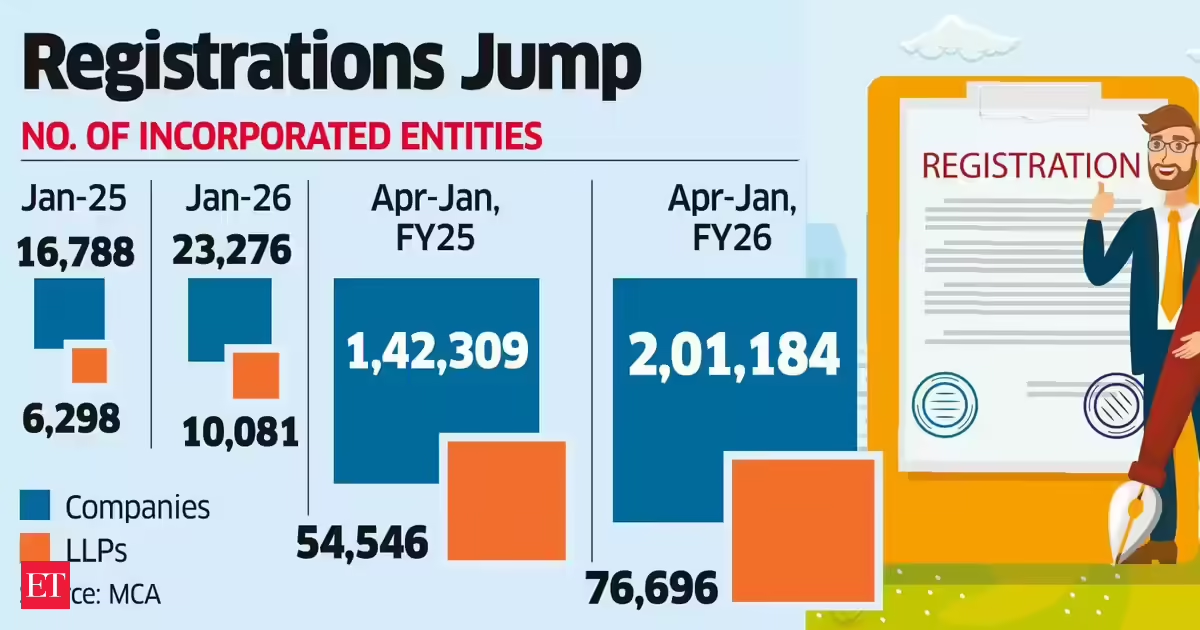 Business4 days ago
LLP registrations cross 10,000 mark for first time in Jan
-

 NewsBeat3 days ago
Mia Brookes misses out on Winter Olympics medal in snowboard big air
-

 Tech6 days ago
First multi-coronavirus vaccine enters human testing, built on UW Medicine technology
-

 Sports1 day ago
Big Tech enters cricket ecosystem as ICC partners Google ahead of T20 WC | T20 World Cup 2026
-

 Business4 days ago
Costco introduces fresh batch of new bakery and frozen foods: report
-

 Tech2 days ago
SpaceX’s mighty Starship rocket enters final testing for 12th flight
-

 NewsBeat4 days ago
Winter Olympics 2026: Team GB’s Mia Brookes through to snowboard big air final, and curling pair beat Italy
-

 Sports4 days ago
Benjamin Karl strips clothes celebrating snowboard gold medal at Olympics
-
Sports6 days ago
Former Viking Enters Hall of Fame
-

 Politics4 days ago
The Health Dangers Of Browning Your Food
-
Sports7 days ago
New and Huge Defender Enter Vikings’ Mock Draft Orbit
-

 Business5 days ago
Julius Baer CEO calls for Swiss public register of rogue bankers to protect reputation
-
 NewsBeat7 days ago
Savannah Guthrie’s mother’s blood was found on porch of home, police confirm as search enters sixth day: Live
-
 Crypto World1 day ago
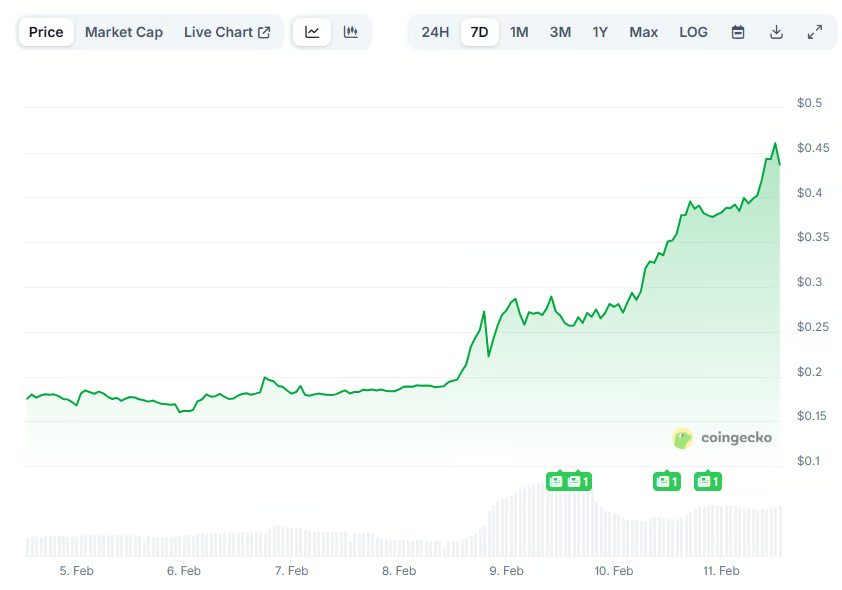
Pippin (PIPPIN) Enters Crypto’s Top 100 Club After Soaring 30% in a Day: More Room for Growth?
-

 Video23 hours ago
Prepare: We Are Entering Phase 3 Of The Investing Cycle
-

 Crypto World2 days ago
Blockchain.com wins UK registration nearly four years after abandoning FCA process
-
 NewsBeat4 days ago
Residents say city high street with ‘boarded up’ shops ‘could be better’
-
 Crypto World3 days ago
U.S. BTC ETFs register back-to-back inflows for first time in a month