

Politics
Ministerial aides quit as calls for Starmer to resign grow

Keir Starmer has suffered his first resignations as the calls for him to step down as prime minister grow.
Tom Rutland, a parliamentary private secretary (PPS) in the Department for Environment, Food and Rural Affairs, was the first to issue a statement announcing his decision to resign. A PPS acts as an unpaid parliamentary assistant, providing a link between the senior frontbencher and backbench MPs. The role is widely regarded as the first step on the ministerial ladder.
Rutland said that the prime minister “has lost authority not just within the parliamentary Labour Party but across the country and that he will not be able to regain it.”
He added: “That significantly impedes the ability of the government to deliver the change that people voted for at the general election – change that we must deliver…
MDU warns Chancellor clinical negligence system ‘not fit for purpose’

Northern Ireland RE curriculum is ‘indoctrination’ – Supreme Court
“I do not have faith that the prime minister can meet this challenge. It is not compatible to hold this view and continue to serve on the frontbench, so I have resigned as a parliamentary private secretary to the secretary of state for environment, food and rural affairs, and will continue to represent my wonderful constituents in East Worthing and Shoreham from the backbenches.”
Naushabah Khan subsequently resigned as a PPS in the Cabinet Office.
In a statement, Khan said: “I did not enter politics to stand by while we fail. We need a clear change of direction now and no game playing. A Labour government can and will rise to meet the moment if we act now.
“I am calling for new leadership, so that we can rebuild trust and deliver the better
future that the British people voted for.”
Sally Jameson, a PPS in the Home Office, has also called for Starmer to resign.
Jameson called for the prime minister to “set out a clear timetable for his departure in September or shortly after. In addition the NEC [national executive committee] should ensure that all potential candidates have the opportunity to stand and any timetable, I hope, would reflect this.”
In addition, Joe Morris, a PPS in the Department of Health and Social Care, has reportedly called for Starmer to step down.
Morris and Jameson did not initially state that they had resigned their roles. However, the government moved quickly to announce their replacements on Monday evening.
David Burton-Sampson was appointed as a PPS in the Department of Health and Social Care, while Linsey Farnsworth took up a PPS role at the Ministry of Justice.
Jayne Kirkham was appointed to the Department for Environment, Food and Rural Affairs, Michael Payne to the Home Office, Tim Roca to the Department for Work and Pensions and Sean Woodcock to the Cabinet Office.
Morris’ resignation was seen as especially significant. He is considered to be an ally of the health secretary, Wes Streeting, a likely leadership challenger. Another Streeting confidante, Jas Athwal – whose Ilford South constituency neighbours Streeting’s Ilford North seat – called for Starmer to resign on Monday afternoon.
Athwal called for Starmer to resign in a “smooth, dignified and orderly way so the party can choose new leadership and get back to the work people elected us to do.”
Collectively, Rutland, Jameson, Khan and Morris were the first frontbenchers to call on Starmer to step down as prime minister, after a day in which the number of backbench MPs calling for change at the top has snowballed.

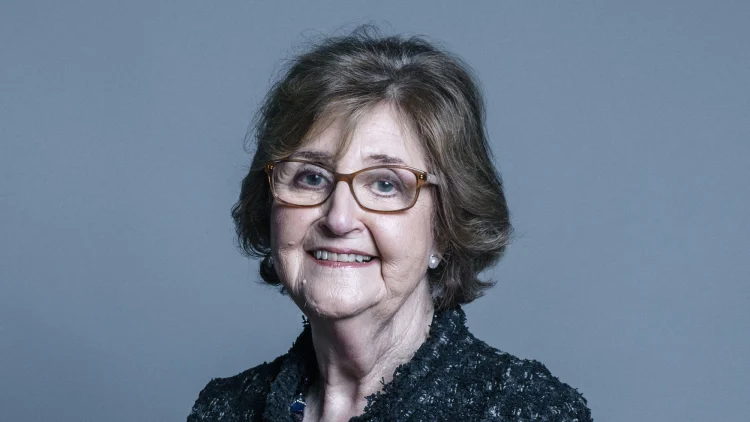

Baroness Ramsay of Cartvale: 12 July 1936 – 28 May 2026 | Image courtesy of UK Parliament
4 min read
Former spy and later a government minister and whip, Meta Ramsay was an exceptional person in so many ways. Loyal to her country, her party and her friends, she was a mentor to many of us. Words by Lord Foulkes
Meta Ramsay was an exceptional person in so many ways: a powerful woman in a man’s world, a most generous friend in every sense, and a mentor to many of us. She was loyal in every way: to her country, the Labour Party and, above all, to her friends.
Her background was relatively modest. Those who knew her mother, Sheila – the daughter of Jewish refugees from Ukraine – could see where Meta got her strength of character. Her father, Alexander, was a gentle man in every sense, but nevertheless an avid supporter of Glasgow Rangers. This likely explains why Meta, though not a football follower herself, would always know the Hearts result by the time we spoke on Sundays.
After happy years at her local Battlefield Primary School, her parents saved enough to send Meta to Hutchesons’, then a fee-paying corporation school, which enabled her to gain a place at the University of Glasgow. There, she joined a cohort of formidable debaters and politicians – including Donald Dewar, John Smith, Ming Campbell, and Douglas Alexander (father of the current secretary of state) – and was able not just to hold her own, but to better them.
At Scottish universities, the men’s and women’s unions were social and debating centres, but the students’ representative council (SRC) was the true hub of power. Meta became the first woman to serve as president of the Glasgow University SRC, a foretaste of things to come. Scotland also had its own national student body, the Scottish Union of Students, and, once again, Meta was the first woman to become its president. It was then that we met, when I attended their conferences as a representative from the Edinburgh SRC.
At the time, the Cold War was at its height, and the international student scene was divided between the Communist International Union of Students (IUS) headquartered in Prague and the International Student Conference (ISC) in Leiden. In a further portent of things to come, Meta moved to the ISC to serve as assistant secretary.
Meta’s service in MI6, the Secret Intelligence Service, was known to very few at the time, long before the organisation became as open as it is today. Her frontline work in Finland, and her role in the defection of Oleg Gordievsky in particular, is now the stuff of legend – and rightly so.
One disobliging colleague said to Labour leader John Smith, ‘Be careful, she was a spy,’ to which John retorted, ‘I know, that’s why I’m appointing her!’
Away from the intense world of intelligence, Meta maintained a warm and deeply grounded personal life. She was utterly devoted to her dear Cairn Terrier, Tam, so much so that she once prevailed upon me to chauffeur him from Glasgow to London! How could I refuse?
When she retired from the Foreign and Commonwealth Office (FCO), she soon moved to work as foreign affairs adviser to the Labour leader, John Smith. One disobliging colleague said to John, “Be careful, she was a spy,” to which John retorted, “I know, that’s why I’m appointing her!”
She was appointed to the House of Lords by Tony Blair and became a whip, skilfully piloting the Scotland Bill through the Lords and keeping her flock in line. And when Labour moved into opposition, she served, fittingly, as a member of the Intelligence and Security Committee and on the North Atlantic Assembly, Nato’s parliamentary body.
Her activity in the Labour Party spanned her entire adult life, bookending her foreign service, including joining the Scottish Executive Committee to provide vital senior female leadership during the period when Ian Murray was Labour’s sole Scottish MP.
She fell ill in London but returned home to Glasgow, where she passed away accompanied by her longstanding friend, assistant, and executor, the wonderful Caroline Thickett. She has since received glowing tributes from all sides of the House of Lords and beyond.
Lord Foulkes of Cumnock is a Labour peer
Ahead of the ten year anniversary of the EU referendum on 23 June, UK in a Changing Europe experts have written a short series of blogs reflecting on some of the issues at the heart of Brexit then and now. Here, Jill Rutter considers how Brexit has impacted the civil service.
We could never persuade former Brexit minister and European Research Group chair Steve Baker to relive Brexit for UK in a Changing Europe’s Brexit Witness Archive. But two quotes from his recent Ministers Reflect interview for the Institute for Government are perfect illustrations of the way in which Brexit impacted the civil service.
Speaking of his own civil servants in his brief ministerial stint at the Department for Exiting the EU (DExEU) he said: “The officials were absolutely excellent in the Department for Exiting the EU, absolutely brilliant and brilliantly led”. But a few paragraphs later he describes how officials reacted to the DExEU ministerial team concluding that the UK had to leave the EU with an FTA-style agreement: “officials all sat there looking crestfallen. They’d all briefed us individually that we should do something hybrid that involved the customs union and alignment. We all said no individually. So they put on a summit. Again, notice they’re managing us, which is a thing to come back to. We gave them very clear directions on what we required as a team.” That sounds much more like the scepticism about the civil service to be expected from Eurosceptic ministers.
But Baker himself acknowledges that the civil servants were pursuing the Brexit that the Prime Minister and Chancellor wanted – and his real frustration (which resulted in his post-Chequers resignation) should be directed at his ministerial bosses, as they were the ones taking the policy in a direction he did not like, not the civil service.
The good news for the civil service is that it managed to deliver a Brexit which was broadly the one chosen by the Johnson government. Gaping holes did not emerge – either in UK legal frameworks or at the borders for goods (failure to stem cross-Channel irregular migration has become a running sore post-Brexit). UK regulators have mostly been able to substitute adequately for their EU counterparts – and, even before the final completion of Brexit, the UK’s medicines regulator gave the first approval for a Covid 19 vaccine. The UK developed missing trade capacity, rolled over EU-era trade agreements and negotiated its own new free trade agreements (FTAs) with countries such as New Zealand and Australia.
The price of that delivery was a massive expansion in the size of the civil service, which is now over a third bigger than it was in June 2016. Not all of that is down to Brexit itself – it was inflated by the need to deal with the pandemic and more recently by attempts to get on top of the asylum backlog. Nonetheless, that is an expansion that is way in excess of initial estimates of the impact of Brexit on the size civil service (and the expansion in the number of public servants in some arm’s length bodies should be added as well to take full account of Brexit as a driver of state expansion).
The bad news for the civil service is that Brexit catalysed a breakdown of relations with a significant segment of the political and ministerial class.
In the Theresa May government, civil servants were collateral damage as her cabinet could not agree on the model of Brexit it wanted to pursue. In some departments, Brexit supporting ministers were reluctant to confront the problems officials raised with them in implementing Brexit. The UK’s permanent representative, Ivan Rogers, resigned after being “stabbed in the back” by Theresa May’s chiefs of staff briefing against him. The Treasury was already bruised by what then-Chancellor Philip Hammond described as “being painted as the villain of the referendum campaign”. Ministers went on the record rubbishing official forecasts. Senior officials who had specialised in European relations found that their CVs were regarded as what former Deputy Permanent Representative to the EU Katrina Williams described as “unfortunate”. Theresa May herself repeatedly denied she was a puppet of her Europe adviser, Olly Robbins.
Although, in one part of the forest, Lord Frost was working more effectively with civil servants to deliver the Trade and Cooperation Agreement, relations elsewhere in government became ever tenser under the Johnson administration. In that administration’s version of Henry VIII, one permanent secretary resigned (the head of the Government Legal Department) over government willingness to break international law; the services of the Cabinet Secretary, Mark Sedwill, were dispensed with and several more permanent secretaries were sacked or not extended as part of Dominic Cummings’s war on the bureaucracy. Meanwhile Johnson’s ministers went on the warpath against civil service wokery and working from home, while attempting to impose headcount reductions to roll back the increased numbers since Brexit.
Keir Starmer came in, determined not just to reset relations with the EU, but also with the civil service. But he too became disillusioned with a government “machine” which he never got to grips with managing – within months of taking office he was complaining about the civil service being too happy in the “tepid bath of managed decline”. Starmer’s peremptory sacking in April 2026 of Olly Robbins, who had rejoined the civil service eighteen months earlier, over Peter Mandelson’s vetting has reportedly had a dire effect on ministerial-civil service relations and on civil service morale, which intriguingly peaked in 2020.
Meanwhile, Starmer’s political opponents used his recruitment in opposition of former civil servant Sue Gray as chief of staff as evidence of political sympathies within the civil service – and to argue the case for the politicisation of appointments more along US lines. That remains a significant plank in Reform UK’s vision for the future state. Starmer’s actions make it harder for Labour to defend the current set-up.
The increasing frustration of ministers with the system and their civil servants is rooted in their own failure to deliver people’s aspirations for higher living standards, make inroads on regional inequality and improve public services, all while navigating an increasingly hostile external environment. That frustration contributed to the initial decision to vote for Brexit in June 2016. It is clear that ten years on, that frustration has grown rather than diminished.
By Jill Rutter, Senior Fellow at the Institute for Government.


Is Caribbean unity at a turning point? Since the brazen and horrific US attack on Venezuela in January, the Caribbean’s regional trade bloc CARICOM has been in crisis. What has been left out by much of the media is the assistance that some Caribbean countries like Trinidad and Tobago gave the United States in its imperialist attack on the South American country.
Trinidad and Tobago support of the US
The Dominican Republic and Guyana all played a role in providing the US with bases and logistical support. However, more than any other country, Trinidad and Tobago provided temporary radar surveillance and the airbase that the US could use to launch its criminal attack that killed at least 80 Venezuelans.
Since then, Prime Minister Kamla Persad-Bissessar has defended the strikes and launched her own verbal attacks on CARICOM member states. She has even gone as far as to question CARICOM’s viability and failure to reflect the economic and geopolitical interests of Trinidad and Tobago.
These tensions have brought into sharp focus the growing challenges in working to bring about regional integration in the Caribbean.
Caribbean collaboration
The region has a long history of regional integration attempts going back almost 70 years with the most recent — the short-lived West Indies Federation — collapsing in 1962.
This latest division will likely test the resilience of CARICOM at a critical time when US imperialism is particularly volatile and a threat to the entire region. As small island states, Caribbean countries have managed to survive the post-independence period through regional cooperation and negotiating as a single bloc.
However, beneath this resilience hides an elite-driven, state-centric approach to development that reproduces economic dependency and creates the conditions for wealthier member states, like Trinidad and Tobago, to pursue unilateral agreements with larger powers.
T&T’s grievances are a decade in the making
To understand how we got here, we have to look at what is motivating the Trinidad and Tobago government to take the position it has against CARICOM.
For months, Persad-Bissessar has been questioning CARICOM’s effectiveness on maintaining regional security, challenging the idea of Trinidad and Tobago’s place within the bloc — especially as the country contributes up to 20% of CARICOM’s annual budget, which amounts to $20 million.
She has since demanded that CARICOM’s secretary general, Carla Barnett, step down once her five-year term ends later this year.
Persad-Bissessar has also repeatedly defended the US’ controversial actions in the lead up to its attack on Venezuela. Between September and December 2025, the US murdered 115 people in the Caribbean Sea on the unproven pretext of “drug smuggling”.
Since then, many fishermen across the region have been reluctant to go out to sea for fear of a US strike, which has had adverse effects on people’s livelihoods.
In September 2025, Roosevelt Skerrit, Prime Minister of Dominica, asserted that the Caribbean Sea should remain a “zone of peace” in response to the increased US military build up against Venezuela.
However, Persad-Bissessar also defended the US’ presence, stating:
CARICOM has chosen to support the Maduro narco-government through the fake zone of peace narrative.
Demographic shock
For Trinidad and Tobago, the position on the US strikes on Venezuela is different from other Caribbean countries. This is in part due to the proximity of the island nations, which is only 11-12km (7 miles) away from Venezuela, making the Caribbean country the closest to South America.
This is important because, for over a decade, migration from Venezuela to Trinidad has steadily increased, due in part to the economic mismanagement of the Maduro government, and the brutal and coercive US sanctions that were designed to cripple the Venezuelan economy. As a result, more than 30,000 Venezuelans have settled in Trinidad and Tobago, adding to the population of 1.5 million people in a short space of time.
This demographic shock has produced familiar anti-immigrant rhetoric around integration, crime, housing and competition for jobs that often emerge in migration discourse in the West. However, in Trinidad and Tobago, this migration wave has exacerbated existing issues, including public service provision for citizens and general unpreparedness for refugees outside of the Caribbean.
Persad-Bissessar’s frustrations stem from what she and other Trinidadian elites view as the disproportionate humanitarian focus that CARICOM has prioritised in relation to the Venezuelan migration.
For Trinidad and Tobago, the priority is to militarise its border as a measure against what it sees as the threat of drug trafficking. These priorities have found a perfect synergy with the US’ refocus on controlling the Caribbean on the dubious basis of security.
Whether Persad-Bissessar knows it or not, she is positioning her country as a key node of US imperialism in the Americas, which will continue to increase tension within CARICOM itself.
CARICOM and the global economy
It could be argued that the tensions between CARICOM and Trinidad and Tobago are structurally rooted in the roles that both polities play in the global economy.
For CARICOM, its state-centric and elite-driven structure means that a lot of its decision making is dominated by heads of government, senior technocrats and private sector lobbies.
It has been said that CARICOM is designed to manage capitalism in the Caribbean. Many critics, such as Jamaican economist Norman Girvan, have argued that such a structure ensures that narrow interests centred around attracting foreign investment, harmonising tax incentives for multinationals and maintaining a tourism-focused development model, deepens the Caribbean’s position at the periphery of the global economy.
To-date, regional integration through CARICOM has failed to include workers or unions in regional decision making, develop plans for regional public ownership in energy, transport and food systems — all of which could strengthen state and regional systems.
Defenders of CARICOM would argue that, as small island states, CARICOM was created to strengthen and amplify the diplomatic power of individual Caribbean countries through collective action. This allows them to better resist absorption into US foreign policy and economic interests.
CARICOM’s foreign policy machinery, the Council for Foreign and Community Relations (COFCOR), was designed specifically for this. It creates coordinated foreign policy positions for CARICOM member states to act as a collective in drafting and creating treaties and trade agreements outside of the US sphere. The aim being to reduce dependence on the United States.
The consequences of foreign dependence
For Garvin and earlier thinkers (prior to CARICOM’s inception) like Walter Rodney, the issue is that Caribbean elites reproduce and maintain Caribbean dependency on foreign investment, remittances, extractive industries and trade with global powers like the US and European Union (EU). This is because they benefit directly from those structures in terms of having access to those markets. They are more inclined to compromise on policy in order to enjoy the benefits that they as a class could access from the developed world.
As a result, we have a region with a weak industrial policy, limited economic diversification and low wages.
It is a region also beholden to EU development funds, IMF frameworks and WTO rules. Even if CARICOM resists US imperialism in a limited context, the elite structure ensures that this resistance will never go far enough in creating full economic and political self-determination.
The bloc’s limitations in assisting Cuba as it faces economic strangulation by the US is an example of this. This weakness cascades into its relationship with wealthier members like Trinidad and Tobago, which clashes with CARICOM regionalism when it starts to obstruct its own attempt to align with global capital.
There is a perception among wealthier Caribbean countries that CARICOM holds them back from acting with full autonomy. Trinidad and Tobago policymakers increasingly question why they must go through their lower-income CARICOM counterparts to craft foreign policy given the country is significantly more industrialised than its neighbours.
As such, Trinidad’s own elites seek to assert their country’s ability to form independent agreements with the US and dictate their own migration policy. Trinidad and Tobago’s elites do not feel as dependent on regional integration as less developed Caribbean countries. Meanwhile, CARICOM does not have any real mechanism to enforce regional integration and cooperation of member states.
Is CARICOM at risk of collapse?
The unilateral foreign policy positions taken by Trinidad and Tobago are concerning for the long term viability of the bloc.
Last year, as US military build-up was increasing, Trinidad’s foreign affairs minister stated there was “no need to consult CARICOM”. Her comments indicate that at least in this moment, Trinidad and Tobago’s government is prepared to move the country away from multilateralism.
The effect is that distrust and suspicion have increased among other CARICOM member states towards Trinidad which could have an effect on regional cooperation in other areas.
However, Trinidad and Tobago is one of the biggest beneficiaries of CARICOM, accounting for a significant share of Trinidadan manufactured goods, energy products and financial services.
If Trinidad and Tobago was to leave CARICOM, it could incur trade losses of up to $3 billion. As such, a sudden Brexit-style departure would be unlikely, even with the current tensions.
The effects of CARICOM hostilities
Nonetheless, a departure is not impossible, but Trinidad and Tobago’s issues, if left unresolved, could weaken CARICOM in the long term.
Trinidad and Tobago doe not have to formally leave CARICOM to undermine the bloc and its neighbours. It could simply reduce or cease engagement altogether over time if the government determines the bloc is unable to serve its interests.
As CARICOM lacks the regional mechanisms to enforce unity, there is space for Trinidad and Tobago to undertake this. However, Trinidad and Tobago’s lack of engagement would weaken CARICOM.
This is the threat that Trinidad and Tobago’s position poses, and it has already started.
The Prime Minister of Barbados, Mia Mottley, urged governments across CARICOM to negotiate as a single bloc since historically, the US has taken Caribbean states and interests more seriously when they negotiate together. The actions of Trinidad and Tobago sets a greater precedent for the US to expect bilateral negotiations going forward for other Caribbean countries.
Regional shifts
These changes are not without their consequences. Venezuela, in response to Trinidad and Tobago’s US assistance, has cancelled a number of key oil and gas deals. Relations with the two countries have remained cold, even with Venezuela’s new President, Delcy Rodriguez.
Rodriguez, on her first foreign visit in April, skipped past Trinidad and Tobago and went to Grenada and then to Barbados to discuss partnerships on a range of issues, such as food and energy security. Unlike Trinidad, both Caribbean countries resisted US pressure to install a radar system and to allow their territories to serve as launch points for an attack on Venezuela.
This signals another trend going forward: if CARICOM continues to pull away from each other, many other countries will see the opportunity to form partnerships with individual states rather than the collective bloc. In the short to medium term, this could seem like an opportunity. But over time, as small island states, this builds dependency and locks the region into internal competition with each other.
For regional integration to work, the Caribbean must rethink how CARICOM functions. It faces too many internal contradictions that will undermine it. This is the challenge facing the Caribbean: how can it create and maintain regional integration that accommodates all the economies in the region?
An alternative to CARICOM?
Perhaps a completely different model is needed to resolve the tension between national and regional interests with a goal of liberating the Caribbean from the divergent and competing capitalist priorities that CARICOM operates under.
The Bolivarian Alliance for the Peoples of Our America (ALBA) demonstrated the possibility in 2004. Both Cuba and Venezuela founded ALBA to challenge neoliberal blocs like CARICOM, and the US-led Free Trade Area of the Americas. They did this by implementing a different economic model of regional integration that does not foment competition amongst its members.
ALBA prioritised solidarity through shared development plans, joint public enterprises, mutual aid during crises and energy integration through barter arrangements as opposed to market determinants. It was deliberately post-capitalist by design and sought to empower Caribbean countries to delink from US-led capitalism.
Countries like Grenada, St. Vincent and the Grenadines, Dominica and Antigua and Barbuda joined ALBA at the time, benefiting from Cuban doctors and engineer exchange, as well as public ownership in the development of regional institutions like the development bank.
But ALBA would go into decline in 2014, due to Venezuela’s economic crisis and the devastating US sanctions imposed.
However, it represents the most recent attempt at creating a regional integration alternative in the Caribbean that resolves the internal contradictions of regional integration in its current form. It shows that such alternative models of regional integration are possible.
What does the Caribbean need now?
If models that prioritise public ownership over elite control are implemented, then the tensions between regional integration and national self determination that define the conflict between Trinidad and Tobago and CARICOM can be mitigated. And in time, completely dissolved.
Solving the conflict is essential for the Caribbean not only to meet the challenges presented by US imperialism but on other issues, such as the climate crisis and growing food and energy security.
Featured image via Roberto Schmidt/ Getty Images
The seat-warmer-in-chief squirms…
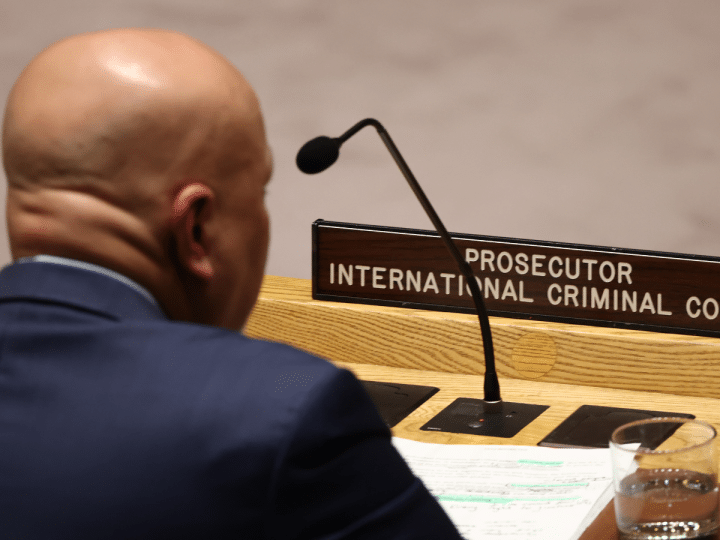

British Chief Prosecutor for the International Criminal Court (ICC), Karim Khan, sat down with Analyst News to discuss the punitive state actions levelled towards him by Russian leader Vladimir Putin and US President Trump.
Khan opened up about the coercive agenda at play to intimidate him as he pursues justice and accountability for the tens of thousands of victims of flagrant war crimes and crimes against humanity.
In response, Khan defiantly centered those who have lost everything as a result of imperialist aggression, saying:
.. it’s not about us. It’s about victims and their right to justice.
They’re not worthless. They’re not numbers. They’re not abstract concepts.
They’re people that have lost their babies, their wives, their husbands, their grandparents.
'It's painful, it's difficult, it's meant to coerce … but it's not about us, it's about the victims' right to justice.'
In an exclusive interview with Analyst News, the International Criminal Court's Chief Prosecutor Karim Khan details the threats and sanctions against him,… pic.twitter.com/afFHn4E5qq
— Analyst News (@AnalystNews_) June 2, 2026
ICC prosecutor: ‘you go against Israel, we’ll come after you and your family’
ICC prosecutor Khan has faced no end of abuse from corrupted officials as a result of his determination to uphold the rule of international law. The decision to issue arrest warrants for political leaders involved in numerous war crimes and crimes against humanity no doubt fuels the ongoing sanctions
Moreover, the US has expanded its punitive and intimidating sanctions beyond Khan himself and extended them to his wider family, revoking his children’s US visas. All the while, there has been no meaningful condemnation from its allies. In fact, David Cameron joined these corrosive efforts, threatening Khan that the UK would withdraw from the ICC itself if warrants against Netanyahu and Yoav Gallant were not withdrawn.
Despite these silencing efforts to obstruct accountability for the genocide in Gaza, which the US and the UK have materially supported through the provision of bombs, bullets and the UK’s spy planes, Khan has remained inspiringly defiant.
As Chief Prosecutor, he makes clear that he will continue to pursue justice and uphold the independence of the court in the face of significant political pressure.
In the interview, he spoke about the threats and warnings he has received from US officials:
Karim Khan: You go against Israel, we’ll come after you and your family. You have been warned. Marco Rubio, Mitch McConnell, I mean, quite powerful individuals, wrote a public letter. They wrote to me and they said, you have been warned. That’s how it ended. You have been warned. Yes, we have faced threats. I’ve been convicted by the Russian Federation to a 15-year sentence for the audacity they think of applying for warrants that judges independently gave in relation to the aggression against Ukraine. And President Trump has sanctioned me and my family because of Palestine.
Analyst News Journalist: You had your email disabled, your bank account’s frozen. Is that still the case?
Khan: Yes, I don’t have any credit card in the world. I mean, all those types of things. You know, travel bans, my children’s visas, revoked to the United States.
The journalist then highlighted how Khan’s family are not prosecutors or involved in decision making yet have equally faced this abuse of power.
Well, this is the question. I mean, even Magnitsky sanctions for human rights violations don’t apply to family. But as the senator said, you know… They would come after me and my family. They’ve done that.
The Magnitsky sanctions mentioned by Khan refer to a bipartisan US federal law enacted in 2012, which:
allow the United States to freeze assets and ban travel for foreign individuals and entities involved in serious human rights abuses or significant corruption, regardless of their nationality.
Khan: “It’s meant to coerce. It’s meant to make us change course.”
We have all witnessed countless severe abuses of the human rights of Palestinians and Iranians. But the US and its allies appear prepared to inflict this kind of punishment on anyone who challenges their sick agenda or seeks to hold Israel accountable.
Activists aboard the latest aid flotilla travelled towards Gaza in an attempt to deliver humanitarian assistance and show solidarity with Palestinians. Before long, Israeli forces once again intercepted the flotilla and detained those on board, an action many have condemned as illegal under international law. Subsequently, several activists reported that Israeli occupation forces subjected them to violent assault, rape, and multiple methods of torture.
Nevertheless, despite a depressingly huge volume of mounting evidence, the US has not applied Magnitsky sanctions against any Israeli officials.
Instead, they have chosen to weaponise those measures against a respected international lawyer for pursuing accountability under international law – and have even targeted his children in the process.
The Chief Prosecutor isn’t having any of it through and makes it clear that he will continue to fight for the people who have paid the price of Western imperialist aggression and Zionist settler colonialism:
But again, this is painful. It’s difficult. It’s meant to coerce. It’s meant to make us change course.
We can’t. And I think that’s a testament to the many women of the office that it’s not about us. It’s about victims and their right to justice.
Khan: ‘what’s liberating is accepting mortality’
This interview will undoubtedly reinvigorate advocates across the world. After all, millions of people have been calling out Israel and its crimes since the Israeli genocide escalated against Palestinian men, women and children after October 7th.
Whether it be the IOF leaving babies to starve to death in neonatal units, the bombing of hospitals and schools, or the kidnapping of thousands of Palestinians without charge or conviction, Israel’s crimes are far-reaching, morally depraved, and prolific.
When asked about whether he has feared for his own life and those of his family due to his principled professional stance, Khan powerfully stated:
What’s liberating is accepting mortality. You know, the cause of death is life.
So, once you accept that, actually these things don’t become very important.
Featured image via Getty/Michael M. Santiago
Politics
Politics Home Article | We need a clean heating plan for commercial buildings, not just homes


Richard Venga, Strategy Director, Commercial Products
| Mitsubishi Electric
As the UK government continues to pursue economic growth in the midst of a global energy crisis, could the decarbonisation of commercial buildings be a part of the solution to tackling both – reducing energy costs and supporting business to grow?
The Warm Homes Plan and the Future Homes and Buildings Standards set out clear objectives for decarbonising homes. Likewise, the Energy Security Bill, announced last month in the King’s Speech, will help to bring down energy costs in the long term.
But there are approximately two million non-domestic buildings in the UK. We now need a plan to retrofit these properties, which have so far been overlooked. Any plan should include a time-bound target for when existing fossil fuel systems must be replaced with a low-carbon system. While new non-domestic buildings will need to electrify under the Future Buildings Standards, ensuring existing buildings adopt low-carbon technologies is critical to the UK’s decarbonisation efforts.
The environmental benefits are clear, but a plan would also bring three key economic benefits:
- helping businesses to navigate volatile fossil fuel prices and plan for the transition
- addressing regional disparities
- strengthening the UK’s clean heat industry
Here’s how a plan for the decarbonisation of commercial buildings can drive energy security and economic growth:
1. Protecting business owners from fossil fuel volatility
The conflict in Iran and the ensuing energy shock have led to volatile gas prices, putting enormous pressure on businesses across the UK. Already stretched, many businesses are having to make difficult decisions on investment and jobs.
Currently, take-up of technologies such as heat pumps, solar panels and batteries among businesses lags behind the domestic sector. We need to see incentives for commercial building retrofit to help address this gap and provide businesses and landlords with the direction to invest.
By adopting these technologies, businesses will benefit from more efficient, modern heating. This will also shield businesses against price shocks in the future.
While there will be upfront costs for business and the government, the investment will prove extremely valuable in the event of any further energy price shocks and create a more secure economy.
2. Addressing regional disparities in the energy efficiency of commercial buildings
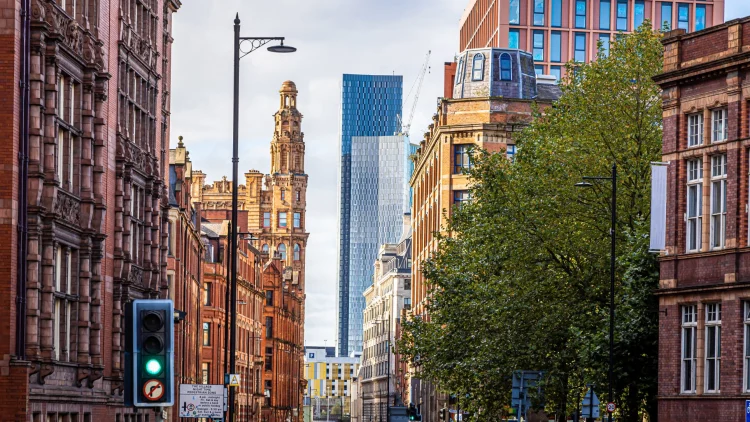
Large businesses, which are often based in major cities, are more likely to require high sustainability standards for their buildings, particularly as tenants increasingly seek buildings that meet higher sustainability standards as part of their own environmental commitments. This creates impetus for landlords to ensure their buildings meet these standards. As a result, we have seen successful retrofitting in business hubs – such as the Exchange Quay office campus in Manchester.
However, outside of major cities and existing business hubs, the demand for this technology is lower. This creates a vicious cycle, where businesses increasingly look to base themselves in cities with more modernised commercial buildings, and landlords focus their investments on these same places.
Regional disparities will continue to be reinforced unless the government acts. In addition to investment in retrofit, we also need clarity on timelines and a commitment to increasing minimum energy efficiency standards. Raising requirements for non-domestic buildings will raise the floor for commercial buildings and help improve supply across the UK.
3. Bolstering the UK’s clean heating sector
A stronger commitment to clean heating for commercial buildings will strengthen this growing sector of the green economy.
A key barrier to expanding the rollout of clean heating is having the right workforce to deliver it. However, 24 per cent of UK contractors say that there is not enough demand for heat pumps to justify training for installation.
A plan for the decarbonisation of commercial buildings would help create this demand and give workers the confidence to invest in skills.
More demand for clean technology also means more opportunity for manufacturers, increasing UK production, creating jobs and opening up new export opportunities – supporting the government’s ambitions for economic and industrial growth.
The logical next step for clean heating
The first few months of this year have seen significant progress on the government’s plans for decarbonising homes and promoting the adoption of clean heating.
The government has made it clear that the UK cannot rely on fossil fuels forever and has made vital steps to address this in the King’s Speech.
The next logical step is investment in clean heating for commercial buildings, which will give stability to business owners, raise standards across the UK, and help grow the green economy.
Now is the time to push forward and put forward a plan that gives equal backing, both in regulation and incentives, for non-domestic buildings.
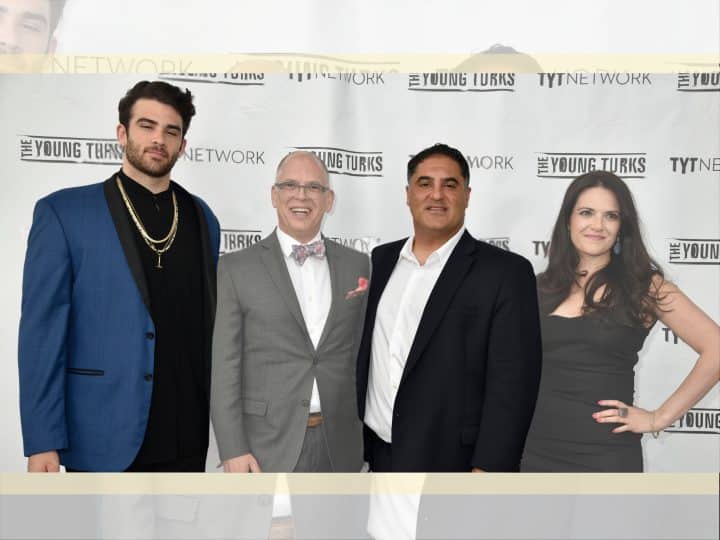

On 1 June, the UK banned two prominent American leftists from entering the UK. The men in question were Hasan Piker and Cenk Uygur, who are both Turkish Muslims. In response to this, the Labour Muslim Network has now spoken out.
Labour Muslim Network alarmed
The response from the network reads:
The Home Office’s decision to cancel the visas of Cenk Uygur and Hasan Piker, preventing them from speaking at events in the UK, is alarming.
Given the significant public interest surrounding this case, the Government should provide a clear explanation of the basis on which this decision was made and the factors that led to the cancellation of their travel permissions.
Support for Palestinian rights, criticism of the actions of the Israeli government, and advocacy for international law and human rights must never be grounds for exclusion from public debate in the United Kingdom.
Muslim communities, and all those who speak out on matters of human rights and international justice, must have confidence that decisions of this nature are applied fairly, consistently and transparently.
Piker and Uygur have both attributed the ban to their criticism of Israel:
the uk has revoked my visa as well. all at the behest of israel. the west is betraying "liberal values" for a genocidal fascist foreign government. soon we will all become israel. https://t.co/UqQG1dogOI
— hasanabi (@hasanthehun) May 31, 2026
Featured image via Kris Connor (Getty Images)
By Willem Moore
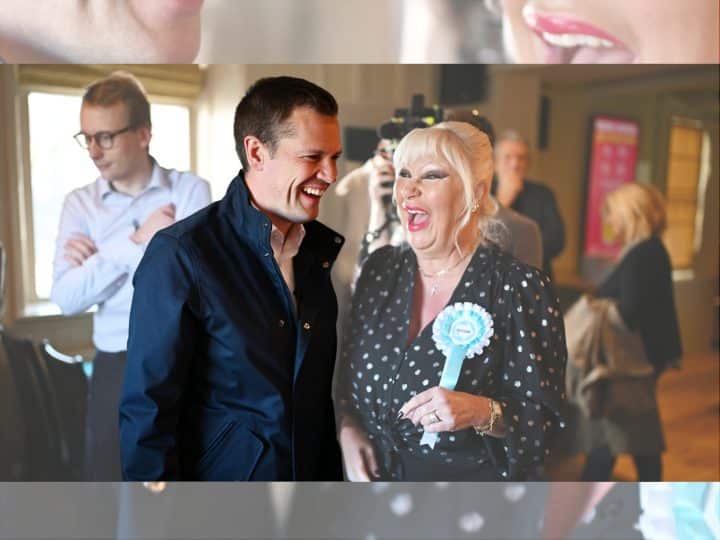

Reform UK MP Robert Jenrick is spreading blatant misinformation in relation to the Henry Nowak case. And despite legal experts and social media users highlighting his lies, the post remains up:
Henry Nowak’s murderer will be out of prison in just over 20 years.
Why did he not get longer? Because the judge ruled that – as a Sikh – he had a “good legal reason” to carry a 21cm “Shastar” knife on the streets of Southampton.
This sentence is a joke. Two-tier justice… pic.twitter.com/LtBkIyStYF — Robert Jenrick (@RobertJenrick) June 1, 2026
Oh, and to make matters worse, this guy used to be a solicitor. In other words, he should and does know better.
Reform lies
Former chief prosecutor Nazir Afzal is among those who criticised Jenrick, noting:
NO he won’t be “out in just over 20 years” – that’s the minimum term before he can apply for parole
N0 he didn’t get a lighter sentence because of the knife – he has deliberately cut out the bit that says he got a LONGER sentence
If he was still a solicitor he’d get struck off.
In recent days, a lot has been said about Sikhs’ right to carry ceremonial knives, known as ‘kirpans’. People are arguing Sikh people should not be permitted to carry these kirpans, but it’s not relevant in this case anyway, because the blade wasn’t a legally permitted kirpan. A kirpan must be blunt and a mere 8cm long; as Jenrick himself notes, this description does not match the murder weapon:
You’re a liar. The judge ruled the Sikh exemption did not apply to the 21cm murder weapon, it was not a kirpan and convicted him of unlawful possession. https://t.co/mF1khIqw4A
— Gilly (@GillysGuidance) June 2, 2026
CrimeLine – a “digital knowledge platform for criminal law” – quoted Jenrick’s words back at him:
“I will not let this lie”. Peak irony.
Cut and paste politics from another liar who also does know better but prefers hate and division.
This is possibly in reference to the fact that Reform is misquoting Kemi Badenoch for political clout:
Reform really are descending into the gutter now. This is a total distortion of what Kemi Badenoch actually said. It’s another example of their increasingly desperate efforts to neutralise Restore. https://t.co/RhXngXMXzc
— (((Dan Hodges))) (@DPJHodges) June 2, 2026
Grim
Reform is pushing out these distortions despite the father of victim Henry Nowak saying:
We do not want his death to be used to create further division, hatred or tension.
Ignoring these words completely, Nigel Farage said:
Henry Nowak’s family have responded to his murder with dignity.
I suggest the rest of us respond with pure cold hard rage.
He said “cold, hard rage”, but he could have said “cold, hard lies”, because that’s what Reform is pumping out. And it’s doing so to ensure scenes like those we saw last night in Southampton:
Dozens of bricks being thrown pic.twitter.com/VwPXkfZlmR
— Taj Ali (@Taj_Ali1) June 2, 2026
Politicians like Robert Jenrick know precisely what they’re doing when they post these lies. And it’s a terrifying sign of the chaos Britain will descend into should these self-serving liars form a government.
Featured image via Leon Neal (Getty Images)
By Willem Moore
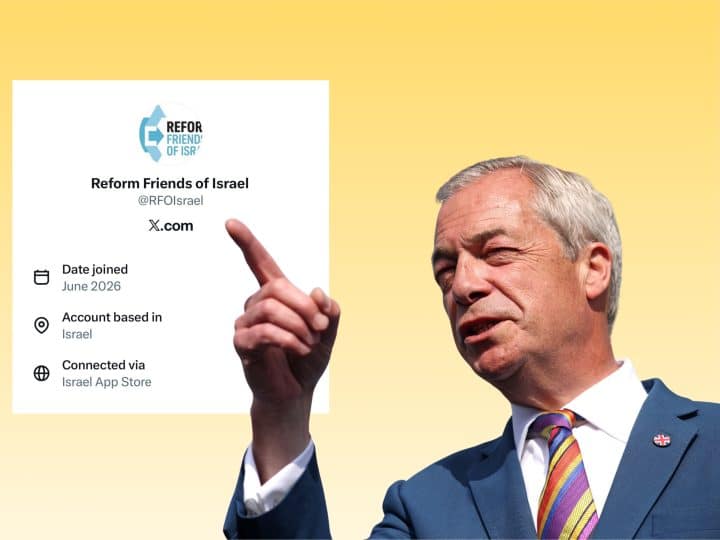

Nigel Farage’s Reform UK sells itself as an alternative to the British political establishment. Historically, said establishment consisted of the Labour and Conservative parties – both of which have significant ‘Friends of Israel’ groups. Now, a group mirroring these foreign influence orgs has emerged:
For anybody who believed Reform offered something different in UK politics… https://t.co/yS439cUHrV
— Craig Murray (@CraigMurrayOrg) June 2, 2026
Oh, and it gets worse:
This is ridiculous. pic.twitter.com/m92HKClgOi
— Aaron Bastani (@AaronBastani) June 2, 2026
Israeli Friends of Reform
In February 2026, Farage announced the creation of two new groups:
- Reform Jewish Alliance.
- Reform Friends of Israel.
The ‘Jewish Alliance’ is a group for British Jews within Reform; the latter group seeks to strengthen the already strong ties between the UK and Israel. As the Jerusalem Post reported:
Farage also announced the creation of Reform Friends of Israel, a parallel organization designed to strengthen ties between Reform UK and Israel. This organization will be led by Jason Pearlman, a British-born former international media adviser to President Isaac Herzog, who has also advised former president Reuven Rivlin, Foreign Minister Gideon Sa’ar, and former prime minister Naftali Bennett.
At the same time that Reform is spearheading initiatives to strengthen ties with British Jews and Israeli Zionists, it’s harbouring antisemites within its own ranks. In the past few months alone, we’ve reported on the following:
Mainstream media have spent days calling @ZackPolanski an antisemite; why are they silent on Reform's failure to suspend an actual antisemite?
By @willem_moore_uk https://t.co/VlrTrc7R3R — Canary (@TheCanaryUK) May 4, 2026
Another Reform activist just got exposed for antisemitism, and once again there's crickets from mainstream journalists and politicians
By @willem_moore_uk https://t.co/Ye7wR92fkd — Canary (@TheCanaryUK) May 7, 2026
Ben Rowe posted Islamophobic, antisemitic and racist memes. Reform said it was 'investigating', so how come he's now a sitting councillor?
Via @willem_moore_uk https://t.co/xKyGhLh6TI — Canary (@TheCanaryUK) May 10, 2026
Farage also has his own history of antisemitism, as his Jewish ex-classmate Peter Ettedgui reported:
It was habitual, you know, it happened all the time. He would often be doing Nazi salutes and saying ‘Sieg heil’ and, you know, strutting around the classroom
Reform Friends of Israel
So we know that Reform is launching a ‘Friends of Israel’ group, but it’s a little difficult to tell if the X/Twitter account is really the ‘official’ account it claims to be.
We can’t see the list of who the account follows or is followed by, because Elon Musk removed that functionality. Twitter does display if you have followers in common, however, so we followed the main account for Reform UK, as well as several of its most senior politicians. Doing so suggests none of these accounts follow RFoI:

As Aaron Bastani of Novara highlighted, the account had accessed the internet via the Israel App Store. This would be conclusive evidence that someone behind the account was in Israel, although the account is currently accessed via the UK app store:

You’ll note it says the account is ‘based in’ Israel, but it also has a circled ‘i’ next to it. This ‘i’ indicates the use of a VPN which spoofs a person’s location – i.e. the account holder could be using a VPN to spoof being in Israel, or they could be in Israel while using a VPN for some other reason.
This account isn’t the first prominent account to be exposed for operating in Israel, anyway; it’s not even the most shocking:
So…X activated locations last night which showed US gov accounts like DHS opened and operating from Israel. Then 20 mins later, X deactivated the feature and today, Gov accts are “exempt” from the location feature. https://t.co/8kiU541EDg pic.twitter.com/3DvM2NkrEM
— GenXGirl (@GenXGirl1994) November 23, 2025
No surprises
The UK establishment’s cosy relationship with Israel is easy to explain, as we have done before:
- The UK profits from Israel’s actions through arms deals and partnerships.
- Israel is a key ally of America, and the UK is America’s foremost lapdog.
- The Israel lobby has proven to be very effective at influencing British politicians – particularly through the ‘Labour Friends of Israel‘ and ‘Conservative Friends of Israel‘ groups.
- Once enough people within the establishment hold an opinion, mirroring that opinion becomes the price of entry.
Reform UK is simply the British establishment rebranded, so of course it’s emulating the special relationship with Israel.
Featured image via Dan Kitwood (Getty Images)
By Willem Moore
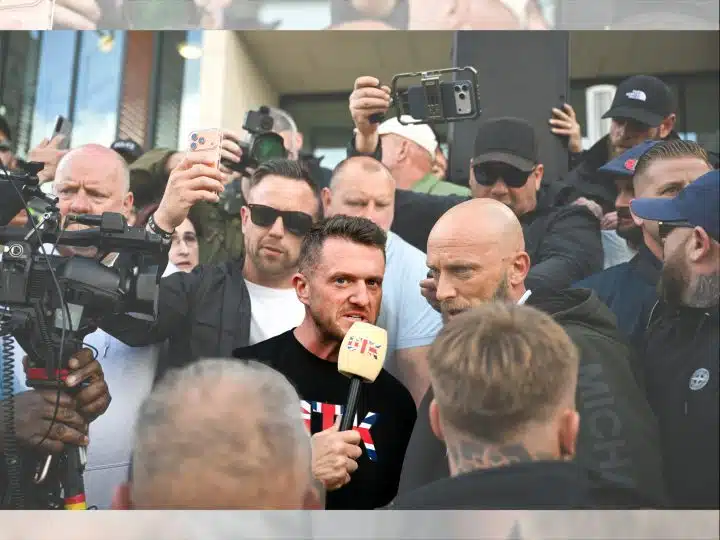

Henry Nowak’s murder has been used as a wedge to drive racial tensions in the UK, with Tommy Robinson putting himself front and centre.
It started with inflammatory comments from Nigel Farage, which predictably led to yet another race riot.
As anyone could have guessed, Tommy Robinson was on the scene to take what Farage had started and run with it. However, Robinson used the murder to incite hate against a different religious group than the murderer’s own — Muslims.
Massive nosher Tommy Turd Robinson showed up to the minute’s silence for Henry Nowak, wouldn’t shut up throughout the entire thing, then went on a racist rant about Muslims despite Nowak’s killer being a Sikh. https://t.co/lIJm1L1wfX
— thelefttake (@thelefttake) June 2, 2026
Tommy Robinson did what Farage wanted
Farage’s intervention followed Vickrum Digwa, a Sikh man, being convicted for the murder of Henry Nowak.
Digwa wrongly claimed that he had been the victim of a racialised assault, and responding officers attempted to arrest Nowak as he lay dying.
The police handcuffed Nowak despite the fact that he was laid out and claiming to have been stabbed. As we regularly report, the police in the UK is prone to incompetence, and frequently face accusations of gross incompetence.
In 2025, the Canary covered the following stats:
In the last five years, police forces in the UK have paid nearly £80m in compensation following claims against them. Figures obtained by Public Interest Lawyers found that 47,658 claims have been lodged against police forces since 2019.
…
Examples of claims against the police include malicious prosecution, wrongful arrest, sexual misconduct, assault, traffic accidents, and property damage.
What Farage did was take a textbook example of police incompetence and he turned it into a call for a white uprising.
Sure thing @policylaila. Nigel Farage knew precisely what he was doing, deliberately whipping up fury. It’s also telling that on race relations, he does no work whatsoever. In the fascist tradition, he just makes irresponsible populist comments that only cause hate and fear. https://t.co/hxn6b4Qn6E
— Major Harry Clark (@WinstonsButler) June 3, 2026
It’s important to note, this is something Farage did despite Nowak’s family asking him not to do. And it’s a call Tommy Robinson gladly picked up.
Fash mob
Before the riots, Robinson released a video, shared by Mukhtar, in which he said he’d be turning up to “report” on events. Alarm bells should have begun ringing for anyone watching because Robinson isn’t a journalist; he’s a shit stirrer.
In 2019, the Canary published this about Robinson:
Stephen Yaxley-Lennon (AKA Tommy Robinson) encouraged “vigilante action” against defendants in a criminal trial when he filmed them and broadcast the footage on social media, High Court judges have found.
The former English Defence League (EDL) founder was found to have committed contempt of court at the end of a two-day hearing at the Old Bailey.
As Mukhtar highlighted on X, Robinson got rushed to the front of the crowd after arriving.
He initially pretended he didn’t want to speak, saying, “No, I’m fucking not”.
A few seconds later, he was on the microphone claiming that he had predicted Pakistani Muslim gangs would start a race riot.
The riled-up crowds would eventually go into full-on riot mode, with Nazi salutes being thrown freely.
Dozens of bricks being thrown pic.twitter.com/VwPXkfZlmR
— Taj Ali (@Taj_Ali1) June 2, 2026
#FaragesRiots
People are referring to the chaos of last night as “Farage’s Riots”.
#FaragesRiots https://t.co/yLJfsygfQP
— Reform Party UK Exposed
 (@reformexposed) June 2, 2026
While it’s correct to call them this, Robinson deserves credit too. The two men keep a distance from one another, but they functionally work as a team.
Farage is the posh boy riling up the masses from the heart of the establishment while Robinson is the thug on the street leading the charge.
Featured image via Finnbar Webster/ Getty Images
By Willem Moore
Roy Keane’s family from daughter marrying footballer to her sibling’s incurable illness

Global PC market faces decline as MacBook Neo bucks trend

Lloyds Bank and Halifax down as app outage means thousands ‘can’t pay bills’



-

 Tech5 days ago
Waymo dominates autonomous vehicle registrations as Tesla trails behind
-

 News Videos5 days ago
This is BROKEN! INSANE 5x MONEY CAR WASH WEEK! The NEW GTA Online UPDATE Today! (GTA5 New Update)
-
 Tech4 days ago
SpaceX just won a second Golden Dome contract. This one is $4.16 billion.
-

 News Videos5 days ago
SHE IS KILLING XRP!!! WATCH URGENT AND ACT FAST
-
 NewsBeat4 days ago
FIRST NIGHT REVIEW: Take That bring the Circus back to life in spectacular sun-soaked style
-

 Business2 days ago
Jade Biosciences, Inc. (JBIO) Discusses Positive Interim Results From JADE101 Phase I Healthy Volunteer Study and Development Plans Transcript
-
 Crypto World5 days ago
CFTC Has Approved the First Regulated Bitcoin Perpetual Contract in the U.S.
-

 Business4 days ago
Is the Spurs Phenom Already Better Than Prime Diesel?
-
 NewsBeat5 days ago
Novak Djokovic v Joao Fonseca LIVE: French Open latest scores and results after Jannik Sinner’s shocking collapse
-
 Crypto World5 days ago
Snowflake (SNOW) Stock Rallies on Strong Q1 Results and AI Product Growth
-
 Entertainment4 days ago
Weak ‘Supergirl’ Box Office Tracking Amid Milly Alcock Backlash
-

 Business4 days ago
Demand Conditions Improve In Chemicals Sector In April 2026
-

 Crypto World5 days ago
MicroStrategy Moves $30 Million in BTC to Coinbase Prime: Is the Bitcoin Sell-Off Already Here?
-

 Politics4 days ago
The House | Inside Andy Burnham’s Makerfield Campaign: “Nobody Thinks This Is In The Bag”
-

 Tech5 days ago
This Week In Security: Ubiquiti Fixes, And FreeBSD Joins The Club You Don’t Want To Join
-
 Entertainment4 days ago
One of the Greatest Sitcoms of All Time Shoots Up Apple TV’s Charts 11 Years Later
-

 Entertainment5 days ago
Maddox Jolie-Pitt Legally Requests to Drop Brad’s Surname
-
 Entertainment4 days ago
Britney Spears Shares Troubling Update After Hard Year
-
 Crypto World22 hours ago
Seagate (STX) Stock Surges to Record High on AI Boom and Legal Settlement
-
 Entertainment5 days ago
Bruce Willis’ Generosity Resurfaces Amid His Dementia
You must be logged in to post a comment Login