Connect with us

Crypto World

How to Reduce Food Waste in Your Kid’s School Lunch

Published

on

How to Reduce Food Waste in Your Kid’s School Lunch

Collect everything the average American kid throws away in the school cafeteria over a single year, pile it on a scale, and you’d be looking at roughly 39 lbs of food. That’s about what a typical 4-year-old weighs.

Multiply that across the country, and school food waste adds up to an estimated 530,000 tons every year—an alarming amount of uneaten sandwiches, rejected fruit, and unopened snacks. 

That makes food waste difficult to dismiss as somebody else’s problem. “If you eat food, you’re part of this whether you like it or not,” says Lauren Click, founder of the nonprofit Let’s Go Compost, which runs food-waste programming in more than 600 schools, libraries, and community centers. The flip side is that you’re also in a position to waste less—starting with a packed lunch, one of the few pieces of the food system a family fully controls. 

Here’s how experts recommend packing a school lunch that produces less trash—and stands a better chance of getting eaten.

Advertisement

See what comes home

Before you overhaul your lunch-packing routine, spend a couple weeks paying attention to what returns at the end of the day. Which foods are untouched? Is the bologna sandwich always missing exactly one bite? What never even made it out of the wrapper?

After a few days, you’ll probably start to notice a pattern. “If you pack based on what actually comes home, not what seems balanced on paper, you can track it each week and adjust over time,” says Lizzie Horvitz, founder and CEO of Finch, a platform that evaluates products for sustainability.

You don’t have to keep tabs on the lunchbox all year. August and September are when parents are still figuring out what—and how much—their kids will eat. “If you’re really paying attention to ‘what’s my kid eating?’ and ‘what’s my kid consistently bringing home?’” Horvitz says, “there really shouldn’t be any waste after a couple of weeks.”

Advertisement

Ask your kid what happened

Seeing what comes home is only half the job. You also need to find out why—and good luck guessing correctly.

Click has heard every version of this story: A kid suddenly stops eating apples, and their parent assumes they don’t like the fruit. The real problem? A classmate declared apples uncool. “You can’t make assumptions, because you’ll never guess what’s going on in the mind of a 5-year-old,” she says.

Keep the conversation curious, not accusatory. Ask your kid who they sit with, how much time they have to eat, and what their friends bring. Maybe the orange takes too long to peel, or they can’t open one of the containers without help. Maybe their friend brings two sandwiches and shares one every day—in which case, congratulations, you can stop making a sandwich.

Advertisement

Save new foods for dinner

The school cafeteria isn’t exactly an ideal tasting room. Lunch periods are short, cafeterias can be loud and chaotic, and no one is sitting nearby encouraging your kid to give that unfamiliar vegetable one more chance. (Rutabaga, anyone?)

“Maybe this isn’t the time to have a really balanced, try-new-things meal,” Horvitz says. “Let’s save that for meals at home.” That’s not an argument for packing nothing but cookies. It means lunch should mostly consist of foods you already know your child will eat; save the experiments for dinner, when you’re there to encourage them.

Choose the food before the lunchbox

Advertisement

Compartmentalized bento boxes are adorable. They’re also built for a very specific amount (and shape) of food, which may not match what—or how much—your kid eats.

Lindsey Schoenfeld, a registered dietitian nutritionist, chef, and co-author of To Your Taste: How to Eat Well and Feel Better for Your Whole Life, suggests starting with the food instead. Ask your kid what they ate all summer and which lunches they loved last year. Then choose containers that fit those foods. The folded half-sandwich that nestled perfectly into one tiny compartment in second grade might not cut it for a middle-schooler.

Before splurging on new gear, check your cabinets. “There’s so many containers that we have around the house,” Schoenfeld says. “Maybe they don’t have a lid right now. Maybe we need to dig through a few shelves.” You might need a new lunchbox, but you probably don’t need every container inside it to be new too.

Reusable containers only reduce waste if you use them over and over, so make cleanup as painless as possible. Many silicone bags and food containers can go straight into the dishwasher—check the manufacturer’s instructions—and you don’t need to scrub them spotless first. “The dishwasher’s job is to make them completely spotless,” Horvitz says.

Advertisement

Pack the amount your child actually eats

An oversized container practically begs to be filled, Schoenfeld says—and parents often respond by packing more than their kid will eat.

As a rough starting point, she suggests about half a cup of fruit, or one small piece of whole fruit, for younger elementary-school kids, in addition to a quarter- to half-cup of vegetables and one serving of grains, such as a slice of bread or a 6-inch tortilla. Middle-schoolers might need the higher end of those ranges, while high-schoolers may eat a full cup of produce and two servings of grains.

But kids aren’t measuring cups. “They grow at different times, and their activity is very different,” Schoenfeld says. One child might spend all day running around on the playground or practicing with the marching band, while another might take medication that suppresses their appetite at lunchtime. If the same amount keeps returning, try sending less before deciding your child has rejected the food altogether.

Advertisement

Find out what time lunch starts

Plenty of parents don’t know what time their kid eats lunch. It’s worth checking: Because schools stagger lunch by grade, some are sitting down with their sandwiches at 10:30 a.m.

That can explain a lot. A child who ate breakfast at 7 might not be hungry three and a half hours later, even though they’re ravenous when they get home. Pack a little less for an early lunch, Schoenfeld suggests, and have a substantial snack ready after school. She likes options that include a real food group, such as cheese and whole-grain crackers, fruit, or carrot sticks.

“It’s good to capture these kids when they’re hungry and you have something good ready,” she says.

Advertisement

Send last night’s dinner

One of the easiest ways to waste less is to pack food you already made—and already know your child likes.

Jessica Randhawa, the chef and recipe developer behind The Forked Spoon, has used vacuum-insulated stainless-steel containers for her son’s lunch since preschool. In the morning, she reheats leftovers—vegetables, meat, whatever is in the fridge—and transfers them to the insulated container. In winter, she sends leftover chicken soup, one of his favorites, in a larger container with a handle. A reusable metal spork goes in with it.

Her larger point: The container matters far less than whether the food gets eaten. “The best low-waste lunch system is one that the child actually eats,” Randhawa says. “Reusable containers aren’t helpful if the food inside is repeatedly wasted.”

Advertisement

Open the lunchbox before the pantry

When a hungry kid walks through the door, take a look inside their lunchbox before handing over a new snack. Schoenfeld does this automatically. “I’m known for saying, ‘Oh, you’re hungry?’” Schoenfeld says. “I just open the lunchbox back up. ‘Look, it’s perfect. It’s ready to go.’”

Of course, food safety gets the final say. Shelf-stable foods—crackers, a sealed pouch, an unopened bag of chips—can go back into the pantry or be eaten later. Perishable food is a different story: If it didn’t stay cold during the school day, toss it.

Don’t automatically rule out single-serve packages

Advertisement

An individually packaged snack isn’t always an environmental villain. If your kid brings home an unopened package of crackers, it can go straight back into the pantry. “It’s like it never came to school,” Horvitz says.

Loose crackers can be saved too, of course, but people are often more willing to toss food that’s already been opened and portioned out. Buying in bulk and using reusable containers still produces the least packaging—but a single-serve snack that gets eaten another day can be better than food that lands in the trash.

“If we’re assuming a kid is eating everything in their lunchbox, we of course want to stray from individually packaged food,” Horvitz says. But if your child is unpredictable about what they’ll eat, a sealed package that comes home isn’t necessarily a failure. The best option is to buy in bulk and portion food into reusable containers; after that, a packaged snack that gets eaten another day can be better than loose food that lands in the trash.

The same general rule applies to drinks: A reusable bottle is best, and pouring juice from a large jug creates less packaging than sending an individual box. If you do pack a can, don’t crush it afterward; Horvitz notes that intact cans are easier for recycling facilities to sort.

Advertisement

Consider a secondhand lunchbox

There’s no rule that says a lunchbox has to be new. Click suggests checking Facebook Marketplace, Poshmark, and eBay, where last year’s enthusiasm for a particular cartoon character is now available at a discount. “They have every character you can think of,” she says.

Just don’t try to replace every disposable item in one frantic back-to-school shopping trip. Pick one change, get used to it, and then consider another. “Don’t try to go zero-waste in one day, because you’re gonna get frustrated,” Click says. “It’s like saying you’re gonna lose 50 lbs in one month.”

Be skeptical of “compostable” packaging

Advertisement

“Compostable” packaging usually needs more than a trash can—or even a backyard compost pile. Many products break down only in commercial composting facilities. Yet a 2025 national analysis found that just 18.1% of the sampled U.S. population had access to a curbside or drop-off program that accepted food scraps and at least some forms of compostable packaging. If your local program doesn’t accept these products, they’ll probably end up in a landfill.

“The word compostable doesn’t mean it will compost,” Click says. She recommends choosing reusable items first. If you do buy compostable products, make sure you have a realistic way to compost them—either at home, if they’re certified for home composting, or through a local service that accepts and processes them.

Show kids where the trash goes

The most effective tool for cutting lunch waste isn’t a product. It might be a field trip.

Advertisement

Click takes children to landfills, where the hard hats, safety vests, and enormous trucks are a hit. But the adults tend to leave with the bigger revelation. “You start to see the birds there eating trash,” she says. “You’re really faced with this reality of, like, you contribute to this.”

Many recycling facilities offer free tours, and county extension offices around the country run gardening and composting programs for kids. The point isn’t to make children feel guilty about every granola-bar wrapper. It’s to help them see where their trash ends up—and why small changes matter.

“There’s not a magical product that you can order online and have it shipped with two-day shipping that will solve this,” Click says. “It really comes down to healthy daily habits that you build over time.”


Source link

Advertisement
Continue Reading
Click to comment

You must be logged in to post a comment Login

Leave a Reply

Crypto World

Webull Expands Crypto Offering as Canada Adoption Grows

Published

on

Webull Expands Crypto Offering as Canada Adoption Grows

Webull, a self-directed brokerage and trading platform, is expanding its Canadian offering to include cryptocurrencies, adding Canada to a crypto footprint that already includes the United States, Australia and Brazil.

The company announced Monday that its Canadian crypto offering will run on Coinbase’s Crypto-as-a-Service infrastructure, with Coinbase providing the underlying trading and custody services. Webull’s Canadian website currently displays 10 cryptocurrencies, including Bitcoin (BTC), Ether (ETH) and Solana (SOL), while indicating that additional assets are also available.

The addition of crypto broadens Webull’s Canadian offering beyond stocks, exchange-traded funds and options, bringing digital assets alongside the traditional investments already available to its retail clients.

Webull cited growing crypto adoption in Canada as one reason for the expansion, pointing to Ontario Securities Commission research that it says shows digital asset ownership has risen to 25% this year from 10% in 2023. 

Advertisement

Canadian crypto investment is growing as the country’s regulators move to establish clearer rules for the industry, including a federal framework for stablecoins. Canada doesn’t yet have comprehensive rules for fiat-backed stablecoins, but the Stablecoin Act, introduced following the 2025 federal budget, would set requirements for both domestic and foreign issuers.

Related: Canadian crypto ownership increases to 25%: Ontario survey

Cointelegraph is committed to independent, transparent journalism. This news article is produced in accordance with Cointelegraph’s Editorial Policy and aims to provide accurate and timely information. Readers are encouraged to verify information independently.

Source link

Advertisement
Continue Reading

Crypto World

Bitcoin needs ETF demand to hold as Fed rate hike risk grows: analysts

Published

on

What 13 days of Bitcoin ETF outflows really means

Bitcoin’s ability to extend its August rally has come under a fresh test as analysts have pointed to sustained spot ETF demand as a key requirement for overcoming rising expectations of a September Federal Reserve rate hike.

Summary

  • Bitcoin is trading near $78,700 after retreating from last week’s high above $81,000.
  • Bitfinex analysts say spot buying and relatively contained leverage suggest the market is not showing signs of overheating.
  • CoinEx’s Jeff Ko sees $80,000–$83,000 as a major supply zone where real capital allocation will be tested.
  • BTSE’s Jeff Mei says ETF demand needs to remain strong across multiple funds, while softer inflation could ease pressure from the Fed.
  • U.S. labor and inflation data will be closely watched before the Fed’s Sept. 15–16 meeting.

According to Bitfinex analysts in an Aug. 31 market report shared with crypto.news, Bitcoin’s latest advance has relied increasingly on spot demand rather than excessive leverage, leaving the market in a stronger position to absorb selling even as U.S. monetary conditions become less supportive.

According to data from crypto.news, Bitcoin (BTC) price was trading around $78,700 at the time of writing, down about 0.4% over the past 24 hours. The asset briefly climbed above $81,000 last week before falling to a low of $76,857 after Federal Reserve Chair Kevin Warsh used his Jackson Hole address to signal that interest rates may still need to rise.

Advertisement

The decline interrupted a rally that had carried Bitcoin from below $65,000 in mid-August to above $80,000. As previously covered by crypto.news, Bitcoin gained about 24% during the previous week as Treasury buybacks, ETF demand, and forced short covering helped fuel the recovery.

Bitcoin ETF demand now faces a tougher test

Bitfinex analysts said the derivatives market has not shown the kind of rapid leverage build-up that typically accompanies an overheated rally. Bitcoin open interest stood at $55.6 billion, more than 20% above its level at the start of August, but the increase has been gradual while basis levels have remained relatively low.

“We are in a market driven by spot buying and, notwithstanding large short liquidations, open interest has only gradually increased, while basis has remained relatively low and at healthy levels historically,” the analysts said.

Advertisement

Holding $77,100, which Bitfinex identified as an important lower-timeframe support level, alongside continued spot buying would indicate that the market remains relatively balanced, according to the report.

ETF flows provide another measure of whether that demand can continue.

U.S. spot Bitcoin ETFs absorbed about $3.04 billion during nine consecutive positive sessions from Aug. 17 through Aug. 27, according to Bitfinex. Friday then produced the first net outflow in 10 sessions, with investors withdrawing $201.9 million as Bitcoin reversed from above $81,000.

Despite Friday’s redemptions, the funds still finished the week with $924.5 million in net inflows, while inflows across the previous two weeks reached about $2.8 billion.

Advertisement

BlackRock’s IBIT accounted for only $33.4 million of Friday’s withdrawals after collecting roughly $2.3 billion during the preceding nine sessions. ARKB and BITB together recorded $164.6 million in outflows.

Institutional demand has also been absorbing Bitcoin sold by larger holders, Bitfinex said. Whale addresses holding between 1,000 and 10,000 BTC have reduced their balances by 50,500 BTC since the end of June, while institutional custodial holdings associated with exchanges and ETF platforms increased by 59,100 BTC.

During the latest August advance alone, custodial balances rose by 31,500 BTC, a move the analysts said closely tracked ETF inflows.

“While whales took profits during the rally, institutional demand absorbed that supply, indicating that assets moving into these regulated vehicles may be less prone to sudden liquidation on the basis of short-term macroeconomic news.”

$80K–$83K could test whether real buyers remain

Jeff Ko, chief analyst at CoinEx, told crypto.news that part of Bitcoin’s August rally came from Treasury buybacks pushing yields and the dollar lower at the same time that traders had built large short positions.

Advertisement

Ko said the mechanical part of the resulting squeeze has now “largely played out,” leaving spot demand as a more important factor around $80,000.

“Treasury buybacks pushed yields and the dollar lower, and that impulse collided with crowded short positioning to produce the squeeze,” Ko said. “What matters from here is whether spot buyers keep absorbing supply around $80K.”

The Treasury catalyst had already produced a sharp response earlier in August. On Aug. 19, the department announced that it would at least double the maximum size of liquidity-support buybacks for 10-to-20-year and 20-to-30-year nominal coupon securities from $2 billion to at least $4 billion per operation from Sept. 9 through Nov. 4.

The change helped compress long-term yields as Bitcoin surged. An Aug. 20 analysis of the buybacks found that BTC jumped 8.2% from an intraday low of $64,100 to $69,500 within 12 hours of the Treasury announcement, while $1.44 billion in short positions were liquidated.

Advertisement

Ko now sees $80,000–$83,000 as more than a technical resistance area because the zone could show whether new investment can replace the buying pressure previously created by forced short covering.

“It is a major supply zone, and the point at which the rally stops being a short squeeze and becomes a test of real capital allocation.”

Ether could provide another signal. Ko said ETH had traded near $2,490 heading into Jackson Hole but subsequently lagged Bitcoin on price. If Treasury yields and the dollar remain elevated while Ether starts outperforming Bitcoin on both price and investment flows, he would view the move as evidence of stronger crypto risk appetite.

Bitfinex also pointed to Ether ETFs as a possible gauge of demand. U.S. spot Ether products took in $815.7 million last week and extended their positive run to 10 sessions, according to the firm. Nearly 12.3% of cumulative Ether ETF inflows since launch arrived during August, while demand adjusted for the relative size of the assets was roughly four times as intense as Bitcoin ETF demand during the past week.

Fed rate hike risk threatens the liquidity support

The pressure on Bitcoin now comes from a less favorable interest-rate outlook.

Advertisement

Warsh’s Jackson Hole remarks pushed the market-implied probability of a September rate increase to about 57%, according to Bitfinex. Ko similarly said CME-implied odds had risen from 39.9% on Aug. 21 to 57% following the speech, while the two-year Treasury yield moved to around 4.31% and the dollar returned toward a two-week high.

Bitfinex analysts said persistent inflation remains one of the main constraints on easier monetary policy. Headline Personal Consumption Expenditures inflation stood at 3.7%, with core inflation at 3.3%, while private domestic demand expanded at a 4.2% annualized pace during the second quarter.

Jeff Mei, chief operating officer of BTSE, told crypto.news that Warsh’s speech had raised the hurdle for Bitcoin because higher interest rates could reduce the amount of liquidity available for crypto assets.

“For a sustained rally, we need a few things to happen. First, ETF demand has to stay strong across all ETF products, and not just BlackRock’s IBIT ETF. Second, we need better inflation data for the Fed to back off and keep rates steady.”

Mei also cautioned that the boost associated with Treasury buybacks could fade quickly.

Advertisement

Earlier in August, Bitcoin broke above $76,000 as ETF inflows accelerated alongside improving U.S. liquidity conditions. Spot Bitcoin ETFs took in $606 million on Aug. 20 alone, extending a run of institutional demand that accompanied the recovery from the mid-August lows.

Bitcoin needs U.S. data to ease the rate pressure

Attention now turns to a run of U.S. economic releases that could alter expectations before the Federal Reserve meets in September.

Ko identified Friday’s August payroll report as the most important immediate event and the final jobs report before the FOMC decision. July payrolls fell by 23,000 against an 80,000 consensus estimate, while May and June were revised lower by a combined 103,000 jobs, according to figures cited by Ko. The unemployment rate currently stands at 4.1%.

Before payrolls, ISM Manufacturing and JOLTS data are due Tuesday, followed by ADP employment figures and the Federal Reserve’s Beige Book on Wednesday and ISM Services on Thursday. Bitfinex analysts also identified the August labor-market and inflation releases as the next major tests for rate expectations.

Advertisement

The August inflation report is scheduled for Sept. 11, putting another major data point immediately before the Sept. 15–16 FOMC meeting.

Ko also pointed to the CLARITY Act as a crypto-specific U.S. catalyst, with a Senate procedural vote currently scheduled for Sept. 15. In his view, the vote represents one of the largest asset-specific events on the September calendar, while the Fed meeting will determine the monetary backdrop facing Bitcoin and other risk assets.

For price, Mei sees $87,000 as the next level that would materially strengthen the bullish case after Bitcoin clears the nearer resistance areas.

“If we break the $87k mark and hold, $100K becomes the real target, and we could be looking at a bull market.”

Advertisement

Source link

Continue Reading

Crypto World

Breaking Down the Savage Season 1 Finale of Furious

Published

on

Breaking Down the Savage Season 1 Finale of Furious
Lola Petticrew as Catherine and Emmy Rossum as Alice in Furious. —Sarah Shatz—Disney

Warning: This post contains spoilers for the finale of Furious.

By the end of the eighth and final episode of the first season of Furious, billionaire Jay Easton (Peter McRobbie) is dead, Catherine (Lola Petticrew) is in prison, and Alice (Emmy Rossum) has secured a full-time position working under Nora (Quincy Tyler Bernstine) in the Bureau’s basement-level sex crimes unit. But not all was as simple as it seemed, as creator Elizabeth Meriwether’s cat-and-mouse thriller still had a final twist up its sleeve.

Over the course of its first seven episodes, Furious tracked NYPD homicide detective-turned-probationary FBI duty agent Alice’s hunt for serial killer Catherine, a sex trafficking survivor targeting wealthy, high-profile men involved in her past abuse. Along the way, we learned Catherine’s primary motive was not simply retributive justice, but rather a desire to uncover the truth about the mysterious circumstances surrounding the death of her best friend and first love Isabel (Larissa Campos) at the Easton estate over a decade earlier. With the help of Nora’s corrupt boss Ed (Danny McCarthy), Jay covered up Isabel’s death to shield his involvement in a prolific child sexual abuse and trafficking ring. Catherine is convinced Jay himself killed Isabel, but due to the severe memory distortion she suffers from as a result of her trauma, she can’t fully remember what happened on that fateful night.

After Catherine’s fiancé Alden (Steve Way) gave Alice’s former partner Danny (Scoot McNairy) a flash drive containing years of incriminating evidence against Jay and his associates, it was revealed there was a folder containing an illicit video of a then-14-year-old Alice being abused by one of the men within Jay’s network. Episode 7 then ended with Alice tracking down Catherine and, instead of arresting her, manipulating her into driving out to Jay’s Connecticut estate while Alice followed closely behind in order to orchestrate an incident that would allow Alice to search Jay’s compound and arrest him without handing over the flash drive.

Who killed Isabel?

Lola Petticrew as Catherine in the Furious finale. —Sarah Shatz—Disney

Although Episode 7 led us to believe Jay’s daughter Emma (Hope Davis) was going to be exposed as the person who had killed Isabel, Furious had a much more tragic reveal on the way. While Emma was anything but innocent considering she spent years procuring underage girls for her father and destroyed evidence of his crimes to protect their family, in the finale, she helped Catherine remember that Catherine herself was the one who ultimately injected Isabel with the drugs that killed her.

On the night Isabel died, both girls had been brought to the Easton house to be abused by Jay and his men. However, Isabel had only recently given birth to her daughter Elena (Chloe Carrillo) and started hemorrhaging and crying out in pain, which led to Jay hitting her. Isabel then asked Catherine to end her life and put her out of her misery, and Catherine complied. In the present timeline, after Catherine finally came to terms with what actually happened, Alice arrests her. While the other cops who had arrived then take over the scene, Alice goes upstairs to find Jay and ends up witnessing him dying of respiratory failure—though we will soon learn that she did more than just witness his demise.

Advertisement

How does the finale end?

Alice (Emmy Rossum) confronts Jay Easton (Peter McRobbie) in the Furious finale. —Sarah Shatz—Disney

Since Emma had destroyed all the evidence at the house and Jay was no longer around to be interrogated, it initially seemed like everyone in Jay’s circle was going to get off scot free while only Catherine went to prison, reinforcing the show’s overarching message about our flawed justice system. But after weighing the personal cost of exposing her video, Alice decided to hand the flash drive over to Nora so she would at least be able to take Ed down.

While visiting Catherine in prison, Alice learned that Catherine had caught on to the fact that Alice had killed Jay that night by purposefully stepping on his breathing tube to cut off his oxygen supply. Alice also decided to take Nora’s advice and watch the video of her abuse in order to face her trauma head on. The finale then ended with Alice using the FBI’s search database to look up a list of everyone who had ever downloaded her file, implying Alice may have acquired a taste for the same method of vigilante justice Catherine had been so fond of doling out. And since it was announced on Aug. 27 that Furious has been renewed for a second season, it seems like we’re eventually going to get to see Alice attempting to balance her devotion to her role as a FBI agent with her newfound thirst for vengeance against those who wronged her.

We also get a satisfying closing note to Alice and Danny’s relationship, as they decompress from the events of the season during a romantic getaway at the beach house he mentioned several episodes back. As to what will happen between them in the future, Rossum tells Entertainment Weekly it’s open-ended. “Now all of a sudden, they could be together, but he’s also processing not being really able to hold the totality of who she is and her secrets now that he knows the tape and has seen part of it,” she says. “So I think it’s really complicated, and I think getting to watch the human toll on him, the potential partner of somebody that has been a victim of violence and sexual violence is really interesting.”

Source link

Advertisement
Continue Reading

Crypto World

What would it take to bring Hyperliquid to the US? Former SEC counsel explains

Published

on

can HYPE hit $100 in 2026?

Hyperliquid has faced a potential 10-to-12-month regulatory process to enter the U.S. market even if federal agencies move quickly, according to former SEC senior counsel Ashley Ebersole, after President Donald Trump said regulators were working on a compliant route for the perpetual futures platform.

Summary

  • Ebersole told crypto.news that bringing Hyperliquid to the U.S. would require more than a single CFTC registration or approval.
  • The CFTC would likely oversee most crypto perpetuals, while securities-linked contracts could fall under SEC jurisdiction.
  • Ebersole estimates that building a regulatory pathway could take 10 to 12 months even if both agencies actively pursue it.
  • Existing law could offer a faster route, but Ebersole said congressional legislation would provide more legal certainty.
  • Any U.S. framework created for Hyperliquid could also give Coinbase, Kraken, and other registered platforms a route to offer similar products.

Ashley Ebersole, co-founder and chief legal officer at tx and a former senior counsel at the U.S. Securities and Exchange Commission, told crypto.news that the main obstacle is not simply securing permission for Hyperliquid to operate in the country. U.S. regulators would first have to establish how offshore-style crypto perpetual futures fit within existing securities and derivatives laws.

President Donald Trump brought the issue into focus on Aug. 19 during a White House meeting with crypto and financial industry executives. Trump said Commodity Futures Trading Commission Chair Michael Selig was working to bring Hyperliquid into the United States in a “fully compliant and legal fashion.” Contemporary reports did not identify an approval, regulatory structure, or timetable for such a move.

Advertisement

The comments came as the administration pressed Congress to advance the Digital Asset Market Clarity Act. As previously covered by crypto.news, Trump used the same Aug. 19 meeting to urge lawmakers to pass the legislation, which would establish clearer boundaries between SEC and CFTC oversight of digital assets.

Hyperliquid would need more than CFTC approval

Ebersole said U.S. law does not currently provide a straightforward route for offering crypto perpetual futures to American retail customers in the same form commonly available on offshore platforms.

The CFTC would probably have primary jurisdiction over perpetual contracts tied to commodities, including crypto assets that are not securities, according to Ebersole. Contracts based on securities, however, could fall under the SEC’s authority as security-based swaps or other securities-linked products.

Advertisement

“The threshold issue is that U.S. law does not currently provide a straightforward regulatory pathway for offering crypto perpetual futures to U.S. retail customers in the form in which they trade offshore,” Ebersole said.

For Hyperliquid, a compliant structure could involve registration requirements covering the trading venue, clearing, and intermediaries. Ebersole said designated contract market, or DCM, and derivatives clearing organization, or DCO, infrastructure could form part of the process, with separate SEC requirements applying where securities are involved.

Registration would address only part of the problem. According to Ebersole, federal agencies would first need to determine whether Congress has already given them sufficient authority over the products and then establish rules under which perpetuals could legally be offered.

“The harder problem is not simply obtaining a registration; it is that the existing U.S. regulatory architecture was not designed around offshore-style perpetuals, so a lot of regulatory ‘building’ would be needed.”

Regulators could use formal rulemaking, exemptive relief, or a combination of both to create such a pathway, Ebersole added.

Advertisement

Some of that regulatory debate is already underway. In July, the Hyperliquid Policy Center and Phantom asked the CFTC to develop rules tailored to onchain markets instead of applying requirements designed for traditional intermediaries. The groups argued that decentralized software developers and non-custodial wallet providers should not automatically face the same registration obligations as conventional financial firms.

SEC and CFTC jurisdiction would follow the underlying asset

Dividing responsibility between the two federal agencies would create another layer of work.

Ebersole compared the issue with the framework established after the Dodd-Frank Act, which divided federal oversight between swaps regulated by the CFTC and security-based swaps overseen by the SEC. In his view, crypto perpetuals could follow a similar principle, with jurisdiction determined by the economic exposure of each contract.

A perpetual based on a security or group of securities would generally involve the SEC, while one tied to a commodity would normally fall under the CFTC’s derivatives authority, he said.

Advertisement

More complicated questions could arise when spot assets and derivatives interact inside the same trading ecosystem. According to Ebersole, such arrangements could create edge cases requiring coordination between both regulators, much as the agencies had to develop detailed jurisdictional boundaries following Dodd-Frank.

The issue has become particularly relevant for equity-linked perpetuals. On Aug. 24, the Hyperliquid Policy Center proposed treating qualifying equity perpetuals as security futures under an existing structure jointly overseen by the SEC and CFTC. The organization said HIP-3 markets had processed more than $480 billion in cumulative notional volume during their first 10 months.

Several days earlier, the Policy Center and trade[XYZ] had also submitted five proposed pillars to the SEC for regulating pre-IPO perpetual contracts. The SEC had published the submission but had not endorsed or approved the proposed products.

A Hyperliquid US pathway could take 10 to 12 months

Even with political support, Ebersole expects the administrative process to take considerably longer than the technical work needed to offer the products.

Advertisement

His 10-to-12-month estimate assumes the SEC and CFTC actively decide to establish a route for perpetuals. Regulators would first have to identify their statutory authority, develop a framework, and prepare any required rules or exemptions.

A formal rulemaking process could then require agencies to publish proposals, collect public comments, review those submissions, adopt final measures, and implement the resulting framework.

“The 10-to-12-month estimate assumes a lengthy procedure phase that’s principally about administrative process rather than technological implementation,” Ebersole said.

A faster process is possible if regulators rely substantially on powers and exemptions already available to them.

Advertisement

“Could that happen in six months? Potentially, particularly if the agencies rely heavily on existing authorities or exemptive mechanisms.”

Ebersole cautioned that the longer estimate already assumes regulators want the process to succeed. Litigation, disagreements between the SEC and CFTC, changing political priorities, or a conclusion that Congress must first pass legislation could push any U.S. launch further out.

U.S. traders already have limited exposure to perpetual products under regulated structures. In June, Kalshi filed with the CFTC to list perpetual futures linked to HYPE after rolling out Bitcoin and Ethereum perpetual contracts for U.S. customers.

Access to Hyperliquid itself remains more restricted. Coinbase added more than 290 Hyperliquid-powered perpetual markets to its Base App on Aug. 19, with leverage reaching as high as 50x on supported contracts, but U.S. users were excluded along with users in the United Kingdom and Canada.

Existing law could provide a faster but less certain route

Rather than waiting for Congress, the SEC and CFTC could conclude that their existing statutory powers are sufficient to establish a regulated framework, according to Ebersole. Such an approach could shorten the process, particularly if agencies use exemptions alongside existing derivatives and securities rules.

Advertisement

A legal constraint remains after the U.S. Supreme Court’s 2024 decision in Loper Bright Enterprises v. Raimondo, which ended the Chevron doctrine that had directed courts to defer to reasonable agency interpretations of ambiguous federal statutes.

“An agency cannot create statutory jurisdiction simply by interpreting an ambiguity in its favor,” Ebersole said.

If an SEC or CFTC interpretation were challenged, he said, a court would independently determine whether Congress had actually granted the agency authority over the product. Agency reasoning could still carry persuasive weight, but it would not receive Chevron-style deference simply because the underlying statute was ambiguous.

Congressional action would therefore provide a cleaner legal route, according to Ebersole, because lawmakers could expressly authorize perpetual products, divide responsibility between the SEC and CFTC, and establish the limits of each regulator’s authority.

Advertisement

Legislation carries its own timing problem. Ebersole said the congressional route could take considerably longer and may not result in a law at all.

The question is particularly relevant while the CLARITY Act remains unresolved in Washington. The legislation seeks to establish federal boundaries between digital commodities and securities, with the CFTC receiving additional authority over qualifying digital commodity markets while the SEC retains jurisdiction over securities.

A US perpetuals framework would not be limited to Hyperliquid

Any regulatory route created for Hyperliquid would also have consequences for competing U.S. trading platforms, Ebersole said.

Federal regulators could not realistically establish a lawful framework that applied only to one company. Once the SEC and CFTC set requirements for offering crypto perpetuals, other firms meeting the same regulatory standards would have grounds to seek permission to offer comparable products.

Advertisement

“Whatever pathway regulators create for Hyperliquid cannot realistically be Hyperliquid-specific,” Ebersole said.

Coinbase, Kraken, and other appropriately registered platforms would therefore have a strong basis to pursue similar products if regulators establish a workable U.S. framework, according to Ebersole.

“The larger significance of onshoring Hyperliquid is not simply whether one offshore platform can enter the United States. It is whether regulators are prepared to welcome a major product category that has largely developed outside the U.S. to regulated domestic competition.”

Source link

Advertisement
Continue Reading

Crypto World

Zakura Common Targets Zcash’s Wallet-Side Privacy Bottleneck

Published

on

Zakura Common Targets Zcash’s Wallet-Side Privacy Bottleneck

In the latest Zcash news, Zakura released Zakura Common on August 31, an open-source cryptography toolkit the team says reduces shielded Zcash transaction creation from more than three seconds to under 200 milliseconds in some cases, according to Zakura’s announcement.

The team says mobile proof generation is more than 14 times faster, addressing one of the biggest delays users face when sending private ZEC.

Source: Zakura Announcement

Desktop transaction creation is more than five times faster under the new stack, according to Zakura. The team also reports Sinsemilla hashing improvements exceeding 21 times, trial decryption that is more than 1.5 times faster, and zk-SNARK verification that is between four and eight times faster.

Wallet developers can adopt the open-source libraries without a Zcash network upgrade or consensus change. Zakura has moved its node software to the new stack in its upcoming 1.3.0 release, while Vizor Wallet is among the first to adopt it.

Zcash (ZEC)
24h7d30d1yAll time

Make Your Prediction Count With $25 For Free on Kalshi

Advertisement

Zcash News: Why the wallet-side delay matters

Shielded Zcash transactions hide the sender, receiver and amount transferred. Before a payment can be broadcast, the user’s wallet must perform substantial cryptographic work to prove that the hidden transaction still follows network rules.

That computation happens on the device before the blockchain processes the payment.

That step is among the reasons shielded transactions can feel slow even when the network itself has not yet done anything. Zakura Common targets this wallet-side bottleneck rather than block production or consensus timing, and the changes do not require an upgrade to Zcash itself.

According to Zakura, wallets using the new libraries should sync faster. Full nodes running Zakura are also expected to benefit from faster transaction checks, reduced orphan rates and faster transaction propagation. The performance figures are Zakura’s own benchmarks.

Part of a larger scaling push

Zakura is a separate Zcash node implementation led by Zcash cofounder Sean Bowe in collaboration with Dev Ojha. Its node software is separate from the Zcash Foundation’s existing implementation. According to the source, it is being used as an early testing ground for broader scaling work, and Project Tachyon has also moved to the new stack.

Advertisement

Zcash’s scaling challenge is not limited to block production speed. Node verification time, the volume of data wallets must download and client-side proof construction are separate bottlenecks that Zakura’s work addresses in parallel.

Zakura’s stated long-term target is more than 50,000 private transactions per second, roughly the scale of major card networks, compared with a described ceiling of about one transaction per second for today’s wallet software. Zakura says its software can already handle the 25-second block times proposed for NU7, described as Zcash’s next major upgrade.

ZEC rose about 5% to near $839 after the release, though it was down Monday morning alongside a broader market pullback. Zakura is inviting wallets to switch to its cryptography libraries, which are publicly available for use on the current Zcash network.

Advertisement

The Best Traders Around Use It: AI Copy Trading Bots From CryptoHopper

The post Zakura Common Targets Zcash’s Wallet-Side Privacy Bottleneck appeared first on Cryptonews.

Source link

Advertisement
Continue Reading

Crypto World

Ripple CTO Emeritus: BIP-110 Vote Loss Doesn’t Justify New Chain

Published

on

David Schwartz, the Ripple CTO emeritus, argued on August 31 that supporters of Bitcoin’s BIP-110 fork crossed from governance into an attack after rejecting the soft-fork result and continuing on a separate proof-of-work chain.

His exchange with fork supporter loogart captures the dispute: whether losing a consensus fight justifies creating a new Bitcoin chain, or whether that move itself amounts to attacking the network.

New Chain Goes Live

The account loogart opened the exchange by describing the sequence from the group’s perspective: it objected to the direction Bitcoin Core was taking, was told to fork, forked with a different proof-of-work algorithm, and is now building a separate chain, all while still being called an attacker.

“You’re not ‘still’ attacking,” Schwartz wrote in response to loogart’s take. “You switched from participating in governance to attacking when you refused to accept that you lost.”

Loogart replied that their group had accepted defeat and continued their version of Bitcoin elsewhere. They argued that open dialogue, a soft fork, and eventually a hard fork cannot amount to an attack because no one was compelled to follow, writing, “Nobody was forced to follow us.”

Advertisement

However, Schwartz rejected that framing, stating that inventing language that makes disagreement impossible to reason through moves the dispute beyond a good-faith disagreement and into what he called attacks and lunacy.

“I’m not arguing that you are incapable of pretending you have good faith disagreement over governance,” the XRP Ledger architect added. “I’m arguing that there’s lots of evidence that when you do so, you are pretending.”

The chain he referenced went live through a flag-day hard fork at block 961,640, replacing SHA256d with BLAKE2b as the mining algorithm. The update also introduced a new 164-byte block header and temporary rules capping block size at roughly 300 kilobytes until September 2027.

Bitcoin Knots developer Luke Dashjr defended the switch on August 30, arguing that BLAKE2b carries none of SHA256d’s known weaknesses, such as ASICBoost, and that the redesigned header closes a block-withholding loophole that previously relied on miner monitoring to catch.

A Fork That Struggled Before It Split Again

As CryptoPotato reported previously, the BIP-110 chain split from Bitcoin’s main chain at block 961,632 after failing to draw enough miner support.

Advertisement

The backing pool, Roughnecks, produced only two blocks before the branch stalled while the main chain kept its normal pace, and the gap between them grew to several hundred blocks within weeks. Dashjr was separately removed as an editor of Bitcoin’s improvement proposal repository over what was described as a conflict of interest in his handling of BIP-110.

The dispute traces back to Bitcoin Core dropping its old limit on OP_RETURN data, which let more non-monetary content, including Ordinals and Runes, fill blocks that BIP-110 supporters wanted reserved for payments.

That disagreement has since split Bitcoin’s online community into camps, exemplified by how one X user, Robin Seyr, called BLAKE2b hostile in the same way Bitcoin Cash (BCH) and Bitcoin SV (BSV) were viewed, while another poster, Luke Mikic, described BIP-110 as an attempt to fix bugs introduced by Taproot rather than an attack on Bitcoin at all.

The post Ripple CTO Emeritus: BIP-110 Vote Loss Doesn’t Justify New Chain appeared first on CryptoPotato.

Advertisement

Source link

Continue Reading

Crypto World

Ripple Price Analysis: XRP Hits Critical Decision Point as Key Support Comes Under Pressure

Published

on

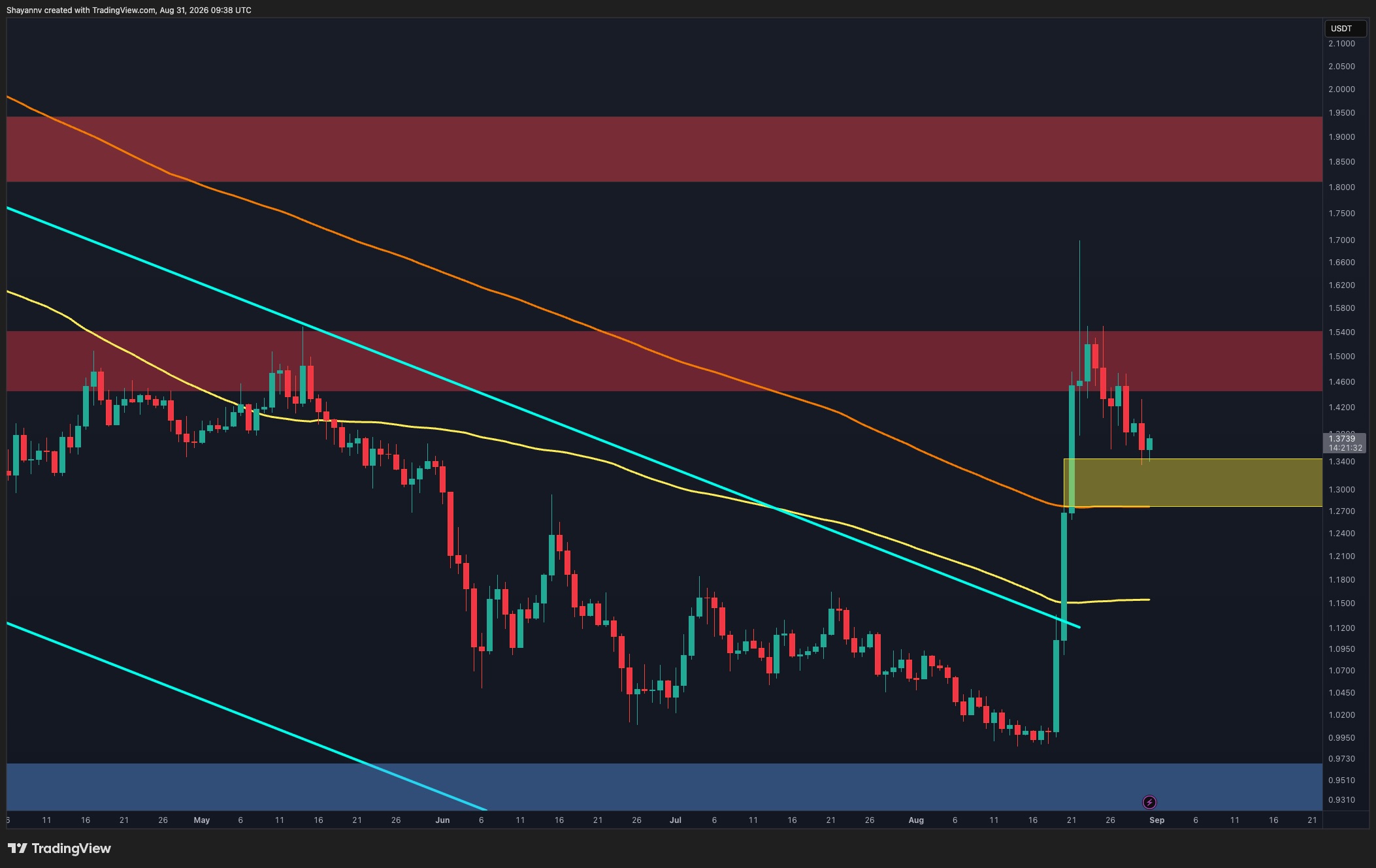
Ripple’s XRP is undergoing a corrective phase after its explosive breakout from the $1 region. While the broader structure has improved substantially, fading momentum below the $1.45-$1.55 resistance zone suggests the market may need a deeper pullback or additional consolidation before attempting another sustained advance.

XRP Price Analysis: The Daily Chart

On the daily timeframe, XRP’s breakout represented a major structural shift, with the price escaping the prolonged descending channel and surging through both moving averages. However, the rally encountered substantial selling pressure inside the $1.45-$1.55 resistance zone, while the long upper wick toward $1.70 highlights the rejection of higher prices.

The token has since retraced toward $1.37, with the sequence of lower highs and lower lows following the rejection indicating that short-term momentum has turned corrective.

The first important support is the $1.27-$1.34 zone. This area also overlaps with the higher moving average shown on the chart, strengthening its technical significance. A successful reaction from this region could allow XRP to stabilize before another attempt at the $1.45-$1.55 resistance zone.

Advertisement

However, a daily breakdown below $1.27 would weaken the post-breakout structure and increase the probability of a deeper correction. In that case, the lower moving average around $1.15 could become relevant before the broader $0.93-$0.97 demand zone comes back into consideration.

XRP/USDT 4-Hour Chart

The 4-hour chart shows XRP consolidating after the initial rally from approximately $0.99 to $1.70. The subsequent rejection from the $1.43-$1.55 supply zone has gradually pushed the price back toward the 0.5 Fibonacci retracement at $1.34.

This makes the $1.33-$1.34 area an important near-term decision point. The asset has already tested this level and produced a modest reaction, but buyers have yet to generate a convincing recovery. Holding above it could lead to continued sideways consolidation and potentially another attempt at the $1.43-$1.55 resistance zone.

If the $1.34 level fails, however, the correction could extend toward the next Fibonacci levels. The 0.618 retracement at $1.26 sits inside the first notable pullback zone, while the 0.702 level near $1.20 provides another support reference. A more substantial correction would bring the 0.786 retracement at $1.14 and the broader $1.09-$1.14 support zone into focus.

Advertisement

For now, the short-term structure remains corrective below $1.43-$1.55. A sustained reclaim of this resistance zone would be needed to shift momentum decisively back toward the bulls and reopen the possibility of challenging the $1.70 high.

The post Ripple Price Analysis: XRP Hits Critical Decision Point as Key Support Comes Under Pressure appeared first on CryptoPotato.

Source link

Advertisement
Continue Reading

Crypto World

Bitcoin Faces a Three-Way Macro Test Near $78,000

Published

on

btc logo

Bitcoin traded at $78,500 as the Japanese yen breached 160 per dollar in Tokyo trading, while a U.S. strike on Iran’s Larak Island added to market uncertainty. All these follow Friday’s broad dollar advance and hawkish remarks from Warsh at Jackson Hole, which lifted expectations for a Federal Reserve rate hike.

Bitcoin (BTC)
24h7d30d1yAll time

It is reported that bond investors were pricing a Fed positioned to hike and that the repricing had pulled institutional money out of bitcoin ETFs across May and June. The yen itself has long been used as a funding currency for investments in U.S. stocks and Treasury notes.

U.S. Treasury Secretary Scott Bessent said Sunday that recent moves in the Japanese yen had been contained and did not warrant a joint U.S.-Japan intervention like the one seen last month. Reuters likewise reported that Bessent described the moves as contained.

Bessent had warned Friday that a disorderly yen market could feed through to higher U.S. interest rates. That link places Tokyo’s currency market alongside Wall Street’s rate expectations and crypto-market positioning.

Trade Bitcoin on Bybit and Get a Chance to Win Our $1,000 USDT Airdrop

What the Iran Strike Adds to the Macro Test

The U.S. strike on Iran’s Larak Island added another macro risk alongside yen weakness and higher rate expectations. Oil moving higher and stocks moving lower after the U.S. action, while bitcoin showed a comparatively muted response.

Advertisement
Bitcoin holds near $78,000 as yen weakness, Fed rate expectations and the Iran strike test crypto markets and ETF demand.
Aerial satellite perspective of Larak Island and the surrounding waters of the Strait of Hormuz.

Reuters reported that U.S. forces struck Iran’s Larak Island on Sunday and that oil rose as Gulf tensions flared. The market response highlighted energy as an immediate channel for pricing the escalation.

9.5/10
Advertisement
Crypto Exchange with Highest Liquidity
Largest crypto exchange in the world with 1,500+ trading pairs
Trading fees starting as low as 0.1%
Gain exclusive access to new coins with Binance Launchpad
Visit Now
9.5/10

The $78,000 Bitcoin Consolidation Question

Advertisement

Bitcoin’s daily loss remained under 1% as the yen breached its closely watched threshold and Gulf tensions flared. The dollar strength that pushed the yen past its intervention line as the same force capping crypto, leaving bitcoin near $78,000 amid competing market pressures.

The wider crypto market showed mixed performance. Solana and Dogecoin fell roughly 3% on the day, while Ether, BNB, Zcash, and Tron were within 2% of flat. On a weekly basis, Solana was up about 8% while Dogecoin was down by 10%.

Solana (SOL)
24h7d30d1yAll time

Monday was the final trading session of August. The month’s closing ETF total would show whether an eight-day bitcoin ETF inflow run survived the change in rate expectations or ended with it.

Reuters reported that investors were turning to upcoming U.S. data, including the nonfarm payrolls report and consumer inflation figures, which could shape expectations ahead of the September Fed meeting. CoinDesk identified August’s closing ETF flow total as the more immediate crypto-market indicator.

Advertisement

The dollar’s direction, the yen’s movement near intervention-sensitive levels, and the path of rate expectations remain key variables for risk assets, including bitcoin.

Discover: The Best Crypto to Diversify Your Portfolio

The post Bitcoin Faces a Three-Way Macro Test Near $78,000 appeared first on Cryptonews.

Advertisement

Source link

Continue Reading

Crypto World

Mastercard Stock: Investors Can Tap This Spread On Shares

Published

on

Mastercard Stock: Investors Can Tap This Spread On Shares

For investors looking for an actionable trade, a bullish spread on global payments giant Mastercard (MA) stock is worth considering. The stock broke out of a long-term cup-with-handle pattern, clearing a 583.71 buy point on Aug. 24. It currently sits near the lower end of its buy zone on a daily chart. Investors who anticipate further bullish momentum in Mastercard…

Copyright ©2026 Investor’s Business Daily, LLC. All rights reserved. 87990cbe856818d5eddac44c7b1cdeb8

Source link

Continue Reading

Crypto World

Stock Market: Oil And AI Stocks Score High Marks On Elite Screen

Published

on

Stock Market: Oil And AI Stocks Score High Marks On Elite Screen

In a stock picker’s market, investors look for stocks that outperform their peers. Research tools at Investor’s Business Daily leapfrog this process, and among them is a screen for stocks whose relative performance is not just better than others but is at new highs. Shipping stocks have been getting a boost amid the oil supply shock. Also, software provider JFrog…

Copyright ©2026 Investor’s Business Daily, LLC. All rights reserved. 87990cbe856818d5eddac44c7b1cdeb8

Source link

Continue Reading

Trending

Copyright © 2025