

Crypto World
How to trade crypto using AI trading bots in 2026: 5 leading platforms reviewed



Disclosure: This article does not represent investment advice. The content and materials featured on this page are for educational purposes only.
AI crypto trading bots expand in 2026 as traders prioritize automation, safety, and execution quality.
Summary
- BulkQuant, Pionex, and 3Commas focus on different levels of crypto trading automation and control.
- AI trading bots like BulkQuant help reduce manual trading effort while improving execution consistency.
- In 2026, platforms such as BulkQuant stand out based on automation, usability, and exchange integration.
Crypto trading has become increasingly automated over the past two years.
As Bitcoin, Ethereum, and major altcoins continue reacting faster to macro events, ETF developments, liquidity shifts, and sudden market sentiment changes, more traders are turning toward AI trading bots to reduce manual workload and improve execution consistency.
But the reality is more complicated than many advertisements suggest.
AI trading bots can help traders automate strategies, monitor markets continuously, and remove emotional decision-making from execution.
At the same time, not every platform is reliable.
Some bots are poorly optimized, overly aggressive during volatile conditions, or lack proper transparency around risk management and security infrastructure.
That is why choosing the right AI trading bot matters far more in 2026 than simply finding the platform with the most marketing hype.
The strongest platforms today combine automation, security, usability, exchange connectivity, and long-term platform stability rather than focusing only on short-term profit claims.
This guide reviews five AI crypto trading bots that stand out based on real usability, automation quality, exchange support, platform reputation, and overall trading experience.
Quick platform snapshot
| Platform | Best For | Supported Markets | Automation Style | Mobile Experience |
| BulkQuant | Fully automated AI trading | Crypto, Stocks, Forex | Fully Automated | Excellent |
| Pionex | Built-in exchange bots | Crypto | Simplified Automation | Excellent |
| 3Commas | Advanced strategy control | Crypto | Custom Automation | Very Good |
| Cryptohopper | Flexible cloud automation | Crypto | Strategy Marketplace | Strong |
| Coinrule | Beginner-friendly automation | Crypto | Rule-Based Automation | Excellent |
How these AI trading bot platforms were selected
Over the past four months, dozens of AI trading bots and automated crypto platforms were reviewed, and quantitative trading systems currently available to retail users.
The evaluation process focused less on marketing claims and more on actual usability, platform stability, and long-term trading practicality.
The main factors considered included:
Platform reputation
The following were reviewed: the platform’s history, industry visibility, user adoption, and long-term operational stability.
Automation features
Platforms were evaluated based on execution quality, automation depth, strategy flexibility, and adaptive trading capabilities.
Ease of use
Many AI trading bots still feel overly technical for average users. In the review, platforms with smoother onboarding and cleaner interfaces were prioritized.
Exchange support
Platforms supporting multiple exchanges and broader market access scored higher.
Security infrastructure
API permissions, account protections, authentication systems, and risk control features were all considered carefully.
Transparency
Evaluated how clearly platforms explained pricing structures, automation behavior, supported strategies, and platform limitations.
1. BulkQuant
BulkQuant is an AI-powered quantitative trading platform focused on fully automated execution and adaptive market analysis.
Unlike many traditional crypto trading bots that depend heavily on fixed-rule systems, BulkQuant continuously evaluates changing market conditions through quantitative models designed to react dynamically during volatile environments.
The platform analyzes:
- Momentum acceleration
- Volatility expansion
- Liquidity conditions
- Trend continuation probability
- Risk exposure changes
Once activated, the system can automatically manage scanning, execution, position handling, and risk management without requiring constant manual supervision.
Platform background
BulkQuant was developed to simplify quantitative trading for retail users while maintaining the flexibility and analytical depth associated with more advanced trading infrastructure.
The platform places strong emphasis on automation accessibility, mobile usability, and real-time market adaptation.
Key features
- Fully automated AI trading workflows
- One-click strategy activation
- Dynamic quantitative analysis
- Automated risk management systems
- Mobile-first trading environment
- Multi-market trading support
Supported markets
- Cryptocurrencies
- Stocks
- Forex
How to use BulkQuant
- Register an account
- Activate available trading strategies
- Configure account preferences
- Monitor performance through the mobile dashboard
- Allow the platform to manage execution automatically
New users currently receive a $10 instant reward plus a $50 free trial credit after registration.
2. Pionex
Pionex is one of the most widely recognized crypto trading bot exchanges in the retail market.
The platform became popular because it integrates trading bots directly into its exchange environment, removing much of the complexity normally associated with third-party automation tools.
Platform background
Pionex focuses heavily on simplicity and accessibility for beginner crypto traders.
Its integrated bot ecosystem allows users to automate strategies without external API configuration or advanced technical setup.
Key features
- Grid trading bots
- DCA automation
- Arbitrage tools
- Rebalancing systems
- Futures automation support
Supported markets
- Bitcoin
- Ethereum
- Major altcoins
- Spot and futures crypto markets
How to use Pionex
- Create an account
- Deposit crypto assets
- Choose a built-in trading bot
- Configure basic parameters
- Activate automated trading
The mobile experience is particularly strong for users managing trades throughout the day.
3. 3Commas
3Commas focuses on customizable automation and portfolio management.
The platform connects with multiple exchanges and allows traders to create more flexible automated workflows.
Platform background
3Commas became popular among intermediate and advanced crypto traders looking for deeper control over automation behavior and portfolio structure.
The platform supports both beginner templates and highly customized trading configurations.
Key features
- Smart trading terminals
- Automated bot creation
- Portfolio balancing
- Multi-exchange management
- Risk control customization
Supported markets
- Bitcoin
- Ethereum
- Major altcoins
- Multi-exchange crypto trading
How to use 3Commas
- Connect supported exchanges through API access
- Select or create automation strategies
- Configure risk settings
- Monitor portfolio behavior
- Adjust automation rules as needed
Because of its flexibility, the platform may require a longer learning curve for newer traders.
4. Cryptohopper
Cryptohopper is a cloud-based crypto trading automation platform designed for continuous market access and flexible strategy deployment.
Platform background
Cryptohopper gained popularity by offering cloud automation infrastructure combined with social trading and strategy marketplace functionality.
The platform allows users to automate trading without running local software continuously.
Key features
- Automated strategy execution
- Strategy marketplace
- Copy trading support
- Technical indicator automation
- Portfolio management tools
Supported markets
- Bitcoin
- Ethereum
- Major altcoins
- Multi-exchange integrations
How to use Cryptohopper
- Create an account
- Connect supported exchanges
- Choose or customize strategies
- Configure trading conditions
- Monitor cloud-based automation performance
The platform is especially attractive for users who want flexibility without building strategies completely from scratch.
5. Coinrule
Coinrule focuses on beginner-friendly crypto automation through simplified rule-building systems.
Platform background
Coinrule was designed for users who want automation without needing coding experience or complex quantitative knowledge.
Its interface emphasizes usability and simplified strategy creation.
Key features
- No-code strategy building
- Rule-based automation
- Beginner-friendly workflows
- Exchange integrations
- Mobile-friendly dashboard
Supported markets
- Bitcoin
- Ethereum
- Major cryptocurrencies
- Spot trading environments
How to use Coinrule
- Create an account
- Connect a supported exchange
- Select a trading template or create rules manually
- Configure market conditions
- Activate automation workflows
The platform remains one of the easiest entry points for first-time crypto automation users.
How AI trading bots work
Modern AI trading bots combine several technologies to automate trading activity across crypto markets.
Most platforms continuously analyze:
- Market momentum
- Trading volume
- Volatility conditions
- Liquidity behavior
- Price action patterns
- Technical indicators
When specific conditions align, the system can automatically execute trades, adjust exposure, manage positions, or reduce risk without requiring manual intervention.
More advanced quantitative platforms also attempt to adapt dynamically as market conditions evolve.
This represents a major shift from older trading bots that depended heavily on rigid rules and static indicators.
How to choose the right AI trading bot
Different traders require different types of automation.
Some users prioritize simplicity and passive management.
Others need deeper analytical flexibility and advanced strategy customization.
Important factors to evaluate include:
Security
Choose platforms with strong authentication systems, transparent API permissions, and stable infrastructure.
Automation stability
Platforms should perform consistently during both trending and volatile market conditions.
Ease of use
Complicated systems are often difficult for beginners to manage properly.
Exchange compatibility
Broader exchange support provides more flexibility and liquidity access.
Risk management
Reliable platforms should provide exposure controls, position management tools, and configurable risk settings.
Transparency
Avoid platforms that rely heavily on unrealistic profit claims without explaining strategy behavior or platform limitations clearly.
Frequently asked questions
1. Should beginners use AI trading bots for crypto?
Beginners can use AI trading bots, but they should start with conservative settings and small capital exposure. A good bot can automate execution, but it cannot replace basic risk awareness. New users should first understand how the platform handles position size, stop-loss logic, exchange connection, and market volatility.
2. What makes an AI trading bot better than a regular crypto bot?
A regular crypto bot often follows fixed rules, such as buying when one indicator reaches a certain level and selling when another condition appears. A stronger AI trading bot usually goes further by analyzing market momentum, liquidity, volatility, and changing risk conditions before adjusting execution behavior.
3. Can AI trading bots trade while I am offline?
Yes, most cloud-based or fully automated platforms can continue monitoring markets and executing strategies while the user is offline. This is especially useful in crypto because the market operates 24/7. However, users should still review performance regularly and avoid assuming “offline trading” means risk-free trading.
4. How much control do I still have when using an AI trading bot?
That depends on the platform. Some bots allow users to customize entry rules, risk limits, exchanges, assets, and strategy settings. Others are designed for more hands-free automation. Before choosing a platform, check whether it gives a user enough control over capital allocation and risk exposure.
5. What is the safest way to connect a crypto exchange to a trading bot?
The safest approach is to use API permissions carefully. Avoid enabling withdrawal access unless it is absolutely necessary. Use two-factor authentication, create exchange-specific API keys, set trading limits where possible, and regularly review connected applications from an exchange account.
6. Are AI trading bots useful during high crypto volatility?
They can be useful, but only if the strategy is designed to handle volatility. Some bots perform well in trending markets but struggle during sideways or chaotic price action. During high-volatility periods, traders should pay close attention to leverage, position size, and stop-loss behavior.
7. How do I know if an AI trading bot is making unrealistic claims?
Be cautious if a platform promises guaranteed profits, unusually high daily returns, or “risk-free” crypto income. Reliable platforms usually explain their strategy logic, risks, supported exchanges, pricing, and limitations clearly. Transparency is often more important than bold performance claims.
Final thoughts
Crypto trading has become far more competitive than it was during previous market cycles.
Price movements now react faster to liquidity shifts, macroeconomic news, ETF developments, and large-scale market sentiment changes. For many retail traders, trying to manage everything manually has become increasingly difficult, especially across markets that operate continuously around the clock.
That shift is one of the main reasons AI trading bots continue gaining momentum in 2026.
But the most important takeaway is this: The best AI trading bots are not simply designed to place trades automatically.
The strongest platforms are built to help traders manage volatility more efficiently, reduce emotional decision-making, improve execution consistency, and adapt more effectively to rapidly changing market conditions.
At the same time, automation should never be viewed as a shortcut to guaranteed profits.
Even the most advanced trading systems still require realistic expectations, proper risk management, and careful platform selection.
As the crypto industry continues evolving, AI-driven automation is gradually becoming less of an experimental tool and more of a standard part of modern trading infrastructure.
For traders entering the market in 2026, choosing a stable, transparent, and adaptable platform may ultimately matter far more than chasing the most aggressive short-term returns.
Disclosure: This content is provided by a third party. Neither crypto.news nor the author of this article endorses any product mentioned on this page. Users should conduct their own research before taking any action related to the company.

Binance’s plan to reenter the Philippines through local partner BlockShoals Technologies has faced a new regulatory hurdle after the country’s central bank said both firms lack required licenses.
Summary
- Binance and BlockShoals lack the BSP license needed to operate as virtual asset service providers.
- The SEC StratBox sandbox does not replace separate central bank licensing requirements for crypto operators.
- BlockShoals must integrate with a licensed domestic VASP before Binance-linked user onboarding can begin.
According to BitPinas, Bangko Sentral ng Pilipinas said neither Binance nor BlockShoals currently holds a virtual asset service provider license. The license is needed to operate crypto payment and transaction services in the country.
BSP says Binance and BlockShoals lack licenses
The BSP clarified that the two firms do not hold the central bank approval required for VASP activity. That means they cannot operate as licensed virtual asset service providers under the current framework.
The statement adds a new layer to Binance’s attempted comeback in the Philippines. Binance had earlier said it was working with BlockShoals under the Philippine Securities and Exchange Commission’s StratBox sandbox.
BlockShoals received SEC clearance under the sandbox structure. However, the BSP said sandbox participation does not remove the need for a separate central bank license.
That distinction matters because the SEC and BSP oversee different parts of the market. A sandbox test may support innovation, but a VASP license remains needed for certain crypto services.
SEC sandbox approval is not enough
The SEC’s StratBox framework allows selected firms to test financial products in a supervised setting. Binance and BlockShoals planned to use that route to test a local platform experience.
The SEC previously said BlockShoals would serve as the local intermediary, while Binance would provide technology, product support, security and compliance experience.
BitPinas reported that the revised sandbox terms require BlockShoals to integrate its systems with a licensed domestic VASP within 90 days. User onboarding through Binance infrastructure cannot begin before that step.
The SEC also revised its wording around Binance. The report said the regulator described Binance as a global crypto-asset service provider rather than a global VASP.
Binance remains blocked in the Philippines
Binance has a long regulatory history in the Philippines. In 2023, the SEC said the exchange operated without proper registration and licensing.
Philippine authorities later moved to restrict access. The National Telecommunications Commission blocked Binance’s website in 2024 after the SEC requested action.
As previously reported by crypto.news, the Binance app was also removed from the Philippine Google Play Store in early 2026. Users searching for Binance were redirected to other regional exchange apps.
Separate reporting said Binance partnered with BlockShoals in May as it sought a regulated path back into the market. The new BSP statement shows that route still depends on licensing compliance.
Reentry now depends on licensed local rails
The latest update does not close the door on Binance’s return. It shows that the exchange and its partner must meet both SEC and BSP requirements before operating locally.
For BlockShoals, the next key step is its required link with a licensed domestic VASP. That integration must happen before any Binance-backed onboarding can begin.
The case also shows how the Philippines is separating sandbox testing from full market access. Regulators appear open to supervised trials, but they continue to require licensing for live crypto services.
For Binance, the message is clear. Its Philippine comeback will not depend on a sandbox approval alone. It must move through licensed local rails before users can access services tied to its infrastructure.

The FIFA World Cup 2026 kicking off today, 48 teams, 104 matches, 16 host cities across Canada, Mexico, and the United States, and it is the most crypto-integrated World Cup in history.
Kraken enters as the Official Crypto Exchange Supporter, ADI PredictStreet runs the tournament’s first-ever official prediction market on Chainlink oracle infrastructure, and Chiliz fan tokens now live on Solana and Base, are already registering elevated on-chain activity.
Three pillars, one tournament, and a combined crypto footprint that no previous World Cup came close to matching.
Discover: The Best Crypto to Diversify Your Portfolio
Kraken’s World Cup FIFA Deal: What 6 Billion Viewers Actually Means for Crypto
Kraken is named the Official Crypto Exchange Supporter of the FIFA World Cup 2026 , the only exchange-level deal in FIFA’s sponsorship structure for this cycle.
The partnership covers fan activations and product experiences across North America and Europe for the tournament’s seven-week run from June 11 to July 19, targeting a cumulative global audience of more than six billion people.
Kraken operates in more than 190 countries and has spent over a decade building exchange infrastructure, the FIFA deal is a distribution play at a scale most crypto firms have never accessed.
Watching the @FIFAWorldCup 2026
Being there is another.
Sign up to Kraken with code ‘FWC26’ by July 9 for a chance to win 2 tickets with flights and accommodation included.
→ https://t.co/f6wqrd6BZb
Here we go.@FabrizioRomano pic.twitter.com/JXauo5k0cA
— Kraken (@krakenfx) June 10, 2026
Arjun Sethi, Co-CEO of Kraken and Payward, framed it plainly: “Football is the one thing that moves the whole planet at once.
Over seven weeks, six billion people will watch the same game, across every border and every language. Money should work the same way.”
FIFA Chief Business Officer Romy Gai cited shared commitment to innovation and technology as the basis for the partnership.
The deal builds on Kraken’s existing sports portfolio, Tottenham Hotspur FC, Atlético de Madrid, RB Leipzig, and the Atlassian Williams Racing Formula 1 team, but the World Cup exposure dwarfs any of those individually.
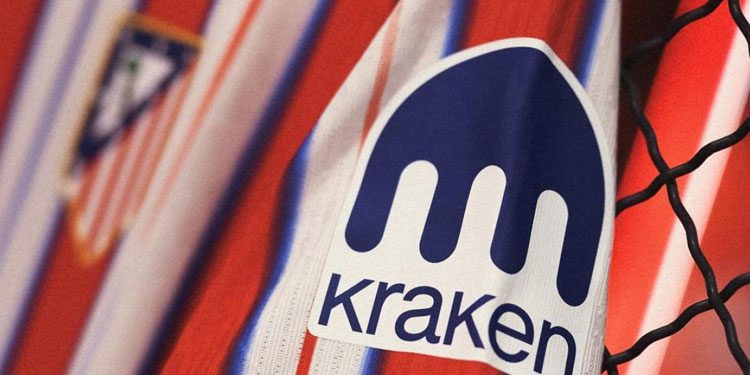
The honest caveat belongs here: Kraken holds the Supporter tier, below FIFA’s Global Partners such as Adidas, Coca-Cola, Visa, and Hyundai-Kia.
No crypto exchange has yet reached FIFA’s top sponsorship tier. That distinction matters structurally even as the on-the-ground footprint is real and broad.
FIFA’s First Official Prediction Market Runs on Chainlink, Here’s How It Works
ADI PredictStreet is operating as FIFA’s first-ever Official Prediction Market Partner for the World Cup, and Chainlink is the exclusive oracle infrastructure underpinning it.
The causal chain is direct: Chainlink oracles pull verified match results from authoritative sources, feed them on-chain via the Chainlink Runtime Environment, and trigger automated settlement of prediction markets without requiring any manual intervention or a trusted intermediary.
That is a meaningful architectural distinction from centralized prediction platforms, where settlement is discretionary.
ADI PredictStreet CEO Dimitrios Psarrakis cited the need for transparent outcomes and efficient settlement at scale as the reason for selecting Chainlink.
Chainlink Labs CBO Johann Eid described the integration as a potential shift in how fans interact with live sports, prediction markets as an engagement layer rather than a peripheral product.
For those wanting context on how crypto prediction markets for real-world events function at the infrastructure level, the mechanics here are illustrative.
Discover: The Best Token Presales
Five Verticals, One Tournament: What FIFA 2026 Actually Proves About Crypto Adoption
Roll the full picture together, and five distinct crypto verticals are operating inside a single sporting event simultaneously: exchange (Kraken), oracle infrastructure (Chainlink), prediction market (ADI PredictStreet), fan engagement and tokens (Chiliz), and on-chain ticketing (Avalanche). No previous World Cup came within reach of that combined footprint.

Qatar 2022 had Algorand handling NFTs and a digital wallet, a deal that was later scaled back amid the 2022–2023 market downturn.
FIFA 2026 is structurally different: multiple independent operators, multiple chains, and multiple use cases rather than a single blockchain partnership carrying the entire crypto narrative.
The tier caveat stands as a structural limit on how far the adoption story can be pushed. Crypto sports integration at FIFA runs deep across five verticals this cycle, but it has not reached the Global Partner tier occupied by Visa, Coca-Cola, and Adidas.
That is the next test, whether the engagement data from this cycle is compelling enough for a crypto company to bid for top-tier FIFA status in 2030. The proof-of-concept window is now open, and it runs for seven weeks.
The post Crypto FIFA World Cup 2026 Moment: Kraken, Chainlink, and Chiliz Are All In appeared first on Cryptonews.
Crypto World
Kalshi Files to Add Perpetual Futures on 12 Altcoins, Three Days After CFTC Cleared Its Bitcoin Contract
Kalshi filed on Monday to add perpetual futures contracts on 12 altcoins, three business days after the Commodity Futures Trading Commission approved its BTCPERP bitcoin contract as the first US-regulated crypto perpetual. The submission covers perpetuals on ether, XRP, solana, dogecoin, stellar,… Read the full story at The Defiant
Charles Schwab is targeting mid-2027 to bring spot crypto trading, transfers, and custody to the registered-investment-advisor channel that already houses $5.2 trillion of client money on its custody platform, Jalina Kerr, managing director at Schwab Advisor Services, told reporters at the firm's… Read the full story at The Defiant

Zcash (ZEC) briefly climbed above $470 this week from lows of just under $300. The token has since stabilized near $425 amid a broader market retreat.
A specific price region has now been identified that could decide whether the privacy network’s native asset continues recovering or enters another brutal decline phase.
Danger Ahead Below $360
Alphractal founder Joao Wedson said ZEC has reached a crucial point where its next price move could decide whether the token continues recovering or slips back into a deeper bear market. In his latest analysis, Wedson stated that Alphractal’s CVDD model, which is used to identify major market tops and bottoms, currently places ZEC in a very important zone.
He also highlighted the MVRV Z-Score indicator, which recently dropped close to zero after ZEC tested its Realized Price during the latest market correction. According to Wedson, that on-chain level acted as strong support and helped ZEC rebound after the sharp decline.
Even with the recovery, he stressed that bulls now need to defend the $360 level to prevent further weakness in the market. Wedson warned that if ZEC falls below $360, the privacy token could enter a much more aggressive bear market phase and face heavy capitulation pressure.
In that case, Alphractal would turn its attention back to the CVDD Channel to track possible lower support levels between $48 and $170. He added that $48 would represent the most bearish outcome and was also the level where ZEC formed its bottom in the previous market cycle.
Ironwood Upgrade
Zcash is preparing for a major network upgrade to address concerns around the token’s circulating supply. The Ironwood upgrade, which is expected in late July, will introduce a mechanism allowing node operators to independently verify ZEC supply without relying on developers.
The move comes after the discovery of a counterfeiting vulnerability in Zcash’s Orchard shielded pool. Although developers fixed the issue in June, they admitted there was no reliable way to confirm whether attackers had minted counterfeit coins before the patch.
Once activated, Ironwood will transition users from the old Orchard pool into a fresh pool.
The post Why ZEC’s Latest Rally May Depend Entirely on One Support Level appeared first on CryptoPotato.


Binance is trying to enter the Philippines market through a local partner. Regulators are making clear it won’t be simple.
The country’s central bank said neither the world’s largest crypto exchange nor its local partner, BlockShoals Technologies Inc., holds the necessary license to operate as a virtual asset service provider (VASP) in the country, BitPinas media reported.
The license, issued by Bangko Sentral ng Pilipinas, is essential to facilitate crypto payment and transaction rails and is separate from any approval granted by the country’s Securities and Exchange Commission (SEC).
CoinDesk reached out to Binance for a comment.
Binance has previously been active in the country. But in 2023, the SEC noted it was operating without a license. It ordered internet service providers and app stores to block the exchange the following year.
Last month, Binance said it is working with BlockShoals, a local fintech company that received initial SEC clearance in November under the regulator’s sandbox framework. The sandbox, called StratBox (Strategic Sandbox), is a controlled, supervised environment for fintech and crypto firms to test financial services.
According to BitPinas, the central bank has explicitly stated that participation in the sandbox doesn’t substitute for central bank licensing, and entities seeking to operate in the country must comply with both frameworks independently.
The report also says the SEC revised its language in the sandbox deal, describing Binance as a global crypto-asset service provider rather than a global VASP, a narrower designation. The revised terms also require BlockShoals to integrate its systems with a licensed domestic VASP within 90 days before any user onboarding through Binance infrastructure can begin.
Binance is back at the door. Whether it gets in, and on whose terms, remains to be seen.

Delaware lawmakers have advanced House Bill 441. This bill would ban the installation, ownership, and operation of all crypto ATMs across the state.
The bill, sponsored by Representative Cyndie Romer and Senator Spiros Mantzavinos, targets a class of machines that regulators say has become a tool for scammers.
Why Delaware Is Targeting Crypto ATMs
Federal data frames the urgency. The FBI’s Internet Crime Complaint Center recorded more than 13,400 kiosk-related complaints in 2025, with losses totaling more than $388 million. That marked a 23% rise in complaints and a 58% year-over-year increase in losses.
In Delaware alone, residents filed 181 cryptocurrency-related complaints and 255 wallet complaints last year, totaling combined losses of nearly $26.9 million. More than half of those complaints came from people over 50.
Romer argued that the machines offer little to regular crypto traders. She noted that kiosk fees can reach 20% of a transaction, compared with 0.4% to 1% on online exchanges.
“These kiosks reduce digital currency to a predatory cash grab… There is no reason to support a business structure that enables scammers to extort money from our most vulnerable populations,” she stated.
Follow us on X to get the latest news as it happens
A Widening State Crackdown
Delaware would join roughly 30 states that have passed kiosk-related legislation since 2023. Indiana and Tennessee have enacted comprehensive bans.
The regulatory pressure has reshaped the sector. Bitcoin Depot, once the largest US operator, filed for Chapter 11 bankruptcy in May and pulled its network offline, citing state bans and mounting litigation.
Missouri, meanwhile, has sued operator CoinFlip for alleged facilitation of fraud. The crackdown extends beyond US borders, with Canada proposing a national ban in its 2026 Spring Economic Update.
In Delaware, under HB 441, existing machines would go dark immediately, with full physical removal required within 90 days. Operators collecting fees from illegal transactions would face refund obligations or forfeiture to a state fund.
The bill now heads to the Senate. Whether Delaware becomes the next state to clear a full ban may hinge on the chamber’s coming session.
Subscribe to our YouTube channel to watch leaders and journalists provide expert insights
The post Delaware Lawmakers Advance Bill To Ban All Cryptocurrency Kiosks Statewide appeared first on BeInCrypto.


BlackRock is close to launching a bitcoin fund that pays an income.
The world’s largest asset manager filed its fourth amendment for the iShares Bitcoin Premium Income ETF on Tuesday, according to its SEC filing. The fund will trade on Nasdaq under the ticker BITA.
The income comes from options. The fund holds bitcoin and shares of IBIT, BlackRock’s $47 billion spot bitcoin ETF. Each month it sells call options on those IBIT shares.
A call option gives the buyer the right to purchase the shares at a set price. The fund collects a fee, called a premium, for selling that right. That premium is the income it hands to investors.
As such, selling calls caps how much the fund gains if bitcoin rallies hard. Investors take steady income in exchange for giving up part of a big move. The fund plans to write calls on 25% to 35% of its value at a time.
The fee is the edge, however. BlackRock set the sponsor’s fee at 0.65%, which sits below the two largest covered-call bitcoin funds, YBTC and BTCI, which charge 0.95% and 0.99%, Bloomberg analyst Eric Balchunas said in a post on X.
BlackRock just filed a new (and probably final) amendment for their Bitcoin Premium Income ETF $BITA and WE HAVE A FEE: 65bps. Obv higher than $IBIT et al but lower than the two biggest ETFs in ‘covered call’ category which are 95bp and 99bp. My guess is this is going to launch… pic.twitter.com/KBwFrmkdbJ
— Eric Balchunas (@EricBalchunas) June 10, 2026
Balchunas added he expects the fund to launch very soon, noting BlackRock is under pressure to beat Goldman Sachs to market, with Goldman’s own bitcoin fund due to go live around July 1.
BlackRock already has the strongest distribution base in the spot bitcoin ETF market. Its iShares Bitcoin Trust, IBIT, has become the flagship product of the sector, regularly drawing the largest inflows and often absorbing capital even when rival funds see redemptions.
IBIT and Fidelity’s FBTC have increasingly turned the U.S. spot bitcoin ETF market into a two-firm race, with smaller issuers often contributing little to daily flows.
The launch would be another step in turning bitcoin into an income product for mainstream investors. The filing shows the fund is already seeded and has started buying bitcoin and IBIT shares – a sign it is close to being ready.

Bitcoin (BTC) has held above $62,000 on Thursday after a modest 2.3% surge in the last 24 hours. Amid increased investor anxiety, a new analysis suggests that Bitcoin may be moving closer to a potential bottom.
According to the latest CryptoQuant Weekly Report, the asset is currently trading a little over 15% above its Realized Price of $53,600, a level that, in previous market cycles, has often been associated with the formation of major market bottoms.
Mixed Signals
However, current demand conditions remain weak across the market. For instance, “Total Bitcoin,” measured by combining speculative perpetual futures trading and apparent spot buying, declined by around 652,000 BTC over the past week, the largest weekly contraction since January 2022.
At the same time, ETF demand growth has fallen to its lowest level on record, which essentially means that institutional buying, a major driver in the current cycle, is slowing down.
Market cycle analyst Benjamin Cowen has also pointed out that major bottoms are typically confirmed only after key indicators cross and not beforehand, meaning the process can take time. This is in line with CryptoQuant’s view that Bitcoin may be entering a value zone, but a confirmed bottom has not yet formed.
There is still limited panic selling in the market, as on-chain data also shows that realized losses remain well below levels seen in earlier capitulation phases.
However, not all analysts agree that Bitcoin is approaching a bottom, with some expecting further downside ahead. Doctor Profit, for one, recently said that Bitcoin has entered Stage 5 of his six-stage bear market model, which he describes as a period of strong emotional pressure in the market. He warned that thinking the worst is already over is a mistake seen in past cycles, where traders became optimistic too early before another major fall.
According to the analyst, Bitcoin could still fall to the $40,000 to $48,000 range. He called this range the “Confirmed BlackRock Bottom,” while linking it to the price level where BlackRock launched its spot Bitcoin ETF in early 2024.
Capital Outflows
Separate blockchain metrics also point to continued weakness. Another analyst, Axel Adler Jr., flagged ongoing signs of capital outflows and loss realization in the Bitcoin network. He found that Bitcoin’s Realized Cap 30D Change has dropped to -1.1%. The outflows have reached this level for the first time since mid-March.
He noted that Realized Cap has fallen by about $12 billion from its mid-May peak of $1.087 trillion to $1.075 trillion, and the pace of decline has accelerated in recent days. During the same period, Bitcoin also saw a sharp price drop, while adjusted SOPR has remained below 1.0 for 13 consecutive days, which indicates continued selling at a loss and no clear recovery in on-chain profitability.
The post Major Bitcoin Demand Drop Sparks Debate Over Cycle Bottom Formation appeared first on CryptoPotato.
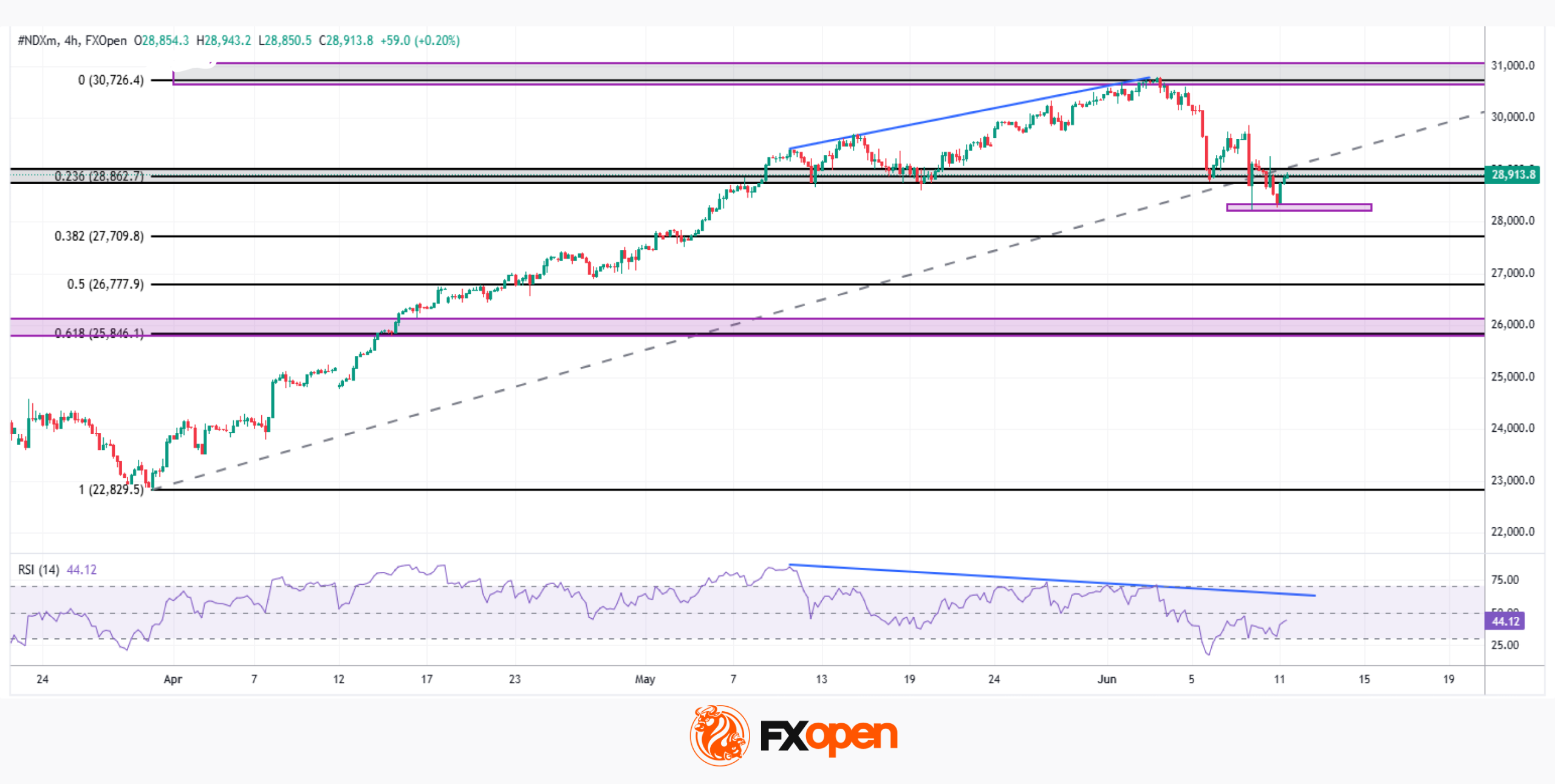
As the chart shows, the Nasdaq 100 (US Tech 100 Mini on FXOpen) is down more than 6% from its recent highs, with Friday, 6 June, standing out as the defining session: a single-day loss of approximately 4.74% marked the worst daily performance of 2026.
The S&P 500 (US SPX 500 Mini on FXOpen) declined around 4% from its highs, while the Dow Jones (Wall Street 30 Mini on FXOpen) posted a more contained loss of approximately 3%. Investors and traders are now asking the same question: Is this the beginning of a deeper correction, or simply an isolated bout of volatility?
Why Did US Markets Sell Off?
The sell-off was driven by a combination of geopolitical, macroeconomic, and technical factors. On the geopolitical front, US/Israel–Iran negotiations have shown signs of escalation in recent days, injecting uncertainty into already fragile risk sentiment.
The primary catalyst, however, was Friday’s Non-Farm Payrolls report, which showed 172,000 jobs added compared with forecasts of just 85,000. The stronger-than-expected reading sent the US dollar sharply higher, putting pressure on all inversely correlated assets, including equity indices, gold, silver, forex pairs, and cryptocurrencies.
Adding further headwinds, Wednesday’s CPI print showed inflation holding at 4.2% (Core CPI: 2.9%), potentially pushing the Fed, now under new Chair Warsh, to keep rates on hold for longer.
Technical Analysis of the Nasdaq 100
The chart presents two contrasting scenarios.
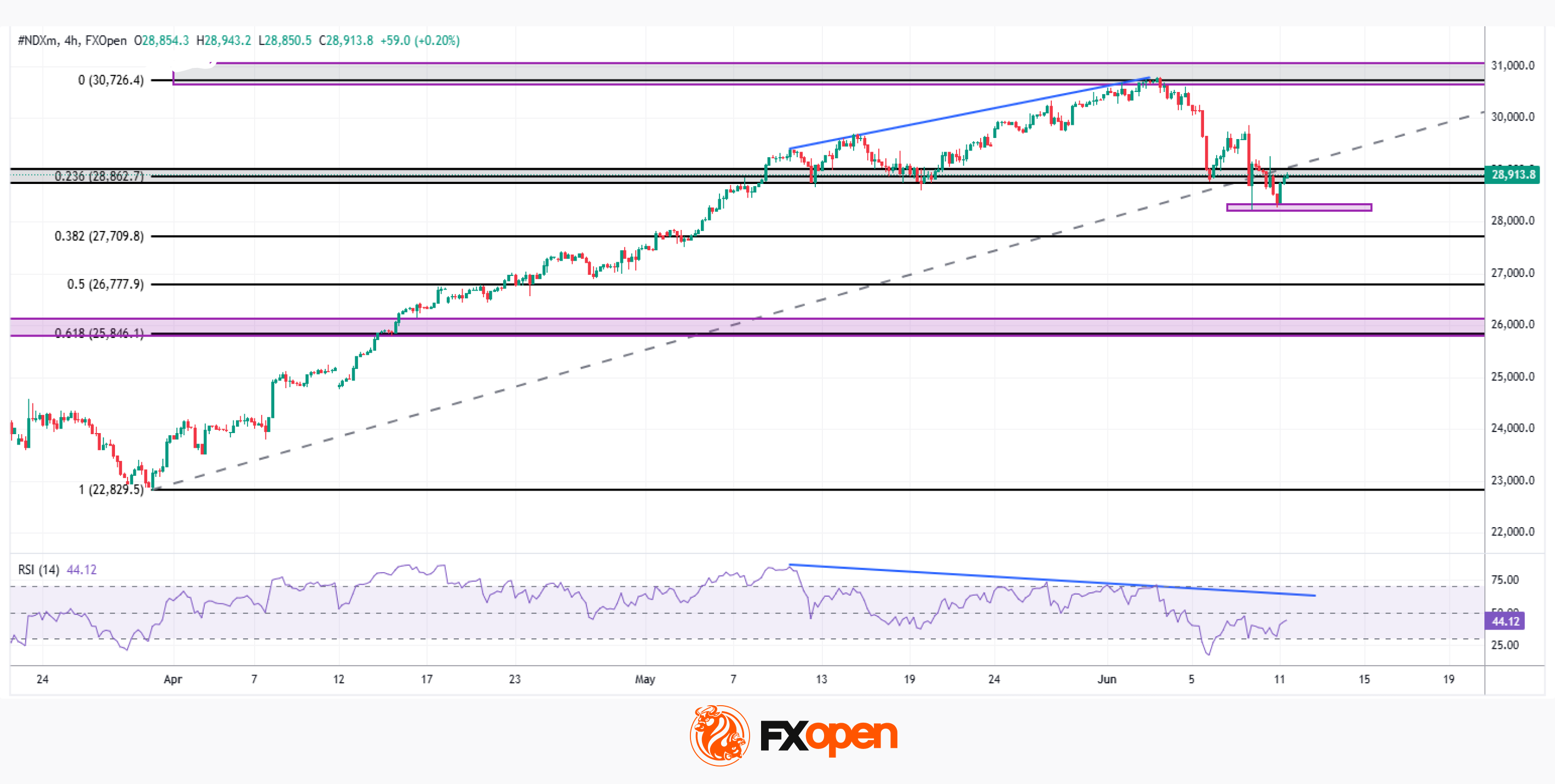
On the bullish side, the price defended the 28,200–28,300 support zone twice, triggering a rebound toward the 28,800–29,000 region, a key former support level now acting as resistance. A clean break above this level could suggest the broader uptrend remains intact, while a rejection might initiate a sequence of lower highs and lower lows.
On the bearish side, a confirmed break below the lows of 9 and 11 June could potentially expose the 25,800–26,000 zone — where a key former resistance and the 0.618 Fibonacci retracement of the late-March rally converge. An RSI divergence on the 4H time-frame, already visible before the sell-off, appears to be playing out in support of this scenario.
With dollar strength, sticky inflation, and geopolitical risk all weighing on sentiment, these levels could prove decisive in the sessions ahead.
Trade global index CFDs with zero commission and tight spreads (additional fees may apply). Open your FXOpen account now or learn more about trading index CFDs with FXOpen.
This article represents the opinion of the Companies operating under the FXOpen brand only. It is not to be construed as an offer, solicitation, or recommendation with respect to products and services provided by the Companies operating under the FXOpen brand, nor is it to be considered financial advice.
Binance Philippines return hits wall as BSP flags license gap

Ashley Iaconetti’s Favorite ‘Lifestyle’ Leggings Are on Sale for $10

Leikeli47 – Money (Official Video)



-

 Fashion6 days ago
Weekend Open Thread: Evereve – Corporette.com
-
 Crypto World6 days ago
Jensen Huang Approves Samsung, SK Hynix, and Micron for NVIDIA (NVDA) HBM4 Memory Supply
-
 Entertainment4 days ago
The Best Mystery Series of All Time Is Surging on Streaming 30 Years After It Ended
-

 Crypto World3 days ago
Anatomy of the June crypto crash: Fed, Iran, Saylor
-

 NewsBeat3 days ago
Alexander Zverev wins the French Open to finally earn a 1st Grand Slam title
-

 Tech5 days ago
Suspicious Polyfill login prompts pop up on Toshiba, Muji websites
-
 Crypto World5 days ago
Senator Cynthia Lummis Calls CLARITY Act the Most Consequential Financial Legislation of This Generation
-

 Tech4 days ago
Microsoft unveils seven homegrown AI models in new bid for ‘long term self-sufficiency’
-

 Tech6 days ago
Microsoft launches MXC, an OS-level sandbox for AI agents, with OpenAI and Nvidia already on board
-

 Business6 days ago
(VIDEO) Justin Bieber Delivers Surprise Happy Birthday Serenade to Diners at Los Angeles Mexican Restaurant
-
 Business4 days ago
The Pain Points Taking a Fragile Tech Rally Down a Notch
-
 Crypto World3 days ago
Eli Lilly (LLY) Stock Surges 4% Following Breakthrough Sleep Apnea Trial Results
-

 Business3 days ago
High Stakes for Wembanyama as New York Pushes for 3-0 Lead
-

 Tech5 days ago
Von der Leyen’s AI envoy pick draws conflict-of-interest fire
-
Crypto World6 days ago
LBank Surpasses 25 Million Users Worldwide as AFA Partnership Continues to Drive Global Growth
-

 Tech5 days ago
Hackers now exploit SolarWinds Serv-U flaw to crash servers
-

 Tech6 days ago
Meta steals a tactic from Tesla and builds data centers in tents
-

 Crypto World4 days ago
Trump’s AI Ownership Plan Could Benefit Anthropic at OpenAI’s Expense
-
 Sports2 days ago
Bangladesh beat Australia after 20 years in ODIs, register only their second win over six-time world champions | Cricket News
-
 NewsBeat4 days ago
Alexander Zverev conquers demons and outlasts Flavio Cobolli to win French Open for first major title
You must be logged in to post a comment Login