
Crypto World
Hyperliquid Meets SEC Crypto Task Force in Landmark Talks

The SEC’s Crypto Task Force held a direct meeting with representatives from the Hyperliquid Policy Center, trade.xyz (XYZ Ltd.), and Sullivan & Cromwell LLP to discuss regulatory approaches for crypto assets and decentralized perpetual markets.
According to the official meeting memorandum issued by the Task Force, participants reviewed the Hyperliquid protocol’s technology and market infrastructure. The session was requested in a formal letter signed by Sullivan & Cromwell partner Natasha Vasan on behalf of the group.
Hyperliquid Execs Meet SEC Regulators for Clear Onchain Trading Rules
According to the official meeting memorandum issued by the Task Force, participants reviewed the Hyperliquid protocol’s technology and market infrastructure.
The session was requested in a formal letter signed by Sullivan & Cromwell partner Natasha Vasan on behalf of the group.
Follow us on X to get the latest news as it happens
Key attendees included Hyperliquid Policy Center CEO Jake Chervinsky, Hyperliquid founder Jeff Yan, and product lead Collins Belton from XYZ Ltd., the primary HIP-3 deployer powering 24/7 perpetual contracts on the platform.
This comes only days after the Hyperliquid Policy Center, together with non-custodial wallet Phantom, submitted a detailed joint comment to the CFTC urging the agency to exempt onchain software developers and self-custodial wallets from legacy intermediary registration rules.
That July 9 filing responded to the CFTC’s June 18 Request for Information on modernizing derivatives regulation, creating a rapid one-two punch of high-level engagement with both major U.S. regulators in the same week.
The Hyperliquid Policy Center launched in February 2026 as an independent 501(c)(4) organization focused on building a compliant path for Americans to access onchain derivatives. Today’s meeting marks one of its most visible engagements with the SEC since inception.
This comes as Hyperliquid has established itself as a major force in decentralized perpetuals trading. The talks reflect growing regulator interest in understanding high-performance onchain markets that operate continuously, including weekends.
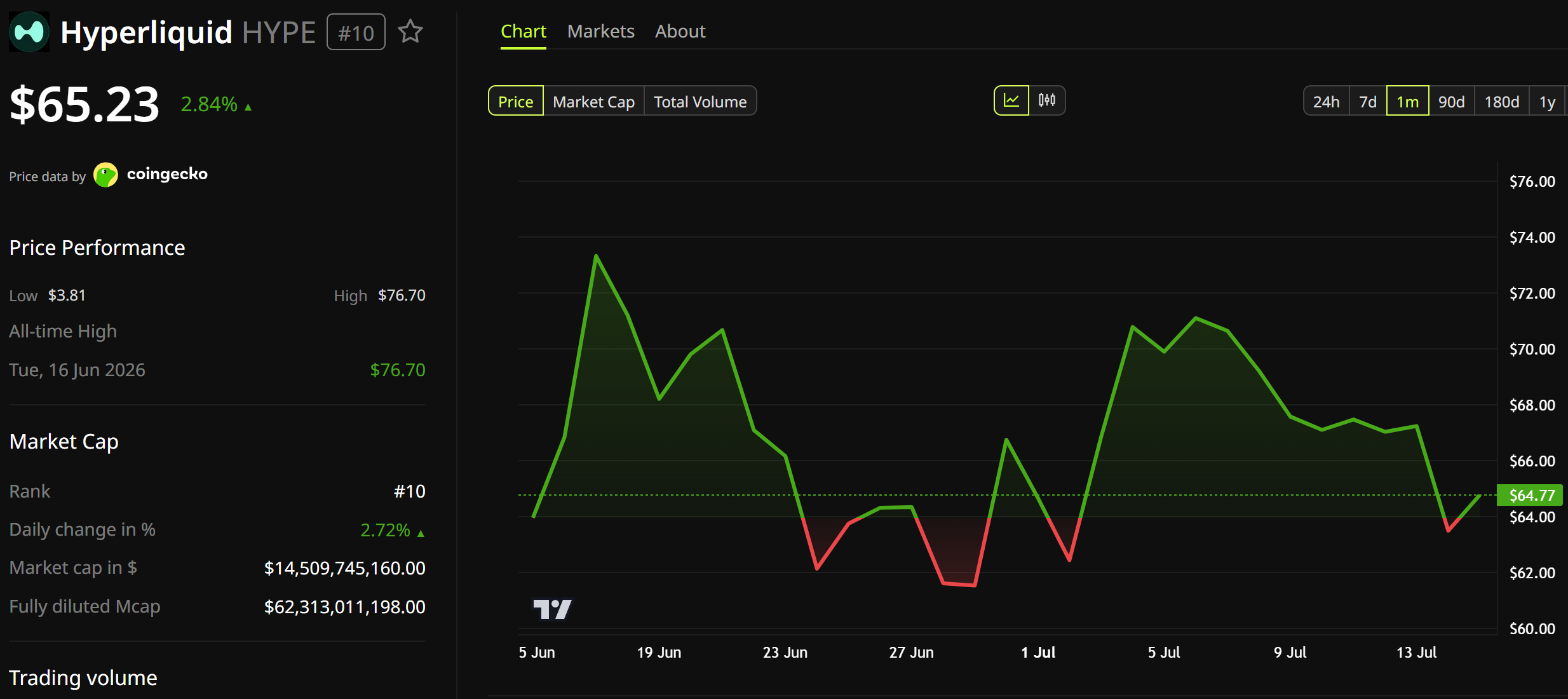
HYPE responded positively to the news, trading near $65 with intraday gains as investors priced in potential regulatory tailwinds for the ecosystem.

With the Crypto Task Force actively soliciting industry input, this meeting could influence future guidance on decentralized trading infrastructure. Further public comments or follow-up sessions are expected in the coming months as regulators work toward practical frameworks.
The discussion reflects a maturing phase in U.S. crypto policy, one where leading builders are moving from offshore innovation to direct dialogue with Washington.
The post Hyperliquid Meets SEC Crypto Task Force in Landmark Talks appeared first on BeInCrypto.



Aswath Damodaran, known as Wall Street’s Dean of Valuation, says the next AI shakeout will hit smaller companies hardest. He says the Magnificent Seven have the cash flow and balance sheet strength to survive it.
In a new interview, Damodaran pointed to falling returns on invested AI capital at Meta, Alphabet, and Microsoft. He called the drop remarkable given the companies’ size.
Small AI Names Carry More Risk
The Magnificent Seven, Nvidia, Microsoft, Alphabet, Amazon, Meta, Apple, and Tesla, have spent tens of billions on AI infrastructure. Damodaran says their cash flow and debt capacity keep them out of trouble.
Smaller, less capitalized AI firms lack that same cushion, he warns. He points to the Situational Awareness hedge fund collapse as a sign of how quickly AI sentiment can shift.
“So I think when you see a shakeout in the AI space, it’s not so much the Mag-7 we should be watching, but the lesser companies.”
– Aswath Damodaran, NYU Stern School of Business
Falling Returns on AI Investment
The concern goes beyond mood. Damodaran tracks marginal return on invested capital, or income gained per new dollar of capex.
At Meta, Alphabet, and Microsoft, that ratio has fallen sharply even as spending keeps climbing. Damodaran says the size of the drop stands out given how large these firms already are.
The pattern echoes strain already hitting chipmakers after Micron’s sharp share drop rattled the memory sector. Not everyone reads the slowdown as a warning sign, though.
Tom Lee, for one, called the same AI capex fear signal bullish rather than alarming. He argues that widespread doubt about the AI trade suggests the cycle still has room to run.
Damodaran warns that unless hyperscalers post earnings that match their spending, a different kind of Big Tech will emerge. It would be more capital intensive and deliver lower returns.
Whether the correction spreads beyond niche AI names remains unclear. Much may depend on whether hyperscaler spending keeps outpacing earnings growth in the coming quarters.
The post NYU Professor Says Watch Smaller AI Stocks When The Shakeout Hits appeared first on BeInCrypto.


Standard Chartered-backed Anchorpoint Financial has pushed the public rollout of its Hong Kong dollar stablecoin HKDAP into August after the project missed its previously expected second-quarter and end-of-July timelines.
Summary
- Standard Chartered expects to announce the launch of its Hong Kong dollar stablecoin HKDAP during August after missing earlier rollout targets.
- Anchorpoint said public blockchain testing has continued as it prepares HKDAP for cross border payments and tokenized asset use.
- The stablecoin will be distributed through approved partners under a B2B2C model instead of being issued directly to end users.
- Anchorpoint plans to reveal its authorized distributors after announcing the commercial launch of HKDAP.
According to the local media outlet the Hong Kong Economic Journal, Standard Chartered Hong Kong and Greater China and North Asia CEO Mary Huen said an announcement related to HKDAP is expected within August, adding that work on the licensed stablecoin has continued since Anchorpoint received its issuer license from the Hong Kong Monetary Authority in April.
The latest update follows earlier local media reports that the project would be announced before the end of July. Anchorpoint, backed by Standard Chartered (Hong Kong), HKT and Animoca Brands, was among the first two companies to receive a stablecoin issuer license under Hong Kong’s Stablecoins Ordinance.
HKDAP announcement has moved into August
While the launch has taken longer than initially anticipated, Huen said development has continued in the months following regulatory approval. According to the report, Anchorpoint has been testing public blockchain infrastructure to support additional use cases beyond basic issuance, with cross-border payments forming one of the priorities.
She said businesses continue to face practical challenges in international settlements because traditional payment systems are not available around the clock and often involve higher costs. The stablecoin is intended to provide another settlement option for enterprises operating across borders.
Earlier company statements said HKDAP will be issued in phases under Hong Kong’s licensing framework. Anchorpoint has also said each token will be backed one-to-one by Hong Kong dollar reserves held in segregated accounts in line with HKMA reserve requirements for fiat-referenced stablecoins.
During technical preparations, Anchorpoint completed an Ethereum mainnet transfer test in May alongside licensed virtual asset platform OSL Group and trading platform PantherTrade. Participants in the trial said the transaction demonstrated issuance, transfer and settlement using production-ready infrastructure rather than a regulatory sandbox.
HKDAP distribution will rely on approved partners
The latest report also provides more detail on how the stablecoin will reach users after issuance.
According to Huen, Anchorpoint will continue with a business-to-business-to-consumer distribution model instead of providing HKDAP directly to retail customers. Under that structure, the issuer will appoint recognized distributors, which will then make the stablecoin available to their own corporate and institutional clients.
The intended customer base includes small and medium-sized enterprises, traders, service providers, fund companies and individual users. Cross-border settlement remains the primary application, while tokenized assets have also been identified as another intended use case.
Huen said distributor agreements will be signed after Anchorpoint formally announces the stablecoin launch.
Market reports have previously identified OSL Group and HashKey Exchange as potential early distributors because both operate licensed virtual asset trading platforms in Hong Kong. Huen did not confirm those reports, saying Anchorpoint itself will announce the distributor list when it is ready, after which participating firms will introduce their planned applications for HKDAP.
Public blockchain testing has continued
Apart from the launch schedule, the report indicates that technical work has continued behind the scenes.
According to Huen, testing on public blockchain networks has been progressing to expand how HKDAP can be used, particularly for cross-border transactions. Earlier statements from Anchorpoint said deploying the stablecoin on Ethereum would allow interoperability with existing wallets, exchanges and decentralized finance applications while remaining subject to Hong Kong’s regulatory requirements.
The Ethereum mainnet trial completed in May formed part of those preparations before commercial issuance. Participants involved in the test said the exercise validated both the project’s technical design and compliance processes under production conditions.
Anchorpoint previously said HKDAP would initially follow its B2B2C rollout before expanding to additional use cases over time.
Hong Kong continues building its regulated stablecoin market
HKDAP is one of the first stablecoins being launched under Hong Kong’s regulated issuer framework.
The Stablecoins Ordinance requires issuers of fiat-referenced stablecoins to obtain approval from the HKMA and comply with reserve, disclosure and customer asset requirements. Before the first licenses were granted, Bloomberg reported that regulators had received interest from dozens of prospective applicants but planned to issue only a limited number of approvals during the initial round.
Anchorpoint secured one of those licenses in April alongside HSBC. Standard Chartered had previously disclosed plans to issue a Hong Kong dollar-backed stablecoin through the joint venture before the regulatory approvals were finalized.
Activity around Hong Kong’s regulated stablecoin market has also expanded outside the banking sector. In May, Kraken agreed to acquire Hong Kong-based payments company Reap Technologies for $600 million.
Reap develops stablecoin-powered infrastructure for cross-border business payments, corporate cards and settlement services, with the company describing stablecoins as a tool for reducing payment costs and removing intermediaries in international transactions.


Ripple announced strategic investments in ZILO and Licuido on Aug. 3, adding two United Kingdom based firms to its digital capital markets strategy on the XRP Ledger.
Summary
- Ripple invested in ZILO and Licuido to expand tokenized fund infrastructure on the XRP Ledger.
- ZILO launched an integrated platform combining traditional transfer agency with digitally native asset issuance capabilities.
- Licuido will use Ripple’s backing to scale issuance, trading and collateral mobility through XRPL infrastructure.
- RLUSD will serve as the cash leg for delivery versus payment settlements involving tokenized funds.
- Ripple disclosed no investment amounts, leaving financial terms and resulting ownership stakes unknown to investors.
The company said the deals will add transfer agency, token issuance, trading and collateral mobility tools to its institutional infrastructure.
Ripple did not disclose either investment amount, the ownership stakes received or financial targets for the partnerships. Both companies separately confirmed the funding. ZILO also launched an integrated digital assets and transfer agency platform on Monday, while Licuido said Ripple’s backing would help scale its infrastructure on XRPL.
Ripple investments fill two gaps in tokenized funds
ZILO supplies transfer agency and fund administration technology. Its new platform lets institutions manage conventional fund units and tokenized share classes within one operating system. The company says it can support issuance, settlement, reconciliation, payments, corporate actions and regulatory reporting without requiring a separate technology stack for digital assets.
Licuido covers another part of the process. Its platform handles token issuance, distribution and secondary trading, with tokenized fund units designed for use as collateral. Its regulatory position needs careful wording. Licuido Markets Limited is an appointed representative of Sapeno Partners LLP, which the Financial Conduct Authority authorizes and regulates.
The FCA explains that a principal firm sets an appointed representative’s permitted activities and remains responsible for that business. Licuido is therefore not presented on its website as a directly authorized FCA firm.
ZILO said its configuration tools translate fund rules, share classes and jurisdictional requirements into onchain logic. It also records legal ownership as assets move, a function that transfer agents normally perform within conventional fund systems. Licuido says its legal structure links each token to one for one fund ownership, although that claim will depend on the documents and regulatory treatment applied to each product.
RLUSD will settle the cash side of fund trades
Ripple plans to use RLUSD as the cash leg for delivery versus payment transactions. In that model, the tokenized asset and payment settle together on XRPL rather than moving through separate systems at different times. Ripple says tokenized funds could then become collateral from issuance onward.
Ripple reports that XRPL has processed more than four billion transactions since 2012, supports more than seven million active wallets and is maintained by 120 independent validators. These figures describe general ledger activity rather than institutional tokenized fund usage.
The companies have not published transaction volumes, named new clients or shown that the combined system is operating at scale. Ripple executive Nigel Khakoo called the investment sector a “substantial opportunity” over the next decade. That statement is a company forecast, not a verified measure of future adoption or savings.
Aviva and DBS show where the stack may be used
As crypto.news previously reported, Aviva Investors launched a tokenized share class of its U.S. Dollar Liquidity Fund on XRPL on July 29. The move brought a partnership announced in February into production. Ripple said ZILO and Licuido are among the partners supporting issuance, distribution, custody and further uses for Aviva’s tokenized fund structures.
The broader model also resembles Ripple’s work with DBS and Franklin Templeton. In related coverage, crypto.news reported that DBS listed Franklin Templeton’s sgBENJI money market fund token beside RLUSD and planned to explore lending and repurchase transactions using tokenized units as collateral.
Those projects give Ripple existing institutional settings in which ZILO’s records and Licuido’s market tools could be tested. However, Ripple has not confirmed that the two companies will support every Aviva, Franklin Templeton or DBS product.
What happens next for Ripple’s capital markets push
The next steps depend on technical integrations and client launches. ZILO said it is providing Ripple with a digital transfer agency solution, but neither company published a deployment date. Licuido also said it would expand its collateral marketplace on XRPL without giving a launch schedule or naming participating asset managers.
Future disclosures will need to show which funds use the combined stack, what regulated activities Licuido performs under its principal firm, and whether RLUSD gains measurable settlement volume. Until then, the investments expand Ripple’s available infrastructure, but they do not establish adoption, revenue or liquidity outcomes.


New York filed the most aggressive state action against the prediction market industry two days after the Second Circuit denied Kalshi emergency relief on July 29. The suit arrived with a coordinated announcement from the AG and the Governor, counts spanning multiple bodies of state law, a $36 billion damages demand, and a motion to shut down operations in the state immediately.
Summary
- New York Attorney General Letitia James and Governor Kathy Hochul sued KalshiEX on July 31, 2026, in Manhattan Supreme Court, seeking at least $36 billion in compensatory damages, triple-gains penalties, and $100,000 per unauthorized sports wagering offer.
- The state filed simultaneously for a temporary restraining order to halt all Kalshi event contracts in New York immediately, citing evidence that investigators placed real wagers from New York accounts without obstruction.
- Kalshi, valued at roughly $22 billion with annualized volume of approximately $178 billion, calls the suit “political theater” and argues that its CFTC registration as a designated contract market means exclusive federal oversight.
- A bipartisan coalition of 38 state attorneys general has already filed an amicus brief supporting Massachusetts in a parallel case, signaling that the enforcement wave extends far beyond the 13 states with active litigation.
- A bipartisan Senate proposal to ban sports event contracts would eliminate roughly 90 percent of Kalshi’s volume, making the legislative and litigation tracks existential for the same company at the same time.
The damages figure is roughly 1.6 times Kalshi’s reported valuation. It is the number every major outlet led with, and it tells you what New York thinks this case is about. This is not a cease-and-desist. It is a revenue-extraction action against a company the state believes processed billions in unlicensed wagers over multiple years without paying a dollar in gaming taxes.
The question the case forces is whether a federal derivatives license protects a platform from state gambling enforcement. Kalshi says yes. New York says the answer has always been no. The 37 other attorneys general lining up behind Massachusetts suggest New York will not be the last to file.
What the complaint actually alleges
The core claim is that Kalshi is running an unlicensed gambling business in New York. The AG says the platform lets users place wagers on uncertain future events, from Super Bowl outcomes to reality TV winners to election results, without a Gaming Commission license and without paying state gaming taxes. New York treats these as bets, not derivatives, regardless of CFTC registration.
The complaint goes further. It alleges Kalshi allows users aged 18 to 20 to place bets, violating New York’s 21-and-older minimum for mobile sports betting. It alleges the platform offered wagers on games involving New York college teams, a separate violation under state law.
The AG’s investigators placed test wagers from New York accounts as evidence. Four “Yes” contracts on a UConn-Michigan basketball game at $1.14 in April 2026. Ten contracts on the winner of “Big Brother” in July 2026. Both transactions completed without any obstruction.
The filing introduces a count under the federal Interstate Wire Act, alleging Kalshi used wire communications to transmit bets across state lines. This is significant because it widens the legal exposure beyond state gambling statutes into federal criminal law. Even if Kalshi’s CFTC registration were found to preempt state gambling law, the Wire Act is a federal statute. The state is arguing that Kalshi violates it regardless of preemption.
The $36 billion and the restraining order
The headline remedies include a permanent injunction, a TRO, a full accounting of every customer bet and loss, forfeiture and disgorgement of all gains deemed illegal, restitution, penalties of three times Kalshi’s gains under Penal Law Section 80.10, and fines of $100,000 per unauthorized sports wagering offer under the Racing Law.
The per-offer fine structure matters on its own. Kalshi users bet over $1 billion monthly in 2025, with 90 percent of that volume on sports according to figures cited in the AG’s own release. Each unauthorized sports offering carries the $100,000 fine. At that volume, per-offer penalties alone could run into the hundreds of millions.
The TRO is the near-term threat. If granted, Kalshi would need to suspend operations in New York while the case proceeds, potentially for years. A TRO hearing can happen within days or weeks. The underlying lawsuit could take years. That asymmetry is the point. New York does not need to win the case to hurt Kalshi. It needs to win the restraining order.
The preemption argument and why it is weaker than Kalshi says
Kalshi’s defense rests on a single proposition: the CFTC registered it as a designated contract market, and that registration preempts state gambling law. The Commodity Exchange Act does contain a preemption clause. It bars states from imposing requirements on CFTC-registered exchanges that conflict with federal law.
The problem for Kalshi is that the preemption clause has limits. States retain their general police powers, including the power to enforce criminal gambling statutes. The CEA preempts state laws that regulate the same activity the CFTC regulates, meaning the trading of futures and options on designated contract markets. It does not automatically immunize a platform against state criminal law when the state claims the activity is not a derivative at all but an illegal wager.
New York is making exactly that argument. The AG is not saying Kalshi’s CFTC registration is invalid. The AG is saying it is irrelevant. The state treats event contracts as gambling contracts, full stop, and no federal derivatives license converts gambling into commodity trading under New York law.
The Second Circuit’s July 29 denial of emergency relief, while procedural, suggests the appellate court was not persuaded that Kalshi would suffer irreparable harm in the absence of a stay. That is not a ruling on the merits. But it is a signal that the courts are not treating federal registration as an automatic shield.
The 38-state coalition and what comes next
New York is not operating alone. Thirty-eight state attorneys general have filed an amicus brief in the parallel Massachusetts case supporting the argument that state gambling laws apply to prediction markets regardless of federal registration.
That coalition includes states with active sports betting markets and states without them, Republican attorneys general and Democratic ones. The breadth matters because it signals that the enforcement wave is not a partisan project. It is a states’ rights argument about gambling regulation, and it has bipartisan support among the officials who would bring the next round of suits.
The 13 states with active litigation represent the first wave. If New York prevails on the TRO or on the merits, the remaining 25 coalition members have a template. Each state has its own gambling statutes, its own damages provisions, and its own political incentives. A state with a regulated sports betting market, collecting licensing fees and tax revenue, has a direct financial interest in shutting down an unlicensed competitor.
Kalshi’s response has been consistent. It calls the suits political theater, points to its CFTC registration, and argues that only federal courts can decide whether event contracts are derivatives or gambling. The company has not announced any plan to geoblock New York users or restrict sports contracts. That decision will be forced if the TRO is granted.
Congress is moving on the same question
The litigation exists alongside a separate legislative track that could eliminate the product entirely. A bipartisan Senate proposal would ban sports event contracts on CFTC-registered exchanges. If enacted, the ban would remove roughly 90 percent of Kalshi’s volume based on the AG’s own figures.
The proposal has support from senators who otherwise favor crypto market-structure legislation, creating an unusual dynamic in which Kalshi’s allies on general derivatives regulation are the same lawmakers seeking to ban its largest product. The CLARITY Act negotiations have run parallel to the sports-contract debate, and several senators have indicated they would support CLARITY only if the sports ban is included.
For Kalshi, the litigation and legislative tracks threaten the business from opposite directions. The state suits attack the legality of the current product. The Senate proposal would ban the product even if the courts find it legal. The company needs to win both fronts to survive in its current form.
The gambling tax problem nobody is discussing
Buried in the New York complaint is an argument that prediction market platforms owe state gaming taxes on every transaction processed within the state’s borders. New York collects a 51 percent tax rate on mobile sports betting revenue. If event contracts are gambling, that rate applies.
The revenue implications are not trivial. Kalshi processed over $12 billion in New York wagers in 2025, according to the state’s estimates. At a 51 percent tax rate on platform revenue (the operator’s cut, not the full volume), the back taxes alone could run into hundreds of millions before the treble-damages multiplier.
Other states with legal sports betting collect their own tax rates, ranging from 10 percent in some jurisdictions to over 50 percent in others. If the gambling classification holds, every state with a gaming tax has a claim against every prediction market that accepted bets from its residents. The tax liability is not hypothetical. It is the mathematical consequence of the classification argument.
The CFTC’s silence
The CFTC has not intervened in any of the state lawsuits. The agency registered Kalshi, approved its event contracts over internal dissent, and has said nothing publicly about whether it believes state gambling laws are preempted by that registration.
The silence is notable because the CFTC could file amicus briefs in the state cases arguing for federal preemption. The agency has the legal authority and the institutional interest. A ruling that state gambling laws override CFTC registration would undermine the agency’s authority over a product category it explicitly approved.
The most likely explanation for the silence is political. The current commission has one confirmed commissioner and four vacancies. Taking a public position in a politically charged case about sports gambling while operating at minimal capacity carries risk with no obvious institutional reward. The commission may also be waiting for Congress to resolve the question legislatively through the sports-contract ban, which would make the preemption question moot.
What to watch
- TRO hearing date. If New York secures the restraining order, Kalshi must decide within days whether to geoblock New York or appeal. The hearing could come within weeks.
- Second Circuit briefing schedule. The denial of emergency relief was procedural. The underlying appeal on preemption will produce the first circuit-level ruling on whether CFTC registration shields platforms from state gambling enforcement.
- Senate sports-contract ban markup. If the ban advances alongside or as part of CLARITY, 90 percent of Kalshi’s volume becomes illegal regardless of how the courts rule.
- State AG filing cadence. Watch for the next state to file after New York. The 38-state coalition has the template. Each new filing multiplies the damages exposure and the compliance cost.
- Kalshi’s geoblocking decisions. If the company begins restricting access in specific states, it is conceding ground on the preemption argument in practice even while contesting it in court.
Frequently asked questions
Can Kalshi continue operating in New York while the lawsuit proceeds?
Only if the court denies the TRO. If the restraining order is granted, Kalshi must suspend New York operations immediately. The TRO hearing could happen within weeks of filing.
Does CFTC registration protect Kalshi from state gambling laws?
Kalshi argues yes. New York and 38 state attorneys general argue no. No appellate court has ruled on the merits. The preemption question is the central legal issue in every pending state case.
Why is the damages figure $36 billion?
The number reflects the total volume of wagers New York alleges were placed by state residents, multiplied by the treble-damages provision under state penal law. The final amount depends on a full accounting of Kalshi’s New York operations.
How many states are suing prediction markets?
Thirteen states have active litigation. Thirty-eight attorneys general have filed an amicus brief supporting the gambling classification in the Massachusetts case.
What happens to open positions if Kalshi is blocked in New York?
Kalshi would need to settle or transfer open positions for New York users. The mechanics depend on the terms of the restraining order and Kalshi’s own procedures for restricted jurisdictions.
Could Congress resolve this before the courts do?
Yes. The bipartisan Senate proposal to ban sports event contracts would remove 90 percent of Kalshi’s volume legislatively, making the state court cases partially moot on the sports contracts while leaving non-sports contracts unaffected.
Are other prediction market platforms at risk?
Any platform offering event contracts to US users faces the same state-law exposure. Polymarket, which operates offshore, faces different jurisdictional questions but the same underlying classification debate.
What is the Interstate Wire Act argument?
New York alleges Kalshi used wire communications to transmit bets across state lines, invoking a federal criminal statute that operates independently of the preemption question. This count survives even if CFTC registration preempts state gambling law.
Disclaimer: This article is for informational purposes only and does not constitute legal, financial, or investment advice. The legal proceedings described are ongoing. Outcomes remain uncertain. Published August 3, 2026.

HONG KONG
Romance scams in Hong Kong net $9M in a single week
An insurance agent in Hong Kong was fleeced out of $3.3 million after her fake online boyfriend convinced her to invest in a fraudulent crypto application.
There were 25 similar romance-linked fraud cases reported to Hong Kong police between July 24 and July 30, which collectively defrauded lonely hearts of $9 million.
Scammers typically connect with victims through dating or messaging apps and sometimes spend months building a rapport before dropping the idea of investing in crypto.
They direct victims to a site that appears to be a legitimate trading application. It displays fake profits to encourage victims to invest more and more funds. Victims typically realize they have been scammed when they are unable to withdraw funds.
Hong Kong news in brief
— Hong Kong-licensed cryptocurrency exchange HashKey Exchange received approval from JPMorgan Chase to open a client money account, its parent company said.
— A Vietnam-linked scheme called Fun Coffee that promised annual returns of up to 222% has imploded in Hong Kong. Authorities say it was a virtual currency scam.
MALAYSIA
Malaysia withdraws support for Blockchain Week after OnlyFans controversy
Fresh from booting out the Network School over hosting Israelis, Malaysia’s Government withdrew its support for Malaysia Blockchain Week over an after-party featuring an influencer previously known for adult content.
A conservative social media scandal erupted after promotional material for an after party featuring local DJ and actress Siew Pui Yi circulated.
She built up a large following on OnlyFans, but hasn’t been on the platform since 2022. That said, don’t go searching for her name on X if you are at work, as some pretty NSFW content shows up. She now 22 million followers on Instagram. Event organizers cancelled the performance.

Source: Javith
CHINA
Chinese newspaper warns of Bitcoin extortion scam using its name
China Business Journal, a state-affiliated newspaper, has warned that fraudsters have been impersonating the publication to extort companies by demanding Bitcoin in exchange for suppressing damaging reports.
The newspaper said scammers used a Proton Mail address to contact businesses, falsely claiming they had uncovered negative information through undercover investigations and threatening to publish the material unless paid in Bitcoin.
China news in brief:
— Researchers from China’s national police academy claim to have invented a new AI system that can detect illegal crypto transactions with nearly 90% accuracy.
—China detained 16 people for crypto money laundering tied to telecom fraud.
SINGAPORE
FalconX cuts 50% of Singapore staff amid prolonged crypto market slump: Report
Crypto prime brokerage FalconX has laid off 10% of its global workforce as it prepares for a prolonged downturn in the cryptocurrency market, Bloomberg reported Monday.
Citing people familiar with the matter, the publication reported FalconX is slashing staff and reshaping its strategy in Singapore by focusing on crypto derivatives trading. It plans to withdraw its license application with the Monetary Authority of Singapore. The company intends to maintain its presence in Asia while expanding its European business.
FalconX employed about 350 people across the United States, the United Kingdom, Singapore and Hong Kong before the layoffs.
Singapore news in brief
— Hashkey Holdings has signed an agreement to potentially acquire Singapore’s APEX, which is one of just three firms in the city state to hold both a brokerage and exchange license from MAS.
SOUTH KOREA
South Korea plans stablecoin rules as opposition pushes crypto tax repeal
South Korea’s Financial Services Commission (FSC) reportedly plans to draft a consolidated Digital Asset Basic Act in conjunction with the ruling Democratic Party.
The proposal would reportedly cover stablecoin issuance and circulation, digital asset business rules, exchange entry requirements, disclosures, internal controls and system-resilience standards.
At the moment, 10 separate digital asset and stablecoin bills are pending in Parliament, while disagreements have prevented South Korea from settling key elements of its second-stage crypto legislation.
Separately, the opposition’s bill to abolish Korea’s planned crypto taxes has moved to a committee. The Government this week vowed the changes would go into force on January 1 2027 despite being postponed on three other occasions.

Seoul, Source: Pexels
South Korea news in brief
— A report from Hashed and the Solana Policy institute recommends that South Korea should allow greater flexibility for stablecoin issuers, provide interim licensing guidance and phase in stablecoin regulation, before completing its Digital Asset Basic Act.
— South Korean cryptocurrency exchange Bithumb said Monday it plans to apply for a preliminary listing review in 2027 and complete an initial public offering in 2028.
—South Korea saw 560.3 billion won ($367 million) in stablecoin outflows to overseas exchanges in June, extending the country’s streak of monthly net stablecoin outflows to 18 consecutive months.
—South Korean police have formed a 41 member crypto tracing and investigations unit focused on cracking down on drug trafficking via Telegram groups.
—A fake Flare Network staking scheme defrauded $8.5 million from 71 investors.
JAPAN
Bitget to exit Japan, close remaining positions after Dec. 31
Crypto exchange Bitget said it will stop providing services to residents of Japan and phase in account restrictions.
The exchange announced Monday that it had stopped accepting new registrations from residents of Japan, while account restrictions will begin Nov. 1. Any positions still open on Dec. 31 will be forcibly closed.
Japan news in brief:
— Japanese game developer Gumi is launching an $18.3 million crypto asset fund on Saturday with SBI Financial Services and backing from Daiwa Securities Group and other investors. The fund will invest primarily in Bitcoin and major altcoins, using staking, portfolio rebalancing and hedging strategies.
— Concerns over US Treasury markets were behind the US decision to intervene in the Japanese yen last week.
INDIA
News in brief:
— A Madras High Court Ruling has recognized cryptocurrency as “property” that is capable of being the subject of trust obligations.
— Binance APAC Head SB Sekar argues that India needs to develop its own rupee backed stablecoins to reduce dependence on USD backed coins like USDT and USDC.
Cointelegraph publishes long-form journalism, analysis and narrative reporting produced by Cointelegraph’s in-house editorial team with subject-matter expertise. All articles are edited and reviewed by Cointelegraph editors in line with our editorial standards. Some articles contain affiliate links, from which Cointelegraph may earn a commission. These relationships do not influence which products we review or our editorial conclusions. Content published in here does not constitute financial, legal or investment advice. Readers should conduct their own research and consult qualified professionals where appropriate. Cointelegraph maintains full editorial independence.


The CLARITY Act is not dead. It is something worse for its supporters: it is alive but unscheduled.
Summary
- The CLARITY Act was absent from the Senate’s published Monday schedule for August 3, with no cloture motion filed as of July 31 and no procedural vehicle confirmed for the 616-page market-structure bill.
- Wednesday, August 5, is the ordinary filing deadline for a cloture petition that could produce a Friday, August 7, vote on the motion to proceed, the last realistic window before the Senate’s August 10 recess.
- Seven Democratic negotiators said on July 22 that the Republican draft “falls short” on ethics, consumer protection, and national security provisions, and no public statement from either side has confirmed those gaps are closed.
- Polymarket odds on 2026 passage have fallen from a February peak above 80 percent to roughly 30 percent as of July 29, reflecting the market’s assessment that the bill is more likely to slip to September or die entirely.
- If CLARITY misses August, the remaining legislative calendar compresses into a September session that carries less political momentum, competes with spending deadlines, and runs into the 2026 midterm election cycle.
Monday’s Senate calendar listed a single vote, cloture on a continuing resolution vehicle. No action on H.R. 3633. No mention of digital assets. The cloture ledger, updated through July 31, recorded the spending bill filing but nothing for crypto market structure. Senator Cynthia Lummis said she believed Majority Leader John Thune intended to make space for the legislation before recess. She framed that as belief, not confirmation.
The gap between “the leader intends” and “cloture has been filed” is the gap between a bill that can pass and a bill that is being discussed. The Senate does not pass bills on intention. It passes them through procedural motions, and none of those motions have been initiated.
What has to happen by Wednesday
Under Rule XXII, a cloture petition requires 16 senators’ signatures. The question is presented one hour after the Senate meets on the following calendar day but one. A filing on Wednesday, August 5, could produce a Friday, August 7, vote on proceeding to the bill.
That vote would not pass CLARITY. It would determine whether the Senate ends debate on the motion to proceed to the legislation. Invoking cloture requires 60 votes when all seats are filled. After successful cloture, Rule XXII permits up to 30 hours of additional consideration before the Senate votes on the underlying motion. A second cloture process could then be necessary to end debate on the bill itself.
The arithmetic is unforgiving. Republicans hold 53 seats. They need at least seven Democrats assuming perfect party unity. Those seven votes have not been publicly committed.
A faster route exists but requires unusually broad cooperation. The petition must include the majority leader, minority leader, seven additional senators not affiliated with the majority, and seven not affiliated with the minority. Under that procedure, the vote occurs one hour after the Senate meets the next calendar day. If cloture succeeds, the Senate immediately votes on proceeding without further debate.
Assembling that bipartisan group would itself demonstrate that negotiators had resolved the outstanding disputes. No public evidence confirms they have.
The seven Democratic holdouts
The negotiating group that matters is specific: Catherine Cortez Masto, Angela Alsobrooks, Cory Booker, Ruben Gallego, John Hickenlooper, Mark Warner, and Raphael Warnock. On July 22, they released a joint statement saying the Republican draft “falls short” and calling for stronger language on ethics provisions targeting senior government officials with crypto holdings, consumer protection for retail investors, and national security guardrails including sanctions enforcement.
The ethics provision is the most politically charged element. The merged text includes a government ethics title negotiated with the White House. Democrats want stronger restrictions on crypto ventures connected to the president and senior officials. Republicans say the existing language is sufficient. The distance between those positions is not primarily technical. It is about how explicitly the statute names the political conduct Democrats want to restrict.
The consumer protection gap is more concrete. Democrats want the bill to include a private right of action for retail investors harmed by unregistered offerings or exchange failures. The Republican draft relies primarily on agency enforcement. Adding a private right of action would give individual investors the ability to sue, which industry groups oppose because it increases litigation risk for exchanges and token issuers.
The national security provisions involve sanctions compliance for decentralized protocols and cross-border transactions. Democrats want explicit obligations on DeFi front-ends. Republicans prefer leaving the question to Treasury rulemaking. The gap is whether the statute itself mandates compliance or delegates that decision to agencies.
Why the August window matters more than September
The Senate’s state work period runs from August 10 through September 11. When the chamber returns, the calendar is different. September brings spending deadlines, a potential government shutdown fight, and the beginning of midterm campaign season. Every day the Senate spends on CLARITY in September is a day it cannot spend on appropriations, nominations, or other legislation with more direct political payoff.
The political dynamics also shift. Voting on crypto regulation before recess is a relatively low-profile act. Voting on it during a shutdown fight or in the weeks before an election is a higher-profile one, and the ethics provisions make that profile sharper. Any senator who votes for a bill that Democrats characterize as insufficiently tough on presidential crypto conflicts will face that vote in campaign advertising.
The precedent from the GENIUS Act is instructive. That bill passed in July 2025 after months of delay, but the stablecoin legislation had narrower scope and less partisan dispute on the ethics dimension. CLARITY is a broader bill with more potential amendment targets and more political surface area.
Polymarket’s assessment is blunt. Odds on 2026 passage peaked above 80 percent in February when bipartisan momentum appeared strong. They have fallen to approximately 30 percent as of July 29. The market is pricing a more-likely-than-not outcome that CLARITY does not become law this year.
What the merged text actually does
For readers who have not followed the 616-page merge, the architecture matters for understanding what is at stake if the bill dies.
The CLARITY Act divides digital assets into three statutory categories: digital commodities overseen by the CFTC, investment contract assets under the SEC, and permitted payment stablecoins governed by the GENIUS Act. A maturity certification process lets tokens graduate from securities treatment as their networks decentralize.
An ETP grandfather clause permanently classifies tokens that anchored a qualifying exchange-traded product before January 1, 2026, as non-securities, covering Bitcoin, Ether, XRP, SOL, and DOGE without requiring issuer action.
The Blockchain Regulatory Certainty Act shields non-custodial software developers from money-transmitter obligations. A DeFi exclusion exempts validators and open-source publishers from registration.
Without CLARITY, the SEC and CFTC continue operating under interim guidance, enforcement discretion, and the agency-level policies that replaced the Gensler-era registration-by-litigation approach. Those policies are revocable. A new administration or a change in commission leadership could reverse them without congressional action.
The year-end vehicle question
If CLARITY misses both August and September, the remaining options narrow to one: attaching it to must-pass legislation in the lame-duck session or in a year-end omnibus. The year-end vehicle strategy has worked for crypto legislation before. The GENIUS Act was originally planned for standalone passage but was ultimately pulled into a broader package.
The risk of the year-end approach is that CLARITY’s 616 pages become a hostage to unrelated negotiations. In an omnibus, every senator has leverage to demand concessions on other titles. The ethics provisions, which are already the most contentious element, would become even more politically charged in the context of a December spending fight.
The alternative to the year-end vehicle is that CLARITY dies with the current Congress. If the bill does not pass in 2026, the next Congress would need to start the process over, potentially with different committee chairs, different political dynamics, and different industry conditions. The two-year clock is not formally a deadline, but it functions as one.
What the industry is doing while it waits
The crypto industry is not waiting for CLARITY to organize its business. Exchanges have already begun structuring operations around the bill’s categories, registering with the CFTC for digital commodity markets and maintaining SEC compliance for assets that would be classified as investment contract assets.
Coinbase, Kraken, and other major exchanges have lobbied publicly for the bill. The industry spent over $100 million on the 2026 election cycle through PACs and direct contributions, a figure that reflects the strategic importance of market-structure legislation.
The risk for the industry is not that CLARITY fails and enforcement resumes. The risk is that CLARITY fails and the interim guidance framework persists indefinitely, leaving every business decision subject to potential reversal by a future administration. The current framework works, but it works because the current appointees support it. Statute is permanent. Agency guidance is not.
What to watch
- Wednesday cloture filing. If no petition appears by close of business August 5, the August window is effectively closed. Watch the Senate cloture ledger for H.R. 3633.
- Democratic negotiator statements. Any public statement from the seven holdouts indicating progress, or the absence of such statements, signals whether the gaps are closing.
- Schumer’s floor management. The minority leader controls the Democratic caucus votes. Watch for any indication that Schumer is whipping votes for or against cloture.
- Polymarket odds. The contract on 2026 passage is the market’s real-time assessment. A move above 40 percent would signal that traders see a path. Continued decline below 30 percent confirms the September-or-bust timeline.
- Year-end vehicle negotiations. If August passes without action, watch for CLARITY’s inclusion in omnibus or continuing resolution discussions beginning in October.
Frequently asked questions
What is the CLARITY Act?
The Digital Asset Market Clarity Act (H.R. 3633) is a 616-page market-structure bill that would divide digital assets into three categories, assign the CFTC and SEC their respective jurisdictions, and replace the current enforcement-based approach with a statutory framework.
Why does CLARITY need 60 votes?
Senate rules require 60 votes to invoke cloture and end debate on a bill. With 53 Republican seats, the bill needs at least seven Democrats to proceed to a floor vote under ordinary procedure.
What happens if CLARITY misses August?
The Senate’s recess runs through September 11. When it returns, the legislative calendar is compressed by spending deadlines and midterm election pressure. The bill could still pass in September or as part of year-end legislation, but the window narrows.
What are the seven Democrats demanding?
Stronger ethics provisions targeting government officials with crypto holdings, a private right of action for retail investors, and explicit sanctions compliance obligations for DeFi front-ends.
Does the crypto industry have a backup plan?
The industry is operating under interim agency guidance that functions but is revocable. Without CLARITY, that guidance remains the legal framework, subject to reversal by future administrations.
How does CLARITY relate to the GENIUS Act?
CLARITY defers to the GENIUS Act on stablecoin regulation and builds on it by adding market-structure provisions for non-stablecoin digital assets.
Could the president sign CLARITY by executive action instead?
No. Market-structure legislation requires congressional passage. Executive orders can direct agencies to write rules, but they cannot create the statutory framework CLARITY provides.
What happens to digital asset classification if CLARITY fails?
The SEC and CFTC continue operating under current interim guidance. Classification remains a matter of enforcement discretion rather than statutory definition, and the Howey test continues to govern securities determinations on a case-by-case basis.
Disclaimer: This article is for informational purposes only and does not constitute legal, financial, or investment advice. Legislative timelines and vote counts are based on publicly available information as of August 3, 2026, and are subject to change. Published August 3, 2026.


The number everyone cited in July was 288 percent. Tokenized stock trading volume nearly quadrupled month over month. The figure appeared in research notes, on crypto Twitter, and in three separate newsletter breakdowns. It was real. What nobody emphasized was the denominator.
Summary
- Tokenized stock trading volume surged 288 percent in July 2026, but a single product, the tokenized QQQ tracker (QQQB), generated the majority of that volume on decentralized secondary markets.
- Robinhood Chain launched tokenized equity trading as a core product in Q2 2026, subsidizing gas fees entirely through its Arbitrum-based rollup to eliminate the friction that killed earlier tokenized stock experiments.
- The gas subsidy is scheduled to expire around the end of September, creating a natural test of whether the demand is real or whether users will abandon tokenized equities the moment trading them costs anything.
- Traditional exchanges are approaching the same market from the opposite direction, with crypto exchanges offering stock perpetual futures that provide 24/7 price exposure without touching the actual equity, creating a direct competitor to the tokenization model.
- The DTCC’s full tokenized-securities launch in October will determine whether institutional infrastructure validates Robinhood Chain’s retail bet or makes it redundant by routing tokenized equities through existing settlement plumbing.
One product drove the surge. QQQB, a tokenized tracker mirroring the Nasdaq-100 index, accounted for the dominant share of July’s decentralized secondary-market volume in tokenized equities. The growth was genuine. The diversification was not.
This is the pattern that has repeated across every tokenized-asset cycle since 2020. A single product finds traction. Volume surges. Headlines follow. Then the question arrives: is this the beginning of a market, or is it one product masking the absence of one?
What QQQB actually is and why it worked
QQQB is a tokenized representation of the QQQ exchange-traded fund, the Invesco product that tracks the Nasdaq-100 index. The token is minted by a regulated issuer that holds the underlying ETF shares in custody, issues blockchain tokens on a one-to-one basis, and allows redemptions during market hours.
The product found traction for a specific reason: it offers something the underlying ETF cannot. QQQ trades on Nasdaq from 9:30 a.m. to 4:00 p.m. Eastern, with limited pre-market and after-hours sessions. QQQB trades 24 hours a day, seven days a week, on decentralized secondary markets. For a global audience that includes Asian and European traders who want Nasdaq-100 exposure during their own business hours, the 24/7 availability is not a gimmick. It is the product.
The concentration risk is the flip side. July’s volume was overwhelmingly QQQB. Tokenized versions of individual stocks, S&P 500 trackers, and sector ETFs exist but generated a fraction of the activity. The market has not diversified beyond one index product, and that matters for anyone projecting the growth curve forward.
Robinhood Chain’s bet on tokenized equities
Robinhood did not build a blockchain to trade memecoins. It built one to trade stocks.
Robinhood Chain launched on Arbitrum in Q2 2026 as a rollup optimized for tokenized equity settlement. The thesis is straightforward: if stocks can be represented as tokens and settled on a blockchain, then trading, clearing, and settlement can happen in minutes instead of the current T+1 cycle, and they can happen around the clock instead of during exchange hours.
The gas subsidy is the lever that makes the thesis testable. Robinhood is paying all transaction fees on the chain through at least the end of September. Users trading tokenized equities on Robinhood Chain pay zero gas. The subsidy eliminates the one friction point that killed previous tokenized stock experiments on Ethereum mainnet, where a $5 gas fee on a $50 stock trade made the economics absurd.
The question the subsidy creates is whether demand survives its removal. Zero-fee trading attracts volume the same way zero-commission brokerage attracted volume in 2019. Some of that volume is real demand from users who value the product. Some is arbitrage and experimentation that disappears when the cost rises above zero. Robinhood will learn which kind it has around the end of September.
The perpetual futures alternative
Crypto exchanges are approaching the same market from the opposite direction. Instead of tokenizing the actual equity and settling ownership on a blockchain, exchanges are offering stock perpetual futures that provide continuous price exposure without any connection to the underlying share.
The perpetual model has advantages. It requires no custody of actual equities, no regulatory coordination with stock exchanges, and no redemption mechanism. A trader gets synthetic exposure to Apple or Nvidia or the S&P 500 through a contract that tracks the price. The position settles in stablecoins. The trader never touches a share.
The disadvantage is that perpetuals are not ownership. A QQQB holder owns a claim on actual QQQ shares held in custody. A QQQ perpetual holder owns a derivative contract. The difference matters for investors who want actual equity exposure, dividend rights, or the ability to transfer their position to a brokerage account. It does not matter for traders who want leveraged 24/7 price exposure and do not care about the underlying asset.
The competitive dynamic is that both models serve the same underlying demand, 24/7 access to equity markets, through fundamentally different structures. Tokenized equities are a custody and settlement play. Perpetual futures are a derivatives play. The winner depends on whether the marginal user wants ownership or exposure.
The DTCC October launch and what it means for Robinhood
The Depository Trust and Clearing Corporation processes virtually all US equity settlement. Its full tokenized-securities launch, scheduled for October 2026, will bring institutional-grade infrastructure to the same market Robinhood Chain is targeting from the retail side.
The DTCC’s approach is different from Robinhood’s. The DTCC is not building a public blockchain. It is building a permissioned network that connects existing market participants, broker-dealers, custodians, and clearinghouses, through tokenized settlement rails. The tokens represent the same securities that currently settle through the DTCC’s book-entry system, but they settle faster and with programmable compliance built into the token itself.
For Robinhood Chain, the DTCC launch is both a validation and a threat. It validates the thesis that tokenized equity settlement is the future of the market. It threatens the specific implementation by offering the same settlement efficiency through existing institutional relationships that Robinhood cannot replicate.
The bull case for Robinhood is that the DTCC serves institutions while Robinhood serves retail. The bear case is that the DTCC’s network will eventually offer the same 24/7 retail access through existing brokerages, making Robinhood Chain’s separate infrastructure unnecessary.
The Arbitrum revenue-share question
Robinhood Chain runs on Arbitrum, and the revenue-sharing arrangement between the two is a cost structure that matters when the gas subsidy ends. Arbitrum collects sequencer fees from every transaction on its rollups. Robinhood Chain has negotiated terms that reduce or redirect those fees during the subsidy period, but the long-term economics depend on what the chain’s users are willing to pay.
If tokenized equity trading generates enough volume to sustain meaningful sequencer revenue, the arrangement works for both parties. If volume drops sharply when gas costs become visible, the chain becomes an expense line rather than a revenue line, and the calculus for maintaining it changes.
The comparison point is Robinhood’s core brokerage business, which generates revenue through payment for order flow, net interest income, and subscription fees. Adding blockchain infrastructure costs on top of that model only makes sense if the tokenized equity product creates new revenue streams that the traditional brokerage cannot capture. That test begins in October when both the gas subsidy and the DTCC launch arrive in the same month.
Why July’s number is both real and misleading
The 288 percent growth is real. Tokenized equity trading volume did nearly quadruple. The absolute numbers are no longer trivially small. The market has moved past the proof-of-concept stage where volume was measured in thousands of dollars per day.
The number is misleading because it obscures the concentration. A 288 percent increase driven by one product in one asset class is not evidence of a broad market forming. It is evidence that one product found product-market fit. That is valuable information, but it is different information from “tokenized equities are taking off.”
The test for the market is whether QQQB’s traction can be replicated. If tokenized versions of SPY, individual mega-cap stocks, and sector ETFs begin generating comparable volume, the growth curve has meaning. If QQQB remains an outlier, the 288 percent is a single-product story dressed in market-wide language.
What to watch
- Robinhood Chain gas subsidy expiry. The end of September is the natural experiment. Volume before and after the subsidy tells you what the demand is actually worth.
- DTCC October launch. The institutional tokenized-securities infrastructure goes live. Watch for which brokerages integrate first and whether retail access follows.
- QQQB volume vs. other tokenized products. The diversification question. If August and September show broadening beyond QQQB into other tokenized equities, the market narrative strengthens. If QQQB dominance persists, it is a single-product story.
- Perpetual futures volume on the same underlyings. The competitive benchmark. If stock perps on crypto exchanges grow faster than tokenized equity volume, the market is choosing exposure over ownership.
- Regulatory signals from the SEC. Tokenized equities sit at the intersection of securities law, blockchain regulation, and exchange licensing. Any SEC guidance on the treatment of tokenized securities as distinct from their underlying assets would reshape the market.
Frequently asked questions
What is tokenized stock trading?
Tokenized stock trading involves buying and selling blockchain tokens that represent actual shares of publicly traded companies or ETFs, held in custody by a regulated issuer.
Why did tokenized stock volume surge 288 percent in July?
One product, QQQB (a tokenized Nasdaq-100 tracker), drove the majority of the volume increase. The product offers 24/7 trading access to an index that traditional markets only trade during US business hours.
What is Robinhood Chain?
An Arbitrum-based blockchain rollup built by Robinhood for tokenized equity settlement. It currently subsidizes all gas fees, making trades free for users through at least the end of September 2026.
How are tokenized equities different from stock perpetual futures?
Tokenized equities represent actual ownership claims on shares held in custody. Perpetual futures are derivative contracts that track the price without conferring ownership, dividend rights, or voting power.
When does the gas subsidy expire?
Robinhood Chain’s gas subsidy is scheduled to end around the end of September 2026. Volume after the expiry will indicate whether demand is genuine or subsidy-dependent.
What is the DTCC doing in October?
The DTCC is launching full tokenized-securities infrastructure on a permissioned network, connecting existing broker-dealers and custodians through tokenized settlement rails.
Can I trade tokenized stocks from outside the US?
Availability depends on the issuer and platform. QQQB trades on decentralized secondary markets accessible globally, but regulatory restrictions vary by jurisdiction.
Does owning a tokenized stock give me the same rights as owning the actual share?
It depends on the token structure. Most tokenized equity products provide economic exposure (price and dividends) but may not convey voting rights. The terms are defined by the issuing entity.
Disclaimer: This article is for informational purposes only and does not constitute financial, investment, or legal advice. Tokenized securities involve regulatory, custody, and technology risks. Published August 3, 2026.
Bithumb has outlined a roadmap to complete its initial public offering in 2028 after detailing upgrades to its governance, financial reporting, and internal control systems.
Summary
- Bithumb has outlined a roadmap to complete its IPO in 2028 after upgrading governance, compliance, and financial reporting systems.
- The exchange plans to finish its K IFRS transition and internal control improvements in 2026 before seeking listing approval in 2027.
- Bithumb said it is restructuring its business, strengthening risk management, and expanding disclosures to support a public listing.
- The IPO preparations continue as the exchange works through recent privacy and anti money laundering compliance actions in South Korea.
According to Bithumb, the South Korean cryptocurrency exchange is working with leading domestic accounting firms to build a risk management framework, convert its financial reporting from Korean Generally Accepted Accounting Principles (K-GAAP) to Korean International Financial Reporting Standards (K-IFRS), and strengthen internal compliance and internal control processes as part of its IPO preparations.
The company said it has also reorganized parts of its corporate structure by spinning off Bithumb Asset to define responsibilities across business units more clearly. Alongside the restructuring, it is expanding its business model and increasing liquidity reserves to improve financial stability before seeking a public listing.
Bithumb added that it plans to regularly disclose its financial position, key management matters, and cryptocurrency asset holdings as part of its commitment to transparent operations. It is also working with domestic and international securities firms, law firms, and accounting firms to evaluate corporate value, review legal risks, and prepare for the preliminary listing review.
Bithumb plans a three-stage IPO process
As outlined by the exchange, the IPO roadmap spans three years, beginning with the completion of internal control improvements and K-IFRS conversion preparations in 2026.
The company said it intends to submit its preliminary listing application and complete required audits in 2027 before targeting the completion of its IPO in 2028. It noted that the schedule could change depending on market conditions and regulatory review timelines.
The latest update follows earlier comments from Bithumb Chief Financial Officer Jeong Sang-gyun, who said in April that the exchange was targeting a 2028 listing. The company also signed an IPO advisory agreement with Samjong KPMG that runs through the end of 2027 as preparations continue.
Earlier this year, local media reported that Kiwoom Securities was negotiating to acquire a stake in Bithumb through a planned purchase of newly issued shares. According to ChosunBiz, both companies were discussing the size of the investment and ownership percentage, although final terms had not been agreed at the time.
Governance and transparency remain central to Bithumb’s plans
Bithumb said the IPO is intended to demonstrate management transparency and strengthen trust among customers rather than simply increase the company’s size.
As part of that effort, the exchange said it has simplified its business structure to reduce potential conflicts of interest while improving corporate governance ahead of the listing review. It also said stronger compliance procedures and institutional-level risk management systems are being introduced to better protect customer assets and support sustainable operations after the IPO.
The exchange further stated that expanding communication with investors, regulators, customers, and the media forms part of its listing preparations. According to the company, regular business updates and public disclosures will help provide more consistent information to the market throughout the process.
Regulatory scrutiny has continued alongside IPO preparations
The listing work has continued while Bithumb addresses regulatory issues in South Korea.
In June, South Korea’s Personal Information Protection Commission imposed a 210 million won, or about $136,000, fine after finding the exchange violated rules governing overseas transfers of personal information. The regulator also ordered Bithumb to revise its cross-border data transfer procedures after determining that user information had been transferred without fully meeting requirements under the Personal Information Protection Act.
The commission’s investigation found that, during order-book sharing between September and November 2025, users had consented to overseas transfers involving Stellar, but member numbers and order information were instead sent to infrastructure operated by BingX. The regulator separately reviewed virtual asset transfers involving 13 overseas exchanges and concluded that customer information shared for anti-money laundering checks had also failed to satisfy all legal consent and notification requirements.
The privacy case followed an earlier enforcement action in which South Korean regulators imposed a 36.8 billion won penalty over anti-money laundering deficiencies involving customer due diligence, transaction monitoring, and transfers linked to unregistered overseas virtual asset service providers.
While announcing the privacy decision, the Personal Information Protection Commission also released blockchain privacy guidelines covering on-chain disclosures, participant data sharing, tracking risks, and privacy protections that should be considered when blockchain services are designed.
South Korea’s crypto framework continues to evolve
Bithumb’s listing plans are unfolding as South Korean policymakers continue developing rules for the digital asset industry.
Lawmakers are considering the Digital Asset Basic Act, which seeks to establish a comprehensive legal framework for cryptocurrencies. Under proposals discussed so far, a single shareholder’s ownership in a cryptocurrency exchange would generally be capped at 20%, although higher ownership of up to 34% could be permitted under conditions that remain under review.
At the same time, established financial institutions have expanded their involvement in the sector. Hana Bank previously disclosed plans to acquire a stake in Dunamu, the operator of Upbit, while local media reported that three Samsung affiliates also planned to invest in the company.
International firms have also increased their presence, with OKX Ventures announcing an investment in Coinone and Binance completing its acquisition of Gopax after years of regulatory delays.
HashKey Exchange said on Aug. 3 that JPMorgan Chase approved its application to open a client funds account, giving the Hong Kong licensed crypto platform another banking route for customer money segregation and U.S. dollar settlement.
Summary
- HashKey received JPMorgan approval to open a segregated client funds account supporting dollar settlement services.
- HashKey says it became Asia’s first licensed digital asset exchange approved for this JPMorgan account.
- DBS activated a separate HashKey customer funds account on June 30 for fiat settlement services.
- Hong Kong rules require foreign currency client money to remain segregated in the same currency.
- HashKey has not disclosed when the JPMorgan account will become operational for customer transaction services.
Parent company HashKey Holdings said the approval would connect the exchange more closely with international banking infrastructure. The announcement did not disclose the account’s launch date, expected balances, supported payment routes or commercial terms.
HashKey JPMorgan account adds a new dollar channel
HashKey said the account would strengthen the stability and transparency of its U.S. dollar funding channels. It also expects the arrangement to support settlement for institutional clients and investors using its regulated exchange.
The company described HashKey Exchange as “the first” licensed digital asset exchange in Asia approved to open this type of JPMorgan account. That remains a company claim. The announcement confirms approval to open an account, rather than the start of live customer deposits and withdrawals.
In addition, the account is designed to hold customer money separately from HashKey’s operating funds. Hong Kong’s Securities and Futures Commission requires licensed virtual asset platforms to keep foreign currency client money in segregated accounts denominated in the same currency.
Hash Blockchain Limited, which operates HashKey Exchange, appears on the SFC’s list of licensed virtual asset trading platforms. The regulator granted its licence in November 2022. The SFC also states that licensing does not guarantee a platform’s performance or creditworthiness.
Moreover, the JPMorgan approval follows HashKey’s June 30 activation of a customer funds account with DBS Bank. The DBS arrangement supports fiat deposits, withdrawals and transaction settlement. It also includes same name virtual accounts for automated fund identification and reconciliation.
DBS was Singapore’s largest bank, with assets of about $697.77 billion at the end of 2025, according to S&P Global Market Intelligence. JPMorgan retained fifth place in S&P’s worldwide ranking. HashKey’s use of both banks gives it separate links to major Asian and U.S. dollar banking infrastructure.
Banking access supports HashKey’s institutional expansion
HashKey has expanded its regulated platform and traditional finance connections since listing in Hong Kong in December 2025. Its offering raised gross proceeds of HK$1.607 billion, about $206 million, before listing costs. JPMorgan was among the joint sponsors of the offering.
As crypto.news previously reported, HashKey opened the IPO with a target of up to $215 million before final pricing. In related coverage, JPMorgan and HashKey later joined a Hong Kong Monetary Authority group studying rules and infrastructure for tokenized bonds.
HashKey also merged the separate HashKey Exchange and HashKey Global applications into one portal in July. The company said jurisdictional controls still separate users and products across Hong Kong, Singapore, Dubai and Bermuda.
The JPMorgan account does not expand HashKey’s crypto licence or allow the exchange to serve restricted U.S. customers. Its stated purpose is to add another regulated banking channel for fiat funds connected to the exchange.
The next verified milestone will be account activation. HashKey has not said when customers can use the JPMorgan route, which currencies will be available at launch or whether access will begin with institutional clients before reaching other eligible users.


American Bitcoin Corp., the Bitcoin miner co founded by Eric Trump and majority owned by Hut 8, reported a $57.2 million net loss for the second quarter on Aug. 3.
Summary
- American Bitcoin reported a $57.2 million loss after recording $71.2 million in digital asset losses.
- Bitcoin holdings rose 14% to 8,002 BTC, including 3,090 BTC pledged under Bitmain purchase agreements.
- Mining output reached a record 932 BTC while quarterly revenue increased 8% to $67 million.
- American Bitcoin’s mining cost remained near $36,500 per coin, broadly unchanged from the previous quarter.
- Adjusted EBITDA improved to a $45 million loss from a $91.3 million loss in March.
The result included a $71.2 million loss on digital assets, even as the company delivered record production and expanded its reserve to approximately 8,002 BTC, according to its official quarterly results.
The loss narrowed from $81.8 million in the first quarter. Revenue increased from $62.1 million to $67 million, while adjusted EBITDA remained negative at $45 million, compared with a $91.3 million loss three months earlier.
American Bitcoin’s asset loss drove the quarterly deficit
The digital asset loss remained the largest expense in the quarter. It fell from $117.2 million in the first quarter to $71.2 million but still exceeded American Bitcoin’s entire quarterly mining revenue. Depreciation and amortization added another $28.2 million, while general and administrative expenses reached $7.7 million.
The $71.2 million figure is an accounting loss recorded within operating expenses. It should not be confused with the cost of producing Bitcoin or automatically treated as an equivalent cash outflow. American Bitcoin did not disclose how much of the loss resulted from completed transactions during the quarter.
The company also recorded an $18.3 million gain on derivatives, reducing its loss before taxes to $55.7 million. Its adjusted EBITDA calculation excludes several items, including depreciation, derivative gains and stock compensation.
American Bitcoin warns that adjusted EBITDA is a company defined measure and should not replace results reported under generally accepted accounting principles.
Record mining raised revenue while costs stayed flat
American Bitcoin mined approximately 932 BTC during the quarter, up from 817 BTC in the first quarter. The result marked its highest quarterly production since the business launched in March 2025 and represented about 26% of all Bitcoin it has mined since then.
Revenue per Bitcoin mined fell about 5% to $71,900 as Bitcoin prices weakened. However, the cost to mine each coin remained near $36,500, compared with $36,200 in the previous quarter. The company attributed the increase to higher energy expenses at selected locations.
Based on the reported $67 million in revenue and $34 million in direct revenue costs, mining gross profit was approximately $33 million. That produces a margin of roughly 49%, supporting management’s statement that the figure remained close to 50% despite a 12% quarterly decline in Bitcoin’s price.
The operational fleet reached about 58,999 miners with 25 EH/s of computing power. American Bitcoin also completed the energization of 11,298 newer machines at Hut 8’s Drumheller location in April, adding approximately 3.05 EH/s.
Nearly 39% of the Bitcoin reserve remains pledged
American Bitcoin’s holdings increased by approximately 981 BTC during the quarter, rising from 7,021 BTC to 8,002 BTC. Mining produced 932 BTC, accounting for most of the increase.
However, not all 8,002 BTC are freely available. Approximately 3,090 BTC, or nearly 39% of the reserve, remain pledged under miner purchase agreements with Bitmain. American Bitcoin still includes those coins in its total because it retains redemption rights and continued economic exposure.
The company’s first quarter SEC filing classified the pledged holdings as restricted Bitcoin. It also recorded a miner purchase liability of $364.3 million as of March 31. The latest results did not provide an updated liability figure for June 30.
The company acquired large batches of Bitmain equipment through agreements that allowed it to pledge Bitcoin instead of paying the full purchase price in cash. Redemption periods generally run for about 24 months, although some extension options may apply.
Reserve growth has not removed pressure on ABTC shares
American Bitcoin said its satoshis per share increased 11% to approximately 10,989 during the quarter. Holdings grew 14%, while outstanding shares increased about 3%.
The figures account for the one for fifteen reverse stock split completed in July. According to the company’s SEC filing on the split, issued shares fell from approximately 1.09 billion to about 73 million. Split adjusted trading began on July 6 under the existing ABTC ticker.
As crypto.news previously reported, American Bitcoin’s reserve surpassed 8,000 BTC in July as the company continued accumulating coins despite pressure on its share price. The earlier update also showed that the reverse split raised ABTC’s quoted price without changing its underlying market value.
ABTC had fallen more than 95% from its peak by mid July. The decline came even as the company expanded its Bitcoin reserve and lowered its production cost compared with late 2025.
Chief Executive Mike Ho said the company believes Bitcoin’s “long term compounding will outperform our cost of capital.” Eric Trump said its objective was “relentless growth.” Both statements describe management’s expectations rather than assured financial results.
The company’s Aug. 3 earnings call and any later SEC filing could provide further details about Bitmain liabilities, mining expansion and the treatment of its digital asset losses. Investors will also be watching whether higher production can move adjusted EBITDA toward profitability without requiring the company to sell its Bitcoin reserve.

Ted Cruz predicts college sports bill passage; Senate vote uncertain
Want The Best Bass Out Of Your Headphones? Here’s What To Look For

day in the life of a financial analyst in toronto #workvlog #exbigfour #corporate


-

 Business5 days ago
Why Trees Belong on the Risk Register
-

 Fashion3 days ago
Weekend Open Thread: Wit & Wisdom
-

 Politics3 days ago
Meta enters AI-training agreement with far-right ‘propaganda rag’ Newsmax
-
 Entertainment6 days ago
‘Stargate’ Creator’s New Sci-Fi Series Returns for Season 3 Tomorrow
-

 Crypto World2 days ago
MicroStrategy Post-Earnings CLARITY Act Push Could Add New Catalyst for Its Stock
-

 Politics7 days ago
The Part of the Electric Transition Nobody Wants to Discuss
-

 Business6 days ago
Major shareholder moves on Canyon
-

 Crypto World3 days ago
XRP Ledger v3.3.0 brings five institutional features
-

 News Videos5 days ago
Bitcoin Enters the 3rd Stage of the Bear Market
-

 Crypto World6 days ago
Kraken Enables Retail Access to Jersey Mike’s IPO via Tokenized Shares
-

 Politics6 days ago
Reform UK betrays West Mids residents by running from party pledges
-

 Politics4 days ago
Luke Littler’s dominance sparks GOAT debate
-

 News Videos6 days ago
Claude: Build Financial Dashboards in Minutes (2026)
-

 Sports4 days ago
Seema Kaliramna Wins Discus Throw Bronze, Takes India’s CWG Medals Tally To 17
-

 Crypto World3 days ago
New York sues Kalshi over prediction market gambling
-

 Business6 days ago
Johnson & Johnson agrees to $5.5B settlement over talc cancer claims
-

 Crypto World2 days ago
Crypto PAC spending tops $2M in Michigan House race
-

 Business4 days ago
Trump Announces Hamas Disarmament Agreement as Iran Strikes Kuwait Air Base and US Attacks Pause Overnight
-

 Tech6 days ago
Gemini can now summarize the messiest comment threads in Google Docs
-

 Tech2 days ago
ESET tracks rise in malicious AI skills and adaptable malware
You must be logged in to post a comment Login