

Crypto World
India is Losing Investors Fast Amid Global AI Boom

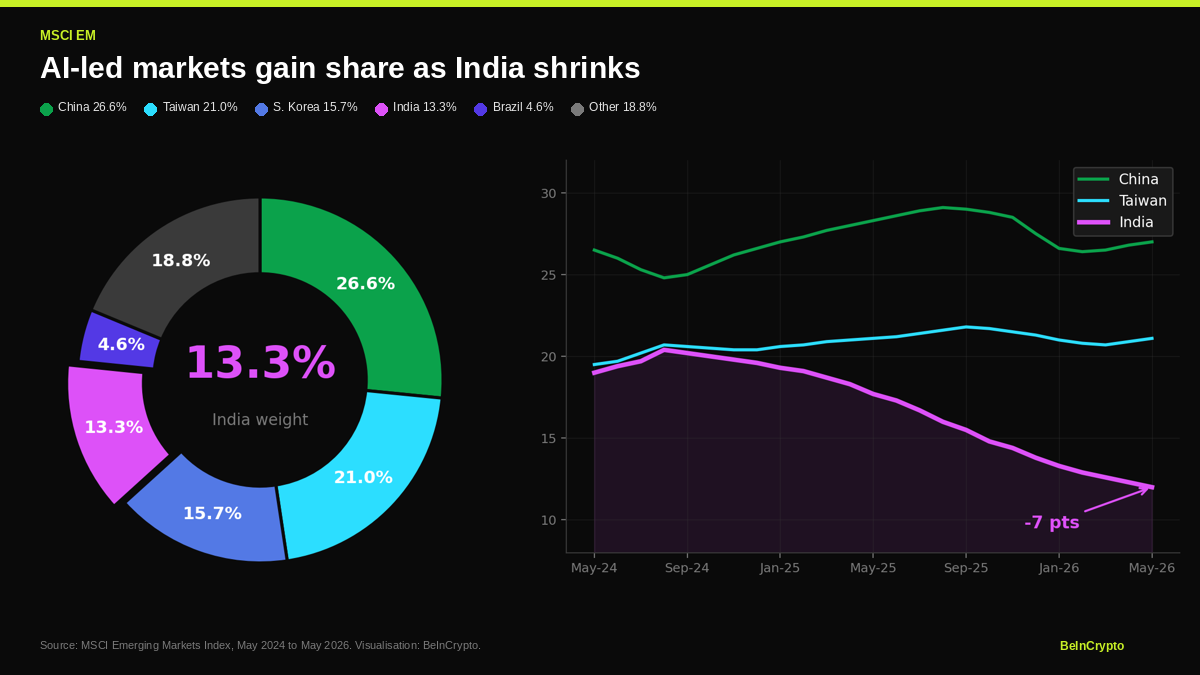
Global investors are rerouting capital away from India and into Asian markets tied to AI infrastructure, leaving the country at risk of falling out of the world’s five largest stock markets for the first time in three years.
The shift goes beyond one quarter of weak earnings. It reflects a structural change in how AI exposure now drives capital allocation across emerging markets, with India holding a few of the names global funds want to own right now.
Capital Flight Pulls India Down the MSCI Rankings
India’s weight in the MSCI Emerging Markets index has dropped to about 12% from roughly 19% a year ago, according to index provider data.

Reports indicate that foreign investors have withdrawn a net $21 billion from Indian equities so far in 2026.
Goldman Sachs estimates foreign ownership of the market sits at a 14-year low and now trails domestic institutions for the first time in more than two decades.
Roughly two-thirds of the reallocation reflects AI positioning, M&G Investments said.
Since the country’s market value peaked near $5.73 trillion in September 2024, about $924 billion has been erased from Indian equities.
Taiwan and South Korea Absorb the Capital India is Losing
Taiwan’s TAIEX has climbed roughly 42% year-to-date, while South Korea’s KOSPI has set fresh highs on AI chip strength, according to exchange data. Together, the two markets have added several trillion dollars in equity value over the past year.

Their listed champions, led by TSMC, Samsung, and SK Hynix, sit directly on the AI buildout that Indian companies do not supply.
The same rotation is bleeding into newer products such as a hybrid crypto-equity benchmark from S&P Global that pairs large-cap stocks with leading AI-linked tokens.
GenAI Squeezes India’s IT Services Giants
The Nifty IT index has fallen about 26% in 2026, while the broader Nifty 50 is down close to 9%.

Tata Consultancy Services and Infosys, which anchor India’s $315 billion IT services sector, hit fresh 52-week lows after OpenAI announced a new enterprise deployment unit.
Generative AI tools are automating the coding, testing, and back-office work that those firms have built their margins on.
Some 15 million Indians work in IT services and global capability centers, putting an entire layer of the economy in the path of AI-driven agents.
Indian policymakers are pushing semiconductor incentives, data center expansion, and a national AI mission. However, the next several quarters will show whether those bets can stop the structural drift away from the country’s equity market.
The post India is Losing Investors Fast Amid Global AI Boom appeared first on BeInCrypto.

XRP Ledger activity rose sharply after XRP briefly moved above $1.54 for the first time in two months, according to Santiment data shared on May 16.
Summary
- XRP network activity hit two-month highs after price briefly reclaimed levels last seen in March.
- Spot XRP ETFs logged $60.50 million weekly inflows, their strongest week since late December 2025.
- ETF demand failed to hold the breakout as XRP slipped back below key resistance again.
The analytics firm said active addresses reached 48,453, the highest level since March 30.
Santiment also reported 3,317 new network addresses, the highest reading since March 19. The firm said part of the move came from “general price FOMO,” but added that more transactions can support mid- and long-term growth when activity reflects real adoption.
Spot XRP ETFs also recorded a strong inflow week. SOSoValue data showed $60.50 million in net inflows for the week, the strongest reading since the week ending Dec. 26. May inflows reached nearly $95 million, already above April’s total.
Crypto.news had already reported a rebound in XRP ETF demand before the latest weekly data. U.S. spot XRP ETFs posted $25.8 million in daily net inflows on May 11, the strongest single-day total since Jan. 5.
XRP breakout fails near resistance
XRP tried to extend its rally after ETF inflows improved and the CLARITY Act advanced in Washington. As crypto.news previously reported, Standard Chartered expected $4 billion to $8 billion in additional XRP ETF inflows if the CLARITY Act moved through the Senate Banking Committee before May 21.
The move did not hold. XRP pushed into a familiar resistance zone before retreating. Crypto.news data showed Ripple’s native token (XRP) trading around $1.42, with a market cap near $87 billion, placing it behind BNB among major crypto assets.
Moreover, the latest ETF streak follows a strong April. Crypto.news reported that XRP ETF products pulled in $81.63 million during April, making it their best inflow month of 2026. The figure reversed March’s $31.16 million monthly outflow.
Disclosure: This article does not represent investment advice. The content and materials featured on this page are for educational purposes only.
MicroStrategy chair Michael Saylor teased another large Bitcoin (BTC) purchase on Sunday with a “Big Dot Energy” post, while traders await Monday’s 8-K filing expected to confirm one of the firm’s biggest weekly accumulation runs of 2026.
Independent tracker Strc.live estimates roughly 15,466 BTC were funneled into Strategy purchases across four active trading days, after STRC preferred share volume hit an all-time record of 15.1 million shares on Thursday.
MicroStrategy’s STRC Engine Powers the Latest Hint
Michael Saylor extended his Sunday hints with a Bitcoin buy tease in a May 17 post, not catching markets by surprise as he often gives an almost similar messaging at the beginning of every week.
Strategy’s recent $1.5 billion repurchase of 2029 convertible notes, settling around May 19, has not slowed the capital-raising flywheel.
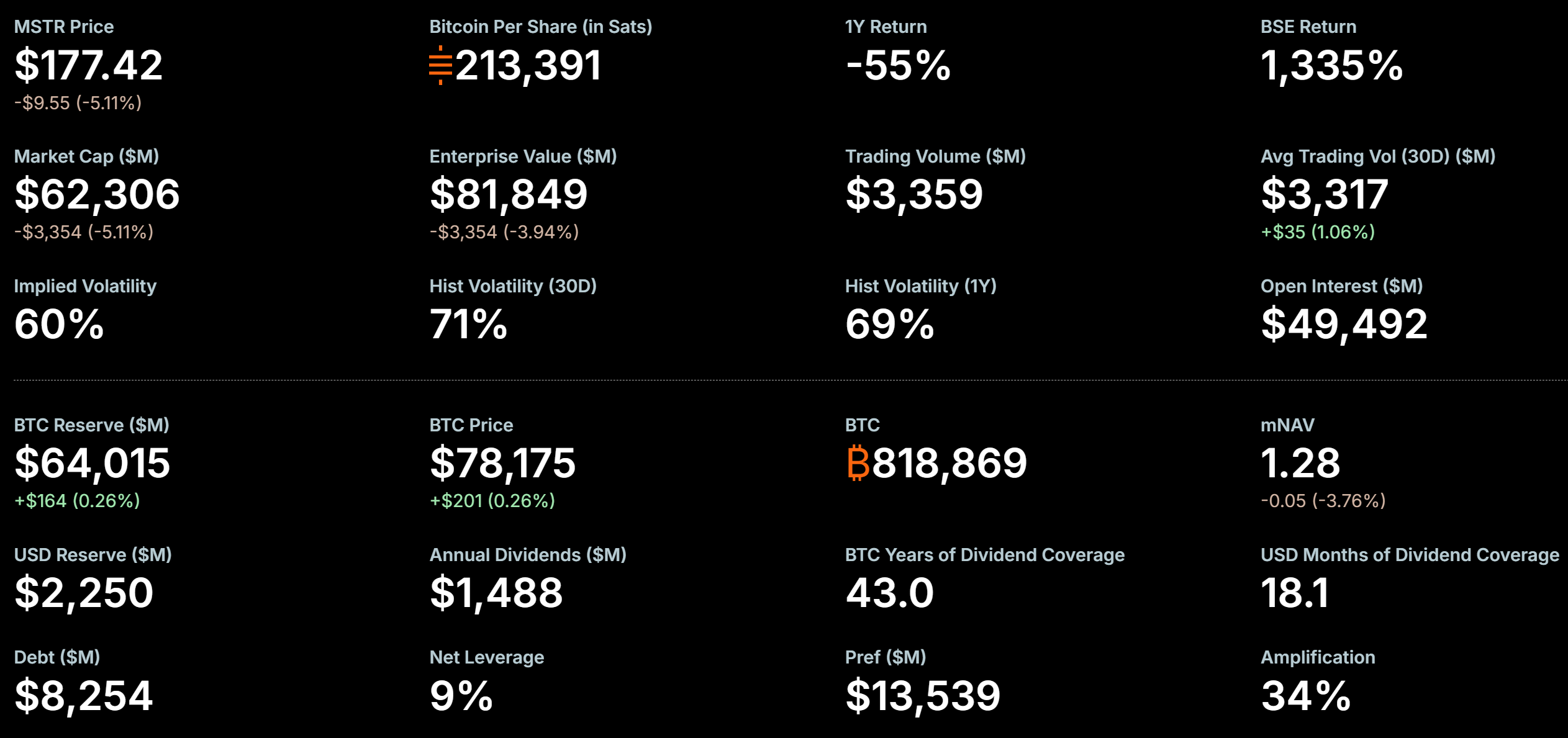
The firm holds 818,869 BTC at an average cost of roughly $75,543 per coin.

Thursday’s STRC trading session set an all-time volume record of 15.1 million shares, topping the prior peak from April 14. The community read the spike as fresh proceeds being deployed into Bitcoin.
Retail Vote Could Sharpen the Dividend Stream
Roughly 80% of STRC is held by retail investors across major brokerages including Charles Schwab, Fidelity, and Robinhood.
Strategy is asking those holders to approve moving the 11.5% annual dividend from monthly to semi-monthly payouts.
The amendment would keep the headline rate steady while shortening cash-flow intervals. Approval could reinforce demand for the variable-rate preferred. It could also sustain the at-the-market issuance pipeline that has funded most of Strategy’s Bitcoin buying this year.
Monday’s 8-K should give the market a concrete number to weigh against the community’s 15,466 BTC estimate.
A strong print would back the bullish reading of Saylor’s meme and keep retail attention on the STRC vote ahead of the next dividend record date.
The post Michael Saylor Teases Bigger Bitcoin Buy for MicroStrategy as 8-K Filing Looms appeared first on BeInCrypto.
Bitcoin’s price breakout attempts were halted on a few occasions at $82,000 in the past week, which could be explained to an extent by the developments on the US ETF front.
The spot Ethereum ETFs suffered even more in terms of a red daily streak, as they didn’t see even a single day in the green.
BTC ETFs Bled Out Heavily
Recall that the previous business week, the one that ended on May 6, was quite impressive as the spot Bitcoin ETFs attracted over $620 million in net inflows. This continued an impressive green streak of six consecutive weeks with more inflows than outflows.
However, this run was snapped in the past five trading days. Data from SoSoValue shows that investors changed their course of action and withdrew $1 billion in total, reducing the cumulative net inflows from $59.34 billion to $58.34 billion.
If we break down this data, it’s evident that May 13 was the worst-performing trading day, with net outflows of $635 bilion. May 15 followed with $290 million, and May 12 was third in line with $233 million. In contrast, net inflows dominated the other two trading days but in a more modest manner: $28.3 million on Monday and $131.31 million on Thursday.
This became the financial vehicles’ worst week since late January when investors were pulling fund out en masse.

In the meantime, the cryptocurrency’s price tried to break the upper boundary of its consolidation range on three separate occasions, but it was halted each time. The last one was on Thursday, after the CLARITY Act passed the Senate Banking Committee, and BTC dumped from $82,000 to under $78,000 by Friday and Saturday.
ETH ETFs in Red, Too
The spot Ethereum ETFs’ performance is even more worrying as there wasn’t a single trading day in the green last week. Investors withdrew $16.9 million on Monday, a whopping $130.62 million on Tuesday, $36.3 million on Wednesday, $5.65 million on Thursday, and $65.65 million on Friday.
Thus, the week ended with net outflows of just over $255 million – the most since late January again. Bloomberg’s ETF specialist James Seyffart compared how the BTC and ETH ETFs have performed lately, and outlined a painful trend for those investing in the altcoin.
Wrote yesterday about the Ethereum ETFs — They have stemmed their outflows and seen some inflows over the last couple months but nowhere near the level of interest that the Bitcoin ETFs have seen over the same time period. Peak was ~$15 billion cumulative net inflows in October pic.twitter.com/cE4R4xXoNo
— James Seyffart (@JSeyff) May 15, 2026
ETH’s price was also stopped at $2,400 earlier this week, and now sits below $2,200.
In the meantime, the ETFs tracking SOL and XRP ended the week without any red days. In fact, the Ripple ETFs marked their best week since December, and the Solana funds did as well.
The post Bitcoin and Ethereum ETFs See Heavy Outflows as Prices Hit Brick Wall appeared first on CryptoPotato.
Crypto World
Five Critical Earnings Reports to Monitor This Week: Nvidia (NVDA), Walmart (WMT), and More

Key Takeaways
- Nvidia’s upcoming earnings represent a crucial moment for AI chip momentum and technology stocks overall.
- Reports from Walmart and Target will reveal current consumer spending patterns across essentials and discretionary categories.
- Home Depot’s quarterly results will shed light on whether elevated borrowing costs continue to constrain renovation activity.
- Palo Alto Networks stands as the cybersecurity bellwether whose performance could influence the entire industry segment.
- These five reports collectively address critical market narratives: artificial intelligence growth, household spending strength, real estate trends, and digital security investment.
The coming week delivers a crucial stretch of corporate earnings, featuring five influential companies whose results will provide essential insights into today’s dominant market themes. Market participants are preparing for reports from Nvidia, Walmart, Home Depot, Target, and Palo Alto Networks. Together, these announcements will help answer two fundamental questions: can the economy maintain its current trajectory, and will the artificial intelligence boom sustain its momentum?
Nvidia
Nvidia stands out as the most anticipated release on this week’s calendar. When the semiconductor leader unveils its quarterly performance, the results may well determine the direction for technology shares more broadly.
The company has emerged as a primary engine behind major index gains throughout the previous twelve months. Extraordinary appetite for artificial intelligence processors and infrastructure solutions has propelled an extraordinary surge in share value.
Market observers are particularly focused on whether this robust demand persists. Critical areas include data center segment revenues, profitability metrics, purchasing activity from Chinese markets, and forward-looking projections for upcoming periods.
Solid performance could energize AI-related equities across the board. Disappointing figures might weigh heavily on semiconductor manufacturers, enterprise software providers, and infrastructure operators.
Walmart
Walmart offers perhaps the most comprehensive perspective on American consumer behavior. The retail giant caters to diverse demographic segments and reports during a period when price pressures, fuel expenses, and family finances dominate economic discussions.
The quarterly figures will demonstrate whether households maintain spending on food staples and basic necessities. Analysts will scrutinize same-store sales performance, online channel expansion, and operating profitability.
Robust numbers could alleviate worries about consumer resilience. Disappointing metrics might trigger broader concerns throughout the retail industry.
Home Depot
Home Depot provides valuable perspective on residential real estate, remodeling activity, and significant household purchases. Elevated financing costs have reduced property transactions, which traditionally translates to diminished expenditures on renovations, fixtures, surfaces, and major equipment.
The retailer serves both trade professionals and individual homeowners, offering visibility across multiple housing-related spending categories.
Analysts will focus on store traffic comparisons, business from contractor customers, and any forward guidance connected to residential market conditions. Strong performance would suggest spending resilience despite higher financing costs. Weakness would intensify concerns surrounding housing-dependent companies.
Target
Target faces greater sensitivity to non-essential purchases compared to Walmart. This positioning means its financial results can indicate whether shoppers continue buying apparel, household furnishings, and consumer electronics — categories vulnerable when household budgets tighten.
The retailer has pursued initiatives to boost customer visits, optimize stock levels, and safeguard profitability. Investors seek evidence these efforts are delivering results.
Important indicators include comparable store performance, profit margins, merchandise inventory, and online transaction volume. Positive surprises could spark significant upward movement. Another underwhelming quarter might sustain downward pressure on shares.
Palo Alto Networks
Palo Alto Networks represents the cybersecurity sector on this week’s agenda. Organizations maintain consistent investment in network defense, cloud-based protection, and information security, establishing it as one of software’s more resilient segments.
The expansion of AI-powered tools simultaneously introduces fresh security challenges, potentially strengthening demand for sophisticated platforms like those Palo Alto provides.
The company’s quarterly performance typically influences broader cybersecurity stocks, including competitors like CrowdStrike, Fortinet, and Zscaler. Market watchers will examine top-line expansion, bookings metrics, and management commentary regarding AI-related security opportunities.



CNN has renewed attention on Q-Day, the unknown future point when quantum computers may become strong enough to break common encryption systems.
Summary
- Q-Day warnings renewed concern over encryption systems that protect internet traffic and crypto wallets today.
- Solana clients Anza and Firedancer already test Falcon signatures for future post-quantum network protection now.
- NEAR researchers warn quantum attacks could create ownership disputes if stolen assets move on-chain fast.
The report said current internet security still depends on mathematical systems that a powerful quantum computer could one day crack.
The concern also reaches crypto because many blockchains rely on public-key cryptography to protect wallets and verify transactions. CNN noted that bad actors may already collect encrypted data for “harvest now, decrypt later” attacks, where stored data could be decrypted once stronger quantum machines exist.
Crypto networks start testing defenses
Crypto.news recently reported that Solana validator clients Anza and Firedancer added early Falcon versions to prepare for possible quantum attacks. Falcon is a post-quantum signature tool designed to give Solana a path toward stronger protection if current cryptography becomes unsafe.
The Solana teams said the tool can be activated if needed and should not create a major performance burden. Jump Crypto said Falcon-512 has a smaller signature size than other selected post-quantum standards, which may help protect speed and storage efficiency.
NEAR warns about ownership disputes
Near One has raised a different concern. Its research team said quantum attacks may not only expose private keys, but also create disputes over who owns crypto after stolen funds move on-chain.
Near One CTO Anton Astafiev said networks may struggle to know whether a transaction came from the real owner or an attacker. The team is preparing a testnet rollout using FIPS-204 quantum-safe signatures by the end of Q2 2026.
NIST urges migration before threat arrives
The U.S. National Institute of Standards and Technology has already released three post-quantum encryption standards. NIST said administrators should begin moving to the new standards as soon as possible because current encryption may face future quantum attacks.
NIST also says organizations should identify where weak algorithms are used and plan upgrades to quantum-resistant systems. For crypto, that means wallets, validators, exchanges, bridges, and custody firms may need long-term migration plans before Q-Day becomes a real network risk.
Crypto World
The Smart Investor’s Blueprint: Building Real Wealth Through Long-Term Stock Strategies

Key Takeaways
- Stocks are ownership stakes in actual businesses, not merely fluctuating numbers.
- Purchasing at the correct valuation is equally crucial as selecting quality companies.
- Managing emotions during market volatility distinguishes successful investors from impulsive traders.
- The margin of safety principle involves purchasing assets below their intrinsic value.
- For most individuals, a straightforward diversified approach beats attempting to select individual winners.
Building wealth through equity markets relies on fundamental principles: acquire quality assets, ensure reasonable pricing, maintain composure, and shield yourself from significant errors. Let’s examine how these concepts translate into actionable strategies.
The Critical Role of Valuation Over Popularity
Numerous investors concentrate exclusively on identifying strong companies. However, even exceptional businesses become poor investments when purchased at inflated prices. Trending stocks generate buzz, and that attention inflates valuations. This often leaves shareholders with lackluster performance despite solid corporate fundamentals.
Valuation represents the practice of assessing whether the price you’re paying aligns with what you’re receiving. Savvy investors examine profitability metrics, cash generation, leverage ratios, dividend policies, and expansion prospects. The objective is discovering businesses trading beneath their genuine economic value.
Frequently, overlooked and unsexy stocks present superior value propositions compared to headline-grabbing names.
Maintaining Composure Through Market Turbulence
Stock prices fluctuate constantly. Markets swing between euphoria and panic. Neither sentiment accurately represents a company’s fundamental worth.
Impulsive investors typically liquidate positions during downturns and purchase during rallies. This behavior contradicts successful strategies. Disciplined investors perceive market declines as chances to acquire strong assets at discounted valuations.
The essential perspective change involves treating markets as instruments to leverage, rather than authorities to obey.
Understanding the Margin of Safety Concept
Among the most valuable concepts for wealth-building investors is the margin of safety. This principle requires purchasing only when prices sit substantially below your calculated intrinsic value.
If analysis suggests a stock possesses $100 in true worth, a prudent investor might only initiate positions at $70 or $75. This difference creates protection against analytical errors. Companies miss forecasts. Competitive landscapes evolve. Economic conditions deteriorate.
Perfect foresight doesn’t exist. Incorporating protective buffers represents how thoughtful investors minimize expensive miscalculations.
Individual Stock Selection vs. Broad Market Approaches
Researching individual companies isn’t necessary for everyone. A straightforward portfolio of diversified index vehicles can deliver strong long-term performance without demanding extensive analysis.
Active stock selection requires substantial effort. It involves analyzing financial reports, understanding competitive dynamics, and maintaining conviction when your perspective diverges from prevailing sentiment. Most individuals lack either the bandwidth or inclination for this level of commitment.
Recognizing which approach suits your circumstances represents a crucial strategic choice.
Drawing the Line Between Investing and Speculation
A distinct boundary separates investing from speculation. Investing relies on thorough analysis and logical reasoning supporting the belief that a business trades below its true value. Speculation depends primarily on expectations that prices will continue ascending.
Historically, markets compensate patience while penalizing short-term orientation. Businesses generating genuine profits, maintaining robust financial positions, and operating sustainable models typically compound value consistently.
Pursuing momentum frequently results in buying near market tops and selling near bottoms.
Final thoughts: sustainable wealth creation typically stems from acquiring legitimate businesses at sensible valuations, maintaining positions through inevitable turbulence, and sidestepping the errors that emerge from responding to temporary market noise.
TLDR:
- HIP-1261 introduces a base-plus-extras fee model to make Hedera transaction costs easier to predict for enterprises.
- All Hedera fees are paid in HBAR, meaning more network usage directly converts to higher token demand over time.
- HBAR holds support between $0.078 and $0.088, with analysts watching $0.103 as the next key resistance level.
- A drop below $0.087 would weaken the short-term bullish structure and signal the corrective bounce may have ended.
HBAR is navigating a fragile recovery phase while a new protocol proposal works to lower barriers for enterprise adoption.
The token continues trading within a narrow support band, with analysts watching key technical levels closely. At the same time, HIP-1261 is drawing attention for its potential to make Hedera’s fee system more predictable.
Together, these developments are shaping how institutions and developers view the network’s long-term utility.
HIP-1261 Targets Enterprise Fee Predictability on Hedera
HIP-1261 introduces a simplified fee model built around a base fee plus additional charges. This structure gives developers and institutions a clearer way to estimate transaction costs before execution.
Companies managing budgets, compliance requirements, and auditing processes benefit directly from this kind of cost transparency.
As X Finance Bull noted, “Companies do not like guessing. They need to know costs before they deploy.” That observation speaks to a broader challenge in blockchain adoption. Without predictable pricing, enterprise deployment becomes difficult to justify internally.
The proposal covers a wide range of network activity. Token transfers, smart contracts, NFTs, identity services, HCS messages, and supply chain functions all generate fee demand under the existing model.
HIP-1261 seeks to bring consistency across these use cases rather than leaving each one with separate pricing uncertainty.
Importantly, all fees on Hedera are still paid in HBAR. Even when fees are priced in USD terms, they convert to HBAR at the time of the transaction.
That means broader adoption and more transactions directly translate to higher HBAR demand from a utility standpoint.
HBAR Price Structure Remains Cautious Amid Weak Recovery
On the price side, HBAR is holding within a corrective recovery structure that analysts describe as unconvincing so far.
The token is supported in the $0.078 to $0.088 range, with resistance sitting near $0.103. Movement above that resistance zone would be the next technical milestone for bulls.
More Crypto Online laid out the scenario clearly: “The market could still extend slightly higher toward the yellow trendline and the next resistance around $0.103, as long as the current support region between $0.078 and $0.088 continues to hold.” That condition makes the support band critical in the near term.
However, a break below $0.087 would damage the short-term bullish case. That level marks a recent swing low, and losing it would raise questions about whether the current recovery has already run its course. Traders are watching it closely.
Despite the cautious technical setup, the broader picture ties back to network activity. More real-world usage means more transactions, and more transactions mean ongoing HBAR demand through network fees.
That connection between utility growth and token demand remains the core long-term argument for the asset.
ZEC traded near $515 as analysts split over a $750 bullish setup and warnings that weak spot demand may expose the rally to leverage risk.

Intesa Sanpaolo, Italy’s largest bank, more than doubled its crypto exposure in the first quarter of 2026, climbing to about $235 million as of March 31, up from roughly $100 million at year-end 2025. The jump marks a significant step in the Italian lender’s ongoing foray into regulated digital assets, reflecting a broader European trend among traditional banks expanding their crypto footprints.
The uptick was driven primarily by Bitcoin positions. Intesa increased its holdings via both the Ark 21Shares Bitcoin ETF and BlackRock’s iShares Bitcoin Trust ETF. The bank also entered Ethereum exposure for the first time through BlackRock’s iShares Staked Ethereum Trust, and added a stake in Ripple’s XRP through the Grayscale XRP Trust ETF, valued at about $26 million, according to Criptovaluta.it.
In a first for the bank’s crypto program, Intesa opened a position in iShares Bitcoin Trust call options, marking its initial foray into crypto derivatives. Previously, the bank confirmed to Criptovaluta.it that its crypto holdings are held for proprietary trading purposes, though it has not disclosed whether any assets are used to hedge products offered to professional clients.
Meanwhile, not all positions followed the same trajectory. Solana exposure, which had been a notable feature of the prior quarter, was pared back sharply, with the Bitwise Solana Staking ETF stake collapsing from 266,320 shares to just 2,817—a near-total exit that underscores a cautious recalibration of non-Bitcoin bets.
Source: Criptovaluta.it
The reshaping of Intesa’s crypto holdings extended into the equities portion of its portfolio. The bank added 165,600 shares of BitGo for the first time, while exiting its Bitmine position. It also closed out put options on the Strategy vehicle and trimmed its stake in Cantor Equity Partners II, the vehicle linked to tokenization firm Securitize’s planned listing. Coinbase shares also moved higher, rising from 1,500 to 10,357.
The timing of these moves aligns with recent corporate developments in the crypto space. Notably, Ripple announced it would offer custody services to the Italian banking group, signaling deeper institutional alignment as banks seek regulated custody for digital assets.
Ripple custody discussions reflect growing institutional demand for trusted asset safekeeping as more banks explore regulated crypto service models.
Intesa Sanpaolo’s share price closed at €5.74 on a Friday session, down 1.56% for the day and about 3.1% lower year-to-date, according to Yahoo Finance data cited in the coverage. The bank’s evolving holdings illustrate how major European lenders are balancing risk, regulatory considerations, and strategic bets on a long horizon for digital assets.
Key takeaways
- Intesa Sanpaolo’s crypto exposure rose to roughly $235 million as of March 31, 2026, up from ~$100 million at year-end 2025, driven mainly by Bitcoin positions and new Ethereum exposure.
- The bank expanded Bitcoin via two regulated ETFs (ARK 21Shares BTC ETF and BlackRock’s iShares Bitcoin Trust) and entered Ethereum exposure through iShares Staked Ethereum Trust; it also added Ripple XRP exposure (~$26 million) via the Grayscale XRP Trust ETF.
- Intesa opened its first crypto derivatives position by buying iShares Bitcoin Trust call options, highlighting a shift toward sophisticated risk/return tools within its proprietary trading framework.
- Solana bets were dramatically reduced, with the Bitwise Solana Staking ETF position nearly wiped out, signaling a reweighting away from non-Bitcoin ecosystem plays.
- Equities holdings moved in tandem with ecosystem developments: BitGo added, Bitmine dumped, Coinbase shares increased, and Ripple custody ties emerged as a strategic inflection point for the bank’s digital asset program.
European banks expand crypto offerings and infrastructure
Intesa’s activity sits within a broader wave of European banks extending their crypto services to retail and institutional clients. Spain’s BBVA now offers 24/7 Bitcoin and Ether trading through its mobile app, while France’s BPCE has rolled out in-app crypto trading via its regulated subsidiary Hexarq, targeting millions of customers by 2026. Belgium’s KBC is also among institutions delivering crypto access to everyday users, signaling a broader consumer-facing shift in the region.
Beyond client services, a consortium of twelve major European banks—including BNP Paribas, ING, UniCredit and Deutsche Bank—formed Qivalis to issue a MiCA-compliant euro-backed stablecoin, aiming for a launch in the second half of 2026. The initiative underscores a collective push to establish regulated, cross-border digital currency rails in Europe, with MiCA-era governance in mind and a focus on interoperability across banking infrastructures.
The cross-border push comes as policymakers in Europe map out a clear regulatory framework for digital assets, a backdrop that lends credibility to banks’ willingness to deploy crypto services at scale. As institutions build out custody, trading, and settlement capabilities, the market is watching how these products perform in real-world use cases, including stablecoin settlement and tokenized asset workflows across traditional finance channels.
In related coverage, European crypto hubs and the evolving regulatory environment continue to be a focal point for institutional-grade adoption, with editorials and market commentary highlighting both opportunities and tensions as banks experiment with regulated digital asset offerings. For a broader discussion of how Europe’s treasury models are adapting to digital assets, see the ongoing discourse in regional coverage such as PBW’s 2026 outlook.
Source-linked reporting on Intesa and the European rollout of crypto services helps illustrate how a single bank’s strategy can mirror a wider continental pattern: institutions are recalibrating exposure, expanding custody capabilities, and pursuing regulated rails that could underpin broader adoption in the years ahead.
For readers seeking the underlying data, Criptovaluta.it summarized Intesa’s quarterly moves and the broader European expansion, while Ripple’s custody announcement underscores one of the pivotal partnerships shaping institutional engagement with digital assets in Europe.
As these developments unfold, investors and users should watch how MiCA-compliant stablecoins gain traction, how custody arrangements evolve, and whether more banks disclose detailed, auditable usage of crypto within their balance sheets and product offerings. The coming quarters will reveal whether these early forays translate into sustained capital allocation and real-world custody utilization across Europe’s banking sector.
Police from China, the United States and the United Arab Emirates carried out their first joint international law enforcement operation against telecom and online fraud in Dubai, according to Xinhua.
Summary
- China, the U.S. and UAE reported their first joint crackdown on Dubai crypto romance scams.
- Authorities said nine fraud dens were dismantled and 276 suspects were captured in the operation.
- DOJ documents link similar networks to fake crypto platforms and millions in victim losses globally.
China’s Ministry of Public Security said the operation dismantled nine fraud dens and led to 276 arrests.
Investigators said the groups used social media to build fake romantic relationships with victims before directing them into “so-called high-return cryptocurrency projects.”
The report said victims suffered financial losses after sending funds into the schemes. Xinhua said Chinese authorities presented the operation as part of wider cross-border cooperation against online fraud.
Crypto.news links raid to wider FBI case
Crypto.news reported earlier that an FBI-led enforcement action disrupted nine crypto scam centers and led to 276 arrests. Dubai police detained 275 people, while authorities in Thailand arrested one suspect tied to the same wider enforcement push.
The report said U.S. prosecutors in the Southern District of California charged several suspects with wire fraud and money laundering. It also said investigators linked the activity to Ko Thet Company, Sanduo Group and Giant Company, which authorities described as companies used to run scam centers.
How the crypto romance scams worked
The Justice Department said the defendants targeted people in the United States and other countries by building trust and affection over time. After that, they promoted crypto investments and helped victims move funds to platforms that were not real.
The DOJ said victims lost control of their crypto once they sent funds to the fake platforms. Prosecutors said the money was then moved through other crypto accounts, including accounts controlled by the scammers. The agency said investigators had already found millions of dollars in losses tied to the cases.
Moreover, the crackdown adds to a wider push against organized crypto investment fraud. The DOJ said FBI San Diego opened the investigation in 2025 after identifying companies and people managing scam compounds tied to crypto fraud.
FBI San Diego also said Operation Level Up had notified almost 9,000 victims of crypto investment fraud and saved an estimated $562 million by April 2026. The new arrests show how law enforcement agencies are now targeting the operators, recruiters and managers behind scam centers, not only the wallets used to move funds.

Michael Carrick reveals when Manchester United will provide ‘clarity’ over future

Taylor Swift’s $2B Fortune Dwarfs Travis Kelce’s $90M Net Worth in 2026

XRP ETF inflows surge as network activity hits March highs

Manchester United reach agreement with Casemiro over contract clause amid transfer speculation

US brings back mandatory military draft registration

Steven Gerrard disagrees with Gary Neville over ‘shock’ Chelsea and Arsenal claim | Football

Mat Armstrong On His Worst Car Rebuild, Insane Car Collection & Making Money on Youtube

Commonwealth Bank shares slump record 10.4% as budget weighs on lenders | Finance Report | ABC NEWS

Escaping the Middle Class Trap: The 3 Paths of Money | Ankur Warikoo Hindi
-

 Crypto World2 days ago
BloFin War of Whales 2026 Grand Prix opens registration for $5M trading championship
-

 Fashion2 days ago
Weekend Open Thread: Theory – Corporette.com
-

 Crypto World2 days ago
E-Estate Announces 1 Year Live: Washington DC Summit as Real Estate Tokenization Enters Its Next Phase
-

 Fashion6 days ago
Coffee Break: Travel Steam Iron
-

 Fashion7 days ago
What to Know Before Buying a Curling Wand or Curling Iron
-

 Politics6 days ago
What to expect when you’re expecting a budget
-

 Tech2 days ago
Tech Moves: Microsoft AI leader jumps to OpenAI; former AI2 exec joins Meta; and more
-

 Tech6 days ago
GM Agrees To Pay $12.75 Million To Settle California Lawsuit Over Misuse Of Customers’ Driving Data
-
Crypto World4 days ago
Bitcoin Suisse expands with Digital Asset License and Investment Business Act Registration Approval in Bermuda
-

 Tech6 days ago
GM agrees to $12.75M California settlement over sale of drivers’ data
-

 Politics5 days ago
Pakistan to enter Chinese capital market as war inflation bites
-

 Crypto World5 days ago
Bitcoin Suisse expands with Digital Asset License and Investment Business Act Registration Approval in Bermuda
-
 Crypto World3 days ago
Google’s Gemini AI Predicts Incredible Solana Price by the End of 2026
-

 Tech2 days ago
Google reimburses Register sources who were victims of API fraud
-

 Business2 days ago
H&R Real Estate Investment Trust (HR.UN:CA) Q1 2026 Earnings Call Transcript
-
 Entertainment7 days ago
Prime Video’s Forgotten but Brilliant 2-Part Horror Anthology Is a Perfect Binge
-
 Entertainment7 days ago
‘Rivals’ Season 2 Is Bigger, Better, and Raunchier Than Ever
-
 Tech7 days ago
University of Michigan’s $20M early OpenAI investment now worth $2B as Musk trial documents reveal endowment bet
-

 Sports2 days ago
Napoleonic enters 2026 Doomben 10,000 field via Abounding withdrawal
-
 Tech6 days ago
Over-Engineered Cardboard PC Case Houses a Full Computer Without Compromising Style or Performance
You must be logged in to post a comment Login