
Crypto World
Institutional Demand Is Back: Bitcoin and Ethereum ETF Inflows Reached 10-Month High

In a sudden but very impactful change in investor behavior, the spot exchange-traded funds tracking the largest cryptocurrency attracted almost $2 billion in fresh funds in the past five business days alone.
The Ethereum counterparts also set a multi-month peak, gaining nearly $700 million within the same timeframe.
Spot BTC ETFs Attract $1.92B
The week started on the right foot, with almost $300 million in net inflows on Monday and another $189.30 million on Tuesday. However, investors picked up the pace on Wednesday after the US Treasury Department announced it would double the maximum size of liquidity-support buybacks for longer-dated government debt, raising them from $2 billion to at least $4 billion per operation.
This had a dramatic effect on risk-on assets like crypto and investor appetite. The spot Bitcoin ETF net inflows skyrocketed to $517 million on that day and then exceeded $606 million on Thursday, the best single-day performance since May 1. Another $307.45 million entered the funds on Friday, ending the perfect green-only week, in which the financial vehicles attracted a total of $1.92 billion.
The total inflows have rocketed from under $51.8 billion at the end of the previous week to over $53.7 billion on August 21.
This made last week the best in terms of net inflows since the one that ended on October 10, when investors poured in $2.71 billion. Recall that this was the trend-changer, as BTC experienced one of its worst crashes at the time, resulting in over $19 billion in liquidations within 24 hours.

Naturally, these ETF inflows were among the reasons behind the underlying asset’s spectacular price revival in the past week. It traded below $65,000 before the Treasury Department’s announcement but skyrocketed by over $15,000 to nearly $80,000 by Friday.
ETH ETFs on a Roll, Too
The landscape around the spot Ethereum ETFs is rather similar, as they have also attracted the most funds since October 2025. In their case, the actual numbers were just under $700 million. And, the net inflows saw a major uptick after the Wednesday announcement, going from $30.85 million on Monday and $71.47 million on Tuesday to $189.15 million on Wednesday, $220.77 million on Thursday, and $185 million on Friday.

The cumulative total net inflows have risen from $11.45 billion at the end of last week to $12.15 billion on August 21. Expectedly, ETH’s price also went on a highly impressive run, surging from $1,900 on Wednesday to over $2,500 on Saturday morning, where it was stopped and now sits $100 lower. The weekly gains, though, are over 28%.
The post Institutional Demand Is Back: Bitcoin and Ethereum ETF Inflows Reached 10-Month High appeared first on CryptoPotato.



Bitcoin traded near $76,600 on Aug. 23 after reaching $79,500 two days earlier, prompting claims that veteran trader Peter Brandt’s 58,000–62,000 forecast was wrong.
Summary
- Brandt forecast Bitcoin would reach 58,000–62,000, and prices entered that range months later during 2026.
- Bitcoin fell to approximately $57,717 on July 1 before rebounding toward $79,500 by August 21.
- Brandt abandoned his later bearish outlook after an inverse head-and-shoulders pattern completed, buying the breakout.
- U.S. spot Bitcoin ETFs drew $1.92 billion across five sessions during the latest weekly rally.
- Treasury will double long-dated buybacks to at least $4 billion per operation beginning September 9.
The historical price record shows otherwise. Brandt issued the forecast in January when Bitcoin traded near $92,400. Bitcoin later entered his stated range and fell to approximately $57,717 on July 1. It subsequently spent weeks near or slightly above the target zone before beginning its latest recovery.
The rally therefore does not invalidate the completed forecast. It shows that market conditions changed after Bitcoin reached the area Brandt identified.
Bitcoin reached Brandt’s target months after his call
Brandt wrote on Jan. 19 that “$58K to $62K is where I think it is going.” He reportedly expected the move within two weeks, although he also acknowledged that his assessment could be wrong.
Bitcoin did not meet that short timetable. However, the price eventually reached the forecast range during the 2026 downturn. Fortune recorded Bitcoin at $58,278 on July 1, while other market data showed an intraday low near $57,717.
The difference between price and timing matters when assessing the forecast. Brandt correctly identified a later trading zone, but the projected two-week horizon was too short. Calling the entire forecast wrong because Bitcoin now trades above $76,000 ignores the intervening decline.
As crypto.news previously reported, Brandt’s January downside target was later reached before he began identifying evidence of a possible market bottom.
Brandt changed position after Bitcoin completed its pattern
Brandt did not remain committed to the bearish position after the chart structure changed. He said BTC’s prolonged inverse head-and-shoulders pattern initially had a 60% probability of resolving downward because the wider trend remained weak.
The completion of the pattern changed his view. Brandt said he “bought the breakout for better or worse” after BTC moved above the neckline. The quotation reflects a trading decision, not a guarantee that the rally will continue.
His updated position illustrates how technical traders often work. A forecast applies while its underlying pattern and price conditions remain valid. A confirmed breakout can invalidate the next bearish setup even when an earlier downside target was achieved.
Brandt also pointed to what he calls “price walls,” a decades-old charting method that identifies areas where tightly grouped price bars may later act as support or resistance. He did not provide a guaranteed upside target in the latest post.
Short liquidations and ETF demand accelerated Bitcoin’s rally
The crypto rose from approximately $62,679 on Aug. 17 to $79,500 on Aug. 21, a gain of nearly 27% from the weekly low. It later retreated toward $76,600 but remained up more than 20% over seven days.
Forced short covering helped drive the early part of the move. Traders holding leveraged bearish positions had to buy BTC when prices crossed their liquidation levels, adding demand during the breakout.
However, the rally was not based entirely on derivatives. U.S. spot Bitcoin exchange-traded funds recorded $606 million in net inflows on Aug. 20, following approximately $517 million the previous day. Five-session inflows reached about $1.92 billion.
In related coverage, crypto.news reported that the combination of short liquidations and spot ETF demand produced one of the market’s largest squeeze events since 2021.
The ETF inflows provide evidence of spot demand alongside forced derivatives buying. Continued inflows would offer stronger support for the rally than short covering alone.
Treasury action changed the macro backdrop
The reversal also followed a change in U.S. bond-market conditions. On Aug. 19, the U.S. Treasury announced that it would at least double the maximum size of liquidity-support buybacks for longer-dated government securities.
The current maximum of $2 billion per operation will increase to at least $4 billion beginning Sept. 9, according to the Treasury. The operations cover the 10-to-20-year and 20-to-30-year sectors.
Long-term Treasury yields declined after the announcement, while the U.S. dollar weakened. Bitcoin, gold and other scarce assets rallied as traders responded to the change in liquidity conditions.
Bitcoin’s next test is whether it can reclaim and hold $79,500 before challenging $80,000. Failure to maintain the breakout could return attention to the low-$70,000 region and the completed pattern’s neckline.
Brandt’s January price target was reached, but his original timing was not. His later bearish view also changed after the market produced a confirmed bullish breakout. Those are separate forecasts and should not be combined into a claim that the $58,000 call failed.
Disclosure: This article does not represent investment advice. The content and materials featured on this page are for educational purposes only.
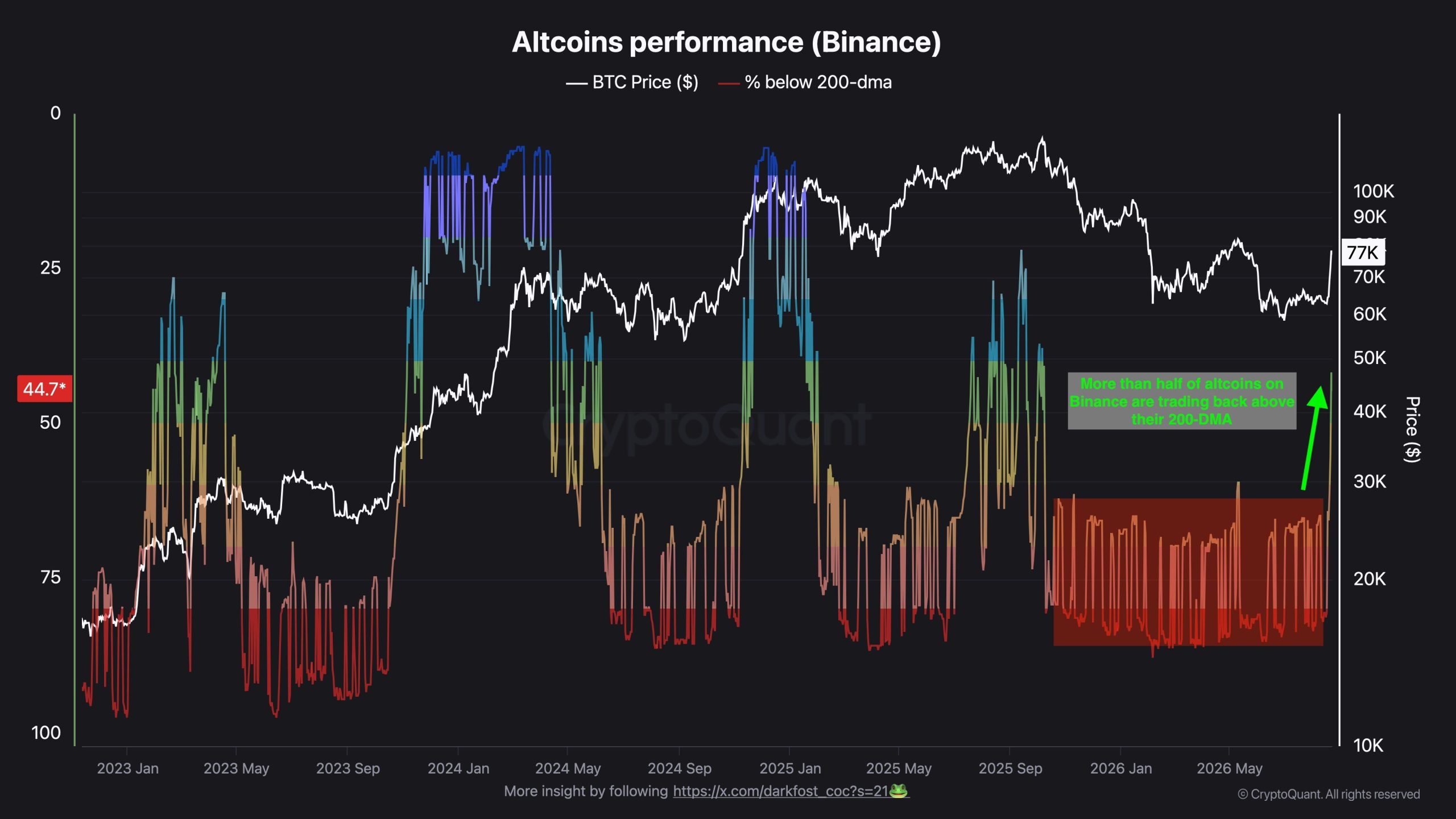
The altcoin market cap surged by $215 billion between August 19 and 22, a gain of more than 24% in 3 days, pushing Total2 back above $1 trillion. Key indicators, however, suggest altseason remains unconfirmed.
The rally followed President Donald Trump’s August 19 White House meeting with crypto executives. Since then, the market has cooled, with the global crypto market cap down 5.51% over the past 24 hours to $2.57 trillion.
Trump Remarks Spark a Broad Altcoin Rebound
At the meeting, Trump urged Congress to pass a “fair version” of the CLARITY Act and said a “sizable” government Bitcoin (BTC) purchase has been discussed. Bitcoin subsequently broke above $70,000 for the first time since June.
Follow us on X to get the latest news as it happens
Altcoins moved even faster. According to analyst Darkfost, mid and small caps led the advance, reversing a dormancy phase that began in November. During that stretch, roughly 80% to 85% of altcoins on Binance traded below their 200-day moving average (DMA).
“Today, more than half of the altcoins available on Binance are trading above their 200-DMA, signaling a regime shift,” Darkfost said.

Historically, Darkfost noted that gains of this scale are an intermediate signal of an early-stage altseason. He cautioned, however, that the market has entered overbought territory and may need a short-term breather.
Why Altseason Is Not Confirmed Yet
Bitcoin dominance tells a more cautious story. The metric stood at 59.69% on August 23, per TradingView, still above the level many traders watch for a broader rotation.
“A real low-cap altseason historically needs BTC.D to drop below 58%. Structure is improving, but altseason isn’t confirmed yet, so let’s wait for further confirmation,” analyst Ash Crypto noted.

The Altcoin Season Index provides another reason to remain cautious. The index currently stands at 49, indicating that fewer than half of the top-performing altcoins outperform Bitcoin over the measured period. The threshold for a confirmed altseason is typically 75, when at least 75% of the tracked altcoins have outperformed BTC.
The gap suggests that the recent rally, while broad, has not yet developed into the sustained market-wide rotation typically associated with an altseason.
Whether the rotation broadens may hinge on the Senate’s September 15 procedural vote on the CLARITY Act, the next major catalyst on the calendar.
Subscribe to our YouTube channel to watch leaders and journalists provide expert insights
The post Is Altcoin Season Finally Coming? Market Just Added $215 Billion appeared first on BeInCrypto.
Eric Trump denied that President Donald Trump is preparing to launch a new coin, calling the claim fraudulent in a post that drew 2.1 million views on X.
He responded to a post claiming the President was launching a new coin.
Follow us on X to get the latest news as it happens
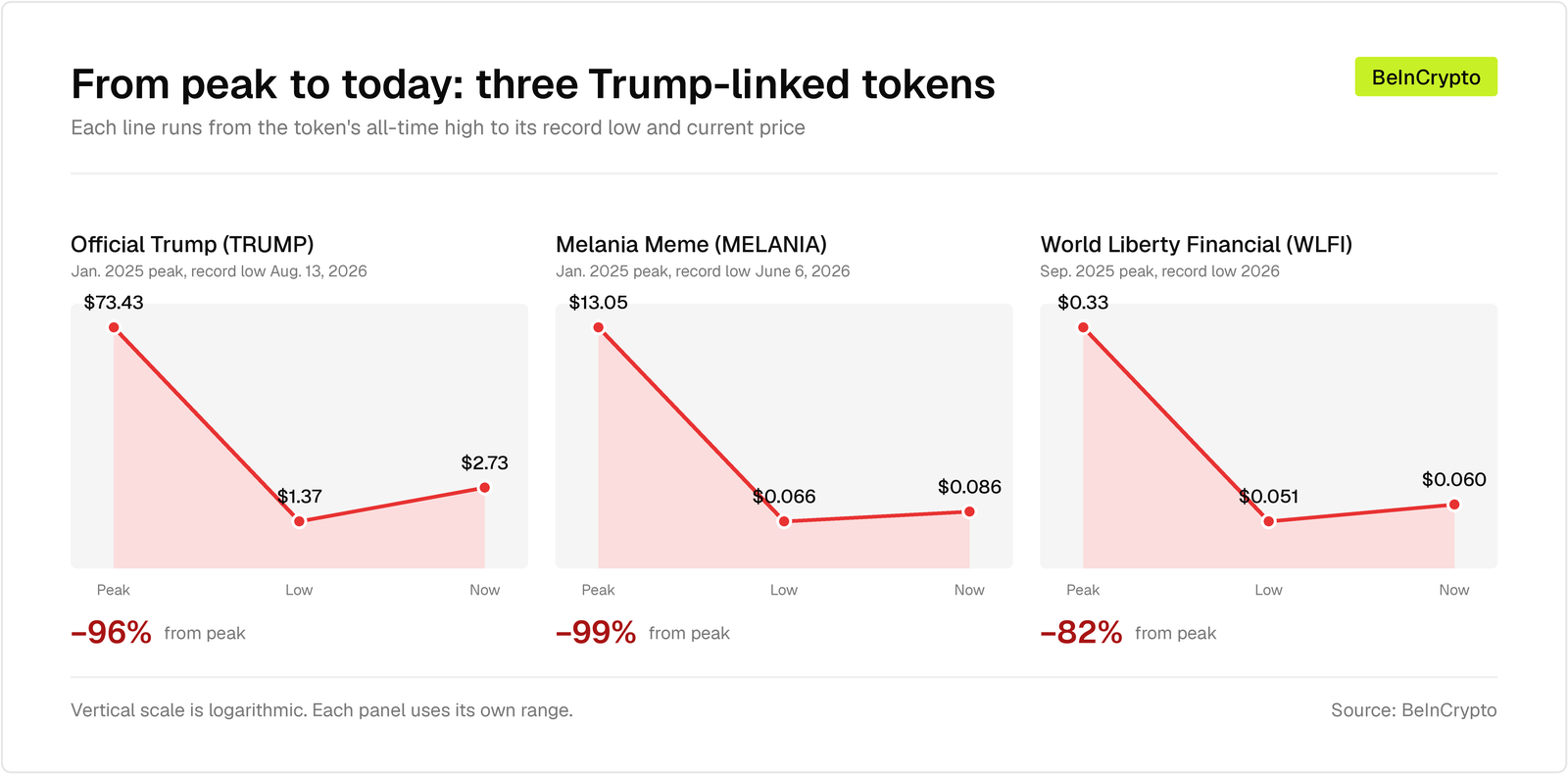
Three Trump-Linked Coins Trade Far Below Their Peaks
The denial concerns a new token. Nonetheless, three Trump-linked assets already trade, but their performance has been far from impressive. Each trades sharply below its all-time high.
Official Trump (TRUMP) launched on Solana on January 17, 2025, three days before the second inauguration. It reached $73.43 within two days and has since lost most of its value.
TRUMP set a record low of $1.37 on August 13 and has since climbed about 88%. That rebound tracked a broader market rally.

Melania Meme (MELANIA) followed two days after TRUMP. It now changes hands for around $0.086, about 99% below its peak, with a market value of $86 million.
Trump-backed World Liberty Financial (WLFI) began trading in September 2025 and briefly touched $0.33. Eric Trump also lists it in his X profile. The governance token sits near $0.06, roughly 78% down.
Losses, Senate Scrutiny, and Public Opposition
The declines have had a measurable cost for buyers. Blockchain analytics firm Nansen previously tracked about 1.48 million wallets that bought TRUMP. It counted 988,905 underwater, with $3.81 billion in combined losses.
As of the latest data, the picture has not changed much. Among wallets still holding meaningful TRUMP, the majority are underwater. Nansen data consistently shows ~85–95%+ of held positions at a loss, most clustered near −97% unrealized ROI.
However, the outcome has been different for the President himself. Trump reported more than $1.4 billion in crypto income for 2025. His disclosure listed over $500 million from WLFI sales and more than $600 million through CIC Digital.
Senate Democrats, including Elizabeth Warren and Richard Blumenthal, have pushed for investigations into potential national security risks from Trump’s crypto ties.
Public backlash has also followed. A Reuters/Ipsos poll found 63% of Americans call the profits inappropriate, while 69% said his business interests shape presidential decisions.
Senators face a procedural vote on the CLARITY Act on September 15. One draft provision would bar sitting officials from issuing digital assets, turning Eric Trump’s denial into a legal requirement.
Subscribe to our YouTube channel to watch leaders and journalists provide expert insights
The post Another TRUMP Coin? Eric Trump Shuts Down New Crypto Rumors appeared first on BeInCrypto.


An unidentified Bitcoin user embedded a 255-byte message in block 963,629 on Aug. 22, announcing a wallet puzzle whose private-key material was allegedly derived from Satoshi Nakamoto’s Genesis Block.
Summary
- Bitcoin block 963,629 contains a 255-byte message describing a deliberately low-entropy Genesis Block wallet security puzzle.
- The 500-byte transaction paid 250 satoshis in fees, equivalent to 0.60 satoshis per virtual byte.
- Anonymous creator claims all inputs needed to reconstruct the wallet exist inside Bitcoin’s Genesis Block.
- Galaxy Research identified the transaction, but neither the author’s identity nor derivation method is verified.
- No verified evidence currently shows the puzzle was solved or that its associated reward moved.
Galaxy Research identified the transaction on Aug. 23. Independent block data confirms that Foundry USA mined block 963,629 at approximately 19:45 UTC on Aug. 22. The block remains part of Bitcoin’s confirmed transaction history.
The message does not reveal the creator’s identity, derivation formula or complete solution. No verified evidence available at publication time showed that anyone had deciphered the puzzle or moved its advertised reward.
Bitcoin puzzle message describes deliberately weak entropy
The transaction contains a human-readable message placed in an OP_RETURN output. Its author said:
“I created a Bitcoin puzzle using information contained in the Genesis Block created by Satoshi to generate the wallet.”
The creator added that the wallet’s entropy was “extremely low” and claimed no private backup was necessary because “everything I needed was already in the Genesis Block.” These are claims from the unidentified author and do not independently reveal how the wallet was generated.
Entropy refers to the randomness used when creating private keys. A secure wallet draws from a sufficiently large and unpredictable set of possible values. A wallet generated from well-known public data can become vulnerable if an attacker can reproduce the exact selection, ordering and transformation process.
Block 963,629 permanently records the challenge
The transaction was 500 bytes and paid a miner fee of 250 satoshis. Its fee rate was 0.60 satoshis per virtual byte, making the on-chain message inexpensive to publish.
The 255-byte payload represented more than half the transaction’s raw size. Galaxy Research therefore characterized it as an “oversized OP_RETURN.” The description refers to its unusual size compared with ordinary data outputs, not a breach of Bitcoin’s consensus rules.
OP_RETURN allows users to create provably unspendable outputs carrying arbitrary information. In related coverage, crypto.news previously explained how users have embedded permanent messages in blockchain transactions, including tributes, political statements and timestamped records.
Once confirmed, the puzzle text became part of Bitcoin’s transaction history. However, embedding a claim on-chain proves that the message existed by that time. It does not prove that every statement inside it is accurate.
Genesis Block offers several possible inputs
Satoshi mined Bitcoin’s Genesis Block, also called block zero, on Jan. 3, 2009. Its hash is 000000000019d6689c085ae165831e934ff763ae46a2a6c172b3f1b60a8ce26f.
The block also contains a timestamp, nonce, Merkle root, public key and the well-known newspaper headline: “The Times 03/Jan/2009 Chancellor on brink of second bailout for banks.” Any of those values could form part of the puzzle’s key-generation process.
Blockstream’s technical reference lists the Genesis Block’s timestamp as 1231006505 and its nonce as 2083236893. The public availability of these values means solvers can reproduce them, but they still need to identify which information the creator selected and how it was processed.
The puzzle should not be confused with the Genesis Block’s original 50 BTC subsidy. Those coins are unspendable because the original Bitcoin implementation did not add that coinbase transaction to the spendable output set.
Solvers still need the missing derivation method
The next verifiable development would be an outgoing transaction signed by the puzzle wallet’s private key. Such a movement could show that someone derived the correct key, although an apparent solution could also come from the original creator.
Galaxy Research had not identified the author or published a verified solution when it disclosed the transaction. The on-chain message also does not establish that the creator recovered forgotten Satoshi code, as the original headline suggested.
Until a valid spend or signed proof appears, the event remains a newly published Bitcoin puzzle built around public Genesis Block data, not a deciphered secret from Satoshi Nakamoto.
Nvidia has reportedly told some of its largest customers that servers built around its AI chips are getting more expensive.
Increases top 15% on systems shipping early next year, people cited by Bloomberg said. The size of each increase varies by chip generation and memory configuration.
Why Memory Makers Now Set the Price
Bloomberg, citing people familiar with the process, reported that the increases cover systems using the flagship Vera Rubin and Grace Blackwell chips.
Server builders that assemble hardware for data center operators, including Microsoft, Alphabet’s Google, and Oracle, passed the notice along.
Nvidia accelerators depend on how much dynamic random access memory (DRAM) is paired with them. Samsung, SK Hynix, and Micron produce most of the world’s supply.
Output has climbed, yet demand still runs ahead of it. This gap has pushed prices for the commodity-like components sharply higher and handed the three producers rare influence over the sector.
Micron chief executive Sanjay Mehrotra has described memory as the strategic infrastructure of the AI era.
“Today there is no AI without memory. AI systems need more memory. They need higher performance memory. They need lower power memory,” he said.
Follow us on X to get the latest news as it happens
Cost Pressure Builds Before Nvidia Earnings
Nvidia runs a 75% gross margin and charges tens of thousands of dollars per chip. Its decision to pass costs on rather than absorb them shows how tight the supply chain has become. Apple and Qualcomm have also raised product prices due to chip shortages.
Amazon, Microsoft, Google, and Meta all run in-house chip programs. However, they still buy Nvidia hardware and still compete for the same memory supply.

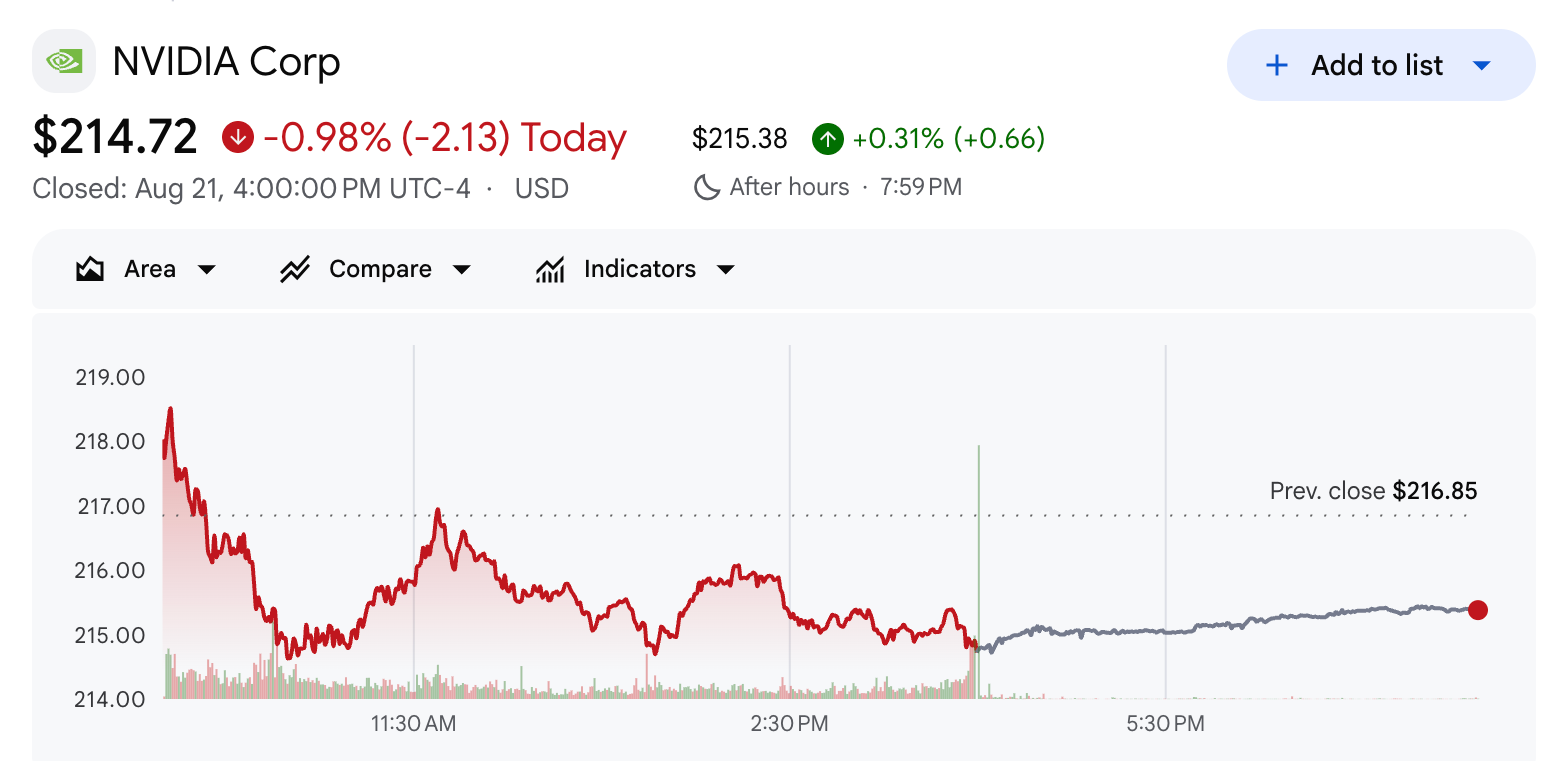
The timing matters. Nvidia reports fiscal second-quarter results on Wednesday after a six-session losing streak, its longest since 2022, that left shares at $214.7 on Friday.
Investors will now weigh whether rising input costs read as a margin threat or as further proof of AI demand.
Subscribe to our YouTube channel to watch leaders and journalists provide expert insights
The post Nvidia Reportedly Warns Top Customers of 15% Price Hikes on AI Servers appeared first on BeInCrypto.


South Korean crypto exchange Upbit processed an estimated 1.15 trillion won, or approximately $830 million, during one hour of volatile trading on Aug. 22.
Summary
- Upbit processed an estimated 1.15 trillion won during the volatile hour beginning 05:00 UTC Saturday.
- Twenty-four-hour Upbit volume reached $3.818 billion, according to data cited by Wu Blockchain during volatility.
- XRP generated 32.20% of Upbit volume, ahead of TRUMP at 10.93% and Tether at 8.39%.
- CoinGlass data showed $523 million liquidated within one hour, including $448 million from long positions.
- Upbit’s volume rebound followed a 273% daily increase to approximately $1.84 billion on August 21.
The volume spike occurred around 05:00 UTC, when Bitcoin, XRP and other major cryptocurrencies recorded abrupt downward price wicks before recovering part of their losses. The resulting liquidations and rapid repositioning drove spot activity higher across South Korea’s largest exchanges.
Upbit volume accelerated during the flash crash
Upbit’s rolling 24-hour volume reached approximately $3.818 billion during the volatility, according to the figures published on X. Bithumb recorded about $1.954 billion, while Coinone processed approximately $172 million.
These numbers were snapshots from rolling 24-hour periods. They change continuously as older transactions leave the measurement window. They should not be treated as audited revenue or final daily figures from the exchanges.
The activity extended a recovery that began before the flash crash. As crypto.news reported, the preceding Bitcoin rally lifted Upbit’s daily volume by 273% to approximately $1.84 billion on Aug. 21, based on CoinGecko data.
That was Upbit’s highest reported daily volume since mid-March. Bithumb’s activity also climbed 132.9% to approximately $934.9 million during the earlier measurement period.
XRP and TRUMP led Upbit trading activity
XRP accounted for 32.20% of Upbit’s measured volume during the surge, according to Upbit Datalab figures cited by market-data publications. TRUMP followed with 10.93%, while USDT represented 8.39%.
Ether and Bitcoin accounted for 5.44% and 5.40%, respectively. The distribution shows that the increase was not driven solely by Bitcoin, even though its broader market rally helped restore trading interest.
XRP had risen strongly before the reversal. It gained more than 14% on Aug. 21 and briefly traded above important moving averages. In related coverage, crypto.news reported that XRP closed above its 50-day and 200-day averages before the market-wide liquidation event.
The concentration also illustrates Upbit’s importance to XRP liquidity. Korean won-denominated XRP markets have regularly generated more turnover than the exchange’s Bitcoin pairs during periods of heightened retail activity.
Leveraged positions amplified the downward wick
The broader market move triggered approximately $523 million in liquidations within one hour, according to data attributed to CoinGlass. Long positions accounted for about $448 million, while short liquidations reached $74.76 million.
Across the measured 24-hour period, liquidations reportedly approached $1.8 billion and affected more than 286,000 traders. The largest identified single liquidation was a BTC-USD position worth approximately $24.96 million on Hyperliquid.
Those figures suggest that forced position closures intensified the decline. When prices fall through liquidation thresholds, derivatives exchanges automatically close leveraged long positions. Those market sales can push prices lower and trigger another round of liquidations.
No verified exchange statement identified a technical fault at Upbit as the cause. Available evidence points to a broader market deleveraging event rather than an isolated Upbit malfunction. The precise order or trade that initiated the move has not been publicly established.
Korean activity rebounded from a weak first half
The sharp increase followed months of declining South Korean exchange activity. Trading across the country’s five won-based exchanges fell 54.6% during the first half of 2026 compared with the previous year.
Upbit nevertheless strengthened its domestic position. Its share of trading across the five exchanges reached approximately 67.4% in July, concentrating much of the market’s returning liquidity on one platform.
The rebound does not yet establish a sustained recovery. A single volatile session can inflate exchange volume because the same assets may change hands repeatedly as traders enter, exit and hedge positions.
Attention will now turn to whether Upbit’s activity remains elevated after the liquidation-driven turnover leaves the 24-hour calculation. Traders will also watch XRP and other heavily traded assets for renewed price gaps, thinner order books or another increase in leveraged positions.

Harm is often caused not by the test itself, but from actions taken to manage the information of unknown significance it produces. It is in this way that a seemingly harmless test can hurt people. We do tests to find things, and when we find things, we commonly act, even when we shouldn’t, because we aren’t rational decision-makers.
Direct-to-consumer testing will change how medicine is practiced. It empowers us to make personal decisions about our health and generates novel, complex information that will unlock scientific breakthroughs.
When buying one of these tests, we should pay attention to what the company is claiming. Is their test a curiosity, an entertainment product, a research tool, or clinical care? The lines are often intentionally blurry.
The need for scientific support, informed disclosure, and regulatory compliance increases as the test moves from curiosity toward clinical care. If the test has only been shown to provide information or to make a diagnosis, or has only been shown to improve health in patients with specific risk factors different from our own, we should be skeptical. As they say, buyer beware.
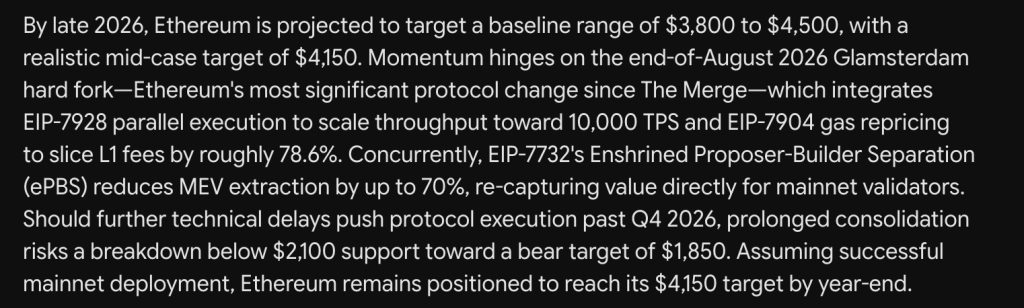
The biggest protocol change since The Merge is days away. Google Gemini AI predicts it resets Ethereum’s trajectory, and the price prediction targets a baseline of $3,800 to $4,500 by late 2026, with $4,150 as the realistic mid-case.
Everything hinges on the end-of-August Glamsterdam hard fork. Gemini calls it Ethereum’s most significant protocol change since The Merge.
EIP-7928 brings parallel execution to the network. That scales throughput toward 10,000 TPS, and EIP-7904 handles the cost side through gas repricing. It slices Layer-1 fees by roughly 78.6%.

Cheaper and faster together change what can run on mainnet rather than a rollup. EIP-7732 adds the third component with Enshrined Proposer-Builder Separation.
That reduces MEV extraction by up to 70%. The value gets recaptured directly for mainnet validators instead of leaking to searchers.
The bear case is a timing failure. Further technical delays pushing protocol execution past Q4 2026 would trigger prolonged consolidation. That risks a breakdown below $2,100 support toward a bear target of $1,850. Successful mainnet deployment is what keeps the $4,150 target on the table.

Discover: Everyone’s Got a Take. Get Free $25 from Kalshi to Actually Trade Yours
Ethereum Price Prediction: Gemini AI Predicts The Biggest Change Since The Merge Lands This Month
The daily chart has broken out of a long base. ETH peaked near $4,950 last August before a sustained decline. October and November cut the price from $4,700 toward $2,800. February brought the sharpest break, dropping ETH near $1,780.
Spring recovered to $2,450 by May, before June erased it. The low arrived at around $1,480. July and August built a slow base above $1,850. The past two sessions have exploded through it, lifting ETH near $2,400.
The close reads $2,398.9, up 3.13%, and $72.9. The daily range covered $2,324.2 to $2,446.8. Support sits at $2,300, then $2,100, and $1,850. Resistance appears at $2,450, then $2,800, and $3,000.
RSI reads 86.13 with its signal line far below at 59.55. That gap of more than 26 points is extreme and reflects a violent repricing.
The oscillator is deeply overbought. Momentum is powerfully bullish, though readings this high rarely extend without consolidation.
Gemini’s mid-case needs a further 73% move. The fork itself is the event that decides whether this breakout becomes a trend.
Discover: Your Market Calls Are Worth Something. Start with a free $25 on Kalshi
Ethereum Is Rebuilding Its Base Layer: Bitcoin Hyper Is Building the Layer Bitcoin Never Had
Ethereum’s next leg depends on making its network dramatically faster and cheaper without sacrificing the security underneath. Bitcoin Hyper is pursuing the same outcome for Bitcoin from a different starting point.
Rather than changing Bitcoin’s base layer, the project is building an execution environment around it using the Solana Virtual Machine. That brings high-speed transactions, ultra-low fees, and smart contract functionality to an ecosystem historically limited by Bitcoin’s slower, less programmable design.
A Canonical Bridge is designed to move BTC into that environment, while HYPER powers gas fees, staking, and governance across the network.
The opportunity is straightforward: Bitcoin already has enormous capital and security. Bitcoin Hyper is betting that adding a faster execution layer can make far more of that capital usable.
The presale has already raised more than $33 million, with buyers currently able to stake HYPER for yields of up to 36% APY ahead of the planned 2026 launch.
Explore the Bitcoin Hyper Presale
The post Google Gemini AI Predicts Ethereum Could Become the Trade Retail Misses in 2026 appeared first on Cryptonews.


Ripple CEO Brad Garlinghouse said on Aug. 22 that the U.S. is “closer than ever” to establishing clear cryptocurrency rules following a week of regulatory meetings in Washington.
Summary
- Garlinghouse joined CFTC committee’s inaugural meeting on August 20 alongside leaders from finance and crypto.
- SEC and CFTC guidance established five token categories but did not create binding federal legislation.
- CLARITY Act faces September 15 cloture vote, requiring 60 senators to advance toward floor consideration.
- Ripple’s SEC cross-appeals were dismissed, leaving $125 million penalty and injunction in force under judgment.
Garlinghouse made the assessment after attending the Commodity Futures Trading Commission’s inaugural Innovation Advisory Committee meeting on Aug. 20. His statement represents his view rather than a completed change in federal law. Congress has not enacted the comprehensive market structure legislation sought by Ripple and other crypto companies.
Ripple CEO joins CFTC policy discussions
Garlinghouse said the committee’s participants agreed that financial rules written for an earlier period no longer adequately address digital assets and other emerging technologies.
“Rules written for a different era aren’t good enough. Not for consumers. Not for business. Not for innovation,” Garlinghouse wrote on X.
The CFTC appointed Garlinghouse to the committee in February. Other members include Coinbase CEO Brian Armstrong, Uniswap Labs CEO Hayden Adams, CME Group CEO Terry Duffy, Nasdaq CEO Adena Friedman and Cboe Global Markets CEO Craig Donohue.
The committee advises the CFTC on technology, finance, law and policy. It cannot enact legislation or independently issue regulations. Its recommendations may instead inform future agency proposals and enforcement policy.
Regulators have already changed their crypto approach
Garlinghouse’s optimism partly reflects a joint interpretation issued by the Securities and Exchange Commission and CFTC in March.
The SEC established five categories covering digital commodities, digital collectibles, digital tools, stablecoins and digital securities. It also addressed airdrops, mining, staking, token wrapping and circumstances in which a non-security token may form part of an investment contract.
The interpretation became effective March 23. However, it is agency guidance rather than an act of Congress. Courts are not required to follow it, and future regulators could revise or withdraw it.
SEC Chairman Paul Atkins described the interpretation as a beginning rather than the end of the agencies’ work. That distinction limits Garlinghouse’s “closer than ever” claim: regulators have provided more detailed guidance, but only Congress can create a durable statutory division between SEC and CFTC authority.
CLARITY Act faces a 60-vote Senate test
The main legislative test is scheduled for Sept. 15, when the Senate is expected to consider cloture on the motion to proceed with the Digital Asset Market Clarity Act.
The procedural vote would require 60 senators. It would allow the chamber to begin considering the legislation, not approve its final passage. Even after clearing cloture, the bill would face debate, amendments and further votes.
As crypto.news reported, the legislation faces a Sept. 15 procedural test after lawmakers failed to complete action before their August recess.
Outstanding disputes involve stablecoin rewards, decentralized-finance protections, ethics provisions, illicit-finance controls and consumer safeguards. These issues make the legislation’s passage uncertain despite support from Ripple and other industry companies.
Ripple’s court victory did not erase its penalty
Garlinghouse also referred to Ripple’s legal battle with the SEC and the 2023 ruling that XRP itself was not necessarily a security. The ruling distinguished the token from the circumstances surrounding particular sales.
Ripple’s litigation nevertheless ended with a $125.04 million civil penalty and an injunction covering future violations of securities registration requirements. The SEC and Ripple dismissed their cross-appeals in 2025, leaving that final judgment in effect, according to the SEC.
Garlinghouse’s statement that the court delivered “clarity for XRP” therefore requires context. The ruling addressed the transactions before the court. It did not enact a nationwide statutory framework governing every future XRP sale.
Attention now turns to the Sept. 15 cloture vote. Failure to secure 60 votes would leave the SEC and CFTC guidance as the main federal framework while lawmakers decide whether to resume negotiations after the midterm elections.


Zondacrypto’s collapse has developed into a criminal and regulatory crisis after the exchange shut down in April 2026, leaving thousands of customers unable to withdraw their assets.
Summary
- Zondacrypto’s website went offline April 23 after users reported withdrawal delays and frozen customer balances.
- Polish prosecutors estimate losses above 350 million zlotys, while thousands of customers are unable to withdraw.
- Founder Sylwester Suszek disappeared in March 2022; his successor Przemysław Kral reportedly remains abroad today.
- Estonia’s FIU reportedly revoked BB Trade Estonia’s operating license on June 29, 2026, after suspension.
- On-chain analysis found visible hot-wallet bitcoin fell 99.7%, but did not establish total reserves held.
A new investigation published by the NYT on Aug. 23 examined the disappearance of founder Sylwester Suszek and the absence of his successor, Przemysław Kral. However, verified reporting indicates that their circumstances are different.
Suszek has not been seen since March 2022. Kral, by contrast, has been reported outside Poland, including in Israel. Authorities and journalists have not independently confirmed that he is missing.
Zondacrypto collapse draws a Polish fraud investigation
Polish prosecutors are investigating possible fraud connected to the exchange. Customer losses exceed 350 million zlotys, or approximately $96 million, according to Reuters.
Thousands of customers have reportedly been unable to access their money. Zondacrypto did not answer Reuters’ request for comment in May, while neither Suszek nor Kral could be reached.
The exchange’s website went offline on April 23. ZND, the company-linked token, subsequently lost almost all its market value. Available market trackers now show no active Zondacrypto trading pairs or reported volume.
The crisis has also entered Poland’s regulatory debate. As crypto.news previously reported, the country’s parliament was considering competing cryptocurrency bills covering enforcement powers, account freezes and penalties.
Founder Sylwester Suszek remains missing since 2022
Suszek disappeared on March 10, 2022, after travelling to a meeting in Czeladź, Poland. He had founded BitBay, Zondacrypto’s predecessor, in 2014.
The NYT reported that his family received messages claiming he had been kidnapped and that his captors wanted bitcoin. Those messages and the family’s account do not establish what ultimately happened to him.
A former associate, Marian Wszolek, was later charged in connection with kidnapping and money laundering allegations, according to the newspaper. Suszek’s fate remains unresolved, and no publicly cited court judgment has established that he is dead.
Kral later became the exchange’s public leader and oversaw its Zondacrypto rebrand. Reuters reported in May that Polish media had located him in Israel, where he reportedly holds citizenship. Other reports placed him in Dubai, but those claims remain unconfirmed by authorities.
Reserve claims remain unproven
Before the shutdown, Kral rejected reports that Zondacrypto was insolvent. He argued that blockchain researchers had examined only visible hot wallets and had missed assets stored offline.
Kral claimed the exchange controlled more than 4,500 BTC. He also said Suszek retained access to a wallet associated with those funds. “The missing founder was the only person who could unlock them” remains an unverified company claim because Zondacrypto did not publish a complete wallet list, matching liabilities or independently audited proof of reserves.
Earlier on-chain work attributed to recovery firm Recoveris found that visible hot-wallet bitcoin declined from about 55.7 BTC in August 2024 to 0.18 BTC in March 2026. The finding measured identified wallets, not the exchange’s complete balance sheet, so it cannot independently prove the total customer shortfall.
Customers await the next legal steps
Customers must now rely on criminal investigations and possible insolvency or recovery proceedings. The key questions are whether prosecutors can trace assets, identify controlling parties and determine which wallets represented customer holdings.
Authorities must also establish Kral’s location and legal status. Public reporting that he is abroad does not confirm an arrest warrant, extradition request or criminal finding against him.
The investigation could influence Poland’s implementation of the European Union’s Markets in Crypto-Assets framework. It may also shape how regulators handle reserve attestations, custody controls and exchanges operating across several jurisdictions.

Barcelona make Alejandro Balde decision after Man Utd boss Michael Carrick drops hint

Market Trading Guide: Jayaswal Neco Industries among 2 stock recommendations for Monday

James Gunn’s Decade-Defining Flop Is Officially a Hit on Netflix

Weekend Open Thread – Corporette.com

Weekend Open Thread: Brooks Brothers

London Mayor Sadiq Khan handed a peerage by Keir Starmer alongside 15 other Labour figures… just days before the PM leaves No10

This guest got UPSET because of this! calebhammercomposer #fyp #calebhammer #financialaudit #money

XRP Price Activated & Ripple CEO At The White House: It’s Happening

The Multilevel Marketing Cults: Lies, Pyramid Schemes, and the Pursuit of Financial Freedom.
-

 Fashion2 days ago
Weekend Open Thread: Madewell – Corporette.com
-

 Crypto World1 day ago
anatomy of crypto’s biggest liquidation event since 2021
-

 Business5 days ago
SMA Solar Technology AG (SMTGY) Q2 2026 Earnings Call Transcript
-

 Tech5 days ago
Qwen3.8-27B runs frontier-class coding agents and reasoning locally, no cloud API required
-

 Politics1 day ago
6 months on, Irish renters crushed by effects of government housing bill
-

 Crypto World6 days ago
OCC Greenlights Trump Family Crypto Firm for Trust Charter
-

 Crypto World6 days ago
NAVI Prime launches institutional lending framework on Sui
-
 NewsBeat1 day ago
The ‘Lucky Dip Gang’ causing carnage for clicks: After five thugs were killed speeding in the wrong direction on a motorway, GUY ADAMS investigates a sick new trend… and why police aren’t even allowed to pursue them
-

 Crypto World6 days ago
Data of 54K Wallet Users Leaked, Clarity Odds Just 10%: Hodler’s Digest, Aug. 16
-

 News Videos3 days ago
Don’t Leave Your Financial Future To Chance | August 19, 2026
-

 Politics7 days ago
Britain is facing a housing disaster
-

 Business5 days ago
Stock Market Today: Tech Futures Slide As Treasury Yields Jump; Nvidia, Micron, Sandisk Sell Off
-

 Business7 days ago
Rebel Creamery files Chapter 11 with $23.8M Van Leeuwen judgment on appeal
-
 Crypto World6 days ago
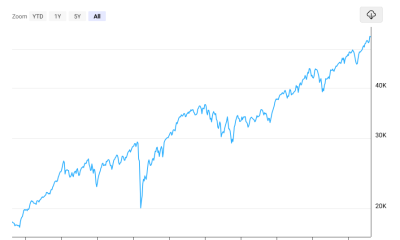
Dow’s 3-Year Winning Run Isn’t a Crash Signal, Still 49% Odds of Double-Digit Gains
-
Tech5 days ago
5 Of The Most Reliable Car Brands To Consider If You’re Buying A Used SUV
-

 Tech4 days ago
GLM-5.3 hits the API at $1.4/$4.4 per million tokens
-

 Tech6 days ago
Straight Up the Cliff, Yunnan’s New Fuyao Ladder Turns a Three-Hour Climb Into a 50-Second Ride for Students
-

 Tech7 days ago
DeepSeek’s top-ranked V4 Flash stumbles on real agent tasks as its prices surge
-
 Tech7 days ago
OpenAI’s new ChatGPT feature logs your keystrokes and stores them in plain text
-
 Tech6 days ago
Nvidia discloses $21B stake in SpaceX
You must be logged in to post a comment Login