

Crypto World
Institutions Added to MSTR Positions in Q1 Despite 18% Price Drop

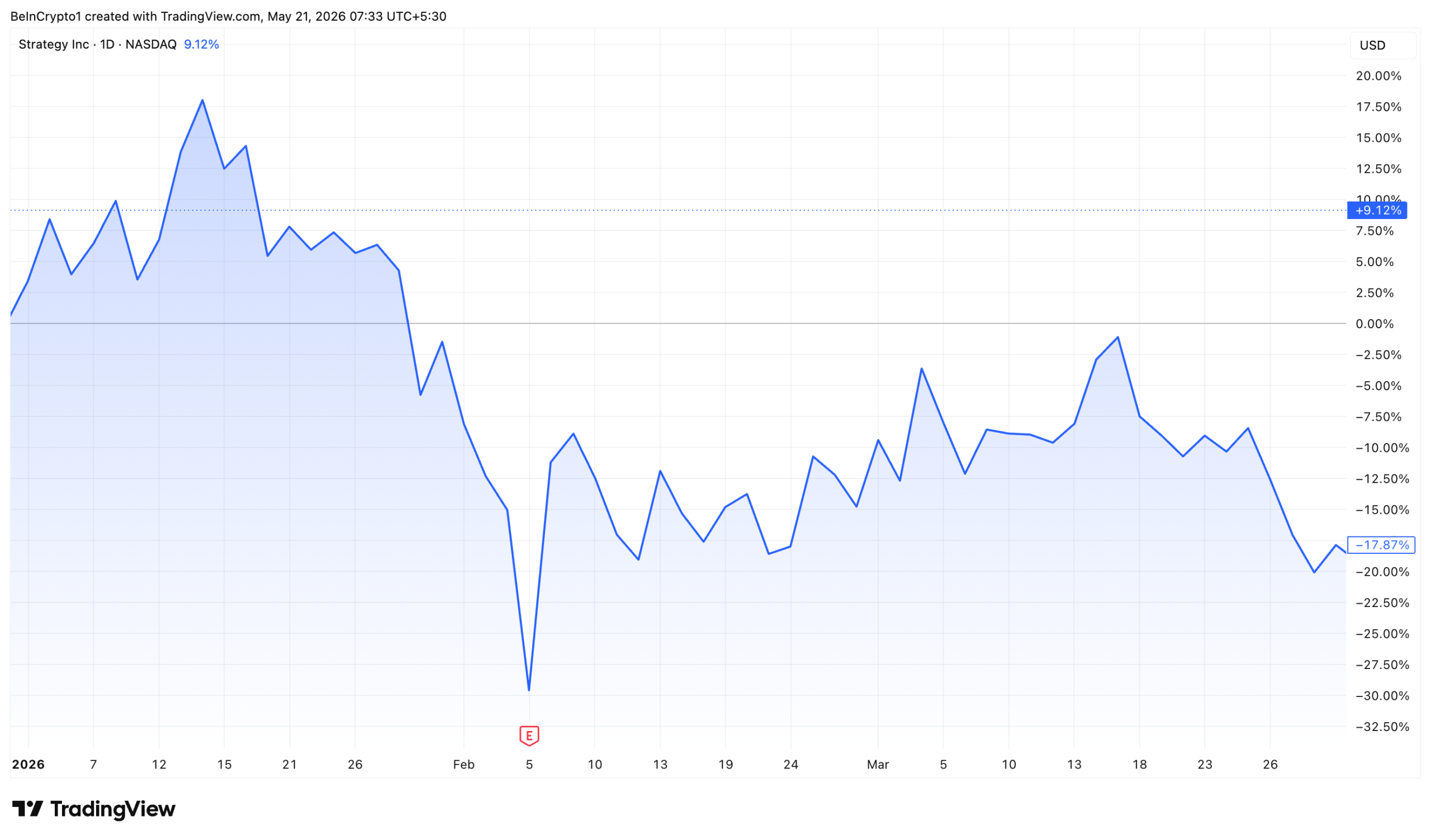
Institutional holders boosted their MSTR positions in the first quarter of 2026, even as Strategy’s (formerly MicroStrategy) stock fell during the period.
Form 13F filings show that 13 of the top 15 institutional shareholders added shares, lifting their combined holdings by $4.6 billion, or 27%.
Top Institutions Loaded Up on MSTR Through Q1 Drawdown
Phong Le, Strategy’s chief executive officer, disclosed the 13F data on social media this week. The filings show Capital International boosted its MSTR stake by $1.92 billion, the largest single increase.
Follow us on X to get the latest news as it happens
Vanguard’s Portfolio and Capital Management entities collectively saw holdings surge by $967 million, while BlackRock Institutional Trust added $377 million.
Defiance ETFs entered with a $511 million position, ranking 14th among top shareholders. In contrast, only Morgan Stanley Investment Management reduced its position, trimming a modest $7 million from a near $1 billion stake. Norges Bank Investment Management held flat at $626 million.
The accumulation came during a challenging period for MSTR. During Q1, the stock fell nearly 18%, tracking Bitcoin’s downturn, which saw the cryptocurrency drop over 22% during the same period.
However, Bitcoin’s modest recovery has also boosted the stock, which has turned green year-to-date, rising more than 9%.

Active Conviction Versus Passive Mechanics
It’s worth noting that Vanguard, BlackRock, State Street, and Geode Capital are predominantly passive index managers. Their position changes often track index rebalancing rather than discretionary buying.
Active managers Capital International, Capital World Investors, and Capital Research Global Investors collectively added more than $2.27B. Those moves indicate deliberate accumulation through the Q1 selloff.
Subscribe to our YouTube channel to watch leaders and journalists provide expert insights
The post Institutions Added to MSTR Positions in Q1 Despite 18% Price Drop appeared first on BeInCrypto.



Key takeaways
- DOGE is up by nearly 1% and is now trading above $0.10.
- The rally comes as memecoins recorded gains amid the broader crypto market recovery.
Memecoins surge higher as market rebounds
Dogecoin (DOGE), Shiba Inu (SHIB), and Pepe (PEPE) are extending their recovery on Thursday following recent corrections.
The positive performance comes as market sentiment helps lift major meme coins. Renewed optimism around a potential peace agreement between the United States and Iran has also contributed to the broader rebound across crypto markets.
Dogecoin is showing a very strong technical structure after rebounding from a key support zone. The coin is now approaching a major moving average level that could determine its next directional move.
Dogecoin price outlook: DOGE rebounds from key support zone
The DOGE/USD 4-hour chart is bearish and efficient despite Dogecoin adding 1% to its value. The leading memecoin faced rejection at the weekly resistance level of $0.119 last week, triggering a decline of more than 11% through Tuesday.
However, it has now bounced back above $0.10 after retesting a key support area around the previous trendline breakout zone, which aligns with the daily support at $0.102,
At the moment, DOGE is approaching the 200-day Exponential Moving Average (EMA) at $0.106.
If the memecoin closes the daily candle above the 200-day EMA, it could strengthen its bullish momentum and open the path toward a retest of the $0.119 weekly resistance.
The momentum indicators suggest that the buyers are stepping in. The Relative Strength Index (RSI) is hovering near 43, indicating neutral conditions after the recent pullback.
Meanwhile, the Moving Average Convergence Divergence (MACD) remains in negative territory, suggesting that upside momentum is still fragile and could face resistance from overhead moving averages.

However, if the sellers return and DOGE drops below the $0.102 support, the bearish trend could push the price below the psychological level of $0.100.
Currently, DOGE remains in a short-term recovery phase, but traders are closely watching whether it can reclaim key technical levels to confirm a stronger bullish continuation.


Boerse Stuttgart Group’s Seturion has added Societe Generale, SG-FORGE and flatexDEGIRO to expand blockchain-based securities settlement across Europe.
Summary
- Boerse Stuttgart’s Seturion added SocGen, SG-FORGE and flatexDEGIRO for blockchain-based securities settlement across Europe.
- SG-FORGE will provide EURCV and USDCV stablecoins for settlement under the new Seturion partnership.
- Related reports show European banks are racing to build MiCA-ready stablecoin and tokenization rails.
The May 21 announcement said Seturion will provide settlement for tokenized securities transactions between the partners. The platform is part of Boerse Stuttgart Group and is designed as an open settlement network for banks, brokers and trading venues.
Seturion will support public and private blockchains. It will also allow settlement against onchain money, including MiCA-compliant stablecoins, and central bank money. Boerse Stuttgart said Nasdaq’s European trading venues will also connect to Seturion.
SocGen and SG-FORGE join tokenized securities plan
Societe Generale plans to issue tokenized structured securities through Seturion. These products include turbo warrants and investment certificates, which are expected to trade on European venues connected to the settlement platform.
SG-FORGE, Societe Generale’s crypto-asset unit, will provide its euro and dollar CoinVertible stablecoins for settlement. The release describes SG-FORGE as the first MiCA-compliant stablecoin issuer backed by a major European bank.
Jean-Marc Stenger, CEO of SG-FORGE, said the company aims to connect digital assets with traditional finance. He said “reference MiCA-compliant stablecoins” can help enable secure onchain settlement.
flatexDEGIRO brings retail investor flow
FlatexDEGIRO will connect its European retail investor flow to Seturion. The online broker serves more than 3.5 million customers across 16 countries and processed more than 75 million securities transactions in 2025.
The move gives Seturion access to retail trading activity tied to Societe Generale’s tokenized structured securities. It also gives flatexDEGIRO a role in testing how tokenized products can move through regulated European market pipes.
Europe’s stablecoin race adds pressure
The Seturion deal comes as European financial firms push deeper into stablecoins and tokenized finance. Related reports show Qivalis expanded to 37 member institutions after adding 25 banks across 15 countries ahead of its planned euro stablecoin launch in the second half of 2026.
Separate market coverage noted that dollar stablecoins still account for nearly all global stablecoin supply. Non-dollar stablecoins reached $771 million by April 2026, but held only 0.24% of the market. That gap keeps pressure on European firms to build deeper euro-denominated digital finance rails.
SG-FORGE has also expanded CoinVertible beyond Seturion. Earlier coverage said the firm deployed EURCV and USDCV on Canton Network for institutional collateral management and repo finance use cases.
For Boerse Stuttgart, the new partners bring issuers, stablecoin settlement and retail order flow into one structure. The project now gives Europe another test case for blockchain securities settlement under regulated market conditions.
Ripple has secured a spot in yet another prestigious ranking and locked in a new strategic partnership.
Meanwhile, its native token, XRP, is down 4% for the week, but the solid institutional interest suggests bearish pressure may soon ease.
In the Spotlight… Again
Just a few days ago, CNBC, the American business news channel, published its updated list of the top 50 disruptor companies for 2026. The ranking includes the most innovative, fast-growing, and industry-shaping firms worldwide, and Ripple was placed 16th.
On its way up, it has leapfrogged well-known names such as Canva, Samsara Eco, Harvey, Revolut, and more. Anthropic holds the first position, followed by OpenAI and Databricks.
Earlier in May, Ripple was also included among the top 10 entities on the Prime Unicorn Index. It was ranked sixth with a valuation of over $26 billion, while SpaceX (valued at more than $1.2 trillion) is the undeniable leader.
The index tracks the performance of US private companies worth over $1 billion. It serves as a benchmark for financial products tied to high-growth firms and includes 232 entities with a combined valuation exceeding $3.4 trillion.
The Latest Partnership
Ripple Prime (the company’s institutional-grade prime brokerage platform) recently collaborated with EDX Markets and EDX International. The development allows the entities’ clients to access EDX’s spot and perpetual futures liquidity for cryptocurrencies within a “unified, capital-efficient” framework. Speaking on the matter was Michael Higgins, International CEO of Ripple Prime:
“Building the next generation of prime brokerage requires partnering with venues that provide a secure, liquid bridge between traditional and digital markets. EDX is institutional-grade and delivers the performance, reliability, and depth that our clients expect.”
Additionally, the partnership lays the groundwork for the future integration of Ripple’s stablecoin RLUSD. Prior to that, the company secured a $200 million debt facility with Neuberger Specialty Finance. The new capital will enable Ripple Prime (formerly known as Hidden Road) to scale its platform and serve more institutional clients.
Green ETF Days
The spot XRP ETFs have enjoyed strong interest lately. SoSoValue’s data show that millions of dollars have flowed into these products over the past weeks, with the latest red day on April 30. In comparison, spot BTC and ETH ETFs have been bleeding recently.

This means that institutional investors (pension funds, hedge funds, and others) have increased their exposure to Ripple’s cross-border token, thereby setting the stage for a possible price recovery.
The issuers behind these products include heavyweights like Canary Capital, Bitwise, Franklin Templeton, Grayscale, and 21Shares. Collectively, they’ve brought in almost $1.4 billion in net inflows since debuting.
XRP Remains in Red Territory
Despite the advancement on the ETF front, Ripple’s native token is down about 4% for the week and is currently worth $1.36 (according to CoinGecko). However, that hasn’t stopped many analysts from making bullish predictions.
Recently, X user CoinForge argued that XRP looks “insane” and stands at a critical level that previously sent it up 700%. For their part, JAVON MARKS opined that the asset is still “holding broken out” against BTC and has the potential to outperform by nearly 800%.
The whale activity reinforces the bullish sentiment. Ali Martinez revealed that large investors have accumulated more than 71 million XRP over the last week. This shows that they might be positioning for a potential rally, which could encourage smaller players to hop on the bandwagon as well.
The post Ripple (XRP) News Today: May 21 appeared first on CryptoPotato.


- Most users want crypto outcomes rather than wallet management.
- Wallets will remain part of the technical stack, while becoming less visible inside consumer products.
- Key management, seed phrases, gas fees, and network selection still create friction.
- Ownership, custody awareness, and transaction finality should remain visible.
- AI agents may become the next user interface for crypto transactions, with transparency and user control as core safeguards.
The crypto wallet has long served as the main entry point into Web3.
Wallets have traditionally stored assets, connected users to dApps, signed transactions, and given people control over their funds.
However, in 2026, crypto sits inside trading apps, payment products, exchange platforms, embedded finance tools, and AI-driven interfaces. Users still need ownership, security, and transaction clarity. But many of them prefer crypto functions without seed phrases, gas settings, network selection, and manual signing flows.
BeInCrypto spoke with Kevin Lee, Chief Business Officer at Gate, Federico Variola, CEO of Phemex, and Fernando Aranda, Marketing Director at Zoomex, about whether wallets are losing their place as crypto’s main user interface, which parts of the journey still feel too technical, and how AI agents could simplify the next stage of crypto interaction.
Users Want Crypto Functions Without Wallet Complexity
Kevin Lee, Chief Business Officer at Gate, sees the trend through familiar financial experiences. For him, users want results. Wallets can still power the product in the background, while the visible experience becomes simpler.
“Most users do not want to deal with wallets, they want outcomes. While wallets remain essential at the infrastructure level, the interface is increasingly abstracted away,” Lee told BeInCrypto.
He pointed to assets held in custody, linked to a payment card, and used through Apple Pay or Google Pay. In this setup, a person can spend crypto through an interface they already understand, without handling private keys, gas fees, or signing processes.
“This allows crypto to be embedded into familiar payment rails without exposing users to private keys, gas fees, or signing processes. Adoption improves because friction and complexity are removed,” Lee said.
For Lee, wallets are becoming less visible rather than disappearing. They still support custody and transactions, but the user sees a cleaner product experience.
“Wallets are not disappearing, but they are becoming invisible, sitting behind more intuitive interfaces that deliver crypto functionality without requiring users to understand the underlying mechanics,” he added.
Wallets and Apps Are Becoming One Product
Federico Variola, CEO of Phemex, sees wallet abstraction through product convergence. Users increasingly expect one app to handle storage, trading, transfers, and access to crypto markets.
“Users just want an app at this point. Whether it’s a trading app that also creates a wallet for you, or a wallet that allows you to trade, like MetaMask or Rabby,” Variola said.
This benefits users by reducing the number of separate tools they need before taking action. Wallet providers are adding trading functions. Exchanges and newer platforms are adding wallet creation inside their own products.
“This is a convergence of products, which is positive for users. It abstracts a lot of complexity and creates opportunities for both wallet providers and newer platforms that can create wallets directly for users. In the end, users benefit from this reduction in complexity,” he said.
Variola also sees a security risk when simplicity goes too far. Users still need to understand self-custody, fund protection, and custody models. A smooth mobile interface can hide weak security habits, especially when assets depend on one device.
“Abstracting too much complexity can also be a downside. Users should still be aware of self-custody, how to secure their funds, and that some custody methods are significantly safer than others,” he said.
He cited Phantom users and parts of the Solana DeFi ecosystem, where many people rely heavily on mobile access without stronger offline security. In his view, these setups can become more exposed to theft.
The User Journey Still Feels Too Technical
Fernando Aranda, Marketing Director at Zoomex, sees wallet usability as one of crypto’s main adoption challenges.
“Users don’t want wallets – they want outcomes. Wallets were a necessary bridge, not the end product,” Aranda told BeInCrypto.
For Aranda, the strongest products in 2026 will hide the wallet while preserving crypto’s main benefits, including control, speed, and ownership.
The most painful part of the journey remains key management. Seed phrases, gas fees, and network selection still ask users to understand crypto mechanics before they can complete basic actions.
“Key management is still broken. Seed phrases, gas fees, network selection – these are artifacts of infrastructure, not user needs. If a product requires users to ‘understand crypto’ to use it, it’s already lost,” Aranda said.
This creates a product challenge across the industry. Many users want to send, trade, store, or spend assets. Crypto products often ask them to make technical choices first. Each extra step adds confusion and increases the chance of error.
What Should Stay Visible?
Even as wallets become less visible, some parts of the experience should stay in front of the user.
Aranda pointed to ownership and finality as two areas which deserve clear communication.
“Ownership and finality. Users don’t need to see behind the curtain, but they must know what they own, where it sits, and when a transaction is irreversible,” he said. “Abstraction shouldn’t mean losing control – it should mean removing noise.”
Of course, a better interface can remove unnecessary technical work, while still showing custody, permissions, approvals, and irreversible actions. Hidden risk creates a smoother screen, but a weaker user.
Variola made a similar point from a security perspective. Users still need to understand self-custody and the differences between custody methods, especially when assets sit inside mobile-first environments.
The future wallet experience may look less like a standalone crypto app and more like a security and permissions system inside larger financial products.
AI Agents Could Become the New Wallet Interface
AI agents could push wallet abstraction further by taking over actions users currently perform by hand.
Instead of choosing networks, checking fees, approving routes, and comparing options, users could give an AI agent a goal. The agent could then execute, optimize, and route transactions in the background.
“AI agents will become the new interface layer – executing, optimizing, and routing transactions on behalf of users,” Aranda said.
This could make crypto easier to use, especially in multi-chain environments where users face too many choices. It also creates a new risk category.
“But this introduces a new challenge: trust. We’re replacing wallet complexity with agent risk. The winners will be those who make AI actions transparent, verifiable, and aligned with user intent,” he said.
If agents handle crypto transactions, users will need strong controls over permissions, spending limits, approvals, and decision logic. The interface may become simpler, but trust will depend on what the user can verify.
Final Thoughts
The crypto wallet will remain part of custody, permissions, and transaction execution. Its role as the main user interface, however, is becoming weaker.
To sum up our expert opinions:
- Gate’s Kevin Lee sees wallets becoming invisible inside familiar payment products.
- Phemex’s Federico Variola sees wallets and trading apps merging into simpler multi-function products.
- Zoomex’s Fernando Aranda sees AI agents becoming the next interface for crypto execution.
The next phase of wallet design depends on balance. Users want less complexity, while still needing clarity over ownership, custody, approvals, and irreversible transactions.
AI agents may simplify the experience further, but their success will depend on transparency, verifiable actions, and user control.
The post Is the Wallet Disappearing as Crypto’s Main User Interface? appeared first on BeInCrypto.


The U.S. Federal Reserve has proposed a new category of restricted payment accounts that could give eligible fintech and crypto-linked banks access to parts of the central bank’s payment infrastructure without granting the full privileges available to traditional banks.
Summary
- The Federal Reserve has proposed restricted payment accounts that would give eligible fintech and crypto-linked banks access to clearing and settlement services.
- Regional Federal Reserve Banks have been asked to pause Tier 3 master account decisions until the rulemaking process is expected to end by Dec. 31, 2026.
- Kraken Financial previously received a limited-purpose master account from the Kansas City Fed, intensifying debate over crypto access to U.S. payment infrastructure.
According to a Federal Reserve Board notice released Wednesday, the proposal would create limited-purpose “payment accounts” for certain nonbank financial institutions, allowing access to clearing and settlement services while excluding tools such as interest on reserves, intraday credit, and the Fed’s discount window.
Through the same proposal, the Fed asked regional Reserve Banks to temporarily pause decisions on pending Tier 3 master account applications while the rulemaking process moves forward. Staff said the pause is expected to remain in place until Dec. 31, 2026.
Federal Reserve officials said the suspension would allow time to gather public feedback and apply the framework consistently across Reserve Banks. The proposal was published as both a request for comment and a notice of proposed rulemaking.
Coming just a day after U.S. President Donald Trump directed the Federal Reserve to review access policies for fintech and crypto firms, the latest proposal keeps direct Fed access out of reach for crypto exchanges themselves.
Under the framework described by journalist Eleanor Terrett, firms would still need to operate through an affiliate that qualifies as an eligible depository institution under the Federal Reserve Act.
Fed formalizes “skinny” account discussions
Inside a separate Board memo, the Federal Reserve said its temporary halt on Tier 3 account requests should end on or before Dec. 31. The document also listed pending applications as of Feb. 28, including a request tied to Kraken’s banking arm, Kraken Financial.
In March 2026, the Federal Reserve Bank of Kansas City approved a limited-purpose master account for Kraken Financial under the Tier 3 framework. The Wyoming-chartered institution became one of the first crypto-linked banking entities to receive direct connectivity to core U.S. payment rails used for settlement.
At the time, Kraken Co-CEO Arjun Sethi described the approval as the convergence of crypto infrastructure with sovereign financial rails. Even so, the account came with restrictions that prevented the firm from earning interest on reserves or borrowing from the Fed’s liquidity facilities.
Pressure around the issue intensified after the approval became public. The Independent Community Bankers of America said it had concerns about allowing a crypto-focused institution access to Federal Reserve infrastructure under a regulatory structure different from conventional banks. The Bank Policy Institute also argued that the Kansas City Fed moved ahead with what it described as a “skinny” master account before a formal systemwide policy had been finalized.
Banking organizations additionally questioned the treatment of Wyoming Special Purpose Depository Institutions, or SPDIs, because those entities do not carry federal deposit insurance. Industry groups argued that allowing uninsured institutions direct settlement access could introduce compliance and financial stability concerns.
Although the latest proposal narrows the scope of available services, it builds on policy discussions first introduced publicly by Federal Reserve Governor Christopher Waller in October. Waller had floated the concept of restricted payment accounts that separate settlement access from broader central banking privileges traditionally reserved for regulated commercial banks.
Elsewhere in Washington, lawmakers have also started pushing for legislative support around payment access. California Representatives Sam Liccardo and Young Kim recently introduced the Payments Access and Consumer Efficiency Act, known as the PACE Act, which would allow certain non-bank firms to access Federal Reserve payment services.
The proposal has emerged alongside a separate Federal Reserve effort to loosen parts of the post-2008 bank capital framework.
Back in March, Fed Vice Chair for Supervision Michelle Bowman introduced a package of Basel III, eSLR, and G-SIB reforms that banking groups said could reduce capital burdens for large and regional lenders. While those discussions focused on traditional banking regulation, both initiatives have added to the debate over how much access nontraditional financial firms should receive within the U.S. financial system.

Two newly launched US-based exchange-traded funds tied to Hyperliquid’s HYPE token are seeing strong early momentum, as trading activity continues to rise since their market debut.
According to SoSoValue data, 21Shares’ THYP and Bitwise Asset Management’s BHYP have generated nearly $41 million in combined trading volume since launching earlier this month.
Rare Momentum Behind Hyperliquid ETFs
Weighing in on the sharp growth in activity, Bloomberg ETF analyst Eric Balchunas said that both funds recorded another 50% increase in trading volume on Wednesday alone. In a post on X, Balchunas described the launches as “perfectly timed,” and added that most major asset classes, including stocks, bonds, gold, Bitcoin, and the broader crypto market, have declined recently. HYPE, on the other hand, has climbed 37% since THYP launched on May 12.
According to Balchunas, the steady increase in trading activity during the funds’ first week is “rare” for new ETFs, which often see initial excitement fade quickly after launch. 21Shares became the first issuer to launch a HYPE-linked ETF in the US with THYP on May 12, attracting $1.2 million in net inflows. BHYP followed on May 14 with $750,000 in net inflows and has continued trending upward since launch.
Grayscale Investments also entered the race for a Hyperliquid-linked investment product after filing for a HYPE ETF in March. The proposed fund is still under review by US regulators. Meanwhile, blockchain analytics platform Lookonchain reported that wallets linked to Grayscale bought and staked 510,387 HYPE tokens worth about $24.95 million over the past week.
A wallet linked to Galaxy Digital also bought 158,100 HYPE, which is worth around $8.8 million.
Hyperliquid Growth Trajectory
Zooming out, HYPE has gained nearly 40% so far this month, pushing its year-to-date returns to almost 123%. Bitwise CIO Matt Hougan recently described the platform as one of the most important crypto projects to emerge in recent years. He also believes that investors still underestimate both its long-term impact and the value of the HYPE token.
Hougan said Hyperliquid has evolved beyond a crypto perpetual futures exchange into a financial “super-app” which offers exposure to commodities, S&P 500 futures, pre-IPO stocks, and prediction markets. The exec added that nearly half of the platform’s trading volume now comes from non-crypto assets and could rise further by the end of the year.
The post HYPE ETFs See Rare First-Week Surge as Eric Balchunas Calls Launch Timing ‘Perfect’ appeared first on CryptoPotato.
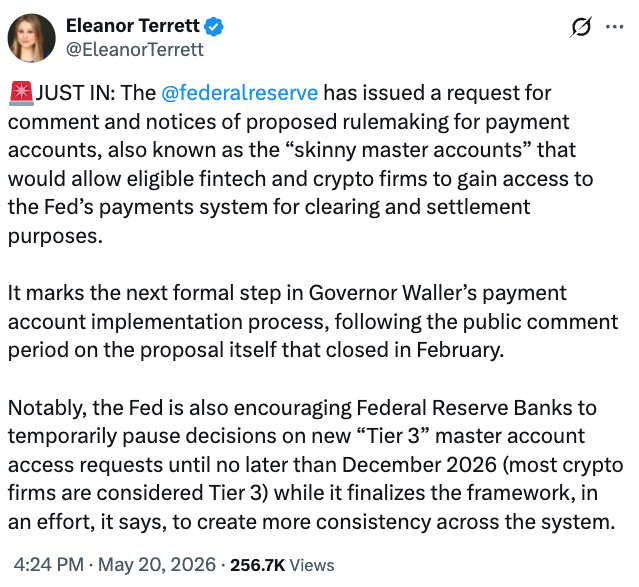
The US Federal Reserve proposed creating limited payment accounts that could give legally eligible fintech and crypto-linked banks narrower access to its payment rails without the backstops available to traditional banks.
The proposal was released on Wednesday through a Federal Reserve Board request for comment and notice of proposed rulemaking, referring to “skinny master accounts” for nonbank financial institutions.
The Fed also encouraged regional Reserve Banks to pause decisions on Tier 3 account-access requests while it finishes the rulemaking, a step staff said is expected to end by Dec. 31, 2026.
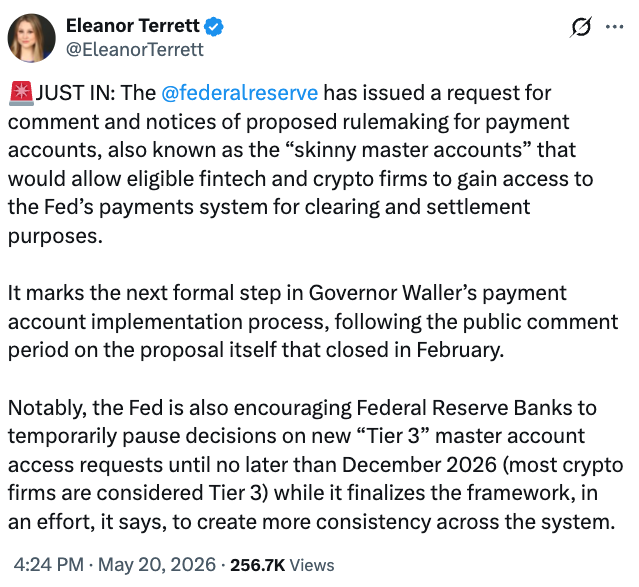
Source: Eleanor Terrett
“The temporary pause will allow the Federal Reserve to solicit and consider public input on payment accounts and to promote consistent implementation,” the announcement said.
The move highlights ongoing regulatory tension over crypto access to US payment systems following President Donald Trump’s executive order calling for broader fintech and digital asset integration, while the Fed maintains a more cautious approach.
Tier 3 pause expected to end by Dec. 31
The Fed expects its temporary pause on Tier 3 master account applications to end on or before Dec. 31, according to a Board memo.
The memo also provided a list of “pending account requests” from Tier 3 institutions as of Feb. 28, 2026. The list included companies such as Kraken Financial, the banking arm of cryptocurrency exchange Kraken.
Kraken was later granted a limited-purpose master account by the US Federal Reserve Bank of Kansas City in early March 2026. The bank approved the access specifically under a Tier 3 classification.
Trump order and limits on direct Fed access by crypto
The crypto industry has long pursued access to Fed master accounts as a way to connect more directly to the US payment system.
The latest proposal does not give crypto exchanges direct access, even though there is broader political support for expanding fintech and digital asset access to the financial system.
Related: About 10% of Americans used crypto in 2025, highest level since 2022: Fed
Even as Trump’s executive order signaled support for wider fintech and digital asset integration, direct access to master accounts would still be unavailable to crypto exchanges. Instead, firms would need to operate through an affiliate that qualifies as an eligible depository institution under the Federal Reserve Act, according to Eleanor Terrett.
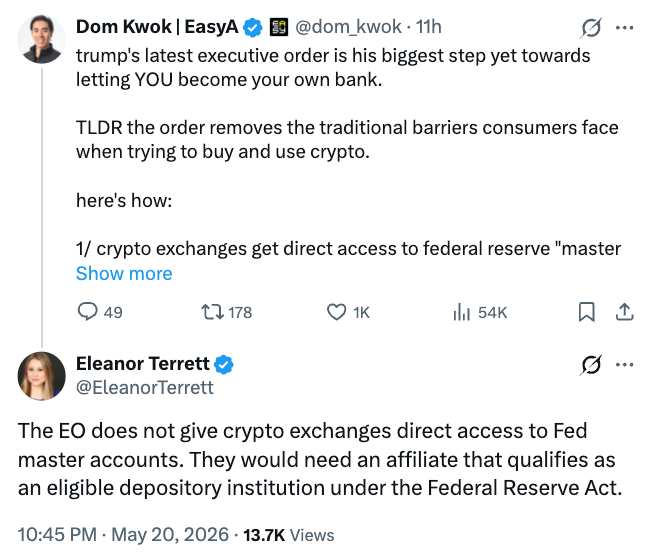
Source: Eleanor Terrett
The concept of “skinny” payment accounts was first introduced in October by Federal Reserve Governor Christopher Waller and was further developed through policy discussions in early 2026.
Unlike master accounts, the proposed payment accounts would be limited to clearing and settlement only. They would not earn interest or provide access to central banking tools such as the discount window or intraday credit.
Magazine: How crypto laws changed in 2025 — and how they’ll change in 2026
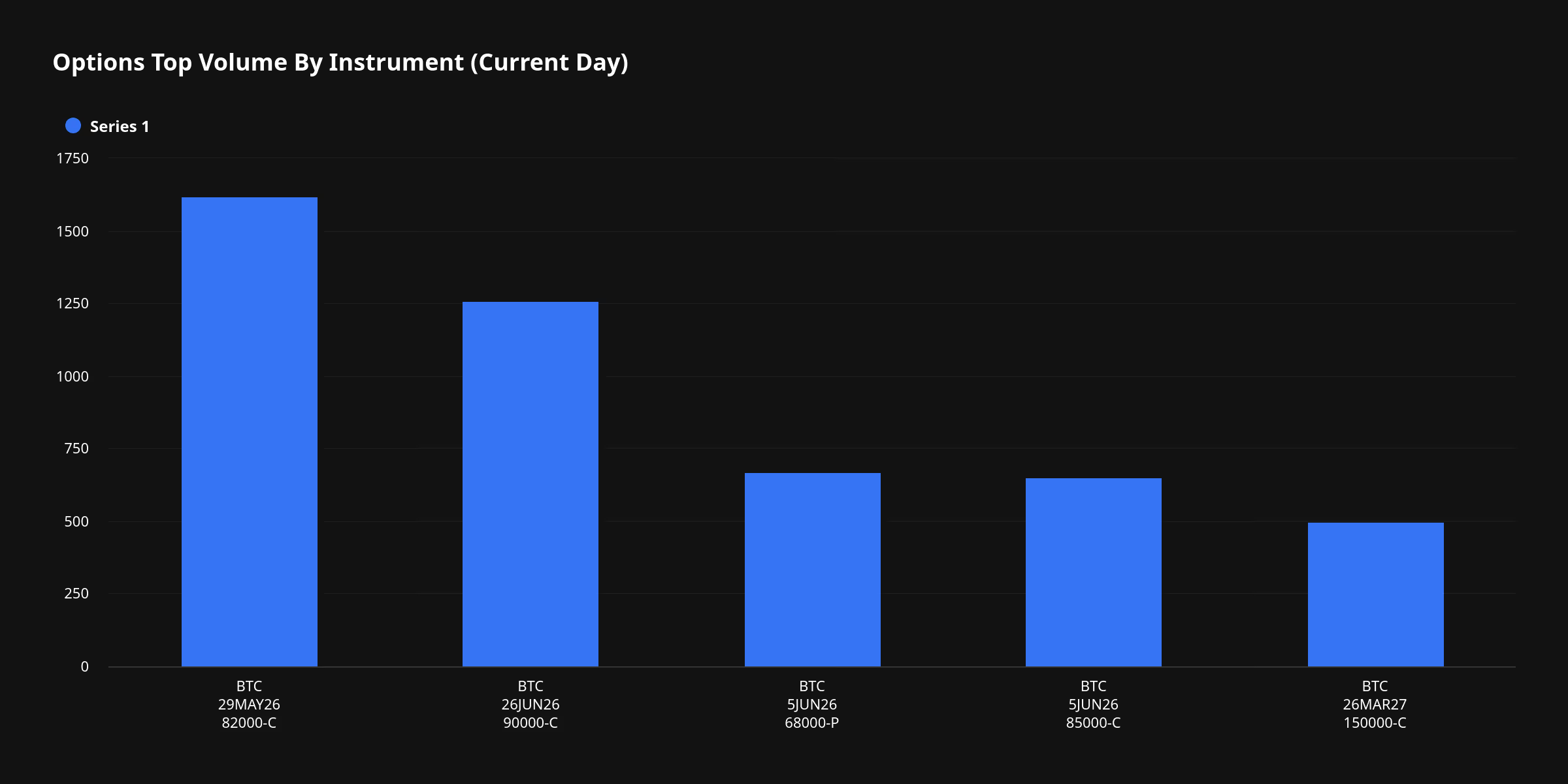
Bitcoin options worth roughly $6.25 billion are set to expire on Deribit on May 29, with positioning data pointing to $75,000 and $80,000 as the key levels to watch. The $75,000 strike carries the heaviest put concentration at $394 million in notional value, while $80,000 dominates on the call side with $532 million
The max-pain price, the level at which the largest number of contracts expire worthless sits at $75,000, just under 3% below where bitcoin currently trades at $77,250. With 43,184 call contracts versus 37,351 puts, the put/call ratio of 0.86 reflects a modestly bullish market, though bitcoin’s position above max pain means downward gravitational pull remains a real consideration.

However, the $82,000 strike is where the most attention is currently focused as of writing. Volume data shows the BTC 29MAY26 $82,000 call was the single most actively traded instrument on Thursday, with approximately 1,600 contracts ($126 million) changing hands, suggesting traders are positioning for a breakout higher rather than a retreat.
The total open interest across the expiry stands at 80,535 contracts, split between 43,184 calls and 37,351 puts.
Meanwhile, Deribit’s overall open interest has now reached $31.3 billion, overtaking BlackRock’s IBIT at $27 billion, according to checkonchain.


Key takeaways
- ZEC is up 12% in the last 24 hours, making it the second-best performer in the top 10.
- The coin could rally past the $700 mark in the near term.
ZEC rallies as broader crypto market underperforms
ZEC, the native coin of the Zcash ecosystem, is up 12% in the last 24 hours, making it the second-best performer among the top 20 cryptocurrencies by market cap.
The rally allowed ZEC to hit the $692 mark earlier today, adding 26% to its market cap so far this week.
ZEC’s rally over the past few days comes as regulatory clarity for ZCash has improved following the U.S. Securities and Exchange Commission’s announcement closing its investigation into the Zcash Foundation.
The Zcash Foundation also reported holding approximately $36.7 million in liquid assets, mostly in ZEC, according to its Q1 update. Core technical development continues on the Zcash protocol despite organizational changes at the Electric Coin Company.
Zcash technical outlook: ZEC targets higher resistance levels above $700
The ZEC/USD 4-hour chart is extremely bullish as Zcash has only been outperformed by Hyperliquid over the last seven days.
At press time, ZEC is trading at $655 after hitting the $692 level. The momentum indicators are extremely bullish, suggesting that the buyers are in full control.
The RSI of 70 means that ZEC is now in the overbought region. The coin could undergo a correction, but the current momentum remains bullish. The MACD lines are also within the overbought territory.
If the rally continues, ZEC could extend its gains past $700 and hit the $745 resistance level for the first time since November. An extended rally would allow ZEC to target the $800 psychological level.

However, if the market undergoes a correction, ZEC could retest the $580 low created on Wednesday.
Failure to defend this support level could expose ZEC to lower demand zones around $485.
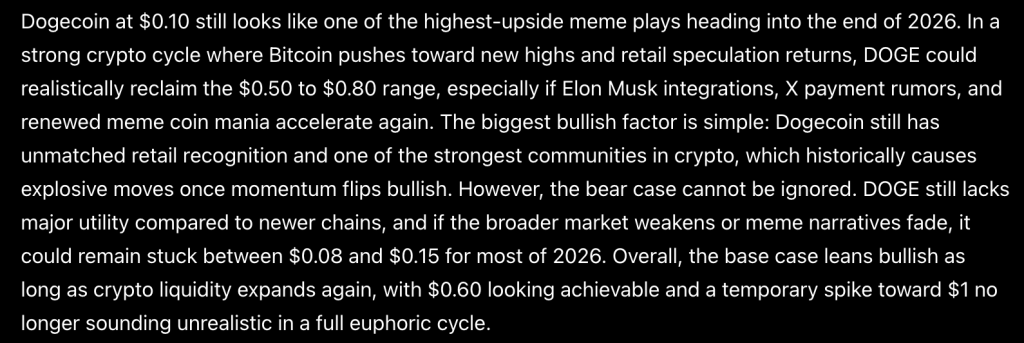
Dogecoin has died a hundred times according to the internet. It keeps coming back anyway. ChatGPT looked at the current $0.10 price and predicts its one of the highest-upside meme plays heading into end-2026.
The base target is $0.60. The euphoric scenario touches $1.
Sam Altman’s AI does not dress up the DOGE thesis in utility arguments it cannot support.
The bull case is built on exactly what Dogecoin has always been built on: unmatched retail recognition, one of the strongest communities in crypto, and a history of explosive moves the moment momentum flips bullish. ChatGPT adds 3 specific catalysts that did not exist in previous cycles.
Elon Musk integrations are still live as a narrative driver. X payment rumors have not gone away. And renewed meme coin mania accelerating during a BTC-led bull run creates the kind of speculative environment where DOGE has historically outperformed everything with a serious use case.
The AI’s logic is simple: in a strong crypto cycle where Bitcoin pushes toward new highs and retail speculation returns, DOGE does not need fundamentals. It needs a crowd. And it has one that no newer meme coin has come close to replicating.
The bear case is equally honest. DOGE still lacks major utility compared to newer chains and if the broader market weakens or meme narratives fade, it could remain stuck between $0.08 and $0.15 for most of 2026.
That is not a crash scenario, it is a dead money scenario, and for a coin with no yield and no utility it is the more painful outcome for holders who bought expecting fireworks.
Dogecoin Price Prediction: DOGE Is at $0.10, Down 76% From Its Peak, and ChatGPT Just Predicts It a 6x.
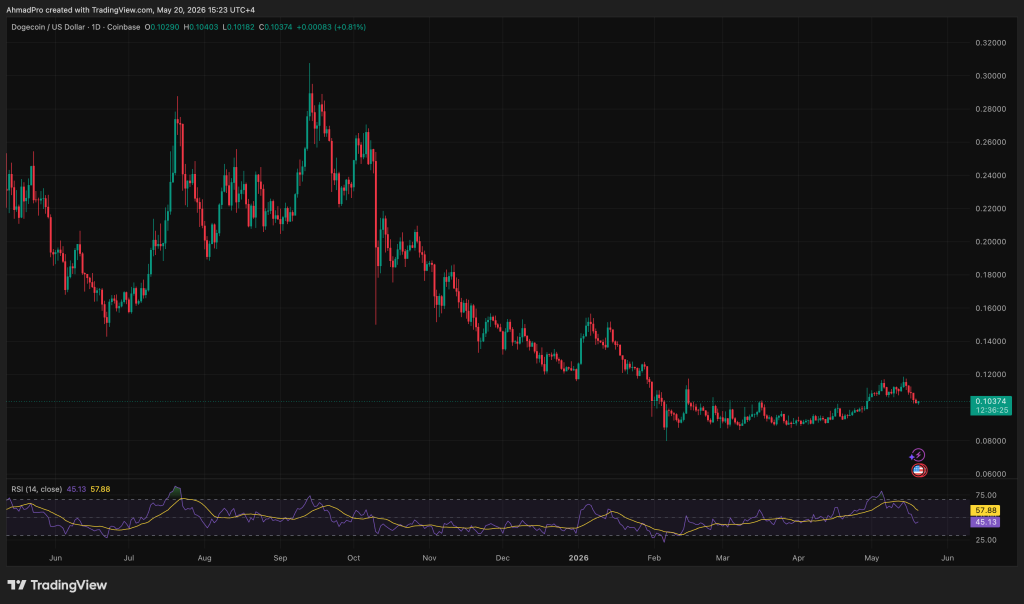
Dogecoin price is trading at $0.1038 on the daily, and the chart tells the full story of a meme coin that ran too far too fast and has been paying for it ever since.
Price peaked around $0.45 in January 2025, crashed through the year, bounced to $0.30 in August on Musk-driven momentum, and then collapsed again through the second half of 2025 all the way to $0.08 in February 2026.
The recovery since that low has been the most sustained upside move on this chart in over a year, with price grinding from $0.08 back to $0.12 before the current pullback to $0.10.
The structure since February is the most constructive thing visible on this chart. Higher lows have printed consistently across March, April, and May, and the base between $0.08 and $0.12 has held for 3 months without a serious breakdown attempt.
That is the accumulation pattern ChatGPT’s bull case needs to be building on right now.
Resistance is $0.12 to $0.13, the ceiling that has capped every recovery attempt since March. Above it $0.15 is the next reference, which is also the top of ChatGPT’s bear case range and the level that separates dead money from genuine recovery.
Above $0.15 the chart opens up significantly with $0.20 as the next meaningful supply zone and $0.30 as the level where the August 2025 distribution sits. ChatGPT’s $0.60 base target requires clearing all of that sequentially. Support is $0.08 to $0.09, the February low and the only real floor in place. At $0.10 current price is sitting near the bottom of the recovery range rather than the top.
ChatGPT’s $1 euphoric scenario needs a full bull market and an Elon catalyst. The chart just needs $0.13 to break first.
Maxi Doge: Early-Stage Meme Coin Targets 1000x Breakout Potential
If the cryptocurrency market enters another bull cycle or altseason, meme coins could see particularly explosive gains, as they often amplify broader market movements.
One newcomer drawing attention is Maxi Doge ($MAXI). The project has already raised $4.7 million through its ongoing presale as traders speculate it could dethrone established meme coins such as BONK or Floki.
Maxi Doge is a hard pumping, loud, distant degen cousin to Dogecoin, leaning into the viral internet culture and speculative enthusiasm that fuelled the meme coin boom in 2021.
The token is an ERC-20 asset on Ethereum’s proof-of-stake network, which gives it a lower environmental footprint compared with Dogecoin’s proof-of-work system.
Presale investors can currently stake MAXI tokens to earn rewards of up to 65% APY, although returns gradually decline as more tokens join the staking pool.
The token is $0.0002808 during the current presale phase, with nominal increases through each subsequent funding round.
Interested investors can visit the official website and connect a supported wallet such as Best Wallet.
Tokens can also be purchased using a bank card.
The post Sam Altman ChatGPT AI Predicts Incredible Dogecoin Price By End of 2026 appeared first on Cryptonews.

Watches that Nico regrets selling #watch #wealth #finance

Heartbroken mum of murdered teenager speaks as killers face justice
Earnings call transcript: BingEx Q1 2026 sees revenue drop, stock dips


-

 Crypto World5 days ago
BloFin War of Whales 2026 Grand Prix opens registration for $5M trading championship
-

 Fashion6 days ago
Weekend Open Thread: Theory – Corporette.com
-

 Crypto World6 days ago
E-Estate Announces 1 Year Live: Washington DC Summit as Real Estate Tokenization Enters Its Next Phase
-

 Tech6 days ago
Tech Moves: Microsoft AI leader jumps to OpenAI; former AI2 exec joins Meta; and more
-

 Tech6 days ago
Google reimburses Register sources who were victims of API fraud
-
 Crypto World7 days ago
Google’s Gemini AI Predicts Incredible Solana Price by the End of 2026
-

 Business6 days ago
H&R Real Estate Investment Trust (HR.UN:CA) Q1 2026 Earnings Call Transcript
-
 Entertainment7 days ago
Zara Larsson Has Blunt Response To Chris Brown Diss
-

 Sports6 days ago
Napoleonic enters 2026 Doomben 10,000 field via Abounding withdrawal
-

 Crypto World6 days ago
BeInCrypto 100 Institutional Awards Nomination: KAST for Best Digital Assets Neobank and Best Digital Assets Fintech
-
 Crypto World6 days ago
Bitcoin Battles US Bond Nerves With BTC Price Dip Toward New May Lows
-

 Fashion4 days ago
On the Scene at Gucci’s Cruise Show in New York City: Mariah Carey, Kim Kardashian, Lindsay Lohan, Iman, and More!
-
 Crypto World6 days ago
Wall Street’s Boldest Gold Prediction Has Russians Rushing to Buy
-

 Crypto World6 days ago
ICE and CME urge US regulators to curb Hyperliquid energy trading
-

 Politics7 days ago
DWP PIP Timms review continues to be an absolute farce
-

 Crypto World6 days ago
IREN closes $3 billion convertible notes deal amid AI infrastructure expansion
-

 Fashion5 days ago
Trending Western Style Vests Perfect for Summer
-

 Entertainment6 days ago
David Letterman Returns to Late Show, Blasts Cancellation
-
 Crypto World7 days ago
Lido Finance Selects Chainlink CCIP as the Official Cross-Chain Infrastructure for wstETH Security
-

 Fashion4 days ago
Amazon Sundays: Memorial Day Hosting
You must be logged in to post a comment Login