
Crypto World
Iran Just Struck 5 Countries, and Cardano Dropped to $0.16: But Kraken Quietly Staked $1B


Cardano (ADA) is trading near $0.1616 on July 13, retesting the 20-day EMA as an overnight geopolitical shock, Iran launching coordinated strikes across five regional countries, rattled crypto markets broadly, and pushed ADA to an intraday low of $0.1572 before a partial recovery.
The move matters because it defines whether this is a controlled pullback to structure or the start of another leg lower. What the chart reveals about that question is less ambiguous than the headlines suggest.
Kraken quietly registered 12 Cardano stake pools in June with approximately $1 billion in ADA delegated, infrastructure commitment at a scale that requires deliberate operational planning, not an automated backend toggle.
— Stake with Pride
 Kraken registered 12 Cardano pools with ~ $1B cardano:native in June! pic.twitter.com/r1NR6eSMAZ
 Midnight + Cardano (@StakeWithPride) July 11, 2026
Simultaneously, Cardano logged 233 GitHub commits over the past seven days, placing it fifth among all Layer-1 networks and accounting for roughly 6.2% of total L1 development activity across approximately 3,700 commits.
That combination of institutional staking posture and developer momentum is the kind of quiet accumulation signal that tends to be ignored amid geopolitical noise and then remembered in hindsight. Broader altcoin flows remain tilted toward Bitcoin and Ethereum for now, keeping ADA rangebound despite the underlying activity.
Can Cardano Price Reclaim $0.19 This Week?
ADA price at $0.16, down 3.60% over 24 hours and off 13.10% over the past seven days, with a short-term bounce of 4.89%, the spread reflecting the extent of intraday volatility the geopolitical event injected. The 7-day range runs from roughly $0.1623 to $0.1922, putting spot price near the bottom of that band.
Technically, the 20-day EMA near $0.1667 is the line in the sand. The RSI sits at 43.04 with a bullish divergence structure still technically active from June lows, though momentum has clearly faded from the 60-level peak seen after the initial bounce. The 50-day EMA at $0.1811 and the 100-day at $0.2111 cap upside meaningfully, the former resistance band at $0.20–$0.22 is now supply, not floor.
Three scenarios structure the near-term read. Bull case: ADA holds the 20-day EMA zone on a closing basis, geopolitical fear subsides, and price grinds back toward $0.19 over 3–5 sessions.
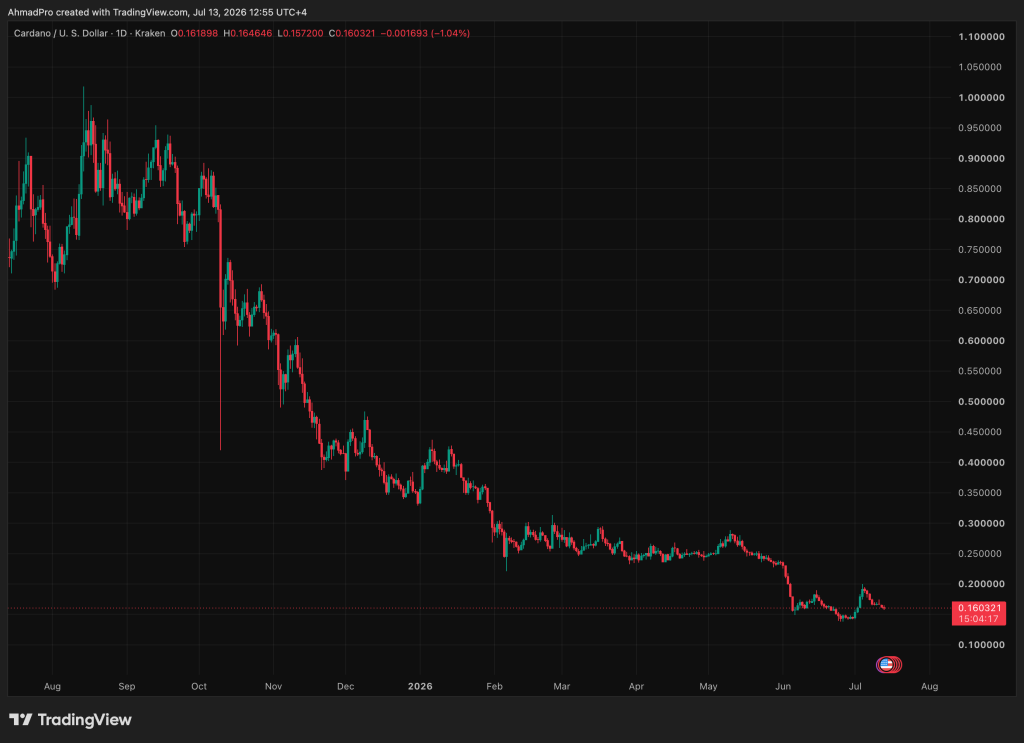
Base case: consolidation between $0.16 and $0.1811 as macro uncertainty keeps risk appetite suppressed, no breakdown, no breakout.
Bear case: a daily close below $0.155 opens a retest of the $0.14 region, invalidating the bullish divergence structure entirely. Broader market conditions remain the dominant variable — ADA does not cleanly diverge from the macro direction at this stage of the cycle. (The Kraken staking news is constructive, but institutional staking yield generation is not the same as a price catalyst.)
Is $0.19 achievable this week? Only if risk appetite recovers faster than the geopolitical situation warrants. The probability distribution skews toward the base case.
LiquidChain Targets Early Mover Positioning as Cardano Tests Critical Support
ADA’s range compression illustrates the core problem with established Layer-1s at this stage: the market cap is large enough to require significant capital inflows to move price, but narrative momentum has stalled below key moving averages with no near-term catalyst to force institutional re-rating.
That’s the structural dynamic pushing some active traders toward earlier-stage infrastructure plays where the asymmetry is still intact.
LiquidChain (LIQUID) is a Layer 3 infrastructure project positioning itself as a cross-chain liquidity layer, its core thesis being that Bitcoin, Ethereum, and Solana liquidity pools remain siloed, and that unified execution across all three represents an unsolved infrastructure problem worth solving.
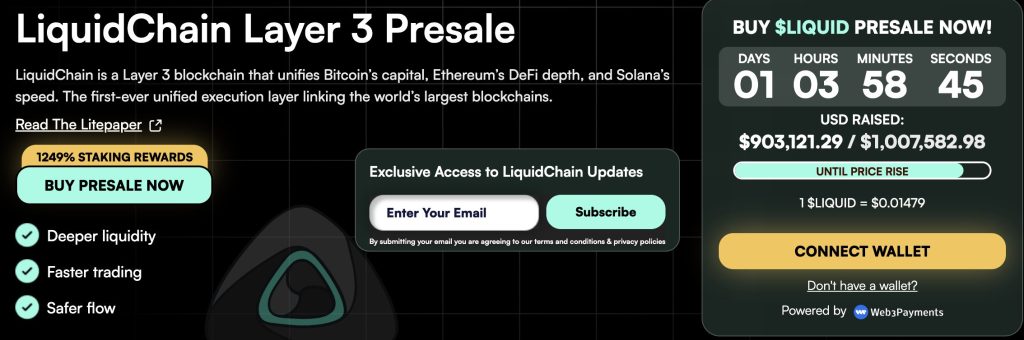
The project’s Unified Liquidity Layer and Deploy-Once Architecture are the headline technical differentiators: developers deploy once and access BTC, ETH, and SOL ecosystems simultaneously through single-step execution with verifiable settlement. The presale is currently priced at $0.01479 with $903,121.14 raised to date, early stage by any measure.
Early-stage presales carry real risk of project non-delivery and illiquidity; that caveat is non-negotiable. Research LiquidChain’s presale terms before allocating.
The post Iran Just Struck 5 Countries, and Cardano Dropped to $0.16: But Kraken Quietly Staked $1B appeared first on Cryptonews.

Bitcoin (BTC) sees its first weekly close above $80,000 since early May as clouds gather over the US inflation outlook.
Key points:
- US PPI and CPI inflation numbers are due this week prior to the Fed’s Sept. 16 decision on interest-rate changes.
- Amid record currency interventions, analysis warns that Japan may not be able to sell US treasuries to help stabilize the yen in going forward.
- Bitcoin’s supertrend indicator delivers its first “buy” signal since late 2025, copying the previous bear-market recovery.
CPI, PPI due as markets see 0.25% rate hike next
US inflation data returns to the forefront this week after surprise employment data pressured crypto and risk assets. The August prints of the Producer Price Index (PPI) and Consumer Price Index (CPI) are due for release on Thursday and Friday, respectively.
CPI matched market expectations at 0.1% month-on-month and 3.4% year-on-year last month, continuing on from softer-than-anticipated June results. Although the numbers paint a positive picture for inflation, Kevin Warsh, chair of the US Federal Reserve, stated that these data prints alone did not support the case for reassessing financial policy.
“Each of these broad inflation measures have fallen significantly from their highs of a few years ago, but progress through the past couple of years has been more modest, and while this summer’s PCE and CPI readings were better than expected, they do not tell me that underlying trends have meaningfully improved,” he said at the Jackson Hole economic symposium in late August, referring to the Fed’s “preferred” inflation gauge, the Personal Consumption Expenditures (PCE) index.
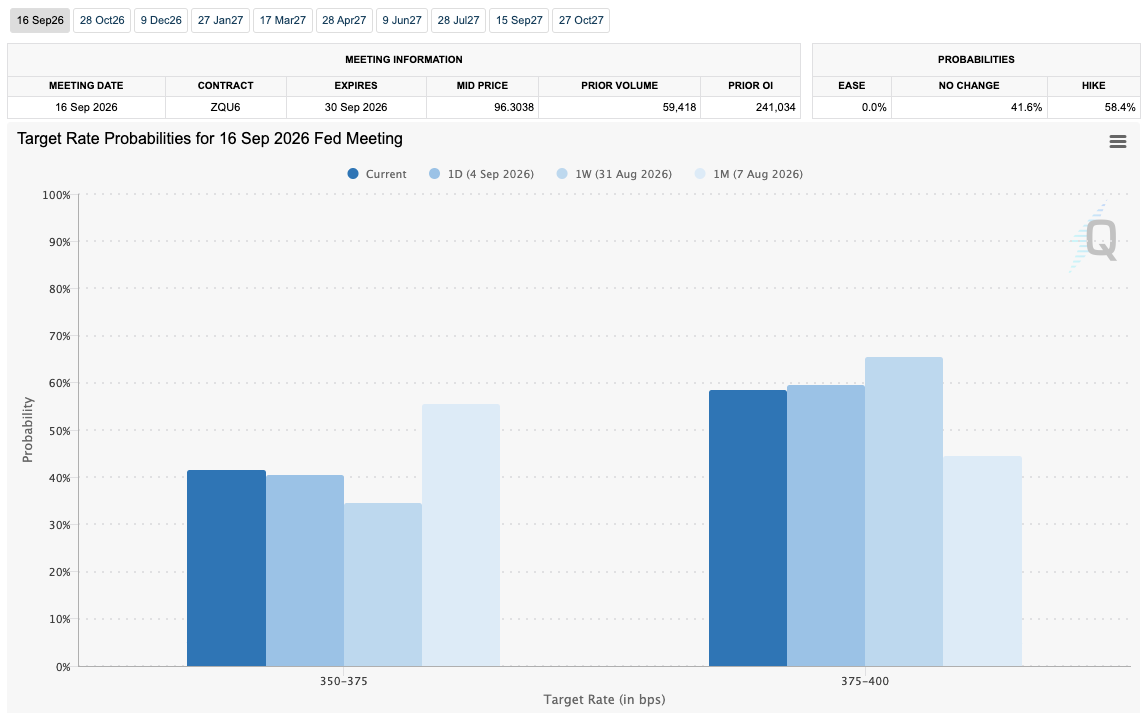
In response to the speech, markets priced in an increased likelihood of Federal Reserve rate hikes at its next meeting on Sept. 16. The latest data from the CME Group’s FedWatch Tool shows that consensus favors a 0.25% rate hike, with odds at 58.4%.
Fed target rate probability comparison for September FOMC meeting (screenshot). Source: CME Group
Fears of rate hikes were also spurred by last week’s nonfarm payrolls data, which came in far stronger than expected and included upward revisions of prior figures. The US economy added 162,000 jobs in August against a prior estimate of 56,000.
A stronger labor market reduces the need for the Fed to loosen policy, cementing the potential for rate hikes with core inflation still above its 2% target. Markets have maintained a hawkish outlook on rates. This is despite Fed governor Christopher Waller voicing support for an ongoing rate-hike pause and US president Donald Trump renewing pressure on the Fed to enact rate cuts last week.
“The Fed Board, with its great new leader, must get smart – BE PATRIOTS for a change. High interest rates put the U.S.A. at a very unfair disadvantage, and I won’t allow that to happen!” he wrote in a post on Truth Social.
Both PPI and CPI have the potential to alter the outlook prior to the meeting, with crypto market volatility often accompanying inflation-data prints.
Commenting, trading resource Mosaic Asset Company noted that the strong jobs numbers could still offer stocks a silver lining.
“While the knee-jerk reaction is centered around the rate outlook, it’s worth keeping in mind that good news for the economy should be good news for corporate earnings. The jobs report adds to recent data pointing to an economy expanding at solid pace, which should support the bull market looking ahead,” it wrote in analysis at the weekend.
Mosaic cautioned that seasonality could add an additional hurdle, with September traditionally equities’ worst-performing month, while November’s US midterm elections should make for more volatile conditions into Q4.
Japanese yen interventions hit record
Traders are focused on the Japanese yen as new government data reveals the extent of its record currency interventions.
On Monday, Japan’s Ministry of Finance reported that its foreign reserves had decreased by $79.57 billion from the end of July amid a record currency intervention in the yen. Japan’s currency strengthened to 155 against the US dollar as a result, still holding that area during Monday’s Asia trading session.
“Japan may have used both foreign securities and deposits, but it most likely sold U.S. Treasurys,” Atsushi Takeda, chief economist at Itochu Research Institute, told Bloomberg.
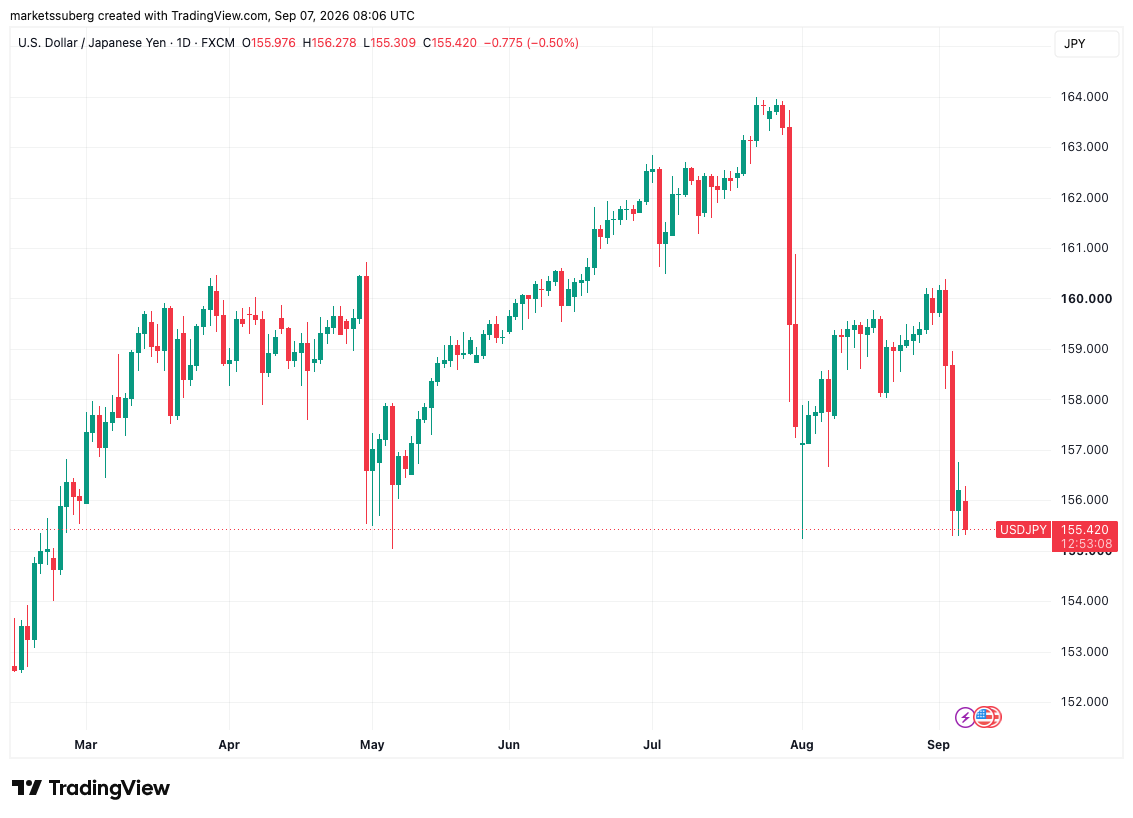
USD/JPY one-day chart. Source: Cointelegraph/TradingView
The move had potential implications beyond the yen, with US bond yields already facing pressure at the long end, prompting the Treasury to announce contingency measures set to begin on Sept. 9. Japan selling US Treasuries to fund future interventions may draw a negative response from Washington, leaving the Bank of Japan (BOJ) in a bind should yen weakness return.
“That would make it difficult for the ministry and the Bank of Japan to act going forward,” Akari Nishimura, economist at the Japan Research Institute, added.
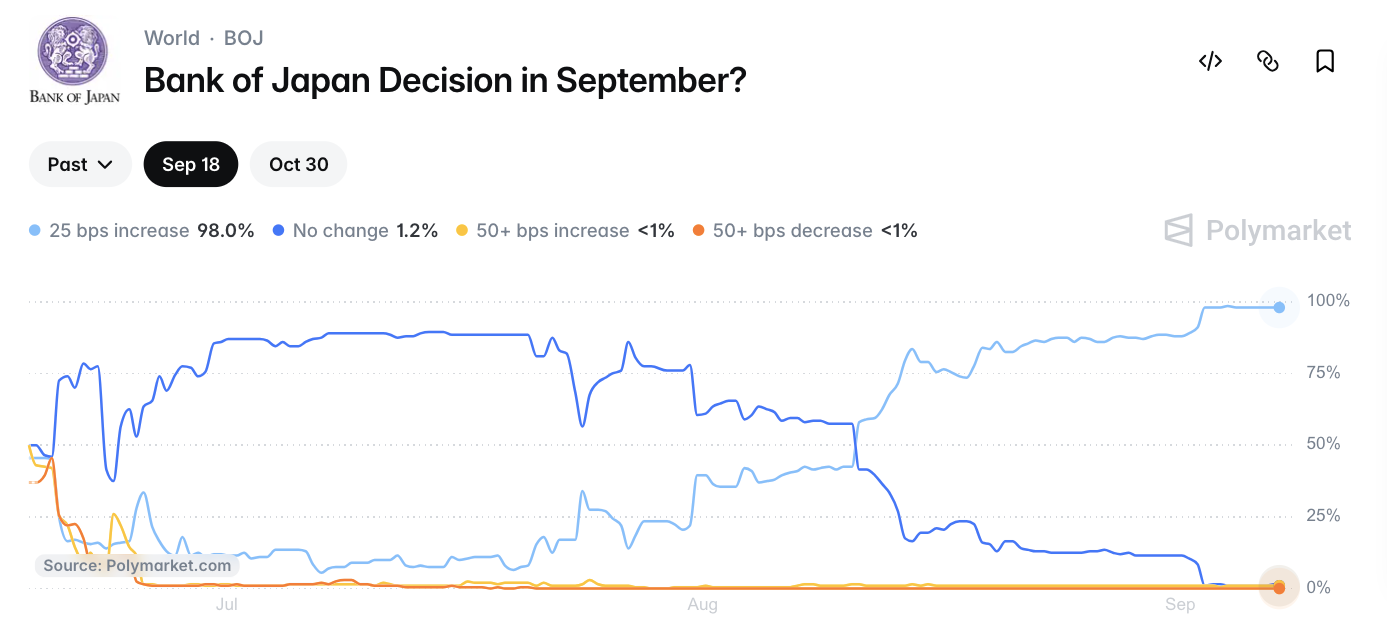
Polymarket probabilities for BOJ rate decision on Sept. 18. Source: Polymarket
Traders now price in an interest-rate hike by the BOJ in September, with benchmark rates already at their highest since 1995 at 1.0%. Data from Polymarket currently sees 98% odds of a 0.25% increase.
Crypto markets remain highly sensitive to moves in USD/JPY and associated headlines due to the potential longer-term impact on the yen carry trade and liquidity trends.
Bitcoin spot market activity still lacking
Bitcoin still needs more spot-market participation to exit its current low-timeframe range centered around $80,000, analysis argues.
Onchain analytics platform CryptoQuant notes that upside volatility seen over the past week was accompanied by sharp upticks in open interest (OI) on derivatives exchanges. This points to derivatives traders dictating snap price moves.
“Aggregate Open Interest rose from $25.2B to $27.53B: +$2.3B (+9.24%) in a single session. On the hourly timeframe, price and OI began expanding almost simultaneously around 09:00 UTC, pointing to a strong influx of new positions,” CryptoQuant reported about a previous price move on Sept. 3, when BTC/USD last rose above $82,000.
CryptoQuant noted that Bitcoin’s realized cap — the aggregate value of the BTC supply measured by the price at which it last moved onchain — has not kept pace with moves in OI.
“The conclusion is clear: the rally had spot/on-chain participation, but the main driver was derivatives. OI expansion, aggressive buying, positive funding, and rising leverage created a structure far more dependent on futures than on realized on-chain capital,” it continued.
Cointelegraph previously reported that the lack of spot demand is a major hurdle to a sustained BTC price trend change. As BTC/USD returned investors to net profit last month, profit taking surged.
CryptoQuant warns that spot demand remains negative, with values increasingly diverging from futures on a 30-day rolling basis.
“While futures demand is driving the rise, spot demand continues to show a negative trend. This is not a good signal, as there can be no bullish rally without spot demand. Despite the rebound, the outflow of spot $BTC has increased further,” it commented.
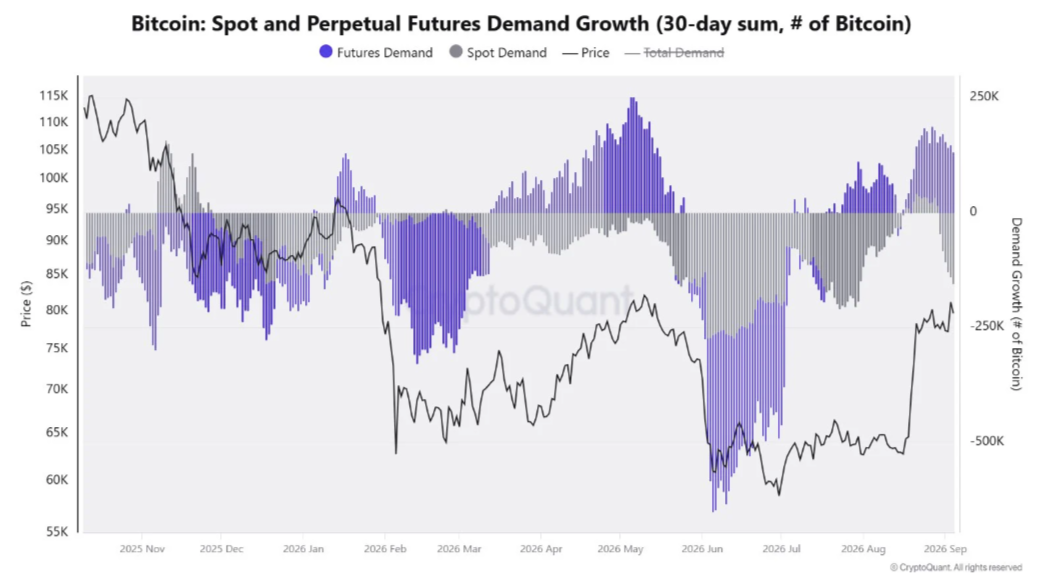
Bitcoin demand growth comparison (screenshot). Source: CryptoQuant
Last week, Cointelegraph reported on the return of negative apparent demand, which reflects that BTC’s dormant supply growth outpaced new issuance.
BTC price seals first weekly close above $80,000 in four months
Bitcoin narrowly touched $80,000 on Sunday, marking its highest weekly close since the week of May 11, per data from TradingView.
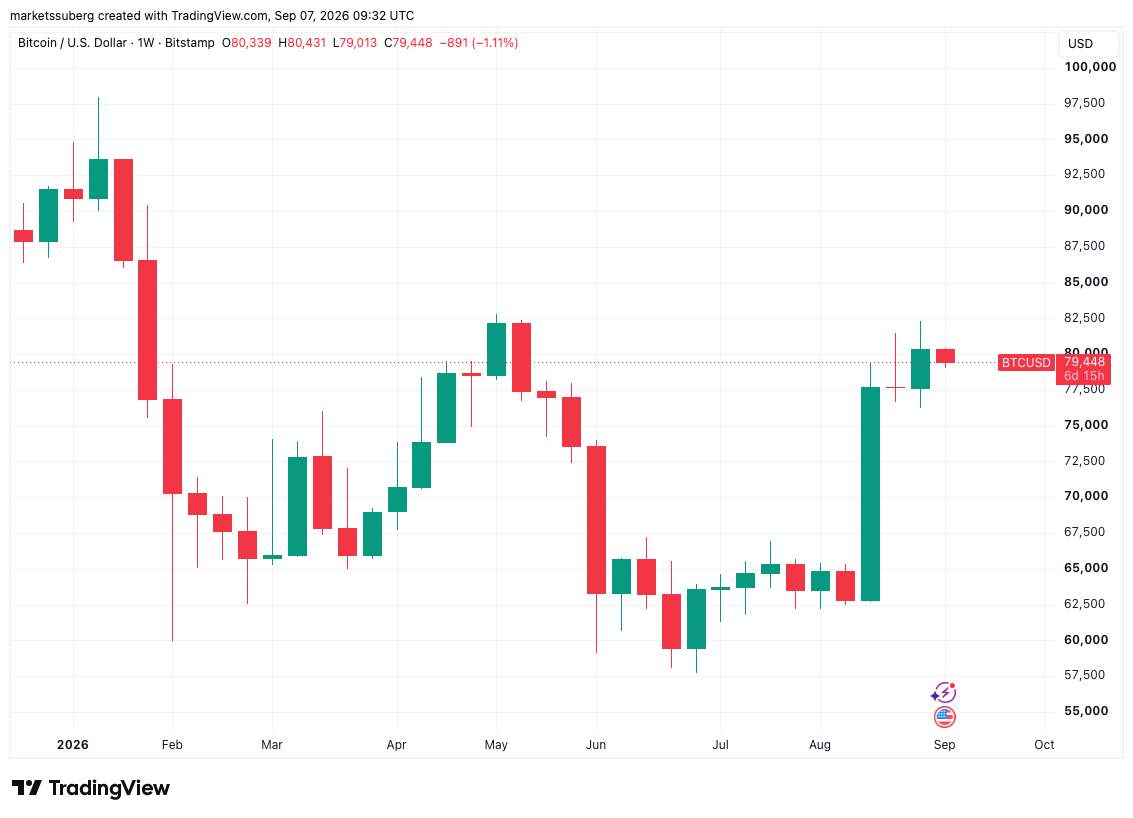
BTC/USD one-week chart. Source: Cointelegraph/TradingView
The $80,000 mark remains elusive support, however, with bulls unable to remain above it consistently as sell-side liquidity mounts immediately above this level. The latest data from CoinGlass shows liquidity concentrated around $80,560, forming a thick wall of resistance, which is keeping BTC/USD pinned in a narrow range.
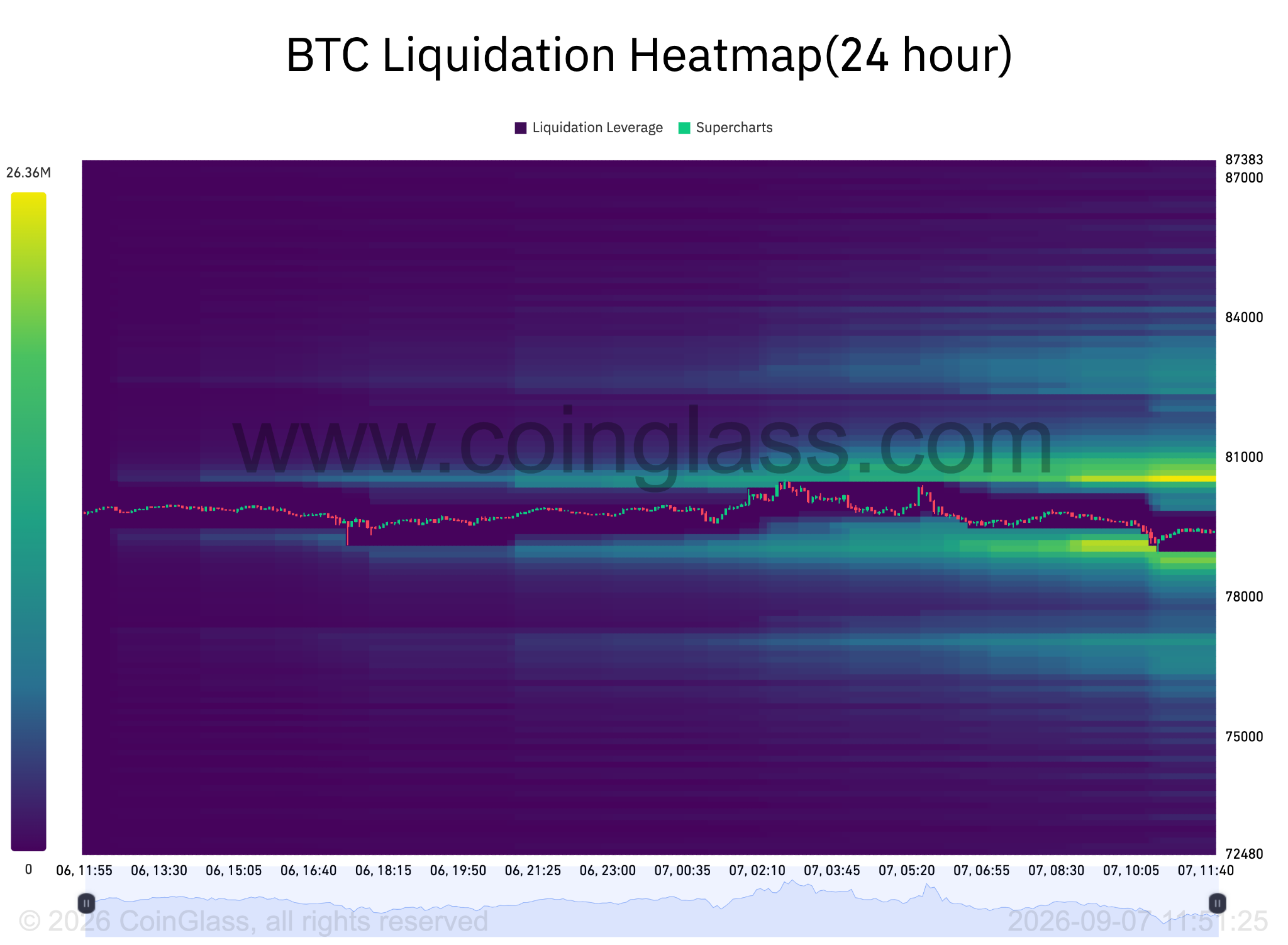
BTC liquidation heatmap. Source: CoinGlass
Last month, onchain analytics platform Glassnode flagged large liquidity bands as key to shaping Bitcoin’s longer-term price action, highlighting a further band between $83,000 and $86,000 in particular.
“While the upward impulse consumed short orders in its path, it stopped short of the dense cluster of short liquidations situated between $83K and $86K,” it wrote in the latest edition of its regular newsletter, The Week Onchain.
“Below spot, the move left behind an intact band of long liquidation fuel between $60K and $63K. Price now trades between these two boundaries.”
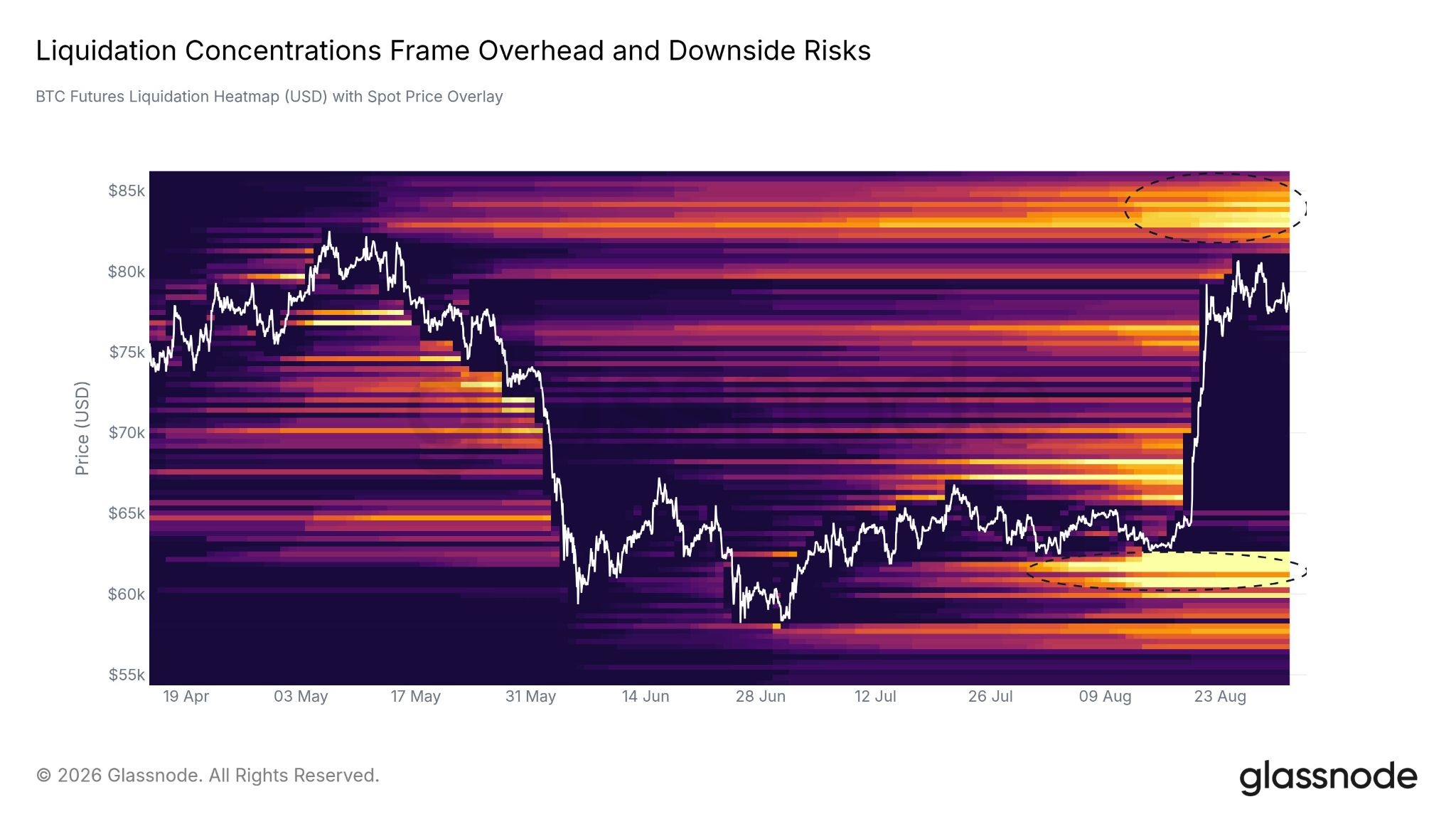
Bitcoin futures liquidation heatmap. Source: Glassnode
Market participants, meanwhile, are considering where the current consolidation could resolve to fresh upside. Jesse Olson, developer of the Markets Sniper trading suite, sees BTC/USD repeating a bullish chart fractal from August 2023, with $76,000 now in sight as a local reversal point.
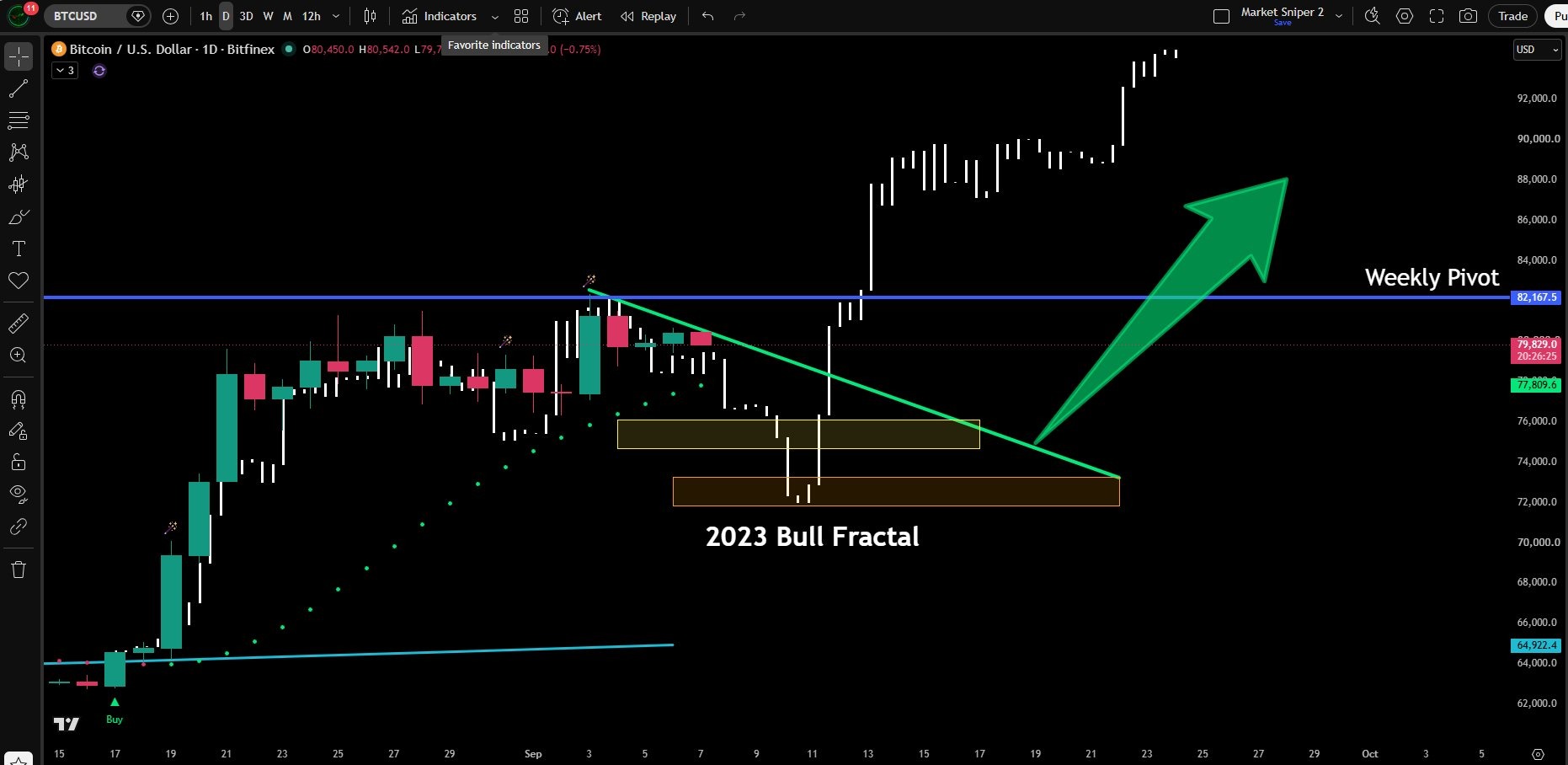
BTC/USD one-day chart. Source: Jesse Olson on X.com
Bitcoin supertrend bull signal copies early 2023 recovery
Sunday’s weekly close saw a classic BTC price trend indicator flip green for the first time since November 2025.
Related: Here’s what happened in crypto today
On weekly time frames, BTC/USD closed above its supertrend line, producing a “buy” signal. Supertrend employs average trend range (ATR) data and a multiplier to calculate a simple buy and sell signal, measured by its interaction with the supertrend line.
Weekly time frames draw particular attention from Bitcoin traders, as a close above the supertrend line has never occurred within a bear market. The last time that supertrend flipped from red to green was in mid-January 2023, with Bitcoin’s last bear-market bottom of $15,600 already two months behind it. Conversely, the indicator flipping from green to red has preceded the start of protracted downtrends.
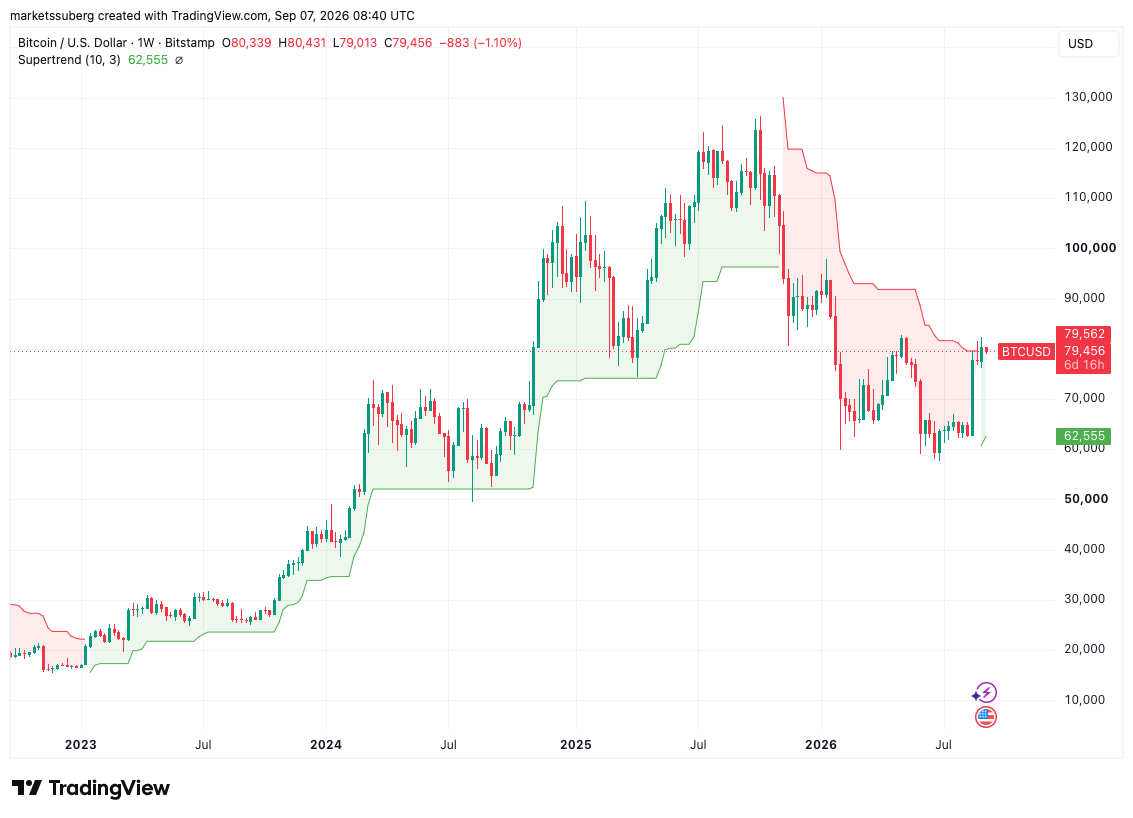
BTC/USD one-week chart with supertrend data. Source: Cointelegraph/TradingView
The signal joins a growing selection of cues that has instilled confidence in some that Bitcoin already saw its macro bottom at $57,000. In August, BTC/USD closed above its 50-week exponential moving average (EMA) for the first time since late 2025 — an event that has historically been crucial for a long-term bullish price-trend reversal.


The FCA reportedly held talks with trading platforms as Britons turn to Polymarket and Kalshi, though its public position still supports the ban.
Crypto World
DBS and Citi complete weekend USD payment via Swift’s Digital Ledger using tokenized deposits


The transaction is the second confirmed live use of Swift’s blockchain ledger, coming as the network races to prove it can compete with digital payment rails that never close.


A Transaction v1 feature activates Wednesday, allowing complex proofs and large multisig operations to fit in one transaction while forcing services that read Solana to update.


Arthur Hayes has released the FLOP Network technical paper detailing a proof-of-useful-inference blockchain for AI agents, with a genesis supply of approximately 2.48 billion FLOP tokens allocated through airdrops.
Summary
- Arthur Hayes has released the FLOP white paper detailing a blockchain where AI agents pay miners in FLOP for inference and computing resources.
- FLOP will launch with approximately 2.48 billion tokens allocated through airdrops, with no venture capital premine or token auction.
- Miners will receive 75% of block rewards, while validators and agents each receive 10% and regular stakers receive 5%.
- Block rewards will start at 96 FLOP and halve every 730 days until reaching a permanent reward of 3 FLOP.
According to the FLOP Network details shared by Hayes, the protocol is designed to let autonomous AI agents pay miners directly for inference, with validators settling proofs of the completed computational work.
FLOP, short for floating-point operations, serves as the native currency of the network. Under the proposed system, an agent can spend FLOP whenever it requires computing resources, allowing the token to function as payment for AI inference.
The latest specifications provide substantially more detail on a project that Hayes first unveiled in August. As crypto.news reported, the BitMEX co-founder said on Aug. 18 that he was returning to an operating role to lead Flop Labs, describing FLOP as “food for your AI agent.”
At the time, Hayes said the token would launch without a presale or venture capital allocation. Flop Labs was targeting a large airdrop in the fourth quarter of 2026 and a genesis block in the first quarter of 2027, although the project had yet to publish its full tokenomics and technical design.
FLOP Network turns AI inference into miner work
FLOP Network combines an account-based blockchain with a consensus model called proof of useful inference, or PoUI, where miners earn rewards by carrying out AI inference requests instead of performing computational work solely to secure the chain.
An AI agent begins the process by submitting a session request to the network’s mempool. Each request specifies information including a model-weight hash, maximum latency, computational requirements measured in FLOPs, a confidentiality setting and the fee offered for completing the task.
A miner with suitable hardware can accept the request and establish a private connection with the agent. Once the requested inference has been completed, the miner returns a proof of the work, while validators incorporate the proof hash into a block to settle the transaction.
Miners receive the session fee paid by the agent and a portion of the network’s block rewards based on the verified compute they contribute. Ordinary GPUs can participate under the proposed architecture, while confidential computing is treated as an optional tier instead of a requirement for joining the network.
The model places FLOP in an emerging market where autonomous software is already being equipped to make blockchain payments. A June crypto.news guide on agentic crypto payments detailed how AI agents can autonomously purchase data, compute and other online services using crypto payment rails such as x402.
Similar infrastructure has started moving into production. By July, the XRP Ledger had processed more than 1.4 million AI-agent transactions, while Ripple was developing tooling that allowed autonomous agents to make payments using XRP and RLUSD.
FLOP’s proposed model differs by tying its native currency directly to inference work performed by miners.
FLOP supply starts at 2.48 billion tokens
The FLOP specifications put the genesis supply at approximately 2.48346 billion tokens, with the initial tokens designated for airdrop distribution rather than a venture capital premine or token auction.
Block rewards begin at 96 FLOP and are divided among four groups. Miners receive 75%, validators take 10%, agents receive another 10%, and ordinary stakers are assigned the remaining 5%.
Issuance follows a fixed halving schedule. The 96 FLOP block reward falls to 48 after 730 days, followed by reductions to 24, 12, 6 and eventually 3 FLOP across five halvings.
Unlike Bitcoin’s issuance model, rewards do not disappear after the scheduled reductions. FLOP’s block subsidy remains permanently at 3 FLOP after the fifth halving, creating continuing emissions for network participants.
The network is designed around an average block time of one second with deterministic sub-second finality, while its development roadmap targets block production below one second.
Hayes had previously provided an earlier outline of the distribution strategy. In August, he proposed allocating roughly 20% of the FLOP supply to testnet participants over a 10-year period and said the network would be funded without a token presale.
That proposal described two revenue sources for miners: block rewards for participating in the network and inference fees paid by AI agents requesting computational work. The latest protocol documentation now specifies how the requests move from agents through miners to validators for settlement.
Validators face staking and slashing rules
Participation as either a miner or validator requires FLOP to be staked, creating collateral that can be penalized when participants submit dishonest work.
Under the proposed rules, miners can face slashing for misrepresenting completed inference, while validators risk penalties for publishing dishonest blocks. Severe violations can result in the full loss of staked tokens and removal from the network.
Token holders who do not operate infrastructure can delegate FLOP to a miner or validator and receive a proportional share of rewards.
The validator set is capped at 1,000. Approximately 50 validators are expected to rotate each month based on verified workload and uptime, while the project plans to incorporate stake into validator ranking above the required participation threshold.
Validators will have a second role in network governance. Changes are proposed through FLOP Improvement Proposals, or FIPs, with most proposals requiring approval from two-thirds of the active validator set before implementation.
The architecture places model weights in a data-availability layer while validators build blocks containing hashes of inference proofs submitted by miners.
Other blockchain projects are pursuing their own versions of an AI-agent economy. NEAR, for example, introduced a system in July that lets users stake tokens for AI services, converting locked NEAR into monthly compute credits that can be used across 43 AI models, including confidential inference and autonomous agent services.
FLOP instead proposes a four-stage execution path built around requests, miner matching, inference proofs and settlement. An agent first posts the required model, latency, compute, confidentiality and fee parameters; a miner accepts the task and runs the model; proof of the completed inference is submitted to the network; and validators include its hash in a block before the miner receives the session payment and its share of protocol rewards.
The FLOP Network project introduction is currently labeled a draft and was last updated on Aug. 27, while the newly published technical specifications remain subject to development before the planned network launch.
Your day-ahead look for Sept. 7, 2026


Key takeaways
- Bittensor trades higher on Monday, extending its five-day gain to approximately 25%.
- TAO’s social dominance has increased amid renewed interest in AI tokens and the launch of the Buttensor meme coin on Solana.
- TAO open interest reached a three-month high of $428.57 million, indicating growing derivatives activity.
Bittensor (TAO) trades in positive territory on Monday, extending its steady five-day rally to approximately 25%.
The artificial intelligence-focused token gained 16% last week before rising another 12% on Sunday. TAO has now reached a two-month high as buyers target a breakout above the psychological resistance at $300.
Social activity surrounding Bittensor is also increasing, supported by renewed interest in AI-related cryptocurrencies and the launch of a similarly named meme coin on Solana.
Bittensor meme coin drives attention toward TAO
A Bittensor parody token named Buttensor (BUTT) launched on Raydium, a Solana-based decentralized exchange, on Monday.
The meme coin’s debut followed Raydium’s official launch of TAO trading on the platform a day earlier. BUTT was subsequently paired with TAO.
The meme coin’s tokenomics direct transaction fees toward automatically purchasing TAO and distributing the acquired tokens to BUTT holders. The arrangement connects speculative activity around the meme coin with demand for Bittensor’s native token.
However, the sustainability of this buying pressure will depend on continued trading activity and retail interest in BUTT.
The release of ChatGPT-6 Astra has also coincided with renewed demand for AI-focused cryptocurrencies.
Santiment data shows that TAO’s social dominance climbed to 0.05% on Thursday following Astra’s release. The metric has since risen to 0.12%, with the launch of Buttensor contributing to the increase in online discussion.
Social dominance measures an asset’s share of cryptocurrency-related conversations. A rising reading can indicate growing investor interest, although elevated social activity can also accompany speculative price movements.
Activity in Bittensor’s derivatives market has strengthened alongside the price rally. CoinGlass data shows that TAO open interest reached a three-month high of $428.57 million on Monday.
The increase indicates that traders are adding positions rather than simply closing existing contracts during the rally.
Rising open interest alongside an advancing price generally supports a bullish outlook. However, a large buildup in leveraged positions could increase volatility and liquidation risk if TAO suddenly reverses.
TAO momentum strengthens near $300
Bittensor trades comfortably above its 50-day, 100-day, and 200-day exponential moving averages, which are clustered between approximately $220 and $236.
Its position above these major indicators confirms the strength of the current uptrend and provides several potential support levels during a correction.
The Moving Average Convergence Divergence indicator remains above its signal line in positive territory, suggesting upside momentum is intact.
However, the Relative Strength Index has reached 70 on the daily chart. This reading places TAO at the threshold of overbought conditions and warns that the rally could temporarily cool as traders take profits.

The psychological $300 level represents TAO’s immediate resistance. A confirmed daily close above $300 would reinforce the bullish outlook and could open the path toward $369, a high recorded on Sept. 13, 2025.
Conversely, rejection from $300 could trigger a pullback toward the 200-day EMA near $236. If that support fails, the 100-day EMA at $222 and the 50-day EMA around $220 form a deeper demand zone.
TAO’s outlook remains bullish while it trades above the moving-average cluster, but overbought conditions leave the token vulnerable to a short-term correction before another breakout attempt.


The Bangko Sentral ng Pilipinas proposed a 12-month suspension of new payment-system operator registrations while introducing tighter controls for payment arrangements involving virtual asset service providers.
Summary
- BSP proposed pausing new payment-system operator registrations for twelve months while reviewing its licensing framework.
- Applications submitted before suspension could proceed through review but receive no decision meanwhile from regulators.
- Payment arrangements involving regulated virtual asset firms would require direct merchant relationships and enhanced monitoring.
- Covered institutions could impose transaction, settlement and exposure limits according to their assessed risks internally.
- Final rules would become effective fifteen days after publication if the proposed circular receives approval.
Under its proposed circular, the BSP would temporarily stop accepting and processing applications to register as an operator of a payment system, or OPS.
The central bank said the pause would support a “holistic review” of its OPS taxonomy, registration process and licensing framework. The proposal remains an exposure draft and does not impose an immediate suspension.
Applications submitted before the pause begins could continue through the BSP’s evaluation process. However, the regulator would neither approve nor deny those applications until the 12-month period ends.
Applicants would also be prohibited from starting activities that require OPS registration during the freeze unless the BSP provides separate authorization. Existing registered operators are not ordered to stop operating under the draft.
The BSP already maintains an OPS registration system under the National Payment Systems Act. Its official guidance says registration creates a baseline inventory that the regulator uses to assess payment-system activities, participants and systemic risks.
Crypto payment arrangements face direct-merchant rules
The proposed Philippines payment rules would require BSP-supervised institutions providing merchant acquisition services to deal directly with regulated VASPs rather than place them behind layered payment facilitators.
A direct merchant arrangement means the acquiring institution holds the contractual relationship with the merchant. This structure gives the institution direct access to information needed for onboarding, transaction monitoring and settlement controls.
The requirement would cover virtual asset businesses that must hold a license, registration or authorization from the BSP, the Philippine Securities and Exchange Commission or another relevant authority.
VASPs appear in the draft alongside casinos, gaming operators, adult-oriented businesses and money-service businesses. The grouping reflects the regulator’s assessment that these sectors need stronger controls. It does not mean the BSP considers their underlying activities identical.
Institutions dealing with covered firms would need enhanced due diligence, closer transaction monitoring and risk-based limits. Those limits could apply to transaction values, settlement schedules and total exposure.
The proposal builds on earlier BSP measures. As previously reported, the central bank tightened token listing and monitoring requirements for licensed VASPs in June. Those rules require continuing reviews and defined suspension or delisting triggers.
Existing layered arrangements would face review
BSP-supervised institutions would need to identify existing payment arrangements involving covered merchants. Layered structures would face an assessment to determine whether they comply with the proposed direct-merchant requirement.
Institutions would reportedly receive six months to complete that review and another six months to address identified weaknesses. Required changes could include restructuring contracts, imposing limits or ending arrangements that exceed the institution’s risk tolerance.
The draft would also strengthen merchant identification. The BSP plans a centralized National QR Code Merchant Database intended to help institutions identify fraudulent, prohibited or problematic merchants across payment networks.
These requirements could affect banks, electronic-money issuers, merchant acquirers and payment facilitators connecting virtual asset platforms to local payment channels. The operational burden will depend on how the BSP defines covered arrangements in the final circular.
The licensing distinction has already affected international crypto companies. Crypto.news previously reported that Binance and BlockShoals lacked BSP-issued VASP licenses, despite participating in the SEC’s StratBox sandbox program.
The SEC later approved BlockShoals to begin sandbox testing, but that sandbox approval preserved separate BSP licensing requirements. The proposed payment rules would add another compliance layer for institutions serving similar arrangements.
BSP will review feedback before finalizing the rules
The BSP is accepting written comments through its policy exposure draft portal. The regulator says stakeholders should submit feedback to the policy officers identified alongside each draft.
The central bank may revise the suspension, implementation periods or covered arrangements after reviewing industry responses. No registration freeze begins solely because the draft has been published for consultation.
If adopted in its current form, the circular would take effect 15 days after publication in the Official Gazette or a newspaper of general circulation. The 12-month pause would begin according to the effective provisions of the final document.
Payment companies should therefore monitor the final text, particularly its treatment of pending applications and existing relationships with VASPs. Regulated crypto firms may also need to establish direct arrangements with acquiring institutions before continuing access to some Philippine payment channels.
Japan’s changing crypto framework has strengthened Shiba Inu’s position in the country, but as of September 7 no regulator, exchange or asset manager has filed for or approved a Japanese SHIB exchange-traded fund.
Summary
- Japan’s parliament passed crypto-market legislation July 15, but regulators approved no Shiba Inu exchange-traded fund.
- The amended framework moves crypto oversight toward FIEA rules covering disclosures, trading conduct and intermediaries.
- Japan promulgated the legislation July 23, with detailed implementation rules still requiring regulatory development afterward.
- JVCEA’s Green List includes SHIB, which nine member exchanges handled as of September 1, 2026.
- Mercari added SHIB trading through Coincheck on June 8, expanding access inside its mobile application.
Japan’s parliament passed legislation on July 15 that brings crypto assets closer to the regulatory system used for financial products. The official legislative record shows that the upper house approved the bill that day. The government promulgated it as Law No. 64 on July 23.
The legislation strengthens disclosure, trading and intermediary rules under the Financial Instruments and Exchange Act. It provides a possible legal foundation for regulated crypto funds. However, it does not approve an ETF for Bitcoin, Shiba Inu or any other individual asset.
The distinction matters because an ETF also requires detailed regulations, an eligible structure, an asset manager, an exchange listing process and regulatory clearance. None of those steps has been announced for SHIB.
Shiba Inu’s Green List status covers exchange reviews
Shiba Inu does appear on the Japan Virtual and Crypto Assets Exchange Association’s official Green List. The list identifies crypto assets that are widely handled by the association’s Japanese members and satisfy four stated conditions.
Those conditions include handling by at least three member companies and a trading history of at least six months. The asset must also have no special conditions imposed by the association or another reason making its inclusion unsuitable.
The September 1 list shows nine member companies handling SHIB. That compares with 29 for Bitcoin, 28 for Ether and 19 for XRP. Green List inclusion can simplify parts of an exchange’s review process, but it does not create automatic ETF eligibility.
A community commentator described the designation as giving SHIB a “head start.” That remains an interpretation rather than a conclusion published by the Financial Services Agency or JVCEA.
Mercari expanded retail access to SHIB in June
Mercari subsidiary Mercoin officially added access to SHIB and 11 other assets on June 8. The service allows eligible customers to trade the assets with Coincheck through the Mercari application, according to the company’s announcement.
Mercoin said its crypto service had passed four million cumulative account openings by March 2026. About 90% of surveyed users had no previous crypto-trading experience, although that figure covers Mercoin’s broader customer base rather than SHIB buyers specifically.
The integration therefore expands SHIB’s retail availability in Japan. It does not mean Mercari has issued an investment fund, applied for an ETF or endorsed a future SHIB product.
Japan still needs ETF and tax implementation rules
Japan’s legislation advances a regulatory process that began with Financial Services Agency discussions about moving crypto toward securities-style oversight. As crypto.news previously reported, earlier policy discussions focused primarily on Bitcoin and Ether as potential initial ETF assets.
A Japanese SHIB ETF would require an identifiable sponsor to submit a product, regulators to establish listing and custody requirements, and an exchange to accept the fund. No such application appears in the official materials reviewed for this report.
Tax reform also remains incomplete. In related coverage, crypto.news reported that the proposed 20% separate tax rate is targeted for 2028. It is not currently available merely because an asset appears on the Green List.
The next confirmed step is regulatory implementation of the amended legislation. Claims that Japanese crypto ETFs could arrive in 2027 remain forecasts. SHIB has gained broader regulated exchange access, but its ETF prospects remain unconfirmed.
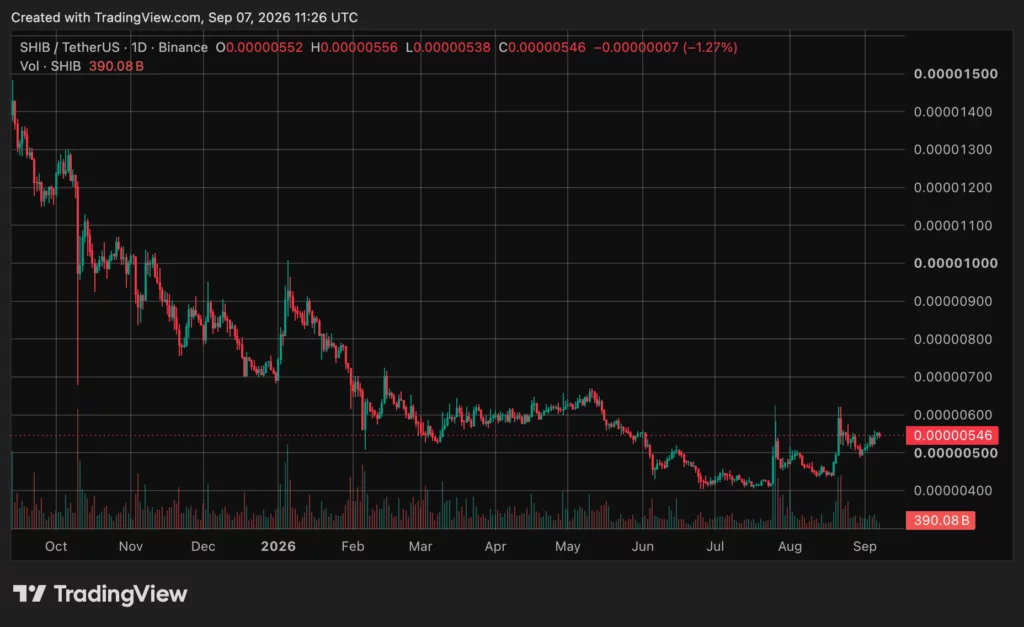
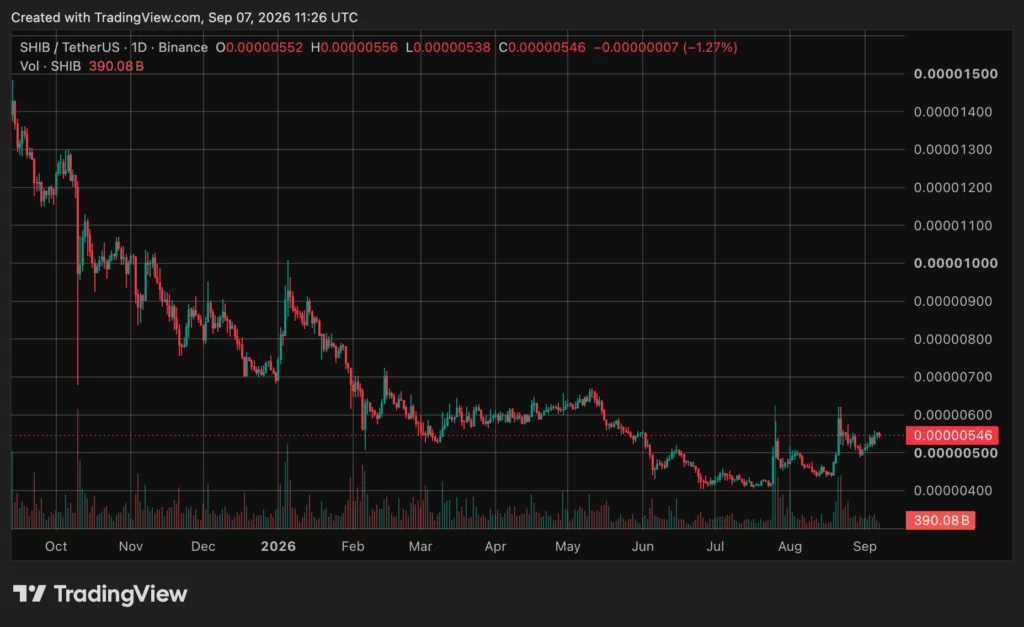
Meanwhile, SHIB traded at $0.0000055 at press time, indicating a 8% increase in in the past 7 days and 17% in the past month.
Crypto World
XRP is Facing a Great $1.43 Wall It Needs to Break: Mid-September Will Be Huge for Ripple

XRP is still stuck below the ceiling that’s capped every rally attempt for over a week. The $1.43 level is the exact zone where sellers have shown up three separate times since late August. What happens over the next nine days could determine whether that wall finally cracks.
Ripple unlocked 1 billion XRP on September 1 across three transactions: 500 million, 400 million, and 100 million tokens. It was a routine escrow release that nonetheless added fresh supply into a market already testing resistance.
Meanwhile, the XRPL 3.3.0 upgrade window could activate as early as September 11, and the Senate has scheduled its CLARITY Act vote for September 15, the single biggest regulatory catalyst on XRP’s calendar this month.
— Skipper | XRPL (@skipper_xrp) September 6, 2026
 $XRP has broken out of its triangle pattern, and the market could be getting ready for a bigger rally.
What if traders are already pricing in the CLARITY Act before it’s even approved? pic.twitter.com/L9YfJ2prQ1
Volatility has been the theme, not direction. Data point showed XRP up 40% over a prior week, and that whiplash sets the stage for what could be a decisive two-week stretch for Ripple’s token.
Discover: The Best Token Presales
Can XRP Price Hit $1.50 This Week?
At $1.41, XRP sits inside a tight consolidation band, holding above the $1.40 support line but unable to convert momentum into a clean breakout. Volume data around this resistance zone suggests buyers are present but not yet aggressive enough to force a decisive move.

Immediate support sits at $1.40–$1.41, with a deeper floor near $1.33–$1.35 should momentum fail. The bull case is when a break above $1.43 opens the door to $1.47–$1.50, with stretch targets near $1.55, $1.60, and eventually $1.68 if the CLARITY Act vote lands favorably.
The September 15 Senate vote is the wildcard here; a positive outcome could be the catalyst that finally clears the wall. The base case is continued chop between $1.35 and $1.43 while the market waits for clarity. However, a failure to hold $1.40 sends the price back toward $1.30–$1.32, invalidating the current setup.
Earn $50 and Enter $300K Prize Draw on EdgeX
LiquidChain Targets Early Mover Upside as Ripple Tests Key Levels
XRP’s setup rewards patience more than conviction right now. Holders are essentially betting on a Senate vote and an escrow supply digest playing out favorably within a two-week window. Even a clean breakout to $1.68 represents roughly 20% upside from current levels for a token with an already massive circulating supply.
That math is fine for a core holding. It’s less exciting for traders chasing asymmetric returns, which is where earlier-stage infrastructure plays start looking more interesting.
A little of this chain. A little of that chain. — LiquidChain (@getliquidchain) September 7, 2026
Then things get interesting.  pic.twitter.com/ybu9a1L0o0
LiquidChain ($LIQUID) is building a Layer 3 execution environment that fuses Bitcoin, Ethereum, and Solana liquidity into a single unified layer. With Liquid, developers deploy once and access all three ecosystems rather than fragmenting liquidity across chains.
The presale is currently priced at $0.014953 with $960K raised so far. Core features include Single-Step Execution, Verifiable Settlement, and a Deploy-Once Architecture designed to eliminate cross-chain friction.
Research LiquidChain before the next pricing tier kicks in.
Discover: The Best Crypto to Diversify Your Portfolio
The post XRP is Facing a Great $1.43 Wall It Needs to Break: Mid-September Will Be Huge for Ripple appeared first on Cryptonews.

Bitcoin Seals its First Weekly Close Above $80,000 Since Early May

NFL Week 1 odds, predictions: Picks, best bets from 10,000 computer sims

The First Spacecraft Launched To Orbit From Europe

Weekend Open Thread – Corporette.com

Weekend Open Thread: Brooks Brothers

London Mayor Sadiq Khan handed a peerage by Keir Starmer alongside 15 other Labour figures… just days before the PM leaves No10

Crypto Live Trading| 31 AUG #vinbullindia #livetrading #vinbulllive #live #trading #cryptotrading

Ripple Explained: What You Need to Know About XRP, RLUSD, and Ripple’s $25M Power Play

A financial bad habbit that drains out pocket #money #finance #dollar #usa
-

 Fashion3 days ago
Weekend Open Thread: Beyond Yoga
-
 Crypto World3 days ago
Bitcoin price stalls near $82K as key resistance holds
-

 Politics3 days ago
Best Gaming Laptops, CPUs, TVs, And Keyboards To Upgrade Your Set Up For GTA VI
-

 Tech3 days ago
The Birds Outside, Drawn For You Automatically
-

 Crypto World3 days ago
IMF Says El Salvador’s Post-Review Bitcoin Purchases Used No Public Funds
-
 Crypto World3 days ago
U.S. added stronger than expected 162,000 jobs in August as labor market bounced back
-

 Sports3 days ago
Alexandre Pato consortium’s Northampton Town investment approved
-

 Sports3 days ago
Commanders’ Chig Okonkwo is a top breakout fantasy football candidate
-

 Sports3 days ago
Golden Eaglets Drawn in Group B for 2026 WAFU B U17 Championship
-
 Crypto World3 days ago
XRP price breaks falling channel as bulls target $1.53
-

 Politics3 days ago
A new European chapter for Gibraltar
-

 Politics3 days ago
How To Avoid Winter Colds: 4 Everyday Habits That Spread Germs, Says Pharmacist
-

 Politics3 days ago
The House | Bin the lectures, bring gossip and be ready to banter: how the new PM should prepare for his Trump encounter
-

 Crypto World3 days ago
From warning to listing: UK’s largest retail investment platform opens access to crypto ETNs
-

 Crypto World3 days ago
FinCEN flags $12.7B tied to Southeast Asia crypto investment scams
-

 Tech3 days ago
A Worthy Android Ereader, With Some Tradeoffs
-

 Tech3 days ago
How To Edit Claude’s Memory
-

 Crypto World3 days ago
Trezor Data Breach Impacts 67,000 More US Customers
-

 Politics3 days ago
33 Cosy Autumn Home Decor Ideas: Blankets, Pumpkin Decorations, And Candles
-

 Tech3 days ago
beyerdynamic AVENTHO Y Debuts at IFA 2026 and Makes Wireless Headphones Less Disposable
You must be logged in to post a comment Login