

Crypto World
Iran Snubs US Envoys in Doha, Dimming Ceasefire Hopes as Oil Rises

Iran refused to meet US envoys Jared Kushner and Steve Witkoff in Doha on Tuesday June 30. Oil prices rose as ceasefire hopes dimmed in the ongoing war.
Qatar’s prime minister met the Americans in Doha instead of Iranian officials. Iran’s Foreign Ministry said Hormuz mine clearance falls under June’s memorandum of understanding (MoU) and needs no outside help, according to Al Jazeera.
Why Tehran Is Staying Away From Doha
Alex Vatanka, a senior fellow at the Middle East Institute, said Iran’s foreign minister, Abbas Araghchi, and speaker Mohammad Bagher Ghalibaf fear a Doha visit could backfire at home. Both officials want visible progress on the MoU signed June 17 first.
“In Tehran they’re asking where’s the action on the MoU? Why are Iranian assets still frozen? Why is Israel still in Lebanon?”
— Alex Vatanka, Al Jazeera
Ghalibaf said Tehran will not negotiate a final deal until Washington meets every MoU condition. Those conditions include unfreezing Iranian funds and ending hostilities in Lebanon. Iran signed the memorandum on June 17, but says Washington has not met these terms yet.
Oil Climbs as Hormuz Risk Lingers
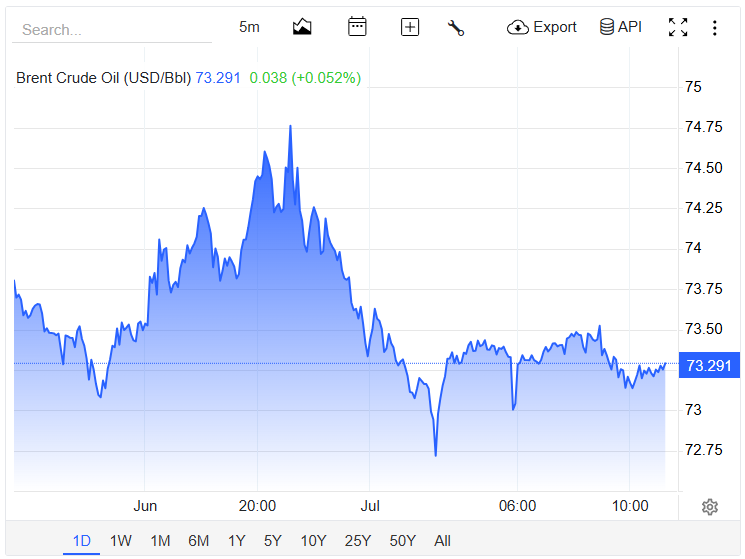
Brent crude peaked at $74.75 a barrel on Tuesday before settling to $73.29 early on Wednesday as traders keep close tabs on Iran’s dealings with the US envoys. Brent had briefly dipped after supertankers resumed Hormuz transit last week.

Vice President JD Vance said tanker traffic through the strait has reached pre-war levels. He also said Iran will not collect tolls from ships passing through Hormuz.
“This is not going to end in a place where the Iranians are collecting tolls on ships going through the Strait of Hormuz.”
— JD Vance, Reuters
US crude inventories fell 6.1 million barrels last week. The International Energy Agency warned in May that global markets would stay undersupplied through the third quarter of 2026.
Brent lost about $45 a barrel between the first and second quarters, its steepest quarterly drop since 2008. WTI fell around $31 in the same period, its biggest drop since 2020. Both benchmarks reversed course as the war de-escalated, pulling back from gains triggered by earlier Iran strikes.
The post Iran Snubs US Envoys in Doha, Dimming Ceasefire Hopes as Oil Rises appeared first on BeInCrypto.

Crypto World
Utorg Obtains MiCA License as July 1 Deadline Forces Much of the Industry Out of Europe
[PRESS RELEASE – Dubai, UAE, July 1st, 2026]
Utorg, a crypto wallet and card platform built on institutional-grade infrastructure, today announced it has received full authorization under the EU’s Markets in Crypto-Assets (MiCA) regulation, effective July 1, 2026 – the date on which the industry’s transitional period ends and unauthorized providers can no longer legally serve European users.
The company, which also provides regulated crypto rails, wallets and stablecoin infrastructure to businesses across 130+ countries, is among a small number of platforms to have completed the full authorization process and is now cleared to operate across all 29 EEA member states, a combined market of over 450 million people.
What MiCA means for users
MiCA is the EU’s first unified regulatory framework for crypto-assets, establishing binding standards on consumer protection, transparency, and financial integrity across all member states.
For users, MiCA authorization means concrete protective measures that previously did not exist in crypto: funds must be held separately from company assets, fees must be disclosed upfront, and users have a legal right to file complaints with a national regulator. If a MiCA-authorized platform fails, user assets are protected under EU law (not subject to the discretion of an offshore jurisdiction).
For Utorg, the authorization is the result of a full regulatory review of its products, operations, and compliance infrastructure. It also means ongoing oversight: Utorg is now subject to regular reporting obligations and supervisory review under EU financial law.
Industry background
July 1, 2026 marks the end of MiCA’s transitional period – the point at which crypto-asset service providers without full authorization can no longer legally serve users in the EEA.
In the months leading up to the deadline, a significant portion of the market has withdrawn from or restricted European operations. Utorg is among the few platforms to have completed the full authorization process and is operational from day one of the new regulatory regime.
Eugene Petrakov, Co-founder of Utorg, said: “Most of the industry spent the last two years hoping MiCA would get delayed or softened. We spent it building toward it. For European users, July 1 means fewer options, stricter standards, and a much shorter list of platforms they can actually trust. We intend to be at the top of that list, not just because we’re authorized, but because we built a product that is safe by design. The license confirms what was already true.”
Utorg’s products available to EEA residents
From July 1, EEA users can continue to access Utorg’s full product suite through the Utorg App, including:
- A crypto wallet supporting buy, send, receive, store, and swap across 170+ cryptocurrencies and 14 blockchains, including BTC, ETH, and SOL. Thanks to its non-custodial nature, Utorg has no access to users’ funds at any point.
- A crypto card accepted at 80 million+ merchants worldwide, with Google Pay and Apple Pay support and allowing users to spend their crypto as they wish. It’s worth mentioning that there are no fees for issuance, maintenance, or top-ups.
This crypto card operates under strict AML (Anti-Money Laundering) and KYC (Know Your Customer) compliance requirements, as mandated by MiCA, ensuring users benefit from the full protections afforded by EU law.
For card payments specifically, Utorg holds a PCI DSS Level 2 certificate under the Payment Card Industry Data Security Standard. This is the same security framework used across the traditional payments industry, and it governs how card numbers, transaction records, and personal details are stored, processed, and transmitted. Compliance is verified through regular audits by an independent assessor.
About Utorg
Founded in 2019, Utorg is a crypto infrastructure and consumer application fintech company operating across 130+ countries. It provides regulated on/off-ramp rails, wallet infrastructure, and stablecoin solutions to fintechs, exchanges, digital asset platforms and other businesses globally. Its consumer app, trusted by more than 2 million users, offers a self-custodial multi-chain wallet and a free Visa crypto card, available on iOS (in July) and Android. Utorg is MiCA-authorized and holds PCI DSS Level 2 certification.
The post Utorg Obtains MiCA License as July 1 Deadline Forces Much of the Industry Out of Europe appeared first on CryptoPotato.
Jim Cramer has named the 5 stocks he believes are best positioned to benefit from the artificial intelligence (AI) spending cycle, pointing to several chip suppliers as the market’s current winners.
Cramer argued that Wall Street is rewarding companies that supply the AI boom while punishing the Big Tech giants that fund it.
The Stocks Cramer Says Will Win
Cramer described Micron Technology (MU), Sandisk (SNDK), Intel (INTC), Marvell Technology (MRVL), and Advanced Micro Devices (AMD) as the quarter’s biggest gainers.
According to him, “supply-demand imbalance” has boosted earnings growth, leading analysts to issue a wave of upgrades and lift price targets for companies across the group.
The numbers behind the memory names are extreme. Micron reported fiscal third-quarter revenue of $41.5 billion. Furthermore, it briefly topped Meta in market cap at $1.4 trillion. Bank of America has also lifted its Micron target to $1,500 from $950.
Meanwhile, other firms have also experienced notable growth. The company posted $5.95 billion in fiscal third-quarter revenue, up 97% from the prior quarter.
The stock has rallied roughly 4,800% over 12 months on AI-driven NAND demand. Citi set a $2,500 price target with a Buy rating.
Intel follows with steadier numbers, reporting first-quarter revenue of $13.6 billion, up 7% year over year. Cramer named it his new favorite.
Follow us on X to get the latest news as it happens
Why Suppliers Are Beating Big Tech
Cramer explained that demand for compute has outrun supply, driving up the cost of memory chips and networking gear. That dynamic has rewarded the sellers rather than the hyperscalers writing the checks.
“Wall Street’s now rewarding tech companies with products in high demand and punishing their customers,” he said.
The pressure shows in the tape. The Magnificent 7 shed roughly $2.3 trillion in market value during June. The drop came as investors questioned whether record AI spending would generate enough profit to justify it.
Even Nvidia (NVDA), a core supplier of AI compute, has lagged the rally. Cramer attributed the drag to concerns that custom chip competition would eat into its dominance.
Subscribe to our YouTube channel to watch leaders and journalists provide expert insights
The post Jim Cramer Names 5 Top AI Spending Cycle Stocks appeared first on BeInCrypto.
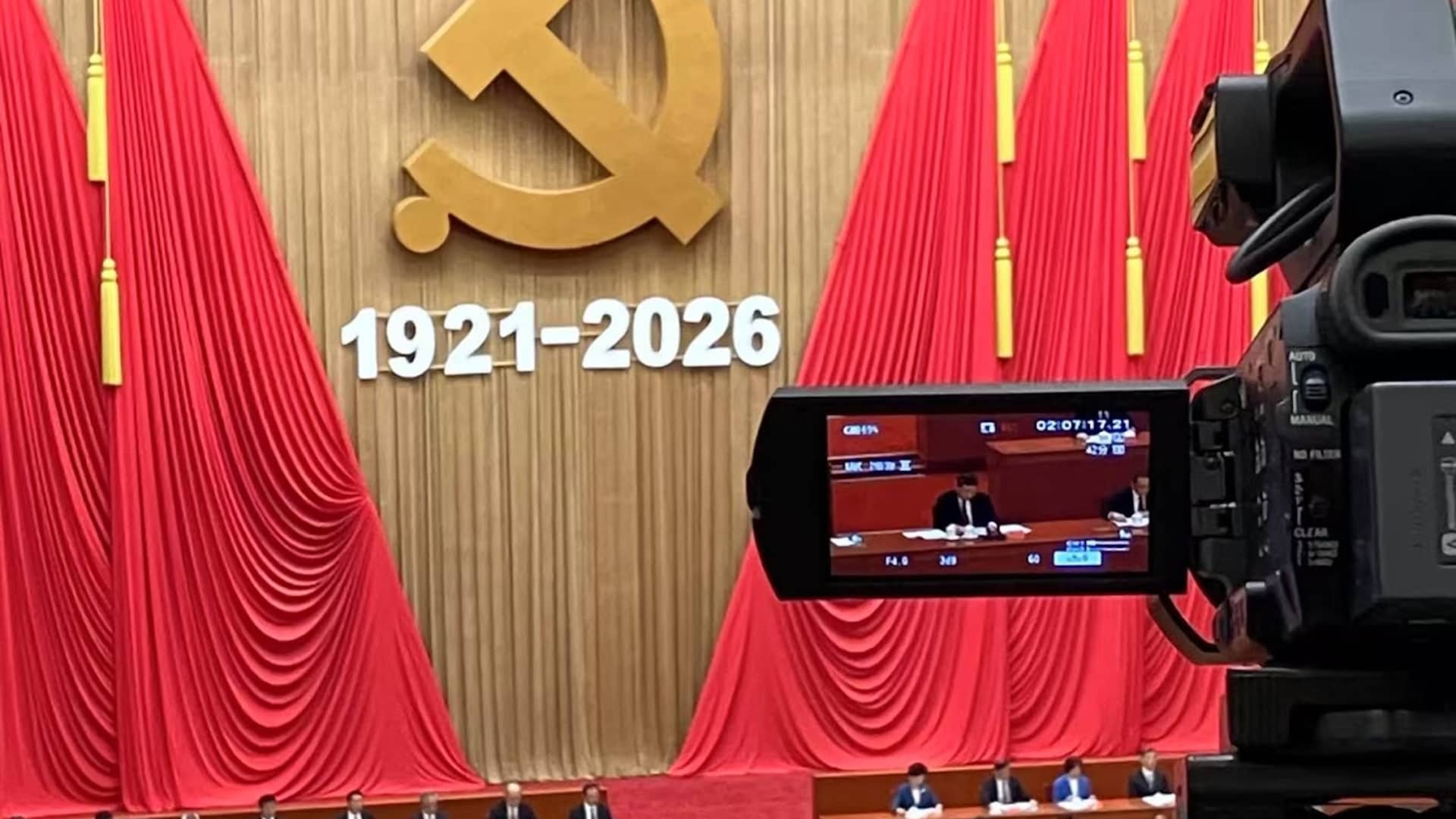
Chinese President Xi Jinping spoke on July 1, 2026, in the Great Hall of the People in Beijing to commemorate the 105th anniversary of the ruling Chinese Communist Party.
Eunice Yoon | CNBC
BEIJING — Chinese President Xi Jinping on Wednesday emphasized the global influence of the ruling Communist Party of China as he marked its 105th anniversary, striking a more outward-looking tone than in previous speeches.
The remarks, which lasted about 40 minutes, contrasted with Xi’s prior speeches on similar occasions that had a domestic focus on China’s “national rejuvenation.”
The Chinese Communist Party has “deeply changed the trend and trajectory of the world’s development through relentless struggle,” Xi said, according to a CNBC translation from Mandarin.
Xi, who is also the party’s general secretary, described the CCP as “the world’s largest ruling party with significant global influence.” He said the CCP enabled China to overthrow imperialism, feudalism and bureaucratic capitalism, paving the way for industrialization.
The CCP was founded on July 1, 1921, and established the People’s Republic of China on Oct. 1, 1949. The economy began to open gradually to foreign investment and trade only in the last few decades and became the world’s second-largest economy in 2010.
China now accounts for about 28% of goods manufactured globally despite U.S. and EU tariffs.
Building on his frequently used phrase “changes not seen in a century,” Xi said Wednesday that those shifts were accelerating, and that “the world has entered a new era of turbulence and transformation.”
Against that backdrop, Xi said China would “promote the building of a new type of international relations,” but did not identify specific countries.
Xi is scheduled to visit the U.S. in September following President Donald Trump’s visit to Beijing in May.
“A strong country must have a strong military, and only a strong military can ensure national security,” Xi said on Wednesday.
China will raise defense spending by 7% this year, the slowest increase in its annual military expenditure since 2021, according to a budget plan released in March by the Ministry of Finance. The country ranks second to the U.S. in military spending.
Xi, now serving an unprecedented third term as president, also used the speech to bolster confidence in long-term national goals.
The Chinese leader reiterated opposition to “Taiwan independence” efforts and “external interference” in the issue, adding that “resolving the Taiwan issue and realizing complete reunification with the motherland is the party’s unwavering historical responsibility.”
On Hong Kong and Macau, Xi called for “promoting the long-term prosperity and stability,” while noting the need to support the integration of the two regions into serving China’s overall development.
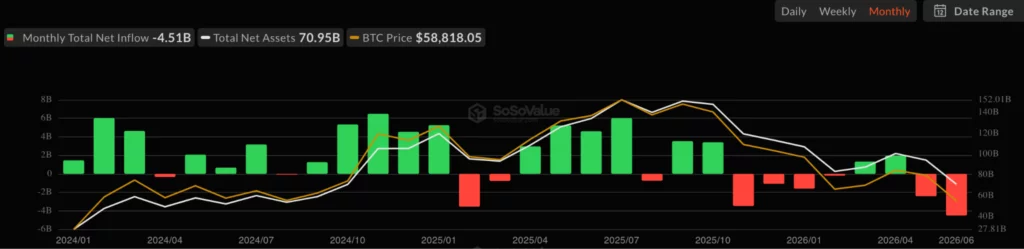
Bitcoin traded near $58,700 as ETF selling, weak U.S. demand and a break below long-term support kept pressure on BTC.
Summary
- Bitcoin trades below $59,000 after U.S. spot ETF outflows reached $4.5 billion in June.
- BTC’s weekly close below the 200-week average raised focus on $58,000 and $50,000 support.
- CryptoQuant data shows weak U.S. demand, but long-term holders and whales continued accumulating Bitcoin.
Bitcoin traded near $58,690 at press time, down about 1.2% over the latest session, according to crypto.news market data. BTC moved between an intraday low of $57,891 and a high of $59,447, keeping the market close to the $58,000 support zone that traders have watched through June.
Meanwhile, the latest price action followed a weak monthly close for Bitcoin. BTC ended June in the red after falling from around $74,000 to near $58,000. June was not only a price decline, but also a shift in market structure as ETF demand, Coinbase Premium and apparent demand weakened at the same time.
The decline has brought BTC back to levels last seen during earlier stress periods. A loss of the $58,000 zone would keep sellers in control and could bring the next major area near $50,000 into view. A recovery attempt would need to reclaim higher moving averages before traders can treat the move as more than a short bounce.
Bitcoin ETF outflows deepen June pressure
U.S. spot Bitcoin ETFs recorded about $4.5 billion in net outflows in June, marking their worst month since launch in January 2024, according to SoSoValue data. The funds also posted $222.6 million in net outflows on June 30, extending a nine-day losing streak.
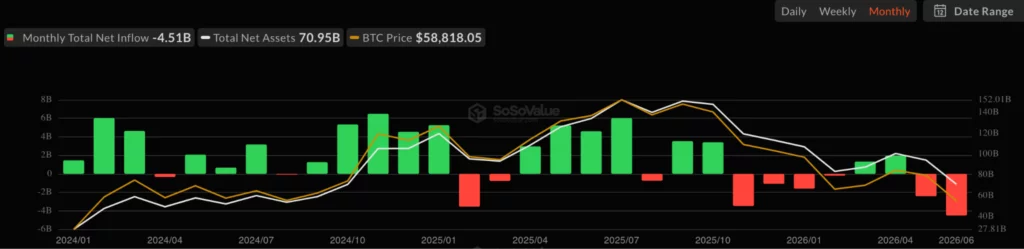
BlackRock’s IBIT accounted for the largest share of June withdrawals, with about $3.55 billion leaving the fund during the month. The combined June outflow passed the previous monthly record of $3.48 billion set in February 2025 by about 29%.
U.S. spot Bitcoin ETFs had already seen a record 13-day outflow streak from May 15 to June 3, with about $4.37 billion leaving the products. That earlier selloff showed how ETF flows had become one of the main drivers of Bitcoin price action in 2026.
Traders had already been watching ETF flows, geopolitical risk and the $62,000 level in late June. The move below that area now shifts attention to whether BTC can defend $58,000 or if the market starts testing lower support.
200-week moving average breaks
Bitcoin also closed below its 200-week moving average for the first time since 2023, according to a Barchart post on X. The 200-week moving average is widely watched because past breakdowns below it have often appeared near deep cycle lows or long accumulation phases.
Earlier in June, $60,000 had become an important psychological and technical level for BTC. A convincing break below that zone could push traders to watch $50,000, which is close to Bitcoin’s August 2024 low near $49,445.
Bitcoin would need to regain the 30-day and 200-day moving averages to turn sentiment more positive. Those levels were far above spot price during the June selloff, showing how much work bulls face before the chart structure improves.
Some traders still view the break as a possible long-term entry point. But the short-term structure remains weak while Bitcoin trades below major averages and below its former support zone. The market now needs stronger spot demand to stop the decline from extending.
Analysts split on Bitcoin correction depth
“If this ends up holding then those who called it a mid-cycle correction will be vindicated,” analyst Matthew Hyland said in a post on X. He argued that Bitcoin’s current decline looks closer to the 2019 and 2021 mid-cycle corrections than deeper bear markets such as 2014, 2018 and 2022.
“BTC has barely seen any massive liquidation events this cycle, relative to its last cycle,” Daan Crypto Trades said on X.
He said lower open interest and lower speculation helped make this cycle’s moves slower and more controlled than the 2021 run.
“Bitcoin has officially dropped to new lows for the year of 2026,” Rekt Capital said on X. He noted that BTC had deviated about 16% below its 2021 all-time high, moving closer to the 22% deviation below the 2017 high seen during the 2022 bear market.
CryptoQuant’s XWIN Japan said June showed two sides of the market. The Coinbase Premium Index stayed negative, showing weak U.S. institutional spot demand, while apparent demand stayed deeply negative. At the same time, long-term holders kept holding, and whale accumulation remained resilient despite short-term panic selling.
Moreover, as reported by crypto.news, SpaceX disclosed 18,712 BTC in its filing, but the IPO’s $75 billion raise also competed for risk capital. That means the listing may have helped Bitcoin’s long-term corporate-treasury story while draining some near-term market liquidity.
That mix leaves Bitcoin at a key decision point. ETF flows, Coinbase Premium, apparent demand and liquidity now matter more than price alone. A rebound in these indicators could support a base near current levels. Without that shift, BTC may remain exposed to further downside below $58,000.
Disclosure: This article does not represent investment advice. The content and materials featured on this page are for educational purposes only.


Phantom has hired three Ventuals creators after the Hyperliquid-based project shut down its OpenAI and Anthropic perpetual futures markets.
Summary
- Phantom has hired Ventuals creators Alvin Hsia, Emily Hsia and Aris Samad for its trading and data teams.
- Ventuals recently shut down its OpenAI and Anthropic perpetual futures markets on Hyperliquid.
- Phantom said the hires will support its deeper push into perpetual futures and Hyperliquid-based trading products.
Phantom CEO Brandon Millman said Alvin Hsia, Emily Hsia and Aris Samad, who created Ventuals, have joined the company’s trading and data teams.
The move brings one of Hyperliquid’s closely watched private-company market experiments into Phantom’s growing trading business.
Ventuals had earlier announced that it was winding down and joining another project within the Hyperliquid ecosystem. The project had gained attention for offering perpetual futures tied to private-company valuations, including markets linked to OpenAI and Anthropic, before those products were closed.
Perpetual futures allow traders to take positions on price movements without a contract expiry date. Unlike traditional futures, these contracts can remain open as long as margin conditions are met, making them one of the most used derivative products in crypto markets.
Their constant availability, deep liquidity, and flexible market design have also made them useful for trading assets beyond listed cryptocurrencies.
Phantom deepens focus on Hyperliquid trading
For Phantom, the hires come as the self-custody wallet continues adding trading-focused features to its core wallet business. The company is best known as a crypto wallet provider, but it has expanded into swaps, staking and derivatives as wallets compete to become more active financial platforms for users.
Millman said Phantom has become the largest distribution partner in the Hyperliquid ecosystem and plans to keep building around perpetual futures. He said open markets had become a major focus for the company and added that Phantom had gone deep into perps and planned to go further.
In the same statement, Millman described Hyperliquid as one of the strongest examples of what open markets can enable, citing its global liquidity and transparent onchain infrastructure. According to him, adding the Ventuals team will help Phantom move faster in developing trading products linked to the ecosystem.
The development also comes as perpetual futures gain attention outside crypto-native exchanges. Kalshi launched its own perpetual futures business last month after receiving regulatory approval, adding another example of trading platforms testing always-on derivatives beyond traditional crypto markets.


U.S. spot bitcoin ETFs recorded $4.5 billion in net outflows in June, their worst month since launching in January 2024, per SoSoValue data.
The previous record was $3.48 billion in February 2025. June’s figure beat that by 29%.
BlackRock’s IBIT, the largest fund by assets, accounted for $3.55 billion of the monthly total alone, including $212 million on June 30, the ninth consecutive day of net outflows. Total ETF assets have fallen to about $71 billion from roughly $83 billion at the start of the month.
[@portabletext/react] Unknown block type “image”, specify a component for it in the `components.types` prop
Two events may have set the streak in motion. SpaceX debuted June 12 and within days had absorbed billions in risk capital, with retail buying on its first trading day breaking all single-session records and the offering raising $75 billion in total.
Five days later, Kevin Warsh’s first Fed meeting as chair turned the dot plot toward hikes, took rate cuts off the table, and gave institutions a reason to reduce exposure to volatile assets.


Anthropic has said it will restore public access to Claude Fable 5 and Mythos 5 after U.S. authorities lifted export restrictions that had kept the company’s two most advanced AI models offline since June 12.
Summary
- Anthropic said public access to Claude Fable 5 and Mythos 5 will resume after U.S. authorities lifted export restrictions.
- The models were pulled offline after officials raised concerns over a reported jailbreak that could make Fable 5 identify software vulnerabilities.
- Anthropic said the redeployed models will include new classifiers to block more cybersecurity-related tasks while cooperation with the U.S. government expands.
According to Anthropic, the decision followed “a series of productive conversations” with the U.S. government, after which the company began redeploying the models with new classifiers designed to identify and block more cybersecurity-related tasks.
The company said the latest safeguards are meant to address government concerns linked to possible misuse if the systems are bypassed through jailbreak methods.
The restrictions had forced Anthropic to suspend access to Fable 5 and Mythos 5 for all users earlier this month, after a U.S. government export control directive instructed the company to block both models for all foreign nationals.
In its June 13 statement, Anthropic said the order also covered foreign-national employees working inside the company, prompting it to disable the models entirely to ensure compliance.
U.S. government clears redeployment after review
U.S. Secretary of Commerce Howard Lutnick said on X on Wednesday that officials had worked with Anthropic over the past two weeks to review and approve Fable 5 while keeping the model aligned with U.S. government requirements.
White House Chief of Staff Susie Wiles also said on X that the government’s priority was to get the best AI technology deployed “as quickly and safely as possible.”
The intervention came after officials became aware of a report in which Amazon researchers found a method to bypass Fable 5’s safeguards and make the model identify software vulnerabilities.
Anthropic, however, has argued that the reported issue was not unique to Fable 5, saying weaker models could also identify the same vulnerabilities and produce similar exploit-related output.
In its earlier response to the order, the company said authorities had presented only verbal evidence of what it described as a narrow, non-universal jailbreak. Anthropic said such a method did not remove a model’s safety protections across a wide range of tasks, unlike a universal jailbreak.
“We disagree that the finding of a narrow potential jailbreak should be cause for recalling a commercial model deployed to hundreds of millions of people. If this standard was applied across the industry, we believe it would essentially halt all new model deployments for all frontier model providers.”
The company had also warned that treating a narrow jailbreak as a reason to recall a commercial frontier model could affect the entire AI industry if applied as a general standard.
Restrictions on Anthropic have raised policy concerns outside the United States as well. On June 29, Austria urged the European Union to explore establishing Anthropic within the bloc, with State Secretary for Digitalization Alexander Proell arguing in a letter that Europe should not risk losing access to major AI advances because of decisions made elsewhere.
Anthropic expands cooperation on AI safety
Alongside the model redeployment, Anthropic said it is increasing cooperation with the U.S. government on model testing, safeguards, and misuse tracking. The company said this will include pre-release access to models and safety systems for evaluation, information sharing on jailbreaks and misuse, and dedicated resources for joint research.
Anthropic has also started drafting a framework with Amazon, Microsoft, Google, and other partners through Project Glasswing, a cybersecurity collaboration announced in April, to assess the severity of AI jailbreaks. The company said the framework is being developed as a consensus effort for classifying jailbreak risks.
The access debate came as Anthropic has continued its push for stricter frontier AI oversight. In its June 11 “Policy on the AI Exponential” proposal, the company called for testing requirements, independent evaluations, cybersecurity standards, and enforcement measures for advanced AI systems, citing potential biological, cybersecurity, and operational risks.
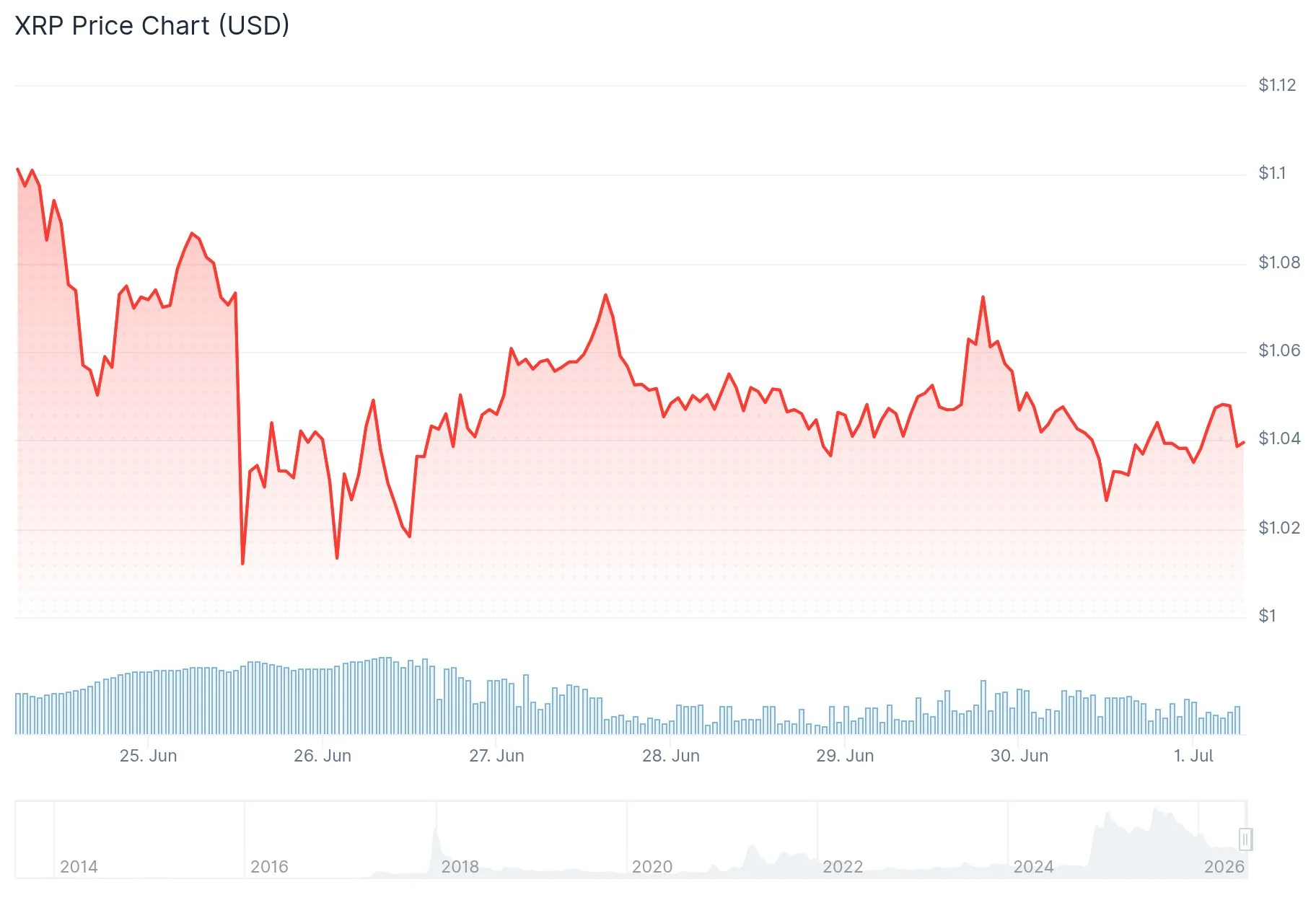
Key Takeaways
- On June 26, XRP touched $1.009, marking its lowest level since November 2024
- Despite the price decline, XRP spot ETF inflows remained in positive territory
- Technical analysis reveals a sustained downtrend originating from July 2025
- Open Interest has found equilibrium around 400 million XRP, indicating reduced speculative fervor
- Bullish divergence patterns on daily timeframes hint at potentially weakening bearish momentum near the $1 threshold
On June 26, 2026, XRP declined to $1.009, representing the token’s lowest point since it last visited these levels in November 2024.
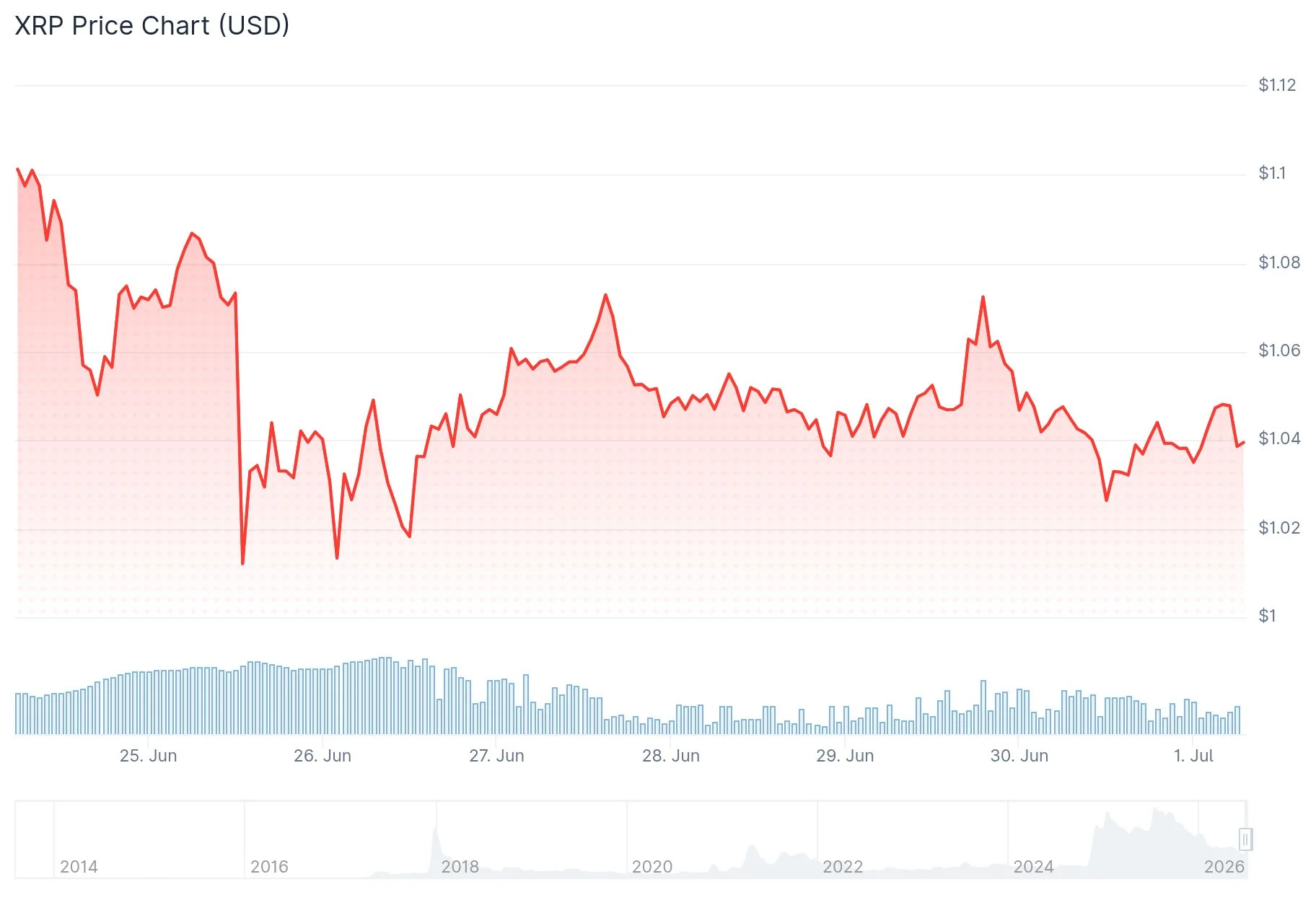
The decline occurred against a backdrop of continuing positive flows into XRP spot exchange-traded funds. Market participants continued accumulating through these investment vehicles despite downward price momentum.
While ETF accumulation reduces circulating supply available for trading, this dynamic has yet to catalyze upward price movement given prevailing market sentiment.
Overall market appetite for XRP has diminished considerably over recent months, accompanied by a notable contraction in speculative trading activity.
Technical Analysis Overview
The daily timeframe reveals XRP locked in a downward trajectory that originated in July 2025. The decisive break beneath the April 2025 swing low at $1.61, which occurred in February, validated the bearish market structure.
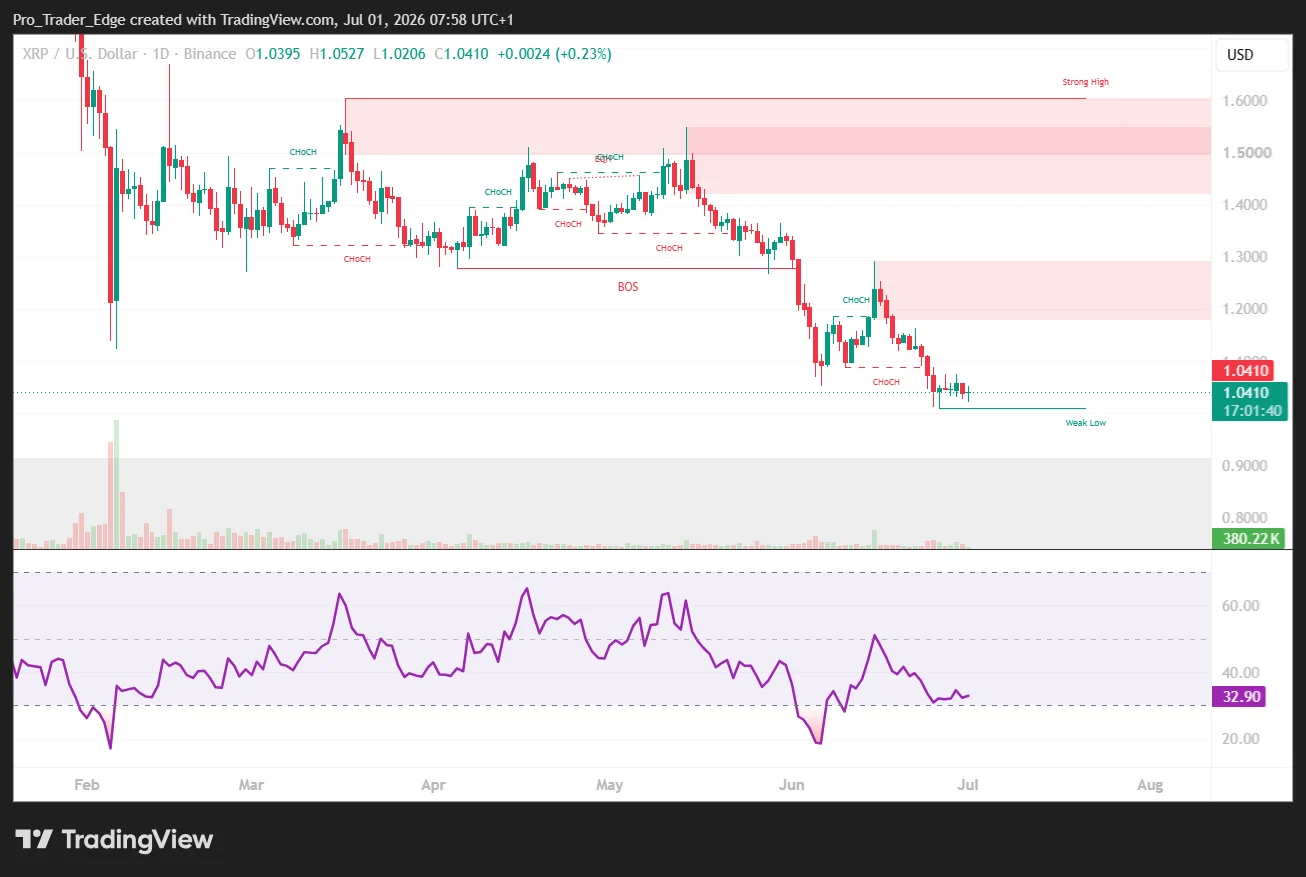
Following this breakdown, XRP consolidated within a defined range for multiple months. Late May witnessed an aggressive selling wave that shattered this consolidation pattern and accelerated the downside move.
A temporary recovery pushed prices toward $1.30 before momentum faded, leaving XRP hovering around $1.05.
Futures market data indicates Open Interest has stabilized at approximately 400 million XRP. The corresponding Open Interest Turnover Ratio has maintained levels near 0.71.
According to analyst Arab Chain, market participants should monitor these indicators for sudden increases. Rapid expansion in either Open Interest or turnover ratio typically precedes elevated volatility periods.
Examining the 4-hour chart, XRP rallied to $1.2935 during mid-June. This advance reached the 78.6% Fibonacci retracement zone around $1.2985 before encountering renewed selling pressure.
Should the bearish trajectory persist, potential downside objectives emerge at $0.975 and $0.854. Market probabilities favored a breach below $1 during July.
Potential Support Dynamics
An alternative technical interpretation presents a more constructive outlook. XRP has consistently rebounded from the $0.90-$1.00 zone, establishing this region as durable support through multiple challenges.
The $1.13 level has transitioned from support into resistance. A successful reclaim of this threshold would indicate emerging bullish momentum.
A bullish divergence pattern on daily charts has persisted for approximately one week. Such formations typically suggest diminishing selling intensity rather than imminent capitulation.
On social platforms, trader Celal Kucuker stated XRP should maintain current support levels and projected a potential climb to $10 within the next twelve months, acknowledging significant volatility along that path.
Technical analyst ChartNerd identified a repeating accumulation structure observed during previous bear cycles, highlighting historical drawdowns ranging from 85% to 96% spanning 14 to 37 months, contrasting with the current 72% retracement over 11 months.
The immediate focus centers on the $1.00 threshold. Maintaining this level preserves the possibility of retesting $1.13 resistance, while a breakdown would expose the $0.87-$0.90 support zone.

Crypto World
What is OpenUSD (OUSD)? Visa, BlackRock, Coinbase, and 140+ Firms Fuel Buzz Around New Stablecoin

Open USD (OUSD) stablecoin has emerged as one of the crypto market’s biggest trending topics after the project drew attention with the announcement of a consortium-backed stablecoin initiative involving more than 140 companies.
Developed by Open Standard, the stablecoin is expected to go live later this year.
Open USD Frenzy
According to the latest findings by Santiment, the scale of participation from major financial and crypto firms has fueled massive discussion across the market. The initiative has attracted some of the biggest names in the industry, making it one of the most talked-about developments in addition to discussions surrounding ANSEM whale activity and Markets in Crypto-Assets (MiCA) licensing.
“The crowd is also debating custody, transparency, liquidity, and whether another major stablecoin can truly compete with USDC and USDT. Either way, the spike in attention shows the market is taking this launch seriously.”
The growing interest follows the official unveiling of OUSD by Open Standard, an independent organization that will oversee the stablecoin. According to the official blog post, Open USD is designed to support global money movement while addressing several issues businesses face when using existing stablecoins.
While stablecoins have become increasingly important because they offer faster, lower-cost, and programmable digital payments, Open Standard said that many businesses still face high minting and redemption fees, limited access to revenue generated by reserve assets, and dependence on third-party issuers for future development.
To address these concerns, OUSD has been built around three core principles. First, businesses will be able to mint and redeem the stablecoin without paying fees or facing volume restrictions. Second, participating partners will receive the earnings generated from the stablecoin’s reserves after a small management fee is deducted to cover operational costs. Third, governance will be handled collectively through Open Standard, whose board will consist of partner organizations rather than a single controlling issuer.
Open Standard said this structure is intended to ensure decisions are made in the interests of the broader ecosystem. The organization also confirmed that more than 140 businesses have already signed up to support or use Open USD, including companies such as Visa, Stripe, Mastercard, American Express, Coinbase, BlackRock, BNY, Standard Chartered, Intercontinental Exchange, Bybit, Solana, Base, OKX, and Ripple.
Commenting on the development, BlackRock’s Global Head of Market Development, Samara Cohen, said,
“We believe stablecoins can play an important role in the evolution of digital markets when supported by trusted infrastructure and practical utility. Open USD is a constructive step toward giving businesses more choice in how they access tokenized value and participate in internet native digital rail.”
Bearish For Circle?
The announcement of OUSD also appeared to weigh on investor sentiment surrounding the USDC issuer, Circle. On Tuesday, CRCL shares fell 17.55% and closed at $62.63.
Former Enterprise Research Analyst at Messari, Sam Ruskin, tweeted that the new stablecoin’s model could pose a competitive challenge to USDC because of its three core design principles. He believes that OUSD’s new model could pressure Circle to expand revenue-sharing agreements, find new distribution partners, or focus on other parts of its stablecoin business.
The post What is OpenUSD (OUSD)? Visa, BlackRock, Coinbase, and 140+ Firms Fuel Buzz Around New Stablecoin appeared first on CryptoPotato.
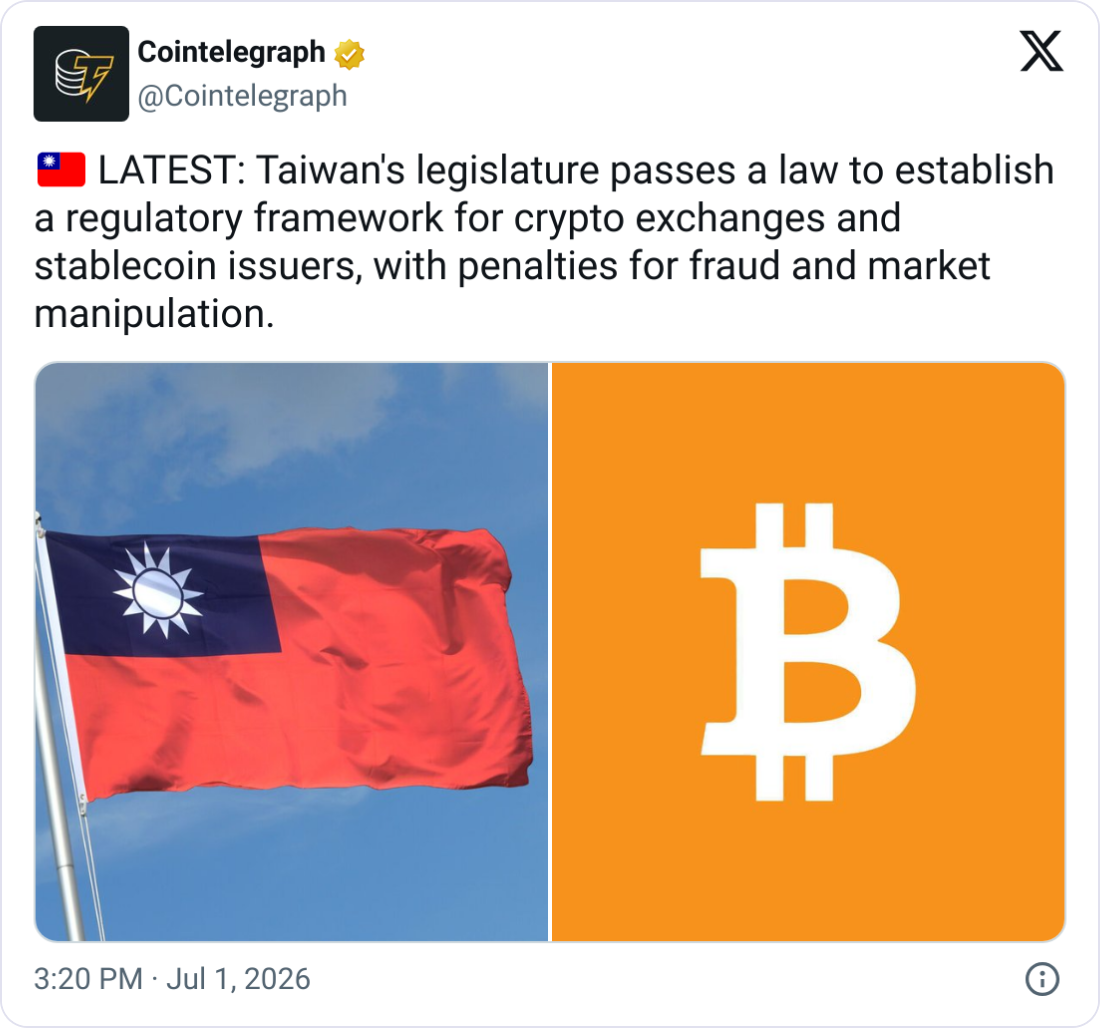
Taiwanese lawmakers on Tuesday passed a law to establish a regulatory framework for crypto, which includes licensing and rules for stablecoins.
The country’s financial watchdog, the Financial Supervisory Commission (FSC), said that the Legislative Yuan passed the law requiring all virtual asset service providers, or VASPs, to get approval from the regulator to operate.
The law also says stablecoins issued in the country must get approval from the central bank and the FSC, and issuers must maintain sufficient reserves with a trustee and undergo regular audits.
The law is the first to regulate crypto and stablecoins in Taiwan, bringing it in line with other nations in the region, such as Japan, Singapore and Hong Kong, that have long passed laws to regulate the sector in a bid to attract the industry.
The FSC said the bill further strengthens the protection of traders’ rights and that issuing stablecoins will help Taiwan integrate with the international market and secure a place in the global crypto market.
Source: Cointelegraph
Taiwan’s rules outline seven types of VASPs, including exchanges, trading platforms, custodians and lenders, which will all be subject to rules for internal control and audits, cybersecurity systems, crypto listing and delisting rules, customer asset segregation and financial reporting.
The rules outlaw crypto-based fraud and price manipulation, with violators facing between three and 10 years in prison and fines ranging from about 10 million New Taiwan dollars ($300,000) to 200 million New Taiwan dollars ($6.3 million).
Those caught operating a VASP or issuing a stablecoin without a license face up to seven years in prison and fines of up to 100 million New Taiwan dollars ($3.1 million), Taiwan’s national news agency, CNA, reported on Tuesday.
Related: US ban on stablecoin yield could see others fill the void: Ledger exec
The implementation date of the bill is still to be determined, and the law will take effect only after it is published by the government’s executive branch.
The FSC said VASPs that complete anti-money laundering registration before the bill is implemented, and institutions that provide related services under the agency, should apply for a license within 12 months after the bill is implemented.
CNA reported that lawmakers also passed a resolution asking the FSC to propose a plan within a year outlining how the crypto industry can provide derivative crypto commodity services, with the aim of providing diversified investments and improving the sector’s health.
Asia Express: Japanese pension fund tips 1% in crypto, G7 urges action on NK hackers

Euro zone factory output ends first quarter on strong note, cost pressures ease – PMI

8 Must-Watch Adventure Horror Movies, Ranked

Five ways to make your clothes last longer





-

 Fashion5 days ago
Weekend Open Thread: Staud – Corporette.com
-

 Politics5 days ago
The House | Manchesterism won’t survive the painful trade-offs unless it gets citizens on board
-

 Crypto World1 day ago
Strategy authorizes up to $1.25B in Bitcoin sales under new capital plan
-

 Politics5 days ago
Potential 2028er World Cup attendee leaderboard
-

 Business5 days ago
Asia stock markets slide as tech shares slump
-

 News Videos3 days ago
MAJOR BITCOIN & MARKET UPDATE!!!! (MUST WATCH ASAP!!!)
-

 Tech6 days ago
A Look At A Gaggle Of Transputer Boards
-
 Crypto World6 days ago
Dell (DELL) Shares Tumble Over 5% Following Analyst Downgrade to Hold
-

 Crypto World4 days ago
Coinbase, Circle Deepen Crypto Stock Losses Despite Resilient S&P 500
-

 Business1 day ago
Australia treasurer says alleged access of prime minister’s bank data ’incredibly concerning’
-

 Crypto World4 days ago
Kraken's xStocks Opens Bending Spoons IPO Registration to EEA Retail
-

 Sports4 days ago
FIH Pro League: India defeat Pakistan 7-1, register biggest win of campaign | Other Sports News
-

 Crypto World5 days ago
Bitcoin Sparks $600M Hourly Liquidations With $65,000 Set To Become Resistance
-

 Tech3 days ago
Bluekit phishing kit adopts browser-in-the-middle for login theft
-

 Tech4 days ago
Russian hackers now target Signal backup recovery keys
-
 Crypto World5 days ago
Hyperliquid Named on Singapore MAS Investor Alert Register
-

 Crypto World6 days ago
Ripple and SBI launch RLUSD in Japan after JFSA approval
-

 Crypto World5 days ago
RTX holders must register wallets before token distribution begins
-
 Business2 days ago
The AI boom won’t burst all at once. It will pop in ‘rolling bubbles’: Macquarie
-

 Tech1 day ago
Anonymous researcher drops 0-day ‘exploitarium’ repo
You must be logged in to post a comment Login