
Crypto World
Is BITCOIN the FUTURE of MONEY?

Monetary changes have always existed in human history: gold replaces barter as a currency for transactions, banknotes replace gold as a means of storing value, and Bitcoin and other cryptocurrencies could be on the verge of replacing paper money. Each type of currency solves the problems of the previous generation of currencies. Right now, Bitcoin offers a solution to the problem of unlimited money printing and counterfeiting. But what is its future, is it destined for failure or success?
Bitcoin, the world’s first decentralised digital currency, was created in 2009 by an anonymous individual or group of individuals under the pseudonym Satoshi Nakamoto. The currency operates on a peer-to-peer network, enabling fast and cheap transactions without the need for intermediaries such as banks.
Since its inception, Bitcoin has been the subject of much debate and speculation, and indeed one of the most common debates surrounding Bitcoin is whether or not it is destined to be the future of money. Some see it as the future of money, while others see it as a speculative bubble destined to burst.
Arguments in favour:
One of the main arguments that favour Bitcoin as the future of money is its decentralised nature. Unlike traditional currencies, which are controlled by governments and financial institutions, Bitcoin is not subject to the whims of politicians and bankers. This makes it a potentially more stable and secure form of currency, as there is no single point of failure that can be exploited.
Another argument favouring Bitcoin is its potential to disrupt the current financial system. The traditional financial system is often criticised for being slow, outdated and overly complex. On the other hand, Bitcoin is fast, efficient and easy to use. This could potentially lead to a more inclusive financial system in which individuals and small businesses have greater access to financial services.
In addition, Bitcoin is a scarce digital asset, meaning that only 21 million bitcoins will ever exist. This scarcity, combined with its digital nature, is a hedge against inflation and currency devaluation, which is increasingly becoming a concern in many parts of the world.
More and more companies are accepting cryptocurrency payments, even those that rely entirely on this payment method. Companies such as PayPal and Square have entered the Bitcoin and cryptocurrency sphere, and more and more companies are joining one after the other. Also, users, volumes, transactions and applications are continuously growing in cryptocurrency. Many would argue that cryptocurrencies will not disappear, and their upward movement is not over.
In terms of regulation, Bitcoin and the cryptocurrency market are being regulated and maturing, and there are now increasingly clear state rules for cryptocurrencies around the world. It can be said that cryptocurrencies are being accepted more and more frequently, and precise sets of rules are slowly emerging.
Arguments against:
However, there are also valid doubts about the long-term viability of Bitcoin as a currency. One of the main problems is its volatility. Bitcoin’s value can fluctuate wildly quickly, making it difficult to use as a medium of exchange. This volatility also makes it a risky investment, as the value of holdings can drop significantly quickly.
Another concern is the energy consumption required to mine new Bitcoins. The mining process involves solving complex mathematical problems, which require significant computing power. This energy is usually generated by burning fossil fuels, contributing to climate change.
On the other hand, it cannot be assumed that all users understand the technical basis of cryptocurrency blockchain technology. This implies that these users do not have the same advantages as technology experts. And therefore, they have no choice but to believe what they say about the security and integrity of the system. This reliance on specialists who can benefit from the system can pose a risk of abuse in using cryptocurrencies.
In addition, the regulatory landscape for Bitcoin is still uncertain in many countries. Many governments have yet to establish clear rules and regulations for the use and trade of digital currencies, which could slow their growth and adoption. There is also the scepticism of the more traditional population to consider.
Bitcoin as a unique and hopeful asset
At the moment, we know that it aspires to be a currency and form of payment, which, moreover, it already is in some scenarios. However, what is relevant is its programmed scarcity, its irrevocability in transactions and its incommunicability. This differentiates it from other financial assets that are not real assets. The rest of the cryptocurrencies promise obligations of the issuer concerning the value of that currency at a given time. They depend on the issuer acting in one way or another to improve the platform where those crypto assets are held. All cryptos are, therefore, financial assets, but bitcoin is a real asset as it is no one’s financial liability.
Whether bitcoin can become a monetary asset and a reserve asset depends on whether it is understood as an economic concept and not as an investment.
Bitcoin could be the last hope for a reserve of freedom once fiat money is completely extinguished. Now that fiat currencies are plummeting towards parity with the dollar and people are beginning to distrust them, Central Banks will take the opportunity to introduce CBDCs (Central Bank Digital Currency) during the chaos and offer them as the solution to all ills.
In short, Bitcoin (you can expand your knowledge of Bitcoin with books such as
`The Bitcoin Standard’, among many others) is an innovative and disruptive technology that has the potential to change the way we think about and use money. However, it remains a relatively new and unproven technology, and there are well-founded doubts about its long-term viability as a currency.

Coinbase’s Layer 2 shifts focus to tokenizing every major asset class and scaling stablecoin payments.

Ivan Kozlov shared the first public update on recovery efforts nine days after an attacker minted 80 million unbacked USR tokens and extracted roughly $23 million.
Galaxy Digital has introduced a Solana staking feature on its GalaxyOne retail platform, furthering its push into consumer crypto services amid intensifying competition among all-in-one trading apps.
In a Tuesday announcement, Galaxy said GalaxyOne users can now stake Solana (SOL) directly through the app, earning up to 6.5% in variable annual rewards. The yield is not fixed and depends on network conditions, validator performance and overall staking participation, meaning actual returns may fluctuate over time.
The rollout reflects a broader industry shift toward integrating yield-generating products into retail platforms, allowing users to earn passive income on idle crypto holdings rather than simply holding or trading them.
To attract early users, Galaxy is waiving commissions on staking until the end of the year — a temporary incentive that suggests the company is prioritizing user acquisition over near-term revenue from the product.

Galaxy already operates institutional-grade Solana validators — infrastructure that helps secure the network by processing transactions and validating blocks.
In proof-of-stake systems like Solana, users delegate their tokens to these validators, which in turn distribute a share of staking rewards. By integrating this capability into GalaxyOne, the company is effectively extending its existing infrastructure business to retail customers.
The move positions Galaxy more directly against platforms like Coinbase and Robinhood, which offer bundled services including trading, custody and staking. As staking becomes a standard feature across crypto apps, competition is increasingly shifting toward fees, user experience and regulatory access.
Related: SEC approval sought for JitoSOL Solana-based liquid staking token ETF
Institutional demand supports staking narrative
Solana staking continues to draw investor interest despite a sharp decline in price amid broader weakness across the crypto market.
Institutional participation has rebounded recently, as staking-based investment products gain traction. The debut of Solana-focused exchange-traded funds (ETFs), including those with liquid staking strategies, has given investors exposure to both price movements and onchain yield.
Solana traded near $250 in September but has since fallen by roughly 67%. Despite the drawdown, staking activity has held up, indicating continued demand for yield.

Bohdan Opryshko, co-founder and chief operating officer of Everstake, which operates validator infrastructure across multiple proof-of-stake networks, said both retail and institutional participants are increasingly “treating Solana as a yield-generating asset rather than a speculative trade.”
Related: Nasdaq tokenization plans could split trading into two markets — TD Securities
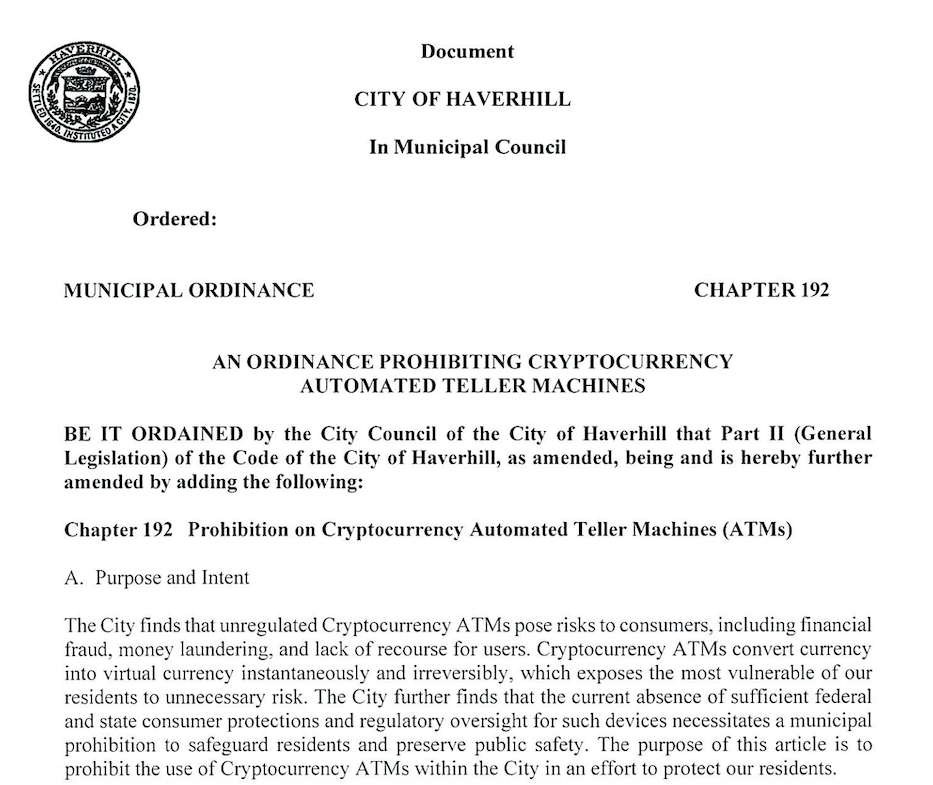
The city council of Haverhill, Massachusetts is set to consider a ban on cryptocurrency ATMs following a proposal for an ordinance introduced on March 17.
According to Haverhill City Council’s agenda, the government body is scheduled to review a crypto ATM ordinance introduced by Mayor Melinda E. Barrett. The proposal would amend the city code to prohibit cryptocurrency ATMs, an ordinance which received a unanimous 11 votes in the council’s March 17 meeting.

The ordinance cited potential risks to Haverhill residents due to “financial fraud, money laundering and lack of recourse” for ATM users. The city said the absence of state and federal regulations necessitated local authorities stepping in. If passed, all crypto kiosks and ATMs would need to be removed from the city within 60 days or face a $300 a day fine.
Haverhill‘s proposed action is just one of many examples of jurisdictions across the US introducing bans on crypto ATMs in response to scams and other illegal activities. In February, a Minnesota lawmaker introduced a bill that could ban crypto kiosks, building on a 2024 law that imposed restrictions on ATM operators.
Related: Crypto gains political clout among 80% of UK young voters
According to data reported by CoinATMRadar and crypto ATM operator Bitcoin Depot, there could be eight or more machines in the Haverhill area. Cointelegraph reached out to Mayor Barrett’s office for comment but had not received a response at the time of publication.
Bitcoin Depot stock declines as company shakes up leadership
As one of the largest crypto ATM operators in the US, the share price of Bitcoin Depot stock (BTM) has declined since 2025, dropping by more than 90% in the past six months. As of Tuesday, the stock was trading at $2.06 on the Nasdaq.
In additional to the potential ordinance in Haverhill, Bitcoin Depot faced Connecticut banking regulators issuing a temporary cease-and-desist order in March, effectively suspending its money transmission license. Authorities in Iowa and Massachusetts have also sued the company for allegedly facilitating crypto scams.
Last week, Bitcoin Depot announced that Scott Buchanan had stepped down as CEO, having served at the role for less than three months. Board member and former MoneyGram CEO Alex Holmes replaced Buchanan as CEO and chair.
Cointelegraph reached out to Bitcoin Depot for comment on the Haverhill ordinance but had not received a response at the time of publication.
Magazine: Are DeFi devs liable for the illegal activity of others on their platforms?
Employees can elect to receive a portion of their salary in shares of WTGXX, earning yield from the day compensation is paid.


- XRP, Solana, and Cardano prices hover near $1.30, $80, and $0.24, respectively.
- Currently, BTC trades around $66,430 after retreating from highs of $68,000.
- Analysts say the week is heavy on macroeconomic data releases, and that’s likely to impact volatility.
XRP, Solana, and Cardano prices hover at critical support levels amid a potentially volatile week for cryptocurrencies, with Bitcoin poised just above $66,000 as traders brace for a fresh wave of macroeconomic data.
While geopolitical risk from the Iran war continues to roil markets, investors weighing the next moves might also want to pay attention to key macroeconomic events this week.
QCP Group has noted, via a post on X, that these data releases will likely shape the next leg of the Bitcoin price.
On Monday, analysts at Greeks.live opined that, in addition to macroeconomic factors, volatility could also hinge on announcements from US President Donald Trump.
Bitcoin led altcoins briefly higher after Trump announced that the US was looking to end its military operation in Iran.
Key macro events to watch this week
This week’s macro calendar is packed, with analysts at QCP Capital highlighting several data releases as potential volatility triggers across traditional markets and cryptocurrencies.
For investors, the key focus is how incoming data shapes expectations for US growth, inflation, and the interest-rate path—factors that continue to drive risk assets, including Bitcoin.
Key macro events to watch for this week:
Mar 31: CAD GDP m/m
Mar 31: US Consumer Confidence, JOLTS Job Openings, Chicago PMI
Apr 1: S&P Global US Manufacturing PMI, ISM Manufacturing PMI
Apr 2: Jobless Claims, Trade Balance
Apr 3: Non-Farm PayrollsMain volatility triggers:…
— QCP (@QCPgroup) March 31, 2026
On March 31, attention turns to US Consumer Confidence, JOLTS Job Openings, and the Chicago PMI.
QCP identifies JOLTS as a key volatility catalyst, as signs of labour market cooling or tightness directly influence Federal Reserve expectations and the dollar, with spillover effects on crypto flows.
Tokens such as XRP, Solana, and Cardano are likely to track Bitcoin’s direction.
On April 1, the S&P Global US Manufacturing PMI and ISM Manufacturing PMI will be released, with the ISM reading seen as particularly important.
A weaker print could strengthen expectations for rate cuts and support crypto, while stronger data may reinforce a “higher for longer” rate outlook and weigh on digital assets.
A similar dynamic applies to jobless claims data, another closely watched indicator.
A sharp rise could signal labour market weakness and potentially support Bitcoin as markets adjust expectations for monetary easing.
The week culminates on April 3 with the release of US Non-Farm Payrolls (NFP).
QCP flags this as a primary macro event that could revive inflation concerns and strengthen the dollar.
Historically, a stronger greenback has pressured Bitcoin, while softer payrolls tend to support the broader digital asset market through expectations of looser policy.
XRP, SOL, and ADA price outlook
From a technical perspective, Bitcoin enters this data-heavy period with a constructive but fragile setup on the daily chart.
Traders are balancing macroeconomic risks with geopolitical tensions, particularly around the Iran conflict and disruptions linked to the Strait of Hormuz.
The result is a market caught between competing drivers of volatility, with implications across risk assets.
Bitcoin’s sensitivity to incoming data could drive broader moves in altcoins.
XRP is holding near $1.30 support but may slip toward $1.20 if BTC weakens following non-farm payrolls data.
On the upside, softer inflation readings could support a move toward $1.50.
Solana (SOL), trading near $80, is testing key moving averages and could face downside risk toward $70.
A stronger bullish push, however, may open the path toward $100.
Meanwhile, Cardano (ADA) has declined to around $0.24, with potential for further downside toward $0.22.
A renewed influx of buyers could instead see the token attempt a move back toward the $0.30 resistance level.
Crypto World
Warren Buffett says he sold Apple too soon and would buy more of it, though not in this market

Warren Buffett said he sold Apple too soon and would buy more of it, though not in the current market.
“I sold it too soon. But, I bought it even sooner, so,” Buffett told CNBC’s Becky Quick in an interview Tuesday on “Squawk Box” in which he announced he’s bringing back his famed charity lunch.
Apple remains Berkshire Hathaway’s largest holding even after the conglomerate trimmed its stake to $61.96 billion at the end of last year, according to InsiderScore.
However, Buffett said Tuesday that he would continue to add to the position if it gets cheaper. He said the iPhone maker is not yet attractive even after falling more than 14% off its recent high, and dropping more than 6% this month. That’s amid turmoil in the broader market, with both the Dow Jones Industrial Average and the Nasdaq Composite in a correction.

Apple performance year to date
“I’m very happy to have it be our largest holding,” Buffett said. “I was not happy to have it be as large as almost everything else combined.”
“It’s not impossible that Apple would get to a price, we would buy a lot of it,” he added. “But not in this market.”
Buffett said the firm has made more than $100 billion in the stock pretax, and was favorable in his comments regarding Tim Cook‘s leadership of the firm over Steve Jobs.
“Tim Cook has done better with the hand. Steve Jobs — he couldn’t have done what Steve Jobs did — but Steve Jobs handed him a hand that Steve would not have done as well,” Buffett said.
“Tim was a fantastic manager, and he’s a good guy, and somehow he gets along with everybody in the world,” he added. “That’s a technique I wouldn’t have, for example, certainly my partner, Charlie Munger, wouldn’t have had it.”
Buffett stepped down as Berkshire’s CEO at the beginning of 2026 after six decades running the conglomerate. He remains chairman of the firm.
Read more from CNBC’s interview with Warren Buffett


Perp DEX edgeX launches its $EDGE TGE tonight with 25% airdrop unlocked, as closed X comments stoke community concerns over transparency and distribution.
Summary
- EdgeX will launch its $EDGE token via TGE at 20:30 Beijing time on March 31, 2026, with trading to begin the same day.
- The token has a total supply of 1 billion, with 25% allocated to a fully unlocked community airdrop at TGE, targeting points and NFT holders.
- Pre-market $EDGE perpetuals are already live on Binance with up to 5x leverage, even as the project faces criticism for limiting discussion on its TGE countdown post.
Decentralized perpetual exchange edgeX will finally launch its native token $EDGE tonight, holding its long-awaited token generation event at 20:30 Beijing time on March 31, 2026, after previously delaying the sale to “ensure stability” and avoid further date changes. The TGE and initial exchange listings are set to go live on the same day, with platforms like Phemex and others noting that the event marks “a significant milestone” for the derivatives-focused protocol. But the build-up has not been entirely smooth: community members have criticized edgeX after the team quietly closed comments on its TGE countdown post on X without explanation, stoking concerns about transparency around the airdrop and early distribution.
edgeX, which positions itself as a “real trading + revenue-driven” perpetual DEX rather than a zero-fee yield farm, has attracted sizable liquidity and volume ahead of launch. According to a December update on MEXC, co-founder KF.edge told a community call that edgeX already processed about $2.28 billion in 24-hour trading volume and had $775 million in open interest, placing it in the same conversation as rivals like Hyperliquid and Aster. A July 2025 report from DL News said the project’s deposits “grew to over $100 million in July, a 1,000% increase since the start of the month,” while monthly perpetuals volume hit roughly $13 billion at its peak, underscoring the scale of airdrop expectations.
The $EDGE token will have a fixed supply of 1 billion units, with 25% earmarked for community airdrops at TGE and fully unlocked from day one, a design that mirrors earlier distributions from competitors like Hyperliquid and has energized points farmers and NFT holders. As MEXC summarized, “25% of EDGE tokens will distribute at TGE to points and NFT holders; points capped at 7,310,000,” with additional pre-TGE trading rewards paid out separately from the initial allocation. The team has framed this approach as a way to “reward real traders,” arguing in a Binance pre-market post that EDGE is “not about the complexity on the chain, but rather turning the experience towards CEX” while maintaining non-custodial infrastructure under the hood.
At the same time, the decision to close comments under the official TGE countdown on X, despite heavy airdrop marketing, has raised eyebrows among users who worry about unseen allocation changes or undisclosed investor terms. One Binance Square post touting pre-market trading urged users to “get ready to charge” and “comment ‘666’ in the comments if you want to join,” but subsequent promotional posts saw comments disabled, limiting public questioning about vesting, market makers or potential listing spreads.
Even before spot and standard perpetual contracts go live, Binance Futures has opened EDGEUSDT pre-market trading with up to 5x leverage, allowing traders to speculate on $EDGE pricing ahead of TGE. Binance said pre-market contracts will be “converted to standard perpetual futures contracts gradually,” once the token is live on exchanges, giving early participants a bridge into regular derivatives markets.
For previous coverage of derivatives-focused DeFi growth, readers can look to a crypto.news story on zero-knowledge proof investments and scalable infrastructure for high-throughput trading, another story detailing how crypto ETF flows have reshaped leverage and volatility in perpetual markets, and a third story on emerging VR and gaming projects tapping on-chain derivatives rails for novel incentive models. If you include the $EDGE market later, remember to link the token name once to its dedicated price page in the crypto.news market-cap section.

Franklin Templeton’s SOEZ Solana crypto ETF pulled $1.50M in a single day on March 25, 2026 – a one-day haul equal to roughly 15.9% of the fund’s total $9.60M in assets under management.
The inflow lands against a backdrop that makes the conviction harder to ignore: SOL has shed approximately 33.5% over the past three months, currently trading around $83.06.
Someone is buying the drawdown through a regulated wrapper, and the size relative to AUM suggests it’s deliberate positioning, not drift.
— BSCN (@BSCNews) March 29, 2026
 MARKETS: SOLANA ETFS BLEED OVER $4 MILLION THIS WEEK
According to data from @SoSoValueCrypto, the suite of spot @Solana $SOL ETFs in the US have collectively seen some $4.24 million in outflows over the past week.
This is the products' first week of net outflows since as far… pic.twitter.com/xmmRk4yLkk
Discover: The best pre-launch token sales
Can Solana Crypto Reclaim $96 as SOEZ Inflows Signal Institutional Accumulation?
SOEZ quietly went live on February 23 and it is not your typical spot product, it actually holds real SOL and stacks staking rewards on top, usually around 5–7% APY, which means you are not just riding price but earning yield while holding, and that adds a layer most spot exposure does not have, with shares sitting around $14.34 by March 30.
On the chart, everything keeps pointing back to that $80 level, because as long as SOL holds above it, the structure is still alive.

Especially with ETF demand slowly soaking up sell pressure and AUM climbing in the background, which gives price room to grind higher and eventually retest the $96 zone.
Right now it looks more like a slow rebuild than a breakout, with SOL likely moving inside the $80 to $92 range while shorts start getting squeezed out and buyers keep absorbing dips, setting up a potential push higher if momentum comes back.
But if $80 gives way with real volume, the story flips fast, because that level is the foundation of the current structure, and losing it opens the door for a sharper drop into the low $70s where the next real support sits.
Explore: Best crypto assets to diversify your portfolio
The post Solana Bets Rise as Franklin’s SOEZ ETF Attracts $1.53M Overnight appeared first on Cryptonews.

Google Quantum AI researchers have published a study suggesting that the cryptography safeguarding Bitcoin and Ethereum could be cracked with far fewer quantum hardware resources than previously believed. The work, released this week, estimates that a practical quantum computer might break the 256-bit elliptic curve cryptography (ECDLP-256) used by major blockchains with under 500,000 physical qubits, given current hardware assumptions.
In tests conducted on superconducting-qubit cryptographically relevant quantum computers, the researchers demonstrated a 20-fold reduction in the number of qubits needed to derive the private key from a public key, a step that underpins the security of most cryptocurrency accounts. The paper highlights a scenario in which a quantum attacker could recover a Bitcoin private key in about nine minutes, potentially enabling an “on-spend” attack within Bitcoin’s typical 10-minute block interval.
“We should estimate the time required to launch an on-spend attack starting from this primed state at the moment the public key is learned to be roughly either 9 minutes or 12 minutes.”
One of the authors, Ethereum researcher Justin Drake, publicly acknowledged growing confidence in a quantum-day timeline. In a social post, he suggested there’s a meaningful chance that by 2032 a quantum computer could recover a private key from an exposed public key, noting specifically that this is not merely a theoretical concern but a material possibility on the horizon.
Ethereum’s “at-rest” risk compounds the challenge
The Google study also casts light on what it calls an “at-rest” vulnerability in Ethereum’s account model. Unlike the Bitcoin scenario, where an attacker would need to time their attack to a specific moment, an at-rest attack relies on a public key that has already been revealed when an account first transacts. Once that public key becomes visible on the blockchain, a quantum adversary could take their time to derive the corresponding private key, potentially compromising the account at any future point.
The researchers warn that this is a systemic exposure that cannot be mitigated merely by user behavior. It argues for a protocol-wide shift to post-quantum cryptography (PQC) to harden security before credible threats can materialize.
Google estimated that the top 1,000 Ethereum accounts, collectively holding around 20.5 million ETH, could be cracked in fewer than nine days under certain quantum scenarios. The finding underscores a key distinction: Bitcoin’s risk window is time-bound, while Ethereum’s exposure could be persistent once a public key has left the user’s control.
The paper ties these technical insights to a broader warning for the crypto community: the clock toward quantum threats is moving faster than many had anticipated, and transitional security measures are urgently needed.
Google’s research is part of a broader push to raise awareness about quantum risk in crypto and to offer concrete recommendations for security upgrades. The team argues that the community should accelerate the adoption of PQC and begin transitioning systems now, rather than wait for a real quantum attack to materialize.
What changes are on the horizon for post-quantum security?
The research arrives amid a wave of activity around post-quantum cryptography and blockchain security. In parallel with the study’s release, Google signaled a firm deadline for its own post-quantum cryptography migration: 2029. While this timeline is specific to Google’s internal deployment, it has intensified industry discussions about how quickly protocols, wallets, and consensus layers across major networks must evolve.
Industry voices have varied in their assessment of the urgency. Nic Carter, a crypto researcher and commentator, summarized the tension in a recent thread, noting that elliptic-curve cryptography could be “on the brink of obsolescence.” He argued that Ethereum developers have already started exploring post-quantum approaches, while Bitcoin communities have been slower to adopt such changes. Carter’s assessment reflects a broader concern that, even if the risk is not imminent for all networks, the potential for accelerated disruption is real and requires proactive planning.
On the development front, Ethereum’s community has been alert to quantum risk for some time. The Ethereum Foundation released a post-quantum security roadmap earlier this year, outlining the kinds of changes needed to signatures, data storage, account structures, and cryptographic proofs to withstand quantum-era threats. Vitalik Buterin himself has highlighted the need for substantial updates across validator signatures, storage formats, accounts, and proofs to build resilience against future quantum capabilities.
Google’s paper and the ensuing discussion have heightened attention on how networks can migrate toward quantum-resistant schemes. The recommendations call for a coordinated transition that minimizes user disruption while upgrading core cryptography, a complex engineering challenge that spans client implementations, node operators, and ecosystem tooling.
Why this matters for investors, users, and builders
The potential for quantum-assisted breaches touches several layers of the crypto stack. For investors, it introduces a strategic risk horizon that could compress security timelines and affect long-hold strategies for large holdings, especially if the most valuable accounts rely on exposed public keys. For users, the findings emphasize the importance of wallet and key-management practices that minimize exposure of public keys and support seamless upgrades to quantum-resilient schemes. For builders and developers, the message is clear: security audits, protocol upgrades, and cross-ecosystem interoperability will need to accelerate in tandem with cryptographic research.
The divergence in risk models between Bitcoin and Ethereum also highlights how different design choices influence vulnerability. Bitcoin’s on-spend risk translates into a window of opportunity for attackers, whereas Ethereum’s account model could face a broader, systemic threat if and when quantum-ready cryptography is not universally deployed. The study’s authors stress that this is not a distant concern but a practical risk requiring immediate attention from protocol designers, wallet providers, and exchanges alike.
What to watch next
As the crypto industry digests Google’s findings, the next several quarters will likely feature intensified focus on post-quantum readiness. Key areas to watch include: the pace of PQC standardization and adoption across major platforms, the ability of wallet providers to roll out user-friendly upgrades, and how layer-2 ecosystems and centralized services handle migration without disrupting service. The Ethereum Foundation’s roadmap and ongoing development work on quantum-resistant signatures and proofs will be critical to gauge whether practical, broad-based adoption can start within a few years. Meanwhile, Bitcoin developers face the challenge of aligning security upgrades with long-standing principles of decentralization and backward compatibility.
Experts caution that even with a clear migration path, incentives and coordination across a diverse set of actors will determine how quickly the ecosystem can transition. The study’s authors emphasize a proactive stance: by beginning the transition now, networks can reduce the risk of a sudden, disruptive quantum-enabled event in the future.
In sum, the Google study reframes the quantum threat as both more tangible and more nuanced than earlier forecasts suggested. It underscores the urgency of moving toward post-quantum cryptography while acknowledging the complexity of achieving a seamless, ecosystem-wide upgrade. For market participants, the message is practical: begin planning today, monitor progress on standards, and be prepared for the first wave of PQC-enabled solutions to arrive sooner than expected.
Readers should keep an eye on updates from major blockchain projects, standard-setting bodies, and security researchers as the push toward quantum resilience accelerates. The question is not merely whether quantum computers will crack current cryptography, but how quickly the industry can adapt to ensure the security of stored value and the integrity of decentralized networks in a quantum-enabled era.
BBC confirms Death in Paradise to be replaced by two hit shows

Trump admin proposes opening 401(k)s to private equity, crypto

Base Doubles Down on Global Markets, Stablecoins, and AI Agents


-
 NewsBeat6 days ago
Manchester United reach agreement with Casemiro over contract clause amid transfer speculation
-

 News Videos6 days ago
Parliament publishes latest register of MPs’ financial interests
-

 NewsBeat4 days ago
The Story hosts event on Durham’s historic registers
-
 Tech5 days ago
Intercom’s new post-trained Fin Apex 1.0 beats GPT-5.4 and Claude Sonnet 4.6 at customer service resolutions
-

 Sports4 days ago
Sweet Sixteen Game Thread: Tide vs Michigan
-

 Business5 days ago
Instagram, YouTube Found Responsible for Teen’s Mental Health Struggle in Historic Ruling
-
 NewsBeat6 days ago
Tesco is selling new Cadbury Dairy Milk bar and people can’t wait to try it
-

 NewsBeat7 days ago
Entrepreneurs Forum survey reveals optimism in North East
-
 Entertainment3 days ago
Lana Del Rey Celebrates Her Husband’s 51st Birthday In New Post
-
Entertainment1 day ago
Fans slam 'heartbreaking' Barbie Dream Fest convention debacle with 'cardboard cutout' experience
-
Crypto World7 hours ago
Dems press CFTC, ethics board on prediction-market insider trades
-

 Sports7 days ago
Fantasy Baseball Week 1 Preview: Top sleeper hitters for both five- and 12-day period led by Munetaka Murakami
-

 Tech7 days ago
US FCC Prohibits Approval Of New Foreign-Made Consumer Routers
-

 Sports3 hours ago
Tallest college basketball player ever, standing at 7-foot-9, entering transfer portal
-

 Tech7 days ago
Embedding compliance in AI adoption
-
Sports7 days ago
One Team in Particular Is Monitoring Kirk Cousins
-

 Fashion7 days ago
Althea Mink: Patrice Taylor’s Atlanta Couture Brand Built on Legacy, Resilience, and Architectural Glamour
-
 NewsBeat7 days ago
DWP to close two benefits for all new and existing claimants before April
-
 Fashion6 days ago
How to Style Spring Like WeWoreWhat: Easy Outfit Ideas for 2026
-

 Entertainment6 days ago
HBO’s Harry Potter Series Will Definitely Fail For One Big Reason, And It’s Not J.K. Rowling Or Snape
You must be logged in to post a comment Login