

Crypto World
Jane Street sued over alleged $134M insider trading in Terra collapse



Terraform Labs’ liquidators have accused Jane Street of insider trading that allegedly netted $134 million during the May 2022 Terra/LUNA implosion, claiming the trading giant front‑ran the depeg using non‑public information while retail investors were wiped out.
Summary
- The court-appointed administrator says Jane Street used confidential data and private Telegram coordination to dump UST ahead of the collapse.
- The lawsuit alleges roughly $134 million in illicit profit from trades executed during a “death spiral” that erased around $40 billion in market value.
- Jane Street has moved to dismiss the case, calling the complaint “self‑defeating” and a “desperate effort” to shift blame for Terraform’s fraud.
The administrator winding down Do Kwon’s Terraform Labs has filed a federal lawsuit accusing Jane Street, its co‑founder Robert Granieri, and traders Bryce Pratt and Michael Huang of insider trading tied to the May 2022 Terra collapse.
Terraform liquidator targets Jane Street over May 2022 trades
According to the complaint, filed in the Southern District of New York and reviewed by the Financial Times, Jane Street “used material, non‑public information obtained from Terraform insiders to front‑run market‑moving events” and exit positions while ordinary investors were left holding collapsing UST and LUNA.
The complaint alleges that Jane Street coordinated its UST trades “through a private Telegram chat” and executed an “85 million UST” sale on May 7, 2022, minutes after confidential instructions were given to withdraw liquidity from a key pool. Terraform’s plan administrator claims those trades formed part of a broader scheme that generated “approximately $134 million in unlawful profits” as Terra’s algorithmic stablecoin lost its peg and the ecosystem unraveled in a matter of days.
In detailing the fallout, the lawsuit places Jane Street’s trading squarely inside one of crypto’s most destructive episodes, describing Terra’s failure as a “$40 billion collapse” that triggered cascading liquidations and contributed to a wider credit crunch across digital asset markets. Crypto.news has previously reported on the long legal afterlife of that implosion, including civil and criminal actions targeting Terraform, Do Kwon and other actors that helped reshape the regulatory conversation around so‑called algorithmic stablecoins.
Jane Street hits back, calls complaint ‘self‑defeating’
Jane Street has categorically denied the allegations and asked a Manhattan court to throw out the case with prejudice. In its motion to dismiss, the firm argues that the administrator “does not identify any material, nonpublic information Jane Street supposedly received” and that the complaint “concedes Jane Street’s single largest UST sale occurred ten minutes after the supposed material non‑public information was visible to the market,” making it “self‑defeating on its own terms.”
The trading firm also frames the lawsuit as an attempt to plug Terra’s hole with someone else’s balance sheet.
“This lawsuit is a desperate effort to pursue funds where none are owed,” a Jane Street spokesperson said, adding that “losses suffered by LUNA and UST holders were the direct result of the multibillion‑dollar fraud perpetrated by Terraform Labs’ leadership, not the actions of Jane Street.”
Coverage in the Wall Street Journal notes that the plaintiff is seeking to claw back the alleged $134 million plus additional damages from Jane Street and its executives, arguing that their trades “hastened the downfall” of Terraform by draining liquidity and accelerating panic. In a separate analysis, DL News reported that Jane Street told the court it simply “sold a deteriorating investment” as public signs of Terra’s failure mounted, insisting that sophisticated firms and retail traders were reacting to the same information as the peg broke.
The case now sits at the intersection of market‑structure reality and post‑crash scapegoating: a high‑frequency trading firm that profited by moving fast, and a liquidator trying to reframe that speed as illicit access to inside information. Whatever the outcome, the lawsuit ensures that the forensic fight over who really accelerated Terra’s $40 billion destruction—Terraform itself, Jane Street, or a combination of both—will play out in open court rather than just in crypto’s collective memory.

Ventuals, the team behind OpenAI and Anthropic perpetual markets on Hyperliquid, is winding down. The shutdown freezes both pre-IPO markets and settles all open positions automatically using 24-hour average prices.
The team announced Monday that it will join another project building within the Hyperliquid ecosystem. Over the next few days, all of its remaining markets will settle and halt for trading.
What the Ventuals Shutdown Means for Hyperliquid
Ventuals built around a simple idea. It offered round-the-clock private markets so anyone could gain exposure to top technology firms before an IPO.
The project ran on Hyperliquid’s HIP-3 market framework, which lets outside teams create and manage their own perpetual futures markets. That model pushed the exchange well beyond cryptocurrencies.
Ventuals traded more than $650 million in volume and attracted over 500,000 HYPE, Hyperliquid’s native token, in community support. It charged no deposit, withdrawal, or management fees.
OpenAI and Anthropic Markets Settle at Frozen Prices
The OPENAI and ANTHROPIC contracts gave traders exposure to two top AI IPO candidates. Neither firm trades publicly, so users speculated on implied valuations rather than owning shares.
Ventuals priced those contracts in company valuation, where a mark of $1,300 signaled a $1.3 trillion firm. It froze both prices at their 24-hour averages and set funding rates to zero.
The OPENAI market settled at $1,341.80 and ANTHROPIC at $1,618.90, implying valuations near $1.34 trillion and $1.62 trillion. Trading halted Monday morning, with all positions settled automatically.
After settlement, vHYPE holders can withdraw their deposited HYPE one-to-one, plus any accrued staking yield.
TradeXYZ Tightens Its Grip on Pre-IPO Markets
The closure highlights fast consolidation among HIP-3 operators. TradeXYZ dominates pre-IPO trading on Hyperliquid.
It holds about 95% of the category’s $1.46 billion lifetime volume, a June 9 Talos report found. Open interest across those markets sits near $106 million.
TradeXYZ built that lead on an accurate pricing record. Its Cerebras (CBRS) contract traded within 1.3% of the chip maker’s $350 Nasdaq open in May. That sat well above the $185 IPO price.
The builder’s SpaceX pre-IPO market sent a similar signal. SPCX launched May 18 and held above the $135 offering price for weeks. SpaceX stock opened at $150 on its Nasdaq debut June 12 and closed up about 19%.
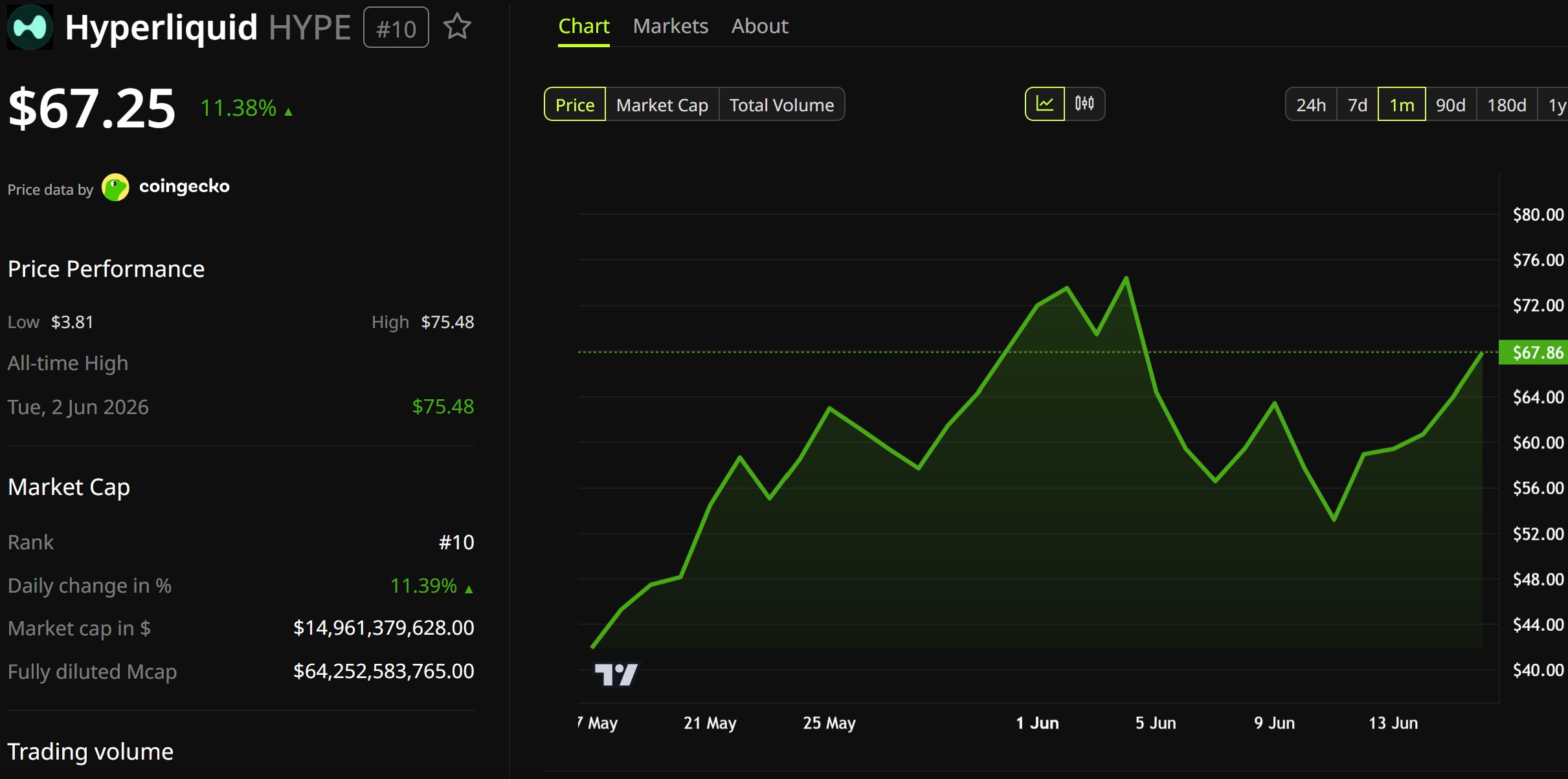
Hyperliquid’s HYPE token traded near $68, up almost 12% on the day. The rally held even as one of its marquee builders exited.

The wind-down leaves TradeXYZ with little competition in a young market.
Rivals emerging or one operator keeps control will shape Hyperliquid’s pre-IPO trading in the coming months.
The post Ventuals Exit Costs Hyperliquid Two High-Profile AI Markets appeared first on BeInCrypto.


A Polymarket trader known as “fishalive” turned roughly $427,000 into more than $4.7 million after Spain failed to beat Cape Verde at the 2026 World Cup, becoming one of the largest single trades on the platform.
The contrarian wager has stunned the football world and the prediction market space alike.
A Million-Dollar Wager on Prediction Market
Polymarket is a leading crypto-based prediction market where users buy “yes” or “no” shares on the outcomes of real-world events. In this case, “fishalive” took the “No” position against a Spain victory at odds reflecting just 9% probability before kickoff.
The user bought roughly $427,952 worth of “No Spain win” shares. After the market settled, the payout reached exactly $4,702,769.23, making it one of the most profitable single Polymarket trades of the entire 2026 World Cup.
The match was played on June 15, 2026, marking Spain’s debut at the FIFA World Cup hosted by the United States, Mexico, and Canada. The new 48-team format placed “La Roja” into Group H, where it faced debutant Cape Verde as the overwhelming favorite.
Follow us on X to get the latest news as it happens
Spain entered as a clear favorite across all major bookmakers and prediction platforms, with Polymarket odds above 90%.
However, La Roja failed to deliver the expected result. Cape Verde, organized and disciplined, secured at least one point in a result already considered historic.
Images of Spanish players showing frustration spread quickly across social media. As a result, the prediction market community immediately turned its attention to the “fishalive” trade, which had captured the unlikely outcome with remarkable precision.
What the Trade Says About Polymarket and the World Cup
The case shows the potential and the risk of prediction markets like Polymarket, which have already recorded massive volumes during the 2026 World Cup. Most participants bet heavily on Spain, with some users losing close to $1 million on the result.
“fishalive” took the contrary position with conviction. The profile has now become a trending account, even though the trader’s real identity remains unknown.
Experts note that trades like this require more than capital. They demand a deeper understanding of factors that algorithms and the broader public often underestimate, including opponent motivation, possible squad rotations, weather conditions, and the emotional drive of emerging African selections.
Cape Verde proved that no match is truly easy at a World Cup. For Polymarket, the moment reinforces its leading position in the sports prediction space, with billions already traded on tournament outcomes, including the overall champion market.
Spain and France remain the top favorites to win the entire tournament according to Polymarket data. Cases like “fishalive” generate viral attention and continue to attract new traders to the platform amid heightened World Cup activity worldwide.
Spain must now recover quickly. Group H also includes Uruguay and Saudi Arabia, and the path forward remains open despite the early stumble. With abundant talent, La Roja still has time to turn things around before facing the next round.
Subscribe to our YouTube channel to watch leaders and journalists provide expert insights
The post Polymarket Trader Turns $427,000 Into $4.7 Million on Spain World Cup Shock appeared first on BeInCrypto.


Veteran trader Peter Brandt said Bitcoin remains one of the clearest markets for classical chart analysis.
Summary
- Peter Brandt said Bitcoin still follows classical chart patterns better than many other markets.
- CryptoQuant data suggests whale selling slowed sharply as large holders resumed accumulation near $65,000 again.
- Bitcoin must reclaim $68,000 with stronger volume before the rebound looks safer for traders.
In a June 15 X post, he wrote, “There are few other markets that so neatly comply to understanding using classical charting principles as Bitcoin.”
Brandt’s weekly BTC chart showed several channels, wedges and consolidation areas across 2023 to 2026. The latest structure looked weaker, with Bitcoin trading near $65,261 and below the 18-week moving average around $71,253.
The chart also showed BTC breaking below a rising channel formed earlier in 2026. The ADX indicator stood near 28.27, pointing to a moderately strong trend. ADX does not show direction, but the break below the channel and moving average suggested stronger downside pressure.
CryptoQuant sees whale selling ease
CryptoQuant shared a different market signal. Its data showed that Bitcoin Inflow Coin Days Destroyed fell from 2.16 million to about 33,000, suggesting that older coins were no longer moving to exchanges at the same pace.
The earlier sell-off was most active in early June, when Bitcoin fell from about $71,300 to $63,800. That phase showed long-held coins moving into exchanges as large holders reduced exposure.
The latest data now points to renewed whale accumulation. More than 11,400 BTC, worth about $700 million, moved from exchanges to private wallets in recent days, according to the report shared by CryptoQuant.
Bitcoin rebound still faces resistance
As crypto.news reported, Bitcoin climbed above $65,500 on Monday after a U.S.-Iran peace deal eased oil and inflation fears. BTC traded above $66,000 at press time, up about 3% in 24 hours, with a daily high close to $65,893.
The rebound placed Bitcoin back near the upper end of the $60,000 to $65,000 support area. crypto.news noted that the next key area sits near $68,000, where sellers may try to slow the recovery.
Technical signals remain mixed. The same crypto.news report said Bitcoin still needs stronger volume above $68,000 to confirm demand. ETF outflows and broader market caution also remain factors for traders.
Two market readings shape the outlook
Brandt’s chart suggests Bitcoin may stay under pressure while it trades below the 18-week moving average and inside a weaker weekly structure. His view does not rule out a longer-cycle recovery, but it points to more patience before a confirmed upside break.
CryptoQuant’s whale data offers a more supportive signal. If large holders continue withdrawing BTC from exchanges, selling pressure may ease further. For now, Bitcoin’s next move depends on whether buyers can turn whale accumulation into a clean break above resistance.
A failed move could return focus to last week’s lows near the $60,000 zone again.
Disclosure: This article does not represent investment advice. The content and materials featured on this page are for educational purposes only.
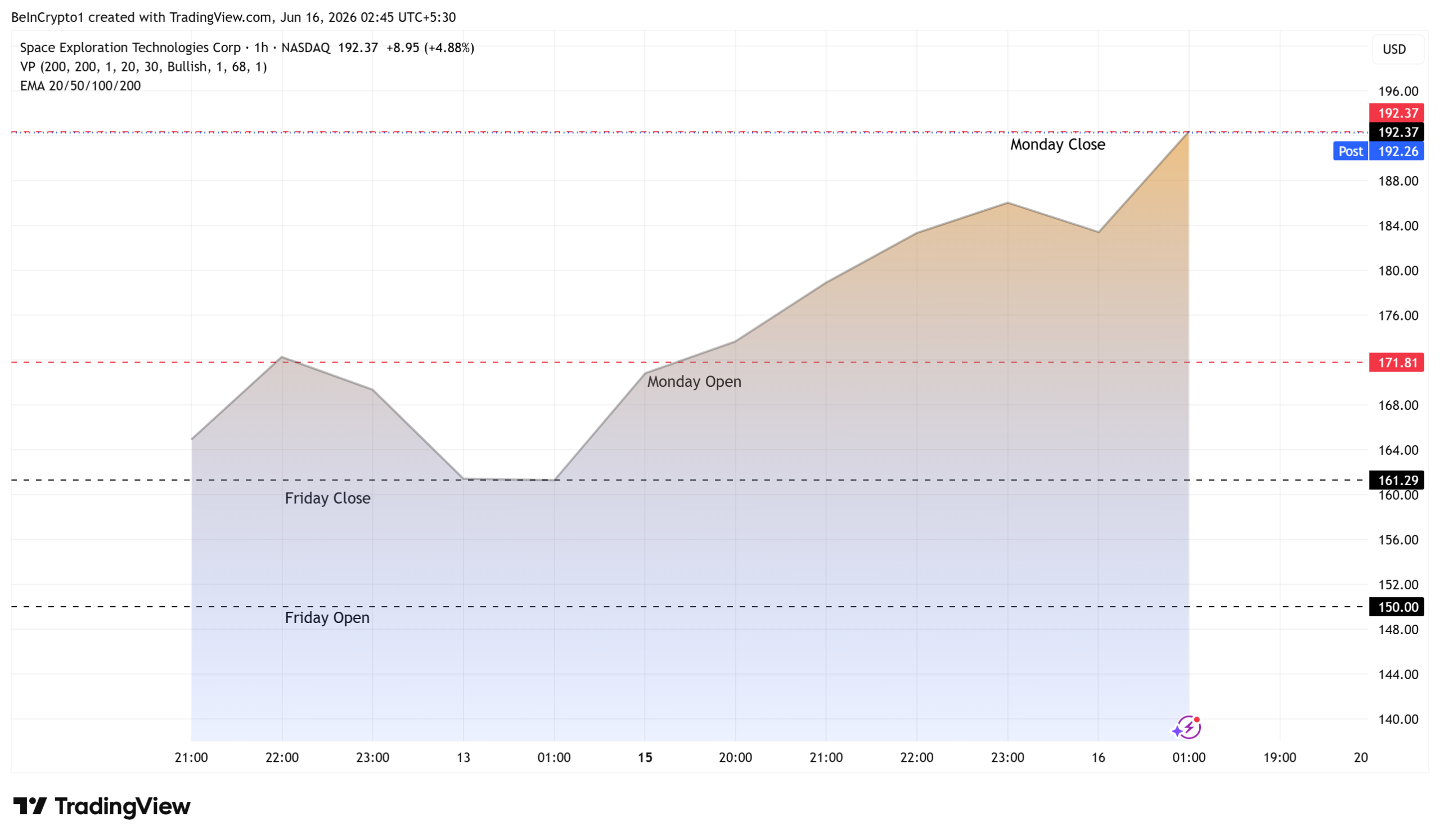
SpaceX (SPCX) extended its post-IPO climb into a second session on Monday, trading near $178 and lifting its two-day gain to roughly 32% above the $135 price set last week.
The advance kept investor focus on a fast-growing roster of leveraged exchange-traded funds built around the new ticker.

SpaceX Shares See A Second Day of gains
SPCX began trading on June 12 at $135 per share, raising about $75 billion in the largest initial public offering on record.
The deal, led by Goldman Sachs, drew roughly $250 billion in orders and closed about three and a half times oversubscribed before pricing.
It overshot the prior record, Saudi Aramco’s $29.4 billion listing in 2019, by about two and a half times.
The stock jumped roughly 19% on Friday to close at $160.95, then climbed to around $192 on Monday.
That left SpaceX valued near $2.3 trillion in its record Nasdaq debut, ranking it among the world’s most valuable listed companies and keeping Elon Musk’s standing as the first trillionaire on paper intact.
The size of that order book sits at the center of the open question beneath the rally, whether the second-session buying reflects durable demand or the froth that often trails a heavily oversubscribed deal.
ETF Issuers Pile In
GraniteShares listed its 2x Long SpaceX Daily ETF (SPAL) and a 2x Short version (SNK) on Monday, while Defiance brought its 2x long product (SPCU) to market the same day.
SPAL carries a net expense ratio of 1.50% and resets its exposure daily, which the issuer states makes it a short-term trading vehicle rather than a long hold.
They join earlier entries from ProShares, Direxion and Leverage Shares, part of a wave of about 25 SpaceX-linked filings submitted ahead of the listing.
Defiance’s earlier SPCL fund drew roughly $10 million in first-day volume and rose about 46% before SPCX itself began trading.
The launches extend a playbook that single-stock leveraged funds have followed since US regulators cleared them in 2022.
Direxion’s 2x Tesla fund (TSLL) and GraniteShares’ 2x Nvidia fund (NVDL) grew to about $6.5 billion and $4.4 billion in assets, a sign of how fast retail traders crowd into amplified bets on one name.
That same appetite now meets the SpaceX valuation debate, with the price far ahead of 2025 results.
Daily compounding means these funds can lose money even when SPCX rises over longer stretches, a risk that grows as more shares reach the market in the weeks ahead.
Not every fund chasing SpaceX is built for day traders. ARK Invest said it now holds SPCX across four active ETFs, ARKX, ARKQ, ARKK and ARKW, after first backing the company through its private ARK Venture Fund in 2023.
The firm picked up about 3.3 million shares worth roughly $444 million around the debut, and SpaceX stood at 11.38% of the Venture Fund’s net assets at the end of May, its largest holding.
The coming sessions will test whether the demand that powered the debut keeps buyers engaged, or whether the leverage now stacked on SPCX amplifies the first real pullback.
The post SpaceX Shares Rally for a Second Session as ETF Issuers Pile In appeared first on BeInCrypto.
Crypto World
Comparing Market Value of SpaceX Stock and Pepeto Shows Why a Presale Entry Beats the Biggest IPO in History
Comparing market value of SpaceX stock and Pepeto reveals something most investors have not stopped to calculate. SpaceX debuted on Nasdaq at $135 on June 12, closed at $170.54, and briefly touched $176.52, giving IPO holders a 19% gain on day one after raising $75 billion in the largest public offering ever, according to CNBC.
By every measure in traditional finance, that debut was historic. But comparing market value of SpaceX stock and Pepeto puts that 19% into a frame that makes it look small.
Pepeto sits at $0.0000001876 with $10.27 million raised, a working exchange already live, and a Binance listing ahead that analysts project could deliver 100x or greater. The IPO gave one day of returns. The presale gives a window to enter before the listing makes the biggest debut in market history feel small.
SpaceX raised $75 billion selling 555.6 million shares at $135, topping Saudi Aramco’s $29 billion record from 2019, according to CNBC. It holds 18,712 Bitcoin worth $1.29 billion, the eighth largest corporate BTC holder, and Saylor declared on June 13 that 25% of the Mag8 now holds Bitcoin, according to CoinDesk.
SpaceX and Pepeto both live in the world of capital formation, but the return profiles could not be further apart.
Pepeto: Why a Sub-Penny Presale Delivers What a $2.1 Trillion Stock Cannot
An IPO at $2.1 trillion is a milestone. It is also a ceiling, because doubling SpaceX needs another $2.1 trillion in fresh market cap. The investors who got in at the $135 IPO price saw 19% on day one, and the average analyst target sits at $164, roughly 2% above where it trades now. The story is real, but size makes the growth math slow.A presale works the opposite direction, with the entry before the listing, not after.
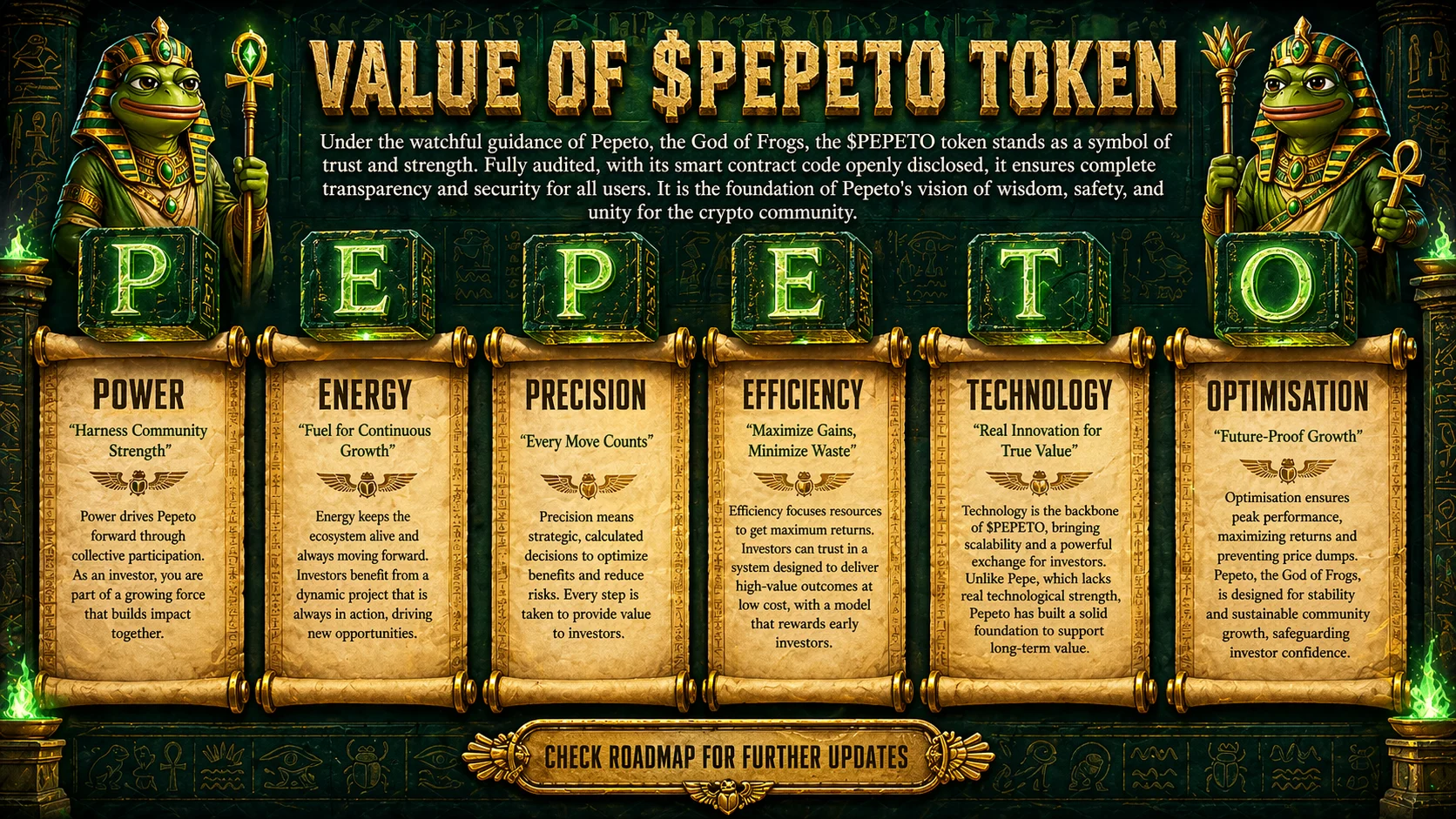
Pepeto sits at $0.0000001876 with a live exchange that handles every swap fee-free across Ethereum, BNB Chain, and Solana. The bridge transfers tokens between blockchains without deducting from the balance, the scanner reviews every token before capital gets exposed, and SolidProof audited the code before the presale opened.
Over $10.27 million flowed in while fear dominated the market. Staking at 170% APY compresses supply daily while the Binance listing approaches. The creator of the original Pepe token reached $11 billion with zero products, then built every smart contract powering this platform.
Comparing market value of SpaceX stock and Pepeto makes the gap clear, because a $2.1 trillion company offers single-digit upside while a presale at six decimal zeros offers a return that only exists before a listing prices it away.
SpaceX (SPCX) Stock at $170.54 as the Opening Day Energy Fades and Analyst Targets Sit Flat
The excitement is already cooling. SpaceX (SPCX) trades at $170.54 on June 14, down from its $176.52 intraday peak as normal price discovery replaces IPO adrenaline, according to Tradingview.
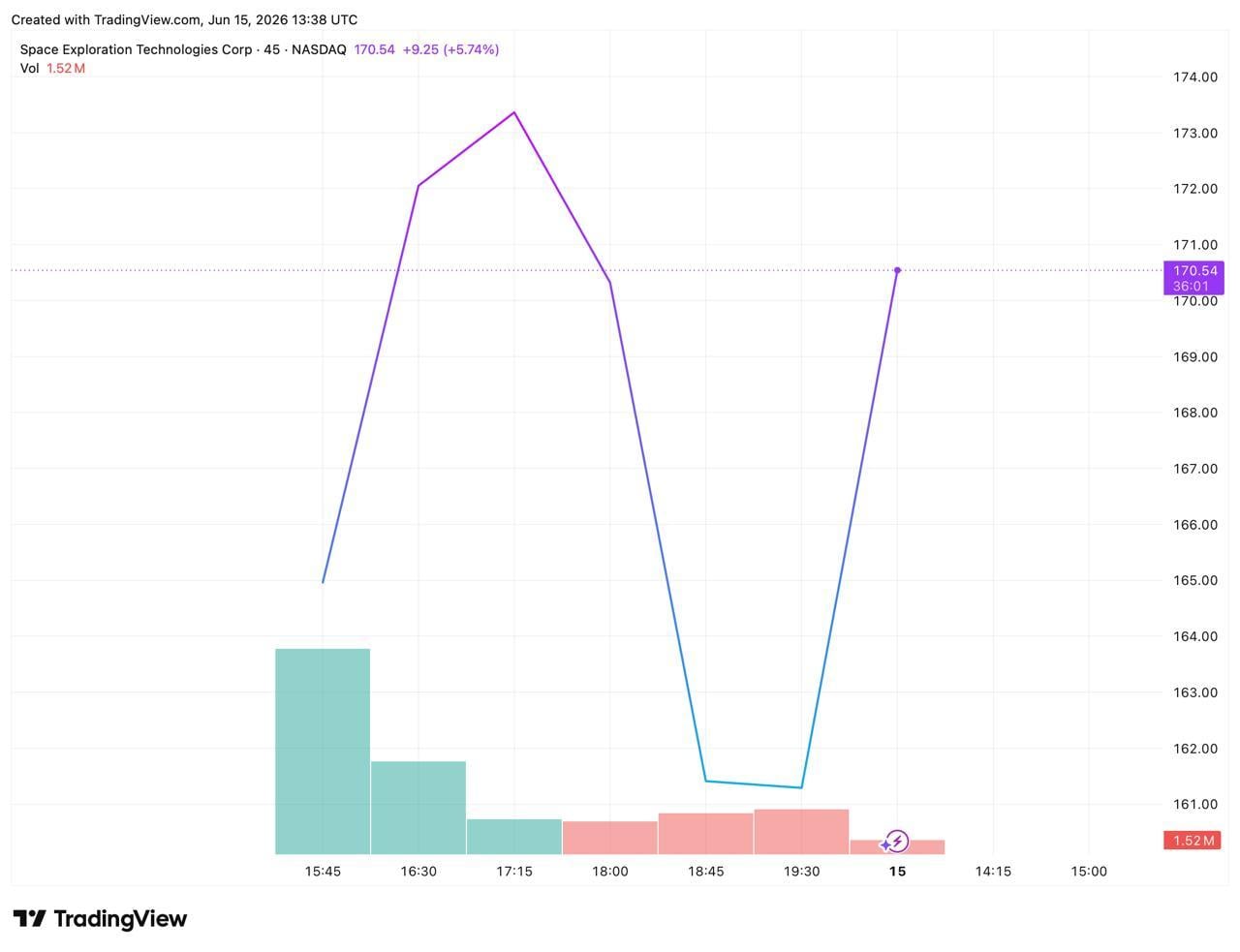
The average analyst target is $164, barely 2% above the current level, and SpaceX reported a $4.28 billion net loss last quarter. Starlink revenue drives the long-term case, but the valuation already bakes in years of growth. A $2.1 trillion company grinding 5% higher is a fine investment, not the kind of entry that changes anything.
Conclusion
Comparing market value of SpaceX stock and Pepeto puts the biggest IPO in history next to a presale targeting the kind of return no stock at any valuation can hand you, because SpaceX rewarded IPO holders with 19% on day one and analysts now see barely 2% more, a fine outcome unless what you are after is a number that multiplies. Pepeto offers that.
Three hundred dollars at $0.0000001876 is the kind of stake that turns into a down payment, a tuition check, or the start of something that was not on the table the week before. SpaceX holders will watch a chart drift a few percent either way, while the people who entered this presale will be telling the story over dinner. Visit Pepeto before the listing prices it away.
Click To Visit Pepeto Website To Enter The Presale

FAQs
How does comparing market value of SpaceX stock and Pepeto show the return gap?
SpaceX at $2.1 trillion gave IPO holders 19% with the analyst target at $164, roughly 2% above current levels. Pepeto at $0.0000001876 targets 100x from a single Binance listing.
Can Pepeto presale returns beat SpaceX stock gains based on the market value comparison?
Pepeto raised $10.27 million during Extreme Fear with live exchange tools, 170% APY staking, and the Pepe creator leading the build. The presale-to-listing math delivers multiples a $2.1 trillion valuation cannot generate.
Disclaimer: This is a Press Release provided by a third party who is responsible for the content. Please conduct your own research before taking any action based on the content.

Crypto World
How the World Cup is driving XRP into global payments, and how XRPPower helps users earn $4,770 daily


Disclosure: This article does not represent investment advice. The content and materials featured on this page are for educational purposes only.
With the 2026 FIFA World Cup approaching, digital payments rise as XRP gains attention for cross-border utility.
Summary
- As the 2026 World Cup drives global attention to digital payments, XRP gains focus for real-world cross-border use.
- XRPPower uses on-chain verification, AI risk control, and enterprise audits to improve transparency, security, trust.
- XRPPower’s AI-driven XRP/BTC Smart Participation Model targets long-term value and passive income opportunities.
With the 2026 FIFA World Cup drawing global attention, digital payments and cross-border finance have once again become market focal points. Leveraging its advantages in global payments, XRP is gaining increasing recognition from institutions and users, and market focus is gradually shifting from short-term price fluctuations to its practical application value.
Simultaneously, more and more users are seeking participation methods that don’t entirely rely on market fluctuations, hoping to achieve long-term value through a smarter, more efficient digital ecosystem.
In response to this trend, XRPPower has launched the XRP/BTC Smart Participation Model, combining artificial intelligence technology with the digital asset ecosystem to provide users with a more convenient digital experience and help more XRP holders explore new opportunities for passive income in the digital finance era.
Why users are paying attention to XRPPower’s AI-powered smart ecosystem
1. A More Transparent Data System
XRPPower adopts an on-chain data recording and verification mechanism, supporting querying, tracing, and verification of key data, further enhancing platform transparency and user trust.
2. International Audit and Management Standards
To continuously enhance operational transparency and ecosystem credibility, XRPPower actively references the management frameworks and audit standards of international professional institutions and has brought in professional teams, including PwC, for evaluation and optimization, continuously improving risk management, operational processes, and user protection systems.
3. Enterprise-Grade Security Protection
The platform integrates SSL/TLS encrypted transmission, DDoS attack protection, real-time risk monitoring, and intelligent early warning mechanisms to build a multi-layered security architecture, providing comprehensive protection for user accounts, data, and assets.
4. AI-Driven Intelligent Risk Control
Leveraging artificial intelligence analysis technology and automated monitoring systems, XRPPower can identify abnormal behavior and potential risks in real time, continuously improving platform operational efficiency and security stability, providing global users with a more reliable digital service experience.
How to join XRPPower and start the smart earnings program?
1. Register an exclusive account
Quickly register using an email address and easily begin the XRPPower digital experience journey.
2. Choose a suitable smart contract
Based on personal needs and financial plans, choose an XRP/BTC smart contract plan and a suitable participation period.
3. Activate and connect to the system
After activating a plan, connect to the XRPPower AI smart system and begin participating in the platform’s digital ecosystem.
4. View account dynamics in real time
During system operation, you can view your account data, earnings records, and asset status at any time through a personal backend, enjoying a more convenient and efficient digital management experience.
Some popular contracts
Investment Amount: $5,000, Contract Period: 15 days, Daily Earnings: $70.50, Total Earnings: $1,057.5, Principal $5,000 Refunded at Maturity.
Investment Amount: $10,000, Contract Period: 20 days, Daily Earnings: $153, Total Earnings: $3,060, Principal $10,000 Refunded at Maturity.
Click to View More Different Contracts
About XRPPower
XRPPower is a platform focused on artificial intelligence, digital asset ecosystem, and intelligent technology services. With its secure, transparent, and compliant operating philosophy, along with its continuously upgraded technical architecture and global service network, the platform has covered 189 countries and regions worldwide, accumulating over 3 million users.
By integrating AI intelligent systems, digital financial infrastructure, and global operational capabilities,
XRPPower is actively driving digital ecosystem innovation, providing global users with a safer, smarter, and more efficient digital service experience.
For more information, visit the official website.
Disclosure: This content is provided by a third party. Neither crypto.news nor the author of this article endorses any product mentioned on this page. Users should conduct their own research before taking any action related to the company.


Kraken has launched perpetual futures for eligible U.S. clients through a CFTC-regulated venue, bringing a product that generated more than $60 trillion in global crypto trading volume in 2025 onto its U.S. platform.
Summary
- Kraken has launched perpetual futures for eligible U.S. clients through its CFTC regulated derivatives business, Bitnomial.
- U.S. traders can now access spot, margin, futures and perpetual contracts from a single Kraken Pro account.
- The launch follows recent regulatory approvals that have brought crypto perpetual futures products back into the U.S. market.
According to a June 15 announcement from Kraken, eligible U.S. users can now trade perpetual futures on Kraken Pro alongside spot, margin and traditional futures products, allowing them to manage multiple trading strategies within a single account.
Perpetual futures have become the dominant product in crypto derivatives markets because they trade continuously and do not expire. Industry data cited by crypto.news previously showed perpetual contracts accounted for $61.7 trillion in trading volume during 2025, making up most activity across the sector.
Unlike traditional futures contracts that settle on a specific date, perpetuals allow traders to maintain positions indefinitely while funding payments help keep prices aligned with the underlying asset.
Kraken brings perpetual futures onshore through Bitnomial acquisition
Central to the launch is Kraken’s acquisition of Bitnomial, a CFTC-licensed derivatives platform purchased earlier this year by parent company Payward.
Kraken said Bitnomial holds exchange, clearinghouse and brokerage licenses, enabling the company to offer perpetual futures to eligible U.S. clients within the CFTC’s regulatory framework. Through the integration, traders can use the same collateral pool across perpetual futures and other derivatives positions rather than moving assets between separate venues.
Arjun Sethi, co-CEO of Payward and Kraken, said the exchange’s objective was to place spot, margin, futures and perpetual contracts within a single account structure so traders do not need to spread capital across multiple platforms.
John Palmer, Kraken’s global head of derivatives, said traders previously faced operational challenges because perpetual futures and other positions often had to be managed on different venues. He said Kraken’s new setup allows clients to access both from one account and through a single counterparty.
The launch comes days after rival exchange Coinbase announced approval to provide access to global crypto perpetual futures liquidity for U.S. users.
As reported by crypto.news on June 11, Coinbase CEO Brian Armstrong said the approval would allow American traders to access a market that had largely developed outside the United States due to regulatory restrictions. Coinbase also stated that its structure would connect domestic users to global liquidity through Deribit, the derivatives exchange it acquired earlier this year for $2.9 billion.
Both developments arrive as U.S. regulators have begun allowing regulated access to products that were historically concentrated on offshore platforms, giving domestic traders new ways to participate in crypto derivatives markets while remaining within U.S. compliance requirements.
The odds of securing a July 4 signing for the CLARITY Act have narrowed, with lawmakers, industry groups, and market observers increasingly turning their attention to the August recess.
Summary
- Many lawmakers and industry participants now see the August recess as a more realistic target for the CLARITY Act than July 4.
- Unresolved ethics negotiations and Senate procedural hurdles continue to slow the bill’s progress.
- Coinbase, Ripple, and other industry groups remain supportive as momentum for the legislation continues.
According to reporting from Crypto In America, many policymakers and industry participants now view August as the more realistic benchmark for advancing the Digital Asset Market Clarity Act, despite continued support from the White House for an Independence Day deadline.
At Consensus Miami in May, White House Crypto Council Executive Director Patrick Witt said the administration was working toward passage by July 4, describing the legislation as a potential birthday gift for the United States as it prepares to celebrate its 250th anniversary.
Witt reiterated that optimism in comments to crypto journalist Eleanor Terrett on Friday, citing ongoing efforts to resolve Agriculture Committee language, negotiate ethics provisions with Democrats, and address law enforcement concerns tied to illicit finance measures.
Yet the legislative path remains demanding. As outlined by Terrett on Monday, the Senate must still merge separate versions approved by the Banking and Agriculture Committees, secure 60 votes to advance debate, clear additional cloture votes on amendments, and pass the final measure before sending it to the House for approval of any Senate changes.
Limited Senate calendar complicates July target
Legislative timing has become one of the biggest obstacles facing the bill.
“But even if all of those outstanding issues were resolved this week, there simply isn’t enough time left on the legislative calendar to make a July 4 signing logistically possible,” Terrett wrote on Monday.
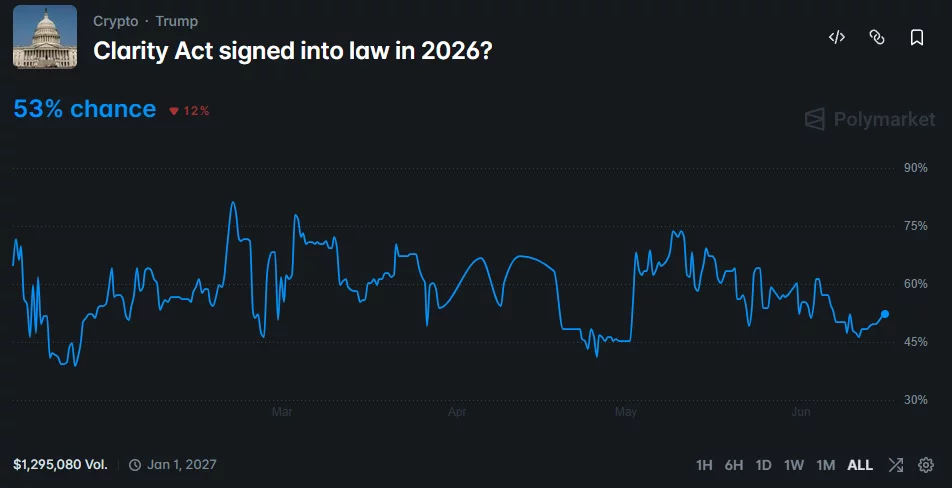
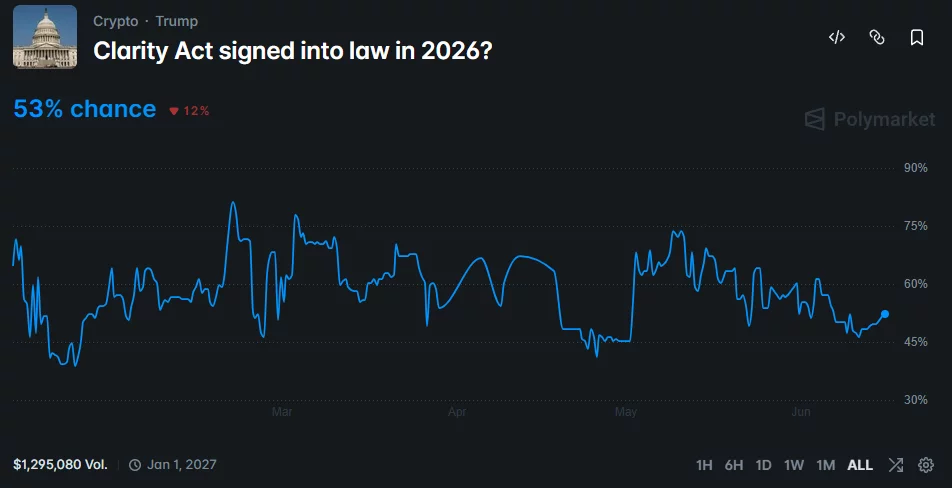
According to prediction market platform Polymarket, the odds of the CLARITY Act becoming law in 2026 have fallen to 53%, down from about 75% in May.
The timeline has become more challenging because several negotiations remain unfinished. According to Crypto In America, talks over ethics provisions sought by Democrats have been difficult, while other policy questions continue to be debated between lawmakers.
Senator Cynthia Lummis of Wyoming, one of the bill’s leading architects, previously told Terrett’s newsletter that combining the committee proposals, ethics language, and related changes tied to the GENIUS Act into a single package and obtaining the required 60 votes could take longer than the July 4 target allows.
The legislation has nevertheless made measurable progress. The Senate Banking Committee advanced the bill with bipartisan backing, while two Democratic members supported the measure on the condition that stronger ethics safeguards linked to President Donald Trump were incorporated into the final text.
Industry support remains strong despite delays
The CLARITY Act remains one of the most significant crypto market structure proposals considered by Congress. The legislation would establish clearer jurisdictional boundaries for digital assets, placing decentralized cryptocurrencies such as Bitcoin and Ethereum under the oversight of the Commodity Futures Trading Commission while leaving qualifying securities under securities regulators.
Beyond market classification, the bill contains provisions covering stablecoins, anti-money laundering compliance, decentralized finance activities, and blockchain validators. As reported by crypto.news earlier, more than 200 crypto organizations, including Coinbase and Ripple, recently urged lawmakers to advance the legislation.
Additional pressure comes from competing congressional priorities. According to Crypto In America, lawmakers must also address a bipartisan housing package, the nomination of former SEC Chair Jay Clayton as Director of National Intelligence, and the reauthorization of FISA Section 702.
Despite the delays, some observers believe the bill retains enough political support to continue moving forward. Adam Minehardt of the Hyperliquid Policy Center told Crypto In America that the amount of political capital already invested in the legislation makes it unlikely to disappear from the congressional agenda, even if the July 4 target is missed.
Disclosure: This article does not represent investment advice. The content and materials featured on this page are for educational purposes only.


The Blockchain Association brought member executives to Capitol Hill this week and reported meeting with more than half the Senate, pressing lawmakers to preserve a key developer-protection provision of the Digital Asset Market CLARITY Act before an August recess deadline tightens the floor-vote… Read the full story at The Defiant


Anthropic has been hit with a proposed class-action lawsuit alleging that subscribers paying up to $200 per month for premium Claude plans have received significantly less usage than the company’s marketing materials suggested.
Summary
- Anthropic faces a proposed class-action lawsuit alleging its Claude Max subscription plans provide less usage than advertised.
- Plaintiff Karl Kahn claims premium subscribers encounter restrictive usage caps that disrupt coding and development work.
- The lawsuit arrives shortly after Anthropic’s Fable 5 and Mythos 5 shutdowns, adding to scrutiny surrounding the AI company.
According to a complaint filed Monday in the U.S. District Court for the Northern District of California, Washington, D.C. resident Karl Kahn is seeking class-action status on behalf of customers who have paid for Anthropic’s higher-tier Claude subscriptions since April 2024.
The filing argues that the company’s Max 5x and Max 20x plans do not provide the level of access many users would reasonably expect from their advertised terms.
At the center of the dispute are Anthropic’s premium subscription tiers, which cost $100 and $200 per month. According to the lawsuit, the company promotes those plans as offering five times and 20 times the usage available under its standard Pro subscription.
The complaint alleges that the actual limits imposed on subscribers fall well below those advertised multipliers and are difficult for customers to predict before reaching usage caps.
Kahn claims he upgraded to the Max 20x plan after increasing his use of Claude for software development and coding tasks. According to the filing, a single five-hour work session consumed roughly 15% of his weekly allowance.
The lawsuit argues that such restrictions forced subscribers to either stop working, ration their usage, or purchase additional access to complete projects.
The complaint focuses on premium subscription limits
Supporting its claims, the lawsuit references emails Anthropic allegedly sent to subscribers in July 2025. According to the complaint, those communications outlined expected weekly usage allowances across different Claude models and subscription tiers.
The plaintiff argues that those disclosures demonstrate a gap between how the plans were marketed and the access ultimately provided.
As a result, the filing asks the court to determine that Anthropic’s marketing practices were misleading or fraudulent and seeks relief for affected subscribers. The case arrives as the company continues to attract investor attention ahead of a widely anticipated public offering.
Legal scrutiny is not limited to Anthropic. Recently, OpenAI faced a multistate investigation related to alleged consumer harm connected to ChatGPT. The probe gained attention because it emerged shortly after reports that OpenAI had confidentially filed paperwork related to a potential IPO.
Anthropic faces pressure from multiple fronts
The lawsuit adds another challenge for Anthropic only days after the company drew attention for a separate controversy involving access to its advanced AI models.
As previously reported by crypto.news, Anthropic suspended access to its Fable 5 and Mythos 5 models after complying with a U.S. government directive tied to export controls.
According to Anthropic, the order required restrictions on foreign nationals, including foreign-national employees located both inside and outside the United States. To comply, the company disabled access to both models while keeping other Claude models available.
Commenting on that decision, CoinFund founder Jake Brukhman argued recently that advanced AI models have become key points of centralized control.
According to Brukhman, decentralized AI networks are attracting interest because access to large-scale computing resources can be distributed rather than concentrated within a small number of companies.
Brukhman cited projects including Gensyn, Prime Intellect, Bagel, Pluralis, Nous Research, Macrocosmos AI, and Covenant as examples of teams working on distributed AI training systems. According to his post, those efforts suggest decentralized training can compete with centralized approaches, although technical challenges remain.
Meanwhile, the newly filed lawsuit places Anthropic’s subscription business under a different form of scrutiny as the company navigates both regulatory and consumer-facing disputes.

‘This simple bedtime trick helped me sleep for the first time in 4 days’

GIC shares decline 6% as Rs 3,088 crore OFS opens at 9% discount

Ventuals Exit Costs Hyperliquid Two High-Profile AI Markets


-

 Business2 days ago
No Jackpot Winner as $257 Million Prize Rolls Over to $269 Million Monday Draw
-

 Crypto World5 days ago
Oppenheimer backs SpaceX as $70 billion retail frenzy builds
-

 Crypto World4 days ago
Markets Rally as SpaceX IPO Looms Amid Iran Tensions and Inflation Surge
-

 Fashion3 days ago
Weekend Open Thread: Tuckernuck – Corporette.com
-
 Crypto World1 day ago
Zimbabwe Requires Crypto Businesses to Register Annually Under New FIU Regulations
-

 Entertainment7 days ago
The Ryan Gosling True Crime Thriller On Netflix That Gets Even Stranger, Stream It Now
-

 Tech3 days ago
NanoClaw integrates JFrog registries to secure AI agent downloads
-
 Sports7 days ago
Bangladesh beat Australia after 20 years in ODIs, register only their second win over six-time world champions | Cricket News
-

 Crypto World3 days ago
Bitget enters Argentina’s regulated crypto market through PSAV registration
-

 Tech4 days ago
This Week In Security: Microsoft On Microsoft, Register Your Domains, Linux On ARM, And FreeBSD Joins The File Cache Club
-
 Tech5 days ago
Dutton Ranch star claims they ‘didn’t see any disruption’ on set following Chad Feehan’s exit from Yellowstone spinoff fueled by Taylor Sheridan clash rumors
-

 NewsBeat4 days ago
El Nino has formed in the Pacific and could set records, forecasters say
-

 Politics5 days ago
Politics Home | Healey Resignation Is “Colossal Failure Of Government”, Says Former Labour Defence Secretary
-

 Tech6 days ago
‘This is Seattle’s position on AI’: City Council votes unanimously to pause big new data centers
-

 Business6 days ago
Thailand Ranks Second Worldwide for AI Adoption Growth, Microsoft Reports
-
 Entertainment4 days ago
Donnie Wahlberg & More Heat Up Las Vegas at Circa’s Barry’s Downtown Prime
-

 Sports5 days ago
First Time Since 1971: Australia Register Historic Low In ODI Cricket
-
 Tech4 days ago
Opendoor Ends India Operations, Fueling a Bigger Conversation About AI and Outsourcing
-

 Politics5 days ago
Belfast burns, while Met chief points finger at Iran and Russia
-

 Business5 days ago
AT&T: Verizon's 27% Outperformance Sets Up A Solid Entry Point
You must be logged in to post a comment Login