
Crypto World
Japan‘s Financial Watchdog Flags KuCoin for OTC Derivatives Transactions

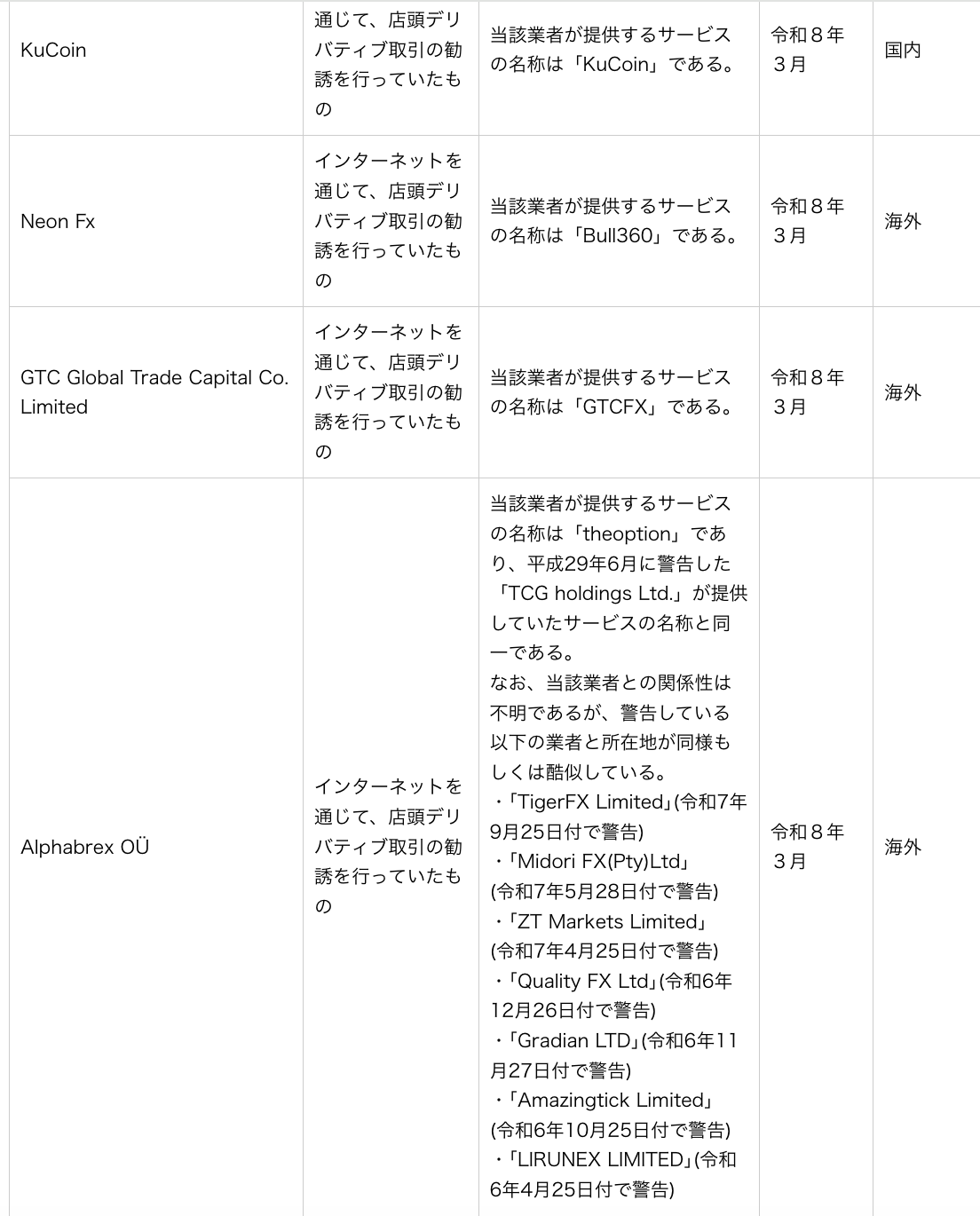
The crypto exchange has previously been in the crosshairs of Japanese regulators for offering products and services without the proper registration.
Japan’s watchdog overseeing many activities for cryptocurrency exchanges, has issued warning letters to companies including KuCoin for conducting certain operations without registering, according to a Thursday update from the Financial Services Agency (FSA).
According to the agency’s latest list of entities “conducting financial instruments business without registration,” the FSA said platforms KuCoin, NeonFX, theoption, and GTCFX received a March notice for “soliciting over-the-counter (OTC) derivatives trading via the internet.” Of the four platforms, the FSA listed KuCoin, which is headquartered in the Seychelles, as offering services to Japanese residents, while the others have an international user base.

The FSA issued a similar warning to KuCoin and other exchanges, including Bybit, in November 2024 for offering products and services to Japanese residents without proper registration. In February 2025, the financial watchdog sent requests to Apple and Google for the companies to suspend downloads of KuCoin’s app.
Japan has a high concentration of crypto users. The FSA reported in February 2025 that there were more than 12 million accounts among a population of about 123 million. The country ranked 19th in Chainalysis’s 2025 Global Crypto Adoption Index.
Cointelegraph reached out to KuCoin for comment, but had not received a response at the time of publication.
Related: Austria’s regulator slaps new business ban on KuCoin’s EU exchange
The FSA’s notice comes as the financial watchdog prepares to shift Japan’s legal framework from the country’s Payment Services Act to the Financial Instruments and Exchange Act. The change would significantly alter reporting requirements for initial exchange offerings and token issuers, and provide regulators with greater enforcement authority over unregistered platforms.
Japan’s PM denies involvement in memecoin project
Sanae Takaichi, who has served as the prime minister of Japan since October 2025, publicly denied connections to the “Sanae token” earlier this month after the project grew to a market value of about $28 million before falling sharply. The FSA was reportedly considering an investigation into the matter.
Magazine: Are DeFi devs liable for the illegal activity of others on their platforms?



Bitcoin mining margins remain under pressure as lower revenue and higher operating costs narrow the list of viable operators.
Summary
- CoinShares said falling hashprice has pushed part of the Bitcoin mining fleet below profitability levels.
- Older mining machines face the most pressure as electricity costs rise above sustainable operating thresholds.
- Bitcoin difficulty dropped sharply in March, offering some relief while miner margins remained under pressure.
A new CoinShares report says part of the global mining fleet now sits below profitability, with older machines and higher power costs facing the most pressure.
CoinShares said Q4 2025 was the hardest quarter for Bitcoin miners since the April 2024 halving. The firm said lower Bitcoin prices and near-record network hashrate pushed hashprice to five-year lows and lifted the weighted average cash cost to produce one Bitcoin among listed miners to about $79,995 in Q4 2025.
The report said hashprice dropped further to about $29 per PH/s/day in Q1 2026. CoinShares added that current mining economics do not support a broad hardware refresh cycle, as weaker returns continue to pressure balance sheets and daily cash flow across the sector.
CoinShares said the current revenue level makes several machine models unworkable at common power rates. The report stated that any miner running hardware below an S19 XP at electricity costs of 6 cents per kilowatt-hour or more is losing money at a hashprice near $30 per PH/s/day.
The firm estimated that this group accounts for about 15% to 20% of the global Bitcoin mining fleet. That places the current squeeze on operators with older fleets, weaker efficiency, or less favorable power agreements, while larger miners with newer hardware and cheaper energy retain more room to operate.
Moreover, hashrate Index said USD hashprice rose 4.9% in the week to March 23, reaching $33.65 per PH/s/day from $32.08. Even so, the same report said that at about $33 per PH/s/day, hashprice remains at or below breakeven for many miners depending on machine type and operating costs.
The network has already started to reflect that strain. Hashrate Index said Bitcoin’s latest difficulty adjustment on March 20 cut difficulty by 7.76% to 133.79 trillion, reducing the work needed to mine a block and giving some relief to miners that stayed online.
CoinShares sees more stress if Bitcoin stays below key levels
CoinShares head of research James Butterfill said,
“If prices were to stay below US$80k for the remainder of the year, we forecast the hashprice to continue to fall.”
He added that in that scenario, “the hashprice would more likely flatline” as miners switch off unprofitable rigs and network hashrate falls.
CoinShares also said higher-cost miners may face more capitulation in the first half of 2026 unless Bitcoin recovers. The report said the sector is moving toward operators with structural advantages, including low-cost power, better machine efficiency, and the ability to shift part of their business toward AI and data center services.


The crypto market fell 2.5% on Friday to $2.45 trillion as hopes of an end to the ongoing U.S. Iran war faded.
Summary
- Crypto market cap fell 2.5% to $2.45 trillion as geopolitical tensions rose after Iran rejected a U.S. proposal to end the conflict.
- Bitcoin dropped to $69,445 while Ethereum slid 4.4%, triggering over $193 million in long liquidations across derivatives markets.
- Rising oil prices and sustained Fed rate expectations weighed on risk sentiment, pressuring cryptocurrencies and global equities.
According to data from crypto.news, Bitcoin (BTC) price dropped 2.5% on the day to $69,445 at the time of writing as bulls failed to defend the $70,000 psychological support. Ethereum (ETH) was hit harder, falling 4.4% to $2,080, while other major altcoins such as BNB (BNB), XRP (XRP), Solana (SOL), and Dogecoin (DOGE) saw losses ranging between 3% and 5%, respectively.
As crypto prices fell, it triggered a massive unwinding of bullish long positions from traders in the crypto derivatives markets. Data from CoinGlass shows that over $193 million in long positions were liquidated from the crypto market in the past 24 hours. Out of this, Bitcoin accounted for $48.93 million while Ethereum saw $75.93 million in long liquidations.
Liquidations occur when a trader’s margin account can no longer support their open positions due to significant price moves. When longs get liquidated, they are forced to sell their assets, which creates further downside pressure on prices.
The crypto market downturn began after Iranian state media reported that Iranian officials had rejected a U.S. proposal to end the ongoing conflict between the two nations in the Middle East. This sparked uncertainty and deteriorated investor appetite for risk assets.
Asian tech stocks such as Japan’s Nikkei 225, Hong Kong’s Hang Seng, and South Korea’s KOSPI dipped lower on Friday shortly after the news broke. Even gold, touted as a safe haven asset amid times of economic stress, also fell 2.9% over the day to under $4,500. Silver fell 6% to $68.
Meanwhile, crude oil prices regained strength as the Strait of Hormuz remained closed for the fourth consecutive day. WTI crude futures rose 3.3% above $93 per barrel on Friday, while Brent oil rose 3.7% to above $106.
The closure of the key maritime bottleneck has severely disrupted global oil flows, resulting in the loss of millions of barrels of daily supply. This has sparked concerns of surging inflation and a supply chain crisis that could ultimately further push back hopes for Federal Reserve rate cuts this year.
According to the CME Group FedWatch tool, the odds of the Federal Reserve holding interest rates steady at 3.5% to 3.75% remain at 93.8%, while 6.5% expect a 25 basis point rate hike.
Risk assets, including cryptocurrencies, have often rallied when liquidity is high, or the market expects a rate cut, and typically decline when the central bank maintains a hawkish stance on monetary policy.
Disclosure: This article does not represent investment advice. The content and materials featured on this page are for educational purposes only.


Circle has reversed part of its recent USDC enforcement action after one of the 16 frozen wallets regained access to funds.
Summary
- Circle restored access to one frozen wallet, easing pressure after criticism over its broader freeze.
- ZachXBT said the unfrozen address linked to Goated.com held about 130,966 USDC after restoration.
- The partial reversal kept attention on Circle’s process as transparency concerns around the case persisted.
The move has shifted attention from the initial freeze to Circle’s review process, as public questions continue over how the company handled the case.
On-chain investigator ZachXBT said Circle unfroze the wallet address “0x61f…e543,” which he linked to Goated.com. Data cited in current reporting showed the wallet held about 130,966 USDC after access was restored.
ZachXBT also said other affected wallets could be restored soon. That update followed Circle’s earlier action against 16 wallets tied to separate business operations, including exchanges, casinos, and foreign exchange platforms.
Earlier reports said the freeze was linked to a sealed US civil case. At the same time, public reporting said the targeted wallets appeared to belong to unrelated businesses, with no clear public explanation for why all 16 were included in one action.
ZachXBT criticized the decision in strong terms. He wrote,
“In my 5-plus years of investigations, it could potentially be the single most incompetent freeze I have seen.”
He also said Circle had “zero basis” to freeze the funds tied to the case.
In addition, the partial unfreeze has kept the wider debate alive around how centralized stablecoin issuers handle enforcement. Market observers said restoring one wallet does not fully answer the questions raised by the earlier blacklisting.
MetaMask security researcher Taylor Monahan also called for stronger investigative standards and accountability when issuers freeze user funds. Current reporting said she pointed to the need for clearer review procedures when court-backed actions affect active business wallets.
The case has renewed attention on the powers built into centralized stablecoins such as USDC. Public reporting noted that Circle can block addresses, a feature supporters link to compliance needs and critics link to control over user funds.


Disclosure: This article does not represent investment advice. The content and materials featured on this page are for educational purposes only.
Bitcoiners have long theorized the sort of black swan events that could cripple the cryptocurrency network, rendering it unusable. Scenarios postulated range from nuclear apocalypse to a catastrophic internet failure – either of which would of course affect humanity in much more tangible ways than merely their ability to transact onchain.
One of the greatest threats envisaged, and which is now being routinely discussed, concerns the specter of quantum computing. Once sufficiently powerful quantum machines arrive, doomsdayers warn, cryptography could collapse overnight, affecting not just Bitcoin but most blockchains as well as traditional banking and web security.
The reason why this fear has gained mindshare, while other black swans – alien technology, say, or Satoshi’s 1M dormant bitcoins being reactivated – haven’t is because the quantum threat has a realistic chance of materializing. Indeed, many would say it’s inevitable and that it’s just a question of when it arrives.
Are we talking years or decades? If it’s the latter, there’s ample time for the world to migrate to quantum-proof systems. If it’s the former, then Houston we have a problem. Which is why it makes sense to head it off now so that when that day arrives, the world is ready and has implemented solutions to prevent digital assets and the distributed ledgers on which they run from being compromised.
As a result, researchers are increasingly paying attention to cryptographic systems that are quantum-resistant, ensuring they remain secure even in a world where quantum computers exist. Fully Homomorphic Encryption (FHE) falls firmly into this category, which is one of the primary reasons why it’s attracting growing interest across Web3 and traditional computing.
To understand why, we need to unpack the quantum threat and examine how FHE’s underlying mathematics differ from the cryptography most blockchains rely on today.
The Quantum Computing Problem
Most people don’t understand quantum computing at a deep level, which is unsurprising given its complexity. But they do understand the significance of the threat it presents. As you’re likely aware, traditional computers process information as bits that exist in one of two states, 0 or 1. Quantum computers use quantum bits, or qubits, which can exist in multiple states simultaneously thanks to a property known as superposition.
Without going too far down the physics rabbit hole, the practical implication is that certain problems which would take classical computers thousands or millions of years to solve can theoretically be solved far faster on a quantum machine. This matters because many widely used encryption systems depend on mathematical problems that are easy to compute in one direction but extremely difficult to reverse.
Two of the most important examples are RSA encryption, which relies on the difficulty of factoring large prime numbers, and Elliptic Curve Cryptography (ECC), which relies on the difficulty of solving discrete logarithm problems. Both of these are vulnerable to a quantum algorithm known as Shor’s Algorithm, which can efficiently solve the mathematical problems that secure them, and ECC is particularly relevant to blockchain because it forms the backbone of most crypto wallet security.
Why Blockchain Could Be Vulnerable
In most blockchain networks, control of funds ultimately comes down to possession of a private key. When you send a transaction, the network verifies that you own that key by checking a digital signature derived from elliptic curve cryptography. Under classical computing assumptions, deriving the private key from the public key is computationally infeasible.
But with sufficiently powerful quantum hardware running Shor’s Algorithm, that equation changes. A quantum attacker could theoretically derive the private key from the public key, allowing them to forge signatures and potentially drain wallets.
This doesn’t necessarily mean the threat is imminent. Current quantum computers remain far too small and error-prone to perform these attacks at scale. But cryptography operates on long time horizons and assets stored on a blockchain today need to remain secure decades into the future – which brings us back to FHE.
Why FHE is naturally Quantum-Resistant
Fully Homomorphic Encryption is built differently. That’s because most modern FHE implementations rely on lattice-based cryptography, which is based on the difficulty of solving problems involving high-dimensional geometric structures called lattices.
In simple terms, the challenge involves solving large systems of equations that include small amounts of noise or randomness. For classical computers, solving these problems efficiently is extremely difficult and – critically – no known quantum algorithms can solve them dramatically faster.
This makes lattice-based systems among the leading candidates for post-quantum cryptography, and organizations such as the U.S. National Institute of Standards and Technology (NIST) have selected several lattice-based algorithms as future cryptographic standards.
Because most FHE schemes are built on these same mathematical foundations, they inherit the same resistance to quantum attacks. In other words, FHE wasn’t originally designed as a quantum defense mechanism but the mathematics it relies on happens to align with the direction post-quantum cryptography is moving.
What this means for Blockchain
Quantum resistance is particularly important for blockchain systems because they’re designed to be enduring infra. We don’t know what one bitcoin will be worth in 20 years, but we’d like to have the confidence that it will be worth something and thus worth holding as a long-term investment – as well as ultimately bequeathing to our descendants.
Which is another reason why it’s important to be thinking about quantum computing now. It’s also worth noting, at this juncture, that blockchains can’t simply swap out cryptographic systems overnight. Their security assumptions are embedded into everything from consensus mechanisms to wallet architecture.
If a widely used cryptographic primitive becomes vulnerable, migrating an entire blockchain ecosystem would be – as Bane would put it – extremely painful. This is why the industry has begun circling FHE.
Because it allows computation on encrypted data and relies on quantum-resistant mathematics, FHE offers a pathway to privacy-preserving blockchain systems that are also post-quantum secure. This is particularly relevant for applications involving sensitive financial data.
The role of FHE in private DeFi
One of the most promising uses of FHE in blockchain today is encrypted decentralized finance. Public blockchains are of course transparent by design, and while this transparency is valuable for verification, it creates problems in financial markets where strategies and wallet balances become visible to everyone.
Fully Homomorphic Encryption addresses this by allowing smart contracts to operate on encrypted balances. For example, a lending protocol can verify that a borrower has enough collateral to secure a loan without revealing the exact amount and liquidation thresholds can remain hidden, preventing traders from targeting vulnerable positions. Encrypted lending models built on FHE demonstrate how smart contracts can enforce financial rules while keeping sensitive information private.
In this context, FHE delivers two benefits simultaneously: privacy coupled with long-term cryptographic resilience.
A future-proof cryptographic model
The rise of quantum computing has forced cryptographers to rethink the assumptions underpinning modern security. It seems inevitable that technologies built around classical cryptographic primitives may eventually need to be replaced. It could happen slowly or it could occur overnight due to a sudden quantum computing breakthrough.
What matters is that when it does happen, we’re prepped and ready rather than scrambling around for a solution – by which point it may be too late. We don’t know how long the pre-quantum era will last. But we do know that every age eventually comes to pass and when the pre-quantum one does, the blockchains that are protected by Fully Homomorphic Encryption will be spared and their security guarantees unimpaired.
In the here and now, FHE is useful for many things including delivering onchain privacy. But someway down the line, its primary value may be as the defense that ensures blockchain remains immune to the onslaught of the most powerful computers ever conceived.
Disclosure: This content is provided by a third party. Neither crypto.news nor the author of this article endorses any product mentioned on this page. Users should conduct their own research before taking any action related to the company.


Nvidia now faces a certified investor class in a long-running securities case tied to the 2017-2018 crypto mining boom.
Summary
- Judge certified investors as a class in Nvidia’s lawsuit over crypto-linked gaming revenue disclosures today.
- Nvidia faces claims it misled shareholders about mining-driven GPU sales during the 2017 boom period.
- The case now moves forward after courts let investors pursue the securities claims together formally.
A California federal judge ruled on March 25 that shareholders who bought Nvidia stock during a defined period can pursue their claims together, while the case moves into its next stage.
US District Judge Haywood S. Gilliam Jr. certified a class covering investors who acquired Nvidia common stock from August 10, 2017, through November 15, 2018. The ruling focused on whether the alleged statements may have affected Nvidia’s share price, which is a key issue in class certification.
The order does not decide whether Nvidia or Chief Executive Jensen Huang committed fraud. It allows investors to press the case together instead of filing separate lawsuits.
Investors allege that Nvidia and Huang misled the market about how much gaming revenue came from GPU sales tied to cryptocurrency miners. Current reporting says the plaintiffs claim Nvidia concealed more than $1 billion in crypto-related GPU sales during that period.
The complaint links the case to two market reactions in 2018. Court filings cited in the Supreme Court record say Nvidia stock fell 4.9% after the company’s August 16, 2018 earnings update, and then dropped 28.5% over two trading days after its November 15, 2018 revenue warning.
Moreover, the dispute has already survived several legal tests. In December 2024, the US Supreme Court dismissed Nvidia’s appeal and left in place a lower court ruling that allowed the shareholder suit to continue.
The case also follows Nvidia’s 2022 settlement with the US Securities and Exchange Commission. The SEC said Nvidia failed to give investors proper disclosure about the effect of cryptomining on its gaming business, and the company agreed to a cease-and-desist order and a $5.5 million penalty without admitting or denying the findings.
Nvidia prepares for the next stage
Nvidia has continued to reject the claims. After the Supreme Court decision in 2024, a company spokesperson said Nvidia was “fully prepared to continue our defense,” while maintaining that clear standards in securities litigation matter for shareholders and the market.
The court has scheduled a case conference for April 21, 2026, as the lawsuit moves forward after class certification. With that step complete, the case now shifts from the fight over procedure to the evidence that investors and Nvidia will present in court.


Tazapay has extended its Series B funding round and raised total capital to $36 million. The new funding comes as stablecoin-based payment infrastructure continues to attract backing from crypto and fintech investors focused on faster cross-border settlement.
Summary
- Tazapay raised $36 million to expand cross-border payment infrastructure and licensing across multiple global markets.
- Circle Ventures led the extension, with backing from Coinbase Ventures, Ripple, and CMT Digital.
- The company serves over 1,000 enterprises and fintechs across 30 countries with licensed operations.
Tazapay said Circle Ventures led the extension round. Coinbase Ventures, CMT Digital, Peak XV Partners, and Ripple also joined the funding.
The company said the new capital will support its digital settlement technology for cross-border payments. It also plans to use the funds to secure more licenses and expand operations in Asia, Latin America, the Middle East, and the Americas.
Tazapay said it now serves more than 1,000 enterprises and fintechs across 30 countries. The company also said it already holds licenses in Singapore, Canada, Australia, and the United States.
It added that license applications are active in the European Union, the United Arab Emirates, and Hong Kong. This part of the plan shows that the company is focusing on regulated markets as it expands its payment network.
Chief business officer Kanupriya Sharda said demand remains strong across several regions. She said,
“The demand we’re seeing from enterprises and fintechs across Asia, LATAM, and the Middle East is unmistakable; businesses want to move money faster, cheaper, and with full regulatory confidence.”
Tazapay also said part of the funding will go toward infrastructure for “agentic payments.” The company did not give full details in the announcement, but it placed that product area alongside its broader settlement and licensing strategy.
Stablecoin payment firms continue to draw investor support
The Tazapay round comes as more firms build stablecoin and fiat payment rails for banks, fintechs, and global businesses. Investors have continued to fund platforms that promise faster transfers and lower cross-border payment costs.
Earlier this month, Ripple said Ripple Payments had expanded into an end-to-end stablecoin and fiat platform. Ripple said the service is live in more than 60 markets and has processed over $100 billion in volume.
In May 2025, cross-border payments firm Conduit raised $36 million in a Series A round. The company said it would use the capital to scale its payment system and expand fiat and stablecoin offerings.
Conduit has promoted its network as an alternative to SWIFT for international money movement. Tazapay’s latest raise now places it among the firms building the next wave of cross-border payment infrastructure.
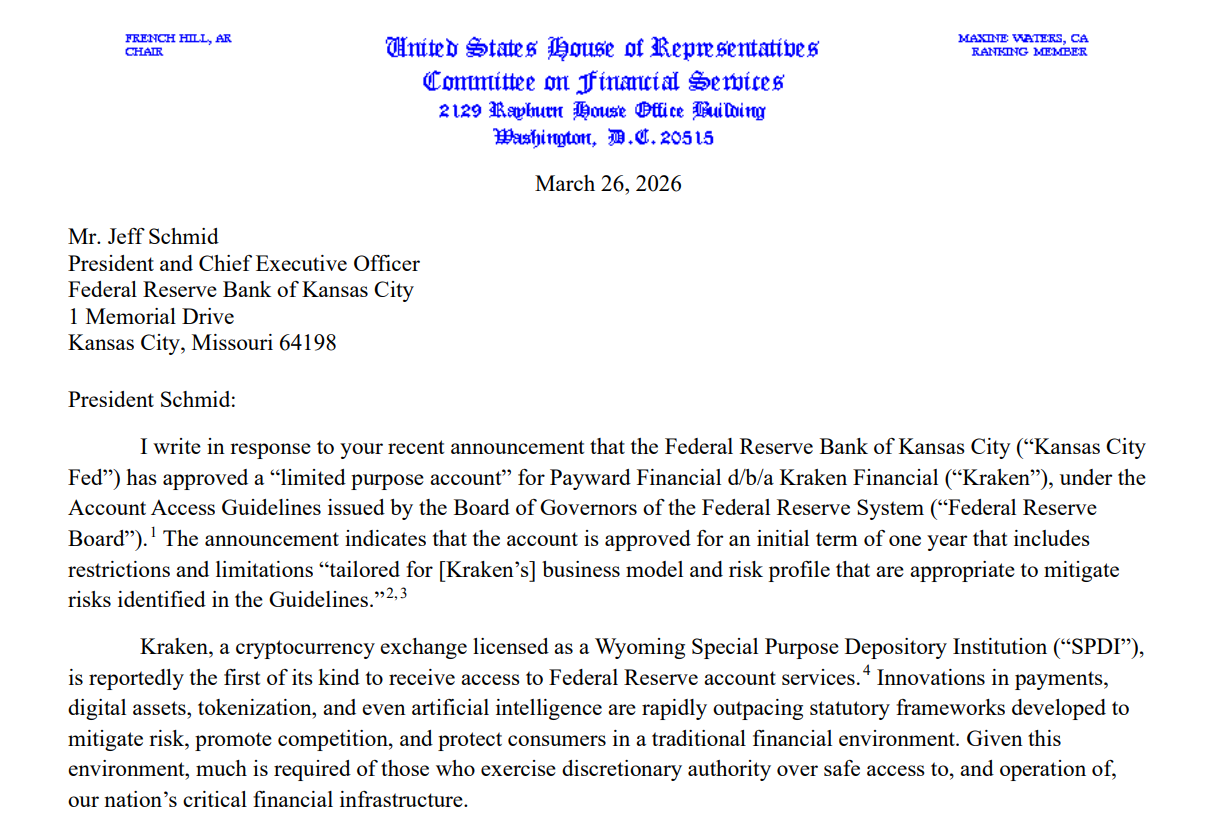
US Representative Maxine Waters, the ranking Democrat on the House Financial Services Committee, is demanding answers from the Federal Reserve Bank of Kansas City over the approval of Kraken Financial’s limited-purpose master account.
In a letter Thursday, Waters asked Kansas City Fed President Jeff Schmid to respond by April 10, outlining what Kraken’s approval means in practice; which Federal Reserve services it can access; the conditions or restrictions that apply and what anti-money laundering and consumer protection measures were considered.
Kraken’s banking unit was granted a limited-purpose master account by the Federal Reserve Bank of Kansas City earlier this month. It was seen as a milestone for the crypto industry as several crypto-linked US companies have been pursuing a master account with the Fed for years.
The account provides direct access to Fedwire, the Fed’s core payments system, potentially allowing Kraken to move money on the same rails used by banks and credit unions.
“The Kansas City Fed’s announcement does not disclose specific information about Kraken’s access to the range of Federal Reserve financial services due to the confidentiality of business information provided by applicants,” Waters wrote in the letter.

“Answers to these questions are critical to ensuring that the process of approving Federal Reserve Bank account access is conducted consistently with the law, with impartiality, and in a manner that continues to foster a safe and efficient payment system,” she added.
Full transparency required to mitigate risks, Waters argues
Waters also argued that Kraken’s access to the Federal Reserve’s payment system raises policy, regulatory and consumer protection concerns. As a result, she said full transparency and clear legal grounding are required to ensure any risks are properly managed.
“Innovations in payments, digital assets, tokenization, and even artificial intelligence are rapidly outpacing statutory frameworks developed to mitigate risk, promote competition, and protect consumers in a traditional financial environment,” Waters wrote.
“Given this environment, much is required of those who exercise discretionary authority over safe access to, and operation of, our nation’s critical financial infrastructure,” she added.
Related: SEC is no longer a ‘cop on the beat‘ on crypto, says US lawmaker
US crypto companies that have been pursuing Fed master accounts include Caitlin Long’s Custodia Bank, which filed a court petition in late 2025 to renew its bid.
Crypto platform Anchorage Digital Bank also applied for an account last year and Ripple has applied through its Standard Custody & Trust Company.
Waters is classed as “strongly against crypto” by advocacy group
Crypto advocacy group Stand With Crypto has a scorecard for US politicians on how supportive they are of crypto based on public statements and voting behavior.
Waters is listed by the group as “strongly against crypto,” based on five statements and six votes against crypto legislation, including the Digital Asset Market Clarity Act and the GENIUS Act.

She also called for a hearing with Securities and Exchange Commission Chair Paul Atkins last year, citing concerns about the agency’s dismissal of crypto enforcement cases.
Magazine: How crypto laws changed in 2025 — and how they’ll change in 2026


Bitcoin (BTC) whale activity has slowed to its weakest level since September 2023, adding to signs that large holders have turned cautious.
Summary
- Santiment said whale activity dropped as investors watched uncertainty and conflict in the Middle East.
- Transfers above $100,000 and $1 million fell as Bitcoin struggled to recover after price swings.
- Analysts said short-term holder losses and weaker speculation may mark a new Bitcoin accumulation phase.
Data from Santiment shows that transfers above $100,000 have dropped as Bitcoin trades below recent highs and investors watch policy updates and geopolitical risks.
Santiment said daily Bitcoin transactions above $100,000 fell to 6,417, the lowest reading since September 2023. Transfers above $1 million also dropped to 1,485, their lowest level since October 2024.
The firm said activity rose sharply during Bitcoin’s early February sell-off, when large holders moved funds during heavy volatility. Since then, that pace has faded as the market entered a consolidation period and failed to regain steady momentum.
Santiment said the decline does not confirm a bullish or bearish trend on its own. The firm said whale activity has become “historically quiet” while market participants wait for more clarity around the CLARITY Act and the conflict in the Middle East.
The firm added that “smart money is in the same boat as smaller retail holders at the moment, and have been reluctant to make moves with so much policy and global uncertainty at play.” That view places the current market in a wait-and-see phase rather than a clear trend.
Moreover, Bitcoin recently reached $76,000, its highest level in about six weeks, before sellers pushed it lower. The rejection sent the asset below $68,000, though it later rebounded toward $72,000 before slipping under $70,000 again.
The latest moves show that Bitcoin remains sensitive to external events as traders track war-related headlines and broader market signals. At the same time, the weak recovery in whale activity suggests that large holders have not yet returned with strong conviction.
Analysts point to washout among short-term holders
Ali Martinez said Bitcoin’s Realized Cap for new holders has hit a low level that often appears after speculative interest leaves the market. According to his view, the recent reset has removed many weak hands and left more committed holders in place.
Analyst Michaël van de Poppe also said short-term holders are sitting on heavy losses in what he described as capitulation. He said many traders bought during Bitcoin’s initial drop toward $80,000, only to see positions fall deeper into loss as the price moved below $70,000.
Disclosure: This article does not represent investment advice. The content and materials featured on this page are for educational purposes only.


Better Home & Finance and Coinbase are preparing a new mortgage product tied to Fannie Mae-backed loans, according to a Wall Street Journal report published on March 26.
Summary
- Better and Coinbase plan a mortgage product that lets homebuyers use crypto holdings as collateral.
- The reported structure would combine a standard mortgage with a separate loan backed by crypto.
- Current Fannie Mae rules require crypto conversion to dollars, making this product a policy shift.
The product would let some homebuyers use crypto as collateral instead of selling those holdings before closing.
The report said the new offer would allow buyers to “pledge their crypto holdings” when taking out a mortgage backed by Fannie Mae. Better Home & Finance would act as the lender, while Coinbase would support the crypto side of the product.
The structure would use two loans. One would be a standard Fannie Mae-backed mortgage, while the second would be backed by the borrower’s crypto assets.
Reports said Bitcoin and USDC are expected to be part of the program, but full eligibility details were not available at publication time. The report also said the pledged crypto could not be traded while it secures the loan.
Borrowers would not need to sell their digital assets for a down payment. Reports added that rates on the crypto-backed portion could run above standard mortgage pricing.
Fannie Mae’s current selling guide says virtual currency can count only after it is converted into U.S. dollars and placed in a regulated financial institution. That means this new structure would mark a change from the existing approach.
The move also follows a 2025 FHFA order that told Fannie Mae and Freddie Mac to consider crypto holdings in mortgage loan assessments. The new product would take that process further by linking crypto directly to mortgage collateral.
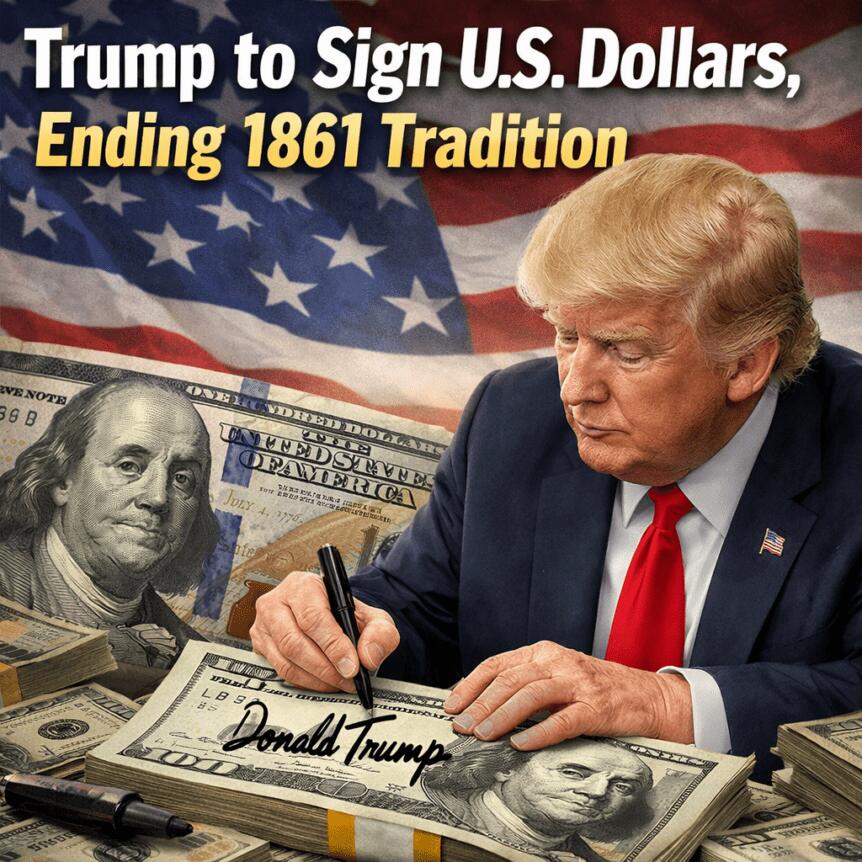
The idea of a sitting U.S. president lending his signature to the nation’s currency is an unprecedented moment in the ongoing relationship between state-backed money and cultural symbolism. According to Reuters, the U.S. Treasury disclosed that President Donald J. Trump’s signature would appear on future U.S. notes as part of a commemorative push tied to the United States’ Semiquincentennial.
The plan would mark the first time a sitting president’s signature appears on U.S. currency, shifting away from the long-standing convention of signatures from the treasurer and the Treasury secretary. Reuters reports that the initial print run of $100 bills bearing Trump’s signature alongside Treasury Secretary Scott Bessent’s is slated for June, with additional denominations to follow in the months after.
Beyond the currency, the U.S. Mint has reportedly considered issuing $1 coins showing the president’s likeness as part of the same 250th-anniversary effort. In late 2025, the Mint released proposed designs featuring Trump’s image and the motto “In God We Trust.”
Trump’s imprint has already threaded through popular culture in various forms, including into cryptocurrencies and collectibles. In crypto circles, a memecoin named after Trump has drawn attention, alongside multiple NFT projects, including the widely publicized Trump Digital Trading Cards.
The Treasury move comes with controversy. Some lawmakers have argued that altering the signatures on U.S. currency would require congressional authorization, casting doubt on the legality of moving ahead without legislative action. The broader cultural reshaping around Trump’s public persona has also spurred diverse reactions, including debates over the renaming of major U.S. landmarks. Reuters and other outlets documented discussions around the John F. Kennedy Center for the Performing Arts, where reports described a board dominated by Trump appointees voting to rename the venue to the “Donald J. Trump and the John F. Kennedy Memorial Center for the Performing Arts.”
In parallel coverage from crypto-focused outlets, Trump’s footprint in the space—through memes, cards, and other collectibles—highlights how political branding can spill into the digital asset ecosystem. While a currency signature may seem esoteric to traders, the episode underscores a broader trend: the fusion of political branding, national symbolism, and the evolving culture around crypto assets.
Key takeaways
- The Treasury’s plan would make Trump the first sitting U.S. president to have his signature appear on U.S. currency, tied to the nation’s Semiquincentennial celebration, according to Reuters.
- The first $100 bills bearing Trump and Treasury Secretary Scott Bessent’s signatures are slated for printing in June, with other denominations to follow later in the year.
- There is reported consideration of issuing $1 coins featuring the president’s likeness as part of the same commemorative initiative, supported by proposed 2025 designs.
- Trump’s presence in crypto culture—through a memecoin and NFT projects—illustrates how political branding intersects with digital assets and community storytelling.
- Lawmakers have raised questions about the legality of changing currency signatures without congressional authorization, reflecting governance and constitutional considerations.
Currency symbolism and the timing of a historic shift
By linking a sitting president’s signature to U.S. currency, the narrative expands beyond monetary mechanics into national symbolism. The Reuters coverage situates the move within a broader commemorative framework for the 250th anniversary of the United States, signaling a potential long-term shift in how currency can carry living political branding. The printing schedule for the initial notes—in June—provides a concrete timeline that will test traditional processes around currency design and circulation.
Commemorative design and potential coin additions
The Mint’s exploration of $1 coins featuring the president’s image indicates a multi-denomination approach to the same commemorative moment. The late-2025 designs had already showcased Trump’s likeness and the inscription “In God We Trust,” suggesting a planned, broad-based branding exercise rather than a narrow currency reform. How these designs would interact with existing patriotic and historic themes remains to be seen, particularly given the regulatory and procedural layers involved in issuing new coinage.
Crypto crosscurrents: branding, memes, and market psychology
The intersection of presidential symbolism with crypto culture is not new, but it continues to shape sentiment and participation in digital asset communities. Reports of a Trump-themed memecoin and related NFT ventures illustrate how political narratives can permeate meme economies and collectible markets, sometimes driving attention and liquidity into otherwise niche corners of the crypto ecosystem. This convergence raises questions for traders and builders about how political branding might influence perception, liquidity, and the cultural value of associated digital assets.
Governance questions and the legislative dimension
Amid the excitement, questions about authorization and legality have surged. Some lawmakers contend that altering currency signatures without congressional action could be unlawful or legally ambiguous, foregrounding a governance tension between executive actions and legislative necessity. Separately, the naming controversy surrounding a major cultural institution—spurred by Trump-aligned appointments—has fed a wider debate about presidential influence over public landmarks and the potential implications for fiscal and cultural policy.
The unfolding story sits at the crossroads of monetary history, national symbolism, and the evolving relationship between politics and crypto culture. As authorities prepare for the first run of Trump-signature notes and potential commemorative coins, market observers will be watching not only for the practical rollout but also for any regulatory clarifications and the way communities across crypto and traditional finance interpret this blend of state power and branding.
Readers should watch for official updates from the U.S. Treasury and the U.S. Mint about certification, design finals, and distribution timelines, as well as any legislative action clarifying the authorization requirements for signing changes on currency. The convergence of currency symbolism and crypto branding could set a precedent for how political narratives shape both fiat and digital-asset narratives in the months ahead.

Samsung Galaxy A57 vs Galaxy A56: What’s new this year?

Rome’s Financial Death Spiral: Is History Repeating? #history #economics

East Kilbride group receive funding to create Regulation Room


-
 Crypto World6 days ago
NIO (NIO) Stock Plunges 6.5% as Shelf Registration Sparks Dilution Worries
-
 NewsBeat2 days ago
Manchester United reach agreement with Casemiro over contract clause amid transfer speculation
-

 Fashion6 days ago
Weekend Open Thread: Adidas – Corporette.com
-

 Politics6 days ago
Jenni Murray, Long-Serving Woman’s Hour Presenter, Dies Aged 75
-

 Crypto World5 days ago
Best Crypto to Buy Now: Strategy Just Spent $1.57 Billion on Bitcoin During Fear While Early Investors Quietly Enter Pepeto for 150x Potential
-

 Crypto World5 days ago
Bitcoin Price News: Bhutan Sells $72 Million in BTC Under Fiscal Pressure, but the Smart Money Entering Pepeto Sees What the Market Does Not
-

 Tech7 days ago
inKONBINI Lets You Spend Summer Days Behind the Register
-

 News Videos1 day ago
Parliament publishes latest register of MPs’ financial interests
-

 Sports4 days ago
Remo Stars and Kano Pillars Strengthen Survival Hopes in NPFL
-

 Sports4 days ago
Gary Kirsten Accuses Pakistan Cricket Board Of ‘Interference’, Mohsin Naqvi Responds
-

 Tech4 days ago
Give Your Phone a Huge (and Free) Upgrade by Switching to Another Keyboard
-

 Business4 days ago
No Winner in March 21 Drawing as Prize Rolls to $133 Million for Next
-

 Sports6 days ago
2026 Kentucky Derby horses, odds, futures, preview, date: Expert who nailed 12 Derby-Oaks Doubles enters picks
-

 Tech4 days ago
AI enters the chat: New Seattle dating app relies on tech to facilitate meaningful human connections
-
Business6 days ago
Columbia Sportswear enters $500 million credit agreement with JPMorgan Chase
-

 Tech5 days ago
Today’s NYT Connections Hints, Answers for March 22 #1015
-

 News Videos4 days ago
Ch 9 Financial Management Part 1 | Detailed One Shot | Class 12 Business Studies Boards 2026
-

 Business6 hours ago
Instagram, YouTube Found Responsible for Teen’s Mental Health Struggle in Historic Ruling
-

 Business5 days ago
Will Duke Basketball Win It All? Duke Basketball Enters Second Round as Third Favorite to Claim NCAA Title
-

 Business7 days ago
(VIDEO) BTS Drops ‘ARIRANG’ Album Today, Marking Epic Post-Military Comeback With Live Concert
You must be logged in to post a comment Login