
Crypto World
Kalshi Adds Sports & Crypto Perps Data Feed on DoubleZero

Prediction market operator Kalshi is expanding how its real-time trading information reaches market participants by partnering with DoubleZero Edge for distribution via DoubleZero’s dedicated fiber network. In a Wednesday announcement shared with Cointelegraph, the companies said Kalshi’s live order book feed for certain sports and crypto perpetuals event contracts will be made available to new DoubleZero Edge subscribers.
The integration targets a long-standing gap in prediction market infrastructure: access to fast, machine-readable market data. Rather than building bespoke systems that reconstruct order books from raw exchange screens or parse multiple API endpoints, subscribers can consume a dedicated data feed designed to deliver order book data directly.
Key takeaways
- Kalshi’s real-time order book for sports and crypto perpetuals event contracts is now distributed through DoubleZero Edge’s fiber network.
- DoubleZero Edge positions the feed as a way to avoid rebuilding infrastructure from order books and API responses.
- Sports appears as one of Kalshi’s biggest demand categories, with crypto also ranking among the top segments by weekly notional volume.
- The rollout arrives as Kalshi remains involved in ongoing regulatory disputes over whether its event contracts are sports wagers or CFTC-regulated derivatives.
Dedicated fiber distribution for prediction market order books
Kalshi said the new offering makes it the first prediction market to distribute its live order book data through DoubleZero Edge’s dedicated fiber network for sports and crypto perpetuals event contracts. For institutional and technical users, the practical value is straightforward: lower latency pathways and a consistent, machine-friendly way to ingest market depth and price levels as trades happen.
DoubleZero co-founder Austin Federa described data access as a core component of market structure, arguing that infrastructure has lagged behind “new financial paradigms” that include crypto, perpetuals, and prediction markets. The pitch here is that the industry has continued to grow without matching the data distribution capabilities usually expected in traditional, high-speed markets—especially for participants who run automated strategies.
Where Kalshi’s volumes come from
Kalshi’s focus areas are not limited to crypto. According to Dune data cited in the announcement, sports accounts for 37.8% of Kalshi’s weekly notional volume, while crypto ranks third at 20.3%. Exotics, meanwhile, lead the mix at 39.4% of weekly notional trading volume.
Those proportions matter because they suggest the network-based data distribution may reach more than a niche slice of traders. A dedicated feed for sports-linked markets could be particularly relevant for participants who need to track changing probabilities and liquidity across event timelines, while crypto perpetuals event contracts add additional complexity that favors fast data ingestion.
Broader visibility, including ChatGPT search
The order book distribution comes amid increasing visibility of Kalshi markets in mainstream discovery channels. In early July, Cointelegraph reported that OpenAI began displaying Kalshi’s prediction market odds for FIFA World Cup matches in ChatGPT search results.
While that development relates more to consumer-facing access than to institutional infrastructure, it underscores how prediction markets are becoming more embedded in the information layer that users interact with—creating more pressure for robust, reliable data pathways underneath.
Regulatory pressure remains a central backdrop
Kalshi’s sports event contracts continue to sit at the center of a regulatory dispute involving state regulators and the U.S. Commodity Futures Trading Commission (CFTC). The disagreement centers on how the contracts should be classified.
State authorities argue the products are essentially wagers subject to state gambling laws. Kalshi and the CFTC, by contrast, contend that these event contracts are derivatives that fall under the CFTC’s exclusive jurisdiction.
The legal conflict has already produced concrete restrictions. On June 29, a Michigan judge temporarily blocked Kalshi from allowing residents to place bets on sporting events. Earlier, Kentucky sued five prediction market platforms—including Kalshi and Polymarket—accusing them of operating unlicensed sports betting platforms. Nevada also issued a temporary ban on Kalshi earlier in March.
Meanwhile, the CFTC has taken an offensive stance as well, suing several states—arguing that federally regulated event contracts should fall under its authority. According to earlier Cointelegraph reporting, the CFTC’s legal actions are aimed at reinforcing the agency’s jurisdiction over products it views as derivatives.
In that context, better market data infrastructure may help participants operate more effectively, but it does not resolve the classification question that determines where and how these markets can be offered. Traders and developers looking at the space may therefore see two parallel tracks: technical maturation through data distribution, and legal outcomes that determine geographic reach.
Looking ahead, readers should watch whether improved access to real-time order book feeds accelerates participation from professional market makers and automated traders—and whether regulatory decisions continue to constrain Kalshi’s ability to offer sports-linked contracts in key jurisdictions.



Slovenia entered the EU’s MiCA stablecoin register through electronic money institution Dinaro, as the update also added two new CASPs.
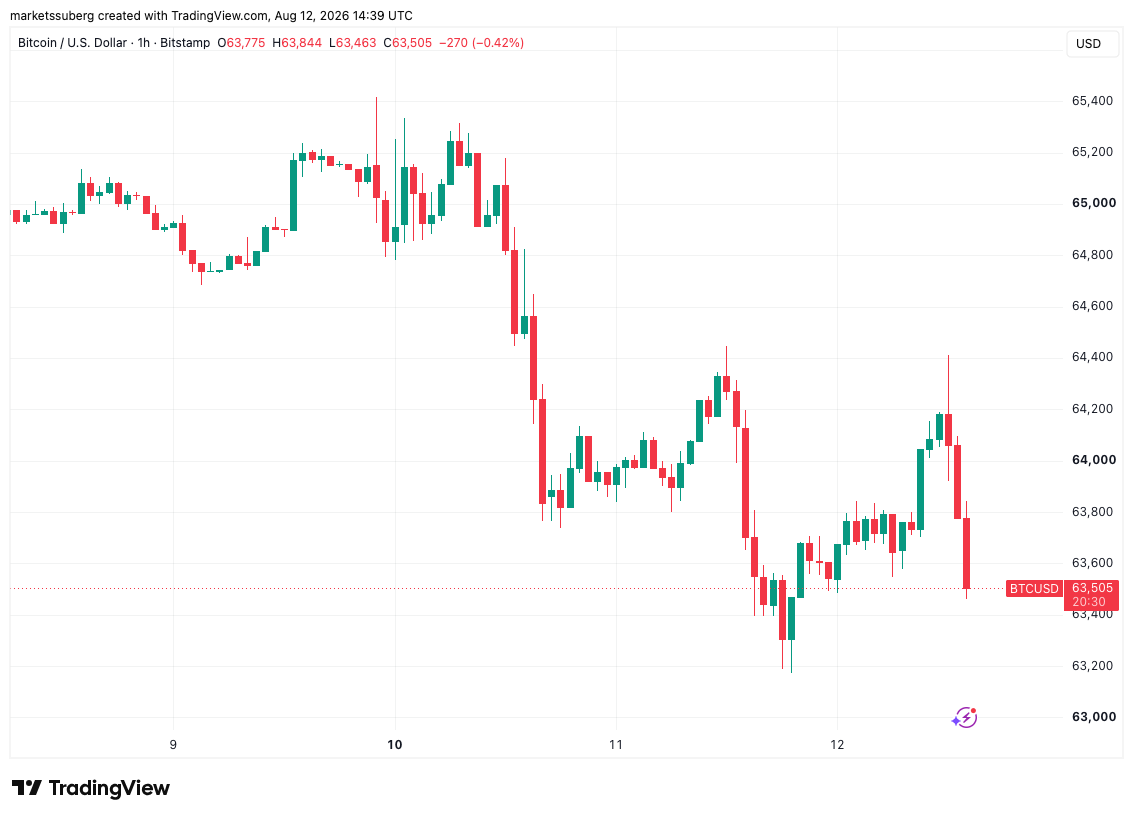
Bitcoin (BTC) saw weakness around Wednesday’s Wall Street open as markets reacted to key US inflation data.
Key points:
- Bitcoin ignores good news around US inflation figures as it dips below $63,500.
- Fed rate-hike odds cool further as attention now switches to Thursday’s PPI numbers.
- Bitcoin is eroding $63,000 support, the latest market analysis warns.
Bitcoin falls despite US inflation data matching expectations
Data from TradingView showed BTC/USD dropping below $63,500, erasing the day’s gains.
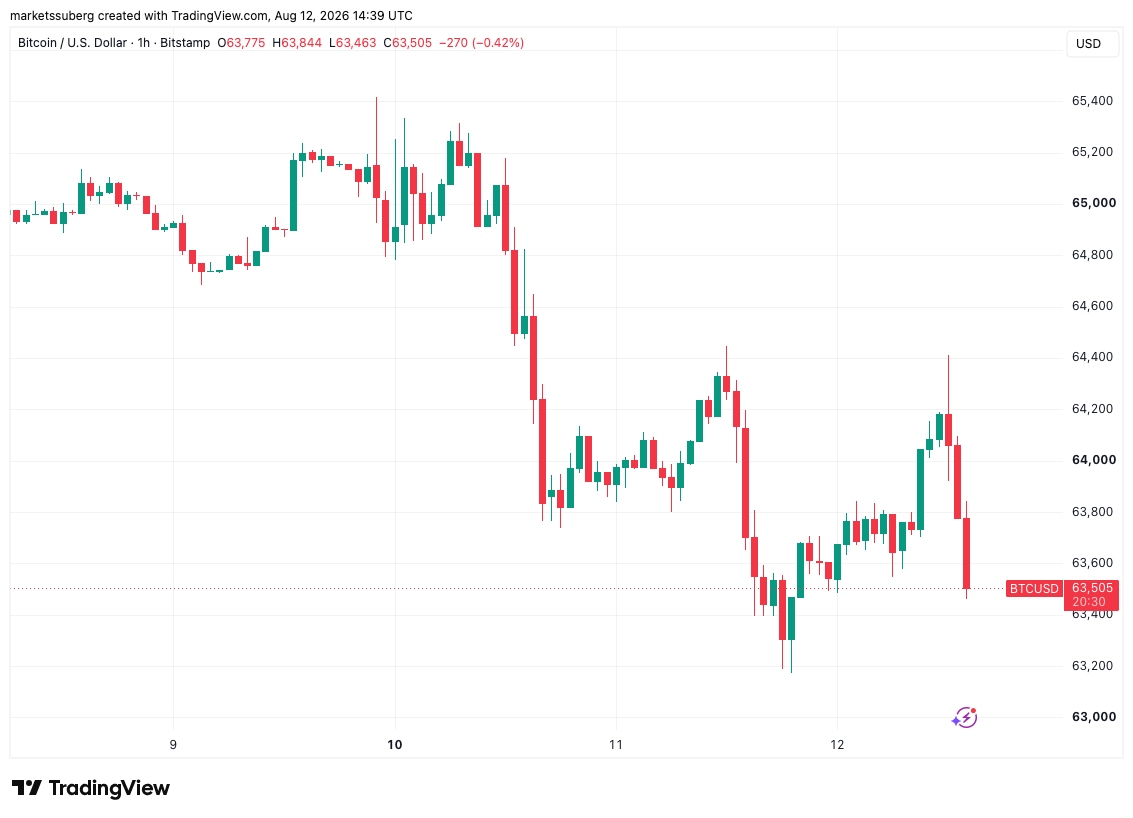
BTC/USD one-hour chart. Source: Cointelegraph/TradingView
US stocks were calm after the July print of the US Consumer Price Index (CPI) matched expectations, at 0.1% month-on-month and 3.4% year-on-year.
“The index for shelter rose 0.1 percent in July, accounting for roughly two-thirds of the monthly all items increase. The index for food also increased 0.1 percent over the month, as the index for food away from home increased 0.3 percent. In contrast, the energy index declined 1.5 percent in July,” an official release from the Bureau of Labor Statistics (BLS) reported.
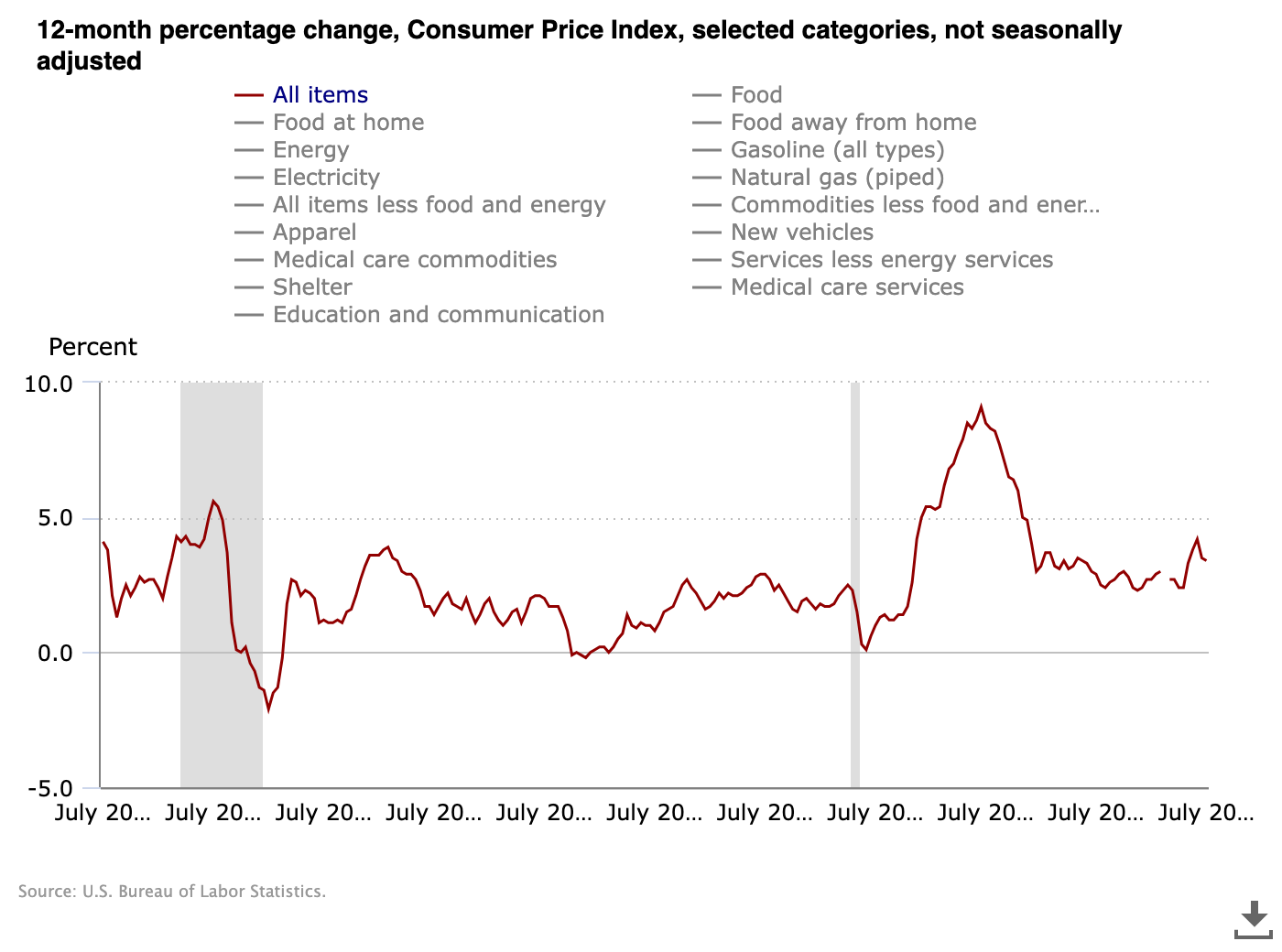
US CPI 12-month % change. Source: BLS
While not repeating the surprise move to the downside seen in June, CPI inflation avoided injecting volatility into risk assets. Among safe havens, gold remained stable after reaching its highest levels in nine weeks on Tuesday.
Fabian Dori, CIO at Sygnum Bank, put the focus on expectations for future Federal Reserve policy changes. Cooling CPI combines with weak labor-market figures to potentially bolster the case for the Fed avoiding interest-rate hikes — an outcome that would benefit crypto and risk-asset liquidity conditions.
“An in-line CPI print after Friday’s –23k jobs report points to gradual cooling without a recession scare or a fresh hawkish re-pricing. September rate odds should stay roughly stable, leaving the macro backdrop for risk assets largely unchanged,” he said in emailed comments.
The latest data from CME Group’s FedWatch Tool saw 60% odds of the Fed holding rates at the current 3.50-3.75% level at its September meeting — up from 30% a month ago.
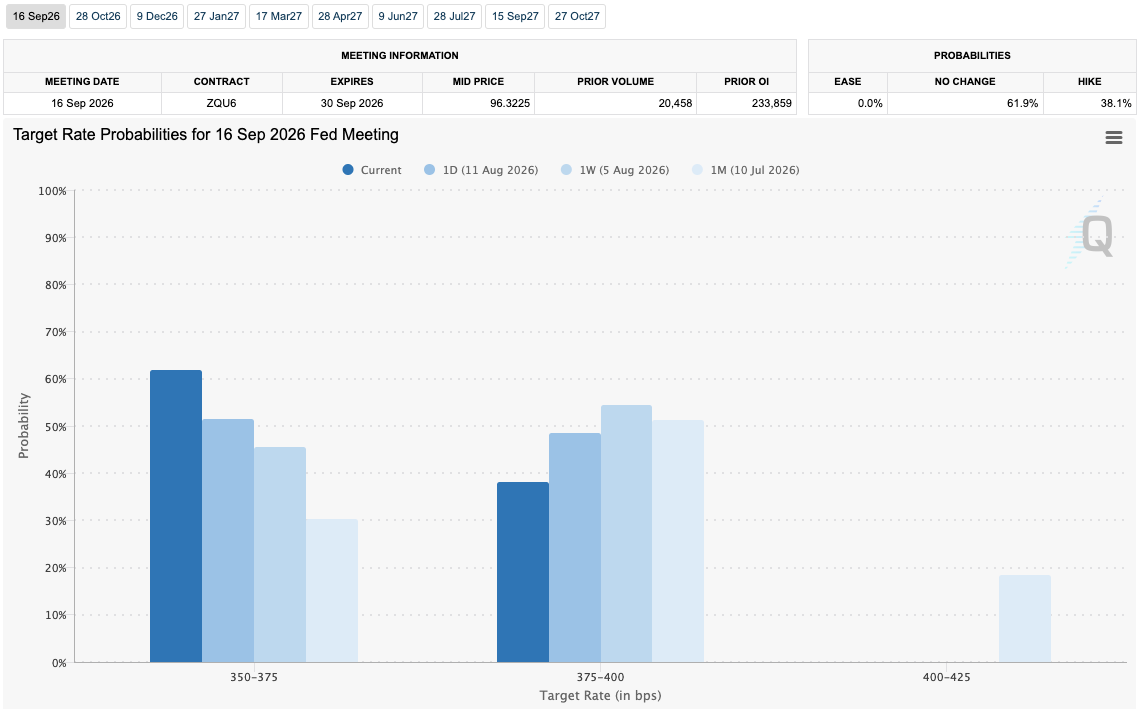
Fed target-rate probability comparison for September FOMC meeting (screenshot). Source: CME Group
Thursday provides the week’s second US macro report with potential implications for market volatility in the form of July Producer Price Index (PPI) numbers, which in June followed CPI in coming in below expectations.
“An in-line CPI print does not resolve much after Friday’s payrolls miss. The more interesting detail is that the Bitcoin options market is still charging a material premium for protection” Andrei Grachev, managing partner at DWF Labs, told Cointelegraph. “On the end-August expiry, downside strikes near $60,000 have been costing more than equivalent upside strikes near $70,000.”
“Tomorrow’s PPI is the next check on whether that premium starts to ease,” he added.
Related: Crypto companies urge AI firms to give Bitcoin developers early access
BTC price $63,000 support “progressively weakening”
Discussing BTC price strength, trader and analyst Rekt Capital had more words of caution for Bitcoin bulls. In a post on X, he warned that each bounce from $63,000 was more and more lacking in trajectory.
Related: Bitcoin miners earn under 0.7% of revenue from fees in new 10-year low
“The progressively weakening support at ~$63k (orange) is clear. 6.27% –> 5.83% –> 3.18% –> and now 1.15% thus far,” he commented alongside an explanatory chart, adding:
“At some point the bounces will become so weak that the floor will simply break.”
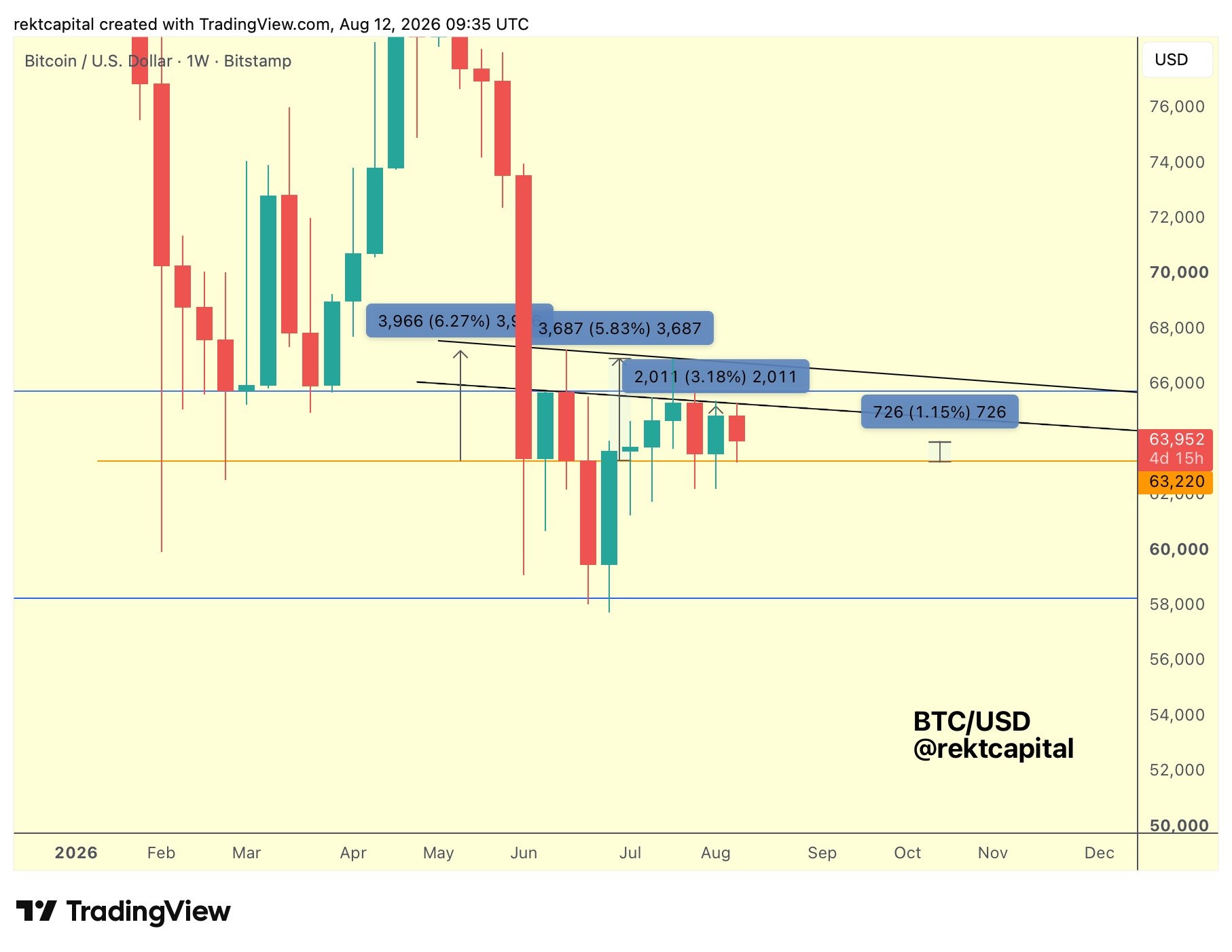
BTC/USD one-week chart. Source: Rekt Capital on X.com
Rekt Capital previously warned that Bitcoin bear-market history was repeating as its 50-month exponential moving average (EMA), currently at $65,827, had become new resistance.
In an update on Wednesday, Bitfinex Alpha, the research arm of crypto exchange Bitfinex, reiterated the strength of the overhead resistance zone.
“Equities spent the past two weeks setting all-time highs (ATH) while bitcoin met resistance at the same $65,000-65,500 region level six times. Between 5 and 10 August, the market printed six consecutive daily highs above $65,000 but bitcoin has not recorded a single daily close above that level since 26 July,” it noted.
Magazine: Inside the fake crypto startup that fooled North Korean IT workers

After shifting its focus to rebuilding its USD stash and reinstating investors’ belief in STRC, Strategy’s CEO, Phong Le, explained that the firm plans to resume its BTC purchases by the end of the year.
As reported by Wu Blockchain, the exec noted that the world’s largest corporate holder of bitcoin remains a massive net buyer of the cryptocurrency, as it has purchased around 175,000 since the year started and has disposed of roughly 7,000. This means that the firm is still a 25x net buyer despite halting its purchases in late June.
Le also explained that the company has used the proceeds from its recent sale to support its preferred stock dividends, share repurchases, and the USD reserve, which is now well over $4.6 billion after the latest sale.
Meanwhile, the controversial STRC share has rebounded swiftly from the $75 lows. Nevertheless, it remains below its par price of $100 as it closed on Tuesday at just over $95.
Strategy’s CEO recently stirred additional controversy within the crypto community by admitting that the firm has turned its complete attention to pushing STRC to the par price. Numerous analysts and commentators questioned the statement, as it was just until a few months ago when the company swore its primary objective was to increase Bitcoin per share.
The post When Will Strategy Buy Bitcoin Again? CEO Phong Le Has the Answer appeared first on CryptoPotato.

Australia, New Zealand, Japan, South Korea, and the U.K. also use both electronic travel records and biometric checks at passport control.
But the EES is unusual in its scale. The system shares its records across 29 European countries. A traveler who enters through France and leaves through Italy, for example, has both movements recorded in one system.
What’s with the hold up?
Despite its goal of making border control more efficient, the initial rollout of the new system has led to delays at a number of European airports.
Days after the full implementation of the EES in April, airport lobby ACI Europe told Politico that queues at airports in 15 countries averaged two to three hours or longer during peak periods. As travel to Europe has increased over the summer months, travelers have seen persistent and at times worsened delays in many of the most heavily touristed countries. In an open letter published July 1, ACI Europe and two other associations said waiting times reached five hours during peak periods. Some airlines and passengers have even reported missed flights as a result of EES delays.

“I believe that in the state of New York, if you have a $5 million second home, then you should be able to afford to pay for police and fire and trash removal and snow removal in the wintertime,” Hochul told local media Tuesday. “Donald Trump ought to focus on all the pain he’s causing New Yorkers and knock it off and don’t worry about us.”
What is New York’s pied-à-terre tax?
In line with Mamdani’s promise to “tax the rich,” New York City implemented a pied-à-terre tax, a yearly levy on high-value residential properties that are not one’s primary residence. Hochul signed the legislation containing it on May 28, and it became effective beginning July 1.
New York authorities say the tax is expected to generate at least $500 million a year in revenue, which would help close the city’s $12 billion budget gap over fiscal years 2026 and 2027.
For two fiscal years starting in July 2026, the levy may apply to one-, two-, and three-family homes valued by the city’s finance department at $5 million or greater, as well as condominium and cooperative units valued at $1 million or more. For covered family homes, the levy rate starts at 0.8% of the market value and goes up to 1.3% for properties exceeding $25 million. As for covered condos and co-ops, the surcharge starts at 4% and reaches up to 6.5% for properties valued at $5 million or more.
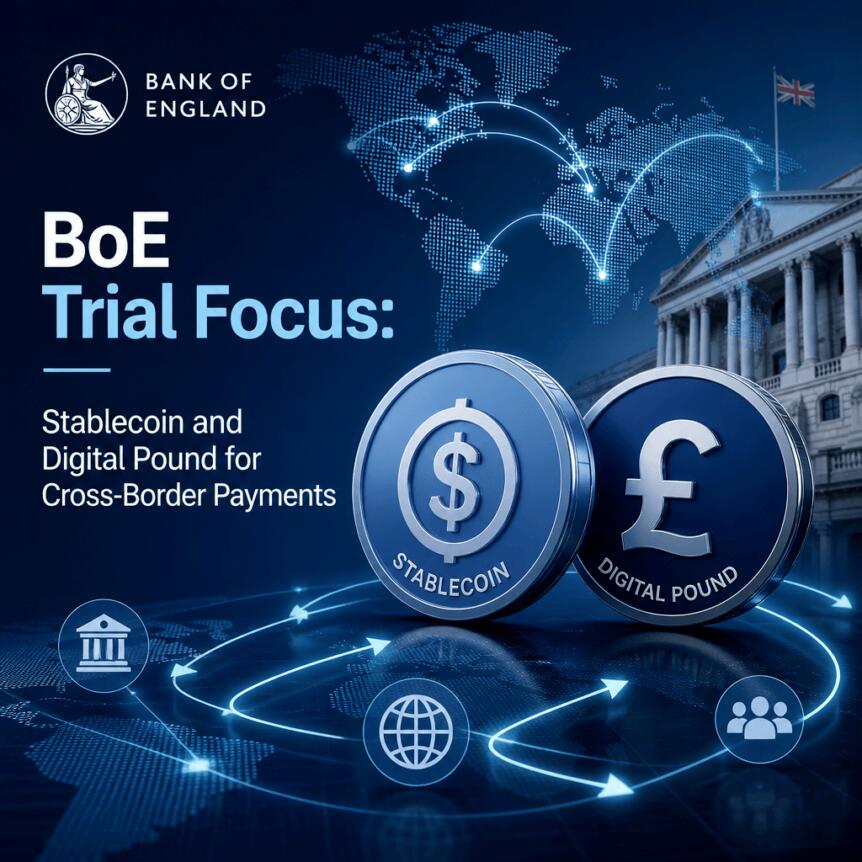
The Bank of England’s Digital Pound Lab is running a trade-finance experiment designed to test whether stablecoins and a potential digital British pound could work together inside the same cross-border payment flow.
In a project announced on Wednesday, NOBO Finance, Dun & Bradstreet and Polygon Labs said the trial links an exporter’s advance delivered via a stablecoin rail with a UK importer’s settlement using simulated digital pounds. The focus is on the practical mechanics of payments timing—particularly the point at which trade finance is released and how long settlement takes.
Key takeaways
- The Digital Pound Lab trial pairs a stablecoin payment to an exporter with simulated digital pound settlement by a UK importer in a single cross-border workflow.
- NOBO Finance, Dun & Bradstreet and Polygon Labs are combining payments testing with a separate effort to generate reusable credit profiles for small businesses.
- The project is explicitly using simulated systems: the Bank of England has not committed to issuing a digital pound and the lab uses no real customers or money.
- The work targets a long-standing trade finance problem where exporters may wait days after shipment to receive payment, tying up working capital.
- The broader initiative aligns with ongoing UK regulatory development for stablecoins and tokenized settlement models.
Trade finance, simulated digital pounds, and stablecoin rails
The Bank of England’s Digital Pound Lab experiment is centered on trade finance—an area where cash flow can be constrained by settlement delays between shipping goods and receiving payment. According to the announcement from NOBO Finance, Dun & Bradstreet and Polygon Labs, the test scenario involves an exporter receiving an advance through a stablecoin-based payment flow while a UK importer completes settlement using simulated digital pounds.
The companies did not describe the trial as a live market product; instead, it is positioned as an experiment within the lab’s research environment. The Bank of England has also emphasized that lab experiments designed by participants should not be treated as signals about future policy or as endorsements of any specific firm or technology.
For exporters—especially smaller businesses—payment timing can determine how much working capital is locked up. When funds arrive days after shipment, firms can face higher financing costs or reduced ability to take on new orders. By testing whether different digital payment components can operate in the same cross-border route, the lab project aims to assess whether tokenized settlement could reduce friction that slows trade.
Reusable credit profiles for small businesses
Beyond payments plumbing, the initiative includes a separate workstream aimed at helping small businesses access credit more efficiently. The plan, as described by the participating companies, is to create reusable credit profiles by combining transaction data, open-finance information and commercial risk data from Dun & Bradstreet.
Polygon Labs is providing the smart contract infrastructure for this part of the project. The practical idea is straightforward: instead of rebuilding risk assessments from scratch for each transaction, the system would attempt to turn available data into a standardized credit profile that could be reused in future trade finance arrangements.
If that approach works as intended, it could reduce the operational cost and time involved in underwriting and credit checks—an issue that often weighs more heavily on smaller firms than on larger counterparties with more established financing relationships.
Why this matters amid UK stablecoin and tokenization rulemaking
The trade-focused lab experiment lands as UK authorities continue building the regulatory structure for stablecoins and preparing the financial system for tokenized assets. In June, the Bank of England published draft rules for sterling-denominated stablecoins it considers systemic to the UK’s financial stability.
That proposal, according to the Bank of England, would allow systemic stablecoin issuers to hold up to 70% of their reserves in interest-bearing government debt. It also introduces a temporary issuance cap of 40 billion pounds (about $52.8 billion) per systemic stablecoin, replacing earlier suggestions that would have limited holdings at the level of individual participants and businesses. The Bank of England has said it aims to finalize those rules by the end of 2026, ahead of a planned 2027 rollout.
Under the framework, stablecoins deemed systemic—because their use could pose risks significant enough to affect financial stability—would fall under the Bank of England’s regime. Non-systemic stablecoins would remain under the Financial Conduct Authority’s oversight.
Meanwhile, tokenization is also being tested through updates to legacy settlement infrastructure. In May, the Bank of England proposed moving its Real-Time Gross Settlement (RTGS) and CHAPS systems toward near-24/7 operation, including weekends and extended daily hours, partly to support cross-border payments and new settlement models as tokenization develops.
Additionally, the Bank of England approved HSBC’s Orion platform to operate in the UK’s Digital Securities Sandbox. That sandbox is expected to support digital bond issuance, including the country’s planned Digital Gilt Instrument—another sign that regulators are exploring how tokenized assets might integrate with existing market infrastructure.
What to watch next in the Digital Pound Lab
Because the Digital Pound Lab trial uses no real money or customers and the central bank has not committed to issuing a digital pound, the near-term value for market participants is primarily methodological: seeing whether a stablecoin rail and a simulated digital pound can coordinate inside a realistic cross-border trade workflow. The next step is whether the lab’s findings inform practical designs for interoperability, settlement timing, and how credit and compliance data could be translated into reusable structures for small businesses.
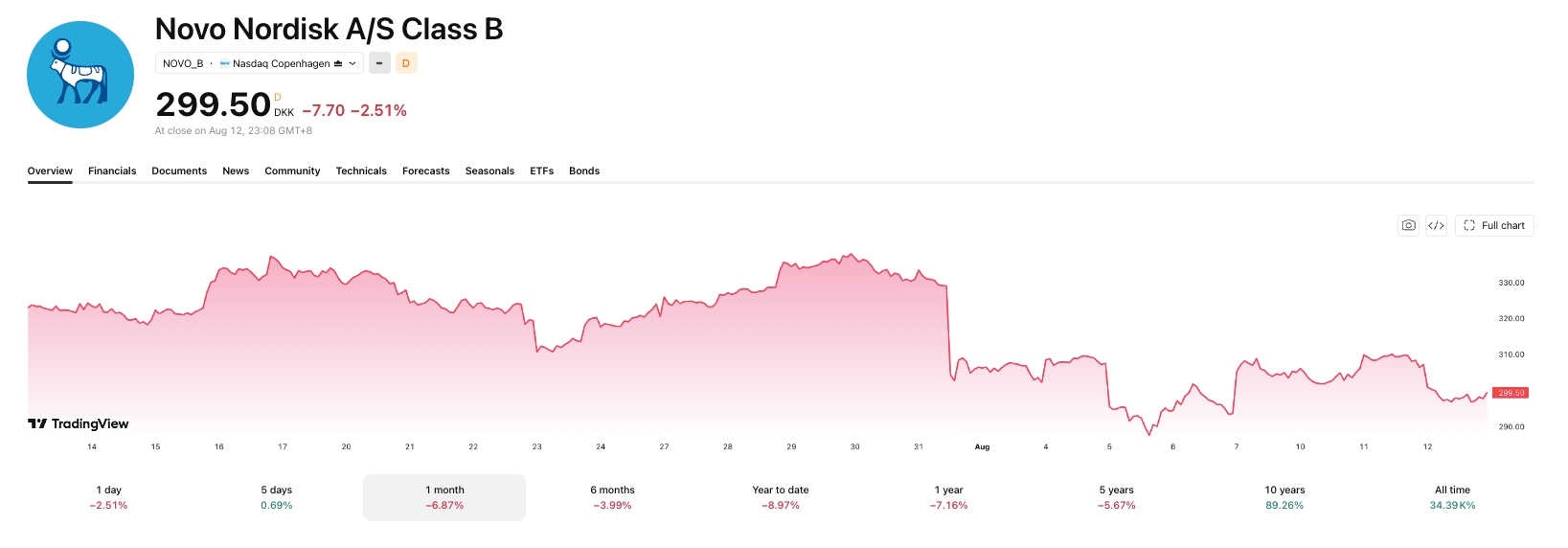
Novo Nordisk’s stock keeps falling even when the news is good, and CEO Mike Doustdar just admitted why. Eli Lilly is beating Novo at its own game.
Doustdar sat down with CNBC’s Jim Cramer this week to explain the disconnect. Novo, famous for its GLP-1 medication Ozempic, raised its full-year sales guidance on August 4, narrowing its projected annual decline from 8% to 3% at the midpoint. Investors sold anyway. NVO shares dropped roughly 6% that day.
A Beat That Still Lost
Doustdar walked through the math on air. Novo slashed prices on Ozempic and Wegovy last year to widen patient access, and volume hasn’t caught up yet to offset those cuts. He compared it to basic arithmetic. Halving a price means you need double the volume just to break even, and volume never doubles on day one.
That gap between falling average revenue per prescription and rising patient counts is exactly what has investors nervous. Novo’s obesity and diabetes drugs now make up around 90% of its business, compared to about 60% at Eli Lilly, leaving Novo more exposed to any pricing or competitive shock in that single category.
Doustdar’s Concession
Oral Wegovy sits at the center of this story. Novo launched the pill version of its weight-loss drug in January, and it quickly became one of the fastest-selling drugs in pharmaceutical history. Doctors have already written more than 5 million prescriptions for it, and 1.5 million patients now take it worldwide. That volume makes Novo’s stock reaction even harder to explain on the surface.
Cramer pressed him on why Eli Lilly’s stock rally has outrun Novo’s despite a less dominant pill. Doustdar didn’t dodge the question.
“Eli Lilly has been gaining market share. And they’re more diversified than Novo Nordisk… there is no secret that Lilly has been quite successful actually in having volume uptake and market share uptake above and beyond Novo.”

He argued Lilly’s ad campaign leans on an older, lower-dose version of Wegovy for comparison. Novo’s newer high-dose formulation matches Lilly’s efficacy, according to Doustdar. That dispute sits at the center of Novo’s lawsuit against Lilly over its advertising claims.
The Pill Still Wins on Paper
The stock slump hasn’t slowed the pill’s numbers. In Novo’s own trials, the pill cuts weight by 17%, against 12% for Lilly’s rival pill, though the two drugs haven’t faced off head-to-head. Doustdar called it the best product launch in pharmaceutical history, a claim that’s hard to dispute on volume alone.
Doustdar is betting that two straight quarters of improving trends will eventually pull the stock along with them. Whether that bet pays off depends on a simple race. Patient volume needs to outrun the price cuts fast enough to convince Wall Street the reset is actually over.
The post Novo Nordisk CEO Concedes Eli Lilly’s Market-Share Gains as Stock Slumps appeared first on BeInCrypto.

“In order to qualify for this care, a young person has to be experiencing very severe, prolonged distress,” Minter says. “I think maybe some people have the misconception that this care is being provided to kids just who are gender nonconforming or who are just identifying as transgender, but that is not the case.”
The number of people who rely on Medicaid and CHIP for gender-affirming care is not publicly available, but in 2023 the spending from both programs on those services totaled $31 million.
Why the new Medicaid rule is contested
Trump wrote about the ruling on social media Tuesday, saying that he directed CMS Administrator Dr. Mehmet Oz to enact the new restrictions.
“We are not going to pay for our innocent children to undergo these barbaric surgeries and practices, which result in unthinkable and irreversible harm to their young bodies,” the post said.
Oz said in a press release that the rule will protect children and is “following the science, saving taxpayer dollars, and, most importantly, protecting children from potentially irreversible harm so they can truly flourish.” TIME has reached out to the CMS for additional comment.


The Securities and Exchange Commission is advancing an “innovation exemption” for tokenized listed securities that Chair Paul Atkins says would give market participants a cabined framework to begin facilitating compliant onchain trading while the Commission develops long-term rules. Bloomberg… Read the full story at The Defiant
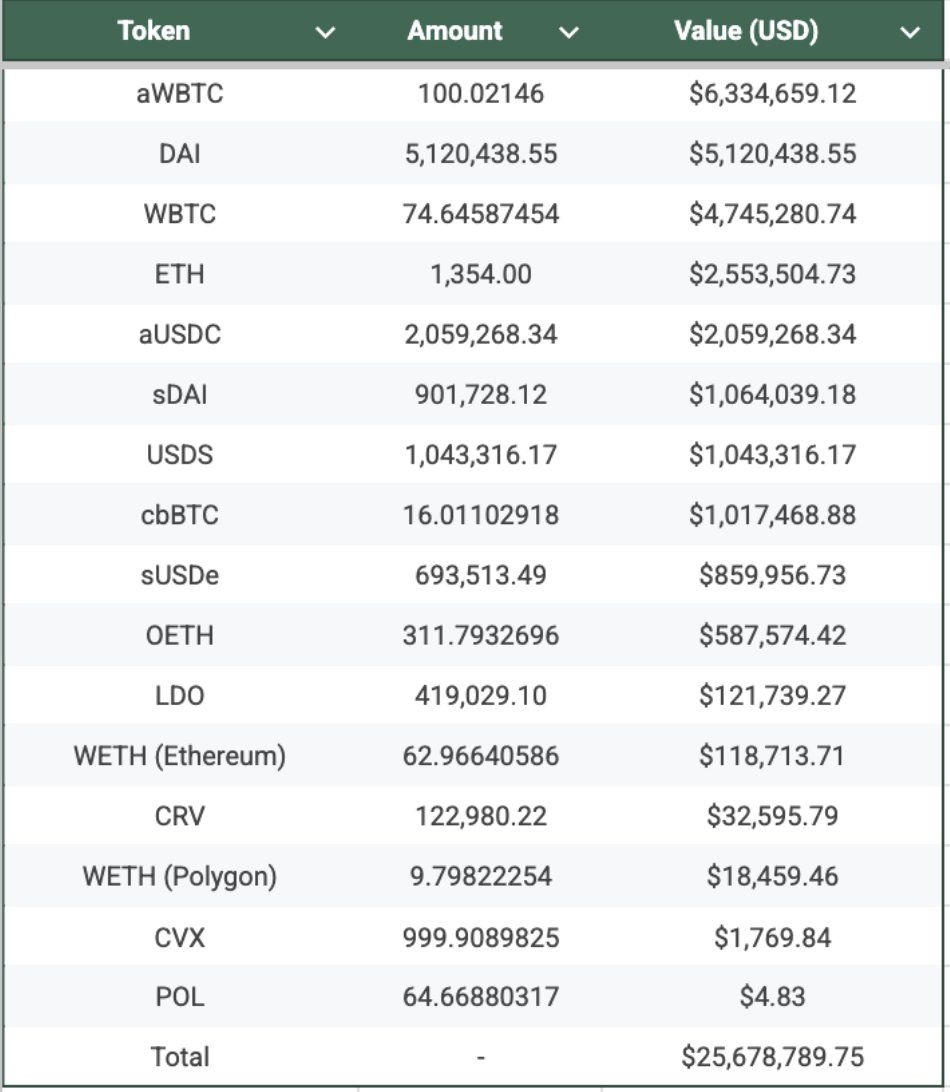
An unknown crypto whale lost $25.6 million after an attacker drained their wallet. The hacker swapped the stolen assets into Dai (DAI) and Ethereum (ETH), onchain analyst Specter reported.
The same wallet lost $24.2 million to a phishing attack in September 2023. Afterward, the attacker returned roughly 90% of the funds.
Follow us on X to get the latest news as it happens
Attacker Drains aWBTC, DAI, and WBTC From Whale Wallet
Blockchain security firm PeckShield detailed the largest holdings taken. This included $6.3 million in aWBTC. DAI losses totaled $5.1 million, while direct Wrapped Bitcoin (WBTC) holdings totaled $4.7 million.
Roughly $2.6 million in ETH also left the wallet. Smaller balances of cbBTC, USDS, Lido DAO (LDO), and Curve DAO (CRV) went the same way.
The attacker converted the proceeds into 20 million DAI and 3,000 ETH. The stolen funds now sit across four addresses.

Whale Fell Victim to a $24.24 Million Phishing Attack in 2023
The victim has a costly history. PeckShield reported in September 2023 that the same whale lost $24.2 million to phishing, including about 4,851 rETH and 9,579.2 stETH.
That phisher swapped the tokens for roughly 13,785 ETH and 1.64 million DAI. These two incidents have now cost the address almost $50 million combined.
The theft lands during a busy month for crypto security. DefiLlama has separately logged 13 hacks in August, with tracked losses above $12 million.
Payment processor Coinsbuy accounted for the bulk of that figure after losing $7.9 million on August 9. Whether this attacker follows the 2023 precedent and returns the funds will likely determine how much the victim recovers.
Subscribe to our YouTube channel to watch leaders and journalists provide expert insights
The post Crypto Whale Loses $25.6 Million 2 Years After $24 Million Phishing Attack appeared first on BeInCrypto.

Slovenia joins EU’s MiCA stablecoin register with first issuer

Utah Football Record vs. the Top Programs in the West

Twitch faces backlash over Amazon training AI on its users’ livestreams


-

 Fashion5 days ago
Weekend Open Thread: Mattifying Sunscreen
-

 Fashion6 days ago
Frugal Friday’s Workwear Report: Cap-Sleeve Pointelle Crewneck Sweater
-

 News Videos5 days ago
Can Astrology Help Find Gold and Silver Trends? A Financial Astrology Guide
-

 Politics7 days ago
Reform UK And Greens Sink To Lowest Favourability Ratings To Date
-

 Tech5 days ago
Rinn Pharma & Biopharma to join NordicPharmaTrain network
-

 Business4 days ago
How to Start a Cleaning Business: A Step-by-Step Guide
-

 Business4 days ago
Datadog: Best Of Breed For Multiple Reasons
-

 Business4 days ago
BDC Weekly Review: Private BDC Q2 Numbers Are Strong
-
 NewsBeat1 day ago
Communication cards help banking customers access services or report scams
-

 Business6 days ago
Brightwater secures funding for WA-first dementia projects
-

 Tech6 days ago
Price Hikes May Be Coming for PC Motherboards Next
-
 Crypto World7 days ago
Galaxy Digital Stock Slides 14% as Crypto Prices Hit Earnings
-
 Business2 days ago
Oil Price Today (August 11): Crude oil rises to $88 after Trump’s compensation demand dents Hormuz opening. Here’s why
-

 Business7 days ago
SpaceX Shares Plunge 13.6% After First Public Earnings as AI Capex Surge and Lockup Spark Selloff
-
 Tech7 days ago
How to Use Your Phone as a Webcam on PC and Mac (2026)
-

 Fashion7 days ago
The Next Paisley Chapter – Julia Berolzheimer
-

 Tech7 days ago
Hackers just broke into America’s tap water. How scared should you be?
-

 Fashion5 days ago
Weekly News Update, 8.6.26 – Corporette.com
-

 Entertainment7 days ago
This $29 One-Piece Looks Just Like Ashley Graham’s Swimsuit
-

 Fashion7 days ago
Thursday’s Workwear Report: The Everyday Linen Shirt
You must be logged in to post a comment Login