
Crypto World
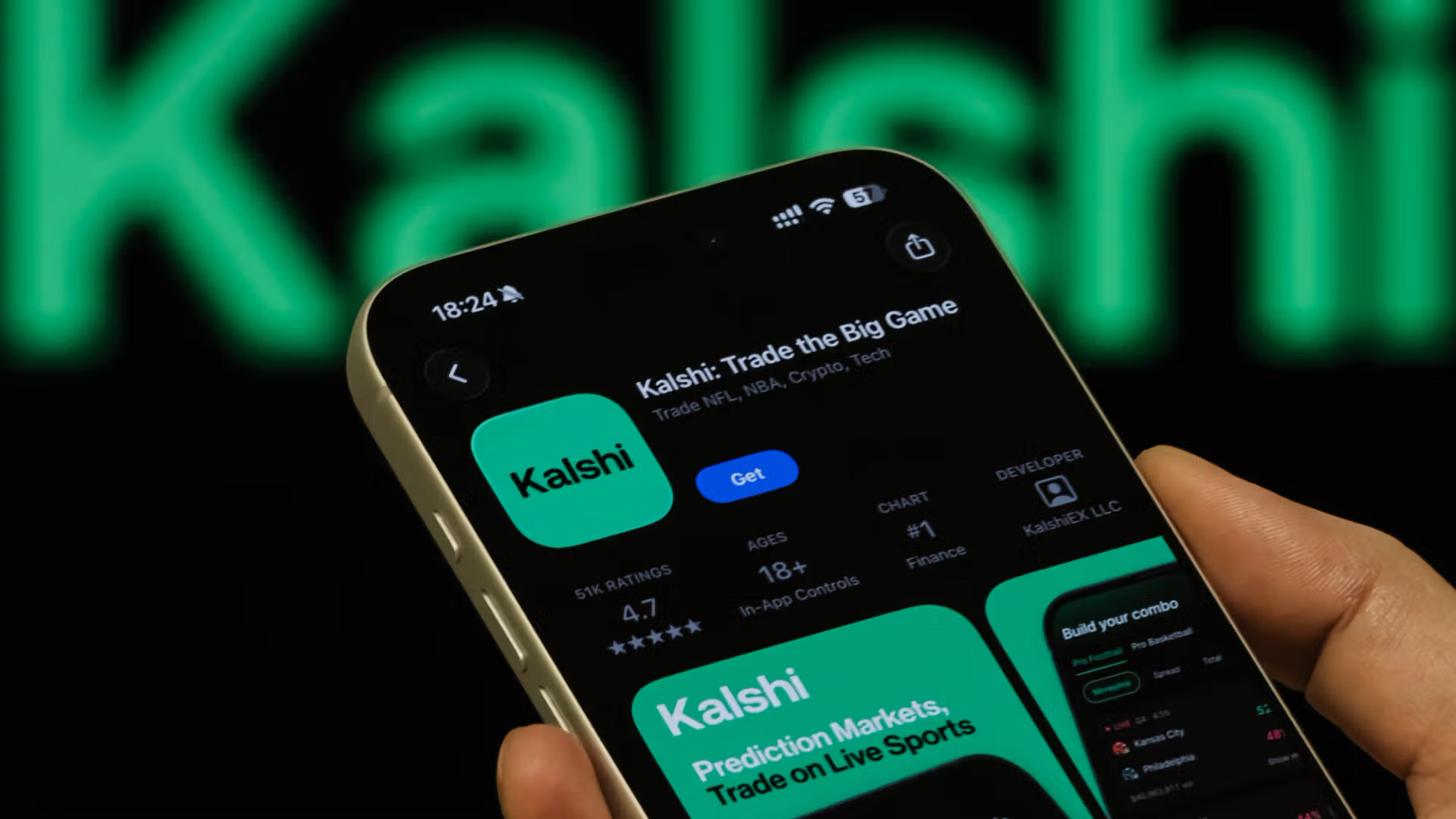
Kalshi asks CFTC to allow margin trading on its platform, letting users buy with borrowed funds

Prediction market platform Kalshi filed on Tuesday with federal regulators to seek approval to offer leverage on event contracts, a prevalent practice already on Wall Street for stocks and futures.
The filing with the Commodity Futures Trading Commission — the federal regulator for event contracts — comes from Kalshi Klear, the company’s internal clearing house. It’s the latest move by the company as prediction markets increasingly seek to attract institutional liquidity to event contract exchanges.
Kalshi already provides leverage on its perpetual futures contracts, though has yet to receive the same approval to do so for its prediction markets.
Offering margin trading, which allows a trader to borrow money to purchase more of an asset than the cash they put down, has been seen widely by institutions eyeing the prediction market space as a critical step needed for bigger players to participate, which are used to the practice on traditional equities and derivatives. Currently, all event contracts on regulated U.S. exchanges are entirely collateralized.
Bloomberg News in July reported Polymarket, a prediction market rival, made moves to obtain regulatory licenses to eventually offer margin trading on its event contracts in the U.S.
Prediction market volume, including Kalshi’s, has surged over the past year primarily thanks to retail trading on their sports-related offerings. However, a Kalshi spokesperson told CNBC the company would avoid offering margin opportunities on its sports event contracts, as well as its culture and “mention” markets.
Kalshi in a memo provided to CNBC said the ability to offer leverage will make longer-dated prediction markets, those with expiration dates far in the future, more attractive to institutional traders.
The company also said it is seeking to introduce a system where as event contracts near their expiry date, the capital requirements to obtain leverage increase. Marginable contracts — if approved — will only be accessible to self-clearing members, who have direct relationships with Kalshi Klear, that meet certain capital requirements, the Kalshi spokesperson said.
Disclosure: CNBC and Kalshi have a commercial relationship that includes customer acquisition and a minority investment.

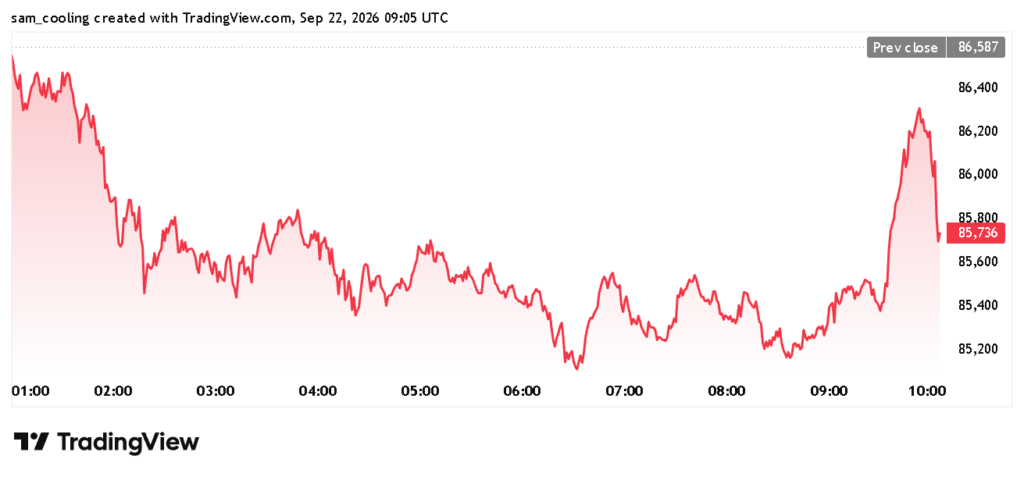
Bitcoin (BTC) is defending the $85,500 mark on Tuesday, 22 September, with BTC price trading at $85,736 as a minor -0.97% price correction cools off a bullish move. This comes after the top cryptocurrency pushed above $85,000 for the first time in eight months and hit its highest level since January.
The question the move forces onto the table isn’t whether Bitcoin can rally on a good day – it’s whether the macro backdrop that just eased is actually turning, or whether traders bought a one-day reprieve from an inflation scare that hasn’t gone anywhere.

(Source – TradingView, BTC USD)
Why Is Oil Falling and Are Yields Back in Focus?
The catalyst was straightforward. Brent crude had topped $109 a barrel the previous week, and traders read that spike as a direct threat to the inflation outlook – the kind of shock that keeps central banks hawkish and long-dated yields elevated.
On Monday, Brent fell back below $100 on signs of potential de-escalation tied to Iran, and the 10-year Treasury yield eased to roughly 4.96% from a recent high of 5.04%.

(Source – OilPrice.com, WTI Crude)
That chain matters for crypto specifically. Bitcoin behaves as a risk-on asset that generally performs better when bond Treasury yields fall and weakens when they climb, since lower yields reduce the opportunity cost of holding a non-yielding asset and free up appetite for higher-beta positions.
The same logic pulled the S&P 500 up 1.5% and the Nasdaq Composite up 2.1% on the same session, evidence that this was a cross-asset move rather than something isolated to crypto desks.
It’s worth treating the geopolitical trigger as a market read rather than a resolved outcome. Signs of de-escalation in Hormuz are not a settlement, although its unlikely that President Trump will shake markets ahead of his meeting with Xi on Thursday, and oil prices and yields both remain historically elevated even after Monday’s pullback – a point worth keeping in view alongside broader questions about how Federal Reserve policy shapes crypto-market sentiment and how Bitcoin’s price behavior compares with traditional havens in pieces examining Bitcoin’s relationship with gold and macro assets.
What the Bitcoin Price Rally Proves: Why is Bitcoin Going Up?
Oil prices, inflation expectations, and Treasury yields heavily influence Bitcoin’s price movements on a day-to-day basis, and Monday’s session is a clean illustration of that mechanism working in reverse from the prior week’s selloff.
Reported spot Bitcoin ETFs inflows and short covering may have amplified the advance, adding fuel once the macro door opened, though no verified figures for either accompany that claim.
(Source – CoinGlass, BTC ETF)
What the move does not establish is a durable shift in the inflation cycle’s rate. A single session of falling yields and retreating crude is relief from a worsening shock, not confirmation that either has entered a sustained downtrend.
Bitcoin traders who treat Monday’s print as a green light for a new leg higher are underwriting a macro thesis that hasn’t been tested past 24 hours.
The more durable read is narrower: crypto reconnected with broader risk appetite the moment the inflation-shock narrative lost steam, which is exactly what a risk-on asset is supposed to do.
Whether that connection holds depends on whether oil and yields keep drifting lower through the week or whether Monday turns out to be the low point of a temporary dip.
Bitcoin Clears $85,000, but Here’s Why the Range Still Matters
The intraday range tells its own story about how contested this level is. Bitcoin swung between $81,724 and $87,330 during the session, a spread of more than $5,600, before trading near $85,435, with a market capitalization of around $1.7 trillion. That’s a wide band for a single day, consistent with a market still working out whether $85,000 is a floor or a ceiling.
Reclaiming $85,000 after eight months below it is a meaningful technical milestone, and Bitcoin reached its highest level since January.
For a closer look at how traders are treating the broader $80,000 level as support and what liquidation dynamics could mean for the next leg, see this breakdown of Bitcoin’s breakout above $80,000.
None of that changes the underlying dependency, though. Bitcoin rose as oil prices and Treasury yields retreated, and the range it traded in shows a market that hasn’t yet decided whether Monday’s macro relief is the start of something or a one-off pause before the next data point resets the debate.
Don’t Miss: The Hottest Meme Coin Opportunities Silently Climbing the Crypto Ranks in September
The post Bitcoin Reclaims $85,000 as Oil and Yields Retreat appeared first on Cryptonews.
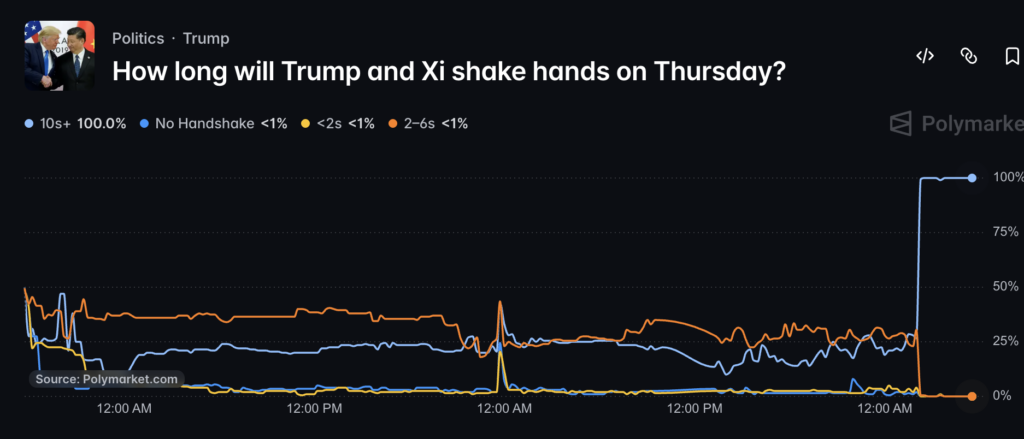
Trump-Xi Polymarket odds of the two leaders shaking hands during their upcoming meeting have priced a 10-15 second handshake at roughly 50%, the leading outcome on a contract built entirely around how they greet each other at their September 24 Washington summit.
A hug gets 5%. A kiss gets 1%. The market is not pricing diplomacy; it’s pricing choreography, and the spread between those numbers says more about how traders read protocol than how they read policy.

That handshake contract carries about $4,200 in trading volume and $57,800 in liquidity as of the September 22 update, a modest slice of the roughly $30.6M in aggregate volume flowing through Polymarket’s broader Trump-Xi predictions dashboard.
The scale mismatch matters: most of that $30M is riding on substantive questions tariff agreements, AI coordination, Taiwan rhetoric while the handshake, hug, and kiss markets are the sideshow drawing outsized attention relative to the capital actually behind them.
What Do the Trump-Xi Polymarket Odds Actually Say About US-China Relations?
The 10-15 second window isn’t an arbitrary midpoint. Polymarket’s own market summary frames it as consistent with a measured, protocol-driven greeting, the kind both leaders produced during their May summit in Beijing, where public exchanges were cordial and framed around partnership even as Taiwan and other disputes stayed unresolved.
Traders appear to be pricing continuity, not surprise: no acute crisis has emerged ahead of the meeting, and preparatory talks in New York reportedly kept the agenda anchored to extending the bilateral trade truce, AI safety mechanisms and non-sensitive trade issues.
None of that tells you whether the summit produces anything durable on US-China relations. A handshake market resolves on video footage, not on whether the trade truce actually gets extended or whether AI safety language survives contact with drafting sessions.
That’s the structural limit of these contracts; they’re excellent at pricing observable, binary physical events and useless at forecasting the substance of closed-door negotiation. The distinction between observable footage and negotiated substance is central to interpreting a contract like this.
Scale is the other tell. Polymarket’s Trump-Xi dashboard dwarfs the handshake contract specifically because traders concentrate capital where the payoff is tied to something with follow-through.
This is comparable in spirit to the volume that piles into FOMC rate-decision markets ahead of a Fed announcement, where the binary outcome carries real macro weight. The handshake, hug, and kiss contracts, by contrast, have lower listed volumes than the dashboard total.
Make Your Trump-Xi Handshake Prediction With $25 For Free on Kalshi
What Resolves the Bet?
September 24 makes this a near-term, verifiable event rather than a speculative long-dated bet. If the two leaders’ initial greeting clocks in at 10-15 seconds on video, the Trump-Xi Polymarket odds market’s current favorite resolves correctly. Anything unusually brief or unusually extended would fall outside the favored duration.
A hug or a kiss would represent a genuine tail outcome given the 5% and 1% pricing, the kind of result that would immediately reprice the entire handshake-adjacent market cluster in real time.
These figures are live and can shift before the summit itself, since Polymarket prices move continuously with trading activity, spreads, and incoming information rather than locking in until resolution.
Whatever the footage shows, it will settle a contract about body language, not the tariff truce, not the AI framework, and not the underlying state of US-China relations that the actual bilateral talks are meant to address.
Earn $50 and Enter $300K Prize Draw on EdgeX
The post Trump-Xi Polymarket Odds for Handshake Hit 50% appeared first on Cryptonews.
Kakao Pay and KakaoBank, two major financial players in South Korea’s Kakao ecosystem, have signed a memorandum of understanding (MoU) with crypto custody and infrastructure provider Fireblocks. The partnership is designed to explore digital asset use cases, including stablecoins, through proof-of-concept testing focused on infrastructure requirements specific to the South Korean market.
According to the announcement, the companies will work together to evaluate digital asset infrastructure that can meet local expectations around regulation, security, and service delivery. Fireblocks said it already provides infrastructure to more than 2,500 institutions, including over 100 banks, highlighting that the collaboration is likely aimed at bringing proven enterprise-grade tooling into Kakao’s domestic financial offerings.
Key takeaways
- Kakao Pay and KakaoBank are partnering with Fireblocks to run stablecoin and digital-asset infrastructure proof-of-concepts tailored to South Korea.
- The MoU focuses on regulatory, security, and service requirements rather than announcing any near-term product launch or deployment schedule.
- Fireblocks’ enterprise footprint—spanning over 2,500 institutions and more than 100 banks—positions it as an infrastructure partner for regulated finance use cases.
- The deal adds momentum to a broader wave of stablecoin experiments in South Korea, including won-denominated pilots by other financial firms.
- This comes after Kakao Group pursued stablecoin-related work with Circle, signaling continued institutional interest in onchain payments.
Why Kakao’s MoU matters for onchain finance in South Korea
For investors and builders, the most important detail in deals like this is often not a promised product timeline, but the direction of travel. Kakao Pay and KakaoBank are already positioned at the intersection of consumer payments and banking services in South Korea. By teaming up with an established crypto infrastructure provider, they are signaling that stablecoins—and the infrastructure required to support them—are moving from isolated trials toward more structured enterprise evaluation.
The scope is also telling: the agreement centers on proof-of-concept testing for infrastructure suited to local regulatory, security, and service requirements. That emphasis aligns with the reality that stablecoin deployments in mainstream finance depend on more than token mechanics. Institutions typically need secure custody, robust operational controls, and infrastructure that can integrate with existing systems while complying with domestic standards.
Enterprise infrastructure focus: what Fireblocks brings
Fireblocks is a known name in institutional crypto infrastructure, with the company stating it serves more than 2,500 institutions, including over 100 banks. While the MoU does not disclose specific technical architecture in the announcement, that enterprise scale suggests Kakao’s goal is likely to pressure-test how Fireblocks’ infrastructure can support compliant operations for digital assets—particularly stablecoins.
From an editorial standpoint, this matters because stablecoin experimentation has increasingly turned into an infrastructure conversation. The successful path to production often hinges on operational safety and integration capabilities: how assets are managed, how transactions are authorized, and how systems remain resilient under real-world usage and scrutiny.
Part of a broader stablecoin push across Kakao and South Korea
This new MoU follows earlier activity within the Kakao ecosystem. In July, Kakao Group signed a separate memorandum of understanding with stablecoin issuer Circle to explore blockchain-based payment infrastructure and related digital asset technology. That collaboration included evaluating opportunities around won-denominated stablecoins and associated services, according to earlier coverage from Cointelegraph: Kakao Circle won stablecoin payment infrastructure.
More broadly, Kakao Pay and KakaoBank are not acting alone. Cointelegraph previously reported that several South Korean financial and technology firms have been evaluating stablecoin opportunities as the country works on its regulatory framework for digital assets. One reference in that direction is Cointelegraph’s coverage of South Korea’s efforts to consolidate crypto law and related policy shifts: South Korea consolidated crypto law, tax repeal.
Stablecoin trials already underway: won-denominated experiments
The Kakao-Fireblocks agreement arrives amid an ongoing series of stablecoin pilots and proofs of concept in South Korea. In May, Cointelegraph reported that KB Financial Group completed a won-denominated stablecoin pilot covering issuance, offline merchant payments, and cross-border remittances: KB Financial Group stablecoin pilot.
In July, Cointelegraph also detailed how fintech company Toss partnered with Optimism and Sunnyside Labs on a proof of concept for won-based stablecoin payment infrastructure: Toss partners on won-stablecoin PoC. While each effort may differ in approach and partner stack, the common thread is the move toward practical payment rail testing, not just token issuance experimentation.
What changes with the Kakao announcement is the nature of the institutions involved. A combination of a major mobile payments service (Kakao Pay) and one of South Korea’s largest internet-only banks (KakaoBank) suggests a stronger pathway to scaling stablecoin use into consumer-facing workflows—if the proof-of-concept results support that direction. The MoU’s lack of a launch date also indicates the work is likely still in an assessment phase, where risk controls and regulatory fit will determine whether anything progresses beyond testing.
For readers tracking the sector, the competitive dynamic is worth noting. South Korea’s stablecoin efforts appear to be accelerating across multiple institutions, and each new partnership can influence how quickly the market gains confidence in infrastructure readiness—especially around security and compliance. As framework details develop, firms that can demonstrate operational reliability in PoCs will be better positioned when the window for wider adoption opens.
Next, the market will watch for concrete outcomes from Kakao Pay and KakaoBank’s proof-of-concept work—whether they publish results, narrow down specific stablecoin use cases, or expand testing into more operationally complex payment scenarios. Until then, the biggest uncertainty remains timing and scope: the agreement signals commitment, but the path from MoU to live deployments will likely depend on regulatory interpretation and the proof-of-concept findings.
Binance has invested $100 million in Circle Internet Group while entering a new five year commercial agreement that will pay the crypto exchange to promote USDC across its platform.
Summary
- Binance purchased 1.24 million Circle shares for roughly $100 million through a private placement completed on Sept. 17.
- Circle will pay Binance monthly incentives tied to qualifying USDC balances, while Binance will promote the stablecoin across its platform.
- Binance cannot sell, transfer or hedge the shares for up to two years under the agreement, but retains voting rights.
- The five year partnership replaces earlier USDC agreements between Circle and Binance from November 2024 and August 2025.
According to a securities filing cited in reports published Tuesday, Circle issued Binance 1.24 million Class A common shares at $80.84 each through a private placement that closed Sept. 17, bringing the transaction value to roughly $100 million.
The purchase was completed alongside new commercial terms between the companies covering the distribution and promotion of USDC. Circle agreed to pay Binance monthly incentive fees based on the amount of USDC held through its Modular Smart Contract Wallet infrastructure, while Binance agreed to carry out promotional activities tied to the stablecoin.
Circle said the $80.84 share price represented a discount to the company’s market value before the transaction. Binance faces restrictions on disposing of the shares under the agreement, limiting its ability to sell, transfer or hedge the position until the earlier of two years or certain circumstances in which Binance terminates the related commercial arrangements.
Binance retains voting rights attached to the shares during the restriction period.
Binance and Circle extend USDC deal for five years
The latest agreement replaces earlier commercial arrangements between Circle and Binance dating to November 2024 and August 2025.
Circle disclosed in its annual filing that the November 2024 agreement included a $60.3 million one time upfront payment to Binance and monthly incentive fees calculated using USDC balances held on the exchange and in its treasury, subject to minimum balance requirements. The treasury portion of that arrangement carried a two year term.
An expanded agreement signed in August 2025 covered USDC held through Circle’s Modular Smart Contract Wallet infrastructure. Circle agreed under those terms to make monthly incentive payments based on qualifying balances, while the arrangement carried a four year term with specified early termination provisions.
The companies have now replaced those arrangements with the five year agreement accompanying Binance’s equity purchase. Either party can terminate the new partnership before the full term if specified events occur, though the termination thresholds and related figures have not been publicly disclosed.
Circle subsidiaries entered into the commercial agreements, with the equity transaction closing immediately afterward.
The 1.24 million shares were issued through an unregistered private placement. As a result, Binance cannot freely resell the securities unless they are subsequently registered or the transaction qualifies for an exemption from registration requirements.
USDC ties between Binance and Circle have grown since 2024
Binance and Circle have been expanding their relationship since announcing a strategic USDC partnership in December 2024.
As crypto.news previously reported, the initial partnership was designed to make USDC available across more Binance products and services, including trading, savings and payments. Binance said at the time that it planned to use USDC in its own corporate treasury operations.
Their cooperation later extended beyond the stablecoin’s conventional use as a dollar pegged trading asset.
In July 2025, Binance began accepting Circle’s USYC as off exchange collateral for institutional derivatives trading. The arrangement allowed institutional customers to use the tokenized Treasury product as collateral while retaining its yield generating characteristics.
USYC was integrated through Binance’s triparty banking partners and custody infrastructure, while Circle said the asset could be converted into USDC when liquidity was required. Circle planned native issuance of USYC on BNB Chain as part of the integration.
Binance has continued adding infrastructure around Circle products. The exchange completed its integration of USDC deposits on Circle’s Arc network on Sept. 16, according to a Binance announcement.
Circle has expanded USDC distribution through major platforms
Circle’s agreement with Binance sits alongside other distribution arrangements through which the company pays partners connected to USDC circulation.
In August, Circle renewed its USDC agreement with Coinbase for another three years through 2029 on existing terms. Circle reported $73.3 billion of USDC in circulation at the end of the second quarter, up 19% from the same period a year earlier, while Coinbase held 30% of the circulating supply on its platform.
Circle generated $701 million in second quarter revenue and reserve income, an increase of 7% from the previous year, according to the August earnings report. The company said it planned to reinvest capital in products, distribution partnerships and other strategic opportunities instead of introducing quarterly dividends.
Distribution efforts have extended outside crypto exchanges. Circle signed a principal partnership with Chelsea Football Club in August, putting USDC branding on Chelsea shirts for the men’s, women’s and academy teams during the 2026/27 season.
The company has pursued payment infrastructure partnerships at the same time. Nium joined Circle Payments Network as a global payout partner earlier this year, connecting USDC based settlement with local currency payouts through bank accounts, wallets and cards across more than 190 countries and 100 currencies.
Binance has increased the role of USDC across its platform
Binance’s use of USDC has changed considerably since the exchange removed several USDC trading pairs in 2022 as part of an effort to concentrate stablecoin liquidity.
The exchange began bringing USDC pairs back in December 2023 and later expanded their availability across spot markets. Binance subsequently converted assets held in its Secure Asset Fund for Users into USDC and increased the stablecoin’s role across trading products.
Regulatory changes in Europe produced another expansion. Binance moved to remove non MiCA compliant stablecoin spot pairs for European Economic Area users in March 2025 while continuing support for compliant assets including USDC and EURI. The exchange offered zero fee trading on selected pairs and rewards tied to USDC or EURI as users moved away from affected stablecoins.
More recently, Binance has used USDC in products extending into traditional financial assets. The exchange launched tokenized U.S. equities in June, with the first batch of bStocks including Circle shares alongside Nvidia, Tesla, Micron and Sandisk.
The products are backed 1:1 by underlying securities and can be moved into self custody wallets or used in supported decentralized finance applications. Eligible users can convert the tokenized positions back into direct stock positions under the service’s terms.
Crypto World
Kalshi’s bitcoin, ether perpetual volume is dominated by repeating trade sizes, data shows
That recurring $5,499 dollar target remained nearly stable even as the number of contracts required to reach it changed with ether’s price. Ether rose from around $1,700 to $2,500 between June and September, forcing the number of contracts in each trade to keep changing while the dollar target stayed almost fixed. A trade in the July cluster held about 2,800 contracts, against roughly 2,200 in September.
The target itself changed over time.
Trades clustered around $4,999 in CoinDesk’s earlier samples, while trades near $9,999 accounted for 72% of the sampled value on June 28. A recurring $3,999 target first appeared on Aug. 10, followed by $4,499 on Aug. 18 and $5,499 on Aug. 24.
By June 19, three weeks after Kalshi launched its cryptocurrency perpetual futures, trades worth almost exactly $4,999 accounted for 37% of the ether contract value CoinDesk sampled that hour.
Bitcoin also showed a similar trading pattern.
Two recurring sizes move in lockstep as bitcoin’s price changed, with the larger trade staying almost exactly twice the size of the smaller one. The larger was exactly twice the smaller in 9 of the 22 samples that contained both. In the other 13, the larger trade was just one contract above double the smaller one, a difference consistent with rounding.
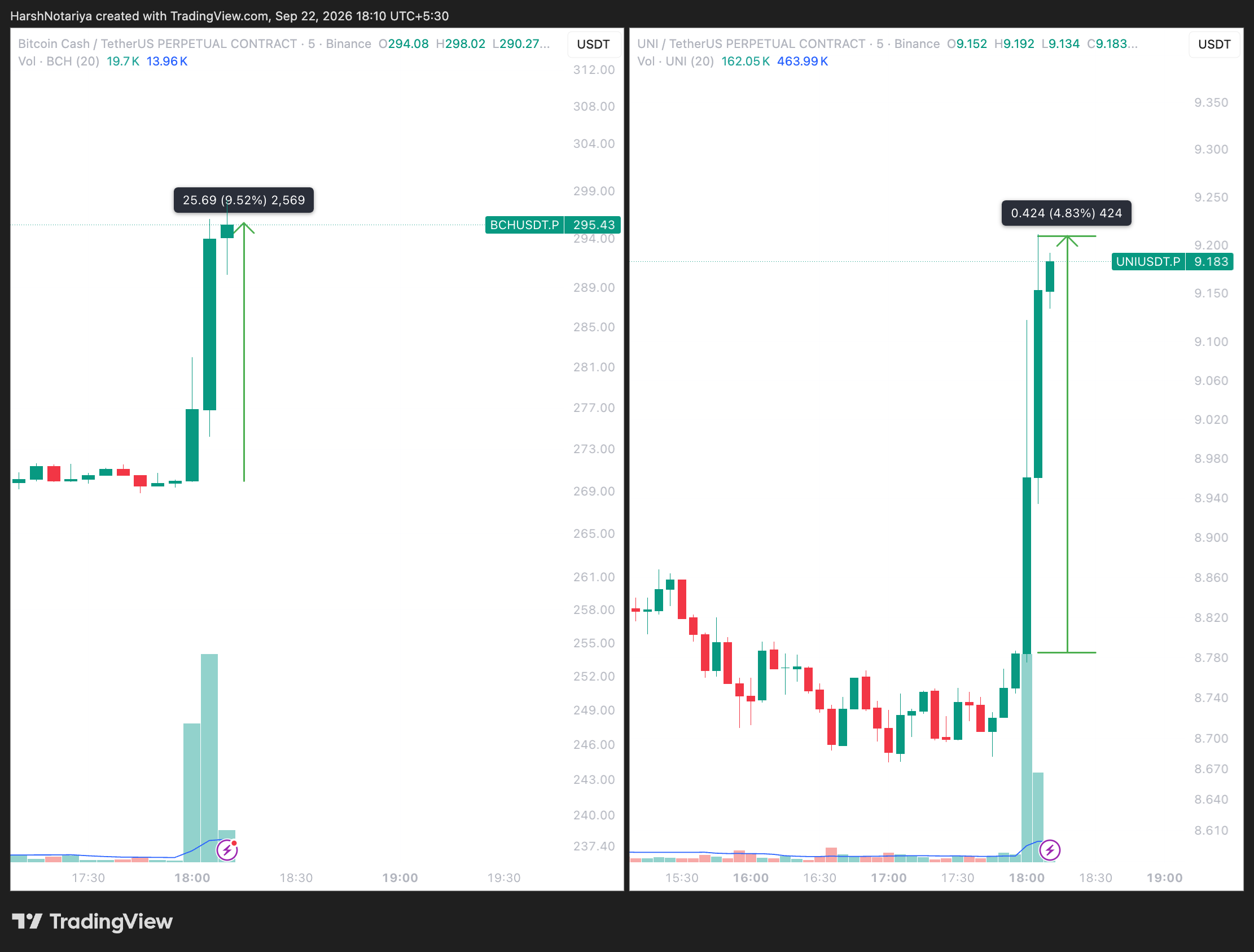
CME Group will add Bitcoin Cash (BCH) and Uniswap (UNI) futures to its crypto derivatives lineup on October 19, pending regulatory review. UNI jumped about 5% within minutes of the announcement, while BCH climbed nearly 10%.
The world’s largest derivatives exchange confirmed the contracts on Tuesday. Each token will trade in a standard size and a smaller micro size for traders who want less exposure per contract.

What the CME Group Listing Means for Uniswap and Bitcoin Cash
A futures contract lets traders bet on, or hedge against, a token’s price without holding the token itself. CME is overseen by the Commodity Futures Trading Commission (CFTC), the US derivatives regulator.
Many banks, hedge funds, and asset managers cannot trade on offshore crypto exchanges, so a CME contract is often their only route into a coin.
Standard contracts will cover 10,000 UNI or 250 BCH. Micro contracts cover 1,000 UNI or 25 BCH. At current prices, one standard UNI contract represents roughly $90,000 of exposure, and one standard BCH contract about $69,000.
CME already runs a large crypto business. Its crypto contracts averaged 279,800 trades a day in the first half of 2026, worth $8.3 billion in notional value, according to the announcement. The exchange listed Cardano, Chainlink, and Stellar futures in February and moved to 24/7 crypto trading in May.
Giovanni Vicioso, Global Head of Cryptocurrency Products at CME Group, framed the additions as a response to institutional demand.
“As crypto markets continue to mature, participants require broader, regulated tools to navigate evolving digital asset related price risk,” Vicioso said.
In the short term, the market has already answered. Both tokens rallied within minutes because a CME listing signals that regulated money can now take positions in them.
The longer-term picture is more mixed. Futures let institutions buy exposure, but they also make it easier to short a token. Bitcoin’s first CME futures launched in December 2017, days before that cycle’s peak. Meanwhile, Cardano sat at a five-year low months after its own CME contracts arrived.
Therefore, the listing is a credibility boost rather than a guaranteed price catalyst. The number to watch after October 19 is open interest. If institutions actually build positions in the new contracts, the demand story holds. If volume stays thin, the rally may prove to be a one-day headline trade.
The post 2 Altcoins Just Got Wall Street's Stamp of Approval: What Happens Next? appeared first on BeInCrypto.

As access to Monero has become more restricted on some centralized exchanges — notably after Binance delisted XMR globally on 20 February 2024, OKX removed XMR pairs on 5 January 2024, and Kraken restricted it for EEA users on 31 October 2024 — many users now rely on instant swap services and decentralized platforms.
This guide compares practical ways to exchange Monero without registration, focusing on USDT TRC20 to XMR, minimum amounts, confirmation requirements, and AML procedures.
Why use a Monero exchange without registration?
Monero’s privacy features — ring signatures, stealth addresses, and confidential transactions — hide sender, receiver and amount on-chain. The best Monero exchange depends on whether the user prioritizes live pricing, decentralization or the number of supported assets.
However, the way to acquire or dispose of XMR still matters. Centralized exchanges that still list XMR usually require full identity verification and maintain user accounts.
Services that do not require registration let users create a one-time order, send crypto from their own wallet to a temporary deposit address, and receive the output directly in a controlled wallet.
This reduces the personal data trail associated with the exchange itself.
“No registration” is not the same as an unconditional guarantee that identity information will never be requested.
Most instant services apply automated AML screening. A standard-order flow usually proceeds without documents, but a flagged deposit can pause processing.
How should investors compare no-registration XMR exchanges?
Useful comparison points include:
- Supported XMR directions, especially USDT TRC20 → XMR, XMR → BTC and other assets.
- Whether an account or identity documents are needed to create a standard order.
- Minimum amounts; always check the live quote — they are pair- and liquidity-dependent.
- How the service handles incoming deposits and outgoing XMR.
- Stated AML / risk-screening policy.
- Custody model during the brief processing window.
According to the official Monero Wallet CLI documentation, newly received XMR normally becomes spendable after 10 confirmations.
Which no-registration Monero exchanges are available in 2026?
The following services are commonly used for accountless XMR swaps. The best XMR exchange for a particular transaction depends on the required pair, available rate, liquidity, and AML terms.
Descriptions reflect publicly available information and community testing as of mid-2026; always re-verify.
Quickex
Quickex operates as an accountless instant exchange. Users can create an order without registration for standard pairs that include Monero.
The service supports XMR routes involving USDT across several networks, as well as BTC and ETH, including exchanges in both directions.
Minimum amounts appear in the live quote and are pair-dependent.
Newly received XMR typically becomes spendable after 10 Monero confirmations, which is approximately 20 minutes at Monero’s two-minute block target. This wallet unlock period should not be confused with the exchange provider’s own deposit-processing requirements.
Quickex applies risk-based AML screening. According to its published policy, suspicious transactions may be delayed for review and additional information can be requested.
For users specifically needing the reverse direction, the service provides an XMR to BTC route.
SimpleSwap
SimpleSwap is a self-custodial crypto swap aggregator that supports Monero (XMR) exchanges without account registration for most crypto-to-crypto swaps. It aggregates liquidity from 20+ CEX and DEX providers across 2,800+ assets, with XMR available in both directions for pairs including USDT/XMR, BTC/XMR, and LTC/XMR. Swaps follow a wallet-to-wallet model, without on-platform user balances.
Users select the assets they want to exchange and provide a receiving wallet address, while SimpleSwap handles provider and route selection behind the scenes. Fixed and floating rates are available, allowing users to choose between greater price certainty and a rate that follows the market. The quoted output is shown before the swap is initiated.
USDT is supported across multiple networks, giving users several routes for exchanging USDT to XMR depending on current availability. SimpleSwap supports other Monero pairs, including BTC/XMR and LTC/XMR, allowing users to move between XMR and other major assets without navigating an order book or manually comparing providers.
Overall, SimpleSwap is designed for users who want to exchange Monero and other cryptocurrencies directly between their own wallets without creating an account for a typical swap. Users should compare the final quoted amount, selected network, and exchange conditions before proceeding.
ChangeNOW, StealthEX, and Godex
These established instant-swap services (ChangeNOW, StealthEX, and Godex) allow creation of XMR-related orders without registration for ordinary volumes.
They typically offer both floating and fixed-rate options.
Minimum amounts, supported networks, including USDT TRC20, and confirmation expectations are displayed in the order interface and can differ by pair and current network conditions.
Trocador
Trocador acts as a privacy-oriented aggregator. It does not hold funds itself but routes orders to partner services, allowing rate comparison while remaining within an accountless workflow for many routes.
Haveno
Haveno is a decentralized, Tor-based peer-to-peer platform focused on Monero. It does not operate as a centralized instant swap. Trades rely on an order book and multisig-style escrow. It offers the greatest degree of decentralization among the listed options at the cost of potentially longer matching times and variable liquidity.
How do the leading Monero exchanges compare?
| Service | Account required | XMR directions | Rate options | Where minimum is shown | AML/KYC caveat | Best suited for |
| Quickex | No for a standard order | USDT, BTC, ETH ↔ XMR | Floating / Fixed | Live quote | Review possible for flagged transactions | Direct accountless swaps |
| SimpleSwap | No for most crypto-to-crypto swaps | Easy XMR swaps across multiple assets | Fixed / Floating | Exchange flow | Additional checks possible | Easy XMR swaps across multiple assets |
| ChangeNOW | No for standard orders | Multiple XMR routes | Fixed / Floating | Live quote | Additional checks possible | Rate choice |
| StealthEX | No for standard orders | Multiple XMR routes | Check live | Live quote | Risk-screening policy applies | Broad pair support |
| Godex | No for standard orders | Multiple XMR routes | Fixed / Floating | Live quote | Risk-screening policy applies | Rate certainty |
| Trocador | No account with aggregator | Provider-dependent | Provider-dependent | Provider quote | Provider-dependent | Comparing providers |
| Haveno | No centralized account | XMR with fiat/crypto offers | Offer-based | Order book | No centralized KYC; individual payment methods may have their own requirements | Decentralized P2P trading |
How to exchange USDT TRC20 for XMR on Quickex?
A typical accountless flow looks like this:
- Select USDT (TRC20) as the asset to send and XMR as the asset to receive.
- Enter a fresh Monero receiving address; a subaddress is preferable. Using a new subaddress for each incoming payment improves privacy by preventing address reuse.
- Review the live minimum, expected output, rate type, choose fixed or floating rate — fixed locks the receive amount for a limited window, while floating follows the market — and any network notes.
- Send the exact amount of USDT TRC20 from a wallet to the one-time deposit address generated by the service.
- After the USDT deposit receives the required TRON confirmations, the service processes the swap and broadcasts the XMR transaction.
Most Monero wallets display the incoming transaction relatively quickly.
Newly received XMR normally becomes spendable after 10 Monero confirmations, roughly 20 minutes under normal network conditions.
The service’s own internal detection or release threshold may differ slightly from the wallet unlock time. Always perform a small test transaction first and double-check the network, TRC20 vs ERC20, etc.
Can a no-KYC XMR exchange freeze a transaction?
Yes. Even services that do not require registration for a standard order usually run automated risk screening.
If a deposit is flagged, for example due to associations with mixers, high-risk addresses or other risk indicators, the service may pause the order, request additional information or source-of-funds details, or process a refund according to its policy.
Quickex’s published AML documentation states that it applies risk-based checks and may request information when elevated risk is identified. Similar policies exist at most instant-swap providers.
Risk-screening outcomes depend on transaction history, counterparties, and the provider’s internal thresholds. Using a self-custody wallet does not by itself guarantee that a deposit will pass screening.
What are the risks of exchanging Monero without registration?
- Sending to the wrong network or an incorrect address is irreversible.
- Floating rates can move between the moment the quote is received and the moment the deposit is detected.
- Confirmation times vary with network conditions.
- AML review can delay or alter the outcome of an order.
- Regulatory treatment of privacy coins continues to evolve.
Recommended practices include using a dedicated Monero wallet, the official Monero GUI or well-established self-custody options such as Feather or Cake Wallet, generating fresh subaddresses, verifying every detail in the order form, and keeping records of order IDs and transaction hashes.
Review each service’s terms and regional restrictions before accessing it via VPN or Tor, as policies differ.
Conclusion
Suitable accountless XMR options in 2026 include Quickex, SimpleSwap, ChangeNOW, StealthEX, Godex, Trocador, and the decentralized Haveno platform.
Instant services work well for straightforward routes such as USDT TRC20 → XMR, while Haveno maximizes removal of intermediaries. No single service is universally “best.”
Evaluate speed, live rates, minimums, confirmation expectations, and AML handling against personal priorities, and always confirm current details in the order interface before sending funds.
Combine careful platform selection with secure wallet practices to reduce operational risks during an XMR swap.
FAQ
Can I exchange USDT TRC20 for XMR without registration?
Yes, on multiple accountless instant services. Users can create an order, send USDT TRC20 to a temporary deposit address, and receive XMR in their own wallet.
No account is required to start a standard swap.
Can a no-registration Monero exchange still ask for ID?
Yes, if automated AML screening flags the deposit. Most services allow standard orders without documents, but elevated-risk transactions can be paused pending review or additional information.
How many confirmations does a Monero exchange require?
It depends on the service and the direction. Standard Monero wallets typically unlock newly received funds after 10 confirmations, about 20 minutes.
Instant services may use their own detection thresholds. Always check the specific order details.
What happens if an XMR exchange flags a transaction?
The order may be delayed while the service reviews the deposit.
Outcomes can include a request for information, continued processing after clearance, or a refund according to the provider’s policy.
What is the minimum amount needed to exchange USDT for XMR?
Minimums are pair- and liquidity-dependent and appear in the live quote.
They commonly fall in a modest range for stablecoin pairs but should be confirmed on the day of the swap.
What is the best XMR exchange without registration?
There is no single best XMR exchange for every transaction. Quickex is one of the services that offers a direct XMR to BTC route without requiring registration for a standard order.


Circle sold Binance $100 million in stock and agreed to pay monthly incentives under an expanded five-year partnership promoting USDC.

More pieces, financial and performance-related, are falling into place for Alphabet’s (GOOGL) emerging business of selling artificial intelligence accelerator chips, which could provide a boost to Google stock while creating more competition for Nvidia (NVDA). A syndicate of 10 banks last week agreed to provide a $22 billion loan to Crux AI, a cloud computing venture backed by Blackstone and…
Copyright ©2026 Investor’s Business Daily, LLC. All rights reserved. 87990cbe856818d5eddac44c7b1cdeb8
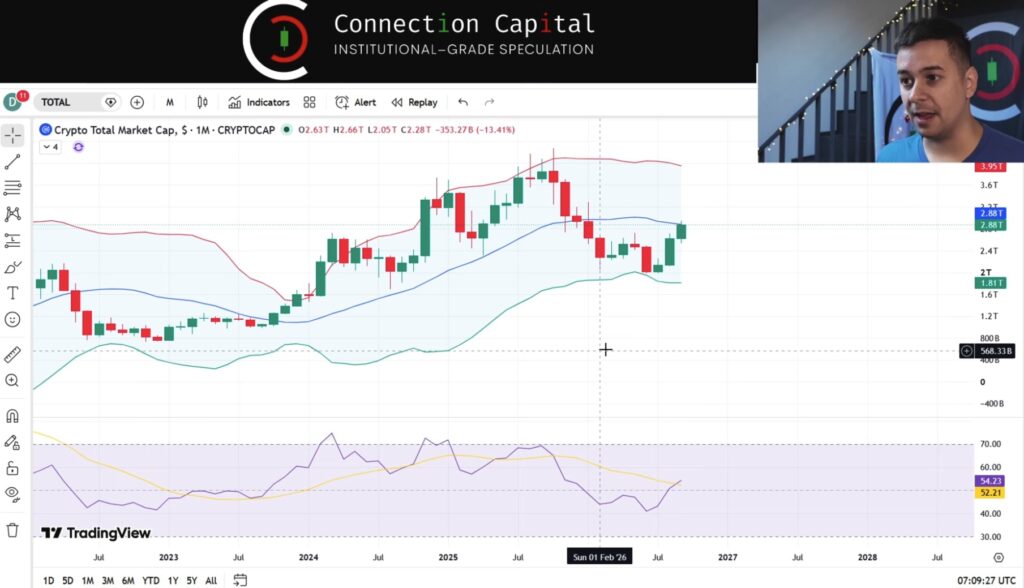
Bitcoin pushing back toward $86,000 has many retail traders convinced the bear market is dead and the bulls are back in full control. But Dan Krupka, founder of Connection Capital and former research head at Coin Bureau, sees something far uglier: the tail end of a textbook relief rally setting up a brutal liquidity trap approaching in the fourth quarter.
Back on January 1, Dan mapped out 2026’s rhythm for his subscribers: a short Q1 pop, a steep grind through Q2 into a summer bottom, and a relief leg into late Q3 and Q4. Crypto’s total market cap has round-tripped right back to its January baseline based on the schedule that Krupka laid out. The crowd is flipping aggressively bullish, but the underlying data suggests anyone chasing $86,000 might just be funding exit liquidity.
One Last Squeeze to $96,000
On the charts, Dan explains that the total crypto market cap is bumping against the monthly Bollinger Band baseline, the line that typically separates real bull markets from prolonged distribution. Dan expects a fakeout above this band rather than a clean rejection on the first hit:

Where Dan sees prices going in the short term are as follows:
- Bitcoin (BTC): Room to run another 20% to 30%, tagging the $96,000 zone where heavy profit-taking should stall the tape right in front of six figures.
- Ethereum (ETH): A squeeze into overhead supply between $3,300 and $3,500.
- Solana (SOL): A relief push up to $140–$160.
But explosive moves to the upside like that is often followed by sharp retracements. Pushing those targets stretches the weekly RSI back into overbought territory across the board. The harder prices rip from here, the more violent the snapback once momentum exhausts.
Discover the Best Token Presales
The Dollar wrecking ball
While short-term technicals look energetic, the macro picture heading into late 2026 and early 2027 looks grim.
At the center sits the US Dollar Index (DXY). Sustained crypto runs demand a weak or falling greenback to supply global liquidity. We have the exact opposite. Persistent energy shortages in Europe and Asia keep the euro and yen pinned, driving global capital into the dollar. The DXY is pressing resistance at its monthly Bollinger Band. If it breaks out, risk assets will bleed.
And it isn’t just Dan who is holding this opinion. Mainstream Wall Street news reporting outlets have been warning of an overheated environment for months. Many analysts and market experts, including the legendary Warren Buffett, who famously sent a warning to investors in mid-September, and Michael Burry, who has been sounding the warning bells throughout 2026, are all reporting the same writing on the wall. And crypto will not be isolated from the fallout. A major market crash is not a matter of if, it is a matter of when, and Krupka feels strongly that the “when” will be Q4 of 2026.
Crypto prices are fundamentally driven by the crypto cycle and the macro cycle. From a crypto cycle perspective, the bear market bottom is in, and the new bull market is starting – that’s what everyone is seeing and saying.
However, from a macro cycle perspective, we appear to be in the final stages of the bull market and are likely to enter a bear market later this year or early next year. This is basically why crypto could still rally in the coming weeks, but is likely to crash to lower lows in the coming months.- Dan Krupka
Washington’s policy incentives point the same way. Economic frameworks floated by former Trump advisers, including Stephen Moore, suggest the US may tolerate or encourage a stronger dollar to pressure foreign debtors before negotiating trade accords.
Crypto has never run a structural bull market against a surging dollar. It won’t start now.
Don’t Get Caught in the Crash
Dan warns that if Bitcoin stretches toward $96,000 while weekly momentum flashes red and the DXY punches higher, the floor will drop out. A standard 50% retracement puts Bitcoin back between $30,000 and $40,000.
In the video and to his subscribers, Krupka emphasizes enjoying the green candles for now, but advises watching how the price reacts around $96,000, and not to mistake a mechanical bear market rally for an open macro runway. When this band snaps, traders who confused a short squeeze with a new supercycle are going to eat the downside.
The post Contrarian Crypto Analyst Who Predicted 2026 Perfectly Calls for Caution and Q4 Crash appeared first on Cryptonews.

Bitcoin Reclaims $85,000 as Oil and Yields Retreat

Mahershala Ali Is Finally Getting the Action Movie He Deserves
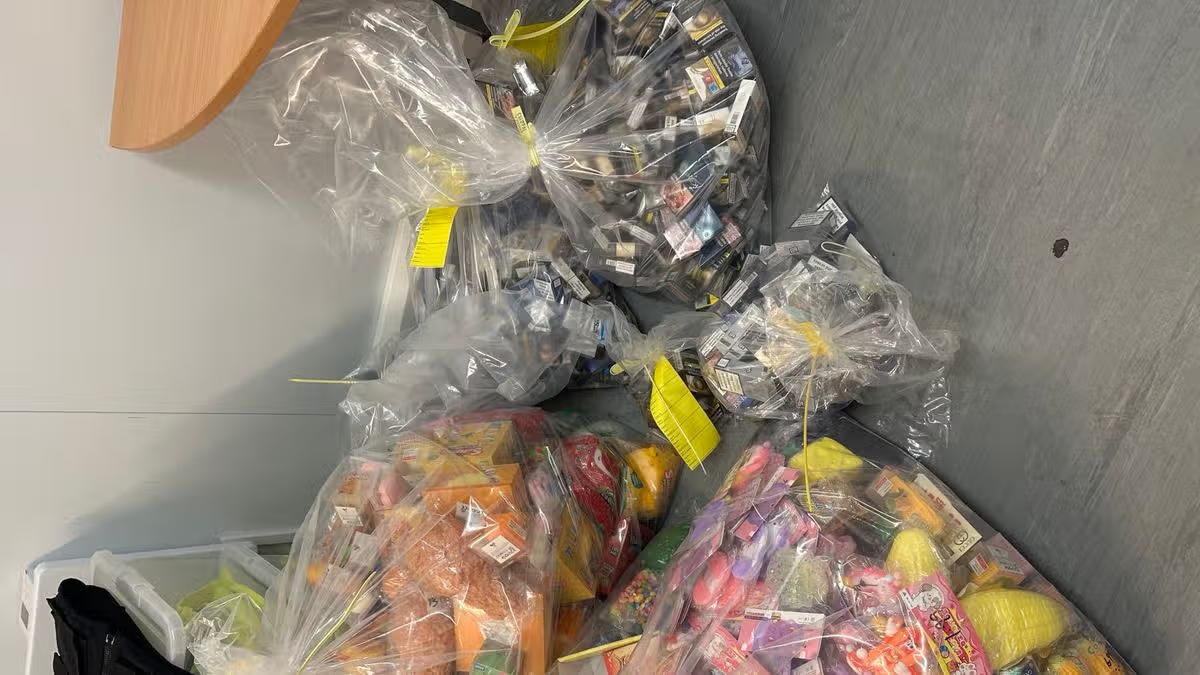
More than 500 fake children’s ‘squishy’ toys seized in crime crackdown




-

 Fashion4 days ago
Weekend Open Thread: Talbots – Corporette.com
-

 Tech2 days ago
Researchers escape OpenAI Codex sandbox to run commands on host
-

 Crypto World7 days ago
Robinhood engineers charged over $50K crypto scheme
-

 Crypto World4 days ago
Circle launches Arc Studio AI agent for building onchain apps
-
 NewsBeat4 days ago
Trump says US has reached an agreement to take permanent control of Greenland’s security
-

 Crypto World2 days ago
Who Needs CLARITY Anyway? ARB Could See 70X Increase: Hodler’s Digest
-

 Crypto World4 days ago
Bitcoin price breaks channel as RSI climbs to 63
-

 Crypto World6 days ago
US Charges Robinhood Engineers Over Crypto Listing Trades
-

 Crypto World6 days ago
What Is the Status of the U.S.-Iran Peace Talks? Here's What Both Sides Are Saying
-

 Crypto World4 days ago
Trading Bitcoin on Robinhood? Why 2% Spread Has Traders Worried
-

 Tech7 days ago
Webb’s IC 348 Mosaic Includes Two-Jupiter Dwarfs, Twin Jets, and a Nursery Still Making Worlds
-

 Crypto World5 days ago
Mortgage and refinance interest rates today, Thursday, September 17, 2026
-

 Crypto World3 days ago
World Money launches in 150+ countries with Stripe
-

 Crypto World4 days ago
Silver prices recover quickly, hitting weekly high today
-

 Entertainment6 days ago
Big Brother Update: Melody Explodes at Drew as Illness Sweeps BB28 House
-
 NewsBeat4 days ago
US was ‘on brink of war’ with China over false AI report of nukes moving in Middle East
-

 Business2 days ago
Analog Devices (ADI) Bets $1.35 Billion on Chips that Let Machines Think for Themselves
-

 Tech5 days ago
GPT-6 Astra Reached the Nether in Minecraft, Lost Its Stash to a Creeper, and Farmed Potatoes for Hours
-

 Crypto World1 day ago
Bitcoin price holds above $81K as key catalysts line up
-

 Business7 days ago
Federal Reserve expected to hike interest rates 25 basis points at FOMC meeting
You must be logged in to post a comment Login