
Crypto World
Kalshi CEO invokes Nasdaq in $36B New York lawsuit


Kalshi CEO Tarek Mansour defended the prediction market operator on Aug. 3 after New York filed a lawsuit seeking at least $36 billion in damages, penalties and related relief.
Summary
- New York seeks at least $36 billion while alleging Kalshi operates an unlicensed gambling platform.
- Kalshi removed the case to federal court, temporarily sidelining New York’s immediate preliminary injunction request.
- Tarek Mansour compared Kalshi with Nasdaq, saying the exchange matches traders and charges transaction fees.
- Federal courts previously refused Kalshi’s bid to block New York from enforcing gambling laws locally.
- The next court fight concerns federal jurisdiction, remand, and whether state gambling rules can coexist.
During a CNBC interview, Mansour compared Kalshi’s structure to Nasdaq and argued that the state’s allegations threaten the wider event contract business.
The legal case also moved away from New York state court. The prediction market platform removed the proceeding to the U.S. District Court for the Southern District of New York shortly after Attorney General Letitia James filed it on July 31.
New York Supreme Court Justice Melissa A. Crane then treated the state’s preliminary injunction request as moot because the case was no longer before her court, according to court records shared by gaming law attorney Daniel Wallach. The decision was procedural and did not reject New York’s allegations.
Kalshi lawsuit moves into federal court
New York’s verified petition accuses the firm of repeatedly violating state gambling laws by offering event contracts without a New York State Gaming Commission license. The state wants a permanent injunction, an accounting of customer activity, restitution, disgorgement and civil penalties. It also seeks $100,000 for each alleged unauthorized sports wagering offer. Those requests remain allegations and have not resulted in a final judgment.
The company transferred the case to federal court about eight hours after the state filing, arguing that New York was attempting to regulate a derivatives exchange overseen by the Commodity Futures Trading Commission. As crypto.news reported, the state had initially asked for immediate restrictions while the wider case proceeded.
Justice Crane’s order temporarily removes that state court request from consideration. Wallach said New York could file the motion again if a federal judge sends the case back to state court. A remand decision would determine the forum, not whether Kalshi’s products are lawful.
Mansour says Kalshi resembles Nasdaq
Mansour rejected New York’s description of Kalshi as an unlicensed sportsbook. He said users trade with other participants while the prediction market platform matches positions and earns transaction fees. He added that officials could “copy and paste that lawsuit and file it against Nasdaq,” extending his defense beyond sports markets.
The comparison reflects Kalshi’s central argument that event contracts are financial instruments rather than conventional wagers. The firm is registered with the CFTC as a designated contract market, and its contracts generally allow customers to take opposing positions on whether an event will occur. New York argues that this structure does not change the products’ gambling character under state law.
Mansour also compared Kalshi’s regulatory battles with earlier disputes involving Uber and Airbnb. He portrayed the state action as resistance from established gaming businesses facing a new competitor. That remains Kalshi’s interpretation. New York has said its case concerns licensing, consumer safeguards, tax obligations and access by users below the state’s minimum sports betting age.
The CEO claimed New Yorkers had collectively earned more than $200 million on Kalshi during 2026. He also said the company proposed a system that could produce almost $10 billion in state tax revenue over five years. Mansour did not publish supporting calculations during the interview, so those figures should be treated as company claims rather than verified totals.
New York says event contracts are illegal gambling
The attorney general’s office alleges that the company allows customers to risk money on future events outside their control, meeting New York’s definition of gambling. The petition cites contracts covering professional sports, college games, elections and entertainment programs. It also alleges that Kalshi charges customers fees for entering those positions.
New York further claims that people aged 18 to 20 can use the platform even though state law sets the minimum age for mobile sports betting at 21. The state says licensed operators must follow local consumer protection requirements and contribute gaming taxes. The prediction market operator disputes the state’s authority to apply those rules to a federally registered exchange.
The petition refers to a reported $22 billion company valuation and annualized transaction volume of $178 billion. Those figures appear as the firm reported numbers in the state filing. They are not findings by the court, and the final monetary exposure cannot be known before an accounting and judgment.
Federal and state regulators remain divided
The new removal follows an earlier setback for the prediction market operator. On July 7, U.S. District Judge Analisa Torres refused to block the New York State Gaming Commission from applying state gambling laws to Kalshi’s sports contracts. She found that Kalshi had not shown at the preliminary stage that the Commodity Exchange Act displaced New York’s rules. Kalshi appealed, but its requests for emergency protection were also rejected.
The CFTC takes the opposite position. In an April federal complaint, the regulator argued that Congress gave it exclusive authority over swaps and other contracts traded on registered derivatives exchanges. New York maintains that states retain their traditional power to police gambling within their borders.
Courts have not applied one consistent approach nationwide. In related coverage, a Washington judge blocked Kalshi sports contracts after finding that state gambling laws could apply. A Minnesota federal judge reached a different early conclusion and temporarily blocked that state’s prediction market ban.
The federal judge assigned to New York’s newly removed case must now consider whether federal jurisdiction exists and whether the proceeding should remain in federal court. A remand would allow New York to renew its injunction request in state court. Keeping the case in federal court would move the immediate dispute into the same court system already handling related questions about CFTC authority and federal preemption.

The ruling leaves New York’s case against Kalshi in place while allowing the CFTC to renew its request before Judge Victor Marrero.
The beginning of August brought renewed optimism to the US technology sector. President Donald Trump announced the cancellation of a planned strike on Iran and expressed his intention to resume negotiations, prompting a sharp decline in oil prices. Investors interpreted the easing of geopolitical tensions as a signal that inflationary risks may also begin to moderate. Additional support for the market came from the Federal Reserve’s earlier decision on 29 July to keep the benchmark interest rate unchanged within the 3.5–3.75% range, although the decision was not unanimous. Together, these developments helped restore investors’ appetite for risk, particularly in large-cap technology stocks.
Technical Analysis of Nasdaq 100
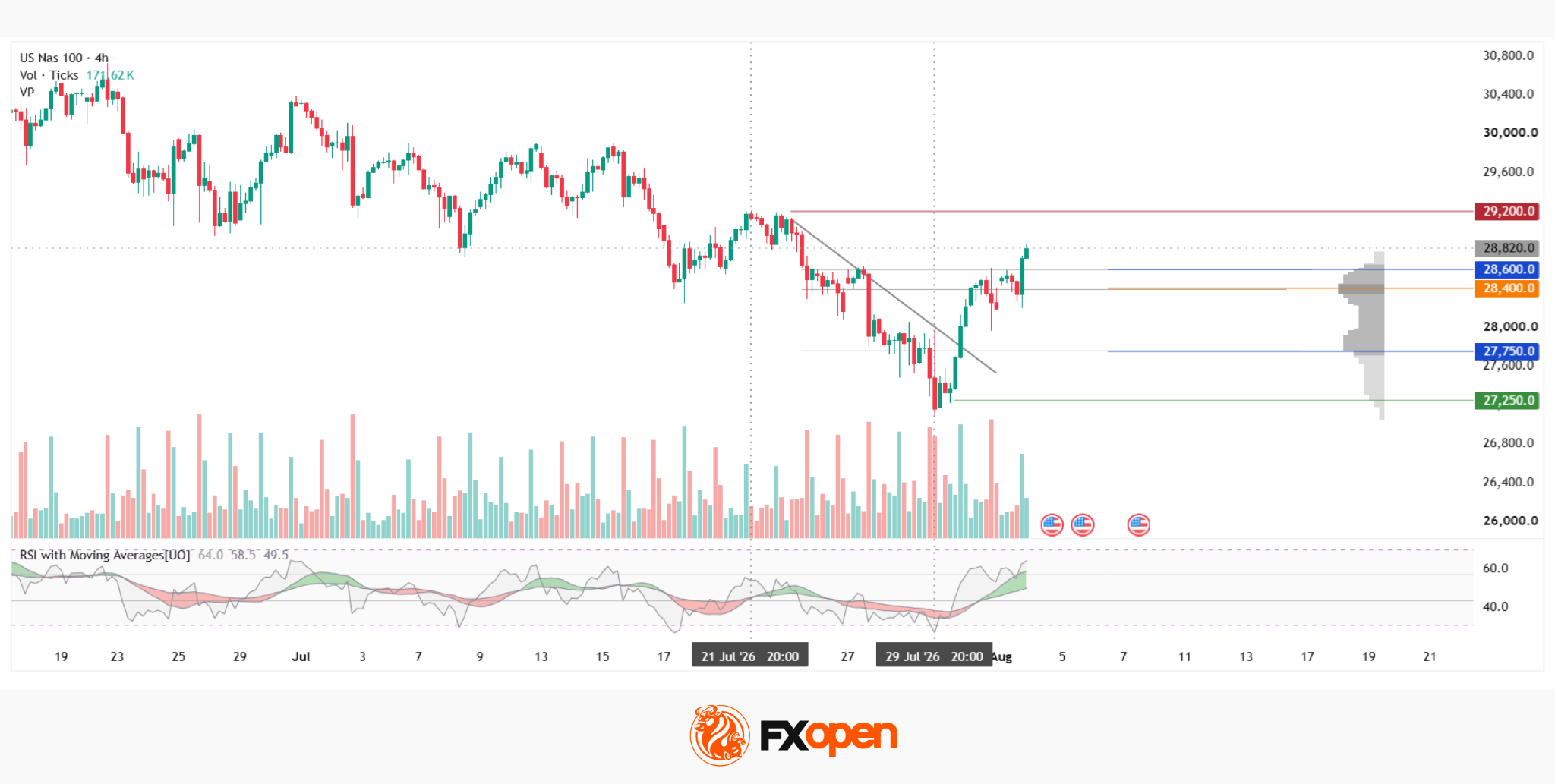
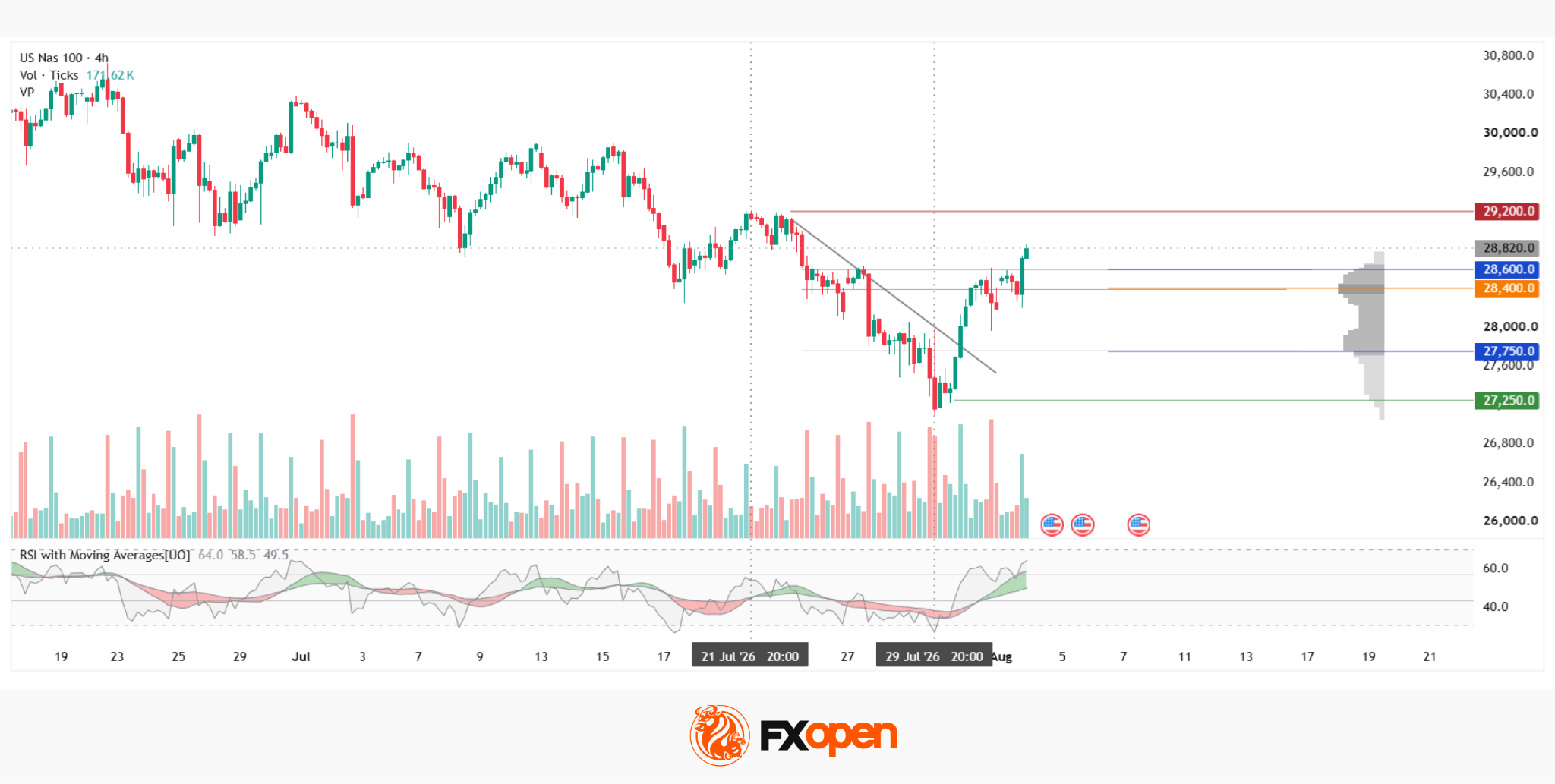
Since mid-July, the Nasdaq 100 index (NDXm on FXOpen) had been moving within a short-term downtrend defined by a descending trendline, before falling towards the 27,100 area, marked by the green support zone. From there, the price reversed, broke above the descending trendline, and recovered roughly half of the previous decline. Following a brief period of consolidation, the current market profile was formed, with the index now trading above its upper boundary at 28,600. Above current levels lies the base of the previous trend at 29,200, marked on the chart as the red resistance level.
Should the current direction reverse, the index may encounter several important technical levels. The POC (Point of Control) at 28,400 represents the nearest area of highest trading activity over the analysed period. Below it are the lower boundary of the market profile at 27,750 and the green support level at 27,250, located near the trend low. The RSI + MAs indicator currently shows readings of 64, 58 and 49. Although the oscillator suggests that the current move may continue, the slower moving average remains within the neutral zone, leaving the bullish signal unconfirmed.
Summary
The Nasdaq 100’s near-term direction is likely to depend heavily on developments surrounding negotiations with Iran. Any deterioration in the geopolitical situation could renew selling pressure on the index, while further diplomatic progress may create room for a move towards higher price levels.
Trade global index CFDs with zero commission and tight spreads (additional fees may apply). Open your FXOpen account now or learn more about trading index CFDs with FXOpen.
This article represents the opinion of the Companies operating under the FXOpen brand only. It is not to be construed as an offer, solicitation, or recommendation with respect to products and services provided by the Companies operating under the FXOpen brand, nor is it to be considered financial advice.
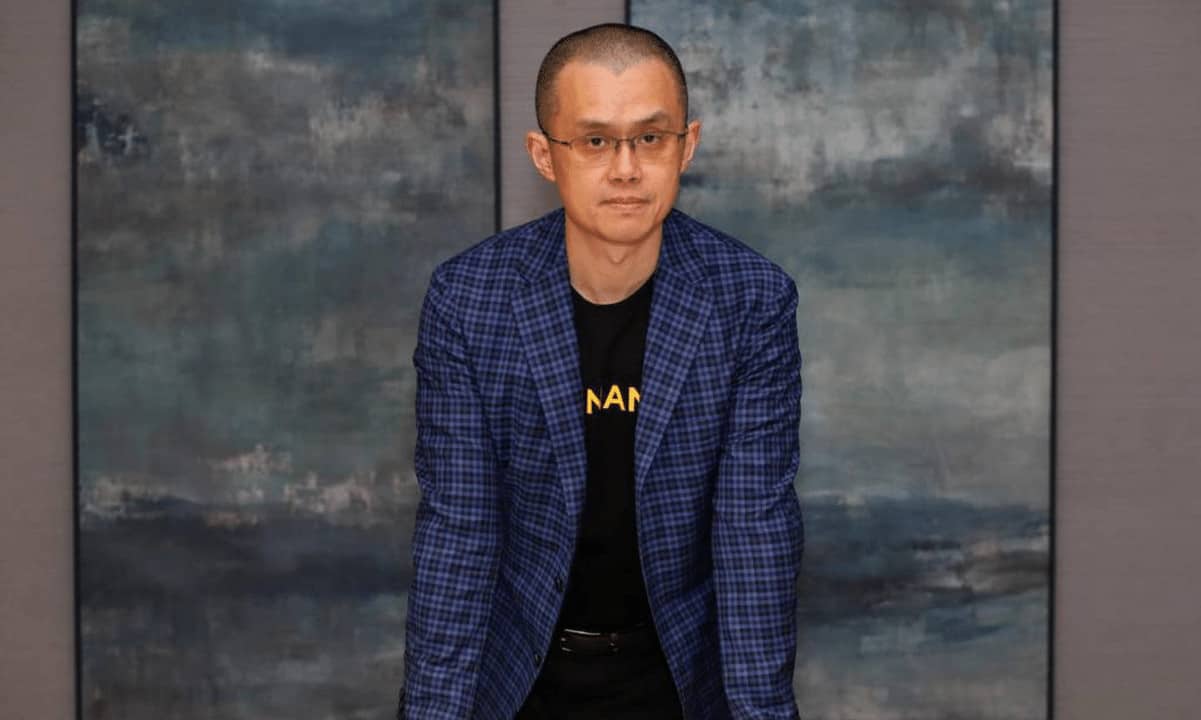
Citing data from popular analyst Willy Woo, Binance’s founder, Changpeng Zhao, published a rather controversial opinion on X, stating that it is statistically safer to store crypto assets on exchanges than in self-custody.
Willy Woo’s data shows that 1.57 million BTC has been lost from investors storing their holdings in self-custody compared to 1.51 million from those keeping their assets on exchanges. However, the data Woo shared comes from a December 2025 report and hasn’t taken into consideration the latest hacks and incidents, including the Coldcard fiasco, in which the value of stolen BTC increases daily.
CZ explained that hack data is easier to collect on the centralized exchange’s side, as most become major news. In contrast, it’s more difficult on the self-custody side, where hacks and lost coins are often not reported.
“On the exchange side, some deceased exchanges drag down the data. Binance (and a few other exchanges) have always covered users for any CEX side hacks.”
He concluded that a balanced approach, in which investors split their holdings into multiple custodians, is “probably best.”
The post CZ and Willy Woo Spark Debate: Exchanges Are Safer Than Self-Custody (Flash News) appeared first on CryptoPotato.
Emerson College Polling surveys of likely midterm election voters paint a similar picture. In March, 49% of respondents said they planned to support the Democratic candidate, while 42% said they would vote Republican. By May, Democrats widened that lead by 2 percentage points, and by July, the gap widened by another 2 points to 53% for Democrats and 42% for the GOP.
George Santos has settled CFTC case over Kalshi prediction market trades by accepting penalties and a three-year trading ban after regulators found he made misleading public statements while betting on his attendance at President Donald Trump’s State of the Union address.
Summary
- George Santos has settled CFTC charges over Kalshi prediction market trades by paying more than $35,000 and accepting a three year trading ban.
- The CFTC found Santos made misleading public statements while placing bets on whether he would attend President Trump’s State of the Union address.
- Trading records show Santos first profited from Yes contracts before switching to No contracts after his travel plans changed.
- Kalshi froze Santos’ account, referred the case to regulators, and said it detected the suspicious trading activity through its surveillance systems.
According to a July 31 order from the U.S. Commodity Futures Trading Commission (CFTC), former U.S. Representative George Santos must return $17,569.98 in trading gains, pay a $17,500 civil monetary penalty, comply with a cease-and-desist order, and stay away from trading on any CFTC-registered entity for three years after settling allegations tied to trades on prediction market platform Kalshi.
The settlement closes an investigation that began earlier this year after Kalshi referred Santos’ trading activity to regulators. While Santos accepted the settlement, the order states that he neither admitted nor denied the agency’s findings or legal conclusions.
CFTC says Santos traded both sides of Kalshi market
Regulators said Santos opened a Kalshi account on Feb. 11, roughly four months after President Donald Trump commuted his prison sentence. The former congressman funded the account with about $7,000 and traded only one event contract, which asked whether he would attend Trump’s State of the Union address.
Trading records included in the order show Santos initially accumulated 30,874 “Yes” contracts between Feb. 12 and Feb. 22 for $6,695.94.
Around the same period, Santos posted on X asking followers whether he should wear a serious or bedazzled suit to the address. The CFTC said the market price for the “Yes” outcome climbed from about $0.15 to $0.70 after the post. Santos later sold his entire position, making a profit of $3,448.43, before withdrawing $10,146.07 through a newly created Venmo account.
Later that day, his airline informed him that his flight to Washington had been canceled. Although he purchased a train ticket and continued posting publicly that he expected to attend, regulators said his trading activity soon moved in the opposite direction.
According to the order, Santos posted another video on Feb. 23 stating that he would attend the speech from the House gallery. About 40 minutes later, he started buying contracts that would pay out if he did not attend.
The CFTC said Santos eventually accumulated 23,855 “No” contracts worth $8,650.66. His train was canceled about an hour after he began building that position. Even after another X user asked whether he would still attend, Santos replied that he would, despite already knowing that both his flight and train had been canceled, information the agency said was not disclosed to the public.
Kalshi activity led to the CFTC investigation
On the day of the State of the Union address, internet records cited by the commission showed Santos accessing Kalshi from his residence rather than traveling to Washington. He later posted that watching the speech on an airport television had not been his original plan.
As the event unfolded, the “Yes” contract price dropped from $0.73 to $0.02, increasing the value of Santos’ “No” position. The order states that he exited those trades early on Feb. 25 with a reported profit of $14,390.57.
Based on that trading sequence, the CFTC concluded that Santos made misleading public statements and omitted material information that influenced the market price for his own financial benefit.
Instead of treating the conduct as a conventional insider trading case based on confidential information, the commission pursued the matter under the Commodity Exchange Act’s anti-manipulation provisions and CFTC Regulation 180.1. The order also classified the State of the Union attendance contract as a swap subject to the agency’s enforcement authority.
Earlier reporting by NPR in June said both the Department of Justice and the CFTC had opened investigations after Kalshi froze Santos’ account and referred the matter to regulators. However, the Washington Examiner later reported that a DOJ official denied the department had an active case, leaving the CFTC settlement as the only confirmed federal enforcement action tied to the trades.
Santos disputes allegations while accepting settlement
Responding through his attorney, Joseph W. Murray, Santos said he originally intended to attend the State of the Union address before severe winter weather disrupted his travel plans.
Murray denied that Santos intended to mislead traders or manipulate the prediction market. He also said his client chose to resolve the matter through settlement rather than continue with expensive litigation.
The CFTC order, however, concluded that Santos’ public statements and omissions occurred while he actively traded positions tied to the same event, allowing him to benefit from price movements in both directions.
Separately, Kalshi said it detected the unusual trading activity through its surveillance systems, froze Santos’ account, and supplied evidence to federal regulators.
Speaking to Axios last month, Kalshi Chief Executive Officer Tarek Mansour said the platform flagged the activity within seconds and received roughly 100 whistleblower complaints within minutes. He added that the exchange plans to pursue its own enforcement action for violations of exchange rules.
Kalshi also said it may reimburse affected traders if it successfully recovers funds from Santos. The company linked its monitoring process to integrity systems developed through its partnership with Sportradar.
Prediction markets continue facing regulatory scrutiny
The Santos case arrives as prediction markets continue drawing attention from regulators over insider trading and market manipulation concerns.
Earlier this year, Kalshi suspended three federal political candidates after determining they had traded on markets involving their own election contests. According to the company, candidates who can directly influence an event’s outcome violate exchange rules regardless of trade size.
Unlike those disciplinary actions, the Santos matter resulted in a referral to federal regulators and ultimately concluded with a formal CFTC enforcement order.
The agency’s approach also follows other recent prediction market cases. Federal prosecutors have charged U.S. Army Master Sgt. Gannon Ken Van Dyke with allegedly using advance knowledge of a military operation to generate more than $404,000 from Polymarket trades tied to Venezuelan President Nicolás Maduro.
In another case, prosecutors accused former Google software engineer Michele Spagnuolo of using confidential Google search ranking data to place multimillion-dollar bets on Polymarket before the information became public.
As regulatory attention has increased, Kalshi has introduced screening tools designed to identify participants directly connected to events listed on its platform, while Polymarket has expanded surveillance programs and hired blockchain analytics firm Chainalysis to assist investigations into insider trading and market manipulation.


South Korea has finalized its 2026 tax reform package while keeping the planned 22% tax on cryptocurrency investment gains set to begin on Jan. 1, 2027.
Summary
- South Korea has finalized its 2026 tax reform plan without delaying the 22% crypto tax scheduled for Jan. 1, 2027.
- Annual crypto gains above 2.5 million won will be taxed at a combined 22%, with the first tax filings due in May 2028.
- Authorities said OECD crypto reporting rules will give South Korea access to overseas transaction data from 48 participating jurisdictions.
- Parliament can still amend or delay the measure as opposition lawmakers continue pushing to repeal the crypto tax.
- Financial regulators are also advancing a Digital Asset Basic Act to establish rules for stablecoins, exchanges and other digital asset businesses.
South Korea’s Ministry of Economy and Finance confirmed on Aug. 3 that it had finalized the 2026 tax reform proposal without including another postponement for virtual asset taxation, clearing the way for the long-delayed measure to proceed next year if lawmakers approve the package in the National Assembly.
Under the current Income Tax Act, profits from transferring or lending virtual assets will be taxed as other income from Jan. 1, 2027. Investors will pay a 20% national tax, with an additional 2% local income tax, on annual gains exceeding 2.5 million won ($1,740). The first tax return covering crypto income earned during 2027 will be filed in May 2028.
The ministry also included an example showing how the tax would apply. An investor earning a 5 million won annual profit from Bitcoin trading would first deduct the 2.5 million won exemption before paying 22% tax on the remaining amount, resulting in a tax bill of 550,000 won.
South Korea has ended another delay in its tax proposal
The tax was originally scheduled to take effect in January 2022 after lawmakers approved amendments to the Income Tax Act in 2020. However, implementation was postponed three times, first to 2023, then to 2025, and later to 2027, as authorities cited incomplete reporting systems and unresolved administrative infrastructure.
Government officials now say those preparations have largely been completed.
The ministry pointed to the Organisation for Economic Co-operation and Development’s Crypto-Asset Reporting Framework (CARF), under which South Korea expects to receive overseas virtual asset transaction data from tax authorities in 48 participating jurisdictions, including Japan, Germany and France, beginning next year. Officials said the international reporting system would significantly reduce blind spots involving offshore crypto transactions.
Finance Minister Koo Yun-cheol had already indicated during a National Assembly Finance and Economic Planning Committee meeting on July 29 that the government intended to proceed with the tax as scheduled while improving the system after implementation where necessary.
Parliament can still change the crypto tax timeline
Although the government has finalized its proposal, the tax reform package still requires approval from the National Assembly before becoming law.
The ministry acknowledged that parliamentary discussions could still result in another delay or other legislative changes before the tax takes effect.
The opposition People Power Party continues to oppose the measure and has proposed amendments to remove crypto income from the Income Tax Act altogether. Party lawmakers have argued that taxing retail cryptocurrency investors while most retail stock investment gains remain exempt creates unequal treatment.
Earlier committee discussions also raised concerns over the current tax design. During the July 29 hearing, People Power Party lawmaker Kim Sang-hoon questioned the absence of rules allowing investors to carry forward trading losses, warning that the framework could encourage traders to move activity from domestic exchanges such as Upbit, Bithumb, Coinone and Korbit to overseas centralized exchanges, decentralized finance platforms or peer-to-peer markets.
Responding during the hearing, Koo said moving virtual assets into South Korea’s capital gains tax framework would require a broader review of the country’s financial tax system. He added that authorities could consider revisions after gaining experience with the tax’s operation.
Digital asset rules continue developing alongside the crypto tax
Separate from the tax package, South Korea is also preparing a wider regulatory framework for digital assets.
The Financial Services Commission told the National Assembly in late July that it is working with the ruling Democratic Party on a consolidated Digital Asset Basic Act. The proposed legislation would combine 10 pending digital asset and stablecoin bills into one framework covering stablecoin issuance, exchanges, disclosures, internal controls and system resilience.
Several issues remain unresolved, including ownership requirements for issuers of won-backed stablecoins and possible ownership limits for major cryptocurrency exchanges.
At the same time, the National Tax Service has established a dedicated digital asset unit and continues preparing implementation guidance for the upcoming crypto tax, according to previous government statements.
Tax policy is expanding beyond cryptocurrencies
South Korea has also begun clarifying how other blockchain-based assets could be taxed.
In June, the Ministry of Economy and Finance said tokenized stocks should generally be treated as securities rather than virtual assets because their economic characteristics resemble conventional securities despite using blockchain technology.
The ministry said taxation could begin under existing securities tax rules once the Financial Services Commission formally determines that tokenized stocks qualify as securities. Officials also indicated that overseas-issued tokenized stocks could still fall under South Korean tax rules depending on the rights attached to the assets.
Meanwhile, tax authorities have been strengthening information-sharing arrangements with overseas counterparts. Alongside participation in the OECD’s Crypto-Asset Reporting Framework, officials have previously said they are expanding cooperation with foreign tax agencies to improve oversight of cross-border digital asset transactions.
Unless lawmakers approve another postponement or pass the pending repeal proposal before the end of 2026, South Korea’s 22% tax on annual cryptocurrency gains above 2.5 million won will take effect on Jan. 1, 2027, ending several years of repeated delays.


Nigeria’s revenue agency has issued rules requiring crypto platforms and peer-to-peer (P2P) marketplaces to collect, report and remit taxes, including paying some withheld amounts in digital tokens.
In its Guidelines on Taxation of Virtual Assets, the Nigeria Revenue Service (NRS) said income tax deducted at source and stamp duty “shall be remitted to the Service in the originating token of the transaction.” Value-added tax, by contrast, must be remitted in the currency used for the payment.
The guidelines place exchanges and P2P marketplaces at the center of withholding, reporting and remittance under the country’s existing laws.
Under the guidelines, platforms must withhold 1% of proceeds from taxable disposals of crypto assets, security tokens and applicable non-fungible tokens. A 10% withholding rate applies to staking, mining, airdrops and decentralized finance, while token-to-fiat and fiat-to-token transfers are subject to a 1.5% stamp duty.
The withheld amounts are advance payments credited against the taxpayer’s final income tax liability. Individuals are taxed at progressive rates, while companies other than small companies face a 30% rate. Stablecoin sales are exempt from the 1% withholding tax.
Nigeria’s crypto tax framework takes shape
The new guidelines follow an executive order signed by President Bola Tinubu that established a Virtual Asset Council chaired by the central bank, with the NRS and the Securities and Exchange Commission serving as vice chairs. On July 18, the presidency said that the NRS would release a policy to implement Nigeria’s tax laws for virtual assets.
Nigeria’s broader tax overhaul took effect on Jan. 1 under the Nigeria Tax Act and Nigeria Tax Administration Act of 2025. The legislation treats digital assets as chargeable assets and requires virtual asset service providers to report transaction details, including customers’ names, contact information and Tax Identification Numbers.
Related: South Africa proposes crypto tax guidance under existing framework
Nigeria first explicitly subjected gains from crypto disposals to tax through the Finance Act 2023, which imposed a flat 10% capital gains tax. The 2025 framework replaced that treatment, while the new guidelines specify how gains are valued and how taxes are withheld, remitted and reconciled.
Magazine: How Fake World Assets and onchain gacha became crypto’s latest craze
Crypto World
1win Introduces Seamless Web3 Login and Crypto Deposits via Trust Wallet, MetaMask, and WalletConnect

[PRESS RELEASE – Willemstad, Curaçao, August 4th, 2026]
1win, a crypto entertainment platform, has launched a new Web3 authentication system that allows users to register, sign in, and deposit funds using a crypto wallet. The new verification mechanism eliminates the need for email registration, passwords, or manually copying wallet addresses.
The feature is now available to all 1win users and supports Trust Wallet, MetaMask, and other wallets via WalletConnect. EVM-compatible networks are supported across all options, while TRON connections are available through Trust Wallet and WalletConnect-enabled TRON options. 1win is among the first crypto entertainment platforms to introduce seamless wallet onboarding for the TRON network, where USDT (TRC-20) remains one of the most widely used payment methods among crypto users.
With the new functionality, a crypto wallet effectively becomes a user’s account identity. They no longer need to create a traditional account, and may simply connect their wallet and confirm the connection. A new 1win account linked to that wallet is created automatically. Deposits are completed by confirming a transaction directly within the wallet application.
The updated onboarding flow removes several common friction points associated with crypto platforms:
- no email registration
- no usernames or passwords
- no manual wallet address copying
- faster onboarding and deposits through native Web3 authentication
For users, this means a significantly more streamlined experience from the very first interaction with the platform, reducing the time between the initial visit and the first deposit.
About 1win
Founded in 2016, 1win is a crypto entertainment platform. Operating across Asia, Latin America, and Africa, 1win offers a wide range of entertainment products adapted to regional audiences. The brand has active collaborations with international public figures, including football legend Luis Suarez, martial artist Jon Jones, and Olympic champion and UFC fighter Gable Steveson. In 2026, 1win welcomed rapper Tyga and UFC legend Ilia Topuria as members of its 1win VIP community.
The post 1win Introduces Seamless Web3 Login and Crypto Deposits via Trust Wallet, MetaMask, and WalletConnect appeared first on CryptoPotato.


South Korea’s two largest crypto exchanges announced four new trading markets on Aug. 4, expanding local access to the HOME, META2 and USDG tokens.
Summary
- Upbit will open HOME trading against KRW and USDT at 17:00 KST on August 4.
- Bithumb scheduled META2 and USDG won markets to open at 16:00 KST on August 4.
- Bithumb changed USDG support from Ethereum to Solana before opening the new Korean won market.
- HOME traded about 32% higher over 24 hours before Upbit’s scheduled Korean market launch Tuesday.
- USDG remained near its dollar peg as Bithumb prepared direct Korean won trading access Tuesday.
Upbit will add Defi App’s HOME token to its Korean won and Tether markets at 17:00 Korea Standard Time. Bithumb plans to open Korean won markets for MetaDAO’s META2 and Global Dollar, or USDG, at 16:00 KST. The exchanges said the opening times could change if they do not secure enough liquidity.
The announcements place a cross chain DeFi token, a market based governance token and a dollar stablecoin in front of South Korea’s active retail market. However, the listings do not change the projects’ underlying technology, token supply or regulatory status.
Upbit gives HOME direct won and USDT access
Upbit said deposits and withdrawals for HOME would open within two hours of its notice. It will support the token through Base only. Users who send HOME through another network may face delays while seeking a return of the unsupported deposit.
The exchange identified the supported HOME contract as 0x4bfaa776991e85e5f8b1255461cbbd216cfc714f. It quoted the previous closing prices at 10.1 won and 0.007069 USDT. Those figures provide reference points for Upbit’s opening restrictions rather than guaranteed launch prices.
Defi App describes itself as a self custody platform for swaps, perpetual contracts and yield products across EVM networks and Solana. Its documentation says the platform connects to outside liquidity sources and protocols while presenting them through one interface. HOME supports governance and staking within the ecosystem.
The HOME token itself uses Base for the market supported by Upbit. The distinction matters because the wider application can interact with several networks, while the exchange accepts deposits only through the chain named in its listing notice.
Bithumb adds META2 and USDG to its won market
Bithumb scheduled both META2 and USDG trading to begin at 16:00 KST. Deposits and withdrawals were expected to open within two hours of the announcement. The exchange set a reference price of 7,558 won for META2 and 1,429 won for USDG.
Both assets will use Solana for deposits and withdrawals. Bithumb initially identified Ethereum as the network for USDG but amended its notice to support Solana instead. Sending either asset through an unsupported network could prevent the deposit from being credited.
MetaDAO uses decision markets, also known as futarchy, for protocol governance. Traders take positions based on whether a proposal would raise or lower a project token’s value. The protocol then uses market prices to determine whether the proposal passes. MetaDAO’s documentation calls its token META, while Korean exchanges use META2 to distinguish it from other assets carrying similar symbols.
USDG is different because it is designed to maintain a stable value rather than deliver market driven price appreciation. Paxos Digital Singapore issues the token and operates under supervision from the Monetary Authority of Singapore. Paxos says holders can redeem USDG for U.S. dollars at a one to one rate.
As crypto.news previously reported, Paxos expanded USDG to Solana to support payments, transfers and treasury uses on the network. The stablecoin is also available on Ethereum, Ink, X Layer and Robinhood Chain.
HOME rises while USDG holds its dollar peg
HOME traded near $0.00872 during research, representing a gain of about 32.1% over 24 hours. Its daily range extended from approximately $0.00617 to $0.00924, while reported volume approached $89.4 million. The timing connects the move with the Upbit announcement, but the listing cannot be confirmed as the only cause.
META traded near $6.39, with its 24 hour trading volume rising about 50.3% to $13.6 million. The token had also gained about 55.1% over seven days. Its earlier Upbit listing and activity within MetaDAO make it difficult to isolate any reaction to Bithumb’s announcement.
USDG remained close to its intended peg at approximately $0.9993. CoinGecko reported a narrow 24 hour range between $0.9976 and $1.00, alongside a market capitalization of about $3.44 billion. Its stablecoin structure means a lasting price surge would not represent the same type of listing reaction seen in HOME or META2.
The listings continue a busy period for Korean exchanges. In related coverage, crypto.news reported that Upbit added Morpho and Euler won markets, while Bithumb has also expanded direct won access for several newer crypto assets.
New listings carry network and order restrictions
Upbit will block HOME buy orders for about five minutes after trading begins. It will also restrict sell orders priced more than 10% below the previous closing price during that period. Only limit orders will be accepted for roughly the first two hours.
Bithumb will apply similar controls to META2 and USDG. Buy orders will be unavailable for five minutes. Sell orders below 90% or above 200% of the stated reference price will also face temporary restrictions, while nonlimit orders will remain unavailable for about two hours.

Crypto security teams are facing a new imbalance: while AI model developers are restricting their most capable cyber-related systems, only a small number of crypto firms appear to have gained early access to those “frontier” tools.
Coinbase has said it secured access to Anthropic’s restricted Mythos model, and Zcash co-founder Zooko Wilcox has described how Anthropic used Mythos to audit the Zcash protocol at the request of Shielded Labs. Meanwhile, Binance’s chief security officer Jimmy Su told Cointelegraph that the exchange has been trying to make progress but has not obtained the most advanced frontier model.
Key takeaways
- Only select crypto companies have reportedly received early access to restricted frontier AI models used for cybersecurity work.
- Executives argue that gating advanced models may be necessary at first, but maintaining restrictions could become harder to justify as capabilities converge with public releases.
- Uneven access may widen the security gap between defenders and attackers, particularly as AI-assisted exploit workflows reportedly speed up.
- Some crypto-adjacent organizations, such as those embedded in critical infrastructure or security tooling, have also joined gated programs.
Why restricted “frontier” models are hard to distribute
The core issue is not whether AI can help security—many teams already use mainstream models for testing and review—but whether defenders get access to the most cyber-capable systems under developer guardrails.
Anthropic has stated that Mythos 5 shares the same underlying model as its publicly available Fable 5, but operates without safeguards that limit sensitive cybersecurity use. OpenAI is described as running a similar tiered approach, with a “Trusted Access for Cyber” pathway for verified defenders and a more permissive cyber-oriented version reserved for a smaller group conducting authorized penetration testing.
Crypto security executives interviewed by Cointelegraph suggested this kind of restricted rollout is likely warranted initially. However, they also highlighted a growing tension: once publicly available models begin to approach the same practical capabilities, continuous gating may become harder to defend—especially if attackers can leverage comparable tools from elsewhere.
Crypto executives push for faster verification pathways
Jimmy Su said Anthropic’s controlled release can be responsible because attackers may benefit from newly released capabilities sooner than defenders. In his framing, limiting early access can reduce the “blast radius,” at least during an initial testing period.
Solana Foundation’s chief information security officer Michael Coates supported guardrails but argued that “legitimate defenders” need a faster route to the models. He said the process should streamline verification and acceptance programs so security teams can use the best available systems to match the pace of exploitation.
Blockchain Capital’s Sean Cheetham expressed a similar long-term view. While restrictions can help avoid immediate misuse, broader availability could ultimately benefit defense because the population of legitimate security researchers is typically far larger than the small groups able to run highly sophisticated attacks. That scale dynamic—more defenders than adversaries—may flip the risk calculus over time.
Who has access—and who appears to be waiting
Despite being the world’s largest exchange by daily trading volume, Binance has not reportedly secured access to Mythos, according to Su. The exchange’s scale underscores the potential operational impact: Binance holds substantial assets on its platform, and a lack of frontier defensive tooling could leave major ecosystems to rely on less capable alternatives.
Beyond exchanges, other organizations have taken different approaches. Cointelegraph previously reported that Fireblocks, which provides custody and security services at large scale, sought access to Mythos but at the time relied on Anthropic’s publicly available model for pentesting. Cointelegraph also cited that Uniswap founder Hayden Adams criticized the safeguards on Fable 5 around cybersecurity prompts earlier this year.
The Ethereum Foundation has said it has been using “coordinated AI agents” to identify bugs across its systems, without disclosing which models were used. Cointelegraph reached out to the Ethereum Foundation, Fireblocks, and Uniswap to confirm whether they had received access to frontier restricted models since then.
Some crypto-adjacent companies, however, have moved further into gated programs. FIS—an infrastructure provider that partnered with Circle for USDC payments functionality last year—reportedly joined Anthropic’s Project Glasswing last month. Project Glasswing is described as Anthropic’s gated program for vetted cyber defenders and organizations responsible for critical software infrastructure to access restricted Mythos models.
HackerOne, which supports bug bounty and security testing for major organizations including crypto exchanges, also said it joined Project Glasswing, though its testing is confined to its own infrastructure rather than customer programs. Separately, Cointelegraph reached out to OpenAI and Anthropic to ask how many crypto firms had received access to restricted models.
AI-assisted attacks are reported to be accelerating
The access gap matters because defenders are not operating in a static threat environment. Cointelegraph reported that Boltz, a Bitcoin swap service, chose to halt its non-custodial bridge after observing a steady rise in AI-assisted hacking attempts over the prior few months. Boltz said attackers are now iterating faster than a team its size can find and patch, pointing to a practical pressure on incident response and code review cycles.
Other security events also suggest attackers are applying automation to find real weaknesses. Cointelegraph reported that Coinkite disclosed a vulnerability affecting some Coldcard devices, where a flaw in wallet seed generation produced less randomness than expected. Coinkite speculated that the attacker could have used AI to review earlier firmware versions to locate and exploit the weakness—even though the company had used what it described as one of the best available AI models to review its code in the weeks before.
Taken together, these reports support a broader concern: even strong internal testing using public AI tools may not be enough if adversaries deploy higher-end capabilities and iterate faster than teams can remediate.
What to watch next for crypto security
The immediate question is whether restricted model access will widen beyond early adopters and whether developers can design guardrails that protect the ecosystem without bottlenecking legitimate defenders. As AI capabilities diffuse—through both public releases and competing models—crypto teams will likely watch not only for new access announcements, but also for changes in exploitation tempo and patch turnaround times across major platforms.

The ‘cold, collected’ abuser who tormented girlfriend who took her own life
Earnings call transcript: Saudi Aramco posts strong Q2 2026 profit amid crisis

NY judge denies CFTC motion to halt enforcement action against Kalshi


-

 Business5 days ago
Why Trees Belong on the Risk Register
-

 Fashion4 days ago
Weekend Open Thread: Wit & Wisdom
-

 Politics3 days ago
Meta enters AI-training agreement with far-right ‘propaganda rag’ Newsmax
-
 Entertainment7 days ago
‘Stargate’ Creator’s New Sci-Fi Series Returns for Season 3 Tomorrow
-

 Crypto World3 days ago
MicroStrategy Post-Earnings CLARITY Act Push Could Add New Catalyst for Its Stock
-

 Politics7 days ago
The Part of the Electric Transition Nobody Wants to Discuss
-

 Business6 days ago
Major shareholder moves on Canyon
-

 Crypto World3 days ago
XRP Ledger v3.3.0 brings five institutional features
-

 News Videos5 days ago
Bitcoin Enters the 3rd Stage of the Bear Market
-

 Politics6 days ago
Reform UK betrays West Mids residents by running from party pledges
-

 Crypto World6 days ago
Kraken Enables Retail Access to Jersey Mike’s IPO via Tokenized Shares
-

 Politics5 days ago
Luke Littler’s dominance sparks GOAT debate
-

 News Videos7 days ago
Claude: Build Financial Dashboards in Minutes (2026)
-

 Sports4 days ago
Seema Kaliramna Wins Discus Throw Bronze, Takes India’s CWG Medals Tally To 17
-

 Crypto World2 days ago
Crypto PAC spending tops $2M in Michigan House race
-

 Crypto World3 days ago
New York sues Kalshi over prediction market gambling
-

 Business6 days ago
Johnson & Johnson agrees to $5.5B settlement over talc cancer claims
-

 Business4 days ago
Trump Announces Hamas Disarmament Agreement as Iran Strikes Kuwait Air Base and US Attacks Pause Overnight
-

 Tech6 days ago
Gemini can now summarize the messiest comment threads in Google Docs
-

 Tech2 days ago
ESET tracks rise in malicious AI skills and adaptable malware
You must be logged in to post a comment Login