
Crypto World
Kaushik Kappagantulu’s Greenhouse in a Box Is Aiding India’s Farmers






New Jersey has asked the U.S. Supreme Court to decide whether federal derivatives law prevents states from regulating sports contracts offered by CFTC-registered prediction markets.
Summary
- New Jersey filed its Supreme Court petition on Sept. 2 after losing its case against Kalshi in the Third Circuit.
- The state says Dodd-Frank did not remove its authority to regulate sports wagering within its borders.
- Conflicting Third and Ninth Circuit decisions have created opposing rules for prediction markets in different states.
- Kalshi maintains that the CFTC’s exclusive jurisdiction over its registered exchange overrides state gambling laws.
A Sept. 2 court filing shows that New Jersey has petitioned the Supreme Court for a writ of certiorari, asking the justices to review a Third U.S. Circuit Court of Appeals decision that favored Kalshi.
The petition asks whether the Dodd-Frank Wall Street Reform and Consumer Protection Act prevents states from applying their sports-gambling laws to bets made within their borders when the contracts are offered on a market registered with the Commodity Futures Trading Commission.
Kalshi operates a designated contract market overseen by the CFTC. The company treats its sports products as event contracts governed by federal derivatives rules, while New Jersey considers them sports wagers subject to state licensing and consumer-protection requirements.
New Jersey challenges Kalshi’s Third Circuit victory
In April, the Third Circuit upheld preliminary relief that stopped New Jersey regulators from enforcing state gambling laws against Kalshi’s sports contracts.
The appellate court found that Kalshi had shown a reasonable chance of succeeding on its claim that sports event contracts qualify as swaps under the Commodity Exchange Act. Under that interpretation, the CFTC’s exclusive jurisdiction could displace conflicting state requirements.
As crypto.news reported at the time, the decision did not settle the full lawsuit. It affirmed a preliminary injunction, meaning the court assessed Kalshi’s likelihood of success without issuing a final judgment on every part of the dispute.
New Jersey is now asking the Supreme Court to reject the appellate court’s interpretation. According to the petition, Congress did not clearly authorize federally registered markets to offer sports betting across the country without complying with state gambling laws.
State officials also argue that sports wagering has long fallen under state authority. Under New Jersey’s position, registering an exchange with the CFTC does not automatically turn a sports bet into a federally protected financial contract.
The petition challenges the Third Circuit’s treatment of sports event contracts as swaps, a classification central to Kalshi’s federal preemption argument. If the products do not fall within that category, the state contends that the Commodity Exchange Act’s exclusive-jurisdiction provision cannot shield them from local enforcement.
Conflicting Kalshi rulings strengthen the request for review
New Jersey’s filing points to a conflicting decision from the Ninth U.S. Circuit Court of Appeals, which recently allowed Nevada to enforce its gaming laws against prediction market sports contracts.
In the Nevada dispute, the Ninth Circuit found that sports contracts were likely wagers rather than swaps covered by the Commodity Exchange Act. The court rejected the argument that CFTC oversight automatically prevented state regulators from acting.
The Ninth Circuit ruling produced a direct disagreement between two federal appellate courts. Kalshi has protection from New Jersey enforcement under the Third Circuit’s reasoning, while prediction market operators face state gambling controls within the Ninth Circuit.
A split between appellate courts is one factor the Supreme Court considers when deciding whether to hear a case, although the filing does not mean the justices have accepted New Jersey’s petition. Kalshi will have an opportunity to respond before the court decides whether to grant review.
The state cited the Ninth Circuit decision in its petition, arguing that the opposing rulings have created uncertainty over the line between federal derivatives oversight and state gambling regulation.
Similar disputes have already spread to other jurisdictions. In August, a federal judge rejected Coinbase’s request to block Michigan regulators from taking action against sports prediction markets, while New York has separately sued Kalshi over products that state officials describe as unlicensed gambling.
New York’s complaint seeks at least $36 billion in penalties and restitution. The state has accused Kalshi of offering unlicensed wagering products and allowing access without the safeguards required of licensed sportsbooks, allegations that Kalshi disputes.
By mid-August, the state enforcement fight had produced more than 20 lawsuits and cease-and-desist actions across the United States. Arizona had also filed criminal charges, while several other states had ordered prediction market operators to stop offering sports-related products.
Major-questions doctrine enters the Kalshi case
Sports law attorney Daniel Wallach said New Jersey’s petition invokes the major-questions doctrine, which courts use when an agency claims authority over an issue carrying major economic or political consequences without clear direction from Congress.
Quoting earlier Supreme Court language, the state called the Third Circuit’s interpretation an “astonishing” conclusion with grave “economic and political consequences.”
New Jersey also argued that allowing federal derivatives law to displace state sports-gambling rules would represent a “significant change in the sensitive relation between federal and state” power in an area of “traditional state authority.”
Under the state’s argument, Congress would have needed to speak clearly before allowing the CFTC’s authority to override local sports-betting laws. The petition says Dodd-Frank contains no clear statement giving federally registered exchanges nationwide immunity from state gambling controls.
Kalshi offered a different reading in a statement shared with Front Office Sports. The company said the Ninth Circuit still accepted the central principle that the CFTC’s exclusive jurisdiction can preempt state law, while disagreeing over how an existing regulation applies to sports contracts.
According to Kalshi, the regulation behind that disagreement is already being rewritten.
“We remain confident in the lower courts’ rulings, and nothing in New Jersey’s filing today changes our view,” the company said.
The CFTC has proposed changes to its event-contract rules, but any final regulation could face a separate court challenge over the agency’s legal authority or rulemaking process. The Ninth Circuit decision could also give states another basis for contesting a rule that treats sports contracts as federally governed derivatives.
Prediction market valuations continue to climb
While legal challenges have spread across the United States, private investors have continued assigning multibillion-dollar valuations to the largest prediction market platforms.
An Aug. 25 SEC filing showed that Kalshi had sold approximately $1.12 billion in equity since April, with about $380 million left under an offering of nearly $1.5 billion. The filing did not identify which financing rounds were included in the amount already sold.
Kalshi’s recent equity filing may include its $1 billion Series F round, which valued the company at $22 billion. Coatue led that financing with participation from Sequoia Capital, Andreessen Horowitz, IVP, Paradigm, Morgan Stanley, and ARK Invest.
Company figures released around the Series F placed Kalshi’s annualized trading volume at $178 billion, up from $52 billion over six months. Kalshi also reported more than two million monthly users and about $1.5 billion in annualized revenue at the time.
Sports accounted for an estimated 85% to 90% of Kalshi’s trading volume, according to figures discussed during a May prediction market debate at Consensus Miami. The concentration makes the classification of sports contracts material to the company’s U.S. operations.
Rival Polymarket is also seeking new funding. A reported $1 billion round would value the company at approximately $21 billion, with Donald Trump Jr.-linked 1789 Capital planning to invest about $300 million.
Polymarket’s U.S. business operates through QCX LLC, a CFTC-designated contract market acquired by the company. Intercontinental Exchange, the owner of the New York Stock Exchange, remained Polymarket’s largest investor after accumulating an approximately 22% stake, according to the Wall Street Journal.
Crypto World
XRP holders can join XRPPower’s automated trading system for a limited time and earn a stable daily income of $5,000
For many long-term XRP holders, waiting for market prices to rise has been a common strategy, however, the cryptocurrency market is highly volatile, and relying solely on price fluctuations for profit means facing market uncertainty.
Summary
- XRPPower has opened a limited time automated trading program for XRP holders and users of other supported cryptocurrencies.
- The platform offers fixed term contracts ranging from seven to 20 days, with stated daily returns based on the amount committed.
- New users receive a $21 registration bonus, while the platform also offers referral rewards of 3% and 2%.
- XRPPower says its system uses automated monitoring, security controls and account tools to manage trading services and user records.
With the continuous development of automation and intelligent systems, more and more digital asset users are focusing on more convenient ways to use their assets. XRPPower is now launching a limited-time participation program for eligible XRP users, allowing them to learn about and experience the platform’s automated trading system, exploring long-term daily profit opportunities while reducing complex manual operations.
This program aims to provide long-term XRP holders with more digital asset service options. Through automated systems and pre-set operating mechanisms, users can participate in related services without frequently monitoring market changes or engaging in lengthy manual operations.
How can new users join XRPPower and learn about its services?
1. Free account registration
2. Understanding platform services and plans
Based on your individual needs, view the duration, participation conditions, and related rules of different service plans. Before participating, it is recommended to fully understand the service content and potential risks.
3. Participate using supported digital assets
Depending on the payment methods provided by the platform, users can use supported digital assets such as XRP, BTC, ETH, and USDT to participate in related services. Please confirm the specific conditions and rules before proceeding.
4. View account information and service records
Users can view relevant service records, balance changes, and historical information through their accounts at any time for a clearer understanding of their account status.
Based on individual needs and platform rules, users can apply for withdrawals or continue to explore other service options offered by the platform.
Some popular profitable contracts
Investment Amount: $1000, Investment Period: 7 days, Daily Yield: $13.2, Principal Returned at Maturity: $1000
Investment Amount: $5000, Investment Period: 15 days, Daily Yield: $70.5, Principal Returned at Maturity: $5000
Investment Amount: $10000, Investment Period: 20 days, Daily Yield: $153, Principal Returned at Maturity: $10000
Click to view all contract yields
How to achieve long-term returns with zero investment
Additional referral rewards
Log in to your account using your referral code or request link to invite friends and family to join the XRPPower platform and earn permanent rewards of 3% + 2%.
Example description:
(A) User A refers User B to make an additional investment; if B invests $10,000, A will receive a 3% ($300) reward.
(B) User B refers User C to make an additional investment; if C invests $10,000, B will receive a 3% ($300) reward, while A will receive a 2% ($200) second-level referral reward.
XRPPower Intelligent Technology System: Continuously enhancing security, efficiency, and transparency
In today’s ever-evolving digital service landscape, users are increasingly focused on platform security, system stability, operational efficiency, and information transparency. XRPPower continuously improves its technical architecture and service processes around these core areas, providing users with a clearer and more convenient digital service experience.
Strengthening security architecture and enhancing multi-Layer protection
XRPPower strengthens platform security through various technical measures, including SSL/TLS encryption, two-factor authentication (2FA), cold and hot wallet isolation, multi-signature, and access control management.
Simultaneously, the platform continuously monitors the relevant practices of international professional institutions in risk management, internal control, and information security, and references the professional concepts of international professional auditing and consulting firms such as PwC to continuously optimize internal management and security processes.
Intelligent monitoring for more efficient system operation
XRPPower applies intelligent data analysis and automation technologies to daily system operations, monitoring system status and abnormal activity to help improve risk identification and operational efficiency.
Furthermore, the platform combines DDoS protection, Web Application Firewall (WAF), and other network security technologies to continuously strengthen network and infrastructure protection capabilities.
Making service information clearer and more understandable
To help users better understand the platform, XRPPower continuously optimizes service pages and account functions, providing a clearer display of service rules, participation conditions, cycles, and related information.
Users can view relevant records and information through their accounts and independently understand and select relevant services according to their needs.
Continuous innovation, driving technology and service upgrades
As artificial intelligence and digital infrastructure technologies continue to develop, XRPPower will continue to monitor industry changes and improve its overall service capabilities through technology updates, system optimization, and process refinement.
In the future, the platform will continue to focus on security, stability, transparency, and intelligence, continuously improving its digital service system to provide users with a more convenient and efficient service experience.
Learn more: https://xrppower.com/
Email: [email protected]
Bitcoin (BTC) sold off into the early European trading hours on Wednesday to hit local lows of $76,400, per data from CoinGecko.
Key points:
- Bitcoin’s apparent demand indicator turns negative again, with BTC price dropping to a local low of $76,400 before reclaiming $77,000.
- USD/JPY drops sharply to 158.5, sparking speculation that another yen intervention has taken place.
- Asian equities sell off sharply as South Korea’s KOSPI falls 4.0% to 6,562.72 and Japan’s Nikkei 225 drops 2.9% to 64,325.64.
Bitcoin’s apparent demand flips negative again
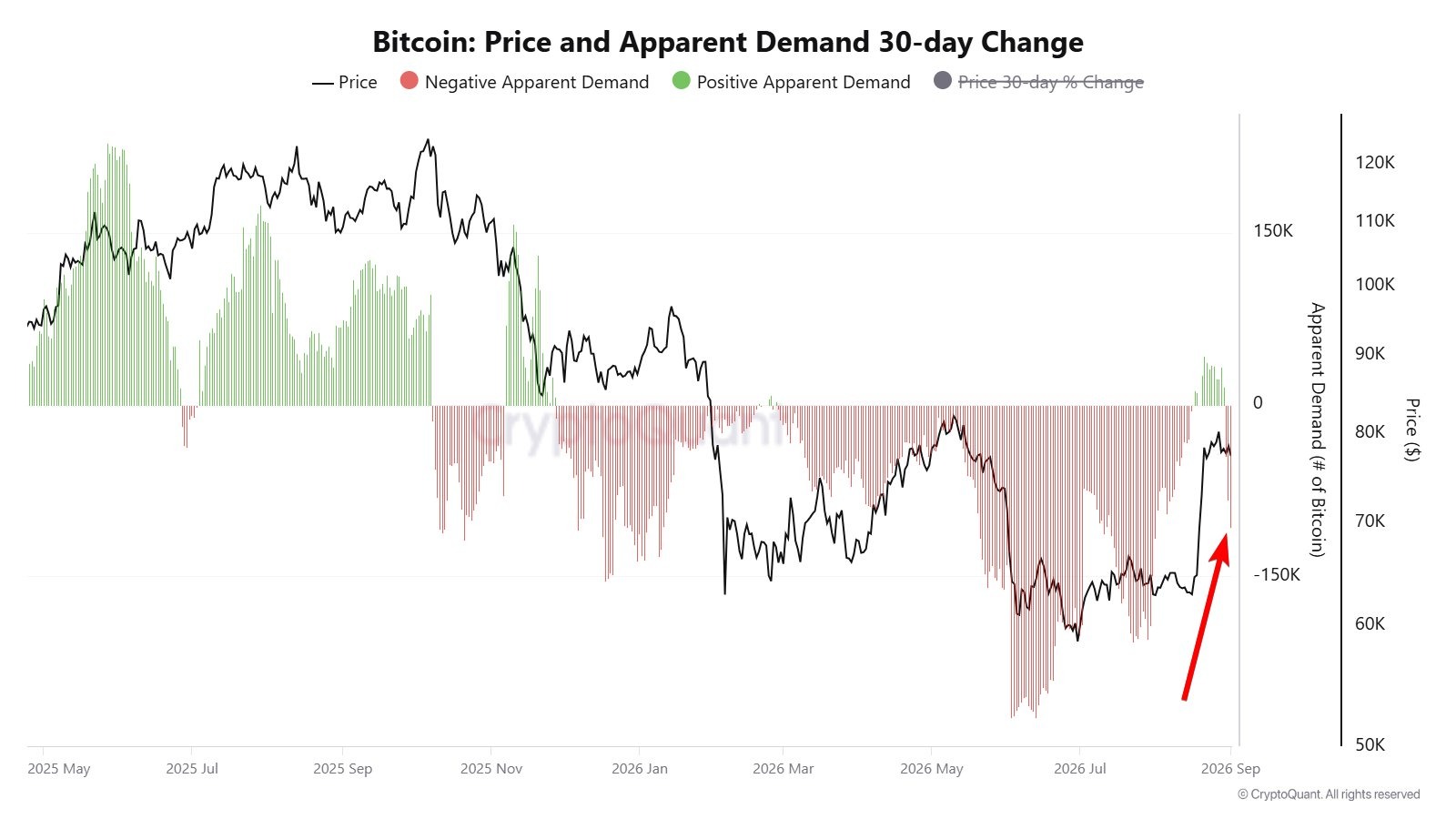
The move in BTC came after US spot Bitcoin exchange-traded funds (ETFs) recorded outflows of $236 million the day prior. Data from CryptoQuant now shows Bitcoin’s apparent demand turning negative once more after a brief reprieve during the August rally.
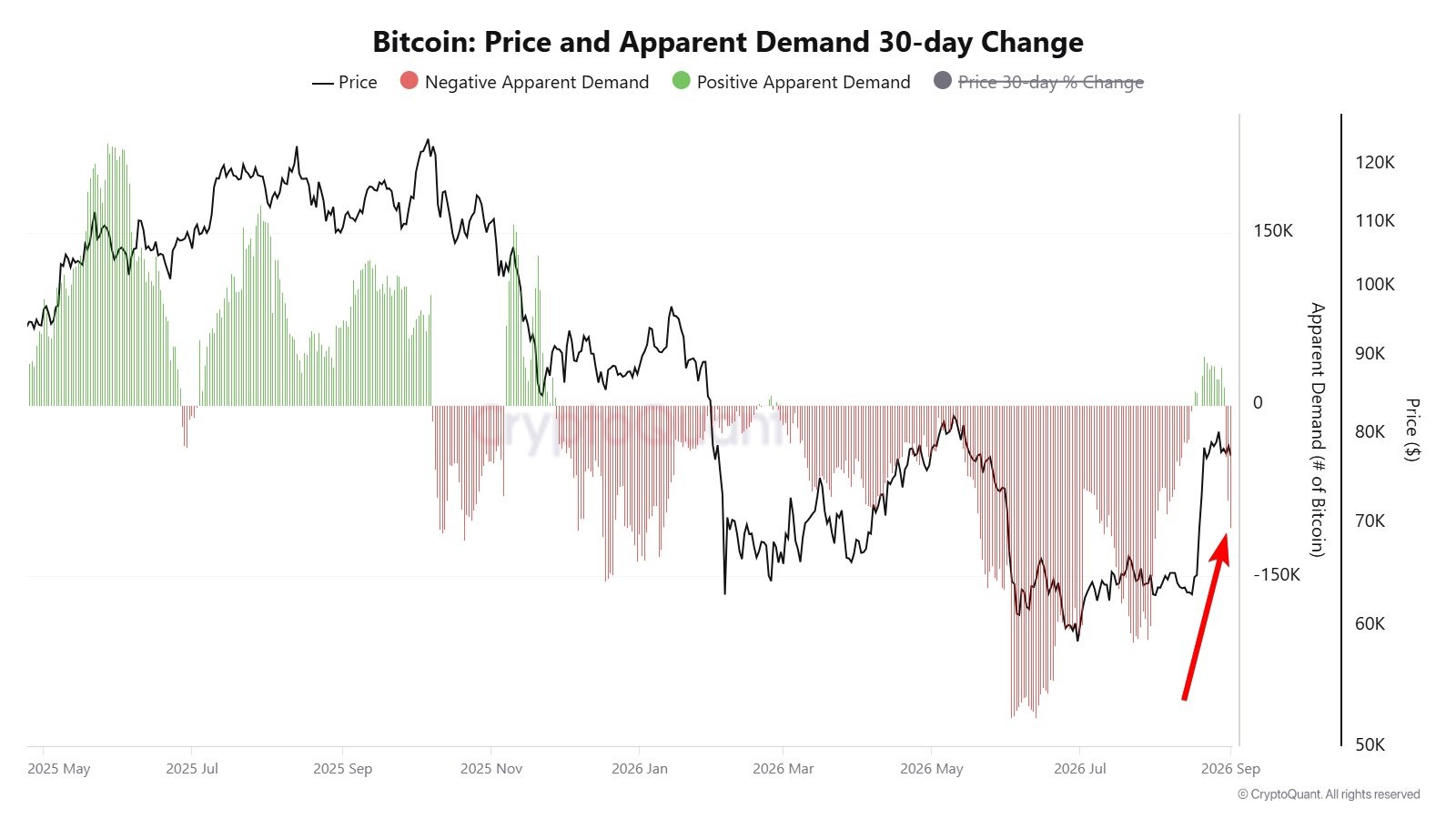
Bitcoin price and apparent demand, 30-day change. Source: CryptoQuant
The indicator is inspired by similar metrics from commodity markets and measures the difference between newly mined issuance and changes in inactive supply. Positive demand implies that old coins are waking up and the market is absorbing them along with new issuance. This is taken to be a sign of active spot demand. Negative readings mean coins are aging into dormancy faster than miners issue them.
At the time of writing, BTC has reclaimed $77,000, but remains pinned under a cluster of resistance that we have previously reported on.
Bonds and Asian equities sell off
The global bond rout that Cointelegraph reported on Monday eased slightly as the US 10-year yield briefly dipped below 4.8%. There was inorganic price action in the USD/JPY pair at 13:00 UTC, which commentators widely took as a sign of another central bank intervention. USD/JPY declined to 158.5, retreating from the psychological 160 level widely seen as a line the Bank of Japan (BOJ) will defend. At the time of writing, no official announcement on the matter has been made.
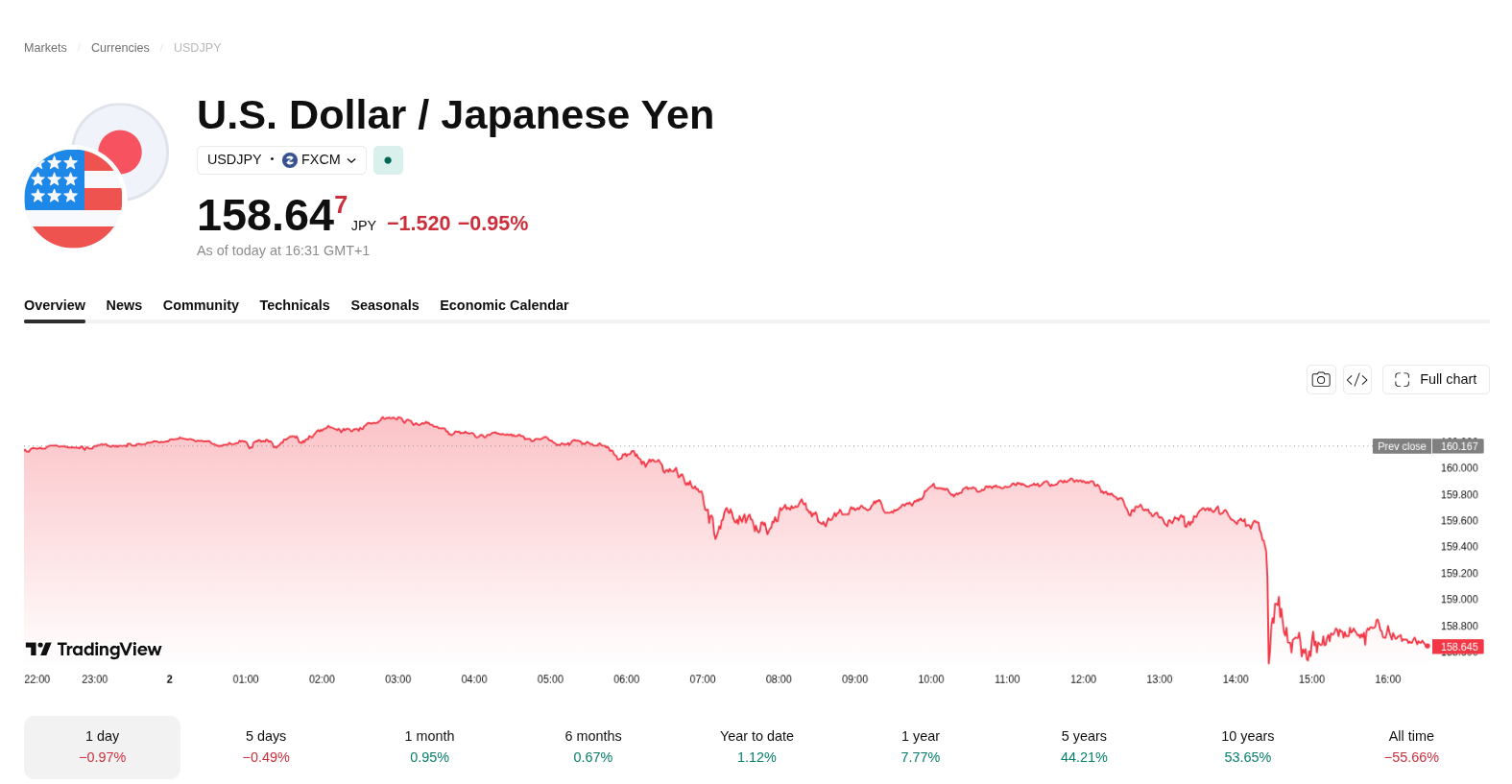
USD/JPY trading pair one-day chart. Source: TradingView
Asian equities, meanwhile, suffered steep declines, likely driven by soaring oil prices and further profit-taking in the AI sector. South Korea’s KOSPI led the decline, falling 4.0% to close at 6,562.72 as chipmakers SK Hynix and Samsung Electronics shed 4% and 4.7%, respectively.
Related: Bitcoin lows pierce $63K as Asia chip-stock crash spreads to Wall Street
Japan’s Nikkei 225 fell 2.9% to 64,325.64, dragged down by tech heavyweights including SoftBank Group, an OpenAI investor. Taiwan’s TAIEX rounded out the losses with a 1.7% drop. Back in July, Cointelegraph reported on the first cracks beginning to show on the US side of the AI trade, as credit spreads on hyperscalers rose significantly.

US federal law enforcement, in cooperation with cybersecurity company CrowdStrike and international partners, announced an operation targeting the Sality malware ecosystem—an infection chain authorities say has been used for more than two decades to steal cryptocurrency and carry out cyberattacks.
In a Tuesday announcement, the US Department of Justice (DOJ) said it disrupted the Sality botnet and related malware in an international effort involving Bulgarian, Hungarian, and Romanian officials, as well as private-sector partners CrowdStrike and the Shadowserver Foundation. The DOJ linked Sality to long-running compromise activity dating back to 2003, including the installation of malware on affected devices.
Key takeaways
- The DOJ says the Sality botnet and malware infrastructure were disrupted through a coordinated international takedown.
- CrowdStrike reports that clipboard-based “clipjacking” was used to replace cryptocurrency addresses with attacker-controlled ones.
- According to CrowdStrike, entities behind Sality stole at least 12.1 million rubles (about $150,000) over the prior eight years.
- Authorities described a peer-to-peer botnet of roughly 15,000 infected computers that periodically checked whether targets were online.
- During the operation, Sality operators reportedly lost the ability to communicate with infected machines.
Why clipboard hijacking matters for crypto security
The most consequential detail in the reporting is how the theft worked. CrowdStrike said that in the previous eight years, the operators used EggJagger, a clipjacking tool that monitors a victim’s clipboard for cryptocurrency wallet addresses and then silently swaps them for addresses controlled by the attacker.
In practical terms, the mechanism targets a common user behavior: copying and pasting wallet addresses when sending funds. According to CrowdStrike, when a victim copies a Bitcoin or Ethereum address to complete a payment, the funds are redirected to the substituted address.
This type of attack is particularly damaging because it doesn’t require the victim to sign malicious transactions or interact with a fake website in the moment. Instead, it compromises the transaction flow at the point of address entry—meaning users who rely on clipboard copy/paste can be tricked even if they never knowingly interact with malware prompts or phishing pages.
Scope and reported impact of the Sality operation
In its write-up on the takedown, CrowdStrike said that the clipjacking approach enabled theft of at least 12.1 million rubles, or roughly $150,000 in cryptocurrency, during the period it described. The company also emphasized that stolen assets remained “never-spent,” meaning the seized digital funds were not later spent or otherwise moved from the attacker-linked destinations in the observed timeframe.
It further stated that the value of these “never-spent” assets peaked at about $1.5 million in January 2025, giving a sense of how significant the stored proceeds could become once operational theft processes are running.
While the reported theft amount and peak valuation describe only what CrowdStrike observed in its analysis, they help clarify why disrupting the botnet’s communication channels is so important: if operators can’t reliably control or maintain infections, their ability to trigger address substitutions and collect funds diminishes.
How the botnet functioned—and what the disruption changed
US officials and CrowdStrike both described Sality as a peer-to-peer botnet. According to the company, about 15,000 infected computers were part of this network, which checked whether systems were online every 40 minutes. That periodic connectivity helped ensure the malware operators could maintain visibility into infection status and, when possible, continue malicious operations.
After the authorities’ efforts, CrowdStrike said the criminals “lost the ability to communicate with infected machines.” In botnet operations, that loss is often decisive: even if infected devices remain in place temporarily, removing command-and-control communications reduces the malware’s ability to coordinate, update, and execute its most profitable functions.
The DOJ’s announcement framed the disruption as part of a broader disruption of Sality malware and the botnet infrastructure tied to it, not just a removal of individual infections. For crypto users, the key takeaway is that these campaigns can persist for long periods—DOJ said Sality was responsible for installing malware on compromised devices since 2003—so enforcement actions and technical disruptions are critical for shrinking the attacker’s operational surface.
What investors and users should watch next
This takedown highlights how cryptocurrency theft campaigns increasingly blend malware distribution with human workflow attacks like clipboard hijacking. Users should treat clipboard-based address substitution as a real threat—especially when sending Bitcoin or Ethereum funds—and consider validating recipient addresses through out-of-band methods (for example, checking a pasted address against a trusted source or using verification steps in wallet software).
Looking ahead, the open question is how attackers adapt if their ability to communicate with infected machines is curtailed. Readers should watch for follow-on malware variants, new clipboard hijacking tools, or broader changes in how criminals maintain access to victim devices as the Sality infrastructure disruption ripples through criminal operations.


Kraken parent Payward has postponed its planned initial public offering until as early as the second quarter of 2027 after market conditions disrupted its previous listing schedule.
Summary
- Payward may wait until at least the second quarter of 2027 to complete its IPO.
- The company confidentially submitted a draft S-1 registration statement in November 2025.
- Payward raised $800 million at a $20 billion valuation before filing with the SEC.
- Second-quarter adjusted revenue rose 17% to $508 million despite lower transaction volume.
Kraken IPO timeline moves into 2027
As per reports on Wednesday, citing two people familiar with the matter, Payward had pushed the offering into the second quarter of 2027 at the earliest.
The new timeline extends the IPO process that has already faced several delays. Payward initially prepared for a public debut after cryptocurrency companies returned to U.S. equity markets in 2025, but falling digital asset prices and weaker trading activity made that schedule harder to maintain.
Payward confidentially submitted a draft registration statement on Form S-1 to the U.S. Securities and Exchange Commission in November 2025. A confidential filing allows a company to begin the SEC review process without immediately publishing its financial statements and other disclosures.
Kraken co-CEO Arjun Sethi later confirmed the confidential filing during an industry conference in April. Sethi said at the time that access to public capital was not the company’s main reason for pursuing a listing, describing regulatory trust and its long-term plans as more important factors.
In March, Payward paused its multi-billion-dollar offering as difficult market conditions reduced demand for new crypto stocks. Reuters said it could not independently confirm the report, while a Kraken spokesperson declined to comment on the listing plans.
An IPO in the second quarter of 2027 would still depend on SEC review, market conditions and Payward’s final decision to proceed. Since its draft filing remains confidential, the company has not publicly disclosed a proposed share price, ticker, exchange, or number of shares for sale.
Payward entered the process with a $20 billion valuation
Shortly before submitting the draft S-1, Payward completed an $800 million financing package across two tranches. The transaction valued the company at $20 billion and supplied additional private capital before the proposed listing.
As crypto.news reported in November, Citadel Securities contributed $200 million through a strategic investment. The funding also supported Payward’s work in regulated derivatives, tokenized financial products and international markets.
Public-listing expectations had increased after Circle Internet Group and Bullish completed IPOs in 2025. Several other digital asset companies also began preparing offerings, raising expectations that the industry would produce another group of U.S. listings in 2026.
Weaker cryptocurrency prices, lower trading volumes, and poor share performance at some recently listed companies later reduced investor interest. Grayscale, Consensys, and Ledger also postponed their listing plans as companies waited for a more favorable market.
Ledger paused preparations for a U.S. listing that could have valued the hardware wallet company at about $4 billion. The company had hired Goldman Sachs, Jefferies, and Barclays as advisers but had not filed a draft S-1, according to a May report.
BitGo, which was identified in that report as the only crypto-native company to list during 2026 at the time, was trading 36% below its January IPO price. The decline added another data point for private crypto companies assessing demand from public-market investors.
Payward revenue rises while trading activity falls
Payward has continued expanding its operations while the listing remains on hold. Company results for the second quarter showed adjusted revenue of $508 million, up 17% from the same period in 2025.
Funded accounts increased 42% from a year earlier to 6.6 million, while assets held on the platform reached $40 billion. Asset-based and other revenue accounted for 60% of total adjusted revenue, according to Payward’s financial report.
Trading figures presented a less favorable picture. Total platform transaction volume dropped 13% year over year to $310 billion as crypto spot activity slowed, while adjusted earnings before interest, taxes, depreciation, and amortization fell to $23 million.
First-quarter results had already shown how newer business lines were reducing Payward’s dependence on spot crypto trading. In May, the company reported $507 million in adjusted revenue, a 3% annual increase, even as Bitcoin fell 22% during the quarter and industry spot volume declined 38%.
Daily average revenue trades in futures rose 51% during the first quarter, supported by NinjaTrader, Breakout, and Bitnomial. Funded accounts stood at 6.1 million at the end of that period, compared with 6.6 million three months later.
Adjusted EBITDA was $18 million in the first quarter as Payward spent money on acquisitions, product development, and regulatory infrastructure. The company also reduced its workforce by about 150 employees in May, equal to roughly 5% of its staff, as part of a cost restructuring.
Kraken builds regulated U.S. derivatives business
Payward has used acquisitions and product launches to move into derivatives, tokenized stocks and payment services while its shares remain privately held.
The company acquired NinjaTrader, a U.S. retail futures platform, for $1.5 billion in 2025. Payward also bought Bitnomial, a CFTC-regulated derivatives exchange, in a $550 million transaction and added Breakout, a proprietary trading platform for qualified users.
Bitnomial gives Payward a regulated route for offering derivatives to eligible American customers. In August, Hyperliquid Labs and Payward entered advanced discussions about bringing selected Hyperliquid-linked perpetual futures to the United States through the platform, a recent report found.
Any products offered through Bitnomial would operate under rules enforced by the Commodity Futures Trading Commission. Bitnomial Exchange is registered as a designated contract market, while NinjaTrader Clearing operates as a registered futures commission merchant under the Kraken Derivatives US name.
In tokenized equities, Payward acquired Backed Finance, the issuer behind Kraken’s xStocks products. The deal gave the company more control over the issuance and trading infrastructure used to offer blockchain-based representations of stocks and exchange-traded funds.
Payward also agreed in May to acquire Hong Kong-based payment company Reap Technologies for $600 million in cash and stock. The transaction, which valued Payward shares at the same $20 billion level established by its funding round, added stablecoin-based cross-border and commercial payment services to the company’s operations.
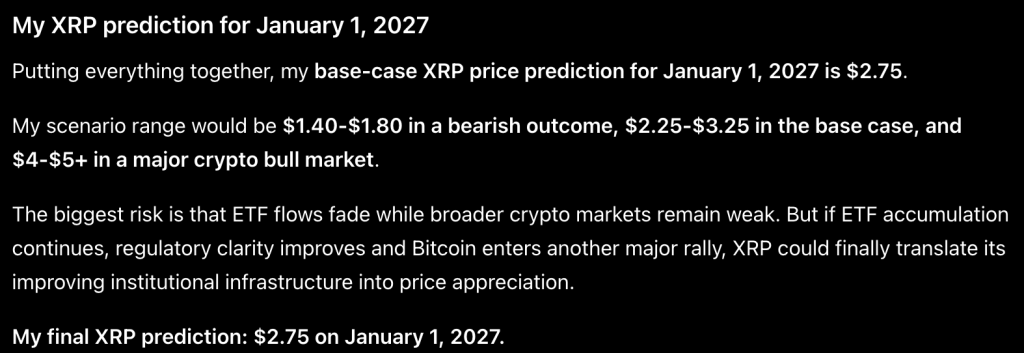
We asked Google Gemini AI what it predicts the XRP price will be by the end of 2026, and the chatbot gave a very bullish answer sure to excite the Ripple army.
XRP enters the final months of 2026 at an important crossroads. After a difficult year for the cryptocurrency market, XRP has struggled to sustain the explosive momentum that took it to multi-year highs, but several fundamental catalysts are now lining up.
That would represent a substantial recovery from current levels, but still leave XRP below its 2025 record high. Below is the word-for-word transcript from Gemini AI, taking into account ETF demand, regulatory progress, improving institutional adoption, and a potential broader crypto-market rally to set a bullish yet realistic end-of-year target for Ripple.

Gemini AI Predicts XRP Price With ETF Flows Providing the Strongest Bullish Signal
Perhaps the most encouraging development is the continued demand for US spot XRP ETFs. The products have now attracted approximately $1.68Bn in cumulative net inflows, with 11 consecutive trading sessions of positive flows contributing roughly $170M to the total.
August was particularly encouraging, with more than $150M flowing into XRP ETFs. If that momentum continues through the final quarter, ETFs could become an increasingly important source of structural buying pressure.
For XRP, this matters because ETF investors generally represent a different pool of capital from speculative crypto traders. Continued institutional accumulation could therefore help XRP establish a higher long-term valuation floor.
Technical Analysis Points Toward a Breakout
XRP’s technical picture is less convincing than its fundamentals. The key battle is around the $1.50-$1.55 region. A decisive move above that area could invalidate the current bearish structure and open the door to $1.70 and eventually $2.
Conversely, a sustained break below approximately $1.20 would considerably weaken the bullish thesis. This means XRP probably needs a strong fourth-quarter breakout rather than simply drifting higher.
If Bitcoin and the wider crypto market enter another risk-on phase, XRP’s relatively large liquidity and growing institutional exposure could enable it to accelerate.
$XRP 8H SETUP IS GETTING INTERESTING. — XRP Update (@XrpUdate) September 1, 2026
Price is compressing near long-term trendline support after the recent rally.
If support holds and XRP breaks descending resistance, $2.00+ comes back into focus.
CONFIRMATION IS KEY. 
 pic.twitter.com/IRYtXcsZTf
Discover: The Best Token Presales
Regulation Could Be the Major Catalyst
The next major catalyst is US crypto legislation. The Senate’s scheduled September 15, 2026 cloture vote on the CLARITY Act is particularly important because regulatory clarity could encourage larger institutional investors to enter the market.
XRP also enters this period without the regulatory uncertainty that previously surrounded its relationship with the SEC. That removes one of the biggest structural obstacles to institutional adoption.
Meanwhile, the adoption of the XRP Ledger and Ripple’s RLUSD stablecoin provides a fundamental narrative that goes beyond speculation.
Gemini AI Predicts XRP, but What Do the Prediction Markets Say?

Prediction markets are considerably more conservative than my forecast. Current market data on Kalshi gives XRP only around a 25% probability of reaching $2.50 by the end of 2026, while the probability of reaching $3 is at 14%.
I view that as a reason to be cautious rather than bearish. Prediction markets provide useful snapshots of consensus, but crypto markets often overshoot consensus during periods of strong momentum.
Make Your XRP Prediction on Kalshi and Claim $25 For Free
My XRP Prediction for January 1, 2027
Putting everything together, my base-case XRP price prediction for January 1, 2027 is $2.75.
My scenario range would be $1.40-$1.80 in a bearish outcome, $2.25-$3.25 in the base case, and $4-$5+ in a major crypto bull market.
The biggest risk is that ETF flows fade while broader crypto markets remain weak. But if ETF accumulation continues, regulatory clarity improves, and Bitcoin enters another major rally, XRP could finally translate its improving institutional infrastructure into price appreciation.
My final XRP prediction is $2.75 on January 1, 2027, while my major bull market prediction is over $5 by the same date.
LiquidChain Targets Early Mover Upside as Google Gemini AI Predicts Bullish XRP Price
XRP holders sitting on ETF-driven conviction have a fair case: institutional money is clearly rotating in, and the paper-loss dynamics some funds are absorbing haven’t shaken the buying. But XRP’s market cap means even a strong breakout to $2 is a double, not a multiple.
XRP movement rewards patience more than urgency. That’s the gap early-stage infrastructure plays are built to fill, with LiquidChain being one of the most prominent right now.
The ceremony starts with a single word. — LiquidChain (@getliquidchain) August 31, 2026

 pic.twitter.com/vudkt5bEzI
LiquidChain ($LIQUID) is a Layer 3 infrastructure project. It is fusing Bitcoin, Ethereum, and Solana liquidity into a single execution environment with a deploy-once architecture, enabling developers to build once and reach all three ecosystems without fragmenting liquidity.
The presale is priced at $0.014951 per token, with a total raised now at $960K. Its unified liquidity layer and verifiable settlement model target a real infrastructure gap rather than a speculative narrative.
Check out the LiquidChain presale website here, and find out why nearly $1M has been pumped into one of the hottest presales of 2026.
Gain Special Access to Layer 3 Trading Here
Discover: The Best Crypto to Diversify Your Portfolio
The post Google Gemini AI Predicts a +300% XRP Price Surge by 2027 appeared first on Cryptonews.

Wyoming has moved Frontier Stable Token (FRNT) reserve reporting closer to real time, expanding its use of Chainlink infrastructure for onchain proof of reserves. The Wyoming Stable Token Commission said it adopted Chainlink Proof of Reserve to publish verified information about FRNT’s reserves and token supply on the blockchain.
Under the update, verified reserve data will be made available onchain using a setup that combines independent examinations by The Network Firm with Chainlink’s Proof of Reserve tooling, aiming to improve how quickly users can see changes in backing between reporting cycles.
Key takeaways
- Wyoming’s commission adopted Chainlink Proof of Reserve to publish verified FRNT reserve and supply data onchain in near real time.
- FRNT already had daily reserve attestations; the integration is designed to make changes in backing visible faster than periodic disclosures alone.
- Wyoming’s GENIUS Act framework still includes monthly disclosure requirements for reserve composition and outstanding supply.
- The commission is also working on Chainlink Secure Mint, which would gate new FRNT minting on verified reserves being at least equal to total supply.
From daily attestations to near-real-time proof
The Frontier Stable Token’s reserve transparency framework has been evolving alongside Wyoming’s regulatory requirements. The Wyoming Stable Token Commission said it already publishes daily reserve attestations for FRNT, while the GENIUS Act requires monthly disclosures covering reserve composition and outstanding stablecoin supply.
The new Chainlink Proof of Reserve integration is meant to tighten that feedback loop. By publishing verified reserve and supply information via Chainlink infrastructure, the commission expects more timely visibility into when the composition and size of FRNT’s backing changes between formal disclosure windows.
In the model described by the commission, independent examinations by The Network Firm are incorporated into the onchain reporting process through Chainlink’s system—an architecture intended to increase confidence that the onchain figures reflect underlying reserve verification rather than relying solely on issuer-provided updates.
Secure Mint on the roadmap
Beyond reporting, the commission also flagged a further step it is working toward: adopting Chainlink’s Secure Mint feature. In its described form, Secure Mint would require verified reserves to equal or exceed FRNT’s total supply before additional tokens can be minted.
For investors and integrators, that matters because it shifts reserve coverage from being an after-the-fact disclosure exercise toward a mechanism that can constrain issuance in real time. While Wyoming did not state a specific timeline for when Secure Mint would be activated for FRNT, the direction is clear: make reserve adequacy a condition for minting rather than only a periodic compliance metric.
How FRNT is backed—and what income supports
FRNT, launched in January, is described as being backed by US dollars and short-term US Treasurys. The commission also said interest income generated from the reserves is deposited into Wyoming’s School Foundation Program.
That structure is relevant to why “proof of reserve” is particularly consequential for this token: the backing is intended to be held in highly liquid instruments, and near-real-time visibility into reserve levels and supply can help stakeholders assess whether the backing remains aligned with outstanding FRNT as it changes.
Wyoming’s broader Chainlink rollout
This Proof of Reserve expansion arrives shortly after Wyoming completed FRNT’s migration from LayerZero to Chainlink’s Cross-Chain Interoperability Protocol (CCIP), with CCIP becoming FRNT’s exclusive cross-chain infrastructure.
According to the commission, the cross-chain infrastructure switch took place roughly two weeks before the Proof of Reserve announcement. Together, the changes point to a broader consolidation of FRNT’s operational stack around Chainlink—both for transparency (reserve verification onchain) and for interoperability (cross-chain messaging via CCIP).
Chainlink’s institutional momentum
The update also fits into a broader pattern of Chainlink integrations across tokenized assets and regulated market infrastructure. In recent months, Chainlink has been used as a pricing-data provider for tokenized equities, participated in banking-group initiatives focused on stablecoin-based atomic foreign exchange settlement, and been referenced in plans for tokenized collateral management platforms.
The article cited several examples of Chainlink involvement, including that Chainlink became a pricing-data provider for Coinbase’s B20 tokenized equities on Base after their August launch, and that Chainlink joined Project Pangea—an initiative involving European and South Korean banking groups exploring euro- and won-denominated stablecoins for atomic FX settlement.
In addition, the report referenced work connected to the Depository Trust and Clearing Corporation (DTCC) for a planned 24/7 platform to manage tokenized collateral, and noted a tokenized liquidity fund launched by Fidelity International using Chainlink and Sygnum infrastructure with daily net asset value data provided by JPMorgan for pricing.
Market participants are also watching LINK, the native token of the Chainlink network. CoinGecko data referenced in the source indicates LINK gained more than 34% over the past month, trading around $11.07 as of Wednesday.
Next, FRNT holders and integrators will likely look for whether Wyoming proceeds with Chainlink Secure Mint in practice and how quickly Proof of Reserve data updates compared with the existing daily attestations and monthly GENIUS Act disclosures. The key question is whether the “near-real-time” verification meaningfully reduces the gap between reserve changes and public visibility—especially during periods of rapid minting or redemption.
Related reading: Charles Schwab adda Solana, Avalanche and Chainlink to nascent crypto platform.


Federal law enforcement officials, working with cybersecurity technology company CrowdStrike, announced action against entities behind malware that enabled the theft of $150,000 in cryptocurrency.
In a Tuesday notice, the US Justice Department said it had disrupted the Sality botnet and malware in an international effort with Bulgarian, Hungarian and Romanian officials, as well as private sector partners CrowdStrike and the Shadowserver Foundation. US officials said that Sality was responsible for installing malware on compromised devices since 2003, resulting in crypto theft and cyberattacks.
CrowdStrike reported that in the previous eight years, the entities behind Sality used EggJagger, a “clipjacking tool that monitors the clipboard for cryptocurrency wallet addresses and silently replaces them with addresses controlled by the operator,” to steal at least 12.1 million rubles, or about $150,000, in cryptocurrency. According to the company, the value of the “never-spent” digital assets peaked at about $1.5 million in January 2025.
“When a victim copies a Bitcoin or Ethereum address to make a payment, the funds are redirected,” said CrowdStrike, explaining the technique behind the theft.
According to CrowdStrike, the criminals behind Sality “lost the ability to communicate with infected machines” as a result of authorities’ efforts to disrupt the network. US officials and the company said Sality was used to steal crypto, while about 15,000 infected computers formed part of a peer-to-peer botnet that checked whether its systems were online every 40 minutes.
Related: A fake crypto job interview nearly installed malware on my computer

Coinbase has expanded its Canadian offering by launching crypto derivatives trading, including perpetual and dated futures linked to major digital assets such as Bitcoin, Ether, and Solana. The move gives eligible users access to a broader range of structured trading products through Coinbase’s regulated futures operation.
The launch is being delivered via Coinbase Financial Markets, a futures commission merchant registered with the U.S. Commodity Futures Trading Commission and operating in Canada under foreign dealer and futures commission merchant exemptions. Coinbase said the program includes 23 crypto perpetual and dated futures, five commodity futures, and exposure to the Coinbase 50 Index.
Key takeaways
- Coinbase is adding crypto derivatives in Canada, including perpetual and dated futures tied to Bitcoin, Ether, Solana, and other assets.
- The products are offered through Coinbase Financial Markets, using its U.S.-registered futures commission merchant framework with Canadian exemptions.
- Trading access is restricted to eligible Canadian customers, including those meeting a $5 million net financial assets threshold or qualifying for certain adviser/dealer arrangements.
- The contracts use nano-sized positions and provide leverage of up to 10x, making risk management central for participants.
- Coinbase’s launch follows other U.S.-linked platforms expanding in Canada, even as regulators tighten rules around parts of the crypto market.
What Coinbase is launching in Canada
Coinbase’s derivatives entry centers on futures contracts that allow traders to take directional or hedging positions without holding the underlying assets. According to the company, the Canadian lineup comprises 23 crypto perpetual and dated futures as well as five commodity futures and the Coinbase 50 Index.
The platform positions the offering as a first for “major crypto-native” exchanges in Canada to provide direct, native crypto futures. For Canadian users, availability is limited to qualifying customers, including those with at least $5 million in net financial assets, or those connected through registered investment advisers and dealers.
Coinbase also outlined contract design and trading mechanics: the futures use nano-sized positions and offer leverage of up to 10x. For retail and smaller professional accounts, leverage limits the margin of error—small price moves can quickly translate into gains or losses depending on position sizing and liquidation terms. Traders considering the product are likely to focus on margin requirements, contract specifications, and risk controls before entering.
How Coinbase’s step fits into a broader Canada push by U.S. platforms
Coinbase’s Canadian derivatives rollout arrives amid growing competition from U.S.-facing trading platforms that are already serving Canadian customers with crypto services. On Monday, Webull expanded crypto trading for Canadian users, citing its use of Coinbase’s infrastructure for both trading and custody.
That expansion added digital assets alongside Webull’s existing stocks, ETFs, and options offerings. Webull pointed to rising crypto adoption in Canada and said, according to Ontario Securities Commission research, crypto ownership has increased to 25% this year from 10% in 2023. The implication for Coinbase is clear: demand for crypto exposure in Canada is broadening beyond spot exchanges into more advanced trading venues.
Earlier in the year, Robinhood also entered Canada after completing a $180 million acquisition of WonderFi. The deal gave Robinhood control of Canadian exchanges Bitbuy and Coinsquare, bringing approximately 300,000 funded customers and WonderFi’s Canadian licenses and regulatory approvals under the Robinhood umbrella.
Taken together, these developments show that Canada has become a more attractive geography for companies seeking scale in crypto trading—spanning retail-style apps to institutional-grade derivatives providers. Coinbase’s derivatives launch extends that trend from spot and brokerage-style access into futures markets that are often used for hedging, basis trading, and structured exposure.
Regulatory pressure and market structure in Canada
While major trading platforms push into Canadian crypto markets, the regulatory picture is also evolving. Coinbase’s launch comes as Ottawa moves to tighten oversight on other parts of the ecosystem.
In April, Canada proposed banning crypto ATMs, pointing to concerns about scams and money laundering. Lawmakers also advanced legislation aimed at prohibiting cryptocurrency donations to political parties and candidates.
This juxtaposition—more product variety from large trading brands alongside tougher rules in areas viewed as high-risk—highlights the direction of travel for Canadian crypto policy. For investors and traders, it matters because regulation can shape which services are expanded, which customer segments are targeted, and how compliance requirements affect availability and liquidity.
Why derivatives access matters for Canadian traders
For participants, futures products can change how crypto exposure is managed. Perpetual futures are typically used for ongoing directional positions and sometimes for hedging, while dated futures introduce fixed expiry cycles that can align with investment horizons or corporate hedging needs.
The addition of nano-sized positions may lower the barrier to expressing smaller trade sizes compared with larger contract units, though leverage up to 10x still requires careful attention to liquidation risk. The most immediate practical impact for Canadian users is the ability to obtain crypto exposure through regulated derivatives rather than only via spot holdings or third-party structured products.
However, this also raises expectations around market quality. Derivatives markets depend on liquidity, order book depth, and consistent risk management across market makers and participants. Traders who adopt Coinbase’s futures offering will likely be watching bid-ask spreads, funding or roll behavior for perpetual products, and how executions perform during volatile market conditions.
Looking ahead, Coinbase’s success in Canada will likely hinge on both user demand for derivatives and the regulatory environment governing access, leverage limits, and product permissions. With Webull, Robinhood, and now Coinbase all broadening their Canadian crypto presence, market participants should watch for how contract specifications, customer eligibility rules, and liquidity develop as trading activity grows.
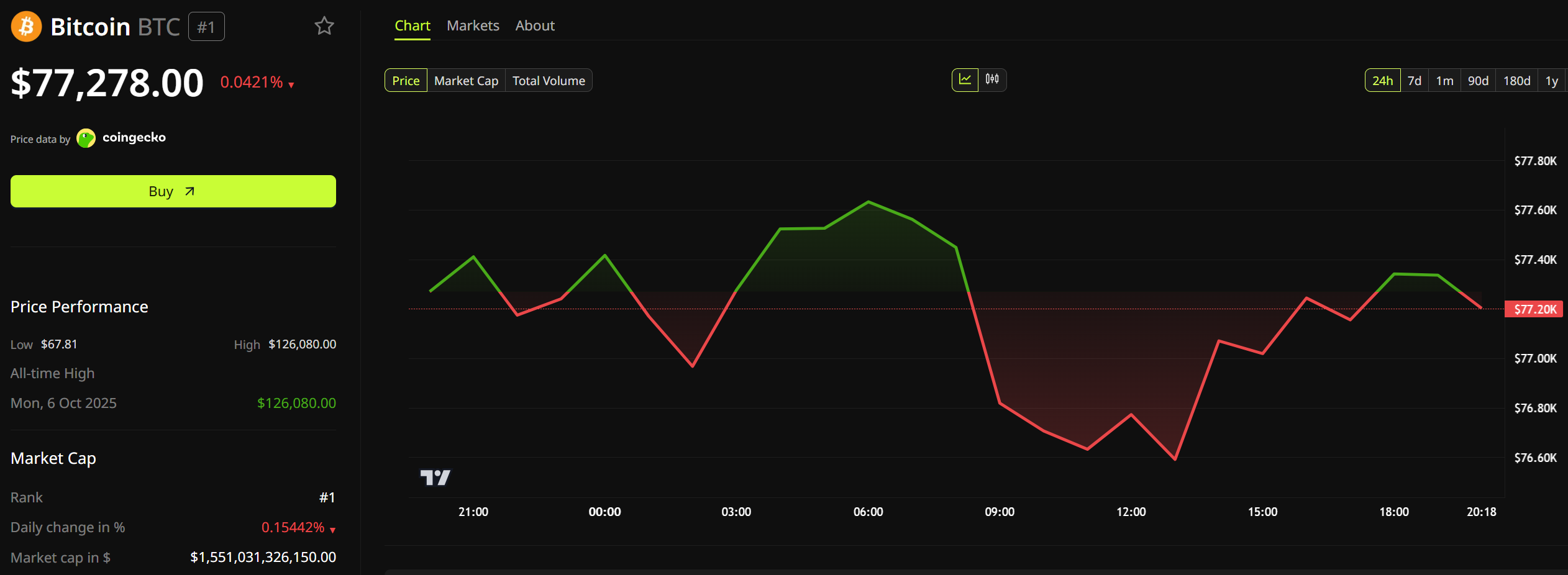
Binance founder Changpeng Zhao (CZ) said speculative capital is rotating back to crypto from artificial intelligence (AI) trades. Meanwhile, research firm River published a model putting Bitcoin (BTC) as high as $840,000 within five years.
That returning money meets a market Glassnode describes as boxed in. BTC trades near $77,278, down 0.04% over the past 24 hours, with heavy overhead supply still sitting above.

AI Money Rotating Back to Crypto Still Needs Rails
CZ framed the shift as a reminder rather than a victory lap. AI pulled speculative flows through 2026. However, he argued the money layer beneath those trades never went anywhere.
Follow us on X to get the latest news as it happens
The capital he describes is tourist money. It moves fast, chases the loudest narrative, and rarely stays for a full allocation cycle.
Advisors Hold 0.008% of Their Assets in Bitcoin
River published its case for a 10% Bitcoin allocation the same day. The report argues portfolios sit structurally underweight despite Wall Street guidance of 1% to 7%.
Investment advisors as a group hold 0.008% of assets in Bitcoin, River found. Meanwhile, 29 of the top 30 registered investment advisors already own some, echoing calls from advisors pushing larger allocations.

$840K is what could happen if just a fraction of investors allocate just a fraction of their capital to Bitcoin,” read an excerpt in the report, citing Sam Baker.
River models 20% to 40% of portfolios adding 2% to 4% weights against a $333 trillion asset base. That implies $1.3 trillion to $5.3 trillion of net inflows over three to five years, or roughly $250,000 to $840,000 per coin.
The $83,000 Supply Wall Decides Who Is Right
Glassnode works on a shorter clock. Its latest report places long-term holder supply between $83,000 and $86,000, with an accumulation floor at $62,000 to $65,000.

The August 19 short squeeze carried Bitcoin price action above $80,000 on August 27 before sellers turned it back toward $76,000. Supply in profit had climbed to 68% from 65% in May at the same nominal price.
Spot Bitcoin ETFs took in $290 million per day at peak, yet strong ETF inflows met secondary turnover near just $3 billion daily. The US 10-year Treasury yield has since returned to 4.8%.
Returning hot money hits the liquidation map long before it touches any allocation model. Whether long-term holders sell into that bid will decide if River’s math gets a down payment or another rejection.
The post CZ Says AI Money Is Rotating Back to Crypto as $840,000 Case Builds for Bitcoin appeared first on BeInCrypto.

Multiple victims, including 2 police officers, in Minneapolis shooting, officials say

Waymo opens robotaxi rides to public in Denver, San Diego and Tampa

Kalshi sports contracts dispute heads to Supreme Court





-

 Fashion5 days ago
Weekend Open Thread: Maeve – Corporette.com
-

 Crypto World6 days ago
Bitcoin’s 22% rally now needs real demand to outlast Treasury liquidity boost
-

 Business6 days ago
Apple Confirms September 9 Keynote and Reveals Its Full Pre-Order Schedule
-

 Crypto World7 days ago
Elon Musk Grok Bot Promise: We Will Make You Whole if AI Loses Your Money
-

 Business6 days ago
Salesforce Stock Soars 19% as Blowout Earnings and Agentforce AI Growth Silence Software Skeptics
-

 Business5 days ago
Onto Innovation Stock: AI’s Next Bottleneck Is Yield (NYSE:ONTO)
-

 Crypto World7 days ago
NVIDIA revenue hits $96.2B as AI demand doubles
-

 Crypto World5 days ago
Bitcoin price tests $82K resistance as Brandt stays long
-
 Tech4 days ago
Hugging Face built a $4.5 billion empire on free AI models. Now Nvidia is buying it for $12.9 billion
-

 Business5 days ago
iPhone 18 Pro Pre-Orders Could Shift to Saturday as Apple Reportedly Avoids September 11 Anniversary
-

 Tech7 days ago
Claude Cowork gets its own browser that doesn’t touch your tabs, bookmarks, or saved passwords
-

 Crypto World6 days ago
Truflation calls for Fed rate cut after PCE forecast
-

 News Videos4 days ago
Charlie Munger on Robinhood: No one should believe that Robinhood’s trades are free
-

 Crypto World7 days ago
GENIUS Act missed its deadline as OCC writes rules anyway
-

 Tech5 days ago
PaperCut releases second emergency patch for exploited flaws
-
 Entertainment5 days ago
‘Adults’ Creators Break Down Season 2’s Most Shocking Moments and Tease a Potential Season 3
-

 Tech6 days ago
The fix for the AI agent that hijacked a company’s DNS: it can propose the change, but it can’t approve it
-

 Tech4 days ago
Tamagotchi Ring Takes the 30-Year Digital Pet and Places it on Your Finger
-

 Tech4 days ago
As the influencer economy drives retail sales, Seattle startup raises $22M to play matchmaker
-
 Business7 days ago
AI Assistant Startup Instinct Rockets to $2.5 Billion Valuation in Weeks Amid Investor Feeding Frenzy
You must be logged in to post a comment Login