
Crypto World
Kraken parent Payward delays IPO to second quarter of 2027 at earliest



The crypto exchange operator, which confidentially filed for a U.S. listing last November, had already put its IPO plans on hold amid difficult market conditions.

Binance founder Changpeng Zhao (CZ) said speculative capital is rotating back to crypto from artificial intelligence (AI) trades. Meanwhile, research firm River published a model putting Bitcoin (BTC) as high as $840,000 within five years.
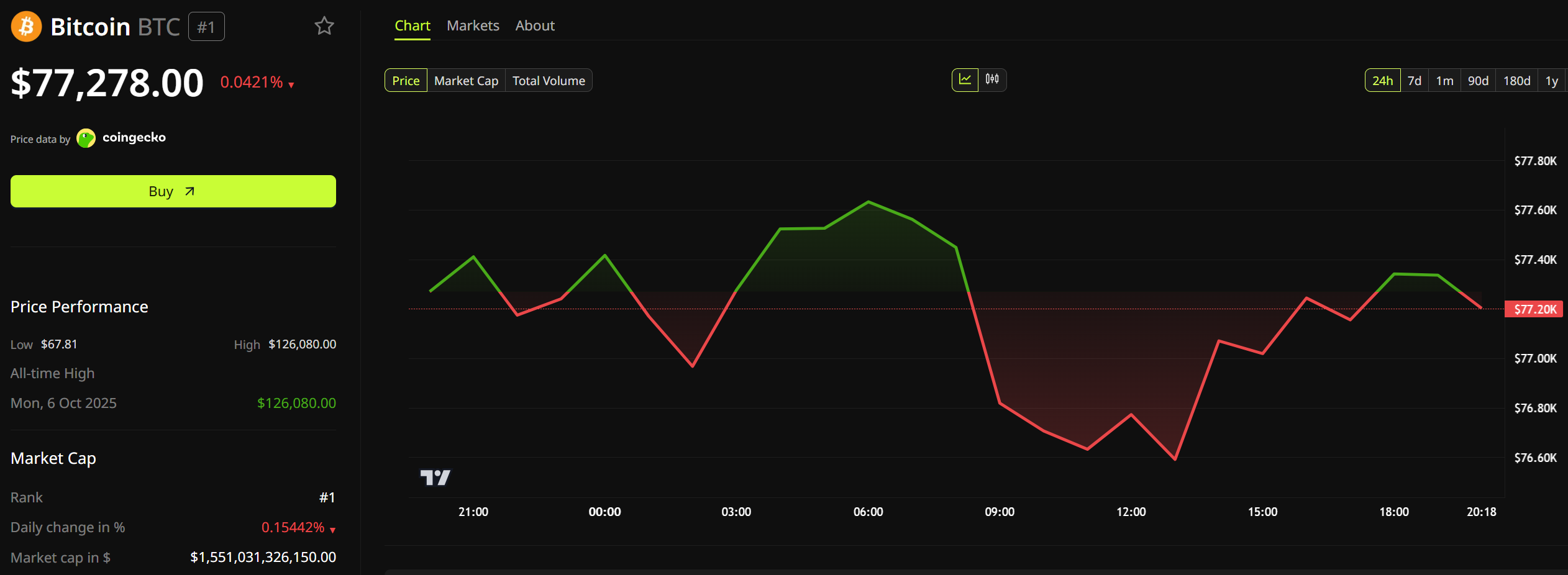
That returning money meets a market Glassnode describes as boxed in. BTC trades near $77,278, down 0.04% over the past 24 hours, with heavy overhead supply still sitting above.

AI Money Rotating Back to Crypto Still Needs Rails
CZ framed the shift as a reminder rather than a victory lap. AI pulled speculative flows through 2026. However, he argued the money layer beneath those trades never went anywhere.
Follow us on X to get the latest news as it happens
The capital he describes is tourist money. It moves fast, chases the loudest narrative, and rarely stays for a full allocation cycle.
Advisors Hold 0.008% of Their Assets in Bitcoin
River published its case for a 10% Bitcoin allocation the same day. The report argues portfolios sit structurally underweight despite Wall Street guidance of 1% to 7%.
Investment advisors as a group hold 0.008% of assets in Bitcoin, River found. Meanwhile, 29 of the top 30 registered investment advisors already own some, echoing calls from advisors pushing larger allocations.

$840K is what could happen if just a fraction of investors allocate just a fraction of their capital to Bitcoin,” read an excerpt in the report, citing Sam Baker.
River models 20% to 40% of portfolios adding 2% to 4% weights against a $333 trillion asset base. That implies $1.3 trillion to $5.3 trillion of net inflows over three to five years, or roughly $250,000 to $840,000 per coin.
The $83,000 Supply Wall Decides Who Is Right
Glassnode works on a shorter clock. Its latest report places long-term holder supply between $83,000 and $86,000, with an accumulation floor at $62,000 to $65,000.

The August 19 short squeeze carried Bitcoin price action above $80,000 on August 27 before sellers turned it back toward $76,000. Supply in profit had climbed to 68% from 65% in May at the same nominal price.
Spot Bitcoin ETFs took in $290 million per day at peak, yet strong ETF inflows met secondary turnover near just $3 billion daily. The US 10-year Treasury yield has since returned to 4.8%.
Returning hot money hits the liquidation map long before it touches any allocation model. Whether long-term holders sell into that bid will decide if River’s math gets a down payment or another rejection.
The post CZ Says AI Money Is Rotating Back to Crypto as $840,000 Case Builds for Bitcoin appeared first on BeInCrypto.
FBI agents took control of domains and servers, specifically Alqassam.ps, to intercept donations and prevent further fundraising for the Al-Qassam Brigades.


Fairshake has entered the final stage of the 2026 U.S. election cycle with $122 million available after supporting nearly 50 winning candidates during the primaries.
Summary
- Fairshake has backed nearly 50 candidates who secured party nominations in the 2026 primaries.
- The super PAC has reserved $122 million for spending before the Nov. 3 general election.
- Prediction markets give four Fairshake-backed Republican Senate candidates at least a 94% chance of winning.
- Fairshake’s largest primary defeat came after it spent over $10 million against Juliana Stratton in Illinois.
Fairshake adds nearly 50 primary wins
According to reports on Wednesday, Fairshake supported nearly 50 successful primary candidates as the crypto industry-backed super PAC prepared to direct its remaining funds toward the November elections.
Among its latest wins, Democratic Representative Jake Auchincloss secured his party’s nomination in Massachusetts after receiving support from Protect Progress, Fairshake’s Democratic-focused affiliate. Protect Progress spent $189,527.60 on four mailers supporting the incumbent, according to Federal Election Commission disclosures cited in a recent crypto.news report on the Auchincloss primary win.
Although Auchincloss has voted for several pieces of crypto legislation, his record has not aligned with the industry on every issue. Stand With Crypto, the Coinbase-backed advocacy group, gives him a C grade, partly because he did not support the GENIUS Act stablecoin legislation last year.
His opponent, Jason Poulos, criticized the outside spending and alleged that some of the material used artificial intelligence. The FEC filing and materials released by Poulos did not show that Auchincloss or his campaign helped prepare the advertisements, while federal rules require super PAC expenditures to remain independent of the candidates they support.
Fairshake and its affiliates have also spent money defending seven members of Congress who have regularly supported digital asset legislation. At the same time, the network backed first-time candidates from both parties who could enter Congress next year.
In August, Fairshake affiliates added several Michigan and Washington victories after spending hundreds of thousands of dollars across the two states. Republican Representative Bill Huizenga received nearly $512,000 in support from Defend American Jobs, Fairshake’s Republican-focused affiliate, while Protect Progress backed Democratic Representatives Suzan DelBene, Kim Schrier and Marilyn Strickland.
Republican Senate candidates lead election odds
Fairshake’s most notable results have come from Republican Senate primaries, where it helped Barry Moore in Alabama, Andy Barr in Kentucky, Kevin Hern in Oklahoma, and Harriet Hageman in Wyoming secure their party nominations.
Hageman is running for the seat held by retiring Senator Cynthia Lummis, one of Congress’ most active supporters of cryptocurrency legislation. The Wyoming lawmaker has worked on digital asset tax, market structure, and Bitcoin-related proposals during her time in the Senate.
Prediction traders expect all four Fairshake-backed candidates to win in November. Polymarket contracts gave Moore a 99% probability of victory, Hern 97%, and Hageman 96% at the time of the report. A Kalshi market placed Barr’s odds near 94%.
Prediction-market prices represent traders’ expectations rather than guaranteed outcomes, and the figures can change as election conditions develop.
If elected, the four Republicans would arrive in the Senate while lawmakers are still working on the Digital Asset Market Clarity Act. The proposed legislation would divide oversight of parts of the U.S. digital asset market between the Securities and Exchange Commission and the Commodity Futures Trading Commission.
Control of Congress will also determine which lawmakers lead the House Financial Services, House Agriculture, Senate Banking, and Senate Agriculture committees. Each panel has jurisdiction over parts of U.S. crypto policy, including securities rules, commodities regulation, stablecoins, and market structure.
Fairshake spokesperson Geoff Vetter said the organization would continue its election activity after its primary results.
“With dozens of wins in House and Senate races across the country, and $122 million ready for the fall, we’re not slowing down.”
Most party nominees have already been selected, although primary contests remain in New Hampshire, Rhode Island, Delaware and Louisiana. The general election is scheduled for Nov. 3.
Illinois delivers Fairshake’s largest defeat
Despite its victories elsewhere, Fairshake failed to stop Illinois Lieutenant Governor Juliana Stratton from winning the Democratic nomination for the U.S. Senate.
The super PAC spent more than $10 million trying to defeat Stratton, making the Illinois contest its largest unsuccessful expenditure of the current election cycle. Stratton defeated a field that included Representatives Raja Krishnamoorthi and Robin Kelly in the race to succeed retiring Senator Dick Durbin.
Fairshake’s advertisements did not prevent Stratton from securing the nomination, and prediction models cited by the report expect her to enter the Senate next year. Illinois has consistently elected Democrats in statewide federal races, giving the party’s nominee an advantage over Republican nominee Don Tracy.
The result showed that high outside spending did not decide every primary. Consumer advocacy group Public Citizen previously calculated that crypto companies had contributed a record $189 million to the 2026 election cycle by the end of June, accounting for about 37% of corporate political contributions included in its analysis.
Public Citizen said Fairshake had spent more than $82 million during the cycle by that point. The organization’s network entered 2026 with approximately $193 million in cash, though the current $122 million figure represents funds available for the final election phase.
Coinbase, Ripple and Andreessen Horowitz remain the main financial supporters of Fairshake and its affiliated committees. The network divides much of its political work between Protect Progress, which supports Democrats, and Defend American Jobs, which concentrates on Republicans.
Rival crypto PACs trail Fairshake’s spending
Other digital asset-linked political groups have raised money during the election cycle but have not matched Fairshake’s activity.
Fellowship PAC, backed by Cantor Fitzgerald and Anchorage Digital, had previously indicated that it could spend $100 million. The committee received about $11 million, with most of the money coming from Cantor Fitzgerald.
The PAC supported a group made up mainly of Republicans and three Democrats, including Virginia Senator Mark Warner. Almost all its spending went to a political firm co-founded by Bo Hines, a former crypto adviser to President Donald Trump who later took charge of Tether’s U.S. operation.
Fellowship’s early connection to Tether created a campaign-finance issue because U.S. political committees cannot accept foreign funds. Rather than receiving money from the stablecoin issuer, the PAC obtained backing from Cantor Fitzgerald, the U.S. financial firm that manages part of Tether’s reserves. It remains unclear whether Fellowship will spend again during the general election.
Tyler and Cameron Winklevoss have separately backed the Digital Freedom Fund through a $21 million contribution from Winklevoss Capital. Kraken parent Payward added another $1 million, but the committee had not started supporting individual candidates at the time of the report.
Crypto World
MicroStrategy Reserve Capital Beats All S&P 500 Financials But Berkshire, MSTR Still Slips
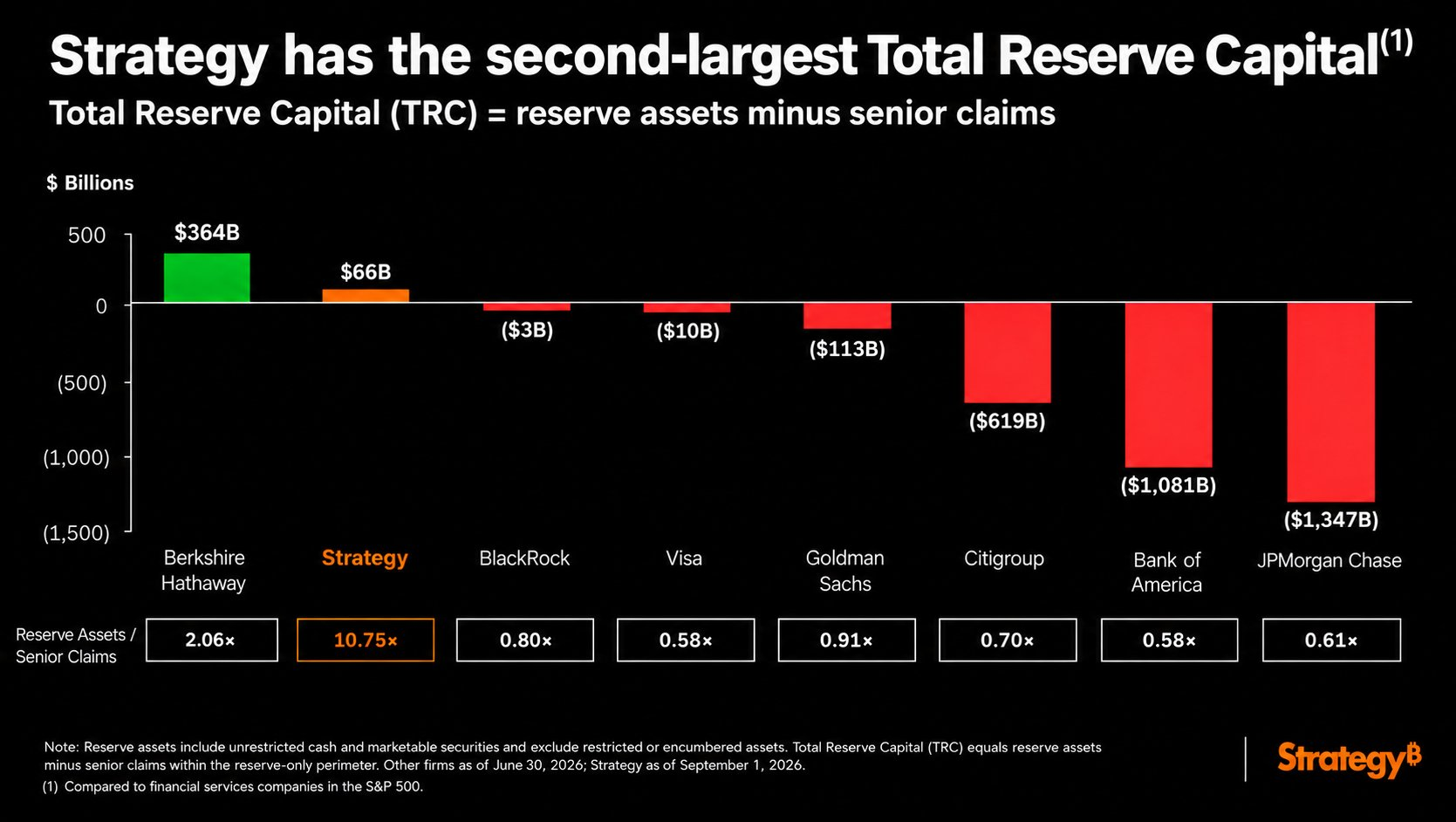
Michael Saylor says MicroStrategy now holds more reserve capital than every financial firm in the S&P 500 but one. Berkshire Hathaway is the exception.
The boast rests on a yardstick the company built itself. MicroStrategy’s own investor briefing lands on a number $15 billion smaller.
How MicroStrategy Got Here
MicroStrategy holds 845,050 BTC. Its first buy, in August 2020, was 21,454 coins for $250 million. That stack is now worth about $65.2 billion. It resumed buying on August 31, ending a 10-week pause with 4,603 coins for $370 million.
Add $6.7 billion in dollar assets and the reserve reaches $72.3 billion. Chief Executive Phong Le cited roughly $72 billion the same day, so the figure holds up.
Le also claimed zero net leverage. The briefing backs him. Dollar assets of $6.714 billion match total debt of $6.714 billion almost exactly, after the company built its dollar pools through August.

“Strategy now has more Total Reserve Capital than every financial services company in the S&P 500 except Berkshire Hathaway. $MSTR,” said Saylor.
Follow us on X to get the latest news as it happens
Bitcoin (BTC) hovers near $77,203, down 0.08% on the day as of this writing. MSTR traded near $122.30 on Wednesday, off 2.1%. The stock fell faster than the coin, as it tends to on soft tape.

Investors had rewarded the cash build in late August, lifting MSTR near $140.
The Metric Is MicroStrategy’s Own
Total Reserve Capital strips senior claims out of liquid reserves. Deposits count as senior claims for banks. That is why JPMorgan shows roughly negative $1.35 trillion.
The chart puts MicroStrategy at $66 billion. Its August 30 briefing counts $21.5 billion of senior claims, including $14.8 billion of preferred stock, and reports a net reserve of $50.7 billion. The $66 billion works only if that preferred stock is set aside. Bank deposits are not.
The same choice flatters the ratio. The chart shows reserves at 10.75 times senior claims. Count the preferred and it falls to 3.4.
MicroStrategy says as much itself. The briefing calls these supplemental measures with significant limitations, not accounting standards.
Berkshire’s filing shows $365.5 billion in cash and Treasury bills at June 30. That number is checkable. The ranking beneath it is not.
The post MicroStrategy Reserve Capital Beats All S&P 500 Financials But Berkshire, MSTR Still Slips appeared first on BeInCrypto.

Coinbase has launched crypto derivatives trading in Canada, giving eligible users access to perpetual and dated futures tied to Bitcoin (BTC), Ether (ETH), Solana (SOL) and other assets.
The products are offered through Coinbase Financial Markets, a futures commission merchant registered with the US Commodity Futures Trading Commission, which operates in Canada under foreign dealer and futures commission merchant exemptions.
Coinbase said Wednesday that the offering includes 23 crypto perpetual and dated futures, five commodity futures and the Coinbase 50 Index. The company said it is the first major crypto-native platform to offer direct native crypto futures in Canada.
Access is limited to eligible Canadian customers, including those with at least $5 million in net financial assets or registered investment advisers and dealers. The contracts use nano-sized positions and offer leverage of up to 10x.
Related: BlackRock launches 2 Canada ETFs, with one allocating 3% to Bitcoin
US trading platforms expand in Canada
The Coinbase launch comes as US trading platforms broaden their crypto offerings in Canada.
On Monday, US online brokerage Webull expanded crypto trading to Canadian customers using Coinbase’s infrastructure for trading and custody, adding digital assets alongside its existing stocks, ETFs and options offerings.
Webull cited rising adoption as one reason for the move, with crypto ownership in Canada climbing to 25% this year from 10% in 2023, according to Ontario Securities Commission research.
Robinhood entered the Canadian market in June through its $180 million acquisition of local crypto company WonderFi, gaining control of Canadian exchanges Bitbuy and Coinsquare. The deal also brought roughly 300,000 funded customers, along with WonderFi’s Canadian licenses and regulatory approvals, under Robinhood.

Robinhood entered Canada after completing its acquisition of WonderFi. Source: Vlad Tenev
The influx of trading platforms comes as Canada tightens oversight of other parts of the crypto market. In April, Ottawa proposed banning crypto ATMs over concerns about scams and money laundering, while lawmakers advanced legislation that would prohibit cryptocurrency donations to political parties and candidates.
Magazine: BTC will hit $1M by 2030… but Arthur Hayes is buying ETH instead
The US state of Wyoming is adding near-real-time onchain reserve verification to its state-issued Frontier Stable Token through an expanded integration with blockchain oracle network Chainlink.
The Wyoming Stable Token Commission said Wednesday it adopted Chainlink Proof of Reserve to publish verified data on FRNT’s reserves and token supply onchain. The system combines independent examinations by The Network Firm with Chainlink’s infrastructure to make the data available in near real time.
Wyoming already publishes daily reserve attestations for FRNT, while the GENIUS Act requires monthly disclosures of reserve composition and outstanding stablecoin supply. The commission said the integration will provide more timely visibility into changes in FRNT’s backing between reporting periods.
The commission is also working to adopt Chainlink’s Secure Mint feature, which would require verified reserves to equal or exceed FRNT’s total supply before new tokens can be minted.
FRNT, launched in January, is backed by US dollars and short-term US Treasurys, with interest income generated from its reserves deposited into Wyoming’s School Foundation Program.
The move comes about two weeks after Wyoming fully migrated FRNT from LayerZero to Chainlink’s Cross-Chain Interoperability Protocol, making CCIP the token’s exclusive cross-chain infrastructure.
Related: Charles Schwab adda Solana, Avalanche and Chainlink to nascent crypto platform
Chainlink expands institutional footprint
Chainlink has picked up several integrations across tokenized equities, stablecoin settlement and traditional financial market infrastructure in recent months.
Most recently, Chainlink became the pricing-data provider for Coinbase’s B20 tokenized equities following their August launch on Base. The feeds cover stocks including Apple, Nvidia, Meta and Alphabet, allowing DeFi protocols to value the tokens for uses including lending, trading and collateral.
In June, Chainlink joined European and South Korean banking groups in Project Pangea, which is exploring the use of regulated euro- and won-denominated stablecoins for atomic foreign exchange settlement across the two regions.
Its push into traditional financial infrastructure has also included the Depository Trust and Clearing Corporation (DTCC), which said in May it would integrate Chainlink technology into a planned 24/7 platform for managing tokenized collateral. That month, Fidelity International also launched a tokenized liquidity fund using Chainlink and Sygnum infrastructure, with JPMorgan providing daily net asset value data for pricing.
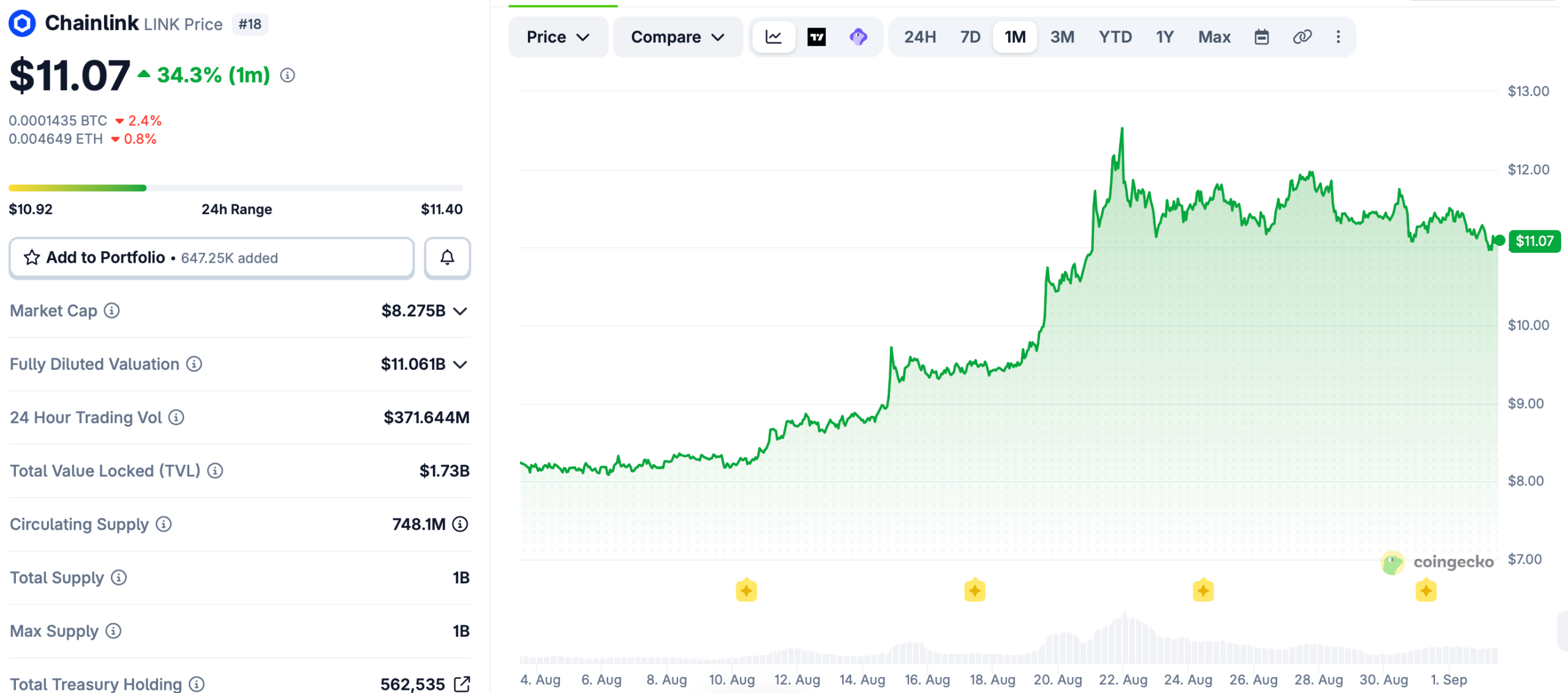
Chainlink’s LINK token has gained more than 34% over the past month, trading at around $11.07 on Wednesday, according to CoinGecko data.
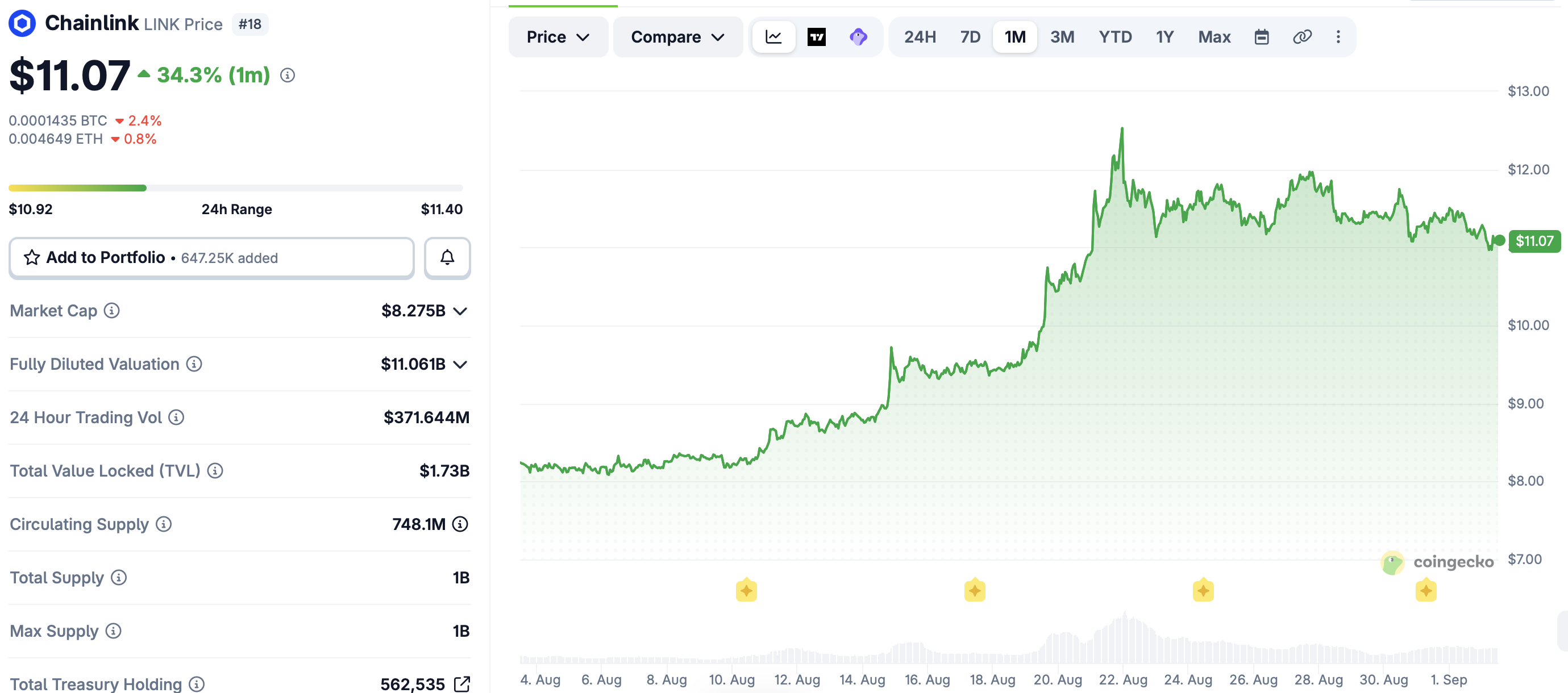
LINK has gained around 34% over the past month. Source: CoinGecko
Magazine: Does the Bitcoin rally mean we haven’t wasted our lives in crypto?

To close such gaps, companies hoping to build at home could start by using modular, off-site methods that can cut project timelines by half and capital costs by 10 to 20%, and deploying technology, collaborative contracting, and more to lower construction costs. Also AI- and robot-first operating models can help employers transform labor productivity. Our analysis found such steps could close half to two-thirds of the U.S. cost gap.
Where cost competitiveness isn’t possible, companies can compete on service quality, brand, customer proximity, and innovation. Complex drug therapies, for example, command premium margins and a decade or more of effective commercial exclusivity. Performance and trust can sustain premium prices. Increasingly, unrestricted access to the U.S. market also matters.
Policymakers face their own challenges. They cannot protect, nurture, ringfence, or subsidize every industry. Instead, they can support industries that can solve America’s so-called “Achilles heels,” the roughly 25% of imported manufactured goods that are critical to national security, exposed to supply concentration, and derived from geopolitically distant trading partners. The scale of intervention required, whether selective trade measures, financial support, industrial policy, or other measures, is substantial. The task is about triage, deciding which industries justify a scale of intervention that would change the playing field, starting with the 25% of imported manufactured goods in which dependencies are most pronounced. Policymakers will also want to work to address existing skews in the international trading system.

New Jersey’s Attorney General and the state’s interim director for the Division of Gaming Enforcement have officially petitioned the US Supreme Court to hear a case aimed at resolving whether state authorities or federal agencies have jurisdiction over prediction market companies.
On Wednesday, Attorney General Jennifer Davenport and gaming enforcement interim director Mary Jo Flaherty filed a petition for a writ of certiorari to the US Supreme Court over New Jersey’s enforcement against prediction market platform Kalshi over sporting event contracts. Officials cited civil cases brought by gaming authorities in “at least 20 states,” seeking the highest court in the US to decide whether prediction market companies could be in compliance with the Commodity Futures Trading Commission (CFTC) while violating state laws.
“Companies like Kalshi claim to offer legal sports betting in all 50 States, but they refuse to follow the gambling laws of any State,” said Davenport. “These companies have no right to offer their sports bets without following state law, which is why dozens of States across the ideological spectrum have opposed them […] We’re calling on the Supreme Court to resolve this issue and recognize that Congress did not silently make the sports-betting industry immune from state law.”

Source: New Jersey Attorney General
Citing New Jersey’s enforcement against Kalshi, the petition presented the Supreme Court with the question of “whether the 2010 Dodd-Frank Wall Street Reform and Consumer Protection Act preempted States from regulating sports bets that occur within their jurisdictions if those bets are offered on markets registered with the [CFTC].” Cointelegraph reached out to the CFTC for comment but did not receive an immediate response.
Related: Kalshi issues first lifetime ban for Republican politician over insider bets
The petition challenges an April opinion from the US Court of Appeals for the Third Circuit, in which judges ruled 2-1 against New Jersey’s gaming authorities, saying Kalshi’s argument that the company had a ”reasonable chance of success” in claiming that the CFTC’s Commodity Exchange Act preempted state law. It specifically challenges the CFTC’s claim that sports bets on prediction market platforms amount to “swaps” under the agency’s purview and argued “federal law does not preempt state sports-gambling laws regardless.”
What are the potential consequences for Kalshi and other prediction markets?
“Because federal law prohibits trading swaps off CFTC-registered markets, a victory for Kalshi would mean that all sports gambling off such CFTC-registered markets would seemingly become illegal even if state law allows it,” said the New Jersey AG’s announcement on the petition.
Kalshi spokesperson Dani Lever told Cointelegraph that the company disagreed with New Jersey’s decision to appeal to the Supreme Court, saying that it could not be “regulated by 50 different regulators.“
”We remain confident in the lower courts’ rulings, and nothing in New Jersey’s filing today changes our view,” said Lever.
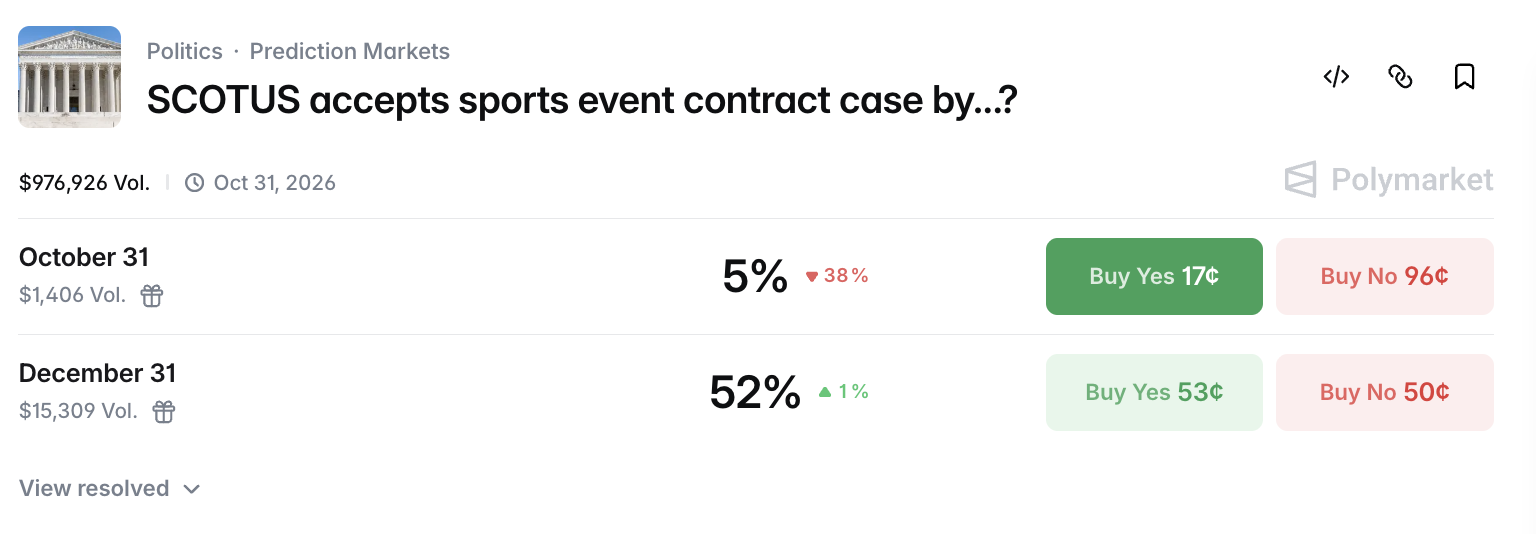
Event contract on when the US Supreme Court will hear a prediction markets case. Source: Polymarket
Whether the Supreme Court justices will take up the issue of prediction markets is unclear. Many experts have been speculating that the justices could weigh in on a case that went to the appellate court in Nevada. Whether the court chooses the Kalshi case in Nevada, the one in New Jersey or an enforcement action against a different company down the road, any potential decision could decide which authorities can regulate prediction markets.
Magazine: Who is legally liable when an AI agent goes rogue?


Caterpillar CEO Joseph Creed disclosed his sale of $26.2 million worth of stock on Tuesday, after exercising an options package four and a half years early.
He sold 32,401 shares on the New York Stock Exchange on August 28, emptying his oldest outstanding tranche of options that had a March 2031 expiration date.
The options had a $219.76 strike price — allowing Creed to exercise 72% below the current stock price that regular investors have to pay today.
Creed’s proceeds of $26.2 million had a weighted average of $808.98 per share, slightly below the filing’s $812.98 valuation for shares surrendered to cover his exercise price or tax liability.
He disposed of 12,002 shares under a filing code for paying an exercise price or tax liability. Their value almost exactly matched the grant’s $9.76 million exercise cost.
Even after the incredible payday, Creed’s August 28 sale only reduced his 2021-vintage options grant to zero. In addition, Caterpillar’s proxy filing lists another 110,651 option grants from years 2022-2025, including vested and unvested compensation.
Moreover, he retained ownership of 34,555 shares of stock, plus another 11,839 shares in his 401(k) retirement account.
Read more: Jefferies slashes SanDisk price target 42% despite record earnings
Creed sells after post-earnings decline
Creed’s sales occurred a few weeks after Caterpillar’s quarterly earnings report.
A few weeks before he would sell $26.2 million, Creed said, “This is the first time in company history that we have generated over $20 billion in sales and revenues in a single quarter.”
Investors haven’t sustained his optimism. Shares of Caterpillar have shed 16% of their value since their $935 high on the day the company reported those earnings.
Creed’s filing didn’t classify his options exercises and associated stock sales under a predetermined, Rule 10b5-1(c) trading plan.
Since 2023, the SEC has required insiders of public companies to tick a checkbox on their Form 4 filings for transactions following a predetermined trading plan, as well as that plan’s adoption date.
Certain pre-2023 grandfathered trading plans are exempt.
Because Creed’s checkbox remained blank, investors are able to speculate more widely about the discretion he exercised in making these sales, rather than dismiss them immediately as unremarkably predetermined.
Got a tip? Send us an email securely via Protos Leaks. For more informed news and investigations, follow us on X, Bluesky, and Google News, or subscribe to our YouTube channel.


Grayscale told the US Securities and Exchange Commission (SEC) to leave crypto exchange-traded fund (ETF) rules alone. New limits would cost investors money and buy them nothing.
The asset manager filed on Aug. 31, the last day of the comment window. The SEC is weighing whether these funds need their own rulebook.
Grayscale Draws a Line on Crypto ETF Rules
The SEC opened the review on June 30 with 27 questions. Crypto is one of seven asset types in the frame.
Chairman Paul Atkins pointed to scale. ETF assets have tripled since 2019. Some sponsors have already parked new launches while the review runs.
One question cuts closest to Grayscale. Should the word “ETF” belong only to funds registered under the Investment Company Act of 1940?
Grayscale said no. Its spot crypto products, including the pending Zcash ETF, are commodity trusts instead. It has run them that way since 2013.
Follow us on X to get the latest news as it happens
Chief Legal Officer Craig Salm went further.
“The term ETF accurately describes the economic reality of exchange-traded commodity trusts, and restricting its use to registered investment companies would create investor confusion rather than resolve it,” read an excerpt in the comment letter.
The 81-Day Delay Behind the Argument
Grayscale also opposed rewriting Rule 6c-11. That 2019 rule lets ETFs launch without case-by-case approval.
Adding portfolio limits or asset-class bans would push up fees, the firm said. Shareholders pay that bill.
Its sharpest evidence is its own record. SEC staff cleared a NYSE Arca listing rule for Grayscale’s five-asset crypto fund on June 30, 2025. The Commission then stayed the decision.
The fund did not trade on the exchange until Sept. 19, a wait of 81 days. Grayscale now wants a confidential pre-filing process with a 45-day staff reply window.
The window has closed. Crypto ETF demand has cooled since the launch boom.
The 1940 law at the center of this fight turns 86 this year. What the SEC does with it sets the pace for every crypto fund still in line.
The post Grayscale Battles SEC Over Future of Crypto ETFs: “Don’t Break What Works” appeared first on BeInCrypto.

United Nations says Britain should put statues of ‘people of African descent’ in public spaces to atone for the slave trade

NBA suspends Clippers owner Ballmer for one year in Kawhi Leonard salary cap probe

CZ Says AI Money Is Rotating Back to Crypto as $840,000 Case Builds for Bitcoin

Weekend Open Thread – Corporette.com

Weekend Open Thread: Brooks Brothers

London Mayor Sadiq Khan handed a peerage by Keir Starmer alongside 15 other Labour figures… just days before the PM leaves No10

Top Small Finance Bank FD Interest Rates 2025 | FD Rates #fd #investmenttips #latestupdate #rate

Crypto Currency Scam in Jagtial District | Politicians & Doctors Lose Crores |

Should AI Give Financial Advice? #ai #chatgpt #podcast
-

 Fashion5 days ago
Weekend Open Thread: Maeve – Corporette.com
-

 Crypto World6 days ago
Bitcoin’s 22% rally now needs real demand to outlast Treasury liquidity boost
-

 Business6 days ago
Apple Confirms September 9 Keynote and Reveals Its Full Pre-Order Schedule
-

 Crypto World7 days ago
Elon Musk Grok Bot Promise: We Will Make You Whole if AI Loses Your Money
-

 Business6 days ago
Salesforce Stock Soars 19% as Blowout Earnings and Agentforce AI Growth Silence Software Skeptics
-

 Business5 days ago
Onto Innovation Stock: AI’s Next Bottleneck Is Yield (NYSE:ONTO)
-

 Crypto World7 days ago
NVIDIA revenue hits $96.2B as AI demand doubles
-

 Crypto World5 days ago
Bitcoin price tests $82K resistance as Brandt stays long
-
 Tech4 days ago
Hugging Face built a $4.5 billion empire on free AI models. Now Nvidia is buying it for $12.9 billion
-

 Business5 days ago
iPhone 18 Pro Pre-Orders Could Shift to Saturday as Apple Reportedly Avoids September 11 Anniversary
-

 Tech7 days ago
Claude Cowork gets its own browser that doesn’t touch your tabs, bookmarks, or saved passwords
-

 Crypto World6 days ago
Truflation calls for Fed rate cut after PCE forecast
-

 Crypto World7 days ago
GENIUS Act missed its deadline as OCC writes rules anyway
-

 Tech5 days ago
PaperCut releases second emergency patch for exploited flaws
-

 News Videos3 days ago
Charlie Munger on Robinhood: No one should believe that Robinhood’s trades are free
-

 Tech7 days ago
Apple’s iPhone 18 Pro event is on September 9
-

 Tech6 days ago
The fix for the AI agent that hijacked a company’s DNS: it can propose the change, but it can’t approve it
-
 Entertainment5 days ago
‘Adults’ Creators Break Down Season 2’s Most Shocking Moments and Tease a Potential Season 3
-

 Tech4 days ago
Tamagotchi Ring Takes the 30-Year Digital Pet and Places it on Your Finger
-

 Tech4 days ago
As the influencer economy drives retail sales, Seattle startup raises $22M to play matchmaker
You must be logged in to post a comment Login