
Crypto World
Leading crypto presales on every investor’s radar in April 2026: Big opportunities right now


Disclosure: This article does not represent investment advice. The content and materials featured on this page are for educational purposes only.
Projects like BlockchainFX are gainining traction as investors target early-stage crypto presales for potential upside during market uncertainty.
Summary
- April 2026 sees surge in crypto presales, with BlockchainFX (BFX) leading as funding nears $15M target
- BlockchainFX gains traction with live beta, multi-asset trading, and strong early investor participation
- Final presale phase drives urgency as BFX offers staking rewards and cross-market trading access
Some months in crypto feel like noise, and some genuinely matter. April 2026 is the latter. The top crypto presales commanding serious attention right now are BlockchainFX (BFX), Pepeto, Ionix Chain, and IPO Genie, each pulling in different types of investors for different reasons. With markets still uncertain, early presale entries during a dip are often where the biggest gains quietly begin.

Among all the top crypto presales available this month, BlockchainFX keeps rising to the top of every serious conversation. Already live in beta, awarded “Best New Crypto Trading App of 2025,” and backed by 23,200+ participants who have pushed over $14.24M into the presale, BFX is now in its final phase. The $15M softcap is nearly reached, the launch countdown is real, and the window to get in at the ground price is closing fast.
BlockchainFX: The presale running out of time and tokens
BlockchainFX is a licensed, regulated trading super app where users can trade crypto, forex, stocks, ETFs, and commodities from one decentralized interface. Most traders today still juggle three or four separate platforms for different asset classes. BFX eliminates that entirely, handling everything in one place with full user custody. The platform is already live with thousands of daily active users and millions in daily trading volume, which is not something most presale tokens can say.
Holding BFX also earns daily staking rewards in both BFX and USDT, reaching up to $25,000 USDT, meaning investors are already generating returns while the presale is still active, not just waiting on a future price move. Multiple third-party audits, full KYC verification, and a verified smart contract back the platform’s credibility. For a token priced at $0.035, the amount of operational substance packed into this early stage is hard to find anywhere else in the top crypto presales list right now.
BFX20: Grab 20% more tokens before the $15m gate closes
The current presale price is $0.035 with a launch price of $0.05, already a 43% return from entry to listing alone. Using bonus code BFX20 adds 20% more BFX tokens to every purchase. On a $15,000 investment, that means roughly 514,285 tokens instead of 428,571. With analysts projecting BFX hitting $1 post-launch, that same $15,000 could return over $514,000. That is not speculation; that is presale math.
With $14.24M raised and the $15M softcap approaching fast, this is the final window. Buying is simple: connect MetaMask or Trust Wallet, pay via crypto or card, and the allocation confirms instantly. BFX20 is only valid during this last phase, and once the cap is hit, the presale closes and the exchange listing begins. Spend $100+ on BFX and gain exclusive access to the $500,000 Gleam prize pool!
Pepeto: Meme energy with an infrastructure angle
At $0.0000001864 per token and $9.04M raised, Pepeto has built a notable following. Unlike most memecoins that run purely on social momentum, the project includes PepetoSwap for zero-fee trading, a cross-chain bridge, and staking rewards. The goal is sustainable utility beyond the hype cycle, which makes it a more interesting memecoin pitch, though execution at scale is still in the process of being fully proven out.
Pepeto remains a memecoin at its core, and the volatility that comes with the territory is very much present. The utility vision is interesting but early. For investors browsing top crypto presales with a higher risk tolerance, it is worth watching, though the risk profile sits in a very different category compared to a regulated, already-live platform like BlockchainFX that has demonstrated real traction.
Ionix Chain: 500,000 TPS ambitions and AI-powered security
Ionix Chain is developing a Layer 1 blockchain using a proprietary “Quantum AI Consensus” mechanism aimed at exceeding 500,000 transactions per second with near-zero fees. Currently priced at $0.025 and moving to $0.030 shortly, the project targets DeFi and AI developers who need serious throughput. The AI-driven fraud detection and cross-chain interoperability put Ionix Chain among the more technically ambitious top crypto presales active in April 2026.
Layer 1 is a competitive space and Ionix Chain has bold claims that need to hold up at mainnet. Execution risk at this stage is real. For investors who want infrastructure exposure across their top crypto presales portfolio, the project deserves attention, though early technical promises in blockchain do not always survive the transition from whitepaper to live network cleanly.
IPO Genie: Opening pre-IPO doors for retail
IPO Genie is addressing a familiar frustration: retail investors locked out of pre-IPO deals while institutions capture all the early upside. At $0.0001408 per token and $1.38M raised, the platform uses AI curation to lower minimum entry points for late-stage startup investments. The listing target of $0.0016 represents significant upside from the current presale price for participants who get in early.
The concept is genuinely useful and the potential audience for democratized startup access is large. IPO Genie is still earlier-stage compared to other top crypto presales this month, and the project needs real deal flow and active user adoption to build confidence beyond the concept stage. The idea has clear merit, but the proof needs to follow soon.

The Research is in: BlockchainFX is the best crypto presale this April
Based on the latest research, the best crypto presale in April 2026 is BlockchainFX, and the case is straightforward. A live platform, regulatory approval, $14.24M raised, 23,200+ participants, daily staking rewards, and a $0.035 entry price that disappears the moment the $15M cap is reached.
Among all top crypto presales active right now, BFX has the strongest combination of real utility, proven infrastructure, and a genuinely limited window left to enter. Investors ready to act should visit the BlockchainFX website and use code BFX20 before the launch begins and the ground floor is gone.
For more information, visit the official website, X, and Telegram.
Disclosure: This content is provided by a third party. Neither crypto.news nor the author of this article endorses any product mentioned on this page. Users should conduct their own research before taking any action related to the company.


TLDR
- BlackRock recorded $935 million in digital asset inflows during the first quarter of 2026.
- Market declines reduced BlackRock’s digital asset AUM by $18.7 billion in the same period.
- The firm ended the quarter with $60.7 billion in digital assets under management.
- Digital assets represented less than 0.5% of BlackRock’s total $13.9 trillion in AUM.
- BlackRock’s iShares Bitcoin Trust increased its holdings to 785,240 BTC by quarter’s end.
BlackRock released its first-quarter 2026 results on April 14 and reported mixed digital asset figures. The firm drew $935 million in digital asset inflows during the quarter. However, market declines reduced its digital asset AUM by $18.7 billion.
BlackRock Digital Asset Inflows Reach $935 Million
BlackRock recorded $935 million in net inflows into digital asset products during the first quarter. The company disclosed the figures in its quarterly earnings report. Finbold reviewed the report on April 15 and confirmed the data.
However, market losses erased $18.7 billion from BlackRock’s digital asset AUM during the same period. The firm also reported a $5 million foreign exchange impact loss. As a result, digital assets closed the quarter at $60.7 billion in total value.
Digital assets accounted for less than 0.5% of BlackRock’s $13.9 trillion in total AUM. The category generated $42 million in base fees during the quarter. This figure represented about 0.77% of $5.4 billion in total base fees.
Digital assets also contributed 0.63% of BlackRock’s $6.7 billion in total revenue intake. For the full year, digital assets brought in $32.3 billion of $744 billion in net inflows. This share represented 4.3% of total net new inflows.
IBIT Expands Bitcoin Holdings as ETHA Reduces Ethereum Exposure
BlackRock’s iShares Bitcoin Trust (IBIT) increased its Bitcoin holdings during the first quarter. The fund added nearly 15,000 Bitcoin to its portfolio. This move brought total holdings to 785,240 BTC by quarter end.
The company confirmed the updated holdings in its quarterly filing. The increase reflected continued capital allocation to Bitcoin exposure. However, the broader crypto market downturn affected asset valuations.
In contrast, BlackRock’s iShares Ethereum Trust (ETHA) reported lower Ethereum holdings in the quarter. The fund reduced its holdings by about 410,750 Ethereum. It closed the period with roughly 3.06 million ETH.
BlackRock continued to expand its digital asset offerings during the quarter. In March 2026, the firm launched the iShares Staked Ethereum Trust ETF (ETHB). The product combines spot Ethereum exposure with staking yield.
The company also filed for the iShares Bitcoin Premium Income ETF (BITA). The proposed fund seeks to generate yield through a covered call strategy. It plans to use options on existing IBIT holdings.
BlackRock operates under CEO Larry Fink. The firm confirmed its ongoing product development efforts in digital assets during the quarter. It ended the period with $60.7 billion in digital asset AUM.

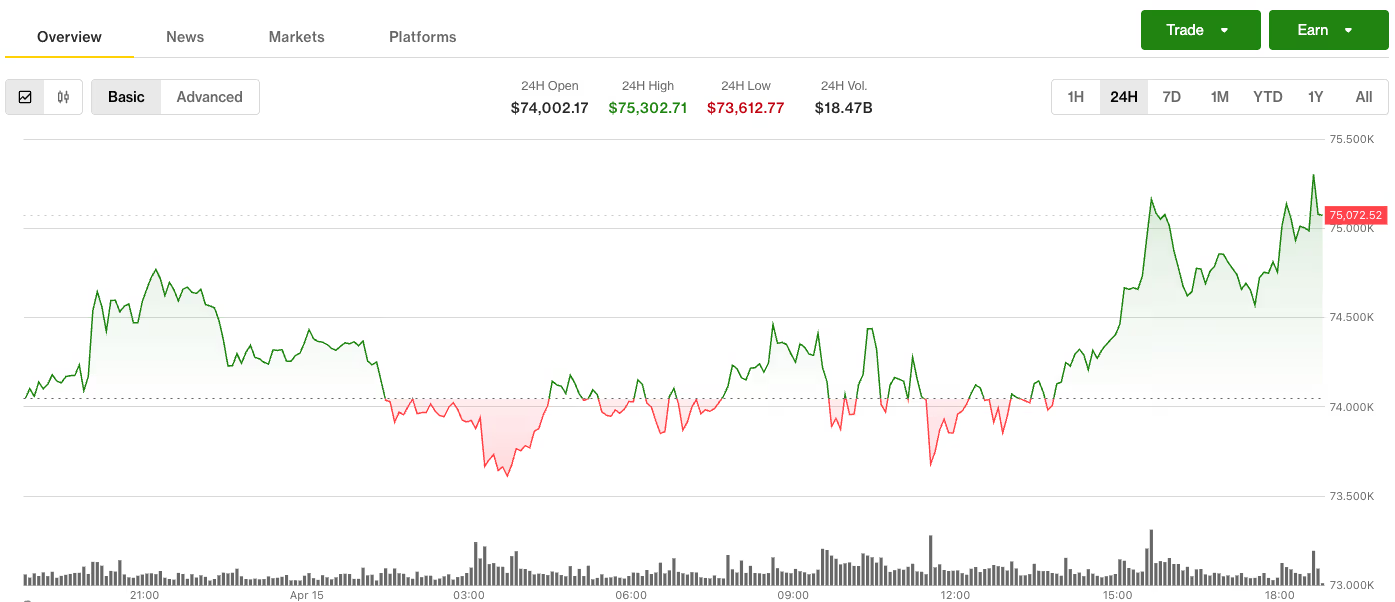
The tone in bitcoin has been more positive of late, but the rally from the February lows has been rather meek, with any attempts to return to $80,000 quickly getting shot down.
U.S. stocks, though, continue their remarkable run in the face of the Iran war, with the Nasdaq gaining 1.6% for its 11th consecutive daily advance and closing at a new record high above 24,000. The S&P 500 added 0.8% and also touched a new record above 7,000.
Bitcoin made another push to break above $75,000 on Wednesday, but the move stalled once again at a threshold that has repeatedly capped gains in recent months.

Trading recently around $75,134, bitcoin was higher by 1.45% over the past 24 hours, according to CoinDesk data.
Crypto-linked stocks moved higher alongside the broader risk-on tone. Coinbase (COIN) rose 6.2%, Robinhood (HOOD) jumped more than 10%, and bitcoin treasury firm Strategy (MSTR) gained 4.4%.
While equities have fully recovered and pushed into new highs, bitcoin is still playing catch-up after its sharp February drop to $60,000.
“Since yesterday we’ve rejected from the top end of this two-month range,” said Jasper de Maere, trader at Wintermute. “It feels like the flow picture, which looked encouraging yesterday, is already being questioned.”
For now, he pointed to $72,000 as the key level to watch. Holding above it would keep the breakout narrative intact, allowing for further attempts at the range highs.
A break lower, however, could see bitcoin slip back into consolidation as volatility compresses, he added.

Bitcoin’s rally above $76,000 cooled on Tuesday as short-term holders started taking profits at the strongest pace seen in 2026, even as longer-term investors continued to accumulate. The dynamic—profit-taking from new entrants meeting persistent demand from whales—could influence BTC’s ability to push into the $80,000 zone in the near term.
Data from on-chain trackers show a contrasting pair of behaviors: fresh buyers and short-term traders trimming gains versus entrenched holders quietly adding to their stacks. The tug-of-war helps explain why Bitcoin has paused near a key resistance level while still showing underlying bid support from larger investors.
Key takeaways
- Short-term holders booked profits: Bitcoin in profit moved to exchanges reached 63,000 BTC on April 14, the highest in 2026, compared with a 44,800 BTC spike on January 14.
- Fresh supply to exchanges and local profit-taking: The 1 day-to-1 week cohort transferred roughly 2,000 BTC back to Binance while BTC hovered near $76,000, suggesting coins are rotating into sell-side liquidity at a key resistance level.
- Early-stage cooling signal from buyers: Crypto analyst Amr Taha described the move as the first clear wave of profit-taking after the retest of monthly highs, signaling a natural cooling of upside momentum.
- Whales step in as buyers of last resort: Inflow of about 71,000 BTC into accumulation addresses represented the largest bullish influx since early 2022, as large holders absorbed available supply from short-term sellers.
- Liquidation landscape hints at a near-term dip before a potential rebound: The market’s liquidity map shows a cluster of long liquidations around $73,000 (about $1.4 billion) and $70,500 (around $3.5 billion in long positions at risk), while a move toward $80,000 could expose roughly $2 billion in leveraged short bets.
Profit-taking versus whale-driven demand
On-chain analysis indicates a sharp contrast between the actions of newer market entrants and those of veteran holders. The surge in BTC moved to exchanges by short-term holders—63,000 BTC in profit on April 14—marks the highest such metric in 2026, following a notable spike of 44,800 BTC on January 14. This activity aligns with a broader pattern: investors new to the market take profits near obvious resistance, a tactic that can temper momentum in bear-market cycles.
Separately, the 1-day-to-1-week cohort reallocated nearly 2,000 BTC back to Binance during the same window, suggesting freshly acquired coins are being used to provision sell-side liquidity as BTC trades around the $76,000 mark. Crypto analyst Amr Taha framed this as the first clear wave of profit-taking after the retest of monthly highs, a signal that momentum may be cooling rather than reversing decisively.
Against this backdrop, a markedly different flow emerged from the so-called smart money. A tweet from market watcher CW highlighted a single-day inflow of more than 71,000 BTC into accumulation addresses—the largest bullish influx in years. This pattern implies that large holders are absorbing supply from the sellers, potentially stabilizing price action while preserving upside potential for longer-horizon players.
Liquidity pockets and near-term price dynamics
The price action around the $76,000 area has been telling. After forming equal highs near that level, BTC faced a rejection at the 100-day exponential moving average, marking the first test of this resistance since mid-January. The immediate result was a pullback toward the mid-$70s, with prices dipping to around $73,500 in the near term.
Looking at the intraday liquidity landscape, buyers’ interest appears to accumulate around $73,000 and $72,000 on shorter timeframes. This could generate bid activity that would help sustain a trend continuation, should the market find fresh thrust from stronger hands.
Another lens on the risk surface comes from liquidation maps. The current heatmap shows roughly $1.4 billion in cumulative long liquidations concentrated near $73,000, and about $3.5 billion worth of long positions at risk near $70,500. On the flip side, an ascent toward $80,000 would expose around $2 billion in leveraged short positions. The spread between these long- and short-side risk zones suggests the market could retest the lower end of the range before attempting a meaningful move higher.
For context, investors should also note related coverage on the broader macro and product side of the Bitcoin market. A separate Cointelegraph report this week highlighted inflows into Bitcoin exchange-traded products as Goldman Sachs reportedly filed for a BTC ETF, signaling continued institutional interest and potential long-term demand drivers for the asset class. Bitcoin ETFs post $412M in inflows as Goldman Sachs files for BTC ETF.
As observers weigh these flows, the critical question remains: will long-term holders’ accumulating pressure sustain a phase of consolidation, or can the market muster enough demand to push through the next major hurdle around $80,000? The answer may hinge on how new buyers balance the temptation to realize gains against the willingness of whales to absorb supply and push price higher in a market still grappling with macro uncertainty and evolving regulatory signals.
In the near term, traders should keep a close watch on how the price behaves around the $72,000–$73,000 range, where bid interest and on-chain liquidity could set the tone for the next move. Eyes also stay on broader market catalysts, including ETF-related flows and any shifts in risk sentiment that could tilt the balance between profit-taking and accumulation.
Related: Bitcoin ETFs post $412M in inflows as Goldman Sachs files for BTC ETF.
Bitcoin’s current dynamics illustrate a market that’s no longer dominated solely by momentum players. A growing chorus of long-term holders and institutions suggests that even as spot prices wobble around resistance, the supply-demand balance may remain tight enough to underpin a continuation of the bull narrative—albeit with increased volatility and intermittent retracements as traders calibrate risk and realize gains.
TLDR
- World Liberty has proposed converting 62.3 billion WLFI governance tokens from indefinite lockups into fixed vesting schedules.
- Insiders who opt into the new terms must burn 4.5 billion WLFI, equal to 10% of their allocation.
- Founders and team members would face a two-year cliff followed by a three-year linear vesting period.
- Early supporters would follow a two-year cliff and a two-year linear vest without any token burn.
- The proposal requires a quorum of 1 billion WLFI and a simple majority within a seven-day vote.
World Liberty Financial (WLFI) has proposed a sweeping change to its token lockup structure while outlining insider burn terms. The Trump-backed decentralized finance project seeks to convert 62,282,252,205 governance tokens into fixed vesting schedules. The plan would impose new cliffs, introduce token burns for insiders, and require holder approval through a formal vote.
World Liberty Sets New Vesting Terms and Insider Burn Condition
World Liberty said it would apply a two-year cliff to all holders who opt into the proposal. Insiders must permanently destroy 4.5 billion WLFI, equal to 10% of their 45,238,585,647 token allocation, upon acceptance. The team stated that holders who decline the new terms will remain locked indefinitely under existing agreements.
Founders, team members, advisors, and partners would face a two-year cliff followed by a three-year linear vest. Tokens would begin unlocking after year two and reach full distribution by year five. The proposal requires a quorum of 1 billion WLFI tokens, a simple majority for passage, and a seven-day voting window.
Early supporters holding 17,043,666,558 WLFI would follow a separate schedule under the plan. They would face a two-year cliff and then a two-year linear vest, with full distribution by year four. The team confirmed that this category would not burn any tokens under the revised structure.
The project stated that it would open a 10-day acceptance window after deploying the new functionality. Participants must affirmatively opt in to activate the revised vesting schedule. Those who do not respond will remain subject to indefinite lockups.
Governance Proposal Follows Dispute and Ecosystem Updates
World Liberty launched WLFI in September 2025 and currently trades at $0.082. The price marks a 75.1% decline from its all-time high of $0.33, according to market data. The team linked the governance update to broader ecosystem expansion tied to USD1.
USD1 operates as a stablecoin deployed across multiple blockchain networks. The platform also supports lending and borrowing features within the WLFI interface. The team framed the vesting overhaul as part of this broader operational update.
The governance move follows a public dispute with Tron founder Justin Sun. Sun alleged that the WLFI smart contract includes an undisclosed blacklisting function. He said the function gives the team “unilateral power to freeze, restrict, and effectively confiscate the property rights of any token holder.”
Sun described himself as “the first and single largest victim” of the feature. He pointed to his wallet, which the project froze in September 2025 after he moved about $9 million in WLFI. In response, World Liberty accused Sun of “playing the victim while making baseless allegations to cover up his own misconduct,” and the team stated that it would address the matter in court.
US Treasury Secretary Scott Bessent marked Tax Day by praising the Working Families Tax Cuts, saying tens of millions of Americans now keep more of their paychecks. But for Bitcoin (BTC) users, the tax code tells a very different story.
Cato Institute research fellow Nicholas Anthony published a new analysis arguing that capital gains rules have made it nearly impossible to spend Bitcoin as money in the United States.
Bitcoin Spending Triggers a Paperwork Avalanche
Anthony explained that every purchase made with BTC requires users to record the acquisition date, the spending date, the original cost, and the gain or loss.
All of those details must land on IRS Form 8949 and Schedule D of Form 1040.
The result, he wrote, is staggering. A person who buys a cup of coffee every day with bitcoin could face more than 100 pages of filings by year-end. Form 8949 alone could run to roughly 70 pages for daily transactions.
“Capital gains tax rates are structured to incentivize long-term holding. This policy distorts the market by incentivizing buying and selling solely to mitigate tax losses. However, it’s especially distortionary in the context of money, given that long-term holding policies discourage what is generally considered ‘currency use,’” wrote Nicholas Anthony,
Congress Has Options, Anthony Says
Anthony outlined several potential fixes. The simplest would eliminate capital gains taxes entirely. A narrower approach would exempt cryptocurrency and foreign currency from capital gains treatment.
He also referenced the Virtual Currency Tax Fairness Act, which would create a de minimis exemption for gains under $200, though he argued the threshold should rise to match average household spending of $80,000.
Meanwhile, payment infrastructure is moving faster than the tax code. Square recently launched no-fee Bitcoin payments at merchant terminals, and self-hosted wallets from Bull Bitcoin, Zeus, and Trezor have simplified consumer spending.
The post Tax Day Relief Skips Bitcoin Users Buried in Capital Gains Paperwork appeared first on BeInCrypto.
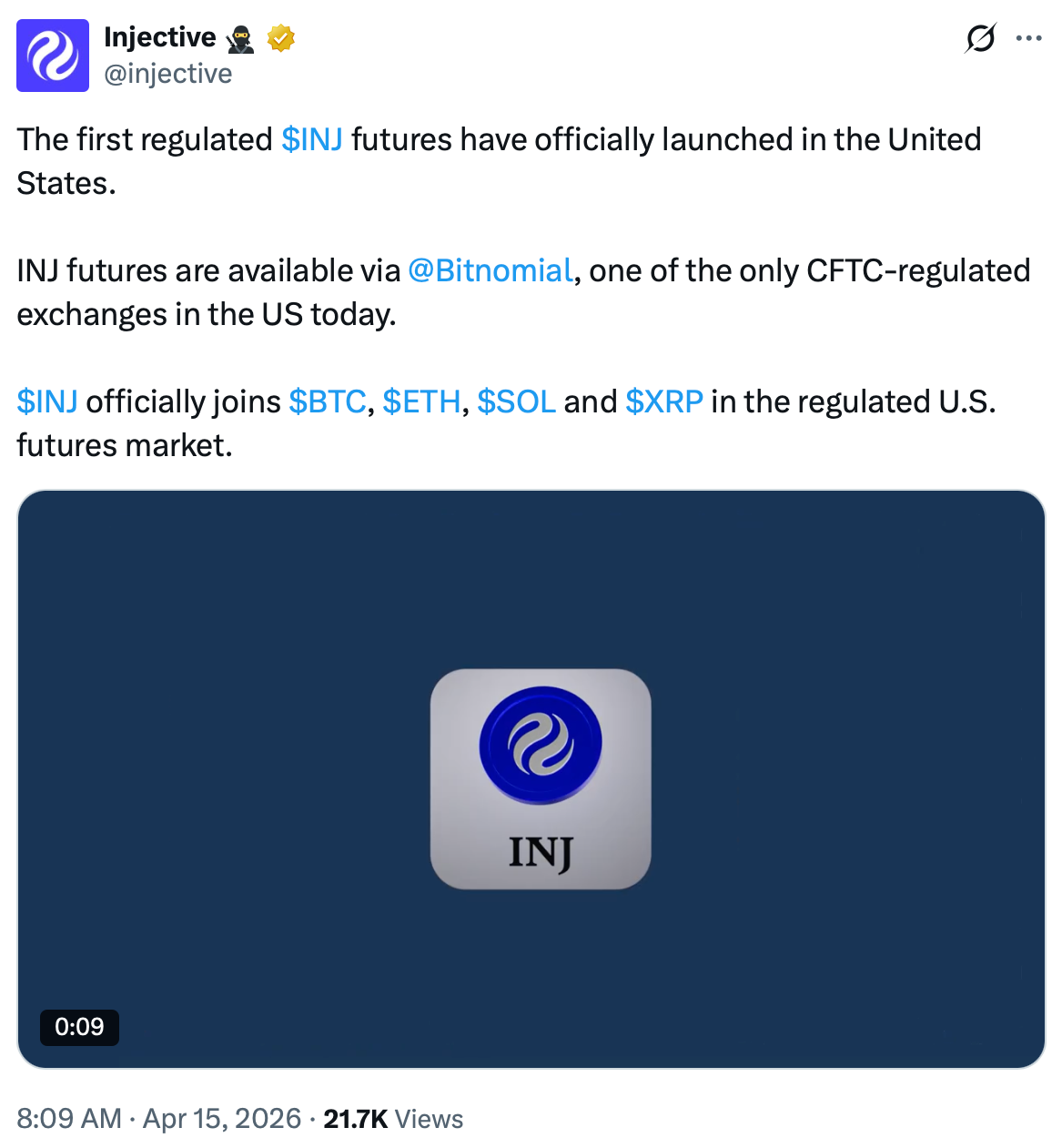
Chicago-based crypto exchange Bitnomial has launched monthly futures contracts tied to Injective, marking the first US-regulated derivatives product for the Web3 financial ecosystem’s native token.
According to Wednesday’s announcement shared with Cointelegraph, the contracts settle in INJ (INJ) with monthly expiries, allowing traders to gain price exposure without holding the underlying asset, and can be margined in crypto or US dollars through Bitnomial’s clearinghouse.
The listing also starts a six-month track record that could support a spot exchange-traded fund under US Securities and Exchange Commission (SEC) listing rules. In July, Canary Capital filed for a staked INJ ETF, with Cboe BZX Exchange submitting a corresponding rule change to the SEC.
Institutional clients can access the futures immediately, with retail trading expected to follow via Bitnomial’s Botanical platform in the coming weeks. The company said it also plans to add perpetual futures and options tied to INJ.

Injective runs on a Layer 1 blockchain built for financial applications, with an onchain order book and cross-chain connectivity to networks including Ethereum (ETH) and Solana (SOL).
Bitnomial is a derivatives exchange that operates a trading venue, clearinghouse and brokerage for crypto futures and options that is regulated by the Commodity Futures Trading Commission (CFTC). In January, the exchange launched monthly futures contracts tied to Aptos (APT) marking the first US-regulated derivatives product for the alt coin.
Related: Injective community passes governance vote to slash INJ token supply
Exchanges push to expand US crypto futures offerings
US-regulated crypto futures remain largely concentrated in major assets like Bitcoin (BTC) and Ether (ETH), with Bitnomial among the few venues listing derivatives tied to altcoins. Expanding those offerings has required navigating a shifting and often uncertain regulatory environment.
In August 2024, Bitnomial moved to list XRP (XRP) futures through CFTC self-certification, but the SEC challenged the plan, arguing the contracts could require securities exchange registration.
After filing a lawsuit in October 2025, Bitnomial dropped the case in March and later that month launched regulated XRP futures for US users, citing evolving SEC policy.
Other platforms have taken a more gradual approach. Coinbase launched CFTC-regulated futures tied to Bitcoin and Ether for institutional clients in June 2023, later expanding access with retail-sized contracts in May 2025 and introducing 24/7 trading to provide round-the-clock market access for US participants.
Also in May, Kraken acquired futures platform NinjaTrader for about $1.5 billion, gaining a CFTC-registered Futures Commission Merchant and expanding its reach into regulated derivatives markets.
Magazine: Should users be allowed to bet on war and death in prediction markets?


A public dispute between Tron founder Justin Sun and Trump-linked crypto project escalated Wednesday after Sun sharply criticized a new governance proposal, calling it “one of the most absurd governance scams” he has seen.
In a lengthy post on X, Sun accused the project of designing a vote that punishes dissent, with token holders who vote against the proposal risking having their tokens locked indefinitely.
He also claimed he and other large holders had been excluded from the process, alleging that tokens tied to roughly 4% of voting power under his control had been frozen.
More broadly, Sun questioned whether the vote has any real authority, claiming control over the protocol sits with anonymous wallet addresses, including a multisignature setup that can override outcomes and a separate account with the power to blacklist users.
“This proposal is not governance,” Sun said in the post. “It is an exercise of power by the selected few who are carefully engineering a further power consolidation and property expropriation operation.”
WLFI proposal
The criticism centers on WLFI’s new proposal that would overhaul token lockups across the ecosystem. More than 62 billion WLFI tokens would be subject to new terms, including multi-year lockups and vesting schedules.
Under the plan, tokens held by insiders — such as team members, advisors and partners — would face a two-year lockup followed by a three-year gradual release, alongside a 10% token burn upon opting in. Early supporters would face slightly shorter vesting terms but no burn. In total, up to 4.5 billion tokens could be permanently destroyed.
Holders who do not accept the new terms would remain locked indefinitely, per the proposal.
Sun was not alone in pushing back. Simon Dedic, founder of Moonrock Capital, said early investors had effectively been “rugged.”
“All the $WLFI early investors who thought they were sitting on solid profits just got rugged, by the Trump family themselves,” Dedic wrote on X, adding that the move appeared to give the project another chance to extract value from investors. He also criticized what he described as “blatant misconduct” with little effort to conceal it.
A World Liberty Financial spokesperson told CoinDesk that the proposal “was designed to further align all the participants in the WLFI ecosystem for the long-run,” adding that it aims to “optimally ensure long-term participation in our ecosystem and help ensure healthy market supply.”
Escalating feud
The backlash marks the latest episode in the breakdown in relations between Sun and the project.
Earlier this week, WLFI threatened legal action, saying it had “contracts” and “evidence” after Sun accused the team of exploiting users through DeFi transactions.
The dispute has been building for months. In September, WLFI blacklisted a blockchain address linked to Sun that held about $107 million worth of its governance tokens at the time. That marks a sharp reversal from late 2024, when Sun was a key backer, investing $30 million in WLFI tokens and taking on an advisory role to help support the project.
Tensions intensified after WLFI deposited 5 billion of its own tokens into lending protocol Dolomite — where one of its advisers is a co-founder — and borrowed roughly $75 million in stablecoins. The tokens fell 12% to a record low the next day, after which Sun publicly accused the project of treating users as “personal ATMs,” triggering the latest legal threats.
TLDR
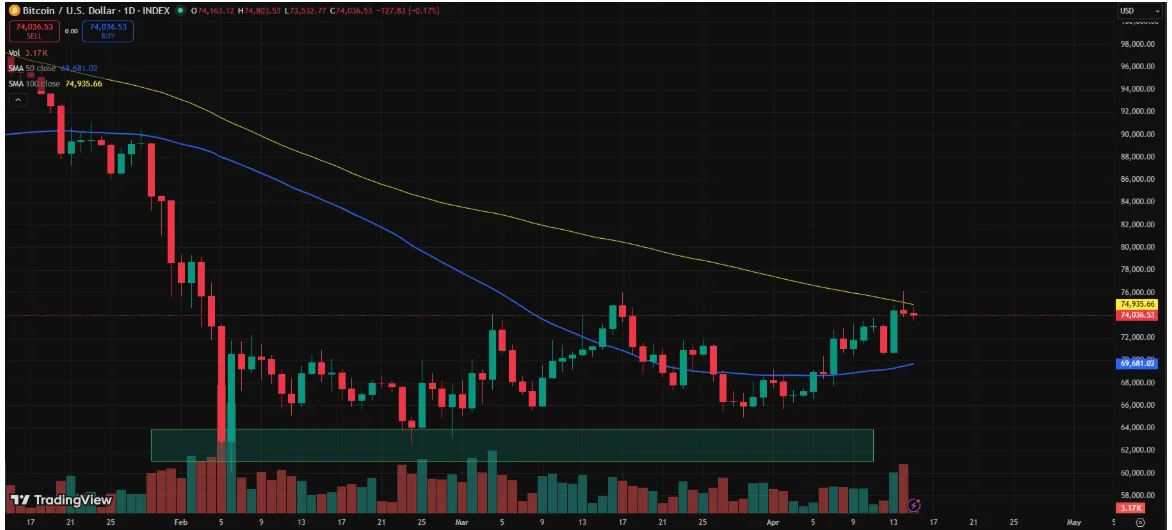
- Bitcoin climbed to $76,100 but failed to close above the $75,000 resistance level.
- The asset ended the session at $74,164 after sellers defended the key supply zone.
- Bitcoin rebounded 15.8% from $65,692 earlier this month before pulling back.
- The $72,000 level continues to act as short-term support for the current range.
- The 50-day moving average at $69,680 could provide support if the price declines.
Bitcoin price faced renewed selling pressure near $75,000 after another failed breakout attempt. The asset reached $76,100 on Tuesday but closed below resistance. Despite the pullback, technical indicators still show room for further upside.
Bitcoin Price Tests $75,000 Resistance Again
Bitcoin (BTC) climbed to $76,100 on Tuesday, marking its highest level since early February. However, sellers pushed the price down before the daily close. The asset ended the session at $74,164 after failing to hold above $75,000.
Earlier this month, Bitcoin rebounded from $65,692 and gained 15.8% to reach the recent peak. It has since retained about 8.45% of that advance. On March 17, Bitcoin also touched $76,000 but fell back to $73,920 after facing strong supply.
The repeated rejection at $75,000 confirms the level as firm resistance. Sellers continue to defend the zone, which limits upward movement. Bitcoin trades at $74,036 at the time of writing.
The price also encountered the 100-day simple moving average near the resistance zone. This moving average stands at $94,935 and adds technical pressure. As a result, bulls failed to secure a daily close above the barrier.
Failure to break resistance increases the risk of a decline toward $68,000 and $65,000. The 50-day moving average at $69,680 could provide support if the price drops. Market structure remains dependent on holding key levels.
Bitcoin Price Holds $72,000 Support as Indicators Stay Positive
Bitcoin price continues to hold the $72,000 micro support level identified by analyst Michael van de Poppe. He stated, “Holding $72,000 opens the path toward a new breakout.” The level now acts as a short-term foundation.
Van de Poppe projected a move toward $80,000 to $85,000 if Bitcoin closes above $75,000 with strong volume. He said the move could occur before the end of April. Such a rally would return Bitcoin to levels last seen in late January.
The daily Relative Strength Index stands at 60.74, which signals room before overbought conditions above 75. The reading reflects steady momentum without extreme conditions. Buyers still maintain control under current levels.
The Moving Average Convergence Divergence also supports bullish momentum. The MACD line reads 1,201.91 and remains above the signal line at 590.84. Green histogram bars continue to expand on the daily chart.
Bitcoin must secure a decisive close above $75,000 to confirm renewed upward momentum. Until then, the price remains within a defined range. Current data shows Bitcoin trading at $74,036.


Bitcoin stalls near $75,000 on Gate as traders test a familiar resistance band after bouncing from $68,000 support that has repeatedly defined this cycle’s downside line.
Summary
- Bitcoin trades at $75,000 on Gate with 1.19% daily gain.
- Move comes after weeks of choppy range between $68,000 and $75,000.
- Traders watch if BTC can finally clear the $75,000 ceiling.
Bitcoin (BTC) surged to $75,000 on Gate’s BTC/USDT market on April 15, marking another test of the level that has capped every major rally this year.
According to Gate market data, BTC/USDT is currently quoted at $75,000 with a 24‑hour increase of 1.19%, after touching an intraday high near $74,949 and a low around $73,510.
The latest push higher extends a rebound that began when Bitcoin bounced from roughly $68,000 support, a range that crypto.news recently described as “the last line of defense” before deeper downside.
In a recent crypto.news story, Bitcoin was trading near $74,400 after a more than 5% intraday jump, with the outlet flagging $75,000 to $76,100 as the “next meaningful resistance” tied to February’s pre‑war swing high.
That zone has repeatedly rejected upside attempts; earlier coverage noted that $73,000 to $75,000 has “capped every rally” since the US‑Iran ceasefire, forcing altcoins like ETH, SOL and DOGE to lag whenever BTC stalls below a clean breakout.
RootData, citing Gate’s order book, similarly reported that “BTC/USDT is currently reported at $75,008.8, with a 24‑hour increase of 5.65%,” underscoring how quickly momentum can accelerate once Bitcoin approaches this band.
The latest move unfolds against a backdrop of strong spot and derivatives flows, with prior crypto.news analysis highlighting that ETF inflows, whale accumulation and short liquidations have repeatedly driven spikes as Bitcoin reclaims key psychological levels such as $70,000 and $75,000.
While the current gain of 1.19% on Gate is modest compared with earlier 5% surges, traders are watching whether sustained closes above $75,000 can finally confirm a technical breakout and reopen the path toward Bitcoin’s all‑time high near $125,600 set in late 2025.
For broader context, previous reporting on Bitcoin’s sharp drop below $75,000 during April 2025 circuit‑breaker events showed how quickly the level can flip from support to resistance when macro risk and leverage unwind collide, a dynamic still in the back of traders’ minds as BTC revisits the mark today.
Relevant crypto.news articles referenced in the piece include this story on Bitcoin’s $68,000 support and $75,000 ceiling, this analysis of BTC’s four‑week high near $74,400, and this breakdown of how $73,000 and $75,000 have repeatedly capped altcoin recoveries.
TLDR
- Michael Saylor signaled a renewed plan to reach 1,000,000 Bitcoin through continued STRC issuance.
- Strategy may have surpassed 800,000 Bitcoin in total corporate reserves.
- The company raised funds this week to acquire 17,284.73 Bitcoin through STRC.
- Strategy continues to purchase an average of 9,000 Bitcoin per working week.
- The firm needs to increase its holdings by about 20% to reach 1,000,000 Bitcoin.
Michael Saylor signaled a renewed accumulation plan as Strategy approaches 1,000,000 BTC on its balance sheet. He posted an image with the caption, “Millions of Possibilities, One Solution,” which referenced STRC preferred shares. Meanwhile, the company continues raising capital and converting proceeds into Bitcoin purchases at a steady pace.
STRC Mechanism Drives Capital Toward Bitcoin Accumulation
Saylor shared a photo holding an orange Rubik’s Cube and wrote, “Millions of Possibilities, One Solution.” He linked the message to STRC, which Strategy uses to fund Bitcoin acquisitions. The post appeared as issuance levels for STRC preferred shares reached record highs.
According to the company’s weekly report starting April 13, STRC keeps channeling market liquidity into Bitcoin purchases. Data from strc.live shows Strategy raised funds this week to acquire 17,284.73 BTC. The firm continues executing purchases as capital becomes available.
STRC enables Strategy to buy Bitcoin by leveraging the spread between its cost of capital and the asset’s yield. Shares currently trade at parity near $100, which supports issuance efficiency. As a result, the company maintains steady access to funding under present market conditions.
Path to 1,000,000 BTC and Current Reserve Status
Strategy’s Bitcoin reserves may have surpassed 800,000 BTC based on recent disclosures. To reach 1,000,000 BTC, the company needs to increase holdings by about 20%. The firm continues accumulating coins through weekly purchases funded by STRC.
At the current rate of roughly 9,000 BTC per working week, Strategy could reach its target within 24 weeks. That timeline points to completion by the end of 2026 if the pace remains unchanged. The company maintains a structured acquisition schedule tied to capital inflows.
Strategy’s Bitcoin holdings now carry a market value of more than $57.7 billion. The company reports it has reached breakeven on its aggregate position at current prices. It continues publishing updates that detail both issuance activity and Bitcoin purchases.
STRC issuance volume remains active as shares trade close to their $100 reference value. This pricing level supports continued capital raises without discount pressure. The company therefore, sustains its funding approach while expanding its Bitcoin reserves.

Unimaginative Arsenal scrape into ‘historic’ consecutive Champions League semis
BlackRock Reports $935M Crypto Inflows, $18.7B AUM Fall

Hailey Bieber Roasted Over ‘Weird’ ‘Toilet’ YSL Campaign Pose

Why Israel is blocking foreign journalists from entering

Bitcoin: We’re Entering The Most Dangerous Phase

Alan Cumming Brands Baftas Ceremony A ‘Triggering S**tshow’
![Ripple Executives Are Aware XRP Will Be Valuable... But They LEGALLY Can't Say Anything! [MUST SEE]](https://wordupnews.com/wp-content/uploads/2026/04/1776291322_maxresdefault-80x80.jpg)
Ripple Executives Are Aware XRP Will Be Valuable… But They LEGALLY Can’t Say Anything! [MUST SEE]

HDB Financial Services Q4 results 2026 | HDB Financial results today | HDB Financial Services Share

Why Bitcoin’s Supply Shock is ALREADY Here
-

 Politics5 days ago
US brings back mandatory military draft registration
-
 Sports5 days ago
Man United discover Nico Schlotterbeck transfer fee as defender reaches Dortmund agreement
-

 Fashion5 days ago
Weekend Open Thread: Veronica Beard
-

 Politics6 days ago
Malcolm In The Middle OG Turned Down ‘Buckets Of Money’ To Appear In Reboot
-

 Politics3 days ago
World Cup exit makes Italy enter crisis mode
-

 Crypto World6 days ago
Canary Capital Files SEC Registration for PEPE ETF
-

 Business5 days ago
Tesla Model Y Tops China Auto Sales in March 2026 With 39,827 Registrations, Beating Cheaper EVs and Gas Cars
-

 Crypto World2 days ago
The SEC Conditionalises DeFi Platforms to Be Avoided for Broker Registration
-

 Crypto World2 days ago
SEC Signals Exemption for Crypto Interfaces From Broker Registration
-

 News Videos15 hours ago
Secure crypto trading starts with an FIU-registered
-
 NewsBeat3 days ago
Pep Guardiola and Gary Neville agree over Arsenal title problem that benefits Man City
-

 Business5 days ago
OpenAI Halts Stargate UK Data Centre Project Over Energy Costs and Copyright Row
-

 Business4 days ago
Ireland Fuel Protests Enter Day 5 as Blockades Spark Shortages and Government Prepares Support Package
-

 Politics6 days ago
LBC Presenter Mocks Trump Over Iran War Failures
-

 Crypto World5 days ago
Federal judge blocks Arizona from bringing criminal charges against Kalshi
-
 NewsBeat4 days ago
JD Vance announces ‘no agreement’ with Iran over nuclear weapons fear
-

 NewsBeat2 days ago
Trump and Pope Leo: Behind their disagreement over Iran war
-

 Crypto World2 days ago
SEC Proposes Certain Crypto Interfaces Don’t Need to Register as Brokers
-

 Tech6 days ago
A version of Windows 10 released a decade ago is now eligible for additional security patches
-

 Business5 days ago
IMF retains floor for precautionary balances at SDR 20 billion
You must be logged in to post a comment Login