

Crypto World
Lucid (LCID) Stock Q1 2026 Earnings Preview: What Wall Street Forecasts Ahead of Tuesday’s Report


Key Takeaways
- Lucid’s Q1 fiscal 2026 earnings arrive May 5, with options markets anticipating a potential 13.30% price swing following the release.
- Analyst consensus calls for approximately $370 million in revenue—a 57% annual increase—alongside an anticipated $2.35 per-share loss.
- Uber has increased its stake to 11.52% and expanded its vehicle commitment to a minimum of 35,000 units for robotaxi deployment.
- Gravity SUV deliveries were halted for 29 days in Q1 due to supply chain complications—investors await recovery details.
- LCID shares have declined 38% year-to-date, with analyst ratings averaging Hold and a mean price target of $13.13.
Lucid Group is scheduled to release its first-quarter fiscal 2026 financial results on Tuesday, May 5. Shares have struggled considerably this year, falling 38% as the electric vehicle manufacturer heads into the report. Options activity suggests heightened volatility expectations, with the market pricing in a potential 13.30% move in either direction—significantly above Lucid’s typical 5.24% post-earnings swing observed over the previous four quarters.
Trading near $6.53, the stock sits well below Wall Street’s consensus price target of $13.13, which implies more than 100% potential upside. However, the gap between analyst projections and actual share performance has persisted.
For the first quarter, analysts project revenue of $369.99 million—marking a 57% year-over-year increase. This would also represent an acceleration from the 36.1% growth rate Lucid delivered in the prior-year first quarter. On profitability, the Street expects a $2.35 loss per share, modestly better than the $2.40 loss reported in Q1 2025.
Lucid’s track record includes six earnings misses in the last nine quarters and multiple revenue shortfalls over the past two years. While expectations are calibrated accordingly, investor confidence remains fragile.
Supply Chain Disruption Impacts Gravity Deliveries
A critical storyline entering this earnings call centers on the Gravity SUV. The model experienced a 29-day delivery suspension during the quarter stemming from a supplier-related problem. While production continued, customer deliveries were paused. Investors will be eager to understand whether the issue has been fully resolved and if it jeopardizes Lucid’s full-year production guidance of 25,000 to 27,000 vehicles.
The company’s previous quarterly results showed revenue of $522.7 million, up 123% year-over-year. However, the report also featured misses on adjusted operating income and EBITDA, keeping analyst sentiment tempered.
The broader automotive manufacturing sector has outperformed recently, with stocks in the category gaining 9.4% on average over the past month. In contrast, Lucid has dropped 30% during the same timeframe.
Uber Partnership Expansion Takes Center Stage
Perhaps the most significant catalyst heading into earnings is Lucid’s deepening collaboration with Uber. In April, Uber injected an additional $200 million into Lucid, bringing its total investment to $500 million. The rideshare giant also expanded its vehicle order to at least 35,000 units, intended for deployment in a global autonomous taxi fleet.
Regulatory disclosures reveal that Uber now controls an 11.52% passive ownership position in Lucid, making it the second-largest shareholder after Saudi Arabia’s Public Investment Fund.
Investors will be looking for specific guidance on deployment timelines and when Lucid vehicles will begin entering Uber’s robotaxi operations.
RBC Capital analyst Tom Narayan recently reduced his price target on LCID from $10 to $8 while maintaining a Sector Perform rating. The adjustment reflects broader macroeconomic headwinds affecting the auto sector, including geopolitical tensions in the Middle East.
Among the 10 Wall Street analysts tracking Lucid, the consensus rating is Hold—comprised of seven Hold ratings, two Sell ratings, and one Buy rating, all issued within the past three months.




Crypto is losing its momentum-trade status as investors turn toward AI stocks, according to Bitwise chief investment officer Matt Hougan.
Summary
- Bitwise says crypto is shifting from momentum trading to contrarian investing as AI stocks dominate flows.
- Matt Hougan says investors still believe in crypto but now favor fundamentals over market hype.
- Bitcoin remains pressured by ETF outflows, equity rotation and weak market sentiment.
Hougan said the crypto market is under pressure because investors now have several fast-moving alternatives. In a June 2 market note, he pointed to AI stocks, robotics firms and SpaceX as assets drawing market attention away from digital assets.
“The crypto market is brutal right now,” Hougan wrote. He added that crypto is moving “from momentum trade to contrarian bet” as AI takes more investor attention.
The shift comes after AI-linked stocks gained strong demand following the public launch of ChatGPT in late 2022. Nvidia, a key AI chipmaker, has seen its shares rise sharply since then, making AI one of the main stories in public markets.
Hougan said this change does not mean crypto is disappearing. Instead, he said it changes the type of investor and project that the market rewards.
Fundamentals Replace Market Hype
Hougan said contrarian bets need patience and a focus on fundamentals. He said investors who still believe in crypto now look for clear revenue, strong use cases and projects with working business models.
“Investors still believe in crypto, but now that it’s a contrarian bet, they favor fundamentals over vibes,” Hougan wrote.
He said this explains why some smaller tokens have performed better than major assets. Hyperliquid, BNB, Zcash and Stellar posted gains in May, while Bitcoin, Ethereum and Solana remained under pressure.
According to Hougan, that rotation shows that the market is no longer rewarding broad crypto exposure in the same way. It is now rewarding assets with clearer stories and stronger data.
Bitcoin weakness reflects broader market rotation
As previously reported by crypto.news, Binance Research also linked Bitcoin’s recent weakness to capital moving into U.S. equities. The firm said AI, defense and energy stocks have pulled flows away from Bitcoin during the current quarter.
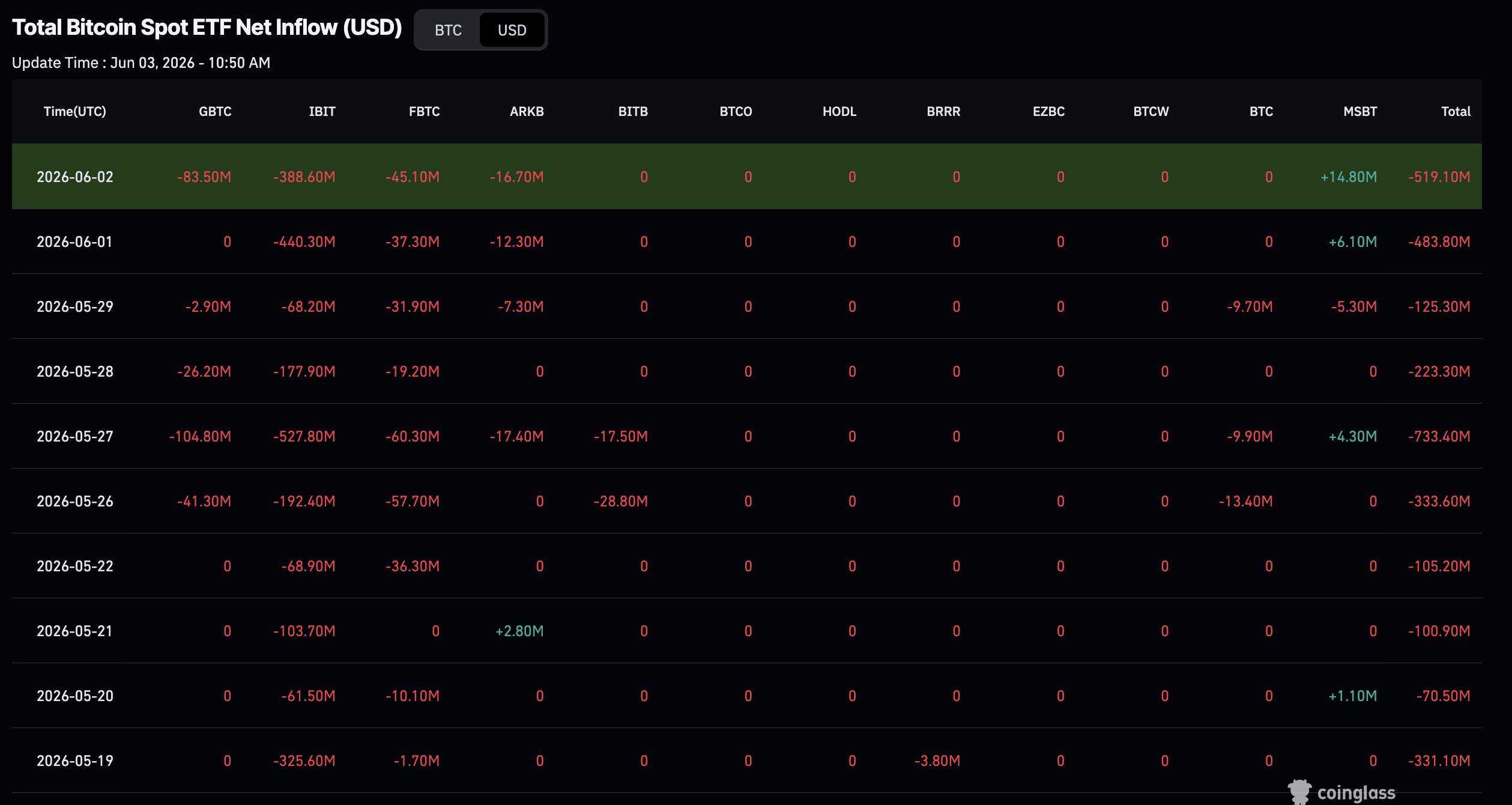
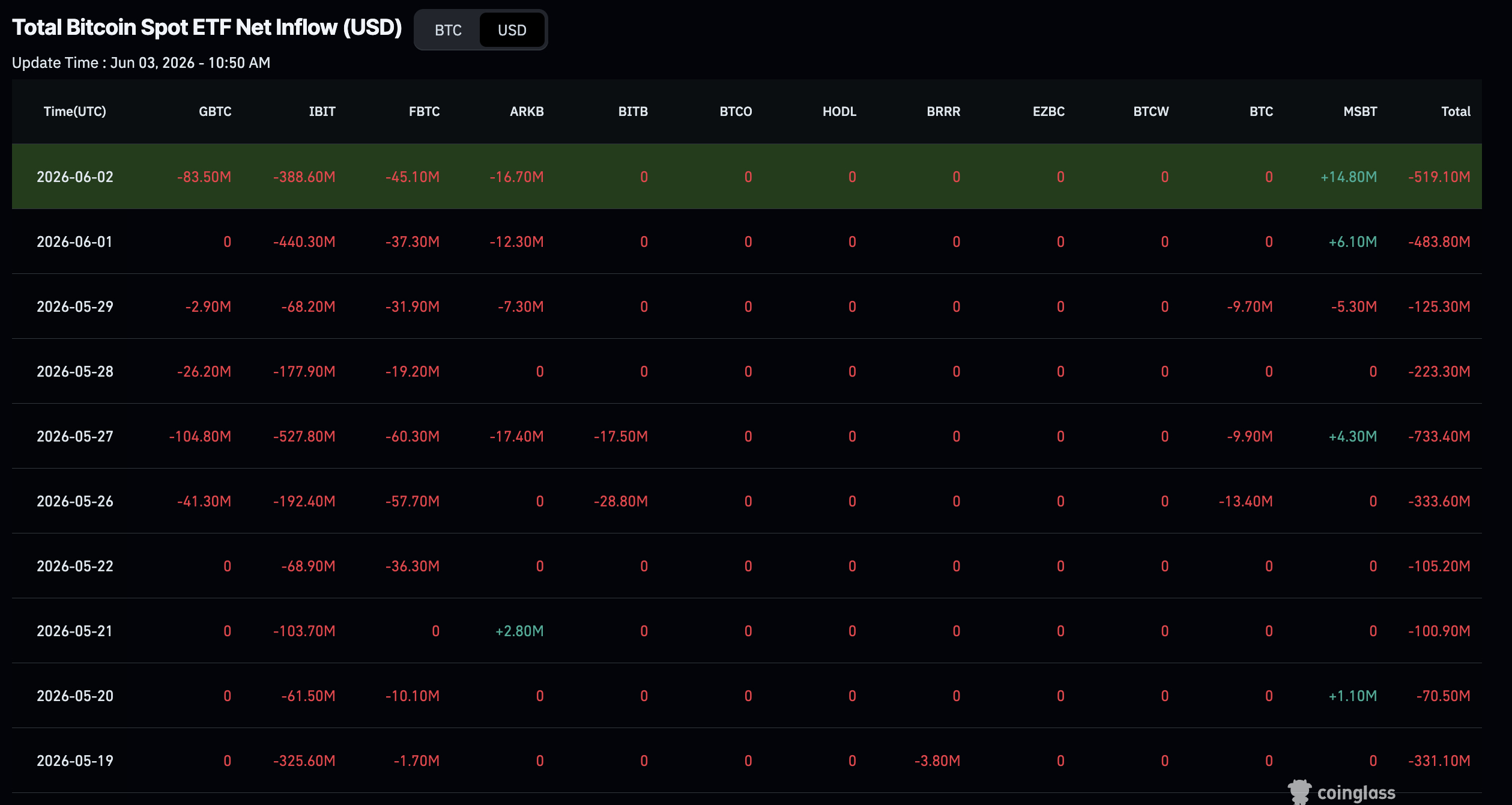
Bitcoin also fell below $70,000 after U.S. spot Bitcoin ETFs recorded $483 million in daily net outflows. Those withdrawals extended an 11-session outflow streak that topped $3.4 billion.
Crypto.news also reported that Mt. Gox-linked wallets moved 10,306 BTC worth about $739 million. No direct sale was confirmed, but the transfer added new concern about possible supply entering the market.
The market remains weak, but Hougan said green pockets in smaller assets may show that crypto is closer to the end of the downturn than the start. He said the next phase will likely depend on fundamentals, regulation and whether investors return after the AI trade cools.
Crypto World
Crypto News, June 3: BTC USD Evil Number at $66K, Peter Schiff Calls for $20K, Geopolitical Fear Porn Everywhere
The crypto market is getting hammered, BTC USD slips to the devilishly symbolic $66,000 level following fresh geopolitical turmoil in the Middle East. Right on cue, Peter Schiff has returned to tell everyone Bitcoin is doomed. Some things never change.
The latest selloff comes as US spot Bitcoin ETFs continue bleeding capital. Funds have recorded $1.67 billion in weekly outflows, with recent totals exceeding $4 billion over the past few weeks.
That’s becoming one of the biggest obstacles for BTC right now. Institutions appear to be rotating into AI stocks, defense names, energy plays, or simply parking cash in high-yield Treasuries while market uncertainty grows. Buffett himself said that he is sitting on a pile of cash, as markets are getting way closer to a casino environment.
Still, Bitcoin has visited the $66K region several times this year. Each previous test attracted buyers and was followed by a rebound toward $70,000 and beyond.

Discover: The best crypto to diversify your portfolio with
Iran Escalation Sends BTC USD to $66K, Peter Schiff A Happy Man
The decline accelerated after Iran reportedly launched missiles and drones toward targets in Kuwait and Bahrain, damaging infrastructure and disrupting flights. US Central Command intercepted part of the attack as tensions with Washington rose following the collapse of recent peace discussions.
Markets reacted exactly as expected. Oil moved higher, investors sought safety, and risk assets found themselves first in line for selling pressure.
Peter Schiff, Bitcoin’s longest-running critic, wasted little time making fresh bearish predictions. According to Schiff, a breakdown of major support could eventually send BTC below $50,000 and even under $20,000.
His warnings generate headlines every cycle, though critics point out he’s been calling for Bitcoin’s collapse for well over a decade while the asset has repeatedly recovered from far worse drawdowns.
In Contrast, Coinbase CEO Brian Armstrong has reportedly described the current selloff as temporary, maintaining his long-term bullish view that Bitcoin could eventually reach seven figures.
— Bitcoin professor (@Bitcoinprof0637) June 2, 2026
 BREAKING: Coinbase CEO Brian Armstrong says people without at least 5% exposure to Bitcoin could “regret it” by the end of the decade.
He believes $BTC could reach $1,000,000 by 2030 as institutional adoption, ETFs, and global demand continue accelerating.
The biggest risk… pic.twitter.com/kbN0uFyNDM
Discover: The best crypto to diversify your portfolio with
Trump, Iran, and Market Uncertainty
Geopolitical tensions remain the dominant story. President Trump dismissed reports claiming the US and Iran have stopped communicating, calling them “fake news.”
Although the peace agreement that emerges remains unclear. If tensions continue to escalate, crypto could face additional volatility alongside equities and other risk assets. Even with stocks doing great, breaching all-time high after all-time high.
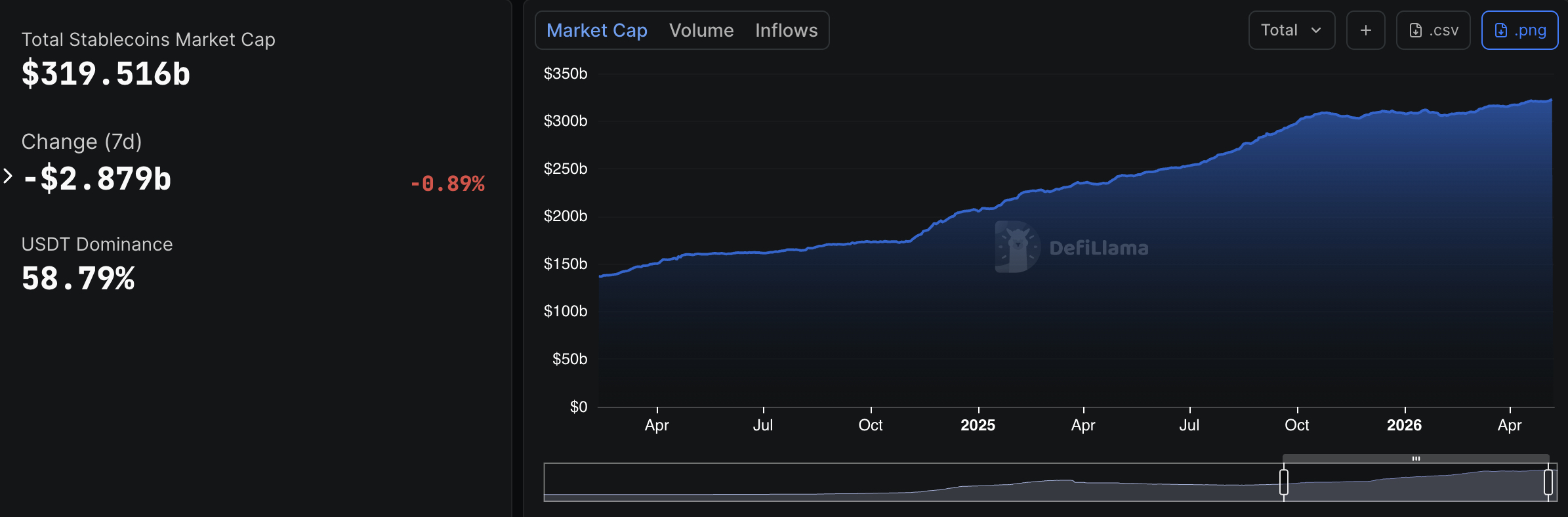
One noticeable trend during the latest panic has been increased demand for stablecoins and digital dollars as crypto holders seek shelter without fully leaving the crypto ecosystem.
In reality, Bitcoin at $66K feels ugly. The markets are reminding everyone they’re markets.
ETF outflows, geopolitical risk, and recession fears are creating a difficult setup at the moment. But Bitcoin has survived wars, banking crises, exchange collapses, pandemics, and countless eulogies written by its critics.
The near-term outlook remains volatile, but Bitcoin continues attracting adoption faster than fear drives investors away. I’m bullish.
Discover: The best pre-launch token sales
The post Crypto News, June 3: BTC USD Evil Number at $66K, Peter Schiff Calls for $20K, Geopolitical Fear Porn Everywhere appeared first on Cryptonews.
Crypto World
Meta (META) Stock Falls After EU Court Confirms Messenger Must Comply with Gatekeeper Rules

Key Points
- Luxembourg’s General Court dismissed Meta’s appeal against the gatekeeper classification for its Messenger platform
- Judges determined Messenger functions as a critical access point for businesses seeking to connect with consumers under Digital Markets Act regulations
- In a partial victory for Meta, the court struck down the gatekeeper designation previously applied to Marketplace
- The company indicated it is “reviewing” the decision on Messenger and will “consider its options,” leaving room for further appeals
- META shares declined 0.47% following the announcement
Meta Platforms (META) experienced a modest decline of 0.47% on Wednesday following an unfavorable court decision in Europe concerning its Messenger application.
The General Court in Luxembourg determined that the European Commission acted appropriately when designating Messenger as a “gatekeeper” under the European Union’s Digital Markets Act (DMA). This regulatory framework, which took effect in 2023, establishes boundaries for major technology platforms’ operations.
According to the court’s assessment, “the Commission did not err in finding that Messenger individually is an important gateway” for commercial entities attempting to access end users.
Receiving gatekeeper status means accepting specific regulatory requirements. Meta contested this classification through legal channels, arguing the designation was unwarranted.
Wednesday’s ruling rejected that challenge, specifically regarding Messenger.
However, the decision wasn’t entirely unfavorable to Meta. In a separate component of the case, judges sided with Meta, removing the gatekeeper classification from the company’s Marketplace feature. The court determined the Commission hadn’t sufficiently justified that particular designation.
In reality, the Marketplace decision has minimal impact. The Commission had already withdrawn that label previously when Marketplace dropped beneath mandatory user thresholds.
Implications of the Court Decision for Meta
Meta recognized the divided outcome. “We welcome the Court’s judgment on Marketplace, which confirms that it should not have been designated in the first place,” a company representative stated.
Regarding Messenger, Meta adopted a more measured tone. “We are reviewing the Court’s finding on Messenger and will consider our options,” the representative continued.
Available options include escalating the matter to the Court of Justice of the European Union, the continent’s supreme judicial authority.
The official case designation is T-1078/23 Meta Platforms v Commission.
The DMA aims to create equitable conditions between dominant technology platforms and emerging competitors. Entities classified as gatekeepers must adhere to prescribed regulations covering interoperability standards, information accessibility, and equitable treatment of competing services.
Understanding the Digital Markets Act
The DMA entered into force in 2023, focusing on organizations the EU identifies as possessing substantial market influence. Gatekeeper classification applies when a platform represents a vital connection point between commercial entities and consumers.
Following gatekeeper designation, organizations must fulfill requirements including enabling third-party integration and avoiding preferential treatment of proprietary services in search rankings.
Meta isn’t alone in facing DMA oversight. Apple, Alphabet, and additional technology giants have received gatekeeper classifications under these regulations.
The Messenger decision strengthens the EU’s argument that the messaging service occupies a pivotal position in business-to-consumer communication across Meta’s ecosystem.
Meta stock closed down 0.47% on the day the ruling was announced.
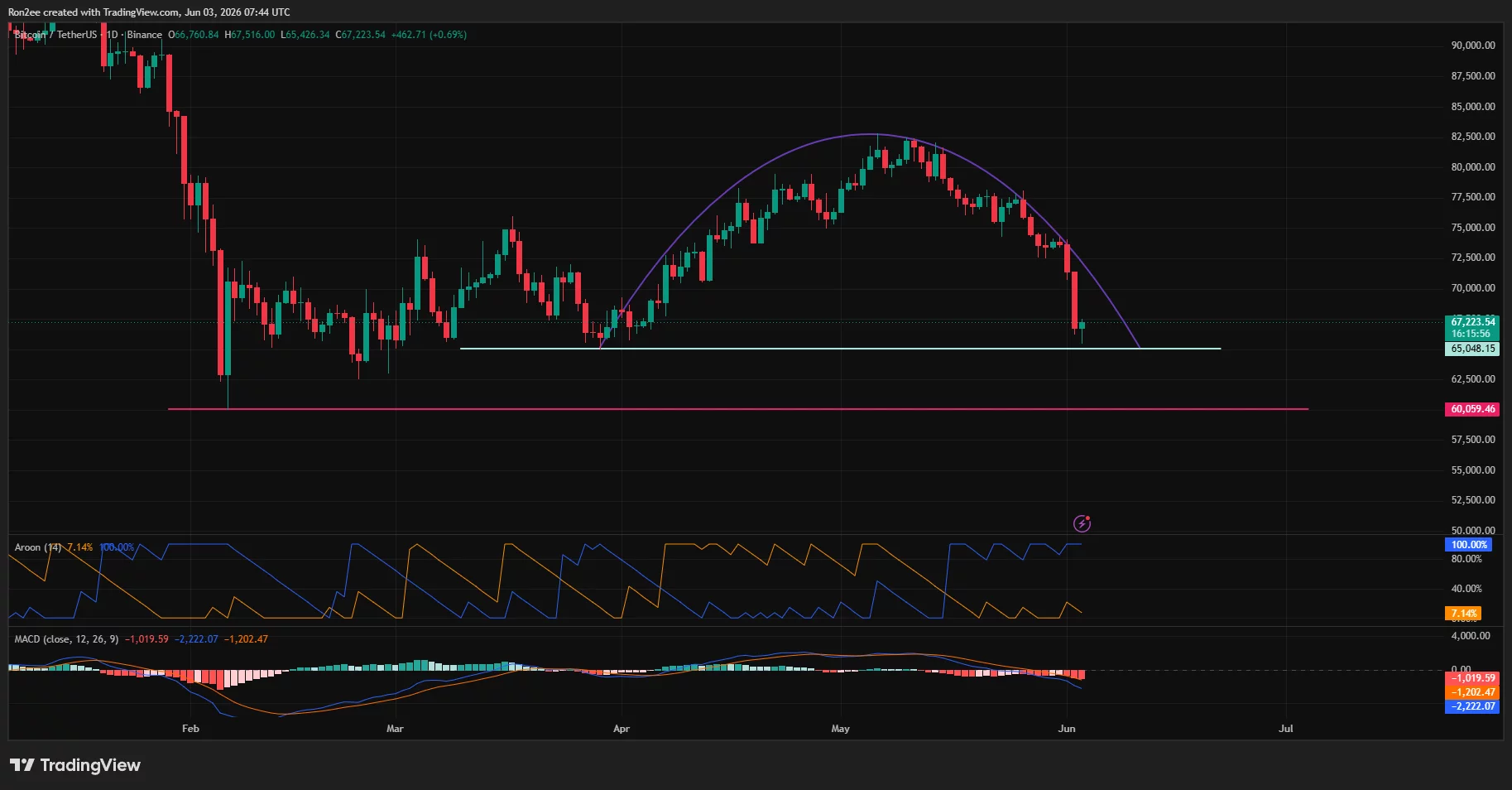
Bitcoin price is testing the key $65,000 support zone after Iran’s retaliatory strikes against the U.S. spooked investors, with charts suggesting a deeper slide toward $60,000 if bears remain in control.
Summary
- Bitcoin price fell 4.5% to an intraday low of $65,700 as Iran’s retaliatory strikes against the U.S. intensified risk-off sentiment across crypto markets.
- U.S. spot Bitcoin ETFs recorded $519 million in outflows, extending the streak to 12 straight trading days.
- Bitcoin is nearing completion of a bearish rounding top pattern, with analysts warning that a break below $65,000 could expose the $60,000 demand zone.
According to data from crypto.news, Bitcoin (BTC) fell 4.5% to an intraday low of $65,700 on Wednesday, June 3, before recovering to trade near $67,100 at press time. The decline extended losses that began after BTC previously broke below the key $72,000 and $68,000 support levels, bringing the cryptocurrency close to its lowest price since February.
Bitcoin price faced pressure on Wednesday after reports said Iran launched missiles at the U.S. Fifth Fleet headquarters in Bahrain following U.S. strikes. The escalation added fresh risk-off pressure across crypto markets as investors moved toward defensive assets, including gold and silver.
U.S. spot Bitcoin ETFs added to the selling pressure after recording $519 million in net outflows on Tuesday, per data from SoSoValue. The withdrawal extended the outflow streak to 12 straight trading days, the longest such run since the fund’s launch, showing that institutional demand has weakened during the latest downturn.
Strategy’s disclosure also remained a concern for traders. The company said in a Form 8-K filing that it sold 32 BTC for roughly $2.5 million, its first Bitcoin sale in nearly four years. While the sale was small, it challenged the firm’s long-running buy-and-hold narrative and weighed on market confidence.
Bitcoin selloff has intensified as macro stress returns
Oil markets remained volatile as traders assessed the risk of further disruption in the Middle East. Crude prices had jumped earlier after tensions around Iran and the U.S. worsened, raising concerns that energy inflation could return as a policy problem for the Federal Reserve.
Gold and silver prices fell alongside cryptocurrencies, suggesting investors were cutting risk across markets rather than seeking refuge in precious metals. At the same time, Japan’s Nikkei 225 rose 2.5% on Wednesday, highlighting a divergence between crypto assets and parts of the equity market.
Derivatives markets added to the decline, with more than 272,300 traders liquidated over the past 24 hours. Total crypto liquidations reached $1.8 billion, most of which came from long positions as Bitcoin lost key support levels per data from CoinGlass.
Mt. Gox-linked wallets also revived supply concerns after moving 10,422 BTC, worth roughly $739 million, to a new address. No direct sale was confirmed, but the transfer renewed fears that creditor repayments could bring additional spot supply into a weak market.
Bitcoin breakdown puts $65K and $60K support in focus
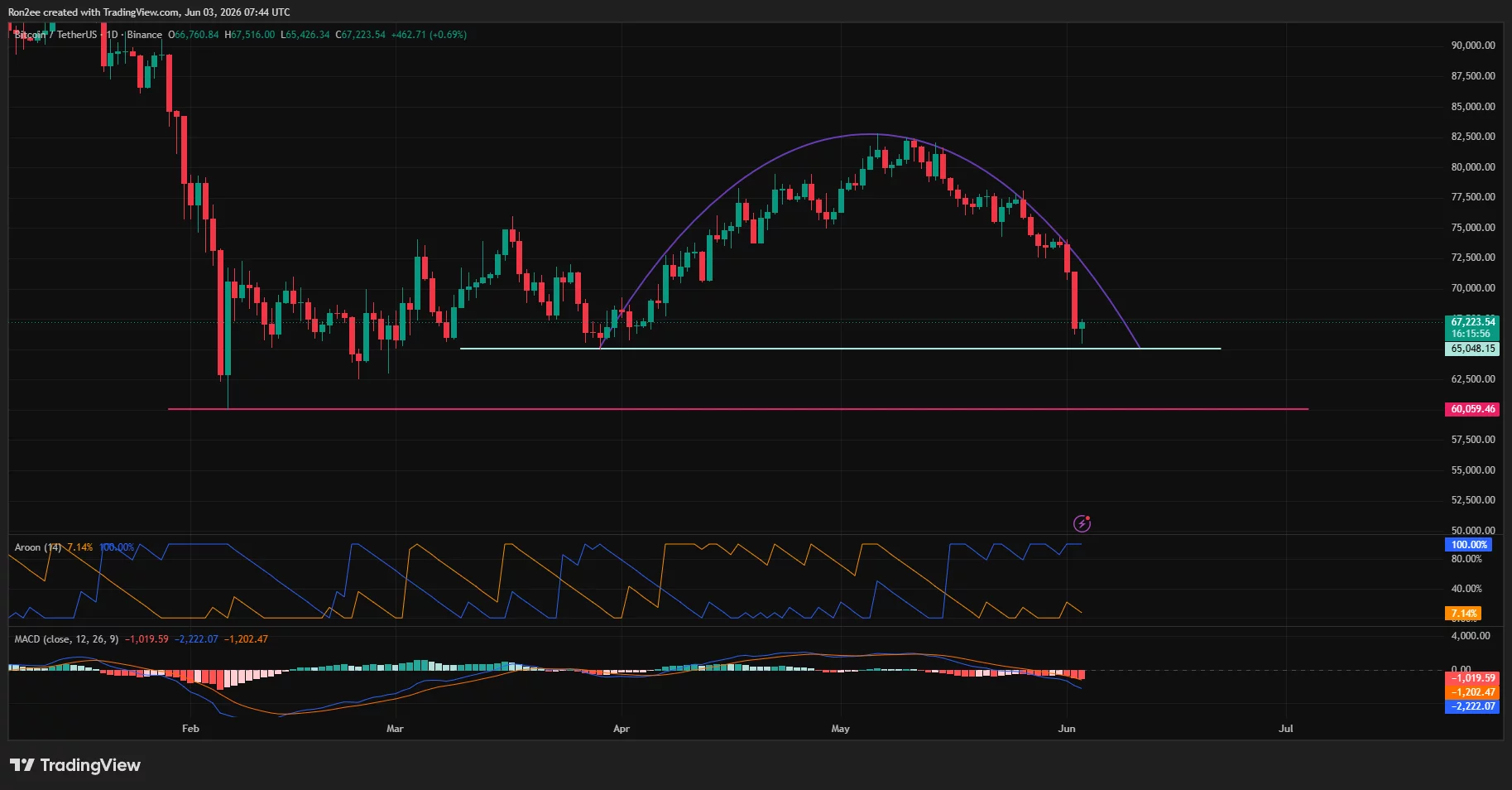
On the daily chart, Bitcoin price is close to completing a rounding top pattern after failing to sustain its recovery from the February low. In technical analysis, a rounding top is a bearish reversal formation that often develops near market peaks and can lead to a deeper correction once support at the base of the pattern breaks.
The weekly chart shows BTC trading below the 0.786 Fibonacci retracement level near $74,233. The next major level sits near the full retracement zone around $60,042, while the $65,400 area now acts as the first downside checkpoint.
The Supertrend indicator on the weekly chart has flipped bearish, with resistance near $90,050. Bitcoin also remains far below the 0.618 Fibonacci level near $85,374 and the midpoint retracement near $93,199, leaving the recovery path difficult unless buyers reclaim higher levels quickly.
Momentum indicators seem to favor the sellers. On the daily chart, the Aroon down line is at 100%, while the Aroon up line is near 7.14%, showing that sellers still control the short-term trend. The MACD line has also dropped deeper below the signal line, with the histogram below zero.
According to crypto analyst Master of Crypto, Bitcoin has “already lost the $72K and $68K support levels.”
“Now, all eyes are on the $60,000 demand zone. If tensions keep rising, don’t be surprised if BTC moves quickly toward a test of $60K.”
Team LAMBO shared a similar view after Bitcoin nearly hit its $65,000 target. Commenting on the setup, the analyst noted that BTC “might go retest the 0.618 fib and then see a rejection from 68.7k towards 65k or even lower to sweep liquidity.”
A clean break below $65,000 would expose the $60,000 demand zone next. However, a recovery above $68,700 could delay the downside move and open a retest of $72,000. A stronger close above $74,233 would weaken the bearish setup and bring the lost Fibonacci support back into play.
Disclosure: This article does not represent investment advice. The content and materials featured on this page are for educational purposes only.
Crypto World
Crypto PACs Gear up for Maryland Races with $3M Media Buys as California Primaries Kick Off
While residents of California, Iowa, Montana, New Jersey, New Mexico and South Dakota are voting today in Democratic and Republican Congressional primaries, the cryptocurrency industry is more focused on the Maryland primaries later this month.
According to filings with the US Federal Election Commission (FEC) as of Tuesday, the Coinbase- and Ripple-backed political action committee (PAC) Fairshake affiliate Protect Progress spent about $3 million combined to support Democratic candidates in House races across California and New Jersey. Another affiliate, Defend American Jobs, spent more than $411,000 to support Republican Senator Mike Rounds’ reelection bid in South Dakota.
In addition to its activities in California, Protect Progress appeared to be prepared for significant spending in Maryland, where primary elections are scheduled for June 23.
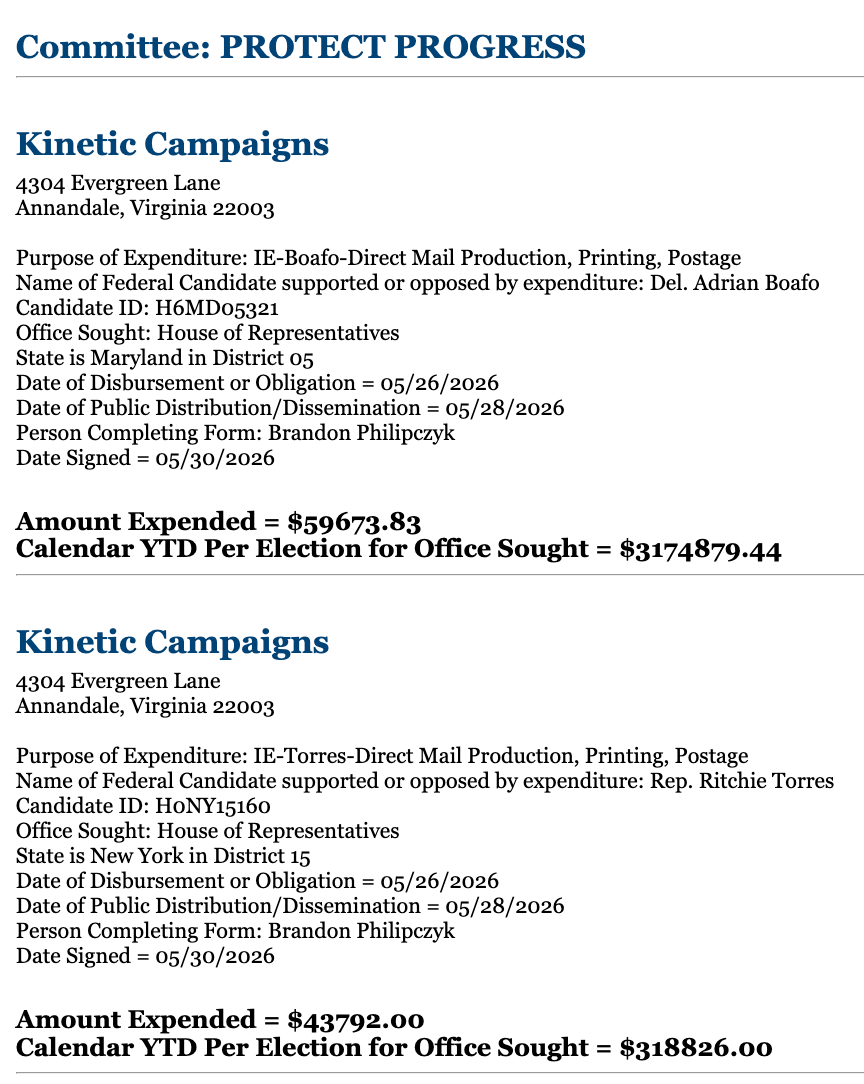
FEC filings showed the crypto-backed PAC spent more than $3.1 million on media to support Democratic candidate Adrian Boafo in Maryland’s 5th district, and about $320,000 on Ritchie Torres’ reelection to New York’s 15th district, which will also hold a primary on June 23.
Source: FEC
Today’s California races will be another test of the cryptocurrency industry’s influence over US elections after Fairshake and other PACs backed House and Senate candidates who won their primaries in Texas last week. In addition to Fairshake, which reported a war chest of more than $193 million as of January, crypto-aligned PACs included Fellowship, backed by $11 million from financial company Cantor Fitzgerald and crypto custodian Anchorage Digital and the Blockchain Leadership Fund funded by $175,000 from Chainlink and Anchorage.
Related: Senator Lummis says China will ‘write the rules’ of new financial era if CLARITY fails
Fairshake has been open about its intention to force out House and Senate lawmakers it considers “anti-crypto,” such as Representative Al Green, who voted against the stablecoin legislation GENIUS Act and digital asset market structure bill, CLARITY. The Texas lawmaker lost his primary for the state’s 18th congressional district after Protect Progress spent $5 million supporting his opponent, Democrat Christian Menefee.
CLARITY Act added to the US Senate legislative calendar
After advancement by the US Senate Agriculture Committee in January and the Banking Committee in May, lawmakers have added the Digital Asset Market Clarity (CLARITY) Act to the chamber’s calendar for consideration and a potential vote. Notably, both versions of the bill with amendments passed by the respective committees will likely need to be consolidated before a vote.
Magazine: HYPE chases $100 target, ETH could dump below $1800: Market Moves


NewLimit, a longevity biotech startup co-founded by Coinbase CEO Brian Armstrong, has raised $435 million in Series C funding to move its first age-reprogramming medicine toward human trials.
Summary
- NewLimit raised $435M to move its first age-reprogramming drug toward human trials next year.
- Founders Fund led the round, while Thrive, Greenoaks, Quiet Capital and Eli Lilly joined.
- Brian Armstrong’s biotech bet links AI, cell reprogramming and longevity medicine beyond Coinbase’s crypto business.
NewLimit Secures $435M Series C
NewLimit announced the funding round on June 2, saying Founders Fund led the raise. New investors Thrive Capital, Greenoaks and Quiet Capital joined the round, while existing backers Kleiner Perkins, Abstract, Nat Friedman and Daniel Gross, Valor Equity Partners, Eli Lilly Ventures and Human Capital also took part.
The company said it will use the funds to push its first aging reprogramming drug into human clinical trials next year. “Following breakthrough results, we’re bringing longevity medicine to human trials,” NewLimit said.
Startup Targets Cell Aging
NewLimit focuses on epigenetic reprogramming, a method that aims to restore youthful function in old cells. The company says its medicines are designed to treat diseases linked to aging by changing how cells behave, without changing the DNA code itself.
Its first program targets the liver. NewLimit said its liver therapy helped old human liver cells show signs of younger function in early research. The company plans to test how that approach works in people during its first human trial.
Armstrong’s Bet Moves Beyond Crypto
NewLimit was founded in 2021 by Armstrong, former GV partner and bioengineer Blake Byers, and computational biologist Jacob Kimmel, who serves as chief executive and president. The company has become one of Armstrong’s most visible projects outside Coinbase.
The raise also comes as crypto.news has tracked Armstrong’s wider push into AI and automation. Recent coverage said Coinbase used AI to cut account restriction resolution times by 90%, while Armstrong also listed AI tools, stablecoins and tokenization among key finance upgrades.
Longevity Funding Gains Momentum
The $435 million round places NewLimit among the better-funded private longevity startups. The Wall Street Journal reported that the raise lifted NewLimit’s valuation to $3.1 billion, more than triple its level from last year.
The company still has no approved product on the market. Its next test will come in human studies, where it must show that early cell-level results can translate into a safe and useful medicine.
NewLimit said it first believed that bringing an aging medicine into human trials would take more than a decade. The company now says recent scientific results helped it move faster than expected.
The raise gives NewLimit more capital to expand its research across liver, immune, metabolic and vascular programs. It also gives Armstrong’s biotech project a larger role in the growing market for longevity medicine.
Although almost the entire cryptocurrency market is deep in the red on a daily, weekly, and even monthly scale, Pi Network’s native token is among the poorest performers, as its price has slipped toward the all-time low seen in February.
This comes despite the project updates and the new games released, especially for Pioneers.
PI Price Tanks
As mentioned above, the past week or so has been particularly painful for the crypto markets, with BTC plunging to just over $65,000 hours ago, while ETH dumped to $1,800. Most other alts have been in the red, and PI is no exception. Its 22% plunge since this time last month resulted in a drop to $0.136 earlier today, which became its lowest level since February.
At the time, the asset was rejected at $0.20 multiple times, which led to the all-time low of $0.1312. The following month was a lot more successful, and PI more than doubled its value by the so-called PiDay 2026 (March 14) after it was listed on Kraken. However, it turned out to be a classic sell-the-news event followed by a massive crash to under $0.18.
The drop below $0.14 today came after sustained selling pressure and multiple key support levels that were lost, including $0.18 and $0.16.

PiScan data shows that the average daily number of tokens scheduled to be released in the next month is rather moderate, at around 5.4 million. However, there are several days that will see the unlocking of more than 10 million tokens, including one for 16 million. These rather significant unlocks could intensify the immediate selling pressure and lead to further declines.

New Games
After the recent update from CiDi Games, a Pi Network Ventures portfolio company, about the upcoming introduction of new games for Pioneers, both entities announced that a portion of those have already been made available.
“CiDi Games gives Pioneers new ways to use Pi through gaming, while also extending the Pi ecosystem with infrastructure that can support more games and developers over time.”
The new games are as follows:
 Coin Whack · arcade roguelike
 Fruit Stack · match-3 fruit puzzle
 Gemnova · cosmic match-3 adventure
 RainbowCubes · colorful elimination puzzle
Separately, the Pi Network Core Team recently announced the successful deployment of protocol update version 23 and noted that the next one, version 24, should have been completed by June 2. At the time of writing, though, there’s no official confirmation.
The post Pi Network’s PI Token Plunges Toward ATL Levels Despite Gaming Progress appeared first on CryptoPotato.
Key Takeaways
- BTC price declined to $67,000 amid capital rotation into artificial intelligence equities
- Bitcoin exchange-traded funds experienced their second-worst three-week withdrawal period ever, losing 62,794 BTC
- K33 Research cautions that increasing leverage combined with weakening institutional interest may drive prices lower
- Bitwise’s Matt Hougan describes cryptocurrency markets as transitioning from momentum-driven to a “contrarian opportunity”
- Alternative cryptocurrencies with solid fundamentals including Hyperliquid, Zcash, and Stellar demonstrate resilience
Bitcoin continues its descent toward $67,000 as capital exits the cryptocurrency sector in favor of artificial intelligence equities, prompting warnings from leading research organizations about potential further declines.
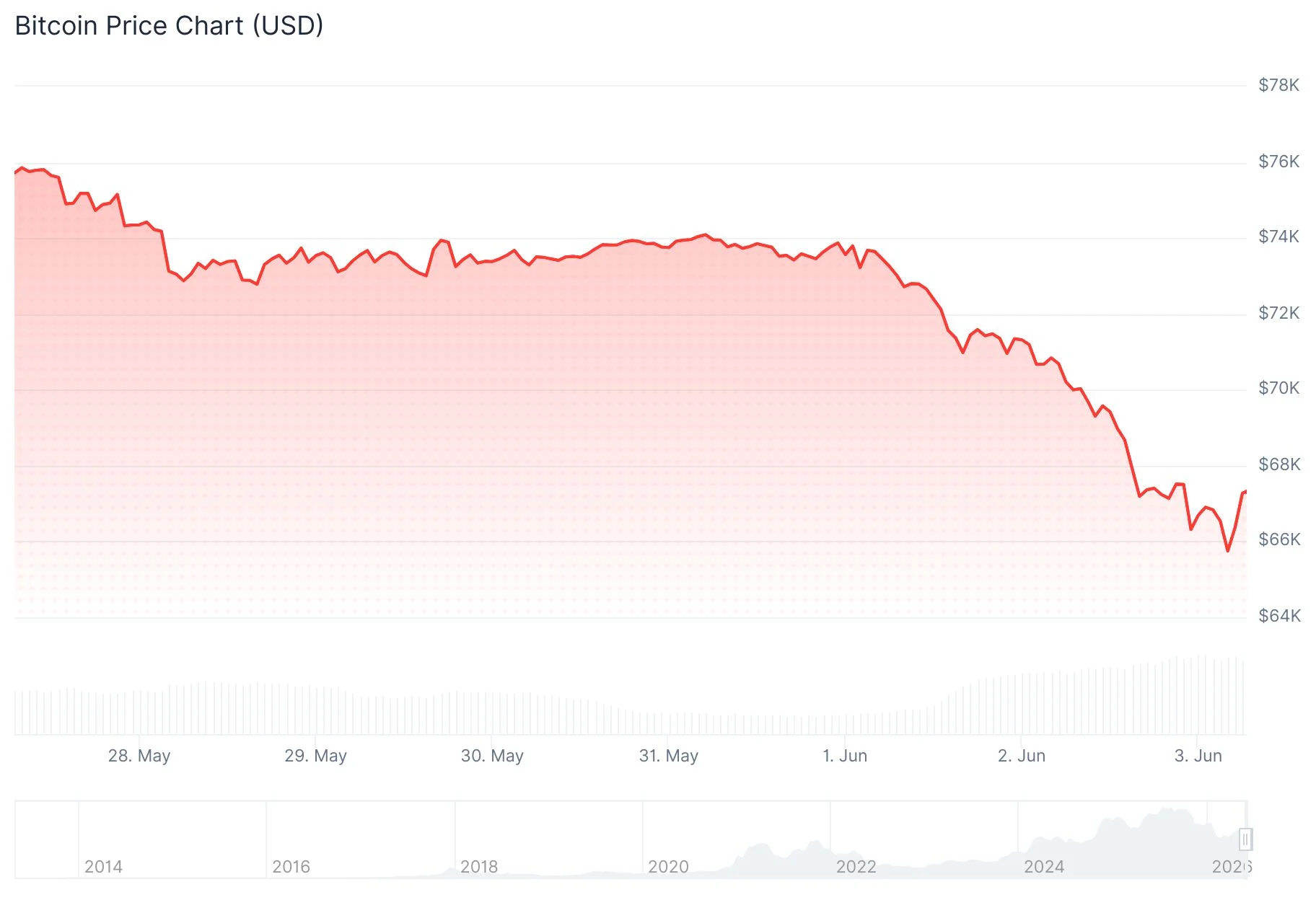
According to Vetle Lunde, research director at K33, bitcoin’s current weakness stems from a fundamental shift in investor perception: the opportunity cost of maintaining BTC positions appears excessive while AI stocks continue their impressive rallies.
“Many market participants perceive the opportunity cost of maintaining BTC exposure as prohibitively high amid the continued surge in AI-related equities,” Lunde noted in Tuesday’s research report.
Market data confirms this trend. Bitcoin exchange-traded funds recorded outflows totaling 62,794 BTC across the most recent three-week period—marking the second-largest withdrawal streak in their history.
The selling pressure intensified following bitcoin’s inability to sustain levels above its 200-day moving average during the previous month. BTC remains confined beneath this technical threshold while both the Nasdaq Composite and S&P 500 indices continue establishing new all-time highs.
Anticipation surrounding potential public offerings from companies such as SpaceX and Anthropic may be diverting additional investment capital away from digital assets, according to K33’s analysis.
Derivatives Markets Flash Caution Signals
The futures and options landscape is displaying concerning indicators. CME bitcoin futures open interest has contracted to levels not witnessed since October 2023, suggesting institutional participants are reducing their market exposure.
Simultaneously, perpetual futures funding rates have climbed despite bitcoin’s price deterioration. This dynamic indicates accumulating leveraged long positions within a declining market environment—a configuration K33 identifies as problematic.
K33’s earlier assessment suggested bitcoin’s February decline to approximately $60,000 likely represented this cycle’s bottom. The research firm now expresses reduced confidence in that projection.
“The underlying selling pressure evident in these leveraged long positions serves as a warning signal for potentially deeper corrections, warranting a cautious approach,” the analysis stated.
Cryptocurrency Transforms Into Contrarian Position
Matt Hougan, Chief Investment Officer at Bitwise, characterized the situation straightforwardly: cryptocurrency no longer represents the market’s most compelling opportunity.
“With AI equities, robotics enterprises, SpaceX, and similar opportunities available—particularly with the Nasdaq-100 delivering 43% year-over-year gains—cryptocurrency’s appeal has diminished,” Hougan observed.
He described cryptocurrency’s evolution from a momentum-driven trade to a contrarian position. This transformation fundamentally alters investor behavior patterns. Momentum-based strategies thrive on enthusiasm and follow-through, while contrarian approaches demand discipline and fundamental analysis.
Nvidia stock has surged approximately 1,500% since ChatGPT’s introduction in late 2022. Such extraordinary performance makes competing for investor attention challenging for bitcoin.
Hougan emphasized this cycle differs from previous downturns. Rather than bitcoin functioning as a defensive asset, capital is migrating toward smaller digital assets offering tangible utility, including Hyperliquid, Zcash, and Stellar.
He further suggested this pivot toward fundamental value analysis potentially signals the bear market’s conclusion may be approaching rather than just beginning.
The aggregate cryptocurrency market capitalization has contracted to $2.38 trillion, representing a 46% decline from its October zenith.
The US Treasury has sanctioned four Iranian crypto exchanges, including the country’s largest, Nobitex, marking the latest effort in its campaign called “Economic Fury” that aims to cut Iran off from the financial system.
The Treasury said on Tuesday that it added crypto exchanges Wallex, Bitpin and Ramzinex to the Office of Foreign Assets Control’s sanction list, prohibiting US businesses and persons from providing services to those platforms.
“While Iran’s economy is in free fall, the regime has chosen to co-opt digital asset technologies for its own corrupt agenda, including evading sanctions and transferring wealth out of the country,” said Treasury Secretary Scott Bessent.
The Treasury’s efforts to cut financial networks from Iran are at the center of its “Economic Fury” campaign, which commenced on April 14, months into the Iran war that kicked off with joint US-Israeli strikes on the country in February.
Source: Treasury Department
The US has repeatedly struck Iran amid efforts to reach a ceasefire agreement and resolve a dispute over the Strait of Hormuz, a vital shipping lane that transits about one-fifth of the world’s oil.
One of the top priorities for Treasury is to end Iran’s nuclear programme, Bessent said.
“As promised, Treasury will continue to follow the money in support of Economic Fury, whether it is through the banking system or through digital assets, to prevent the regime from developing a nuclear weapon.”
The latest sanctions come four days after Bessent revealed that the Treasury had seized nearly $1 billion in crypto from Iranian crypto exchanges and wallets since the Iran war began.
Nobitex the centerpiece of Iran’s “digital dollar pipeline”
The Treasury said Nobitex, Iran’s largest crypto exchange, has continued to facilitate payments for the Islamic Revolutionary Guard Corps and other sanctioned entities.
On Tuesday, blockchain forensics platform Chainalysis said that Nobitex is at the center of Iran’s “digital dollar pipeline,” and that it handles about 50% of the country’s crypto trading volume.
Related: US Senate advances resolution to curb Trump’s Iran war powers
The Treasury claimed that Nobitex has contributed to the repression of the Iranian people by facilitating state-linked surveillance of civilians.
Nobitex’s CEO, Seyed Ali Khoee, and chairman Amir Hossein Rad were also added to OFAC’s sanction list.
The Treasury said it has cut off “tens of billions of dollars” worth of funding channels from otherwise being accessible to the Iranian regime and its proxies.
That includes action taken against alleged shadow bank networks, as well as foreign officials and companies seeking to support Iran’s oil trade and military activities.
Magazine: Should users be allowed to bet on war and death in prediction markets?
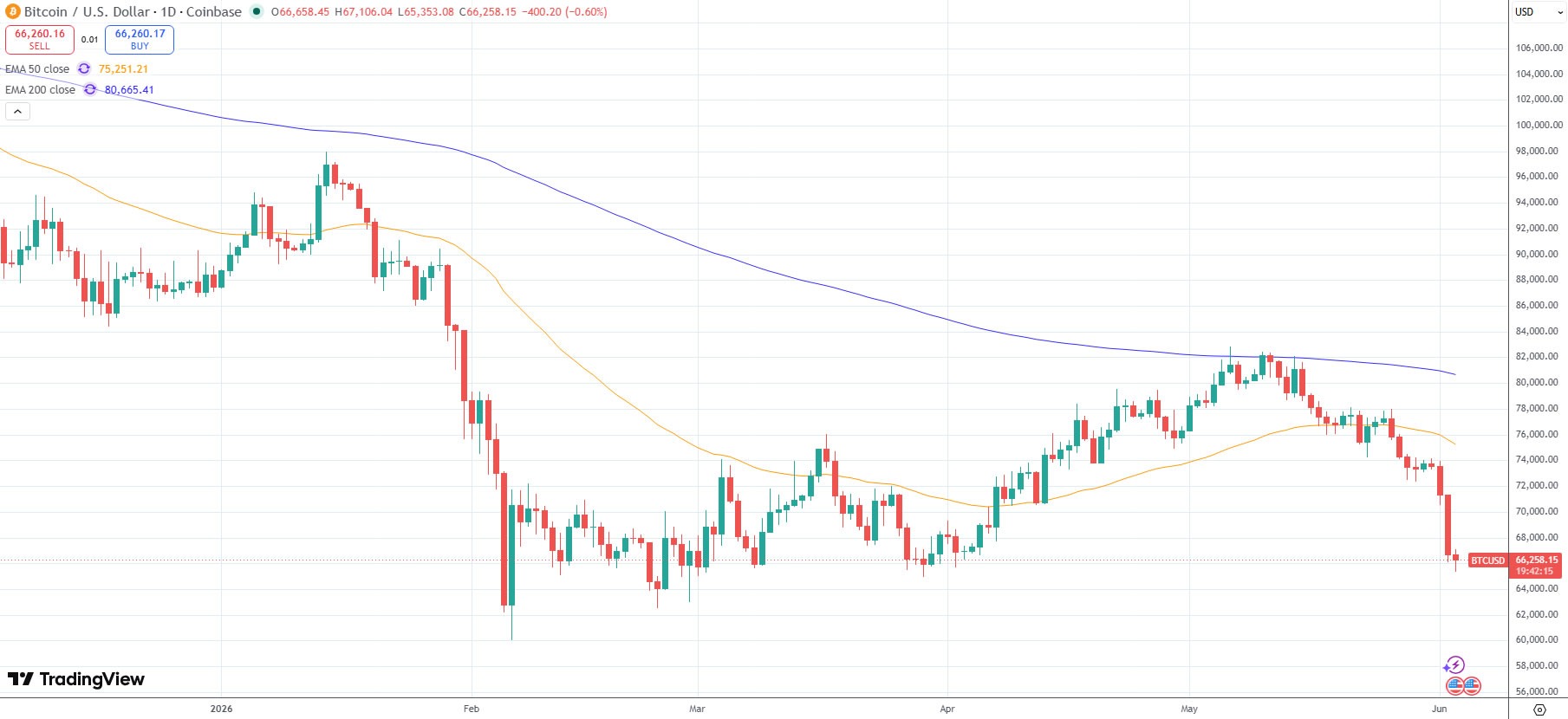
Bitcoin prices have dropped 7% on the day, breaking key support to a nine-week low after the US and Iran launched fresh strikes as talks over a possible ceasefire have stalled.
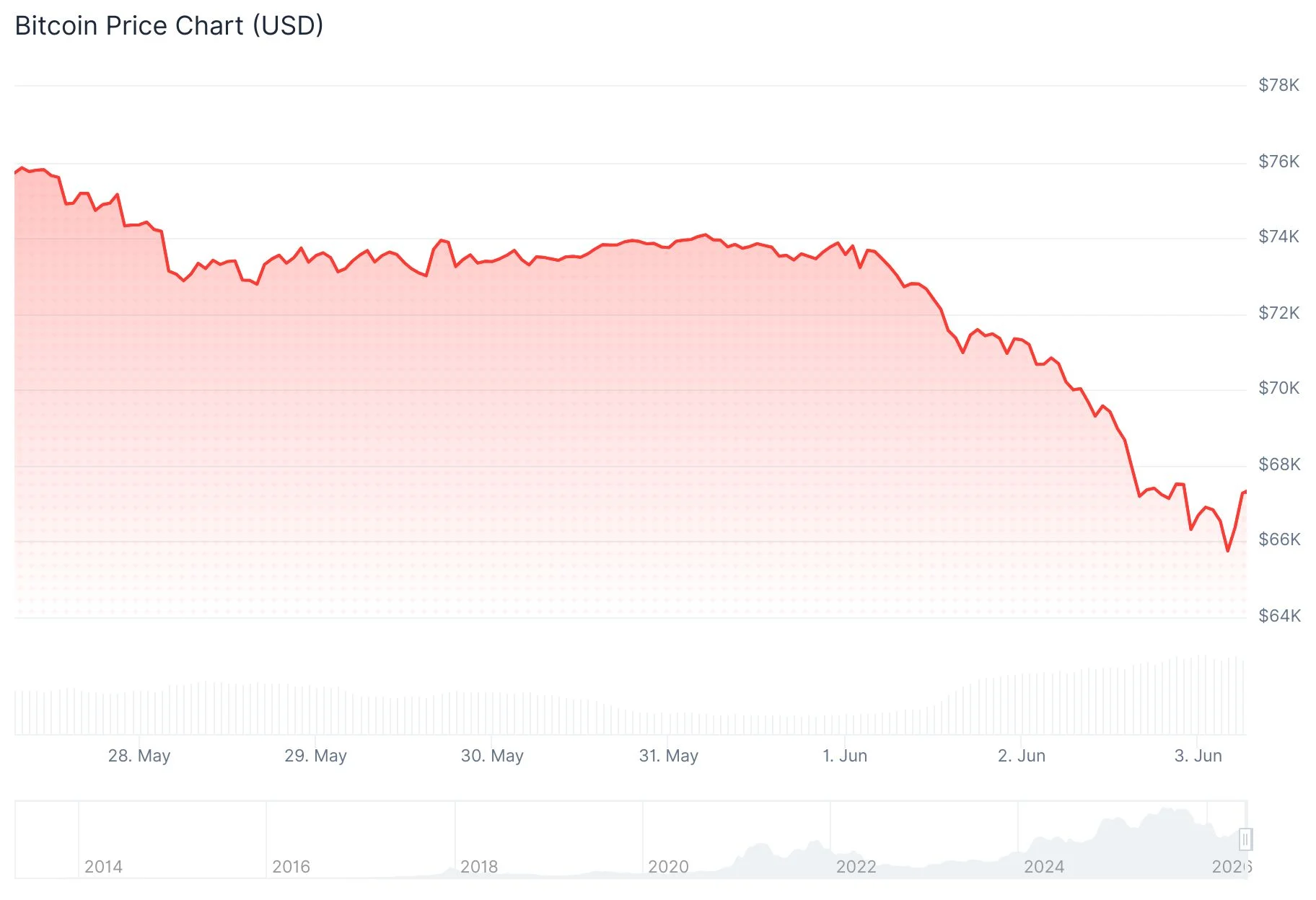
Bitcoin (BTC) fell to $65,385 on Coinbase in early trading on Wednesday, its lowest level since late March, according to TradingView.
The slump follows the largest daily fall since Feb. 5 as BTC shed more than $4,500 on Tuesday.
According to CoinGlass data, around 277,000 traders have been liquidated over the past 24 hours, with total liquidations of around $1.83 billion. More than 90% of them were long positions, primarily in Bitcoin and Ether (ETH).
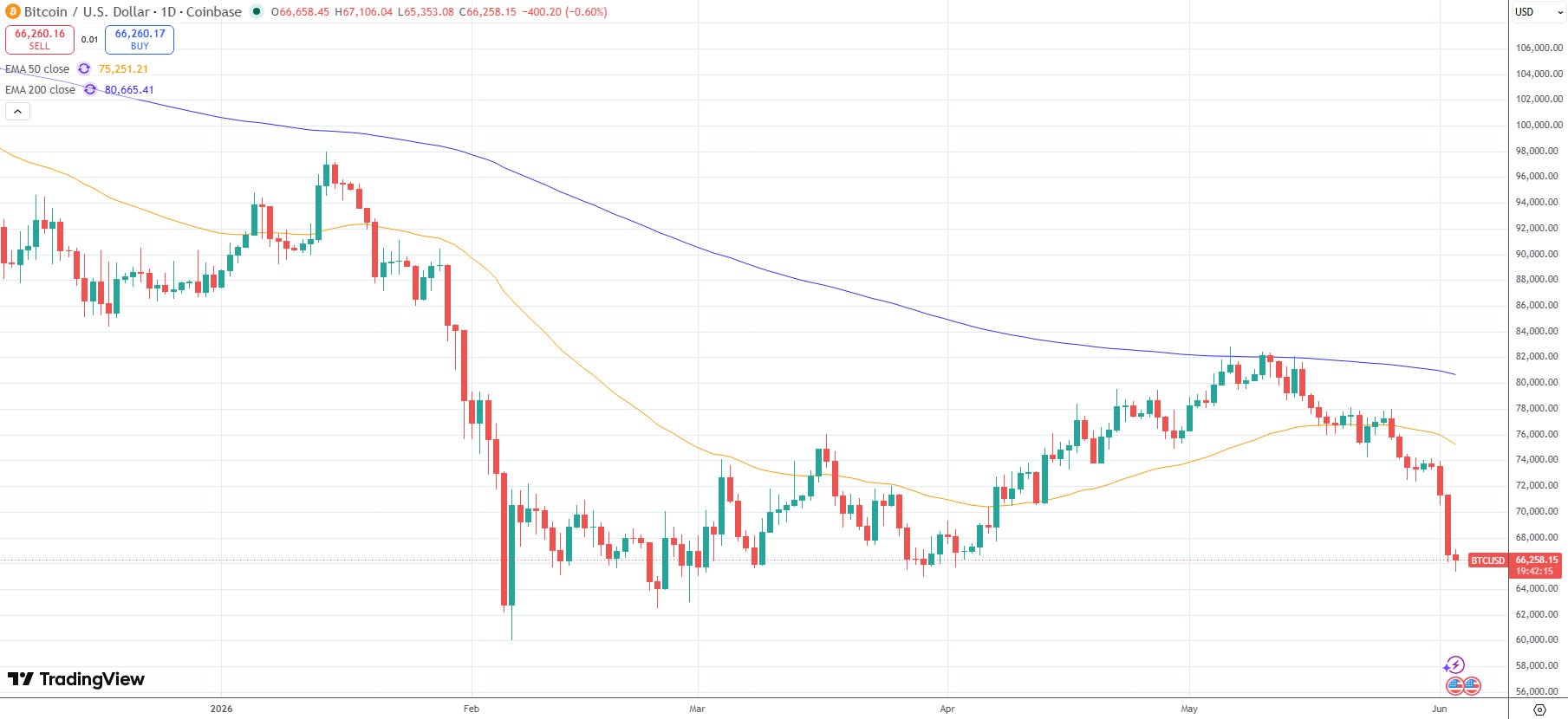
Bitcoin has fallen below $66,000 in the most significant single-day drop since February. Source: TradingView
Andri Fauzan Adziima, the research lead at Bitrue Research Institute, told Cointelegraph that Bitcoin’s current drop is more about “leveraged liquidations, heavy ETF outflows, and technical breakdowns than pure Iran news, but it amplifies the fear.”
Adziima said he expected “choppy consolidation,” as real support sits lower around $64,000 to $65,000, “with any de-escalation or strong macro rebound potentially sparking a sharp relief rally.”
The $150 billion crypto market capitalization exodus came as the US continued its military strikes against what it called “aggressive Iranian behavior.”
US Central Command stated on Tuesday that it had successfully defeated multiple Iranian ballistic missiles and drones, and “conducted self-defense strikes” on Qeshm Island in response to attempted attacks by Iran across the Middle East.
“Iran launched several ballistic missiles toward regional neighbors; however, all failed to hit their intended targets,” CENTCOM said. Two Iranian missiles were fired at Kuwait, and three missiles were launched at Bahrain, it added.
Related: Crypto turns ‘contrarian bet’ as AI stocks draw investor attention: Bitwise
The latest skirmish comes amid a two-month ceasefire between the US and Iran, which has included indirect talks on extending the ceasefire and lifting a blockade of the Strait of Hormuz. However, negotiations have yet to yield an agreement.
President Donald Trump claimed on Truth Social on Tuesday that “reports that the Islamic Republic of Iran, and the USA, stopped speaking a few days ago are false and erroneous.”
“The conversations between us have been going on continuously, including four days ago, three days ago, two days ago, one day ago, and today,” he said.
The comments came after Iran’s Tasnim news agency reported on Tuesday that the country would halt all conversations with the US until Israel ceased attacking Lebanon.
Magazine: Big Questions: Do we really only need 2–5 cryptocurrencies?

MONEY (ORIGINAL MIX)

LIVE as Stephen McCullagh sentenced for murder of pregnant Natalie McNally
Howdens stock rises on DIY Kitchens acquisition deal



-

 NewsBeat7 days ago
Israel says it has killed new Hamas military leader in Gaza City airstrikes
-

 Tech5 days ago
Waymo dominates autonomous vehicle registrations as Tesla trails behind
-

 News Videos5 days ago
This is BROKEN! INSANE 5x MONEY CAR WASH WEEK! The NEW GTA Online UPDATE Today! (GTA5 New Update)
-
 Tech4 days ago
SpaceX just won a second Golden Dome contract. This one is $4.16 billion.
-

 News Videos5 days ago
SHE IS KILLING XRP!!! WATCH URGENT AND ACT FAST
-
 NewsBeat4 days ago
FIRST NIGHT REVIEW: Take That bring the Circus back to life in spectacular sun-soaked style
-

 Business2 days ago
Jade Biosciences, Inc. (JBIO) Discusses Positive Interim Results From JADE101 Phase I Healthy Volunteer Study and Development Plans Transcript
-

 Tech7 days ago
The Samsung pay deal is the moment Korean unions changed register
-
 Crypto World5 days ago
CFTC Has Approved the First Regulated Bitcoin Perpetual Contract in the U.S.
-
 Entertainment7 days ago
The Most Misunderstood Sci-Fi Horror Movie of the Last 10 Years Just Took Over Netflix
-
Crypto World7 days ago
SpaceX’s $2 Trillion IPO: Why Tech Giants Nvidia (NVDA), Apple (AAPL), and Microsoft (MSFT) May Face Pressure
-

 Business4 days ago
Is the Spurs Phenom Already Better Than Prime Diesel?
-
 NewsBeat5 days ago
Novak Djokovic v Joao Fonseca LIVE: French Open latest scores and results after Jannik Sinner’s shocking collapse
-
 Crypto World5 days ago
Snowflake (SNOW) Stock Rallies on Strong Q1 Results and AI Product Growth
-
 Entertainment4 days ago
Weak ‘Supergirl’ Box Office Tracking Amid Milly Alcock Backlash
-

 Business4 days ago
Demand Conditions Improve In Chemicals Sector In April 2026
-
 Crypto World5 days ago
MicroStrategy Moves $30 Million in BTC to Coinbase Prime: Is the Bitcoin Sell-Off Already Here?
-

 Politics4 days ago
The House | Inside Andy Burnham’s Makerfield Campaign: “Nobody Thinks This Is In The Bag”
-

 Tech5 days ago
This Week In Security: Ubiquiti Fixes, And FreeBSD Joins The Club You Don’t Want To Join
-

 Entertainment5 days ago
Maddox Jolie-Pitt Legally Requests to Drop Brad’s Surname
You must be logged in to post a comment Login