

Crypto World
Main Street’s msUSD collapses as Altura winds down vault

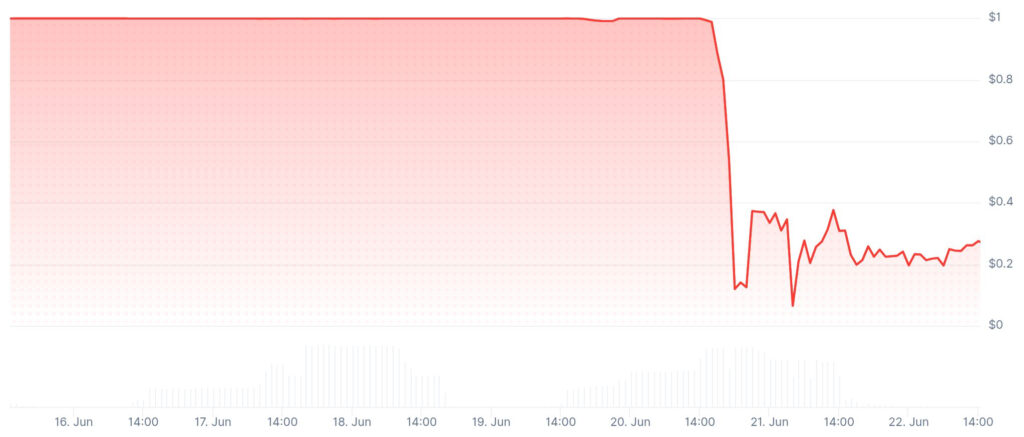
Main Street Finance’s stablecoin msUSD has depegged to $0.27, sparked by a post addressing the “shutdown of [its] third-party proof-of-reserves dashboard.”
The following day, the firm behind the dashboard in question, Accountable, announced it was terminating its asset verification services with msUSD’s issuer.
In classic DeFi fashion, the fallout appears to have led to a bank run on Altura’s USDT vault, leading to the firm deciding to close down the vault.
At least $8.5 million was withdrawn ahead of the announcement and before a sell-off of the AVLT vault token led to an 11% depeg.
The weekend’s depegs come on the back of ongoing troubles for DeFi stablecoins apxUSD and sUSDat, which are backed by Strategy’s struggling STRC.
Read more: Saylor distances himself from STRC-backed DeFi after stablecoin wobble
Main Street Finance: ‘Institutional-grade yield’
Late on Saturday, Main Street Finance published a long post to X reassuring users that it “remains fully backed,” calling the loss of its dashboard a “reporting issue, not a solvency issue.”
By the time of the post, the price of msUSD had already collapsed. It sat at around $0.12 after losing its $1 peg around six hours previously but has since rebounded to around $0.27 from a low of $0.06 in the early hours of Sunday morning (UTC).
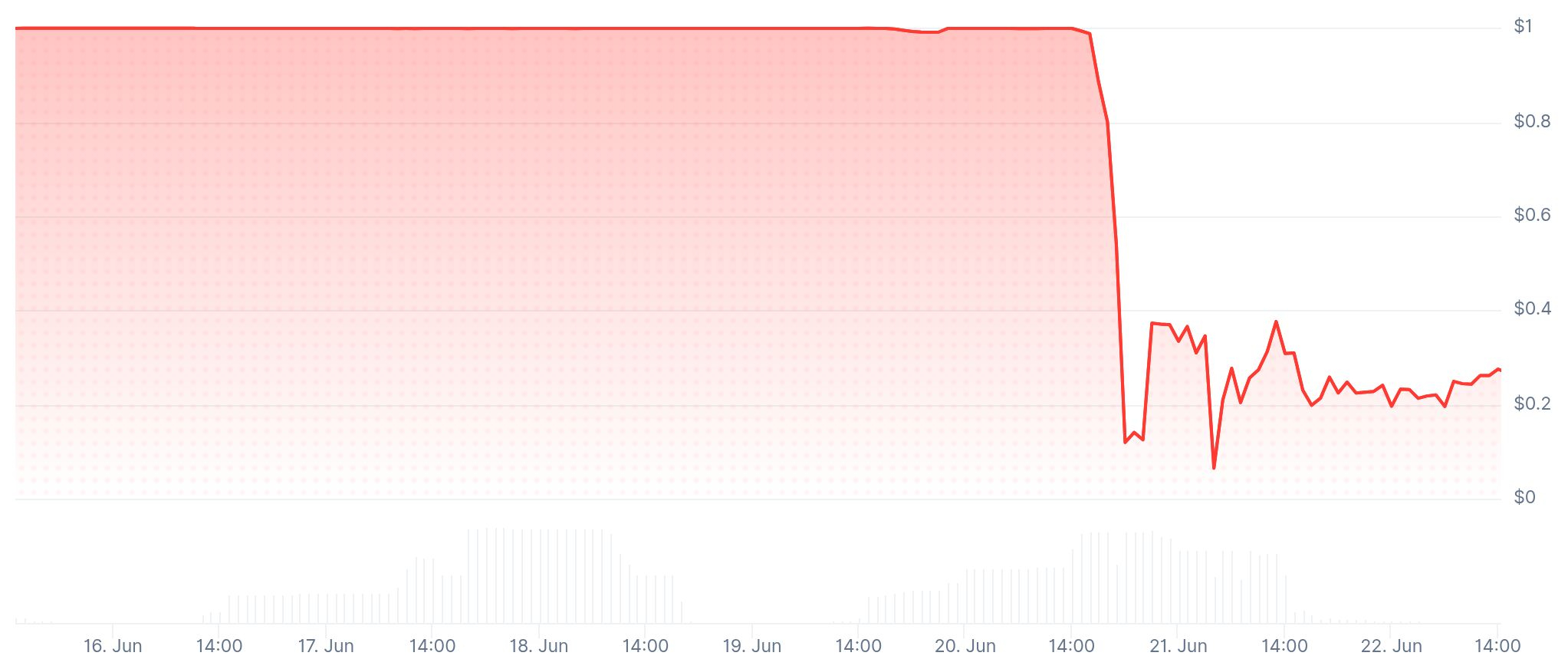
The advance reaction led some to believe that “insiders… got the memo that they should take the available liquidity to get out.”
Then, on Sunday, RWA accounting firm Accountable announced that, following Main Street Finance’s failure to provide adequate proof of reserves, it was terminating its contract with the firm.
Others questioned Accountable’s lack of prior action, given that doubts over Main Street’s transparency were publicly raised back in April.
Accountable’s post positions it as “neutral verification infrastructure,” however it also claims it “did not retain an ongoing, source-level view of [Main Street’s] reserves,” raising concerns over the reliability of its data on other clients.
Read more: DeFi projects under fire for inflated TVL and murky lending loops
Given Accountable’s entire business case, the post also drew ridicule, with one user comparing it to May 2022’s infamous Three Arrows Capital AUM statement.
In addition to the depeg of msUSD, Main Street’s yield token, msY, which it promises “turns box spreads into market-neutral” 12% yield also collapsed in price.
Blockchain auditor Peckshield highlighted the Morpho msY/USDC market hitting 100% utilization, trapping $18 million of AlphaPing assets.
Read more: Resolv hack shows DeFi learned nothing from last contagion
Altura: “the yield engine”
Altura runs a HyperEVM-based USDT yield vault, currently offering almost 30% yield.
In a post on Sunday, Altura distanced itself from the msUSD depeg, stressing it “never had any exposure to Mainstreet or any of its underlying investment strategies.”
It also assured users that it had successfully redeemed over $5 million during the previous 24 hours.
Rather than reassuring depositors, however, it appears the post had the opposite effect.
Twelve hours later, Altura co-founder and CEO Ranveer Arora revealed that, due to “sustained withdrawal demand and current market sentiment” the firm would proceed with “an orderly wind-down of the Altura vault.”
Redemptions had now climbed to $8.5 million.
The rush for the exits was reflected in the price of the vault’s yield-bearing AVLT token. Over the past 24 hours it has dropped 14%, from $1.09 to $0.93 at the time of writing.
Between redemptions and price action, AVLT’s market cap dropped from $39 million to a low of $26 million over the weekend.
In a later update, Altura stated that “a maturity mismatch between our onchain and off-chain positions” forced it to pause withdrawals. It promised market making strategies would be closed within 72 hours but “RWA positions will take more time due to their inherent nature.”
On top of the $18 million exposed to the msY/USDC market, AlphaPing also has over $10 million of exposure to AVLT, according to its Morpho curator dashboard.
Read more: High yields to haircuts: Has DeFi learned anything from yield vault collapse?
DeFi’s risk curator “daisy chain”
Despite its premise as transparent, open finance, the DeFi sector has faced a number of shocks in recent months due to murky “daisy chains” and recursive lending.
In late October, concerns began to circulate over the stability of a number of high yield vaults. These tokens often used looped leverage against one another, inflating TVL far above the legitimate stablecoin backing.
The space exploded days later when one of the main offenders, Stream Finance, revealed it had lost $93 million. Its stablecoin, xUSD, immediately collapsed 75%.
Read more: Four months on, MEV Capital falls victim to $4B DeFi daisy chain implosion
Later, in March, a $23 million hack of Resolv’s USR due to a private key compromise wrought havoc across multiple yield vaults as opportunistic traders bought depegged USR and used it to drain liquidity in markets with hardcoded oracles.
So-called risk curators even continued to provide liquidity to the vulnerable markets via Morpho’s Public Allocator automation feature.
Such episodes go to show that rather than a novel financial system which operates autonomously and permissionlessly, DeFi is all too often forced to recur to the blame game when things go awry.
Got a tip? Send us an email securely via Protos Leaks. For more informed news, follow us on X, Bluesky, and Google News, or subscribe to our YouTube channel.


Former Ethereum Foundation contributors and ETH treasury firms Bitmine and Sharplink have launched a new research and development nonprofit, Ethlabs, with the stated goal of preparing Ethereum for what they describe as the next phase of institutional adoption.
Sharplink said on Monday that Ethlabs is intended to “ready Ethereum for the next phase of institutional adoption,” positioning the organization as a long-term home for core research and development work. The initiative is backed by Sharplink and Bitmine, alongside Ethereum co-founder Joe Lubin and other Ethereum contributors.
Key takeaways
- Ethlabs is a new nonprofit focused on Ethereum core research and development aimed at supporting large-scale institutional use.
- Sharplink frames the move around growing on-chain settlement demand from stablecoins, tokenized real-world assets, and other financial activity.
- Ethlabs is co-founded by five former senior Ethereum Foundation researchers, signaling an attempt to preserve continuity in technical stewardship.
- The launch arrives amid renewed criticism around Ethereum Foundation funding capacity and leadership departures.
- Joe Lubin links the project to expanding “steward nodes” and increasing network utilization, tying research goals to practical adoption.
Why Ethlabs says it exists
In its announcement, Sharplink argued that several categories of financial activity are converging on Ethereum as a settlement layer. The company specifically pointed to stablecoins, tokenized real-world assets, funds, and “autonomous AI commerce” moving on-chain, describing Ethereum as “neutral” and “credibly permissionless” for that role.
On that basis, Sharplink said Ethlabs exists to ensure the network can absorb this demand “at scale.” The organization’s pitch is less about changing Ethereum’s direction in a political sense and more about building technical capacity—through stable funding—for research and development that supports the network’s next growth phase.
Backers and founding team
Ethlabs was co-founded by five former senior Ethereum Foundation researchers: Ansgar Dietrichs, Barnabé Monnot, Caspar Schwarz-Schilling, Josh Rudolf, and Julian Ma. The involvement of former EF researchers is notable because many ecosystem upgrades over Ethereum’s lifecycle have relied on specialized technical work that is difficult to replicate quickly.
Sharplink also said Ethlabs brings together technologists who have guided the network through “its most consequential upgrades over the past decade,” adding that the initiative provides “stable, long-term funding” in what it calls an institutional context.
Joe Lubin—Ethereum co-founder—told supporters that Ethereum “is entering its next stage of evolution.” He also said there should be “a number of steward nodes of Ethereum” aimed at growing utilization of the blockchain.
Lubin further stated that Ethlabs, by giving researchers and developers an “independent home,” will be instrumental in preparing for a “next major wave of adoption.” The language underscores an expectation that technical work and operational participation (such as steward nodes) should move in tandem.
Launch timing: funding concerns and Foundation leadership departures
Ethlabs’ debut lands shortly after warnings about Ethereum Foundation funding constraints resurfaced. In May, Vitalik Buterin said the Ethereum Foundation’s resources were limited, noting that it held only about 0.16% of the total supply of Ether (ETH).
More recently, former Ethereum Foundation contributor Trenton Van Epps warned that Ethereum could be heading toward a “slow-burning funding crisis.” The concern centered on the risk that ongoing asset selling by the Foundation could undermine long-term support for core development.
The launch also coincides with an ongoing wave of leadership exits from the Ethereum Foundation, including the reported departure of co-executive director Hsiao-Wei Wang, which was described as leaving last week in earlier coverage.
Institutional readiness vs. what remains uncertain
Ethlabs’ stated mission—ensuring Ethereum is ready to scale for major on-chain financial and settlement activity—raises a practical question for market participants: how will this new funding and organizational structure translate into concrete technical deliverables?
Sharplink’s message is clear about the direction—capacity for institutional-grade adoption—but the announcement provides limited detail on specific engineering timelines or near-term protocol milestones. For investors and developers, the next signals to watch are the organization’s published research agenda and how it coordinates with existing Ethereum ecosystem contributors, particularly in areas such as scalability, security, and the infrastructure needed for higher-throughput settlement use cases.
It is also worth noting that Ethlabs is being positioned as a stable “institutional home” for core technology work, while critics have argued that the Foundation’s financial situation may be limiting its ability to sustain that same role. However, whether Ethlabs’ model becomes a substitute for the EF or a complementary structure will likely depend on its governance, funding durability, and its ability to attract ongoing developer participation.
Ether market backdrop
The policy and funding narrative is playing out against a softer market environment for Ether. Ether is trading about 65% below its reported peak around $1,700, with those levels last seen in October 2023 and April 2025, according to the figures referenced in the announcement context.
That backdrop can matter because periods of weaker sentiment often reduce risk appetite and slow down spending across the ecosystem—making stable funding for core development more salient. Even so, the immediate relevance for users will hinge on whether research efforts lead to improvements that directly affect performance and reliability.
For now, the key question is whether Ethlabs can convert its “long-term, independent home” framing into measurable progress on Ethereum readiness for institutional settlement demand—and how that effort interacts with the Ethereum Foundation’s evolving role amid continued leadership and funding debates.


Meta will lead a $900 million (₹8,550 crore) Series H round in Indian fintech CRED, valuing the company at $4.5 billion (₹43,239 crore) post-money.
The deal combines primary and secondary share purchases. In addition, founder Kunal Shah will step down as CEO to join Meta’s global leadership team.
Meta Joins CRED Cap Table With $900 Million Minority Investment
According to the press release, Meta joins CRED’s cap table as a minority investor and will not gain access to customer data. The company stated that the Series H funding will support its growth efforts, strengthen its institutional capabilities, and reinforce its leadership position across multiple segments.
Shah will retain his personal stake in CRED despite leaving the operating role. At Meta, he will take over as head of WhatsApp, succeeding Will Cathcart, who led the messaging app for seven years before moving to a new role.
“Kunal built CRED into one of India’s most important technology companies, and he brings the kind of builder mentality and global perspective that will serve him well in running the world’s biggest messaging app,” Meta CEO Mark Zuckerberg posted.
Follow us on X to get the latest news as it happens
Miten Sampat, who has run strategy and finance since 2020, takes over as interim CEO with immediate effect. The board is building a leadership structure aimed at an eventual public listing.
Why Meta Is Betting on Indian Fintech
The investment deepens Meta’s India strategy beyond social platforms. The technology giant has expanded aggressively across the country in recent months.
In June, Meta signed a deal to lease its first AI data center in India from Reliance Industries. The 168 MW facility in Jamnagar adds to a partnership that began with Meta’s $5.7 billion investment in Jio Platforms in 2020.
Now, the latest round gives Meta a minority stake in one of India’s leading fintech platforms. CRED serves 17 million (1.7 crore) monthly members across payments, lending, insurance, and wealth products.
The fintech processes more than 40% of credit card bill payments in India. Its lending arm manages $2.5 billion (₹24,000 crore) in assets for major financial institutions.
Subscribe to our YouTube channel to watch leaders and journalists provide expert insights
The post Meta To Pour $900 Million Into CRED as Its CEO Joins Meta appeared first on BeInCrypto.
Uniswap price has held above the $3 level after a sharp three-day rally driven by Standard Chartered’s bullish coverage and a wave of short liquidations across derivatives markets.
Summary
- Uniswap price held above $3 after Standard Chartered’s $100 price target triggered a sharp rally.
- CoinGlass data shows major liquidation clusters between $3.30 and $3.85 that could fuel volatility.
- Bulls must defend the $2.93 support zone as hawkish Fed policy continues to pressure risk assets.
According to data from crypto.news, Uniswap (UNI) price traded around $3.03 on June 22, roughly 20% above its June 15 levels despite retreating from a local high near $4 reached earlier in the week.
Market sentiment improved after Standard Chartered initiated coverage of the decentralized exchange token on June 15 and projected a long-term price target of $100 by 2030, drawing renewed attention to DeFi assets after months of underperformance.
The banking giant’s forecast arrived as UNI was trading near multi-month lows below $2.50. Fresh spot demand quickly pushed the token through several overhead resistance levels and triggered a rapid repricing across futures markets.
According to CoinGlass data, UNI futures volume surged while open interest climbed sharply during the advance, highlighting aggressive positioning from traders attempting to capture the breakout.
As crypto.news previously reported, Standard Chartered analyst Geoffrey Kendrick argued that Uniswap remains one of the strongest beneficiaries of growing decentralized exchange activity and could capture a larger share of on-chain trading volumes over the coming years.
“We initiate coverage of Uniswap with a UNI-USD price forecast of USD 100 by end-2030, a 40x increase from today’s USD 2.50 level.”
Uniswap price faces major liquidation cluster above $3.30
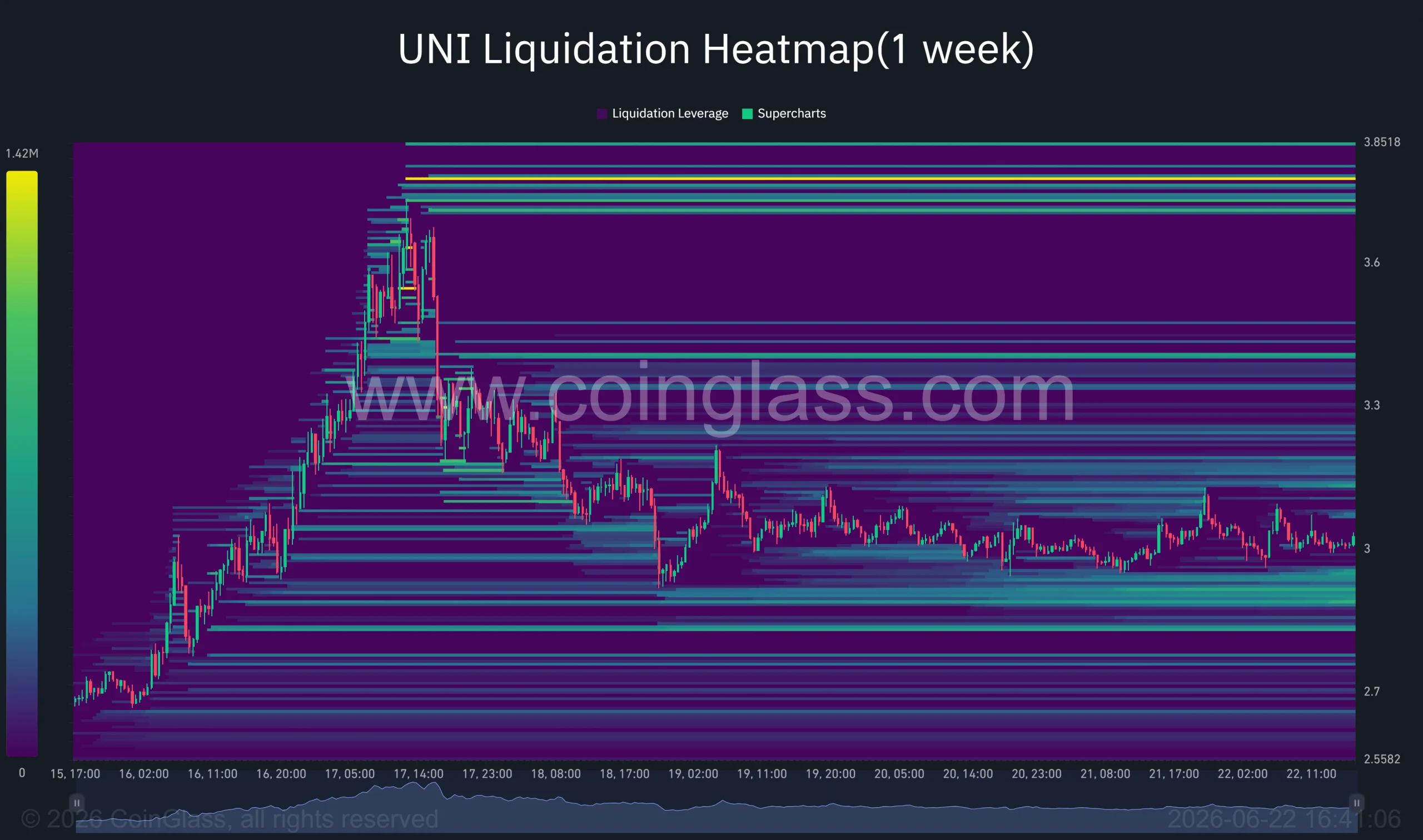
CoinGlass liquidation data shows several large leverage concentrations sitting above the current market price. The most significant cluster remains between $3.30 and $3.45, while another dense pocket of short liquidations is visible near $3.75-$3.85.
A move into those zones could force additional short covering and create another burst of volatility similar to the squeeze witnessed between June 15 and June 17.
Daily chart structure also improved after UNI reclaimed the Murrey Math support zone around $2.93. The token now trades just below the key pivot level at $3.125. A successful break above that area would expose resistance levels at $3.32, $3.51, and $3.71.
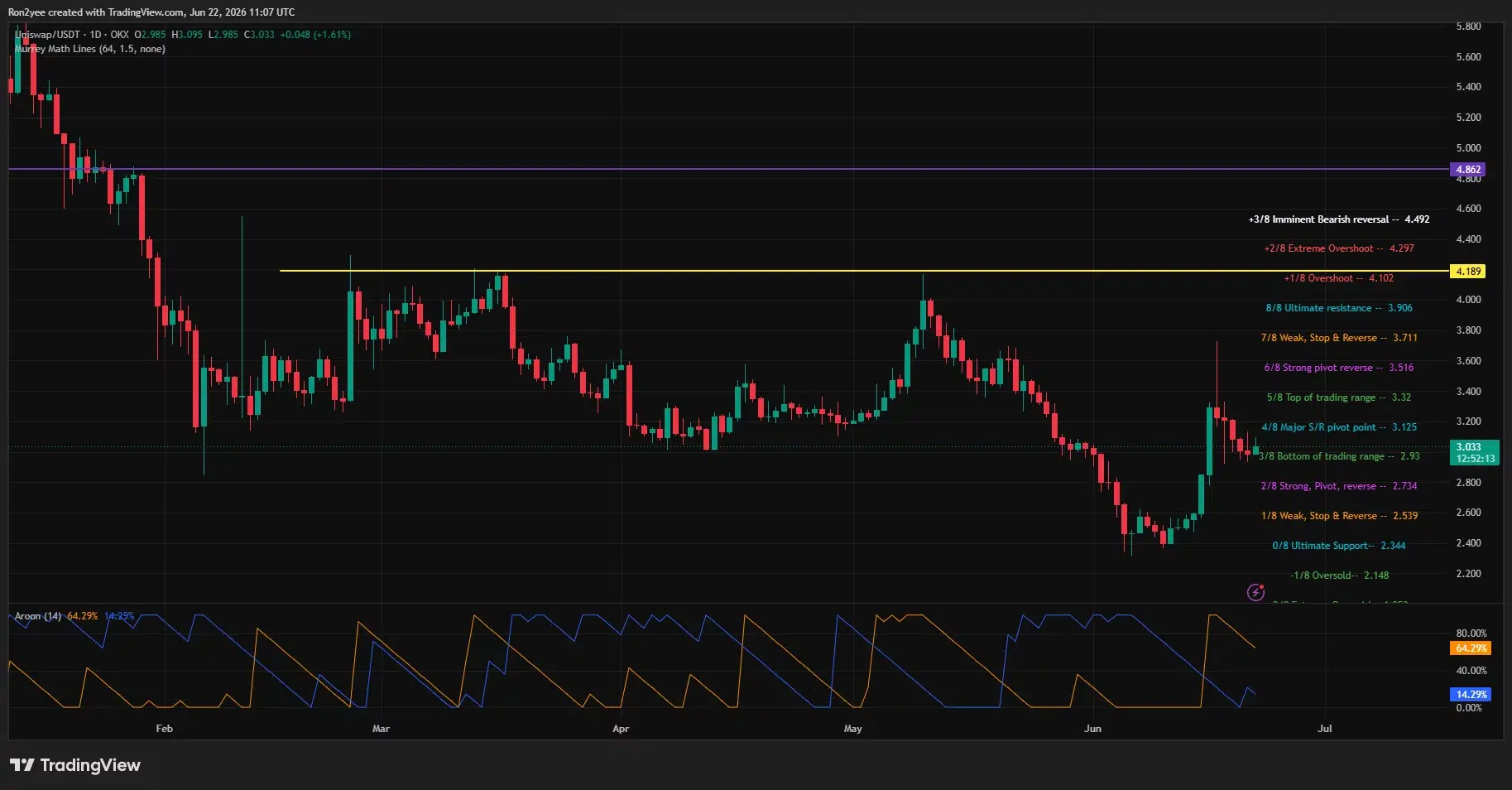
Beyond those levels, the next major overhead barrier sits near $3.90, which coincides with the strongest liquidation concentration visible on the one-week heatmap.
Momentum indicators remain constructive despite the pullback. The Aroon Up indicator remains elevated above 60%, suggesting buyers continue to control the dominant trend even after several days of consolidation around the $3 mark.
Uniswap price risks deeper pullback if $2.93 support fails
Profit-taking emerged shortly after the rally as traders locked in gains from the rapid advance. At the same time, risk appetite across digital assets weakened following the Federal Reserve’s latest policy decision under Chair Kevin Warsh, which reinforced expectations that interest rates could remain restrictive for longer than previously anticipated.
Technical downside risks remain concentrated around the $2.93 support zone. Losing that level would place the $2.73 pivot and the $2.54 support area back into focus. The liquidation heatmap also shows relatively thin leverage positioning beneath current prices, reducing the likelihood of a large liquidation-driven rebound if support fails.
For now, UNI continues to trade above the level that capped prices throughout most of June. As long as buyers defend the newly reclaimed $2.93-$3.00 range, traders are likely to keep watching the dense liquidation pockets above $3.30 for the next directional move.
Disclosure: This article does not represent investment advice. The content and materials featured on this page are for educational purposes only.
Bithumb, South Korea’s second-largest crypto exchange, will add Canton (CC) to its Korean won market on June 23.
Summary
- Bithumb will open Canton’s KRW market, giving Korean traders direct access to CC on Tuesday.
- CC momentum remains weak, with MACD bearish and RSI below neutral despite modest daily gains.
- Canton’s protocol change lowers onboarding friction after institutional partnerships expanded across Korea and Wall Street.
The exchange said deposits and withdrawals would open within two hours of the notice, while trading would start at 14:00 local time.
The exchange will support Canton through Canton Mainnet only. Bithumb set the reference price at 234 won and said it would apply its usual trading limits for new listings. It said, “Canton (CC) will be added to the KRW market,” while warning users that crypto assets carry high risk.
Under the listing rules, buy orders will face a five-minute pause after trading starts. Sell orders will also face a five-minute price band linked to the reference price. For about two hours after launch, Bithumb will allow limit orders only.
Canton attracts Wall Street and Korean attention
Canton (CC) is the native token of Canton Network, a blockchain built by Digital Asset for privacy-focused tokenization, trading and settlement. The project targets institutions that need blockchain settlement while keeping selected data private.
The network has drawn support from firms tied to traditional finance, including Goldman Sachs, Citadel Securities, Tradeweb, DTCC and BNP Paribas. As previously reported by crypto.news, Digital Asset raised $355 million in a round led by Andreessen Horowitz’s crypto fund, with other backers including Citadel Securities, Apollo, BNP Paribas, CME Ventures, Coinbase Ventures, HSBC, Optiver and the Abu Dhabi Investment Authority.
Canton has also gained attention in South Korea. crypto.news earlier reported that Shinhan Asset Management and Shinhan Investment & Securities signed separate agreements with the Canton Foundation to study Korean tokenized assets, domestic rules and global market access. Shinhan’s move placed Canton closer to South Korea’s growing tokenized finance market before Bithumb’s listing.
The network also appeared in recent stablecoin coverage. As crypto.news reported, Visa tested stablecoin settlement on Canton using Brale’s SBC token. The test looked at whether institutions could settle on-chain while keeping sensitive payment and settlement data away from public view.
Protocol update lowers onboarding friction
The listing follows a fresh Canton Network protocol update. Canton Network said, “CIP-0119 approved,” adding that transfer preapprovals now include a free 90-day base duration.
The change addresses a practical onboarding issue for new users. Canton Network said the update removes the “bootstrapping problem for new participants who needed CC to receive CC.” It also said users would face standard traffic costs only, with no extra CC fees required for onboarding.
This update arrives as exchanges and institutions study how to support Canton Coin transfers. Digital Asset’s own exchange integration guide says platforms can start with Canton Coin deposits and withdrawals, then add broader support for Canton Network tokens later.
Canton price and indicators stay soft
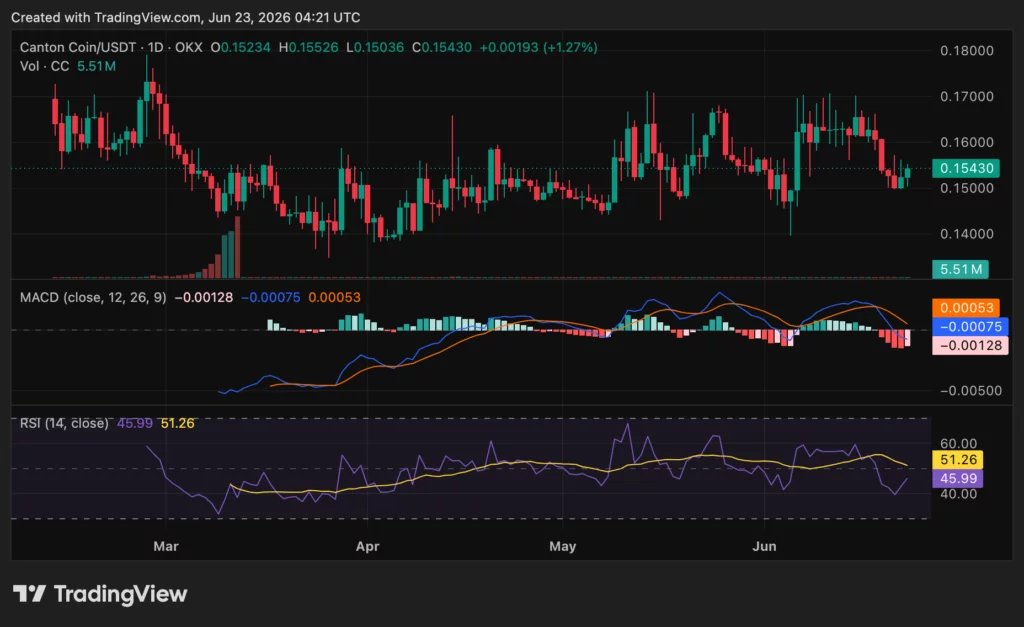
Canton traded at $0.153908 on June 23, based on crypto.news market data. CC rose 1.95% over 24 hours but slipped 0.31% in the past hour. The token stayed down 6.56% over seven days and 5.36% across the past month.
The same data showed 24-hour volume at $10.65 million, with price action between $0.149594 and $0.154728. Canton ranked 19th by market value, with a market cap near $5.98 billion. Its all-time high remains $0.194152, set on Feb. 3, while its all-time low stands at $0.059024 from Dec. 6, 2025.
Technical indicators show weak momentum despite the Bithumb listing news. The MACD histogram stood near -0.00128, with the MACD line below the signal line. RSI stood at 45.99, below its moving average of 51.26, which shows buyers have not regained control.
The indicators do not show heavy selling pressure. RSI remains above oversold levels, and MACD sits close to the zero line. For now, the setup points to consolidation unless RSI moves back above 50 and MACD turns positive again. Stronger spot demand would be needed to confirm a clearer shift.
Disclosure: This article does not represent investment advice. The content and materials featured on this page are for educational purposes only.
Native USDC, EURC, and CCTP Are Coming to Cronos. Expanding Stablecoin Infrastructure for a Growing Ecosystem. The blockchain industry continues to move toward a future where digital assets, traditional finance, and emerging technologies seamlessly interact. In a major step toward that vision, Circle has announced that native USDC, EURC, and Cross-Chain Transfer Protocol (CCTP) support will soon be available on the Cronos network.
This integration brings trusted stablecoin infrastructure to one of the industry’s fastest-growing blockchain ecosystems and opens new opportunities for payments, decentralized finance, AI-powered applications, and institutional adoption.
What Is Cronos?
Cronos is an EVM-compatible Layer-1 blockchain developed by Crypto.com. The network supports a broad range of blockchain use cases, including:
- Digital payments
- DeFi trading and lending
- AI-native applications
- Gaming and Web3 experiences
- Tokenized real-world assets
- Cross-border financial services
With access to Crypto.com’s extensive user base of more than 150 million registered users, Cronos has established itself as a significant blockchain ecosystem capable of supporting both retail and institutional participants.
Why Native USDC and EURC Matter
Stablecoins play a critical role in blockchain ecosystems by providing price stability, liquidity, and efficient settlement mechanisms.
The arrival of native USDC and EURC on Cronos introduces regulated, fully reserved digital currencies directly issued by Circle.
Key Benefits
1. Trusted Fiat-Backed Stability
Both USDC and EURC are designed to maintain a 1:1 value relationship with their respective fiat currencies:
- USDC is redeemable 1:1 for U.S. dollars
- EURC is redeemable 1:1 for euros
This stability makes them attractive for trading, payments, settlement, and treasury management.
2. Enhanced DeFi Liquidity
Native stablecoins can serve as foundational liquidity assets across the Cronos ecosystem.
Benefits include:
- Lower trading slippage
- More efficient capital deployment
- Improved lending and borrowing markets
- Stronger liquidity pools
- Better trading experiences for users
As liquidity deepens, developers can build more sophisticated financial products on Cronos.
3. Support for AI-Powered Transactions
As autonomous AI agents become increasingly active on blockchain networks, stable and programmable digital currencies become essential.
USDC and EURC can help facilitate:
- Agent-to-agent payments
- Automated settlements
- Machine-driven financial workflows
- AI-powered marketplaces
- Cross-platform value exchange
This creates a strong foundation for the next generation of AI-native blockchain applications.
Introducing CCTP: Seamless Cross-Chain USDC Transfers
One of the most significant aspects of the announcement is support for Circle’s Cross-Chain Transfer Protocol (CCTP).
CCTP enables native USDC to move securely between supported blockchain networks without relying on traditional wrapped assets.
What CCTP Enables
Eligible institutions, traders, and development teams will be able to:
- Transfer native USDC across supported blockchains
- Access institutional-grade payment infrastructure
- Utilize the fiat on/off ramps
- Enable full deposit and withdrawal functionality
- Integrate native USDC through APIs
- Improve capital efficiency across multiple ecosystems
For developers building multi-chain applications, CCTP significantly simplifies the movement of liquidity and settlement assets.
Powering the Future of the Cronos App
Native USDC is expected to play an important role within the Cronos App, a mobile-first trading platform designed to unify multiple financial markets.
Users will eventually be able to:
- Deposit dollars
- Trade cryptocurrencies
- Access tokenized stocks
- Participate in prediction markets
- Manage multiple asset classes from a single account
By serving as the primary dollar settlement layer, USDC can help streamline user experiences while reducing friction between traditional and digital financial systems.
Expanding Opportunities for Institutions
Institutional adoption remains one of the most important growth drivers in the blockchain industry.
The addition of native USDC, EURC, and CCTP provides businesses with access to:
- Institutional-grade trading infrastructure
- Compliant onchain settlement
- Programmable payments
- Global liquidity access
- Efficient treasury management
- Cross-border transaction capabilities
For organizations seeking regulated digital asset infrastructure, these capabilities create a more enterprise-ready environment on Cronos.
EURC and the Growing European Opportunity
While USDC has become one of the world’s most widely adopted stablecoins, EURC introduces a unique opportunity for euro-denominated blockchain activity.
EURC can support:
- European payment systems
- Business settlements
- Treasury operations
- Cross-border commerce
- DeFi markets denominated in euros
Its MiCA-aligned framework and euro redeemability make it particularly attractive for businesses and users operating within the European Union.
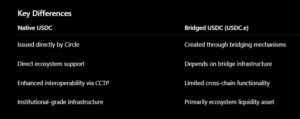
Native USDC vs. Bridged USDC on Cronos
Currently, Cronos supports Bridged USDC (USDC.e), which enables users to access USDC liquidity via bridging.
With the upcoming launch of native USDC, the Cronos ecosystem plans to migrate liquidity toward the native asset gradually.

Importantly, existing USDC.e holders will not experience immediate disruption. Bridged USDC will continue operating normally and remain clearly identified throughout the ecosystem.
A Major Step Forward for Cronos
The upcoming integration of native USDC, EURC, and CCTP represents more than just a stablecoin launch. It strengthens Cronos’ foundation as a blockchain capable of supporting consumer applications, institutional finance, AI-powered systems, and global payments.
By combining trusted stablecoin infrastructure, regulated fiat-backed assets, and seamless cross-chain functionality, Cronos is positioning itself as a hub for the next generation of digital finance.
As blockchain adoption continues to accelerate, the arrival of native USDC, EURC, and CCTP could play a pivotal role in expanding liquidity, improving interoperability, and unlocking new opportunities for developers, businesses, and users across the Cronos ecosystem.
RESOURCES
REQUEST AN ARTICLE

Disclosure: This article does not represent investment advice. The content and materials featured on this page are for educational purposes only.
AI-powered crypto trading platforms are gaining traction in 2026 as investors seek automated strategies, risk controls, and data-driven market execution.
Summary
- Money Simpler is an AI crypto quant trading platform offering automated multi-asset strategies with low entry barriers.
- Platform provides AI automated trading with no coding, offering beginner friendly access and small user rewards.
- Money Simpler supports multi-asset AI strategies across crypto and forex with automated execution and risk controls.
In the volatile cryptocurrency market, manual trading is often limited by emotions, time, and energy, making it difficult to consistently capture market opportunities. As AI technology continues to integrate into the digital asset trading field, more and more investors are leveraging quantitative trading platforms to improve trading efficiency through automated execution and intelligent risk control.
Various AI-powered cryptocurrency quantitative trading platforms and automated trading tools are emerging, but they differ significantly in terms of strategy capabilities, user experience, risk management, and target audience.
This article will conduct a comparative review of the most-watched AI cryptocurrency quantitative trading platforms in 2026 to help investors find more suitable automated trading tools.
2026 best AI cryptocurrency quantitative trading platform ranking
| Rank | Platform | Best For | Ease of Use | Automation | Beginner Friendly |
| 1 | Money Simpler | Passive AI Quant Trading | ⭐⭐⭐⭐⭐ | Full | ⭐⭐⭐⭐⭐ |
| 2 | Pionex | Built-in Trading Bots | ⭐⭐⭐⭐ | Full | ⭐⭐⭐⭐ |
| 3 | Cryptohopper | Strategy Marketplace | ⭐⭐⭐⭐ | Semi | ⭐⭐⭐ |
| 4 | 3Commas | Advanced Traders | ⭐⭐⭐ | Semi | ⭐⭐⭐ |
| 5 | Coinrule | Rule-Based Strategies | ⭐⭐⭐⭐ | Semi | ⭐⭐⭐⭐ |

1. Money Simpler – Best AI cryptocurrency quantitative trading platform of 2026
Money Simpler ranked first in this evaluation, primarily due to its fully automated AI-powered quantitative trading system and extremely low barrier to entry. Compared to many platforms that require users to configure strategies or continuously manage trades, it focuses more on automated execution and operational simplicity.
The platform automatically analyzes the market and executes trades through an AI multi-strategy framework, helping users participate in the digital asset market in a simpler way. For novice investors looking to lower the barrier to entry for quantitative trading, its automated trading experience offers a significant advantage.
New user rewards: Sign up to receive a real reward of $10 and a $50 trial credit.
Key Advantages
- No coding or quantitative trading experience required
- No exchange API setup required
- No need to manually execute trading signals
- AI-powered automated trading system
- Multi-strategy trading framework
- 24/7 automated trade execution
- Automated risk control and position management
- Beginner-friendly user experience
Supported trading scenarios
- Cryptocurrency quantitative trading
- Forex, stock, and ETF trading
- Futures and commodities trading
- Multi-strategy quantitative trading
- 24/7 automated market participation
Who is it best suited for?
Beginner and long-term investors who want to reduce manual operations through AI-automated trading, without the need for programming or complex strategy configuration.
2. Pionex – The best cryptocurrency platform for using built-in trading bots
Pionex is one of the more well-known automated trading platforms in the cryptocurrency market. Its biggest feature is its built-in variety of trading robots, allowing users to utilize automated trading functions without the need for third-party tools.
The platform offers various robot solutions, including grid trading, dollar-cost averaging strategies, and arbitrage tools, suitable for investors who want to use automated tools to assist their trading. Compared to traditional manual trading, Pionex helps users reduce repetitive operations and achieve 24/7 market participation.
Key Advantages
- Built-in automated trading bots
- No third-party integrations required
- Supports popular strategies such as grid trading
- Easy-to-use trading interface
- Suitable for traders exploring automated trading
Who is it best suited for?
Cryptocurrency investors who want to use off-the-shelf trading bots and are willing to choose and adjust trading strategies according to their own needs.
3. Cryptohopper – Best suited for strategy markets and advanced custom trading.
Cryptohopper is one of the earliest automated cryptocurrency trading platforms on the market. Its core features lie in its rich strategy market and high strategy customization capabilities. Not only can users create their own trading rules, but they can also use trading strategies and signals provided by third-party developers.
Unlike platforms that emphasize simplifying the operating process, Cryptohopper is more suitable for users who want to delve deeper into trading strategies. The platform provides functions such as automatic trading, portfolio management, backtest analysis, and strategy optimization, providing more flexibility for more experienced traders.
Key advantages
- Extensive strategy marketplace
- Supports custom strategy creation
- Advanced backtesting and optimization tools
- Automated trade execution
- Highly flexible and customizable platform
Who is it best suited for?
Advanced traders who want more strategy options and customization options, and are willing to invest time in researching trading systems.
4. 3Commas – The most suitable automated trading platform for advanced strategy management
3Commas is a well-known automated trading platform in the cryptocurrency space, renowned for its rich array of trading tools and flexible strategy management features. The platform supports intelligent trading terminals, automated bots, and portfolio management tools, providing users with a high degree of strategic freedom.
Compared to platforms that focus more on simplifying operations, 3Commas emphasizes trading control. Users can customize trading rules, risk parameters, and automated execution logic to achieve more personalized trading management.
Key Advantages
- Comprehensive automated trading tools
- Supports multiple trading bot strategies
- Flexible risk management settings
- Portfolio management features
- Suitable for experienced traders
Who is it most suitable for?
Experienced professionals who are familiar with technical analysis require sophisticated and customized trading strategies, engage in high-frequency trading across multiple asset classes, and seek a high degree of strategy control.
5. Coinrule – The best platform for rule-driven automated trading
Coinrule is a platform focused on rule-driven automated trading, its core feature being the ability to create trading rules without programming. Users can build automated strategies using simple conditional logic, enabling market monitoring and trade execution.
The platform offers numerous preset templates to help users quickly establish automated trading processes. Compared to professional quantitative trading platforms, Coinrule emphasizes ease of use and strategy visualization, making it popular among novice users looking to try automated trading.
Key Advantages
- Rule-based strategy automation
- Extensive strategy template library
- Visual strategy builder
- Automated trade execution
- Flexible strategy customization
Who is it best suited for?
Investors who want to experience automated trading without coding and are willing to set their own trading rules based on market conditions.
How to choose the best AI trading robot in 2026?
When choosing an AI trading robot, investors should focus on its level of automation, ease of use, risk control capabilities, and long-term stable operation. For most ordinary investors, platforms that require no programming, complex configuration, and have automated execution capabilities are generally easier to use.
If automation and user-friendliness are paramount, Money Simpler is a platform worth considering; if more customization options are desired, other specialized trading tools can be considered.
Frequently Asked Questions (FAQ)
Are AI cryptocurrency quantitative trading platforms suitable for beginners?
Yes. Many platforms now offer automated trading features, allowing beginners with little or no quantitative trading experience to get started quickly.
Do I need programming knowledge to use AI quantitative trading?
Not necessarily. For example, Money Simpler allows users to access AI-powered automated trading without coding or complex configurations, making it a suitable option for those looking for a lower learning curve.
Can AI trading bots guarantee profits?
No. AI trading tools can help execute strategies and manage risk, but no platform can guarantee profits. Investors should always be aware of market risks and invest responsibly.
Why does Money Simpler rank first in this review?
Money Simpler stands out for its high level of automation, ease of use, and beginner-friendly experience. Its no-code approach and simplified setup process contributed to its top overall ranking in this comparison.
Conclusion
As AI-driven quantitative trading continues to develop, more and more investors are leveraging automated tools to participate in the digital asset market. Different platforms vary in their level of automation, strategy functionality, and ease of use, catering to different types of traders.
Based on the results of this evaluation, Money Simpler stands out with its fully automated AI-driven quantitative trading system, low barrier to entry, and user-friendly interface, making it one of the AI cryptocurrency quantitative trading platforms to watch in 2026.
Users who wish to learn more about the platform’s features can visit the Money Simpler official website to register an account, explore available AI-driven quantitative trading solutions, and experience the related functions offered by the automated trading platform.
Disclosure: This content is provided by a third party. Neither crypto.news nor the author of this article endorses any product mentioned on this page. Users should conduct their own research before taking any action related to the company.

Ethlabs, a newly launched Ethereum-focused research and development nonprofit, says it was created to help prepare the network for what it describes as the next wave of institutional adoption. Backed by former Ethereum Foundation contributors and funded by firms including Bitmine and Sharplink—along with support from Ethereum co-founder Joe Lubin—the initiative is positioned as a dedicated, long-term home for core technical work.
Sharplink said in its announcement that Ethlabs exists to ensure Ethereum can absorb increasing on-chain activity at scale, pointing to the growing movement of stablecoins, tokenized real-world assets, funds, and autonomous AI commerce onto public networks. The launch arrives amid renewed attention to Ethereum’s governance and funding challenges, including warnings from former Ethereum Foundation contributor Trenton Van Epps about a potential “slow-burning funding crisis.”
Key takeaways
- Ethlabs is a new nonprofit designed to support Ethereum’s research and core development with stable, long-term funding.
- Its backers include Sharplink, Bitmine, and Ethereum co-founder Joe Lubin, alongside former senior Ethereum Foundation researchers.
- The announcement frames Ethereum as a “neutral, credibly permissionless settlement layer” for institutional on-chain activity.
- The timing underscores ongoing scrutiny of Ethereum Foundation resources and leadership turnover.
A dedicated institutional-ready R&D push
Ethlabs was launched to “ready Ethereum for the next phase of institutional adoption,” according to Sharplink’s statement. In that framing, Ethereum’s role expands beyond a base layer for crypto-native trading and apps—toward the settlement layer for global financial activity as more assets and services migrate on-chain.
Sharplink emphasized that as stablecoins and tokenized assets grow in use, demand is increasingly converging on Ethereum. Ethlabs’ stated goal is to make sure the network is technically prepared for that shift, particularly in terms of scaling and readiness for enterprise-grade usage.
The organization was presented as a continuation of research work traditionally tied to Ethereum’s deepest infrastructure and upgrade cycles. Sharplink said Ethlabs brings together technologists who have helped guide the network through major upgrades over the past decade, and that the project offers that work a more “institutional” structure with stable funding rather than relying exclusively on short-term cycles.
Who’s behind Ethlabs
Ethlabs was co-founded by five former senior Ethereum Foundation researchers: Ansgar Dietrichs, Barnabé Monnot, Caspar Schwarz-Schilling, Josh Rudolf, and Julian Ma. The nonprofit is also tied to funding support from Bitmine and Sharplink, according to Ethlabs’ launch announcement.
Joe Lubin, an Ethereum co-founder, said Ethereum is “entering its next stage of evolution,” and argued that multiple “steward nodes of Ethereum” should help grow the blockchain’s utilization. In his statement, he linked Ethlabs directly to a long-term effort to support independent research and development aligned with Ethereum’s core values.
Lubin added that giving researchers and developers “a long-term, independent home” could be instrumental in preparing Ethereum for the “next major wave of adoption.” The implication is that Ethlabs is meant not only to contribute technical research, but also to preserve continuity of expertise during periods when institutional attention and funding structures are under pressure.
Context: renewed debate over Ethereum Foundation funding
The Ethlabs launch comes just days after Trenton Van Epps—described as a former Ethereum Foundation contributor—warned Ethereum could face a “core development funding crisis.” His concern fits into broader commentary that Ethereum may be drifting toward a funding squeeze for long-term protocol work.
At the Foundation level, the issue has been publicly discussed before. Earlier this year, Vitalik Buterin stated that the Ethereum Foundation’s resources were limited, noting it held about 0.16% of the total supply of ether (ETH). While the figure alone doesn’t determine whether core development is funded adequately, it has become part of the public narrative about whether the Foundation’s current structure and holdings can sustain the ecosystem’s ongoing engineering demands.
Leadership changes have also kept pressure on Ethereum’s institutional arrangements. The article notes an ongoing wave of departures from the Ethereum Foundation, most recently the departure of co-executive director Hsiao-Wei Wang, who left last week.
Crypto educator David Hoffman was cited as saying the Foundation was “intentionally leaving a power vacuum” for new structures to step in and influence Ethereum’s direction. Hoffman added that Ethlabs’ approach represents a “brightest future” for Ethereum—commentary that reflects a belief that the new nonprofit could help stabilize or reshape how long-term research is supported.
What investors and builders should watch next
For market participants and builders, the real question is how Ethlabs’ “institutional home” translates into measurable continuity for Ethereum development. The narrative emphasizes stable funding and dedicated research leadership, which—if sustained—could reduce the risk of stop-start engineering cycles that can slow protocol work.
At the same time, the timing suggests Ethlabs is attempting to address not only technical scaling needs, but also the ecosystem’s trust and governance concerns around who funds and stewards the next phase of Ethereum’s roadmap. With public debate ongoing about Ethereum Foundation resource constraints and the direction of core development, Ethlabs may become one of the key organizations shaping the next chapter.
Ether price performance is also part of the broader backdrop mentioned in the report, with ETH trading about 65% below its peak near $1,700, levels last seen in October 2023 and April 2025, amid what the article characterizes as “crypto winter” sentiment lows. While price doesn’t validate a development strategy on its own, funding concerns and builder incentives often become more acute when market conditions are weak.
Readers should watch whether Ethlabs moves beyond announcements into sustained research output, clear funding commitments, and ongoing collaboration with Ethereum’s broader development ecosystem. The organization’s success will likely depend on whether it can maintain long-term support while demonstrating concrete technical contributions that match the network’s scaling and institutional adoption priorities.


Strategy has increased its cash reserves by $300 million while adding 520 Bitcoin worth roughly $35 million, highlighting a growing focus on liquidity alongside continued cryptocurrency purchases.
Summary
- Strategy bought 520 Bitcoin for $35 million, raising its total holdings to 847,363 BTC.
- A June 22 filing showed the company increased cash reserves by $300 million to $1.4 billion.
- Debate over STRC intensified as critics questioned Strategy’s capital structure despite Saylor’s defense.
According to a June 22 filing, the company acquired 520 Bitcoin at an average price of $67,068 per coin, bringing its total holdings to 847,363 BTC.
The purchase followed a familiar signal from Executive Chairman Michael Saylor, who posted “Looks better with more dots” on X a day earlier alongside Strategy’s Bitcoin acquisition chart, a graphic that traders closely watch for clues about upcoming purchases.
Although the latest acquisition extended Strategy’s accumulation streak, the filing showed a much larger movement elsewhere on the balance sheet. Cash reserves increased by $300 million to $1.4 billion after the company sold 2.71 million MSTR shares for approximately $335.5 million during the previous week.
Cash reserves take center stage
In the filing, Strategy said it plans to continue replenishing its USD Reserve to support the credit quality of its Digital Credit securities. The disclosure arrived as investors remain focused on STRC, the company’s preferred stock, which recently traded well below its $100 par value.
Only a small portion of the proceeds raised from the MSTR share sale appears to have been directed toward the latest Bitcoin purchase. The remainder was largely retained as cash, a move that has fueled discussion among market participants about whether supporting STRC has become a more immediate priority.
Some investors expect Strategy to increase STRC’s dividend rate to improve demand and help the preferred shares recover toward par value. Others have suggested stock buybacks as another possible option.
Earlier on June 21, Saylor defended the company’s financing model as criticism surrounding STRC intensified. According to comments shared by Saylor, Strategy’s combined Bitcoin and cash holdings exceed its outstanding debt by roughly $48 billion. He also stated that the company has raised more than $60 billion in capital since 2022 and deployed those funds into Bitcoin purchases.
Critics question the capital structure
Meanwhile, debate around Strategy’s financing approach has intensified as the company continues to issue securities while expanding its Bitcoin treasury.
Long-time Bitcoin critic Peter Schiff argued that investors could eventually pursue legal action against Strategy and Saylor. Schiff also claimed that the way STRC was promoted may have violated SEC marketing rules, though no regulatory findings supporting that allegation have been announced.
Separate concerns have come from institutional investors. As previously reported by crypto.news, Arca Chief Investment Officer Jeff Dorman suggested that Strategy could ultimately need to sell between $3 billion and $4 billion worth of Bitcoin to relieve pressure on its capital structure and support STRC holders.
The discussion comes as Strategy’s purchases remain closely tied to market sentiment. Earlier this month, the company briefly interrupted its long-running accumulation pattern with a small Bitcoin sale before resuming purchases. Strategy later said the transaction did not alter its long-term Bitcoin strategy.
Despite criticism surrounding the company’s funding model and ongoing MSTR share sales, investors appeared to welcome the latest Bitcoin acquisition. MSTR shares rose 3.44% to $116.40 in pre-market trading on June 22, extending gains after Saylor confirmed the newest addition to Strategy’s Bitcoin reserves.
Bitcoin has reclaimed the $65,000 level after the U.S. Treasury temporarily authorized Iranian oil sales amid progress in talks with Tehran.
Summary
- Bitcoin climbed above $65,000 after the U.S. Treasury temporarily authorized Iranian oil sales through August 2026.
- Falling oil prices and signs of progress in U.S.-Iran negotiations improved market sentiment and supported risk assets.
- Technical charts show Bitcoin attempting a breakout, with the $68,200-$68,500 zone emerging as the next major resistance area.
According to data from crypto.news, Bitcoin (BTC) climbed more than 3.5% from an intraday low of $63,231 to a high of $65,468 on Monday, June 22, before easing to around $65,000 at press time. The asset’s recovery came as investors responded to signs of improving geopolitical conditions and falling energy prices.
In a statement released on June 22, the U.S. Treasury announced a General License allowing the production, delivery, and sale of crude oil, petroleum products, and petrochemicals of Iranian origin through Aug. 21, 2026.
Treasury Secretary Scott Bessent linked the decision to recent diplomatic developments in Switzerland. Bessent stated that ongoing talks had been productive and noted that Iran had committed to maintaining free transit through the Strait of Hormuz while also permitting inspectors from the International Atomic Energy Agency to return to the country.
Additional support for market sentiment came after U.S. Vice President JD Vance said Iran had agreed to allow nuclear inspectors back into the country, a step he described as evidence of Tehran’s willingness to move away from its nuclear program.
Lower oil prices have improved risk appetite
Reports that the U.S. and Iran had agreed to a roadmap targeting a final peace agreement within 60 days weighed on energy markets throughout Monday.
Oil prices fell to around $74 per barrel, extending losses and reaching their lowest levels since early March. Lower crude prices eased concerns that a prolonged conflict in the Middle East could disrupt global energy supplies or add pressure to inflation.
As crypto.news reported earlier today, Pakistan and Qatar released a joint statement after talks held in Switzerland over the weekend, saying both sides had established a framework for pursuing a permanent agreement within 60 days.
While Bitcoin benefited from improving risk sentiment, gains extended outside the crypto market. Gold rose 1.1% on the day, while silver advanced nearly 3%, indicating that investors continued to maintain exposure to traditional safe-haven assets even as risk markets recovered.
Strait of Hormuz traffic has returned to normal levels
Shipping activity through the Strait of Hormuz also showed signs of stabilization following concerns that the waterway could face disruptions.
According to Marine Traffic data, vessel movements through the strategic shipping route increased sharply between June 19 and June 21, with 71 confirmed transits recorded during the period. Traffic peaked on June 20, when 35 vessels passed through the strait.
Marine Traffic data further showed that a growing number of commercial ships were operating with Automatic Identification System signals active, suggesting improving confidence among shipping operators. The increase followed reports that a naval blockade had been lifted and came after Iran reopened the strait under the terms of a ceasefire memorandum signed last week.
Bitcoin price faces key resistance near $68,000
Technical indicators suggest traders are now watching whether Bitcoin can build on its move above $65,000.
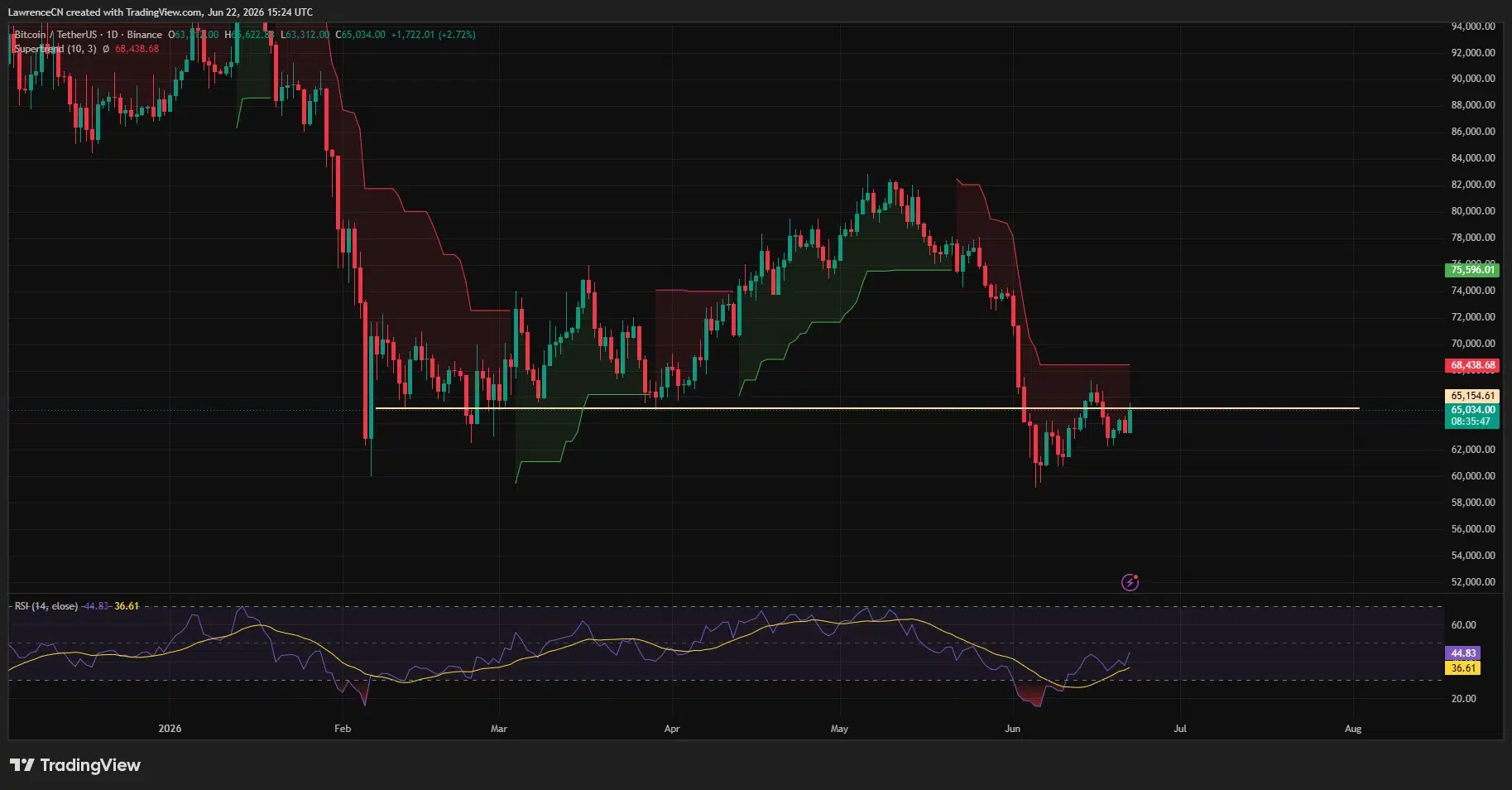
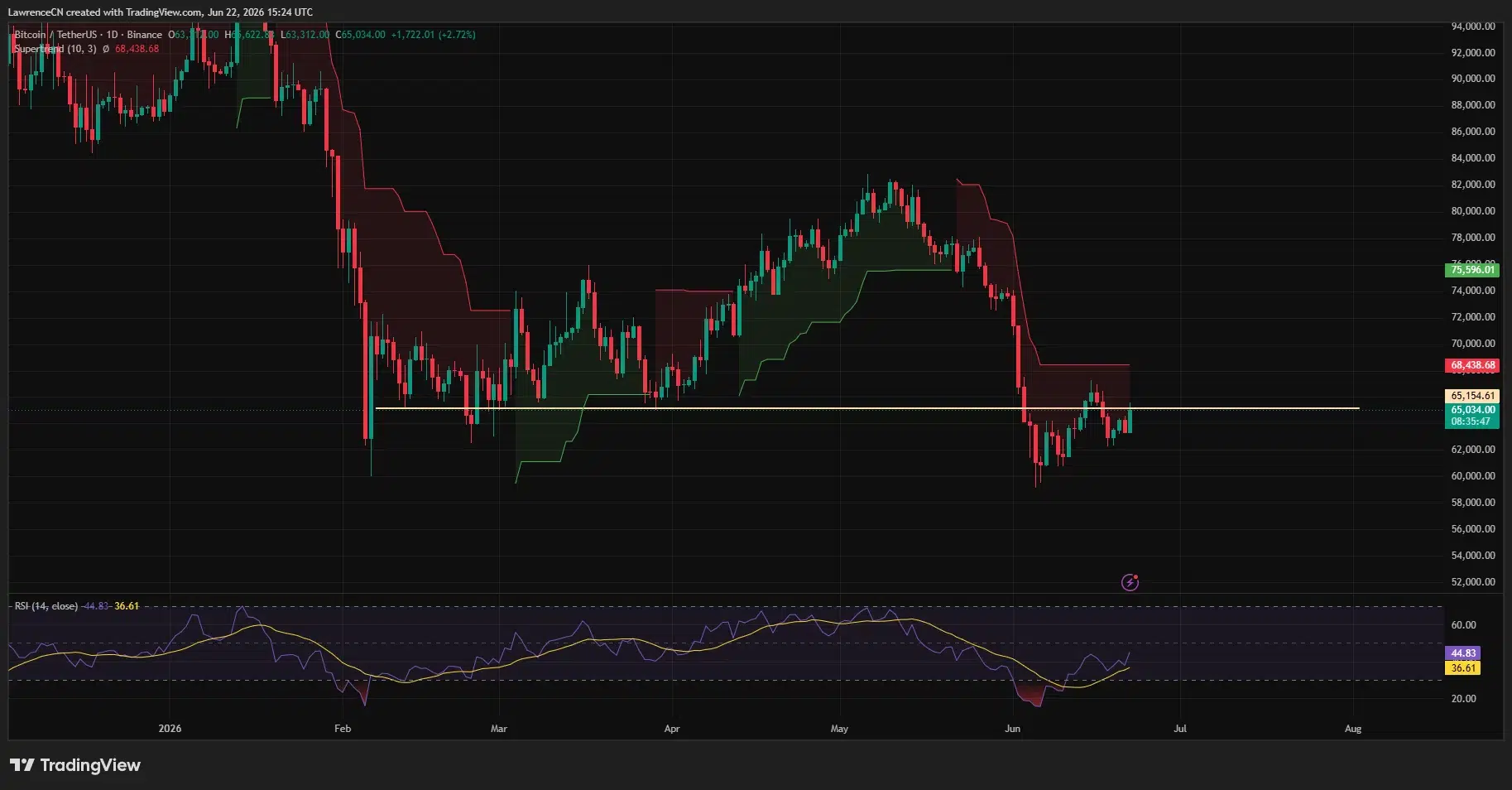
On the daily chart, BTC has reclaimed a former support zone near $65,150 that had acted as resistance following the June selloff. The rebound has pushed the daily RSI higher from oversold conditions, although momentum remains below the neutral 50 level.
Meanwhile, the four-hour chart shows Bitcoin attempting to break out of a multi-week symmetrical triangle pattern that formed after the sharp decline from May highs. The breakout area aligns closely with the 23.6% Fibonacci retracement level near $64,768.
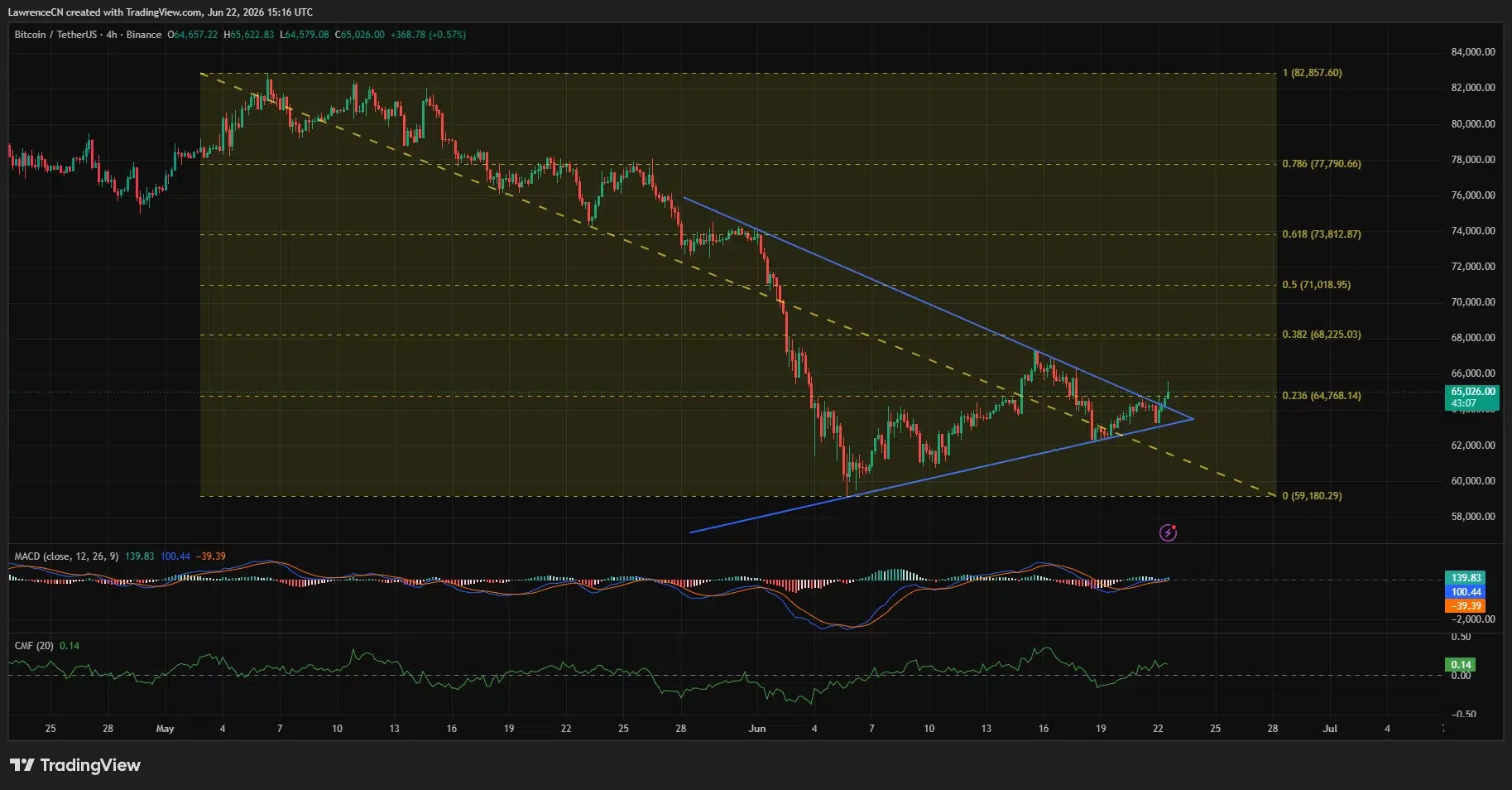
A sustained move above current levels could open the door to the $68,200-$68,500 resistance zone, where the 38.2% Fibonacci retracement and daily Supertrend indicator converge.
Commenting on Bitcoin’s latest setup, analyst Lennaert Snyder suggested Bitcoin’s latest advance appears driven by a squeeze on short positions rather than a decisive trend reversal.
“The 68K/69K is a liquidity cluster I’m mentioning for quite a while now, and still one to carefully monitor.”
Snyder added that “there’s a lot of money to be made for market makers at 68-70K,” highlighting an area where liquidity could continue drawing BTC price higher.
From a technical perspective, however, Bitcoin must first establish $65,000 as support. A rejection from current levels could send the asset back toward $63,200, while the $62,000 area remains the next significant support zone.
Disclosure: This article does not represent investment advice. The content and materials featured on this page are for educational purposes only.
XRP Ledger has deployed fixes for several software issues after a security review uncovered edge cases and bugs in the network’s core implementation.
Summary
- XRP Ledger fixed multiple software issues in the XRPL 3.2.0 upgrade after Common Prefix uncovered bugs and edge cases during a formal security review.
- Common Prefix will next conduct formal verification of XRPL’s Single Asset Vault and Lending Protocol proposals as development expands into DeFi and tokenization.
- XRP rose about 3.6% to an intraday high of $1.16, while debate continued over Ripple’s XRP escrow strategy and future token releases.
According to the XRP Ledger Foundation, the fixes were included in the recently released XRPL 3.2.0 upgrade after blockchain security firm Common Prefix identified numerical and behavioral issues during a formal analysis of the network.
The collaboration, announced in a June 22 X post, tasks Common Prefix with conducting formal verification and security analysis of the XRP Ledger consensus mechanism. Formal verification relies on machine-checked mathematical proofs to confirm that software behaves according to its specifications under all possible conditions.
During its review, Common Prefix developed models of XRPL components that exposed several edge cases in xrpld, the software that powers XRP Ledger validators. The XRP Ledger Foundation said the issues have already been addressed and deployed through version 3.2.0.
Alongside the consensus review, Common Prefix will maintain the XRPL Payment Engine specification and keep it synchronized with future xrpld releases. The Payment Engine processes all value transfers on the network, including cross-currency payments, decentralized exchange trades, automated market maker interactions, and rippling operations.
Security review expands to lending and vault infrastructure
Attention is now turning to additional protocol features scheduled for deeper security testing.
Following the completion of the initial review, Common Prefix and XRPL contributors will begin formal verification work on the Single Asset Vault proposal, known as XLS-65, and the Lending Protocol proposal, known as XLS-66.
Commenting on the effort, RippleX Head of Engineering J Ayo Akinyele said security requirements must advance as more financial functions move directly into the protocol.
“As XRPL expands the financial capabilities built directly into the protocol, the rigor applied to security, testing, and validation must evolve alongside it. Security doesn’t come from any single review. It comes from layers of testing, validation, and continuous improvement.”
The security initiative arrives as XRP Ledger developers continue preparing the network for more advanced financial applications, including tokenization and decentralized finance services.
XRP supply debate continues alongside network upgrades
While developers focus on protocol security, discussion around XRP’s token economics has continued within the community.
As previously reported by crypto.news, pro-XRP attorney and commentator Bill Morgan recently argued that Ripple should reduce the amount of XRP it returns to escrow following its monthly token unlocks.
Morgan wrote that Ripple “should release more of the 1 billion each month and not lock so much back in escrow,” contending that a faster release schedule could accelerate XRP’s path toward full circulation.
According to Morgan, removing the remaining escrow overhang sooner would strengthen XRP’s argument as a hard-money asset because market participants could evaluate the token without future scheduled releases hanging over supply expectations.
Not all holders share that view. Some traders have argued that larger token releases could increase selling pressure if demand growth fails to match the increase in circulating supply, while others contend that the net amount Ripple ultimately keeps out of escrow carries more weight than the headline unlock figure itself.
Meanwhile, market participants responded positively to the latest XRPL security developments. XRP (XRP) price rallied about 3.6% from $1.12 to an intraday high of $1.16 on June 22 before easing to around $1.14 at the time of writing.

York voices divided following Prime Minister’s resignation
Dollar near 1-yr high with more rate cues in focus; yen in intervention zone

Sharplink, Bitmine, and Joe Lubin Support Ethereum R&D Nonprofit EthLabs


-

 Fashion3 days ago
Weekend Open Thread: Miami – Corporette.com
-
 Tech6 days ago
The Adder At The Heart Of Intel’s 8087 FPU
-

 Entertainment2 days ago
Renter of Home in Anne Heche Crash Denies Settlement With Son
-

 Tech17 hours ago
Microsoft accidentally kills epic Outlook email threads
-

 Business2 days ago
Soccer-U.S. defends Iran World Cup travel restrictions, says discussions ongoing
-

 Politics4 days ago
BBC Reporter Discusses Cross Party Criticism Of Trumps Iran Deal
-
 Business3 days ago
Wall Street Week Ahead: Investors see Micron earnings as pulse check of AI rally momentum
-

 Tech5 days ago
AWS enters the context layer race with a graph that learns from agents, not manual curation
-

 Crypto World3 days ago
HIVE shares jump as $220M AI deal speeds Bitcoin mining pivot
-
 Crypto World3 days ago
Can Charles Hoskinson Really Rescue Cardano?
-

 Crypto World3 days ago
Jake Chervinsky accuses CME of protecting derivatives monopoly
-

 Tech10 hours ago
Nearly 7,000 fake Amazon domains registered ahead of Prime Day 2026, researchers warn
-

 Sports4 days ago
FIFA World Cup 2026: Canada beat 9-men Qatar 6-0 to register first ever win | FIFA World Cup 2026
-

 Business2 days ago
MHP SE 2026 Q1 – Results – Earnings Call Presentation (OTCMKTS:MHPSY) 2026-06-20
-
 Tech2 days ago
Signal’s Meredith Whittaker says AI chatbots ‘are not your friends’ and calls Copilot agents a backdoor
-

 Crypto World5 days ago
Anthropic’s Dario Amodei Urged AI Unity at G7, Even as US Banned His Models
-

 Politics3 days ago
Andy Burnham and the meaning of Makerfield
-

 Business4 days ago
Brexit cost 6% of UK economy, Bank of England company data suggests
-

 Tech5 days ago
Weeks Of In-The-Field Testing And A Verdict
-

 Entertainment3 days ago
Jose Alvarado Wants Taylor Swift at More Knicks Games
You must be logged in to post a comment Login