

Crypto World
Malta to Offer Free ChatGPT Plus Across the Country via OpenAI


OpenAI and the Maltese government have unveiled a world-first partnership to roll out ChatGPT Plus to all Maltese citizens, marking a notable milestone in government-backed AI access. The plan ties free access to a year-long ChatGPT Plus subscription to the completion of a government-supported AI literacy course for residents.
Under the programme, citizens who finish the AI literacy course—developed by the University of Malta—will receive complimentary access to ChatGPT Plus for one year. The course itself covers the basics of what AI is, what it can and cannot do, and how to use it responsibly at home and in the workplace.
“Malta is the first country to launch a partnership of this scale because we refuse to let our citizens stay behind in the digital age,” said Silvio Schembri, Maltese minister for economy, enterprise and strategic projects. “The goal is to turn AI from an unfamiliar concept into practical assistance for our families, students, and workers.”
The Malta Digital Innovation Authority will oversee distribution to eligible participants when the first phase launches this month, with plans to broaden the program as more residents and citizens abroad complete the course.
Key takeaways
- The Maltese government and OpenAI are partnering to provide free ChatGPT Plus access for one year to citizens who complete a government-backed AI literacy course developed by the University of Malta.
- The initiative represents a “world-first” scale in government-AI collaboration and aims to translate AI from a theoretical concept into practical everyday use for families, students, and workers.
- Distribution will be managed by the Malta Digital Innovation Authority, with the first phase starting this month and expansion tied to course completion by more residents and Maltese abroad.
- The partnership sits within OpenAI’s broader “OpenAI for Countries” program, which tailors AI adoption to each nation’s priorities such as education, workforce training and public services.
- OpenAI has signaled a growing global footprint in government partnerships, including work with Estonia on ChatGPT Edu and with Greece under separate country-focused initiatives, as well as defense-related deployments in the U.S. on classified networks.
A first-of-its-kind deal in Malta
At a time when policymakers are weighing how to accelerate AI literacy while managing risks, Malta’s approach pairs education with practical tooling. The University of Malta-led course is designed to demystify AI and provide a framework for responsible usage, a step that could help bridge the gap between theoretical understanding and everyday application. By tying certification and household access to a government-endorsed curriculum, the program signals a deliberate strategy to bake AI familiarity into public life rather than leaving it to private platforms alone.
The one-year ChatGPT Plus subsidy acts as an incentive for citizens to engage with the course and begin integrating AI into daily tasks—from research and writing to workflow automation and problem-solving. The government’s aim is not only to boost digital literacy but to demonstrate how AI can serve as a practical assistant across education, work, and family life. The initial phase is set to roll out this month, with the Malta Digital Innovation Authority charged with ensuring eligible participants receive access and that the rollout scales as more people complete the course, including Maltese residents living abroad.
From a governance perspective, the arrangement underscores a growing willingness among governments to experiment with official AI programs that go beyond mere procurement or pilot projects. It also places a spotlight on how AI access programs can be paired with formal education to produce measurable literacy and usage outcomes rather than ad hoc, platform-centric uptake.
OpenAI for Countries: a tailored, country-by-country approach
The Malta agreement is a notable example within OpenAI’s broader OpenAI for Countries initiative, a programme through which the company collaborates with governments to push AI from early interest to nationwide adoption. Unlike standardized models, this program emphasizes customization aligned with each country’s priorities—spanning education, workforce training and public services. The Malta partnership demonstrates how such a framework can translate into tangible benefits for citizens and institutions alike.
In a broader context, OpenAI has pursued a multi-country strategy designed to fit diverse governance architectures and policy objectives. For example, last year Estonia’s government partnered with OpenAI to provide all secondary school students and teachers with access to ChatGPT Edu, a version tailored to educational needs. Separately, OpenAI has launched an initiative with Greece to expand AI-enabled capabilities within public services. These moves illustrate how governments are experimenting with AI in a structured, policy-aligned manner rather than adopting a one-size-fits-all solution.
The flexibility of the OpenAI for Countries program aligns with a growing trend toward customized public-sector AI tooling, where the focus is not only on how to deploy models but also on how to integrate them into educational curricula, job training, and service delivery. In some arenas, OpenAI’s technology has also found roles beyond civil government—for instance, a reported deal to deploy its models on classified military networks in collaboration with the U.S. defense complex. Such arrangements highlight both the breadth of potential applications and the sensitivities that accompany AI in high-stakes environments.
According to the program’s framing, the goal is to move beyond curiosity about AI to practical, system-wide adoption that can improve efficiency, accessibility and decision-making across public life. The Malta programme signals this broader ambition, illustrating how a national-scale effort can begin with education and access—and scale into ongoing public-sector utility.
What this means for investors, users and builders
From an investor and developer perspective, Malta’s model offers a live-case study in how government partnerships can underpin user onboarding and capability-building around AI tools. For users, the immediate benefit is clear: a structured pathway to use an advanced AI service at no personal cost for a defined period, contingent on completing an educational module that frames safe and responsible use. For builders and policymakers, the initiative tests governance, data governance, privacy protections, and the interoperability of AI services with public-sector workflows. The Malta rollout could inform subsequent programs in other jurisdictions that seek to harmonize AI access with formal education and service delivery standards.
As OpenAI continues to expand country-specific programs, observers will watch how these partnerships navigate issues such as data governance, digital inclusion, and the alignment of AI capabilities with public-interest goals. The Estonia and Greece examples show that governments can tailor AI deployments to educational and administrative ecosystems, potentially creating a blueprint for similar initiatives elsewhere. However, observers will also scrutinize how these programs adapt to different regulatory environments, privacy norms, and financial models as they scale beyond initial pilots.
For developers and platforms building AI-powered tools, Malta’s approach reinforces the importance of establishing clear educational content, public-facing risk disclosures, and governance channels that can handle large-scale adoption. It also underscores the potential for AI literacy to become a prerequisite for broad access to advanced tools, a development that could shape product design, user onboarding, and policy dialogue in the months ahead.
In the broader market context, Malta’s move sits at the intersection of digital literacy, public-sector modernization and AI-enabled public services. While the immediate commercial impact to OpenAI or the University of Malta may be limited by the program’s scope, the symbolic and practical implications could influence how other nations approach AI education and access, potentially accelerating a wave of country-led AI initiatives in the coming years.
Readers should stay tuned to how the first phase unfolds in Malta, including participation rates, user feedback, and any adjustments in eligibility or course content. The evolution of this program will offer important signals about the practical viability of government-backed AI access and its place in a broader strategy to democratize advanced technologies.
OpenAI’s broader strategy to engage with governments remains a developing landscape. As nations explore tailored AI adoption—balancing innovation with safeguards—the Malta initiative adds a concrete data point to the evolving policy and market narrative around AI in the public sector.
For now, the Maltese program marks a notable milestone: a government-backed pathway that connects AI literacy, civic participation and consumer access to a leading AI service, with potential implications that reach far beyond a single country’s borders.
As this initiative unfolds, watchers should monitor not only uptake and satisfaction but also the durability of the model once the year-long free access ends, and how Malta plans to sustain AI-enabled public services in the long term.


A scholarly framework from Stevens Institute of Technology argues for a measured approach to enforcing insider trading rules in prediction markets, rather than pursuing an outright ban. The work suggests that price accuracy in these markets responds to enforcement intensity in a non-linear way, and that policy should aim for a calibrated middle ground to maintain both market integrity and participation.
The paper, released on June 2 by Balbinder Singh Gill, assistant professor of finance, develops a formal economic model to explore how strictly insider trading in prediction markets should be policed. According to Cointelegraph, the model reveals that prediction-market price accuracy varies in a “hump-shaped” fashion with enforcement intensity: too little enforcement invites insiders to crowd out participants, while too much enforcement suppresses the insider’s informative contribution.
Gill explains that tougher enforcement can actually enhance participation by limiting insider-driven distortion, yielding an interior optimum where enforcement is neither minimal nor maximal. “Trade-offs matter,” he suggests, and the resulting policy recommendation favors calibrated enforcement aimed at preserving informative trading without stifling legitimate information discovery.
Key takeaways
- Optimal enforcement for prediction-market insider trading is interior—neither a complete laissez-faire regime nor an outright ban.
- The appropriate level of enforcement should depend on the provenance of the information driving trades.
- Hard-won, independently researched edges warrant lower enforcement, while misappropriated information and manipulation risk justify stronger action.
- Regulatory actions and platform responses are already evolving, with ongoing enforcement warnings and measures to increase disclosure and oversight in sensitive markets.
- High-profile cases and congressional attention underscore the broader regulatory relevance for platforms, financial institutions, and market participants.
Calibrated enforcement in prediction markets
The central argument of Gill’s model is that price discovery in prediction markets benefits from a balanced enforcement regime. Inadequate enforcement allows insiders to crowd out diverse participation, undermining the informational content of prices. Conversely, excessive enforcement can suppress insider contributions that carry genuine, timely information, thereby degrading market efficiency. The resulting insight is that enforcement should be calibrated to achieve optimal welfare, rather than pursuing maximal crackdowns or laissez-faire tolerance.
Gill emphasizes that the impact of enforcement depends on the nature of the information and its source. Markets should be designed to tolerate the kind of information that participants obtain through legitimate, diligent efforts, while mitigating information flows that are misappropriated or susceptible to manipulation. The nuanced perspective aligns with a broader policy objective: preserve the integrity of price formation without disincentivizing information production and market participation.
Trading on a genuine, independently researched edge is the activity society should be most reluctant to punish […] And trading by those who can move the outcome warrants the stiffest enforcement, because their positions invite manipulation.
Kalshi’s response and enforcement landscape
The academic framing arrives as prediction-market operators increase their regulatory and operational safeguards. Kalshi, for its part, has begun introducing measures intended to curb insider trading by enhancing data collection and risk assessment in sensitive markets. Specifically, Kalshi is requiring users in certain markets—such as those tied to company performance or national security—to disclose their employer via an online form. It has also developed a “specific risk score” to flag markets with heightened insider-trading or manipulation risk.
The timing coincides with governance and regulatory developments following an audit-committee review and heightened scrutiny from lawmakers and regulators. The changes come amid broader enforcement attention on prediction markets: the Commodity Futures Trading Commission’s (CFTC) enforcement chief warned in April that insider-trading violators would face enforcement action, and in May U.S. House lawmakers opened a probe into Kalshi and Polymarket over insider trading concerns.
Two recent high-profile cases illustrate ongoing regulatory risk in this space. A Google employee was charged in May for allegedly using insider information about the company’s search trends to trade on Polymarket for substantial gains, and a U.S. soldier faced charges in April for trading on classified knowledge of a military operation. These incidents have fueled calls for stronger controls and more robust AML/KYC frameworks within prediction markets.
Regulatory context and policy implications
Gill’s framework sits amid a dynamic regulatory landscape that spans U.S. authorities and international approaches. In the United States, the CFTC continues to signal a zero-tolerance stance toward market manipulation and insider trading in derivatives-like markets, while lawmakers scrutinize platform conduct and enforcement effectiveness. The evolving oversight has implications for exchanges and liquidity providers, who must balance user privacy, data collection, and regulatory compliance requirements.
Beyond the U.S., the growing attention to stablecoins, cross-border activity, and regulatory harmonization—such as the European Union’s Markets in Crypto-Assets Regulation (MiCA) framework—highlights the need for consistent risk-management standards. Institutions engaged with prediction-market activity—banks, asset managers, and corporate treasury teams—face increasing compliance expectations around information governance, employee disclosures, and market manipulation controls. A calibrated enforcement approach that preserves legitimate information production while deterring misuses can help align market design with formal regulatory objectives and cross-border policy coherence.
From a risk-management and compliance perspective, the discussion underscores several practical implications for operators and participants. First, a tiered approach to information provenance—recognizing the difference between hard-earned research and misused confidential data—offers a path to more precise AML/KYC and surveillance requirements. Second, enhanced disclosure and risk-scoring mechanisms may be warranted in markets identified as susceptible to insider trading or manipulation. Finally, ongoing regulatory engagement—through supervisory guidance, enforcement actions, and legislative oversight—will continue to shape how prediction markets are structured and governed.
Closing perspective
As enforcement expectations evolve, the emphasis on calibrated, provenance-aware policies could refine how prediction-market platforms balance innovation with integrity. In the near term, continued regulatory scrutiny, platform-adjusted controls, and further empirical research will determine whether interior enforcement can reliably sustain price informativeness without stifling legitimate information discovery.
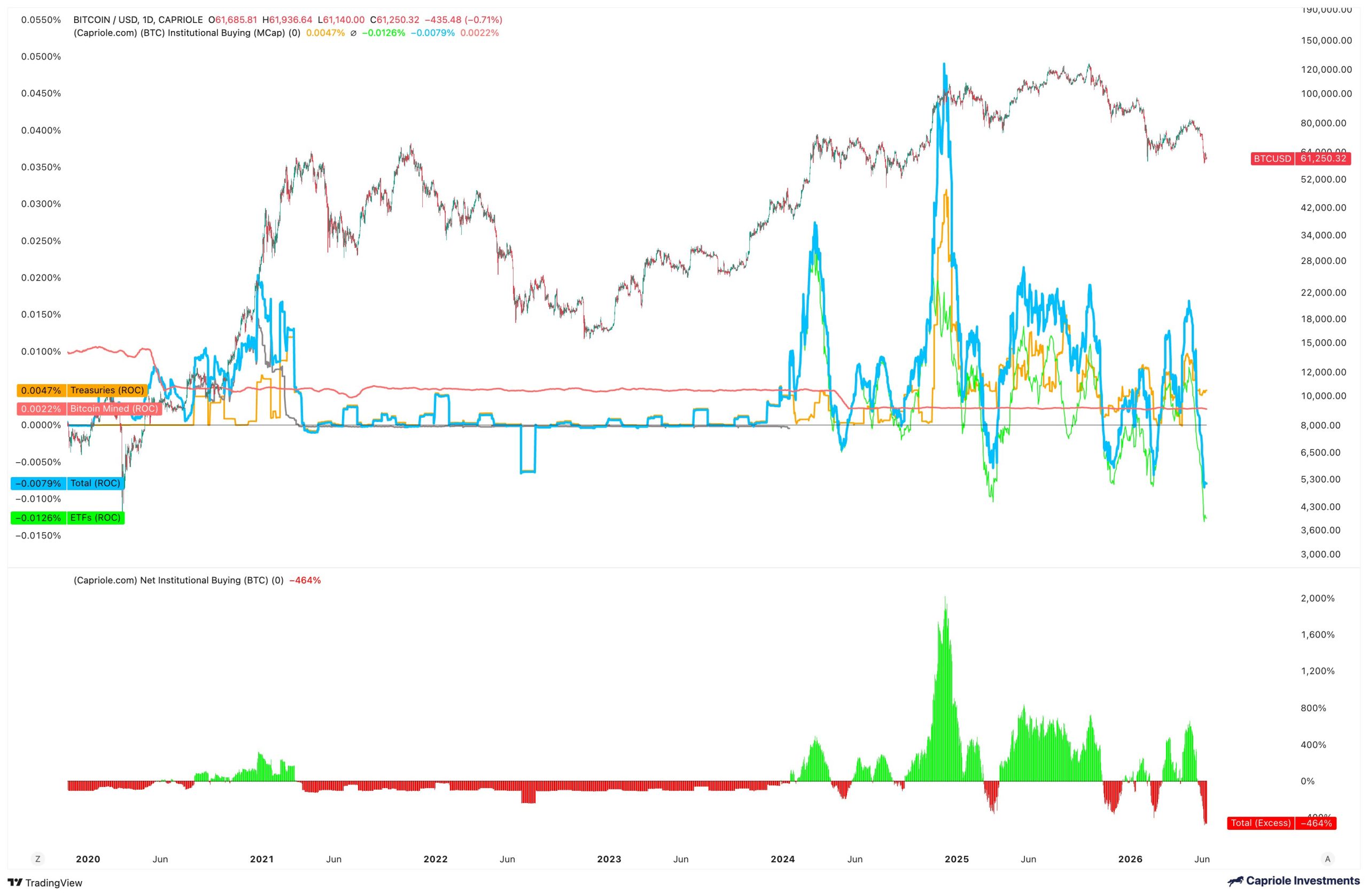
Bitcoin (BTC) faced renewed risks of a breakdown toward $30,000, according to a new analysis, as institutional demand turned deeply negative.
Key takeaways:
- Data shows institutions are offloading around 450% of the daily BTC supply.
- Bitcoin risks slipping below $30,000 if supply absorption remains weak.
Institutions are selling almost 2,000 BTC per day
Capriole Investments’ institutional buying model, which tracks Bitcoin demand from ETFs, corporate treasuries, and miner issuance, shows net institutional selling at around 450% of daily mined supply, equivalent to about 2,000 BTC per day.
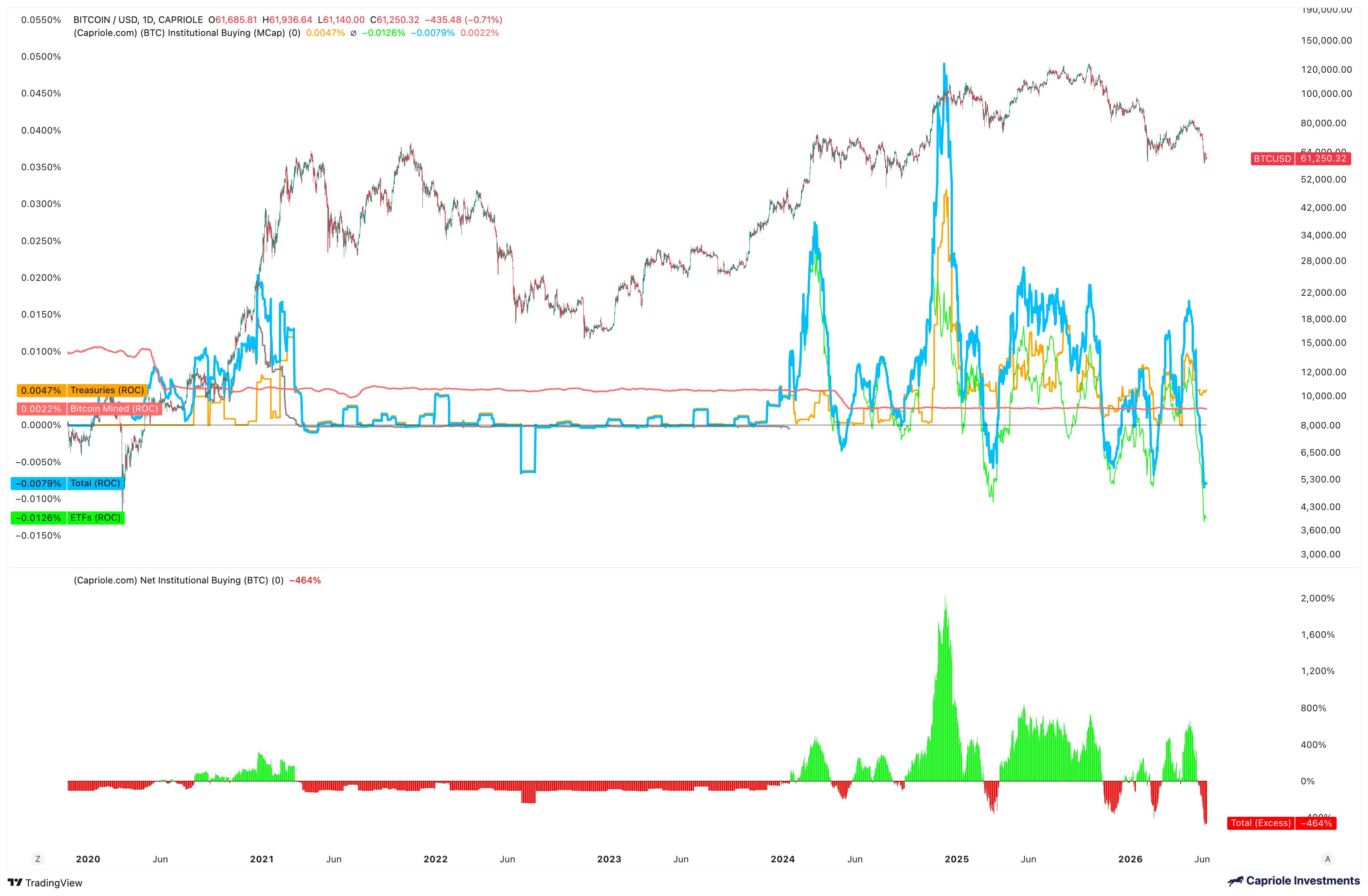
BTC/USD vs institutional buying market cap. Source: Capriole Investments
In other words, large holders are selling 4-5x more Bitcoin than is mined each day.
Spot Bitcoin ETFs appear to be the biggest drag. Their flow line has fallen sharply below zero, suggesting ETF outflows are now overwhelming other sources of demand.
In the past month, for instance, these funds have witnessed nearly $27 billion in withdrawals, according to data resource Glassnode.
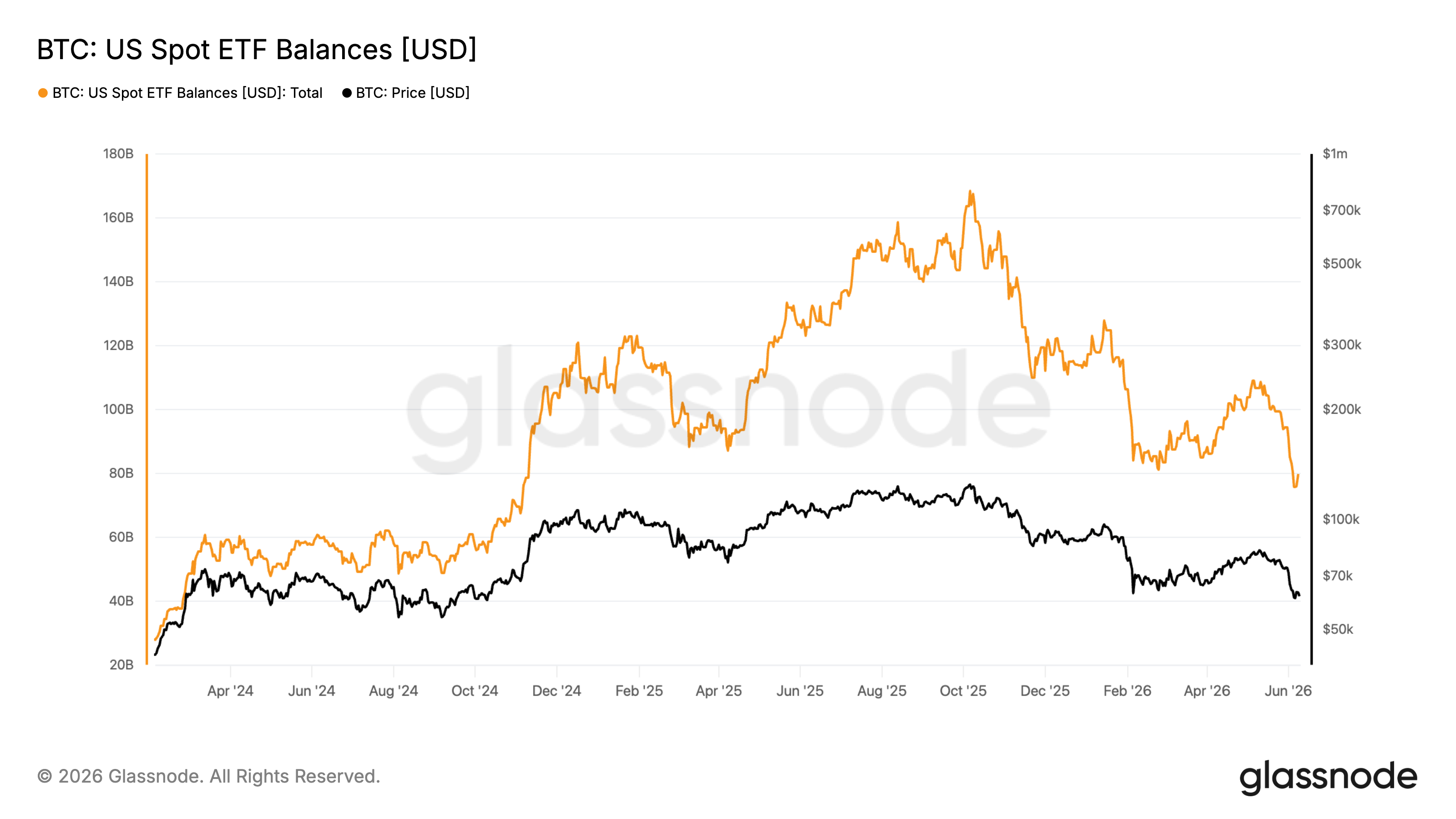
US Bitcoin Spot ETFs net balances vs. BTC price. Source: Glassnode
That marks a sharp reversal from the 2024–2025 trend, when ETF inflows helped push Bitcoin toward record highs.
Strategy’s slowdown is a weak spot
Michael Saylor’s Strategy helped anchor Bitcoin’s institutional demand earlier in 2026, buying 89,599 BTC in Q1 alone.
The company kept buying into Q2, adding roughly 62,300 BTC through late May, including a major 24,869 BTC purchase in mid-May. That lifted its holdings above 843,000 BTC.
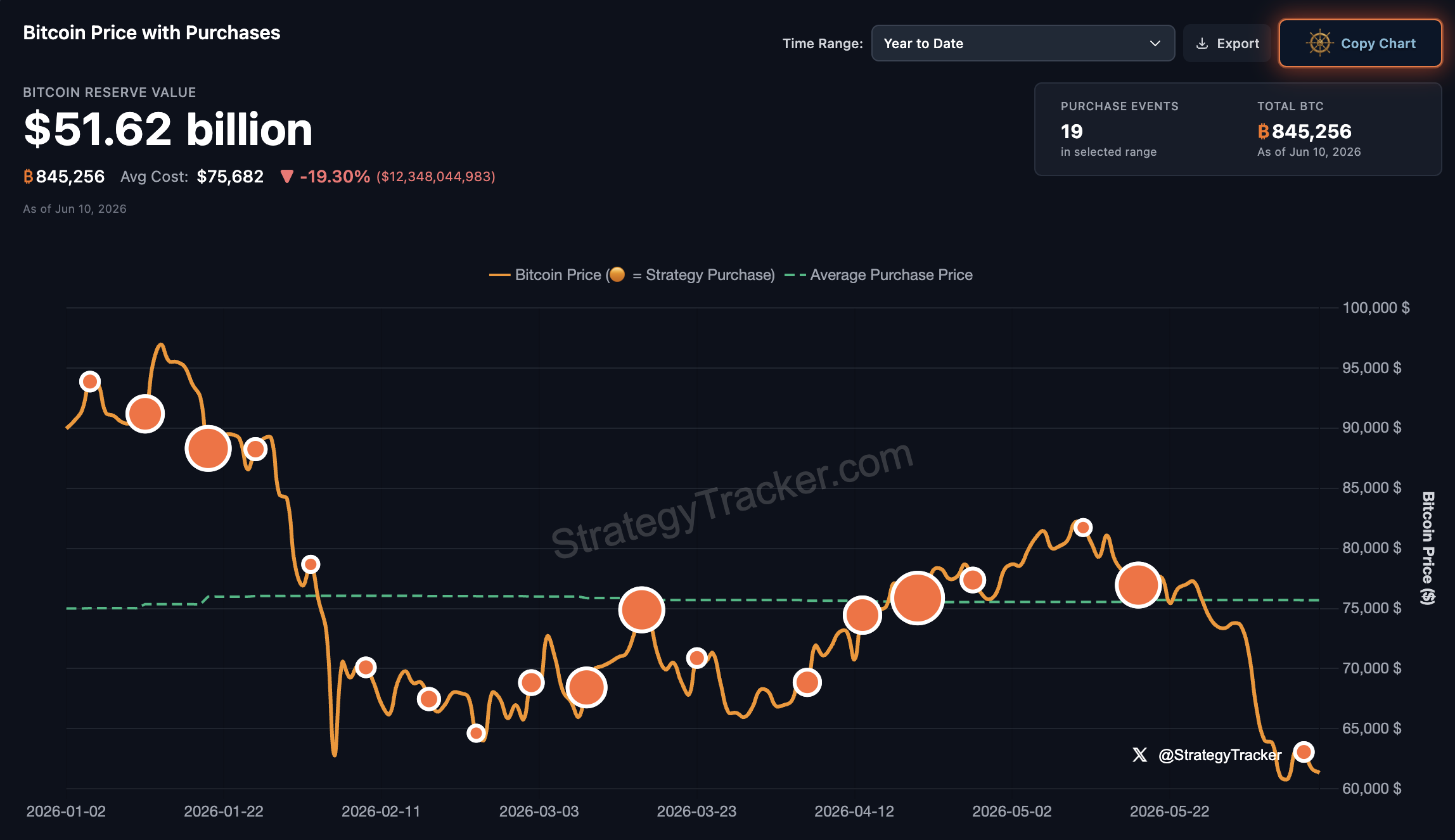
Bitcoin price with Strategy purchases. Source: StrategyTracker.COM
The accumulation coincided with BTC’s roughly 40% rebound from its 2026 low of $59,930, reinforcing the view that corporate treasury demand remained one of the market’s strongest pillars during the recovery.
However, its latest buying has slowed sharply, with only a 1,550 BTC purchase in early June after a small 32 BTC sale to fund preferred-stock dividends.
Related: Why Strategy’s 32 Bitcoin sale became a bigger crypto debate
Strategy’s latest purchases are running well below its Q1 and early Q2 pace, and they barely cover ETF-led selling pressure, which Capriole’s model estimates at roughly 2,000 BTC per day.
Bitcoin may slip toward $30,000 or lower, analyst warns
BTC’s latest leg down could match its previous 36%–39% declines, putting the next downside target in the $49,000–$53,000 range, according to analyst CryptoBullet.
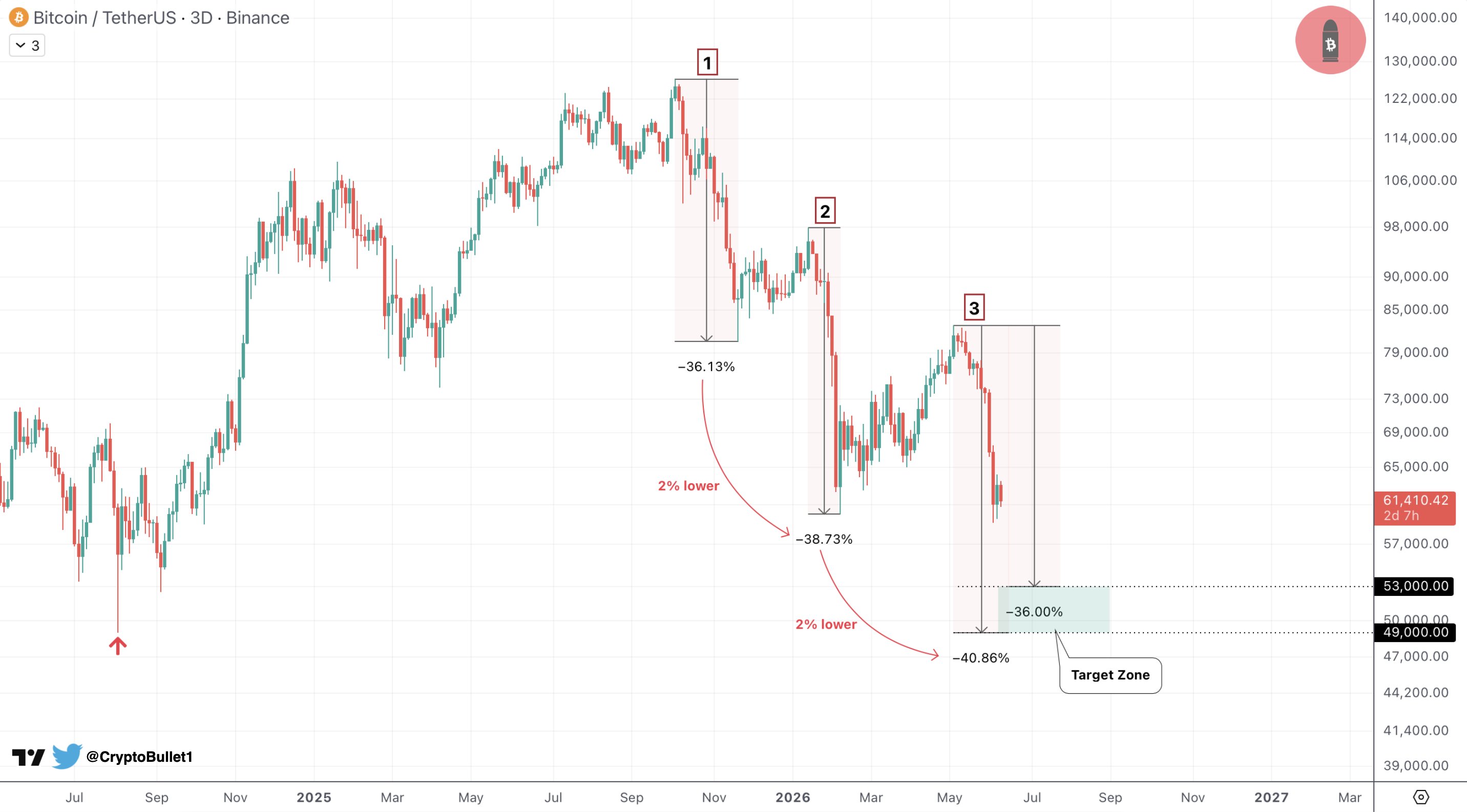
BTC/USD three-day chart. Source: TradingView/CryptoBullet
That zone may act as initial support, but analyst Jelle’s Fibonacci model suggests it may not mark the final bear-market floor.
In a Wednesday post, he noted that every BTC bear market has dropped well below its 0.618 Fibonacci retracement before bottoming. Previously, BTC fell 65% below the 0.618 level in 2014–2015, 59% in 2018 and 44% in 2022.
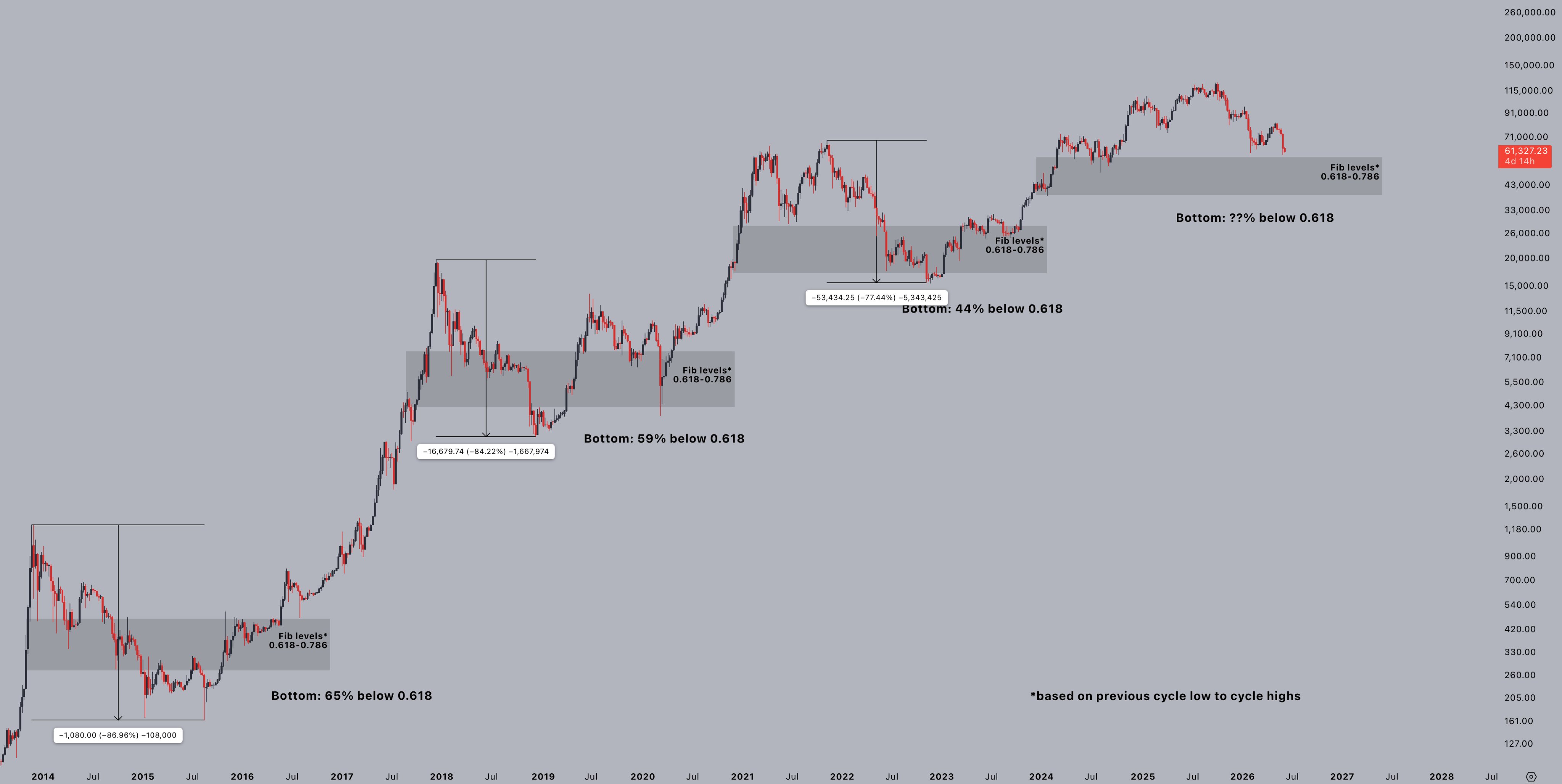
BTC/USD all-time performance chart. Source: TradingView/Jelle
With Bitcoin’s current 0.618 retracement near $57,000–$58,000, even a repeat of the shallower 2022 drawdown would imply a potential bottom near $32,000.
Deeper 2018-style and 2015-style drawdowns would point toward $23,000–$24,000 and $20,000, respectively.


The U.S. Commodity Futures Trading Commission proposed its first prediction markets regulation on Wednesday, pitching an approach to how it can make widespread evaluations of whether contracts trip the federal standard for what’s off-limits.
The agency that regulates U.S. derivatives has been a defender of prediction markets such as those run by Kalshi, Polymarket and Crypto.com, with Chairman Mike Selig making them a top legal and regulatory priority for the CFTC. He’s been promising a new, tailored regulatory regime for the industry, and the new proposal addresses part of what may be multiple rules pursued by the regulator.
“The CFTC will protect the integrity of our regulated markets without standing in the way of responsible innovation,” Selig said in a statement. “This proposal gives the commission a durable, transparent framework to identify the contracts Congress directed us to scrutinize while letting legitimate markets move forward.”
Federal law holds that contracts involving war, terrorism, assassination, illegal activity and gaming can be deemed outside of the public interest and not allowed. In practice and in its recent embrace of data-sharing agreements with professional sports leagues, the CFTC has embraced the massively growing field of sports betting as an apparent public interest.
The platforms on which event contracts are traded are regulated exchanges under the CFTC, and the agency has said that exchanges are the first line of defence in determining whether contracts are legal and markets aren’t manipulated or abused.
The proposal weighs a 90-day review process on public-interest determinations for individual contracts.
President Donald Trump has recently expressed support for the track Selig has been on, saying in a social-media post that “Other Countries are after this new form of Financial Market, and we want to remain at the top.”


- Travala launches AI travel protocol for autonomous bookings.
- Platform supports 2.2 million + hotels with on-chain USDC payments.
- Developers earn 10% cbBTC rebates for AI-driven bookings.
Travala has launched what it describes as the world’s first end-to-end agentic AI travel protocol, allowing autonomous artificial intelligence agents to search, book, and pay for travel services with minimal human involvement.
The Singapore-based travel booking platform said the new protocol enables AI agents to access more than 2.2 million hotel listings, including properties operated by major brands such as Marriott, Hilton, and IHG.
The system allows agents to complete the entire booking process independently until final payment authorization is required from the user.
The launch comes as interest in agentic AI continues to grow across industries.
According to Travala, the total value of agentic commerce transactions is projected to reach $8 billion in 2026 and expand to an estimated $3.5 trillion by 2031.
The company also cited Morgan Stanley Research, which forecasts that autonomous “agentic shoppers” could account for up to 20% of all online retail spending by 2030.
Protocol aims to automate travel bookings
At the center of the initiative is the Travala Travel MCP, a Model Context Protocol designed specifically for agentic commerce.
The protocol operates on the Base blockchain and uses the x402 protocol, an open payments standard designed to facilitate direct stablecoin payments between applications, APIs, and AI agents.
According to Travala, the infrastructure enables gasless USDC transactions on Base, with settlement occurring almost instantly and transaction costs of roughly $0.01 per booking.
For consumers, the technology powers an AI travel concierge that can plan, book, and manage trips through a single conversation within Claude.
The company said the system maintains context across searches, bookings, and cancellations, creating a more seamless travel-planning experience.
Travala added that security is maintained through ERC-7715 session keys, ensuring that AI agents can initiate payment requests while final transaction approval remains under the user’s control.
Developer incentives built into the platform
To encourage adoption, Travala has introduced a developer rebate program tied to the new protocol.
Developers who build and integrate AI agents with the Travala Travel MCP will receive a 10% rebate in Coinbase Wrapped Bitcoin (cbBTC) for successful bookings completed through their applications.
The rebates will be settled directly onchain to developers’ wallets.
The protocol also incorporates ERC-8004 technology, which the company said links an agent’s reputation to verified real-world outcomes.
Travala said this creates a machine-verifiable trust layer intended to reward high-performing agents and support ecosystem integrity.
Company sees broader role in agentic commerce
Travala plans to expand the protocol over time by adding new travel products, including flights.
The company also said its native AVA token is expected to gain additional utility as adoption of the Travel MCP grows.
“The launch of the world’s first agentic AI travel protocol marks the death of the checkout button and the beginning of a truly autonomous travel economy,” said Juan Otero, CEO of Travala. “By combining our global travel inventory with the industry’s first machine-to-machine settlement protocol, we’re effectively hardcoding Travala as the default travel rail for the agentic web.”
Sam Frankel, Head of Partnerships at Base, also highlighted the significance of the launch.
“Base is built to be the home of the onchain economy, and Travala’s Travel MCP is exactly what that looks like in practice, devs using our infrastructure to power machine-to-machine commerce that’s seamless, autonomous, and global. We’re thrilled to see Travala lead the charge on real-world use cases for agentic payments,” he said.

Trad.Fi, a United States–based equipment financing platform, unveiled a plan to assemble a private credit pipeline of up to $650 million that will be minted on-chain over the next 48 months. The initiative targets a vast, still largely paper-based segment of the US economy: financing for manufacturing equipment, industrial systems, and residential solar installations. Trad.Fi says the goal is to dramatically shorten the financing cycle, promising a one-day digital credit approval compared with the weeks or months typical of conventional lines of credit.
Crucially, the $650 million figure represents a pipeline, not deployed capital. The credit lines would be supported by committed senior facilities and signed letters of intent from anchor borrowers. Trad.Fi reports about $85 million in signed term sheets already in hand and roughly $40 million expected to close imminently.
Beyond streamlining credit access for small businesses, the initiative includes an on-chain investment pool designed to give investors exposure to the originated equipment-finance loans. A third party, not yet named, is expected to operate the pool when it launches in the coming weeks. In the initial phase, US-based investors will not be eligible to participate.
The architecture behind the tokenization relies on W3, which will tokenize the loans and manage the associated credit records across the Base, Arc, and Avalanche blockchains. Notably, legal agreements tied to the loans—such as UCC-1 filings and borrower documentation—will remain off-chain, creating a hybrid model of on-chain asset records with traditional legal underpinnings.
Trad.Fi’s move sits within a growing, though uneven, ecosystem of tokenized real-world assets (RWAs). The space has seen a flurry of activity as platforms seek to bring more tangible, cash-flowing credit into the blockchain fold, while investors seek diversified yields outside pure crypto markets. Other firms operating in tokenized credit include Centrifuge, Tradable, Maple Finance, Figure Technologies, and Credix.
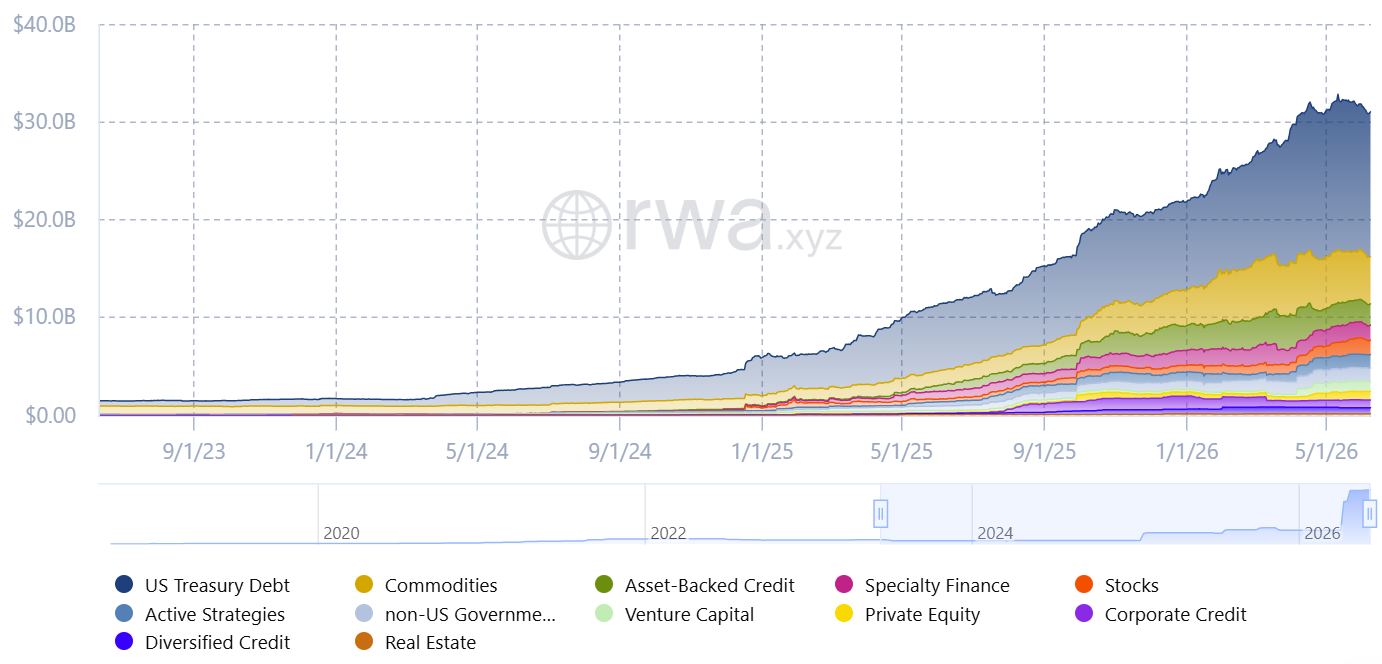
The broader context for RWAs, however, remains nuanced. A recent datapoint places the total value of tokenized RWAs at about $31.3 billion, a figure that has ebbed slightly over the past month. Within that mix, tokenized US Treasury debt accounted for roughly $14.8 billion, while tokenized corporate credit was around $1.2 billion, illustrating both the scale and the ongoing consolidation within the asset class.
Key takeaways
- Trad.Fi aims to create a tokenized private-credit pipeline of up to $650 million over 48 months, anchored by senior facilities and signed LOIs.
- An on-chain investment pool will provide exposure to the originated loans, with initial US participation restricted in the early phase.
- The project hinges on W3’s tokenization rails across Base, Arc, and Avalanche, while key loan documents will remain off-chain.
- RWAs continue to grow as a sector, but the market has cooled recently, with total tokenized assets around $31.3 billion and US Treasury debt forming a large share of the mix.
A push to digitize credit for manufacturers
The core problem Trad.Fi highlights is the friction and time delay that plague traditional credit approval in the equipment-finance domain. Alexander Szul, CEO of Trad.Fi, emphasized that the current system’s heavy paperwork and repetitive workflows contribute to missed business opportunities for small firms seeking capital. He described a shift toward programmable rails as a necessity to move capital, records, and workflows onto a digital backbone that can be accessed and verified in near real time.
Small businesses lose deals waiting for financing, and the only way to fix that is to move the capital, the records and the workflow onto programmable rails.
Structure, participants, and timeline
Under the plan, the $650 million is a credit pipeline rather than immediately deployed cash. Anchor borrowers will sign LOIs and commit to senior facilities that back the on-chain pool. Trad.Fi already reports about $85 million in signed term sheets and roughly $40 million expected to close soon, signaling progress toward a larger funding runway.
The on-chain investment pool is meant to offer capital markets access to the loans originated on Trad.Fi’s platform. A third-party operator will run the pool, with the launch anticipated in the coming weeks. In this early phase, investors based in the United States will not be eligible to participate, reflecting a cautious approach to onboarding capital in a regulated environment.
Tokenization is slated to operate on W3 infrastructure, providing the on-chain credit registers across several networks. While the loan agreements themselves will stay off-chain, the on-chain records are intended to streamline verification, servicing, and reporting for both borrowers and lenders. This hybrid model reflects the current state of the tokenized-credit market, which often blends blockchain-native assets with traditional legal constructs to satisfy regulatory and banking standards.
Industry peers have pursued similar models. Centrifuge, Tradable, Maple Finance, Figure Technologies, and Credix are among the firms that have previously explored or deployed tokenized credit facilities, illustrating a broader trend toward RWAs as a potential source of yield and diversification for crypto-native and traditional investors alike.
RWA market backdrop and investor implications
As RWAs gain traction, trackers note a mixed market dynamic. The overall value of tokenized RWAs has slipped modestly in recent weeks, reflecting ongoing macro and liquidity considerations. Within the asset mix, tokenized U.S. Treasury debt remains the largest segment, underscoring the appeal of high-credit-quality assets within a tokenized framework. Corporate credit, while smaller, represents a meaningful foothold for institutional participants seeking diversified exposure beyond traditional crypto instruments.
The evolving landscape raises several questions for readers: Will the initial exclusion of U.S. investors in Trad.Fi’s pool limit early liquidity, or could subsequent phases open participation to a broader base? How might off-chain loan documentation interact with on-chain recordkeeping in a regulatory context? And what timing and scale will subsequent tokenized-credit offerings achieve as more players enter the space?
For context, recent reporting has highlighted adjacent developments in the tokenized-deposit space, including JPMorgan and Citi-backed Clearing House plans for a tokenized deposit network in 2027, as noted by The Wall Street Journal. These stories illustrate the wider momentum toward integrating traditional financial rails with blockchain-native infrastructure, even as the exact regulatory and operational contours remain under close watch.
All told, Trad.Fi’s push signals a meaningful step toward frictionless, on-chain credit for capital-intensive sectors of the real economy. If successful, the model could offer faster decisioning, more transparent servicing, and a new avenue for investors seeking diversified exposure to equipment-related cash flows without relying solely on conventional lenders.
What remains uncertain is how quickly the pipeline will translate into deployed capital, how the on-chain pool will perform in varying market conditions, and how regulators will treat the hybrid structure of on-chain records with off-chain legal agreements in practice.
Readers should watch for updates on anchor-borrower signings, the pool operator’s identity and launch timeline, and any regulatory clarifications that could affect on-chain credit pools. As RWAs continue to evolve, Trad.Fi’s experiment will be a telling gauge of the efficiency gains and potential hurdles in tokenized, real-world credit markets.
Pyth Network, a blockchain oracle and market data provider, has launched new pricing indexes for US stocks and commodities, a move aimed at supporting around-the-clock trading products across crypto exchanges.
The company announced Wednesday that Coinbase, Kraken, dYdX and Nado are already using the indexes to power new trading markets.
According to Pyth, the indexes are designed for perpetual futures, tokenized assets, prediction markets, derivatives settlement and exchange-traded product benchmarking, providing continuous reference prices even when traditional financial markets are closed.
The initial lineup includes major US stocks such as Nvidia, Tesla, Apple, Circle and Strategy, as well as gold, silver, West Texas Intermediate (WTI) crude and Brent crude.
Pyth also partnered with MarketVector, an index provider owned by VanEck, to develop thematic equity index futures covering sectors and themes including artificial intelligence, defense, technology and China.
The launch expands Pyth’s push into institutional market data services. Earlier this year, the blockchain oracle provider introduced a platform that allows financial institutions to publish and monetize market data across blockchain networks.
Related: RedStone launches settlement layer to address RWA liquidity gap in DeFi lending
Continuous pricing could become critical infrastructure for tokenized assets
The launch reflects a broader push toward around-the-clock trading of real-world assets on blockchain rails. Platforms offering tokenized stocks, commodities exposure and perpetual futures require reference prices even when traditional exchanges in New York or London are closed.
That presents a challenge for products tracking assets such as Nvidia shares or Brent crude, whose primary markets operate on fixed schedules, creating demand for continuous pricing infrastructure.
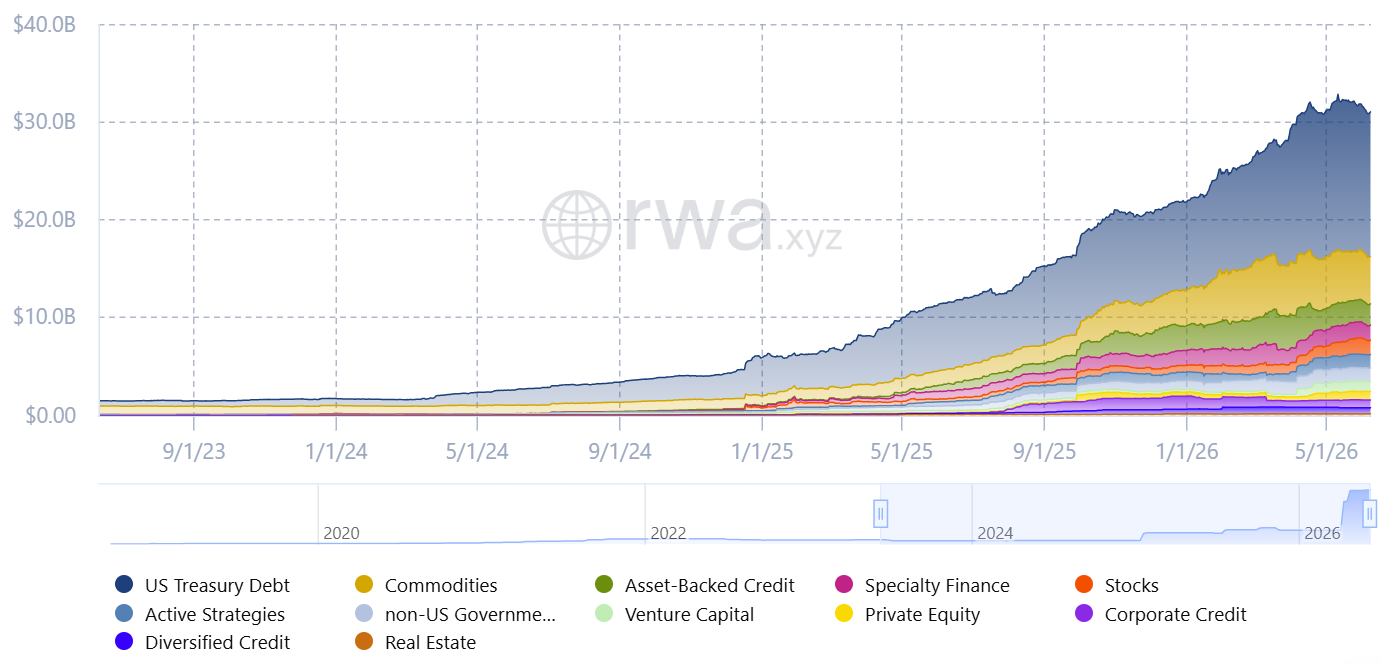
The market for tokenized RWAs, excluding stablecoins. Source: RWA.xyz
The shift comes as tokenized real-world asset (RWA) markets continue to expand, led by tokenized stocks and commodities. Binance Research reported this week that the tokenized stocks sector grew 422% year over year, making it the fastest-growing segment of the RWA market.
Tokenized precious metals also gained traction, with the market expanding 39% over the same period, much of that growth occurring earlier in the year.
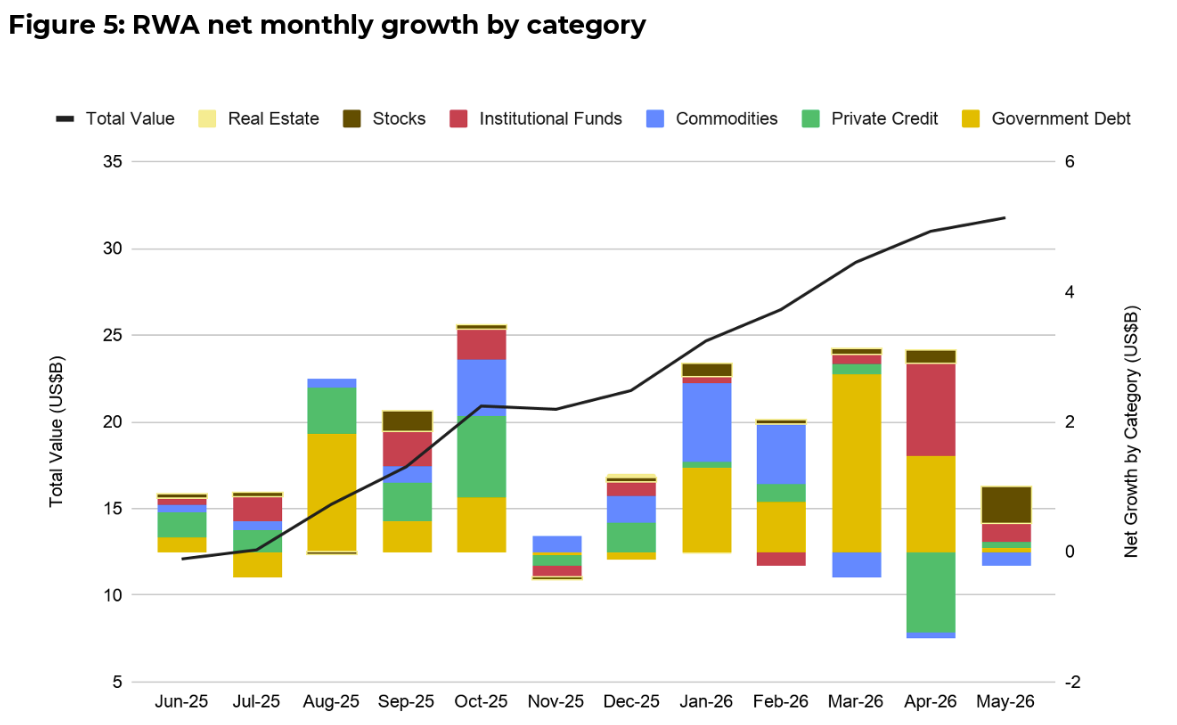
Tokenized stocks, commodities and real estate experienced significant growth over the past year. Source: Binance Research
Related: Crypto Biz: Crypto infrastructure spending rises as ETF appetite cools

Quick Summary
- CBRL shares climbed 11% during premarket hours following an unexpected quarterly earnings beat
- The company reported adjusted earnings per share of 29 cents compared to Wall Street’s projected loss of 48 cents
- Quarterly revenue reached $797.4 million, surpassing analyst projections of $776.7 million
- Annual revenue forecast increased to $3.27B–$3.3B from the previous $3.24B–$3.27B range
- Adjusted EBITDA outlook upgraded to $120M–$125M from the prior $85M–$100M estimate
Shares of Cracker Barrel (CBRL) experienced a remarkable 11% surge during Wednesday’s premarket session after the casual dining chain delivered an unexpected profit and upgraded its annual projections.
Cracker Barrel Old Country Store, Inc., CBRL
The company’s shares finished Tuesday’s regular session at $36.30, reflecting a 43% gain year-to-date, before jumping another 8% to $39.20 in extended trading after the earnings announcement.
During its third fiscal quarter, Cracker Barrel delivered adjusted earnings of 29 cents per share. Wall Street analysts had forecast an adjusted loss of 48 cents. The variance represents a significant outperformance.
On a GAAP basis, the restaurant operator recorded net income of $42.8 million, translating to $1.90 per share, versus $12.6 million, or 56 cents per share, in the same period last year. The GAAP results reflected a $47.4 million legal settlement.
Quarterly revenue totaled $797.4 million, representing a decline from last year’s $821.1 million but exceeding the analyst consensus estimate of $776.7 million.
Negative Comps Continue, but Recovery Underway
Comparable restaurant sales declined 2.6%, while total same-store sales decreased 1.8% on a year-over-year basis. Customer traffic fell approximately 6.7% throughout the quarter.
While these figures remain in negative territory, they represent substantial improvement compared to the 8.5% and 7.9% comparable sales declines experienced in the previous two quarters — when the brand was dealing with significant logo controversy fallout.
Notably, the retail division exceeded restaurant sales performance for the first time in over four years, management highlighted.
Chief Executive Julie Masino informed analysts that the average guest check reached $15.85, representing a 4.3% year-over-year increase, though still trailing casual and family dining sector averages. She indicated that menu adjustments have been implemented to enhance value perception. Chief Financial Officer Craig Pommells expressed that the company remains “encouraged by the gradual improvements in the underlying traffic trend.”
The restaurant chain’s Google Star rating increased 4% year-over-year, reaching its highest point since 2018.
Annual Forecast Upgraded
The quarter’s profitability improvement stemmed from disciplined expense management, including a corporate reorganization finalized in the second quarter that’s projected to deliver $20 million to $25 million in annual cost savings.
Cracker Barrel has revised its full-year revenue expectations to a range of $3.27 billion to $3.3 billion, up from the prior guidance of $3.24 billion to $3.27 billion. The Street consensus had stood at $3.25 billion.
The adjusted EBITDA forecast was elevated to $120 million–$125 million from the previous outlook of $85 million–$100 million. Analyst consensus expectations had been approximately $92.7 million.
Following customer backlash over a brief rebranding initiative, the company restored its traditional logo and reintroduced several original food preparation methods, including the practice of rolling and baking biscuits fresh daily.
Despite the year-to-date rebound, CBRL stock continues to trade 35% below its levels from twelve months ago.

The May Consumer Price Index (CPI) report has just been released, showing that inflation in the United States increased precisely as economists had forecasted.
The figure surged to 4.2%, the highest level since April 2023. For its part, Core CPI (which excludes food and energy prices) has risen to a nine-month peak of 2.9% (again meeting expectations).
This is a concerning development, especially since the Federal Reserve views 2% inflation as healthy. The Kobeissi Letter now warns that the likelihood of future rate hikes is climbing: a factor that may trigger a further sell-off in the already fragile crypto market.
Somewhat surprisingly, though, BTC jumped after the disclosure, reaching almost $62,000 before reversing to the current $61,500 (per TradingView).
Most leading altcoins, including Ethereum (ETH), Solana (SOL), and Ripple (XPR), have mirrored the movement. However, the market remains highly volatile, and the near-term price direction remains unclear.
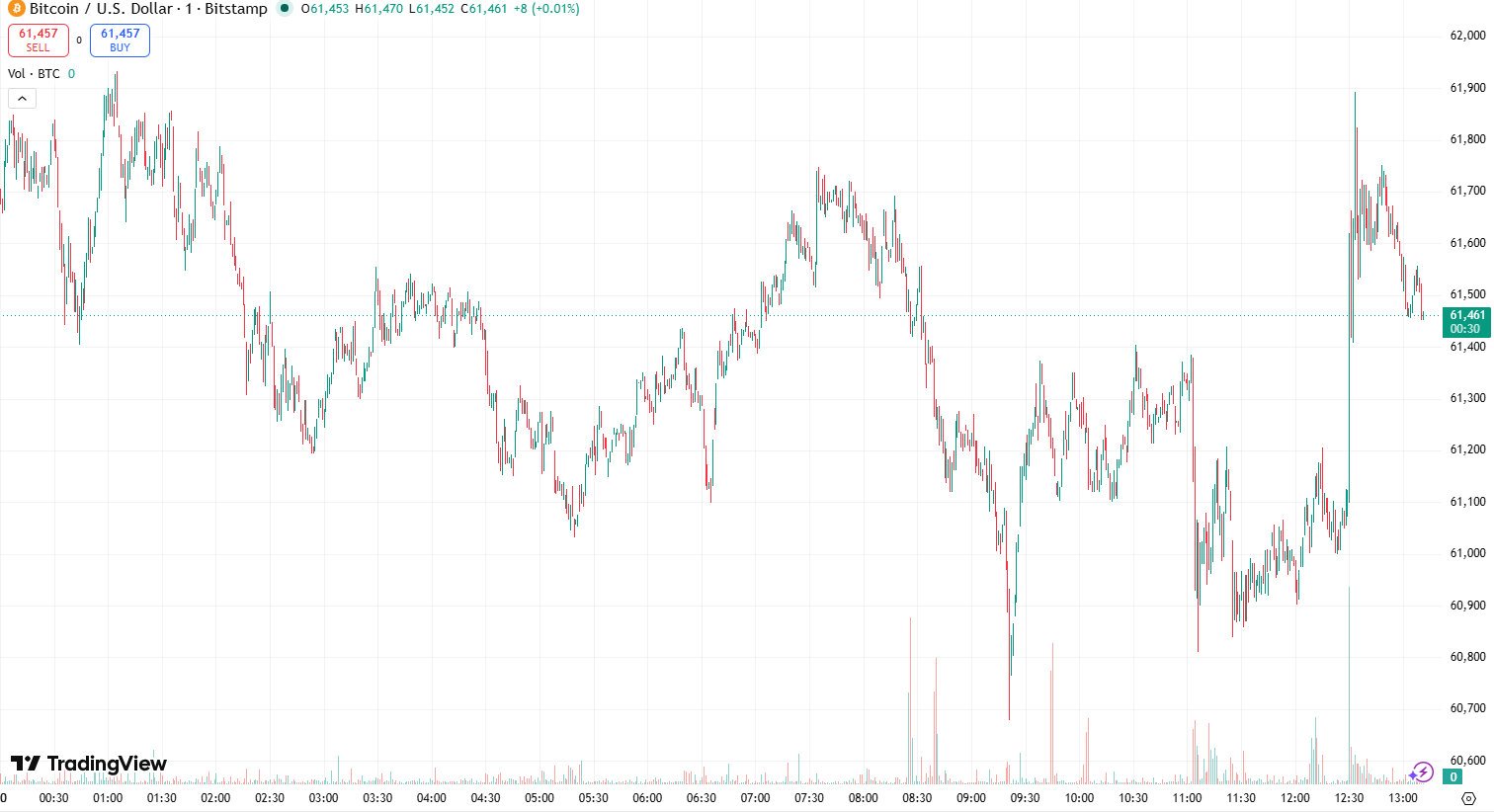
The post Bitcoin (BTC) Price Moves as US CPI for May Hits 2-Year High appeared first on CryptoPotato.


The FBI has launched Operation Riptide, a 60-day coordinated offensive targeting the infrastructure, communications, and financial networks behind global cybercrime.
Americans filed more than 1 million complaints last year, reporting over $20 billion in losses from online fraud. That figure marks a 26% increase in a single year.
A Shift From Reaction to Disruption
All 56 FBI field offices and global law enforcement attachés are driving the operation. Riptide targets the hosting networks, encrypted messaging platforms, and cryptocurrency laundering channels that cybercriminals share.
The goal is to impose real costs before crime spreads further.
The campaign implements Executive Order 14390 and the Trump administration’s National Cyber Strategy. FBI agents have served search warrants, secured indictments, made arrests worldwide, and seized millions in cryptocurrency.
World Cup Timing Raises the Threat Level
Operation Riptide has been launched ahead of the 2026 FIFA World Cup, a period fraud analysts flag as high risk. Football ticket scams this year have surged 36%, with fraudsters selling counterfeit passes and fake crypto fan tokens to supporters worldwide.
The UK’s FCA previously warned that Premier League crypto sponsorships risk exposing retail fans to misleading promotions. Similar fraud tactics spread fast during major global sporting events.
FBI’s Global Enforcement Strategy
Riptide builds on a string of recent FBI-led actions. The agency’s joint phishing network takedown with Indonesian authorities dismantled a fraud ring tied to $20 million in losses and 17,000 victims.
A domestic Ohio crypto Ponzi sentencing showed the breadth of federal prosecutions moving through courts.
US authorities also seized more than $15 billion in bitcoin from an alleged Cambodian crypto fraud network last year. That case set a new benchmark for large-scale crypto confiscation.
Fraud losses are climbing, and the World Cup is drawing millions online simultaneously. Whether offensive disruption can outpace the threat will become clear within weeks.
The post FBI Launches Operation Riptide to Disrupt $20 Billion Cybercrime Networks appeared first on BeInCrypto.


Key takeaways
- The oversold technical conditions may limit the pace of the decline, but the broader market structure remains bearish.
- The structure will remain bearish unless BTC can reclaim the $64,000 region and build momentum back above key moving averages.
BTC Extends Losses Ahead of Key US Inflation Data Bitcoin (BTC) continued its decline on Wednesday, trading below $61,500 as renewed geopolitical tensions in the Middle East and persistent institutional selling kept risk sentiment subdued.
Investors are also preparing for the release of the US Consumer Price Index (CPI) data for May, which could significantly influence expectations for Federal Reserve policy.
Renewed Middle East tensions keep risk assets under pressure
Geopolitical concerns intensified after the United States conducted what it described as self-defense strikes against Iran following the downing of a US Apache helicopter in the Strait of Hormuz.
Iran’s Islamic Revolutionary Guard Corps (IRGC) responded by saying it had targeted an airbase in Jordan hosting US forces, as well as locations in Kuwait and Bahrain, and warned of further escalation if US actions continue.
Market participants are closely watching the upcoming US inflation data. Economists expect the May CPI report to show another increase in consumer prices, partly due to elevated energy costs linked to the Middle East crisis.
If inflation comes in hotter than expected, it could strengthen expectations that the Federal Reserve will maintain a hawkish stance and keep interest rates elevated for longer.
Higher borrowing costs tend to reduce liquidity and make yield-bearing assets more attractive relative to risk assets, potentially adding further pressure on Bitcoin.
Institutional demand remains weak. According to CoinGlass, US-listed spot Bitcoin ETFs recorded net outflows of $77.44 million on Tuesday, following $91.37 million in outflows earlier in the week.
These withdrawals extend a broader trend of persistent weekly outflows from spot Bitcoin ETFs, suggesting that large investors remain cautious amid macroeconomic uncertainty and geopolitical risks.
Bitcoin technical outlook: Bears retain control
The BTC/USD 4-hour chart is bearish and efficient as Bitcoin maintains a clearly bearish near-term structure.
Price remains well below all three major moving averages, while a former upward trendline near $73,004 has turned into resistance, reinforcing the view that the medium-term uptrend has been broken.
The RSI near 38 indicates oversold conditions that could slow the decline, but it does not yet signal a confirmed reversal.
The MACD remains in negative territory, although downside momentum appears to be moderating, increasing the risk of consolidation rather than an immediate recovery.

If the bulls regain control, immediate resistance is seen at the $64,004 level, with the $72,037 zone also posing as a strong supply zone.
No significant support levels are identified immediately below the current price in this setup, leaving BTC vulnerable to further downside if selling pressure persists.

Liquidity Absorption

Ben Stokes out of England squad, Joe Root captains for second Test

Nestle USA unveils cookie dough innovation



![DJ KANJI - MONEY UP (feat. 7 & eyden) [Official Music Video]](https://wordupnews.com/wp-content/uploads/2026/04/1776001891_maxresdefault-80x80.jpg)

-

 Fashion5 days ago
Weekend Open Thread: Evereve – Corporette.com
-
 Crypto World5 days ago
Jensen Huang Approves Samsung, SK Hynix, and Micron for NVIDIA (NVDA) HBM4 Memory Supply
-

 Crypto World2 days ago
Anatomy of the June crypto crash: Fed, Iran, Saylor
-
 Entertainment4 days ago
The Best Mystery Series of All Time Is Surging on Streaming 30 Years After It Ended
-

 NewsBeat3 days ago
Alexander Zverev wins the French Open to finally earn a 1st Grand Slam title
-

 Tech4 days ago
Suspicious Polyfill login prompts pop up on Toshiba, Muji websites
-
 Crypto World4 days ago
Senator Cynthia Lummis Calls CLARITY Act the Most Consequential Financial Legislation of This Generation
-

 Tech3 days ago
Microsoft unveils seven homegrown AI models in new bid for ‘long term self-sufficiency’
-

 Tech5 days ago
Microsoft launches MXC, an OS-level sandbox for AI agents, with OpenAI and Nvidia already on board
-

 Business5 days ago
(VIDEO) Justin Bieber Delivers Surprise Happy Birthday Serenade to Diners at Los Angeles Mexican Restaurant
-
 Business4 days ago
The Pain Points Taking a Fragile Tech Rally Down a Notch
-
Crypto World5 days ago
LBank Surpasses 25 Million Users Worldwide as AFA Partnership Continues to Drive Global Growth
-

 Crypto World3 days ago
Trump’s AI Ownership Plan Could Benefit Anthropic at OpenAI’s Expense
-

 Tech5 days ago
Meta steals a tactic from Tesla and builds data centers in tents
-

 Tech5 days ago
Von der Leyen’s AI envoy pick draws conflict-of-interest fire
-
 Crypto World2 days ago
Eli Lilly (LLY) Stock Surges 4% Following Breakthrough Sleep Apnea Trial Results
-
 Sports22 hours ago
Bangladesh beat Australia after 20 years in ODIs, register only their second win over six-time world champions | Cricket News
-

 Business2 days ago
High Stakes for Wembanyama as New York Pushes for 3-0 Lead
-

 Tech4 days ago
Hackers now exploit SolarWinds Serv-U flaw to crash servers
-

 Tech3 days ago
Notion restores access to Anthropic after service disruption
You must be logged in to post a comment Login