

Crypto World
Market Structure Shift (MSS) in Trading

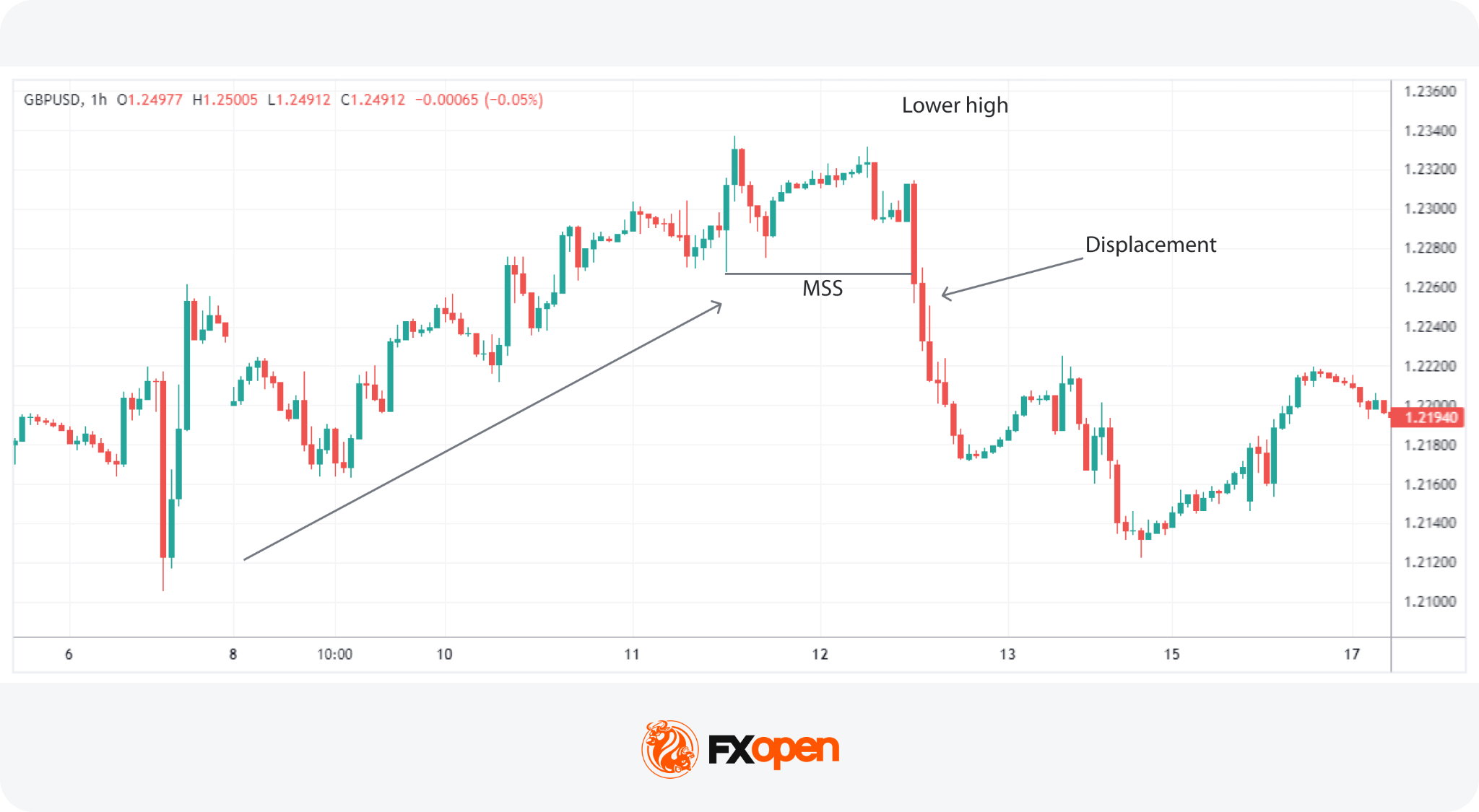
A Market Structure Shift (MSS) is an ICT trading concept used to identify potential changes in market direction. It typically occurs when price fails to maintain the existing structure and breaks a key swing level with strong momentum, known as displacement.
Traders use MSS across forex and CFD markets to analyse possible reversals and shifts in momentum. This article explains what MSS means in trading, how traders identify it, and how it differs from BOS and CHoCH.
What Is an MSS in Trading? Key Takeaways
- Market Structure Shift (MSS) is used to identify potential reversals in price action.
- A valid MSS usually includes both structure failure and displacement.
- BOS often signals continuation, while MSS focuses on reversal confirmation.
- CHoCH may appear before MSS as an early warning of weakening trend structure.
- ICT traders often combine MSS with liquidity sweeps, Order Blocks, and Fair Value Gaps.
- MSS can appear across forex and CFDs on indices, commodities, and cryptocurrencies*.
What Is a Market Structure Shift (MSS)?
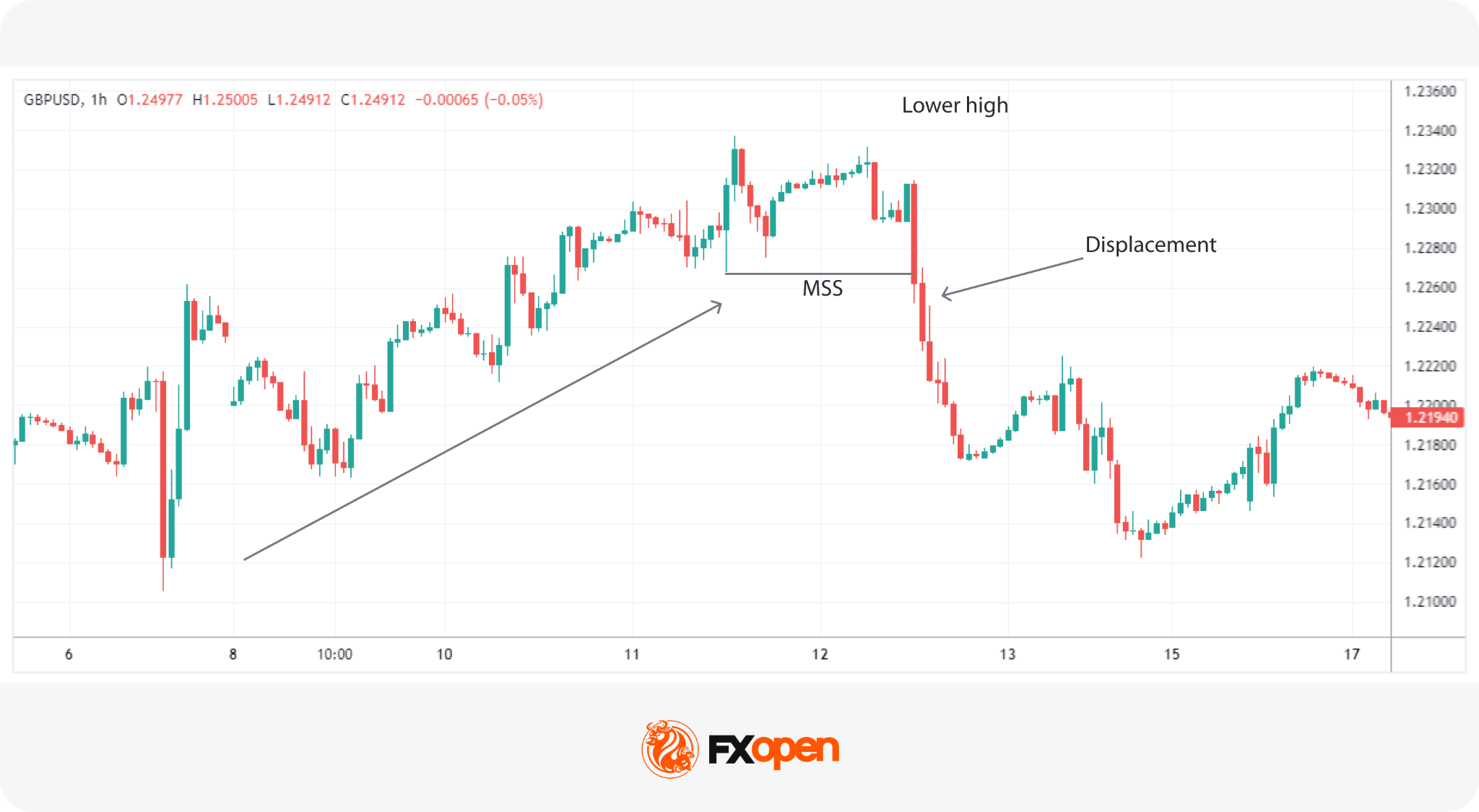
A Market Structure Shift (MSS) is an indicator of a significant change in the prevailing trend, marked by a series of patterns that may point to a reversal. An ICT MSS forms when a market fails to extend its current trend and then breaks a key swing point with displacement. The break must be decisive, not a shallow probe of the level.
The process begins with a shift in market structure that fails to sustain the ongoing trend. For example, during an uptrend, the market might fail to make a new higher high, instead forming a lower high. This initial deviation raises a caution flag about the trend’s strength.
The confirmation of an MSS in trading occurs when there is a decisive break of a significant swing point, known as a displacement move. This displacement is critical—it’s not merely a slight breach but a robust move that clearly indicates a shift. Without displacement, the pattern is closer to a CHoCH than a confirmed Market Structure Shift.
A bullish MSS forms when a downtrend loses momentum and reverses upward. In MSS trading, the bullish setup begins when price prints a higher low. That higher low hints that selling pressure may be weakening. The bullish MSS confirms once price breaks above the most recent swing high with a clear displacement candle.
A bearish MSS is the mirror pattern. An uptrend forms a lower high, indicating buying pressure may be fading. The bearish MSS confirms once price breaks below the most recent swing low with a strong downward displacement candle. That sequence often signals a shift from a bullish structure toward a potential bearish leg.
MSS Confirmation Signals
A valid Market Structure Shift depends on more than a single broken level. Traders typically look for several confirmation signals stacking together before treating the pattern as confirmed. The aim is to filter out shallow probes and false breaks that lack genuine momentum.
Common ICT MSS confirmation criteria include:
- A failed higher high in an uptrend or a failed lower low in a downtrend, indicating early structural weakness.
- A decisive break of the most recent counter-trend swing point, not a wick-only breach.
- A clear displacement candle showing strong momentum expansion through the broken level.
- A prior liquidity sweep above a swing high in an uptrend or below a swing low in a downtrend, which may add weight to the setup.
- Alignment with the higher timeframe directional bias, which traders often use as a contextual filter.
No single signal confirms an MSS on its own. The combination of failed structure, counter-trend swing break, and displacement is typically what separates a confirmed MSS trading setup from a routine fluctuation.
Market Structure Concepts in ICT Trading
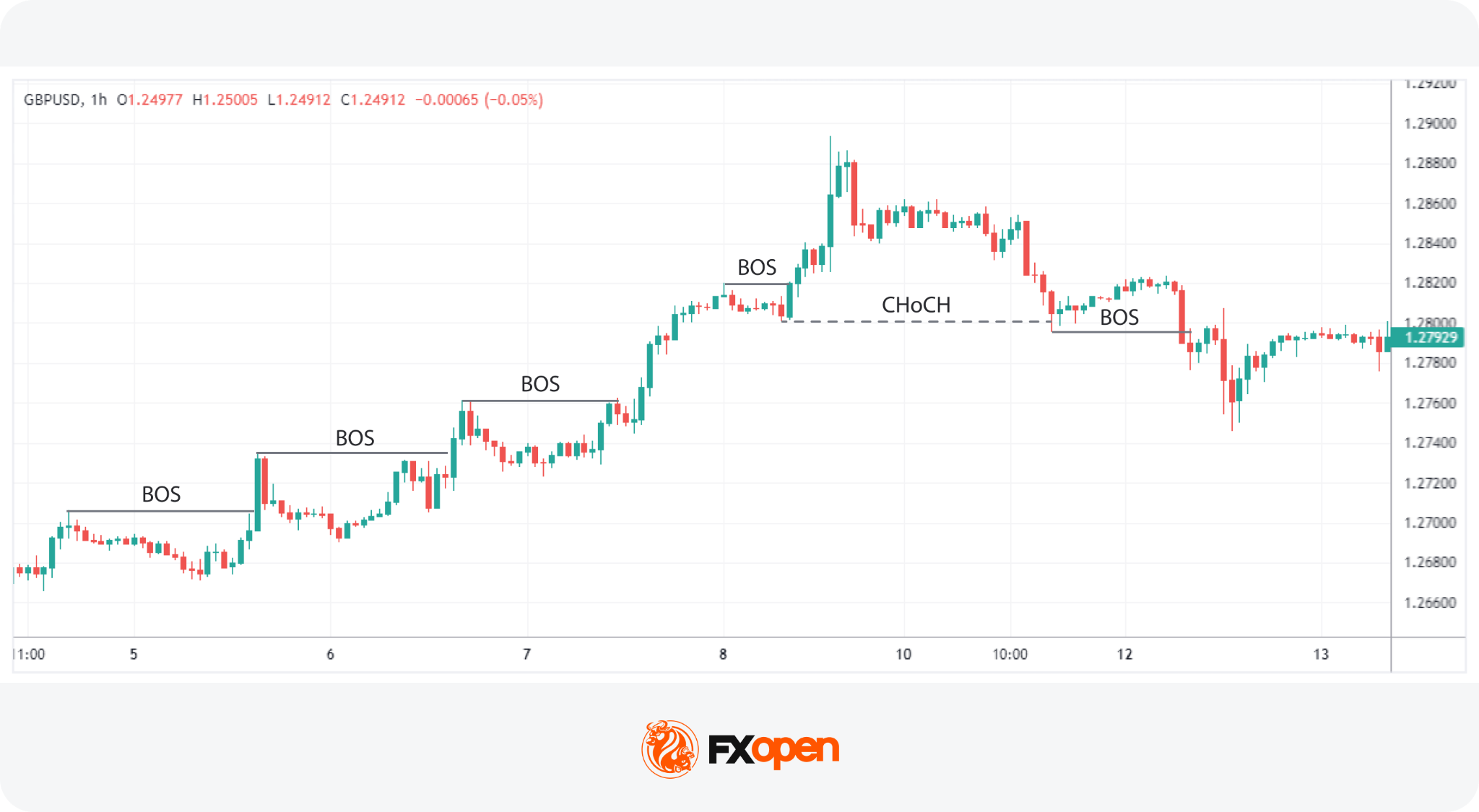
Break of Structure (BOS) and Change of Character (CHoCH) are two core concepts in ICT trading. They describe how price interacts with previous swing highs and swing lows. Both sit alongside the broader ICT Market Structure Shift framework.
A BOS occurs when price breaks beyond a recent swing point in the direction of the existing trend. The pattern typically signals trend continuation rather than reversal.
A CHoCH forms when price breaks against the prevailing trend, taking out the most recent counter-trend swing point. Traders often treat it as an early warning of a potential reversal, not a confirmed one.
MSS vs BOS vs CHoCH
Traders often confuse these three patterns because each involves a break of structure. The distinction lies in what the break signals and what confirmation it requires. Understanding MSS vs BOS and MSS vs CHoCH may help traders interpret price action more accurately.
A BOS confirms continuation of the existing trend. A CHoCH offers an early reversal warning when price breaks counter-trend structure for the first time. An MSS goes further, requiring both a failed swing point and a displacement move through the broken level.
How Traders Identify MSS
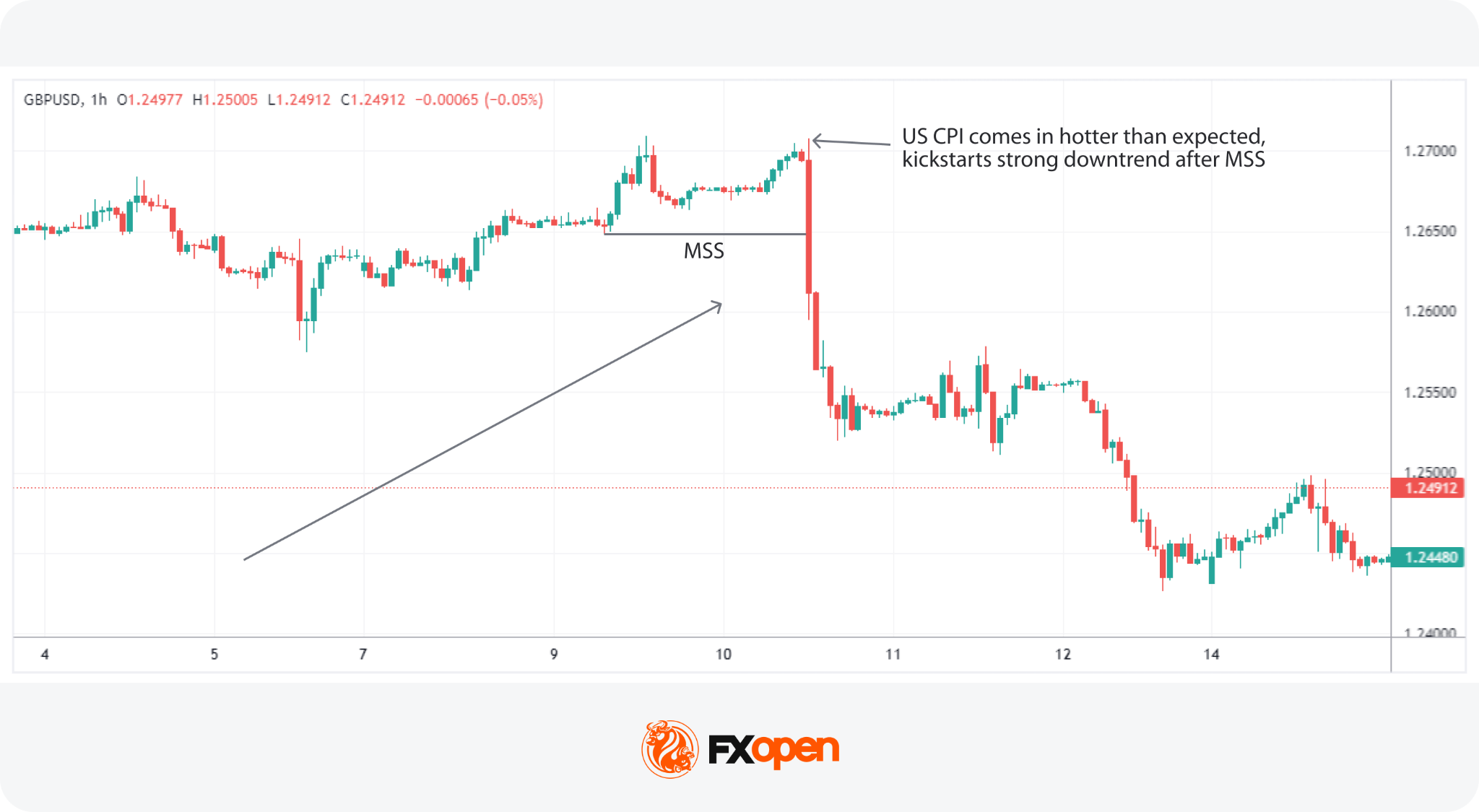
An MSS in price action trading functions as a directional tool. Identifying one is a process rather than a single observation. Traders typically work through three stages: read the existing structure, define the relevant swing points, and verify both a structural break and a displacement candle.
MSS Identification Checklist
To use an MSS in trading, traders often follow these steps:
- Read the existing structure: Establish whether price is in an uptrend, downtrend, or sideways range by mapping recent higher highs and higher lows or lower highs and lower lows.
- Watch for failed structure: Look for a lower high in an uptrend or a higher low in a downtrend, which may signal that the current trend is losing momentum.
- Mark the relevant swing highs and lows: Identify the most recent counter-trend swing point. That level becomes the line price must break for an MSS to develop.
- Confirm with a displacement candle: The break of the swing point should occur with a strong expansive candle. A wick-only breach typically does not qualify.
- Check higher timeframe bias: Cross-reference the setup against the higher-timeframe structure. Setups aligned with the higher timeframe direction tend to carry more weight.
- Account for liquidity context: A liquidity sweep above a swing high or below a swing low ahead of the break may add additional confirmation to the MSS trading setup.
MSS and Economic News
Market Structure Shift trading patterns sometimes form around scheduled releases on the economic calendar, such as central bank decisions, inflation prints, or employment data. The volatility around these events may accelerate displacement moves through key swing points. Traders typically treat news-driven breaks with extra caution, since whipsaws are common before the move resolves in either direction.
MSS With Other ICT Components
An ICT Market Structure Shift rarely sits in isolation. Traders typically pair it with other ICT trading concepts such as Break of Structure, Order Blocks, Fair Value Gaps, and Smart Money Concepts to build a fuller read of market intent. Each component adds a different layer to the analysis.
To see how these pieces interact on live charts, you can explore FXOpen’s TickTrader platform.
MSS and Break of Structure
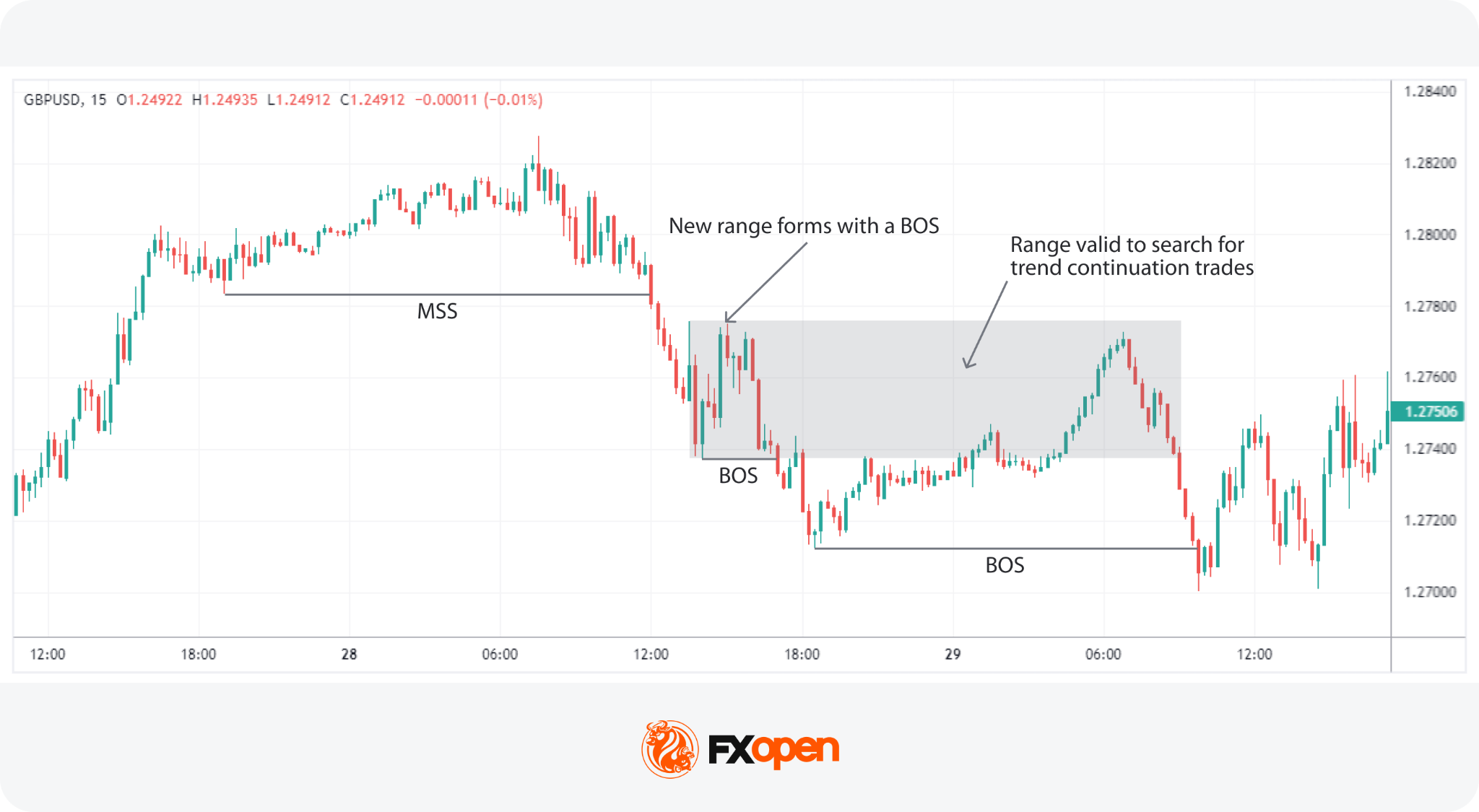
MSS and BOS sit at different points in the same lifecycle. A common sequence runs Market Structure Shift and then BOS.
Take an uptrend that begins to weaken. Price forms an MSS once a displacement candle drives decisively through a recent higher low.
From there, price establishes a new range, and a subsequent break of the new swing low registers as a BOS in the new bearish direction. Each stage carries different confirmation weight, and traders typically wait for the displacement before treating the reversal as confirmed.
MSS With Order Blocks and Fair Value Gaps
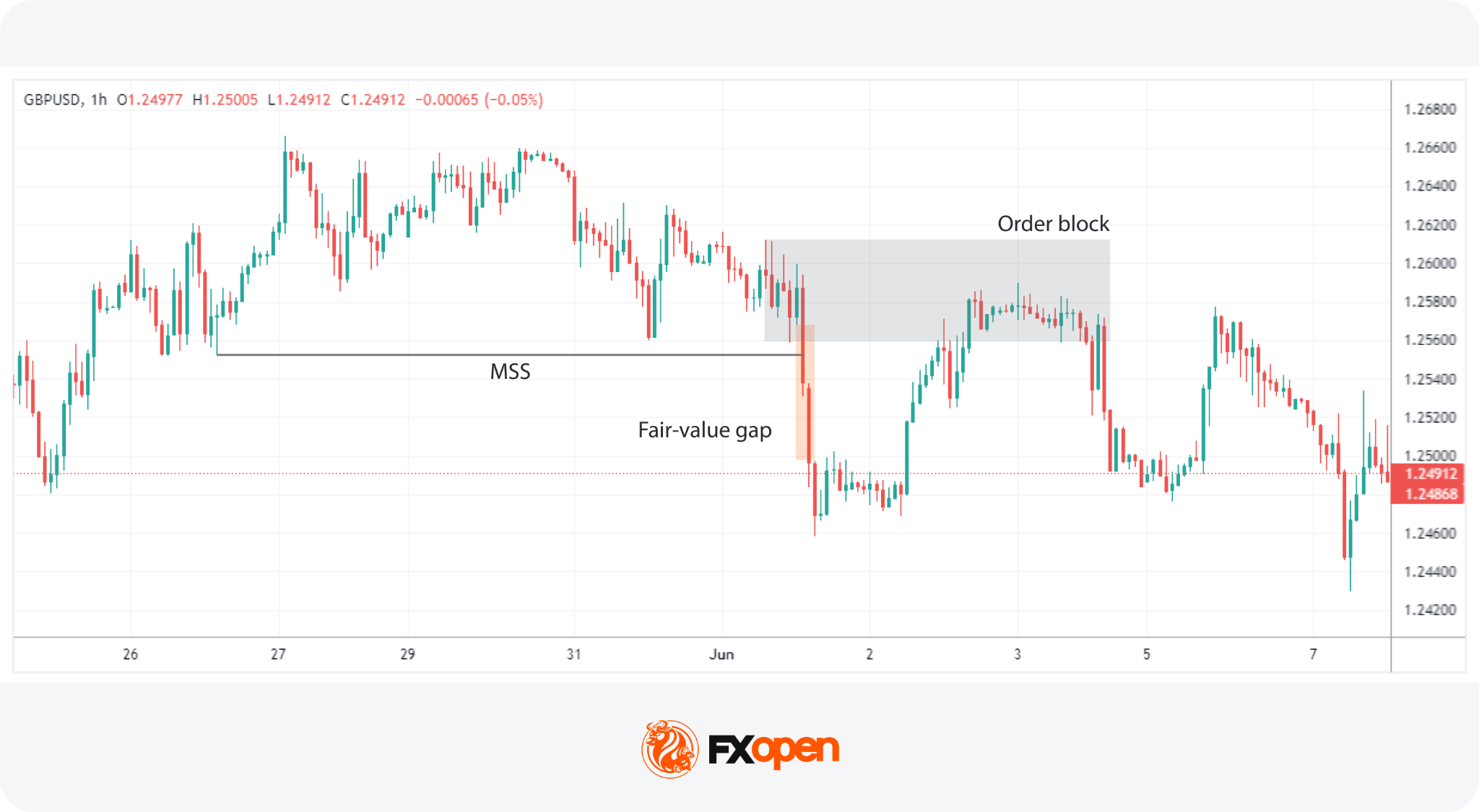
Traders combine Market Structure Shift trading with Order Blocks and Fair Value Gaps as the MSS confirms a structural shift, while the Order Block and FVG point to specific zones where price may return before the new trend extends. The displacement that confirms the Market Structure Shift almost always leaves both footprints behind, which makes them a natural follow-on reference for analysing the move.
- Fair Value Gap: This is a price range that the market skips over quickly during a displacement, leaving it untested by typical market trading. It often acts like a vacuum, drawing the price back to fill in the gap at a later stage.
- Order Block: An Order Block is a consolidation area that precedes a strong price move and is considered a footprint left by institutional traders. It represents levels where significant buying or selling occurred, potentially acting as support or resistance in future price movements.
If the price returns to fill a Fair Value Gap and enters the Order Block, this scenario can provide a potent setup for a reversal. Traders might look for confirmatory signals at these levels to enter trades that anticipate the market returning to its previous course or extending the reversal initiated by the MSS.
A compact order block trading workflow that pairs with an MSS typically follows this sequence:
- Identifying the confirmed MSS, noting the swing point that was broken with displacement.
- Marking the Fair Value Gap left inside the displacement candle range.
- Marking the Order Block at the origin of the displacement move, usually the last opposing candle before the impulse.
- Watching for price to retrace towards the FVG or Order Block.
- Looking for additional confirmation at the level, such as a smaller reaction candle or further structural alignment.
MSS in Forex and CFD Markets
The Market Structure Shift in forex is one of its most common applications, given the deep liquidity and clean swing structure of major currency pairs. The pattern also forms regularly across index CFDs such as the S&P 500 and DAX 40, commodity CFDs including gold and crude oil, and cryptocurrency* CFDs like Bitcoin and Ethereum.
MSS is a price action pattern, which means it is not tied to a specific market or timeframe. The same logic of failed swing point plus displacement applies on a 5-minute chart and a daily chart alike. Lower timeframes tend to produce more frequent setups but with weaker individual signals. Higher timeframe MSS patterns appear less often, but typically carry greater structural weight when they form.
Common MSS Mistakes
Several recurring errors weaken MSS trading results. Awareness of them may help traders apply the pattern in an ICT trading strategy more selectively.
- Trading without displacement. A swing break alone is not an MSS. Without a strong displacement candle, the pattern is closer to a CHoCH and carries less conviction.
- Ignoring higher timeframe bias. A bullish MSS on a 30-minute chart against a clear daily downtrend often resolves as a short-lived retracement rather than a sustained reversal.
- Acting before confirmation. Wicks through swing points without a closed displacement candle frequently lead to false signals. Patience for the candle close typically filters out the noise.
- Overusing MSS in ranging markets. The pattern is designed for trending-to-reversing conditions. In tight consolidation, traders often see clustered swing breaks that mean little structurally.
Key Takeaways
Market Structure Shift (MSS) is used in ICT trading to identify potential changes in market direction after the existing structure begins to weaken. Rather than acting as a standalone entry signal, MSS is typically analysed alongside displacement, liquidity context, higher timeframe structure, and other ICT concepts such as Order Blocks and Fair Value Gaps.
Understanding the difference between MSS, BOS, and CHoCH may help traders interpret whether the market is signalling continuation, early reversal conditions, or a confirmed structural shift. As with all trading approaches, risk management and confirmation remain essential, particularly during volatile market conditions.
If you are looking to put these strategies into practice, you may consider opening an FXOpen account, where advanced tools and resources are readily available to support your trading journey.
FAQs
What Is a Market Structure Shift?
A Market Structure Shift (MSS) is an ICT concept that indicates a potential reversal in market trends. It’s marked initially by a lower high in an uptrend or a higher low in a downtrend, followed by a displacement—a significant and rapid price movement that decisively breaks through a key market level.
How Are Market Structure Shifts Identified?
Identifying an MSS involves observing for early signs of trend weakening (lower highs in an uptrend or higher lows and downtrend) and waiting for a subsequent displacement that confirms the shift. This displacement should significantly penetrate a key swing point, clearly indicating a new direction in market momentum.
What Is the ICT Method of Trading?
The ICT (Inner Circle Trader) method of trading is a comprehensive approach that utilises various trading concepts such as Market Structure Shifts, Order Blocks, and Fair Value Gaps, focusing on how institutional traders influence the market. It emphasises understanding and leveraging these components to align trading strategies with probable market movements.
What Is the Difference Between MSS and BOS in ICT?
In ICT, a Market Structure Shift (MSS) refers to a potential trend reversal, confirmed by a lower high (uptrend) and higher low (downtrend) followed by a displacement. A Break of Structure (BOS), however, simply indicates the continuation or acceleration of the current trend, marked by the breach of a key high or low point within the ongoing trend direction.
What Confirms a Valid MSS?
A valid Market Structure Shift typically requires three elements stacking together. First, a failed swing point such as a lower high in an uptrend or a higher low in a downtrend. Second, a decisive break of the most recent counter-trend swing high or low. Third, a clear displacement candle showing strong momentum through the level.
Can MSS Appear on All Timeframes?
Yes. MSS is a price action pattern, so the same swing-failure-plus-displacement logic applies on a 5-minute chart, a 4-hour chart, and a daily chart alike. Lower timeframes typically produce more frequent setups but with weaker individual weight. Higher timeframe MSS patterns appear less often, but often carry stronger structural significance when they form.
Is MSS Used in Forex Trading?
Yes, the Market Structure Shift is widely used in forex trading, particularly on major pairs such as EUR/USD, GBP/USD, and USD/JPY where liquidity is deep and swing structure tends to be cleaner. It also applies to forex crosses and exotic pairs, though clarity of structure varies. MSS additionally appears across index, commodity, and cryptocurrency* CFDs.
Can MSS Signal Trend Continuation?
No. An MSS is specifically a reversal pattern. Continuation in the direction of the existing trend is signalled by a Break of Structure (BOS), not an MSS. Confusing the two is one of the most common analytical errors in ICT trading. An MSS requires a failed swing point that runs counter to the prevailing trend, which is what distinguishes it from a BOS.
*Important: At FXOpen UK, Cryptocurrency trading via CFDs is only available to our Professional clients. They are not available for trading by Retail clients. To find out more information about how this may affect you, please get in touch with our team.
This article represents the opinion of the Companies operating under the FXOpen brand only. It is not to be construed as an offer, solicitation, or recommendation with respect to products and services provided by the Companies operating under the FXOpen brand, nor is it to be considered financial advice.



TRM Labs has tied four cryptocurrency addresses to live scams targeting 2026 World Cup fans, spanning fake ticket sites and a fixed-match betting scheme as matches play out across North America.
The blockchain intelligence firm says wallets associated with the operations have received less than $1,700 combined so far. However, it warns that scam volume and frequency could ramp up.
How World Cup Demand Fuels Crypto-Based Scams
Major sporting events create concentrated demand spikes for tickets, travel, and merchandise. Scammers build that timing into their planning, seeding fake infrastructure weeks ahead, then promoting it hard near kickoff, TRM research shows.
FIFA-WTO studies estimate that the tournament could draw 6.5 million attendees and add up to $40.9 billion to global GDP. That scale gives fraudsters a deep pool of potential victims.
Watchdogs flagged the risk early. The FBI warned in May about spoofed FIFA websites built to steal personal data and sell fake tickets. The Better Business Bureau echoed the alarm.
Angela Dennis, CEO of the Better Business Bureau of Central Ontario, told reporters why mass demand draws fraud.
“When there is such a mass volume and this high demand, that’s when scammers really get excited because people do fall for the information that they send, whether it’s an email, a phishing email or a text, and having people link to fake sites and providing personal information or payment details to them,” Dennis stated.
Follow us on X to get the latest news as it happens
Inside the On-Chain World Cup Scams
TRM identified several on-chain scam types, led by fake ticketing and fixed-match betting. Fraudulent ticket sites pose as official sellers, list sought-after matches, and demand crypto.
One Polygon (POL) wallet pulled in about $1,562, almost all on April 1. A second operation, tied to a Bitcoin (BTC) address, keeps its phishing page live but has not accepted any payments.
Fixed-match schemes charge an upfront fee for supposed insider results. TRM linked one to a Bitcoin wallet that collected small sums between January and May 2026, then routed them into a custodial account.
A third route runs through tokens. TRM pointed to the $WORLDCUP coin. It trades on LBank as a fan-made commemorative project with no FIFA tie, exposing holders to familiar low-liquidity meme coin losses.
Scammers also lean on bridges to muddy the trail, with TRM counting roughly $1.9 billion in scam funds moved through them over time.
A third scam runs through tokens. A coin called $WORLDCUP trades on the LBank exchange, billed as a fan-made commemorative project with no affiliation with FIFA. Holders face the standard low-liquidity meme coin loss patterns when issuers exit.
“The amounts involved in these cases are modest, but the movement of funds follows patterns commonly seen in consumer crypto fraud,” the report read.
Scammers lean on bridges to move proceeds and complicate tracing. Across all tracked activity, roughly $1.9 billion in scam funds has passed through bridges.
TRM expects to see more typologies as the tournament continues, including gambling pitches, deepfake impersonations of FIFA figures, and fake streaming sites.
Subscribe to our YouTube channel to watch leaders and journalists provide expert insights
The post Crypto Scammers Hit World Cup Fans as Tournament Gets Underway appeared first on BeInCrypto.

TLDR:
- US export control order forced global shutdown of Fable 5 and Mythos 5 models immediately across all users
- Anthropic says restriction stems from alleged jailbreak concern but calls issue narrow and non-systemic in scope
- Other Claude models remain online as company complies with government national security directive requirements
- Firm disputes severity of claims, citing prior red-teaming tests and absence of verified harmful exploits
A US government export control directive has forced Anthropic to suspend global access to Fable 5 and Mythos 5. The order applies to all foreign nationals, including employees outside the United States.
The decision triggered an immediate shutdown of both models across all customer environments. According to internal communication, the directive was issued citing national security concerns tied to potential jailbreak vulnerabilities.
Fable 5 and Mythos 5 Export Control Order Shakes Anthropic AI Access
AnthropicAI confirmed it received the directive at 5:21pm ET from US authorities.
The order required immediate suspension of Fable 5 and Mythos 5 access worldwide. The restriction applies even to foreign national staff working within the company.
The company stated compliance was mandatory under export control rules.
As a result, it disabled both models across its infrastructure. Other Claude models remain fully operational without restriction.
The announcement highlighted that the directive affects users across all regions. Customers outside the United States lost access at the same time as domestic users. The scope of the order reflects broad national security classification.
Anthropic noted the shutdown was abrupt and not pre-planned.
Engineering teams executed global deactivation procedures shortly after receiving the notice. Service disruption affected enterprise users and developers relying on the models.
Fable 5 and Mythos 5 Security Concerns and Jailbreak Claims Explained
The directive reportedly stemmed from concerns about a potential jailbreak method targeting Fable 5.
Authorities believed the technique could expose cybersecurity-related capabilities under certain conditions. The company reviewed the same demonstration internally.
Anthropic stated the identified issue involved narrow vulnerabilities already seen in other models. It added that similar weaknesses could be reproduced using publicly available AI systems. The company did not identify evidence of a universal jailbreak.
Internal assessments showed safeguards were tested extensively before release.
The models underwent thousands of hours of red-teaming with external partners. These included government-linked AI safety institutes and third-party evaluators.
According to Anthropic, no verified harmful deployment resulted from the reported vulnerability. The company said it had not received documentation of a broad exploit affecting model safety systems. It described the issue as limited in scope and non-systemic.
Despite disagreement with the directive’s severity, Anthropic complied with legal requirements.
The firm emphasized ongoing discussions with regulators to restore access. It also reaffirmed that other models remain unaffected and continue operating normally.



Bitget has secured registration in Argentina as a Virtual Asset Service Provider, adding another regulated market to its Latin American footprint as crypto adoption in the country approaches 20% of the population.
Summary
- Bitget has secured Virtual Asset Service Provider registration in Argentina, extending its regulated presence across Latin America.
- Argentina’s crypto market now includes nearly 20% of the population and more than 15,000 businesses that accept digital asset payments.
- The approval comes as Bitget continues expanding tokenized stock and real world asset products across its exchange and wallet ecosystem.
According to a press release shared with crypto.news, Bitget has been added to Argentina’s Virtual Asset Service Provider registry maintained by the National Securities Commission, known locally as the CNV.
The registration allows the exchange to operate within the country’s existing framework for crypto service providers while complying with oversight requirements tied to anti-money laundering and counter-terrorism financing rules.
As part of the registration, Bitget will be subject to reporting and compliance obligations before Argentina’s Financial Information Unit and other relevant authorities. The approval comes as policymakers across Latin America continue building formal rules for digital asset businesses operating in their jurisdictions.
Argentina has emerged as one of the region’s busiest crypto markets, with company data indicating that nearly 20% of the population uses digital assets and more than 15,000 businesses accept crypto payments. Growing participation has turned the country into a key destination for exchanges seeking expansion opportunities across Latin America.
“Regulatory frameworks for digital assets continue developing across Latin America, making compliance and registration increasingly important for platforms operating in the region,” said Gracy Chen, CEO of Bitget.
“Argentina represents an important market within Latin America’s broader digital asset landscape, and Bitget remains focused on supporting sustainable growth by aligning with local regulatory requirements.”
Argentina adds to Bitget’s regional expansion
Coming shortly after regulatory progress in Mexico, the Argentina registration extends Bitget’s presence in markets where crypto adoption and regulatory development are advancing at the same time.
Recent months have also seen the company deepen its focus on products that connect digital assets with traditional finance. Earlier in June, Bitget enabled 15 tokenized stocks and exchange-traded funds, including Apple, Nvidia, Tesla, Microsoft and Amazon-linked assets, to be used as collateral for USDT-margined futures trading through its Unified Trading Account system.
At the time, Chen said users were looking for more ways to put tokenized assets to work across different trading activities as demand for blockchain-based financial products continued to grow.
A separate announcement from Bitget Wallet on June 9 expanded the company’s tokenized asset infrastructure further. The wallet introduced support for direct trading of tokenized real-world assets through its DEX Aggregator API, allowing partner platforms to route trades from cryptocurrencies into tokenized stocks without requiring separate trading systems.
According to Bitget Wallet, the upgrade introduced an RFQ-based routing model designed to secure liquidity before transactions reach the blockchain. Initial integrations included Ondo Finance and xStocks, two of the largest participants in the tokenized asset sector.
Bitget Wallet also reported that its ecosystem now offers access to more than 300 tokenized products spanning equities, commodities, precious metals and other financial instruments. Company figures further show that Bitget’s tokenized equity products have generated more than $30 billion in trading volume since 2025.
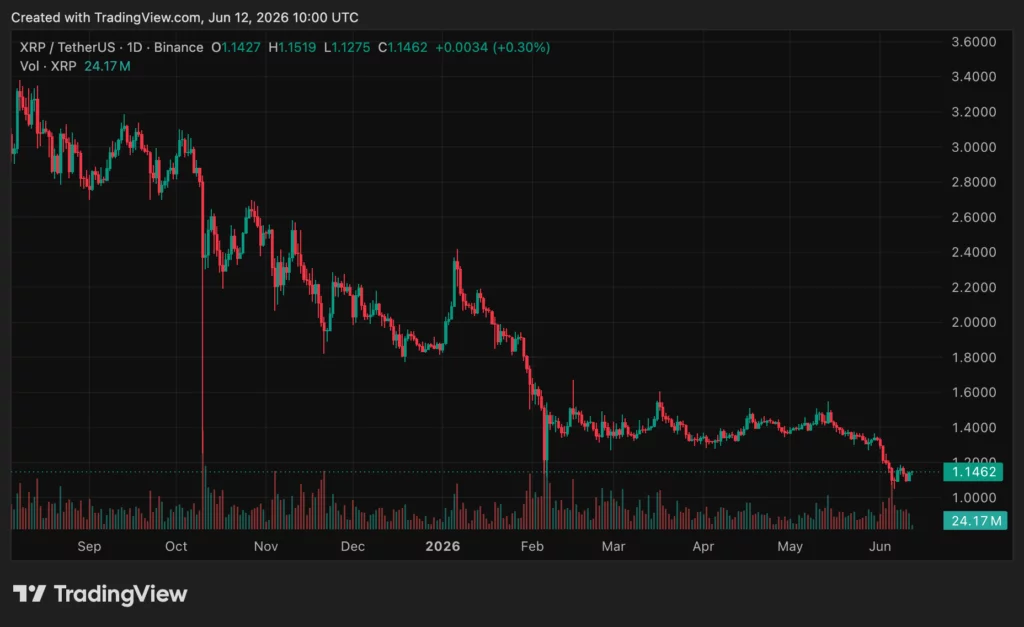
XRP traded near $1.15 on June 12 after a volume-backed rebound from the $1.10 area, but traders still watched whether the move could break the wider downtrend.
Summary
- XRP rose near $1.15 after buyers defended $1.10 and pushed through short-term resistance.
- Weak sentiment and zero ETF outflows kept XRP in focus despite its broader monthly downtrend.
- Ripple’s MXNB launch on XRPL added enterprise payments context as traders watched the $1.20 area.
XRP price rebounds from $1.10
XRP traded at $1.15, up nearly 3% over 24 hours, according to crypto.news market data. The token recorded about $1.68 billion in daily trading volume, while market capitalization stood near $71.24 billion.
The 24-hour trading range stayed between $1.10 and $1.15. That shows buyers defended the lower end of the range and pushed price back toward short-term resistance.
The rebound followed a weak period for XRP. The token remained down 21.48% over 30 days and 48.73% over the past year, showing that the latest move has not erased the broader decline.
XRP still ranks sixth by market value. Its fully diluted valuation stood near $114.79 billion, with about 62.05 billion tokens in circulation from a maximum supply of 100 billion.
Volume-backed move tests resistance
XRP rose from about $1.1080 to $1.1442 during the earlier 24-hour session, gaining more than 3%. The strongest move came when buyers pushed through resistance near $1.1220.
Volume surged to about 120.2 million XRP during the June 11 17:00 UTC session. That was more than 160% above average and helped confirm the short-term breakout.
The move was notable because recent XRP rebounds had faded quickly. This time, buyers kept bidding into the close and pushed price above $1.14.
The next test sits around $1.20 to $1.25. Every major XRP recovery this year has struggled before that zone, so a clean break above it would be needed to improve the larger structure.
Sentiment stays weak despite rebound
Santiment said XRP’s weighted sentiment has fallen to its lowest level since October 2025. The metric tracks social volume and the ratio of positive to negative commentary.
“XRP’s sentiment at 8-month lows, but this level of FUD tends to spark bull rallies,” said Santiment.
That signal does not confirm a price rally. It shows that crowd interest has weakened while negative commentary has increased, which can sometimes appear near rebound zones.
Santiment also noted that XRP has seen strong rebounds in the past when traders became disinterested. That makes sentiment a useful secondary signal, but not a full trading signal on its own.
ChartNerd also pointed to XRP returning to the lower regression band of the Gaussian Channel on the two-week timeframe near $1.04. The analyst described that zone as a macro opportunity area based on prior cycles.
“One of our XRP signals just fired,” said ChartNerd.
XRP ETF flows and technical levels matter
According to SoSoValue data, XRP spot ETFs recorded zero outflows on June 11, while Bitcoin, Ethereum, and Solana ETFs saw redemptions. XRP ETF net assets were reported near $984.77 million, close to the $1 billion mark.
That matters because steady ETF demand can support price during weak market conditions. It does not guarantee a breakout, but it can reduce the pressure that comes from spot selling.
Technically, XRP is trapped between a short-term rebound and a longer-term downtrend. Price has reclaimed $1.14, but it still trades below the larger descending trendline that has guided the market since early 2026.
Immediate support sits near $1.10. A loss of that area could expose $1.04, where analysts are watching the lower regression band and recent support.
On the upside, XRP needs to clear $1.15 first, then build momentum toward $1.20. A daily close above $1.20 would shift focus to $1.25, where earlier recoveries have failed.
MXNB launch adds XRPL context
Ripple and Bitso expanded their partnership by bringing the MXN-backed stablecoin MXNB to the XRP Ledger. The stablecoin will also integrate with Ripple’s Payments on Decentralized Exchange infrastructure.
The setup is designed to support enterprise settlement between the United States and Mexico. Ripple’s RLUSD and Bitso’s MXNB are expected to provide on-chain dollar and peso liquidity for payment flows.
The launch adds another institutional use case for XRPL. Still, XRP price must confirm strength through the chart, because network growth does not always lead to immediate token demand.
As previously reported by crypto.news, the XRPL 3.2.0 upgrade is also expected on June 15. The upgrade will rename the core software from “rippled” to “xrpld” and may reduce server memory use by around 40%.
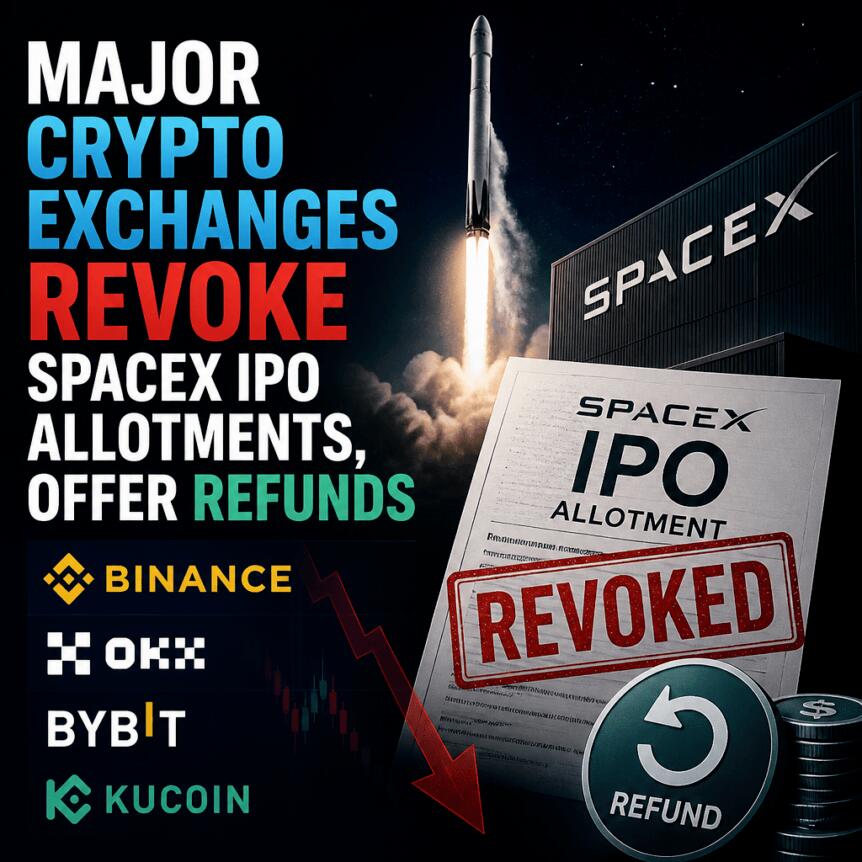
Several major crypto trading and wallet platforms have canceled their tokenized SpaceX IPO campaigns after SpaceX began trading publicly on the Nasdaq. Bybit, Binance, Bitget Wallet and MEXC all pointed to problems in securing underlying allocations, leaving subscribers without the expected access and triggering refunds in some cases.
SpaceX’s IPO, reported as more than four times oversubscribed, raised $75 billion and valued the company at more than $2 trillion on its first day. Shares opened at $150, rose from the $135 IPO price, and closed at $161.11 on Friday.
Key takeaways
- Bybit, Binance, Bitget Wallet and MEXC canceled their tokenized SpaceX IPO offerings once allocations could not be fulfilled.
- Multiple platforms blamed xStocks’ inability to deliver the underlying assets needed to distribute SpaceX tokenized IPO allocations.
- Binance’s campaign had reportedly attracted more than $557 million in USDC deposits before being halted.
- Bitget Wallet and MEXC stated they would refund affected users.
Tokenized IPO campaigns lose the allocation race
As SpaceX transitioned from private markets to public trading, crypto platforms offering tokenized access attempted to translate that demand into participation for their users. But once the IPO went live, these campaigns ran into a practical bottleneck: they could not obtain SpaceX allocations through xStocks, the entity involved in distributing the tokenized exposure.
According to Bybit’s announcement, the firm did not receive any SpaceX allocations due to xStocks’ failure to deliver the underlying assets. In that situation, Bybit said subscribed users would not receive SpaceX allocations despite the earlier subscription process.
Bybit says xStocks delivery issues stopped allocations
Bybit was among the earliest platforms to market tokenized IPO participation with its Bybit IPO Express, which included a SpaceX debut. In its cancellation message, Bybit directly tied the outcome to xStocks’ inability to deliver the underlying assets required for the allocation.
Bybit’s statement indicated that because no allocations were received, the campaign could not proceed as advertised. For users, that meant the tokenized IPO access did not materialize in the form of SpaceX allocations tied to the public listing.
Binance’s deposits were not enough to proceed
Binance also reported that it could not move forward with its tokenized SpaceX IPO campaign after citing circumstances outside its control. Earlier coverage described the initiative as attracting more than $557 million in USDC deposits, reflecting significant interest from Binance users.
Binance Wallet was also described as relying on xStocks for allocation delivery. With xStocks unable to provide the underlying assets, Binance said it was unable to proceed with the campaign, despite the apparent scale of deposits recorded before the IPO date.
Bitget Wallet and MEXC move to refund users
While some platforms framed their cancellation around delivery constraints, others emphasized remediation. Bitget Wallet and MEXC both stated that they would refund users who were affected after they were unable to secure an allocation of xStocks’ tokenized SPCX exposure.
In an X post, Bitget Wallet chief operating officer Alvin Kan said it was “disappointing that this didn’t work out in the end,” adding that the company was sending refunds. Kan also acknowledged that the episode had shaken trust within the industry, while arguing that the platform would continue and “come out of this stronger.”
MEXC similarly indicated that refunds were the next step, aligning with the broader pattern of tokenized IPO campaigns encountering execution risk when upstream allocation mechanics fail.
What this setback signals for tokenized IPO access
This episode highlights a recurring challenge for tokenized access products: they may package participation in high-demand public events for retail or crypto-native audiences, but they still depend on traditional allocation and settlement flows. When the party responsible for sourcing and distributing the underlying exposure cannot deliver, platforms can only cancel or unwind the offering.
That dependency matters now because the market conditions were unusually favorable for such products. SpaceX’s IPO drew massive interest, and reports said it was more than four times oversubscribed. Yet even with demand concentrated around a single, widely watched listing, crypto platforms were still unable to convert subscriptions into allocations.
For investors and traders, the practical takeaway is that tokenized IPO participation should be viewed as an execution-sensitive service—not only a market product. Users should watch for clarity around allocation guarantees, the identity of the upstream allocation provider, and how refunds are handled when delivery fails.
Going forward, the key question is whether platforms and allocation intermediaries can align incentives and operational readiness ahead of the next major high-profile IPO. Until then, users should expect that tokenized IPO offerings may carry additional counterparty and process risk—especially when demand is at the level seen during SpaceX’s public launch.


The government told Anthropic it had become aware of a method to bypass, or jailbreak, Fable 5. Anthropic reviewed the technique and said what it saw was narrow, not a universal jailbreak, and involved identifying a small number of previously known, minor vulnerabilities. It said other publicly available models, including OpenAI’s GPT-5.5, can find the same vulnerabilities without any bypass at all.
The company said the government has so far provided only verbal evidence of a potential narrow jailbreak, which it described as essentially asking the model to read a codebase and fix software flaws, a task defenders use every day.
It said applying this standard across the industry “would essentially halt all new model deployments for all frontier model providers.”
Anthropic built its entire brand around safety-first AI development, and it is now publicly disputing a national security directive on the grounds that the government’s evidence does not clear its own stated bar.
The company will share more details about the specific jailbreak within 24 hours.
The crypto market is now pricing the shutdown as a negative for the IPO case, and the Anthropic perp’s drop from its post-launch highs reflects that. The first question for the company’s public listing ambitions is whether the government’s order gets reversed, narrowed, or extended to other model classes once Anthropic publishes its technical rebuttal.


Many are assumed to belong to Bitcoin’s pseudonymous creator Satoshi Nakamoto and other owners who lost their keys, which means they can never be moved to safety. Another 5 million or so are exposed through address reuse, according to Project11, a research group tracking the issue, though most of those are thought to be active holdings in exchange wallets.
Swapping in quantum-resistant signatures is the easy part, but the fight is over the coins nobody moves. One camp argues for a hard deadline, after which the signature schemes Bitcoin uses today, ECDSA and Schnorr, stop being accepted and any unmigrated coins become unspendable. Leaving them live, this side says, hands a future attacker, potentially a sanctioned state like North Korea, a stash of bitcoin large enough to crash the price and taint the network’s legitimacy.
The other camp calls that confiscation, a violation of the absolute property rights Bitcoin was built on, and warns it sets a precedent for freezing coins under government pressure later.
Between them sit the several proposals CoinDesk has tracked over the past two months.
Hourglass would cap how many vulnerable coins can be spent per block to prevent a supply flood. BIP-361, from developer Jameson Lopp and others, would let migrated holders prove ownership after the cutoff with a quantum-resistant proof that exposes no key. PACTs, from Paradigm’s Dan Robinson, would let owners timestamp a private claim now and move funds later without revealing anything today.


CoreWeave and Nebius have secured places in the Nasdaq 100 after Nasdaq announced that both companies will be added to the index before trading begins on June 22.
Summary
- CoreWeave and Nebius will join the Nasdaq 100 on June 22 following Nasdaq’s quarterly rebalance.
- CoreWeave’s inclusion follows its transformation from a crypto miner into a major AI infrastructure provider.
- While AI firms gain index representation, some crypto miners continue facing financial and listing challenges.
According to Nasdaq’s quarterly index rebalance announcement, CoreWeave and Nebius will join the Nasdaq 100 alongside Astera Labs, Rocket Lab, and Teradyne.
Investors welcomed the news, sending CoreWeave shares up about 7.3% to roughly $102 and lifting Nebius shares about 6.3% to around $233 in Friday trading.
The additions come as companies tied to artificial intelligence infrastructure continue attracting capital and market attention. Membership in the Nasdaq 100 often increases exposure to institutional investors and can generate buying activity from exchange-traded funds and other passive investment products that track the benchmark.
For CoreWeave, the milestone follows a rapid transformation from cryptocurrency mining into one of the most closely watched AI infrastructure providers in public markets.
As previously reported by crypto.news, the company exited crypto mining and rebranded as an AI infrastructure business in 2019 after weakening mining economics following the 2018 crypto market downturn.
AI infrastructure companies gain ground in major indexes
Recent business developments have strengthened CoreWeave’s position within the AI sector. As reported by crypto.news in April, the company signed a multi-year agreement with Anthropic to support workloads for the Claude family of AI models.
Under the agreement, Anthropic will use CoreWeave’s cloud data centers to run AI workloads, with deployment expected to expand over time as demand increases.
The Anthropic partnership followed an $8.5 billion capital raise led by Meta Platforms. According to crypto.news, the financing was backed by deployed computing capacity and projected cash flows rather than graphics processing unit hardware, a structure that differed from financing models commonly used by crypto mining firms.
Meanwhile, Nebius has built its business around AI cloud services and has attracted investors seeking alternatives to larger cloud providers. The company markets itself as a full-stack AI cloud platform and has benefited from rising demand for computing power used to train and operate advanced AI systems.
CoreWeave’s latest expansion plans highlight the scale of that demand. The company recently raised the lower end of its 2026 capital expenditure forecast to $31 billion, citing higher component costs as it continues adding computing capacity.
Crypto miners face pressure while AI spending accelerates
While AI-focused companies move into one of the world’s most closely followed technology indexes, several firms tied to cryptocurrency mining continue dealing with operational and financial challenges.
Canaan offers a contrasting example. As reported by crypto.news, the Nasdaq-listed Bitcoin miner achieved a record fleet efficiency of 17.9 joules per terahash in May and improved efficiency by 11% from a year earlier. The company mined 90 Bitcoin during the month and increased its treasury holdings to approximately 1,867 BTC and 3,952 ETH.
Despite those operational gains, Canaan reported first-quarter revenue of $62.7 million, down from $196.3 million in the previous quarter, while posting a net loss of $88.7 million. Crypto.news previously reported that the company also received a second Nasdaq non-compliance notice after its share price remained below the exchange’s $1 minimum bid requirement, giving it until July 13, 2026, to regain compliance.
Industry projections cited by crypto.news suggest publicly listed miners could generate as much as 70% of revenue from AI-related activities by the end of 2026, up from roughly 30% today. As companies invest in data centers and high-performance computing infrastructure, some miners have sold portions of their Bitcoin holdings to finance that transition.
Against that backdrop, the Nasdaq 100 additions underscore how investor interest has increasingly concentrated around companies supplying cloud capacity, AI data centers, and computing infrastructure, even as parts of the cryptocurrency mining sector continue searching for new growth models.
Disclosure: This article does not represent investment advice. The content and materials featured on this page are for educational purposes only.


Hong Kong has priced its largest-ever digital bond sale at around HK$12 billion (approximately $1.5 billion), extending the city’s push to bring traditional fixed-income markets onto blockchain-based infrastructure.
Summary
- Hong Kong Mortgage Corporation priced a HK$12 billion digital bond sale, which it described as the largest tokenized bond issuance completed globally.
- Investor demand reached about HK$24 billion equivalent, with orders from more than 100 institutional accounts across Hong Kong, mainland China, and overseas markets.
- The blockchain based issuance reduced settlement time from five business days to three and set a new maturity record for a Hong Kong dollar digital bond.
The Hong Kong Mortgage Corporation (HKMC) said on June 11 that it had completed pricing for the inaugural public digital bond issuance under its $30 billion Medium Term Note Programme. Bookbuilding and pricing were finalized in Hong Kong on June 10 following investor roadshows and pre-marketing activities.
According to HKMC, the transaction consists of three tranches, including a HK$6 billion two-year bond, a HK$2.5 billion five-year bond, and a three-year bond worth RMB3 billion.
Investor demand reached about HK$24 billion equivalent at its peak, with orders coming from more than 100 accounts. HKMC said participants included local investors, Southbound Bond Connect investors, and international institutions such as central banks, multilateral development banks, insurers, private banks, commercial banks, and asset managers.
The issuance surpasses previous tokenized bond transactions completed in Hong Kong and, according to HKMC, is the largest digital bond sale completed globally so far.
Hong Kong expands tokenized bond market
Built using distributed ledger technology, the bonds were issued natively on a blockchain platform operated by Hong Kong’s Central Moneymarkets Unit, which also handled settlement and custody functions.
Beyond the size of the deal, HKMC said the issuance reduced the settlement cycle from five business days to three. Investors were able to access the bonds through existing Central Moneymarkets Unit infrastructure and linked accounts with Euroclear and Clearstream.
Among the three tranches, the five-year Hong Kong dollar bond establishes a new maturity record for a digital bond denominated in Hong Kong dollars, according to the corporation.
Lee Wai Man, deputy chief executive of the Hong Kong Monetary Authority and executive director of HKMC, said the transaction demonstrates support for the Hong Kong government’s strategy of strengthening the city’s role as an international fixed-income and financial center. Lee said the issuance could encourage more issuers, investors, intermediaries, and market participants to adopt tokenized fixed-income products.
HKMC chief executive Raymond Li said strong investor participation during the marketing process helped the institution complete pricing successfully and showed rising interest from both underwriters and investors entering the digital bond market.
Recent developments indicate that Hong Kong is continuing to build infrastructure around tokenized debt markets. Earlier this month, the Hong Kong Monetary Authority announced the formation of a tokenized bond expert group that includes institutions such as JPMorgan Securities, HSBC, Standard Chartered, UBS, Ant Digital, and HashKey Group.
According to the HKMA, the group is examining market practices, regulatory considerations, and infrastructure requirements that could support wider use of tokenized bonds across the financial system.
Government-backed issuance has already played a key role in Hong Kong’s tokenization efforts. Authorities issued HK$800 million of tokenized green bonds in 2023, followed by a HK$6 billion multi-currency digital green bond sale in 2024 that Hong Kong officials previously described as the largest digital bond issuance at the time.
The latest HKMC transaction also arrives one day after South Korea’s KB Kookmin Bank announced a $100 million blockchain-based digital bond sale in Hong Kong. Kookmin Bank said blockchain technology was used throughout issuance, registration, trading, and settlement, reducing settlement times from five business days to three and highlighting growing institutional use of tokenized debt instruments across Asia.


Strategy also sold about 800,000 shares for $128 million through its at-the-market program in the same week. If the bitcoin sale did not matter, traders were left asking why it needed to happen at all.
One possible answer is the S&P 500.
Strategy met the technical requirements for index inclusion in September 2025 but was passed over. Some market commentators have argued that the company’s refusal to sell bitcoin could make it look more like an investment vehicle than a treasury company, which would hurt its chances. Selling a small amount of bitcoin may help Strategy show it can use BTC as a corporate treasury asset, not just hold it forever.
The market reaction was real, however, as bitcoin was already trading into weak risk appetite. Iran tensions had pushed oil higher and revived higher-for-longer rate worries. Tech stocks were under pressure. Bitcoin traded more like a high-beta Nasdaq proxy than an independent store-of-value trade.
But the rebound came from the same macro channel.
President Donald Trump said the U.S. had effectively ended the war with Iran, while officials pointed to progress toward a signed accord. Brent crude fell toward $85. Stocks rallied. SpaceX listed on Nasdaq on Friday and closed at $161, up 19% from its $135 offer price, giving risk traders another reason to step back in.

Shakur Stevenson doubles down on Tim Tszyu vs Errol Spence prediction: “He can’t beat him”

Andrew Yang thinks the next big startup opportunity is lowering the cost of living

Why history suggests Bitcoin will fall further


-

 NewsBeat5 days ago
Alexander Zverev wins the French Open to finally earn a 1st Grand Slam title
-
 Entertainment6 days ago
The Best Mystery Series of All Time Is Surging on Streaming 30 Years After It Ended
-

 Crypto World5 days ago
Anatomy of the June crypto crash: Fed, Iran, Saylor
-

 Crypto World2 days ago
Oppenheimer backs SpaceX as $70 billion retail frenzy builds
-

 Crypto World2 days ago
Markets Rally as SpaceX IPO Looms Amid Iran Tensions and Inflation Surge
-
Crypto World6 days ago
Senator Cynthia Lummis Calls CLARITY Act the Most Consequential Financial Legislation of This Generation
-
 NewsBeat6 days ago
Alexander Zverev conquers demons and outlasts Flavio Cobolli to win French Open for first major title
-

 Tech6 days ago
Microsoft unveils seven homegrown AI models in new bid for ‘long term self-sufficiency’
-

 Tech7 days ago
Hackers now exploit SolarWinds Serv-U flaw to crash servers
-

 Business5 days ago
High Stakes for Wembanyama as New York Pushes for 3-0 Lead
-
 Business6 days ago
The Pain Points Taking a Fragile Tech Rally Down a Notch
-

 Tech5 days ago
Notion restores access to Anthropic after service disruption
-
 Crypto World5 days ago
Eli Lilly (LLY) Stock Surges 4% Following Breakthrough Sleep Apnea Trial Results
-
 Business6 days ago
The investment to transform historic St Helen’s ground in Swansea
-

 Crypto World6 days ago
Trump’s AI Ownership Plan Could Benefit Anthropic at OpenAI’s Expense
-
 Sports4 days ago
Bangladesh beat Australia after 20 years in ODIs, register only their second win over six-time world champions | Cricket News
-

 Business7 days ago
Forensic Expert Floats Handyman Theory in Disappearance of Savannah Guthrie’s Mother
-

 Tech5 hours ago
NanoClaw integrates JFrog registries to secure AI agent downloads
-

 Tech16 hours ago
This Week In Security: Microsoft On Microsoft, Register Your Domains, Linux On ARM, And FreeBSD Joins The File Cache Club
-

 Politics2 days ago
Politics Home | Healey Resignation Is “Colossal Failure Of Government”, Says Former Labour Defence Secretary
You must be logged in to post a comment Login