

Crypto World
Metaplanet adds 2,823 BTC while Bitcoin income revenue drops 41%



Metaplanet has added 2,823 Bitcoin to its treasury, raising its total holdings to 43,000 BTC while second-quarter revenue from its Bitcoin income business fell.
Summary
- Metaplanet bought 2,823 more Bitcoin, raising its total holdings to 43,000 BTC at an average overall cost of 15.3 million yen per coin.
- The company’s Bitcoin income business generated ¥1.747 billion in Q2 FY2026, down about 41% from the previous quarter.
- The latest purchase came as Metaplanet’s stock remained under pressure near its 52 week low, keeping investor focus on its Bitcoin NAV and capital strategy.
According to Metaplanet’s July 2 disclosure, the Tokyo-listed company purchased 2,823 BTC at an average price of 12.7 million yen per coin, lifting its total Bitcoin balance to 43,000 BTC. The company said its overall average purchase price now stands at 15.3 million yen per Bitcoin.
The latest purchase keeps Metaplanet among the largest public corporate holders of Bitcoin, alongside companies such as Strategy and Twenty One Capital. The company had ended the first quarter with 40,177 BTC, bought for roughly $4.18 billion at an average cost of $104,000 per coin.
Bitcoin income revenue slows in Q2
Alongside the new Bitcoin purchase, Metaplanet disclosed that its Bitcoin Income Generation business recorded ¥1.747 billion in operating revenue for the second quarter of the fiscal year ending December 31, 2026. The figure was down from ¥2.969 billion in the first quarter and far below the ¥4.242 billion recorded in the fourth quarter of FY2025.
The second-quarter result represented a decline of roughly 41% from the previous quarter and nearly 59% from the Q4 FY2025 peak, based on the company’s disclosed figures. First-half FY2026 revenue from the business stood at ¥4.717 billion.
On a trailing-twelve-month basis, Metaplanet reported ¥11.396 billion in Bitcoin Income Generation revenue, up from ¥10.780 billion in the previous quarter. The company uses the trailing-twelve-month figure to present the business over a longer period rather than through a single quarter.
The income business has become a closely watched part of Metaplanet’s Bitcoin strategy because the company has used Bitcoin options as part of its treasury operations. The latest numbers show weaker quarterly revenue even as the longer-period figure remained higher than the previous quarter.
Metaplanet has set a long-term target of holding 210,000 BTC by the end of 2027, equal to about 1% of Bitcoin’s fixed supply. At the end of June, the company said it planned to accumulate roughly 170,000 more Bitcoin to reach that target, including the latest purchase.
The company has continued adding Bitcoin even as its stock has come under pressure in recent weeks and was seen touching a 52-week low.
The valuation debate has centered on Metaplanet’s mNAV ratio, which compares the company’s market value with the value of its Bitcoin-backed asset base.
In comments published on June 9, CEO Simon Gerovich said management would strongly consider common share buybacks if the company traded below the value of its underlying Bitcoin holdings, though he said the comments were not a formal buyback announcement.
Beyond Bitcoin accumulation
Metaplanet is also moving to build services around its Bitcoin treasury. In a June 12 announcement, the company said it agreed to acquire Siiibo Securities for JPY 2.1 billion and convert the Japanese securities firm into a wholly owned subsidiary. The transaction is expected to close on July 13, after which Siiibo Securities will be renamed Metaplanet Securities.
Company documents described the deal as the first major acquisition under Project Nova, Metaplanet’s plan to build a Bitcoin-focused financial services ecosystem. The acquisition gives Metaplanet control of a Type I Financial Instruments Business Operator in Japan, which the company plans to use for Bitcoin-linked investment products and yield-focused offerings.
Metaplanet has also said it is pursuing Japan’s first listed perpetual preferred share product while building systems for recurring dividend distributions. The company has previously identified preferred shares, additional fundraising, and possible buybacks as capital allocation tools tied to its Bitcoin strategy.

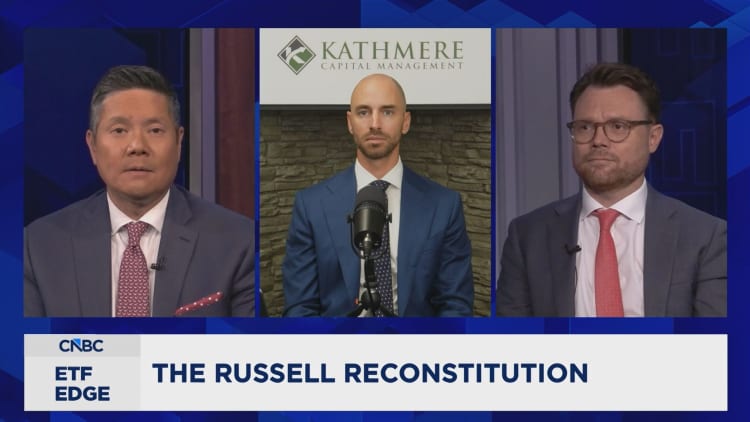

SpaceX may put other mega-cap IPOs on the fast track.
According to Kathmere Capital Management’s chief investment officer, it could emerge as the ultimate blueprint for Silicon Valley — especially when it comes to the expected Anthropic and OpenAI public debuts.
“It would not surprise me at all to see a similar dynamic play out with some of these [IPOs] set to come in the months ahead,” Nick Ryder told CNBC’s “ETF Edge” this week.
Ryder, whose firm provides financial advice to individuals and businesses, contends market conditions will determine whether upcoming mega-cap IPOs will rip a page from SpaceX’s playbook.
“We’ve been in… a pretty historic two- [or] three-month rally for the equity market [which] was feeding into [SpaceX],” added Ryder. “When these other mega IPOs eventually come to market the environment might be different, and so it’s really hard to predict how it will be.”

SpaceX since public debut
SpaceX, which went public on June 12 with a historic $2 trillion-plus market cap, soared 53% above its $150 opening price in just three trading days. But the big gain didn’t last. As of Wednesday’s close, shares of the aerospace and satellite company are up nearly 17% since the debut.
Index inclusion
Also notable: SpaceX is one of the fastest stocks to get added to major indexes. It’s already in the Russell 1000. Now, it’s set to be added to the Nasdaq-100 on July 6 after the market close.
Arne Noack is the FTSE Russell head of equity & multi-asset indices for the Americas. He sees the indexes themselves, rather than SpaceX, as the true blueprint for upcoming IPOs.
“As index providers, [we] have put in place a blueprint that is clearly visible for anyone… meaning there is a fast-track eligibility. If you meet certain thresholds, you’re potentially eligible for index inclusion,” Noack said.

Bitcoin price is attempting a recovery, with it trading around $61,000 after bouncing from recent lows near $58,000 and breaking the bearish prediction. However, macro headwinds remain significant. Central banks continue signaling tighter policy, which has historically reduced liquidity available for risk assets, including Bitcoin.
Analyst targets remain sharply divided, highlighting the market’s uncertainty. Bernstein still projects Bitcoin could reach $150,000 in 2026, while Galaxy Digital’s Alex Thorn recently lowered his target to $120,000 from $185,000. That gap reflects very different expectations for growth, liquidity, and investor demand.
A strategist, Matt Weller, argues that the key issue is monetary policy. As central banks lean hawkish, money supply growth slows, reducing support for Bitcoin’s store-of-value narrative. Because institutional participation has grown, BTC now reacts more closely to interest-rate expectations than in earlier cycles.
Institutional buying and ETF flows still provide support, but they may not be enough on their own. Earlier macro-driven outflows already weakened momentum during this cycle. As a result, Bitcoin’s next major move will likely depend more on global liquidity conditions than on crypto-specific demand.
Discover: The Best Token Presales
Bitcoin Price Prediction: Reclaim $75,000 Before Rate Expectations Shift?
Bitcoin trades around $58,600 after losing momentum from earlier highs. The decline has turned $72,000 from a breakout target into a major resistance level. For now, bulls must first reclaim $70,000 before any sustained recovery can develop.
A bullish outcome depends on stronger liquidity, rising accumulation, and clearer expectations for interest rate cuts. If those factors align, Bitcoin could regain $70,000 and eventually challenge higher resistance. A move beyond $100,000 would require sustained buying pressure and improving market conditions.

Don’t Miss Out on Our $1,000 USDT Airdrop on ByBit
Meanwhile, the base case favors consolidation between $58,000 and $70,000 as investors wait for clearer signals from the Federal Reserve. ETF inflows and corporate purchases continue supporting demand, although they have not been strong enough to trigger a lasting breakout.
On the downside, prolonged tight monetary policy and weak liquidity could send Bitcoin back toward recent lows. That would reinforce the cautious outlook adopted by several market analysts. Likewise, ARK Invest’s lower 2030 bull-case target suggests even long-term optimists are adjusting expectations. Patience remains essential until macro conditions improve.
Discover: The Best Crypto to Diversify Your Portfolio
Bitcoin Hyper Positions for Early-Stage Upside While BTC Consolidates
BTC at the current level isn’t the entry point of the cycle; the window has closed. Spot upside toward $115,000–$150,000 exists, but from current levels, the risk/reward has compressed considerably compared to where institutional accumulation was building. That compression is exactly what pushes active traders to look earlier in the capital stack, because $100,000 BTC will only growth your $1,000 to less than $2,000.
Bitcoin Hyper ($HYPER) is a Bitcoin Layer 2 built on the Solana Virtual Machine, positioning it as the first BTC L2 to deliver SVM-powered smart contract execution, targeting performance that matches or exceeds Solana’s throughput while preserving Bitcoin’s security.
The project has raised close to $33 million at a current presale price of $0.01368, with staking live for presale participants. Core infrastructure includes a Decentralized Canonical Bridge for BTC transfers and low-latency execution designed to address Bitcoin’s programmability gap directly.
For us, watching BTC consolidate while central bank policy stays restrictive, early-stage infrastructure with a direct Bitcoin ecosystem thesis offers a different risk profile.
Research Bitcoin Hyper before the next stage price increase closes that entry gap.
Don’t Miss Out on Our $1,000 USDT Airdrop on ByBit
The post Bitcoin Price Prediction: Price Recovering as Central Banks Tighten Liquidity appeared first on Cryptonews.

TLDR
- Micron shares declined an additional 2.18% in Thursday’s premarket session to $1,009.76, after plummeting 10.6% Wednesday to settle at $1,032.28.
- Global contagion sent South Korea’s KOSPI benchmark tumbling 7.9%, with memory chip competitors SK Hynix and Samsung plunging 14.6% and 9.1% respectively.
- Year-to-date gains through Wednesday still show Micron ahead by 262%, trading approximately 128% above its 200-day moving average.
- Critical support zone identified near $991; falling through this level may trigger additional downside pressure.
- Wall Street maintains optimistic outlook with consensus price target of $1,542.05, while Cantor Fitzgerald and Barclays project $2,000.
Micron Technology (MU) shares experienced significant turbulence this week, collapsing 10.6% during Wednesday’s session to settle at $1,032.28, then extending losses with a 2.18% decline in Thursday’s premarket trading to approximately $1,009.76. This two-session retreat represents part of a wider semiconductor sector downturn that triggered volatility across domestic and international markets.
The selling pressure transcended American markets. South Korea’s KOSPI benchmark — which has been among 2026’s strongest-performing global indices — closed Thursday’s session down 7.9%. With heavy concentration in memory chip manufacturers, the index bore the brunt of sector-specific weakness. SK Hynix plummeted 14.6% while Samsung retreated 9.1%. These companies compete directly with Micron in DRAM and NAND memory segments.
Despite recent volatility, Micron‘s broader performance trajectory remains impressive. Through Wednesday’s close, shares have surged 262% year-to-date — performance that eclipses most Wall Street benchmarks. The KOSPI maintains an 81% gain for 2026 despite Thursday’s pullback. Meanwhile, the S&P 500 has advanced a modest 9.3% during the same period.
However, short-term technical indicators reveal emerging weakness. Micron currently trades approximately 4.1% beneath its 20-day simple moving average of $1,048.47, suggesting the immediate trend is undergoing consolidation following the stock’s June peak. The relative strength index registers at 51.95 — neutral territory — indicating the shares are pausing rather than experiencing fundamental breakdown.
Key Levels to Watch
Market participants are monitoring two critical price thresholds. Overhead resistance exists around $1,089.50, representing the level Micron must reclaim to reestablish bullish momentum. Conversely, downside support emerges near $991. Breaching this floor could trigger additional selling pressure.
For perspective, Micron continues trading roughly 19.5% above its 50-day moving average of $841.56 and approximately 128.4% above its 200-day moving average of $440.26. These metrics suggest the long-term uptrend remains fundamentally sound.
Micron maintains substantial ETF representation. The stock commands an 8.39% allocation in the Invesco S&P 500 Momentum ETF (SPMO), a 9.78% weighting in the Invesco PHLX Semiconductor ETF (SOXQ), and a 9.46% position in the Global X DAX Germany ETF (DAX). Such concentrated ETF exposure means institutional fund flows can magnify price movements in either direction.
Earnings and Analyst Targets
Micron’s upcoming quarterly earnings release is scheduled for September 22, 2026. Wall Street consensus anticipates earnings of $31.24 per share — a substantial increase from $3.03 reported in the prior-year period. Revenue projections stand at $50.72 billion, dramatically exceeding last year’s $11.31 billion. These forecasts illustrate extraordinary growth momentum.
The stock currently trades at a price-to-earnings multiple of 23.3, which analysts view as reasonable compared to semiconductor industry peers.
Analyst sentiment remains decidedly bullish. Consensus price target for MU sits at $1,542.05. Cantor Fitzgerald elevated its target to $2,000 on June 29, while Barclays established an identical target on June 25. Cantor’s previous target stood at $1,500.
Micron’s Benzinga Edge metrics support the optimistic thesis: momentum score of 99.62, quality score of 97.83, and growth score of 85.15. The lone weakness appears in valuation, scoring just 24.83 — reflecting concerns about how rapidly shares have appreciated.
As of Thursday’s premarket session, MU traded at $1,009.76, down 2.18%.



Ethereum layer-2 scaling network Taiko’s cross-chain bridge is back online, just 10 days after the June 22 hack.
The protocol halted operations after the attack, which stemmed from a compromised SGX signing key mistakenly exposed on GitHub. The flaw enabled an attacker to forge withdrawal proofs, draining roughly $1.7 million from the bridge and ERC20 Vault contracts.
Bridge exploits involving exposed keys remain a persistent challenge in crypto, with hundreds of millions lost industry-wide in 2026. However, Taiko’s quick recovery stands out, with every user made whole in less than two weeks.
“The bridge is open,” Taiko announced on X on Thursday. “You can move funds to and from Taiko again. Our response is complete: the network is fully restored and every user is whole. Any limits in place won’t affect normal use. A reminder: we’ll never DM you first, and there’s no claim site. Only trust this account,” it added, promising to publish a full post-mortem of the incident soon.
Taiko’s restoration of the bridge is the result of a multi-stage recovery that involved patching the vulnerability, replenishing bridge reserves to full 1:1 backing, restoring layer-2 network activity, and subjecting the fix to an independent security review.

Key Takeaways
- Shares of Nebius Group (NBIS) plummeted 17% during Wednesday’s session, hitting an intraday low of $228.17 with trading volume spiking 85% above typical levels
- A Bloomberg article revealing Meta’s plans to launch a cloud infrastructure service competing with neocloud companies sparked the massive sell-off
- The decline came despite impressive quarterly results showing $399 million in revenue — a 684% year-over-year increase — and an EPS beat of $0.54
- Analyst sentiment remains cautiously optimistic with a “Moderate Buy” rating across 15 analysts; Bank of America maintains a $280 price objective
- Company executives have offloaded more than $124 million in shares over the last three months, raising questions about confidence
Meta’s Cloud Ambitions Trigger Sharp Decline in Nebius Group (NBIS) Stock
Shares of Nebius Group (NBIS) experienced a dramatic 17% decline on Wednesday, touching a session low of $228.17 before settling near $229.18. The stock had closed at $276.17 the previous day. Trading activity exploded, with more than 30 million shares changing hands — approximately 85% higher than normal daily volume.
The catalyst for this sharp downturn was a Bloomberg article detailing Meta Platforms’ intention to commercialize AI computing resources and models — including direct GPU capacity sales. This business model places Meta in direct competition with neocloud specialists such as Nebius and CoreWeave.
CoreWeave similarly experienced a decline exceeding 6% following the same disclosure.
The market reaction extends beyond simple competitive concerns. Meta currently ranks among the world’s largest purchasers of GPU computing power. A strategic pivot toward selling excess capacity rather than solely consuming it could fundamentally reshape supply dynamics across the entire industry.
Neocloud companies including Nebius have benefited tremendously from surging AI infrastructure requirements. Wednesday’s market action demonstrated how rapidly investor confidence can evaporate when threatened by well-capitalized competitors.
Robust Growth Metrics Clash With Valuation Concerns
The stock decline contrasts sharply with Nebius’s operational performance. The company delivered $399 million in quarterly revenue — representing an extraordinary 684% year-over-year expansion. Management exceeded earnings projections by $0.54 per share, posting a loss of just $0.23 compared to the consensus estimate of a $0.77 loss.
The organization’s customer acquisition pipeline has reached unprecedented levels, and underlying demand for AI infrastructure capabilities continues accelerating. However, several Wall Street analysts had previously cautioned that the stock’s valuation appeared overextended following its remarkable pre-earnings rally.
NBIS currently trades above its 50-day moving average of $215.92 and significantly above its 200-day moving average of $142.48. Even after Wednesday’s correction, the stock maintains considerable premium to these technical benchmarks.
With a price-to-earnings multiple of 73.93 and a market capitalization approaching $58 billion, valuation remains elevated. The stock’s beta coefficient of 4.03 underscores its extreme volatility — a characteristic vividly illustrated by Wednesday’s price action.
Wall Street Perspectives and Executive Stock Sales
The analyst community maintains a generally favorable outlook despite divided opinions. Fifteen analysts currently cover the stock, with nine recommending Buy and six maintaining Hold ratings, resulting in a “Moderate Buy” consensus. The mean price target stands at $203.25.
Bank of America established a $280 price objective with a Buy recommendation in early June. BNP Paribas Exane initiated research coverage in June with a Neutral stance and $255 target. Morgan Stanley maintains an Equal Weight rating alongside a $144 price target.
Insider transaction patterns present a more cautious narrative. The Chief Technology Officer divested approximately $3.7 million in stock on June 4th, representing a 5.1% reduction in personal holdings. The Chief Revenue Officer sold roughly $3 million on June 2nd, trimming his stake by 28.6%.
Collectively, company insiders have liquidated more than $124 million in stock value during the past 90 days.
Nevertheless, institutional investors have demonstrated confidence by expanding positions. Orbis Allan Gray, Fred Alger Management, and Morgan Stanley have all increased their shareholdings in recent reporting periods.
Wall Street analysts project Nebius will report a full-year loss of $1.91 per share on average.

Key Highlights
-
CRCL shares advance following Standard Chartered’s institutional USDC launch.
-
Global bank introduces direct USDC creation and redemption services.
-
Development reinforces Circle’s position in regulated digital currency markets.
-
Initial deployment begins in DIFC with expansion plans underway.
-
Partnership expands Circle’s footprint among institutional investors.
Shares of Circle Internet Group (CRCL) climbed 3.81% to reach $64.38 during pre-market hours following Standard Chartered’s introduction of institutional-grade USDC services. This advance came after CRCL closed the prior session at $61.95, representing a 1.09% decline. The development establishes a connection between a leading international financial institution and Circle’s regulated digital dollar platform.
Pre-Market Rally Follows USDC Service Announcement
Circle Internet Group equity experienced upward momentum ahead of market open after Standard Chartered unveiled its USDC creation and redemption platform. This offering leverages Circle’s existing framework while focusing on corporate and institutional participants. The partnership enhances Circle’s standing within the regulated digital currency ecosystem.
This new functionality enables organizations to obtain USDC via Standard Chartered’s established client onboarding and servicing infrastructure. Consequently, institutional participants can bypass the need for direct Circle relationships. This arrangement introduces a banking intermediary between traditional currency systems and distributed ledger settlement mechanisms.
Circle produces USDC through licensed operating entities, maintaining its status as a leading dollar-backed digital currency. Applications include cross-border transactions, financial settlement, corporate treasury operations, and capital management. Banking collaborations of this nature can accelerate mainstream institutional adoption.
Major Bank Pioneers Institutional Stablecoin Infrastructure
Standard Chartered achieved a milestone as the inaugural licensed Global Systemically Important Bank offering this type of USDC service architecture. Operations will commence through the bank’s Dubai International Financial Centre presence. This deployment reinforces the United Arab Emirates’ commitment to regulated cryptocurrency infrastructure.
The platform integrates traditional banking capabilities with custody solutions, digital asset technology, and public blockchain networks. Organizations gain unified access for moving between fiat currency and stablecoins. This arrangement enables businesses to coordinate blockchain-based settlement and treasury functions with enhanced oversight.
Standard Chartered intends to broaden this service across additional jurisdictions following regulatory clearance and operational preparation. Bank executives positioned this deployment as an initial step within a comprehensive stablecoin strategy. Such moves reflect increasing appetite for compliant digital asset infrastructure.
Institutional Appetite Drives CRCL Momentum
Circle stands to gain from growing corporate and institutional interest in stablecoins and blockchain settlement systems. USDC availability through an established international bank may unlock additional enterprise applications. This integration embeds Circle more firmly within conventional financial architecture.
The announcement arrives as financial institutions and corporations evaluate stablecoins for payment processing and treasury optimization. Organizations seek operational efficiency and transaction transparency while maintaining regulatory compliance and risk management protocols. Standard Chartered’s approach satisfies these requirements through its supervised banking structure.
CRCL’s pre-market appreciation underscored this enhanced institutional positioning. Shares recovered from the previous session’s weakness and early trading pressure. Nevertheless, the fundamental narrative centers on Circle’s deepening integration with regulated banking infrastructure.
Crypto World
Metaplanet (3350) buys another $170 million of bitcoin expanding treasury to 43,000 BTC


Metaplanet (3350) announced the purchase of an additional 2,823 BTC ($170.7 million), bringing its total treasury to 43,000 BTC ($2.6 billion).
The acquisition cements the Tokyo listed firm as the third largest publicly traded company holding bitcoin, trailing only Strategy MSTR) and Twenty One Capital (XXI), according to data tracked by Bitcoin Treasuries.
Metaplanet closed 3.5% higher at 207 yen ($1.28) on Thursday following the announcement.
Alongside the bitcoin purchase, the company released its second quarter FY2026 results for its Bitcoin Income Generation business. The division generated approximately 1.75 billion yen ($10.85 million) in operating revenue during the quarter, taking first half revenue to approximately 4.72 billion yen.
Metaplanet uses bitcoin options to generate recurring income while expanding the company’s bitcoin holdings. On a trailing 12-month basis, revenue reached approximately 11.4 billion yen.
The latest results reinforce Metaplanet’s dual strategy of aggressively accumulating bitcoin while generating recurring cash flow from its Bitcoin Income Generation business.
XRP has rebounded toward the stubborn $1.07 resistance after Ripple’s latest XRP Ledger lending plans and rising network activity revived buying interest, but another breakout attempt now faces a level that repeatedly rejected bulls throughout June.
Summary
- XRP has rallied back to the stubborn $1.07 resistance after Ripple’s lending roadmap and stronger on-chain activity revived buying interest.
- Technical indicators show improving short-term momentum, but major moving averages and a descending trendline continue to cap the uptrend.
- A breakout above $1.07-$1.09 could trigger a short squeeze toward $1.15, while rejection risks another test of the $1.03-$1.00 support zone.
According to data from crypto.news, XRP (XRP) climbed nearly 5% from around $1.03 to an intraday high near $1.08 on July 2 before stalling at the same resistance level that repeatedly rejected buyers throughout late June.
The recovery followed Ripple’s announcement of an institutional-focused XRPL Lending Protocol alongside its monthly escrow release, where 300 million XRP entered circulation while 700 million tokens remained locked. Because only a fraction of Ripple’s holdings reached the market, dilution concerns eased, and buyers stepped back in.
On-chain activity strengthened alongside the price recovery. Daily active addresses on the XRP Ledger jumped more than 72%, while new wallet creation reached its highest level in roughly three months as investors accumulated after XRP’s June decline.
Exchange balances also continued falling as coins moved into self-custody, reducing immediately available supply during the latest rally.
Historical seasonality has also added support. July has consistently ranked among XRP’s strongest months over recent years, encouraging systematic traders to rebuild long exposure after the second quarter ended. The move also came as Bitcoin stabilized above $60,000, allowing capital to rotate back into several large-cap altcoins.
XRP remains trapped below long-term resistance despite improving momentum
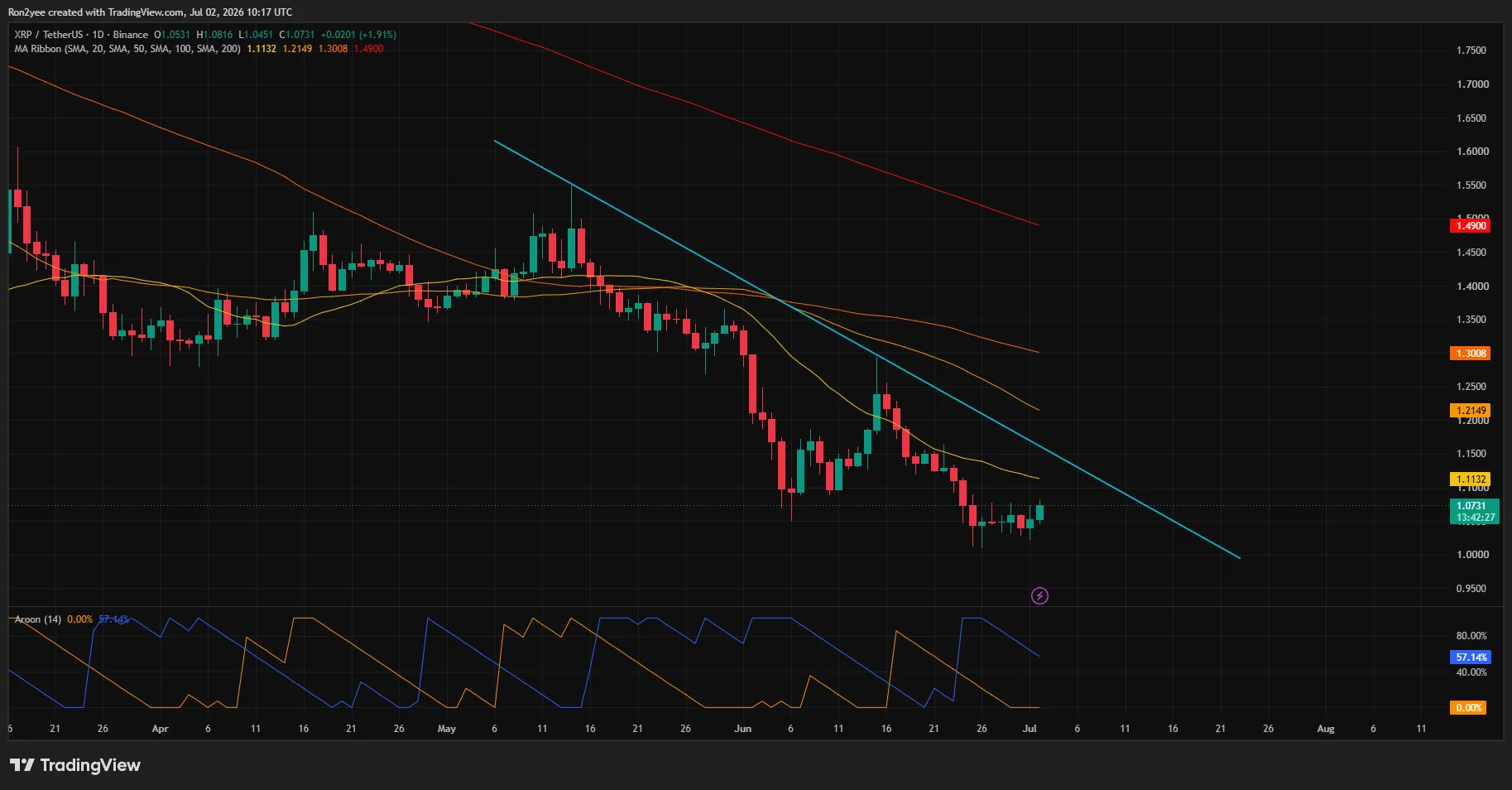
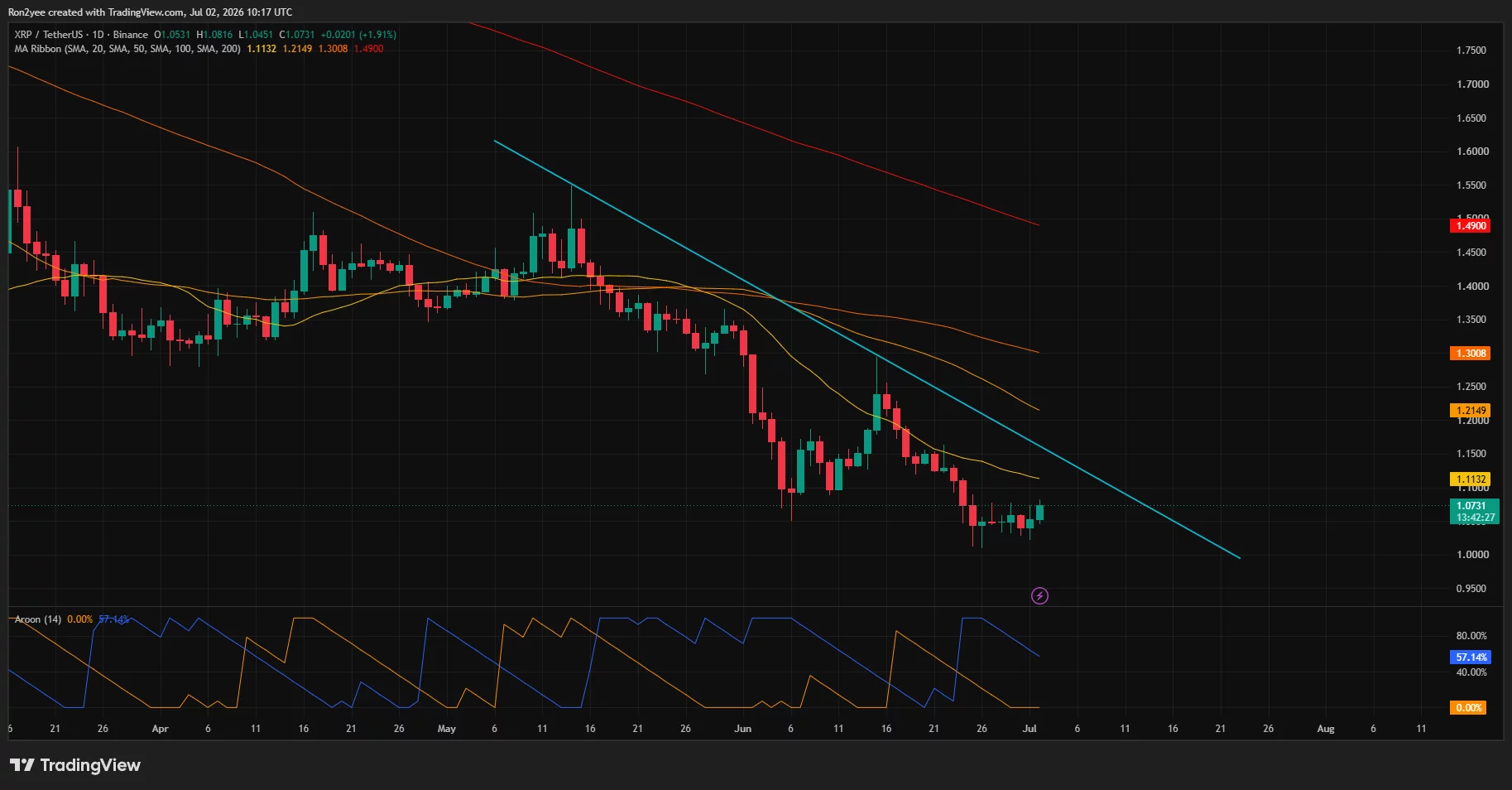
The 1-day chart shows XRP still trading beneath every major moving average despite the latest bounce. The 20-day moving average sits near $1.11, followed by the 50-day around $1.21, the 100-day near $1.30, and the 200-day close to $1.49. A descending trendline connecting lower highs since May continues to cap every recovery attempt, leaving the primary trend bearish until those barriers are reclaimed.
On the 4-hour chart, however, buyers have regained short-term momentum. XRP has pushed back above recent consolidation lows and is once again testing the $1.075-$1.08 resistance zone that rejected advances several times during June.
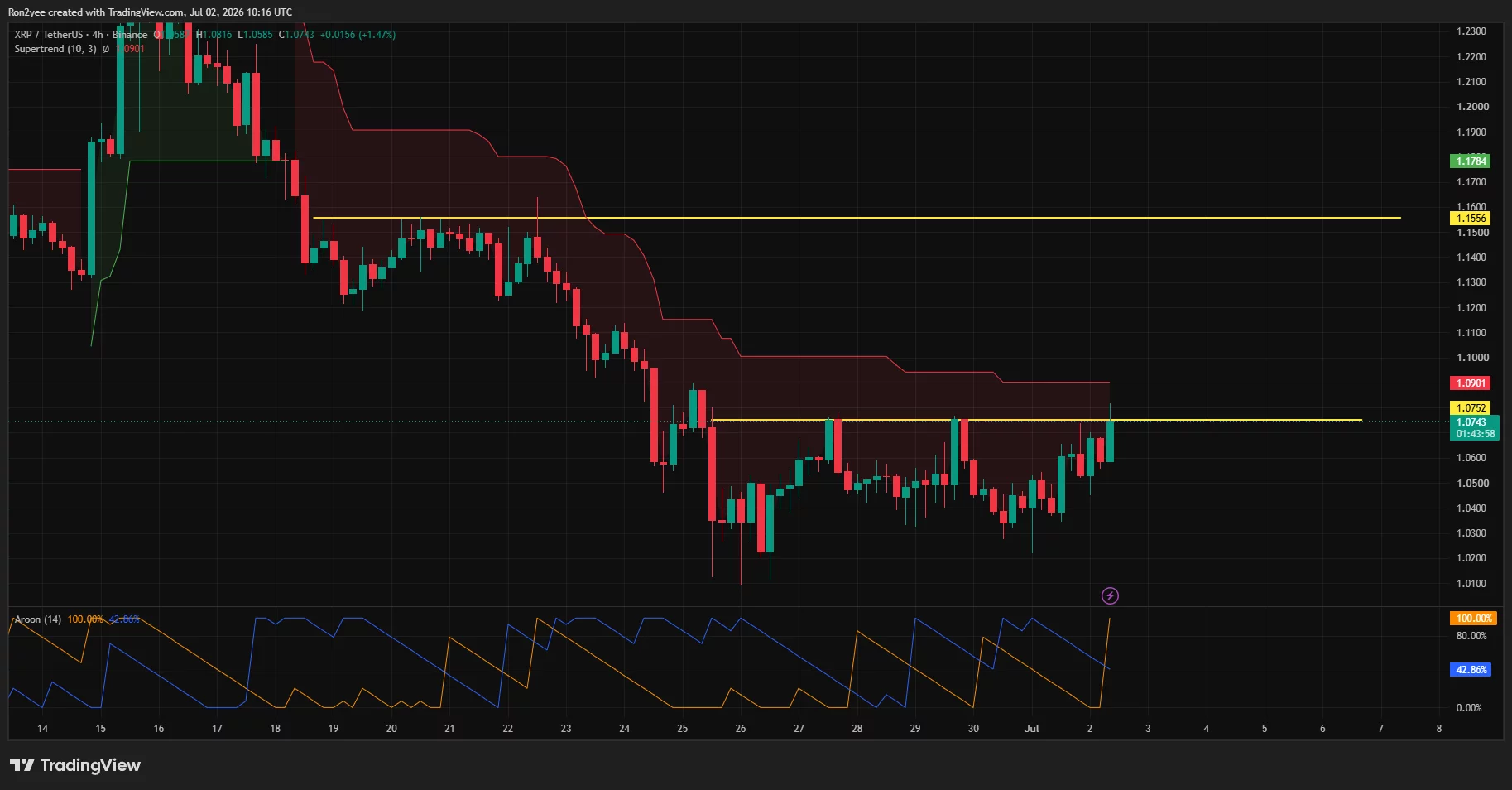
The Supertrend indicator still remains bearish near $1.09, making that level the first confirmation hurdle before bulls can target the next resistance around $1.15. A successful break there could expose the declining 20-day average near $1.11 first before opening room toward $1.21.
Meanwhile, the Aroon indicator presents a mixed picture across timeframes. The daily chart still favors sellers, while the four-hour reading has shifted decisively toward buyers after Aroon Up surged to 100%, suggesting short-term momentum has strengthened even though the larger trend has yet to reverse.
Derivatives positioning also supports the importance of the current price zone. CoinGlass liquidation data shows one of the largest short liquidation clusters sitting between $1.08 and $1.10.
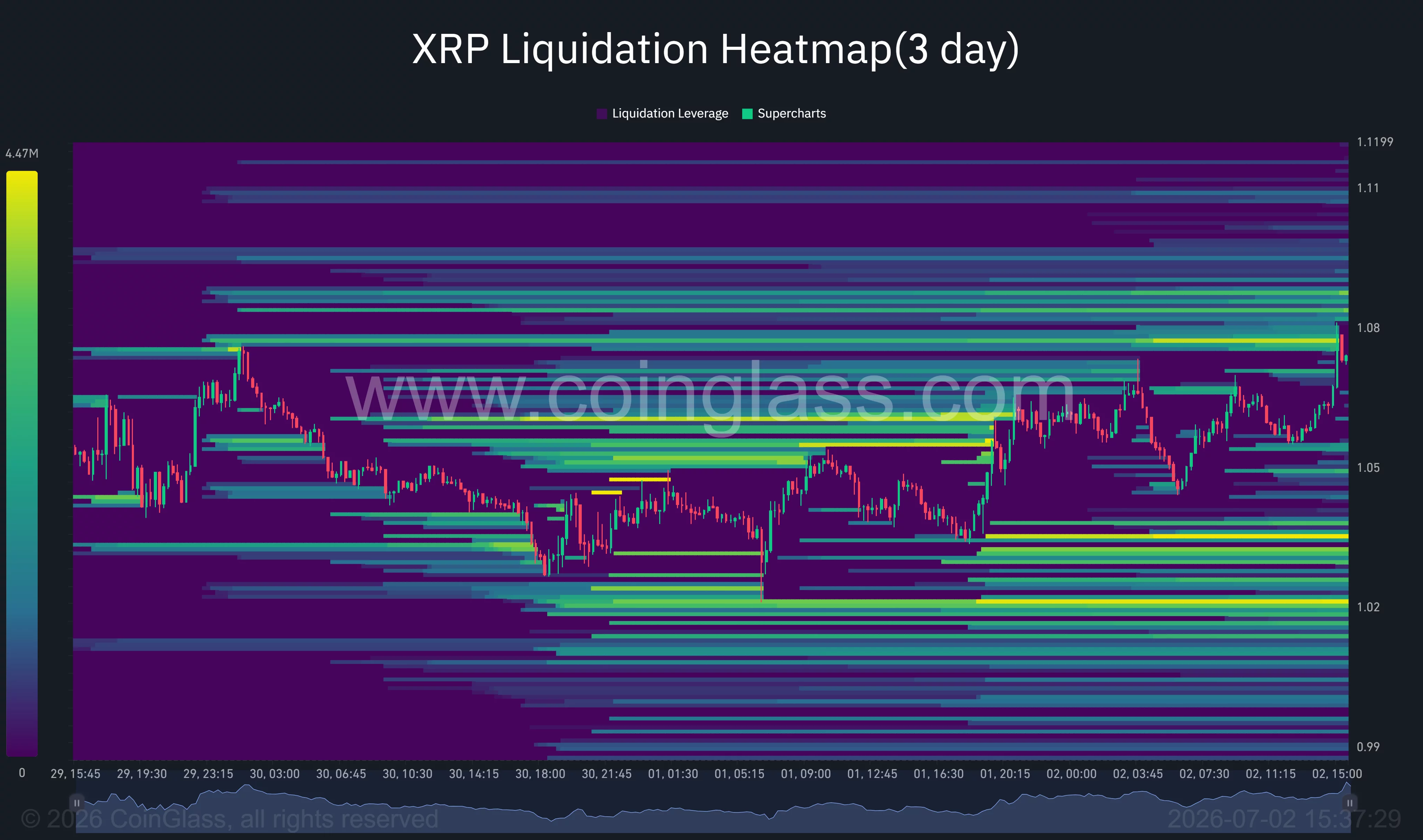
A decisive move through that range could trigger forced buying from leveraged short positions and accelerate a squeeze toward $1.11 and potentially $1.15. On the downside, sizeable long liquidation pools remain concentrated around $1.03 and $1.02, making those levels important support if the breakout attempt fails.
Commenting on the current structure, analyst ChartNerd wrote in a July 2 X post:
“Relief is possible from this $1.00 low but the overall trend remains down for now.”
The analyst also noted that XRP has historically remained under pressure after losing its 20-week exponential moving average and argued that reclaiming roughly $1.35 would be needed to restore a higher-timeframe bullish trend.
Failure at $1.07 would keep sellers in control
Several risks continue to challenge the recovery despite improving sentiment. XRP remains roughly 70% below its July 2025 peak near $3.66 after months of restrictive monetary policy, weaker crypto market liquidity, and delayed regulatory progress in the U.S.
The postponement of the U.S. CLARITY Act removed one of the largest anticipated policy catalysts, while elevated Treasury yields have continued limiting capital flows into higher-risk assets.
Technically, another rejection near $1.07-$1.09 would reinforce the descending trendline that has controlled price action for nearly two months. A drop below $1.03 would expose the psychological $1.00 support once again, and losing that level could send XRP toward the next demand zone around $0.98.
Conversely, a clean close above the Supertrend and repeated June highs would invalidate the immediate bearish structure and give buyers their strongest opportunity in weeks to extend the recovery toward $1.15 and then the cluster of moving averages above $1.20.
Disclosure: This article does not represent investment advice. The content and materials featured on this page are for educational purposes only.

Ethereum has a “wall of worry” where negative sentiment is meeting staking absorption, reported CryptoQuant on Tuesday.
The Coinbase Premium, a measure of institutional interest, is 230% below its three-month average, while Binance funding rates are deeply negative, signaling caution from US institutions and leveraged traders, it added.
Despite this wall of negativity, ETH’s price has stayed stable over the past week rather than breaking down.
ETH Staking Hits Record 40M
Meanwhile, the Ether supply is tightening as stablecoin balances on Binance are draining while staking inflows have surged 65%, “suggesting long-term holders are locking up supply even as short-term traders de-risk,” it stated.
“While traders are shorting or de-risking on Binance, long-term holders are actively locking supply into the staking contract.”
This combination of deep pessimism and a shrinking liquid/exchange supply is a classic pattern, which historically creates fragile conditions for short traders if selling pressure exhausts.
The analysts concluded that monitoring the reversal of the Coinbase Premium will be the primary signal for a shift in this regime.
Ethereum’s Wall of Worry: Negative Sentiment Meets Staking Absorption
“Historically, when speculative sentiment is this depressed while organic supply is being absorbed by staking, it creates a fragile environment for short-sellers.” – By @CryptoOnchain pic.twitter.com/C8XO4Omlmp
— CryptoQuant.com (@cryptoquant_com) June 30, 2026
The staking figures speak for themselves, with a record amount of ETH off the table and locked up.
ETH staking has hit an all-time high of 40 million, which equates to 33% of the entire supply, according to Ultrasound.Money.
Additionally, the validator exit queue is just 9,248 ETH, while more than 2.9 million ETH are in the entry queue.
Bitmine chair Tom Lee said that crypto is a hyper-volatile asset, and some macro headwinds are weighing on ETH, such as markets seeing a Fed hike, Clarity Act purgatory, AI FOMO, and private credit hurting flows.
However, there are also some tailwinds, including the tokenization megatrend, crypto downstream of AI, money becoming digital/software, and peak pain, he said in a recent interview.
ETH Price Outlook
Despite these tailwinds, ETH prices remain depressed, with the asset dipping to an intraday low of $1,550 on Tuesday.
There was little momentum during Wednesday morning Asian trading, with ETH lifting to $1,585. The longer it stays at current levels, the greater the chances of another leg down, especially if Bitcoin loses support at $58,000.
The post Staking Surge Tightens Supply, But Negative Sentiment Still Dominates Ethereum appeared first on CryptoPotato.
Crypto World
Standard Chartered Launches USDC Minting and Redemption Service for Institutional Clients
TL;DR
- Standard Chartered has become the first G-SIB to offer institutional clients direct USDC minting and redemption services.
- The new solution allows eligible clients to access USDC without opening a separate account with Circle.
- Initially launching through the bank’s DIFC operations, the service supports settlement, treasury, and liquidity management.
- The partnership underscores growing institutional demand for regulated stablecoin infrastructure despite rising competition in the sector.
Standard Chartered, currently at the fore front of the stablecoin adoption campaign, has introduced a new service that enables institutional clients to mint and redeem USDC directly through the bank, marking a significant step in the integration of traditional banking with digital assets.
Developed in partnership with Circle Internet Group, the issuer of USDC, the offering makes Standard Chartered the first Global Systemically Important Bank (G-SIB) to provide institutional access to USDC minting and redemption through a single banking relationship.
Unlike existing arrangements, eligible clients will not need to open separate accounts with Circle. Instead, they can access USDC minting and redemption through Standard Chartered’s institutional platform, allowing them to move between fiat currencies and blockchain-based assets within a unified banking environment.
The service will initially be available through the bank’s Dubai International Financial Centre (DIFC) operations, with plans to expand into additional markets as regulatory approvals are secured.
New Service Aims to Bridge Traditional Banking and Digital Assets
Standard Chartered said the new capability is designed to simplify how institutions interact with regulated stablecoins by combining banking services, custody, and digital asset infrastructure into a single offering.
The bank expects the solution to support a wide range of institutional activities, including on-chain settlement, treasury operations, and liquidity management, while also laying the foundation for future payment-related use cases. By embedding USDC access into its existing institutional banking platform, Standard Chartered aims to provide clients with the governance, compliance, and risk management standards associated with a global financial institution.
The launch also reflects growing demand among corporations and financial institutions for regulated stablecoin infrastructure capable of supporting cross-border transactions and digital asset operations. Starting in the UAE further reinforces the country’s position as an emerging hub for regulated blockchain and digital asset innovation.
Partnership Highlights Stablecoin Adoption Despite Growing Competition
The partnership, just barely a month after another one with CoinMENA, represents another milestone for Circle as it continues expanding the reach of USDC through established financial institutions. Bringing a global systemically important bank into its ecosystem could strengthen USDC’s position among institutional users seeking regulated access to stablecoins.
The announcement also comes just hours after renewed attention on Circle’s competitive position in the stablecoin market. As earlier reported, Circle’s shares recovered modestly after a sharp selloff triggered by the launch of the OpenUSD consortium, an initiative backed by more than 140 organizations, including major financial and technology companies such as Stripe, Coinbase, Visa, Mastercard, and BlackRock.
While some analysts have warned that increasing competition could pressure USDC’s market position over time, Standard Chartered’s decision to integrate USDC into its institutional banking services signals that demand for regulated stablecoin infrastructure continues to grow.

USMCA: Why the expected fight over the North American trade deal never kicked off

SpaceX as ultimate blueprint for new wave of mega-cap IPOs

The House | “Brings welcome clarity”: Mark Garnier reviews ‘Brexit: A Very British Civil War’


-

 Fashion6 days ago
Weekend Open Thread: Staud – Corporette.com
-

 Politics6 days ago
The House | Manchesterism won’t survive the painful trade-offs unless it gets citizens on board
-

 Crypto World2 days ago
Strategy authorizes up to $1.25B in Bitcoin sales under new capital plan
-

 Politics6 days ago
Potential 2028er World Cup attendee leaderboard
-

 Business6 days ago
Asia stock markets slide as tech shares slump
-

 News Videos4 days ago
MAJOR BITCOIN & MARKET UPDATE!!!! (MUST WATCH ASAP!!!)
-

 Tech7 days ago
A Look At A Gaggle Of Transputer Boards
-
 Crypto World7 days ago
Dell (DELL) Shares Tumble Over 5% Following Analyst Downgrade to Hold
-

 Crypto World5 days ago
Coinbase, Circle Deepen Crypto Stock Losses Despite Resilient S&P 500
-

 Business2 days ago
Australia treasurer says alleged access of prime minister’s bank data ’incredibly concerning’
-

 Crypto World5 days ago
Kraken's xStocks Opens Bending Spoons IPO Registration to EEA Retail
-

 Sports6 days ago
FIH Pro League: India defeat Pakistan 7-1, register biggest win of campaign | Other Sports News
-
 Crypto World6 days ago
Bitcoin Sparks $600M Hourly Liquidations With $65,000 Set To Become Resistance
-

 Tech2 days ago
Anonymous researcher drops 0-day ‘exploitarium’ repo
-

 Tech4 days ago
Bluekit phishing kit adopts browser-in-the-middle for login theft
-

 Tech5 days ago
Russian hackers now target Signal backup recovery keys
-
Crypto World6 days ago
Hyperliquid Named on Singapore MAS Investor Alert Register
-

 Crypto World6 days ago
RTX holders must register wallets before token distribution begins
-

 Sports23 hours ago
Broncos roster: OL Ben Powers (No. 74) entering final year of contract
-
 Business3 days ago
The AI boom won’t burst all at once. It will pop in ‘rolling bubbles’: Macquarie
You must be logged in to post a comment Login