
Crypto World
Mezo Taps Aerodrome To Support Token Trading On Base

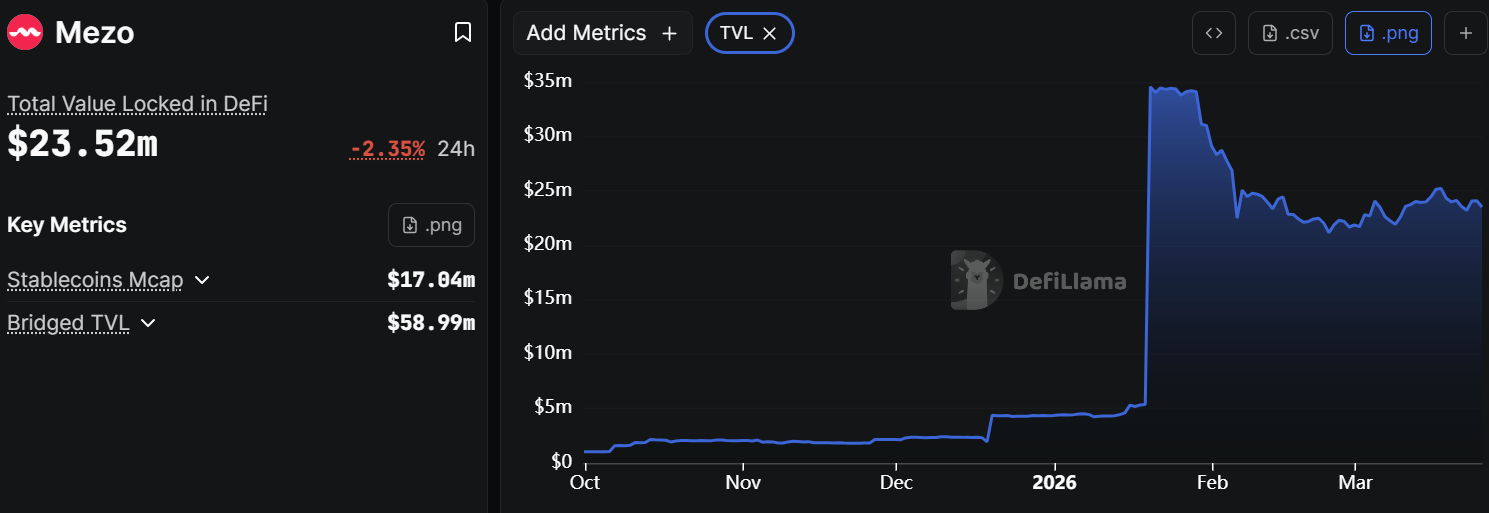
Mezo, a Bitcoin-native lending protocol, will collaborate with Aerodrome Finance to support trading activity for its token and Bitcoin-backed stablecoin on the Base network, as projects look for ways to bring more financial use cases to Bitcoin.
In a Thursday announcement, Mezo said it will allocate 2.25% of its MEZO token supply to Aerodrome’s vote-escrow (veAERO) participants — users who lock tokens in exchange for governance rights and rewards. The program is designed to encourage those users to direct funds into MEZO trading pairs, increasing activity around the token and its US dollar-backed stablecoin, MUSD.
Aerodrome is a liquidity provider on Base built by the team behind Optimism, a configurable enterprise blockchain infrastructure.
The partnership links Base-based traders with a newer group of Bitcoin-focused applications, as developers experiment with adapting existing DeFi models to Bitcoin.
Mezo, which allows users to borrow against their Bitcoin (BTC) holdings, said it has issued more than 2,000 loans and helped move roughly $23 million in Bitcoin-denominated assets from Ethereum.

The move gives Mezo access to a large and active DeFi user base on the Base network. Bitcoin-native applications often struggle to attract enough trading activity. On Base, infrastructure such as Aerodrome can help support more consistent trading in new tokens and stablecoins.
Related: Coinbase’s Base transitions to its own architecture with eye on streamlining
Bitcoin DeFi activity grows as new platforms emerge
Bitcoin is increasingly being positioned as a base layer for decentralized finance, driven in part by increasing institutional participation and long-term holders seeking ways to generate returns on idle assets.
Bitcoin-based DeFi activity has picked up since 2024, with a growing number of platforms aiming to bring lending, borrowing and yield strategies to the network.
Recent examples include Lombard, which is building Bitcoin-based lending infrastructure and has teamed with Bitwise to allow institutional investors to earn yield and borrow against their Bitcoin holdings.
Another project, Hashi, has recently launched on the Sui network with early participation from BitGo, Bullish and FalconX, among others. The platform enables users to earn yield on Bitcoin through onchain lending and borrowing.
Related: Babylon-Ledger tie-up expands access to Bitcoin Vaults for collateral use



Tether has launched XAU₮ on BNB Chain and Binance, extending its 60% share of a $4b tokenized gold market across 12+ networks via the USDt0 cross-chain system.
Summary
- Tether’s gold-backed token XAU₮ is now live on BNB Chain, bringing the product to the world’s largest cryptocurrency exchange ecosystem and expanding its cross-chain reach to over 12 blockchains via the USDt0 network.
- The gold-backed stablecoin market grew from roughly $1.3 billion to over $4 billion in 2025, with XAU₮ commanding approximately 60% of total supply.
- Binance simultaneously listed XAUt on March 26, offering spot trading, 1–50x USDT perpetual contracts, VIP borrowing, and one-click purchases via card and mobile pay.
Tether on March 26 announced that Tether Gold (XAU₮) is now live on BNB Chain, placing the dominant tokenized gold product directly into the ecosystem of the world’s largest cryptocurrency exchange and its hundreds of millions of users. Each XAU₮ token represents one fine troy ounce of physical gold — London Good Delivery standard — held in Swiss vaults and independently attested on a 1:1 basis.
The launch is timed to a market that has moved sharply in tokenized gold’s favor. Gold surged 64% in 2025 — its largest annual gain in 40 years — setting more than 50 all-time highs as geopolitical tensions and trade uncertainty pushed investors toward safe-haven assets. The gold-backed stablecoin market nearly tripled over the same period, climbing from roughly $1.3 billion to over $4 billion, with XAU₮ holding approximately 60% of total supply.
The BNB Chain deployment is backed by Tether’s USDt0 cross-chain network, which gives XAU₮ unified liquidity across more than 12 blockchains. The architecture is designed to improve the efficiency of issuance, transfer, and settlement, and eliminates the need for users to navigate traditional custody logistics, counterparty premiums, or settlement delays associated with physical gold markets.
What Tether and BNB Chain executives said
“With XAU₮, we are not changing what gold is; we are making it usable in a modern financial system,” said Paolo Ardoino, CEO of Tether, in the official announcement. “You still have direct exposure to physical gold, but now it can move instantly, settle globally, and integrate seamlessly with digital markets. Listing on BNB Chain expands that access to hundreds of millions of users, bringing gold into a system where it can actually be used, not just held.”
Nina Rong, Executive Director of Growth at BNB Chain, added: “XAU₮ on BNB Chain extends what is already the second-largest RWA ecosystem by TVL. It gives users a trusted, gold-backed asset they can use across DeFi without friction.”
BNB Chain doubles down on real-world assets
The Tether Gold deployment deepens BNB Chain’s position in tokenized real-world assets. As reported in a previous crypto.news story, the network’s RWA value surged 555% year over year in Q4 2024, making it the second-largest RWA blockchain behind Ethereum. The addition of XAU₮ — already the largest gold-backed token by market cap — reinforces that trajectory as institutions accelerate tokenized commodity adoption.
XAU₮ is issued by TG Commodities, S.A. de C.V., a registered Digital Asset Service Provider under El Salvador’s Digital Asset Issuance Law. Reserve details and vault attestation reports are publicly accessible at gold.tether.to. Binance also listed XAUt on March 26 with perpetual futures, leveraged trading pairs, and principal-protected yield products — though the launch was briefly delayed from 21:30 to 22:00 UTC+8.
The move follows Tether’s January launch of Scudo, a fractional unit for XAU₮ equal to one-thousandth of a troy ounce, detailed in a previous crypto.news story, which was aimed at making tokenized gold viable for payments and everyday on-chain use.

TLDR
- BlackRock has integrated Chronicle’s Proof of Asset system for its tokenized BUIDL fund.
- The system provides independently verified holdings-level data through an onchain dashboard.
- The tokenized BUIDL fund manages about $1.7 billion in U.S. Treasuries, repos, and cash.
- Securitize issues and manage the BlackRock USD Institutional Digital Liquidity Fund onchain.
- Chronicle sources data directly from custodians and administrators to verify asset composition.
BlackRock has integrated Chronicle as a verification provider for its tokenized BUIDL fund. The firm will use Chronicle’s Proof of Asset system to publish independently verified holdings data. The update strengthens transparency for the $1.7 billion onchain U.S. Treasuries vehicle.
BlackRock and Tokenized BUIDL Add Independent Asset Verification
BlackRock confirmed that its BlackRock USD Institutional Digital Liquidity Fund will use Chronicle’s Proof of Asset system. The system delivers independently verified holdings-level data for the tokenized BUIDL fund. It continuously attests to asset availability, freshness, and integrity through the Chronicle dashboard.
Securitize issues and manages the tokenized BUIDL fund onchain. Carlos Domingo, CEO of Securitize, said, “Tokenization becomes meaningful when investors and protocols can independently verify what’s actually backing the product.” He added that Chronicle’s support shows tokenized funds are evolving into transparent, data-driven instruments for institutions and global markets.
Chronicle Protocol built Proof of Asset as an institutional-grade oracle layer. The system sources data directly from custodians and fund administrators. It then publishes attestations covering valuation, composition, custody, and asset existence.
Niklas Kunkel, founder of Chronicle, described the product as an “integrity layer” for tokenized finance. He said the tool delivers granular data for asset managers, allocators, and risk teams. He stated, “We’re building a layer that didn’t exist until now.”
Robert Mitchnik, BlackRock’s head of digital assets, addressed the integration. He said the system gives platforms and allocators greater visibility into tokenized asset evaluation and usage. He explained that institutions require deeper verification standards for digital products.
Chronicle Expands Data Infrastructure Across Tokenized Funds
Chronicle reported that Proof of Asset secures about $5 billion in total value. The system supports funds, including the Janus Henderson Anemoy Treasury Fund (JTRSY). It also covers Superstate’s Short Duration US Government Securities Fund (USTB).
Securitize has also implemented Chronicle’s system for its Tokenized AAA CLO Fund (STAC). Chronicle said Proof of Asset differs from price or NAV relays because it verifies underlying holdings data. Kunkel stated that the infrastructure introduces a new verification standard for tokenized funds.
The tokenized BUIDL fund currently holds about $1.7 billion in assets. The portfolio includes U.S. Treasuries, overnight repurchase agreements, and cash. BlackRock manages the fund as the largest onchain Treasuries investment vehicle.
The announcement follows recent efforts to publish off-chain financial data on blockchain networks. Coinbase recently said it would push order book, equities, and futures data onchain through ChainLink’s DataLink tool. Firms such as S&P Global and FTSE Russell have also moved to provide market data directly onchain.

Crypto World
Stragegy’s (MSTR) STRC shares rebound to par value faster than historical average to enable more BTC buying


Stretch (STRC), the perpetual preferred equity issued by Strategy (MSTR), the world’s largest corporate holder of bitcoin, reclaimed its $100 par value during Thursday’s trading session, giving the company the leeway to raise funds to add to its stash of the largest cryptocurrency.
The recovery took nine trading days following the March 13 ex-dividend date, when buyers of the stock no longer qualify for the next payout. Prices of ex-dividend stocks typically drop to reflect the cash being distributed to the previous shareholders.
At its core, STRC works by adjusting yield to steer price. If shares trade above $100, the company can trim the dividend to cool demand. If shares fall below that level, it can raise dividends to attract buyers. Keeping the price anchored lets the firm issue new shares near par, bringing in capital that is then deployed to buy bitcoin.
The return to par, this time, was slightly faster than the historical average of around 10 trading days for STRC, according to STRC.live.
STRC functions as a short-duration, high-yield credit instrument, offering an 11.5% annual dividend paid monthly. This structure helps incentivise trading near its $100 par value, enabling the company to utilise at-the-market (ATM) share issuance to raise capital for additional bitcoin acquisitions.
In comparison, SATA, the equivalent tool issued by bitcoin treasury company Strive (ASST), offers a higher 12.75% dividend. Currently priced at $99.25, it is also approaching par value.
Strategy bought 1,031 bitcoin last week for a total cost of $76.6 million, or $74,326 per coin. However, the magnitude of that buy was far lower than that of recent acquisitions, and STRC wasn’t at par during last week’s bitcoin purchase.
The firm’s holdings now stand at 762,099 bitcoin, bought for approximately $57.69 billion, at an average price of $75,694 per bitcoin.
Read more: Michael Saylor’s Strategy dominates DAT bitcoin buying as treasury demand collapses
Bitcoin’s (BTC) consolidation continued into Thursday as bulls struggled to keep hold of $70,000, and competing narratives on BTC’s market structure versus its increasing institutional adoption clashed with the bearish overarching factors negatively impacting US equity markets.
Citing Bernstein’s $150,000 by the end of 2026 price estimate, Bloomberg analysts said that data shows institutional investors returning to the Bitcoin markets in droves, reinforcing the view that BTC had “reached a floor.”
In early March, a week-long stretch of inflows to the spot Bitcoin ETFs nearly topped $1 billion, while Strategy purchased 22,237 BTC for $1.6 billion through its new perpetual preferred equity, Stretch (STRC). In addition to the success of STRC, Strategy also unveiled plans to raise capital to buy $44.1 billion in additional Bitcoin.
Further proof of institutions stepping back into the crypto market came from $10 trillion asset manager Morgan Stanley filing documents to launch its own spot Bitcoin ETF. Morgan Stanley recommends investors maintain a 2% to 4% allocation to cryptocurrencies, and on March 26, a proposed Labor Department rule, which would permit brokerages that manage and offer services in the $10 trillion 401(k) retirement plan market to invest in Bitcoin, progressed through the White House’s regulatory review process.
On Thursday, Coinbase also launched token-backed down payments for Fannie Mae loans, essentially permitting Bitcoin holders to use BTC and USDC to fund home mortgages. The offering allows investors holding Bitcoin to unlock the trapped liquidity of BTC without selling or generating a taxable event.
Related: US Bitcoin ETFs post 6-day inflow streak as crypto rallies
How important is Bitcoin’s $70,000 support?
While institutional investors’ renewed interest in buying Bitcoin has clearly returned, BTC’s price volatility and its inability to break out of a near 6-month price downtrend remain clear hurdles. The ongoing US-Israel and Iran war, along with President Trump’s threat to send ground troops to Iran continues to negatively impact stock markets and cryptocurrencies.
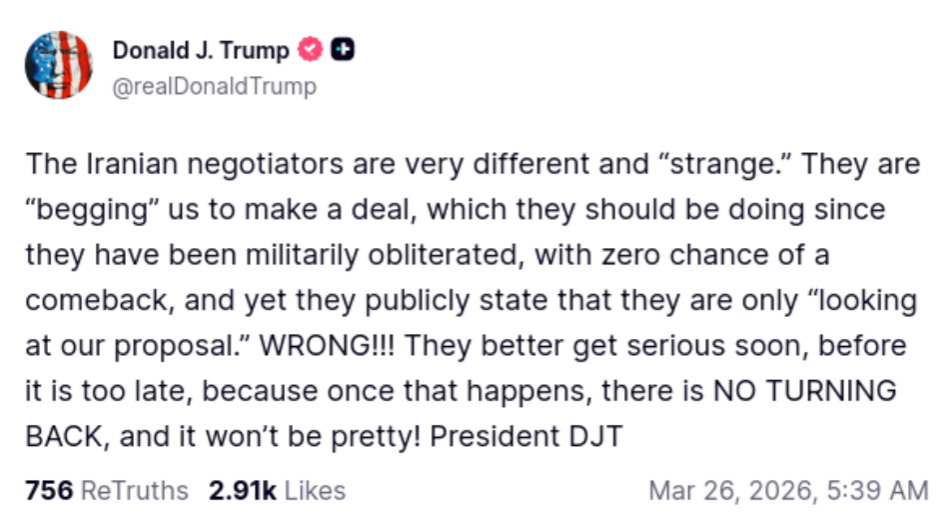
On Thursday, in a Truth Social post, President Trump said Iran’s negotiators had “better get serious soon, before it is too late, because once that happens there is NO TURNING BACK, and it won’t be pretty!” The clear buildup of US military assets deployed to the Middle East has markets worried that a ground operation could begin as early as this weekend.

Following a series of comments from the President, US markets sold off, with the DOW shedding 400 points, while the S&P 500 and Nasdaq saw 1.49% and 2.07% respective losses. On the other hand, WTI crude oil and Brent Crude rallied, with each seeing gains of over 4%.
With growing uncertainty on which direction the US-Israel and Iran war takes and the longer-term impact of record-high oil prices on US inflation and the wider economy, investors are electing to decrease their exposure to volatility.

This explains Bitcoin’s frequent re-visits to prices below $70,000 along with the short-lived nature of rallies in the $71,000 to $76,000 range. That said, one positive is that institutional and retail investors appear to view $70,000 and below as an optimal buying zone, thus reinforcing the level as support.
This article does not contain investment advice or recommendations. Every investment and trading move involves risk, and readers should conduct their own research when making a decision. While we strive to provide accurate and timely information, Cointelegraph does not guarantee the accuracy, completeness, or reliability of any information in this article. This article may contain forward-looking statements that are subject to risks and uncertainties. Cointelegraph will not be liable for any loss or damage arising from your reliance on this information.


BNB price is down, dropping by 3% in 24 hours to under $630, but the technical prediction tells a more complicated story than the red candle suggests. A pullback from the March 17 peak of $675 has rattled short-term holders, yet longer-dated moving averages are quietly trending upward.
BNB is still holding the third-largest market cap among non-stablecoin cryptocurrencies, sitting above $85 billion, ahead of XRP’s $84 billion and Solana’s $50 billion. That ranking reflects the combined weight of Binance’s centralized exchange dominance and BNB Chain’s expanding DeFi footprint.
No major protocol announcements or regulatory catalysts have emerged yet, meaning price action here is largely technical.
With consolidation tightening and April seasonality historically favorable, broader crypto market conditions could accelerate BNB’s next directional move faster than most expect.
Discover: The best crypto to diversify your portfolio with
BNB Price Prediction: Can Binance Coin Reclaim $725 This Month?
BNB opened March 26 at a $600 area, hit an intraday high of $629 a tight range, signaling indecision. However, the seven-day picture shows a decline from $645, a consolidation phase following the spike to $685 on March 16. Support appears to be building around the $620 zone and resistance clusters between $650 and $675.
The moving average picture offers the bullish counterargument. Both the 50-day and 200-day MAs are sloping upward as of March 21, a structural positive. The 4-hour frame remains bearish relative to its MAs (that’s the friction point right now), creating a classic higher-timeframe bull, lower-timeframe bear setup.
BNB’s all-time high of $1,370 in October last year remains a longer-term reference point. At $630, it’s trading at less than half that peak, which either means deep value or a structurally weakened asset, depending on your time horizon.
Discover: The best pre-launch token sales
Bitcoin Hyper Targets Early Mover Upside as BNB Tests Key Levels
BNB upside target sounds compelling, until you account for its $88 billion market cap. Large-cap altcoins face a size problem: the capital required to move the needle is enormous, and the percentage gains that defined 2024 cycles are structurally harder to replicate. That math is exactly why early-stage infrastructure plays attract traders who’ve already captured large-cap exposure.
Bitcoin Hyper ($HYPER) is one presale drawing attention in that context. It’s positioned as the first-ever Bitcoin Layer 2 with Solana Virtual Machine (SVM) integration, targeting the three core limitations that have defined Bitcoin for years: slow transactions, high fees, and the near-absence of programmable smart contracts.
The architecture claims to deliver faster performance than Solana itself, while preserving Bitcoin’s underlying security. The project has already raised more than $32 million at a current price of $0.0136776, with staking rewards of 36% APY for early participants.
For those who’ve done the research: explore Bitcoin Hyper here.
This article is not financial advice. Cryptocurrency investments are highly volatile. Always conduct your own research before making any investment decisions.
The post BNB Price Prediction: Price Drops, But Bullish Signals Flashing appeared first on Cryptonews.
Bitcoin pared earlier losses Thursday afternoon after U.S. President Donald Trump said he would extend a pause on attacks against Iran’s energy infrastructure.
In a Truth Social post, Trump said the pause will now be 10 days, citing ongoing diplomatic talks.
“As per Iranian Government request… I am pausing the period of Energy Plant destruction by 10 Days,” Trump wrote, adding that the “talks are ongoing” and “they are going very well.”
The news helped stabilize markets after an ugly Thursday that saw bitcoin slide 3% and the Nasdaq 2.4%, with that tech-heavy index now lower by about 10% since peaking for the year in late January.
The surge in oil prices since the breakout of hostilities has garnered most of the headlines, but the selloff in Western bond markets is growing more troublesome.
The U.S. 10-year Treasury yield — below 4% just weeks ago — jumped to as high as 4.43% on Thursday, before pulling back to the current 4.41%. Alongside that sharp rise has been not just the vanishing of expectations for Federal Reserve interest rate cuts, but also serious bets that the U.S. central bank will soon hike rates.
Similar moves in bond yields and central bank expectations are taking place across Western Europe as well.
Nevertheless, the Trump comments sent bitcoin higher by about 1% from its worst levels, and it is now trading just above $69,000. Ether (ETH), XRP (XRP), Solana (SOL) and all also rebounded from session lows, though they remained 3%-5% lower over the past 24 hours.


Largest U.S. Bitcoin miner offloads roughly a quarter of its treasury to buy back $1 billion in zero-coupon notes at a 9% discount, dropping to third among corporate BTC holders.
MARA Holdings, the largest publicly traded Bitcoin miner in the U.S., sold 15,133 BTC for approximately $1.1 billion between March 4 and March 25, deploying the proceeds to retire roughly $1 billion in convertible debt, the company said Thursday.
The transactions represent one of the single largest BTC liquidations by a public miner and mark a decisive break from the accumulation-first playbook MARA pursued through much of 2024 and 2025, when it raised billions through zero-coupon convertible note offerings specifically to buy more Bitcoin.
Debt Slashed by 30%
MARA entered into privately negotiated agreements with noteholders to repurchase approximately $367.5 million of its 0.00% convertible senior notes due 2030 and $633.4 million of its 2031 notes, according to a press release. It paid roughly $322.9 million and $589.9 million, respectively — an average discount of about 9% to par — capturing approximately $88 million in cash savings.
The buyback cuts MARA’s total convertible note obligations from roughly $3.3 billion to $2.3 billion, according to the company’s disclosure.
The sale follows a policy change MARA disclosed in its 10-K filing with the SEC earlier this month, formally authorizing the sale of BTC held on its balance sheet — not just newly mined coins. In the second half of 2025, the company had already begun selling a portion of production to cover rising operating costs amid post-halving margin compression.
“Our decision to sell a portion of our Bitcoin holdings reflects a strategic capital allocation move designed to strengthen our balance sheet and position the company for long-term growth,” Chairman and CEO Fred Thiel said in the announcement.
The shift is stark. Just a few months ago, MARA was among the most aggressive corporate BTC accumulators, alongside Strategy (formerly MicroStrategy), using convertible debt issuances to expand its holdings to over 50,000 BTC.
Following the sale, its stash sits at 38,689 BTC, worth approximately $2.7 billion at current prices, according to BitcoinTreasuries data. The drawdown pushes MARA to third among corporate Bitcoin holders, behind Twenty One Capital, which holds 43,514 BTC. Strategy remains far ahead with more than 762,000 BTC and is still buying.
AI Pivot
Thiel framed the deleveraging as a prerequisite for MARA’s broader strategic pivot into digital energy and AI/high-performance computing infrastructure. In February, the company announced a joint venture with Starwood Capital targeting 2.5 GW of AI and HPC data center capacity, and last year agreed to acquire a 64% stake in Exaion, a high-performance computing subsidiary of French energy giant EDF.
The company said it plans to continue selling Bitcoin “from time to time” as part of its 2026 capital and liquidity strategy.
This article was written with the assistance of AI workflows. All our stories are curated, edited and fact-checked by a human.
Crypto World
Bitcoin Price Prediction Shows BTC Below $70K on $13.5B Derivatives Expiry While Pepeto Crosses $8M

Only $2.93 billion in Bitcoin DeFi is deployed while $13.5 billion in crypto derivatives expire today on Deribit, and the BTC outlook turns uncertain as the token tests the 200 day moving average at $69,200 for the third straight session below $70,000.
But the real question now is not how to generate yield on Bitcoin but where to deploy capital before a listing that compresses what years of holding cannot. The bitcoin price prediction shows a pullback, but Pepeto is already past $8 million raised with a Binance listing approaching. This is the kind of entry that Bitcoin DeFi yield will never generate on its own.
Crypto derivatives face a major quarterly expiry on March 27 with $13.5 billion set to expire on Deribit, where positioning points to elevated demand for volatility strategies rather than strong directional bets, according to CoinDesk.
Bitcoin slipped more than 3% Thursday with ETH, XRP, SOL, and ADA losing 4% to 5% as fading hopes of Middle East de escalation weighed on risk sentiment, according to The Block.
The BTC forecast faces volatility from the expiry, and the exchange already running at presale pricing with 100x projected is where the capital lands before the listing.
Where the BTC Pullback Meets Presale Returns Before the Window Closes
Pepeto
The derivatives expiry creates volatility that rotates capital fast. Most traders chase whatever is already running, but traders who use Pepeto find what has not moved yet and enter before it does.
That is the core difference. Most traders who missed the early stages of major rallies simply did not have verified information at the right time. By the time an opportunity became obvious, the entries were already gone. The exchange exists to fix that directly, acting as the verification layer that keeps you informed, protected, and positioned before the move happens.
The BTC forecast may be turning uncertain, but the risk scorer goes through every contract before your capital touches it, catching the dangers that cause losses regardless of which direction the market moves. PepetoSwap handles every trade at zero fees and the cross chain bridge sends tokens at zero cost.
Now think about what that means for your position. More than $8 million raised at $0.000000186 with 193% APY staking compounding early wallets proves the conviction held through the worst fear readings in 16 months. The SolidProof audit verified every contract, and the developer who created the original Pepe coin reaching $11 billion with the same 420 trillion supply built the exchange alongside a former Binance expert. Pepeto with 100x projected by analysts is a path to returns that Bitcoin DeFi yield will never approach, regardless of how the derivatives settle.
Bitcoin Price Prediction: Will BTC Hold $69,560 or Break Lower After the Expiry?
Bitcoin trades at $68,560 as of March 27 after testing the $72,000 level repeatedly but meeting rejection each time, with futures open interest at a one week high as traders build short positions, according to CoinMarketCap.
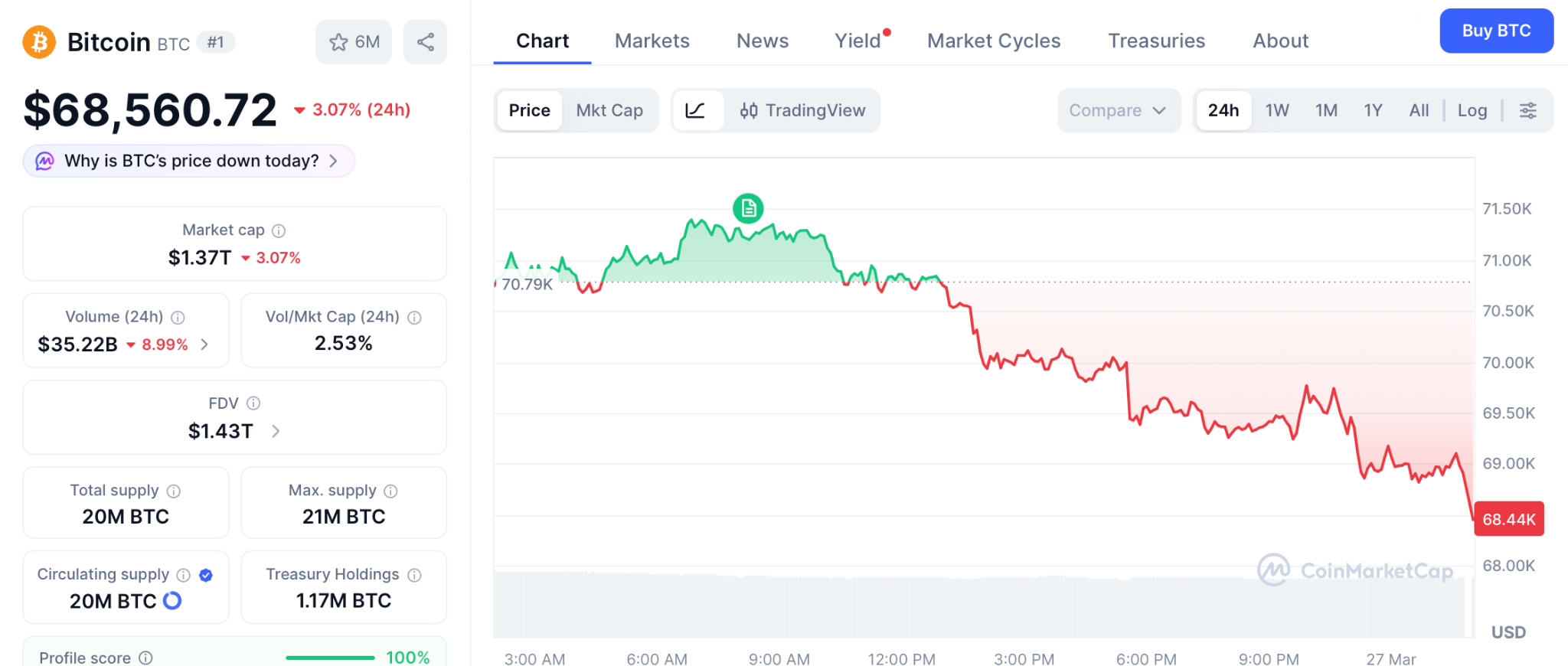
The bitcoin price prediction depends on whether BTC holds the 200 day moving average at $69,200. Losing $69,200 opens $67,000 with $65,000 as the next floor. Reclaiming $72,000 opens $74,000 to $76,000 if expiry volatility clears for buyers.
Spot ETF outflows hit $124 million on March 25, the fifth straight day of redemptions. The BTC forecast for recovery depends on Friday’s PCE data and whether Iran talks produce real progress before the five day window expires March 28.
Bitcoin Price Prediction Confirms One Position Right Now Can Change How Your Entire Cycle Ends
The bitcoin price prediction turned uncertain after BTC settled below $70,000 for the third straight session. Even the $13.5 billion derivatives expiry did not create the directional move bulls needed.
The market is volatile, and capital always finds the entry that delivers the most from this level of fear. Right now, that capital is finding Pepeto with more than $8 million raised while the Fear and Greed Index sits at 10. DOGE went from $0.007 to a $90 billion market cap, and the same pattern is visible before the crowd confirms it. The Pepeto official website is where getting in before the Binance listing is how one position right now changes how your entire cycle ends.
Click To Visit Pepeto Website To Enter The Presale

FAQs:
What does the latest bitcoin price prediction reveal after BTC dropped below $70,000?
The bitcoin price prediction shows BTC testing the 200 day average at $69,200 with $67,000 as the next support if it breaks, while reclaiming $72,000 opens $74,000.
What is the BTC forecast as $13.5 billion in derivatives expire?
The expiry drives volatility but not direction. The Pepeto official website is where the exchange targeting 100x from the listing is still at presale pricing while BTC consolidates.
What does the bitcoin price prediction mean for traders looking for better returns?
BTC targets recovery over months while Pepeto offers 100x from one listing event with a live exchange and more than $8 million in committed capital during the deepest fear in over a year.
Disclaimer: This is a Press Release provided by a third party who is responsible for the content. Please conduct your own research before taking any action based on the content.
Crypto World
Brazil’s New Anti-Gang Law Lets Authorities Liquidate Seized Crypto to Fund Police Operations


Law No. 15,358 gives judges sweeping power to freeze digital assets during investigations as Brasília takes a “financial strangulation” approach to organized crime.
Brazilian President Luiz Inácio Lula da Silva signed Law No. 15,358 on March 25, establishing what the government calls the Legal Framework for Combating Organized Crime. The legislation, also known as the Raul Jungmann Law, gives judges the authority to freeze, seize, and forfeit crypto and other digital assets tied to criminal organizations — and funnel the proceeds into public security funds.
The law is notable for explicitly incorporating digital assets into Brazil’s anti-crime toolkit. Article 9 of the legislation authorizes judges to order the “seizure, attachment, blocking or freezing of movable and immovable property, rights and assets, including digital or virtual assets” during investigations, as well as prohibit operations on crypto exchanges and block access to digital wallets — all without prior notice to the accused.
Crucially, the measures don’t require a conviction. Judges can authorize the provisional use or early sale of seized cryptoassets, with proceeds directed to state or federal security funds to finance police operations, intelligence work, and officer training. In cases where illicit origins are clear, an “extraordinary forfeiture” process allows assets to be declared lost even without a criminal judgment.
The bill was first introduced in November, shortly after authorities cracked down on an illegal Bitcoin mining operation. It was drafted to target the financial infrastructure of gangs like Comando Vermelho and the PCC.
The law also introduces two new criminal categories — “structured social domination” and “aiding structured social domination” — carrying sentences of 12 to 40 years. Leaders of ultraviolent criminal organizations face mandatory imprisonment in maximum-security federal facilities, and the use of encrypted messaging apps or privacy tools to conceal criminal activity is designated as an aggravating factor that increases sentences.
The legislation mandates the creation of a national criminal database that maps the financial structures of known criminal organizations, designed to improve coordination between police, prosecutors, and the judiciary across Brazil’s states. The law also enables international cooperation for asset recovery and intelligence sharing, allowing Brazilian agencies to work with foreign counterparts to trace and recover illicit funds.
Upon final conviction, individuals permanently lose access to the formal financial and crypto systems and are barred from contracting with the government, participating in public tenders, or receiving fiscal incentives for 12 to 15 years.
The law stands in pointed contrast to a separate legislative effort introduced in February by Federal Deputy Luiz Gastão. His bill, an expanded version of PL 4501/2024, proposes a Strategic Sovereign Bitcoin Reserve, known as RESBit, to gradually acquire up to 1 million BTC over 5 years. That proposal would explicitly prohibit the sale of judicially seized Bitcoin, retaining confiscated assets within the reserve rather than liquidating them.
Law No. 15,358 takes the opposite approach: it treats seized crypto not as a reserve asset but as a resource to be converted and spent on law enforcement. Whether the two frameworks can coexist — or whether the RESBit bill advances at all — remains an open question.
This article was written with the assistance of AI workflows. All our stories are curated, edited and fact-checked by a human.
On-chain traders on Hyperliquid can now trade over 250 tokenized U.S. equities.
Felix Protocol has launched tokenized U.S. stocks and exchange-traded funds on HyperEVM, delivering on a partnership with Ondo Finance that was first announced in January.
The launch gives on-chain traders access to more than 250 tokenized equities through Felix’s native trading interface, with assets backed by real shares held off-chain through Ondo Global Markets. Felix claims users can execute orders as large as $1 million with net execution costs below 10 basis points — a threshold the protocol says addresses one of the key barriers to on-chain equity adoption.
“On-chain traders no longer have to off-ramp funds to gain exposure to US capital markets,” the protocol said in a post on X. The offering is not available to U.S. users or those in other prohibited jurisdictions.
Ondo Infrastructure
All tokenized assets on Felix are built on Ondo Global Markets’ spot infrastructure, which routes mints and redemptions through Felix’s smart contracts. Each token gives users economic exposure to the underlying asset’s price action and dividends, rather than direct share ownership.
Ondo is the dominant issuer in the tokenized equity space. The protocol’s total value locked (TVL) recently surpassed $550 million in tokenized stocks alone, commanding 59% of the market, according to data from RWAxyz. Ondo’s broader platform — which includes tokenized Treasuries and its USDY dollar-yield product — holds roughly $2.9 billion in total TVL, per DefiLlama.
From Lending to Equities
Felix began as a collateralized debt position and lending protocol on HyperEVM, and has grown into the fifth-largest DeFi application on Hyperliquid’s Layer 1 network. The protocol currently holds approximately $167 million in TVL, according to DefiLlama.
Felix said future iterations of the equities product will include limit orders and dollar-cost averaging across tokenized assets, exposure to international equity markets in countries such as South Korea, Japan, and India, support for hundreds of additional U.S. equities, and the integration of stocks and ETFs as collateral on Felix’s lending markets.
The collateral use case could be particularly significant: it would allow traders to borrow against their tokenized equity holdings on-chain, merging the protocol’s existing lending infrastructure with its new equities product.
This article was written with the assistance of AI workflows. All our stories are curated, edited and fact-checked by a human.

North Carolina’s voter ID law upheld by federal judge despite bias claims

Saks CEO Accused of Potential Favoritism Toward Moncler in Bankruptcy Proceedings

Tether Gold launches on BNB Chain as tokenized gold market tops $4B


-
 Crypto World6 days ago
NIO (NIO) Stock Plunges 6.5% as Shelf Registration Sparks Dilution Worries
-
 NewsBeat2 days ago
Manchester United reach agreement with Casemiro over contract clause amid transfer speculation
-

 Fashion6 days ago
Weekend Open Thread: Adidas – Corporette.com
-

 Politics6 days ago
Jenni Murray, Long-Serving Woman’s Hour Presenter, Dies Aged 75
-

 Crypto World5 days ago
Best Crypto to Buy Now: Strategy Just Spent $1.57 Billion on Bitcoin During Fear While Early Investors Quietly Enter Pepeto for 150x Potential
-

 Crypto World5 days ago
Bitcoin Price News: Bhutan Sells $72 Million in BTC Under Fiscal Pressure, but the Smart Money Entering Pepeto Sees What the Market Does Not
-

 Tech7 days ago
inKONBINI Lets You Spend Summer Days Behind the Register
-

 News Videos20 hours ago
Parliament publishes latest register of MPs’ financial interests
-

 Sports3 days ago
Remo Stars and Kano Pillars Strengthen Survival Hopes in NPFL
-

 Business4 days ago
No Winner in March 21 Drawing as Prize Rolls to $133 Million for Next
-

 Sports3 days ago
Gary Kirsten Accuses Pakistan Cricket Board Of ‘Interference’, Mohsin Naqvi Responds
-

 Tech4 days ago
Give Your Phone a Huge (and Free) Upgrade by Switching to Another Keyboard
-

 Sports6 days ago
2026 Kentucky Derby horses, odds, futures, preview, date: Expert who nailed 12 Derby-Oaks Doubles enters picks
-

 Tech4 days ago
AI enters the chat: New Seattle dating app relies on tech to facilitate meaningful human connections
-

 Business7 days ago
DLocal: Entering 2026 At Escape Velocity
-
Business6 days ago
Columbia Sportswear enters $500 million credit agreement with JPMorgan Chase
-

 Tech5 days ago
Today’s NYT Connections Hints, Answers for March 22 #1015
-

 News Videos3 days ago
Ch 9 Financial Management Part 1 | Detailed One Shot | Class 12 Business Studies Boards 2026
-

 Business4 days ago
Will Duke Basketball Win It All? Duke Basketball Enters Second Round as Third Favorite to Claim NCAA Title
-

 Sports4 days ago
2026 Kentucky Derby horses, odds, futures, preview, date: Expert who hit 12 Derby-Oaks Doubles enters picks
You must be logged in to post a comment Login