
Crypto World
Michael Burry Buys Microsoft (MSFT) Stock During 25% Decline From Peak


Key Takeaways
- Michael Burry revealed a fresh Microsoft position through his Cassandra Unchained Substack on April 23
- The purchase followed a software sector decline triggered by disappointing IBM and ServiceNow earnings guidance
- Burry dismisses concerns about AI disruption undermining traditional software companies
- Microsoft shares have declined approximately 25% from July 2025 highs and roughly 13% year-to-date
- Burry simultaneously increased stakes in Adobe, Autodesk, Veeva Systems, MSCI, and PayPal
Michael Burry has established a long position in Microsoft (MSFT), incorporating the tech giant into his expanding portfolio of discounted software investments.
The investment was made public through Burry’s Cassandra Unchained Substack newsletter on April 23. While the precise stake size remains undisclosed, Burry confirmed he has “gone long on Microsoft” following what he described as “forensic” analysis of the company.
The entry point was strategic. Software equities experienced significant pressure that day following weak forward guidance from IBM and ServiceNow. Market participants interpreted the results as evidence that artificial intelligence tools are cannibalizing traditional enterprise software revenue.
Burry interpreted the situation through a different lens. He characterized the selloff as excessive and identified opportunities in what he termed “bombed out software and payment stocks.” Notably, he maintained all existing software holdings throughout the decline.
The approach reflects Burry’s contrarian investment philosophy — accumulating positions when market sentiment turns negative.
The Microsoft Investment Case
Microsoft has experienced significant valuation compression. Shares have retreated approximately 25% from the July 2025 all-time high and declined roughly 13% on a year-to-date basis. Despite an 18% rebound from recent lows preceding Burry’s announcement, the stock remains substantially below peak levels.
The current forward price-to-earnings ratio stands near 26x, representing a considerable discount to the five-year median P/E of 34x, per GuruFocus data.
For Burry, this valuation disconnect represents an attractive entry opportunity. His investment thesis centers on acquiring a proven cash-generating business trading below historical multiples, rather than speculating on AI narrative.
Microsoft’s commercial cloud operations — encompassing Azure, Office 365, and Dynamics — operate on subscription models generating predictable recurring revenue. Azure ranks among only two true hyperscale cloud infrastructure platforms globally. The corporation produces tens of billions in annual free cash flow.
Burry’s perspective is direct: the underlying business fundamentals remain intact, while current pricing reflects emotional selling rather than deteriorating economics.
Expanded Software Sector Accumulation
The Microsoft investment forms part of a broader strategic initiative. Throughout recent weeks, Burry has systematically accumulated positions across multiple software companies.
He established new positions in Adobe (ADBE), Autodesk (ADSK), and Veeva Systems (VEEV). Additionally, he expanded existing holdings in MSCI and PayPal.
His investment rationale remains consistent across these positions — artificial intelligence disruption concerns have compressed valuations of high-quality software businesses to levels that undervalue their fundamental earnings capacity.
Institutional investors have predominantly moved in the opposite direction, reducing software exposure based on concerns that AI applications will erode traditional software economics. Burry’s Substack communications center on positioning contrary to this consensus view.
Sell-side analysts maintain constructive views on Microsoft aligned with Burry’s perspective. The stock holds a consensus Strong Buy rating from 37 analysts — including 34 Buy ratings and three Hold ratings. The mean price target of $581.61 suggests potential upside of approximately 56% from current trading levels.
Burry initiated his Microsoft stake on April 23, 2026, coinciding precisely with the software sector decline following IBM and ServiceNow’s guidance announcements.


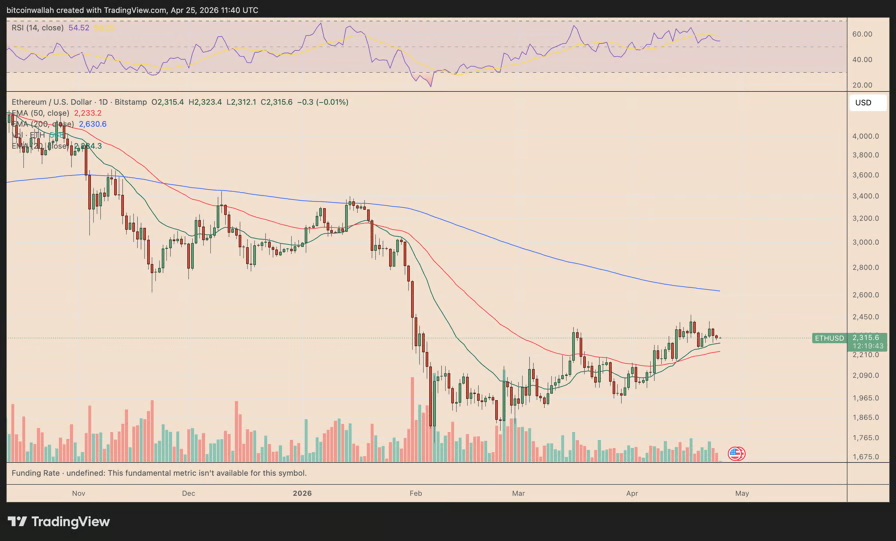
Ether (ETH) has surged more than 10% in April, reaching as high as $2,430 this month amid renewed market optimism.
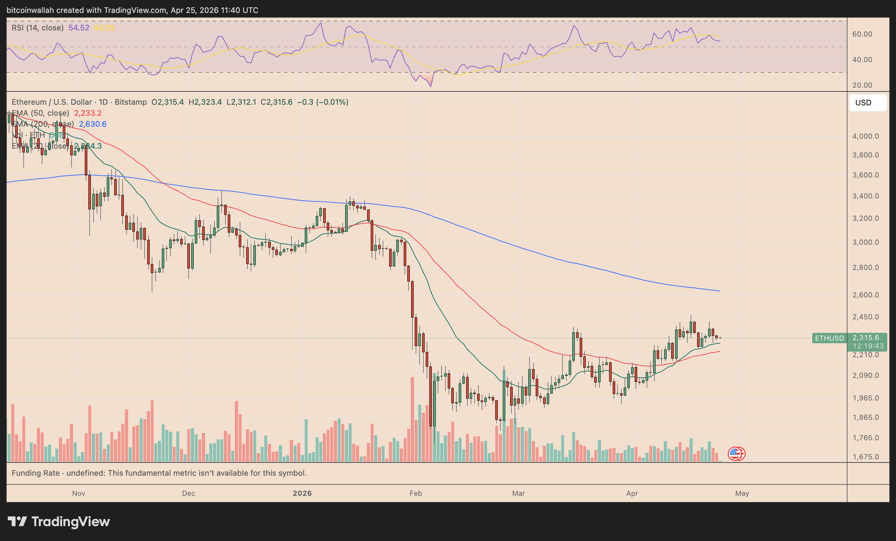
ETH/USD daily chart. Source: TradingView
Yet during the same period, the Ethereum Foundation, a nonprofit overseeing the Ethereum protocol’s development, has continued notable treasury sales.
Key takeaways:
- The Ethereum Foundation has sold approximately 20,000 ETH so far in 2026.
- Institutional demand for ETH remains strong, offsetting the foundation’s impact on the market.
Why is the Ethereum Foundation selling ETH?
In early April, the Foundation sold 5,000 ETH for roughly $11 million in DAI. This was followed by a larger 10,000 ETH OTC sale to Tom Lee’s Bitmine at an average price of $2,387, raising approximately $23.9 million.
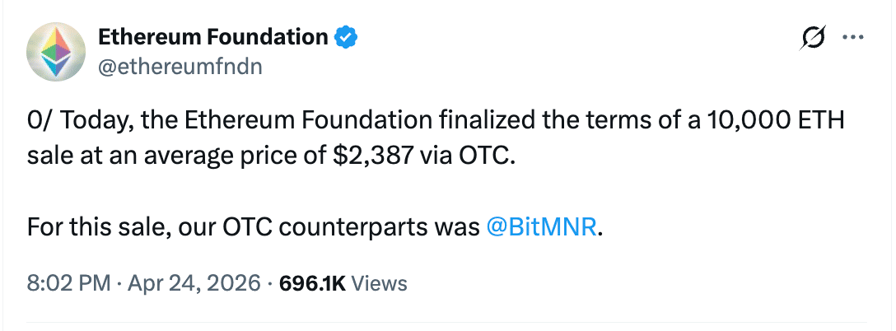
Source: X
The sales are not reactions to price action but follow a disciplined Treasury Policy adopted in June 2025.
The Foundation maintains fiat and stablecoin reserves equal to roughly 2.5 years of operating expenses. Periodic ETH sales replenish these reserves to fund protocol development, research, grants, and ecosystem support.
In 2026 alone, the Foundation has sold approximately 20,000 ETH, raising over $45 million. It still holds around 92,500 ETH (~$215 million) in its liquid treasury, plus 53,000 ETH staked, according to data resource Arkham Intelligence.
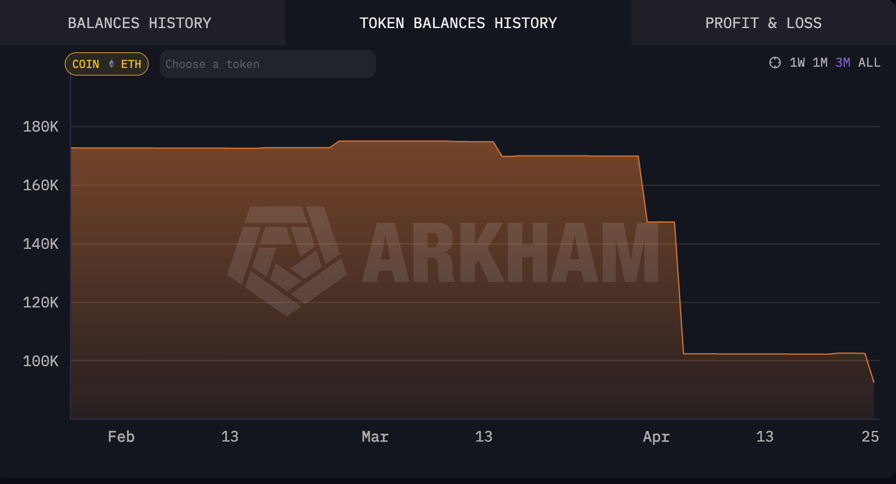
Ethereum Foundation’s ETH balance. Source: Arkham Intelligence
The Foundation’s 53,000 staked ETH may generate $4–$5 million in annual yield, assuming the current ETH price and the annual percentage yield of approximately 2.7%–3.8% gross remains about the same or higher in the future.
This new income stream should gradually reduce the Foundation’s reliance on ETH sales to fund its operations.
Are Ethereum Foundation’s sales bearish for ETH?
The Ethereum Foundation’s ETH sales remain small relative to daily ETH volume.
A typical 5,000–10,000 ETH sale represents just 0.08%–0.25% of Ethereum’s average daily trading volume of $10–12 billion.
This modest size means the market can comfortably absorb the Foundation’s selling pressure with negligible impact.
On-chain data already highlights robust underlying demand for ETH from large holders.
For instance, the number of daily accumulation addresses, wallets steadily buying and holding Ether, rose to 2,434 this week, surpassing the number of exchange depositing addresses (wallets preparing to sell), which fell to 2,300, as shown below.
Binance ERC-20 stablecoin whale activity index. Source: CryptoQuant
Also, spot Ethereum ETFs have recorded strong inflows for three consecutive weeks, attracting more than $2 billion in new capital since early April, according to data from SoSoValue.
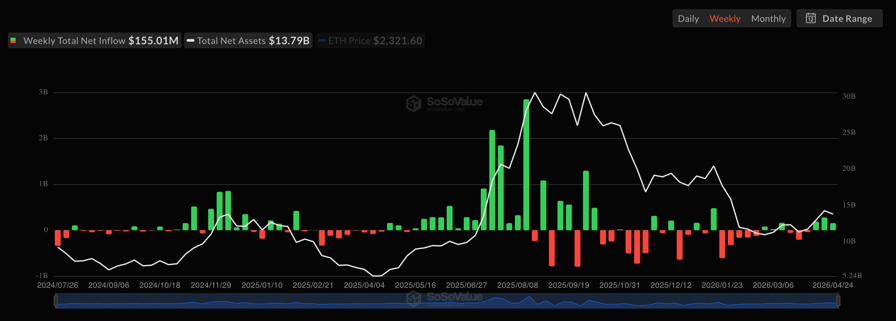
US spot Ethereum ETF weekly flows. Source: SoSoValue
This sustained institutional buying signals growing demand for Ethereum investment products on Wall Street.
Ether’s rising wedge hints at 15% dip ahead
From a technical perspective, Ether is currently forming a rising wedge pattern, a structure defined by two ascending trend lines that are converging, accompanied by noticeably declining volume.
In technical analysis, a rising wedge resolves when the price breaks below the lower trend line and falls by as much as the structure’s maximum height.
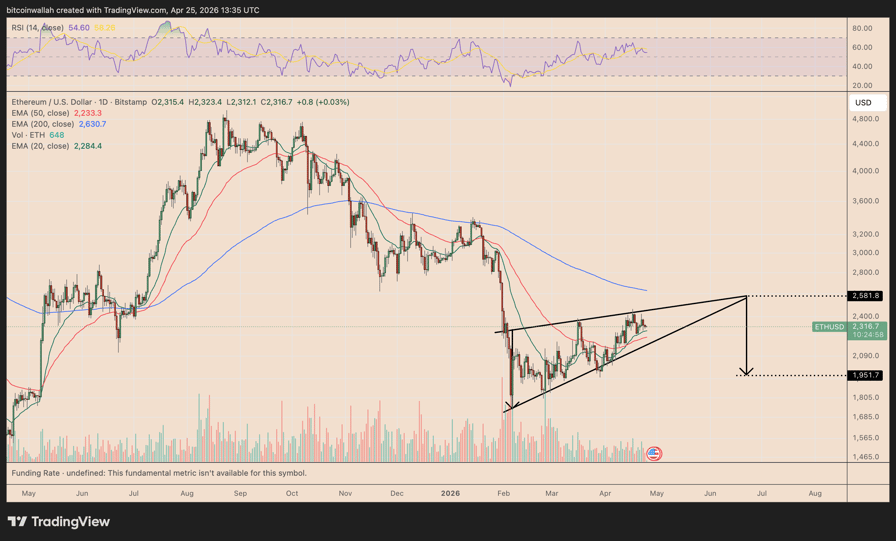
ETH/USD daily chart. Source: TradingView
Applying this rule to ETH’s chart brings its downside target to around $1,950, down by over 15%, by June, assuming the breakdown point is the wedge’s apex at approximately $2,580, where the two trend lines converge.
Related: Ethereum whale opens $90M long bets as ETH price chart eyes $3.2K
Conversely, a break above the wedge’s upper trendline may invalidate the bearish outlook. Instead, bulls may target the 200-day exponential moving average (200-day EMA, the blue line) at around $2,630 as their next upside target.


Pudgy Penguins’ recent rally may be a breakout driven by ecosystem momentum. This move appears to have benefited long-term holders in unexpected ways, according to on-chain data.
According to DNTV Research founder Bradley Park, the surge may have provided liquidity, that is, enough buyers in the market, for large holders to sell following a mid-April token unlock.
“The news around the Pengu Card, PenguBot, and other ecosystem updates are secondary narratives at best,” Park told CoinDesk. “The real story is the large token unlock that happened roughly 10 days ago.”
The Pudgy Penguins team did not respond to a request for comment by press time.
Token unlocks are scheduled releases of coin supply, similar in spirit to post-IPO lockup expirations that periodically flood equity markets with newly available shares.
Park points to the token unlock on April 17, when roughly 703 million PENGU — about 0.79% of the total supply of roughly 88 billion — hit the market in a single tranche.
The on-chain activity in the hours that followed, paired with a sharp jump in futures positioning, tracks the pattern seen at prior unlocks, where large holders use a window of rising liquidity to sell into strength.
The primary unlock wallet received 182.8 million PENGU and, within roughly 50 minutes, dispersed them across 19 separate addresses.
Park calls the sequence a “vesting-claim-and-disperse” pattern, the kind of choreography more commonly associated with preparing to sell than with settling in for the long hold.
The mechanics aren’t complicated: tokens come out of the vesting contract and get split across multiple wallets, which lets the eventual sale move in pieces small enough that no single transaction tips the market against the seller.
The futures market moved alongside it. Open interest in PENGU rose from about $36 million to $59 million during the rally, with repeated short squeezes amplifying upward momentum.
Short squeezes — the same mechanic retail traders watched drive GameStop in 2021 — force traders betting against the price to buy back in and cover their positions, layering fresh demand on top of whatever was already pushing the market higher.
For a holder trying to exit, that is close to an ideal environment: someone else’s forced buying absorbing their selling, with the price still moving the right way.
Open interest measures the total value of futures contracts still open in the market, and when it rises alongside price, it usually means traders are piling into new long positions rather than closing out old ones. That deepening of liquidity is exactly what a large holder needs to sell size without moving the price against themselves.
“My hypothesis: the price rally was engineered to provide exit liquidity for unlock recipients,” Park told CoinDesk in a note. “The bullish narratives — game launches, Visa card, Telegram bot — gave market participants a reason to bid, while the unlock beneficiaries used the resulting liquidity to sell into strength.”
“The news didn’t cause the rally,” he added. “It provided cover for post-unlock distribution.”
Park’s analysis aligns with broader signs of concentration in the NFT market.
As CoinDesk reported earlier, buyer participation has been declining even as prices rise, with activity increasingly concentrated in a handful of collections, such as Pudgy Penguins. In that environment, relatively small flows can have an outsized impact on price.
Next month will show if this is an isolated event or part of a pattern.
Pudgy Penguins’ vesting schedule shows monthly unlocks of roughly 703 million PENGU continuing through at least July, with the next tranche scheduled for May 17.
Each event introduces new supply, creating recurring windows where price action and underlying flows may diverge.
What the market has to sort out now is whether the rally reflects durable demand or just well-timed liquidity around new supply.
The ecosystem news is real enough. Whether it points to growth or to a cover for an exit is the question the next few months of unlocks – without the same bullish narratives – will answer.
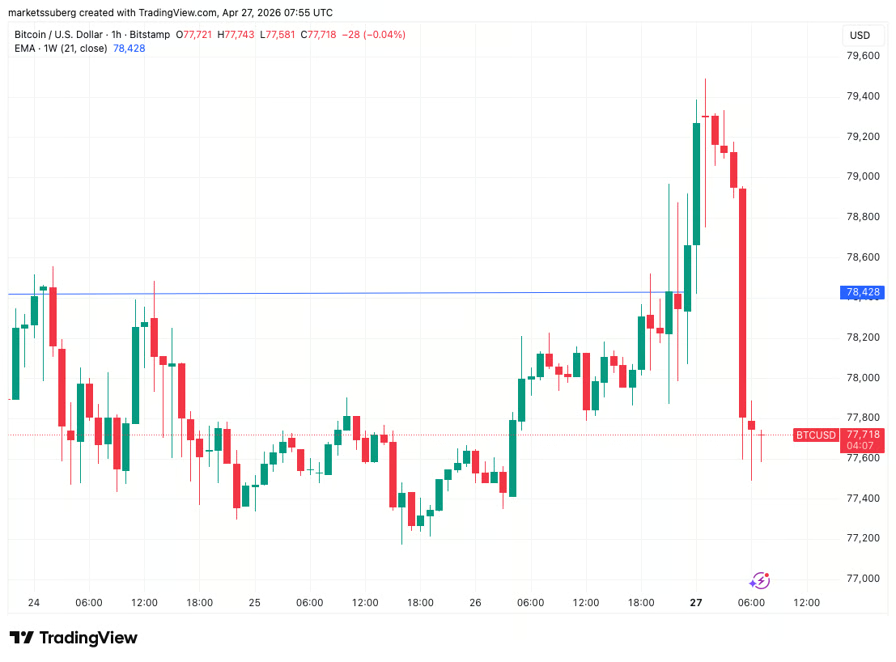
Bitcoin (BTC) counts down the final days of April with a fresh attack on $80,000 as price teases key breakouts.
- Bitcoin sees its first weekly close above a key trend line since October 2025.
- Liquidity grabs ramp up as traders eye a potential support retest closer to $70,000.
- The Federal Reserve interest-rate decision and inflation data form macro volatility catalysts.
- Analysis sees the “end of capitulation” on Bitcoin as institutions shore up the market.
- US manufacturing data could allow BTC/USD to avoid a retest of its macro lows.
Bitcoin closes above 21-week trend line for the first time in six months
Bitcoin may have failed to tap $80,000 or even hold its latest gains, but the weekly close was still significant.
After a last-minute push higher, BTC/USD managed to close out the weekly candle just above a key trend line, data from TradingView confirms.
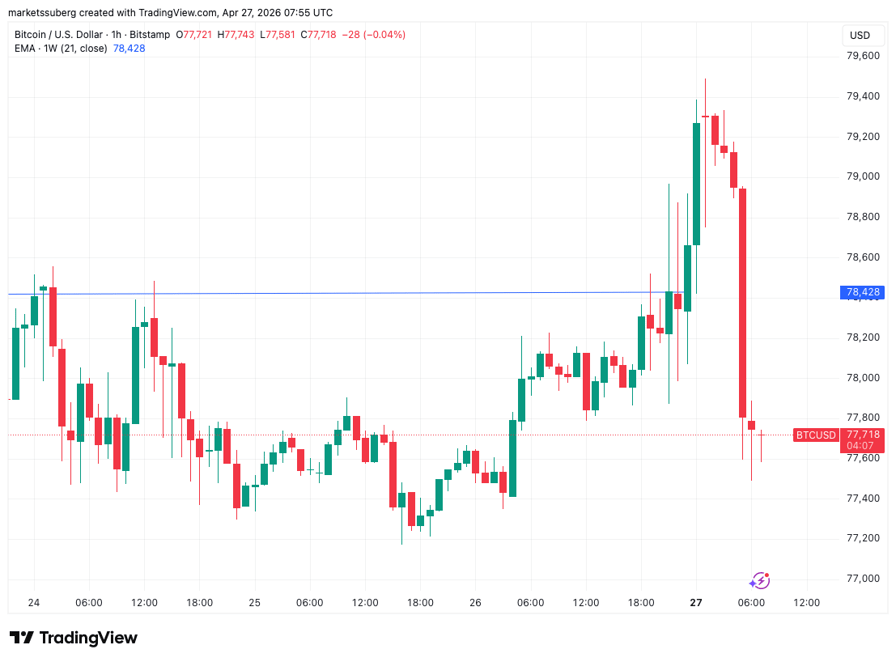
BTC/USD one-hour chart with 21-week EMA. Source: Cointelegraph/TradingView
This was its 21-week exponential moving average (EMA) — a resistance feature on the chart in place since October 2025. The last weekly close above it was when the pair traded at nearly $115,000.
As Cointelegraph reported, the 21-week EMA was already on the radar for trader and analyst Rekt Capital.
A weekly close above it, he argued last week, was a prerequisite for avoiding a support retest of $73,000.
“Unless BTC is able to reclaim the 21-week EMA as support… Then this EMA could indeed force BTC into a post-breakout retest of the top of the Double Bottom price broke out from last week,” he told X followers.
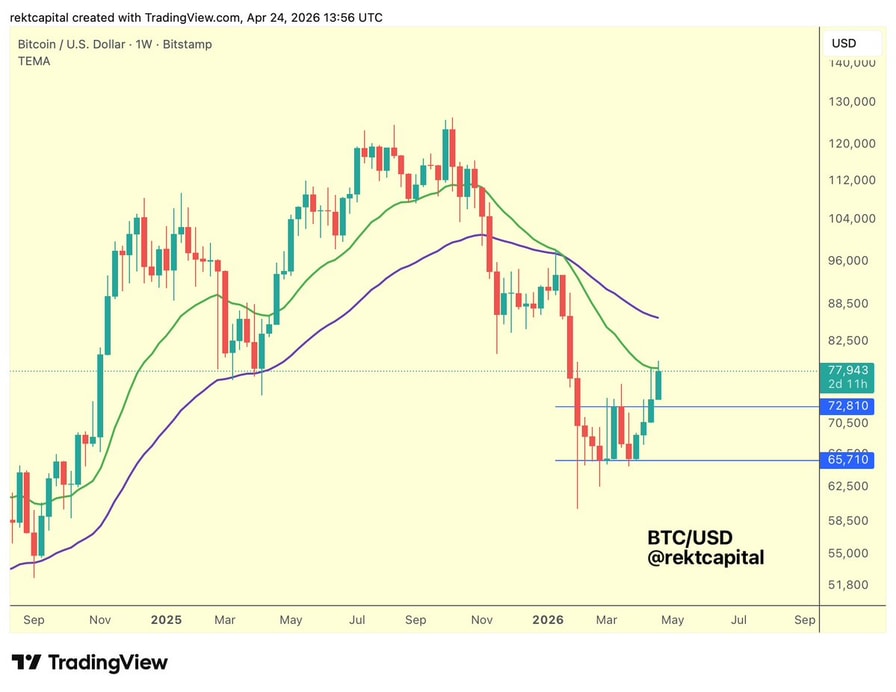
BTC/USD one-week chart. Source: Rekt Capital/X
The 21-week EMA currently forms the upper boundary of Bitcoin’s bull market support band, together with the 20-week simple moving average (SMA) at $76,550.
Similarly, it was in October last year that price completed a weekly close fully above the band’s two trend lines.
Last week, trader Daan Crypto Trades said that such an event “could confirm the end of this down trend and further relief bounce.”
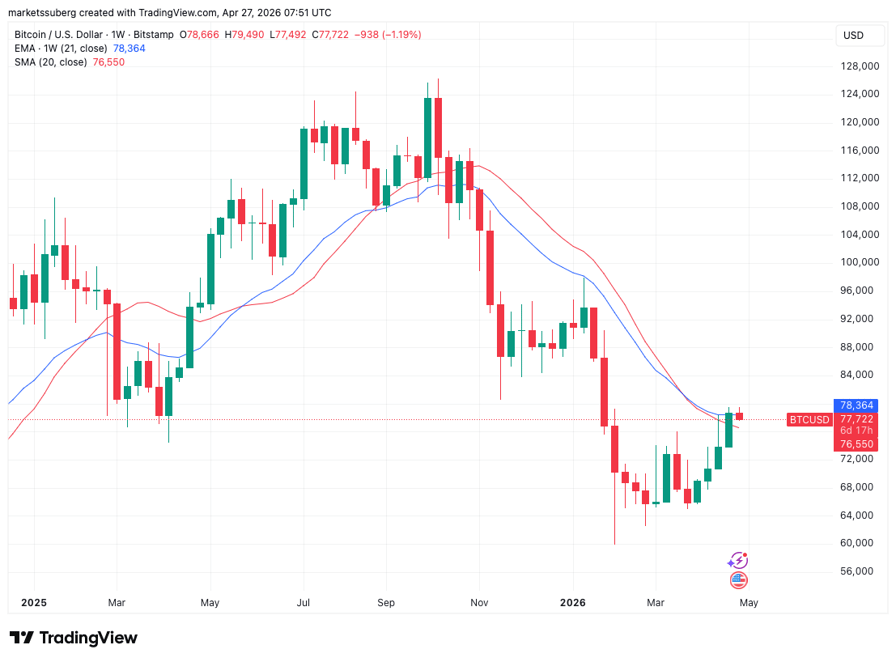
BTC/USD one-week chart with bull market support band. Source: Cointelegraph/TradingView
Liquidity grabs drive low-time frame BTC price action
On short time frames, the BTC price landscape is offering traders mixed signals.
As overall strength persists despite geopolitical uncertainty, bulls continue to struggle with reclaiming key support lines.
“Some great momentum on $BTC lately, however there are some crucial levels to consider,” crypto trader Michaël van de Poppe commented in his latest analysis on X.
Van de Poppe said that price breaking through $79,000 opens up the path to levels up to $100,000, which will nonetheless “take time.”
“If there’s no clear breakout at $79K, it wouldn’t be surprising to expect some period of consolidation before there’s another test of the resistance,” he reasoned.
“In that case, there’s a level that I prefer to see hold: $73.5k+.”
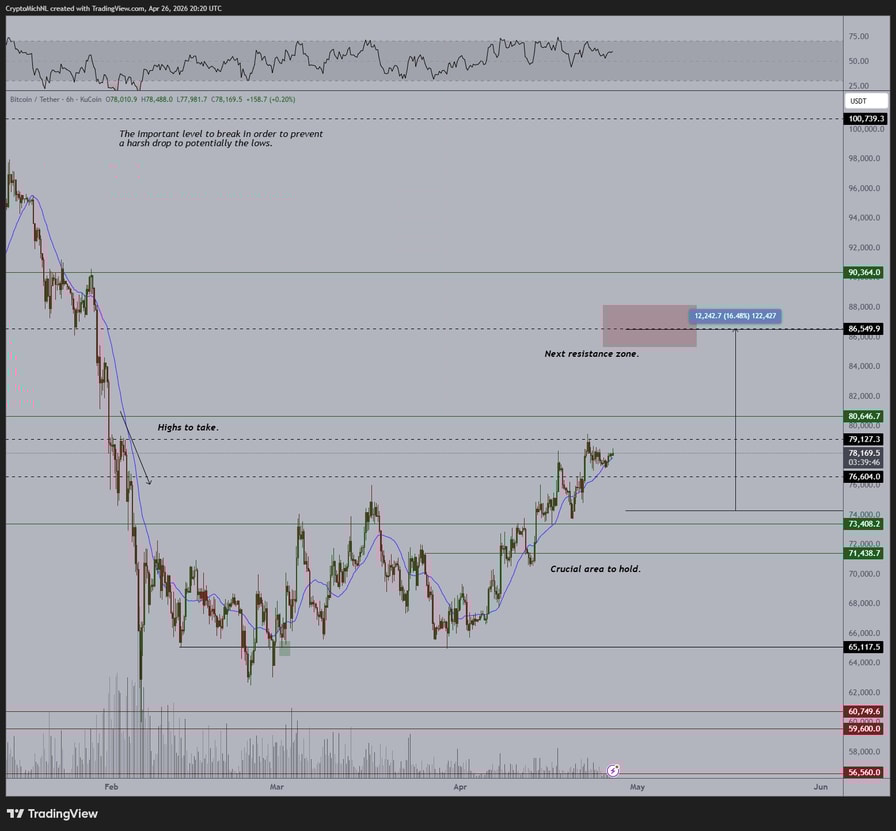
BTC/USDT six-hour chart. Source: Michaël van de Poppe/X
Earlier, Cointelegraph reported on expectations of a fresh BTC price comedown and even new macro lows.
Van de Poppe added that such an outcome could occur should the $73,000 area fail.
Continuing, trader CrypNuevo suggested that liquidity grabs could bring about that trip to the lower end of the $70,000-$80,000 corridor.
After the weekly close, BTC/USD took out late shorts above $79,000 before rapidly heading downward, liquidating newly placed longs, data from CoinGlass shows.
-2026-04-27_10_54_38.png?prefix=media%2Fcontent)
BTC 24-hour liquidation heatmap. Source: CoinGlass
“Price could take the upside liquidations first in a range highs deviation, before going for the lower ones at $70k mid-range,” CrypNuevo predicted.
He added that both $70,000 and $80,000 had an “interesting amount” of potential liquidations to offer.
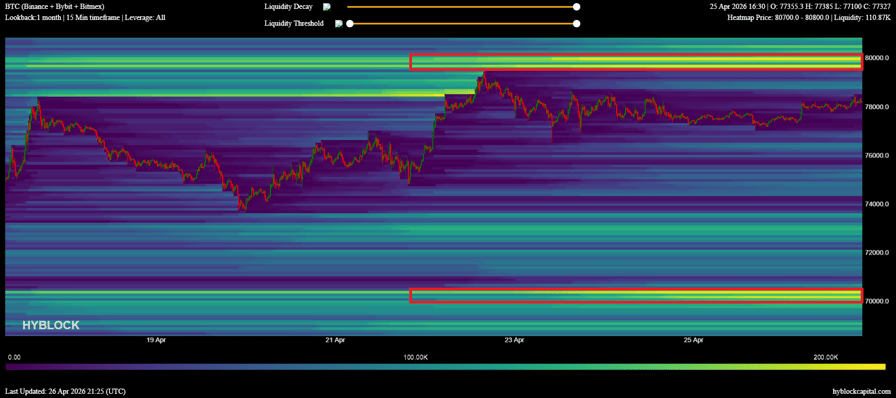
BTC liquidation heatmap. Source: CrypNuevo/X
Powell’s final Fed FOMC meeting brings stocks warning
With markets still unsure of the roadmap for the US-Iran war, risk appetite is nonetheless “returning,” analysis says.
This week has begun with the hope of further negotiations to end the conflict, this time thanks to an Iranian proposal.
Bitcoin appeared to find reason for relief on the news, hitting new multimonth highs before quickly retracing.
“Risk appetite continues to grow rapidly in this market,” trading resource The Kobeissi Letter wrote in an X response as BTC/USD neared $79,500.
Macro volatility is set to continue in the coming days, thanks also to US macroeconomic events.
Wednesday will see the Federal Reserve’s next decision on interest-rate changes, and markets will be watching Chair Jerome Powell’s press conference for cues when it comes to future policy.
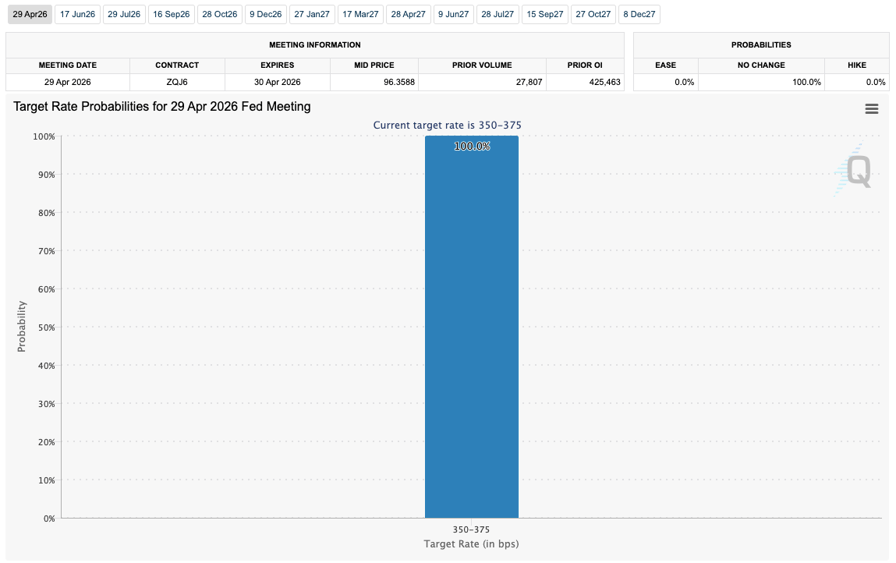
Fed target rate expectations for Wednesday’s FOMC meeting (screenshot). Source: CME Group FedWatch Tool
The war has added new inflation risks for the US, and Thursday’s release of the Fed’s “preferred” inflation gauge should reflect its impact on the trend.
This week also marks the last Federal Open Market Committee (FOMC) meeting with Powell as Chair, ahead of the assumed takeover by Kevin Warsh.
“New Fed chairs have a history of being greeted with market volatility,” trading resource Mosaic Asset Company noted in the latest edition of its regular analysis series, The Market Mosaic.
An accompanying chart put the average S&P 500 drawdown in the year a new Fed chair takes over at 20%.
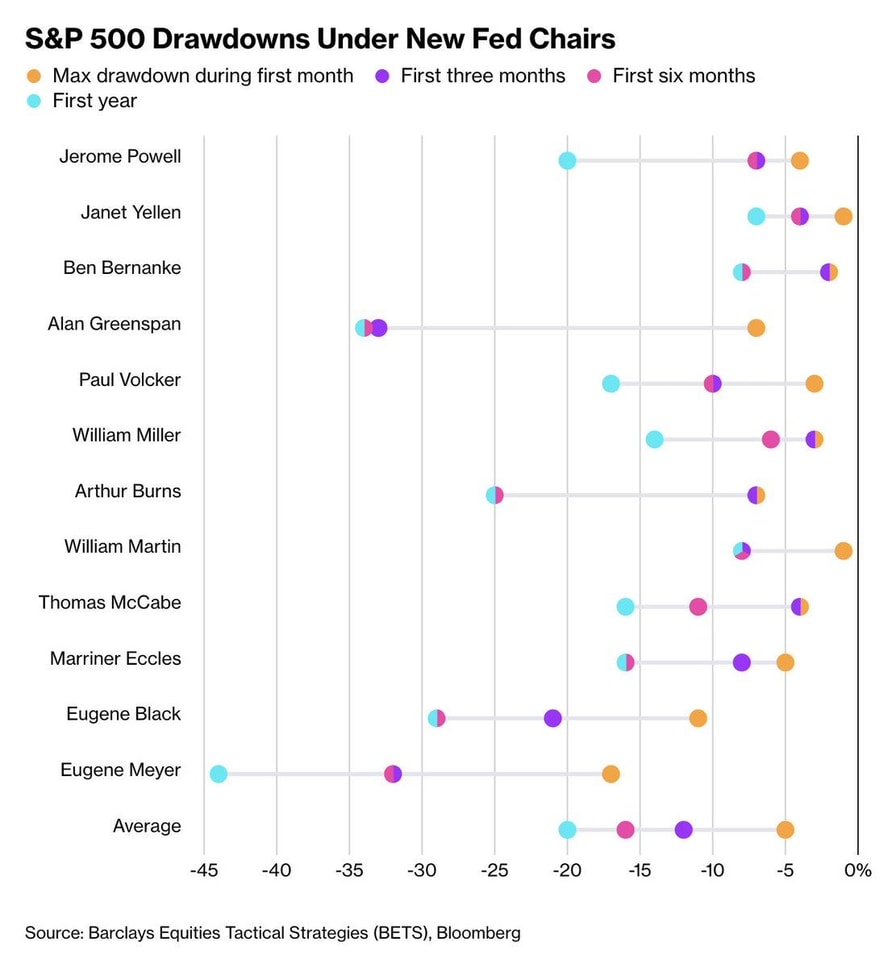
S&P 500 drawdowns under new Fed chairs. Source: Mosaic Asset Company
BTC price analysis sees “structural bottom” in place
Bitcoin near $80,000 has led analysts to suggest that the “end of capitulation” is already here.
In one of its QuickTake blog posts on Monday, onchain analytics platform CryptoQuant pointed to institutional investors as the key supporting factor during the 2026 bear market.
“During the Hormuz Shock, large investors refused to sell their Bitcoins and the panic in derivatives was irrelevant, as institutional conviction was already cemented,” contributor GugaOnChain summarized.
In early February, CryptoQuant argued, when BTC/USD briefly fell to near $60,000, a “purge” of low-conviction investors had already been underway for several months.
“Operators took profits, purging weak hands and retreating the support to $54.5K,” GugaOnChain continued, referring to Bitcoin investors’ average cost basis, also known as realized price.
“In practice: the retail that paid the speculative premium at $90K entered absolute panic with the free fall. Forced to sell at a loss, they returned their Bitcoins to the Smart Money in the $62K zone, establishing an early support above the fair price.”
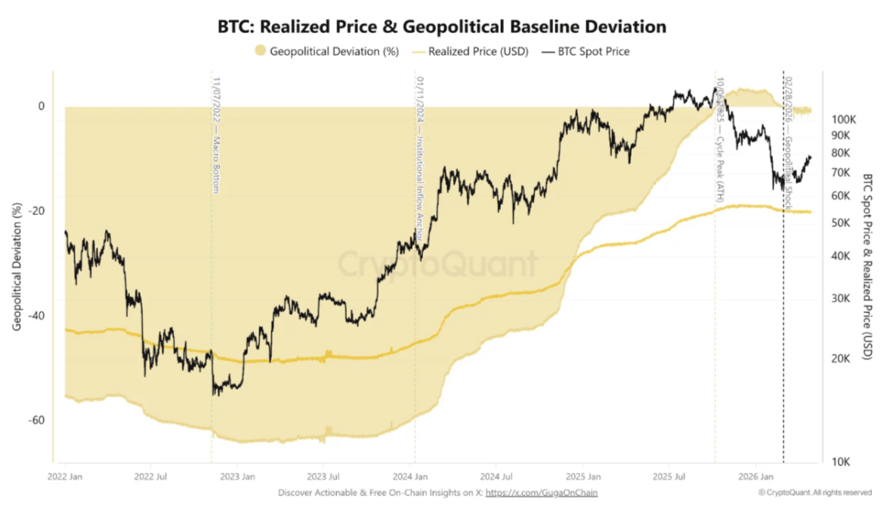
Bitcoin realized price data (screenshot). Source: CryptoQuant
CryptoQuant described the “apex” of the process occurring in February, with a recovery underway ever since.
“The apex of this purge occurred on February 5, 2026, consolidating the ground zero of this Bear Market. With the Spot squeezed at $62.8K and the Realized Price (RP) at $55.3K, the deviation was only 1.34%,” GugaOnChain explained, calling a “structural bottom.”
“Unlike the absolute capitulation of 2022, when the price crossed below the network’s base, this time the panic stalled at a 13% distance from the Wall. Institutional capital erected a concrete floor before the abyss, exhausting the selling power of investors without conviction.”
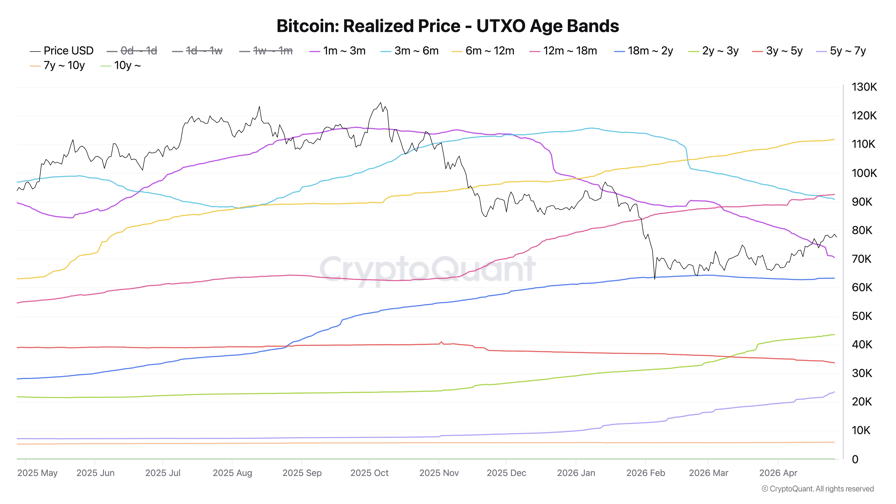
Bitcoin realized-price data ordered by date coins moved onchain. Source: CryptoQuant
US macro data may save Bitcoin from new bear-market low
Throughout the current macro volatility, US Purchasing Managers’ Index (PMI) has formed a key upside catalyst for crypto and risk assets.
Related: Bitcoin Bull Score hits six-month high as 2022 bear-market fears linger
This is set to continue, with PMI entering an “expansion” phase for the first time since 2022.
For commentator Matthew Hyland, this now has implications for Bitcoin price action for the rest of 2026. In this bear-market year, BTC/USD should find a bottom in Q4, matching 2022 — but PMI should change the landscape.
“Because of the strength of the PMI expansion trigger along with the other 10+ signals I do not believe the ‘4 year cycle’ works out as most expect,” he wrote on X.
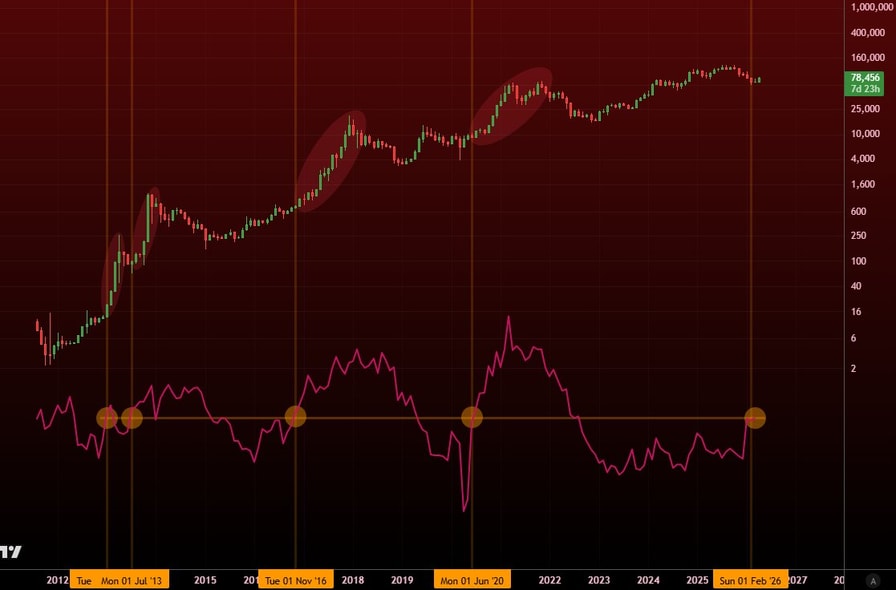
BTC/USD versus US PMI data. Source: Matthew Hyland/X
Instead of beating its February lows, Bitcoin should instead put in “higher low” near $60,000, contrary to the majority’s expectations. Supporting this, Hyland made reference to “10+ signals” showing that the new bottom is already in place.
“My invalidation would be a severe black swan something worse than the past few months however black swans are NOT likely so Its low percentage odds of being invalidated and not favorable to happen,” he added.


Bitcoin’s recovery is being driven by perpetual futures traders, not organic spot buyers, according to CryptoQuant CEO Ki Young Ju. On-chain apparent demand remains net negative despite heavy ETF inflows and corporate accumulation.
Bitcoin (BTC) trades near $77,500 after failing to push through $80,000. The divergence between futures positioning and spot flows is becoming the defining feature of the April market.
Investors are Betting on Bitcoin Price, Not Buying
Ki Young Ju shared a CryptoQuant chart showing the growth in 30-day Bitcoin spot and perpetual futures demand. The purple futures bars have climbed back into positive territory through April 2026.
The gray spot bars, however, remain below the zero line for most of the month. Spot demand growth is still contracting on a 30-day basis, even as price action has recovered.
That gap matters because perpetual futures positions can be opened with leverage and unwound just as quickly. Spot buying, by contrast, requires fresh capital to absorb supply at the offer.
ETF Flows and MicroStrategy Buys Have Not Flipped the Signal
US spot Bitcoin ETFs attracted $786 million in their strongest weekly inflow since February in mid-April. Inflows continued at $823 million the next week, with BlackRock’s IBIT leading demand.
MicroStrategy, the corporate vehicle led by Michael Saylor, also bought 34,164 BTC for $2.54 billion in its third-largest single purchase. The buy was made at an average price of $74,395, lifting total holdings to 815,061 BTC.
Despite both flows, on-chain apparent demand has remained net negative through April. CryptoQuant data showed 30-day apparent demand near -87,600 BTC earlier in the month.
The gap suggests ETF and Strategy purchases are being matched and exceeded by selling from existing holders and miners.
When Will the Bear Market End?
Ki Young Ju has tracked Bitcoin demand cycles for years. He previously declared the cycle theory dead, citing structural rotation between old whales and new long-term holders.
His latest framing suggests that sustainable bottoms form only when spot and futures demand recover at the same time. A futures-led rebound without a spot recovery has historically resolved through another leg lower as leverage unwinds.
The current setup matches that pattern. Funding rates have ticked up, open interest is rising, but the underlying spot bid remains weak.
Traders are now watching whether spot demand, as measured by CryptoQuant, can flip positive in the coming weeks. A turn would suggest fresh capital is finally absorbing the supply pressure flagged in earlier warnings.
If futures positioning continues to lead while spot demand stays red, the rally faces a familiar risk. Previous mid-cycle bounces in 2025 unwound the same way, through forced liquidation rather than fresh dollar inflows.
The post CryptoQuant CEO Warns Bitcoin Demand Imbalance appeared first on BeInCrypto.


TL;DR
- Hyperliquid (HYPE) holds near $42 with a bullish structure above $40.
- The bullish structure is supported by rising futures Open Interest and positive funding rates.
Hyperliquid (HYPE) trades above $42 on Monday, sustaining its upward trajectory from an ascending trendline.
While the broader trend remains constructive, signs of cooling retail interest contrast with a steady buildup in leveraged positions, creating a mixed near-term outlook for the decentralized exchange token.
Retail momentum fades as social dominance drops
Retail-driven momentum appears to be weakening. Data from Santiment shows Hyperliquid’s social dominance has declined sharply to 0.137%, down from 0.688% at the height of the US-Iran conflict in late March.
The drop suggests reduced retail attention as geopolitical tensions ease, removing a key narrative driver that previously fueled speculative interest in the DEX.
In contrast, derivatives activity is heating up. According to CoinGlass, HYPE futures Open Interest (OI) has climbed roughly 3% over the past 24 hours to $1.65 billion, signaling an increase in outstanding leveraged positions.
Funding rates remain positive at 0.0077%, indicating that long positions continue to dominate. This persistent positive funding over the past month reflects growing bullish conviction among leveraged traders, even as spot-driven retail enthusiasm cools.
HYPE price outlook: Rising wedge puts $40 support in focus
The HYPE/USD 4-hour chart is bullish and efficient as HYPE is consolidating within a rising wedge.
The token remains supported above both its 50-day EMA at $38.98 and 200-day EMA at $34.90, reinforcing the underlying bullish structure.
Momentum indicators suggest steady but controlled upside. The Relative Strength Index (RSI) sits at 56, pointing to positive but not overbought conditions, while the MACD is trending higher toward a bullish crossover, hinting at fading downside pressure.
If the bulls push higher, they would encounter immediate resistance at the $43.71 level, which caps the current recovery and aligns with the upper wedge boundary near $46.80. A decisive break above this zone could trigger a stronger bullish continuation.
However, if the market undergoes a correction, the ascending trendline support near $41.21 remains critical.

A breakdown below this level would likely expose the 50-day EMA at $38.98, with the 200-day EMA at $34.90 acting as a deeper demand zone if selling pressure intensifies.
While Hyperliquid’s structure remains bullish above $40, the divergence between fading retail interest and rising leverage suggests the next move could be determined by whether momentum expands or reduces.

Sam Sidhu, CEO of Customers Bank.
Courtesy: Customers Bank
Nearly half an hour into a conference call on Friday to discuss first-quarter results with analysts, Customers Bank CEO Sam Sidhu revealed something unusual — up until that point, he hadn’t actually been speaking.
“The prepared remarks you heard on my behalf today were delivered by my AI clone, not read by me,” Sidhu said, calling it a potential first for a public company earnings call.
The point of the stunt, he said, was to underscore a broader shift happening as Customers Bank, a $25.9 billion asset lender catering to startups and small businesses, embraces artificial intelligence.
Customers Bank has signed a multiyear partnership with OpenAI in which the AI giant will embed engineers at the company to help it automate lending and client onboarding, CNBC has learned exclusively.
The deal is part of Sidhu’s effort to get ahead of other banks in the industry’s race to transform itself using AI agents as a new digital workforce. His strategy hinges on automating core banking processes — slashing loan timelines from weeks to days, for instance — and scaling growth without adding staff at the same pace.
While many bankers have described AI in broad terms like productivity gains, Sidhu is tying it directly to financial targets.
Sidhu told CNBC that the project will improve the firm’s efficiency ratio from about 49 to the low 40s, boosting the bank’s returns starting next year.
The relationship with OpenAI — which has targeted finance as one of its core industries — will be a symbiotic one for the AI giant, according to the bank CEO.
“We’re going to be co-creating enterprise solutions they could potentially sell to other banks in the future,” Sidhu said. “The goal here is end-to-end, automated agentic led workflow” for lending, deposits and payments.
OpenAI said it was proud to help Customers Bank “as they build a more intelligent operating model that empowers employees, strengthens client service, and sets a new standard for regional banking,” chief revenue officer Denise Dresser said in a statement provided to CNBC.
Always-on workers
The bank expects to roll out AI agents across lending, deposits and payments over the next six to 12 months.
If they succeed, closing a commercial loan will go from taking 30 to 45 days, including underwriting, document collection and legal negotiations, to about seven days, Sidhu said.
Opening accounts for complex commercial clients, which can take more than a day, will be collapsed to under 20 minutes using conversational AI and automated document gathering, he said.
“When you have an autonomous agent, you’re essentially creating a digital worker … and they can work around the clock,” Sidhu said.
Customers Bank has been laying the groundwork for this announcement for years, first tapping OpenAI in 2023 because Sidhu had what he describes as a tiny investment in the AI giant through his contacts in the venture capital world. The OpenAI deal signed last week broadens their relationship, enabling AI engineers into the bank’s processes, he said.
The bank is among a handful of smaller lenders that target the startup and venture capital community, and it reportedly bid for Silicon Valley Bank in 2023 amid the regional banking crisis that year.
Key advantage
While it is a relatively tiny firm compared to the likes of JPMorgan Chase, which has $4.9 trillion in assets, Customers Bank has a key advantage, according to Sidhu, who began his career at Goldman Sachs in 2004. The megabanks have sprawling global operations and far higher complexity and regulatory standards for AI implementation, he said.
“Smaller banks are not going to be expected to have the same level of frameworks as many of the larger banks,” he said. Regulators want community and regional banks “to be able to compete with larger banks.”
The lender already uses AI to write half the firm’s software code and has saved 28,000 hours of work so far, equal to not hiring about 15 full-time employees, he said.
“This is an opportunity for us to potentially slow that hiring … and do more revenue per employee,” he said.
The bank is also exploring entering new businesses that would have been prohibitively expensive to tackle before AI agents. For these AI-native business lines, smaller teams oversee automated systems that handle work previously requiring large numbers of humans, he said.
Unlike typical software licensing agreements, Sidhu said both sides are contributing resources to build new tools together, with OpenAI gaining real-world use cases inside a regulated financial institution.
“It’s going to benefit our investors. It’s going to benefit our customers,” Sidhu said. “Our regulators will hopefully also be happier over time, because they’re going to see us reducing risk as well.”


Project Eleven, the quantum cybersecurity startup backed by Coinbase Ventures, Balaji Srinivasan, Castle Island Ventures, and Variant, awarded a one bitcoin (BTC) prize last week to a researcher who claimed to have broken a 15-bit elliptic curve key on IBM Quantum hardware.
However, despite a Project Eleven press release framing it as the largest public quantum attack on the cryptography securing “Bitcoin, Ethereum, and over $2.5 trillion in Elliptic Curve Cryptography-secured digital assets,” several independent reviewers managed to replicate the feat using non-quantum, classical computing tactics like random number generation.
Indeed, within hours of the news, independent Bitcoin developers reproduced the supposed breakthrough on home computers.
Using no quantum computing, they showed that the prize winner basically repurposed a fancy random number generator.
Replicating a quantum prize win with home hardware
Researcher Yuval Adam ran one of the replication experiments using the public code of prize winner Giancarlo Lelli, a specialist whose GitHub repository hosts the winning submission.
However, Adam swapped Lelli’s IBM Quantum backend for a far more basic random number source, Linux kernel’s /dev/urandom.
Adam mostly left the rest of the setup alone, then opened a pull request against Lelli’s repository, documenting the outcome.
Finally, Adam asserted that random data from a non-quantum laptop provided a classical computer as much brute force energy as Lelli’s “IBM Quantum” backend for the goal of recovering a cryptographic private key from a public key.
He posted the summary on X: “I replaced the quantum computer with /dev/urandom. It still recovers the key.”
In the end, Linux’s urandom helped a regular computer recover the key in an comparable number of attempts to the supposed quantum backend.
Classical computations wearing quantum costumes
Former Bitcoin Core maintainer Jonas Schnelli claimed to have reproduced the prize-winning pipeline in roughly 20 lines of Python without any quantum hardware.
Schnelli summarized, “The quantum computer contributed nothing (noise)! The answer was recovered by a classical checker sifting random noise.”
Coldcard founder NVK read the source code and reached the same verdict, calling the demonstrations “classical computations wearing quantum costumes.”
Lelli’s own README conceded the point in plain text: “When shots >> n, random noise alone can recover d with high probability.”
Project Eleven’s three-judge panel awarded the BTC anyway.
Read more: The internet is laughing at El Salvador’s ‘quantum-safe’ bitcoin
A Community Note and a venture round
Project Eleven’s announcement on X now carries a Community Note fact-check, arguing that the recovery method works even when the quantum output is replaced with random data and a classical computer, providing no quantum advantage over classical computing.
Ark Labs engineer Alex Bergeron was blunter, saying, “TLDR; zero accountability. We shopped a parlor trick around to media publications because our goal isn’t really to help Bitcoin, it’s to raise another round.”
The potential conflict of interest is hard to overlook. Project Eleven, founded by Stanford graduate Alex Pruden, closed a $20 million Series A in January at a $120 million valuation.
The company sells post-quantum migration tooling. It designed the Q-Day Prize, picked the judges, awarded the bounty, and issued the press release warning that 6.9 million BTC sit in wallets exposed to quantum attack.
After reading numerous social media complaints, Pruden later conceded on X that the demonstration represented “incremental progress in a noisy, early field,” while complaining that critics somehow “moving goalposts” were the real problem.
His own press release had described the supposed breakthrough as the largest public demonstration of an attack threatening trillions of dollars.
As Protos has previously documented, fears about quantum breakthroughs are ramping up due to accelerating post-quantum deadlines from Cloudflare, Google, and IBM.
Newly accelerated deadlines cluster around the year 2029 to the very early 2030s. Unfortunately, Project Eleven’s prize money rewarded publicity over cybersecurity progress toward meeting these deadlines.
Undeterred, the company is now developing its next contest.
Got a tip? Send us an email securely via Protos Leaks. For more informed news, follow us on X, Bluesky, and Google News, or subscribe to our YouTube channel.


A debate has started in the crypto market after researcher Giancarlo Lelli received a 1 BTC reward from Project Eleven.
Summary
- Project Eleven awarded 1 BTC after a researcher cracked a 15-bit ECC key using quantum tools.
- Adam Back said the result looked more like statistical guessing than a real quantum breakthrough.
- Critics said Bitcoin’s 256-bit keys remain far beyond the scale of the latest experiment.
The prize followed his reported success in cracking a 15-bit ECC key using a cloud-based quantum computer.
Project Eleven said Lelli used a modified version of Shor’s algorithm for the test. The group also said its challenge had moved from 6-bit keys to 15-bit keys within seven months, showing faster progress in quantum testing.
Adam Back disputes quantum breakthrough claim
Blockstream CEO Adam Back challenged the idea that the test marked a real quantum attack on crypto. He argued that the result did not prove a useful quantum method against Bitcoin or modern cryptographic systems.
Back said the test looked closer to statistical guessing than a technical breach. In his view, the quantum computer did not solve the kind of hard problem that protects Bitcoin private keys.
Meanwhile, the main criticism focused on the small 15-bit key size. A key of that size has a limited search space, which makes it far easier to test possible answers than real Bitcoin keys.
Former Bitcoin Core developer Jonas Schnelli also questioned the result. He said the researcher checked about 20,000 possibilities out of 32,497, giving the method a high chance of success without quantum advantage.
Schnelli described the result as similar to “flipping a coin.” He also said, “Quantum computing contributed nothing useful here,” arguing that the experiment did not show a real threat to crypto security.
Bitcoin security debate continues
The claim has raised fresh discussion about quantum computing and Bitcoin. Some market watchers see the Project Eleven result as a step toward future risks, while critics say it does not apply to full-strength cryptography.
Back maintained that Bitcoin remains far from the reach of current quantum machines. He said quantum systems would likely target state secrets or banking systems before becoming a practical concern for Bitcoin.
Bitcoin uses far larger key sizes than the one tested in the experiment. For that reason, Back and other skeptics view the challenge as a small-scale test rather than proof that Bitcoin faces an immediate quantum threat.
The episode shows growing interest in post-quantum security across crypto. However, experts remain divided on whether the Project Eleven result marks real progress or only a controlled experiment with limited market relevance.
Crypto World
Verizon (VZ) Stock Surges 4% on Strong Q1 Results and First Subscriber Growth Since 2013

Key Takeaways
- Verizon shares climbed approximately 4% during premarket hours following stronger-than-expected Q1 results
- Company reported 55,000 net postpaid phone subscriber additions — marking the first positive first quarter since 2013
- Adjusted earnings per share reached $1.28, surpassing Wall Street’s $1.21 forecast
- 2026 full-year EPS outlook increased to $4.95–$4.99 range from previous $4.90–$4.95 guidance
- Service outage in January temporarily impacted wireless revenue due to $20 customer compensation credits
Verizon delivered quarterly earnings on Monday that exceeded Wall Street expectations, sending shares higher in early trading. The telecommunications company saw its stock climb approximately 4% before market open, hitting $48.33.
Verizon Communications Inc., VZ
The carrier reported adjusted earnings of $1.28 per share, topping the FactSet analyst consensus estimate of $1.21. Total revenue reached $34.4 billion, representing a 2.9% increase compared to the same period last year, although falling just short of the anticipated $34.8 billion.
While the earnings beat drew praise, the real story centered on customer growth. Verizon brought in 55,000 net postpaid phone subscribers during the first quarter. Wall Street analysts had projected losses ranging from 81,000 to 88,000 customers.
This marks the first time Verizon has delivered positive postpaid phone customer growth during a first quarter since 2013. For a telecom giant working to revitalize its wireless operations, this represents a significant achievement.
Behind the Customer Growth Revival
CEO Dan Schulman attributed the turnaround to strategic changes in customer approach. “We are beginning to reclaim our market leadership by putting the customer at the center of everything we do, reducing friction to increase loyalty and create genuine value,” he explained.
A key component of this approach involved aggressive targeting of competitors’ customers. Verizon provided enhanced incentives to consumers who presented bills from AT&T and T-Mobile, successfully converting rival subscribers to its network.
The company has also expanded its focus on bundled offerings — pairing home internet services with wireless packages — a tactic AT&T has successfully employed to improve customer retention. Early indicators suggest this strategy is delivering results.
The quarter also represents Verizon’s first financial report including Frontier, following the acquisition’s completion on January 20.
One notable challenge: wireless service revenue faced pressure from $20 customer credits distributed after a roughly 10-hour service disruption in January. These compensation payments, issued to hundreds of thousands of affected customers, modestly reduced overall revenue.
Upgraded Full-Year Outlook
Verizon increased its full-year adjusted earnings per share projection to a range of $4.95–$4.99. This revision moves up from the company’s prior $4.90–$4.95 target and exceeds the $4.90 analyst consensus at the midpoint.
The telecommunications provider also indicated it now anticipates total retail postpaid phone net customer additions for 2026 will fall within the upper half of its 750,000 to 1 million forecast range.
While subtle, this represents a significant upgrade in confidence. Verizon isn’t merely celebrating one strong quarter — management is signaling sustained momentum ahead.
S&P 500 futures traded relatively flat on Monday as investors awaited earnings reports from major technology companies.

Disclosure: This article does not represent investment advice. The content and materials featured on this page are for educational purposes only.
LILPEPE nears presale completion after raising over $28 million as investor interest continues to grow.
Summary
- Little Pepe passes $28M in presale funding as Stage 13 nears close and token price moves toward $0.0023.
- LILPEPE gains traction with Layer 2 utility, zero-tax trading, staking rewards, and DAO governance features.
- As presale demand rises, Little Pepe stands out by combining memecoin momentum with real blockchain utility.
The LILPEPE coin is close to wrapping up its presale with a total amount of funds collected surpassing the mark of $28 million. Although the project itself could be considered one of the newcomers on the market, it now appears among the most interesting to observe during the presale in the crypto world. At the moment, the coin’s price is $0.0022, with $0.0023 expected for stage 14.

The pricing strategy used by the Little Pepe coin has been quite instrumental in building momentum for the project. Early investors have been rewarded while simultaneously pressuring late investors into getting involved in the investment project. As the presale process winds down, there has been a marked increase in the number of buys that the coin has experienced as investors try to lock in their gains in anticipation of the price increase.
Utility, ecosystem strength, and $777k giveaway rewards
One of the key reasons why Little Pepe continues to have traction in the crypto space is that the coin seeks to shift focus away from the memecoin concept and incorporate real utility in its ecosystem.
The Little Pepe coin is developed on an Ethereum-compatible Layer 2 blockchain network. These include rapid transactions, low gas prices, and scalability, all of which help make it more practical and effective for investors. In addition, it features zero taxation trade, anti-sniper mechanism for bots, staking benefits, meme launchpad, and DAO governance — all meant to improve its usability in the long term. Unlike most newly launched memecoins, one of the distinguishing factors about Little Pepe is its focus on utility, and this aligns with the prevailing industry trends.

Another appealing feature is a $777,000 giveaway for ten lucky individuals who can each get $77,000 of the LILPEPE token. Secondly, there is a 15+ ETH giveaway, where the top three buyers would be rewarded 5 ETH, 2 ETH, and 3 ETH. Adding on to it, some random 15 buyers will be rewarded 0.5 ETH as part of the giveaway program. These giveaways help investors to engage more in the presale race.
Late-stage demand and outlook beyond the presale
Now that the presale is drawing to a close, market factors are already starting to shift according to their well-known patterns. In particular, investors who might not have participated until now are joining the fray in greater numbers due to the scarcity of tokens and the upcoming rise in their price. These are typical behaviors for successful presales, which, if continued until the end of the process, will help to achieve a successful close. Meanwhile, the overall environment on the crypto market is favoring projects at an earlier development stage because of the flow of funds toward smaller projects that have higher chances of growth than larger-cap projects.
At present, Little Pepe is enjoying these trends, thanks to its impressive funding and growing popularity. As the presale is wrapping up, Little Pepe will soon be facing its first real test as a project: its performance on the market after launch. Provided that the ongoing positive trend holds true, Little Pepe will complete its presale with strong results and become one of the most promising projects on the crypto market.
For more information about Little Pepe, visit the official website, X, and Telegram.
Disclosure: This content is provided by a third party. Neither crypto.news nor the author of this article endorses any product mentioned on this page. Users should conduct their own research before taking any action related to the company.

IFRS 10 Explained | Consolidated Financial Statements | #ifrs #ifrs10 #ifrsstandards #shorts

Ronnie O’Sullivan v John Higgins LIVE: Old rivals battle for quarter-final place at World Snooker Championship

Spotify teams up with Peloton to launch global fitness content hub

Manchester United reach agreement with Casemiro over contract clause amid transfer speculation

US brings back mandatory military draft registration

Steven Gerrard disagrees with Gary Neville over ‘shock’ Chelsea and Arsenal claim | Football


-

 Politics7 days ago
Gary Stevenson delivers timely reminder to register to vote as deadline TODAY
-

 Fashion3 days ago
Weekend Open Thread – Corporette.com
-
 Crypto World2 days ago
Hyperliquid $HYPE Rally Builds Momentum as AI Sector Enters Prove-It Phase
-
Crypto World7 days ago
Bank of Hawai’i (BOH) Q1 2026: Net Income Drops to $57.4M as Net Interest Margin Expands
-

 Politics5 days ago
Making troops accountable for war crimes threatens US alliance, ex-SAS colonel warns
-

 Politics5 days ago
Disabled people challenge government SEND proposals over segregation concerns
-

 Business5 days ago
Rolls-Royce Voted UK’s Most Iconic Trade Mark as IPO Register Hits 150
-

 Business4 days ago
Patterson-UTI Energy, Inc. (PTEN) Q1 2026 Earnings Call Transcript
-

 Politics5 days ago
Zack Polanski responds to home secretary’s taser threat
-
 Crypto World6 days ago
Five Value Stocks with Recovery Potential in 2026: PayPal (PYPL), Nike (NKE), and More
-

 Politics5 days ago
Starmer handler McSweeney to be dragged from shadows by Foreign Affairs Committee
-
 Sports1 day ago
IPL 2026: Ruturaj Gaikwad registers slowest fifty of the season, enters all-time unwanted list | Cricket News
-
Politics5 days ago
Wings Over Scotland | How To Get Away With Crimes
-

 Crypto World6 days ago
New York sues Coinbase, Gemini over prediction market offerings
-
 Business5 days ago
HCL Tech share price tank over 9% after weak Q4. JPMorgan, HSBC & 3 others cut target price
-

 Politics5 days ago
‘Iran is still a nuclear threat’
-
Entertainment6 days ago
Sydney Sweeney cameo cut from “The Devil Wears Prada 2”, source explains why (exclusive)
-

 Crypto World6 days ago
Crypto’s great hope in Senate’s Clarity Act still has a path to survive tight calendar
-
 Sports4 days ago
Tim Bradley names the current best in the world: “Better than Inoue and Usyk”
-

 NewsBeat1 day ago
LK Bennett closes all stores after entering administration
You must be logged in to post a comment Login