

Crypto World
Michael Saylor Calls Bitcoin Selloff an AI Rotation as MicroStrategy Sits $10 Billion Underwater

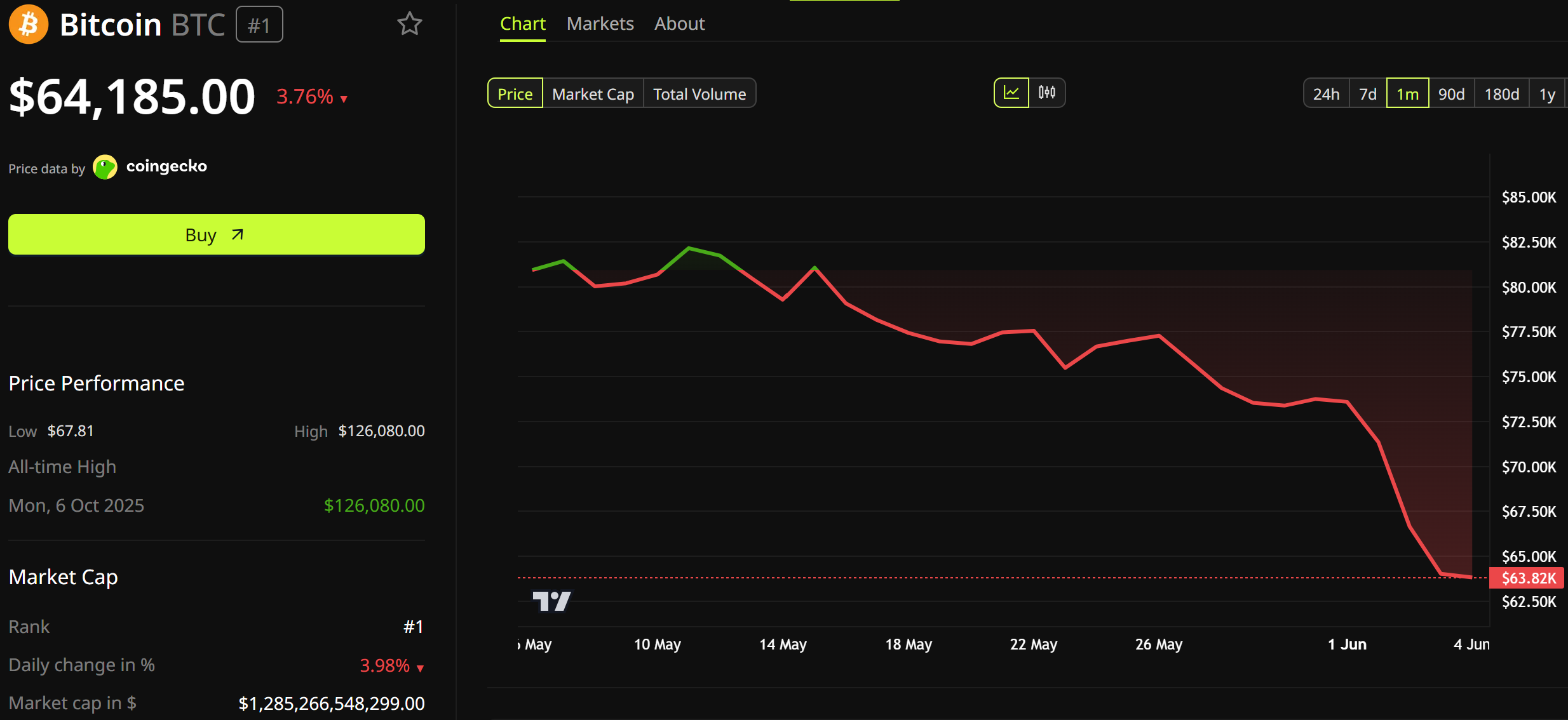
Michael Saylor conceded that the recent Bitcoin selloff reflects a rotation of capital toward AI rather than weakness in the pioneer crypto itself.
He pointed to roughly $4 billion in Bitcoin ETF outflows since May 14, with the king of crypto trading near $64,000 at the time, down about 4% on the day and nearly 49% below its October 2025 record.

Michael Saylor Reframes the Bitcoin Selloff
Saylor argued that capital markets are absorbing enormous sums to fund AI infrastructure. He put the figure at about $400 billion over six months across data centers and chips.
Analysts peg 2026 capital budgets at the largest US tech firms above $600 billion. That scale gives his rotation argument some footing.
He cast the ETF redemptions as temporary repositioning, not a structural problem. MicroStrategy holds 843,706 Bitcoin at an average cost near $75,702, per Strategy’s record Bitcoin holdings.
That average now sits well above the market price. With Bitcoin near $64,000, the 843,706 coins are worth about $54 billion against a cost basis near $63.9 billion.
That leaves MicroStrategy about $10 billion underwater on the largest corporate Bitcoin treasury. The loss is unrealized, yet it pressures a stock that trades as a leveraged proxy for the token.
The strain is already visible. A June 1 filing shows Strategy sold 32 BTC to fund preferred-stock dividends, its first sale since 2022. The move was small, yet it showed those obligations now drawing on the same balance sheet.
“Capital markets are funding the AI buildout at historic scale: ~$400B over 6 months. Bitcoin ETFs have seen ~$4B of outflows since May 14, pressuring $BTC. This is a capital rotation, not a Bitcoin impairment. Volatility creates opportunity,” Michael Saylor indicated.
Follow us on X to get the latest news as it happens
The Dot-Com Echo
The framing carries an irony, give Michael Saylor rode the same dot-com wave that once broke his company.
MicroStrategy peaked at $333 on March 10, 2000, the day the Nasdaq Composite also topped out. The stock then fell from $260 to $86 on March 20, a one-day drop above 60%.

That restatement erased about $66 million in revenue and turned reported profits into losses. Saylor and two executives later paid roughly $11 million to settle fraud charges, without admitting wrongdoing.
Analysts at PFR Capital now explore a possibility where Saylor could rattle markets again.
“In March 2000, MicroStrategy…changed its revenue recognition method…investors started doubting the revenue, profits, accounting quality, and so on of other companies. What happened after that, everyone knows. So you could say MicroStrategy single-handedly crashed the entire market. 26 years have passed. Will MicroStrategy be able to replay its market-crashing magic? Let’s wait and see,” PFR Capital’s Jayson Hu posed.
The parallel is imperfect, however, since the 2000 collapse stemmed from accounting. The current bet rests on transparent, on-chain purchases.
Still, leverage and concentration leave MSTR shareholders exposed to sharp swings.
Competing Reads on the Outflows
However, not everyone shares Saylor’s calm. CNBC’s Mad Money host Jim Cramer weighed in as the selling spread. He had touted doomed “new economy” stocks days before the 2000 top.
“Saylor suboptimal move roiling Crypto. Some wags pondering it was only up in the 90s because of Saylor… Seems extreme but it is all i hear,” he noted.
Bloomberg analyst Eric Balchunas described the stretch bluntly, while noting lifetime ETF inflows still top $55 billion. May marked the heaviest Bitcoin ETF outflows of 2026.
The split reflects a broader trend, with hedge funds rotating away from Bitcoin as AI narratives draw liquidity.
The post Michael Saylor Calls Bitcoin Selloff an AI Rotation as MicroStrategy Sits $10 Billion Underwater appeared first on BeInCrypto.



Bitcoin has seen its network use fall to its weakest level in more than seven years as selling pressure and lower on-chain activity weigh on market confidence.
Summary
- Bitcoin active addresses dropped near 2019 bear market levels, according to Bitcoin Magazine’s 60-day moving average data.
- Bitcoin network use has declined since the 2021 bull market, as ETFs reduced direct on-chain transaction demand.
- The Genius Act helped stablecoin activity expand on Ethereum, Solana, and Tron, adding pressure on Bitcoin utilization.
Bitcoin Magazine data showed that the 60-day moving average of active Bitcoin addresses stood slightly above 600,000 on June 4. The reading placed Bitcoin’s address activity near levels last seen during the 2019 bear market, according to the same data.
Bitcoin active addresses return to 2019 levels
According to Bitcoin Magazine, the decline in active addresses has continued since the end of the 2021 bull market. The data showed a steady drop in wallet activity over several years, even as Bitcoin became more accessible through regulated investment products.
Spot Bitcoin exchange-traded funds changed how many investors gain exposure to BTC. After the products received approval, some investors moved toward ETF shares instead of direct on-chain transactions, according to the report. These products offered regulated access and deeper trading liquidity, which reduced the need for some investors to move Bitcoin across the network.
At the same time, Bitcoin has faced stronger competition from other layer-one networks. Ethereum, Solana, and Tron have continued to host stablecoin payments and frequent settlement activity, while Bitcoin remains mostly used as a store-of-value asset.
The report also linked part of the decline to the Genius Act, a U.S. law signed in July 2025 that created federal rules for stablecoin issuers. After the law took effect, institutional stablecoin activity expanded across chains built for faster and cheaper payments.
According to the report, more firms have used Ethereum, Solana, and Tron for stablecoin transfers, while Bitcoin has seen less frequent transactional demand. The trend has added pressure to Bitcoin’s active-address count, which remains one of the key measures used to track network participation.
BTC price slides as sentiment weakens
Bitcoin traded near $63,950 at the time of reporting, down more than 26% since the start of the year. The decline has kept market attention on the February 2026 support area, where traders previously watched for buyer interest.
As previously reported by crypto.news, Bitcoin had rebounded from an intraday low near $61,500 after weaker-than-expected U.S. labor market data raised expectations that the Federal Reserve could still cut interest rates later in 2026.
The U.S. Department of Labor reported that initial jobless claims for the week ended May 30 rose by 13,000 to 225,000. Economists had expected 215,000 claims, while the prior week’s reading was revised higher to 212,000.
Labor data offers limited relief
Additional Labor Department figures showed final labor costs rose 1.8% in the first quarter, below economists’ estimate of 2.5%. Continuing jobless claims fell by 8,000 to 1.777 million for the week ended May 23.
Market participants often view weaker labor data as supportive for risk assets because it can give the Federal Reserve more room to lower interest rates if economic conditions soften further.
However, the report warned that Bitcoin’s network activity may remain under pressure if capital continues moving into artificial intelligence-related stocks. A recovery in active addresses could support bullish sentiment, but Bitcoin’s current on-chain data shows participation remains weak compared with previous market cycles.


Elon Musk rewrote the IPO playbook in almost every direction for SpaceX. The S&P 500 just reminded him there are rules he cannot rewrite.
S&P Dow Jones Indices confirmed Thursday it is keeping its eligibility rules entirely unchanged, effectively shutting out SpaceX from the world’s most important stock index.
To join the S&P 500, a company must be profitable in its most recent quarter and across its prior four quarters combined. SpaceX posted a net loss of $4.94 billion in 2025. The S&P was equally clear on exceptions, stating waivers “should not be granted solely based on market capitalization.”
What This Means for Passive Investors and SpaceX
Passive S&P 500 index funds control trillions in assets and would have been forced to buy SpaceX shares automatically had the rules been relaxed. Without index inclusion, that automatic institutional bid simply does not exist, at least for the next twelve months.
Nasdaq moved in the opposite direction, fast-tracking its own rules to allow SpaceX into the Nasdaq 100 shortly after listing. Index funds tracking the Nasdaq 100 will be forced to buy a sizeable portion of publicly available shares when inclusion is confirmed. This will provide a floor of institutional demand that the S&P 500 will not contribute to.
SpaceX does have a path into less prominent benchmarks. S&P confirmed that it will modify the entry rules for its broader Total Market Index and the Dow Jones US Total Stock Market Index. Moreover, FTSE Russell has already made SpaceX eligible for its global equity indexes under fast-entry rules.
The Crypto Impact
For crypto markets, the S&P exclusion adds an interesting wrinkle. SpaceX’s S-1 disclosed 18,712 Bitcoin at a cost basis of $661 million. This means that every buyer of SpaceX stock gets passive Bitcoin exposure whether they want it or not.
With the Nasdaq 100 forced buy coming and the S&P 500 bid absent, the pool of investors gaining that indirect Bitcoin exposure is smaller than it would have been under a fast-track scenario.
With SpaceX, OpenAI, and Anthropic together expected to pull in more than $240 billion by year-end, analysts warn these megacap listings may drain liquidity from tech, AI, and crypto markets and potentially mark a cyclical peak.
Art Hogan, chief market strategist at B. Riley Wealth, backed the S&P decision.
“Making exceptions because companies are so large and have been private so long yet are still not profitable didn’t make a great deal of sense,” he said.
The biggest IPO in history will begin trading next Friday, June 12. However, the index that defines Wall Street will not list it for at least a year.
The post SpaceX Will Be Worth $1.75 Trillion Next Week but the S&P 500 Won’t Be Adding It appeared first on BeInCrypto.


The chances of passing the CLARITY Act this year have narrowed as lawmakers face a crowded legislative calendar and unresolved disputes over key provisions, according to JPMorgan analysts.
Summary
- JPMorgan analysts said the window for passing the CLARITY Act is narrowing as Congress faces a packed schedule ahead of the 2026 midterm elections.
- Stablecoin reward provisions remain a major point of disagreement between banks and crypto advocates.
- Senator Cynthia Lummis said Senate action on the bill may not occur until August.
According to a report from JPMorgan analysts led by Nikolaos Panigirtzoglou, political timing is becoming one of the biggest obstacles to the crypto market structure bill. The analysts said the approach to the 2026 U.S. midterm elections is reducing the time available for Congress to advance major digital asset legislation, raising the possibility that market structure reforms could be delayed.
The CLARITY Act would establish a federal framework for regulating digital assets and divide oversight responsibilities between the Securities and Exchange Commission and the Commodity Futures Trading Commission.
Although the legislation recently advanced to the Senate calendar, several steps remain before it can become law, including Senate approval, reconciliation with House legislation, and a signature from President Donald Trump.
Adding to the uncertainty, JPMorgan said the final shape of the legislation could depend heavily on political developments over the coming months. The analysts noted that a bill negotiated before the midterm elections could look substantially different from one considered afterward, particularly if control of Congress changes.
Stablecoin provisions remain a sticking point
Alongside concerns over timing, disagreements surrounding stablecoin rules continue to weigh on the bill’s prospects.
In JPMorgan’s view, opposition from parts of the banking industry has intensified because of provisions dealing with stablecoin rewards and interest-like products. The analysts pointed to continuing debates over whether issuers should be allowed to provide returns on stablecoin balances without being subject to the same requirements that govern traditional banks.
Recent comments from banking executives have highlighted those concerns. JPMorgan Chief Executive Officer Jamie Dimon and New York Citi Bank Chairman and CFO David L. Cohen have both criticized aspects of the legislation, arguing that some provisions could create regulatory gaps.
During a CNBC interview, Dimon also criticized Coinbase Chief Executive Officer Brian Armstrong and claimed the legislation would allow crypto firms to offer products similar to bank deposits without equivalent protections. He further argued that the bill does not adequately address Anti-Money Laundering requirements or obligations under the Bank Secrecy Act.
Those claims were challenged by Senator Cynthia Lummis, chair of the Senate Banking Subcommittee on Digital Assets. Speaking to CNBC, Lummis said AML and Bank Secrecy Act requirements already apply to digital assets and are included in the legislation. She also accused Dimon of misrepresenting the legislation, saying the JPMorgan chief “either hasn’t read the bill or he wants to mislead people.”
Senate negotiations continue as August timeline emerges
While debate over stablecoins has attracted significant attention, lawmakers are still working through several other sections of the legislation.
Speaking with journalist Eleanor Terrett, Lummis said a Senate vote before the July 4 recess remains possible but suggested that action before the August recess is more likely.
According to Lummis, lawmakers must still combine provisions from the Senate Banking Committee, the Senate Agriculture Committee, ethics-related measures, and certain changes connected to the GENIUS Act before the final package is ready.
Developer protections have also become part of the negotiations. The Blockchain Regulatory Certainty Act language included within the CLARITY Act would shield developers of decentralized software from being treated as money transmitters when they do not take custody of customer funds.
Support for that provision has grown in recent weeks. Defend Developers recently launched a political action committee focused on supporting blockchain developers, decentralized finance builders, and software engineers.
Separately, the Blockchain Association said 160 former national security, intelligence, and law enforcement officials signed a letter urging Congress to move the legislation forward, describing digital asset regulation as a national security and law-enforcement priority.
Even with that support, Lummis acknowledged that securing the 60 votes needed for cloture and finalizing the legislative package could take longer than initially expected.
XRP is down 9% on the weekly chart! Can the support at $1 stop the downtrend?
Ripple (XRP) Price Predictions: Analysis
Key support levels: $1
Key resistance levels: $1.4, $1.6, $2
Downtrend Resumes
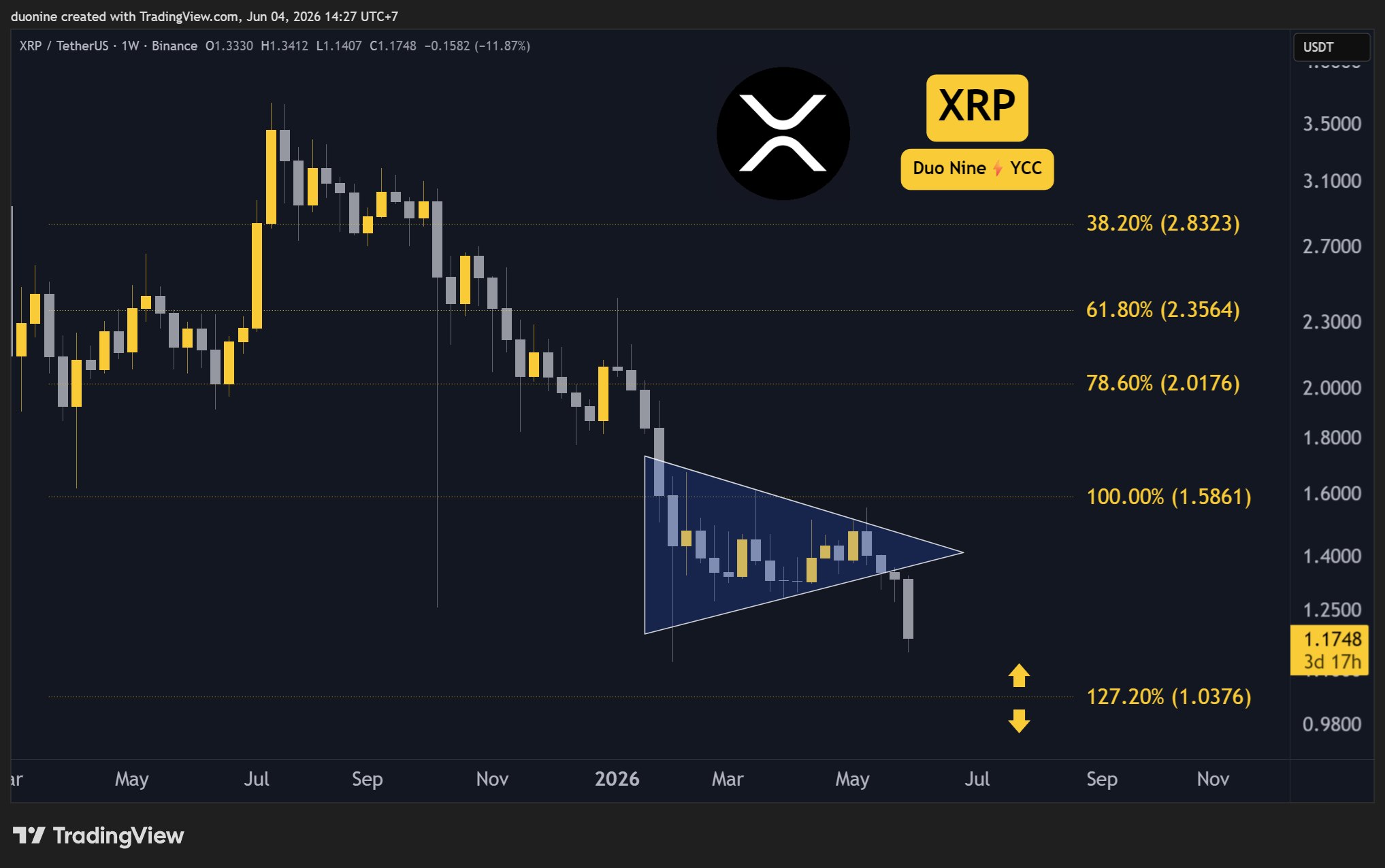
After three months of XRP moving sideways to form a large pennant, the price finally fell below it. With this latest drop, XRP resumes its downtrend, which is on a collision course with the $1 support level.
Unfortunately, buyers have vanished from the order books as crypto assets across the board are in the red this week. XRP is no different and was unable to stop the recent sell pressure. Because of this, lower lows are likely in the future.
Key Support Approaching
The most important support level right now is found at $1. This level has not been tested so far this year, and it’s likely to be tested in the near future if this downtrend continues at this pace.
For buyers to return, XRP needs to become attractive again. A price around $1 is also a key psychological level that has a good chance of triggering a battle between buyers and sellers. Hopefully, this level will allow for a relief rally once tested.
Bearish Cross on 3-Day MACD
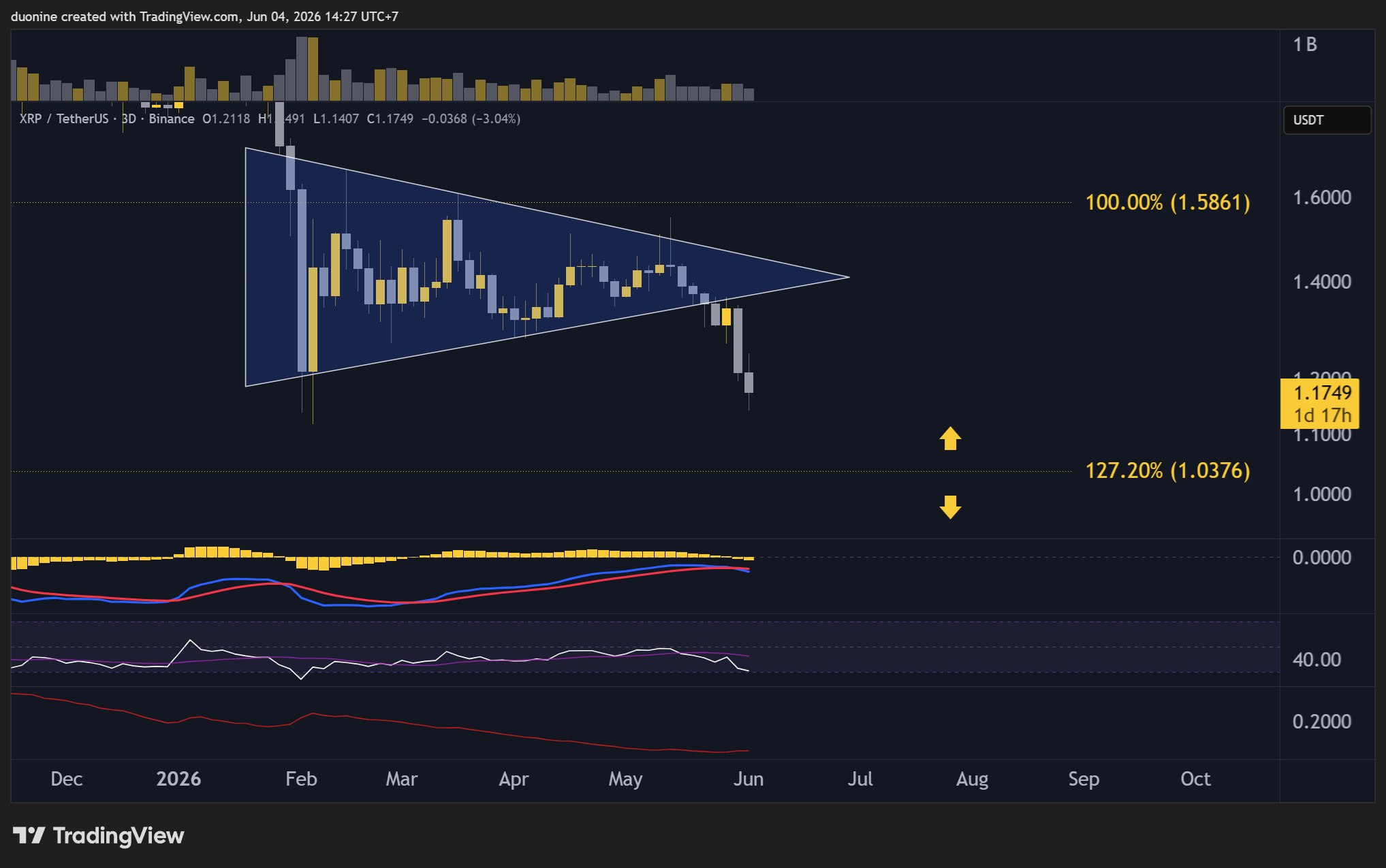
Last week, we discussed the bearish cross on the 2-day timeframe. However, since then, the 3-day MACD also did a bearish cross. This reconfirms the downtrend and encourages sellers to take positions expecting new lows.
Sellers have been dominating since mid-May when buyers had a last attempt at a breakout. That move turned into a bullish trap, and the price has been going down non-stop since.

The post Why is the Ripple (XRP) Price Down This Week? (June 4) appeared first on CryptoPotato.

Professional ownership of US spot Bitcoin ETFs declined sharply in Q1 as Bitcoin’s bear market deepened, suggesting that trading-focused institutions were a meaningful source of selling during the downturn. A CoinShares analysis of quarterly 13F filings found that professional investors reduced Bitcoin ETF exposure to 261,000 BTC from 313,000 BTC, a 17% drop.
The combined value of those holdings fell 35% to $17.8 billion, and the share of total US Bitcoin ETF assets held by 13F filers slipped to 20.8% from 24.7%. “This dataset is consistent with what bitcoin markets have historically looked like in drawdowns,” CoinShares digital asset analyst Matt Kimmell wrote in the report, noting that leveraged and tactical strategies tend to unwind during downturns.
The selling was heavily concentrated among hedge funds and brokerages, which together accounted for roughly 96% of the reduction in exposure. Hedge funds cut their holdings by 31,400 BTC, a 39% retreat, while brokerages reduced exposure by 18,800 BTC, a 53% decline. In contrast, investment advisors—the largest professional cohort with 150,300 BTC in holdings—trimmed exposure by just 5.9%. Banks, meanwhile, added 7,800 BTC, effectively doubling their exposure for the quarter.
The decline in professional ownership coincided with a sharp price correction in Bitcoin. The asset fell about 22% in Q1, extending declines from late 2025 and briefly slipping below $60,000. At its trough, Bitcoin was down roughly 50% from its October 2025 all-time high above $126,000.
Key takeaways
- 13F-based professional exposure to US spot Bitcoin ETFs fell 17% in Q1 to 261,000 BTC; the dollar value dropped 35% to $17.8 billion; 13F filers’ share of ETF assets declined to 20.8% from 24.7%.
- Hedge funds and brokerages accounted for the vast majority of the reductions (about 96%); hedge funds down 39% (31,400 BTC) and brokerages down 53% (18,800 BTC).
- Investment advisors reduced exposure by 5.9%; banks added 7,800 BTC, roughly doubling their holdings.
- Bitcoin’s Q1 price move, down about 22%, aligned with a broader drawdown that began in 2025 and culminated in a roughly 50% peak-to-trough drop from the October 2025 high.
- Regulatory developments provided some optimism: clearer SEC-CFTC delineation and changes affecting retirement accounts were cited as potential long-term tailwinds, even as policy debates continue around the CLARITY Act and market structure logistics.
- Institutional sentiment showed signs of resilience, with traditional players like BlackRock acknowledging BTC’s potential role in diversified portfolios, signaling continued mainstreaming despite regulatory uncertainties.
Regulatory backdrop and what it could mean for markets
CoinShares framed the Q1 regulatory landscape as increasingly constructive for the digital asset ecosystem. The report notes progress toward clearer boundaries between the SEC and CFTC, along with proposals that would affect how digital assets are treated within retirement accounts. These strides arrive amid ongoing regulatory narratives about market structure and asset classification that could influence product design and institutional participation in the years ahead.
The regulatory drumbeat extended into ongoing agency planning. The U.S. Securities and Exchange Commission (SEC) has signaled digital assets as a strategic priority through 2030, with a draft strategic plan outlining an aim to build a firm regulatory foundation “through a rational, coherent, and principled approach.” This emphasis on clarity could reduce some of the overhang that has deterred more conservative institutions from deeper participation in crypto markets.
Industry sentiment and the path forward
Beyond policy, the report underscored a growing openness to Bitcoin among traditional financial institutions. Earlier this year, BlackRock acknowledged Bitcoin’s potential role in diversified portfolios, arguing that conventional stock-and-bond diversification models have become less reliable in post-2020 financial environments. That stance—if replicated by other mainstream asset managers—could translate into steadier demand for BTC exposure, even as the regulatory backdrop remains nuanced.
Yet the market remains shaped by policy debates. The CLARITY Act, a proposed framework intended to define the roles of the SEC and CFTC and to establish a more comprehensive regulatory environment for digital assets, continues to draw scrutiny from banks and industry participants. While some lawmakers anticipate a Senate floor vote as early as August, observers caution that legislative timing and compromise will significantly influence how quickly the sector can move toward clearer, codified rules.
For traders and investors, the Q1 data highlight a broader pattern: professional strategies—especially leveraged and tactical plays—tend to unwind during drawdowns, potentially amplifying short-term volatility while nonetheless signaling the sector’s path toward greater institutional integration if regulatory clarity accelerates.
Analysts and market watchers will be closely watching how 13F reporting evolves in the next quarter, how BTC price action behaves in a backdrop of evolving policy, and whether large incumbents continue to scale into Bitcoin amid ongoing regulatory debates. The interplay between price dynamics and policy clarity will likely shape both product development and institutional appetite in the near term.
Readers should monitor the CLARITY Act’s progression and the SEC’s 2030 strategic plan for more concrete signals about the regulatory environment. As traditional finance engages more deeply with Bitcoin, the coming quarters could reveal whether this period of consolidation among professional holders marks a pause before renewed accumulation or a longer-lasting reweighting of institutions’ crypto portfolios.
Investors will want to watch how regulators finalize responsibilities between the SEC and CFTC, how retirement-account treatment evolves, and whether support from major asset managers persists as the market seeks a clearer, more navigable framework for digital assets.


Apple has advanced plans to use Nvidia’s Blackwell B200 chips in Google data centers for its long-delayed Siri overhaul.
Summary
- Apple has reportedly advanced plans to use Nvidia Blackwell B200 chips for its delayed Siri AI upgrade.
- The chips will be hosted in Google data centers, according to The Information’s latest report.
- Apple tested a Gemini-based model on Private Cloud Compute, but performance was reportedly too slow.
- The company may use Nvidia confidential computing to protect cloud-based Siri requests during processing.
The Information reported that Apple plans to route cloud-based Siri requests through Google’s Nvidia-powered infrastructure after tests on its own Private Cloud Compute system failed to deliver the speed needed for the upgraded assistant. The report said Apple tried to run a modified version of Google’s Gemini model on its PCC servers, but the performance was too slow for practical use.
The expected announcement could come during Apple’s Worldwide Developers Conference keynote on June 8, where the company is also expected to preview iOS 27 and major Apple Intelligence updates. Yahoo Tech reported that the refreshed Siri could arrive for users in September alongside the iOS 27 release.
Apple turns to Google-hosted Nvidia chips
According to The Information, Apple will use Nvidia Blackwell B200 processors hosted inside Google’s data centers to support cloud-based Siri tasks. The move would place part of Siri’s AI workload on outside infrastructure, even though Apple has long preferred to control its hardware, software, and cloud systems.
At WWDC 2024, Apple senior vice president Craig Federighi said cloud-based Apple Intelligence tasks would run on Apple’s own servers through Private Cloud Compute. Apple described PCC as a privacy-focused system built on Mac-series chips that could process requests without storing user data or exposing it to outside parties.
Two years later, The Information’s report suggests Apple needs more powerful AI infrastructure to deliver the Siri features it first promised in 2024.
Privacy remains central to the rollout
MacRumors reported that Apple may keep the Private Cloud Compute name even if some Siri requests move through Google-hosted Nvidia hardware. The report said Apple plans to use Nvidia’s confidential computing technology to protect user data while it is processed in the cloud.
Nvidia says its confidential computing tools encrypt data during processing on supported hardware. For Apple, the feature could help answer privacy questions created by the use of third-party data centers.
The final structure of the system remains unclear, according to MacRumors, because Apple has not publicly explained how PCC branding would apply to Nvidia chips hosted by Google.
Siri overhaul follows years of delays
Yahoo Tech reported that the Siri update will be the assistant’s largest redesign since its 2011 launch. Apple first previewed several planned Siri features in 2024, including personal context awareness and the ability to understand what appears on a user’s iPhone or iPad screen.
The same report said Siri may also receive a dedicated app built to compete with ChatGPT, Claude, and other AI assistants. Yahoo Tech added that Apple plans to place Siri inside the iPhone’s Dynamic Island and let users swipe down from the middle of the screen to begin a conversation.
Nvidia gains another high-profile AI customer
The Information’s report also adds weight to a 2025 rumor that Apple had ordered 250 Nvidia NVL72 servers at about $4 million each. Nvidia introduced the Blackwell B200 architecture in 2024 for large language model training and inference.
Apple has not confirmed the reported arrangement. Still, the WWDC keynote on June 8 is expected to show how far the company has moved in rebuilding Siri after nearly two years of delays.
Crypto World
Altcoins Bleed, Bitcoin Crashes as Total Crypto Market Cap Erases Another $150 Billion: Market Watch
Bitcoin just can’t catch a break these days as another leg down pushed it south to well below $62,000 earlier today, and the subsequent recovery attempt was halted in its tracks.
The altcoins have bled out again, heavily, and the total crypto market cap has plunged toward $2.250 trillion.
BTC Sees New 4-Month Low
Although bitcoin’s troubles began at the end of May, they actually intensified substantially as the new month began. In fact, the asset stood above $73,000 on June 1, but the bears were quick to resume control of the market and initiate several consecutive leg downs.
As reported earlier this week, BTC first lost the $70,000 support level, but that was just the beginning. It kept dropping in value and slipped below $66,000 yesterday. After a brief but unsuccessful bounce to $67,000, the cryptocurrency went downhill again and dumped to just over $61,000 earlier today for the first time since the February crash.
After leaving more than $1.6 billion in liquidations across the entire market, BTC rebounded slightly to $64,000, where it faced another rejection. As of press time, the asset trades below $63,000, showing a 14% decline on a weekly scale.
Its market cap has tumbled to $1.260 trillion on CG, and its dominance over the alts is down by over 2% in the past week to 55.6%.

Alts Still Very Red
The altcoins are in no better shape today. In fact, most have charted even more profound declines. Ethereum is down to $1,750, hitting a 14-month low earlier today. SOL has plunged below $70 after a 9% daily decline. XRP dropped below $1.15 earlier today before rebounding very slightly.
ADA slumped below $0.19 for the first time in years. BNB is below $600 after a 7% decline. ZEC, DOGE, LINK, AVAX, and many others are deep in the red as well. WLD is among the few exceptions with a notable 11% surge during this time of distress.
NEAR, TON, and RENDER have dumped the most, losing up to 18% of value daily.
The total crypto market cap has erased another $140 billion in just a day and is below $2.270 trillion as of press time.

The post Altcoins Bleed, Bitcoin Crashes as Total Crypto Market Cap Erases Another $150 Billion: Market Watch appeared first on CryptoPotato.


Kalshi has launched Ethereum perpetual futures in the United States after securing approval for the product, while proposed XRP and other altcoin contracts remain subject to separate regulatory review.
Summary
- Kalshi has launched CFTC-regulated Ethereum perpetual futures in the U.S., days after debuting Bitcoin perpetual contracts.
- XRP, Solana, Dogecoin, Hedera, and other proposed crypto perpetual futures remain subject to separate CFTC review before trading can begin.
- Kalshi reportedly plans to use CF Benchmarks pricing data for future crypto perpetual products as it expands beyond Bitcoin and Ethereum.
According to a June 4 announcement from Kalshi, the CFTC-regulated prediction market operator has opened trading for Ethereum perpetual futures, extending its push into crypto derivatives after introducing Bitcoin perpetual contracts last week.
The company described the new offering as “American Perpetuals” and said users can trade the product under a regulated framework. Kalshi is also waiving trading fees for a limited period for users who join its waiting list.
Ethereum joins Bitcoin as the second cryptocurrency available through Kalshi’s perpetual futures lineup. A day earlier, the company launched CFTC-approved Bitcoin perpetual futures, giving U.S. traders access to a product structure that has largely been offered through offshore crypto exchanges.
Unlike traditional futures contracts, perpetual futures do not expire. According to information published by Kalshi and the CFTC, these products remain open indefinitely and rely on funding payments to help keep futures prices aligned with spot market prices.
Scott Melker, known as ‘The Wolf Of All Streets’, commented on the Ethereum launch in an X post, describing it as a trade structure that had previously been unavailable to many American market participants. He said the product provides regulated leveraged exposure to ETH while operating without an expiration date.
Ethereum joins regulated perpetual futures market
Growth in perpetual futures trading has turned the segment into one of the largest parts of the crypto derivatives industry. Reuters reported that global perpetual futures volume reached $61.7 trillion in 2025, representing a 29% increase from the previous year. Separate market data cited by Kalshi placed offshore perpetual futures volume at $92.9 trillion during the same period.
Most of that activity has historically taken place on exchanges such as Binance and Hyperliquid, where traders have long had access to perpetual contracts. U.S. institutions and retail participants, however, have had limited access to comparable regulated products.
Alongside the launch, market data shared by analyst Ted Pillows showed Ethereum open interest had fallen more than 6% to $26.48 billion. He used Kalshi’s newly launched product to test a small ETH short position shortly after trading became available.
At the time of writing, Ethereum (ETH) was trading near $1,769, down more than 3% over the previous 24 hours. Crypto analyst Ali Martinez said ETH had broken below the $1,825 support level and suggested that prices could decline toward $1,600 and potentially $1,400 if selling pressure continues.
XRP and other altcoins remain under review
While Ethereum trading is now live, several additional crypto perpetual contracts are still awaiting regulatory clearance.
Kalshi has reportedly filed to certify perpetual futures linked to XRP, Solana, Dogecoin, Stellar, Shiba Inu, and Hedera. Information surrounding the filings indicates the company plans to use pricing data supplied by CF Benchmarks, a provider whose reference rates are already used across multiple institutional crypto products.
Recent guidance from the CFTC suggests that approval of one perpetual contract does not automatically extend to other assets. The regulator said perpetual contract structures may not be appropriate for every asset class and encouraged firms to submit products for individual review before listing them.
As a result, XRP and other proposed altcoin contracts may follow separate approval paths even after Ethereum’s launch.
CF Benchmarks data is already used in several regulated crypto products, including XRP futures markets operated through CME. Combined with growing activity on the XRP Ledger and rising interest in XRP-related investment products, the existing infrastructure could provide a foundation for future regulated perpetual listings if the contracts receive approval.


Trump-Linked Crypto Firm Has Drawn Fresh Scrutiny as U.S. Regulators Defend Stablecoin Oversight
Summary
- World Liberty’s bank charter bid faced fresh scrutiny during a House Financial Services Committee hearing.
- Jonathan Gould said the OCC will review World Liberty’s application under existing charter laws.
- Democratic lawmakers questioned World Liberty’s Trump family ties, foreign investors, and crypto partners.
The Trump-linked crypto firm World Liberty Financial Inc. has drawn fresh scrutiny in Congress as U.S. bank regulators defended their handling of stablecoin rules and charter applications.
The House Financial Services Committee heard sharp exchanges on Thursday as Comptroller of the Currency Jonathan Gould faced questions over World Liberty Trust Company’s application for a national trust-bank charter.
Representative Gregory Meeks, a New York Democrat, asked Gould whether he was “working for the American people” or acting as a “Trump fixer.” Gould rejected the accusation and said Democratic lawmakers had applied the only political pressure he had felt.
Gould told the committee that the Office of the Comptroller of the Currency would review the application under the law governing bank charters. He also said the agency was following ethics rules as it considers World Liberty’s request.
Democrats press OCC over World Liberty charter
Democratic lawmakers have argued that World Liberty’s ties to President Donald Trump and his family raise conflict concerns. They have also cited the firm’s foreign investors and crypto partners, including Binance, while questioning whether the company should receive a U.S. banking charter.
Senator Elizabeth Warren and other Democrats have previously pressed regulators over the same issue, according to Gould’s comments at the hearing. Gould called the pressure “unfortunate and unprecedented” while defending the OCC’s process.
World Liberty is also a stablecoin issuer, which placed the company inside a larger debate over how U.S. agencies should enforce the GENIUS Act.
Regulators move ahead With stablecoin rules
Federal Deposit Insurance Corp. Chairman Travis Hill told lawmakers that regulators had already proposed several rules tied to the GENIUS Act. Hill said the FDIC and other agencies would soon propose a rule requiring customer identification programs for stablecoin issuers.
The hearing focused heavily on how banks, credit unions, and stablecoin companies will operate under the new law. Regulators described the rulemaking process as ongoing, with several requirements still being drafted.
Kyle Hauptman, chairman of the National Credit Union Administration, told lawmakers that stablecoins could make payments faster in the United States. Hauptman said Americans may one day receive tax refunds or emergency government funds on weekends and holidays through stablecoin payment systems.
Representative Brad Sherman, a California Democrat and longtime crypto critic, rejected the idea of using stablecoins for government payments. Sherman told the committee he could not think of a worse idea, arguing that it would legitimize an alternative to the U.S. dollar.
Sherman also said the GENIUS Act bars stablecoin issuers from paying interest. He warned that lawyers may look for ways around that restriction and urged regulators to write rules strong enough to prevent evasion.
Fed faces questions over Kraken access
Federal Reserve Vice Chair for Supervision Michelle Bowman also faced questions about the Fed master account granted to crypto exchange Kraken.
Bowman said Kraken received only limited access to the payments system for an initial 12-month period. She told lawmakers the Fed would monitor the arrangement closely while it prepares formal rules for similar access requests.
Crypto firms are watching the Fed’s policy work because so-called skinny master accounts could give approved companies limited access to central bank payment services.
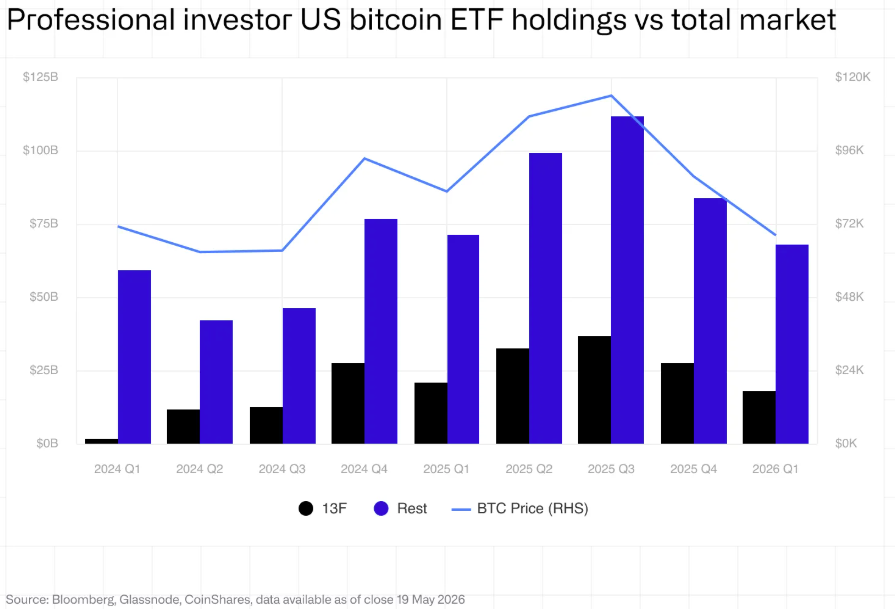
Hedge funds have reduced their exposure to U.S. spot Bitcoin exchange-traded funds by 39% during the first quarter, as professional investors pulled back from the market amid a steep decline in Bitcoin prices.
Summary
- CoinShares reported that hedge funds cut U.S. spot Bitcoin ETF exposure by 39% in Q1, leading a broader institutional pullback.
- Professional investors reduced combined Bitcoin ETF holdings by 17% to 261,000 BTC as Bitcoin fell 22% during the quarter.
- Citigroup said ETF flows drive roughly 45% of Bitcoin’s weekly returns and identified regulatory progress as a potential catalyst.
According to a CoinShares report based on quarterly 13F filings, hedge funds cut their Bitcoin ETF holdings by 31,400 BTC during Q1. The reduction formed the largest portion of a broader institutional retreat that saw professional investors lower their combined exposure from 313,000 BTC to 261,000 BTC, a decline of 17%.
The report showed that the value of Bitcoin ETF holdings reported by professional investors fell to $17.8 billion, down 35% from the previous quarter. At the same time, the share of total U.S. spot Bitcoin ETF assets held by 13F filers dropped from 24.7% to 20.8%.
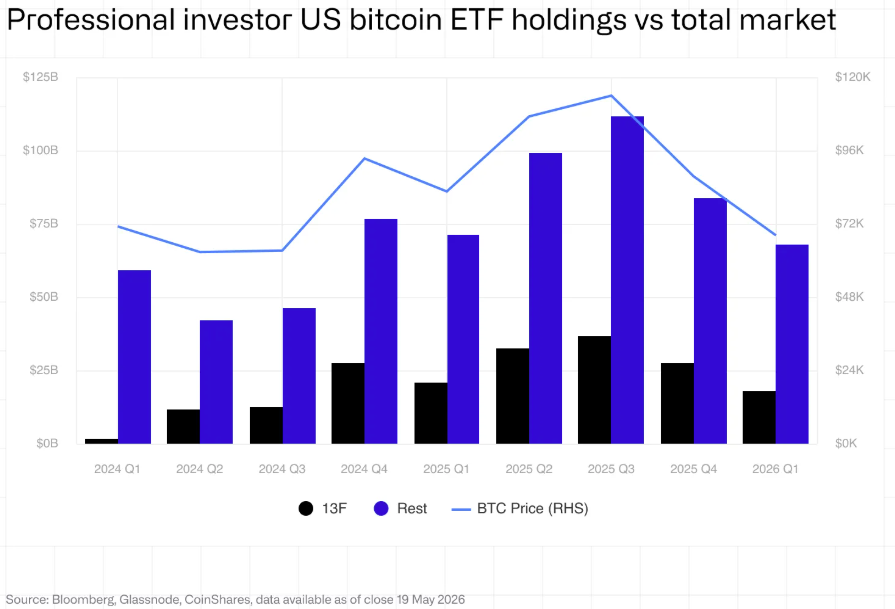
CoinShares digital asset analyst Matt Kimmell said the pattern resembles previous Bitcoin market downturns, when leveraged and tactical investors typically reduce positions as prices fall.
Hedge funds and brokerages led the selling
Data from CoinShares showed that hedge funds and brokerages accounted for roughly 96% of the decline in Bitcoin ETF exposure during the quarter.
While hedge funds reduced holdings by 31,400 BTC, brokerages cut another 18,800 BTC, representing a 53% decline from their previous positions. In contrast, investment advisors remained comparatively stable. CoinShares reported that advisors, who collectively held 150,300 BTC at the end of the quarter, reduced exposure by only 5.9%.
Banks moved in the opposite direction. According to the report, the sector added approximately 7,800 BTC worth of Bitcoin ETF exposure during Q1, more than doubling its holdings from the previous quarter.
The institutional pullback occurred alongside a sharp correction in Bitcoin. CoinShares noted that the cryptocurrency lost 22% during the quarter and briefly fell below $60,000 after extending losses that began late last year. At its lowest point, Bitcoin traded roughly 50% below its October 2025 record high above $126,000.
Additional analysis from Citigroup suggests ETF activity continues to play a major role in Bitcoin price performance. In a recent note, the bank estimated that spot Bitcoin ETF flows account for around 45% of weekly fluctuations in Bitcoin returns.
Regulatory developments remain a key focus
While ETF positioning weakened during the quarter, CoinShares highlighted several regulatory developments that could support digital asset adoption over time.
Among the measures cited in the report were ongoing efforts by U.S. regulators to clarify how oversight responsibilities should be divided between the Securities and Exchange Commission and the Commodity Futures Trading Commission. CoinShares also pointed to proposals related to the treatment of digital assets in retirement accounts.
Regulatory discussions have continued beyond the first quarter. Earlier this week, the SEC identified digital assets as a strategic priority through 2030 and stated in a draft policy document that it intends to establish a clearer regulatory framework for digital asset markets.
Attention has also remained on the CLARITY Act, a market structure proposal that would further define the responsibilities of the SEC and CFTC. CoinShares noted that the bill could create a more comprehensive framework for digital assets if enacted.
Separately, Citigroup said it currently assigns roughly a 50% probability to the legislation passing, although the bank believes the chances of approval this year have become less certain.
According to Citigroup, meaningful regulatory progress could improve investor sentiment, which has remained under pressure amid sustained spot Bitcoin ETF outflows.
Disclosure: This article does not represent investment advice. The content and materials featured on this page are for educational purposes only.

Bitcoin network activity drops to a 7-year low as price weakens

TV’s Hottest Actress Doesn’t Care That You Hate Her
Leaked document from Scottish Labour election defeat shows plans to review links with UK party



-

 Tech7 days ago
Waymo dominates autonomous vehicle registrations as Tesla trails behind
-

 News Videos7 days ago
This is BROKEN! INSANE 5x MONEY CAR WASH WEEK! The NEW GTA Online UPDATE Today! (GTA5 New Update)
-
 Tech6 days ago
SpaceX just won a second Golden Dome contract. This one is $4.16 billion.
-

 Business3 days ago
Jade Biosciences, Inc. (JBIO) Discusses Positive Interim Results From JADE101 Phase I Healthy Volunteer Study and Development Plans Transcript
-

 News Videos6 days ago
SHE IS KILLING XRP!!! WATCH URGENT AND ACT FAST
-
 NewsBeat6 days ago
FIRST NIGHT REVIEW: Take That bring the Circus back to life in spectacular sun-soaked style
-

 Business6 days ago
Is the Spurs Phenom Already Better Than Prime Diesel?
-

 Sports2 days ago
French Open 2026 results: Alexander Zverev beats Rafael Jodar and will play Jakub Mensik in semi-finals
-
 Crypto World6 days ago
CFTC Has Approved the First Regulated Bitcoin Perpetual Contract in the U.S.
-

 Politics6 days ago
The House | Inside Andy Burnham’s Makerfield Campaign: “Nobody Thinks This Is In The Bag”
-
 NewsBeat6 days ago
Novak Djokovic v Joao Fonseca LIVE: French Open latest scores and results after Jannik Sinner’s shocking collapse
-
 Entertainment6 days ago
Weak ‘Supergirl’ Box Office Tracking Amid Milly Alcock Backlash
-

 Tech3 days ago
CryZENx Releases Fresh Playable Content Deep Inside Jabu-Jabu for His Ocarina of Time Remake
-
 Crypto World6 days ago
Snowflake (SNOW) Stock Rallies on Strong Q1 Results and AI Product Growth
-

 Entertainment7 days ago
Maddox Jolie-Pitt Legally Requests to Drop Brad’s Surname
-

 Business6 days ago
Demand Conditions Improve In Chemicals Sector In April 2026
-
 Entertainment6 days ago
One of the Greatest Sitcoms of All Time Shoots Up Apple TV’s Charts 11 Years Later
-

 Tech7 days ago
This Week In Security: Ubiquiti Fixes, And FreeBSD Joins The Club You Don’t Want To Join
-
 Crypto World6 days ago
MicroStrategy Moves $30 Million in BTC to Coinbase Prime: Is the Bitcoin Sell-Off Already Here?
-
 Crypto World3 days ago
Seagate (STX) Stock Surges to Record High on AI Boom and Legal Settlement
You must be logged in to post a comment Login