
Crypto World
Morgan Stanley Hiring Blockchain Engineers to Integrate Ethereum, Polygon, Canton, and Hyperledger


TLDR:
- The blockchain engineer role integrates Ethereum, Polygon, Hyperledger, and Canton.
- Multi-chain strategy balances public liquidity with enterprise-grade compliance.
- Role focuses on interoperability, secure APIs, and internal orchestration layers.
- Compensation reaches $150,000, reflecting strategic blockchain talent investment.
Morgan Stanley is building a multi-chain blockchain infrastructure integrating Ethereum, Polygon, Hyperledger, and Canton, with engineers earning up to $150,000.
Globally, top banks like ICBC ($6.7T assets) and JPMorgan Chase ($4T) are driving trading and investment growth. This highlights institutional focus on secure, real-time financial data and advanced blockchain solutions.
Role Overview and Multi-Chain Focus
In their post, Morgan Stanley noted that the blockchain engineer will lead projects integrating at least four blockchains. Ethereum offers a public ecosystem with deep liquidity and extensive developer tools.
Polygon complements Ethereum by providing lower fees and faster transactions while maintaining compatibility with Ethereum standards.
Hyperledger supports permissioned networks, channel-level privacy, and customizable consensus, making it suitable for internal banking workflows and consortium-based settlement systems.
Canton emphasizes privacy-preserving synchronization across networks, designed for regulated financial markets.
The combination indicates Morgan Stanley is targeting a hybrid approach. Public networks may handle secondary market activity and broader liquidity access.
Permissioned networks focus on issuance, compliance, and confidential processing. Engineers in this role will manage the integration across these systems to ensure consistent performance and interoperability.
This structure allows different layers of the platform to operate according to business needs. Developers will need to design abstraction layers, secure API gateways, and key management frameworks.
This ensures governance, observability, and DevOps controls remain uniform across networks.
Strategic Purpose and Talent Investment
Morgan Stanley’s posting highlights the institution’s intent to build multi-chain capabilities while reducing reliance on any single blockchain.
Ethereum and Polygon provide market access, while Hyperledger and Canton satisfy privacy and regulatory requirements.
By combining public and permissioned systems, the bank maintains flexibility for evolving regulatory landscapes. Banks are increasingly adopting hybrid systems to balance compliance with liquidity opportunities.
The posting lists compensation up to $150,000 per year, reflecting the strategic value of this role. The position signals that Morgan Stanley is not experimenting but actively investing in blockchain infrastructure.
Candidates are expected to deliver integration solutions that connect public networks with enterprise-grade permissioned systems.
Internal orchestration and platform-agnostic engineering will allow Morgan Stanley to select networks based on product requirements. Engineers will ensure secure transaction processing, consistent governance, and operational transparency.
This aligns the bank with global trends toward tokenized assets and programmable financial infrastructure.


The partnership brings leveraged derivatives to one of crypto’s largest consumer distribution channels, targeting emerging-market users priced out of traditional brokerages.
Wallet in Telegram has launched perpetual futures trading through a new integration with Lighter, the Ethereum-based decentralized exchange (DEX), the teams announced Thursday.
The feature enables users to open long and short positions on more than 50 assets — spanning crypto, metals, equities, oil, and ETFs — with up to 50x leverage and a minimum position size of $1, all without leaving the Telegram app.
The Open Platform (TOP), the entity that develops Wallet in Telegram, told Forbes that it evaluated multiple decentralized perpetual exchanges before selecting Lighter, with the decision driven by cost structure, incentive design, and alignment with a retail-heavy audience. Lighter’s zero-fee model for standard accounts was a key factor.
Rather than competing for power users on standalone exchanges, Wallet is targeting a broader audience that may not have previously used derivatives platforms. The wallet has more than 150 million registered users, many of whom were onboarded through earlier gamified mini-app features on Telegram.
Users in the United States and the United Kingdom are excluded from the rollout. The initial focus is on emerging markets where traditional brokerage infrastructure is more limited.
Lighter Struggles Post-TGE
The deal represents a significant distribution channel for Lighter, which has become one of the top perp DEXs by volume since launching its public mainnet in late 2025.
Lighter processed $59 billion in perpetual volume in March 2026, ranking fourth among perp DEXs, according to DefiLlama. That’s down nearly 80% from its peak of $292 billion in November.
The platform runs on a custom zero-knowledge rollup on Ethereum, where every order match and liquidation is cryptographically verified onchain. It raised $68 million in November 2025 from Founders Fund, Ribbit Capital, Haun Ventures, and Robinhood. Since then, Lighter has expanded into spot trading, launched its LIT token, and introduced equity perpetuals.
Still, the exchange trails category leader Hyperliquid, which processed nearly $210 billion in March, by a wide margin.
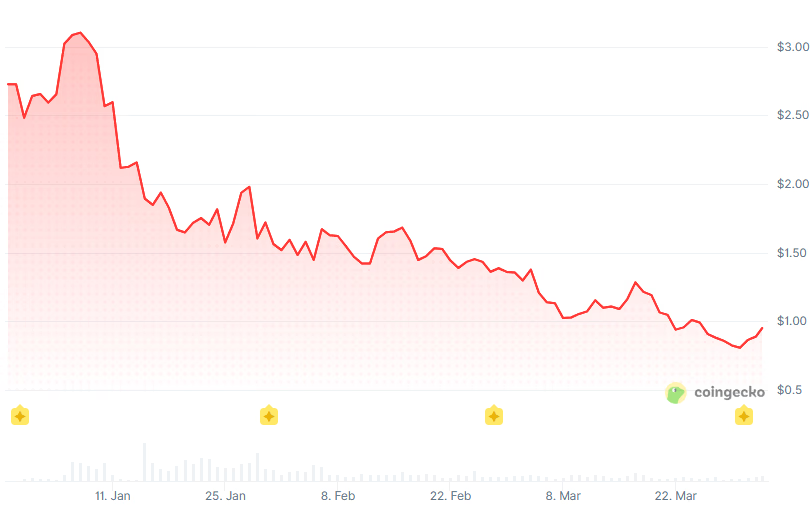
The platform’s LIT token rallied 5% on the news, but has struggled since its December launch, losing more than two-thirds of its value since January 1.

Lighter also announced that its Partner Attribution program is now open, allowing developers to integrate the exchange’s perpetuals and spot infrastructure into their own applications.

TLDR
- Arthur Hayes questioned whether native multisig wallets on Solana could have prevented the Drift Protocol hack.
- Early investigations showed that attackers compromised administrative access rather than exploiting smart contract code.
- Solana leaders stated that human weaknesses and operational security gaps enabled the breach.
- Drift Protocol froze all functions and removed the compromised wallet from its multisig setup.
- The DRIFT token fell to $0.038 before recovering to around $0.052 within 24 hours.
A $280 million exploit at Drift Protocol triggered debate across the crypto sector and pressured token prices. Arthur Hayes questioned wallet infrastructure, while Solana leaders blamed operational failures. Early findings indicate attackers compromised administrative access rather than smart contracts.
Arthur Hayes Raises Wallet Security Concerns After DRIFT Exploit
Arthur Hayes challenged crypto wallet design after hackers drained about $280 million from Drift Protocol. He asked on X, “If Solana had native multi sig addresses, would the Drift hack even have been possible?” His remarks focused attention on wallet controls and multisignature structures.
Meanwhile, executives across the Solana ecosystem addressed the breach and clarified its scope. They said the attack did not stem from faulty smart contracts. Instead, they pointed to compromised administrative permissions and weak operational security.
Jacob Creech, Solana’s vice president of technology, urged protocols to review their configurations. He wrote, “Every protocol should evaluate their setup and understand if it fits your security requirements.”
He added that stronger multisig thresholds and timelocks can restrict unauthorized actions.
Drift Protocol responded by freezing all protocol functions after detecting the exploit. The team removed the compromised wallet from its multisig setup. It also said it is working with exchanges, bridges, and law enforcement to trace funds.
The DRIFT token fell sharply after news of the breach spread. It dropped to a record low of $0.038 before recovering part of the losses. At the time of reporting, DRIFT traded near $0.052, down 27% in 24 hours.
Retail sentiment on Stocktwits shifted during the volatility. Sentiment moved to “bullish” from “neutral” within a day. Chatter levels increased to “extremely high” from “high,” reflecting intense discussion.
Solana Leaders Say Human Weaknesses, Not Code, Enabled Attack
Solana leaders stated that the breach exposed weaknesses in permission management practices. Lily Liu, president of the Solana Foundation, said the incident “hits hard” for the ecosystem. She added that the smart contracts themselves remained intact.
Liu wrote on X, “The real targets now are humans: social engineering and opsec weaknesses more than code exploits.”
She emphasized the need to improve operational safeguards. She said the ecosystem must strengthen processes around access controls.
Creech echoed that view and encouraged internal reviews across protocols. He highlighted the importance of aligning security setups with risk exposure. He said better controls can limit damage when credentials become compromised.

TLDR
- The IMF states that tokenization replaces core financial architecture rather than improving existing systems.
- The report identifies stablecoins as the weakest link within the tokenized financial structure.
- Stablecoin transaction volume reached $1.8 trillion per month by early 2026.
- The IMF says 97% of stablecoins are denominated in U.S. dollars.
- The report warns that stablecoins can lose their peg during periods of market stress.
The International Monetary Fund (IMF) released a policy paper in April 2026 on tokenized finance. Tobias Adrian authored the report in his role as Financial Counsellor. The document argues that tokenization replaces core financial architecture rather than improving existing systems.
IMF Flags Stablecoins and Tokenization Settlement Risks
The IMF states that tokenization shifts trust, settlement, and risk management into shared digital infrastructure. It explains that programmable tokens embed ownership and compliance directly on ledgers. As a result, risk moves from institutions to code and system design.
The report separates tokenized money into deposits, regulated stablecoins, and wholesale CBDCs. It states that each form allocates risk differently within the system. However, it identifies stablecoins as the weakest structural point in tokenization.
The Fund reports that stablecoin transaction volume reached $1.8 trillion per month by early 2026. It notes that volumes were minimal in 2018 and rose sharply through 2024 and 2025. The paper describes this growth as rapid settlement expansion within crypto markets.
The report states that 97% of stablecoins are denominated in U.S. dollars. It adds that these tokens now influence money markets and payment systems. As a result, dollar-based stablecoins extend dollar usage into tokenized markets.
Adrian writes that stablecoins resemble money market funds more than central bank money. He states that a fully backed stablecoin can still lose its peg. He links that risk to liquidity stress during redemption surges.
Rapid Settlement and Sovereignty Risks Highlighted
The IMF explains that traditional finance uses settlement lags to manage stress. It states that two-day settlement windows allow regulators to intervene. However, tokenization enables atomic settlement that removes that delay.
The report warns that automated liquidations can trigger rapid asset sales. It states that coding errors or faulty price feeds can spread losses quickly. As a result, stress events unfold faster than in traditional markets.
The paper adds that central bank backstops operate on business-day cycles. It explains that tokenized systems function continuously, including weekends and holidays. Therefore, stablecoins operating as settlement layers face immediate testing during stress.
The IMF states that stablecoins connect every component of tokenized markets. It explains that smart contracts, collateral positions, and liquidity pools settle in them. Consequently, a broken peg would affect all linked transactions simultaneously.
The report also highlights cross-border risks for emerging economies. It states that dollar stablecoins can move capital outside banking channels. As a result, central banks may lose response time during currency pressure.
The IMF notes fragmentation across multiple token platforms. It states that liquidity splits across separate ledgers and bridges. The report concludes that fragmentation can increase systemic strain within tokenized finance.
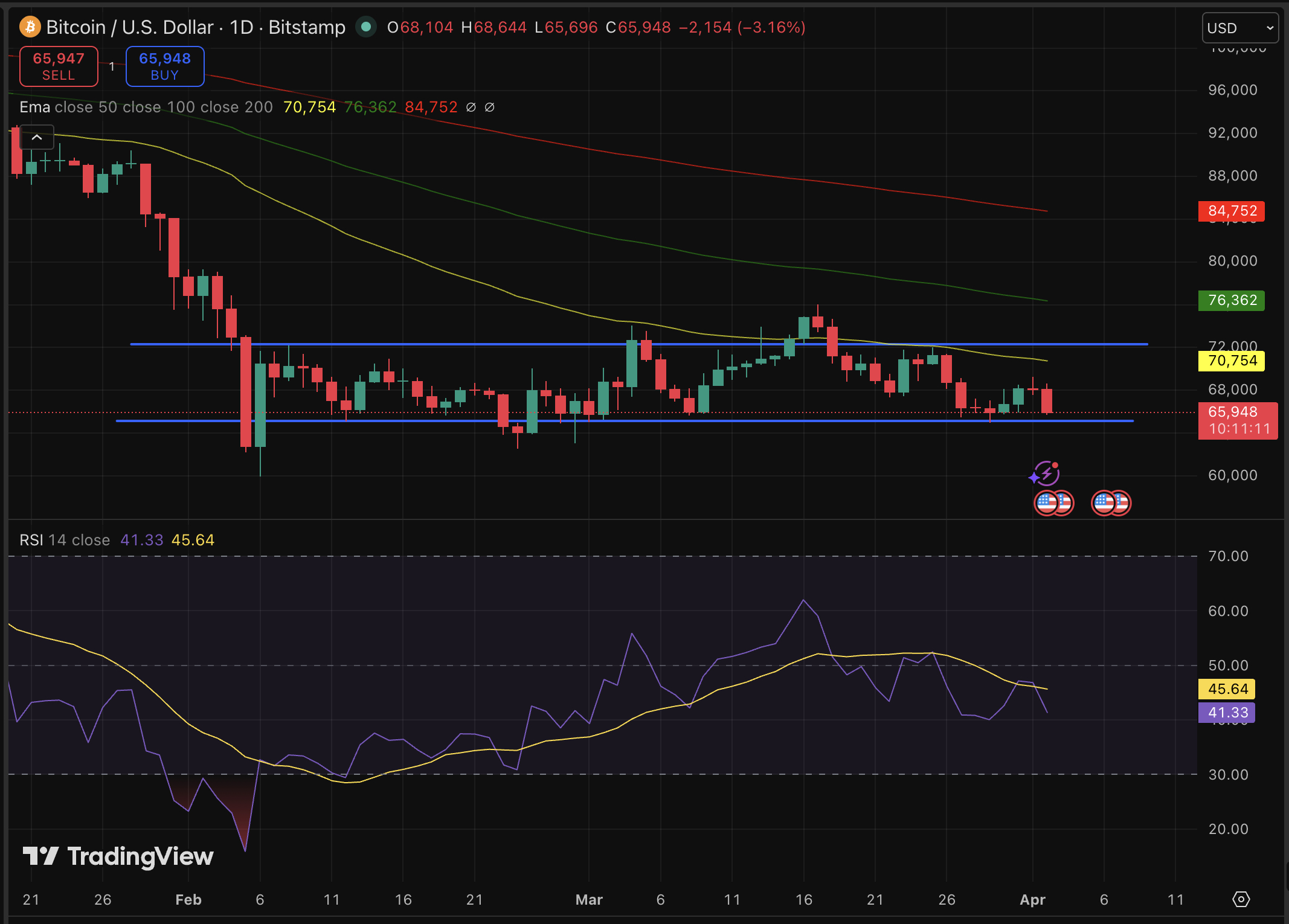
Bitcoin is under pressure, and the macro forces closing in aren’t easing. BTC USD price just fell to the $66,000 zone, down -3.5% in the last 24 hours, with bears eyeing a drop toward the $64,000 critical level if current levels fail to hold.
Risk assets across the board got hit after U.S. President Donald Trump’s address to the nation left markets rattled rather than reassured. Trump’s tone on the Iran conflict, referencing power plants, a 2–3 week war timeline, and NATO criticism, failed to deliver the de-escalation traders were pricing in.
“Between threatening Iran’s power plants, saying the Iran War would last 2-3 more weeks, and calling out NATO, there was nothing new,” trading resource The Kobeissi Letter noted.
BTC logged intraday lows near $65,000 on the news, recording roughly 4% daily losses before recovering by a small margin. Gold and equities fell in tandem, too, in classic risk-off rotation.
The U.S. dollar is now eyeing a breakout to yearly highs, and oil is strengthening on the same geopolitical cues. That combination has historically been a headwind for Bitcoin. The correlation between BTC and macro risk appetite is tightening at exactly the wrong moment.
Discover: The best crypto to diversify your portfolio with
Can BTC USD Price Hold $66,000 or Are New Lows Incoming?
The technical picture is deteriorating. RSI sits at 45, which is neutral on the surface, but declining, while the 50-day SMA has compressed to $7,0,700, and the 200-day SMA is at $84,700. It’s okay, but the daily chart has shifted to a strong sell configuration even as RSI avoids outright oversold territory.
Immediate resistance at the aftermath sits in the $67,000–$69,000 zone, a range that has capped multiple recovery attempts. BTC has now rejected $69,000 at least once this week. Below current levels, the immediate target is $64,000 as the 1-week forecast low. A longer-term trendline dating back to 2017 sits beneath that, which could act as a final support before any structural breakdown.
One trader on TradingView captured the mood bluntly: “A lot of people are turning very bearish on Bitcoin, but I don’t think it’s time to be bearish.” Conviction on either side is thin right now. The oil-BTC relationship is the wildcard that could force the issue.
Discover: The best pre-launch token sales
Early-Mover With Upside Potential as BTC Tests Supports
Spot BTC may be grinding lower, but the infrastructure layer being built on top of Bitcoin is attracting capital that doesn’t care about short-term price action. If Bitcoin’s base layer is the store of value, the race is now on to build the execution layer.
Bitcoin Hyper ($HYPER) is positioning itself at that intersection. Billed as the first-ever Bitcoin Layer 2 with Solana Virtual Machine (SVM) integration, the project delivers faster throughput than Solana, while inheriting Bitcoin’s security model.
The presale has raised more than $32 million at a current price of $0.0136, with staking bonus available at a high 36% APY. Key infrastructure includes a Decentralized Canonical Bridge for BTC transfers and ultra-low-latency smart contract execution that is targeting Bitcoin’s core limitations: slow finality, high fees, and zero programmability.
As macro volatility compresses large-cap returns, early-stage infrastructure plays with genuine technical differentiation are drawing attention.
For traders who want to explore the project further: Research Bitcoin Hyper here.
This article is not financial advice. Crypto assets are highly volatile. Always conduct your own research before investing.
The post BTC USD Price Could Break New Lows: U.S. Dollar and Oil Getting Stronger appeared first on Cryptonews.
Arizona is moving to make XRP a state treasury asset. XRP price itself trades at $1.28, down by 4.5% in today, with crypto sentiment at extreme fear and a single bearish prediction hitting the market. The bill that could change everything is closer to a full House vote than most traders realize.
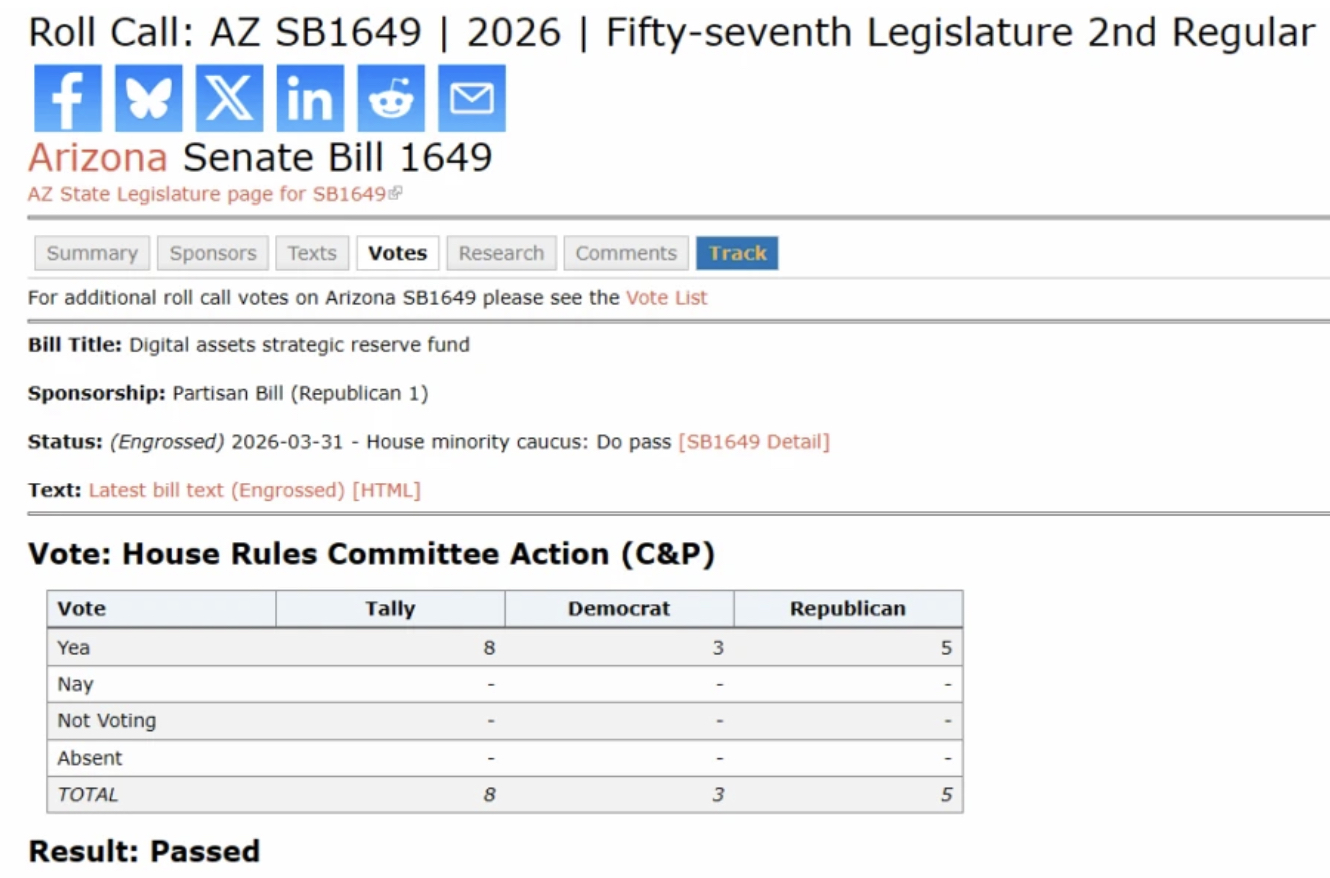
Arizona’s SB1649 would create a Digital Assets Strategic Reserve Fund, placing confiscated, surrendered, or state-held digital assets under the state treasurer’s direct control. XRP is explicitly named alongside Bitcoin, stablecoins, and a handful of altcoins.
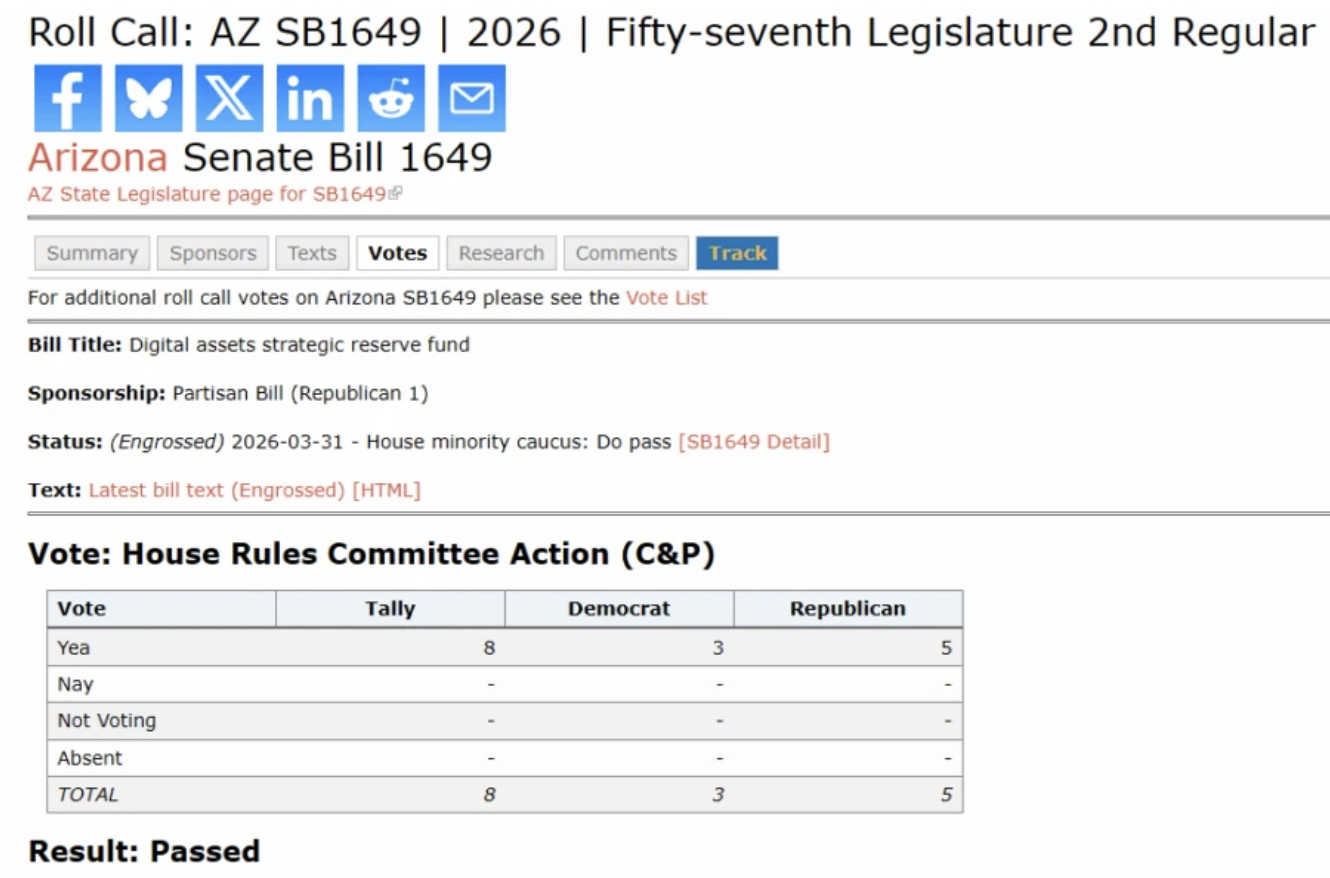
The measure cleared the House Rules Committee 8-0 on March 30, moving it to a full chamber vote. Critically, the bill allows the treasurer to earn additional returns through staking, airdrops, or limited lending, meaning XRP’s utility as a yield-bearing reserve asset is already baked into the legislative language.
The macro backdrop is ugly right now, but Ripple’s accelerating institutional legitimacy keeps long-term bulls engaged. Whether this bill passes or not, the precedent it sets for state-level crypto adoption is hard to ignore.
Discover: The best crypto to diversify your portfolio with
XRP Price Prediction: $2 Before Arizona’s House Vote?
XRP is consolidating under pressure. At under $1.30, the asset is trading below its 50-day SMA of $1.44, with RSI sitting at a neutral-to-bearish 43, not yet oversold, but lacking momentum. For holders, these are the key levels to watch. Support is at $1.25, and the strongest is at $1.23. Resistance sits at $1.33–$1.34, with $1.40 the line that needs to break for any meaningful recovery.
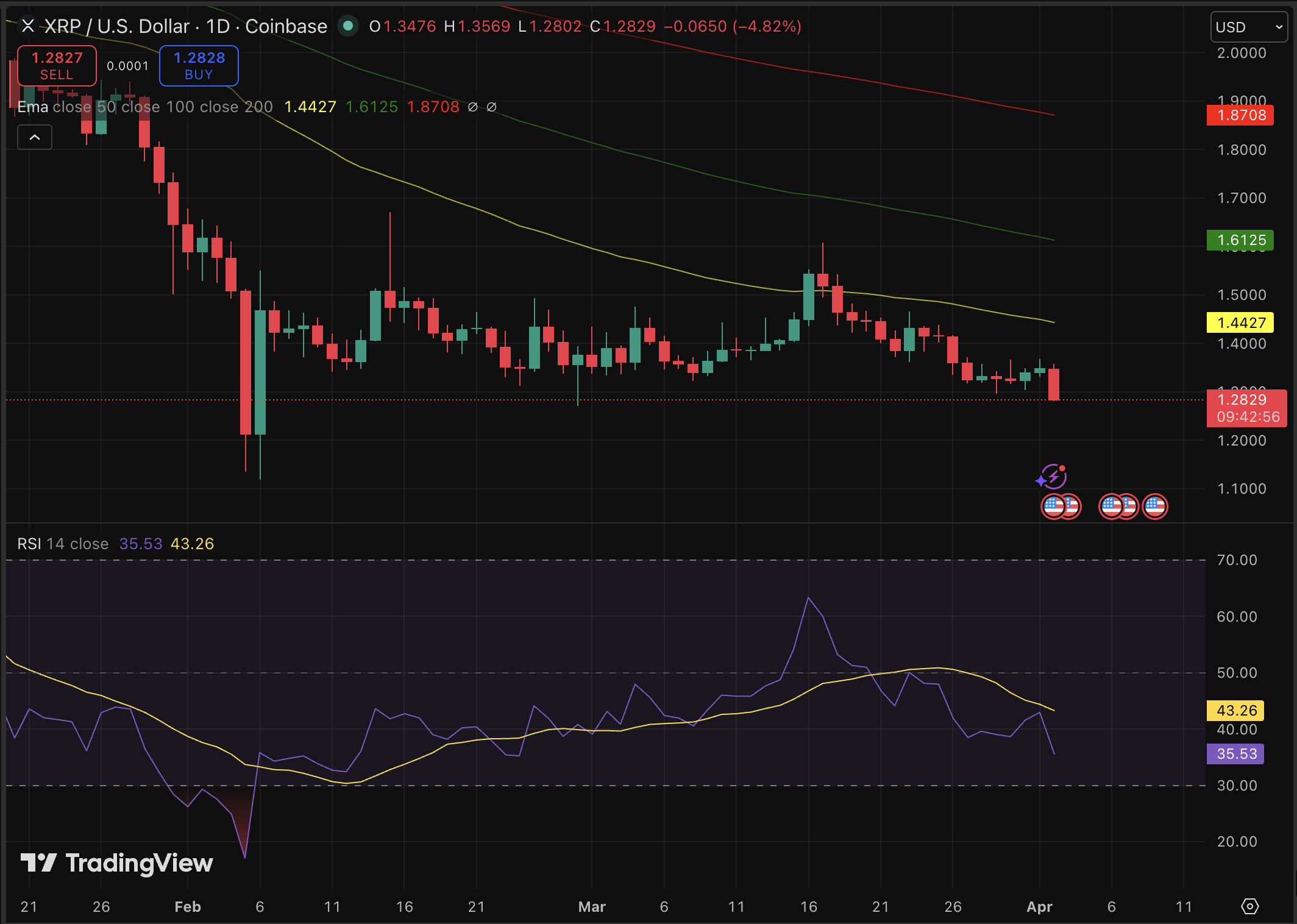
In a good scenario, the Arizona House passes SB1649, ETF approval odds crystallize into a confirmed timeline, and XRP reclaims $1.42, opening a path toward the $2.10 upper bound analysts cite for 2026.
But if $1.25 fails, macro pressure deepens, and XRP retests sub-$1.20 territory. One TradingView analyst has identified a forming bull flag, parabolic if confirmed, painful if it resolves downward.
Discover: The best pre-launch token sales
Maxi Doge Eyes Early-Mover Upside as XRP Tests Key Support
XRP’s 6% weekly decline is a reminder that even fundamentally strong assets bleed in risk-off environments. For traders unwilling to wait out a potentially extended consolidation at this market cap, early-stage presales offer a different risk profile, higher volatility, but asymmetric upside that a $80B asset simply can’t replicate.
Maxi Doge ($MAXI) is an ERC-20 meme token built around a 240-lb canine mascot and a unapologetically aggressive trading culture. The presale has raised $4,7 million at a current price of $0.0002811, with staking at 66% APY in rewards for early holders.
Features include holder-only trading competitions with leaderboard rewards, a Maxi Fund treasury for liquidity and partnerships, and meme-first marketing built for viral distribution. The risk-off market environment is actively pushing attention toward presale-stage projects like this one.
Research Maxi Doge before the presale window closes.
This article is for informational purposes only and does not constitute financial advice. Crypto assets are highly volatile. Always do your own research before investing.
The post XRP Price Prediction: XRP Could Soon Become a State Treasury Asset appeared first on Cryptonews.

Murad Mahmudov, the crypto trader widely known online as the “Memecoin Messiah,” has endured a brutal nine-month stretch, wiping almost $60 million from his bets. Yet he remains bullish on SPX6900, a memecoin that aspires to outpace the S&P 500 and redefine memecoin economics.
Key takeaways:
- Mahmudov argues SPX6900 could grow the market cap of the token to $1 trillion—from roughly $250 million today—an extraordinary, 400,000% rise.
- On the technical front, SPX6900’s three-day chart points to a potential further decline of about 20% in the coming weeks.
- Public portfolio data shows a heavy concentration in SPX6900, with the Muststopmurad wallet holding about 29.964 million SPX (roughly $7.8 million), about 96% of the publicly tracked portfolio value.
- Despite steep losses, there have been no meaningful sales of SPX6900 or other major positions, according to DropsTab, suggesting the trader has not yet realized losses beyond the unrealized figure.
- The broader memecoin sector remains battered, with a large share of projects inactive and exit liquidity in some names showing limited real trading activity.
SPX6900 on a bold trajectory, or a fragile setup?
In a post circulated on X, Mahmudov asserted that SPX6900, a memecoin’s bid to overtake the S&P 500 in market presence, could surge to a $1 trillion market capitalization from its current roughly $250 million valuation—a jump of about 400,000%. The claim frames SPX6900 as a long-term bet on a narrative shift within the memecoin space, one that hinges on mass adoption and liquidity enhancements to propel a token past a traditional stock index in perceived value.
By contrast, the marketplace for memecoins has faced a brutal environment. SPX and other memecoins have tracked a broader retreat in the sector, with prices and on-chain liquidity deteriorating as traders reassess risk capital. Bitcoin remains the sole cryptocurrency to have reached a $1 trillion market cap in historical precedent, underscoring how extraordinary such a SPX6900 thesis would be in ordinary market conditions.
Concentration risk and unrealized losses
Public wallet analytics place Mahmudov’s SPX6900 exposure at the core of his tracked holdings. Arkham Intelligence flags the trader’s wallets under the entity “Muststopmurad,” and current data show approximately 29.964 million SPX held—valued at about $7.79 million. This single line item accounts for roughly 96% of the total tracked portfolio, estimated near $8.1 million.
The magnitude of the drawdown is stark. At a peak in July of the previous year, the same holdings carried an implied value of around $67 million. The ensuing correction has produced an unrealized loss near $60 million as the memecoin sector retraced more than 80% from its highs. The heavy tilt toward SPX6900 illustrates a classic high-conviction, high-risk position where outsized gains are possible but gains can evaporate rapidly in a sentiment-driven market.
Despite the paper losses, Mahmudov’s on-chain footprint shows no clear exit from these bets. DropsTab, a portfolio-tracking service that aggregates public wallets, indicates no material sales of SPX6900 or his other major positions. The platform records realized profits and losses on the tracked holdings as zero, suggesting the decline has come largely from price moves rather than realized dispositions. The portfolio, by this accounting, still shows more than $6.22 million in unrealized gains across its positions, indicating a complex mix of upside exposure that the trader has not yet cashed in—or chosen not to crystallize.
Exit liquidity and the broader memecoin backdrop
The memory-heavy, supply-sensitive dynamics of memecoins are also reflected in on-chain liquidity metrics. Market data show that several memecoin names—such as RETARDMAXX, HONK, and CHAD—struggle to attract meaningful liquidity. On Solana-based pairs, RETARDMAXX displayed around $44,000 in liquidity with only six transactions and modest daily volume, while CHAD showed roughly $842 in liquidity with no trades or new makers recorded in the same window. HONK’s pair registered just $1 in liquidity and no activity, underscoring the fragility of exit liquidity for some of these tokens in stressed markets.
Such liquidity gaps matter for holders who may wish to monetize losses or trim risk, particularly when a narrative previously supported by hype but now confronted with waning enthusiasm. In a market where a majority of new tokens fail to find steady demand, the ability to realize gains—or even limit losses—depends on the existence of durable liquidity pools and active buyers. CoinGecko’s January tracking highlighted the fragility of the broader memecoin set, reporting that 53.2% of all cryptocurrencies tracked since 2021 were inactive, with 11.6 million token failures recorded in 2025 alone that disproportionately affected memecoins. This backdrop helps explain why even sizable unrealized gains on a single position may struggle to translate into liquidity if the market lacks buyers willing to step in at meaningful levels.
Technical setup: a potential continuation of downside in SPX6900
From a chart perspective, the SPX6900 price action on a three-day horizon appears to be breaking down from a rising wedge pattern. A breakdown beneath support near the $0.26 level has already been triggered, with the price trading below the 20-, 50-, and 100-period exponential moving averages, a configuration that often signals a continuation of the downtrend in the near term. If the pattern plays out as the setup suggests, a measured move could take SPX6900 toward the $0.205 area—roughly 20% below current levels. Such a move would have implications for Mahmudov’s portfolio, potentially shaving another $1.5 million or more from the SPX stake, depending on the token’s price action and any accompanying shifts in liquidity.
Beyond the mechanics of the chart, the risk for concentrated memecoin bets remains structural. The memecoin sector’s volatility has historically outpaced broader crypto markets, with narrative-coupled demand driving extreme swings in both directions. For Mahmudov, the question is whether the SPX6900 thesis can withstand a test of time and liquidity, or if the current trend portends further writedowns before a credible inflection—if one ever arrives—materializes.
As of now, Mahmudov’s public posture suggests a patience-based stance rather than a willingness to harvest losses. The combination of a grandiose market-cap target, a highly concentrated position, and a market environment that has punished many memecoins for thin liquidity presents a case study in risk management rather than conventional investing wisdom. For observers, the ongoing question is whether SPX6900 can deliver on its promised scale or if the token’s path will remain a cautionary tale about the limits of meme-driven valuation in a crowded, unforgiving market.
What to watch next: productizing a memecoin’s ascent into mainstream liquidity remains the central hurdle. If SPX6900 can attract meaningful exchange listings, deeper liquidity, and broader investor interest, the thesis could gain traction. If not, the focus will shift to risk controls around highly concentrated portfolios and the practicalities of exiting positions in a market where exit liquidity is uneven at best.
Digital banking platform SoFi Technologies has launched Big Business Banking, a platform that allows companies to manage fiat and crypto transactions within a single regulated system.
According to Thursday’s announcement, the offering enables companies to hold deposits, move funds and settle transactions around the clock using either traditional currencies or digital assets, consolidating functions that have typically been split across banks, custodians and crypto service providers.
It also introduces support for issuing and redeeming the company’s stablecoin, SoFiUSD, allowing businesses to convert between fiat and onchain assets while keeping reserves within a regulated banking environment.
The rollout includes participation from companies such as Cumberland, BitGo, Bullish, B2C2, Fireblocks, Wintermute, Jupiter, Galaxy, Mesh Payments and Mastercard, reflecting early demand from trading, payments and infrastructure providers.
SoFi said the system is expected to connect with blockchain networks, including Solana, to support onchain settlement.
The move comes as the bank has been pushing deeper into digital assets. In June, SoFi resumed crypto trading, enabling users to buy, sell and hold digital assets, and expanded blockchain-based remittance services to more than 30 countries.
In December, it launched SoFiUSD, a fully reserved dollar-backed stablecoin issued by its banking subsidiary, redeemable on demand and initially deployed on Ethereum.
Related: Standard Chartered says faster stablecoin turnover could curb demand
Crypto companies build digital asset infrastructure for institutions
While SoFi is expanding from the banking side, crypto-native companies are building similar infrastructure to integrate digital assets into institutional systems.
In March, crypto infrastructure platform BitGo launched a financing platform that enables institutions to borrow and lend against liquid, staked and locked assets within a single custody account.
In January, Fireblocks acquired crypto accounting platform TRES for $130 million, adding tax and compliance capabilities as institutions seek audit-ready reporting for digital asset operations.

This week, Ripple added digital asset capabilities to its treasury platform, enabling companies to manage crypto and fiat balances in one system.
Beyond expanding services for institutional clients, several platforms are also pursuing US banking licenses. On Wednesday, crypto exchange EDX Markets applied to the Office of the Comptroller of the Currency to establish a national trust bank, aiming to separate custody and settlement from trading through a non-depository entity called EDX Trust.
Earlier this month, Zerohash applied for a national trust bank charter to expand its stablecoin and custody services, joining applicants including Coinbase, Laser Digital and Payoneer as companies seek regulatory approval to offer integrated crypto financial services.
Magazine: AI agents will kill the web as we know it: Animoca’s Yat Siu


In today’s newsletter, Paul Frost-Smith, CEO of Komainu, covers how institutional crypto is converging with traditional finance, but speed can introduce risk if legal and compliance layers aren’t aligned.
Then, in “Ask an Expert,” Sam Boboev, from the “Fintech Wrap Up,” details the key coordination risks institutions must solve for.
Beyond custody: why connectivity will define the next era.
Institutional crypto markets
Institutional adoption of crypto has matured rapidly. The challenge is no longer simply securing assets, but moving and managing them efficiently across a fragmented ecosystem of custodians, exchanges and counterparties. With assets under professional custody now exceeding $200 billion, the inefficiencies of siloed infrastructure have an increasingly material impact on trading, hedging and liquidity management.
Treasury teams often find assets stranded across multiple platforms, creating operational friction that slows trades, constrains intraday liquidity and increases risk exposure. Idle assets tie up capital, amplify counterparty risk and raise the cost and complexity of managing institutional portfolios. In a 24/7 market where speed, execution and real-time visibility matter, the ability to mobilise capital across platforms is no longer optional, it is a prerequisite for scale, efficiency and resilience.
The next phase of market evolution will be defined by connectivity. Platforms that link custody, liquidity and collateral in real time are no longer “nice to have,” they are critical infrastructure. Networked systems enable assets to move faster, collateral to be rehypothecated safely and positions to be adjusted instantly without the delays inherent in siloed setups. Institutions that can leverage integrated infrastructure gain a direct advantage in capital efficiency, risk management and operational agility.
Technologies such as Bitcoin’s Liquid Network illustrate the potential. By combining security, transparency, and near-instant settlement, these networks provide a model for institutions to operate efficiently while mitigating counterparty and operational risk. Assets that are digital-native and programmable can be pledged, transferred and released automatically according to predefined rules, bringing crypto markets closer to the operational standards expected in traditional finance.
The implications are clear. The efficiency and integration of underlying infrastructure directly affect portfolio outcomes. A digital asset’s value is no longer defined solely by its market price; mobility and utility are just as important. Firms that can connect these “pipes” of digital finance gain better liquidity, faster execution and strategic flexibility at scale, enabling them to deploy capital more effectively across trading, hedging and yield-generating activities.
This shift also signals a broader trend, with custody evolving beyond its traditional role. Once synonymous with storage, it now functions as a dynamic, active layer that validates, transfers, and interacts with assets programmatically. Institutional investors evaluating service providers should look beyond security and regulatory compliance to consider the ability to support fast, interconnected and reliable market activity.
Looking ahead, interoperability and network connectivity, not just regulatory clarity, will define which institutions can scale efficiently in crypto markets. Those that build their strategies around connected, integrated infrastructure will be positioned to capitalise on opportunities that siloed competitors cannot.
As institutional participation deepens, the competitive edge in crypto markets will increasingly come from how effectively firms can deploy and mobilise capital. Connectivity, interoperability and real-time collateral mobility will define the infrastructure institutions rely on to trade, hedge and manage risk at scale. Those that prioritise integrated systems today will be better positioned to navigate a market that is becoming faster, more interconnected and more operationally demanding.
– Paul Frost-Smith, CEO, Komainu
Ask an Expert
Q1: What defines the next phase of institutional crypto market structure?
The next phase is defined by convergence with traditional financial infrastructure. Crypto is no longer operating as a parallel system; it is being absorbed into existing institutional frameworks. This shows up in three areas: regulated custody, tokenized financial instruments and stablecoins as settlement rails. Institutions are not adopting crypto for speculation, but for balance sheet efficiency, faster settlement and programmable financial flows. The market structure is shifting from exchange-led liquidity to infrastructure-led integration.
Q2: Where is the real value being created right now?
The value is moving down the stack into infrastructure. Custody, tokenization platforms and stablecoin issuance are becoming the core control points. These layers determine how assets are issued, transferred and settled. Distribution still matters, but control over settlement and asset representation is where defensibility is forming. This is why we are seeing traditional players focus on tokenized money market funds, on-chain repo and institutional-grade stablecoins.
Q3: What are the key risks institutions need to solve for?
The primary risk is not volatility, but coordination across legal, technical and operational layers. Tokenized assets can settle instantly, but ownership rights, compliance rules and jurisdictional enforcement still operate off-chain. This creates a structural mismatch. Institutions need systems where the ledger, compliance logic and legal frameworks are aligned. Without that, speed introduces risk rather than efficiency.
– Sam Boboev, founder, Fintech Wrap Up
Keep Reading
- Bitcoin enters the public bond market as Moody’s gives a first-of-its-kind crypto deal a rating.
- Franklin Templeton is launching a dedicated cryptocurrency division, Franklin Crypto, anchored by its planned acquisition of crypto investment firm 250 Digital.
- Australia has passed its first comprehensive crypto law, requiring exchanges and custody platforms to obtain financial services licenses within six months.


Coinbase (COIN) said Thursday it had received initial approval for a national trust company charter from the U.S. Office of the Comptroller of the Currency, Bloomberg reported, marking a step toward it operating as a federally regulated crypto custodian.
The approval is not final. It is a conditional green light that sets out requirements Coinbase must meet before it can receive a full charter. These typically include building out compliance systems, hiring key personnel and undergoing regulatory reviews. The OCC also expects firms to show they can manage risk, protect client assets and follow anti-money laundering rules. Only after those steps are complete can the agency grant full approval.
“We still need final approval… our business will not operate under an OCC charter until we have that final approval,” Paul Grewal, chief legal officer at Coinbase told CoinDesk. “This next phase allows us to get into more detail on how we can extend our business in ways that are exciting and important for crypto’s development.”
If finalized, the charter would allow Coinbase to run a non-insured national trust company. That structure permits the firm to hold digital assets on behalf of clients but bars it from taking deposits or making loans.
Coinbase first applied for the charter in October, alongside firms such as Ripple. More recently, Citadel-backed exchange EDX Markets said it had filed for a similar structure. The cluster of applications points to growing demand for regulated custody as large investors enter crypto markets.
For institutions, custody is less about trading and more about trust. A pension fund, for example, may want exposure to bitcoin but needs a regulated entity to hold the asset securely. A federal charter can provide that assurance in a way state licenses may not.
The move aligns with Coinbase’s effort to rely less on trading fees, which can swing with market cycles. Custody offers steadier revenue. The company already acts as custodian for several U.S. spot bitcoin exchange-traded funds, holding the underlying assets on behalf of fund managers.
“The big opportunity going forward would be payments… custody-adjacent but separate,” Grewal said. “We think we’ll be able to offer a much wider range of products and services to our customers than ever before.”
UPDATE (April 2, 16:57 UTC): Adds comments from Coinbase chief legal officer Paul Grewal.
Disclosure: This article does not represent investment advice. The content and materials featured on this page are for educational purposes only.
Cifra Markets aims to bring regulated, transparent access to crypto in a $2.55 trillion global market.
At the time of writing, the global cryptocurrency market is a $2.55 trillion market, yet millions of users still lack access to a regulated, transparent gateway into digital assets. Unverified peer-to-peer platforms, unregulated online exchangers, and offline dealers with questionable liquidity have long dominated the space. Cifra Markets is changing that.
In this project review, we take a deep dive into Cifra Markets to understand the unique features that set it apart.
Overview
Website: https://cifra.by/en/
Sector: Crypto broker
Supported coins: 300+ cryptocurrencies
Margin trading support: Yes
KYC verification: Required
Tokenized US stocks: Offered
What is Cifra Markets?
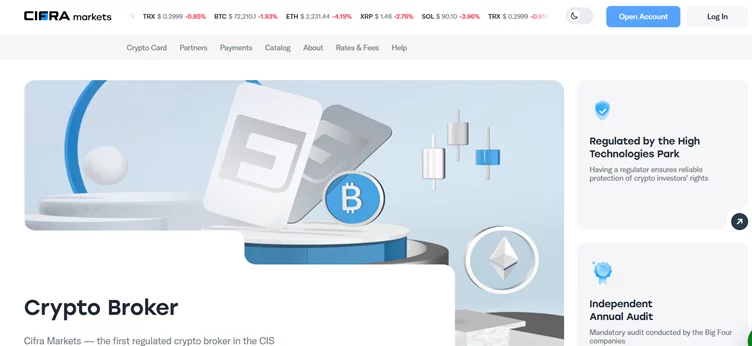
Cifra Markets is a licensed crypto brokerage firm operating from the Republic of Belarus, a country where cryptocurrencies have been legal and regulated at the state level since 2017. It was among the first brokers to get a license in the jurisdiction, a testament to its commitment to regulatory compliance, and establishing trust within a highly competitive financial market.
Cifra is positioned as a legal alternative to P2P crypto exchanges and operates in the Commonwealth of Independent States (CIS) region, Asian, and Middle Eastern markets. It also provides crypto trading through partnerships with regulated crypto exchanges.
What makes Cifra unique?
1. Security is at the heart of Cifra Markets. The company operates as a registered resident of the High Tech Park (HTP) in Belarus. By operating in this region, Cifra adheres to strict requirements on asset custody, cybersecurity, independent technical auditing, and client service quality. This helps the platform to bring institutional-grade compliance to crypto users, a combination that has historically been unavailable for brokers operating in the region.
2. Cifra Markets has built its infrastructure based on principles commonly used in traditional financial standards. The platform integrates with multiple partner banks to enable instant fiat deposits and withdrawals.
3. To ensure that every transaction on the platform is legal, Cifra Markets imposes strict AML standards for all deposited cryptocurrencies. Every transaction is screened by blockchain analytics firms, such as Elliptic, and Shyft, to verify the “cleanliness” of digital assets before they are credited to client accounts. If funds are linked to sanctioned addresses or illicit activity, they are rejected and automatically returned to the original blockchain address.
4. Users are able to purchase cryptocurrency using fiat through bank transfers. They can also convert fiat into crypto, or from fiat to crypto, by using any bank in the CIS. Users can choose to deposit and withdraw funds in US dollars, euros, Belarusian Rubles, or Russian Rubles.
5. The platform provides users with access to over 300 cryptocurrencies as well as tokenized U.S. stocks, such as AAPLX, GOOGLX, NVDAX, AMZNX, HOODX, CRCLX, and more.
6. Cifra offers margin trading with leverage of up to 5x, allowing traders to enter large positions with a smaller initial capital.
7. Cifra Markets has its own trading interface and technology stack, including a Mini App designed to simplify access for beginners. This aims to reduce the complexity often associated with large global exchanges, making the platform accessible for a wide range of users.
8. Fiat and USDT can be exchanged directly through the order book in the trading application, where prices are set by participants placing their orders. For larger transactions, users have access to an OTC desk.
How to get started
Getting started on Cifra is easy and straightforward.
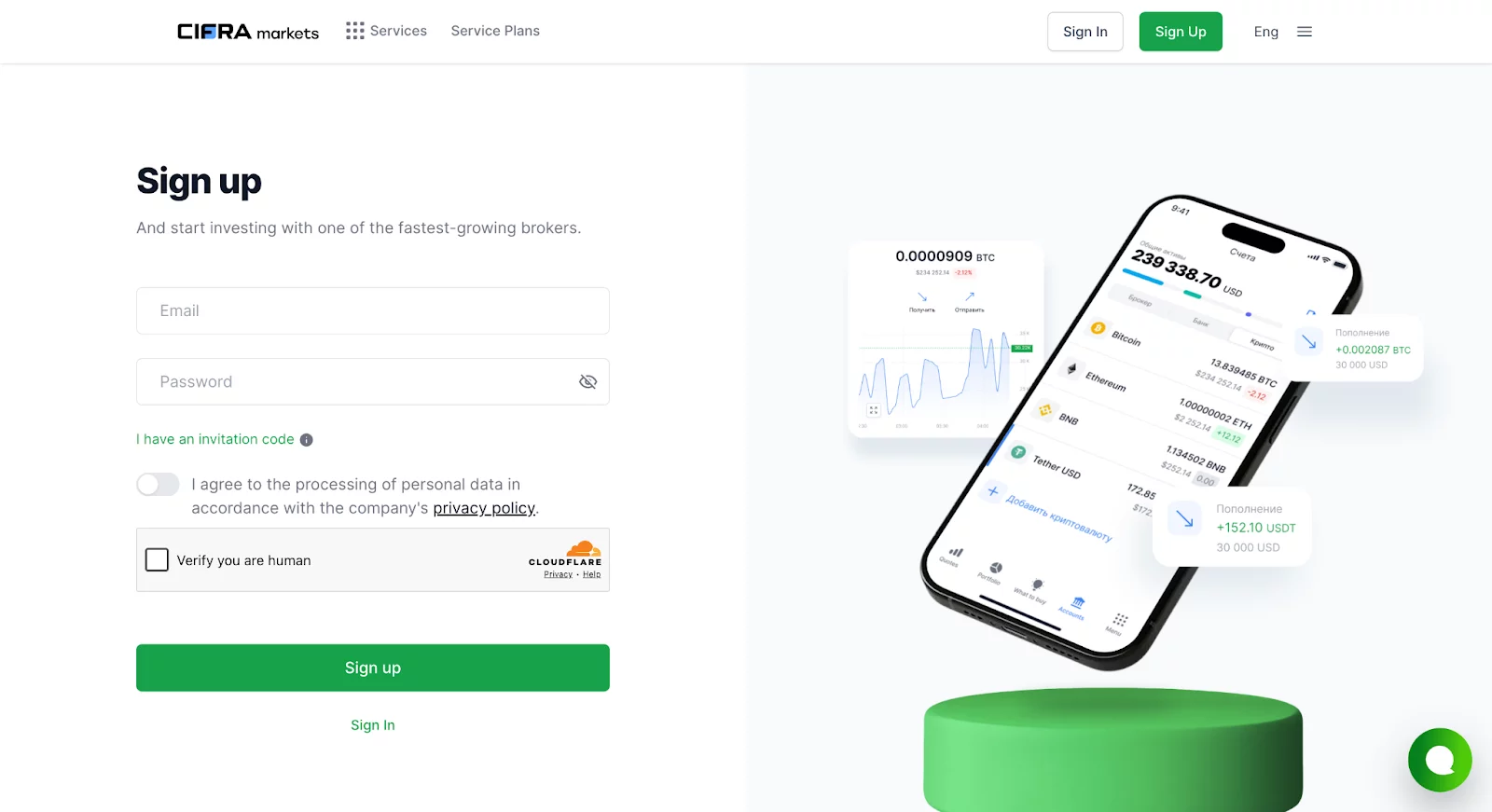
Firstly, add a working email address and a strong password, and then click on sign up to continue.
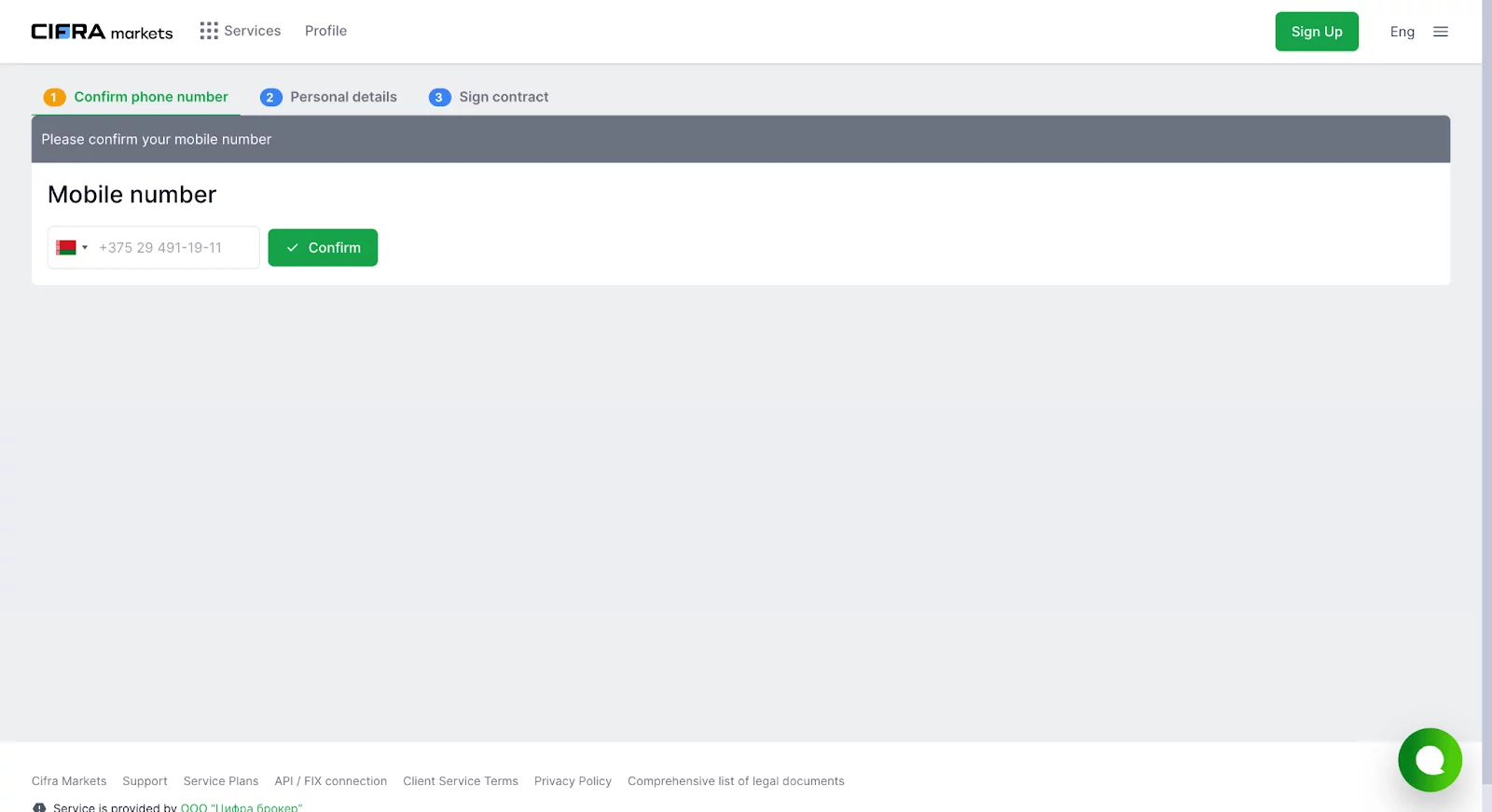
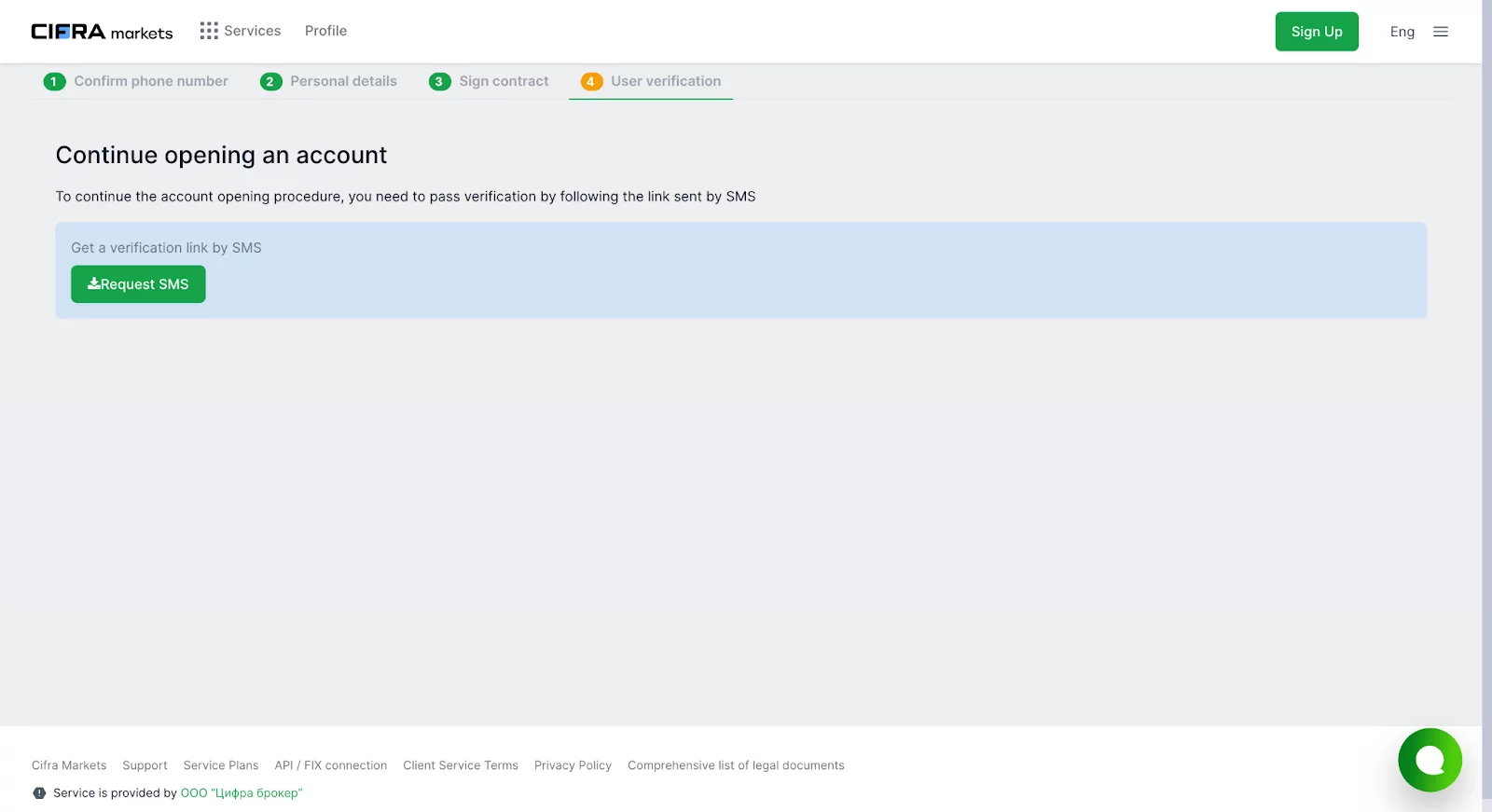
Next, enter a valid phone number. A one-time password (OTP) will be sent to this number, which must be verified before proceeding to the next step.
After an OTP is confirmed, the “Personal details” tab will open. Click on “Go to the next step” to proceed.
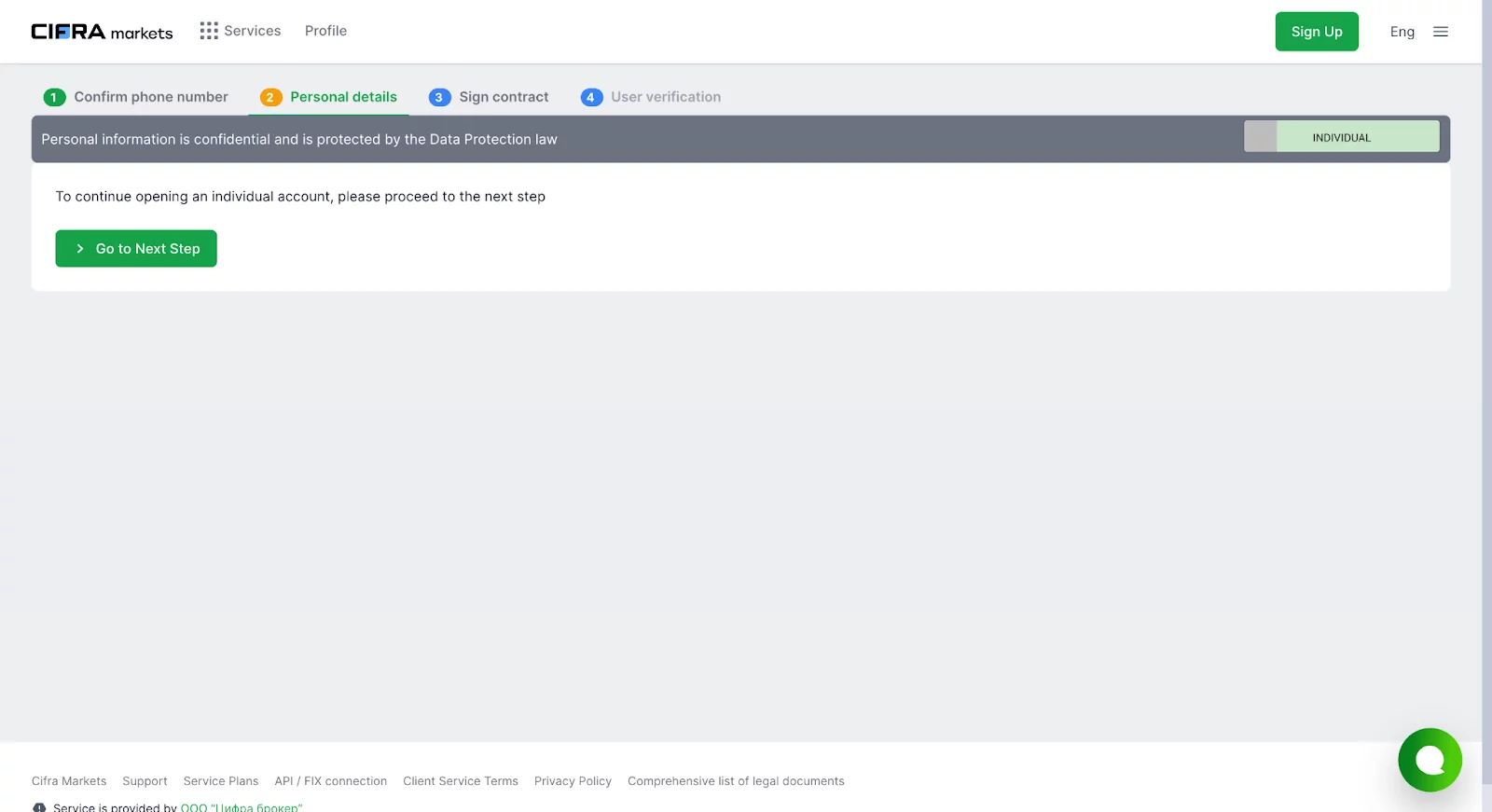
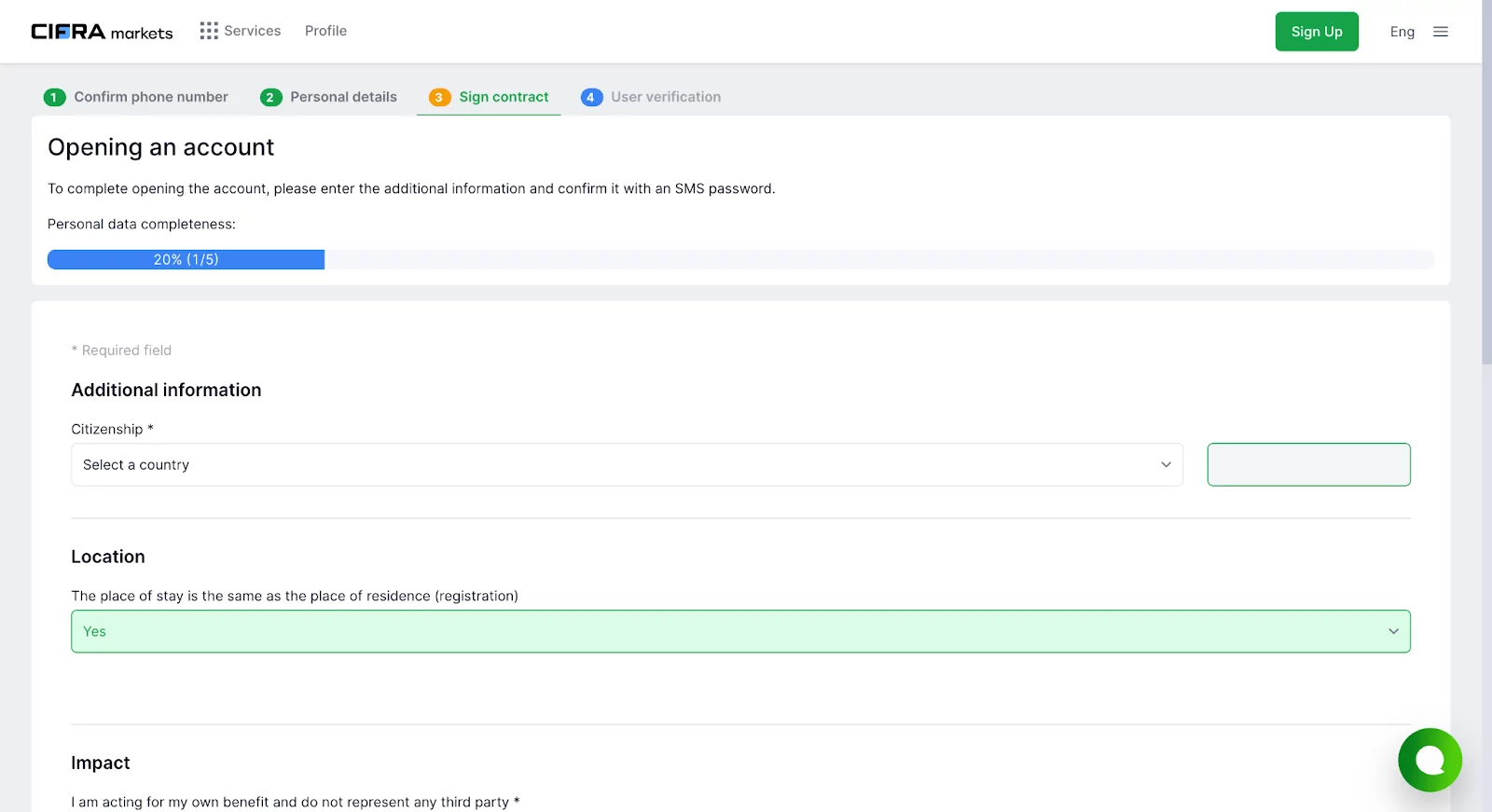
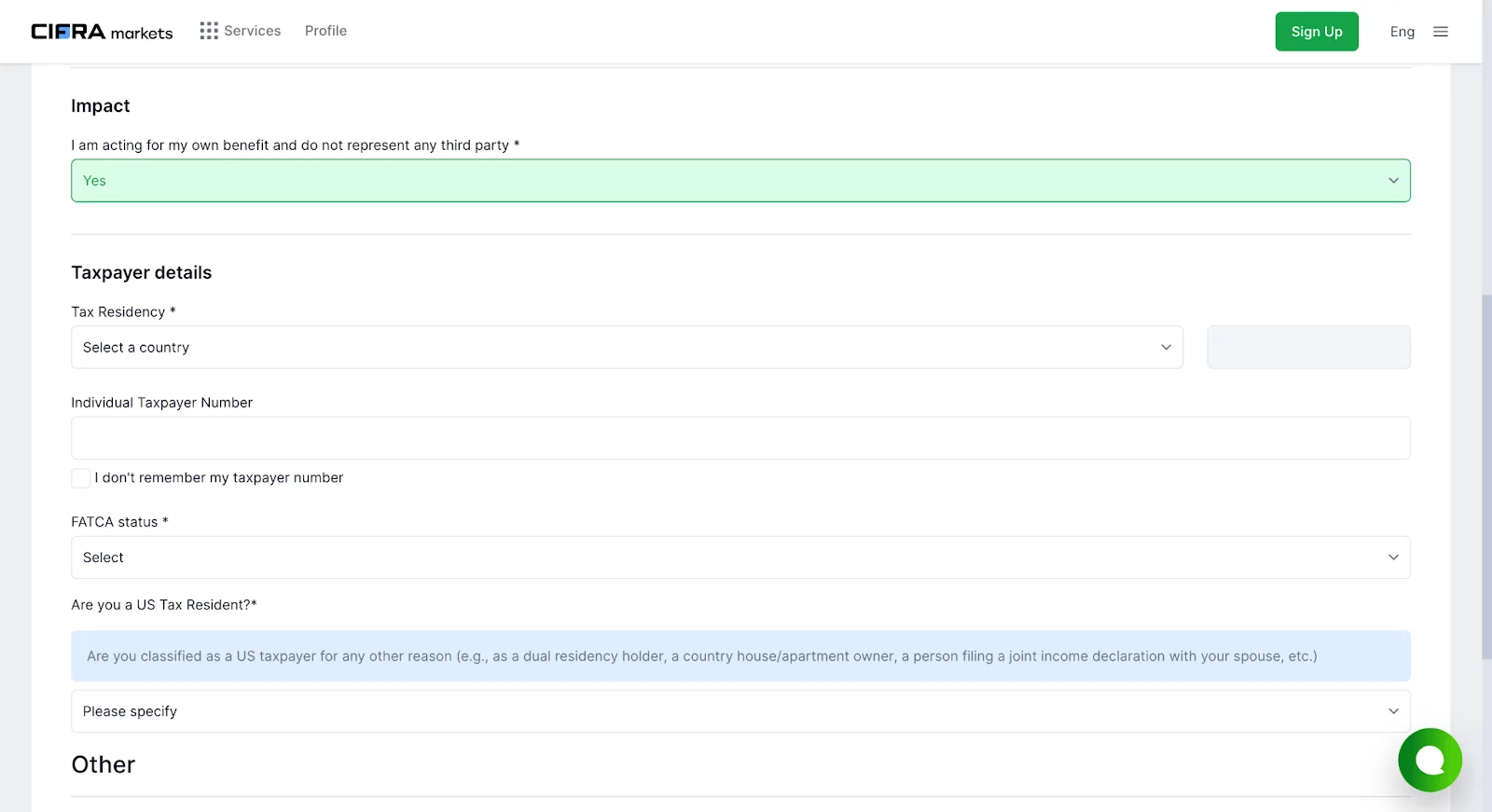
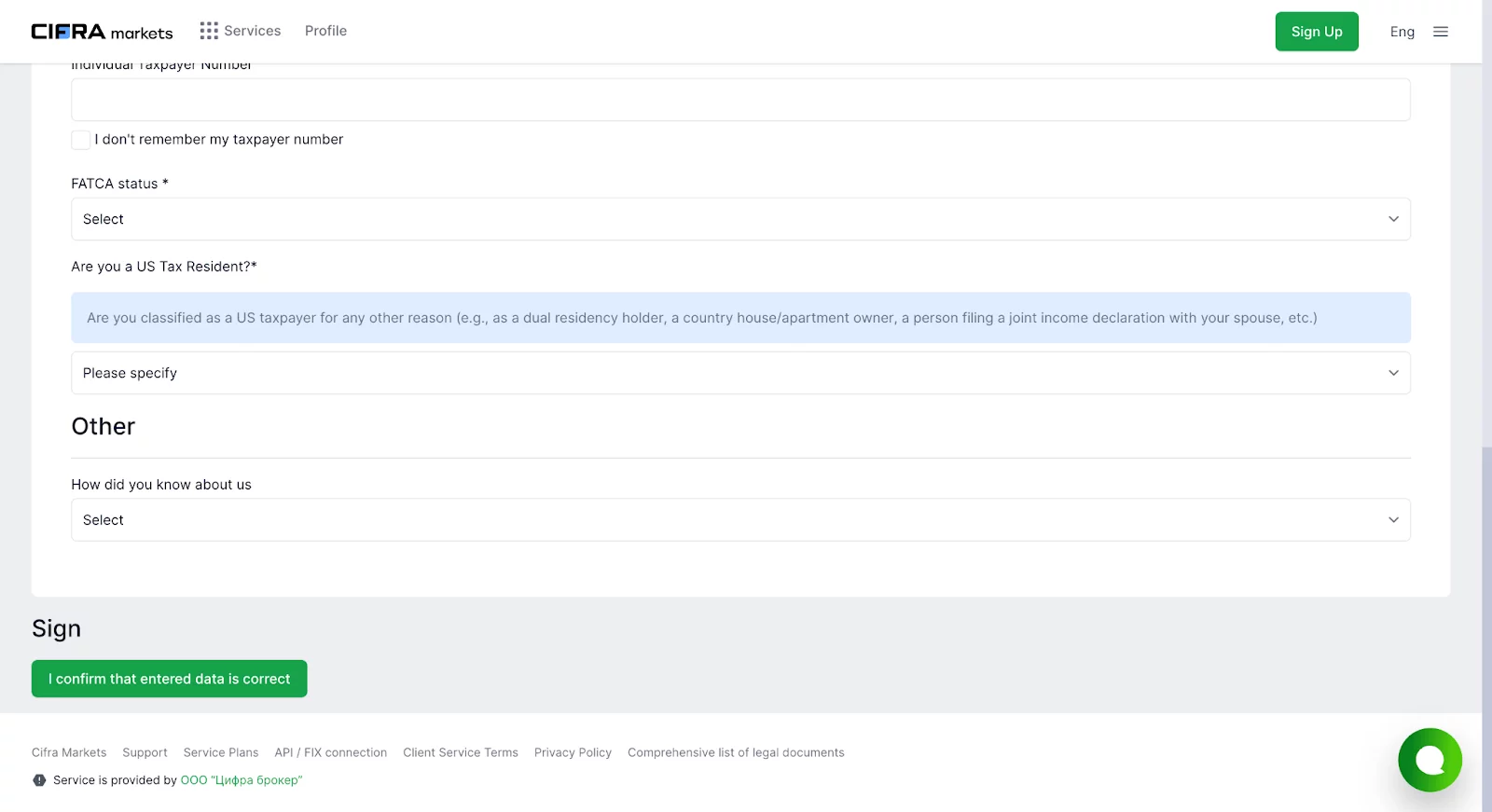
To open an account, enter additional details like citizenship, tax identification number, and location, then confirm that the data entered is correct. A progress bar at the top indicates how much of the required information has been completed.
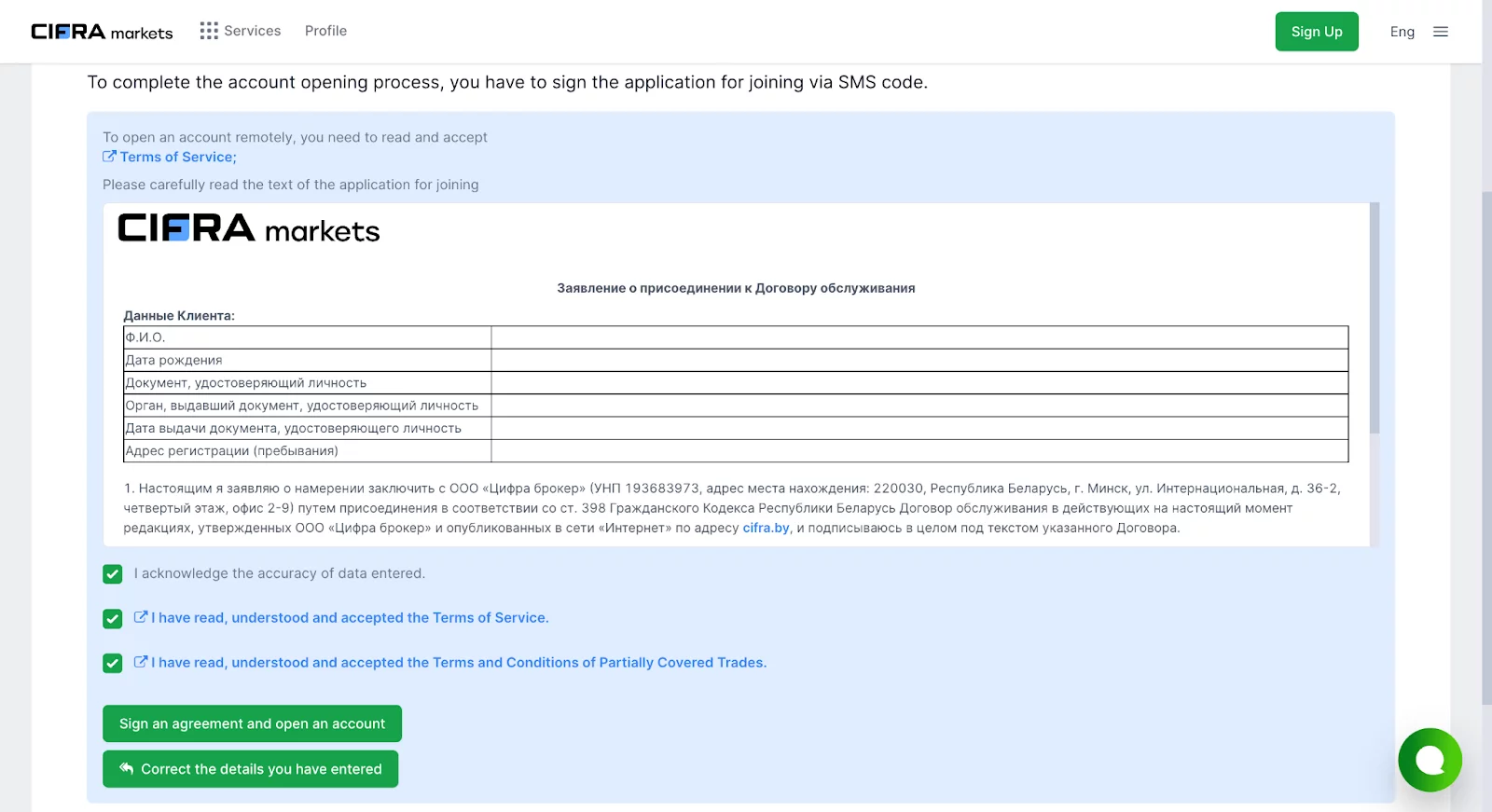
Once the personal information is entered, the next step is to sign the agreement and open an account.
A new tab will open requesting a KYC link via SMS. The link will be sent to the phone number specified earlier. After successful KYC verification, the account will be ready to use.
Who is Cifra best suited for?
Cifra is well-suited for both retail and corporate clients, offering features that cater to individual traders as well as institutional or business-level needs. Retail traders can use the platform for straightforward activities such as buying and holding cryptocurrencies, while institutional clients can leverage advanced tools, including margin trading, tokenized assets, and portfolio management features.
Public review
With a 4.4-star rating on Google Play Store, the Cifra Markets app appears to be a reliable and user-friendly platform for cryptocurrency trading. In one of teh comments, a user said, “A convenient and user-friendly app for working with cryptocurrency. I liked that everything is official and transparent: it’s easy to open an account, there is access to popular coins, and different types of trading. Payments are familiar, support responds quickly, and using it is comfortable.”
However, one user said he was experiencing difficulties logging into the app. The issue was promptly resolved by Cifra’s customer support team, who guided him through the steps to access his account. This demonstrates the company’s responsiveness in addressing user concerns.
Conclusion
Cifra Markets stands out as a regulated, secure, and user-friendly gateway into the world of cryptocurrency. By combining state-level licensing in Belarus, robust AML compliance, and institutional-grade security standards, the platform offers a trustworthy alternative to unverified P2P exchanges that have long dominated the market. Its comprehensive infrastructure, including access to 30+ cryptocurrencies, tokenized U.S. stocks, and margin trading, caters to both retail and institutional users, making crypto trading accessible and efficient for a wide range of participants.
Beyond its technical capabilities, Cifra’s focus on transparency, ease of use, and responsive customer support reinforces its commitment to building confidence among users. For traders and businesses seeking a reliable, legally compliant, and fully-featured crypto brokerage in the CIS and beyond, Cifra Markets delivers a compelling solution that blends security, innovation, and accessibility in one platform.
Disclosure: This content is provided by a third party. Neither crypto.news nor the author of this article endorses any product mentioned on this page. Users should conduct their own research before taking any action related to the company.

New fossils provide snapshot of the beginning of complex animals that led to us

The Light System on Building a New Category in Wellness Technology
Wallet in Telegram Rolls Out Perpetual Futures Trading via Lighter


-

 Business7 days ago
Instagram, YouTube Found Responsible for Teen’s Mental Health Struggle in Historic Ruling
-

 NewsBeat6 days ago
The Story hosts event on Durham’s historic registers
-

 Sports6 days ago
Sweet Sixteen Game Thread: Tide vs Michigan
-
Entertainment3 days ago
Fans slam 'heartbreaking' Barbie Dream Fest convention debacle with 'cardboard cutout' experience
-
 Entertainment5 days ago
Lana Del Rey Celebrates Her Husband’s 51st Birthday In New Post
-
Crypto World2 days ago
Dems press CFTC, ethics board on prediction-market insider trades
-

 Crypto World22 hours ago
Gold Price Prediction: Worst Month in 17 Years fo Save Haven Rock
-

 Tech4 days ago
The Pixel 10a doesn’t have a camera bump, and it’s great
-

 Sports2 days ago
Tallest college basketball player ever, standing at 7-foot-9, entering transfer portal
-

 Tech2 days ago
EE TV is using AI to help you find something to watch
-

 Fashion5 days ago
Amazon Sundays: Soft Spring Layers
-

 Tech3 days ago
Apple will hide your email address from apps and websites, but not cops
-

 Tech2 days ago
How to back up your iPhone & iPad to your Mac before something goes wrong
-

 Politics3 days ago
Should Trump Be Scared Strait?
-

 Tech3 days ago
Flipsnack and the shift toward motion-first business content with living visuals
-

 Crypto World3 days ago
U.S. rule change may open trillions in 401(k) funds to crypto
-

 Business7 days ago
Chinese universities with military links bought Super Micro servers with restricted AI chips
-

 Fashion6 days ago
Weekly News Update, 3.27.26 – Corporette.com
-

 Tech4 days ago
Elon Musk’s last co-founder reportedly leaves xAI
-
Crypto World4 days ago
Bitcoin’s Six-Month Losing Streak: What On-Chain Data Says About the Market’s Next Move
You must be logged in to post a comment Login