
Business
Passenger on British Airways mayday flight describes fear and shout of ‘I don’t want to die’


A passenger on a British Airways flight that issued a distress call on approach to Heathrow Airport earlier this month has described the rising fear in the cabin and a lack of information from the crew.
Edward Killiwick had been travelling back from a friend’s birthday party with his partner Julie, on the flight from Dusseldorf in Germany on 6 July.
He said passengers were told that the landing had been aborted, and then he felt a “very violent manoeuvre” and “did think we could crash”. He and his partner had to comfort a woman who “completely lost it and started screaming, ‘I don’t want to die’”.
The flight landed safely, but the incident is being investigated with assistance from BA.
The UK’s Air Accidents Investigation Branch (AAIB) said it was “investigating a serious incident”, and France’s accident investigation authority, the BEA, said on Wednesday that the plane, an Airbus A320, had issued a distress call.
Edward said: “The violent manoeuvre almost felt like it was avoiding another aircraft. You could feel the engines going at full power.
“It was a bit odd going around in a holding pattern with no information. I thought if they’re not talking, then they’re not in a good place.”
He said they were in a holding pattern for about 15 minutes.
The BEA said that as the plane approached Heathrow, there was a data system failure which triggered a stall warning.
The crew then flew the aircraft in a different mode called “alternate law”, which removes some automated flight protection systems. Another stall warning then occurred at 3,000 feet — which experts say was likely to have been just miles away from the airport.
The urgency call the crew had already made was upgraded to mayday, indicating imminent danger.
A British Airways spokesperson said the airline was assisting the AAIB with its investigation and was not legally able to comment further at this stage.
Edward said: “I was definitely scared. After the violent manoeuvre I thought, there is definitely something very badly wrong here. I did think we could crash.
“I did think it was a possibility, and I think everyone else did.”


The woman’s case in California state court is the latest to allege workplace bias in Silicon Valley that focuses on cultural prejudices of some tech workers from South Asia. Cisco Systems Inc. is fighting a suit brought by California’s civil rights agency alleging bias against a member of India’s so-called lower castes, known as Dalits.
Anita Nariani Schulze is part of the Sindhi minority — she is Hindu, with ancestry in the Sindh region of what is now Pakistan. Her complaint alleges that her senior and direct managers, both male, consistently excluded her from meetings while inviting her male counterparts, criticized her, micromanaged her work, and deprived her of bonuses, despite positive performance evaluations and significant team contributions.
Schulze claims the managers’ animus reflects sexism, racism, religious bias and discrimination on the basis of national origin. The Sindhi Hindu nationality is “known for its technical acumen” and its gender equality, she says, which “exacerbated the managers’ discriminatory treatment.”
In a tentative ruling on Wednesday, Santa Clara County Superior Court Judge Sunil R. Kulkarni rejected Apple’s request to toss out the suit. While not ruling on the merits of the case, Kulkarni said Schulze had adequately supported her legal claims. Apple had argued her claims weren’t specific enough and were based on stereotypes.
But the judge rejected Schulze’s request to represent a class of female Apple employees who suffered job discrimination over the last four years. He agreed with Apple that she didn’t show a pattern of discrimination that could be applied to a broader group.
It wasn’t clear from the court’s docket whether the judge will hold a hearing Thursday before issuing a final ruling.
Apple didn’t immediately reply to a request for comment.
In the Cisco case, the California Department of Fair Employment and Housing alleged that two Indian employees at the San Jose-based company discriminated against a Dalit co-worker on the basis of caste.
Cisco has denied the claims, insisting it has “zero tolerance for discrimination.” It also said the lawsuit should be tossed out because caste isn’t a protected category under U.S. civil rights law.
Business
Trump Announces Hamas Disarmament Agreement as Iran Strikes Kuwait Air Base and US Attacks Pause Overnight
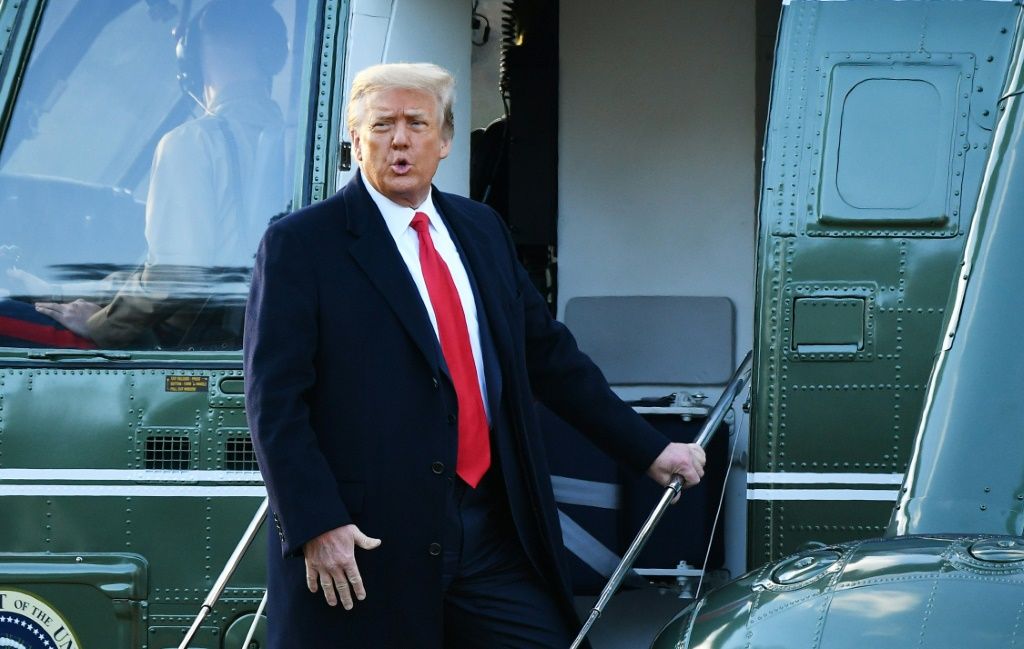
President Donald Trump announced Thursday what he called a historic agreement for Hamas to disarm in Gaza, even as fighting elsewhere in the region continued, with Iranian forces striking a military base in Kuwait early Friday while overnight U.S. strikes on Iranian territory appeared to pause for the first time in days.
Trump described the disarmament agreement in a post on Truth Social, writing that “the Board of Peace reached a HISTORIC agreement for the COMPLETE DISARMAMENT of Hamas and all other armed groups in Gaza,” calling it “a monumental step toward lasting PEACE and SECURITY.” A senior Hamas official, Ghazi Hamad, confirmed to CNN that the group had reached an agreement with the Board of Peace, the body overseeing implementation of a broader U.S.-brokered ceasefire plan, to relinquish its weapons. But Hamad stressed the deal remains conditional on Israel first meeting its own obligations under the agreement. “The agreement is a package,” Hamad said. “We will not begin any weapons-related steps until Israel implements these commitments. Frankly, if Israel does not implement them, we will not proceed.”
According to Hamad, those Israeli obligations include halting attacks on Palestinians in Gaza, withdrawing troops to a designated boundary known as the yellow line, allowing a surge in humanitarian aid, and permitting a Palestinian technocratic committee to take over civilian governance of the strip. Hamad also said Hamas’s heavier weapons would not be decommissioned or destroyed but instead “stored under the National Committee’s supervision,” while lighter weapons belonging to the group’s police force would be handed over first. He expressed skepticism about Israel’s willingness to follow through, citing what he described as extensive violations during an earlier phase of the ceasefire. “Our experience with the first phase was very bad,” Hamad said. “Israel did not abide by the agreement and there were hundreds or thousands of violations. Now it is a challenge for the guarantors — the United States, Qatar, Turkey, and Egypt — to ensure 100% that Israel will fully honor and implement all items of the agreement.”
A separate Gaza militant group, the Palestinian Islamic Jihad Movement, disputed the characterization of the deal entirely, saying early Friday that reports of the agreement were “inaccurate.” Israeli Prime Minister Benjamin Netanyahu had not publicly commented on Trump’s announcement as of Friday morning, though members of his right-wing governing coalition voiced opposition to the agreement.
A senior U.S. official told reporters Thursday night that Trump would be “very, very disappointed” if Israel failed to uphold its end of the arrangement, characterizing the request to Israel as simply following through on a 20-point plan it had already agreed to. The official added that the administration expects further details to be worked out over the coming weeks, with visible progress anticipated “in the next month or two” rather than adherence to a strict timeline. International reaction to the announcement was largely cautious. German Foreign Minister Johann Wadephul called the news “hopeful” while stressing that “real progress” depends on Hamas actually disarming. The National Committee for the Administration of Gaza, the technocratic body authorized by the United Nations to eventually govern the strip, welcomed the announcement as “an important milestone.”
Conditions on the ground in Gaza have shown little improvement despite the ceasefire signed roughly nine months ago. At least 1,214 Palestinians have been killed and 3,977 others injured by Israeli strikes since October 11, according to the Palestinian Ministry of Health.
Elsewhere in the region, the conflict between the United States and Iran showed signs of a possible pause after days of intensifying strikes. Neither Iranian state media nor U.S. Central Command reported any strikes hitting inside Iranian territory overnight into Friday, a marked change from Wednesday night, when the U.S. military launched what it described as a “heavy wave of strikes” against Iran in retaliation for an earlier Iranian attack on American military positions.
Even as U.S. strikes on Iran paused, Iranian forces struck outward. Iran’s military said it targeted Kuwait’s Ahmad al-Jaber Air Base early Friday, releasing footage that appeared to show projectiles launched toward Kuwaiti territory, according to Iranian state broadcaster Press TV. Kuwait’s army said it intercepted the attack, describing it in a statement as “heinous Iranian aggression” that caused “material damage as a result of falling shrapnel, without any human casualties.” Iran said the strike was carried out in response to earlier U.S. attacks on Qeshm Island, where American strikes this week killed a couple and their two-year-old child in their home, according to Iranian state media.
Shipping through the Strait of Hormuz, the critical Persian Gulf waterway through which a significant share of the world’s oil normally flows, has remained severely disrupted amid the fighting. Only five vessels transited the strait on Thursday, according to shipping analytics firm Kpler, after Iran’s Islamic Revolutionary Guard Corps warned the channel would not reopen “should excessive rhetoric, threats by American officials, and their interference with maritime movements in the region continue.” Further south, 47 ships passed through the Bab el-Mandeb Strait on Thursday, even as Iran-backed Houthi rebels in Yemen maintain a separate announced blockade of Saudi shipping through that chokepoint. Saudi Arabia responded Thursday by announcing a new Maritime Defense Alliance backed by 14 other countries aimed at protecting international shipping routes.
Oil prices fell Friday despite the region’s continued volatility, with Brent crude down 1.4% to nearly $88 a barrel and U.S. crude also down 1.4% to $82 a barrel, according to market data. Brent has fallen 9.3% and U.S. crude nearly 8% over the course of the week even as fighting between the U.S. and Iran resumed, with Deutsche Bank analysts noting in a Friday research note that shipping through the Strait of Hormuz “has been disrupted but it hasn’t completely stopped, while the US and Iran currently look to be avoiding a move from low-level escalation to all-out war.”
Trump is scheduled to convene his Cabinet Friday for a meeting at Camp David, the presidential retreat in Maryland, marking the 13th Cabinet meeting of his current term as the administration continues navigating both the Gaza ceasefire implementation and the ongoing conflict with Iran.


California-based La Terra Fina operates a facility in Union City, Calif.

Earnings call transcript: Cameco Q2 2026 misses estimates but shares rise
Glantz from Rusi thinks that as legitimate businesses close, crime moves in. “Rents are down, there’s a lot of empty spaces, so landlords are willing to pretty much take just about anybody,” he says.
Plumb came up with a new name for these areas: the “shuttered front”, a string of constituencies with struggling High Streets that Power to Change think could play a pivotal role in future elections.
Indeed, Reform’s Nigel Farage and Richard Tice were among the first mainstream politicians to regularly talk about visible signs of High Street criminality.
In 2024, Farage said at an event: “You can see High Streets with five, six, seven barber shops in them.” Tice added: “Seriously, how come lots of these new barber shops have got no customers in them? How come they all want cash only? These are fronts for money laundering and drug money, and someone has to talk about it.”
And in a social media video he made last year – one that quickly set parts of the internet alight – Robert Jenrick, who was then the shadow justice minister, listed “weird Turkish barber shops” as a visible sign of decline, alongside bike theft, phone theft, and drugs in town centres. “It’s all chipping away at society,” he said. He later clarified that he was “obviously not talking about all Turkish-style barber shops”. Jenrick defected to Reform earlier this year.
Some politicians argue the language around High Street decline is in danger of becoming racially coded. In January, Miatta Fahnbulleh, then the devolution, faith and communities minister, agreed when asked by the Guardian if she thought the focus on Turkish barbers had racist overtones. “Yes, I do. The fundamentals aren’t to do with the colour of the skin of people running our High Streets. It’s to do with long-term decline and neglect.”
At the time a Reform spokesman was quoted as saying: “This is not a matter of ethnicity.
“The National Crime Agency itself has said many of these establishments are used as fronts for money laundering as well as a whole range of criminality which is why they carried out hundreds of raids on them last year.”
Meanwhile, immigration – the issue that voters consistently highlight as among the most pressing, and that Reform campaigns heavily on – came up in our investigation too. We exposed a Kurdish gang that was enabling migrants to work illegally in mini-marts the length of Britain, by offering to put their own names to official paperwork. Trading Standards told us they find a constant supply of staff from asylum hotels, who are vulnerable to abuse by employers, working in those shops.
Josh Nicholson, a researcher at the Centre for Social Justice think tank, says, “Chaos and flux in Westminster are reflected in our High Streets.
“People feel powerlessness, they look at Westminster and see an inability of politicians to grapple with the basics and that feeds down to a local level.”
This feeling of helplessness came up again and again in our travels.
“Nothing is going to change,” Daniel, in Swansea, told us about the criminality on his High Street, which has become a hub for counterfeit rolling tobacco. He has seen violence on the High Street and an increase in raids on High Street shops. He’s a dual British and Chinese national and was considering moving to Hong Kong.
“It doesn’t make me feel safe. I’ve got kids.”
SMEs and solopreneurs today face a myriad of challenges. With rising costs and growing competition, many businesses now operate with fewer staff members, or without dedicated expertise on business-critical areas, for instance, sourcing or supply chain.
As a result, time-poor founders and CEOs may deprioritise sourcing and revert to their usual suppliers, even when more competitive products, pricing or terms may be available elsewhere.
One solution Is Accio Work , Alibaba’com’s 24/7 agentic business team that helps SMEs automate end-to-end business tasks, moving beyond advice to execute work across research, sourcing, negotiation, marketing, sales, operations and CRM. It requires no code or setup and automates complex tasks such as sourcing, supplier research, procurement and marketing that would otherwise consume hours of manual effort.
While many AI tools draft, suggest or provide answers to specific prompts, Accio Work is designed to take a goal or business objective and create a specific action plan to deliver results. Its agents work in coordination with one another, providing SMEs with automated workflows rather than a series of isolated tasks. Users get access to a pre-configured team of AI agents without requiring technical setup, allowing them to set goals in natural language, while the system assembles specialist agents to work on the task autonomously. These agents can support businesses across the entire lifecycle, including product strategy and design, product and supplier search, comparison and vetting, enquiry and negotiation, store operations, marketing and sales.
Making sourcing more manageable
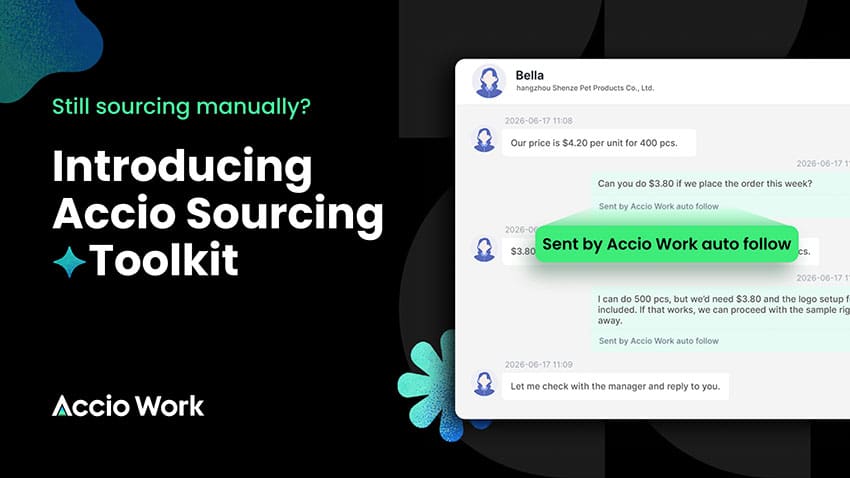
One of Accio Work’s special features is the Accio Sourcing Toolkit which has been designed to offer senior-level sourcing expertise to any growing SME or solopreneur. This toolkit can automate key sourcing tasks, including supplier identification, product and supplier comparisons, and bulk outreach, 24/7 – allowing founders to focus on other tasks.
SMEs can describe a product or product specification and use the toolkit to find the best-suited suppliers that can bring it to life. For founders who are flush with new product ideas but may not have the time or expertise to bring ideas to market, this is particularly powerful.
By automating manual research, outreach and supplier follow-up, the toolkit reduces the time spent on repetitive tasks linked to sourcing, making the process easier to manage and more impactful.
Supporting better supplier decisions
The Sourcing Toolkit also presents SMEs with a range of options from different suppliers for assessment ahead of formal negotiations. This can bring together a range of product and business-critical data points or factors, from pricing and delivery times to product availability, enabling enables SMEs to move from operating with instinct to making more evidence-based choices.
And it supports autonomous outreach and negotiation with suppliers, including follow-ups 24/7. But this is not about taking negotiation away from the business owner, rather, it helps SMEs access more comprehensive information on pricing and sourcing terms so they can pursue stronger business outcomes.
Moving faster from idea to execution
Finally, the Sourcing Toolkit combines product research, opportunity analysis and supplier discovery to help SMEs identify products with strong commercial potential. Once an opportunity has been identified, businesses can move directly into supplier discovery and sourcing. This can enable SMEs to capitalise on new and emerging trends with greater agility and reduce the time to market.
It draws on Alibaba.com’s decades of expertise in B2B commerce, allowing SMEs to access supplier and product intelligence that would otherwise be difficult to gather independently.
Accio Work is plug-and-play, with zero set-up, no configuration and no code. It is built for real business scenarios, with enterprise-grade security, sandboxed environments, granular permissions and user approval for sensitive actions.
The Next Step: CoCreate Pitch 2026
For founders who want to do more than just source their ideas but also bring them onto the international stage: Alibaba.com has redesigned the CoCreate Pitch Competition 2026 into a fully AI-driven product innovation contest with a total prize pool of over one million US dollars.
For the first time, applicants can register directly through Accio Work. A dedicated “CoCreate Pitch Agent” transforms early product ideas into structured pitch concepts and actionable business plans. The European Final will take place on November 19 and 20, 2026, in London.


Company is testing a new beverage concept to extend its Refreshers platform.

CXMT, a secretive Chinese chipmaker, launched its trading debut following a $9.8 billion IPO. The company aims to challenge global semiconductor leaders and impact the trillion-dollar industry. Its IPO marks a significant step in China’s tech ambitions, reflecting increased focus on domestic chip production amidst geopolitical tensions and supply chain shifts.
Chinese semiconductor powerhouse CXMT (China Microelectronics Corporation) has officially debuted on the stock market following its impressive $9.8 billion IPO. This landmark move marks China’s push to become more self-reliant in advanced chip manufacturing amidst global supply chain challenges. CXMT, known for producing advanced DRAM chips, aims to strengthen its position as a key player in the global semiconductor industry.
The IPO has been met with strong investor enthusiasm, reflecting confidence in China’s semiconductor sector and its growth potential. The funds raised will be used to expand manufacturing capacity and invest in cutting-edge technology, which is vital as demand for high-performance chips continues to surge across electronics, communication, and data centers.
CXMT’s entry into the public markets signals China’s intensified efforts to compete with industry giants in the United States and South Korea. As global chip shortages persist, China’s semiconductor ambitions are gaining momentum, solidifying its role as a significant player in the future of tech innovation.
Other People are Reading
Canadian economy grew by a greater-than-expected 0.3% in May

Australian shares have posted a fourth straight month of gains, but a final session rally largely crumbled as investors took profits ahead of a historically weak period for the exchange.
Apple faces Indian engineer’s bias lawsuit

Ripple Just Got Full MiCA Authorization in Europe But Fed’s Hawkish Tone Is Keeping XRP Capped at $1.10
End of baseball or fair trade from a serious role-model team?


-

 Fashion7 days ago
Weekend Open Thread: Brooks Brothers
-
 Sports5 days ago
Commonwealth Games boxing: Jadumani Singh seals dominant 5-0 win over Pakistan’s Sumama Rehman to enter quarter-finals | Commonwealth Games News
-

 Business2 days ago
Why Trees Belong on the Risk Register
-

 Tech5 days ago
Intel is reversing course and bringing hyper-threading back to its server chips
-

 Crypto World6 days ago
Ripple bought a bank in pieces. The $4 billion audit
-

 Politics4 days ago
Luke Littler dismantles Gerwyn Price to retain title in Blackpool
-
 Entertainment7 days ago
A New Post-Apocalyptic Gundam Anime Series Blasts Into SDCC
-

 Politics3 days ago
The Part of the Electric Transition Nobody Wants to Discuss
-

 News Videos5 days ago
BITCOIN JUST ENTERED THIS CRITICAL ZONE…
-

 Business2 days ago
Major shareholder moves on Canyon
-

 Crypto World5 days ago
XRP Ledger adds $2.6B as RWA inflows rank second
-

 News Videos1 day ago
Bitcoin Enters the 3rd Stage of the Bear Market
-

 Politics5 days ago
Spain sweeps the board at 2026 World Cup with individual awards
-
 Entertainment3 days ago
‘Stargate’ Creator’s New Sci-Fi Series Returns for Season 3 Tomorrow
-

 Entertainment6 days ago
Sara Gilson Killed By Husband After Viral “Pedophile” TikTok Video
-

 Crypto World3 days ago
Kraken Enables Retail Access to Jersey Mike’s IPO via Tokenized Shares
-

 Tech6 days ago
Anthropic launches Claude Opus 5, a cheaper AI model for coding, agents and enterprise workflows
-

 News Videos3 days ago
Claude: Build Financial Dashboards in Minutes (2026)
-

 Tech4 days ago
New macOS Sequoia & Sonoma security updates for older Macs
-

 Politics21 hours ago
Luke Littler’s dominance sparks GOAT debate
You must be logged in to post a comment Login