

Crypto World
Nathan Allman’s sudden death leaves Ondo Finance at a turning point



Ondo Finance said its founder, Nathan Allman, has died unexpectedly, creating a sudden leadership change at one of the best-known names in tokenized real-world assets.
Summary
- Ondo Finance confirmed Nathan Allman’s death and named longtime President Ian De Bode as new CEO.
- The company said De Bode has led strategy, product, and daily operations for two years.
- Related reports show Ondo expanded across tokenized stocks, ETFs, Treasuries, and major crypto wallet integrations.
The company announced the news on May 25 and said its thoughts were with Allman’s family and loved ones.
In its public statement, Ondo said “Nate’s brilliance, humility, and drive shaped every part of what Ondo is today.” The company did not disclose further details about the cause of death. Allman founded Ondo in 2021 after working on Goldman Sachs’ digital assets team.
Ian De Bode takes over as Ondo CEO
Ondo Finance named longtime President Ian De Bode as CEO. The company said De Bode had been leading strategy, product, and daily operations for more than two years and had the confidence of the leadership team.
De Bode also said the company’s direction would not change. In a statement, he said “The mission of Ondo, Nate’s mission, has not changed.” He added that Allman would have wanted the team to keep executing with care and discipline.
The appointment gives Ondo an internal successor at a time when users, partners, and investors are likely to look for clear communication. De Bode had already been involved in the work that shaped Ondo’s product roadmap and market expansion.
Ondo’s RWA business remains in focus
The leadership change comes as Ondo remains a major player in the tokenized real-world asset market. Its products include OUSG, USDY, and Ondo Global Markets, which links crypto wallets and apps to tokenized U.S. stocks, bonds, and ETFs.
Related market coverage shows Ondo has been expanding quickly. A May 19 report said Ondo Finance’s total value locked had moved above $4 billion, up from about $1.95 billion at the start of the year, while Ondo Global Markets had passed $1 billion in TVL.
Ondo also built a wider distribution base through wallet and exchange integrations. Earlier reports said MetaMask added access to more than 200 tokenized U.S. stocks and ETFs through Ondo, expanding access for eligible users in supported regions.
Wider tokenization growth
Separate reports also show why Ondo’s next steps remain central to the RWA market. crypto.news recently reported that tokenized real-world assets had reached about $31 billion to $34 billion by May 2026, with U.S. Treasuries and Ethereum-based products leading the sector.
Ondo has also expanded into tokenized stocks and ETFs through several partnerships and integrations. Recent coverage said the platform brought 35 tokenized assets to Hyperliquid’s HyperEVM, while earlier reports noted Franklin Templeton’s tokenized ETF partnership with Ondo.
Ondo said it would continue building what Allman started. For the company, the near-term focus now shifts to leadership continuity, product execution, and maintaining trust across its RWA ecosystem.


TLDR
- CryptoQuant identifies $53,600 as Bitcoin’s realized price and a potential bottom zone.
- Bitcoin traded near $62,150 after falling to around $59,000 last week.
- Total Bitcoin demand dropped by 652,000 BTC, the largest weekly contraction since January 2022.
- One-year apparent demand growth turned negative and fell below its moving average.
- Thirty-day ETF demand growth declined to negative 74,000 BTC since January 2024 launch.
Bitcoin could approach $53,600 as a potential floor while demand metrics remain weak, CryptoQuant reported on Wednesday. The firm said this level matches the current realized price, which tracks the aggregate onchain cost basis. However, research head Julio Moreno stated that demand conditions remain “deeply unfavorable” and no durable recovery has formed.
Bitcoin Realized Price Signals Possible Bottom Zone
CryptoQuant identified $53,600 as Bitcoin’s realized price and a possible bottom area. Moreno said Bitcoin historically bottoms near or slightly below this metric in bear cycles. He told The Block, “Historically, it’s a level that would confirm a bottom.”
However, Moreno added that price may not necessarily hit that level. He said demand weakness keeps that possibility open for now. Bitcoin fell to about $59,000 last week, placing it 9% above $53,600.
After the drop, Bitcoin rebounded and traded near $62,150. In November 2022, Bitcoin briefly fell below its realized price during the FTX selloff. It later recovered, reinforcing that level as a key valuation reference.
Demand Metrics Show Persistent Weakness
CryptoQuant reported a 652,000 Bitcoin contraction in total demand last week. The firm combines speculative futures activity and apparent spot demand in that measure. Moreno wrote that both segments weakened as Bitcoin dropped below $60,000.
Long liquidations increased and spot selling accelerated during that period. Meanwhile, one-year apparent demand growth turned negative and declined below its moving average. Moreno said this marked the fastest pace of decline since February 2024.
He wrote that fewer buyers exist today compared with a year ago. He added that this trend “removes the demand foundation required to sustain any price recovery.” The report also pointed to slowing institutional demand through spot exchange-traded funds.
Thirty-day ETF demand growth fell to negative 74,000 Bitcoin. CryptoQuant said this marked the weakest reading since U.S. spot ETFs launched in January 2024. Moreno wrote that ETFs now contribute to net supply expansion as investors reduce exposure.
At the same time, realized losses have not reached capitulation levels. Bitcoin holders realized 187,000 Bitcoin in losses over the past 30 days. That compares with 400,000 Bitcoin during the February 2026 drop below $60,000.
During the November 2022 market bottom, realized losses reached 1.2 million Bitcoin. Moreno said, “The absence of a capitulation-level spike in realized losses indicates that a large cohort of holders is still above water at $59,000.” He added that heavy selling and seller exhaustion usually precede major bottoms.
Moreno concluded that the current price should serve as a valuation floor candidate. He said a bull market requires a constructive demand recovery. He stated that such a recovery does not yet appear in the data.

Tether is leading a funding round of as much as $1.4 billion for German tech company NEURA Robotics, deepening the stablecoin issuer’s push into artificial intelligence and robotics.
The round, which values NEURA at roughly $7 billion, is expected to include a mix of strategic and financial investors. Tether said it is leading the raise through its investment arm, which deploys capital from the company’s profits and excess reserves across sectors including AI, energy and digital infrastructure.
NEURA said it expects to integrate Tether’s Wallet Development Kit into its robotic systems, enabling machines to receive payments and execute transactions within predefined parameters. The companies also plan to deploy Tether’s QVAC AI runtime, which is designed to run models directly on devices rather than through cloud-based infrastructure.
Tweet from Paolo Ardoino, CEO of Tether. Source: Tether on X.com
Founded in 2019 and headquartered in Metzingen, Germany, NEURA Robotics develops humanoid robots, robotic arms, autonomous mobile robots and other AI-powered systems for industrial and commercial applications. It is building an ecosystem called Neuraverse, a software platform intended to connect robots, AI models, data and services.
The investment follows reports from November 2025 that Tether was considering a 1 billion euro ($1.15 billion) investment in the company. The Financial Times reported at the time that the deal could value the tech maker at between $9.3 billion and $11.6 billion, though neither company confirmed the discussions.
Today’s announcement did not disclose how much money Tether is contributing to the current funding round.
Related: Tether, Georgia plan lari-backed stablecoin GELT under new rules
Tether expands AI and payments push
The NEURA investment is part of Tether’s broader push beyond stablecoins into artificial intelligence, payments and emerging technologies. The company reported $1.04 billion in net profit during the first quarter of 2026 and said its excess reserves reached a record $8.23 billion, providing additional capital for investments outside its core USDT (USDT) business.
Source: DefiLlama
In recent months, Tether has accelerated its push into AI through its QVAC platform. In March, the company introduced a training framework that enables AI models to be trained and run on consumer hardware, including smartphones and non-Nvidia chips. Two months later, it unveiled QVAC MedPsy, a family of medical AI models designed to run directly on smartphones and other devices rather than through cloud-based infrastructure.
The company has also sought to expand the ecosystem around its technology stack. In May, Tether launched a grants program to fund developers building local-first AI and payment applications using its open-source tools, including QVAC and its Wallet Development Kit.
In a January 2025 interview, CEO Paolo Ardoino said AI-powered humanoid robots could become commonplace within the next decade as advances in computing and automation reshape the workforce.
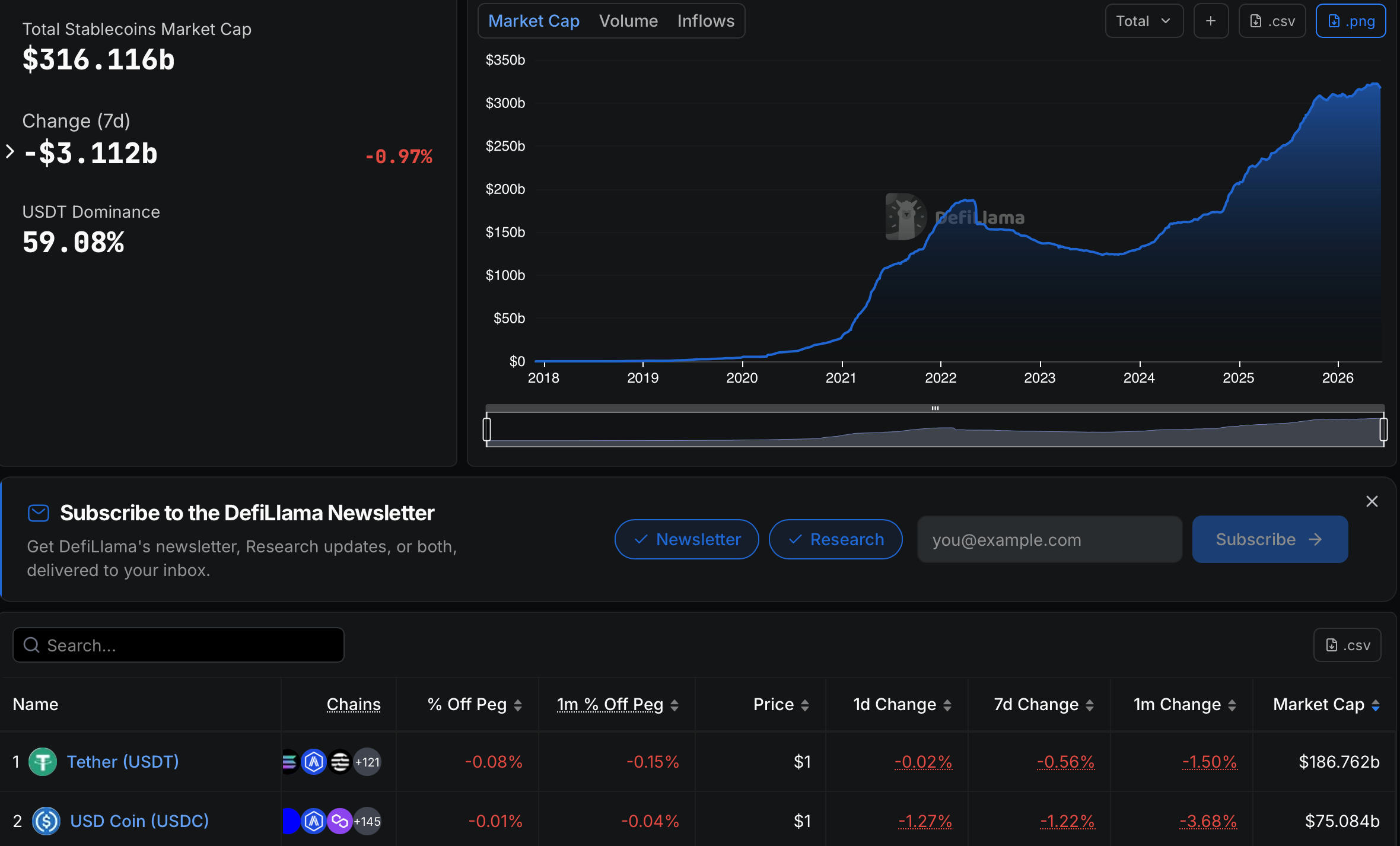
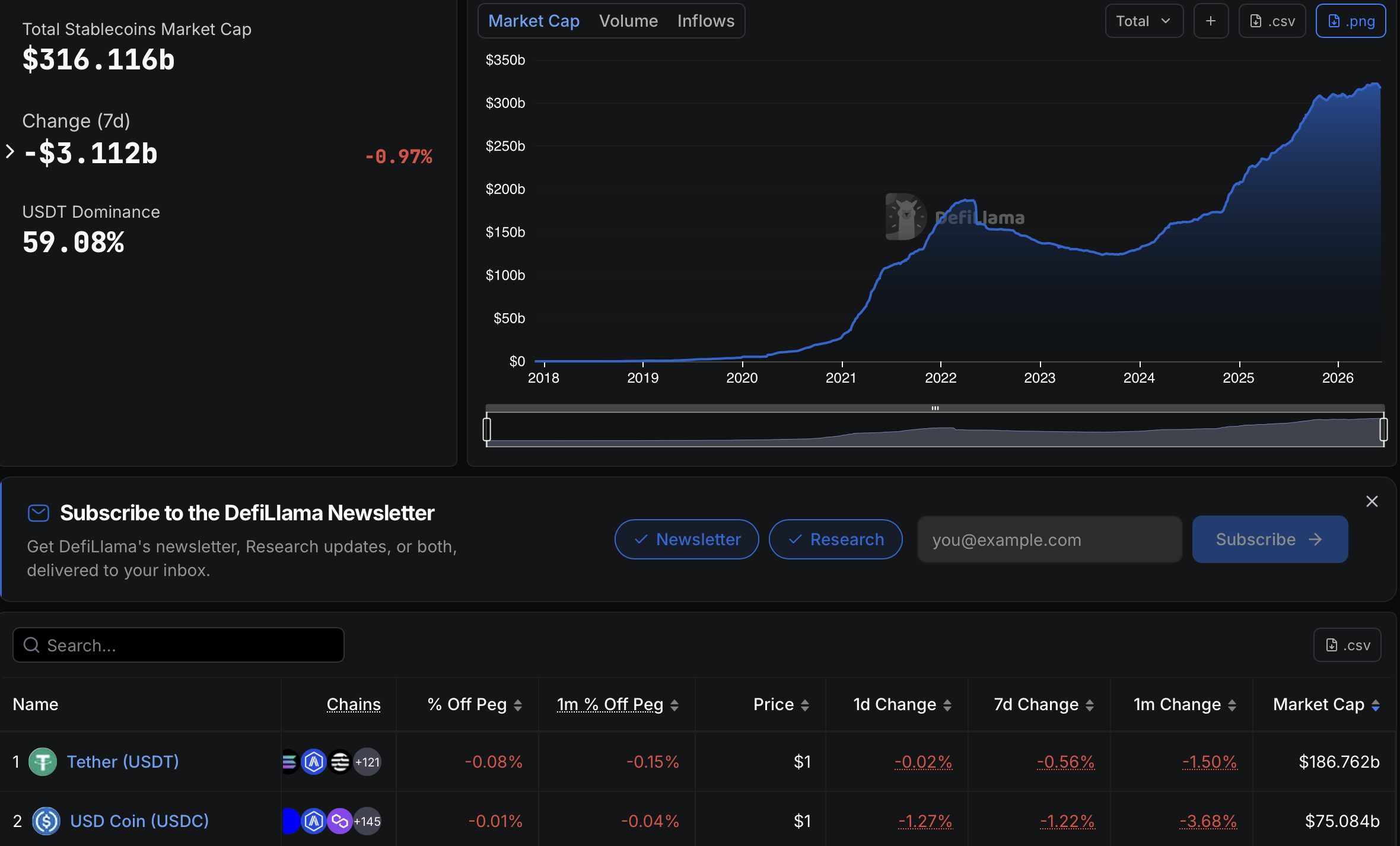
Tether issues the $187 billion USDT stablecoin, which controls roughly 59% of the global stablecoin market, giving it one of the largest balance sheets in the digital asset industry.
Magazine: Kraken’s $600M stablecoin firm, Huione scandal deepens: Asia Express
US President Donald Trump told reporters he “loves” inflation on Wednesday after government data showed consumer prices rising at the fastest annual pace in three years. The Consumer Price Index (CPI) climbed 4.2% from a year earlier.
The reading lands one week before the Federal Reserve’s June policy meeting under new Chair Kevin Warsh. Traders now lean toward rate hikes rather than cuts, which could pressure risk assets like Bitcoin (BTC).
Energy Prices Push US Inflation to a 3-Year High
Inflation rose 0.5% in May after a 0.6% jump in April, the Bureau of Labor Statistics reported. Energy drove most of the increase, climbing 3.9% after a 3.8% rise the prior month.
Gasoline now averages $4.15 per gallon, according to AAA. That compares with an average of $2.98 when the US and Israel first struck Iran on February 28. Meanwhile, real wages fell 0.1% in May, marking a second straight month of declines.
When asked about the latest inflation numbers, Trump embraced them.
“The numbers were great…I love the inflation,” he said.
Trump went on to acknowledge a covert effort to route millions of barrels of oil through the Strait of Hormuz. The president predicted oil would “come down like a rock” once the war ends. He previously insisted that blocking Iran’s path to a nuclear weapon is the “only thing” he considers.
Follow us on X to get the latest news as it happens
Bitcoin Faces Pressure as Rate Hike Odds Climb
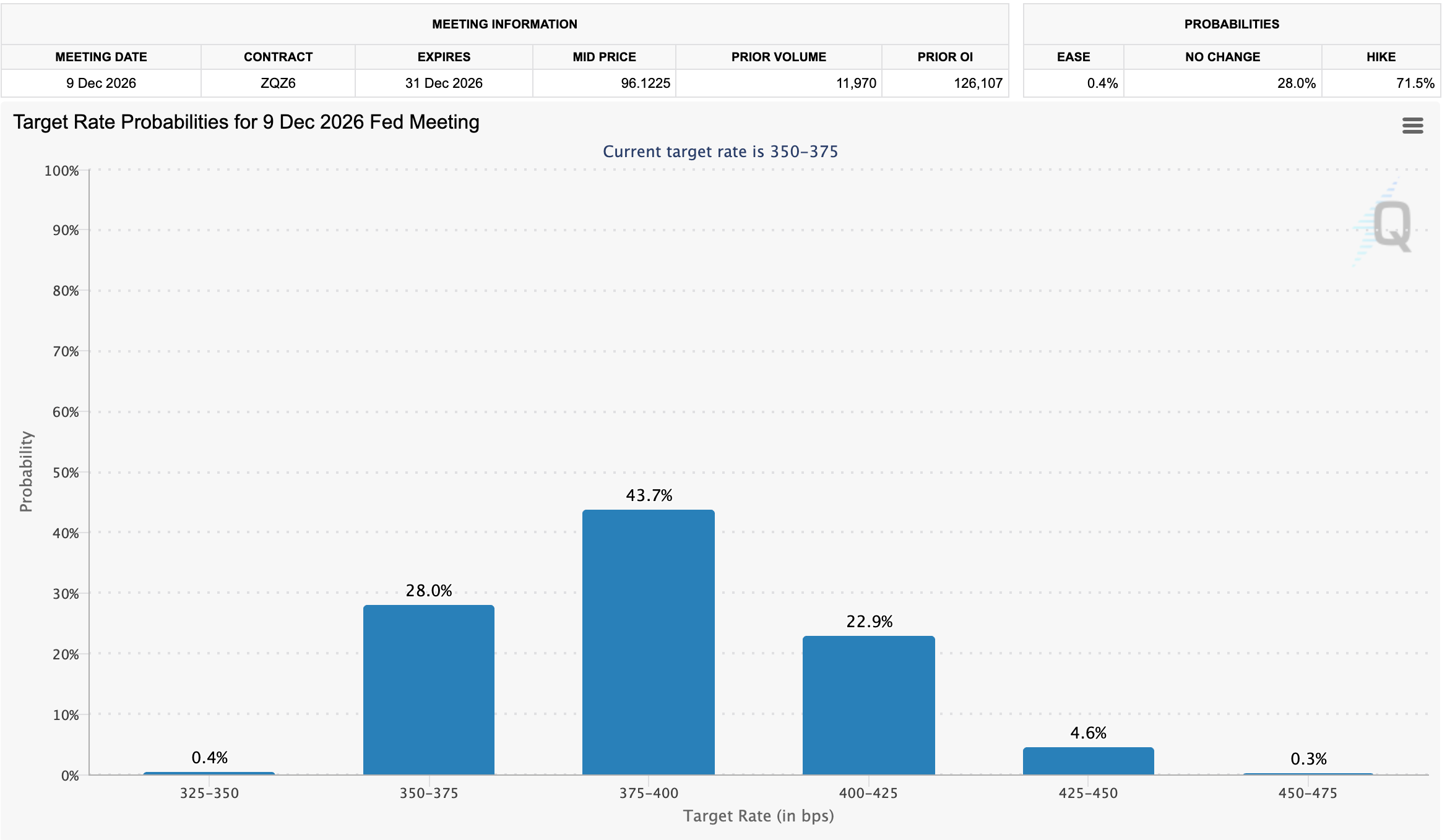
Persistent inflation complicates Trump’s repeated calls for lower borrowing costs. CME FedWatch shows a 98.4% chance the Fed holds at 3.5%–3.75% next week. However, markets now price more than 70% odds of a rate hike by the end of 2026.

That shift matters for Bitcoin. Higher rates typically strengthen the dollar and Treasury yields, drawing capital away from non-yielding assets.
BTC trades near $62,000, down almost 24% over the past 30 days, according to BeInCrypto Markets. The token now sits roughly 51% below its all-time high of over $126,000. A 1% bounce over the past day has done little to repair the broader downtrend.

Warsh inherits a Fed facing accelerating prices and softening real incomes. If next week’s meeting signals tightening ahead, Bitcoin’s macro headwinds could strengthen into the summer.
Subscribe to our YouTube channel to watch leaders and journalists provide expert insights
The post President Trump Loves Inflation, and Bitcoin Could Feel the Impact appeared first on BeInCrypto.


Botanix Labs is winding down its Spiderchain Bitcoin Layer 2, giving users until July 9 to withdraw all assets before the network goes dark. The Polychain-backed project cited insufficient demand for Bitcoin-native DeFi as the reason it could not sustain itself economically. In a post on X Tuesday,… Read the full story at The Defiant


Curve Finance has launched Llamalend v2 on Optimism with support for isolated lending markets and non-crvUSD borrowing pairs, opening the first phase of a lending system upgrade ahead of a planned Ethereum mainnet rollout later this year.
Summary
- Curve has launched Llamalend v2 on Optimism, expanding lending beyond crvUSD-only borrowing markets.
- Users can now use Curve LP tokens as collateral while maintaining exposure to liquidity pool rewards.
- The rollout starts with three isolated markets and a 250,000 OP incentive program ahead of an Ethereum mainnet launch.
According to Curve Finance, the new version removes a key limitation from Llamalend v1, which was built around crvUSD as the borrowed asset. Markets can now be created using supported assets on both sides of a lending pair, subject to governance approval, allowing collateral and borrowed assets to be selected without requiring crvUSD.
The deployment begins on Optimism, where Curve said users will initially be able to access three isolated markets: ETH against wstETH, wstETH against USDC, and WBTC against USDC.
All three markets will launch with borrow caps set at zero, meaning users can lend assets but cannot borrow until governance approves debt limits through a DAO vote expected to take about seven days.
LP tokens can now support borrowing activity
Alongside the expansion beyond crvUSD markets, Curve has introduced support for LP tokens as collateral. According to the protocol, liquidity providers can deposit Curve LP tokens, continue earning trading fees from liquidity pools, and borrow against those positions simultaneously.
The update ties lending activity more closely to Curve’s exchange infrastructure. Curve said the framework could also support other productive collateral types in the future, including yield-bearing vault assets and principal tokens used in fixed-yield strategies.
Llamalend v2 retains the liquidation model introduced with the original protocol in early 2024. Rather than liquidating a position at a single price point, the system uses a liquidation range that gradually converts collateral into the borrowed asset as prices move through predefined levels.
Curve previously said the design was created to reduce concentrated liquidation pressure during periods of market stress and give borrowers more time to manage positions.
Risk controls remain separated on a market-by-market basis. According to Curve, each lending market carries its own collateral asset, borrowed asset, oracle configuration, borrowing limits, and risk parameters. Borrow caps start at zero and must receive governance approval before debt can accumulate.
LlamaRisk reviews markets before borrowing begins
For the initial rollout, Curve said LlamaRisk will review proposed collateral assets and oversee market assessments before markets move through governance. The protocol noted that isolated markets reduce the possibility of risks spreading between unrelated lending pairs.
Support for the launch includes a 250,000 OP token grant from the Optimism Foundation, according to Curve’s announcement. The incentives are expected to be distributed over roughly two months to encourage liquidity and participation.
Curve’s technical documentation also states that an initial incentives campaign will distribute 100,000 OP tokens through Merkl across the first markets.
Before enabling borrowing, Curve said it chose to deploy on Optimism to observe contract behavior, integrations, and user activity in a lower-risk environment. A launch on the Ethereum Mainnet is expected during the second half of the year.
The rollout follows other recent lending-related initiatives from Curve. As previously reported by crypto.news, the protocol introduced a bad-debt recovery framework for LlamaLend markets that converts distressed lending positions into tradable on-chain claims.
Curve founder Michael Egorov described that mechanism as an investment tool that could eventually be applied to other markets if successful.
Binance has moved its tokenized-equity program from announcement to live product, introducing bStocks, a first batch of five US equities that eligible users can convert into on-chain tokens and trade around the clock, seven days a week. The exchange posted the launch Wednesday to its official… Read the full story at The Defiant
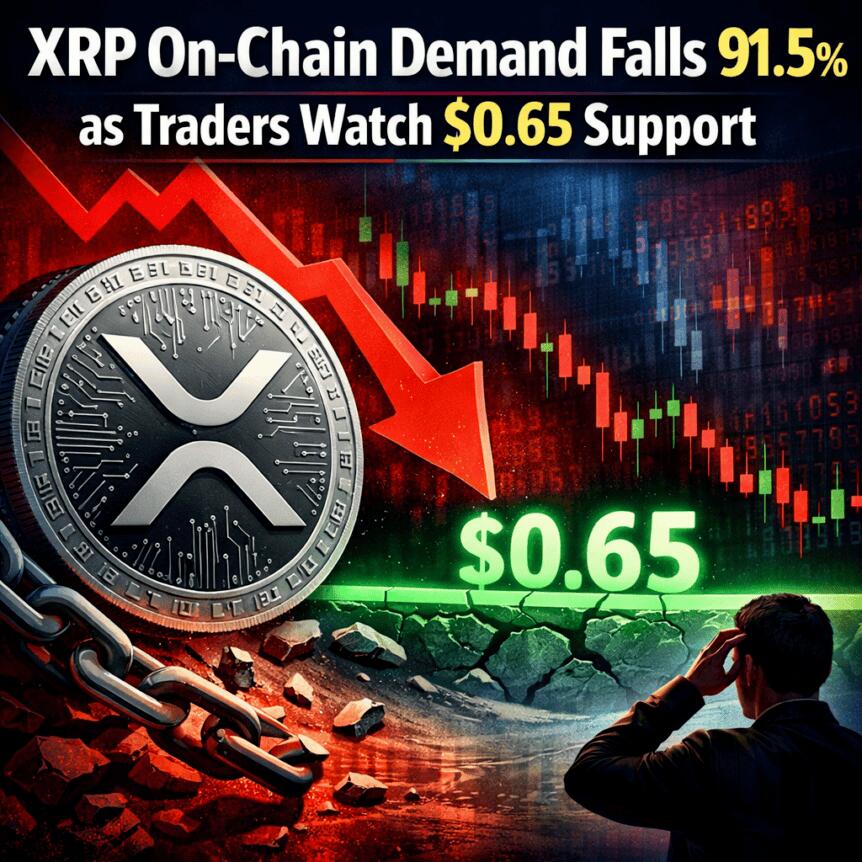
XRP’s on-chain activity has cooled dramatically since its 2025 surge, according to Glassnode’s latest on-chain metrics. The 90-day average of total XRP network fees has plunged to about 500 XRP from roughly 5,900 XRP in February, a 91.5% drop that points to a sharp slowdown in on-chain demand after the mid-2025 price spike that briefly pushed XRP above $3. The pullback in on-chain activity mirrors a broader shift in trader behavior and market structure after a period of intense speculation.
Compounding the view of a cooling market, XRP’s 90-day realized profit-to-loss ratio has collapsed to 0.38, suggesting that more coins are being realized at losses than profits on-chain. At the height of its price run in January and July 2025, when XRP traded near $3.40, the ratio reached around 50 as profit-taking dominated flows. The current regime, by contrast, signals a possible capitulation environment where selling pressure is less about wholesale distribution by big holders and more about risk-off sentiment and leverage-driven liquidations.
Key takeaways
- On-chain demand for XRP has slumped sharply since the 2025 rally, with the 90-day average of network fees falling 91.5% to around 500 XRP.
- The 90-day realized profit-to-loss ratio has fallen to 0.38, indicating losses are being realized more than profits as investors exit positions.
- Exchange-related activity shows a cooling dynamic: large XRP transfers to centralized venues like Binance have declined since the 2025 peak, hinting at a shift away from mass whale distribution.
- A defined accumulation zone between roughly $1.00 and $0.65 is taking shape, anchored by technical levels such as a fair value gap and a high-volume node around $0.50–$0.65.
- Despite near-term weakness, a subset of analysts maintains a longer-term bullish thesis, with a target range of about $15–$18, underscoring the ongoing debate over XRP’s eventual fundamental trajectory.
On-chain activity and what it signals
Glassnode’s analysis stresses that XRP’s on-chain activity has cooled substantially after the explosive run that pushed the token above $3 in the first half of 2025. The drastic drop in the 90-day fee average—from thousands of XRP to a few hundred—suggests a cooling in the network’s transaction activity and a retrenchment of speculative demand. In practical terms, the fee data are often treated as a proxy for everyday transactional use on the XRP ledger, and the current readings imply a lull in users and a normalization after a period of exuberant activity.
Observers are watching whether this cooling translates into a more stable or even depressed price regime. The price action that followed the mid-2025 spike created a technical environment where traders now see a broad band between $1.00 and $0.65 as a critical zone. The question is whether buyers will accumulate enough demand to defend that range or if the market will test lower levels in a broader risk-off cycle.
Profit dynamics: from profit-taking to capitulation?
The realized profit-to-loss ratio offers a window into how investors are managing their XRP positions as market conditions shift. The ratio’s plunge to 0.38 means that for every $1 of realized profit, approximately $2.63 of losses have been realized, a pattern often observed when a market moves from a distribution phase into capitulation, albeit without the same intensity of selling by large holders as in prior cycles.
For context, the ratio reached about 50 during the weeks when XRP hovered near $3.40 in 2025, indicating heavy profit-taking at those price points. The reversal to a low ratio is consistent with a broader shift away from aggressive on-chain profit-taking and toward a more cautious posture among market participants. While this doesn’t preclude a return to stronger hands pushing prices higher, it does highlight a renewed emphasis on risk controls and stop-out dynamics in a market that has already experienced substantial speculative fervor.
Whale flows, exchanges, and the bigger picture
On the exchange-front, data from CryptoQuant offers a complementary view to Glassnode’s on-chain activity. Analysts have flagged a decline in transfers of XRP to major exchanges, particularly among the higher-cohort holders. Notably, inflows of 100,000–1,000,000 XRP and those above 1,000,000 XRP have weakened since the 2025 peak, with declines of about 15% and 20%, respectively, since October 2025. The trend points to a reduction in the step-like distribution that often accompanies top-of-cycle sell-offs.
Analysts caution that the near-term price weakness appears more connected to leverage-driven liquidations and a risk-off mindset than to a broad, coordinated dump by large holders. In other words, while large holders are still active participants in the space, their activity does not appear to be the dominant force shaping XRP’s price action at this juncture. The combination of fading on-chain demand and shifting exchange dynamics creates a nuanced backdrop for traders who must weigh potential liquidity gaps against the possibility of renewed demand in a broader crypto-market upcycle.
In terms of regional and behavioral signals, the XRP ecosystem still shows a classic pattern: from a few clear acceleration points to a more cautious phase where traders hunt for lower-risk entries. CryptoQuant’s analysis highlights how inflows to exchanges from large holders have cooled, which historically has preceded or accompanied broader corrections in the XRP market. Yet, as ever in volatile crypto markets, these trends must be contextualized within macro conditions, liquidity cycles, and evolving regulatory dynamics that continue to shape investor risk appetite.
Technical map: where buyers are watching
From a chart perspective, XRP has been consolidating within a zone that many traders view as a potential bottoming region. The weekly price action points to a cluster of technical levels between $1.00 and $0.65. A notable fair value gap created during XRP’s late-2024 rally spans roughly $0.63 to $1.00, and price has shown movement back toward this zone after breaching the $1.40 level on the downside. Visible-range volume profile data indicate relatively light activity below current prices until a high-volume node sits around $0.50–$0.65, suggesting a meaningful area of liquidity in that neighborhood.
The point of control—the price area with the most traded volume—sits near $0.52–$0.55, reinforcing the idea that this range has become a magnet for immediate supply and demand. In addition, XRP’s five-year ascending trendline projects to intersect near $0.60–$0.65 in the coming months, a confluence of support that could anchor a potential bounce if macro conditions support renewed risk appetite.
On the community front, market observers have begun highlighting the $0.60–$0.65 band as a practical accumulation zone. Traders such as Crypto Patel have identified $1.00–$0.60 as a preferred range to accumulate, while others like Javon Marks continue to model a longer-term bull scenario with a target of roughly $15–$18 per XRP—a move that would imply roughly 1,100% upside from current levels. While such a trajectory remains contingent on a sustainable macro and market-driven re-pricing of risk, the convergence of on-chain, exchange, and technical signals keeps the narrative alive for those investors betting on a reacceleration in XRP’s adoption and liquidity cycle.
What to watch next
As the market digests a quieter on-chain environment and a shift in exchange activity, XRP traders will be closely watching whether demand can re-emerge around key support around $0.60–$0.65 and whether buying interest can sustain a move back toward the $1.00 threshold and beyond. The overarching question remains whether the longer-term bull thesis can absorb another round of macro shocks or if a fresh catalyst—regulatory clarity, improved liquidity conditions, or institutional participation—could reframe XRP’s trajectory in 2026.


Japan's three largest banks have moved from exploratory talks into formal infrastructure deployment, establishing a joint stablecoin council targeting live transactions by March 2027. Mitsubishi UFJ Bank (MUFG), Mizuho Bank, and Sumitomo Mitsui Banking Corporation (SMBC) published a joint press… Read the full story at The Defiant
Brad Garlinghouse has endorsed claims that Wall Street firms are increasingly pursuing the same institutional finance strategy that XRP was once criticized for supporting.
Summary
- Brad Garlinghouse backed Hugo Philion’s claim that Wall Street and crypto firms are increasingly adopting XRP’s institutional finance vision.
- Philion said Ripple’s payments strategy has remained consistent despite years of regulatory challenges and industry criticism.
- The comments come as the XRP Ledger prepares its v3.2.0 upgrade and Ripple supports Mastercard’s new AI payments network.
According to comments shared on X, Ripple CEO Brad Garlinghouse responded with a one-word endorsement after Flare co-founder Hugo Philion argued that many parts of the crypto industry are now embracing the bank-focused approach that XRP and Ripple promoted from the beginning.
The exchange began after an X user highlighted remarks Philion made during a recent interview discussing Ripple’s long-standing role in digital payments. The user wrote that parts of the crypto sector had mocked XRP’s institutional vision in the past but were now attempting to replicate it. Garlinghouse replied simply, “True.”
Philion’s comments centered on how perceptions of Ripple have changed over time. During the interview, he said XRP and Ripple were once criticized for working closely with banks and financial institutions. According to Philion, many projects across the crypto market are now seeking similar relationships with traditional finance firms.
Ripple’s institutional strategy gains fresh attention
Speaking in the interview, Philion said he had always been interested in XRP and viewed Ripple’s payments strategy as being largely on the right track. He argued that regulatory challenges have created more obstacles for the company than issues related to its business model.
While discussing the criticism Ripple faced in its early years, Philion said XRP was often labeled a “banker coin.” He contrasted that view with the current market environment, where many crypto companies are actively pursuing partnerships with banks, payment providers, and financial institutions.
Philion also stated that Ripple has remained consistent with its original objective of improving payments infrastructure. According to his comments, the company has continued building around that use case while maintaining one of the most active communities in the digital asset industry.
Recent developments involving Ripple have added context to the discussion. As previously reported by crypto.news, Mastercard recently launched an AI-powered payments network called Agent Pay for Machines with support from more than 30 companies, including Ripple, Coinbase, the Solana Foundation, Stripe, Adyen, Cloudflare, and OKX.
According to Mastercard, the platform is designed to allow autonomous software agents to carry out transactions, settlements, and machine-to-machine payments. Ripple said fast settlement infrastructure remains an important component for such systems, reinforcing the company’s long-standing focus on payment efficiency.
XRP Ledger prepares next software release
Alongside the renewed debate over Ripple’s role in financial infrastructure, development work on the XRP Ledger continues ahead of a scheduled software update.
According to the XRP Ledger Foundation, version 3.2.0 is expected to be released on June 15 following last month’s rollout of version 3.1.3. The previous release included updates affecting NFTs, Multi-Purpose Tokens, Vaults, the Lending Protocol, and Permissioned Domains.
One of the most notable changes in the upcoming release is a rebranding of the network’s core server software. According to the XRP Ledger Foundation, the software currently known as “rippled” will be renamed “xrpld.”
The foundation said the change is intended to better represent the expanding open-source ecosystem surrounding the XRP Ledger.
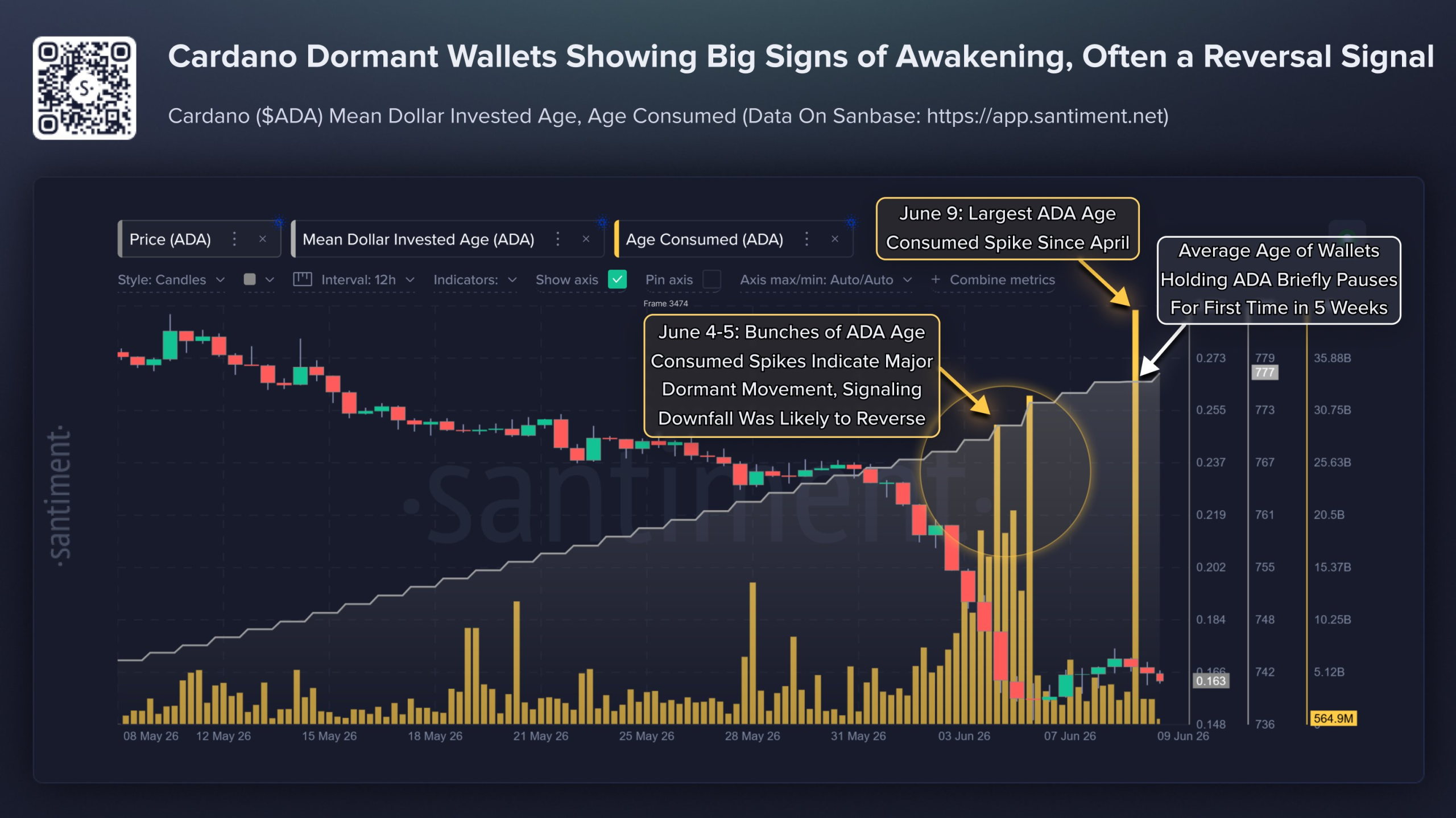
Long-dormant Cardano wallets are suddenly moving ADA again, according to Santiment data, right after Charles Hoskinson’s bold reappearance claiming the network can “run the world.”
Is it the bullish reversal signal investors have long awaited, or simply a dead cat bounce before more distribution?
What the Cardano Dormant Wallet Activity Reveals
Cardano dormant wallets are addresses holding ADA that have stayed inactive for long periods. Santiment data show these older holdings are suddenly becoming active again, a behavioral shift that has historically appeared around major reversal points.
Cardano’s Mean Dollar Invested Age, which tracks the average age of capital held across ADA wallets, had been rising steadily since early May. That trend paused for the first time in five weeks, signaling that older coins are now changing hands.
Follow us on X to get the latest news as it happens

At the same time, the Age Consumed metric spiked sharply between June 4 and June 9. The largest surge happened on June 9, marking the strongest reading since April and confirming dormant ADA holdings are entering circulation.
Age Consumed measures how many tokens moved and how long they were held before moving. A sharp spike means coins that have sat idle for long periods suddenly become active, which often coincides with shifts in the broader market direction.
“These signals don’t automatically mean a reversal is coming, but they do indicate that something has changed beneath the surface. Historically, clusters of Age Consumed spikes paired with a pause (or downturn) in Mean Dollar Invested Age have often appeared around key market turning points,” Santiment said.
The timing matters. ADA trades near $0.16, down roughly 94% from its all-time high of $3.09, and the recent price capitulation may be motivating long-term holders to start moving their tokens again.
CoinGlass data adds another layer. Roughly 20 million ADA (~ $34 million) left exchanges for self-custody wallets in the past 24 hours, reinforcing the narrative that participants are buying the dip rather than distributing into broader market weakness.

Why Hoskinson’s Return Strengthens the Bullish Thesis
Charles Hoskinson reappeared with a bold message on June 8. The Cardano founder argued the blockchain has the potential to become the foundational operating system for the entire globe, solving a multi-trillion-dollar global trust crisis.
He identified four core pillars that he believes make Cardano uniquely different. These include the Ouroboros consensus protocol, the extended UTXO accounting model, the modularity of partner chains like Midnight, and a decentralized governance structure.
Hoskinson also criticized rival networks for sacrificing decentralization in favor of speed. He framed Cardano as playing a different long-term game focused on solving real problems rather than chasing the flavor of the week across crypto markets.
“…When I look at the competitors, we’re playing a different game than them. And that’s why we’re going to win… They’re chasing the flavor of the week, the company of the week, the announcement of the week. And we want to change the world. We want the world to be a better place,” Hoskinson argued.
He urged the Cardano community to stop focusing solely on metrics such as Total Value Locked or short-term token prices. His broader pitch ties Cardano’s mission to global trust, economic value creation, and even what he described as world peace.
The combination of his message and the dormant wallet activity creates an interesting setup. Long-term ADA holders appear to be repositioning just as the founder reasserts the long-term vision, a move that has historically signaled accumulation phases.
The signals are not bulletproof. Dormant coins moving could also reflect distribution rather than accumulation. Yet exchange outflows, capitulation-level prices, and renewed founder communication suggest the bullish reading currently outweighs the bearish interpretation for ADA across the coming weeks.
Subscribe to our YouTube channel to watch leaders and journalists provide expert insights.
The post Large Dormant Cardano Wallets Move as Hoskinson Reappears: Reversal Signal? appeared first on BeInCrypto.

Karmelo Anthony’s New Mugshot Photo Sparks Reactions Online

#prosperidade#financas#motivacao

Belfast man danced on roof of police Land Rover and incited others to riot, court told



-

 Fashion5 days ago
Weekend Open Thread: Evereve – Corporette.com
-
 Crypto World6 days ago
Jensen Huang Approves Samsung, SK Hynix, and Micron for NVIDIA (NVDA) HBM4 Memory Supply
-

 Crypto World3 days ago
Anatomy of the June crypto crash: Fed, Iran, Saylor
-
 Entertainment4 days ago
The Best Mystery Series of All Time Is Surging on Streaming 30 Years After It Ended
-

 NewsBeat3 days ago
Alexander Zverev wins the French Open to finally earn a 1st Grand Slam title
-

 Tech5 days ago
Suspicious Polyfill login prompts pop up on Toshiba, Muji websites
-
Crypto World4 days ago
Senator Cynthia Lummis Calls CLARITY Act the Most Consequential Financial Legislation of This Generation
-

 Tech6 days ago
Microsoft launches MXC, an OS-level sandbox for AI agents, with OpenAI and Nvidia already on board
-

 Tech4 days ago
Microsoft unveils seven homegrown AI models in new bid for ‘long term self-sufficiency’
-

 Business6 days ago
(VIDEO) Justin Bieber Delivers Surprise Happy Birthday Serenade to Diners at Los Angeles Mexican Restaurant
-
 Business4 days ago
The Pain Points Taking a Fragile Tech Rally Down a Notch
-
 Crypto World3 days ago
Eli Lilly (LLY) Stock Surges 4% Following Breakthrough Sleep Apnea Trial Results
-
Crypto World6 days ago
LBank Surpasses 25 Million Users Worldwide as AFA Partnership Continues to Drive Global Growth
-

 Tech5 days ago
Von der Leyen’s AI envoy pick draws conflict-of-interest fire
-

 Tech6 days ago
Meta steals a tactic from Tesla and builds data centers in tents
-

 Crypto World4 days ago
Trump’s AI Ownership Plan Could Benefit Anthropic at OpenAI’s Expense
-
 Sports1 day ago
Bangladesh beat Australia after 20 years in ODIs, register only their second win over six-time world champions | Cricket News
-

 Business3 days ago
High Stakes for Wembanyama as New York Pushes for 3-0 Lead
-

 Tech5 days ago
Hackers now exploit SolarWinds Serv-U flaw to crash servers
-

 Tech3 days ago
Notion restores access to Anthropic after service disruption
You must be logged in to post a comment Login