

Crypto World
Near Leads AI Token Rally With 50% Surge as $5 Price Target Emerges

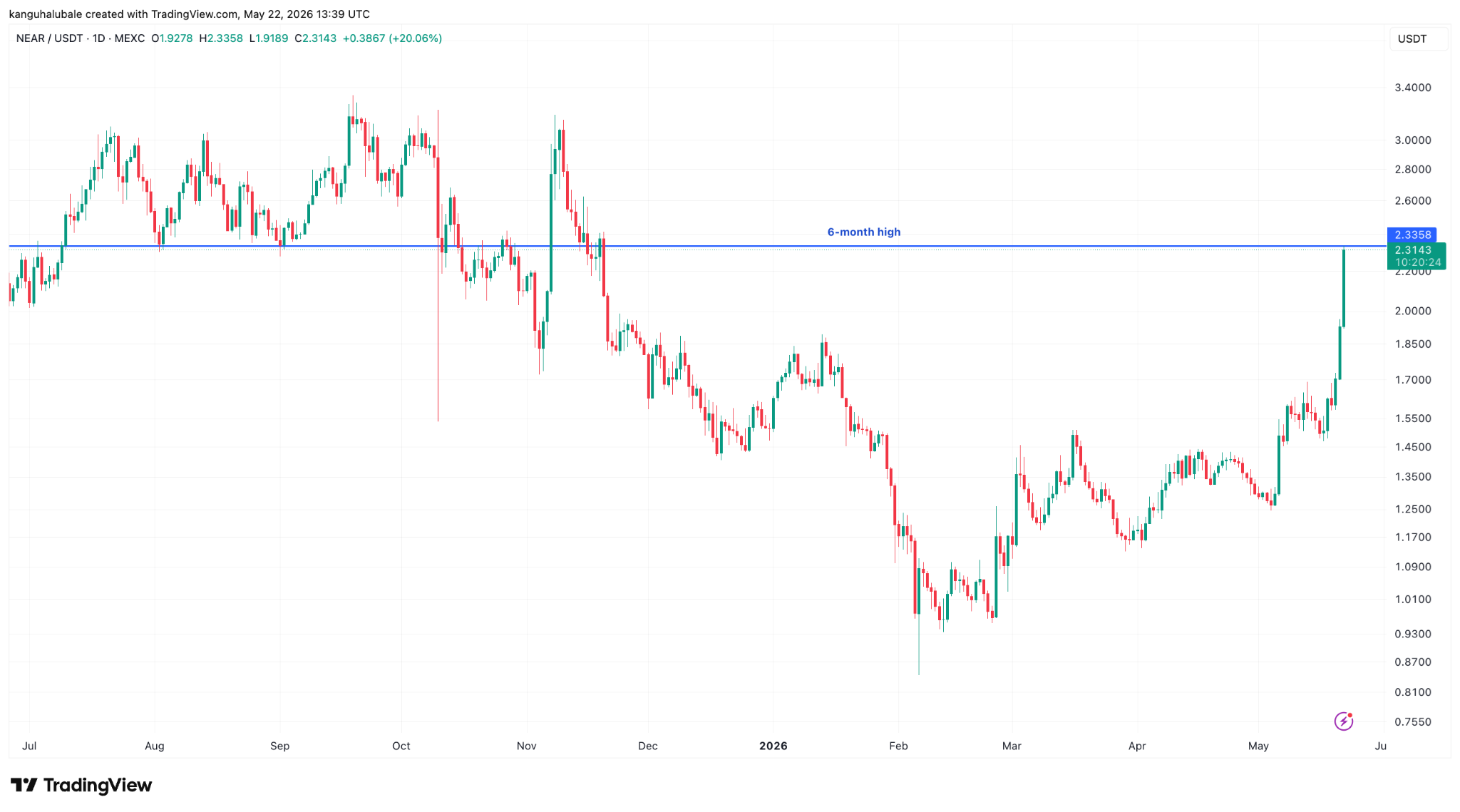
NEAR Protocol (NEAR) displayed strength on Friday, rising 34% over the last 24 hours to $2.32, leading artificial intelligence-based tokens in a rally fueled by NEAR’s network upgrades and NVIDIA’s bullish revenue forecast.
NEAR is trading 50% higher than its price seven days ago and has gained a whopping 115% over the last 90 days.
Key takeaways:
- NEAR price surged 50% in seven days, hitting six-month highs as AI crypto tokens rallied on strong market momentum.
- NEAR Protocol upgrades focused on AI, privacy and scaling boosted investor confidence and trading volume above $1 billion.
- A breakout from a multi-year wedge pattern puts $5.75 in focus if NEAR clears resistance between $2.60 and $3.
NEAR price rallies to six-month highs
Data from TradingView shows that NEAR’s recovery began on Monday, rising 58% to a six-month high of $2.34 on Friday from a low of $1.48.
Accompanying NEAR’s price growth is an uptick in its trading volume, which has increased by 190% to $1.15 billion over the last 24 hours, reinforcing the intensity of the buyers.
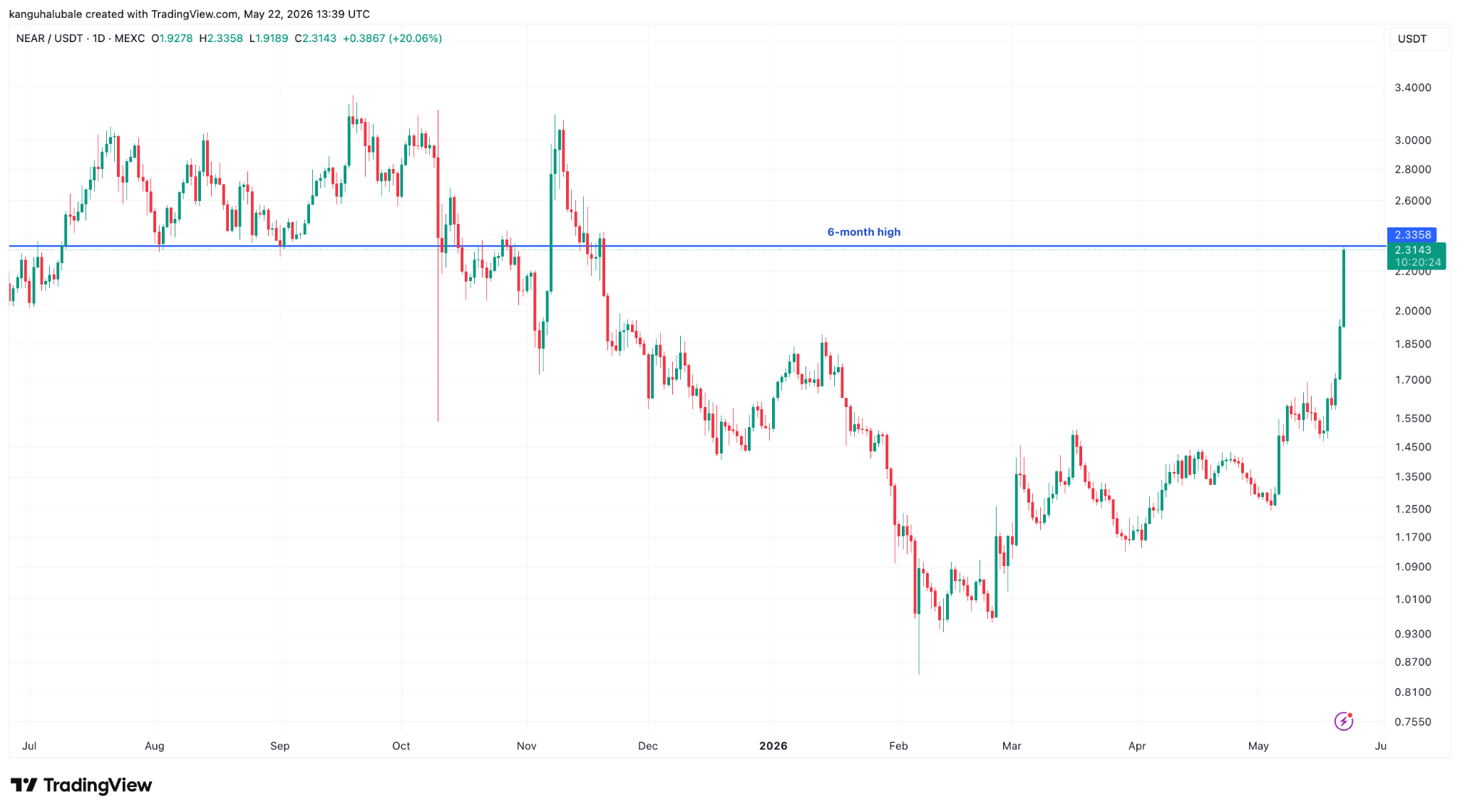
NEAR/USD daily chart. Source: Cointelegraph/TradingView
The altcoin’s jump above $2.30 triggered over $9.85 million in short liquidations, as those betting against the price were caught off guard.
The gains come after NEAR Protocol announced of major upgrades focused on privacy, AI integration, and network scaling.

Source: X/NEAR Protocol
Aurora, the Ethereum-compatible scaling solution built on NEAR, also announced the update of its Aurora Intents Widget. The update integrated ADI Chain as a new entry point, enabling smoother cross-chain swaps, deposits, and application flows for users.

Source: Aurora
These developments demonstrate ongoing technical progress within the NEAR Protocol ecosystem, potentially increasing demand for blockspace and the NEAR token.
NEAR price rallies as AI tokens recover
NEAR is not the only AI-themed token outperforming the crypto market today. Other cryptocurrencies in the AI sector have witnessed impressive 24-hour gains, including Grass (GRASS), OpenServe (SERVE) and Artificial Superintelligence Alliance (FET), which have gained over 27%, 21% and 11% over the day, respectively.
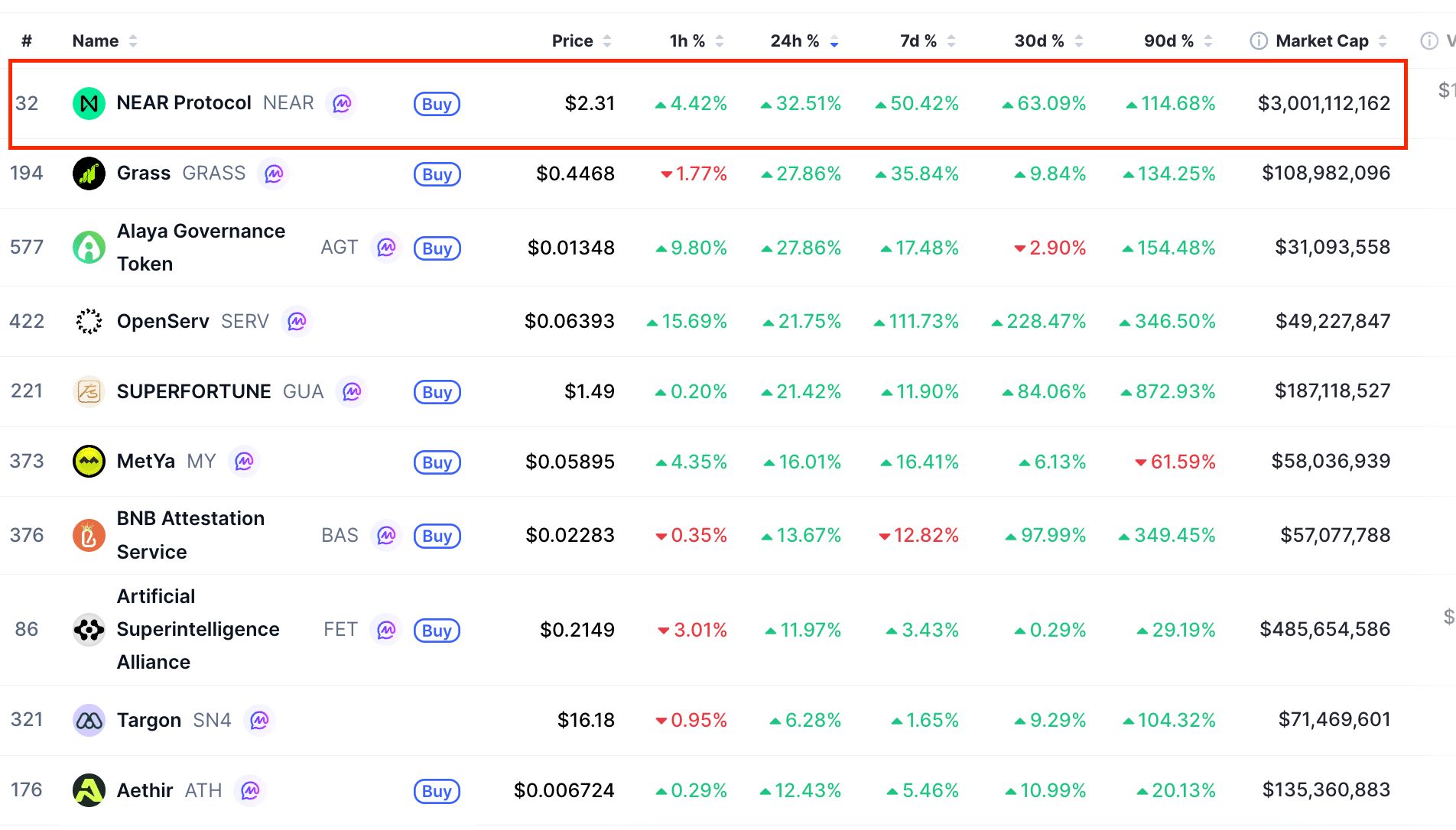
Performance of top AI tokens by market capitalization. Source: CoinMarketCap
Notably, the surge in AI tokens has also been accompanied by an increase in their total market value. The market capitalization of AI and big data crypto projects and tokens has risen by 8% over the past 24 hours to $21.44 billion at the time of publication, reflecting renewed investor confidence in the sector.
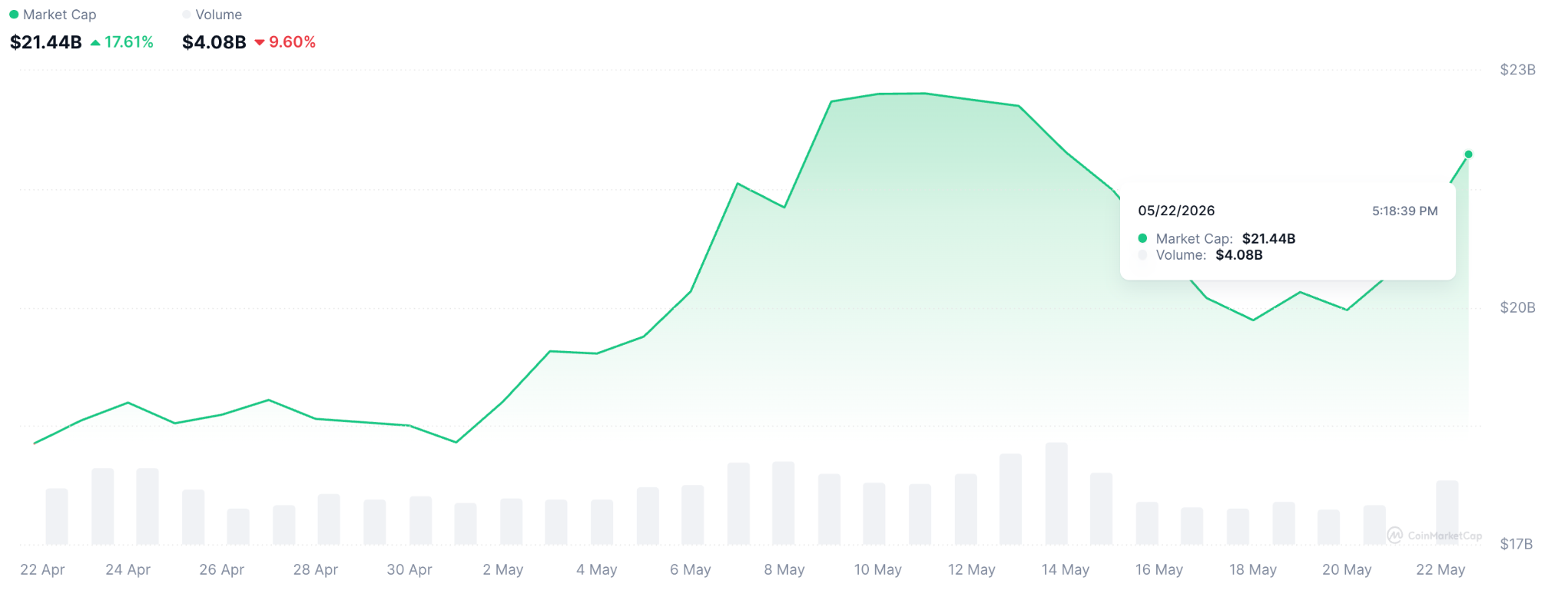
Market capitalization and volume of AI and big data tokens market. Source: CoinMarketCap
Broader sector momentum was fueled by positive signals from Nvidia’s AI dominance and revenue forecasts. Nvidia, which maintains an 81–90% share of the AI accelerator market, reported massive profits of approximately $81.6 billion in Q1 2026 and raised its projected revenue opportunity through 2027 to $1 trillion.
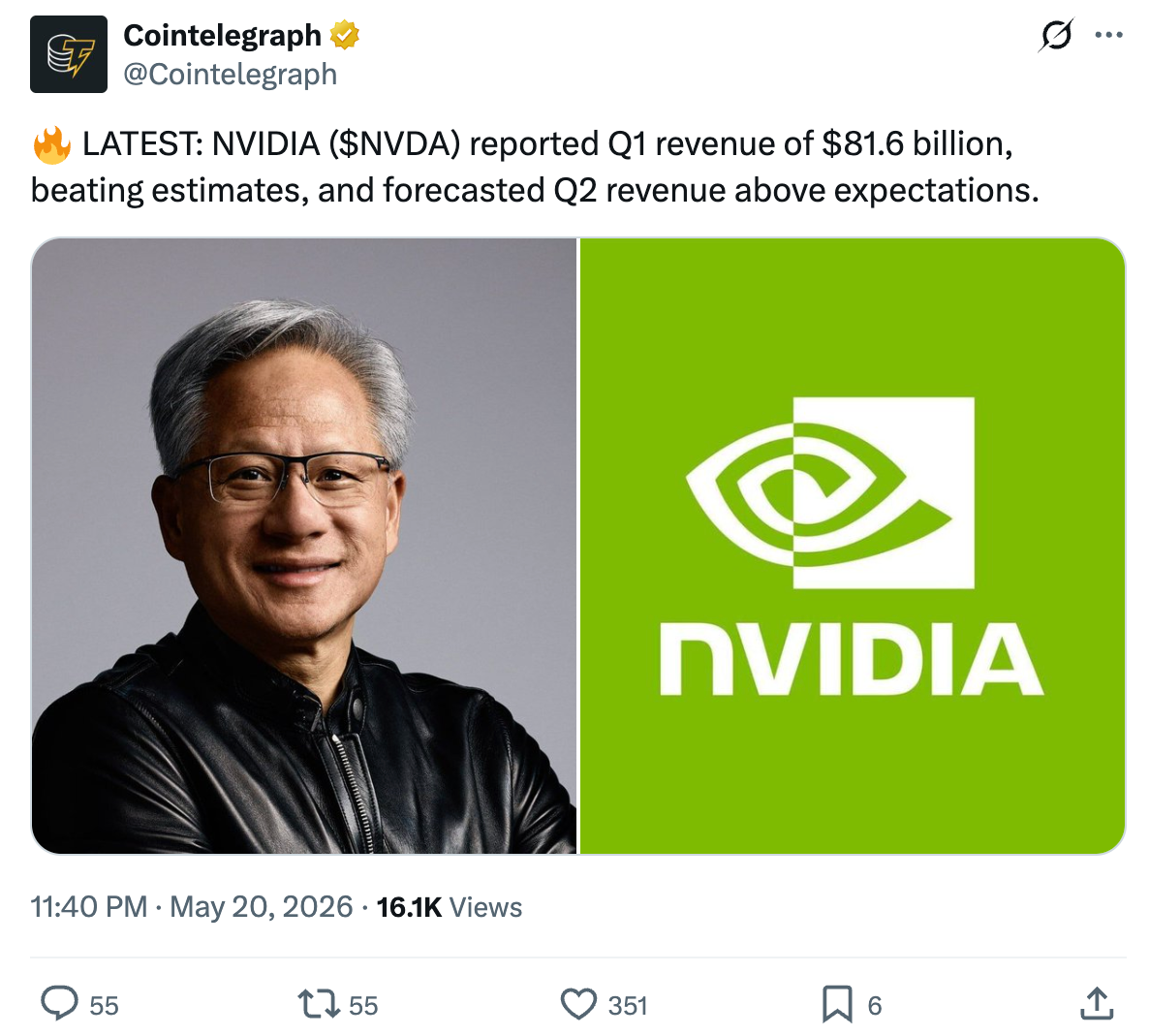
Source: X/Cointelegraph
Historically, Nvidia events have triggered strong rallies in NEAR price, as seen in February when the altcoin soared 58% following the company’s Q4 2025 earnings report.
How high can NEAR price go?
NEAR’s latest rally saw it break out of a multi-year falling wedge that has capped the price since late 2024.
The NEAR/USD pair now faces stiff resistance at the $2.60-$3.0 supply zone, where major moving averages sit, as shown on the weekly chart below.
A break above this level would clear the path toward the measured target of the wedge at $5.75, roughly 160% above the current price. The relative strength index has increased to 63, indicating increasing upward momentum.
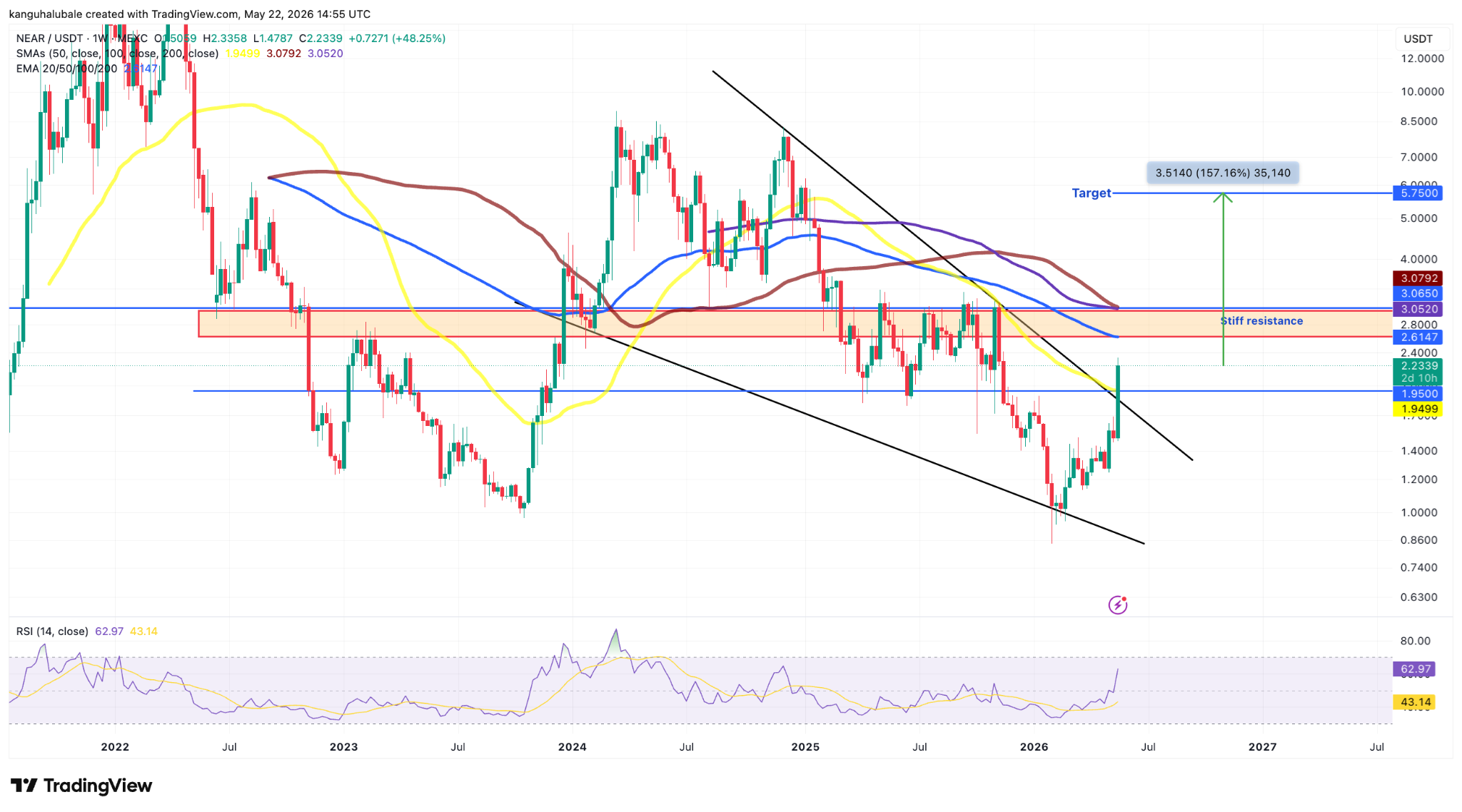
NEAR/USD weekly chart. Source: Cointelegraph/TradingView
In an X post on Tuesday, MN Capital founder Michael van de Poppe said NEAR is displaying “one of the most bullish charts” in the market, adding that a continuation was in the cards as long as it held $1.40 as support.
“The first real resistance zones for $NEAR are at $2 and $2.25-$2.50,” Van de Poppe said in a follow-up post on Thursday, adding “it’s clearly trending higher,” with the next target near $2.75.
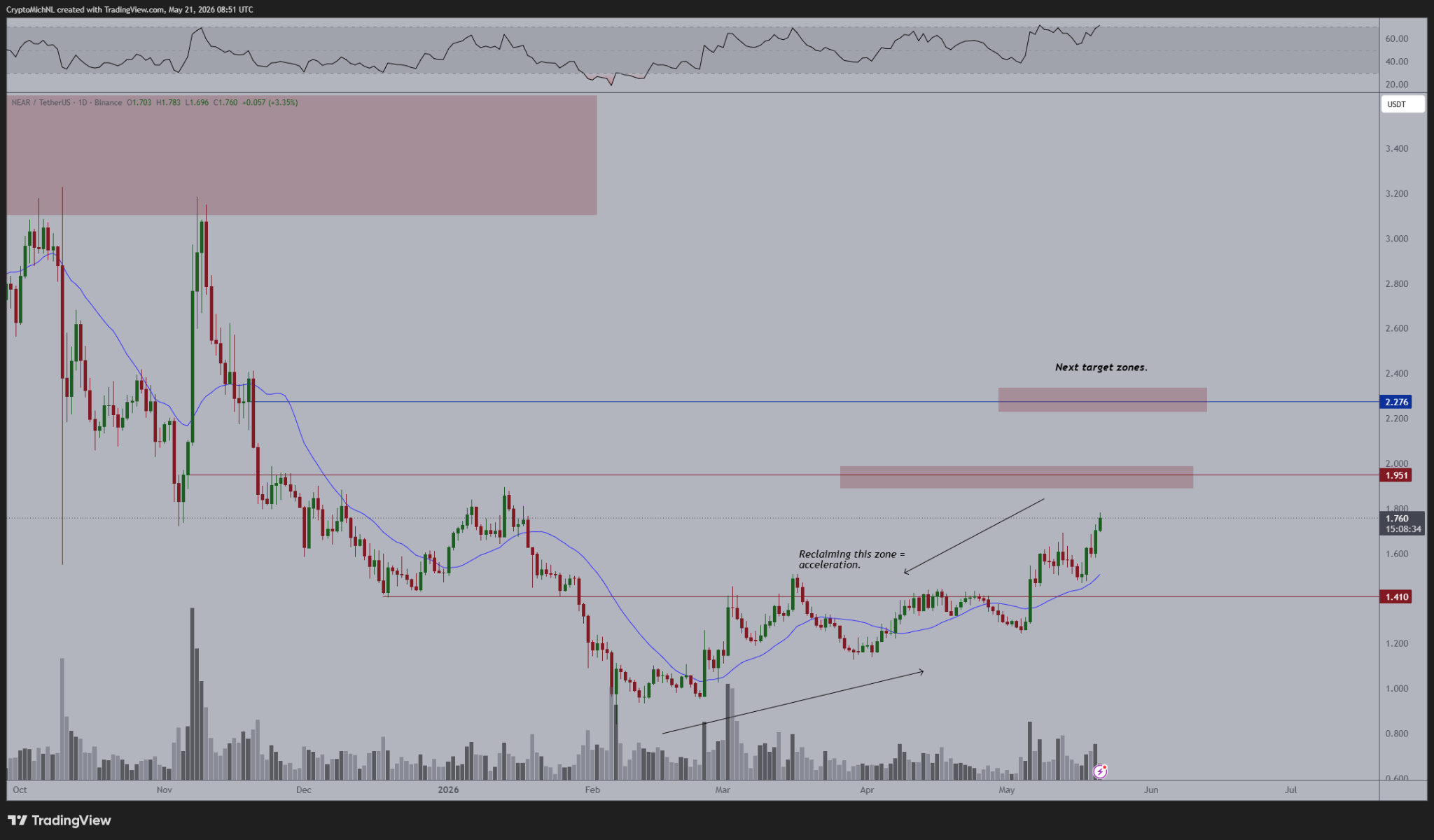
NEAR/USD daily chart. Source: X/Michael van de Poppe

Exodus has launched a marketplace for tokenized assets through a partnership with Ondo Finance, allowing eligible users to trade more than 200 tokenized stocks, ETFs and other real-world assets on Solana directly from the crypto wallet.
The company said Exodus Markets is available in select markets and that users can access the service by updating to the latest version of the app. Tokenized assets do not represent ownership of the underlying securities and do not provide shareholder rights, according to the announcement.
Cointelegraph contacted Exodus to determine which jurisdictions are eligible for Exodus Markets but had not received a response by the time of publication.
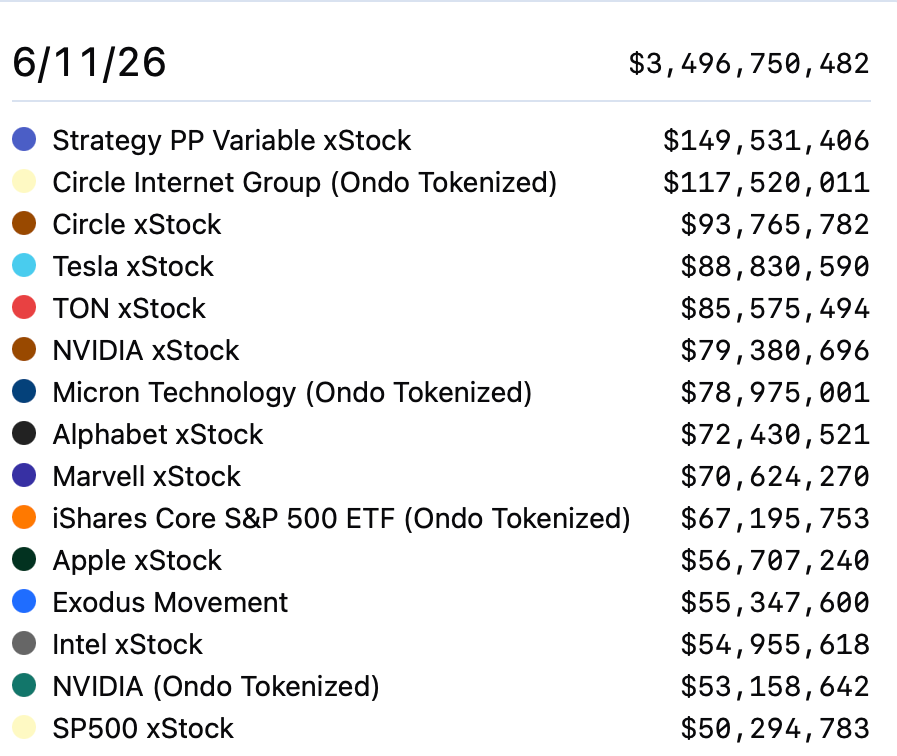
Founded in 2015, Exodus is a self-custody crypto wallet provider. RWA.xyz data shows tokenized Exodus shares account for more than $55 million in onchain value, placing them among the largest tokenized equities by market size.
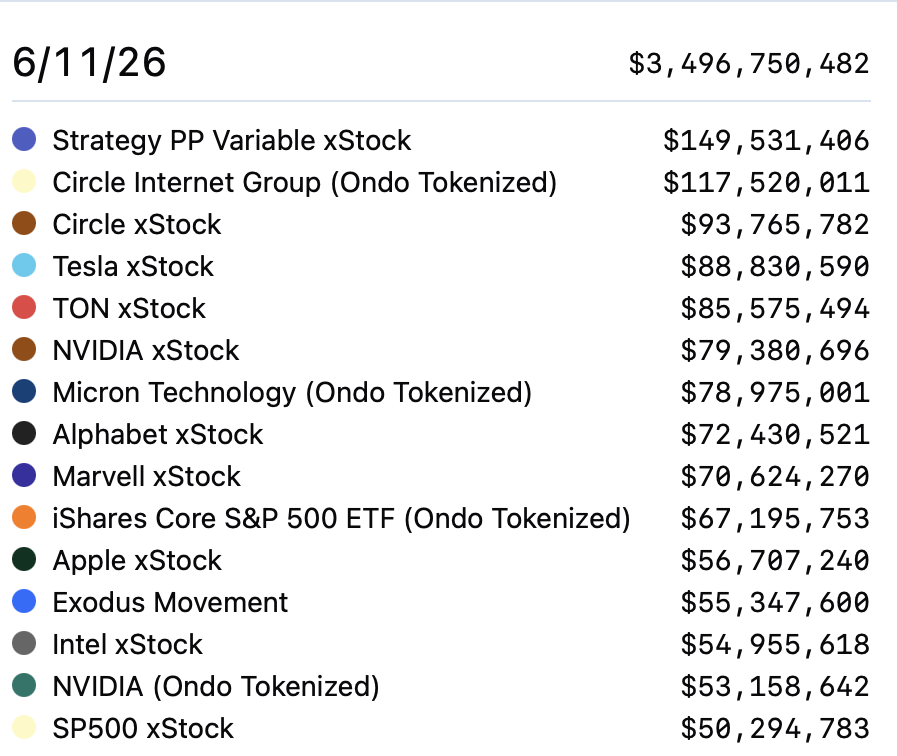
Top tokenized equities. Source: RWA.xyz
Ondo Finance is one of the largest issuers of tokenized real-world assets. According to RWA.xyz data, the company’s tokenized products hold about $2.7 billion in assets, led by its USDY and OUSG Treasury funds.
Related: TradFi advisers want stablecoins, tokenization over Bitcoin: Bitwise
xStocks leads growth in tokenized equities
The launch comes amid rapid growth in tokenized equities. According to RWA.xyz, the value of tokenized stocks has climbed to $3.5 billion, up more than 139% over the past 30 days, while the number of holders has increased 37% to roughly 357,000.
Much of that growth has been driven by xStocks, a tokenization platform backed by Kraken and issued by Backed Finance. Data shows the company accounts for approximately $2.5 billion in tokenized stock value, representing more than 69% of the sector after growing more than 500% over the past month.
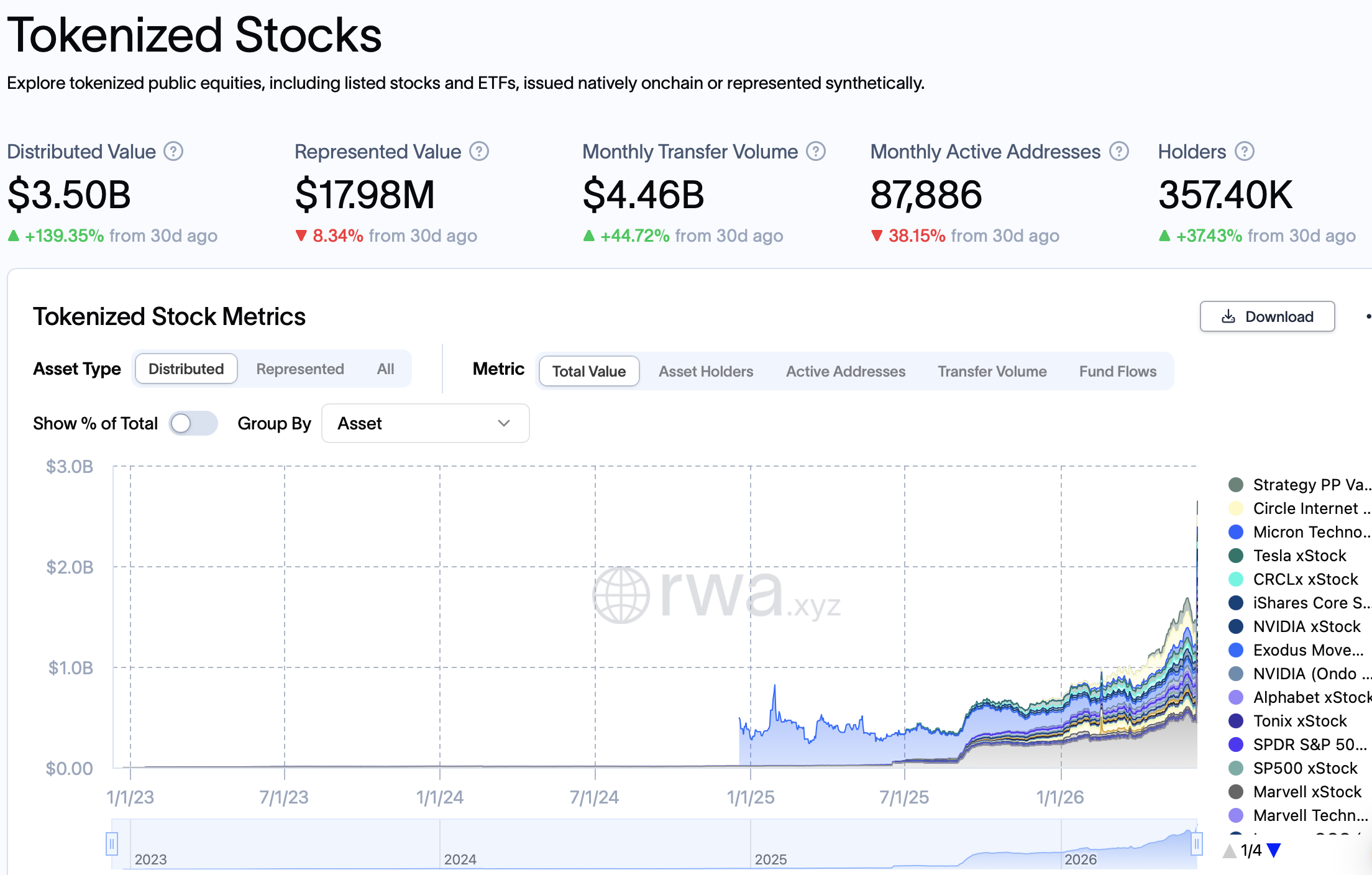
Source: RWA.xyz
Recently, the trend has expanded into pre-IPO markets, with crypto exchanges racing to offer tokenized exposure to SpaceX ahead of the company’s stock market debut on Friday.
Last week, Kraken announced that SpaceX would become the first company available through its xStocks IPO Access platform, allowing eligible users to trade tokenized shares backed 1:1 by the underlying stock. Days later, Bybit said it would also offer SpaceX through xStocks as the inaugural listing on its new tokenized equity platform.
Binance entered the market in May with a perpetual futures contract tied to SpaceX’s expected pre-IPO valuation, while Coinbase launched pre-IPO markets in June with a SpaceX-linked perpetual futures product for eligible users outside the United States.
Blockchain.com also rolled out a SpaceX-linked perpetual contract this month through its OTC desk as part of a new 24/7 institutional trading platform.
SpaceX shares gained around 22% shortly after trading began on Friday, rising from an opening price of $135 to about $164 by midday, according to Yahoo Finance data.
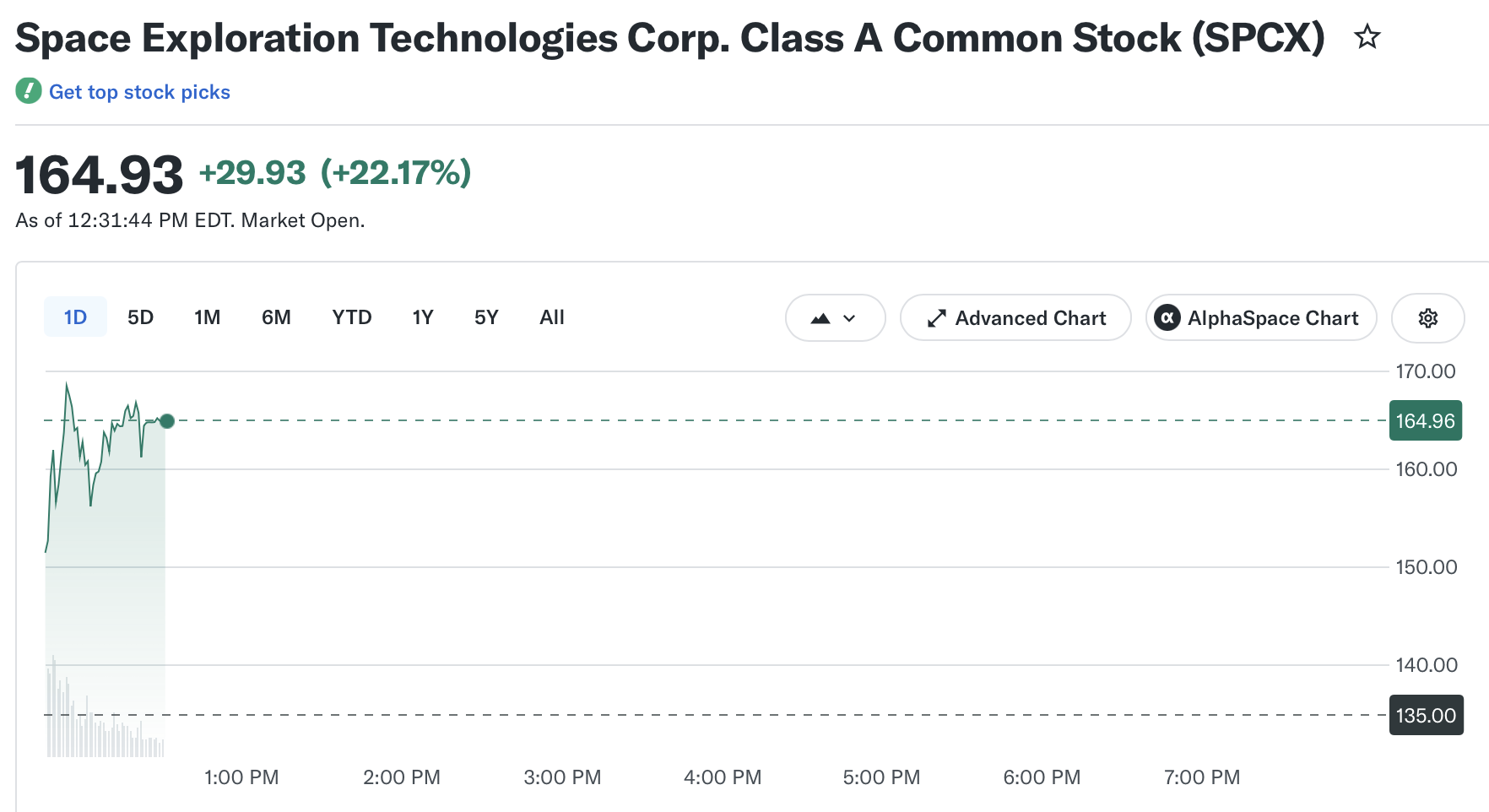
Source: Yahoo Finance
However, Bybit announced on Friday that subscribers to its SpaceX IPO offering would receive refunds after xStocks failed to secure the underlying shares needed to fulfill allocations.
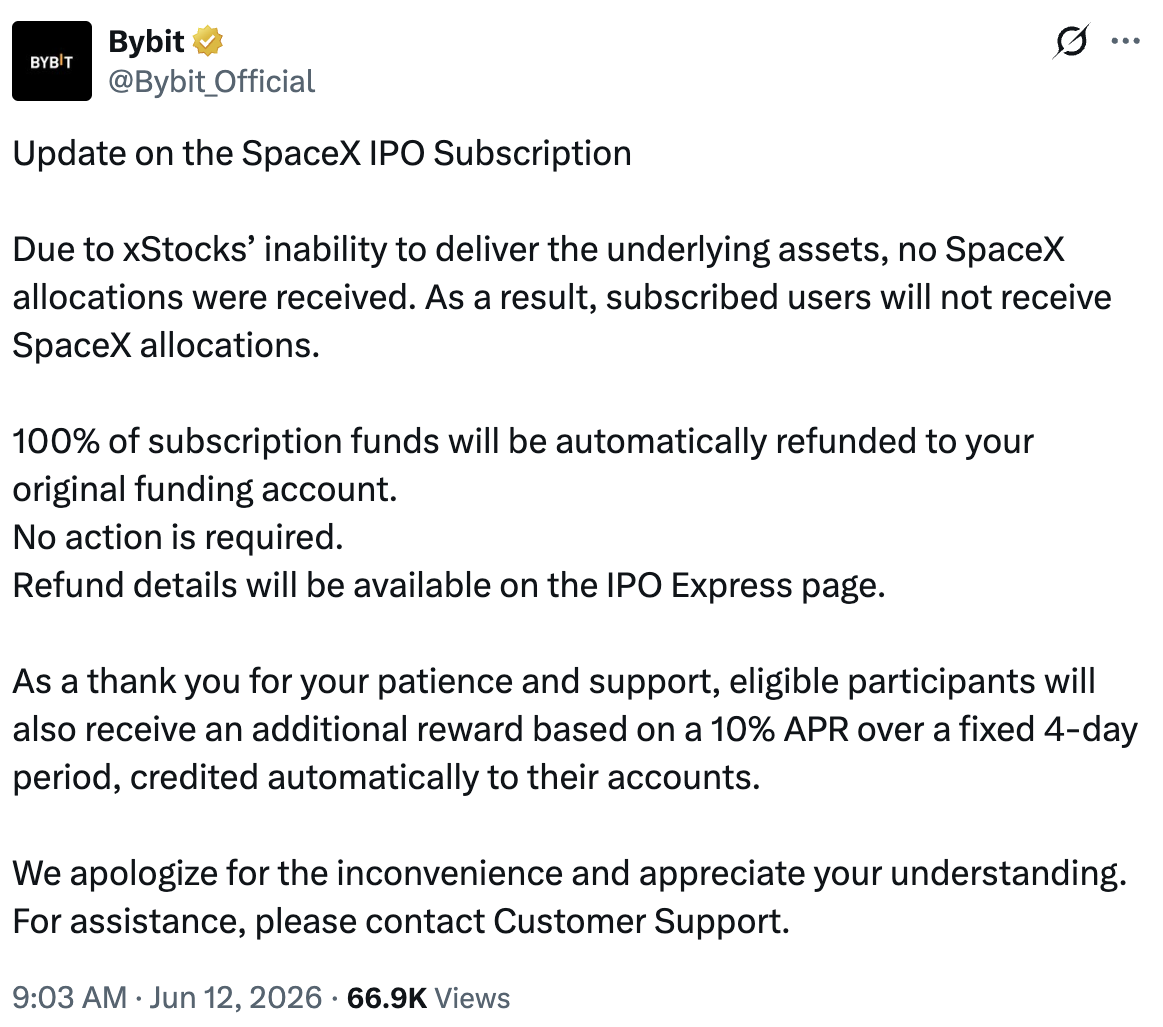
Source: Bybit
Magazine: Does ‘Paper Bitcoin’ mean there’s an unlimited supply of BTC?
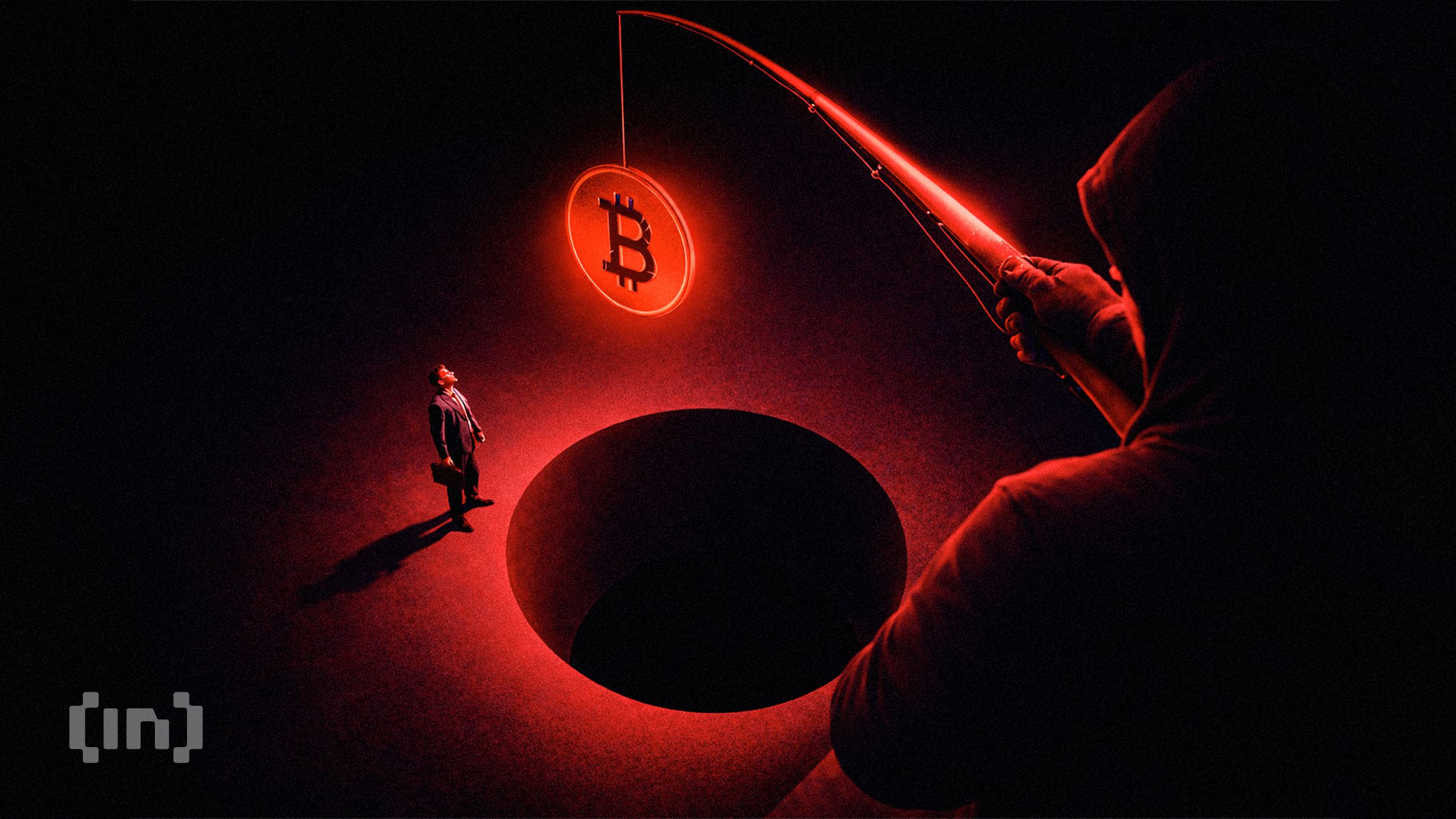

Bitcoin Core developers have disclosed a privacy bug that can expose the very detail it was designed to hide, a user’s IP address. A fix will arrive in version 31.1.
The flaw sits in private broadcast, an optional feature added in version 31.0 this April. Developers published the warning on June 6.
How the Privacy Bug Backfires
Private broadcast sends transactions through Tor, an anonymity network famous for accessing the dark web, so recipients never learn where they originated.
However, the official advisory admits this promise can break.
The trouble begins when the software attempts an encrypted connection to another computer on the network. If that attempt fails, it quietly retries over a normal connection and skips Tor entirely. The recipient then sees the sender’s real IP address, and with it their approximate location.
Worse, attackers do not need luck. A hostile node can deliberately reject the encrypted handshake and force the revealing retry.
The risk is critical because Bitcoin’s ledger is public. Linking a transaction to an IP address can tie payments to a real person.
Who is Affected and What to Do
The bug only touches people who run version 31.0 and switched the feature on. Everyday wallet transactions remain unaffected. Developers credit researcher Eugene Siegel with the discovery.
Meanwhile, markets barely flinched. Bitcoin (BTC) trades near $63,700, little changed over the past day. Developers now face the quieter job of repairing trust in Bitcoin privacy efforts.
Until version 31.1 ships, affected users should disable the feature or route all their traffic through Tor. The episode follows a recent transaction relay dispute and revives questions about who maintains Bitcoin Core.
The post Bitcoin Core Developers Find Privacy Bug That Can Leak User IP Addresses appeared first on BeInCrypto.
Crypto prices have spent much of the year reacting to macro headlines and regulatory uncertainty, but tokenization has remained one of the industry’s few consistent growth stories. Active real-world assets are surging, banks are embracing blockchain infrastructure and tokenized equities are expanding into new markets.
That momentum was on full display this week as Kraken rolled out tokenized access to the highly anticipated SpaceX IPO, offering eligible users in more than 110 markets a chance to participate through xStocks.
Elsewhere, prediction markets surpassed onchain gambling for the first time, and former FTX CEO Sam Bankman-Fried formally asked US President Donald Trump for a pardon.
Tokenized RWAs keep growing through crypto downturn
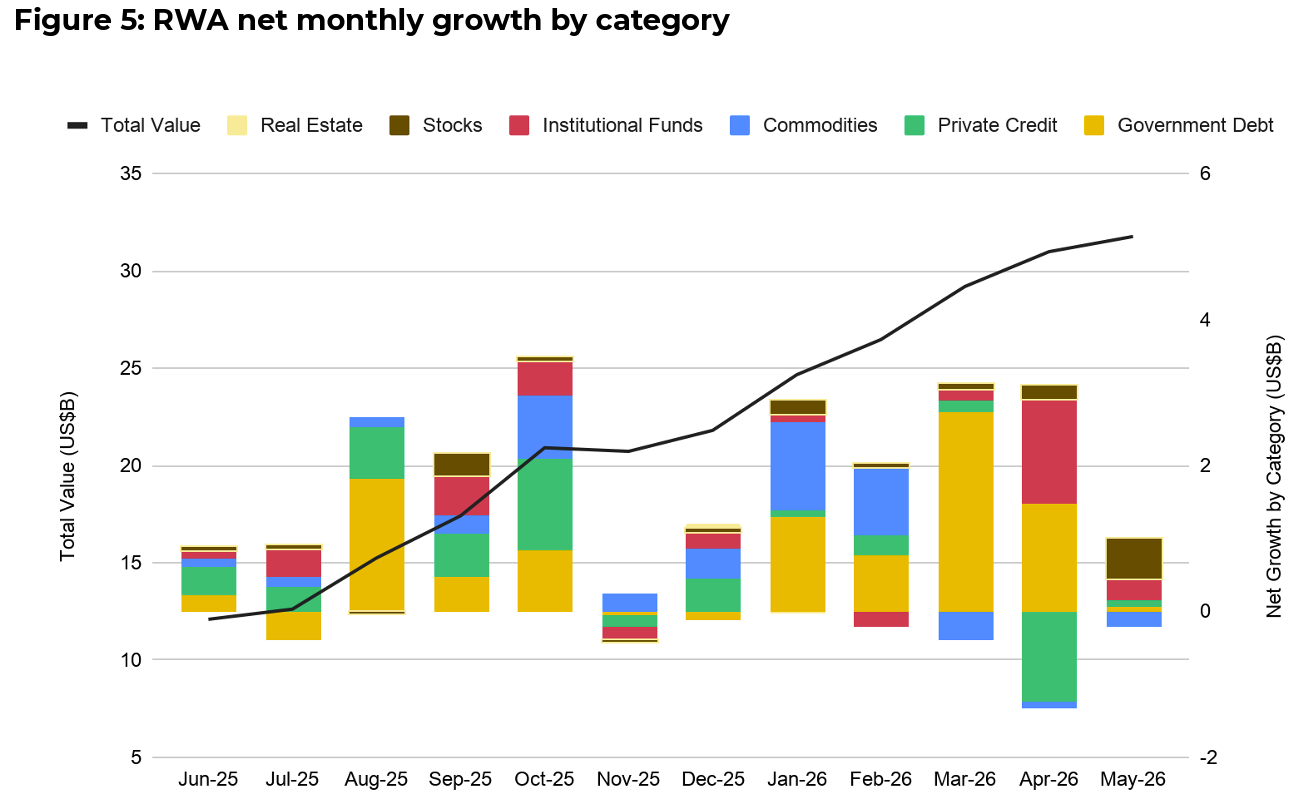
Tokenized RWAs continue to gain traction despite a weaker crypto market. According to Binance Research, the market for active tokenized RWAs has surged 589% since early 2025, with bonds and money market funds adding $6.5 billion in value while tokenized stocks jumped 422%.
The sector is also becoming more diversified. Platforms such as Ondo Global Markets have fueled demand for tokenized equities, while tokenized precious metals gained $1.5 billion as investors sought safe-haven assets earlier this year.
At the same time, traditional financial institutions are expanding their blockchain initiatives, from Apex Group’s tokenized fund services to The Clearing House’s planned tokenized deposit network, highlighting growing adoption beyond crypto-native companies.
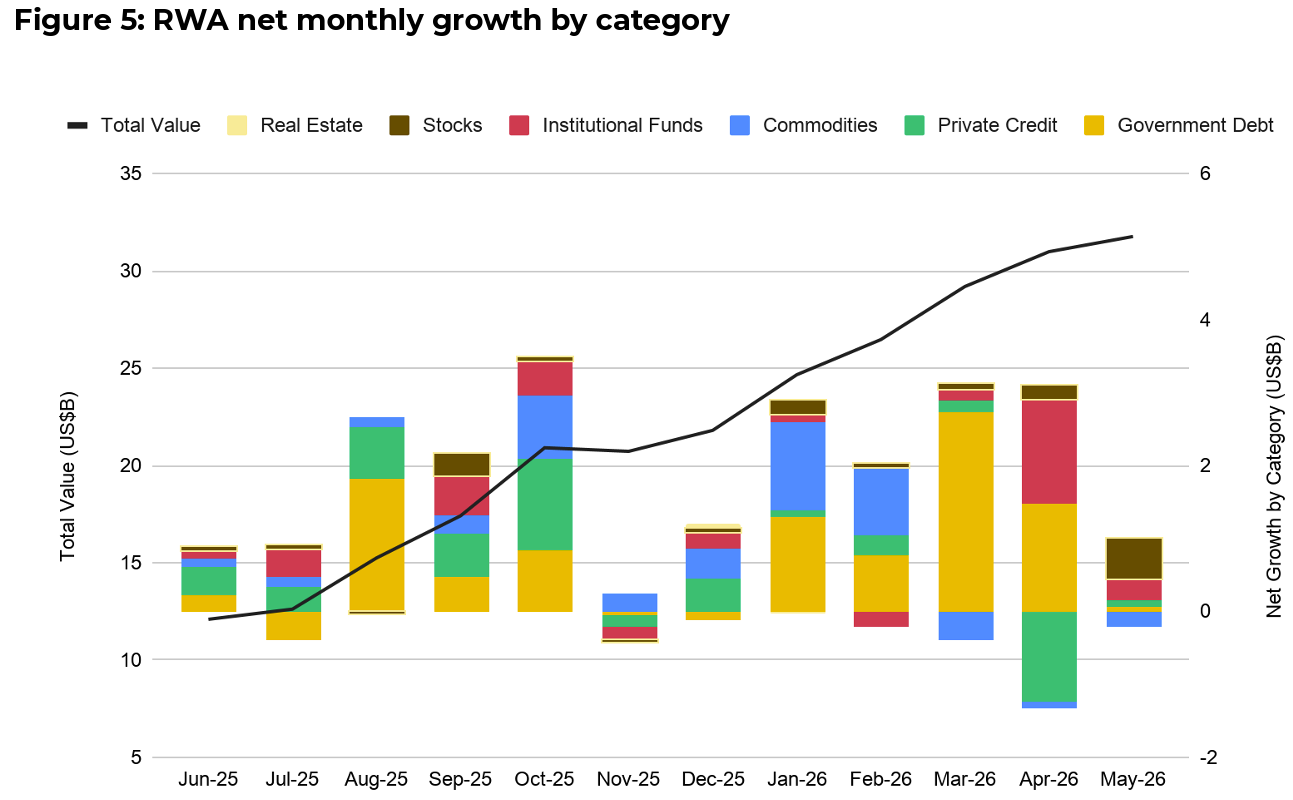
RWA growth by asset. Source: Binance Research
SpaceX IPO gets tokenized
Crypto exchange Kraken gave eligible users in more than 110 markets access to the SpaceX IPO through xStocks, allowing investors to purchase tokenized shares of Elon Musk’s aerospace company ahead of its public debut.
According to Kraken, investors who received an allocation will be issued SPCXx, a tokenized representation backed 1:1 by the underlying equity and tradable 24/7 across participating platforms.
The launch comes as demand for tokenized equities continues to accelerate. SpaceX targeted a $75 billion raise in its Nasdaq debut, with the offering reportedly oversubscribed by roughly four times ahead of public trading, putting it on track to become the largest IPO in history.
Prediction markets surpass onchain gambling
Prediction markets surpassed onchain gambling for the first time in the first quarter of 2026, generating $36.6 billion in volume compared with gambling’s $14 billion, according to blockchain intelligence firm TRM Labs. The milestone comes after both sectors topped $50 billion in annual volume in 2025, underscoring their rapid growth.
Crypto gambling, however, hasn’t lost momentum. Quarterly wagering volume remained near record highs despite the broader market pullback, with TRM attributing the resilience to a loyal and expanding user base. While so-called high rollers – who averaged $13,558 per bet and $378,000 in lifetime gambling volume – still account for most betting volume, casual bettors and daily users are driving the fastest growth, broadening participation across the sector.
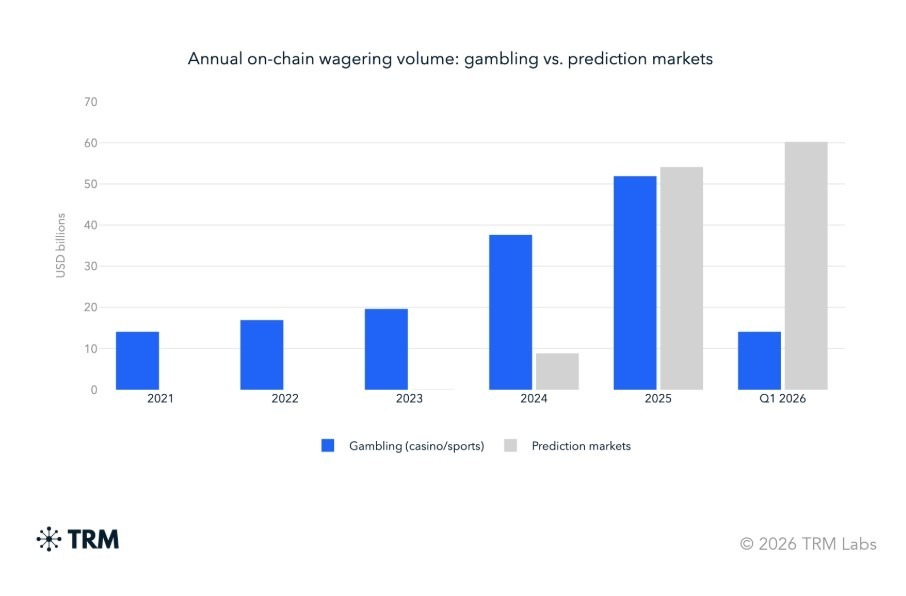
Prediction markets eclipse onchain gambling for the first time. Source: TRM Labs
Sam Bankman-Fried seeks Trump pardon
Former FTX CEO Sam Bankman-Fried has formally applied for a presidential pardon from US President Donald Trump, adding another legal avenue to overturn his conviction in connection with the crypto exchange’s multibillion-dollar collapse.
The request appears on the US Department of Justice Office of the Pardon Attorney’s list of pending clemency applications. The pardon bid comes as Bankman-Fried continues to appeal his 2023 fraud conviction and 25-year prison sentence after a separate request for a new trial was denied.
In recent months, he has also posted a series of social media messages that appear increasingly aligned with Trump, despite the president previously saying he did not plan to pardon the former crypto executive.
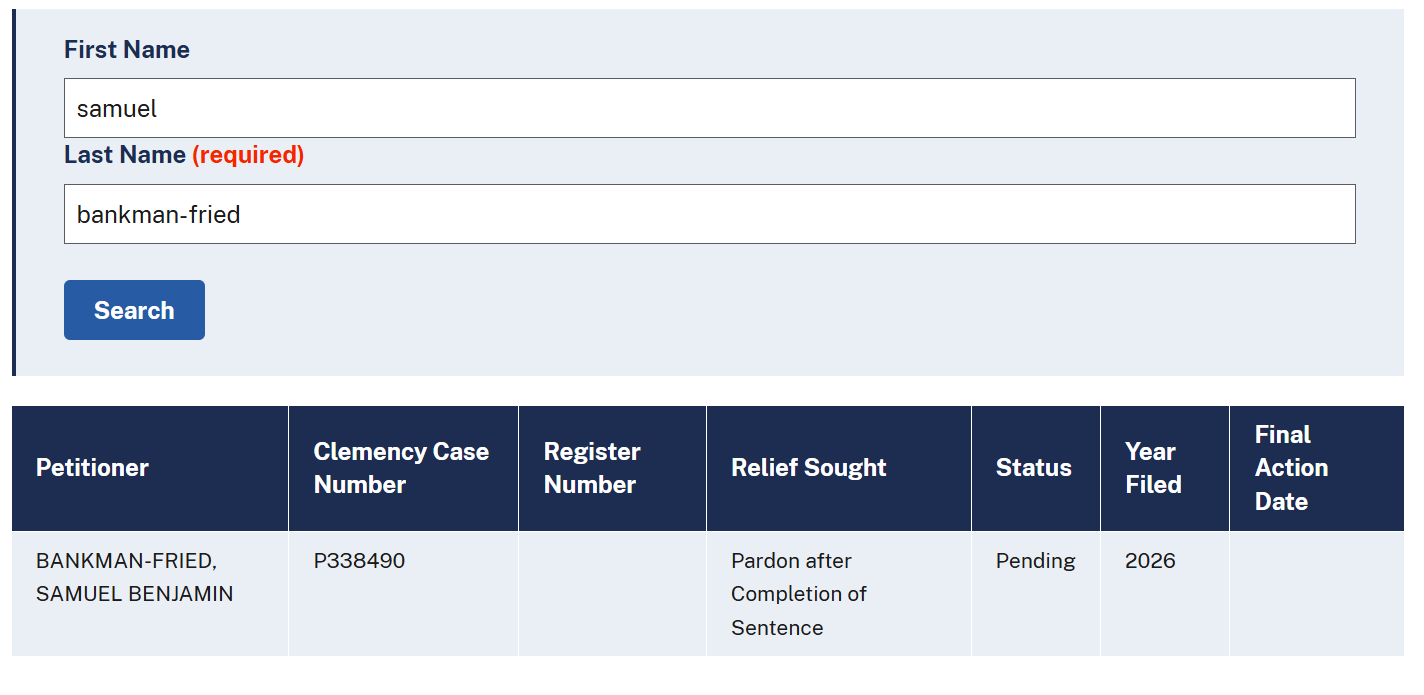
Sam Bankman-Fried’s pardon request. Source: Office of the Pardon Attorney
Crypto Biz is your weekly pulse on the business behind blockchain and crypto, delivered directly to your inbox every Thursday.
Crypto World
The U.S. government is betting $2 Billion on quantum computing, and the defense side can’t keep up


This is why the most exposed institutional holders have been waiting. They are waiting for the coordination work to happen, which a research grant does not accomplish. The work needs an actor with the standing to convene the protocol communities, the custodians, and the regulators who must move together. No funded entity has taken on that role at the scale Bitcoin requires.
The geopolitical race
Government funding accelerated the offense. Every dollar that compounds into quantum hardware compresses the defense’s runway.
The day after the U.S. announcement, Emmanuel Macron committed €1 billion to France’s quantum strategy and called for Europe to “change the scale” of investment, naming the U.S. and China as its competitors.
China had already routed roughly $17.5 billion through three regional venture funds before the U.S. announcement landed; the U.S. move now gives Beijing the political cover to authorize another round. This is what a three-way industrial-policy race looks like, and it just compressed everyone’s planning horizon, whether they were ready or not.
What has to happen now
A serious response begins with coordinated migration work, started before the offense capability matures, because the migration has a long tail, and the runway just got shorter.
What is different about the post-quantum case is the scale of the coordination challenge. Bitcoin is uniquely exposed: any address that has ever spent funds has its public key sitting onchain in the clear, forgeable the moment elliptic curve cryptography breaks, with no way to recall it.


Federal prosecutors have charged a Tennessee resident over an alleged cryptocurrency investment operation that authorities say misused investor funds.
Summary
- Federal prosecutors charged Misam Abidi with operating an alleged crypto Ponzi scheme through Star Credit Holdings.
- Authorities allege Abidi diverted more than $1.9 million of investor funds to himself and family members.
- The indictment includes wire fraud, money laundering, unlicensed money transmission, and false tax return charges.
Court documents accuse the defendant of making false claims about returns, reserves, and assets under management. The Justice Department announced the charges on Friday and outlined allegations covering activity between 2020 and 2024.
Prosecutors detail alleged investment scheme
According to the U.S. Department of Justice, Misam M. Abidi, 47, of Nolensville, Tennessee, faces an 11-count federal indictment. Prosecutors allege he operated a crypto investment company called Star Credit Holdings. Authorities claim he attracted investors through promises of high returns and claims about financial protections.
The indictment states that Abidi represented the company as managing more capital than it actually controlled. Prosecutors say investors from multiple states provided funds to the operation. Court filings allege that Abidi used investor money for purposes unrelated to legitimate trading activities.
Prosecutors claim he paid earlier participants with funds received from newer investors. The indictment describes that structure as a Ponzi-style operation. Authorities also allege he directed investor funds toward personal expenses. According to prosecutors, more than $1.9 million went to Abidi and members of his family.
Authorities cite loans and tax allegations
Federal prosecutors also accuse Abidi of helping investors obtain personal loans. According to the indictment, those loans provided additional funds for Star Credit Holdings. Authorities claim Abidi encouraged investors to borrow money in their own names. Prosecutors further allege he submitted false information connected to at least one loan application. Court documents state that one affidavit falsely claimed an investor’s identity had been stolen.
The indictment also includes allegations tied to federal tax filings. Prosecutors claim Abidi failed to report income connected to the investment operation. Authorities allege those omissions resulted in false tax returns. Federal investigators included tax-related offenses among the listed criminal counts. The charges remain allegations unless proven in court.
U.S. Attorney D. Michael Dunavant addressed the case in a public statement. “Ponzi schemes, cryptocurrency scams, and financial fraud can be devastating to individual investors,” Dunavant said. He added that such conduct can harm financial institutions and the U.S. Treasury. Dunavant also praised federal agencies involved in the investigation. He stated that prosecutors would pursue financial fraud cases throughout the district.
The indictment lists multiple federal offenses
The federal indictment includes several criminal counts. Prosecutors charged Abidi with wire fraud and money laundering offenses. Authorities also charged him with operating an unlicensed money-transmitting business. The indictment further includes counts related to false tax return preparation. Each charge carries separate penalties under federal law.
Federal investigators have not announced a trial date. Court proceedings will continue in the coming months. If a jury convicts Abidi on all counts, he could face decades in federal prison. The Justice Department announced the indictment on Friday as the latest development in the case.
This offense comes at a time when US lawmakers are trying to cope with crime. As it was reported by crypto.news, bipartisan lawmakers have introduced the Federal Cryptocurrency Theft Enforcement and Coordination Act. The bill would create a federal task force led by the attorney general and involving the DOJ, FBI, Homeland Security, and Treasury.
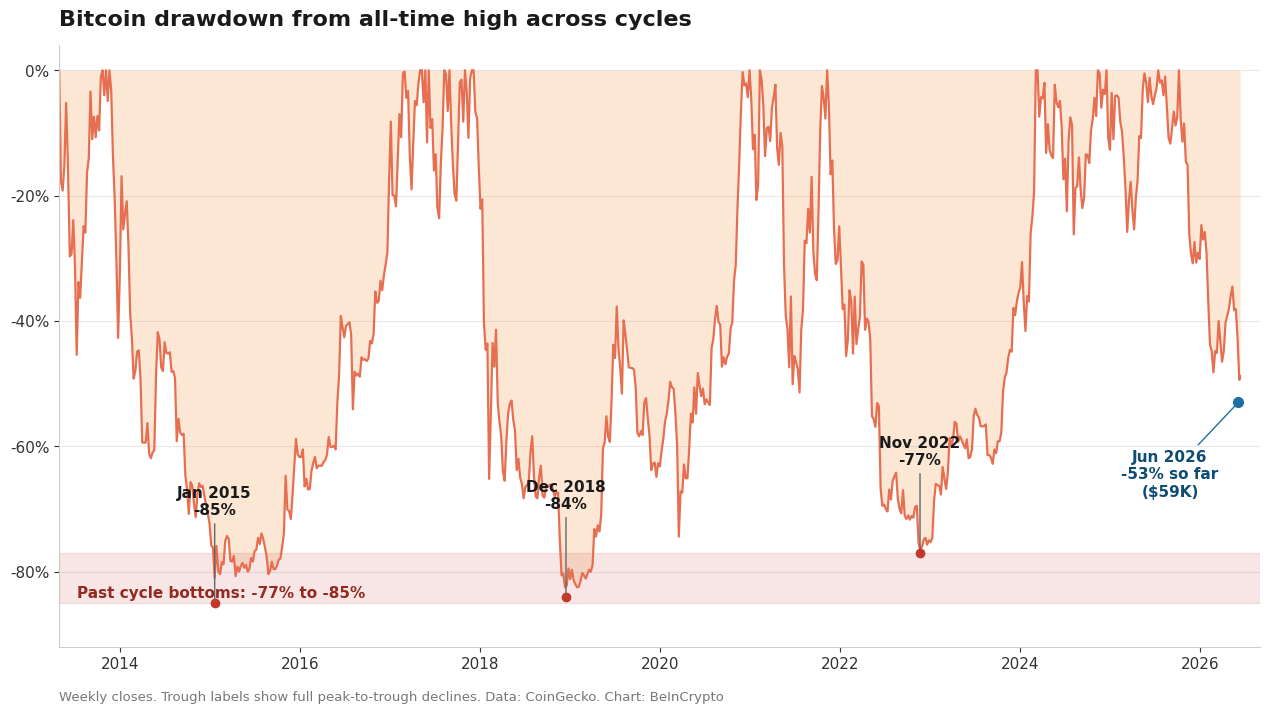
Standard Chartered says the Bitcoin (BTC) bottom is in at $59,000, while Galaxy Research argues the true low remains months away. However, both firms now reject the brutal 80% collapse that closed every previous market cycle.
Geoffrey Kendrick of Standard Chartered made his call in a Friday client note. Meanwhile, Galaxy’s Alex Thorn released a data-heavy cycle study this week arguing for patience.

Standard Chartered Calls the Bitcoin Bottom at $59,000
Kendrick, the bank’s global head of digital asset research, said the slide to $59,000 marked this cycle’s low. That level sits 53% below October’s $126,000 all-time high.
“I think we have now seen the low in crypto asset prices for the cycle. That would be USD59k for BTC (53% down from USD126k high)… Winter is over. Welcome back to crypto Spring,” Kendrick wrote in the note to clients.
Follow us on X to get the latest news as it happens
Two catalysts support his view. President Trump canceled planned strikes on Iran on Thursday and said a deal could be signed within days, before the June 15-17 G7 summit in Evian.
A truce could end the oil rally that pushed Treasury yields higher and punished risk assets.
SpaceX’s record $75 billion listing, the largest in history, is the second. Kendrick argued some ETF holders sold fund shares to free up cash for Friday’s Nasdaq debut.
Indeed, US spot Bitcoin ETFs lost roughly $4.3 billion across the record ETF outflow streak of 13 straight sessions.

Notably, the $59,000 turn sits above Kendrick’s own February forecast of a capitulation near $50,000, which he framed as a buy level for a $100,000 year-end target.
BTC traded near $63,854 as of this writing.
Galaxy Sees the Floor Closer to $40,000
Thorn, Galaxy’s head of firmwide research, reached the opposite conclusion. He said the four-year cycle is compressing, and that compression changes where the floor sits.
Galaxy anchored its thesis to the Bitcoin halvings that cut new supply every four years. It found that only four of the 13 signals that marked every prior bottom have triggered.
Moreover, the current 51% decline remains far milder than the 77% to 85% drops that ended past cycles.
Timing matters too. Past bottoms arrived 12 to 13 months after each top, and this cycle sits just eight months past its October peak.
Consequently, Galaxy’s base case puts the floor between $40,000 and $46,000, arriving by late 2026. That timing echoes separate calls for a bottom in October 2026.

“A calmer top has raised the floor, but it has not removed it,” read an excerpt in the Galaxy report.
The report also warns the floor itself can fall if a real panic emerges.
Where the Two Forecasts Meet
Despite the disagreement, both firms say the four-year cycle remains intact, just gentler. Galaxy’s data shows each bear market has grown shallower, shrinking from 85% to 84% to 77% across three cycles.
Market structure explains why.
Galaxy notes the aggregate cost basis of holders sits at 43.7% of the prior peak, versus roughly a third in earlier cycles.
Therefore, a classic capitulation would end at a much higher dollar price today.
ETF demand and corporate treasuries support that elevated cost basis. In contrast, retail-driven cycles produced the deep washouts of 2015, 2018, and 2022.
The coming days offer a quick test. Standard Chartered wants Friday ETF inflows, lower oil prices, and proof that Strategy’s 32 BTC sale was a one-off.
Those signals may show which forecast cracks first.
The post Bitcoin Bottom Debate: Standard Chartered and Galaxy Agree on Just One Thing appeared first on BeInCrypto.
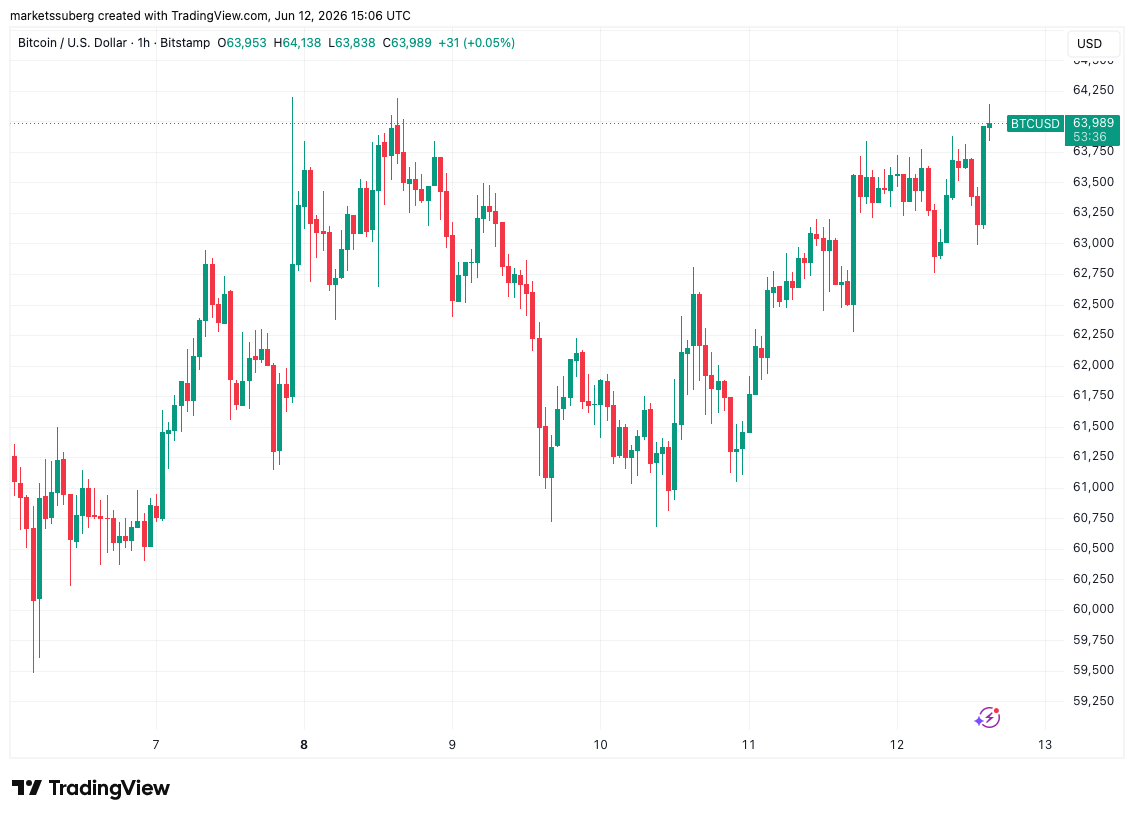
Bitcoin (BTC) hit $64,000 after Friday’s Wall Street open while analysis warned of “unreliable” BTC price support.
Key points:
- Bitcoin hits local highs during the US trading session as US-Iran peace hopes offer modest risk-asset relief.
- SpaceX looks set to launch the largest IPO ever witnessed,
- BTC price concerns linger over the ability of a key trend line to hold as support.
Crypto, risk assets “shrug off” inflation headwinds
Data from TradingView showed BTC/USD retaining gains as crypto and risk-asset markets surfed mixed signals over a US-Iran peace deal.
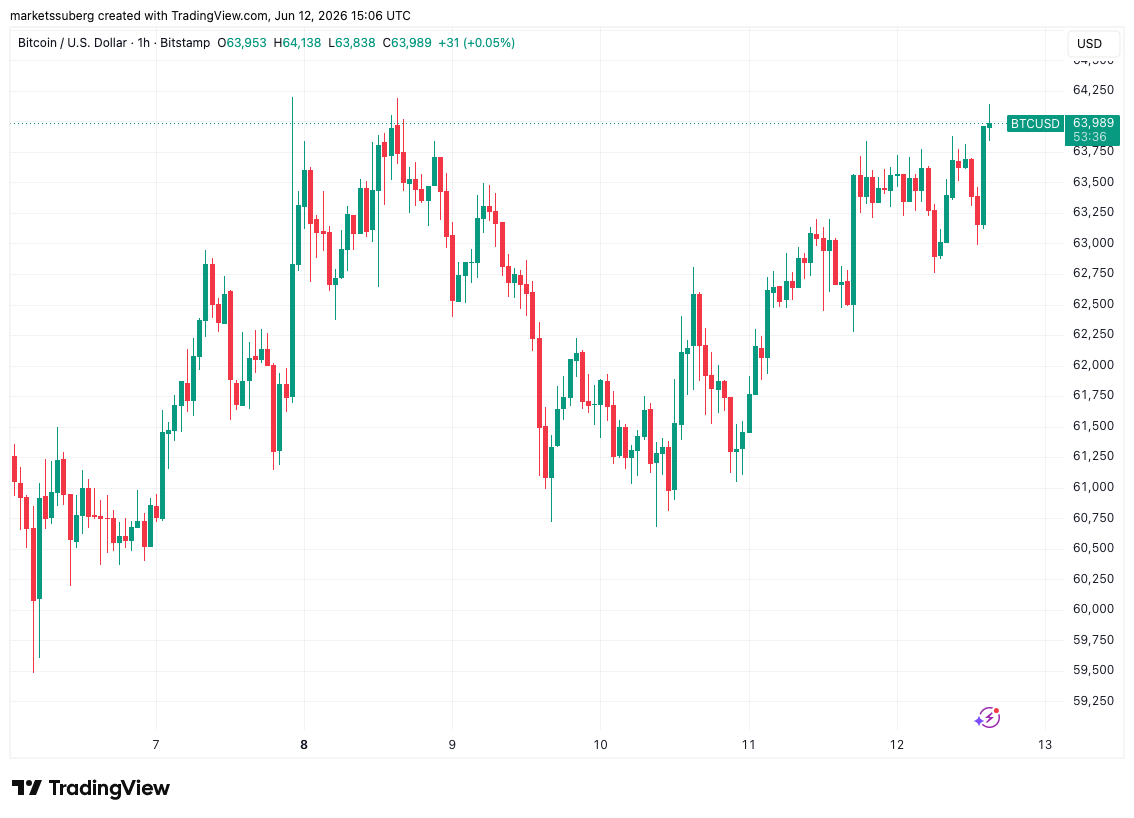
BTC/USD one-hour chart. Source: Cointelegraph/TradingView
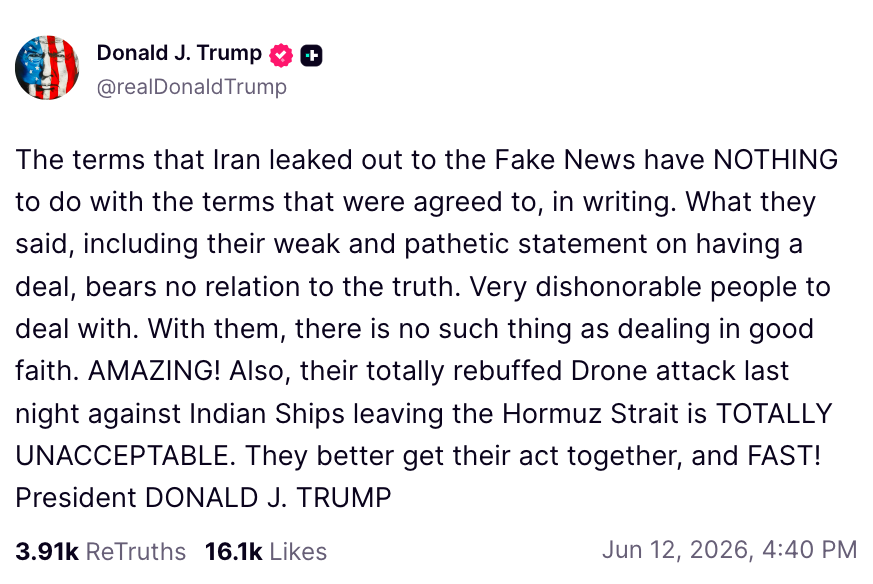
At the time of writing, there was no official information about whether a deal would go ahead, with US President Donald Trump rebutting details from the Iranian side.
“What they said, including their weak and pathetic statement on having a deal, bears no relation to the truth,” he wrote in his latest post on Truth Social.
Source: Truth Social
Stocks opted to tread water at the US open on the day that SpaceX launched the biggest initial public offering (IPO) in history. Shares were slated to debut at $170 — $45 above the initial IPO price.
In a fresh analysis, trading resource Mosaic Asset Company said that markets now faced a combination of a strong labor market and high inflation.
“While equity markets seemed to shrug off inflation fears and the impact to valuations and monetary policy, better economic data is giving the average stock a reason to rally,” it summarized in its latest Mosaic Chart Alerts update.
“While some of the air is being released from the massive rally in AI infrastructure stocks, laggards off the late March lows are turning up recently.”
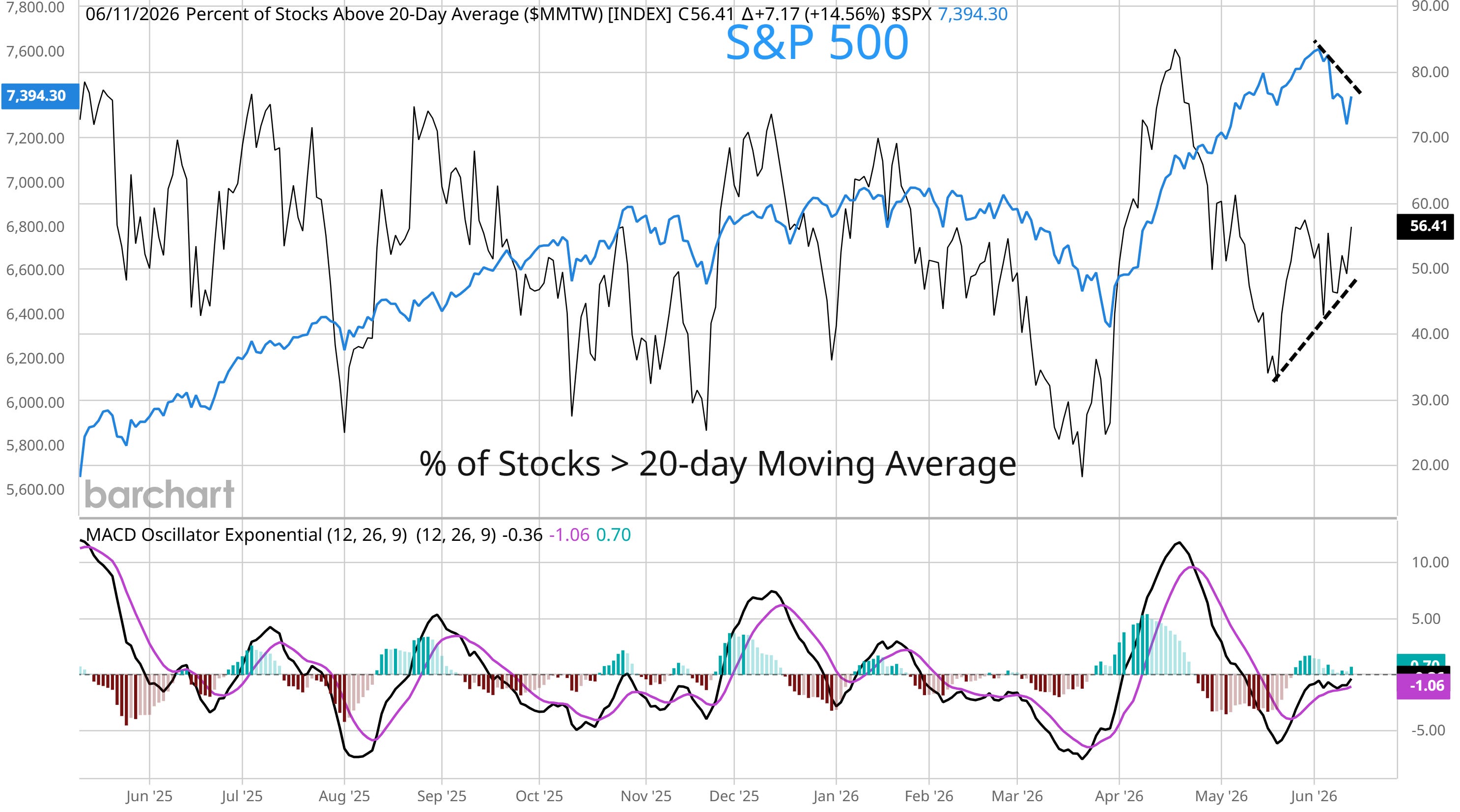
S&P 500 chart data. Source: Mosaic Asset Company
As Cointelegraph reported, this week’s US inflation data set new multi-year records on the back of the US-Iran war and its impact on oil prices.
BTC price 200-week trend line in focus
While Bitcoin saw new local highs near $64,000, market participants remained highly cautious on the outlook.
Related: Bitcoin miner ‘capitulation’ comes as trader sees later 2026 bear-market bottom
Trader and analyst Rekt Capital was suspicious of a long-term trend line holding up price — the 200-week simple moving average (SMA) at $62,025.
“Bitcoin is currently treating the 200-week SMA as support. But this SMA has historically proven to be an unreliable support, with price breaking down from it over time,” he warned X followers.
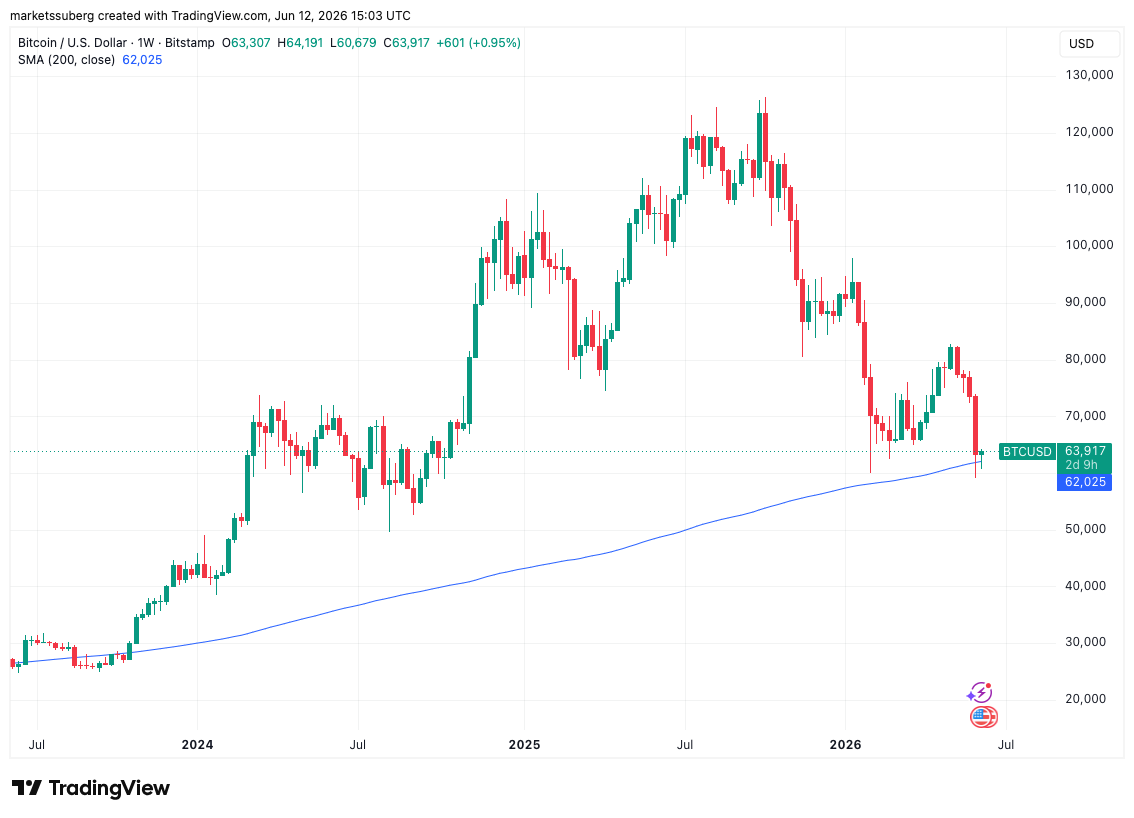
BTC/USD one-week chart with 200SMA. Source: Cointelegraph/TradingView
Rekt Capital saw additional friction coming from the fact that BTC/USD had dropped below old all-time highs from 2021.
“This deviation below old All Time Highs for Bitcoin tends to take months to fully develop to ultimately form a Bear Market bottom,” he commented.
“Though Bitcoin has deviated -14% below old ATHs thus far, this process is still technically ongoing and will be for a while.”
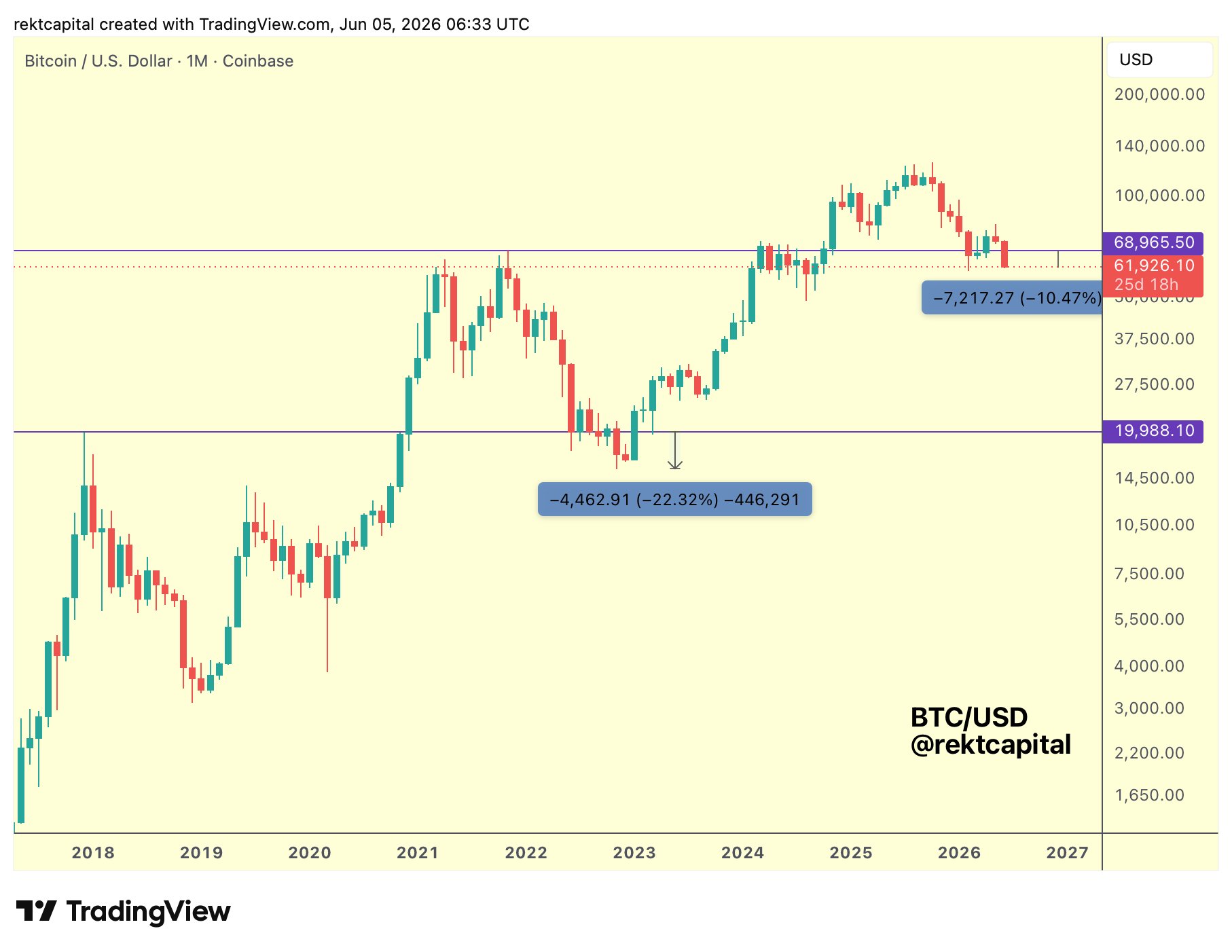
BTC/USD one-month chart. Source: Rekt Capital/X
Pi Network price has recovered from its recent record low, but a developing bearish continuation pattern and another wave of token unlocks have kept the risk of a fresh all-time low firmly in focus.
Summary
- Pi Network faces fresh downside risk as a descending triangle forms near key support at $0.124.
- More than 144 million PI tokens are scheduled to unlock over the next 30 days, keeping supply pressure elevated.
- Bulls must reclaim $0.130 and break above $0.145 to reduce the risk of a new all-time low.
According to crypto.news data, Pi Network (PI) traded near $0.128 on June 12 after rebounding from its June 6 low around $0.119. The token gained roughly 1.8% over the past 24 hours as Bitcoin climbed more than 2% and the total cryptocurrency market capitalization rose to $2.18 trillion.
Improved risk appetite followed reports that President Donald Trump halted planned U.S. airstrikes against Iran, while traders also reacted to SpaceX’s public market debut and its reported Bitcoin holdings.
June 18 has emerged as the next major catalyst for the ecosystem. The Pi Core Team has required all Mainnet node operators to complete the Protocol 25 upgrade by that date, warning that nodes that fail to upgrade may be disconnected from the network.
The upgrade introduces compatibility with Stellar Core V20 and lays the groundwork for Soroban smart contracts, a development many holders view as a step toward DeFi and tokenization use cases within the Pi ecosystem.
Exchange flows have started to improve despite the weak price trend. Recent wallet data showed 579,018 PI leaving tracked centralized exchanges against inflows of 319,304 PI, resulting in net outflows of 259,714 tokens.
Exchange balances stood at roughly 546.4 million PI, while most major trading venues, including OKX, Bitget, MEXC, Gate.io, LBank, and Kraken, recorded negative daily flows.
Reduced exchange balances can ease immediate selling pressure, although the effect remains limited by the network’s unlock schedule.
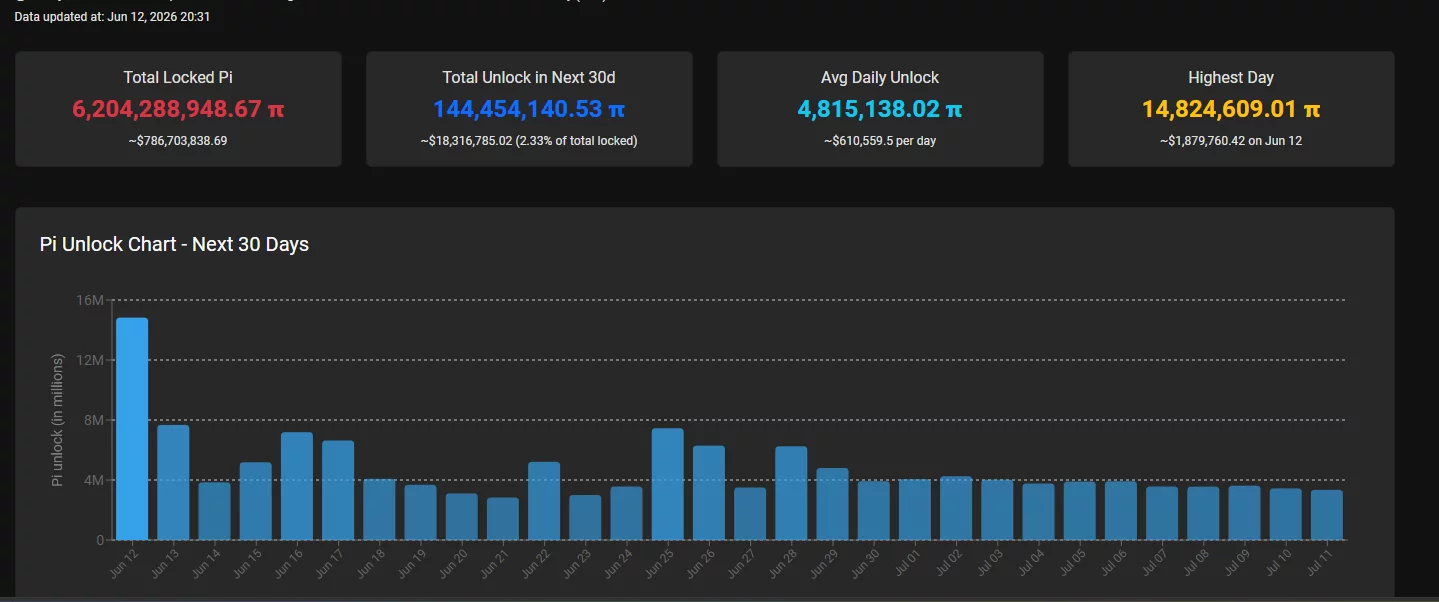
Fresh supply continues to enter circulation at a rapid pace. Pi unlock data shows that approximately 144.45 million PI tokens will be released over the next 30 days, representing about 2.33% of locked supply. Average daily unlocks stand near 4.8 million tokens, while June 12 alone is scheduled to see more than 14.8 million PI unlocked, the largest single-day release during the period.
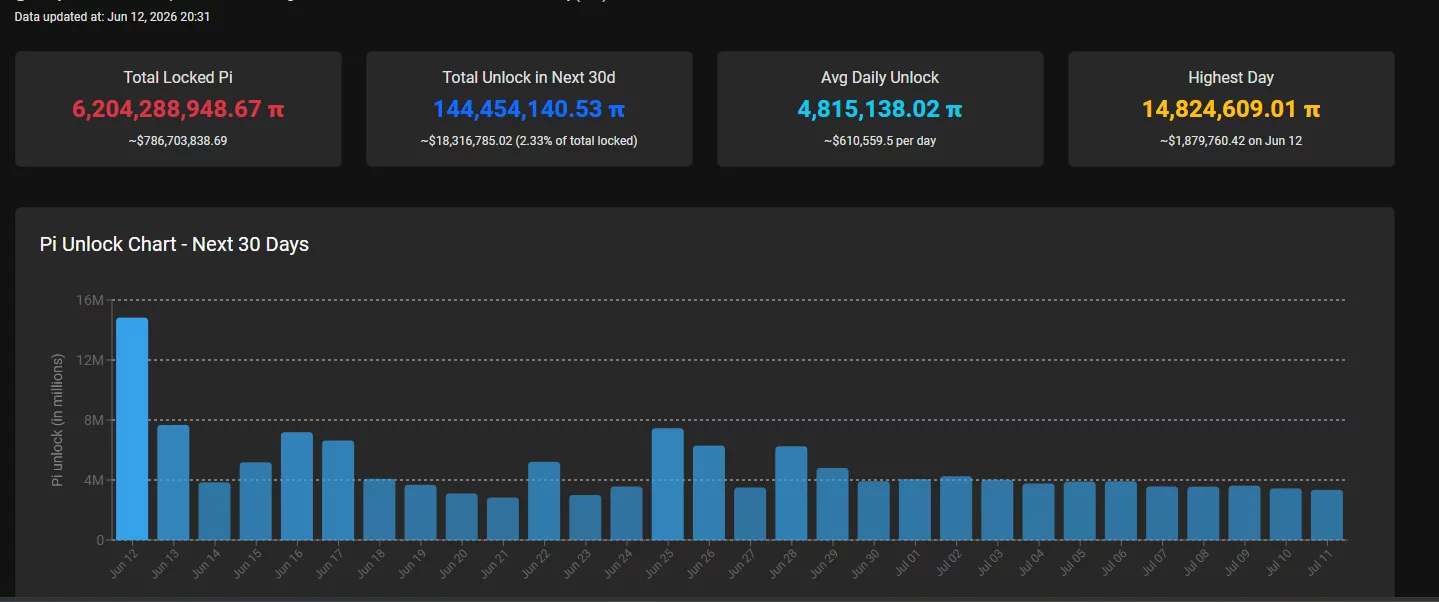
Thin liquidity has amplified the impact of those releases. Daily trading activity remains relatively modest compared with the size of incoming supply, leaving the token vulnerable to selling from early miners and users completing KYC verification and Mainnet migration.
Previous unlock waves coincided with accelerated declines as newly available tokens entered exchange wallets.
Descending triangle keeps pressure on key support
The four-hour chart shows PI forming an inverse cup-and-handle pattern after its recovery from the June 6 low near $0.119. Price climbed toward $0.132 before losing momentum and carving out a downward-sloping handle beneath resistance. The structure places key support between $0.124 and $0.125.
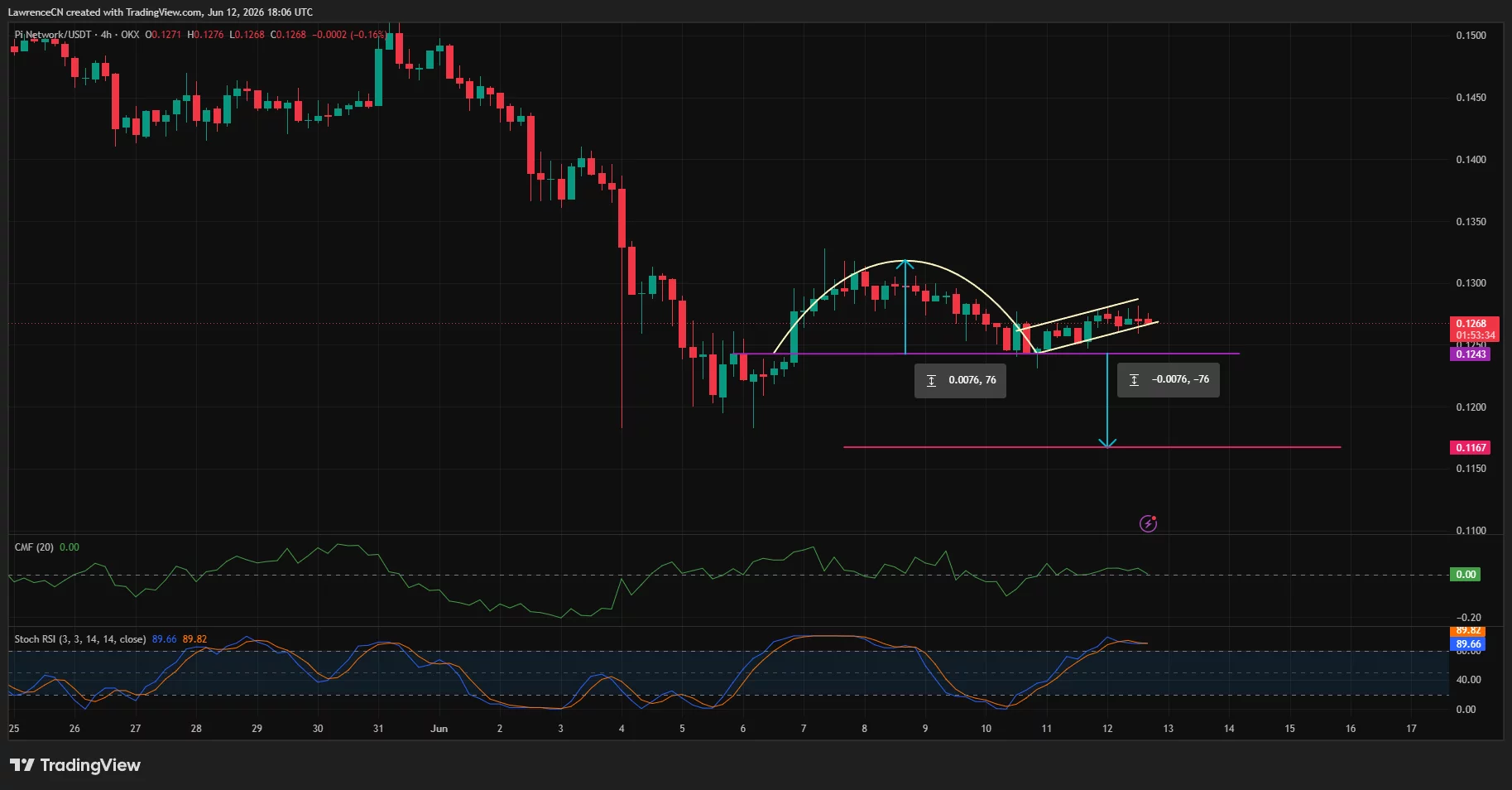
A breakdown below that zone would confirm the bearish continuation pattern and expose the measured target near $0.116. Such a move would place the June all-time low back under pressure and could open the door to another leg lower if sellers regain control.
The daily chart presents a similar picture. PI remains trapped beneath a descending trendline that has controlled price action since early May. The token also continues to trade below its Supertrend resistance near $0.146, while a former support area around $0.130 has turned into overhead resistance.
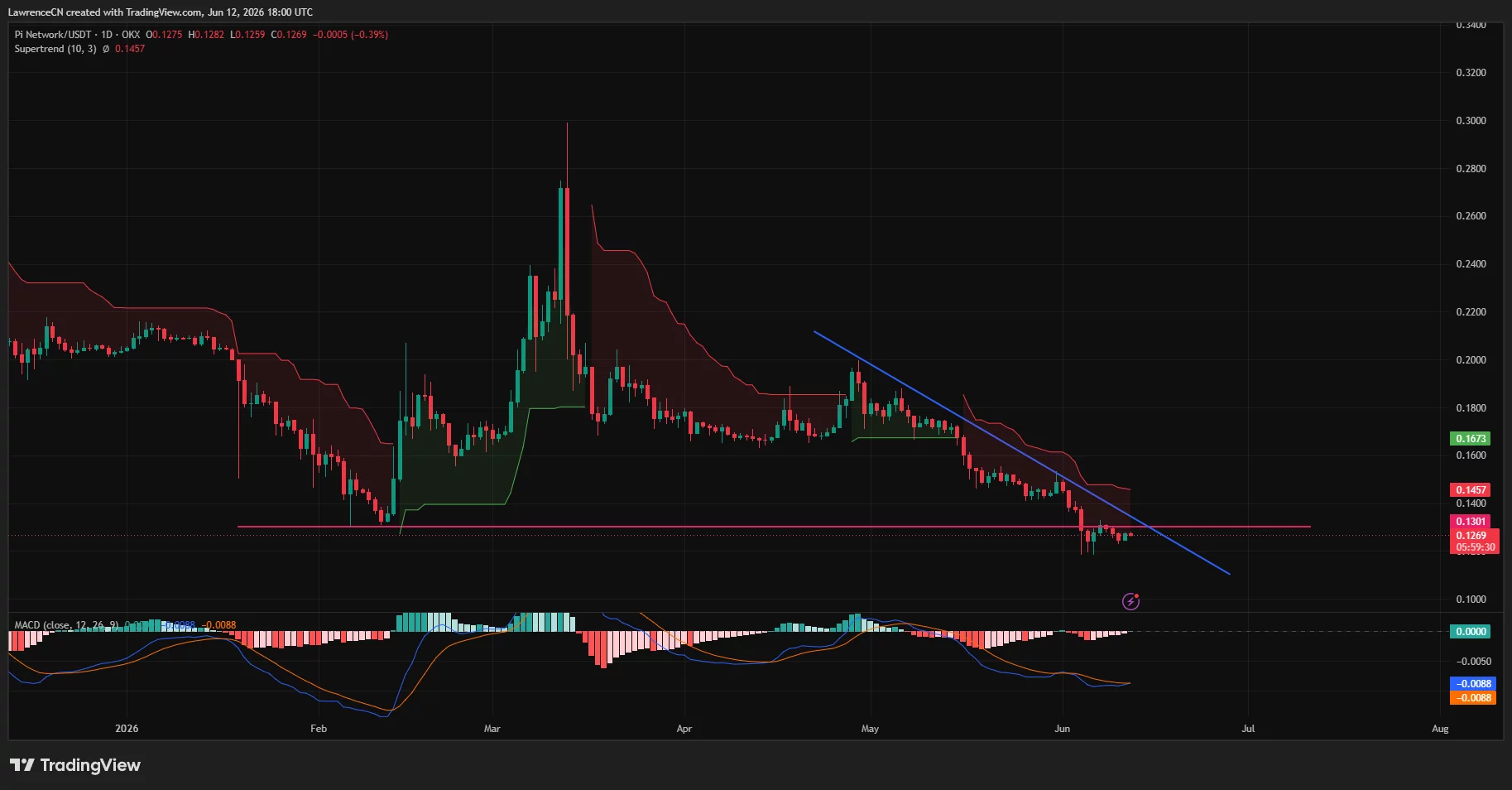
Momentum indicators have yet to deliver a convincing bullish reversal. The MACD remains below the zero line despite some improvement in histogram readings, while price continues to print a sequence of lower highs and lower lows. Stochastic RSI on the four-hour timeframe has climbed into overbought territory, raising the possibility of another short-term pullback.
Token unlocks and macro risks threaten the recovery
Macro conditions remain another source of uncertainty. Pi’s latest rebound arrived alongside a recovery in Bitcoin and risk assets, but any reversal in crypto sentiment could quickly revive selling pressure across smaller-cap tokens.
Large altcoins continue to trade near critical support levels, and leveraged crypto markets remain sensitive to geopolitical headlines and Federal Reserve policy expectations.
For Pi Network, bulls must reclaim $0.130 and then break above the descending trendline near $0.145 to invalidate the current bearish structure. A successful breakout would also put the Supertrend resistance at risk and improve the odds of a move toward $0.18.
Until then, the combination of persistent token unlocks, weak long-term trend structure, and a developing bearish pattern leaves PI vulnerable to another breakdown.
A decisive move below $0.124 would increase the probability of a retest of $0.119 and could open the door to a fresh all-time low below the June bottom.
Disclosure: This article does not represent investment advice. The content and materials featured on this page are for educational purposes only.
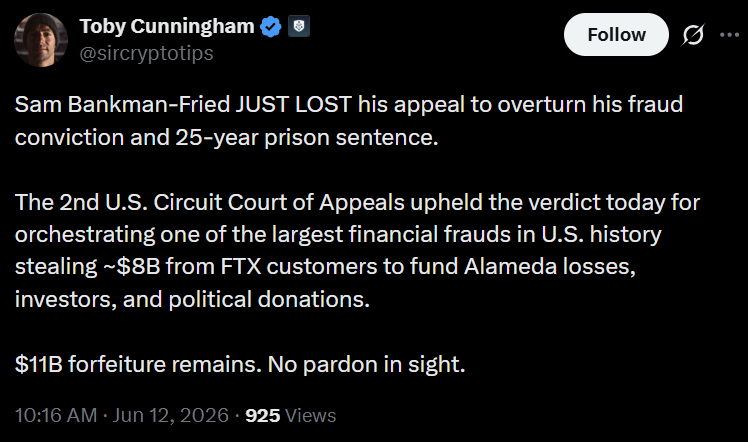
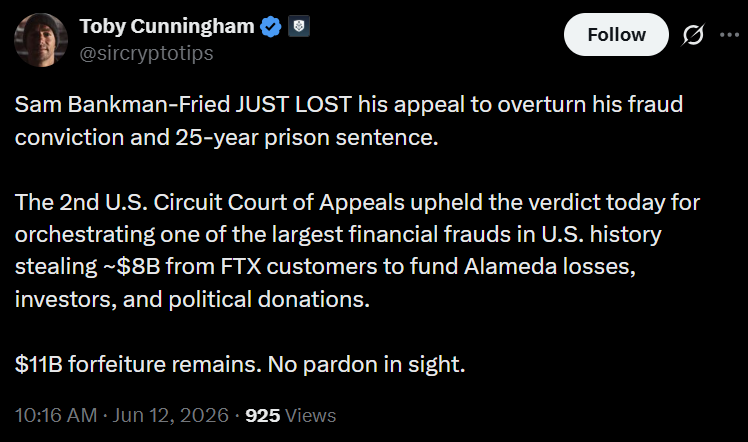
Former FTX CEO Sam Bankman-Fried failed to overturn his fraud conviction and 25-year prison sentence tied to the collapse of FTX after a three-judge appeals panel rejected his bid for relief.
The unanimous ruling by the 2nd US Circuit Court of Appeals in Manhattan, New York, found that the government’s case against Bankman-Fried was, in the court’s words, “conservatively stated, robust,” according to Reuters.
Source: Toby Cunningham
“While he was publicly reassuring customers, investors and regulators that FTX customer funds were safe, he was simultaneously using FTX as his own personal piggy bank, spending customer funds on real estate, political contributions, and investments,” wrote Circuit Judge Barrington Parker.
The decision comes as Bankman-Fried pursues another avenue to challenge his conviction. As Cointelegraph recently reported, he has formally applied for a presidential pardon from US President Donald Trump, with the request appearing on the US Department of Justice Office of the Pardon Attorney website in early June.
Bankman-Fried was sentenced to 25 years in prison in 2024 after being convicted on fraud and conspiracy charges stemming from the multibillion-dollar collapse of FTX.
Related: Sam Bankman-Fried ramps up Trump support following Ellison’s release
Bankman-Fried’s pardon bid faces long odds
In a recent interview with Fox Business, Bankman-Fried said he was “absolutely” seeking a presidential pardon from Donald Trump. However, the former FTX CEO does not appear to have much support from the president.
Trump told The New York Times in January that he had no plans to pardon Bankman-Fried. A White House spokesperson also declined to comment on the clemency request, referring Bloomberg last week to the president’s earlier remarks.
Still, Trump has shown a willingness to grant high-profile pardons, including one for Silk Road founder Ross Ulbricht shortly after returning to office.
Ulbricht operated the dark web marketplace Silk Road, which used Bitcoin as a primary payment method. He was serving two life sentences plus 40 years before Trump pardoned him in January 2025.
Related: FTX law firm Fenwick & West to pay $54M to victims in settlement


SpaceX shares opened at $150 on Friday before rising to $162, marking a strong start to one of the most closely watched stock market debuts in recent years.
The aerospace and satellite internet company priced its initial public offering at $135 per share on Thursday. SpaceX sold 555.6 million shares, raising $75 billion in what stands as the largest IPO ever.
Bitcoin was roughly flat at $63,400, while AI-related crypto stocks saw modest gains.
Trading under the ticker SPCX on Nasdaq, the company had been valued at roughly $1.8 trillion based on the IPO price.
The debut gives public investors their first chance to own shares in a company that has reshaped the commercial space industry through reusable rockets and built one of the world’s largest satellite networks through Starlink. The satellite internet business has become a major source of growth, serving customers in remote areas where traditional broadband can be difficult to access.
SpaceX generated about $19 billion in revenue last year from launch services, government contracts and Starlink operations.

Jonah Hill’s Long-Awaited R-Rated Comedy Sequel Finally Confirmed

Elon Musk’s SpaceX soars to two trillion dollars in record-breaking IPO

Lotza rolls out sparkling soda


![[KPOP IN PUBLIC] LISA - 'MONEY' | Cover by BN DANCE TEAM FROM VIETNAM](https://wordupnews.com/wp-content/uploads/2026/02/1770893501_maxresdefault-80x80.jpg)
-
 Entertainment6 days ago
The Best Mystery Series of All Time Is Surging on Streaming 30 Years After It Ended
-

 NewsBeat5 days ago
Alexander Zverev wins the French Open to finally earn a 1st Grand Slam title
-

 Crypto World5 days ago
Anatomy of the June crypto crash: Fed, Iran, Saylor
-

 Crypto World1 day ago
Oppenheimer backs SpaceX as $70 billion retail frenzy builds
-

 Tech7 days ago
Suspicious Polyfill login prompts pop up on Toshiba, Muji websites
-

 Crypto World1 day ago
Markets Rally as SpaceX IPO Looms Amid Iran Tensions and Inflation Surge
-
 Crypto World6 days ago
Senator Cynthia Lummis Calls CLARITY Act the Most Consequential Financial Legislation of This Generation
-

 Tech5 days ago
Microsoft unveils seven homegrown AI models in new bid for ‘long term self-sufficiency’
-
 NewsBeat5 days ago
Alexander Zverev conquers demons and outlasts Flavio Cobolli to win French Open for first major title
-

 Tech7 days ago
Von der Leyen’s AI envoy pick draws conflict-of-interest fire
-

 Business5 days ago
High Stakes for Wembanyama as New York Pushes for 3-0 Lead
-

 Tech6 days ago
Hackers now exploit SolarWinds Serv-U flaw to crash servers
-
 Business6 days ago
The Pain Points Taking a Fragile Tech Rally Down a Notch
-
 Crypto World4 days ago
Eli Lilly (LLY) Stock Surges 4% Following Breakthrough Sleep Apnea Trial Results
-

 Tech5 days ago
Notion restores access to Anthropic after service disruption
-

 Crypto World5 days ago
Trump’s AI Ownership Plan Could Benefit Anthropic at OpenAI’s Expense
-
 Business5 days ago
The investment to transform historic St Helen’s ground in Swansea
-
 Sports3 days ago
Bangladesh beat Australia after 20 years in ODIs, register only their second win over six-time world champions | Cricket News
-

 Business6 days ago
Forensic Expert Floats Handyman Theory in Disappearance of Savannah Guthrie’s Mother
-

 Tech5 hours ago
This Week In Security: Microsoft On Microsoft, Register Your Domains, Linux On ARM, And FreeBSD Joins The File Cache Club
You must be logged in to post a comment Login