

Crypto World
NEAR Protocol Price Outlook for June: Key Drivers and Targets


NEAR Protocol’s native token has stood out in a tense market, delivering a sharp rebound as the broader crypto space wavered. NEAR touched as high as $2.75 on Tuesday, logging roughly a 20% surge in the last 24 hours even as overall crypto market capitalization slipped about 3.7% in the same period. The move underscores a blend of recovering on-chain activity and a forward-looking upgrade pathway designed to improve scalability for AI- and privacy-centric use cases on NEAR.
Traders and analysts are watching a familiar-yet-bullish pattern emerge: a bottoming setup in which NEAR has clawed back from a multi-year low and is testing a key resistance zone tied to long-term trend lines and technical averages. The setup, while not a guarantee of a continuation, has historically preceded sizable upside moves in similar basing phases for NEAR.
Key takeaways
- NEAR is rebounding from a long-term bottom around $0.90–$1.10, with a potential path toward the $3.40–$3.77 area if the pattern plays out similarly to prior rallies.
- On-chain fundamentals look supportive: NEAR Intents, the protocol’s cross-chain transaction system, logged $19.69 billion in volume and generated about $32.64 million in fees, according to DefiLlama data.
- The network is poised for a June upgrade that introduces dynamic resharding, a feature designed to automatically scale capacity with demand, reducing the need for manual infrastructure tinkering.
- A fractal-style lens suggests upside of roughly 25%–40% from current levels, with an initial obstacle near $2.61–$2.72 where the 100-week EMA and the 0.236 Fibonacci level converge.
- Longer-term views echo bullish sentiment from notable market voices; BitMEX co-founder Arthur Hayes has described a substantial upside potential for NEAR over time.
Price action in a fractal setup
NEAR’s price action has drawn a vivid parallel to its prior rebound cycles. The weekly chart shows a rebound from a bottom zone centered around $0.90–$1.10, a region that previously coincided with meaningful rallies in 2021 and 2024. Historical context matters here: the 2021 rebound from that zone produced eye-popping gains, and the 2024 recovery yielded another multi-hundred-percent upside. In each instance, the rally faced resistance around a descending trend line, which effectively capped momentum at key points.
As of the latest readings, NEAR had climbed about 225% from its February bottom and was pressing against a multi-year descending trend line resistance. The most likely near-term upside target lies in the $3.40–$3.77 zone, a confluence area where the 200-week exponential moving average (EMA) and the 0.382 Fibonacci retracement align. If reached, that would signal a substantial acceleration from current prices, potentially extending NEAR’s gains into the 25%–40% range depending on the speed and continuity of buying pressure.
On the flip side, the path is not without friction. A more durable breach above the $2.61–$2.72 area—coinciding with the 100-week EMA and the 0.236 Fibonacci level—would be a bullish signal, opening the door to a test of higher targets. However, failure to clear this resistance zone could invite a pullback toward the 50-week EMA near $2, translating to a roughly 30% slide from the current level if momentum fades. The weekly RSI sits near 68, which indicates robust momentum but also suggests the market could tip into overbought territory if buyers push hard into the next leg up; a move above 70 would heighten the risk of short-term consolidation or a pullback toward $2.
Chart context for the price framework comes from TradingView-based technicals, with the weekly view emphasizing the resonance of these longer-term averages and trend lines in shaping NEAR’s trajectory. See the market visuals here: TradingView.
Fundamental tailwinds: NEAR Intents and the June upgrade
Beyond price action, NEAR’s narrative rests on a combination of practical on-chain activity and structural upgrades meant to bolster scalability. NEAR Intents—NEAR’s cross-chain transaction framework—has gained attention as a frictionless cross-chain mechanism that aims to move assets across blockchains without the ongoing burden of bridges or fragmented liquidity. In terms of activity, DefiLlama data shows NEAR Intents handling roughly $19.69 billion in volume and generating about $32.64 million in fees, underscoring meaningful utilization that can underpin a price resilience narrative in a recovering market.
The upcoming June upgrade is central to the bullish case. The upgrade introduces dynamic resharding, a mechanism designed to automatically scale network capacity in response to rising demand. This approach reduces the operational burden on developers and users who previously had to manage layered infrastructure changes to accommodate growth. Dynamic resharding can improve throughput and reduce latency without requiring manual sharding interventions, potentially making NEAR a more attractive platform for AI- and privacy-focused apps that require robust performance under load.
These developments arrive as the ecosystem has continued to pursue AI-oriented and privacy-preserving use cases. NEAR’s emphasis on cross-chain interoperability and scalable architecture positions it to compete with other high-throughput layer-1s that are likewise courting AI-native workflows and cross-chain liquidity.
Market commentary around NEAR’s longer-term potential is shaped by industry voices as well. Notably, Arthur Hayes, co-founder of BitMEX, has signaled a belief that NEAR could deliver substantial upside over time, citing a multi-factor thesis that combines ecosystem development with scalable technology. For readers seeking the origin of that view, see the referenced discussion: Hayes’ stance on NEAR’s long-term growth.
What this means for investors and builders
From an investment perspective, NEAR’s current setup presents a nuanced picture. The price action suggests a nascent upside that could be accelerated if the $2.61–$2.72 resistance zone gives way, opening a path toward the longer-term target near the 200-week EMA and the 0.382 retracement. The fractal-like pattern provides a rough map for upside magnitude, but it also highlights the risk: a failed breakout could pull NEAR back toward the lower boundary of its recent range, especially if broader risk appetite remains fragile.
On-chain activity adds a degree of credibility to the move. The NEAR Intents data indicates real usage and fee generation, offering a structural complement to price momentum. If the June upgrade delivers on the promise of dynamic resharding, the network could handle larger volumes more gracefully, supporting real-world adoption as developers push AI- and privacy-first applications that leverage cross-chain capabilities. In other words, the upgrade is not just a tech upgrade; it could be a pivot point for user acquisition and developer interest, both of which matter for long-term value capture.
In the broader market context, investors should balance the optimism with the realities of momentum-driven moves. The RSI signals momentum but can overheat if price climbs too aggressively. The key near-term challenge remains breaking above the $2.61–$2.72 zone to validate the fractal-based upside thesis. If the price clears this resistance decisively, new targets become more credible; if not, a consolidation or pullback toward the mid-$2s could reassert itself.
For builders and users, the June upgrade is the focal point. Dynamic resharding addresses a common scalability friction and could meaningfully improve the user experience as traffic grows. If NEAR can demonstrate tangible reductions in friction and improved throughput during high-demand periods, it would reinforce the narrative that NEAR is well-positioned to support AI-driven use cases and privacy-focused integrations, differentiating it from other scaling narratives that rely primarily on rollups or cross-chain bridges.
Where the story goes next
Readers should watch how NEAR handles the approaching resistance zone and whether the June upgrade delivers on its scalability promises. The combination of a technical breakthrough with tangible on-chain activity and a defined upgrade roadmap could set the stage for a more durable rally. Yet, the market’s memory of sharp corrections serves as a reminder that continued upside would require sustained demand and clear fundamental catalysts to support higher levels.
As the ecosystem progresses, the next milestones—upgrading the network for dynamic resharding and demonstrating real-world cross-chain efficiency through NEAR Intents—will be the telltale signs of whether this rebound gains lasting traction or remains a pulse of momentum within a broader seasonal environment.
Stay tuned for further progress on the June upgrade and for any shifts in on-chain activity that might accompany NEAR’s price path. The intersection of scalable tech, cross-chain utility, and AI-focused development will likely define NEAR’s role in the evolving multi-chain landscape over the coming months.

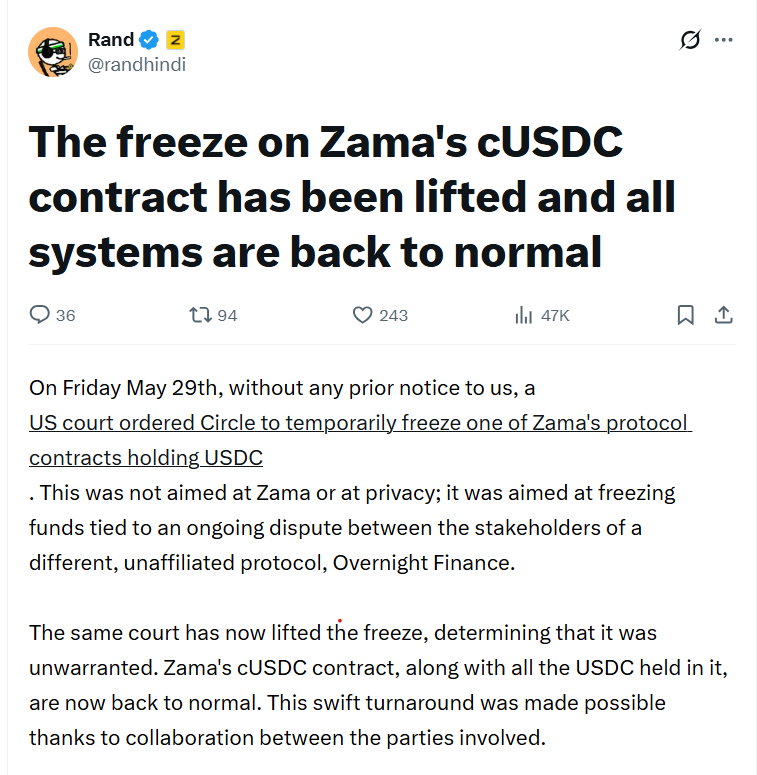
Privacy-focused blockchain protocol Zama said it will accelerate compliance measures and proceed with its confidential USDC launch after a US court lifted a temporary freeze on about $12.5 million in USDC held in its cUSDC smart contract, according to a Tuesday X post by co-founder Rand Hindi.
The freeze, first reported by Cointelegraph on Saturday, stemmed from a temporary restraining order obtained in connection with an ongoing dispute involving stakeholders of an unrelated project, Overnight Finance. Circle froze the funds after receiving the court order, even though Zama was not a party to the case, according to Hindi’s account.
“The same court has now lifted the freeze, determining that it was unwarranted,” Hindi wrote. He added that the protocol’s cUSDC contract and all underlying USDC had returned to normal operation.
The incident highlights tensions between privacy-focused blockchain infrastructure and centralized stablecoins whose issuers can freeze assets under court order.
Hindi argued that the episode “could have happened to any protocol holding freezable assets,” including decentralized exchanges, lending protocols and bridges.
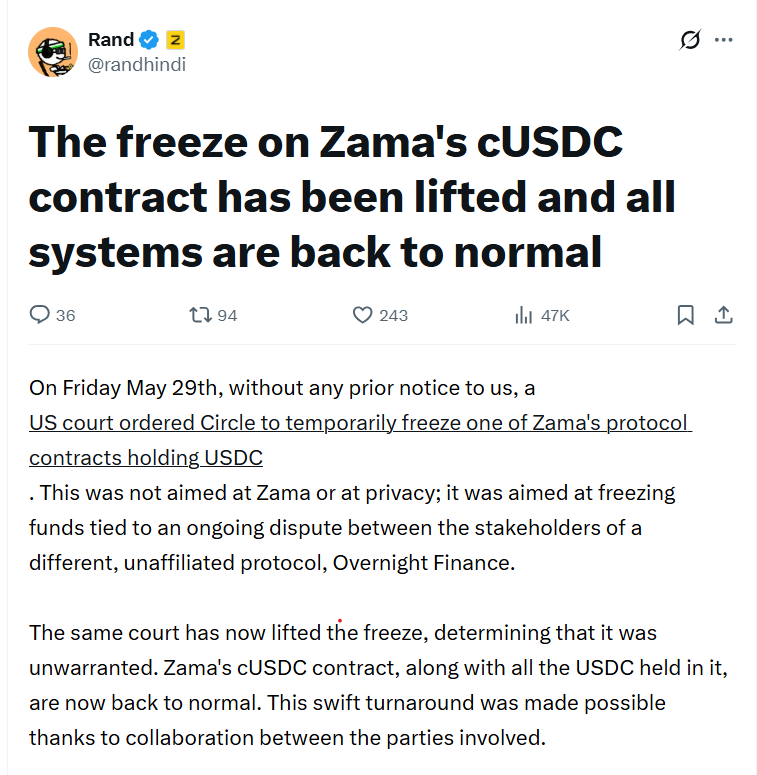
Zama USDC freeze lifted. Source: Rand Hindi
According to Hindi, approximately $12.5 million in USDC was deposited into Zama’s confidential USDC wrapper on May 11.
He said the deposit address later became the subject of litigation and a temporary restraining order connected to a dispute involving Overnight Finance. Because the deposit represented more than 99% of the contract’s total value shielded, plaintiffs sought a blanket freeze order through Circle, he said.
Jeremy Bradley, Zama’s chief operating officer, told Cointelegraph the court ultimately concluded that freezing an entire smart contract pool imposed disproportionate harm on uninvolved users. He said Zama demonstrated that, because its protocol preserves visible sender and recipient addresses while encrypting balances and amounts, the disputed account could be isolated and frozen directly without affecting other users.
Bradley said the case illustrates how protocols holding centralized stablecoins in pooled contracts may be exposed to similar risks. “Automated market makers, lending protocols, bridges, and anyone holding USDC in a pooled contract is effectively one court order away from this exact situation,” he said.
Related: SEC Commissioner Peirce defends crypto privacy tools against surveillance push
Zama to accelerate compliance roadmap
In response, Zama said it will accelerate its compliance roadmap, including introducing automatic enforcement of compliance actions taken by underlying asset issuers.
Under the proposed framework, if Circle freezes a USDC address, the corresponding confidential USDC held by that address would also be frozen. The protocol also plans to establish a compliance council and integrate additional compliance and transaction-monitoring tools.
Bradley said the measures accelerate an existing roadmap rather than represent a change in strategy. “We always designed the protocol with programmable compliance in mind,” he said, adding that the incident made deploying those tools more urgent and would help provide institutions with greater confidence in the protocol’s ability to respond to legal requests.
Despite the incident, Hindi said Zama remains committed to building on USDC and plans to launch its cUSDC product later this month, including shielding $5 million of USDC from its own treasury.
Bradley said the episode has reinforced interest from institutional users rather than dampened it, arguing that the court’s decision to lift the freeze demonstrated that the protocol can operate within existing legal frameworks while preserving privacy features.
He added that Circle was acting pursuant to a court order and that the broader issue was the lack of tools for carrying out targeted freezes without affecting entire smart contract pools.
Asia Express: North Korea denies crypto hacks, Upbit’s bank tests Ripple
Strategy’s (MSTR) first bitcoin sale since 2022 may have been tiny relative to its massive $58 billion holdings, but the market’s reaction could signal a broader shift in crypto markets, according to Standard Chartered’s head of digital asset research, Geoff Kendrick.
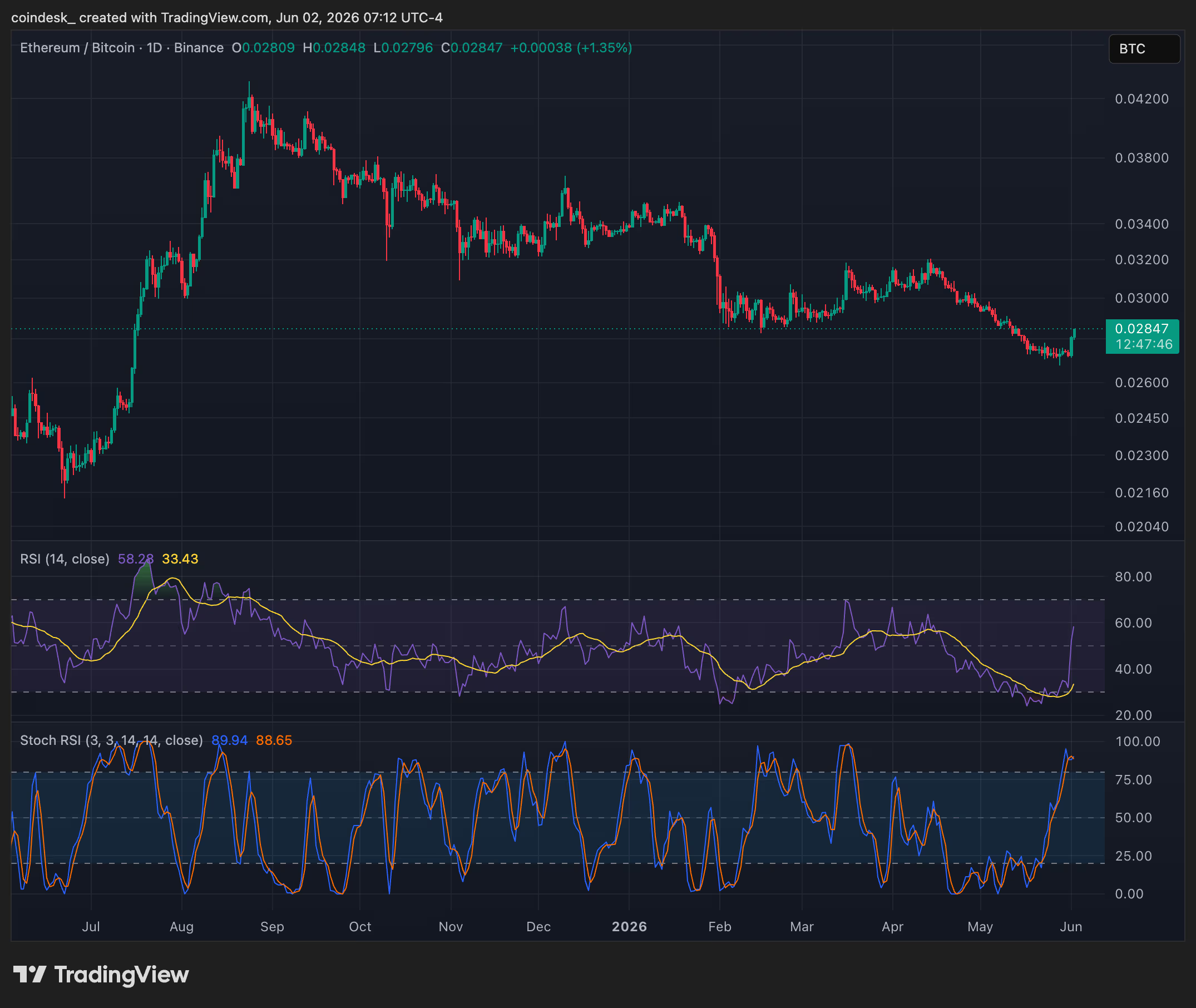
In a note to clients, Kendrick pointed out that ether (ETH) significantly outperformed bitcoin on the day the sale was announced, despite broader weakness in crypto prices. Since Monday, ETH has appreciated 5% relative to BTC.
Among sessions when bitcoin declined, the move ranked among the largest ETH-versus-BTC gains since the start of 2024, he noted.
“I see [Monday] as being the start of ETH outperformance versus BTC,” Kendrick wrote.
The call comes as investors continue debating whether ether can regain momentum after lagging behind bitcoin for much of the past two years. Since September 2022, when the Ethereum network transitioned from a mining-centric proof-of-work to a proof-of-stake model, ETH has depreciated 66% versus BTC, reaching a five-year low in April 2025. That downtrend, however, has shown signs of shifting, as ETH has bounced more than 60% from the lows over the past year.
Kendrick, who has a long-term ETH price target of $4,000 by the end of 2026 and $40,000 by 2030, said he expects the ETH-BTC ratio to climb to 0.04 by year-end from around 0.028 currently, implying ether would outperform bitcoin by more than 40% even if both assets move higher or lower.

This isn’t the first time Kendrick has forecasted ETH outperforming bitcoin. Earlier this year, he had a similar call, citing the passage of U.S. Clarity Act, which he said would create a regulatory framework for the sector and boost digital assets such as ETH, as it would unlock the next chapter for decentralized finance.
Bitcoin vs. Ethereum digital asset treasuries
While Strategy’s bitcoin sale has rattled the market, Kendrick argued that the significance of the transaction isn’t the $2.5 million in BTC that changed hands, but what it reveals about the different economics of bitcoin and ether treasury firms.
Strategy (MSTR) and other bitcoin treasury companies rely largely on bitcoin price appreciation and capital markets activity to support their business models. Because bitcoin does not generate yield, treasury firms may occasionally need to sell holdings or raise capital to cover expenses and obligations.
Read more: Strategy sparked panic with bitcoin sale, but analysts say it was ‘immaterial’
Meanwhile, ETH can be staked to earn yield, currently around 3% annualized, providing a source of income without requiring firms to liquidate assets.
For example, Tom Lee’s Bitmine (BMNR), the largest Ethereum treasury, amassed a $11 billion ETH stash without issuing any debt. While that bet is deeply underwater, the firm estimates its staking operations generate roughly $258 million in annualized revenue, with projected rewards approaching $300 million annually through its MAVAN staking platform.
Kendrick argued that staking income makes ether treasury companies more self-sustaining than their bitcoin-focused peers. While Ethereum treasury firms such as Bitmine and SharpLink Gaming (SBET) currently trade at lower premiums than Strategy (MSTR), he expects investors to reward them for generating recurring income from their holdings, helping close that valuation gap over time.
Read more: Saylor’s Strategy sold bitcoin for the first time since 2022. These firms are still buying


Bitcoin occupies a fascinating classification gray zone: part commodity, part currency, part technology asset, part macro hedge. Far from being a mere philosophical curiosity, that ambiguity is the defining feature of how the asset trades.
Because no shared understanding of what bitcoin fundamentally is has yet taken hold, no consistent framework exists for how it should behave. Different investor cohorts bring their own interpretations to the table, and the market becomes a vibrant battleground of competing narratives. That tension, more than any single variable, shapes bitcoin’s price.
In practice, the most influential of these cohorts — macro and institutional capital — has come to treat bitcoin as a liquidity-driven asset, and that choice carries broad implications for how the asset behaves today. Once investors reach a real agreement about bitcoin’s primary function, its price will find firmer footing. We’re not there yet, but we’re getting closer.
Bitcoin’s perpetual identity crisis
Bitcoin suffers from a continuous identity crisis, and understanding that struggle is key to understanding the asset itself. One group of investors views it as “digital gold,” expecting it to serve as a hedge against inflation and currency debasement. For them, bitcoin should appreciate during periods of monetary expansion or geopolitical stress, offering the same kind of protection that traditional stores of value have historically provided.
Another cohort approaches bitcoin as a high-growth, high-volatility technology proxy. In this framework, bitcoin behaves less like a defensive asset and more like a confident bet on innovation, adoption and network effects. These participants tend to respond to macro signals much the way equity investors in growth stocks do.
A third group treats bitcoin primarily as a trading instrument. For these participants, the asset’s fundamental nature is largely beside the point. What matters is momentum, liquidity, leverage and sentiment. Time horizons are short, conviction is fluid and positioning can shift rapidly on price action alone.
Each framework implies a distinct rationale for owning bitcoin, and entirely different triggers for buying and selling. A “digital gold” investor may accumulate during downturns, while a momentum trader exits at the first sign of weakness. A macro fund may trim exposure in response to tightening financial conditions, while long-term holders see that same environment as a compelling opportunity.
The result is a market where price isn’t anchored to a single narrative but pulled in multiple directions at once. Bitcoin doesn’t behave consistently because its participants aren’t operating under a shared set of assumptions.
Bitcoin’s shifting correlations (to gold, stocks, macro liquidity, SaaS valuations, to name a few) are best understood as a direct consequence of this identity crisis.
When liquidity is abundant and risk appetite is strong, bitcoin tends to behave like a high-beta equity, rising alongside other speculative assets. During periods of stress, however, it frequently sells off in tandem with equities. That behavior challenges the “digital gold” thesis, at least in the short run, as the asset fails to deliver the downside protection typically associated with safe havens.
And yet, there are genuine moments when bitcoin attracts flows consistent with a store-of-value narrative. In certain macroeconomic environments (particularly those marked by concerns about currency debasement or geopolitical instability), investors do allocate to bitcoin as a meaningful hedge.
Why bitcoin faces a unique categorization problem
Most asset classes eventually converge around a dominant valuation framework. Equities, for example, are valued on expected cash flows, while bonds are priced relative to yields and interest rates. These frameworks give investors a common language, helping markets find equilibrium.
Bitcoin has no such anchor, at least not yet. It doesn’t generate cash flows, it isn’t widely used as a medium of exchange, it doesn’t map cleanly onto technology platforms like Meta or Apple, and it lacks gold’s centuries-long track record. In the absence of a clear benchmark, investors are free to impose their own models. Put simply, there’s no shared framework to help the market settle on a stable interpretation of value.
Regulatory divergence adds another layer of complexity. Authorities around the world don’t define bitcoin the same way — El Salvador made it legal tender, while U.S. regulators largely treat it as a commodity. It’s difficult for investors to fully commit to a single framework when the regulatory environment remains unsettled.
What the future holds for bitcoin
In practice, bitcoin’s behavior is shaped less by long-term believers and more by the marginal buyer, meaning the participant whose actions set the price at any given moment. Increasingly, that marginal buyer is institutional capital operating within a macroeconomic framework.
These investors don’t approach bitcoin as an ideological asset. They treat it as one component within a broader portfolio, allocating based on liquidity conditions and signals from central banks. Within that context, bitcoin is categorized as a risk-sensitive asset.
When liquidity expands (through lower interest rates, quantitative easing, or improving financial conditions), bitcoin gets bid up alongside other risk assets. When liquidity contracts, it gets sold as part of broader de-risking. This dynamic explains why bitcoin so often trades in line with equities and other growth-sensitive instruments, even when its underlying narrative — a digital currency with a hard cap on supply — suggests it should behave quite differently.
The dominance of this cohort doesn’t resolve bitcoin’s identity crisis, but it does impose a working framework on price behavior. As long as macro-driven capital remains the marginal buyer, bitcoin will tend to reflect liquidity conditions more than any single fundamental narrative.
But convergence toward a dominant identity is coming. It could occur for a number of reasons, ranging from financial advisors finally becoming comfortable with the asset’s concept to the dollar massively devaluing (and thereby leading everyone to see bitcoin as a safe haven). Either way, when it arrives, bitcoin’s price behavior is poised to stabilize in a meaningful, lasting way.

Robinhood has expanded into Canada by acquiring WonderFi Technologies in an all-stock deal worth about $180 million, gaining control of the crypto licenses that WonderFi holds in the country and bringing Bitbuy and Coinsquare under the Robinhood umbrella. The move signals a tangible step in Robinhood’s international strategy, adding two of Canada’s largest crypto exchanges to its platform and establishing a Canadian foothold for its crypto offerings.
Robinhood disclosed in a Monday statement that the closing of the acquisition marks its entry into Canada and will see Bitbuy and Coinsquare joined under the Robinhood brand. WonderFi previously disclosed that the two exchanges together generated roughly $49.8 million in revenue in 2025. Johann Kerbrat, the general manager of Robinhood Crypto and International, described WonderFi as an operator with extensive regulatory experience that serves both beginner and advanced users, calling it an ideal partner to accelerate the firm’s Canadian ambitions.
Key takeaways
- Robinhood completes an all-stock purchase of WonderFi valued at $180 million, securing Canada’s crypto licenses and expanding its footprint to Bitbuy and Coinsquare.
- WonderFi’s leadership and staff, including its executive team, will remain with the company as part of the integration, and Robinhood anticipates adding about 300,000 funded customers from WonderFi.
- Canada’s crypto market is growing, with ownership estimated around 4.1% of the population and a 2025 market revenue cited at about $263 million, driven by hardware sales; analysts see Canada as the fastest-growing North American crypto market with a long-run revenue potential exceeding $1 billion by 2033.
- The acquisition follows a previously announced deal in May, set at 36 Canadian cents per WonderFi common share, with WonderFi stock trading in the low-40s to mid-30s Canadian cents range in the prior month.
A Canada-first expansion
The deal positions Robinhood to capitalize on Canada’s regulated crypto landscape, where Bitbuy and Coinsquare operate as two of the country’s largest exchanges. By integrating these platforms, Robinhood aims to offer its broader user base direct access to Canadian crypto markets, while leveraging WonderFi’s established compliance framework to navigate provincial and federal requirements. The acquisition is framed as a strategic step to accelerate Robinhood’s mission in Canada, leveraging WonderFi’s regulatory experience to support both retail investors and more seasoned crypto users.
Assets under one umbrella
Bitbuy and Coinsquare, now aligned with Robinhood through WonderFi, bring a combined scale that Radio suggests positions Robinhood to broaden its Canadian crypto services. WonderFi reported that Bitbuy and Coinsquare generated nearly $49.8 million in 2025 revenue, underscoring the commercial potential of an integrated platform. As part of the acquisition, Robinhood emphasized that these exchanges would operate under its brand, benefiting from its technology, security, and customer ecosystem while continuing to service Canadian customers under existing licenses.
People, customers, and integration paths
Robinhood indicated that WonderFi’s workforce will stay onboard, preserving leadership continuity during the transition. The company also projected a notable user boost, expected to add about 300,000 funded customers from WonderFi’s footprint. This combination of talent retention and customer growth could help Robinhood accelerate product development and regulatory compliance capabilities in a market that remains highly attentive to consumer protections and transparent operations.
Canada’s crypto market: momentum with caveats
Industry data cited in conjunction with the deal points to ongoing Canadian crypto adoption, though at a measured pace. Triple A estimates around 4.1% of Canadians own cryptocurrency, reflecting a broad but still developing market penetration. Grand View Research, in its regional outlook, pegged Canada’s 2025 crypto market revenue at approximately $263 million, driven in part by hardware adoption, and highlighted Canada as the fastest-growing regional market in North America. The firm projects total Canadian crypto revenue could exceed $1 billion by 2033, outlining a long runway for players expanding in the space. These figures frame the acquisition not merely as a strategic brand move but as a bet on a growing yet still evolving market where regulatory clarity and consumer trust remain critical levers of growth.
From Robinhood’s perspective, the Canadian expansion aligns with its broader strategy of building a regulated, user-friendly crypto ecosystem that can scale across borders. By weaving WonderFi’s compliance strengths into its international operations, Robinhood seeks to provide a stable platform that appeals to both new entrants and veteran traders who demand clear rules, reliable custody, and robust security features. The integration also places pressure on local competitors to demonstrate comparable regulatory readiness and customer protection measures, a dynamic that could shape product and pricing strategies across the Canadian market.
The acquisition’s timing also reflects evolving regulatory expectations in Canada, where provincial regulators increasingly emphasize consumer protection, security standards, and transparent disclosures for crypto platforms. While the deal promises expansion and scale, it also heightens scrutiny around cross-border operations, licensing portability, and ongoing compliance costs—factors investors will monitor as the integration unfolds.
In the near term, readers should watch how Robinhood absorbs WonderFi’s onboarding processes, risk controls, and customer support infrastructure into the Canadian framework. The success of the integration will likely hinge on seamless migration of customers, consistent execution of regulatory obligations, and the ability to deliver a cohesive product experience across the Bitbuy and Coinsquare platforms under the Robinhood banner.
Source notes: Robinhood’s press release confirming the Canada entry and the WonderFi acquisition; WonderFi’s disclosures on Bitbuy and Coinsquare revenue; market estimates from Triple A and Grand View Research; historical context on WonderFi’s share-level indicators and deal terms documented in the May agreement.
Readers should stay tuned for updates on the integration timeline, any regulatory milestones, and how the combined platform plans to differentiate itself in a competitive North American crypto landscape.
Crypto World
Bitcoin (BTC) faces an ‘identity crisis’ and DeFi devs need to stop acting like tech bros


The cryptocurrency market is enduring a sharp narrative shift, but the real growth is happening away from the spotlight, according to the co-founder of Solana-native yield protocol Solstice Labs.
Ben Nadareski argued that the industry’s biggest asset is experiencing structural confusion in an interview with CoinDesk onvTuesday.
“Bitcoin is going through a bit of an identity crisis right now,” Nadareski said. “It’s not the store of value, like gold, to the masses. It’s also not the speculative investment vehicle that everybody was really attracted to. While bitcoin and the core assets go through their identity crisis, quiet players in the DeFi industry are growing rapidly.”
Decentralized finance’s “silent” growth is heavily challenged by ongoing exploits, according to Nadareski, a flaw he blamed on developers frequently building innovative code while completely ignoring the core responsibilities of managing capital.
“They don’t quite realize you’re now also a financial asset manager if you’re working in DeFi,” Nadareski stated. “That doesn’t mean you’re in tech. That means you’re building tech in financing, which adds two aspects of risk to the market.”
OpenZeppelin co-founder and former CTO Manuel Aráoz said “DeFi is not safe anymore” last month noting that AI coding agents have made smart contracts fatally vulnerable.
Drift Protocol and Kelp Dao were hacked by North Korean cybercriminals in April in two exploits that drained nearly $600 million from the two lending crypto pools. In February 2025, Bybit suffered a $1.46 billion attack, described as the biggest hack of all time.
Nadareski said that to bridge this trust gap, DeFi platforms must hold themselves to traditional banking standards, implementing real-time proof of reserves and automated multi-signature time locks rather than relying on unproven code layers.
DeFi principles
The entry of legacy banking giants does not mean crypto natives have lost the space, Nadareski said. Instead, he pointed to market structure where Wall Street uses faster digital rails for its operational back offices, while decentralized platforms preserve direct user access.
“The convergence is already among us. The institutions have been coming for years and now they are here,” he highlighted.
Winning platforms will be those that accommodate large financial entities while maintaining low fees and equal access for everyday retail users. Since its launch, Solstice has scaled past $500 million in total value locked (TVL) from over 40 institutional allocators, including Galaxy Digital and Susquehanna.
Solstice has also unveiled a strategic partnership with big-data analytics platform ApexE3, which is backed by Consensys and Tensorix.
Treating decentralized networks as a financial utility rather than a tech playground is the only path forward, according to Nasareski.
“Expect more out of DeFi than you do TradFi,” he concluded. “The average retail end-user anywhere in the world should expect 10 times more of an output of transparency, trust, and optimization of their capital.”

Binance today unveils a fully regulated AED on/off ramp in the United Arab Emirates, allowing users to move between fiat and crypto with direct access to the UAE banking system. Deposits in AED carry zero fees, while withdrawals come with clearly defined, low costs. The rollout is anchored by a direct integration with Abu Dhabi Commercial Bank, reflecting a broader push toward regulated crypto access in a forward-looking regulatory environment. The solution is built under the UAE’s Client Money Account framework, with institutional controls designed to safeguard user funds. By reducing currency conversions and intermediaries, the launch aims to simplify and speed up fiat-to-crypto and crypto-to-fiat flows for residents and visitors.
Key points
- Direct UAE bank integration with Abu Dhabi Commercial Bank enables AED deposits with zero fees (minimum 10 AED, maximum 7,200,000 AED per day) and withdrawals at minimum 11 AED and maximum 7,200,000 AED per day.
- All transactions are conducted in AED and processed within the same business day, reducing FX friction and intermediaries.
- Built under the UAE’s Client Money Account framework, reflecting a regulated approach that emphasizes protection and transparency.
- Launch serves Binance’s existing users and a growing segment of new UAE users seeking regulated access to digital assets.
Why it matters
The move reduces barriers to crypto access in a leading regulatory market by pairing zero-deposit fees with direct, regulated on/off ramps. Direct bank integration and AED-only processing simplify fiat-to-crypto and crypto-to-fiat flows, potentially supporting broader adoption while aligning with investor protection and market integrity goals.
What to watch
- Uptake among UAE residents and new users seeking regulated access to digital assets.
- Whether the bank network expands beyond Abu Dhabi Commercial Bank or adds future features.
- Any updates to deposit/withdrawal limits or fee structures as the service scales.
Disclosure: The content below is a press release provided by the company or its PR representative. It is published for informational purposes.
Press release
Binance Unlocks Seamless AED Crypto Access in the UAE with Regulated Bank Integration and Zero Deposit Fees
Your Dirhams. Your Crypto. On Your Terms
Dubai, UAE, 2 June 2026 – Binance, the world’s leading blockchain ecosystem and cryptocurrency infrastructure provider, announced the launch of its fully regulated AED on and off ramp solution in the UAE, enabling users to move between fiat and crypto with a level of simplicity, cost efficiency, and trust that marks a new chapter for digital assets in the region.
For years, entering crypto often meant navigating fragmented systems, hidden fees, or relying on peer to peer methods that left users questioning both cost and security. Today, that experience changes.
With direct integration into the UAE banking system through Abu Dhabi Commercial Bank, one of the country’s most established financial institutions, Binance users can deposit AED into their accounts with zero fees (minimum 10 AED and maximum 7,200,000 AED per day) and withdraw funds at some of the lowest costs in the market (minimum 11 AED and maximum 7,200,000 AED per day).
Transactions are processed seamlessly, within the same business day, and conducted entirely in AED, removing the friction of foreign exchange conversions and unnecessary intermediaries. This is more than a product launch. It is the removal of the final barrier between traditional finance and crypto in one of the world’s most forward looking regulatory environments.
Built under the UAE’s Client Money Account framework, the solution reflects a broader shift in the region’s approach to digital assets, one that prioritizes user protection, transparency, and long term infrastructure over experimentation.
Binance’s regulated environment ensures that user funds are safeguarded with institutional grade controls, offering a level of assurance that stands apart from informal or unregulated alternatives.
This launch serves not only Binance’s existing user base, but also a growing segment of new users in the UAE seeking regulated access to digital assets as part of a diversified portfolio strategy. By making AED transfers simpler, faster, and more cost-efficient, Binance is reducing the barriers to entry for first-time crypto participants while enhancing the experience for existing users operating across both fiat and digital asset markets.
Tarik Erk, Binance’s Head of MENAT and Senior Executive Officer Abu Dhabi, commented: “At its core, this is about trust meeting usability. For a long time, access to crypto required compromise, whether on cost, speed, or confidence. What we are introducing today changes that equation entirely. Users in the UAE can now move their money from their bank to crypto and back in a way that feels natural, regulated, and efficient. This is what real adoption looks like when infrastructure catches up with ambition.”
The launch also signals a deeper maturation of the UAE crypto ecosystem. No longer defined by early stage experimentation, the market is now entering a phase where execution matters more than promise.
The ability to offer direct, regulated, and cost efficient fiat access is a critical milestone in that journey.
By combining zero fee deposits, minimal withdrawal costs, direct bank integration, and a regulated framework, Binance is setting a new benchmark for how users in the region engage with digital assets.
As the UAE continues to position itself as a global hub for responsible crypto innovation, this development reinforces a simple but powerful idea. The future of finance is not just about access. It is about access you can trust.
For more information, please visit:
About Binance
Binance is a leading global blockchain ecosystem behind the world’s largest cryptocurrency exchange by trading volume and registered users. Binance is trusted by more than 310 million people in 100+ countries for its industry-leading security, transparency, trading engine speed, protections for investors, and unmatched portfolio of digital asset products and offerings from trading and finance to education, research, social good, payments, institutional services, and Web3 features. Binance is devoted to building an inclusive crypto ecosystem to increase the freedom of money and financial access for people around the world with crypto as the fundamental means. For more information, visit: https://www.binance.com.

Bitcoin (BTC) slipped back under the $70,000 level during Europe’s trading session, resuming a distribution phase as sellers regather momentum. The move comes amid a confluence of on-chain signals suggesting short-term holders are realizing losses and exchange inflows are rising, even as pockets of demand persist from larger holders.
Analysts point to a renewed tilt toward distribution rather than a sustainable rebound. Short-term holder metrics, inflows from investors moving coins to exchanges, and a shift in market sentiment all align with a cautious, risk-off tone running through the broader crypto market. At the same time, on-chain observers noted notable activity among longer-term holders and whales, signaling that the market remains conflicted about the path forward.
Key takeaways
- Short-term holders are realizing losses as BTC tests key support, with the Short-Term Holder SOPR (STH-SOPR) dipping to 0.98, signaling renewed selling pressure.
- Six- to twelve-month holders have boosted exchange deposits since May, reaching levels last seen in October 2025, a signal that larger players may be rebalancing into or out of risk positions.
- The realized profit/loss ratio for Bitcoin has deteriorated to -0.87 from -0.4 last week, a data point Glassnode describes as part of a distribution phase with deteriorating breadth.
- Market sentiment falls back into “extreme fear,” while spot Bitcoin ETFs endure an 11-day streak of net outflows, underscoring a cautious, risk-off mood.
On-chain signals point to renewed distribution
CryptoQuant’s data show the STH-SOPR metric—an indicator of whether supplies moved by short-term holders are being realized at a profit or a loss—has slipped below the break-even line, currently at 0.98. This setup implies short-term investors are more likely to be selling at a loss than taking profits, a pattern associated with distribution rather than accumulation when sustained by broader selling pressure.
The same research outfit highlights a notable dynamic among medium-term participants: the six- to twelve-month holder cohort has escalated its exchange deposits since May. In fact, inflows have risen to levels last seen in October 2025, when Bitcoin traded above $126,000, underscoring a potential willingness among this group to realize gains or cut exposure in the face of uncertainty.
“This exchange inflow volume needs to be well absorbed; otherwise, BTC will face deeper correction waves.”
Adding to the convolution, Glassnode’s latest Market Pulse notes that Bitcoin’s realized profit/loss ratio has moved to -0.87 from -0.4, indicating a swing toward realized losses across the network. The report frames the current period as a distribution phase with deteriorating breadth, suggesting selling pressure could intensify if demand remains tepid.
Bitcoin: Short-term holder SOPR. Source: CryptoQuant
The price action this week also evokes a historical echo. CryptoQuant analysts pointed to a February episode when macro headlines and policy uncertainty coincided with a broader USD strength and a dip in BTC, highlighting a pattern where uncertainty can catalyze on-chain distribution rather than a swift rebound.
Bitcoin exchange SOPR age bands. Source: CryptoQuant
Sentiment cools as risk-off tone prevails
Market psychology shifted toward fear as the Crypto Fear and Greed Index moved to 23, signaling “extreme fear” among investors. The gauge uses volatility, momentum, trading volume, and social signals to quantify sentiment, with readings below 25 historically associated with risk-off positioning.
The broader crypto market has softened, with global market capitalization dipping around 7% over the past week and Bitcoin itself down about 9% in the same period, underscoring how price volatility has mirrored a cautious mood rather than a renewed risk-on rally.
Meanwhile, spot Bitcoin ETFs have recorded 11 consecutive days of outflows, according to data tracked by Farside Investors. The persistent outflows contrast with hopes for renewed institutional demand and illustrate the tension between short-term liquidity shifts and longer-term positioning.
Spot Bitcoin ETF flows chart. Source: Farside Investors
In this context, some on-chain observers flagged signs of ongoing activity among larger players. Santiment noted that, as BTC traded through the sub-$70,000 zone, a majority of on-chain transactions over $100,000 in value—the hallmark of whale involvement—represented a form of accumulation that historically preceded more meaningful moves. The platform described the pattern as “historically a strong sign of whale accumulation.”
BTC $100K+ transactions. Source: Santiment
What to watch next for traders and investors
The current configuration—elevated exchange inflows among mid-term holders, a still-fragile realized loss landscape, and a sentiment metric echoing fear—suggests that BTC may struggle to regain a stable near-term footing unless new catalysts emerge. The price underside around $70,000 appears to be a critical juncture: a held support could buoy sentiment and invite a measured re-accumulation, while a breach could intensify the distribution dynamic and push downside pressure deeper into 2026.
Investors will want to monitor whether longer-term holders and whales sustain any accumulation in the absence of broader macro catalysts, and whether ETF flows reverse as institutional demand evolves. Any material shift in on-chain behavior—such as a sustained decline in exchange inflows from the six- to twelve-month cohort, or a notable uptick in realized gains—could alter the balance of supply and demand in the weeks ahead.
As always, the market’s next chapter will hinge on both macro developments and the evolving narrative for risk in crypto assets. Watch for potential catalysts—policy clarity, regulatory signals, or firming macro cues—that could tilt sentiment away from fear and toward a steadier, more constructive path for Bitcoin.

The cryptocurrency market has endured a sobering few months as macroeconomic concerns and a volatile geopolitical situation test the resolve of even the most steely investor. The current scenario is in stark contrast to November 2024, when optimism around a Trump victory in the US presidential elections saw Bitcoin (BTC) and the broader cryptocurrency market post a stunning rally. BTC surged past $100,000 for the first time in the months following President Trump’s victory, reaching a new all-time high of $126,198 in October 2025.
However, the cryptocurrency market lost steam soon after. BTC struggled to maintain momentum and slipped below $100,000, a level that many thought would be the foundation of an unprecedented push to new highs, with expectations of a clear regulatory framework and a crypto-friendly government. Prices are now at multi-month lows and investors are hesitant to dabble in crypto, at least for the moment. So what went wrong?
Euphoria
The Leadup to the 2024 Elections
The mood in the cryptocurrency market during the lead-up to Donald Trump’s 2024 presidential election victory was one of optimism. The industry threw its weight behind the Republican candidate as he promised pro-crypto legislation, clearer regulatory policies, and an end to Gary Gensler’s “regulation by enforcement” approach. However, President Trump was not always an unwavering supporter of cryptocurrency.
During his first term as US president, Donald Trump vehemently opposed the crypto industry, claiming Bitcoin and other tokens were based on “thin air” and could not be called money. He even called it a “scam,” competing with the US dollar. His views changed drastically during the Biden presidency, and leading industry figures rallied in support after he announced his intention to run again in 2024, especially after he promised to make the US the “crypto capital of the world” at the Nashville Bitcoin conference.
The cryptocurrency industry became the largest corporate donor during the 2024 presidential election, donating $238 million, with almost all of it going toward Trump’s campaign. The industry also donated an additional $18 million to the president’s inauguration. The 2024 elections saw the emergence of Fairshake, a Super PAC backed by the cryptocurrency industry. The Super PAC’s donors include Coinbase, Ripple, and Andreessen Horowitz, and it supported pro-cryptocurrency candidates, contributing more toward Republican candidates than Democratic ones.
The Crypto President
Donald Trump won the 2024 US presidential election relatively comfortably, beating Democratic candidate Kamala Harris. The victory sent both cryptocurrency and equity markets surging. US shares and the dollar posted their biggest gains in nearly eight years. Bitcoin surged to a new all-time high after gaining 37% in November 2024, with many expecting a move beyond the coveted $100,000 mark. Trump promised to make the US the crypto capital of the world on the campaign trail, calling himself the “crypto president.”
Trump’s victory had a profound impact on the cryptocurrency industry, with its market capitalization surging from $1.6 trillion to over $3 trillion. BTC briefly corrected after crossing $95,000, before surging past $100,000 at the beginning of 2025. Prices had been on the up since early 2023, but the biggest gains were recorded only when the victory was certain.
Promises and Appointments
Trump made several promises to the cryptocurrency industry to secure their support. He appointed a new Crypto Task Force under the United States Securities and Exchange Commission (SEC) and directed the regulatory body to drop several lawsuits against prominent industry entities and individuals, including Coinbase, Kraken, Robinhood, Consensys, and Tron founder Justin Sun. The SEC also settled its long-running case against Ripple under the Trump administration. Trump chose several crypto-friendly officials to lead key departments, the most significant being Paul Atkins to replace Gary Gensler as SEC chair.
The president also appointed David Sacks as the White House AI and Crypto Czar and Stephen Miran as chairman of the Council of Economic Advisors.
Strategic Bitcoin Reserve
President Trump announced plans to establish a strategic Bitcoin reserve if elected on July 15, 2024. Shortly after the announcement, Senator Cynthia Lummis introduced the BITCOIN Act, proposing the purchase of 1,000,000 BTC for the strategic reserve, but Senator Sherrod Brown blocked the proposal. Shortly after assuming office, Trump signed an executive order to establish a strategic Bitcoin reserve leveraging the asset’s fixed supply as a hedge against financial instability and fiat currency risk.
The reserve was intended to be funded by Bitcoin seized by the US Treasury during forfeitures and civil trials. The order also outlined budget-neutral strategies to acquire more Bitcoin for the reserve and directed the administration to establish a digital asset stockpile consisting of forfeited digital assets, while also directing that no additional acquisitions be made toward the stockpile.
Several US states also introduced state-level legislation to create reserves, including Arizona, New Hampshire, Texas, Utah, and Oklahoma. Global reactions were mostly negative: the managing director of the European Stability Mechanism criticized the shift toward cryptocurrencies, South Korea said it would not include Bitcoin in reserves, and the Swiss National Bank rejected a proposal to create a Bitcoin reserve.
Regulatory Clarity
President Trump also promised regulatory clarity, enacting several measures that were seen as relief for an industry that had grappled with Gensler’s approach. He signed into law the Guiding and Establishing National Innovation for US Stablecoins Act (GENIUS Act), creating a comprehensive stablecoin ecosystem. The act passed the Senate 68-30 and the House on July 17, 2025, coming into effect on July 18, 2025. It allowed financial institutions to issue stablecoins backed 1:1 with the US dollar or other highly liquid assets, required monthly reserve disclosures, gave users priority in insolvency, and clarified SEC and CFTC oversight over stablecoins. More on the act is available via Fidelity.
The administration directed financial regulators to review rules prohibiting cryptocurrency companies from obtaining banking licenses and asked the Federal Reserve to grant non-bank crypto entities access to reserve payment accounts. The SEC was directed to repeal Staff Accounting Bulletin 121 (SAB 121), allowing traditional banks to offer customers digital asset custody services. The administration also dropped investigations into several digital asset platforms while settling with others and pardoned several prominent figures imprisoned by the previous administration, including Silk Road founder Ross Ulbricht and Binance founder Changpeng Zhao. It also settled with Tron founder Justin Sun for $10 million after the SEC put the case on hold.
The Cracks Appear
Trump promised sweeping policy changes, enacting legislative pushes, executive orders, and key appointments. However, things have not gone exactly to plan. Policy uncertainties, ethical concerns, and other limitations have slowed the crypto push at a time when markets are struggling due to the prevailing geopolitical situation.
Ethical and Conflict of Interest Concerns
U.S. presidents have historically distanced themselves from business interests while in office. Assets are often placed in blind trusts or divested to avoid conflicts. President Trump did not place his assets in a blind trust; instead he handed control of his business empire to his eldest sons while maintaining real estate, media, and licensing holdings. According to reporting, Trump family-linked crypto ventures have generated over $1.4 billion.
The Trump family has also benefited from the $TRUMP and $MELANIA meme coins, which generated millions in fees. World Liberty Financial, another Trump family-backed crypto venture, has applied to launch a federally regulated bank in the US, raising potential conflict-of-interest concerns. Trump has maintained he has not violated any law, while ethics experts say there is no evidence the president or his family broke the law.
Bitcoin Reserve Stalls
The industry welcomed the executive order establishing a strategic Bitcoin reserve but was disappointed to learn the US would not be buying Bitcoin for the reserve; instead it would contain Bitcoin seized during forfeitures and civil trials. As of March 2025 the US government held 200,000 BTC, but nearly half were linked to the Bitfinex hack and would have to be returned to affected users. The White House crypto and AI czar said the government would explore budget-neutral strategies to acquire more Bitcoin.
The strategic reserve is still being debated in the House. The latest bipartisan legislation proposed on May 22 would lock the US government’s Bitcoin holdings for twenty years while dropping the mandate to purchase 1 million BTC.
Market Reality Sinks In
Optimism about President Trump’s crypto promises waned for several reasons. Policy problems aside, adverse geopolitical and macroeconomic factors and a risk-off sentiment among institutional investors dragged markets even lower, with Bitcoin and other altcoins tumbling to multi-month lows.
Trump’s Tariff Strategy
President Trump’s tariff strategy to renegotiate trade deals caused substantial volatility. Bitcoin dropped to multi-month lows after Trump threatened sweeping tariffs on China, with the flagship cryptocurrency plunging over 8% on October 10, 2025. That market move saw total liquidations of $19.13 billion, which CoinGlass called the largest liquidation event in crypto history.
Overleveraged traders aggravated the crash, and the crypto market cap declined from over $4 trillion to $3.6 trillion. Markets recovered after a US-China deal led to a rollback in tariffs. The October 10 crash occurred just days after Bitcoin surged to its all-time high of $126,198, highlighting the volatility introduced by tariff threats.
Bitcoin suffered another crash in February 2026 after Trump announced plans to increase global tariffs to 15%. The downturn was also linked to investor concerns about a US military buildup around Iran, fears that later proved valid given the ongoing US-Iran conflict and the closure of the Strait of Hormuz. The February downturn pushed Bitcoin to its lowest level since September 2024, prompting speculation that the bull market had ended.
Ethereum and Other Altcoins Stall
Ethereum (ETH) and other prominent altcoins fared no better when faced with tariff-induced uncertainty, macroeconomic headwinds, and a deteriorating geopolitical outlook. Ethereum soared past $4,500 after Trump’s election and inauguration in January 2025, reaching an all-time high of $4,953 on August 25, driven by the passage of the GENIUS Act and surging inflows into spot Ethereum ETFs.
Several listed companies began purchasing Ethereum as a reserve asset, including Bitmine Immersion Technologies, which holds a notable Ethereum treasury. ETH traded above $4,000 until the October 10 market crash, when it fell to $3,510. It continued around $3,500 until February 2026, when it crashed to a multi-month low of $1,742. ETH has struggled to regain momentum since, barely crossing $2,500 and losing nearly 60% since its all-time high.
ETH’s decline decimated corporate treasuries holding the asset, which suffered substantial unrealized losses. The downturn also stopped the expansion of Ethereum treasury companies in their tracks. Prominent altcoins underperformed over the past year, with Bitcoin dominance around 60%, driven by institutional allocations to spot Bitcoin ETFs. Many altcoins also lack clear real-world use cases and have suffered security breaches that eroded investor confidence.
According to JPMorgan, Ethereum and other altcoins will continue trailing Bitcoin unless a major network boom changes market dynamics. Weak DeFi growth, sluggish network activity, and limited real-world utility have eroded investor interest in major altcoins.
Price Action During the US‑Iran Conflict
The US‑Iran conflict has been another significant influence on Bitcoin and the broader crypto ecosystem. The conflict triggered volatility and liquidations as investors fled to safer assets such as gold and institutions adopted a risk-off approach. It also disrupted global supply chains, sent oil prices soaring, and pushed inflation higher, all of which could keep central banks on a tighter interest-rate path, pressuring risk assets like Bitcoin.
The conflict escalated on February 28, 2026, when the US and Israel launched operations targeting Iranian facilities and leadership. BTC plunged to a low of $63,018 almost immediately, triggering a wave of liquidations. Other cryptocurrencies, including Ethereum and Solana (SOL), recorded sharp declines as leveraged positions were liquidated.
Uncertainty around the Strait of Hormuz, which handles roughly 20% of global seaborne oil trade, pushed oil prices to near record levels and fueled inflation concerns. Investor sentiment slipped into “Fear” territory as the crypto Fear and Greed Index hit very low levels, forcing many to reduce exposure to risk assets. Volatility surged and institutional investors looked for safer avenues.
Crypto Struggles While Equities Rally
While crypto struggled, equity markets remained surprisingly stable and in some cases reached record levels. Bitcoin, Ethereum, XRP, Solana, and other major tokens faced intense selling pressure while gold surged. The S&P 500 traded close to record levels, creating a divergence between crypto and equities driven by capital rotation, macro volatility, wealth preservation, geopolitical concerns, and overleveraged traders.
Bitcoin was down roughly 40% from its all-time high as of May 2026, wiping out nearly all its gains over the past year and forcing even long-term holders to reassess positions. Liquidity has been elusive and capital into crypto ETFs has dried up, contributing to the disparity with equities.
A Correction or Collapse
Bitcoin’s slide over the past year has been called the “worst crisis in crypto since 2022” by the New York Times. Market experts who predicted $200,000 BTC were forced to backtrack as the downturn raised the specter of another crypto winter.
The industry felt that politics, regulatory uncertainty, and impossible asks were preventing innovation. Many in the industry believed the previous administration had victimized them and lobbied heavily to gain political influence, spending $238 million to support Trump. That strategy initially seemed to work, but the tariff strategy and geopolitical shocks exposed the industry when conditions turned.
The downturn is now widely viewed as a structural correction rather than a complete collapse. Volatility remains high, with 10%–20% price swings that are common in crypto. Moreover, the market capitalization has remained around $2.5 trillion, unlike the 2022 crash when it slipped below $1 trillion. Still, the combination of macro and geopolitical concerns, liquidations of leveraged positions, and supply-chain disruptions made the correction feel particularly brutal.
Crypto Market Outlook Remains Positive
Despite the challenges, the bullish structure of Bitcoin and the broader market remains intact. Analysts believe markets could recover strongly if conditions change. The GENIUS Act created a regulatory framework for stablecoins and clarified operational guardrails, while the SEC repealed SAB 121, allowing traditional banks to offer crypto custody services.
Institutional interest has transformed Bitcoin into a strategic asset class, driving the emergence of Bitcoin treasury companies and regulated products like spot Bitcoin ETFs offered by legacy finance players. Meanwhile, some companies continue to accumulate Bitcoin for their treasuries.
The CLARITY Act is still being debated. It cleared the House and advanced in the Senate but faces opposition from banks, Democratic lawmakers, labor unions, regulators, and parts of the crypto industry, which fear it may incentivize deposit outflows.
A US‑Iran ceasefire could ease geopolitical tensions, improve supply chains, and help bring oil prices under control. An improved macro outlook could allow the Federal Reserve to consider rate cuts, easing pressure on Bitcoin and other risk assets. For now, markets are waiting for a clear catalyst.
Reports from industry research teams, including Coinbase and CoinDCX, highlighted regulatory progress and institutional adoption as reasons for cautious optimism. Market sentiment, while fragile, has improved; the passage of the CLARITY Act could be the catalyst for a revival.
But the recent months may have taught the industry a lesson: angling for a seat at the political table can have costs. Political association with a single administration has divided the industry and tied price action to policy announcements. The Trump family’s crypto associations and controversial pardons raised ethical concerns and undermined trust. The industry must decide whether to lean into politics or return to economic fundamentals.
Crypto World
Hyperliquid predicted 80% of an oil market move before traditional exchanges even opened, says TD Securities
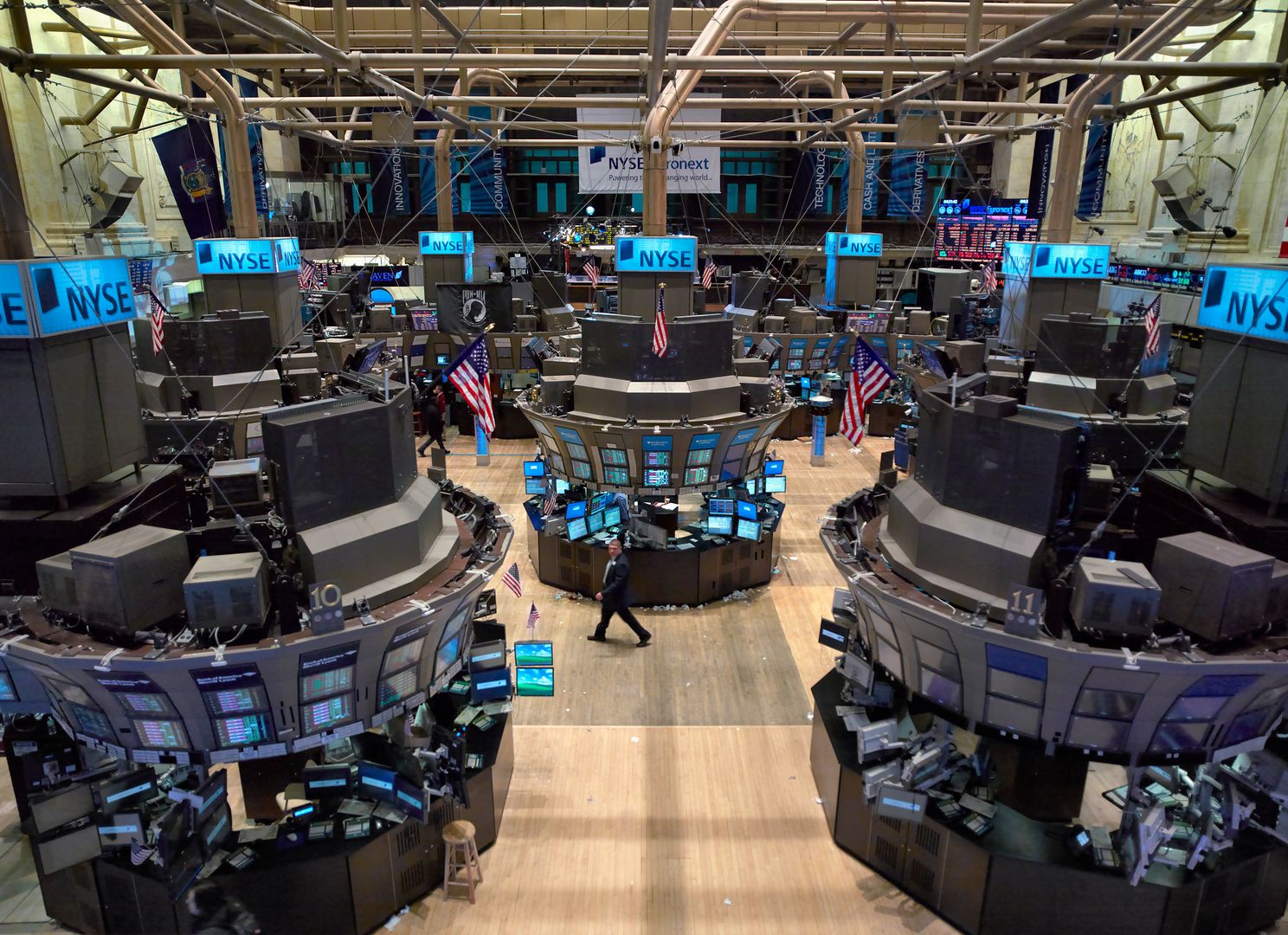
Perpetual futures are beginning to break out of their origins and emerge as a broader asset class beyond crypto, according to a new report from TD Securities.
The bank said recent regulatory developments in the U.S. and growing institutional demand are helping transform perpetual futures, commonly known as “perps,” from a niche crypto instrument into a market structure that could eventually span commodities, equities and private-market investing.
“PERPs are no longer just a crypto product. They are becoming a broader market-structure product,” TD Securities wrote.
Perpetual futures differ from traditional futures because they do not expire. Instead, they rely on funding-rate mechanisms that keep prices aligned with underlying markets. The contracts have become the dominant trading vehicle in crypto, accounting for roughly 80% of global digital asset trading volumes, according to TD.
Momentum accelerated last month when the Commodity Futures Trading Commission (CFTC) allowed bitcoin perpetual futures to trade on prediction market platform Kalshi. Around the same time, Coinbase (COIN) announced plans to launch U.S. equity-index perpetual futures and moved closer to connecting American customers with offshore perpetual futures markets.
The report argues that institutional demand is expanding beyond cryptocurrencies. Hyperliquid (HYPE), the largest decentralized perpetual futures platform, now offers contracts linked to commodities and private companies. The exchange has become a venue for trading pre-IPO contracts tied to firms such as Cerebras and SpaceX, allowing traders to speculate on valuations before public listings.
Hyperliquid’s growth is also beginning to test the traditional role of exchanges such as CME Group in price discovery.
TD pointed to trading activity during the U.S.-Israel-Iran conflict earlier this year, when commodity markets were closed for the weekend but Hyperliquid remained open. According to the report, notional volume in oil-linked perpetual futures on the platform grew from roughly $25 million to more than $550 million by the third weekend of trading. Hyperliquid also priced in about 80% of the subsequent move in West Texas Intermediate crude before CME’s market reopened.
“The significance was not just the volume, but price discovery happening before traditional commodity markets reopened,” TD wrote.
The trend extends beyond commodities. TD said Hyperliquid’s pre-IPO perpetual futures tied to companies such as Cerebras and SpaceX have become an early test of whether blockchain-based markets can help establish valuations before stocks begin trading publicly.
That growth has drawn scrutiny from incumbent exchanges. TD noted that ICE and CME have pushed regulators to examine Hyperliquid’s oil-linked products while simultaneously exploring similar offerings themselves, highlighting a growing battle between traditional and crypto-native market infrastructure.
TD expects commodities to be the next major growth area for perpetual futures, with oil, gold and copper among the most likely candidates. As regulators move toward creating a formal U.S. framework for the products, the bank said the larger question is whether perpetual futures can retain their appeal once they are brought under tighter oversight.

Key Highlights
- Cisco shares climbed approximately 5% to reach $127.38, with an intraday peak of $128.05 marking a new 52-week high on Monday
- At its annual Cisco Live event in Las Vegas, the networking giant introduced Cisco Cloud Control — an integrated agentic AI platform spanning networking, security, compute, and collaboration capabilities
- The company committed to rolling out quantum-safe security features across most of its core product lineup by December 2026
- Bank of America analysts increased their CSCO price target from $114 to $135 while reaffirming their Buy recommendation
- This momentum follows an impressive Q3 FY2026 earnings performance, with revenues climbing 12% year-over-year to reach $15.84 billion
Cisco shares experienced a significant rally on Monday, advancing nearly 5% to close at $127.38 while reaching an intraday 52-week high of $128.05. This performance represents more than a 100% gain from the stock’s 52-week low of $62.71.
The driving force behind this surge was the company’s annual Cisco Live conference held in Las Vegas, where executives revealed what they described as some of the most significant product launches in the company’s recent history.
The centerpiece announcement is Cisco Cloud Control — an integrated agentic platform that merges networking, security, compute, observability, and collaboration capabilities into a single unified environment. The system enables both human administrators and AI agents to work from a shared data infrastructure.
“Operating at human scale is no longer sufficient,” explained DJ Sampath, SVP and GM of AI software and platform at Cisco. “We need machine-scale operations to meet today’s demands.”
The platform has already begun its controlled deployment for U.S.-based customers. International availability is anticipated before the end of 2026.
Core Capabilities of Cloud Control
One standout feature, Live Protect, functions as a real-time security shield — neutralizing newly identified vulnerabilities without requiring system reboots or scheduled maintenance periods. This capability is currently deployed on Cisco’s N9000 series switches, with plans to extend it to campus and branch smart switches plus secure routers throughout 2026.
Cloud Control also features an Agent Builder tool that allows organizations to develop custom AI agents aligned with their specific operational workflows, alongside an App Builder that generates applications from natural-language instructions. The platform integrates with over 50 third-party solutions, including AWS, Microsoft, Google Cloud, and ServiceNow.
OpenAI’s Codex represents the inaugural offering in Cisco’s newly launched agent marketplace — embedded directly into Cloud Control rather than requiring separate access. Cisco indicated plans to monetize marketplace transactions, though specific revenue-sharing details remain under development.
Quantum-Safe Security Initiative
Cisco unveiled its commitment to implement quantum-safe communication capabilities across the majority of its core product portfolio by December 2026. All newly released campus, branch, and data center routers, switches, and firewalls will feature quantum-safe secure boot functionality from launch.
New Quantum Ready Assessments, accessible through Cisco IQ, will enable customers to identify assets vulnerable to “harvest now, decrypt later” attack scenarios. Worldwide availability is scheduled for July 2026.
Cisco also revealed a collaboration with Workday as the inaugural partner for Agent Passport, leveraging Cisco’s AI Defense technology to authenticate AI agents operating within Workday environments.
Wall Street Support and Financial Performance
Bank of America elevated its price target for CSCO from $114 to $135 in advance of the conference, maintaining its Buy rating on the stock.
These Cisco Live revelations come on the heels of a robust Q3 FY2026 earnings report released in mid-May, which showed revenue growth of 12% year-over-year to $15.84 billion with earnings per share exceeding analyst expectations.
Cisco has also recently increased its AI infrastructure order forecast for the complete fiscal year to $9 billion.
The broader market showed modest gains on Monday, with the S&P 500 advancing 0.2% and the Dow Jones Industrial Average rising 0.3%.


Police appeal for help in search for Spennymoor teen William

CIPD warns of unintended consequences for SMEs

Zama Accelerates Compliance Push After Court Reverses $12.5M USDC Freeze



-

 NewsBeat6 days ago
Israel says it has killed new Hamas military leader in Gaza City airstrikes
-

 Tech6 days ago
NASA taps Blue Origin to deliver lunar rovers for Moon Base initiative
-

 News Videos4 days ago
This is BROKEN! INSANE 5x MONEY CAR WASH WEEK! The NEW GTA Online UPDATE Today! (GTA5 New Update)
-

 News Videos7 days ago
XRP *JUST* SUCCEEDED!!!! CLARITY ACT EXPOSED!!! (SHE EXPOSED IT)
-
 Crypto World7 days ago
Micron Crosses $1 Trillion Market Cap as AI Demand Reshapes Memory Sector
-
 Tech3 days ago
SpaceX just won a second Golden Dome contract. This one is $4.16 billion.
-

 Business7 days ago
Selena Gomez Reportedly Upset Over Benny Blanco’s Comments on Her ‘Terrible’ Diet
-

 Tech5 days ago
Waymo dominates autonomous vehicle registrations as Tesla trails behind
-

 News Videos4 days ago
SHE IS KILLING XRP!!! WATCH URGENT AND ACT FAST
-

 Entertainment7 days ago
Days of our Lives 2-Week Spoilers May 25-June 5: Gwen Rages, Abe Confesses & 2 Tragic Anniversaries!
-
 NewsBeat4 days ago
FIRST NIGHT REVIEW: Take That bring the Circus back to life in spectacular sun-soaked style
-

 Tech6 days ago
The Samsung pay deal is the moment Korean unions changed register
-

 Business20 hours ago
Jade Biosciences, Inc. (JBIO) Discusses Positive Interim Results From JADE101 Phase I Healthy Volunteer Study and Development Plans Transcript
-

 Tech7 days ago
Millions of AI agents imperiled by critical vulnerability in open source package
-
Crypto World4 days ago
CFTC Has Approved the First Regulated Bitcoin Perpetual Contract in the U.S.
-
Crypto World6 days ago
SpaceX’s $2 Trillion IPO: Why Tech Giants Nvidia (NVDA), Apple (AAPL), and Microsoft (MSFT) May Face Pressure
-
 Entertainment6 days ago
The Most Misunderstood Sci-Fi Horror Movie of the Last 10 Years Just Took Over Netflix
-

 Crypto World7 days ago
Spain blocks prediction markets Polymarket Kalshi
-
 Crypto World4 days ago
Snowflake (SNOW) Stock Rallies on Strong Q1 Results and AI Product Growth
-
 NewsBeat4 days ago
Novak Djokovic v Joao Fonseca LIVE: French Open latest scores and results after Jannik Sinner’s shocking collapse
You must be logged in to post a comment Login