
Crypto World
North Korean Hackers Test AI to Advance Their Cyberattacks



North Korea’s Kimsuky hacking group has established and tested local artificial intelligence (AI) tools as it researches ways to integrate the technology into malware development and attack techniques, South Korean cybersecurity firm Genians said Monday.
The group appears to have used generative AI to create decoy documents. Genians said Kimsuky is developing capabilities to incorporate existing AI models into its attack activities.
Inside Kimsuky’s Local AI Tools
Kimsuky is a threat group operating under North Korea’s Reconnaissance General Bureau. The US Treasury sanctioned it in 2023 as a state-controlled espionage unit.
Investigators found evidence that Kimsuky had installed and configured several tools for running AI models locally, including Ollama, GPT4All, and Msty.
Genians said local processing could reduce the risk of sensitive or stolen material being sent to external AI services. The researchers also identified retrieval-augmented generation, or RAG, which allows AI models to retrieve information from selected documents.
Genians also identified AI-agent frameworks, speech-to-text software, and Cursor, an AI-assisted coding tool, on related infrastructure. The company said the collection could support efforts to integrate AI into malware development, data analysis, and attack automation.
“Based on these findings, the threat actor associated with the state-sponsored hacking group Kimsuky is assessed to have continuously researched ways to actively incorporate AI technologies into actual threat activities, including malware development and the advancement of attack techniques, rather than merely experimenting with them,” the report read.
Follow us on X to get the latest news as it happens
From Crypto Decoys to Automation
The group reportedly used financial and cryptocurrency decoy documents that appeared to be AI-generated. The files mimicked investment reports.
Other North Korea-linked operations have paired AI with crypto-focused attacks on executives and engineers. Such groups stole a reported $2.02 billion in crypto during 2025, according to one industry estimate on theft.
Genians identified two potential risks. RAG could help retrieve useful information from stolen documents, while speech-to-text tools could convert stolen audio into searchable text.
Nonetheless, Genians assessed that Kimsuky’s local AI efforts remained focused on research and acquiring knowledge about how the technology could support its operations. The researchers found no evidence that the group had trained its own AI models.
Subscribe to our YouTube channel to watch leaders and journalists provide expert insights
The post North Korean Hackers Test AI to Advance Their Cyberattacks appeared first on BeInCrypto.

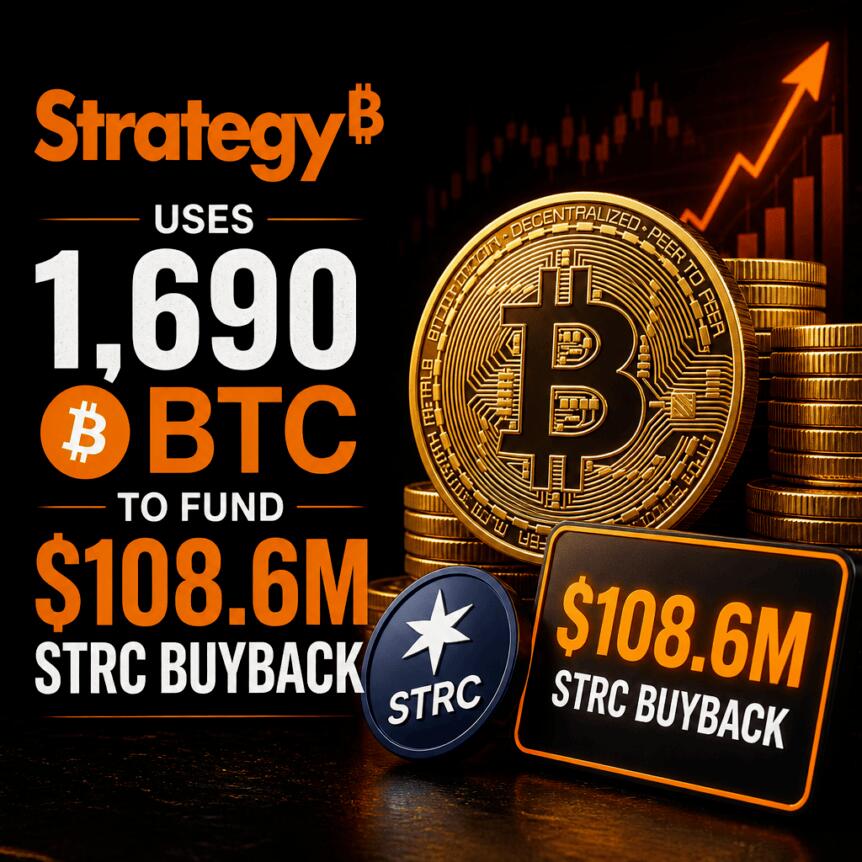
Strategy, the publicly traded firm with the largest corporate Bitcoin treasury, has again converted part of its BTC holdings into cash to support buybacks of its STRC preferred stock. In its latest SEC filing, the company reported a second consecutive week of Bitcoin sales used to fund repurchases of STRC shares.
According to a Monday 8-K filing with the US Securities and Exchange Commission (SEC), Strategy sold 1,690 Bitcoin for $108.6 million between Aug. 3 and Aug. 9. The proceeds were used to buy back 1.15 million shares of its STRC preferred stock for the same $108.6 million total.
Key takeaways
- Strategy sold 1,690 BTC for $108.6 million (Aug. 3–Aug. 9) to repurchase STRC preferred shares.
- This was the company’s fourth disclosed Bitcoin sale of 2026, bringing 2026 total BTC sales to 6,948.
- Strategy still holds 840,447 BTC with an aggregate purchase price of $63.36 billion, implying ongoing long-term exposure.
- The filing shows remaining repurchase capacity under both the preferred stock and common-stock buyback programs.
- Alongside STRC buybacks, Strategy continued building a US dollar reserve, reporting $4.65 billion as of Sunday.
Bitcoin sales tied directly to STRC buybacks
Strategy’s latest filing reinforces the company’s funding approach: using periodic Bitcoin liquidations to finance preferred stock repurchases. STRC is a variable-rate preferred stock structured to pay monthly dividends, and Strategy’s buybacks appear designed to manage capital structure while continuing dividend-related obligations.
On this occasion, the company reported an average net sale price of $64,262 per Bitcoin for the 1,690 BTC it sold. For comparison, Strategy’s broader Bitcoin cost basis is higher: the company cited an average purchase price of $75,385 per BTC for total holdings, including fees and expenses.
Strategy also previously disclosed a similar sequence. Earlier coverage noted that Strategy sold 1,638 BTC for $104.73 million between July 27 and Aug. 2, and used those proceeds to fund STRC repurchases as well. The current week’s sale follows that pattern closely—suggesting the company is maintaining an active, repeatable mechanism rather than relying on one-off treasury adjustments.
How much BTC Strategy has sold in 2026
While the latest transaction adds another step to Strategy’s 2026 funding routine, it does not represent a major shift away from holding BTC. The filing states the trade marked the company’s fourth disclosed Bitcoin sale of the year, bringing total 2026 BTC sales to 6,948 BTC.
After the latest sale, Strategy still holds 840,447 Bitcoin purchased for an aggregate $63.36 billion. That large remaining position matters for investors because Strategy’s balance sheet exposure to Bitcoin remains the dominant driver of its treasury value, even as the company periodically monetizes BTC to meet financial objectives.
From a market perspective, these disclosures also keep the question of “how much BTC is converted” in focus. If Strategy’s buyback-linked sales continue on a regular cadence, traders may increasingly weigh whether those conversions pressure sentiment around BTC liquidity at specific intervals—even if the firm’s long-term exposure remains intact.
Repurchase capacity and the dollar reserve build
Beyond the immediate buyback, the 8-K includes additional numbers that help map out how Strategy plans to fund and sustain the preferred stock program. The filing says Strategy has $785.2 million remaining under its digital credit securities repurchase program, which covers the preferred stock. It also reports another $1 billion available under its Class A common-stock repurchase program.
Strategy simultaneously continued building its US dollar reserves. The company reported a $4.65 billion balance as of Sunday, up from roughly $4 billion in the previous weekly update. In the filing, Strategy said $650 million of $653.1 million in net proceeds from recent MSTR stock sales went toward the reserve.
The reported cash number also includes expected proceeds from at-the-market (ATM) sales that had not yet settled at the time of the update. Taken together, the reserve build is relevant because it may reduce the need for frequent immediate BTC liquidations under certain market conditions—while still leaving BTC as the core long-duration holding.
STRC share momentum alongside buybacks
Strategy’s STRC buybacks come at a moment when the preferred stock has shown strength. The article cited that STRC shares rallied during Strategy’s recent repurchases, reclaiming $90 on Aug. 3 after rebounding 24% from their June lows.
In premarket trading Monday, STRC was up 0.46% to $95.45, after closing Friday at $95. According to Yahoo Finance, Strategy’s MSTR shares were also slightly higher, up 0.25% to $100.26 at the time of the report.
While price moves in any single session can’t be attributed solely to buybacks, the sequence is still notable: repurchases funded by BTC sales are arriving while market participants appear willing to bid up STRC from earlier weakness. For investors, the practical takeaway is that Strategy’s corporate actions are being tested in real time by equity market liquidity, particularly around preferred stock where dividends and variable-rate mechanics can influence demand.
Looking ahead, readers should watch two things: whether Strategy continues the pace of BTC-to-STRC conversions disclosed in its SEC filings, and how the firm’s remaining repurchase capacity and US dollar reserve evolve week to week. Any change in the cadence—or in the average net sale price compared with its cost basis—could affect how investors interpret the trade-off between maintaining BTC exposure and supporting the company’s preferred stock funding engine.


Quantum Fintech Group founder Harry Chun Tak Yeh was found dead in Paraguay after falling from his luxury 30th-floor apartment last week.
Local media reports that Yeh fell from his apartment in the early hours of the morning, either on a Tuesday or Friday, before his naked body was found covered by a black plastic bag.
Police discovered his apartment ransacked with the door wide open, and nobody else present.
Yeh’s 29-year-old partner, Isadora de Proenca Braganholo Carvalho, says she was unaware of what happened. The Brazilian national was staying in Yeh’s other apartment on the 27th floor.
Police are currently investigating whether or not Yeh’s death was an accident, suicide, or a potential murder.
Yeh made his fortune investing in BTC in 2013 when it was worth roughly $60. He then went on to found crypto hedge fund Quantum Fintech Group in 2020 and claimed to manage over $2 billion worth of funds.
Read more: Billionaire Brock Pierce did an interview with a Pro-Putin cult
One crypto developer, who goes by “@0xz80 on X,” shared some “stories” about Yeh.
Yeh supposedly gathered a group of Fantom layer-1 developers and 500 Dubai-based escorts together for an event, and joked that “Us 200 crypto nerds [had] no idea how to talk to them.”
@0xz80 also claimed that Yeh rented out an entire E11even, a famous nightclub brand and gave his developers crates full of cash.
In addition to these displays of wealth, @0xz80 added that Yeh “made it to the top of some of the sketchiest corners of crypto,” and that he was “one of the sketchiest people I’ve ever met in my life.”
Got a tip? Send us an email securely via Protos Leaks. For more informed news and investigations, follow us on X, Bluesky, and Google News, or subscribe to our YouTube channel.
Crypto World
XRP price faces pressure as ETF inflows slow, while UE Crypto cloud mining emerges with daily earnings potential exceeding $7,000

Disclosure: This article does not represent investment advice. The content and materials featured on this page are for educational purposes only.
XRP struggles amid weaker ETF inflows, while UE Crypto expands access to cloud mining with free services and mobile management for major crypto assets.
Summary
- Weak XRP ETF momentum and RLUSD activity keep XRP near its yearly low as UE Crypto launches free cloud mining.
- XRP struggles near $1.04 amid softer ETF demand, while UE Crypto expands access to cloud mining through its mobile app.
- As XRP underperforms Bitcoin and Ethereum, UE Crypto introduces a free mining service supporting BTC, XRP, DOGE and ETH.
Recent data shows that the upward momentum of spot XRP ETFs continues to weaken, while XRP price performance remains sluggish, significantly underperforming major digital assets such as Bitcoin and Ethereum.
Affected by factors including slowing ETF inflows and declining trading activity of Ripple’s stablecoin RLUSD, XRP continues to face price pressure. It is currently hovering around $1.0424, only about 3.5% above its yearly low of $1.007, as short-term market caution continues to increase.
Why is cloud mining becoming increasingly popular?
Traditional cryptocurrency mining often requires significant hardware investment, professional mining facilities, and 24/7 dedicated maintenance. It not only has high entry barriers and substantial upfront costs, but also involves challenges such as rapid equipment upgrades, high electricity consumption, and frequent equipment failures.
The emergence of cloud mining has fundamentally changed this situation. There is no need to purchase mining machines, deploy equipment, or handle professional maintenance. Users simply select a suitable computing power plan online and can remotely access large-scale computing resources. With one-click participation, automated operation, and earnings settlement, cloud mining enables users to pursue long-term passive income with a low barrier to entry and is becoming an increasingly popular choice among digital asset investors.

UE Crypto launches a new free cloud mining service
UE Crypto — a global leading cloud computing power service platform headquartered in the United Kingdom — has officially launched a free cloud mining experience for users worldwide. The platform supports major digital assets including BTC, XRP, DOGE, LTC, and ETH. It has also launched a mobile app, allowing users to check earnings and computing power status at any time while managing contracts and services directly, truly making mining accessible “anytime, anywhere.”
Platform strengths
- Operates more than 150 modern intelligent mining farms worldwide
- Deploys more than 6 million high-performance computing devices
- Uses 100% clean energy, including hydropower, wind power, and solar power, for green and low-carbon operations
- Services cover users globally, with more than 2 million users served
- Beginner-friendly and professionally optimized, with a simple and efficient process
- Invite friends to earn up to 5% commission, with opportunities to win additional rewards of up to $30,000
Three steps to start stable passive income
Step 1: Register an Account
Visit the official UE Crypto website and complete registration using an email address. The entire process takes approximately 2 minutes. New users receive a $20 trial credit upon registration and can use it to experience daily earnings directly.
Step 2: Choose a computing power contract
The platform offers multiple income plans, with investment amounts ranging from $100 to $100,000, providing flexible options for different budgets and expected returns. Contract terms, durations, and expected earnings are all publicly disclosed and transparent.
Step 3: Earnings are automatically credited
Once the contract takes effect, the system automatically allocates computing power and begins daily settlement. No manual monitoring or technical operation is required. Earnings can be withdrawn at any time to a personal digital wallet or reinvested into new contracts to achieve continued growth and compound returns.
Overview of popular earning plans
- Entry Experience: Invest $100・2-day contract → Principal returned at maturity, with a net profit of $8
- Stable Allocation: Invest $500・5-day contract → Principal returned at maturity, with a net profit of $31.25
- Advanced Growth: Invest $3,000・17-day contract → Principal returned at maturity, with a net profit of $698.7
- Long-Term Allocation: Invest $10,000・35-day contract → Principal returned at maturity, with a net profit of $5,530
- Premium Planning: Invest $50,000・40-day contract → Principal returned at maturity, with a net profit of $34,200
Earning potential, green operations & security
Relying on large-scale computing power clusters and an intelligent scheduling system, eligible users can achieve maximum daily earnings exceeding $10,000. There is no need to bear additional costs related to hardware purchasing, depreciation, maintenance, or electricity consumption. Computing power and operations are fully managed by the platform’s professional team, allowing users to receive their share of the earnings.
In terms of security, UE Crypto adopts bank-level encryption technology, a multi-layer risk control system, and 24/7 security monitoring to comprehensively protect accounts and assets. At the same time, the platform adheres to the concept of green development, with all mining farms powered by clean energy, achieving 100% carbon neutrality while balancing efficient earnings with sustainable development.
Conclusion
As the digital asset market matures and investment strategies return to a more stable approach, cloud mining is becoming an increasingly important way for investors to pursue long-term stable returns. With its global computing power network, clean energy infrastructure, intelligent operations, and streamlined participation process, UE Crypto significantly lowers the barrier to participating in digital assets.
No need to purchase mining machines, no need for technical expertise, and no need to manage operations. Register and start pursuing passive income.
For more information, visit the official website.
Disclosure: This content is provided by a third party. Neither crypto.news nor the author of this article endorses any product mentioned on this page. Users should conduct their own research before taking any action related to the company.

SpaceX stock swung between a slight gain and loss early Monday, as shares attempt to reclaim the 135 IPO price and notch their third consecutive daily gain. SPCX rallied late last week as its first insider share lockup expired following its Q2 earnings beat. Cathie Wood and her ARK Invest firm purchased more shares on Friday. SpaceX (SPCX) stock jumped…
Copyright ©2026 Investor’s Business Daily, LLC. All rights reserved. 87990cbe856818d5eddac44c7b1cdeb8

Meta Platforms (META) Chief Executive Mark Zuckerberg warned Monday against a “concentration of power” in AI as the social media giant introduced a new open-source large language model. Meta stock rose premarket. The Facebook parent company’s new Muse Glimmer AI model will be capable of “agentic” tasks while being offered under an open source license, the company said in a…
Copyright ©2026 Investor’s Business Daily, LLC. All rights reserved. 87990cbe856818d5eddac44c7b1cdeb8
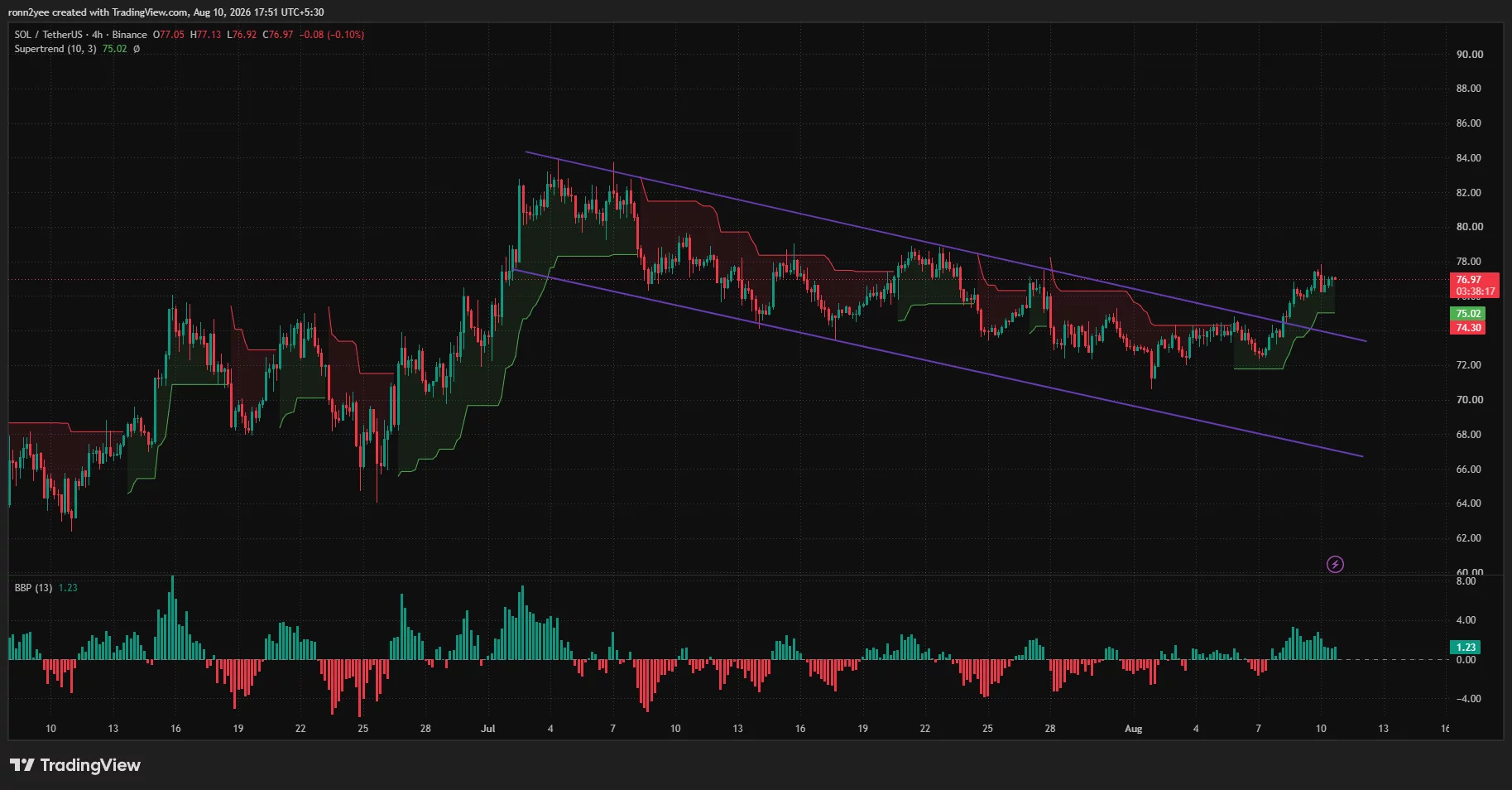
Solana price rallied nearly 7% from its Aug. 7 low, breaking a five-week descending channel as proposed supply changes and institutional adoption renewed demand for SOL.
Summary
- Solana price rose from $72.49 to $77.36, breaking above a five-week descending channel.
- 4-hour Supertrend support flipped bullish at $75.02, strengthening the breakout structure.
- Liquidation clusters at $78 and $80 could accelerate gains if buyers maintain control.
- Daily momentum remains mixed, leaving $74–$75 as the main breakout invalidation zone.
Solana price breaks its five-week downtrend
According to data from crypto.news, Solana (SOL) price traded around $76.93 on Aug. 10, up nearly 7% from its Aug. 7 low of $72.49. The recovery pushed SOL through the upper boundary of a descending channel that had controlled its price since early July.
The 4-hour chart shows that SOL first reclaimed $74.30 before breaking the channel near $75. The price then climbed to an intraday high of $77.36, where buyers encountered initial resistance.
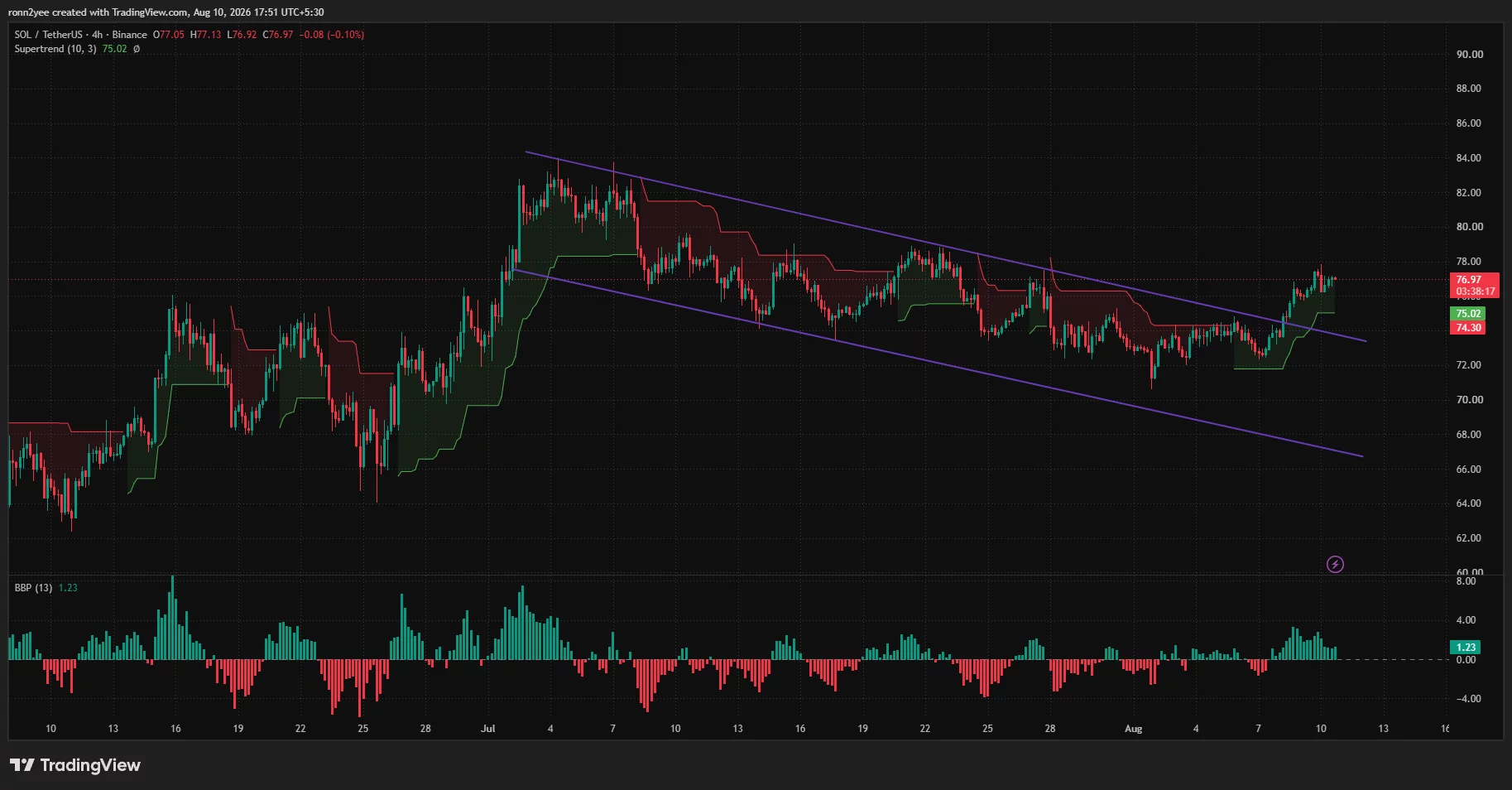
Trading volume expanded during the breakout, while the bull-bear power indicator rose to 1.23. A positive reading indicates that buyers currently have more short-term control than sellers.
The Supertrend indicator has also flipped below the market and now provides dynamic support at $75.02. Holding above this level would keep the 4-hour structure bullish and could turn the former channel resistance into support.
Crypto analyst Dami-Defi identified the same structural change in an Aug. 10 post on X.
“SOL just broke a five-week downtrend,” the analyst said.
The breakout does not yet confirm a broader trend reversal, however. SOL remains well below its May swing high near $97 and its January peak above $145.
What is driving the SOL recovery?
The rally coincided with growing validator support for two proposals designed to reduce Solana’s future supply growth.
SIMD-0550 would increase the annual disinflation rate from 15% to 30%, bringing the network toward its terminal inflation rate faster. SIMD-0553 would introduce resource-based transaction fees and could raise daily SOL burns from about 650 tokens to between 7,500 and 9,000.
The formal governance process is expected to run through Aug. 18. The proposals remain subject to validator approval, meaning their projected supply effects are not guaranteed. Solana’s governance forum describes SIMD-0550 as a doubling of the pace at which inflation declines.
Institutional developments have added another source of demand. BlackRock recently unveiled its Daily Reinvestment Stablecoin Reserve Vehicle, which can record fund ownership across several public blockchains, including Solana. The product holds cash, short-term U.S. Treasuries and repurchase agreements rather than SOL itself.
Western Union has also expanded its use of the network. Its USDPT stablecoin is issued on Solana by federally regulated Anchorage Digital Bank, while a related Stablecard product launched across 37 markets. Western Union formally launched USDPT on Solana in May.
These developments do not directly require institutions to purchase SOL in large amounts. They do, however, strengthen Solana’s case as infrastructure for regulated funds and dollar-based payments.
SOL targets $78 liquidity before $80
The three-day liquidation heatmap shows the nearest concentration of leveraged positions around $77.80–$78.20. This zone matches the next horizontal resistance visible on the 4-hour chart.
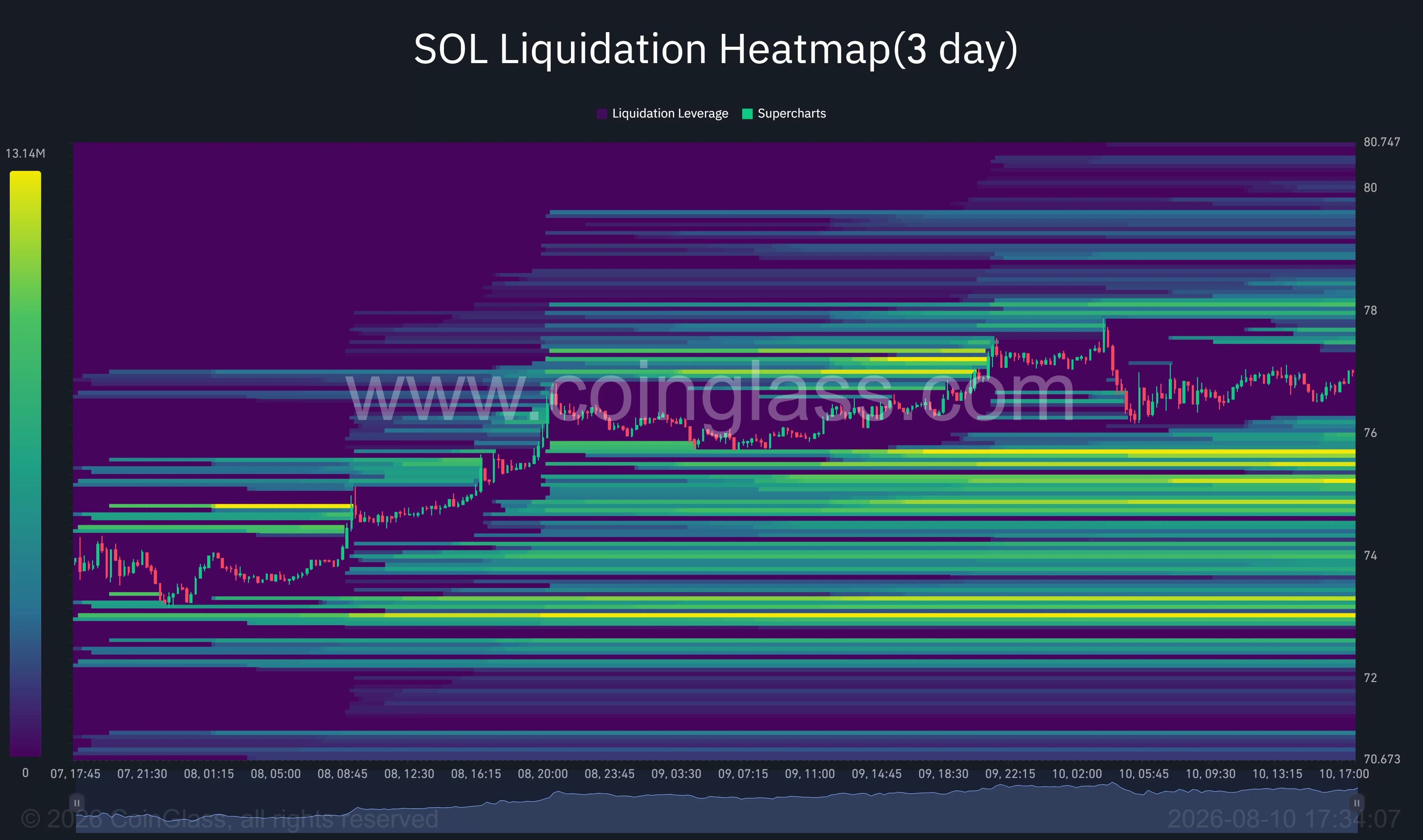
A break above $78 could trigger another round of short liquidations and open a move toward $80. The upper section of the former channel and previous July swing levels place the next larger resistance between $82 and $84.
Dami-Defi’s chart projects a possible move toward $83 if SOL successfully retests the broken trendline.
Michaël van de Poppe offered a more ambitious longer-term outlook. In an Aug. 10 market update, he said SOL had formed a higher low against Bitcoin and forecast a possible recovery toward $100–$120.
That target would require SOL to reclaim several resistance zones that are not visible in the current short-term breakout. The first tests remain $78, $80, and $83.
Daily Solana chart still needs confirmation
SOL’s daily chart is improving, although it has not produced a fully confirmed bullish reversal.
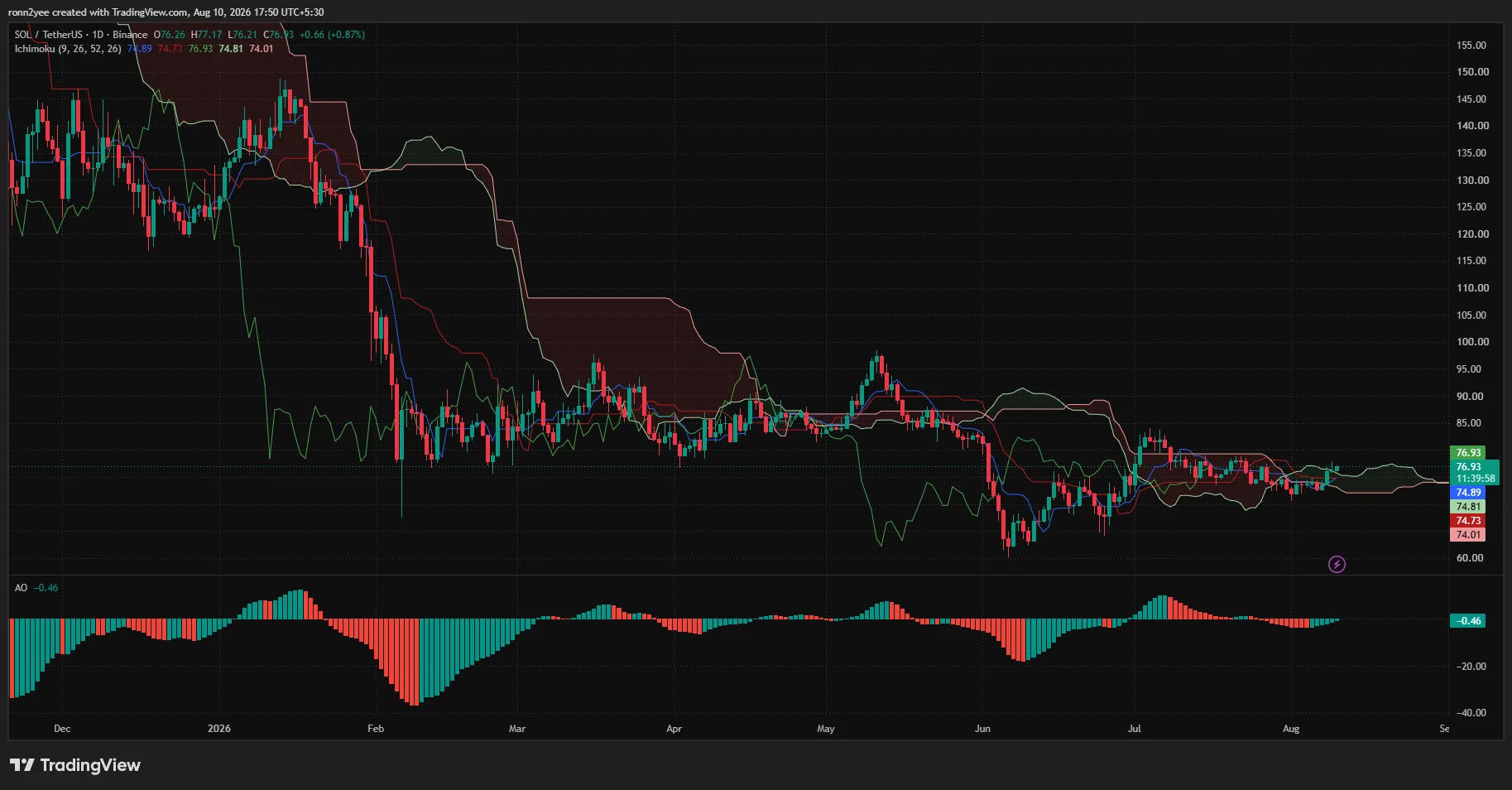
The price has moved above the Ichimoku conversion line at $74.89 and the baseline at $74.73. SOL is also attempting to clear the upper edge of the cloud around $76.93, making the current area an important daily closing level.
A sustained close above the cloud would strengthen the case for a move toward $80–$84. Rejection near $77, however, could send SOL back to test the Ichimoku cluster between $74.73 and $74.89.
The Awesome Oscillator remains slightly negative at -0.46. Its red bars have contracted and the indicator is moving toward zero, suggesting bearish momentum is fading but has not yet reversed completely.
Liquidation data reinforces the downside levels. Large long-liquidation concentrations sit around $75.70, $75.10 and $72.80. If SOL loses $75, forced selling could pull the price toward $73 before buyers regain control.
US developments remain a key SOL catalyst
Solana’s institutional adoption has become increasingly tied to regulated U.S. financial infrastructure. BlackRock’s fund structure involves tokenized ownership of Treasury-backed assets, while Western Union’s USDPT is issued by a U.S. federally chartered crypto bank.
The next network catalyst is the planned Alpenglow rollout. The upgrade aims to reduce transaction finality from about 12.8 seconds to between 100 and 150 milliseconds, with implementation expected in stages between August and October if testing proceeds as planned.
For now, SOL’s 4-hour breakout favors buyers while the price remains above $75. A daily close above $78 would provide stronger confirmation and shift focus toward $80–$84. Losing $74 would place the breakout at risk and reopen the path toward $72.80.
Disclosure: This article does not represent investment advice. The content and materials featured on this page are for educational purposes only.


Bitdeer mined 2,694 BTC in Q2, but ended the quarter holding just 150 BTC after liquidating its treasury earlier this year.

Barrick Mining (B) and Newmont (NEM) reached an agreement that may clear the way for Barrick’s IPO of its North American gold assets to unlock their full value. While the agreement resolves opposition from Newmont, with which Barrick has a Nevada Gold Mines joint venture, Bloomberg reported on Sunday that some major Barrick shareholders disapprove of the IPO plan. While…
Copyright ©2026 Investor’s Business Daily, LLC. All rights reserved. 87990cbe856818d5eddac44c7b1cdeb8

Bitcoin opened the week by printing fresh August highs as traders digested incoming U.S. inflation figures and renewed attention on global rate expectations. With the latest month-to-date strength pushing price toward the mid-$60,000s, market participants are now focusing on whether key technical levels can hold—especially with volatility risk rising ahead of CPI and PPI releases.
At the same time, the macro backdrop remains complicated: markets are still recalibrating the path for Federal Reserve policy into 2026, while the Japanese yen has moved back toward the widely watched 160-per-dollar area after recent U.S.-linked intervention. The mix of macro drivers and onchain positioning is helping shape a market debate that’s increasingly split between large holders and smaller retail addresses.
Key takeaways
- U.S. CPI and PPI data land this week, arriving after mixed-but-cooler inflation and labor signals that have shifted rate-hike odds.
- The Japanese yen is back near the 160 level following earlier intervention dynamics that traders link to broader risk-asset liquidity.
- BTC bulls are centered on the $65,800 region, framed by multiple traders and order-book-derived liquidation focus.
- CryptoQuant data points to a multi-month high in accumulation among large Bitcoin wallets (addresses holding >10,000 BTC).
- Despite pockets of strength, onchain “cycle” indicators still suggest the bear market phase may not be over—particularly in the second half of 2026.
Inflation data and the Fed’s tightening/pausing calculus
This week’s market attention is firmly on the release schedule for the Consumer Price Index and Producer Price Index. The July CPI is due on Wednesday and the July PPI on Thursday, milestones that often move expectations around the Federal Reserve’s future interest-rate path.
Recent inflation signals have been uneven, and the new prints arrive amid additional uncertainty tied to the U.S.-Iran conflict. According to Reuters, oil prices have remained sensitive to developments around the Strait of Hormuz—an exposure that can feed through to CPI depending on whether shipping conditions deteriorate or reopen. SS WealthStreet founder Sugandha Sachdeva told Reuters that crude oil remains “caught between opposing forces” as markets weigh the possibility of a breakthrough over the strait versus Iran’s conditions for reopening.
Beyond oil, the immediate context for traders is the direction of prior U.S. macro releases. Cointelegraph previously noted that last month’s CPI and PPI results surprised to the downside, with CPI posting its largest monthly decline since April 2020. Labor-market data also contributed to a cooler tone: after nonfarm payrolls fell short of expectations, Cointelegraph reported weaker-than-expected labor conditions and rising odds of a more dovish Fed.
Those changes have mattered for rate pricing. As reflected in CME Group’s FedWatch Tool, the probability of the Fed pausing at its Sept. 16 meeting stood at 56% as of Monday, after earlier market pricing leaned more heavily toward a hike. In the latest edition of its newsletter, Mosaic Asset Company wrote that a week earlier implied odds favored a September rate hike, but now pricing “slightly favor[s] the Fed keeping rates on hold,” with just one hike before pausing well into next year.
Yen dynamics return to the center of risk-asset debate
While U.S. data drives part of the narrative, traders are also monitoring currency flows that can alter liquidity across global markets. The Japanese yen has remained a focal point after a rare episode of U.S.-Japanese coordination—the first joint intervention since the late 1990s.
After USD/JPY weakened to its lowest levels since 1986 earlier in August, the New York Fed—acting on behalf of the U.S. Treasury—purchased yen using euros via the Exchange Stabilization Fund. U.S. Treasury Secretary Scott Bessent indicated at the time that further interventions were possible, arguing the U.S. strongly supports Japan’s steps to correct what he characterized as the yen’s “substantial undervaluation.”
In the days since, the yen’s trajectory has been mixed. It initially strengthened toward around 156 per dollar, but has since weakened again and is back above 158.50, edging toward the key 160 level.
Brookings Institution senior fellow Robin Brooks cautioned that intervention mechanics alone may not reverse the underlying trend. In a Substack post, he compared the effectiveness of the move to prior “rate check” dynamics around Japan’s Feb. 8 general election, arguing that price action didn’t show meaningful reversal and suggesting the intervention is unlikely to stop the yen’s weakening trend.
Earlier Cointelegraph reporting also flagged how the yen carry trade can influence liquidity conditions for crypto and other risk assets. QCP Capital similarly emphasized that the larger issue is whether higher Japanese yields change incentives for investors to allocate capital overseas.
BTC technical focus shifts to $65,800 while traders watch liquidity
Bitcoin’s price action during the week has been defined by a blend of breakout expectations and resistance from widely watched moving averages. Into Sunday’s weekly close, BTC printed month-to-date highs around $65,420, then consolidated as traditional markets reopened.
TradingView data continued to show BTC/USD stuck in a range, with the 50-month exponential moving average (EMA) acting as overhead resistance near $65,827. Still, trader Michaël van de Poppe argued that three breakout signals are forming based on traditional momentum indicators. He reported “strong” bullish divergences in both MACD and RSI across three-day and one-week time frames—an approach that looks for confirmation even when price temporarily stalls.
In van de Poppe’s framework, the pivotal line is $65,800. He suggested that if the $65,800 weekly level breaks, a “volatile move upwards” could follow due to short-side liquidity being forced to exit after consolidation. Separately, CoinGlass order-book-derived liquidation mapping also highlighted $65,800 as a key area where liquidations could cluster if price turns decisively.
At the time of reporting, cross-crypto short liquidations over the prior 24 hours were $53 million, indicating that while the market is not in a full-scale expansion phase, traders are positioned enough for moves around key levels to have feedback effects.
Other technical commentary from CryptoQuant contributor Andrew Kamsky pointed to a falling wedge pattern on the daily chart and described a potential “decision window” for the range by Aug. 17. He framed scenarios where rejection between $66.4K and $66.8K followed by higher lows could build toward an ascending triangle, while a move back inside the wedge would weaken the bullish setup and a break below support would invalidate it. As an upside possibility, Kamsky cited $72,000 as a “possible scenario.”
Onchain signals: large-wallet accumulation rises as smaller holders reduce
The most constructive onchain development comes from growing activity among large Bitcoin investors. CryptoQuant’s analysis points to a sharp shift toward accumulation among addresses holding more than 10,000 BTC. On a 60-day rolling basis, that cohort’s balance increased by 46,420 BTC on Aug. 9, which CryptoQuant described as the largest uptick since March 15.
CryptoQuant also emphasized that the latest reading nearly doubled the 23,238 BTC accumulation peak recorded in mid-March. In other words, the acceleration has not merely continued—it has intensified.
Just as importantly, CryptoQuant described a divergence between large holders and smaller addresses. After accumulating through July, wallets holding between 0.1 BTC and 1 BTC distributed roughly 9,700 BTC over the same 60-day window through Aug. 9. The implication is that large holders are adding exposure while smaller participants are trimming, a positioning split that matters because it can influence how quickly demand absorbs sell pressure if price tests lower support levels.
This week’s accumulation narrative also fits into a broader backdrop of participation concerns. Cointelegraph previously cited CryptoQuant-era observations of strong accumulation between $62,000 and $65,000 alongside order-book and market-structure debates. Glassnode cofounder Rafael Schultze-Kraft added another angle in social commentary: he described spot markets as “virtually dead,” pointing to a daily spot turnover ratio of 0.32% (the lowest level in his data) and a roughly 64% year-over-year decline in dollar volume.
Cycle indicators still warn that the bear market may be lingering
Even with accumulation data and bullish divergences on short-term charts, some analysts argue the market remains in a late-stage bear-market condition. Schultze-Kraft discussed a record “capitulation” phase in a basket of 45 indicators tracked via Glassnode’s Bitcoin Cycle Position Heatmap. In his description, the market is in its coldest stretch since FTX—late in the bear cycle but not yet in the most definitive “deep blue” stage that previously marked a floor.
CoinGlass offers a similar framing through its Bull Cycle Peak Indicators compilation, which it reports as sitting 32% toward an ideal “sell” zone. Taken together, these approaches suggest that while selective accumulation and liquidity dynamics may support short-term upside attempts, structural reversal confirmation may still require more broad participation than what spot metrics currently indicate.
Trader and analyst Rekt Capital added a historical lens by comparing the current chart structure to the 2022 bear market. In a weekend post, he argued that Bitcoin was forming lower highs relative to a July upside wick in 2022, while August produced a higher high in that earlier cycle. He also reiterated that Bitcoin has yet to reclaim the 50-month EMA around $65,827—presenting the same technical ingredient that often precedes a deeper bear-market capitulation phase.
For traders and investors, the next decision points are likely to converge: how CPI and PPI shift Fed expectations, whether the yen’s approach to 160 changes global liquidity incentives, and whether BTC can turn $65,800 into a confirmed support level rather than another range boundary. Watch whether onchain accumulation broadens alongside spot activity—or whether the market continues to show strength dominated by a smaller set of large holders.
Amazon stock is trading close to record levels as founder Jeff Bezos closes in on a roughly one-third stake in Liverpool Football Club.
Sky News reports that Fenway Sports Group could announce the transaction this week. One insider said the stake may now exceed 30%, valuing the club at $6 billion.
Bezos Joins a Consortium Chasing More Than 30% of Liverpool
Amit Bhatia leads the syndicate. He is the son-in-law of steel billionaire Lakshmi Mittal and held a stake in Championship side Queens Park Rangers until recently.
Eduardo Saverin sits alongside Bezos in the group. The 44-year-old Facebook co-founder backed a failed bid for Chelsea during the 2022 auction. Forbes puts the Bezos fortune above $280 billion, while Saverin is worth more than $32 billion.
FSG confirmed the approach last month.
“An investment consortium led, managed, and represented by Amit Bhatia has expressed interest in making a strategic minority investment in Liverpool Football Club.”
FSG spokesperson, via Sky
FSG bought Liverpool for 300 million pounds in 2010. Dynasty Equity then took a small position in 2023 at a valuation above $4.5 billion. A $6 billion figure would therefore cap 16 profitable years at Anfield.
Bezos has never been linked to a football deal before. His interest signals how far wealthy investors now treat sport as an asset class. Liverpool meanwhile enters a season of transition after the sacking of Arne Slot and the departure of Mo Salah. The club won the Premier League in 2024-25, then finished fifth.
Amazon Stock Holds Near Records After the $3 Trillion Close
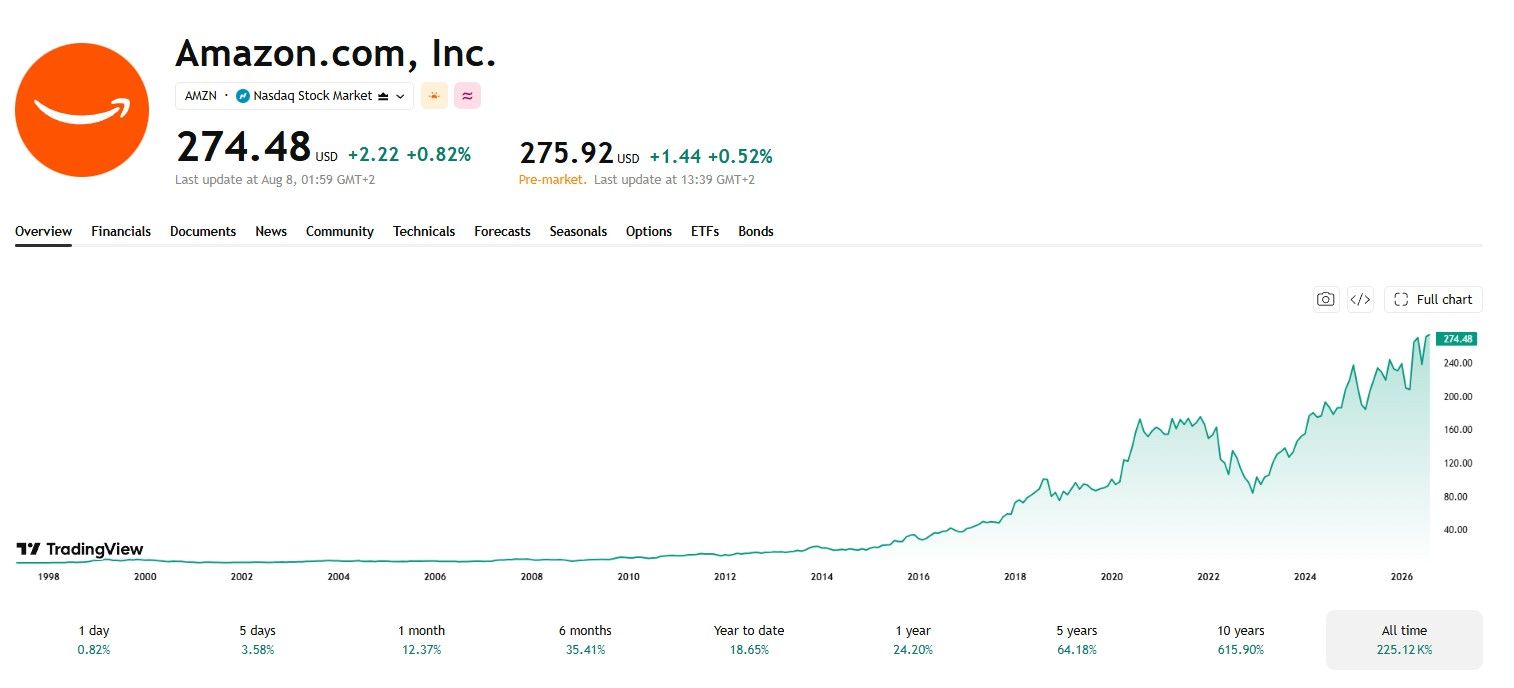
Amazon closed at $274.48 on Friday, up 0.82% on the day. Shares have gained 24.2% over the past year and 18.65% since January.

The company topped $3 trillion for the first time on August 3, although that record lasted one day. Amazon is worth roughly $2.96 trillion now, with a 52-week high of $287.20.
Cloud growth at Amazon Web Services drove the run. Analysts responded by lifting Amazon price targets, and the most bullish reached $400.
Bezos also completed a scheduled $4 billion sale of Amazon shares this month. He filed that plan eight months earlier, so the timing was mechanical rather than opportunistic. Crypto traders can follow the same names onchain, because brokers have started listing tokenized US stocks.
FSG and the consortium both declined to comment on timing. Football’s finances face wider scrutiny after FIFA moved to sell a World Cup stake. The coming days should show whether Liverpool’s new backers stay passive or eventually push for outright control.
The post Amazon Back Near $3 Trillion as Jeff Bezos Reportedly Eyes a Third of Liverpool appeared first on BeInCrypto.

Marcus Rashford’s reason for picking No. 14 shirt at Barca as he’s forced into Man United change

Art made of money

Transfer news LIVE: Arsenal FC want Romero, Barcola hijack; Liverpool done deal; Man Utd; Chelsea latest


-

 Fashion3 days ago
Weekend Open Thread: Mattifying Sunscreen
-

 Fashion3 days ago
Frugal Friday’s Workwear Report: Cap-Sleeve Pointelle Crewneck Sweater
-

 Sports4 days ago
Jordan Coyle & Cordiamo take Laya Arena Stakes at RDS
-

 News Videos2 days ago
Can Astrology Help Find Gold and Silver Trends? A Financial Astrology Guide
-
 Business5 days ago
US stocks: Dow closes at record on Mideast optimism; SpaceX, AMD drag Nasdaq
-
 Crypto World7 days ago
US Tech Stocks See Largest 5-Week Inflow in History: Can Nasdaq Break Its Downtrend?
-

 Politics4 days ago
Reform UK And Greens Sink To Lowest Favourability Ratings To Date
-

 Business6 days ago
Nvidia Stock Climbs 2.5% as Chip Sector Rally Builds Ahead of AMD Earnings, Nvidia’s Own Report Looms
-

 Crypto World6 days ago
Polymarket targets $20 billion valuation as competition heats up in prediction market sector
-

 Tech5 days ago
OpenAI, Anthropic AI agents targeted real people and systems in cyber tests
-

 Business5 days ago
Supply chain issues impact Ingredion
-
 Crypto World6 days ago
CLARITY Act Senate Vote Locked In, But 60-Vote Hurdle Looms Large
-

 Tech3 days ago
Rinn Pharma & Biopharma to join NordicPharmaTrain network
-

 Crypto World7 days ago
The Senate has one week: CLARITY’s last August window
-
 Crypto World6 days ago
Dow and S&P 500 Hit Records on AI Earnings: When Will the Bubble Burst?
-
 Crypto World7 days ago
California Wildfire Bets Expose Polymarket’s Dark Side
-

 Business1 day ago
How to Start a Cleaning Business: A Step-by-Step Guide
-

 Business1 day ago
Datadog: Best Of Breed For Multiple Reasons
-

 Business7 days ago
CNH Industrial Shares Jump Over 15% After Beating Estimates and Raising Full-Year Earnings Guidance
-
 Crypto World6 days ago
Dollar Index Trapped at 100 as Hawkish Fed Meets Official Selling
You must be logged in to post a comment Login