
Crypto World
Nvidia (NVDA) Class Action Certified Over Hidden Crypto Mining Sales Claims


Key Takeaways
- On March 25, a federal judge in California granted class certification in an investor lawsuit against Nvidia and its CEO Jensen Huang
- Plaintiffs allege the company concealed more than $1 billion in graphics card sales to cryptocurrency miners, misrepresenting them as gaming revenue between 2017 and 2018
- In 2022, Nvidia settled with the SEC for $5.5 million over inadequate disclosure of crypto mining’s influence on gaming segment sales
- The certified class includes all NVDA shareholders who purchased shares from August 10, 2017 through November 15, 2018
- A case management hearing is scheduled for April 21 through Zoom; shares traded at $174.03, declining 2.5%
Nvidia (NVDA) was trading at $174.03, down 2.50% at the time of writing.
Shares declined following a California federal court decision that brought the extended cryptocurrency revenue litigation significantly closer to reaching trial.
The Foundation of the Legal Challenge
The central accusation is clear-cut: Nvidia communicated to shareholders that its gaming graphics card revenue was expanding because of increased purchases from video game enthusiasts. However, this narrative omitted critical information.
Throughout the 2017 cryptocurrency surge, Ethereum mining operations were purchasing GeForce graphics cards in massive quantities. This demand was silently responsible for a substantial portion of what Nvidia classified as “gaming” revenue.
Quarterly sales surged by 52% followed by 25% year-over-year during these timeframes. The plaintiffs contend that shareholders were completely unaware of how much revenue depended on cryptocurrency activity.
When Bitcoin collapsed in 2018 and mining operations became economically unviable, demand for GPUs plummeted. Gaming segment revenue declined sharply, and the cryptocurrency-fueled basis of the prior growth became unmistakable after the fact.
Nvidia’s own fourth quarter FY2019 earnings discussion compounded the issue. Company executives explicitly attributed the revenue decline to the cryptocurrency mining collapse — a statement that directly conflicted with how they had characterized the earlier expansion.
SEC Enforcement Action Preceded This Lawsuit
The Securities and Exchange Commission acted before this civil case gained momentum. In May 2022, Nvidia agreed to a $5.5 million settlement after regulators determined the company had inadequately disclosed how cryptocurrency mining materially affected gaming GPU sales during the second and third quarters of fiscal 2018.
The commission’s enforcement division stated that Nvidia’s disclosure shortcomings prevented investors from accessing information essential for proper business evaluation.
Nvidia resolved that enforcement action without admitting guilt — a framework that allowed the company to maintain its legal position while essentially confirming the underlying factual claims.
The current civil litigation continues from where the SEC action concluded. The question is no longer whether disclosure failures occurred, but rather who bears financial responsibility.
Plaintiffs further contend that Nvidia personnel were actively monitoring cryptocurrency market movements and linking them to GPU sales performance in real time during those reporting periods. This evidence, they assert, demonstrates that executive-level statements regarding gaming demand were deliberately misleading — not merely incomplete.
On March 25, Judge Haywood Gilliam approved certification for the investor class — encompassing all individuals who purchased NVDA shares between August 10, 2017 and November 15, 2018. This decision is procedural in nature and doesn’t establish whether Nvidia’s disclosures constituted fraud.
A case management conference has been set for April 21 through a publicly accessible Zoom webinar.
Nvidia responded: “Investors who purchased NVIDIA in the 2017-2018 timeframe have done incredibly well, as our corporate strategy unfolded as we consistently predicted. We will address the complaint in court.”



Quick Overview
- Australian regulators impose $10M penalty on Binance for systematic client misclassification
- Over 85% of Australian clients wrongly categorized, granting inappropriate derivative access
- Retail traders suffered combined losses exceeding $12M from risky products
- Flawed verification processes allowed unqualified users to bypass safety measures
- Federal Court ruling follows license cancellation and business shutdown
Australian regulators have imposed a $10 million penalty on Binance following discoveries of systematic client categorization failures that granted retail investors access to hazardous derivative instruments. The decision focuses on operational deficiencies within Binance Australia Derivatives. The judgment reveals substantial breakdowns in customer verification, regulatory oversight, and investor safety protocols.
Systematic Client Categorization Failures Put Retail Investors at Risk
Federal Court proceedings revealed that Binance incorrectly categorized over 85% of its Australian customer base as wholesale participants. A total of 524 retail investors gained unauthorized entry to sophisticated derivative instruments lacking mandatory protective measures. These violations spanned the period from July 2022 through April 2023.
The exchange permitted users to make multiple attempts at qualification assessments until achieving passing scores on necessary thresholds. Personnel neglected to authenticate documentation and investor declarations throughout the registration process. These practices undermined protective mechanisms established to shield retail market participants.
Binance erroneously granted approval to certain applicants under professional or exempted categories without conducting adequate verification. Users obtained entry to high-stakes financial products despite failing to meet eligibility standards. This oversight directly resulted in monetary damages throughout the impacted customer segment.
Regulatory Violations and Monetary Consequences
Binance acknowledged numerous violations of Australian financial services regulations. The platform failed to distribute required disclosure documentation and neglected to establish appropriate market targeting criteria. Additionally, it operated without a compliant dispute resolution mechanism.
Wrongly classified customers experienced substantial monetary setbacks throughout their trading operations. They sustained approximately $8.66 million in trading losses while paying close to $3.89 million in transaction fees. Combined financial damage surpassed $12 million.
Binance has already distributed over $13 million in restitution payments to impacted customers. Regulatory bodies additionally mandated that Binance assume legal expenses connected to enforcement proceedings. Overall financial repercussions escalated well beyond the imposed penalty.
Enforcement Measures and Industry-Wide Ramifications
Regulatory authorities launched investigations into Binance Australia’s operations during 2022 after initial compliance irregularities surfaced. Subsequently, officials revoked its financial services authorization in April 2023. This enforcement action compelled Binance to terminate its domestic derivatives operations.
Officials stressed that Binance neglected to establish fundamental compliance infrastructure from inception. Insufficient personnel education and supervision enabled recurring registration mistakes. Authorities characterized the violations as institutional rather than sporadic incidents.
This ruling establishes significant precedent for international cryptocurrency platforms entering regulated jurisdictions. Organizations must deploy rigorous customer verification protocols and sustain compliance structures from operational commencement. Binance currently encounters heightened regulatory examination alongside persistent oversight challenges across multiple territories.
Crypto World
Bitcoin Accumulation Trend Strengthens as Whales and Retail Add Holdings Amid Price Dip
TLDR:
- Bitcoin whales accumulated over 61K BTC in one month despite price hovering near key support levels
- Retail wallets matched whale accumulation pace, adding nearly 0.42% to holdings during market dip
- Historical trends show rallies often start when whales buy while retail sells, not current pattern
- Traders focus on $67K to $69K levels as Bitcoin remains range-bound with short-term setups forming
Bitcoin accumulation trend remains active as large and small holders continue adding to positions despite recent price weakness near the $68,000 level.
Data from Santiment shows coordinated accumulation across key wallet tiers, even as short-term price action stays range-bound.
This pattern reflects steady positioning during uncertainty, with market participants responding differently across timeframes while maintaining exposure to Bitcoin.
Whale and Retail Wallets Move in Parallel
Santiment data shows that wallets holding between 10 and 10,000 BTC added 61,568 BTC over the past month. This represents a 0.45% increase in holdings during a period of price retracement.
The accumulation occurred while Bitcoin briefly traded near $68,100, indicating sustained interest from larger market participants.
At the same time, smaller wallets holding less than 0.01 BTC also increased their holdings. Retail participants recorded a 0.42% rise over the same timeframe.
This places both cohorts on nearly identical accumulation paths, which is not always typical in similar market conditions.
Santiment shared this data publicly, noting that both whales and retail continue to accumulate despite macroeconomic uncertainty.
The firm also pointed out that historical cycles often behave differently. In previous cycles, strong upward moves followed periods where large holders accumulated while retail reduced exposure.
The current structure, therefore, presents a mixed signal. While accumulation is ongoing, the alignment between retail and large wallets suggests a more complex market phase. Price movement remains constrained, with no clear breakout confirmed yet.
Short-Term Trading Levels Remain in Focus
Market participants are also watching short-term price levels closely. Trader Lennaert Snyder outlined a cautious approach in a recent update.
He noted that Bitcoin is trading near the previous weekly low around $67,360, limiting late short opportunities.
According to his plan, short positions may only be considered after specific liquidity events. These include reactions near the $68,955 level or after addressing an imbalance around $86,399. Entry confirmation would rely on lower timeframe signals such as M15 engulfing patterns or structure breaks.
His commentary reflects a tactical approach to current price action. Rather than chasing moves, traders are waiting for confirmation signals before entering positions. This aligns with the broader range-bound structure seen in recent sessions.
At present, Bitcoin continues to trade within a narrow band, with both bullish and bearish setups dependent on key levels.
While accumulation data provides context, short-term execution remains driven by technical confirmation. As a result, market participants are balancing long-term positioning with immediate price reactions.


Ripple’s native token (XRP) stayed under pressure on Friday as traders watched a key chart level and fresh signals from the Ripple ecosystem.
Summary
- XRP trades near $1.34 after recent declines as analysts identify a critical decision zone.
- Analysts say reclaiming $1.80 and breaking $2.20 would confirm stronger upside momentum for XRP.
- Ripple adds AI security tools while institutional exposure like Goldman Sachs positions remains active.
CoinGecko data showed XRP at about $1.34 on Friday, with a 24-hour trading volume near $2.61 billion. The same data showed XRP down about 3% on the day and about 8% over the past seven days, with a market capitalization near $81.9 billion.
Crypto analyst EGRAG CRYPTO said XRP was at a “very sensitive level” and described the current area as a point where market direction could be decided. The analyst said a hold at this zone could support a move higher, while a break could send XRP toward deeper support around $1.15.
EGRAG also said the weekly structure matters more than short-term noise. In the post, the analyst pointed to $1.80 as a reclaim level and said a break and hold above $2.20 would be needed for stronger upside confirmation.
The analyst compared the current setup with earlier cycle behavior and said the signal had previously marked a zone near major bottoms rather than the exact low. “The cross marked a ZONE, not the exact bottom,” the post said.
Ripple adds AI tools to XRPL security process
Ripple said it is adding AI-assisted testing, a dedicated red team, and stricter review standards to strengthen XRP Ledger security before code reaches production. The company said the goal is to improve reliability as XRPL supports payments, tokenized assets, and institutional use cases.
Ripple said the new process will use AI across the XRPL development lifecycle to scan for vulnerabilities, review code changes, and model threat scenarios. The company said this work is part of the next phase of XRPL growth as network complexity increases.
Moreover, reports this week said Goldman Sachs disclosed more than $152 million in XRP ETF exposure through a recent SEC filing. That figure suggested that some institutional investors are still maintaining XRP-linked positions through structured products even as price action remains weak.
Disclosure: This article does not represent investment advice. The content and materials featured on this page are for educational purposes only.
Crypto World
Ondo, CC sidestep macro concerns with institutional deals as BTC, ETH prices slide: Crypto Daybook Americas
By Omkar Godbole (All times ET unless indicated otherwise)
Bearish macro headlines dominate crypto market sentiment, as they have done for most of the month, but concrete updates advancing mainstream blockchain adoption still have the ability to resonate with investors.
That’s evident from the 7% gain in Canton Network’s CC token over the past 24 hours. It’s the second-best-performing top-100 token by market value, behind Ondo Network’s ONDO token, which has risen 9%.
CC’s upswing follows Visa’s announcement that it joined Canton Network as a super validator, helping secure and validate transactions on the blockchain.
The move is pivotal because it brings a global payments giant onto a privacy-preserving network specifically built for institutions that want to transact on the blockchain without exposing sensitive data to other network participants.
Visa will help “extend privacy‑preserving blockchain infrastructure to banks and financial institutions around the world,” the firm said in an official announcement.
Privacy is widely seen as a key requirement for broader institutional adoption of the technology. At Consensus Hong Kong in February, investment banking giant JPMorgan and crypto firms Abraxas and B2C2 emphasized the need for privacy-preserving infrastructure, noting that institutions are unlikely to transact at scale on fully transparent networks where sensitive financial data could be exposed.
ONDO, too, is rallying primarily due to its pole position in the real-world asset tokenization sector, underscored by the early-week news of its partnership with Franklin Templeton to tokenize traditional assets.
The broader market remains under pressure due to geopolitical tensions and oil prices, which have traders pricing a Fed rate hike in two weeks.
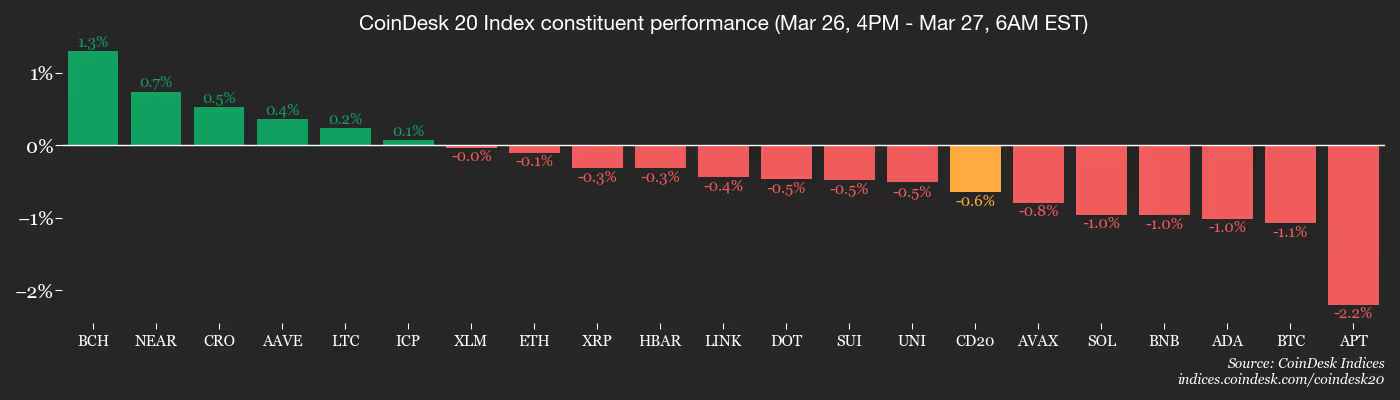
Bitcoin has dropped over 3% to $66,800 alognside similar losses in ether (ETH) and XRP (XRP). Solana’s SOL token fell over 5% and the CoinDesk 20 Index (CD20) lost 3% decline.
According to Marex, renewed outflows from spot ETFs are weighing on bitcoin.
“ETF outflows have returned in size, which removes a steady bid from the tape and makes dips feel less protected,” Marex’s analysts said in a morning note.
They added that with the quarterly options expiry out of the way, the market is more exposed to the real catalysts again: oil, war headlines, rates and risk appetite.
Speaking of risk appetite, it could remain weak as government bond yields across the advanced world, including the U.S. and Japan, are rising again. Stay alert!
Read more: For analysis of today’s activity in altcoins and derivatives, see Crypto Markets Today
What to Watch
For a more comprehensive list of events this week, see CoinDesk’s “Crypto Week Ahead“.
- Crypto
- Macro
- March 27, 10:00 a.m.: U.S. Michigan Consumer Sentiment Final for March est. 55.5 (Prev. 56.6)
- Earnings (Estimates based on FactSet data)
- March 27: Sphere 3D (ANY), post-market, -$4.68
- March 27: Bonk Inc (BNKK), post-market
- March 27: Mawson Infrastructure Group (MIGI), post-market, -$10.40
- March 27: ZeroStack (ZSTK), post-market, -$1.97
Token Events
For a more comprehensive list of events this week, see CoinDesk’s “Crypto Week Ahead“.
- Governance votes & calls
- Unlocks
- Token Launches
Conferences
For a more comprehensive list of events this week, see CoinDesk’s “Crypto Week Ahead“.
Market Movements
- BTC is down 6.13% from 4 p.m. ET Thursday at $66,329.42 (24hrs: -4.44%)
- ETH is down 8.13% at $1,987.25 (24hrs: -4.27%)
- CoinDesk 20 is down 3.34% at 1,909.22 (24hrs: -3.86%)
- Ether CESR Composite Staking Rate is unchanged at 2.74%
- BTC funding rate is at -0.0097% (-10.5930% annualized) on Binance

- DXY is up 0.10% at 100.00
- Gold futures are unchanged at $4,460.60
- Silver futures are unchanged at $68.82
- Nikkei 225 closed down 0.43% at 53,373.07
- Hang Seng closed up 0.38% at 24,951.88
- FTSE is down 0.69% at 9,902.97
- Euro Stoxx 50 is down 1.39% at 5,488.69
- DJIA closed on Thursday down 1.01% at 45,960.11
- S&P 500 closed down 1.74% at 6,477.16
- Nasdaq Composite closed down 2.38% at 21,408.08
- S&P/TSX Composite closed down 1.53% at 31,887.52
- S&P 40 Latin America closed up 0.44% at 3,481.68
- U.S. 10-Year Treasury rate is up 9 bps at 4.42%
- E-mini S&P 500 futures are down 0.51% at 6,492.00
- E-mini Nasdaq-100 futures are down 0.71% at 23,624.25
- E-mini Dow Jones Industrial Average Index are down 0.48% at 46,009.00
Bitcoin Stats
- BTC Dominance: 58.49% (-0.61%)
- Ether-bitcoin ratio: 0.02996 (0.07%)
- Hashrate (seven-day moving average): 994 EH/s
- Hashprice (spot): $31.97
- Total fees: 2.37 BTC / $164,687
- CME Futures Open Interest: 118,140 BTC
- BTC priced in gold: 15.1 oz.
- BTC vs gold market cap: 4.44%
Technical Analysis

- The chart shows bitcoin’s daily price swings in candlestick format since July last year.
- BTC has slipped to support of the trendline from Feb. 6 low, characterizing the price bounce within the broader downtrend.
- Should the support give way, we could see a deeper selloff that could test dip demand around February lows near $60,000.
- The latest pattern is similar to the one seen through December and January, which ended up deepening the selloff.
Crypto Equities
- Coinbase Global (COIN): closed on Thursday at $173.38 (–4.26%), –1.72% at $170.39 in pre-market
- Galaxy Digital (GLXY): closed at $19.61 (–8.06%), –1.33% at $19.35
- MARA Holdings (MARA): closed at $8.58 (+3.62%), –0.58% at $8.53
- Riot Platforms (RIOT): closed at $14.01 (–7.62%), –0.18% at $13.98
- Core Scientific (CORZ): closed at $15.79 (–7.39%), –0.51% at $15.71
- CleanSpark (CLSK): closed at $9.30 (–6.63%), –0.54% at $9.25
- Exodus Movement (EXOD): closed at $6.85 (–6.04%)
- CoinShares Bitcoin Miners ETF (WGMI): closed at $37.08 (–7.99%)
- Circle Internet Group (CRCL): closed at $98.27 (–5.38%), –2.35% at $95.96
- Bullish (BLSH): closed at $36.44 (–2.64%), –0.93% at $36.10
Crypto Treasury Companies
- Strategy (MSTR): closed at $132.93 (–4.46%), –0.99% at $131.61
- Strive Asset Management (ASST): closed at $10.41 (–4.06%), –1.15% at $10.29
- SharpLink Gaming (SBET): closed at $6.53 (–10.30%), –0.61% at $6.49
- Upexi (UPXI): closed at $1.07 (–10.08%), +1.87% at $1.09
- Lite Strategy (LITS): closed at $1.16 (–3.33%)
ETF Flows
Spot BTC ETFs
- Daily net flows: -$171.3 million
- Cumulative net flows: $56.14 billion
- Total BTC holdings ~1.29 million
Spot ETH ETFs
- Daily net flows: -$92.5 million
- Cumulative net flows: $11.6 billion
- Total ETH holdings ~5.76 million
Source: Farside Investors
While You Were Sleeping
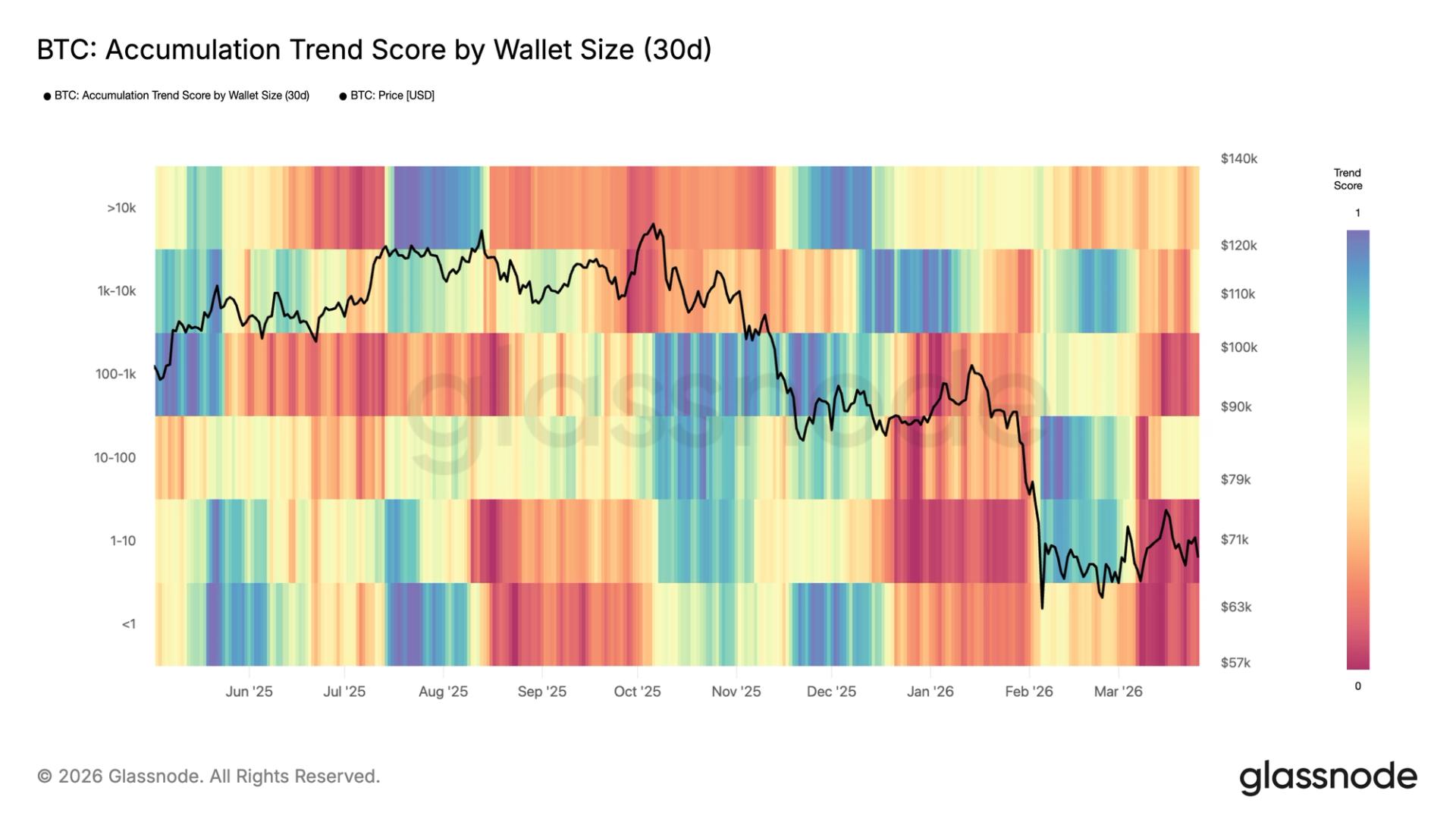
Glassnode’s Accumulation Trend Score by cohort is signaling broad-based selling led by retail participants as bitcoin falls below $67,000.
The 30-day Accumulation Trend Score, broken down by wallet cohorts, measures the relative behavior of entities accumulating or distributing coins on-chain. It combines both the size of each cohort’s holdings and their net balance change over the past 30 days. A score closer to 1 indicates accumulation, particularly by larger entities, while a score near 0 reflects distribution or a lack of accumulation.
Currently, the heaviest selling pressure is coming from retail participants holding less than 10 BTC. Wallets with under 1 BTC have a score of 0.11, while those holding 1 to 10 BTC are even lower at 0.05, indicating aggressive distribution.
Further up the spectrum, selling pressure becomes less pronounced. Whales holding 1,000 to 10,000 BTC are neutral with a score around 0.5, suggesting neither strong accumulation nor distribution, waiting to see where prices head next.
The largest cohort, those holding over 10,000 BTC, are showing mild distribution but not at levels seen late last year when Bitcoin traded above $90,000. Meanwhile, entities holding 100 to 1,000 BTC are also in notable distribution.
There has been limited accumulation since early February, when bitcoin briefly dropped toward $60,000. The current trend suggests retail investors are capitulating, while larger players remain on the sidelines, waiting rather than actively buying.

Key Highlights
- Shares closed down 11.37% at $688.80 Thursday, then climbed 1.50% to $699.10 after hours.
- Company disclosed plans for a 240,000-square-foot Greensboro, NC production site purchased from Qorvo, with operations expected by mid-2028.
- NVIDIA named as a confirmed customer through existing strategic supply agreements linked to the facility.
- Previous quarter showed Lumentum exceeding EPS forecasts ($1.67 actual vs. $1.41 projected) while revenue jumped 65.5% annually to $665.5M.
- Wall Street price targets vary significantly — BNP Paribas projects $1,040 while the average consensus hovers at $575.06; company insiders offloaded approximately $38.9M in shares recently.
Shares of Lumentum Holdings (LITE) experienced significant volatility Thursday, plummeting 11.37% before settling at $688.80. Trading volume reached approximately 6.18 million shares — representing a 4% increase over typical daily activity.
However, the semiconductor stock staged a comeback during extended trading hours. Shares climbed 1.50% to $699.10 after the company disclosed details about a significant domestic manufacturing investment.
Lumentum revealed its purchase of a 240,000-square-foot production campus in Greensboro, North Carolina, from fellow semiconductor company Qorvo. The facility will focus on manufacturing indium phosphide optical components, including continuous wave lasers and ultra-high-power laser systems utilizing 6-inch InP wafers.
Operations are scheduled to reach full capacity around mid-2028. Chief Executive Michael Hurlston noted that clients are “constructing the technological backbone that will shape the future generation of computing.”
NVIDIA received confirmation as a client through existing strategic partnership agreements connected to this manufacturing expansion. Debora Shoquist, NVIDIA’s EVP of Operations, stated the development “reinforces supply chain reliability and enables us to address increasing infrastructure requirements with assurance.”
The after-hours recovery indicates investors interpreted Thursday’s selloff as an attractive entry point rather than evidence of underlying business deterioration.
Impressive Financial Performance and Upgraded Outlook
Lumentum’s latest quarterly earnings provided substantial reasons for investor confidence. The firm reported earnings per share of $1.67, surpassing Wall Street’s $1.41 consensus by $0.26.
Total revenue reached $665.5 million — representing a 65.5% increase compared to the same period last year and exceeding analyst expectations of $646.74 million. Management issued Q3 2026 EPS guidance ranging from $2.15 to $2.35.
Despite this positive momentum, shares have retreated from their 52-week peak of $808.80. The stock nevertheless trades 84% higher than its 52-week bottom of $45.66, with an extraordinary 941.90% gain over the trailing twelve months.
Current pricing remains substantially above key technical indicators — the 50-day moving average sits at $567.66 while the 200-day moving average rests at $363.11, both considerably beneath today’s levels.
Wall Street Remains Divided
Analyst perspectives vary considerably. BNP Paribas maintains a bullish $1,040 price objective, suggesting roughly 47% appreciation potential from present valuations.
Morgan Stanley kept its Equal-Weight stance while increasing its target from $520 to $595. Mizuho holds an “outperform” recommendation with a $645 price goal.
The aggregated view from 19 Wall Street analysts indicates a “Moderate Buy” rating with a mean price target of $575.06 — presently trading below the stock’s current market value.
Regarding insider activity, company executives have disposed of approximately 65,775 shares valued at roughly $38.9 million during the previous 90-day period. Institutional investors control about 94% of outstanding shares.
LITE’s relative strength index registered 52.34 entering Friday’s session, with the company’s total market capitalization standing near $49.18 billion.
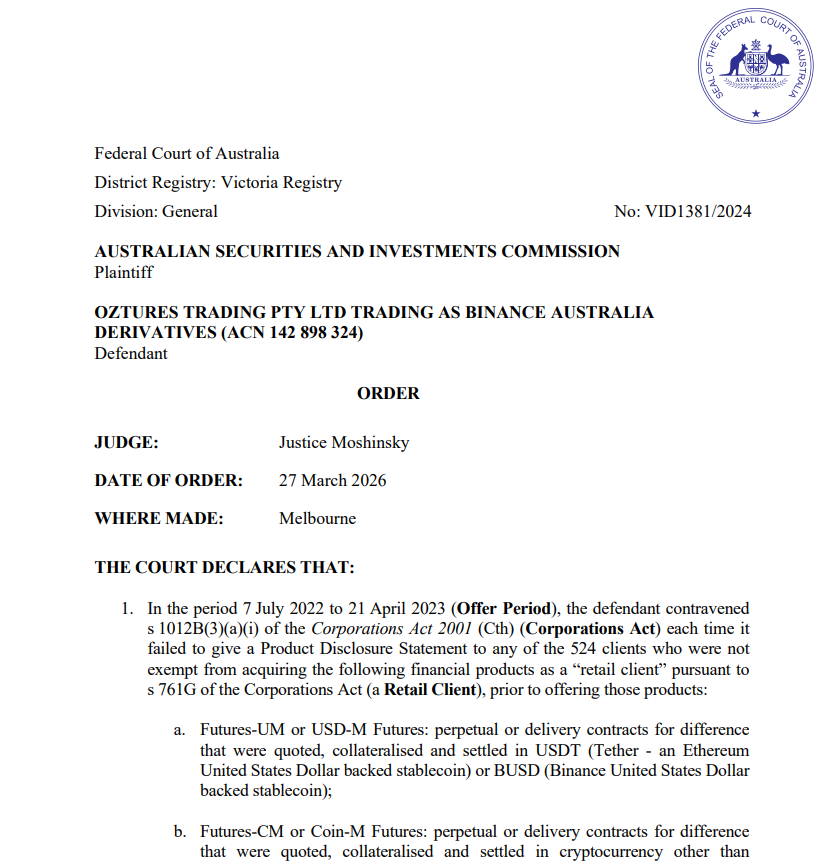
An Australian court ordered Binance Australia Derivatives to pay $6.9 million after misclassifying retail clients and exposing them to high-risk crypto products.
The Federal Court of Australia has ordered Oztures Trading Pty Ltd, trading as Binance Australia Derivatives, to pay a 10 million Australian dollar ($6.9 million) penalty after the company admitted to misclassifying more than 85% of its Australian client base and exposing retail investors to high-risk crypto derivatives without required protections.
The Australian Securities and Investments Commission (ASIC) said the affected group included 524 retail investors who were wrongly treated as wholesale clients between July 2022 and April 2023. Those clients later incurred $6.3 million in trading losses and paid $2.6 million in fees.
Binance also admitted in a statement of agreed facts to multiple compliance failures, including not providing product disclosure statements to retail clients, not making a target market determination and not maintaining a compliant internal dispute resolution system.
The penalty comes on top of the around $9 million in compensation that Binance’s local derivatives unit was ordered to pay to affected clients in November 2023.

Binance did not immediately respond to Cointelegraph’s request for comment.
Related: White House clears review of proposal to allow crypto in 401(k) retirement plans
This is a developing story, and further information will be added as it becomes available.
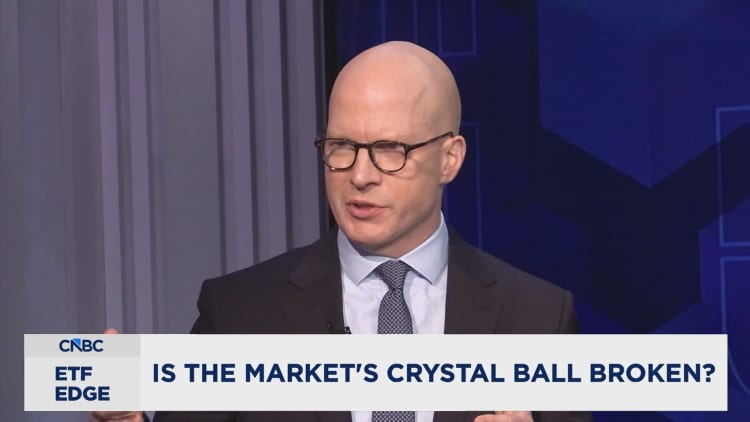

Investors may want to take a step back as stocks swing amid rising geopolitical tensions.
DBi’s Andrew Beer suggests the market’s crystal ball is broken.
“It’s not normal for big markets to move as much as they are right now,” the firm’s managing member told CNBC’s “ETF Edge” this week. “Something is deeply wrong in the market’s ability to forecast the state of the world… The only thing we can all do as investors is: This is the moment to plan and to prepare for the worst. You hope for the best.”
Beer, who has spent more than three decades in the hedge fund industry, thinks it’s remarkable the number of stresses on the financial system over the past 12 to18 months hasn’t caused things to spin out of control.
“You just you have more geopolitical risks stacked on top of each other today [and] more economic risk factors than I remember at any time in my career,” he added.
Beer urges investors to ask themselves how they would act if a 2008 or 2022 market downturn happens again.
“These financial assets are, they’re an investment, but they’re also what you need to survive, to live on, to retire, and so it’s the very real human side of it that I hope people will focus on,” he added.
According to Beer, investing like it’s 2025 could turn into regret.
“The best thing to do in 2025 was just turn off your computer beginning of the year and come back at the end of the year, and you’ve made money, your stocks and your bonds and everything else,” he said. “It won’t continue like that. We will go through a more difficult period.”
Recent moves in gold, silver, bitcoin and crude oil underscore how difficult it has become for investors to calibrate portfolios, especially as sharp reversals unfold over short periods of time, according to Beer.
“No one has a playbook for that,” said Beer, who is also watching for signs of strain in private credit, insurance company portfolios and other corners of the market where unusual stress could begin to spread.
NovaDius Wealth Management’s Nate Geraci highlighted exchange-traded funds that are designed to offer portfolio protection — particularly managed futures ETFs.
“This is absolutely something that is a longer-term allocation, and I almost view it as portfolio insurance,” the firm’s president said in the same interview. “You want that insurance when something goes bad in the market, and maybe that’s stocks and bonds going down together.”

Key Highlights
- Unity reported preliminary Q1 revenue of $505M–$508M, surpassing its own forecast of $480M–$490M and beating the Street’s $494M estimate.
- The company boosted its adjusted EBITDA outlook to $130M–$135M from the previous $105M–$110M range, representing a 58% increase versus the prior year.
- Vector, Unity’s artificial intelligence-driven advertising platform, powered the outperformance and now represents approximately 80% of Strategic Grow segment revenue.
- The company plans to shut down the ironSource Ads Network by April 30 and has engaged advisors to divest its Supersonic game publishing division.
- Wall Street firms including Citizens, Wedbush, and William Blair maintained positive ratings, with Citizens setting a $37 price objective.
Unity Software significantly exceeded its first-quarter projections, propelling shares approximately 15% higher in early Friday trading. The company disclosed the preliminary financial results in a Thursday evening announcement.
Management now projects first-quarter revenue landing between $505 million and $508 million. This handily surpasses the company’s previous outlook range of $480 million to $490 million, as well as the Wall Street consensus estimate of $494 million compiled by FactSet. The figure represents approximately 17% growth on a year-over-year basis.
Regarding profitability, Unity anticipates adjusted EBITDA will reach between $130 million and $135 million. This significantly exceeds the company’s earlier projection of $105 million to $110 million, marking a substantial 58% climb compared to the year-ago period.
Chief Executive Matt Bromberg highlighted Vector, the company’s artificial intelligence-powered advertising solution, as the primary catalyst behind the strong performance. Vector employs machine learning to connect players with appropriate games and has been generating superior long-term returns for advertising partners, according to management.
Vector currently comprises nearly 80% of the Strategic Grow segment’s revenue. The entire Grow division is projected to generate approximately $352 million during the first quarter.
Strategic Divestitures of Underperforming Assets
Unity simultaneously revealed plans to discontinue the ironSource Ads Network, with operations ceasing on April 30. During the latest quarter, ironSource contributed merely 11% of overall revenue expansion.
Additionally, the company has retained a financial advisor to pursue strategic alternatives for its Supersonic game publishing operations. Management indicated these strategic moves will accelerate top-line growth, enhance adjusted EBITDA performance, and boost operating margins.
The restructuring initiative has garnered favorable analyst commentary. William Blair’s Dylan Becker observed that the Grow segment, once these legacy operations are removed, is already expanding at a notably faster pace than the consolidated business.
Citizens maintained its Market Outperform recommendation with a $37 valuation target. The firm highlighted that Vector’s positive momentum persists, while data integration capabilities with Vector have entered the testing phase. Unity’s in-app purchase commerce solution is also scaling up.
Wedbush reaffirmed its Buy stance with a $30 price objective. Meanwhile, BofA Securities raised Unity from Underperform to Neutral, pointing to a more balanced risk profile.
Valuation Analysis Points to Upside Potential
Unity’s earnings per share are expected to improve dramatically from -$0.96 to $1.02 during the current fiscal year, based on InvestingPro projections. Citizens anticipates EBITDA margin expansion as the high-margin Vector platform captures an increasingly larger portion of total revenue.
William Blair’s Becker emphasized that Unity’s valuation remains attractive relative to direct competitors when examining 2026 revenue and EBITDA multiples.
Separately, Unity is said to be evaluating strategic alternatives for its China operations, including a possible divestiture that could command a valuation exceeding $1 billion.

House Financial Services Committee ranking Democrat Rep. Maxine Waters sent a formal letter Thursday to Federal Reserve Bank of Kansas City President Jeff Schmid, demanding answers on why Kraken’s banking subsidiary was granted a Federal Reserve master account, and what that access actually means in practice.
Waters set an April 10 response deadline, asking Schmid to detail which Fed services Kraken can access, what restrictions apply, and what anti-money laundering and consumer protection measures were evaluated before approval.
This is not routine congressional oversight. It is a direct challenge to the legitimacy of the most consequential crypto banking decision the Federal Reserve has made.
Key Takeaways:
- Legislative Pressure: Rep. Maxine Waters has demanded the Kansas City Fed respond by April 10, outlining the scope, restrictions, and risk controls behind Kraken Financial’s master account approval.
- Kraken’s Position: Kraken Financial — a Wyoming SPDI operating under a full-reserve, no-lending model — became the first crypto-native firm to secure Fed master account access, granted as a one-year pilot on March 4, 2026.
- What’s at Stake: The account gives Kraken direct access to Fedwire, placing a crypto exchange on the same payment rails as commercial banks and credit unions — a structural shift that traditional banking groups are calling premature and opaque.
What Waters Is Actually Demanding
Congressional scrutiny of the Kansas City Fed’s approval process centers on one core complaint: the Fed disclosed almost nothing.
The Kansas City Fed’s press release explicitly cited business confidentiality as the reason for withholding details about which services Kraken can access, a stance Waters called insufficient given the stakes.

Waters wrote that “the Kansas City Fed’s announcement does not disclose specific information about Kraken’s access to the range of Federal Reserve financial services due to the confidentiality of business information provided by applicants.”
Her letter demands specifics: which Fedwire functions, what ACH access, which safeguards, and how the approval aligns with existing statutory frameworks.
The account in question is a limited-purpose, or “skinny”, master account, granting Kraken Financial Tier 3 access to Fedwire and potentially ACH for reserve holdings and settlements.
It does not include access to Fed liquidity facilities. Fed Vice Chair for Supervision Michelle Bowman described the arrangement at an American Bankers Association conference on March 11 as a learning exercise: “We’re trying to learn,” she said, acknowledging the Fed could intervene if behaviors proved inconsistent.

Kraken Financial operates as a Payward subsidiary under Wyoming’s Special Purpose Depository Institution framework, full-reserve, no lending, no FDIC insurance. Every deposit is backed 1:1. That structure was central to the approval argument, but it has not quieted critics.
Bank Policy Institute policy counsel Paige Pidano Paridon stated the approval “ignores public comment that the Federal Reserve sought on this framework, and it was issued with no transparency into the process for approval or the risk mitigants.” The Fed had closed a public comment period on a crypto payment prototype account proposal less than one month before the March 4 approval, a timeline that has amplified banking sector frustration.
What to Watch
The deeper signal is precedent. Custodia Bank, also a Wyoming SPDI, was denied a master account in 2023 after years of litigation. Kraken’s approval on the same institutional framework, without a finalized Fed policy, means the criteria for access remain effectively opaque, which is precisely what Waters is targeting.
Transparency requirements that emerge from this congressional exchange could shape whether any future crypto firm can replicate Kraken’s path, or whether this pilot becomes a one-off carve-out.
The April 10 deadline for Kansas City Fed President Schmid’s response to Waters is the immediate inflection point. If Schmid discloses detailed service access and risk protocols, it normalizes the approval and weakens the transparency critique.
If he cites confidentiality and deflects, the congressional pressure escalates, potentially triggering formal committee hearings that put the entire Fed crypto banking framework under public examination.
The one-year pilot evaluation and Kraken’s IPO timeline are moving in parallel. How the Fed answers Congress will determine whether Kraken’s master account becomes the template for crypto banking access, or the last one approved before the window closes.
The post US Lawmaker Presses Kansas Fed Over Kraken Exchange Master Account Approval appeared first on Cryptonews.

57% of sports fans skip games over streaming costs, Fox News Poll finds

European Commission investigating breach after Amazon cloud hack

Is Google Building an XRP Killer or Fueling Its Growth?


-
 Crypto World7 days ago
NIO (NIO) Stock Plunges 6.5% as Shelf Registration Sparks Dilution Worries
-
 NewsBeat2 days ago
Manchester United reach agreement with Casemiro over contract clause amid transfer speculation
-

 Fashion7 days ago
Weekend Open Thread: Adidas – Corporette.com
-

 Politics7 days ago
Jenni Murray, Long-Serving Woman’s Hour Presenter, Dies Aged 75
-

 Crypto World6 days ago
Best Crypto to Buy Now: Strategy Just Spent $1.57 Billion on Bitcoin During Fear While Early Investors Quietly Enter Pepeto for 150x Potential
-

 Crypto World6 days ago
Bitcoin Price News: Bhutan Sells $72 Million in BTC Under Fiscal Pressure, but the Smart Money Entering Pepeto Sees What the Market Does Not
-

 News Videos1 day ago
Parliament publishes latest register of MPs’ financial interests
-

 Sports4 days ago
Remo Stars and Kano Pillars Strengthen Survival Hopes in NPFL
-

 Sports4 days ago
Gary Kirsten Accuses Pakistan Cricket Board Of ‘Interference’, Mohsin Naqvi Responds
-

 Tech5 days ago
Give Your Phone a Huge (and Free) Upgrade by Switching to Another Keyboard
-

 Business5 days ago
No Winner in March 21 Drawing as Prize Rolls to $133 Million for Next
-

 Sports7 days ago
2026 Kentucky Derby horses, odds, futures, preview, date: Expert who nailed 12 Derby-Oaks Doubles enters picks
-

 Tech5 days ago
AI enters the chat: New Seattle dating app relies on tech to facilitate meaningful human connections
-

 News Videos4 days ago
Ch 9 Financial Management Part 1 | Detailed One Shot | Class 12 Business Studies Boards 2026
-
Business7 days ago
Columbia Sportswear enters $500 million credit agreement with JPMorgan Chase
-

 Tech6 days ago
Today’s NYT Connections Hints, Answers for March 22 #1015
-

 Business16 hours ago
Instagram, YouTube Found Responsible for Teen’s Mental Health Struggle in Historic Ruling
-
 Crypto World7 days ago
Small-cap Russell 2000 enters correction territory
-

 Business5 days ago
Will Duke Basketball Win It All? Duke Basketball Enters Second Round as Third Favorite to Claim NCAA Title
-

 Sports4 days ago
2026 Kentucky Derby horses, odds, futures, preview, date: Expert who hit 12 Derby-Oaks Doubles enters picks
You must be logged in to post a comment Login