
Crypto World
Nvidia (NVDA) Tumbles 4% Amid Rising Competition from Google and Amazon Custom Chips


Key Takeaways
- Nvidia shares declined over 4% Thursday even as major tech companies announced significant AI infrastructure spending hikes
- Google revealed intentions to commercialize its proprietary TPU chips for external clients, intensifying competitive pressures
- Amazon highlighted accelerating growth in its proprietary chip division
- Top four hyperscalers collectively plan AI infrastructure investments reaching $725 billion in 2026
- Nvidia’s B300 server pricing in China has surged to approximately $1 million following stricter smuggling enforcement
Nvidia shares tumbled over 4% Thursday, defying the broader narrative of explosive AI infrastructure spending commitments from technology’s biggest players. The decline signals mounting investor anxiety about a critical question: can Nvidia maintain its market leadership as its largest clients develop competing chip solutions?
The downturn followed earnings reports from Meta, Alphabet, Microsoft, and Amazon, each announcing elevated capital expenditure forecasts for 2026. Meta increased its projection by $10 billion, targeting a range of $125 billion to $145 billion. Alphabet boosted its guidance by $5 billion, potentially reaching $190 billion. Microsoft indicated its fourth-quarter capital spending alone would exceed $40 billion.
Combined, these four cloud computing giants are projected to deploy up to $725 billion on AI infrastructure throughout the year. With Nvidia commanding approximately 90% of the AI accelerator market, this investment wave should theoretically benefit the semiconductor manufacturer substantially.
Yet market sentiment doesn’t always align with positive fundamentals.
Alphabet’s TPU Commercialization Triggers Market Concerns
Investor apprehension stemmed primarily from Alphabet’s strategic announcement. The company disclosed plans to market its proprietary Tensor Processing Units — TPUs — to external clients who can deploy them within their own infrastructure environments.
Historically, TPUs functioned exclusively within Google‘s ecosystem. By commercializing these chips, Alphabet positions them as a viable, albeit specialized, competitor to Nvidia’s GPU offerings. While TPUs typically lack the versatility of Nvidia’s solutions, they deliver superior cost efficiency for specific artificial intelligence applications.
Amazon similarly emphasized expansion in its proprietary chip initiatives during its quarterly earnings presentation. While both organizations remain significant Nvidia clients, the strategic trajectory is unmistakable.
Nvidia has historically downplayed threats from custom chip development, emphasizing the superior versatility its GPUs provide for AI application developers. However, maintaining this position without encountering market skepticism is becoming increasingly challenging.
Chinese Market Sees B300 Server Prices Approach $1 Million Mark
On supply dynamics, pricing for Nvidia’s advanced B300 server systems in China has escalated to approximately 7 million yuan, representing a sharp increase from roughly 4 million yuan in late 2024. This translates to nearly $1 million per system.
Intensified enforcement against semiconductor smuggling operations in China — which previously sustained a parallel market for export-restricted hardware — has substantially constrained available supply. The B300 represents one of Nvidia’s most sophisticated AI server configurations and remains subject to US export restrictions in the Chinese market.
Meanwhile, Thursday’s trading session delivered mixed results across the semiconductor industry. Qualcomm surged 9% following announcements of expanded data center initiatives. Memory sector players Sandisk, Western Digital, and Seagate also posted gains after Microsoft and Meta highlighted increasing expenditures for storage and memory infrastructure.
Regarding investment activity, Nvidia’s venture division NVentures contributed to a $50 million extension of Swedish AI legal technology company Legora’s Series D funding round, establishing a $5.6 billion valuation and bringing aggregate capital raised to $600 million.
Nvidia shares were trading near $200.84 Thursday afternoon, representing an approximate $8.41 decline for the session.


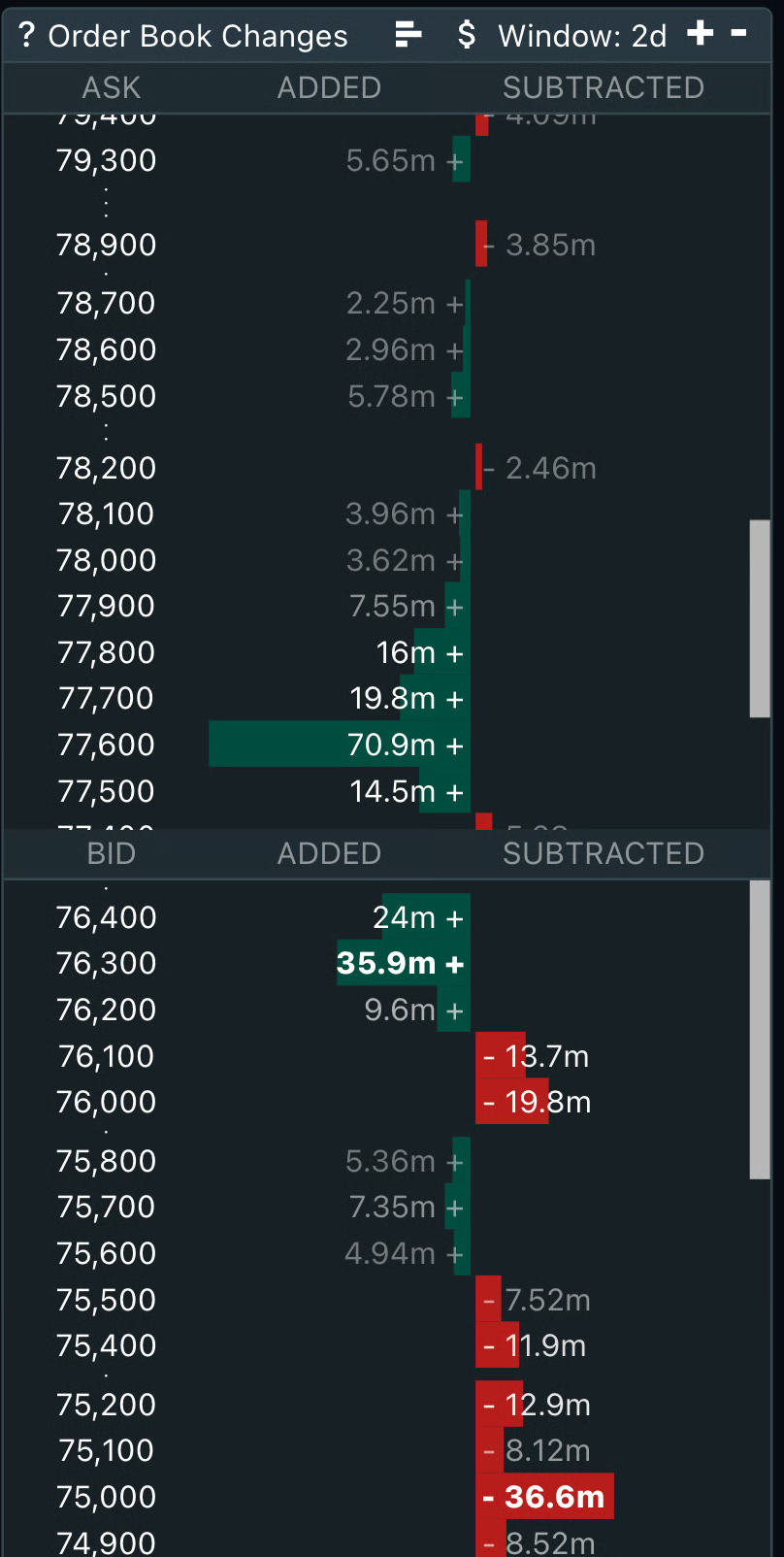
Bitcoin (BTC) traders pushed the price to $77,400, but data suggests profit-taking may thwart the bull’s goal of turning the $77,000 to $80,000 zone into support.
Orderbook data from TRDR shows over $130 million in asks extending from $76,700 to $79,300.
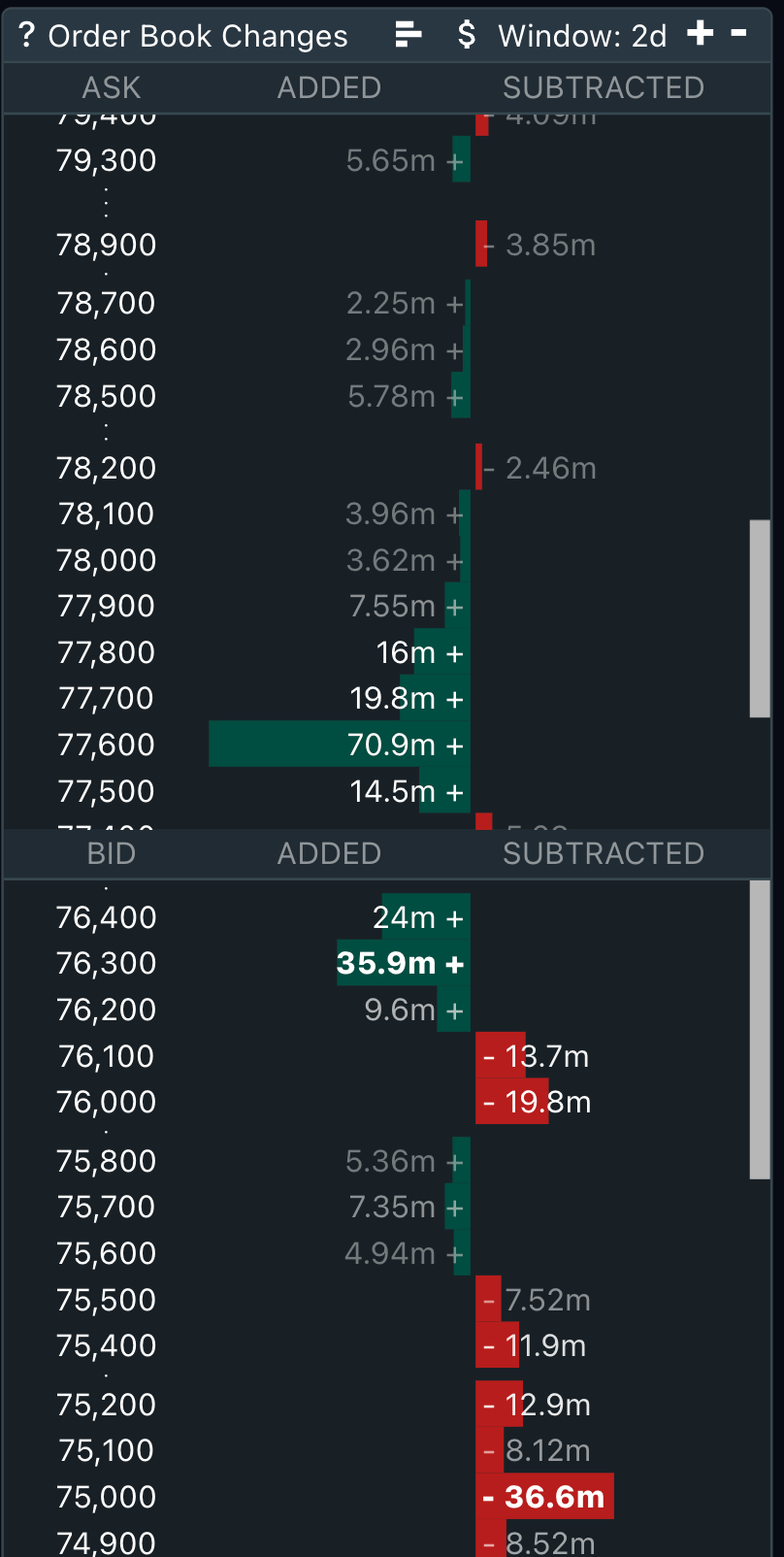
BTC/USDT Binance perps orderbook. Source. TRDR.io
Given Bitcoin’s negative futures funding rate and the small negative long-short delta (-$1.47 million at the time of writing), bulls have a slight edge in the short-term.
The situation could shift further in their favor if the BTC price pushes into short liquidity starting at $76,800, where there is a -$66.5 million to -$189 million negative delta, meaning short positions face a significantly higher risk of forced closure.
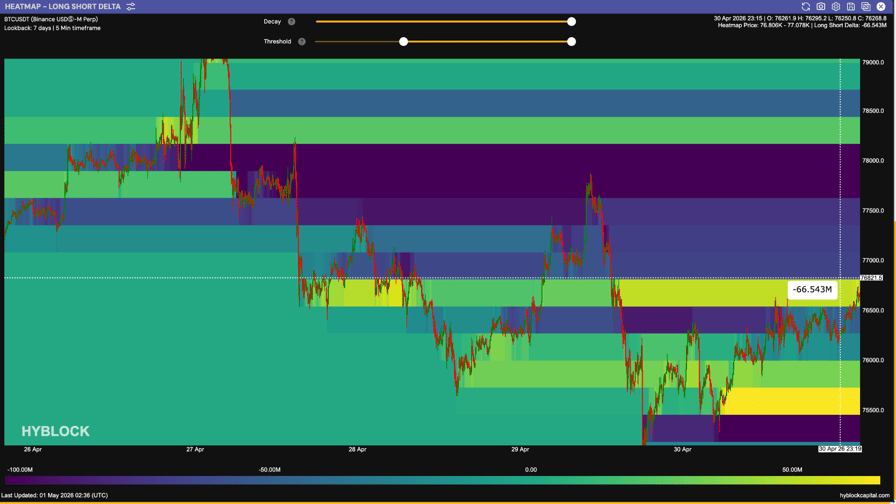
BTC/USDT long-short-delta. 7-day lookback. Source: Hyblock
From a technical analysis perspective, the current price action saw Bitcoin lock in $75,000 as support through a confirmed support-resistance flip, and it also traded back above the 20-day moving average ($76,067) after falling below it on Wednesday and Thursday.
Related: Repeat Bitcoin profit taking near $77K suggests rally is losing steam
In the short-term, the most desirable outcome for bulls would be a repeat of this week’s price action, where, in this case, BTC rallies through the channel trendline resistance at $79,000, followed by another SR-flip to confirm $80,000 as support.
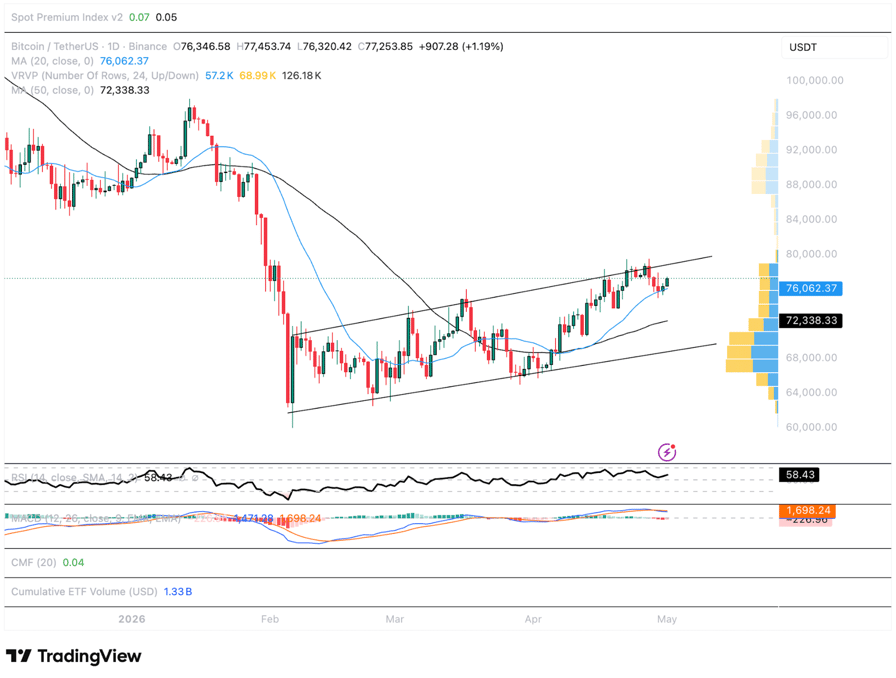
BTC/USDT 1-day chart. Source: TradingView
Beyond the expected profit-taking kicking in at $77,000, a volume spike in either spot or perpetual futures markets is the missing ingredient to absorb the selling and extend BTC’s breakouts.
As shown in the TRDR chart below, the bulk of BTC’s intraday moves stem from liquidations and the absence of sustained spot volume and long leverage, resulting in rallies that lack duration.
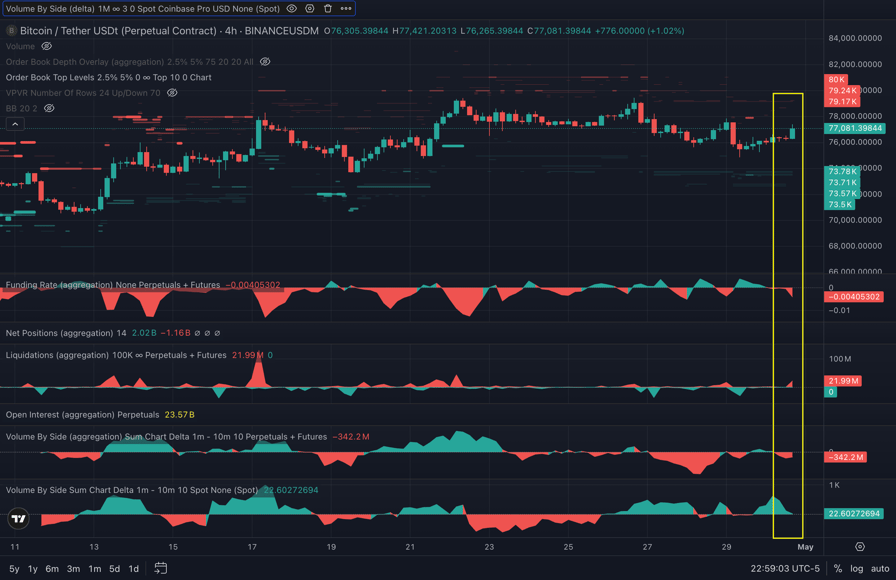
BTC/USDT perps (Binance), 4-hour chart. Source: TRDR.io


Nexo extends its 0% APR, no‑liquidation Zero-interest Credit to Solana and XRP, targeting holders who want dollar liquidity without selling their crypto.
- Coinbase Asset Management unveils CUSHY, an on-chain digital credit strategy with a tokenized share class built on Superstate’s FundOS platform.
- The strategy targets on-chain public credit, structured private credit, and tokenized yield sources across Solana and Base, aiming to bridge traditional fixed income with blockchain rails.
- CUSHY underscores a broader institutional shift toward tokenized credit markets, following Coinbase’s earlier stablecoin credit initiatives with Apollo and its bitcoin yield funds.
Coinbase’s new on-chain credit push
Coinbase Asset Management (CBAM) has introduced CUSHY, a new on-chain digital credit strategy that uses a tokenized share class mechanism to bring traditional credit exposure onto public blockchains, in a move the firm frames as a bridge between legacy fixed income markets and programmable finance.
Built on Superstate’s FundOS operating system, CUSHY is structured to support 24/7 primary and secondary market trading of fund shares across networks such as Solana and Base, with FundOS specifically designed “to streamline the tokenization of real-world assets” for asset managers seeking on-chain capital formation.
According to Coinbase Asset Management, the strategy rests on three pillars: on-chain public credit assets, structured private credit serving both digital-native and traditional borrowers, and tokenized yield sources that package underlying credit exposures into blockchain-native instruments.
FundOS, launched by real-world asset specialist Superstate, is described as tackling “the operational complexity of fund tokenization” and is already used to operate tokenized portfolios like USTB and USCC, which Superstate presents as proof that traditional securities can be issued, managed, and settled on-chain at scale.
In an earlier partnership announcement, CBAM said its alliance with Apollo aims “to bring Coinbase stablecoin credit strategies to market,” combining Apollo’s private credit origination with Coinbase’s tokenization stack so that “tokenized investment products providing exposure to Apollo-managed credit strategies” can be distributed through on-chain wrappers.
Those stablecoin credit strategies sit alongside Coinbase’s bitcoin-focused yield products, including the Coinbase Bitcoin Yield Fund, which targets a 4%–8% net bitcoin return per year over a market cycle while avoiding “riskier high-interest bitcoin loans and systematic call selling,” and the subsequent US-focused bitcoin yield strategy for accredited investors.
More broadly, industry research notes that tokenized private credit markets reached roughly $9.68 billion in 2025 after growing 930%, as on-chain credit systems emerge as “transparent, efficient, and permissionless” alternatives to bank-led lending that rely on smart contracts, decentralized oracles, and on-chain identity for underwriting.
This context positions CUSHY not as an isolated product but as part of a wider shift in which stablecoins, tokenized funds, and credit strategies are increasingly issued as blockchain-native claims, with Coinbase, Apollo, and Superstate each betting that institutional demand for compliant, yield-bearing digital instruments will continue to migrate on-chain.
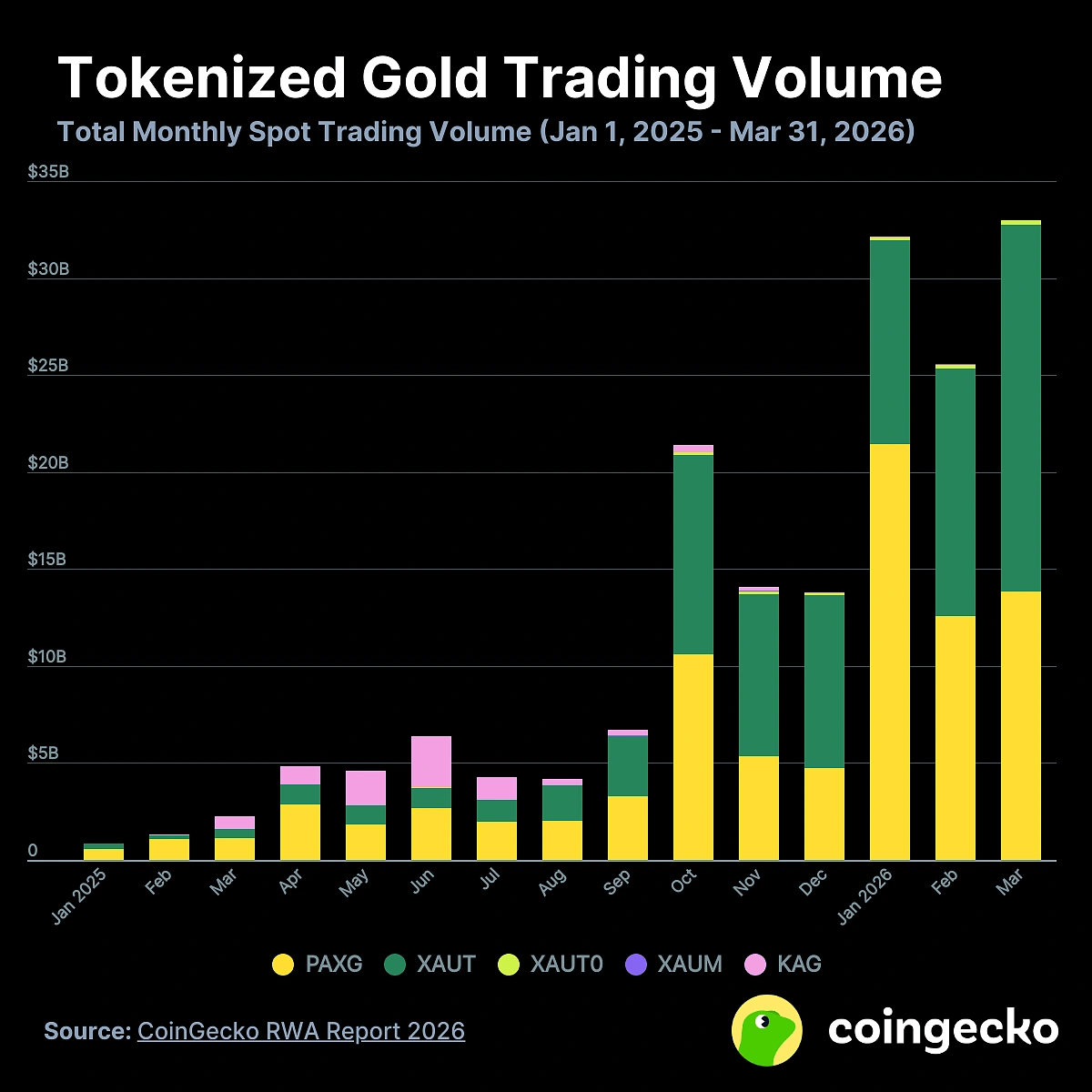
Spot trading of tokenized gold totaled $90.7 billion during Q1 2026 alone. That figure already exceeds the $84.6 billion recorded across the whole of 2025.
The jump marks a notable acceleration in the real-world asset (RWA) sector. Crypto traders are pursuing 24/7 exposure to the safe-haven asset through gold-backed tokens.
Gold Rally Pulls Crypto Investors Into On-Chain Bullion
CoinGecko’s latest RWA report indicates that centralized exchanges handled the bulk of spot trading. That said, monthly spot volume for tokenized gold has been uneven, mirroring shifts in broader market conditions.
October 2025 saw volume spike to $21.38 billion as gold hit fresh record highs, more than tripling the $6.73 billion logged the month prior, before easing back to $14.07 billion in November.
Follow us on X to get the latest news as it happens
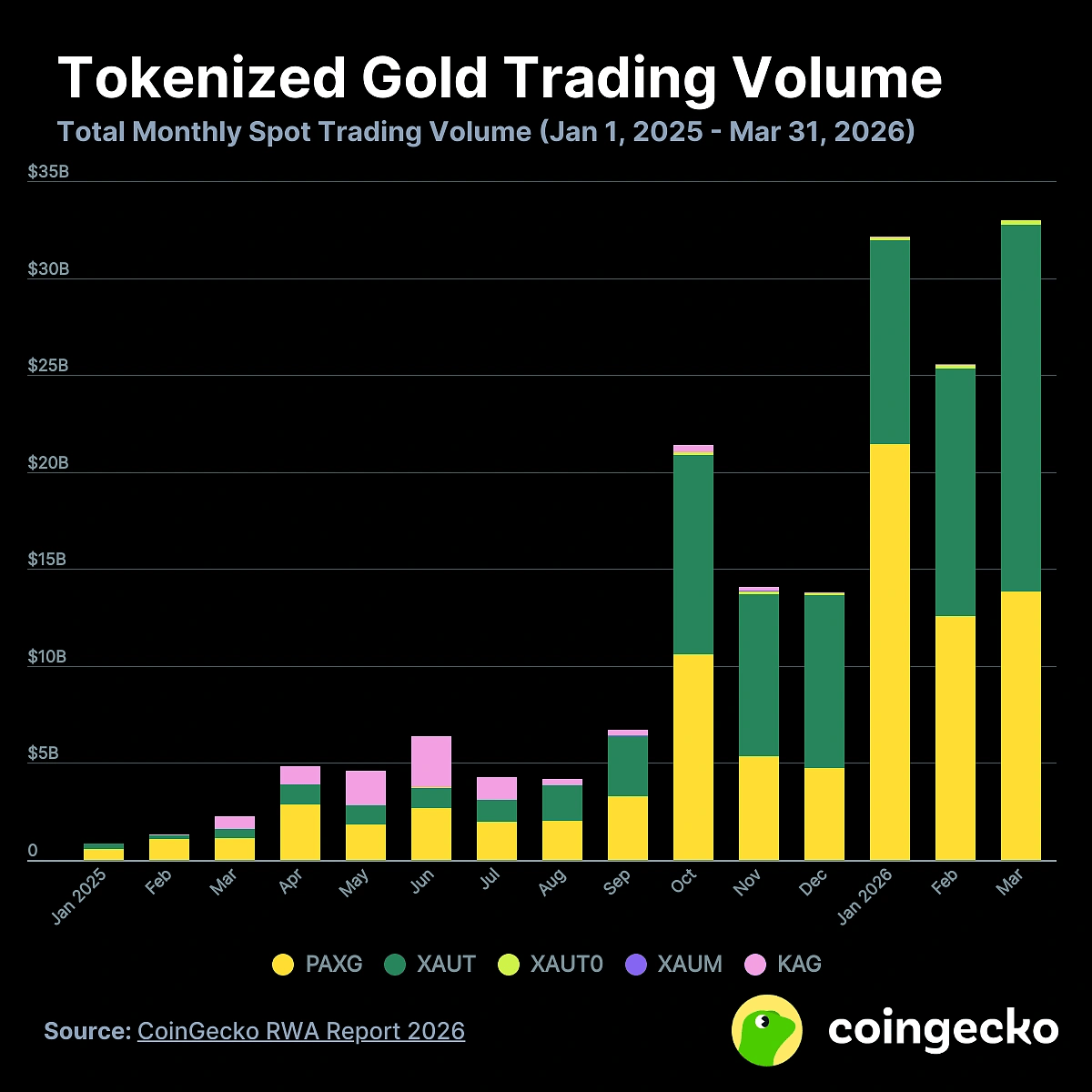
Notably, spot trading of tokenized gold was largely concentrated in PAX Gold (PAXG) and Tether Gold (XAUT). Over the period, PAXG’s share of monthly volume ranged from 34.2% to 82.5%, while XAUT’s share ranged from 14.8% to 64.6%.
“Over the last fifteen months, PAXG and XAUT saw $5.72 billion and $5.32 billion in average monthly spot trading volume, respectively, while the average total monthly volume stood at $11.69 billion. Meanwhile, KAG averaged $0.57 billion, Tether’s omnichain deployment XAUT0 recorded $0.10 billion, and XAUM just $0.007 billion,” the report read.
This two-product dominance is a pattern that holds across tokenized commodities more broadly. Coingecko noted that the market capitalization of tokenized commodities climbed 289% to $5.55 billion over 15 months.
“Tokenized commodities remain largely dominated by gold-backed tokens – specifically Tether’s XAUT and Paxos’ PAXG, which accounted for 89.1% of the expansion by contributing $1.87 billion and $1.80 billion, respectively. This is in line with the extended rally of the spot gold price over the past year,” CoinGecko wrote.
PAXG posted the biggest market share gain, climbing from 36.8% to 41.8% of the category. Its market capitalization increased to $2.32 billion.
XAUT held its lead at $2.52 billion in market capitalization. Its share “round-tripped from 45.4% to 45.5%.” Earlier, the token’s share stood 54.7% in late October 2025.
Smaller precious metals tokens lost relative ground despite absolute gains. Kinesis Silver (KAG) grew its market cap above $0.35 billion, yet its share fell to 4.8%. Meanwhile, Matrixdock’s XAUM expanded elevenfold to $0.07 billion, raising its share from 0.4% to 1.3%.
The shift is reshaping the broader RWA sector. Tokenized commodities now hold 28.7% of the market, while Treasuries’ dominance slipped from 73.7% to 67.2%. The rotation’s longevity will hinge on where bullion prices settle through 2026.
Subscribe to our YouTube channel to watch leaders and journalists provide expert insights
The post Tokenized Gold Crosses 2025’s Full-Year Volume in Just 1 Quarter appeared first on BeInCrypto.
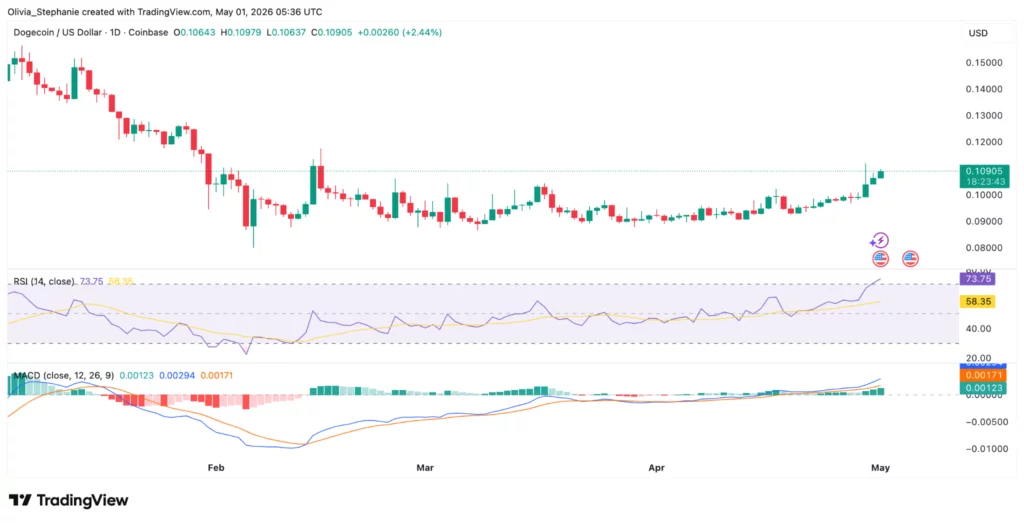
Dogecoin posted strong gains over the past week, outperforming many top crypto assets.
Summary
- Dogecoin whale transfers above $100K reached 739 in one day, Santiment data showed.
- Whale wallets holding at least 100M DOGE now control a record 108.52B tokens.
- DOGE’s RSI crossed 70 as price neared resistance, raising short-term pullback risks.
The token traded near $0.109, with steady daily volume and rising market cap. Short-term momentum has pushed prices higher despite a broader mixed market.
On-chain data from Santiment showed a sharp increase in whale transactions. The network recorded 739 transfers above $100,000 in one day. Large holders now control 108.52 billion DOGE, marking a record level. Santiment noted that “the memecoin’s +14% price rise over the past 10 days is very likely not just a coincidence”.
RSI signals overbought conditions
The Relative Strength Index (RSI) on the daily chart climbed above 70. This level often signals overbought conditions. The current reading near 73 suggests strong buying pressure, but also raises the risk of short-term cooling.
The RSI trend has been rising steadily since mid-April. This reflects sustained demand. However, when RSI remains elevated, price pullbacks can follow. Traders often watch this zone closely for early reversal signs.
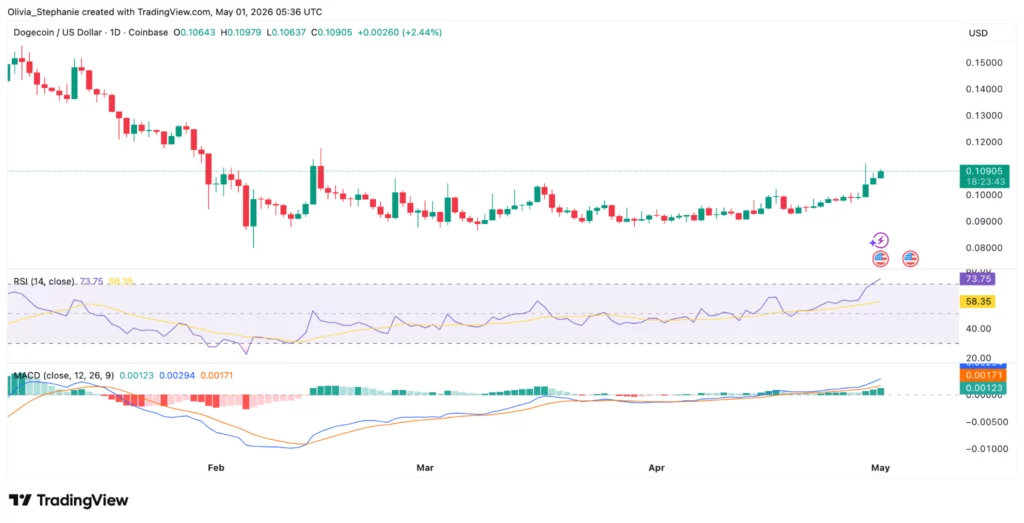
Additionally, the MACD indicator remains in positive territory. The signal line and MACD line are both trending upward. This confirms ongoing bullish momentum in the short term.
Histogram bars have also turned green and continue to expand. This suggests increasing strength in the current trend. Still, momentum indicators can lag during fast moves, making confirmation from price action important.
Resistance pressure and sell signals emerge
Price action shows Dogecoin approaching a key resistance zone near $0.11. The chart indicates multiple attempts to move higher, with gradual progress. This level has acted as a barrier in recent sessions.
Some analysts flagged caution signals. Ali Martinez stated that “TD Sequential flashes a sell signal on Dogecoin”. Another trader pointed to repeated rejections at resistance, adding that “the pattern is clean… this drop is coming”. These signals contrast with strong whale accumulation and ongoing momentum.
Disclosure: This article does not represent investment advice. The content and materials featured on this page are for educational purposes only.


Visa has added Polygon as a settlement chain in its stablecoin program, giving fintech issuers a new way to settle card payment flows beyond standard banking hours.
While card payments feel instant to users, settlement for issuers still depends on bank calendars, cut-off times, weekends, and holidays. This creates a working-capital cost for fintechs, especially program managers and sponsor-bank-backed issuers with large card volumes.
Polygon’s addition gives those firms access to stablecoin settlement on a chain already used for high-volume USD payment activity.
Weekend Settlement Creates a Capital Cost
Card networks operate on real-time authorization and delayed settlement. A customer pays with a card immediately, while the funds between issuers, acquirers, and payment networks often move later through fiat systems such as ACH, Fedwire, SEPA, or local payment providers.
Fintech issuers usually cover this timing difference through prefunding or collateral.
With prefunding, an issuer places expected weekend volume into a Visa-held account before banks close. Visa can draw from the balance while banks are offline.
With collateral, an issuer maintains a standing balance for Visa to use if settlement fails. This capital sits aside for risk coverage instead of supporting daily operations or growth.
Large banks can often avoid these requirements due to stronger credit profiles. Fintech issuers usually absorb the cost.
Stablecoin Settlement Gives Issuers a Faster Route
Polygon gives Visa partners a route to settle in stablecoins during weekends and holidays.
Instead of waiting for fiat systems to reopen, an issuer can settle card flows in stablecoins on Polygon while payment activity continues. Settlement can complete in seconds, with finality after confirmed blocks.
This can reduce the need for large weekend prefunding balances. It can also help collateral sit closer to current exposure rather than a larger weekend estimate.
For stablecoin-native fintechs, the model is straightforward. Companies already holding USDC or other supported stablecoins can use those balances for Visa settlement.
For fiat-native fintechs, the process needs conversion, custody, settlement, and reporting. Polygon is positioning its Open Money Stack around this full workflow.
Open Money Stack Connects Fiat and Stablecoin Settlement
Polygon’s Open Money Stack is designed for fintechs entering stablecoin payments without rebuilding their operations.
Polygon handles the on-chain settlement leg. Polygon Wallets support custody on the issuer side, with coverage across more than 50 chains. Coinme, a licensed fiat on/off-ramp network with money transmitter licenses across 48 US states, supports fiat-to-stablecoin conversion.
Polygon Labs’ Coinme acquisition remains subject to regulatory approval.
The goal is a single operating flow. Dollars can convert into stablecoins, settle to Visa, and reconcile with existing treasury systems after the weekend.
For issuers, this reduces the complexity of adopting stablecoin settlement. It also places Polygon closer to the back-office payment flows where fintechs feel the cost of delayed settlement most.
Polygon Builds Its Case With Stablecoin Volume
Polygon’s case rests on payment activity, cost, and performance.
According to data cited by Polygon Labs from Allium and Dune, Polygon recently handled a large share of USD stablecoin transfers, including USDC activity. The source material also points to throughput above 2,600 transactions per second, roughly five-second finality, and lower fee volatility for institutional payment use.
Those points are relevant for card settlement. Payment firms need predictable execution during peak periods, weekends, and holidays. Low fees alone are insufficient when settlement flows require reliability and clean reconciliation.
Polygon’s existing work with firms such as Stripe, Revolut, Mastercard, BlackRock, and Flutterwave also strengthens its position as a payments enabler rather than a standalone blockchain network.
Final Thoughts
Visa adding Polygon to its stablecoin settlement program is a step in the right direction for fintech issuers.
The strongest benefit sits in treasury operations. Card payments already happen around the clock, while settlement still follows bank calendars in many markets. Stablecoins give issuers a way to close part of this timing problem.
For Polygon, the integration adds another proof point for stablecoin payments. For fintech issuers, it offers a possible reduction in idle capital, weekend prefunding pressure, and settlement delay.
The post Visa Adds Polygon to Stablecoin Settlement as Card Payments Go 24/7 appeared first on BeInCrypto.


Polymarket partners with Chainalysis to deploy on-chain surveillance targeting insider trading and manipulation as volumes hit $7B monthly and regulation intensifies.
Summary
- Polymarket has selected Chainalysis to power a first-of-its-kind, fully on-chain market integrity monitoring system aimed at detecting insider trading and market manipulation across its prediction markets.
- The rollout lands two days after Polymarket’s April 28 exchange upgrade, which introduced new smart contracts, a rebuilt order book, and pUSD, an ERC-20 collateral token on Polygon backed 1:1 by USDC.
- Record trading volumes — including a single-day high of $425 million and more than $7 billion in monthly volume this year — are driving the push toward institutional-grade surveillance and compliance.
Polymarket has partnered with Chainalysis to deploy what it calls “a first-of-its-kind on-chain solution to monitor trading activity and enforce its Market Integrity Rules” across its DeFi prediction market platform, formalizing a surveillance layer explicitly designed to identify insider trading, fraud, and manipulation in real time.
In the announcement, Polymarket said that because “every trade, position, and settlement is recorded on a public blockchain,” that transparency can now “be harnessed to set a new public standard for market integrity in prediction markets and beyond,” with Chainalysis providing anomaly detection tuned to patterns “consistent with insider knowledge in prediction markets.”
Chainalysis system targets insider trading on-chain
The agreement spans multiple Chainalysis product lines, including investigative tools to create “blockchain-verified evidence for proactive and reactive engagement with law enforcement,” on-chain threat prevention, and professional services to “develop new detection capabilities and support complex investigations” as new abuse patterns emerge.
Polymarket framed the message bluntly, stating that the enhanced monitoring “sends a clear signal: insider trading, in addition to all types of fraud and market manipulation, is not welcome on Polymarket, and those who attempt it will be identified,” positioning the platform as a test case for what “market integrity can look like in an on-chain world.”
The Chainalysis deployment builds on a March update in which Polymarket published enhanced Market Integrity Rules and highlighted a “multi-layered monitoring system” on its Polygon-based DeFi venue, where all holders in each contract and their positions are publicly viewable and suspicious activity can trigger reviews, bans, and referrals to law enforcement.
Upgrade, volumes, and pUSD collateral
The integrity rollout follows Polymarket’s April 28 exchange stack upgrade, described internally as its “most significant overhaul” to date, which introduced CTF Exchange V2 smart contracts, a rewritten central limit order book engine, and Polymarket USD (pUSD) as a new collateral token.
According to Polymarket’s documentation, pUSD is “a standard ERC-20 token on Polygon, backed 1:1 by USDC,” with the backing “enforced onchain by the smart contract — no algorithmic peg, no fractional reserve,” while all trading still settles in native USDC to improve capital efficiency at the settlement layer.
The platform is migrating off bridged USDC.e toward pUSD issued directly against Circle’s USDC, a shift Polymarket says is designed to cut failed trades, lower gas costs, and improve order management, with most users handled automatically via a one-time approval prompt and API traders required to reconfigure clients for the new contracts.
This infrastructure push is happening against a backdrop of explosive growth: Polymarket set a new all-time daily volume record of about $425 million on February 28, surpassing its prior high from the 2024 U.S. election, while February’s total volume topped $7 billion — roughly a 7.5x year-over-year jump, according to on-chain analytics cited by multiple research firms.
Regulatory and compliance pressure around prediction markets is intensifying as well, with recent analyses noting that by early 2026, platforms like Polymarket and Kalshi were outlining fresh insider trading controls and governance restrictions as the broader sector scaled toward roughly $21 billion in monthly volume, making robust surveillance a prerequisite for institutional participation.


Gemini’s Olympus unit won CFTC clearing license enabling in-house derivatives infrastructure for futures, options, perpetuals, and prediction markets.
Summary
- License enables in-house clearing for futures, options, perpetual contracts and prediction markets
- Gemini received Derivatives Clearing Organization (DCO) license from CFTC on April 30, 2026
- Approval follows December 2025 Designated Contract Market (DCM) license for Gemini Titan subsidiary
Gemini announced April 30 that its affiliate Gemini Olympus received a Derivatives Clearing Organization (DCO) license from the Commodity Futures Trading Commission, positioning the exchange as one of few crypto-native platforms with complete regulatory infrastructure to operate derivatives clearing in the United States. The license allows Olympus to act as a clearinghouse for regulated derivatives trading, including prediction markets.
“Today marks a major milestone in Gemini’s marketplace expansion,” said Cameron Winklevoss, Gemini’s President. “In addition to our crypto spot marketplace, Gemini now has a full-stack, end-to-end marketplace for predictions as well as futures, options, and more.”
Regulatory Roadmap Complete
The DCO approval follows the CFTC‘s December 2025 designation of Gemini Titan as a Designated Contract Market, which enabled the launch of its predictions marketplace the same month. Gemini Titan will explore expanding its derivatives offering for U.S. customers to include crypto futures, options, and perpetual contracts.
According to The Block, Gemini is pursuing a futures commission merchant (FCM) license from the CFTC and working to obtain all derivatives-related licenses from the regulator. The company said it now has end-to-end trading infrastructure spanning spot crypto, prediction markets, futures and options.
Winklevoss described the DCO license as “a major building block for our super app, where users will be able to fulfill their existing and future financial needs all in one place”.
The United Kingdom’s financial regulator has signed off on new rules and guidance for tokenized funds, aiming to make it easier for asset managers to use blockchains within the existing fund regime rather than in separate experimental structures.
In a Thursday policy statement, PS26/7, the Financial Conduct Authority (FCA) said tokenization and distributed ledger technology (DLT) could make fund management more efficient and that it wants to “support innovation in the UK asset management sector,” as part of a digital assets roadmap first outlined in a January 2025 letter to the prime minister.
The changes give firms a clearer path to integrate blockchain into regulated fund operations, as policymakers seek to modernize market infrastructure without altering existing investor protection frameworks, and reflect a broader push to bring tokenized finance into the regulatory perimeter rather than allowing it to develop in parallel systems.
Simon Walls, executive director of markets at the FCA, said in the release that tokenization would “play an important role in asset management,” and that the regulator had delivered a practical framework to give firms confidence in how fund tokenization can operate within the FCA’s rules.
How tokenized funds move into the UK rulebook
PS26/7 allows firms to run investor records on DLT using the industry “Blueprint” model, confirming that onchain transaction records can serve as the primary books for unit deals without requiring a full off-chain duplicate, provided “appropriate resiliency plans” are in place.
Related: Coinbase rolls out UK crypto-backed loans as FCA shapes rules
The FCA said the Blueprint has already been used to authorize the first tokenized UK undertakings for collective investment in transferable securities (UCITS), and that authorized funds can maintain their register on public DLT networks if controls meet its standards, including issuing units across multiple blockchains as long as investors’ rights and charges remain consistent.
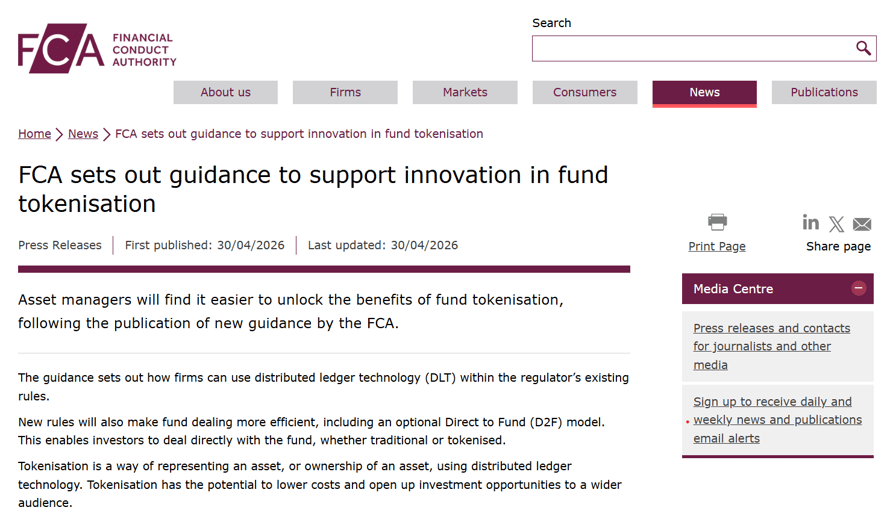
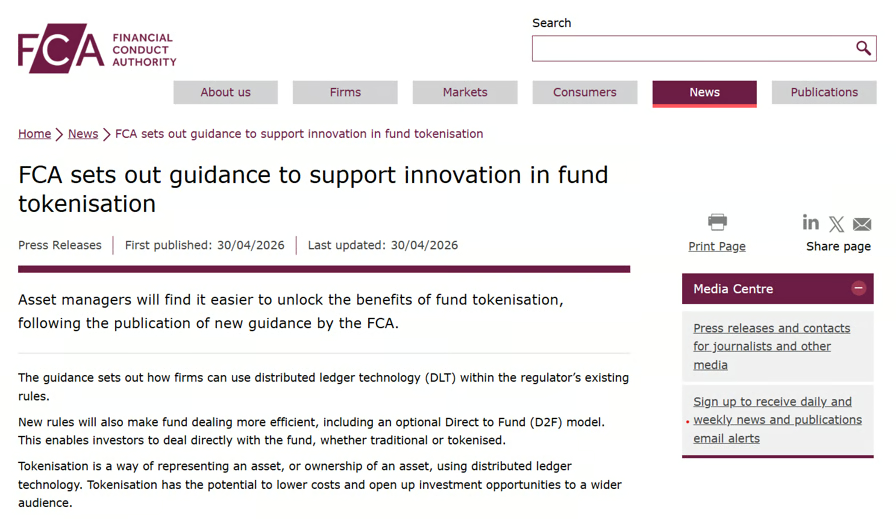
FCA guidance for fund tokenization. Source: FCA
The main rule change is an optional “Direct‑to‑Fund” (D2F) dealing model, where the fund or its depositary, rather than the manager, is the counterparty to investor trades. Deals go through a single step in which units are issued or canceled directly against cash moving between investors and the fund, a structure the FCA says is intended to make fund operations more efficient and easier to align with onchain settlement.
Looking ahead, the FCA sketches a roadmap that moves from today’s tokenized funds to tokenized assets and, eventually, tokenized cash flows, including models where investors hold tokenized assets in digital wallets and managers use smart contracts to manage them.
The regulator says it remains open to waivers so funds can use digital cash and stablecoins for settlement and certain expenses, and that it will seek further views in 2026 on wider use of DLT in wholesale markets
The policy statement comes after the FCA opened a consultation on guidance for its wider cryptoasset regime earlier this month, covering stablecoin issuance, trading, custody and staking, ahead of a full framework due to take effect in October 2027.
Cointelegraph reached out to the FCA for comment but had not received a response by publication.
Magazine: Singapore isn’t a ‘crypto hub’ — it’s something better: StraitsX CEO


Polymarket partners with Chainalysis to deploy on-chain surveillance targeting insider trading and manipulation as volumes hit $7B monthly and regulation intensifies.
Summary
- ECB kept rates unchanged at April 30 meeting but signaled potential June rate hike
- Lagarde emphasized intensifying risks to both inflation and economic growth
- Markets pricing approximately 50 basis points of tightening by year-end
The European Central Bank maintained interest rates unchanged at its April 30 meeting, but ECB President Christine Lagarde’s press conference remarks indicated a June rate hike has moved closer to reality, according to ING analyst Carsten Brzeski. Lagarde stressed that risks on both growth and inflation are intensifying, though the decision to keep rates steady was unanimous.
Brzeski noted the ECB has introduced a clear inclination towards rate hikes within its wait-and-see stance. Markets currently price approximately 50 basis points of tightening by year-end, with between 20 and 40 basis points anticipated by June.
Inflation Risks Tilt Upward
The ECB baseline projections see headline inflation averaging 2.6% in 2026, 2.0% in 2027 and 2.1% in 2028, revised higher from December primarily due to energy price pressures from the Iran war. Core inflation is projected at 2.3% in 2026, moderating to 2.2% in 2027 and 2.1% in 2028.
Lagarde warned that “the war in the Middle East has made the outlook significantly more uncertain, creating upside risks for inflation and downside risks for economic growth”. The ECB president told the IMF’s International Monetary and Financial Committee that the conflict “will have a material impact on near-term inflation through higher energy prices”.
ECB staff projections included adverse scenarios showing headline inflation potentially reaching 3.5% or even 4.4% in 2026 if energy supply disruptions persist. The deposit facility rate remains at 2.00%, with main refinancing operations at 2.15% and marginal lending facility at 2.40%.
Over half of economists polled by Reuters expect the ECB to hold rates April 30 but hike in June as war-driven inflation accelerates. According to Bloomberg, the anticipated quarter-point increase would likely be the only move as the conflict won’t cause a long-lasting price shock.

AI signage at the Robert Bosch booth at the Beijing Auto Show in Beijing, China, on Saturday, April 25, 2026.
Bloomberg | Bloomberg | Getty Images
BEIJING — Electric carmakers in China are layering on more of the same artificial intelligence features as they try to survive a prolonged price war in the world’s largest auto market.
The competition has shifted over the last few years, from extending battery range to rolling out driver-assist systems and using more powerful automotive chips. Now, automakers are focusing on a suite of in-car AI features.
More than 50 car brands now use ByteDance’s Doubao AI model, the company’s cloud platform Volcano Engine announced last Friday at the Beijing auto show, where the tech unit had a booth next to robotaxi company Pony.ai.
That means Doubao is in 145 car models and over 7 million vehicles, Volcano Engine said. Besides domestic vehicles, Doubao AI has also been integrated in new foreign-branded models, such as the all-electric Mercedes-Benz GLC, the SAIC Audi E7X and the SAIC Volkswagen ID. ERA 9X.
“We will keep on integrating new features faster,” Fermín Soneira, CEO of the Audi and SAIC Cooperation Project, told reporters this month ahead of the auto show. He noted how automakers can quickly deploy tech updates remotely, or “over-the-air.”
Despite the rapid rollout of new features, automakers face persistent pressure on sales.
“It’s going to remain tough, because the capacity is there,” he said. “This price war is not going to really stop in the next month.”

The shift towards AI reflects consumer demand for connected features, including Huawei-smartphone-compatible interfaces or voice-based assistants such as Doubao.
ByteDance’s Doubao is by far the most widely used AI chatbot in China, with more than 155 million weekly active users as of early this year, according to consultancy Chozan. Volcano Engine’s auto show booth included demos of both Chinese-language and English-language AI systems for cars.
The price war has turned into a feature war around cockpit technology, said Stephen Dyer, partner and managing director and head of AlixPartners’ Asia automotive and industrials consulting practice.
The challenge is, however, that much of that technology soon becomes similar, making it harder for companies to stand out.
Among the top 20 best-selling electric car models in China, those priced at 100,000 yuan ($14,645) or above offered similar driver-assist and in-car entertainment functions, according to AlixPartners.
With “technology, they’re going to have to race and keep racing, because it disseminates so quickly that you’re never going to be able to sustain a differentiated technology for long,” Dyer said.
Instead, he expects Chinese companies to start competing more on the “outside-of-the-car experience,” similar to luxury brands that offer exclusive lifestyle experiences.
Chinese automaker Nio, for example, offers its customers exclusive access to products and clubhouses, on top of vehicles featuring premium interior materials.
The Chinese electric car company has struggled with the cost of offering such perks and slower market growth. But Nio claimed last week its ES8 is the first car model in the industry’s 400,000 yuan-and-above segment to deliver 100,000 units in just 215 days.
Alibaba also announced Friday that its Qwen artificial intelligence model will be integrated into vehicles from automakers including BYD and a local joint venture of Volkswagen. The system allows drivers to order food delivery, book hotels, buy tickets to attractions and track packages, among other features, through voice commands.
The model will run on Nvidia‘s automotive chip system and is designed to function even with limited network connectivity.
At the end of the day, AI should run in the background to support the user experience, not necessarily be a feature of a vehicle, Tu Le, founder and managing director at consultancy Sino Auto Insights, told CNBC’s Eunice Yoon.
Even if it’s difficult for automakers to stand out in China, they may be able to compete more effectively with foreign peers.
“What we consider maybe simple features and like, standard features in mass market vehicles in the China market, are going to be expected in the Western market sooner rather than later as well,” Le said.

NBA Playoffs Wednesday recap: Pistons, Rockets stay alive as Cavs Take Lead

UK firms ignore decade-old flaws as hackers hammer networks with 67 million attacks and AI-driven scans surge nationwide

DWP confirms statutory sick pay changes as 1.3 million more workers gain coverage

Manchester United reach agreement with Casemiro over contract clause amid transfer speculation

US brings back mandatory military draft registration

Steven Gerrard disagrees with Gary Neville over ‘shock’ Chelsea and Arsenal claim | Football


-

 Tech4 days ago
Register Renaming | Hackaday
-

 Fashion7 days ago
Weekend Open Thread – Corporette.com
-
 Crypto World5 days ago
Hyperliquid $HYPE Rally Builds Momentum as AI Sector Enters Prove-It Phase
-

 Politics3 days ago
Drax board avoid their own AGM, accused of greenwashing & environmental racism
-

 Tech3 days ago
Images of Samsung’s rumored smart glasses have leaked
-
 Sports5 days ago
IPL 2026: Ruturaj Gaikwad registers slowest fifty of the season, enters all-time unwanted list | Cricket News
-

 NewsBeat5 days ago
LK Bennett closes all stores after entering administration
-

 Tech4 days ago
Why Blue Badges Disappeared From Toyota Hybrids
-

 Fashion2 days ago
Kylie Jenner’s KHY Enters a New Era with ‘Born in LA’
-

 Crypto World7 days ago
Michael Saylor says BTC winter is over. Market analyst disagrees, says bitcoin was in a pullback
-
 Entertainment6 days ago
Mariah Carey Slams Deposition Claims In Brother’s Lawsuit
-

 Business2 days ago
Most Commercial Energy Audits Miss the Real Losses
-
 NewsBeat7 days ago
Trump threatens to review UK’s claim to Falkland Islands and punish Nato allies over Iran war disagreement
-

 Business4 days ago
(VIDEO) Charlize Theron Climbs Times Square Billboard to Promote New Netflix Thriller ‘Apex’
-

 Business7 days ago
Jeanine Pirro announces closure of Federal Reserve building cost probe
-
 Crypto World6 days ago
Nvidia (NVDA) Stock Jumps 5% as Intel Earnings Ignite Semiconductor Rally
-

 Tech5 days ago
Microsoft to roll out Entra passkeys on Windows in late April
-

 Tech5 days ago
OpenAI’s Sam Altman apologizes for not reporting ChatGPT account of Tumbler Ridge suspect to police
-

 Crypto World3 days ago
CFTC’s AI will review U.S. crypto registration applications, chairman tells CoinDesk
-

 Tech5 days ago
OpenAI CEO apologizes to Tumbler Ridge community
You must be logged in to post a comment Login