

Crypto World
NVIDIA Q1 FY2027 Revenue Hits Record $81.6 Billion as AI Infrastructure Demand Accelerates


TLDR:
- NVIDIA Q1 FY2027 revenue reached a record $81.6 billion, rising 85% year-over-year and 20% sequentially.
- Data Center revenue surged 92% annually to $75.2 billion, with networking revenue climbing 199% year-over-year.
- NVIDIA raised its quarterly dividend from $0.01 to $0.25 per share and approved an $80 billion buyback program.
- Q2 FY2027 revenue guidance stands at $91 billion, excluding all Data Center compute revenue sourced from China.
NVIDIA reported record first-quarter fiscal 2027 revenue of $81.6 billion, marking an 85% year-over-year increase. Data Center revenue reached $75.2 billion, up 92% annually.
The company also guided Q2 revenue to $91 billion. Non-GAAP diluted EPS climbed 140% to $1.87. Operating cash flow hit $50.3 billion, while free cash flow totaled $48.6 billion during the quarter.
Record Revenue Driven by AI Infrastructure Demand
NVIDIA’s Q1 FY2027 results reflect growing demand for AI computing infrastructure worldwide. Revenue rose 20% sequentially from $68.1 billion in Q4 FY2026. The company’s GAAP gross margin stood at 74.9%, up 14.4 percentage points year-over-year.
Data Center compute revenue alone reached $60.4 billion, rising 77% from a year ago. Networking revenue within the segment hit $14.8 billion, up 199% annually. These numbers show strong adoption of NVIDIA’s Blackwell GPU platform across hyperscale clients.
Jensen Huang, NVIDIA’s founder and CEO, described the moment as a turning point for global infrastructure. He stated that “the buildout of AI factories — the largest infrastructure expansion in human history — is accelerating at extraordinary speed.” Huang further noted that agentic AI is now doing productive work and generating real value across industries.
NVIDIA returned approximately $20 billion to shareholders through buybacks and dividends during Q1. The Board also approved an additional $80 billion share repurchase authorization on May 18, 2026, with no expiration date.
Huang added that NVIDIA is “uniquely positioned at the center of this transformation” as the only platform running across every major cloud.
Dividend Increase and Shareholder Returns Signal Confidence
NVIDIA raised its quarterly cash dividend from $0.01 per share to $0.25 per share. The dividend will be paid on June 26, 2026, to shareholders of record as of June 4, 2026. This marks a notable shift in NVIDIA’s capital return strategy.
As of Q1’s close, the company had $38.5 billion remaining under its prior share repurchase authorization. The new $80 billion addition further strengthens NVIDIA’s buyback capacity. Together, these moves reflect management’s confidence in sustained earnings growth.
GAAP net income for the quarter came in at $58.3 billion, up 211% year-over-year. Non-GAAP net income reached $45.5 billion, rising 139% from the same period last year. Both figures point to strong profitability alongside revenue growth.
GAAP diluted EPS of $2.39 compares to $0.76 in Q1 FY2026, a 214% increase. Non-GAAP diluted EPS of $1.87 reflects a 140% annual gain.
Huang noted that NVIDIA’s platform “runs in every cloud, powers every frontier and open source model, and scales everywhere AI is produced.”
Q2 Outlook and Structural Reporting Changes
NVIDIA guided Q2 FY2027 revenue at approximately $91 billion, plus or minus 2%. The company stated that this outlook excludes any Data Center compute revenue from China. GAAP and non-GAAP gross margins are expected to remain near 74.9% and 75.0%, respectively.
Operating expenses for Q2 are projected at around $8.5 billion on a GAAP basis and $8.3 billion non-GAAP. For the full fiscal year 2027, NVIDIA expects tax rates of 16% to 18%, excluding discrete items. These projections reflect continued investment in research and operations.
NVIDIA also announced a new reporting framework splitting its business into Data Center and Edge Computing platforms. Within Data Center, it will now report Hyperscale and ACIE sub-markets separately. Edge Computing will cover PCs, game consoles, robotics, and automotive devices.
Edge Computing revenue for Q1 reached $6.4 billion, up 29% year-over-year and 10% sequentially. New partnerships with Hyundai, Kia, BYD, and Uber support growth in autonomous driving. Expanded collaborations with Google Cloud and Marvell also continue to broaden NVIDIA’s ecosystem reach.




Senator Lummis says a Clarity Act Senate floor vote could come before August, with passage odds at 75%.
Summary
- Galaxy Research raised its 2026 Clarity Act passage probability to 75% following the Senate Banking Committee’s 15-9 bipartisan vote on May 14.
- Senator Lummis said she would love a June floor vote but called that timeline “probably pretty optimistic,” with August now the realistic target.
- Seven Democratic votes are needed to clear the 60-vote filibuster threshold, with an elected officials ethics provision as the key sticking point.
A Senate floor vote on the Clarity Act could come within 30 days, with Galaxy Research raising its 2026 passage probability to 75% following last week’s 15-9 bipartisan Senate Banking Committee vote.
Senator Cynthia Lummis struck a measured tone. “Nobody is popping the champagne quite yet. There’s still a lot of work to do,” she said. On timing she was direct: “I would love to have this bill on the floor in June. That’s probably pretty optimistic.”
What still has to happen before a Senate floor vote
The bill must first be merged with a Senate Agriculture Committee version that differs on CFTC jurisdiction provisions. After reconciliation, the combined text needs 60 Senate floor votes to clear a filibuster.
Crypto.news has tracked the compressed legislative calendar throughout 2026, with the Memorial Day recess now passed as an earlier hard deadline. Galaxy Research head of research Alex Thorn estimates a signing during the week of August 3 in the optimistic scenario.
What a Clarity Act signing would mean for crypto markets
Galaxy Research’s 75% probability is the highest institutional estimate on record for the bill. White House crypto adviser Patrick Witt said Clarity Act passage would deliver roughly 90% of what the crypto industry needs from Congress.
Analysts at Standard Chartered have estimated passage could unlock $4 to $8 billion in additional XRP ETF inflows alone. The XRP price page tracks market reaction against the legislative backdrop in real time.
Why the ethics provision is the last major obstacle
Two Senate Democrats voted yes in the Banking Committee, but reaching 60 floor votes requires seven more Democratic crossovers. The primary sticking point is a conflict-of-interest provision covering elected officials participating in crypto markets.
Cody Carbone of the Digital Chamber told reporters a deal on the ethics provision would likely be completed before the bill goes to the floor. “I imagine the deal will be completed before this goes to the floor, because they’ll want to only bring it to the floor if they feel confident they’ve got 60,” he said.

SpaceX’s latest SEC filing reveals a Bitcoin position of 18,712 coins, valued at about $1.45 billion at current prices, with an average purchase price of $35,320 per BTC. The disclosure, embedded in the company’s S-1 registration statement, places SpaceX among the largest bitcoin-holding corporate treasuries and exceeds prior estimates from blockchain trackers.
The disclosure coincides with SpaceX’s bid to go public, a process that could see the company raise around $75 billion and reach an implied valuation between $1.75 trillion and $2 trillion. In that scenario, owning SpaceX stock would also provide exposure to its Bitcoin stash, adding a crypto dimension to an otherwise aerospace- and AI-centric business lineup.
Key takeaways
- SpaceX reports 18,712 BTC in its S-1 filing, representing about $1.45 billion at current prices, with an average cost of $35,320 per BTC.
- The holdings position SpaceX as the seventh-largest BTC asset among public companies, surpassing peers like Tesla, which holds 11,509 BTC.
- Earlier estimates from trackers such as BitcoinTreasuries.NET and Arkham had placed SpaceX’s BTC at around 8,285, illustrating how official disclosures can differ from market tallies.
- SpaceX’s IPO plan aims to raise roughly $75 billion, with a valuation explored in the range of $1.75 trillion to $2 trillion, potentially enabling equity holders to gain crypto exposure alongside aerospace and AI ventures.
- The filing frames SpaceX as pursuing what it calls one of the largest actionable total addressable markets in history, a $28.5 trillion opportunity spanning AI, space, and connectivity.
SpaceX’s BTC position and the IPO pairing
The S-1 filing shows SpaceX’s 18,712 BTC stake was acquired at an average price of $35,320 per coin, a figure that helps contextualize the company’s willingness to hold crypto as part of its corporate treasury strategy. In the public markets, this level of Bitcoin exposure is rare for a private company that is now transitioning toward an offering that could bring the treasury into the limelight for public investors. The 18,712 BTC tally places SpaceX ahead of several large holders among publicly traded or soon-to-be-public entities, and it underscores how crypto assets have become a strategic asset class for corporate balance sheets.
The filing explicitly ties the Bitcoin position to SpaceX’s broader capital-raising plan. If the IPO proceeds as outlined, investors would gain not only a stake in a diversified aerospace-and-AI platform but also a direct link to Bitcoin through the equity instrument. This dynamic—crypto exposure embedded in a mega-cap tech/group IPO—highlights a growing appetite among high-profile private firms to leverage public markets as a funding channel while maintaining crypto exposure as a strategic asset.
SpaceX versus peers and the trackers’ estimates
The SEC document marks a notable shift from prior third-party estimates. Tesla, another high-profile corporate BTC holder, is reported to hold 11,509 BTC, which means SpaceX’s disclosed holdings exceed Tesla’s. The discrepancy with tracker estimates—BitcoinTreasuries.NET and Arkham had pegged SpaceX at roughly 8,285 BTC—illustrates the challenges of cross-verifying private treasury positions until formal filings surface. This gap between trackers and official filings is a reminder of how quickly crypto balances can move and how much is still opaque in private holdings until disclosed in regulatory documents.
Beyond the raw numbers, the comparison signals changing attitudes toward corporate crypto. SpaceX’s approach — acquiring a sizable BTC stake and seeking public-market liquidity — contrasts with earlier adoptions that treated BTC as an opportunistic diversification rather than a structural asset class embedded in corporate strategy.
Toward a massive addressable market and long-term implications
In the same filing, SpaceX frames its ambitions within a sweeping total addressable market, pegging a potential opportunity of about $28.5 trillion across AI, space, and connectivity. That figure reflects not only the company’s ambitions in satellite internet (Starlink) and orbital infrastructure but also the strategic leverage of AI-enabled systems and data services. If realized, the combination of a sizable crypto treasury and a public-market financing event could reshape how SpaceX funds next-generation projects—from Starlink expansion to orbital data centers and even long-term ambitions like interplanetary missions.
SpaceX is among a small cohort of highly valued private firms anticipated to pursue public listings in 2026, alongside AI-centric rivals. The IPO route could unlock billions in capital while bolstering investor access to a company that sits at the intersection of aerospace, communications infrastructure, and advanced AI development. For market participants, the key takeaway is not only the BTC balance but what the financing strategy reveals about SpaceX’s longer-term business model and growth trajectory.
The combination of a substantial Bitcoin treasury and a high-stakes public offering underscores a broader trend: crypto assets are increasingly integrated into the strategic DNA of large technology and infrastructure players. For investors, the implications are twofold. First, SpaceX stock could offer indirect exposure to Bitcoin through a widely traded equity instrument, potentially pairing crypto sensitivity with a diversified tech portfolio. Second, the IPO will spotlight how crypto assets are treated in valuation models for mega-cap issuers, particularly when those assets are integrated into a company’s strategic financing toolkit.
As SpaceX navigates the regulatory and market pathways to become a public company, observers will be watching how the treasury policy evolves, whether additional Bitcoin purchases surface before or after the IPO, and how the company articulates the role of crypto within its broader corporate strategy. The coming months will reveal how much of SpaceX’s crypto stance is a temporary hedge, a long-term treasury policy, or a signal of a fundamentally crypto-forward corporate culture.
What remains uncertain is how investors will price the interplay between SpaceX’s growth prospects, its ambitious connectivity and AI initiatives, and the Bitcoin position that now sits at the heart of its reported treasury. Readers looking for the next updates should track SpaceX’s regulatory disclosures and any further color on how the crypto holding aligns with the company’s stated mission and capital-raising milestones.
TLDR
- A South Korean funeral company reported a $33 million unrealized loss from a leveraged Ethereum ETF investment.
- The firm used prepaid customer funeral funds to invest in a high-risk crypto-linked exchange-traded fund.
- The investment dropped from 59.5 billion won to 10.2 billion won by the end of 2025.
- The ETF aimed to deliver twice the daily returns of a crypto mining company tied to Ethereum.
- Company officials described the loss as temporary and linked it to global market volatility.
A South Korean funeral services company has reported a $33 million unrealized loss tied to an Ethereum ETF-linked investment. The firm used prepaid customer funds to buy a leveraged crypto-related ETF, raising concerns in South Korea. The loss highlights risks tied to holding leveraged Ethereum ETF products over extended periods.
South Korea Ethereum ETF Bet Triggers Major Loss
Bumo Sarang disclosed an unrealized loss of 49.3 billion won, or about $33 million. The company confirmed the figures in a recent financial update.
The firm had invested 59.5 billion won into a leveraged exchange-traded fund. That position fell to 10.2 billion won by the end of 2025.
The ETF tracks BitMine Immersion Technologies, a crypto mining company with exposure to Ethereum. It trades under the ticker BMNU and aims to deliver twice daily returns.
Bumo Sarang ranks as South Korea’s seventh-largest funeral service provider. The company manages prepaid funeral service contracts from customers.
Company representatives described the loss as temporary. They said it reflects “short-term unrealized loss due to global market volatility.”
The investment relied on a 2x leveraged ETF structure. This structure amplifies both gains and losses daily.
The ETF tracks BitMine Immersion Technologies, which trades under BMNR. The firm’s operations include Ethereum mining activities.
Leveraged ETF Structure Drives Losses
Leveraged ETFs rebalance daily to maintain target exposure. This design makes them unsuitable for long-term holding.
Daily compounding can erode value during volatile trading periods. This effect is widely known as volatility decay.
If the underlying stock rises 5%, the ETF targets a 10% gain. However, a 5% drop results in a 10% loss.
Over multiple days, price swings can reduce overall returns. This happens even if the underlying asset ends near its starting level.
Prepaid funeral funds require careful risk management. Customers expect those funds to remain stable until needed.
Using such funds for leveraged crypto-related investments creates a mismatch. The investment carries a higher risk than the obligation it supports.
The ETF involved is part of the T-REX leveraged product family. These funds include clear warnings about short-term usage.
Bumo Sarang has not reported realized losses yet. The company stated the position remains on its balance sheet as of late 2025.
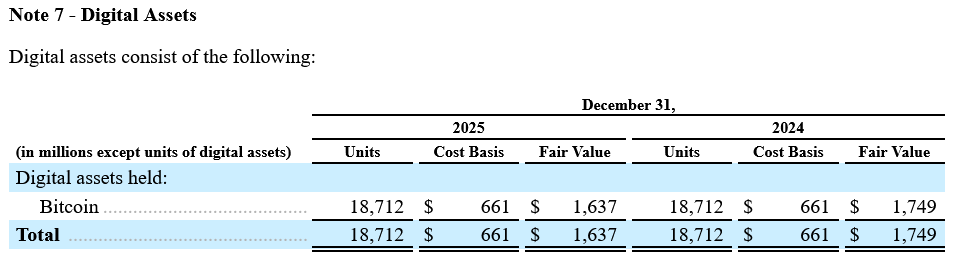
Elon Musk’s aerospace company SpaceX reported holding 18,712 Bitcoin worth $1.45 billion in a recent filing, over 10,000 coins more than blockchain tracking firms had estimated.
In the company’s S-1 registration statement, filed as part of its bid to become a public company on June 12, SpaceX revealed it purchased Bitcoin (BTC) at an average of $35,320 per coin. Its reported holdings would make it the seventh-largest among public companies.
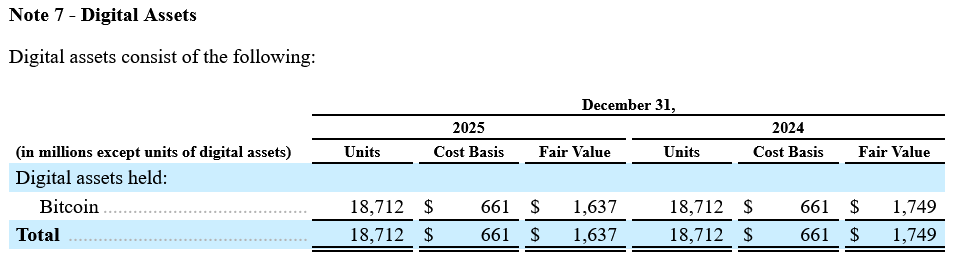
SpaceX’s Bitcoin holdings as of Dec. 31, 2025. Source: SEC
SpaceX is poised to become the biggest IPO in capital markets history, aiming to raise around $75 billion with an estimated valuation of $1.75 trillion to $2 trillion. Buying its stock would give investors a way to gain exposure to Bitcoin, alongside the company’s aerospace and AI businesses.
SpaceX Bitcoin accumulation began five years ago
SpaceX began buying Bitcoin in early 2021, around the same time that Musk’s Tesla started investing in the cryptocurrency.
The latest SEC filing shows that SpaceX has considerably more Bitcoin than Tesla, which holds 11,509 Bitcoin. It also surpasses estimates from BitcoinTreasuries.NET and crypto analytics firm Arkham, which estimated SpaceX’s Bitcoin holdings at only 8,285 Bitcoin.
Related: Saylor’s Strategy scoops $2B Bitcoin, holdings reach 843,738 BTC
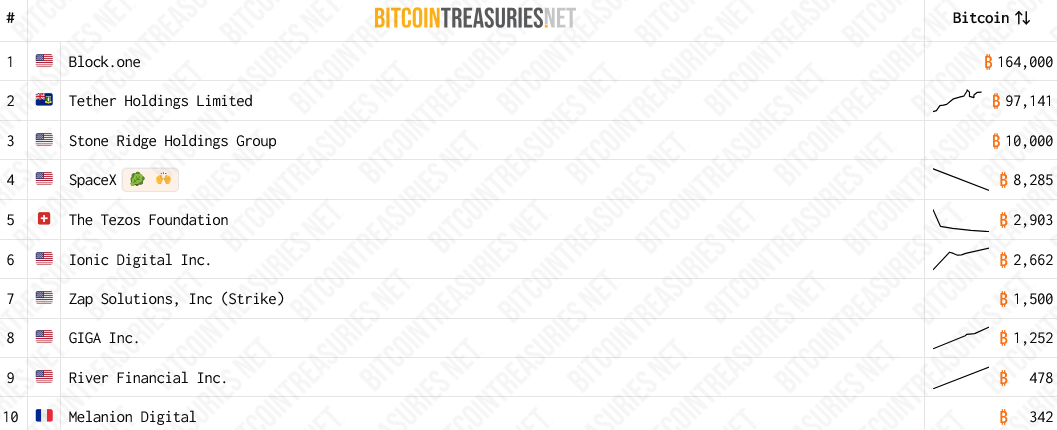
BitcoinTreasuries.NET data shows that SpaceX only holds 8,285 Bitcoin on its balance sheet. Source: BitcoinTreasuries.NET
SpaceX chasing largest addressable market in “human history”
SpaceX is one of few private companies with large valuations looking to go public in 2026, along with AI firms OpenAI and Anthropic.
Going public could unlock billions of dollars in capital for the company to fund projects like Starlink, orbital data centers and potentially Mars colonization.
In the filing, SpaceX said it is targeting the largest actionable total addressable market in “human history,” estimating a $28.5 trillion opportunity spanning AI, space and connectivity.
Magazine: eToro founder timed Bitcoin top perfectly due to belief in 4 year cycles
TLDR
- Fairshake PAC spent about $20 million to support candidates in three US primary races.
- All candidates backed by Fairshake PAC either won their races or advanced to runoffs.
- The spending targeted elections in Georgia, Alabama, and Kentucky.
- Affiliates Defend American Jobs and Protect Progress supported both Republican and Democratic candidates.
- Around $5 million funded advertising for Barry Moore’s Senate primary campaign in Alabama.
- Protect Progress previously supported Yadira Caraveo with about $2 million in her House primary race.
Fairshake PAC secured victories across key US primary races after deploying about $20 million in targeted spending. The crypto-backed political group supported candidates in Georgia, Alabama, and Kentucky. Every candidate it backed either won outright or advanced to a runoff.
Fairshake PAC Spending Drives Primary Wins
Fairshake PAC directed funds through affiliated groups supporting both Republicans and Democrats. These affiliates included Defend American Jobs and Protect Progress.
The PAC supported five Republican candidates and one Democrat in the latest primaries. Each backed candidate remained competitive after Tuesday’s results.
In Alabama, the group spent about $5 million supporting Representative Barry Moore’s Senate campaign. The funds financed a focused advertising push during the primary race.
Protect Progress previously backed Representative Yadira Caraveo with about $2 million. The support targeted her Democratic House primary campaign.
Fairshake PAC distributed remaining funds across races in Georgia and Kentucky. It focused on candidates open to digital asset regulation policies.
The strategy centered on competitive races rather than broad spending across many districts. This approach concentrated financial impact on fewer contests.
Crypto Industry Ramps up Political Spending
Fairshake PAC operates with financial backing from major crypto firms including Ripple Labs and Coinbase. The group plays a central role in industry political efforts.
Crypto-linked Super PACs plan to spend about $271 million during the 2026 midterm elections. Fairshake remains the primary vehicle for this spending.
The PAC reported spending about $130 million during the 2024 election cycle. It entered the current cycle with about $193 million in available funds.
These financial levels exceed many traditional corporate political action committees. The scale allows targeted spending in high-stakes races.
The PAC focuses on candidates who support clear crypto regulation frameworks. These include rules on stablecoins and token classification.
Industry priorities also include legislation defining securities and commodities in crypto markets. Exchanges seek clearer regulatory guidance through such measures.
Tuesday’s results extend Fairshake PAC’s track record in primary races. Backed candidates have consistently performed well in recent elections.
Campaign finance groups have raised concerns about rising industry political spending. Critics argue that large contributions may influence election outcomes.
Fairshake PAC has not issued a formal statement following the latest primary results. The election outcomes remain the most recent confirmed development.


Hester Peirce will leave the SEC in November 2026 to join Regent University School of Law as professor.
Summary
- Regent University School of Law announced on May 19 that Hester Peirce will join as associate professor starting in November 2026.
- Peirce has led the SEC’s Crypto Task Force since January 2025 and served as commissioner since 2018, appointed by President Trump.
- She will teach securities regulation, financial markets, digital assets and public policy at Regent Law in Virginia Beach.
Regent University School of Law announced on May 19 that Hester Peirce will join its faculty as associate professor starting in November 2026. The announcement signals Peirce is winding down her time at the SEC after more than seven years as commissioner.
“Greg Jacob and Hester Peirce have served at the highest levels of law, government, and public life,” said Dean S. Ernie Walton. “Their decision to join Regent Law full time is a remarkable blessing for our students.”
What Peirce built at the SEC and what she is leaving behind
Peirce is widely known in the crypto industry as “Crypto Mom” for her consistent advocacy for digital asset innovation. Her dissents from enforcement-heavy SEC actions under former chair Gary Gensler earned her the nickname and the industry’s loyalty.
Peirce became an SEC commissioner in January 2018 and was named head of the Crypto Task Force in January 2025. Crypto.news has reported on the task force’s formation and its 10-point roadmap for resolving the SEC’s backlog of crypto regulatory issues.
Her term technically expired in mid-2025 but SEC commissioners can serve up to eighteen months beyond expiry until a replacement is confirmed. Crypto.news has also tracked her consistent position that the agency should allow experimentation rather than applying securities law reflexively.
“All I’m asking is that we have an innovation policy that allows people to innovate and try new things,” she said in a recent interview.
What her departure means for crypto regulation
Peirce’s exit removes the most prominent pro-crypto voice inside the SEC at a critical moment. The Crypto Task Force she led has been central to the agency’s shift away from enforcement-only oversight toward clearer rules.
Crypto.news has covered expert analysis that even with a friendlier SEC, courts remain the unpredictable variable in how US crypto regulation ultimately takes shape. At Regent Law, Peirce will teach securities regulation, financial markets, digital assets and public policy.

Disclosure: This article does not represent investment advice. The content and materials featured on this page are for educational purposes only.
WhiteBIT launches dedicated UK platform as exchange expands presence in regulated British market.
Summary
- WhiteBIT launches whitebit.uk, expanding crypto trading and GBP services for users across the United Kingdom.
- WhiteBIT UK introduces spot trading, FPS deposits, lending, and auto-invest tools for UK crypto users.
- It expands into the UK with a regulated-focused platform offering retail and institutional crypto services.

WhiteBIT, the largest European cryptocurrency exchange by traffic, has announced the launch of whitebit.uk, a dedicated platform designed to serve users in the United Kingdom. The move marks a strategic step in strengthening the WhiteBIT presence in one of the world’s most mature and highly regulated financial markets.
The launch aligns with WhiteBIT’s broader mission to drive global adoption of blockchain technology by making crypto more accessible and practical for everyday use.
WhiteBIT UK is tailored to meet the expectations of both retail users and professional market participants. For retail users, the platform offers core features like spot trading, market analytics, and instant conversion. Users can fund accounts in GBP using payment cards and the Faster Payments Service (FPS). For institutional participants,
WhiteBIT UK includes capabilities such as liquidity and market-making support, token listing options, Crypto-as-a-Service, and API connectivity, enabling integration and management of digital asset operations within a single platform. In addition, users in the UK can access crypto lending services, as well as auto-invest functionality (subject to product availability, onboarding checks, and applicable UK regulatory requirements)
The launch comes at a time of sustained growth in crypto adoption across the UK. According to the Financial Conduct Authority, in 2025, overall awareness of cryptoassets remains high at 91% among the general public, while around 8% of UK adults hold crypto. The data also shows that 73% of users rely on centralised exchanges, highlighting the role of established platforms in providing access to digital asset markets. The UK continues to rank among the top markets globally for crypto engagement and fintech innovation.
“Entering the UK market marks an important milestone in WhiteBIT’s expansion across regulated jurisdictions,” said Volodymyr Nosov, Founder and President of W Group, which WhiteBIT is a part of. “The UK has long been a global financial hub, and we see strong demand for platforms that combine innovation with a high level of trust, transparency, and compliance. Our goal is to provide users with access to digital assets while maintaining the standards that define our platform globally.”
https://www.instagram.com/reel/DYjcDJKOTBz/?igsh=eHAwdDlpcGoyaTJh
WhiteBIT has built its reputation around security and operational resilience, consistently ranking among the top 3 secure exchanges globally, according to CER.live. It was the first exchange to obtain Level 3 certification under the Cryptocurrency Security Standard (CCSS) developed by the CryptoCurrency Certification Consortium (C4). WhiteBIT applies rigorous compliance procedures, including AML and KYC protocols, alongside advanced infrastructure designed to safeguard user assets.
As the UK market continues to evolve, WhiteBIT plans to further expand its product offering and local presence, supporting both individual users and institutional partners with compliant solutions.
Investing in cryptoassets carries a significant risk of loss, which may arise from a range of factors including market volatility, liquidity constraints, technological issues, or the actions of third parties.
Although platforms typically implement security, compliance, and risk management measures, these cannot eliminate the underlying risk of losing some or all of your investment. Cryptoassets are not regulated in the same way as traditional financial products and are not covered by the Financial Services Compensation Scheme (FSCS). Users may also not have access to the Financial Ombudsman Service (FOS). They should carefully consider whether investing in cryptoassets is suitable for them and seek independent advice if needed.
About WhiteBIT
WhiteBIT is the largest European cryptocurrency exchange by traffic. Founded in 2018, the platform is a part of W Group which serves more than 35 million customers globally. WhiteBIT collaborates with Visa, FACEIT, FC Barcelona, Juventus FC, and the Ukrainian national football team. The company is dedicated to driving the widespread adoption of blockchain technology worldwide.
Disclosure: This content is provided by a third party. Neither crypto.news nor the author of this article endorses any product mentioned on this page. Users should conduct their own research before taking any action related to the company.

The European Commission has launched a formal review of the Markets in Crypto-Assets Regulation (MiCA), signalling that the European Union is considering updates to its landmark digital asset framework just two years after MiCA began applying. On Wednesday, the commission opened a public consultation inviting input from the crypto industry, financial institutions, and the broader public, with the process running through Aug. 31. The commission argued that crypto markets and the global regulatory environment have continued to evolve since MiCA took effect in 2024, prompting an assessment of whether the framework remains fit for purpose. As Cointelegraph notes, market observers have started referring to potential updates as “MiCA 2.”
Key takeaways
- The EU has initiated a targeted review and public consultation to evaluate MiCA’s performance and potential amendments, focusing on asset classification and the treatment of wrapped, synthetic, and tokenized assets.
- Stablecoins are a central focus, including whether MiCA’s prohibition on interest or interest-like remuneration should be retained or revised, along with questions on reserve requirements, liquidity management, redemption rights, and thresholds for “significant” tokens.
- The review extends to emerging risk areas such as DeFi, staking, lending, and tokenized financial assets, as well as the regulatory framework governing crypto asset service providers (CASPs) and consumer protections.
- Regulators are examining how to balance stronger protections and clearer rules with practical access to regulated banking and payment channels, aiming to bolster consumer confidence.
- The review occurs ahead of a key MiCA transitional milestone in July 2026, when CASPs must be fully authorized or cease operations if they do not meet the regime’s standards.
Regulatory review process and scope
The commission’s targeted consultation is designed to assess MiCA’s functioning in practice and identify where adjustments may be needed. The process seeks input on ongoing classification challenges, including how the EU defines crypto assets relative to traditional financial instruments, and how wrapped tokens, synthetic assets, and tokenized fund interests should be treated under the regime. The aim is to determine whether the current framework remains fit for purpose amid evolving markets and a shifting global regulatory landscape. The consultation is open to industry participants and the public, allowing a broad set of stakeholders to contribute to the regulatory dialogue.
Stablecoins, reserve requirements, and asset classification
A core element of the MiCA review is the treatment of stablecoins. The commission is evaluating whether the existing ban on interest or interest-like remuneration should be maintained or revised, alongside broader questions on reserve requirements, liquidity management, redemption rights, and the criteria used to identify “significant” tokens. By reassessing these areas, EU regulators hope to clarify risk management expectations for issuers and providers while reducing ambiguity for market participants. In parallel, the consultation examines whether consumer protections and supervisory practices are aligned with the practical realities of stablecoin operation, settlement, and custody in a cross-border, regulated environment.
Expanded scope: DeFi, staking, tokenization, and market integrity
Beyond stablecoins, the review probes risk areas and business models that have historically fallen outside MiCA’s primary perimeter, including decentralized finance (DeFi), staking, lending, non-fungible tokens, and crypto asset service providers (CASPs). Regulators are assessing how to address market integrity, investor protection, and potential simplification of compliance rules while ensuring licensing and cross-border oversight remain coherent across EU member states. The inclusion—or lack thereof—of DeFi and tokenized financial assets within the regulatory framework could influence how platforms operate within the EU and how they align with broader international standards.
The Commission’s review also emphasizes consumer trust and comprehension of crypto assets under MiCA. The public consultation document asks about consumer awareness of popular assets such as Bitcoin, Ether, stablecoins, DeFi, and tokenized assets, and contemplates measures that could enhance confidence, including clearer rules, stronger protections, more effective supervision, and easier access through regulated banks and payment providers. This emphasis on user protection and trust underscores the EU’s broader objective of melding innovation with robust regulatory safeguards.
The timing of the review is tied to MiCA’s transitional framework, with July 2026 marking a critical juncture when CASPs must be fully authorized or exit the EU market if they do not meet regulatory requirements. In parallel, ESMA has signaled the approaching end of transitional periods under MiCA, reinforcing the importance of timely and concrete regulatory outcomes for market participants.
The targeted MiCA review thus serves as a regulatory calibration exercise—balancing the need for clarity and proportional oversight with the EU’s aim of fostering a safe, innovative, and globally aligned crypto market. The ongoing dialogue will inform not only EU licensing and supervision practices but also cross-border compliance expectations for institutions operating within or interacting with the European market.
The Commission’s initiative is watched closely by exchanges, wallet providers, banks, and institutional investors that navigate a complex compliance landscape across Europe. It also aligns with broader policy discussions around digital assets, market structure, and the legislative trajectory toward a more harmonized European regime for crypto activities.
What happens next will hinge on the feedback received and how regulators translate it into amendments, if any, with implications for licensing, supervision, and market access across EU member states. The review could either yield targeted refinements to MiCA or signal a broader recalibration of Europe’s approach to crypto regulation, particularly for evolving product categories like DeFi and tokenized assets.
Crypto World
Despite Trump’s pledge, a CBDC is being explored behind closed doors, says former CTFC chair
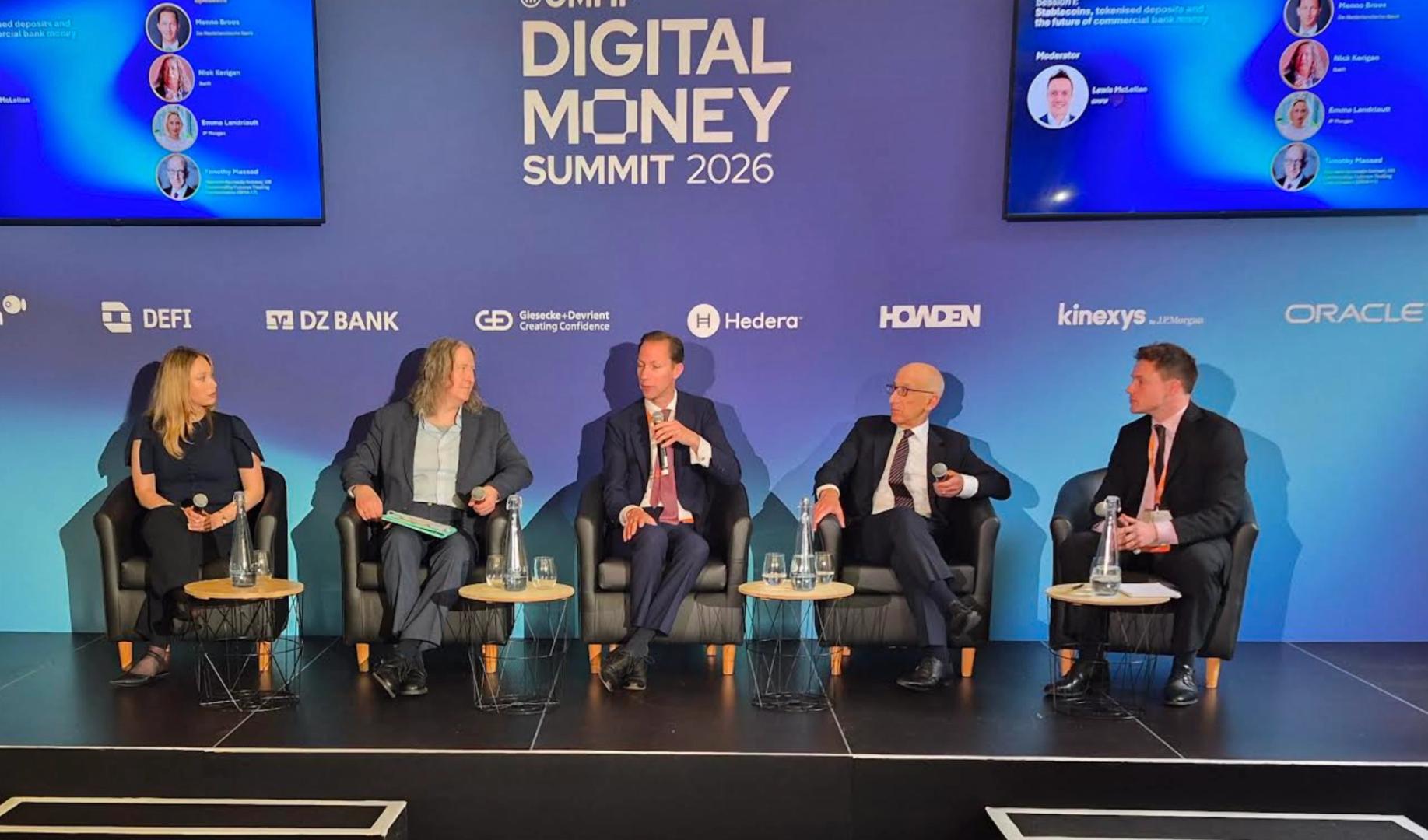
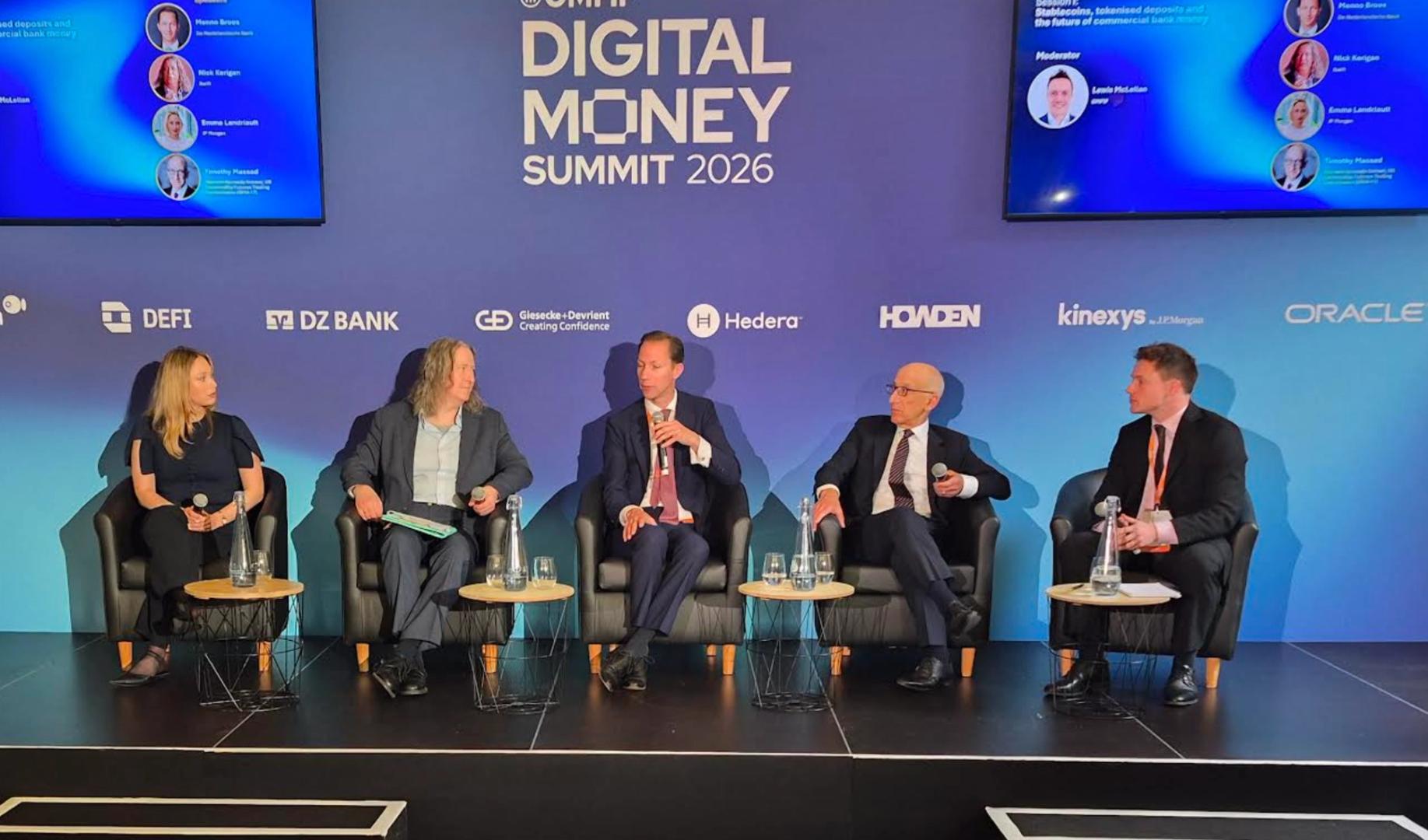
In the lead up to taking office, U.S. President Donald Trump fiercely opposed a Central Bank Digital Currency (CBDC) or government-backed dollar-pegged stablecoin, however the global market dynamics means it is inevitable, said Timothy Massad, the former chairman of the Commodity Futures Trading Commission (CFTC).
In an interview with CoinDesk on Tuesday during the Digital Money Summit 2026 in London, Massad went further, saying that despite the CBDC topic being highly sensitive in Washington, D.C.,it is being considered behind closed doors.
Mark Gould, chief Payments Executive at the U.S. Federal Reserve and also present at the event, refused to speak of a central bank stablecoin, saying this was not a topic at present “This is not under our remit,” he said, but when asked if a government-backed digital dollar would be the Fed’s responsibility he said yes, but not at present.
In March 2024, nine months before taking office for a second time, Trump vowed he would ban the creation of CBDC. “As your president, I will never allow the creation of a central bank digital currency,” he said while still campaigning. In March of this year, an initiative to ban the Federal Reserve from issuing a digital dollar was approved in an overwhelmingly bipartisan 89-10 vote in the Senate, but it remains part of a housing bill that may still hit a wall in the House of Representatives.
Massad said international central banking experiments with stablecoins are quietly forcing the U.S. to build government-endorsed settlement rails for onchain money to avoid losing ground to Europe.
During the panel discussion, the former CFTC chair (2014-2017) pointed to Project Agora, a major Bank for International Settlements (BIS), of which the U.S. is a member country, bringing together seven central banks, as a prime catalyst.
“The U.S. is a participant in Project Agora,” Massad said, highlighting that the work behind closed doors is moving forward despite Washington’s public-facing objections.
“We don’t have a central bank president who is going to get out there and speak about wholesale or retail CBDC, but that does not mean that we are not looking at how to create one.”
In a conversation after the session, Massad told Coindesk that while the Trump Administration will publicly say a formal retail CBDC is off the table, the evolution of tokenized finance will force a government-backed alternative.

Political action committees (PACs) aligned with and funded by the cryptocurrency industry notched a series of wins in three US state primaries on Tuesday, potentially setting a precedent for the 2026 midterm elections.
The Fairshake PAC and its affiliates poured a combined $20 million into supportive media for the races. The committee, largely funded by crypto companies Ripple Labs and Coinbase, is behind the Defend American Jobs PAC in supporting Republican candidates and Protect Progress PAC for Democrats considered to be “pro-crypto.”
Four Republican candidates and one Democrat won their respective primaries for US Senate and House of Representatives seats in Georgia and Kentucky, while one Alabama Republican will go to a runoff election.
“Fairshake’s 6-0 sweep tonight was a clear victory for pro-crypto leaders across the country,” Fairshake spokesperson Geoff Vetter told Cointelegraph. He said:
“This powerful bipartisan mandate is being heard across America from Georgia to Alabama to Kentucky.”
According to Federal Election Commission filings, Protect Progress spent more than $4.2 million to support Jasmine Clark, a Georgia representative running in the state’s 13th Congressional district. Defend American Jobs reported similar expenditures for media to support Republican candidates: $455,000 for Clay Fuller in Georgia’s 14th district, $709,000 for Houston Gaines in Georgia’s 10th district, $431,000 for Jim Kingston in Georgia’s 1st district and $7.2 million for Andy Barr for Kentucky’s US Senate seat.
Barry Moore, who was supported with $7.4 million from Defend American Jobs in his run for Alabama’s US Senate seat, will head to a runoff against state Attorney General Steve Marshall and Republican candidate Jared Hudson, after none of the three secured a majority of the vote in the primary.

Source: Jasmine Clark
Fairshake and its affiliates, backed by the crypto industry, are expected to spend millions of dollars in 2026 to “oppose anti-crypto politicians and support pro-crypto leaders,” according to a spokesperson in January. The company reported holding a $193 million war chest, far surpassing its 2024 expenditures of $130 million on media and ads to support congressional candidates.
Related: Crypto PACs spend $7.2M to support candidates in 5 US states ahead of elections
Despite the multimillion-dollar expenditures, the crypto-backed PAC hasn’t always been successful in swaying enough voters before a key election or primary. Fairshake reportedly spent $8 million opposing Illinois Lieutenant Governor Juliana Stratton in her US Senate primary, but she beat other candidates with more than 40% of the vote.
Coming Texas run-off seen again testing crypto PAC support
Protect Progress has ramped up spending on supportive media for Democratic candidate Christian Menefee, running to unseat incumbent Al Green in Texas’ 18th Congressional District.
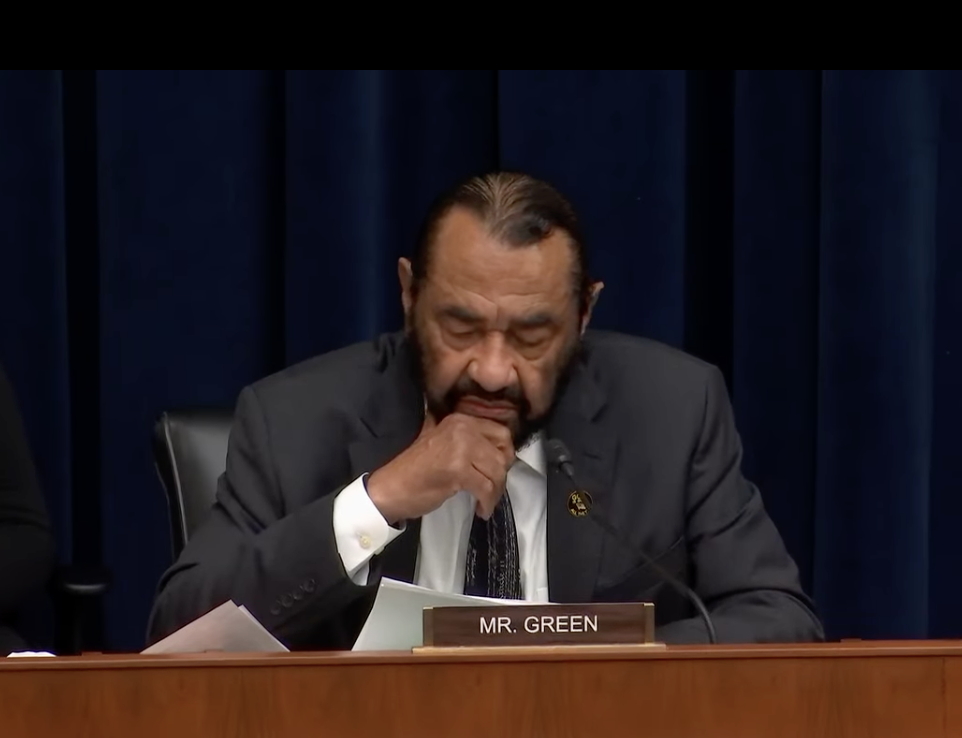
Representative Al Green addressing the House Financial Services Committee in March. Source: Al Green
According to FEC filings as of Tuesday, the PAC spent more than $4.1 million to support Menefee. It also reported spending more than $2.8 million on media to oppose Green, who has expressed anti-crypto views and voting records against the payment stablecoin bill GENIUS Act and digital asset market structure bill, the CLARITY Act.
Protect Progress reportedly spent more than $1.5 million opposing Green ahead of a March primary against Menefee, but neither candidate secured a majority of the vote, triggering next Tuesday’s runoff.
Magazine: 5 tech predictions the mainstream media got horribly wrong

Clarity Act floor vote could come by August says Lummis
“Growing Pains” cast: See the Seaver family more than 40 years later

The best way to save money on buying perfumes! #beauty #LifeHack #advice #moneysavingtips


-

 Crypto World5 days ago
BloFin War of Whales 2026 Grand Prix opens registration for $5M trading championship
-

 Fashion5 days ago
Weekend Open Thread: Theory – Corporette.com
-

 Crypto World5 days ago
E-Estate Announces 1 Year Live: Washington DC Summit as Real Estate Tokenization Enters Its Next Phase
-

 Tech6 days ago
Tech Moves: Microsoft AI leader jumps to OpenAI; former AI2 exec joins Meta; and more
-

 Tech5 days ago
Google reimburses Register sources who were victims of API fraud
-

 Crypto World7 days ago
Google’s Gemini AI Predicts Incredible Solana Price by the End of 2026
-

 Business5 days ago
H&R Real Estate Investment Trust (HR.UN:CA) Q1 2026 Earnings Call Transcript
-
 Entertainment6 days ago
Zara Larsson Has Blunt Response To Chris Brown Diss
-

 Sports5 days ago
Napoleonic enters 2026 Doomben 10,000 field via Abounding withdrawal
-
 Crypto World5 days ago
BeInCrypto 100 Institutional Awards Nomination: KAST for Best Digital Assets Neobank and Best Digital Assets Fintech
-

 Fashion4 days ago
On the Scene at Gucci’s Cruise Show in New York City: Mariah Carey, Kim Kardashian, Lindsay Lohan, Iman, and More!
-
 Crypto World5 days ago
Bitcoin Battles US Bond Nerves With BTC Price Dip Toward New May Lows
-
 Crypto World5 days ago
Wall Street’s Boldest Gold Prediction Has Russians Rushing to Buy
-

 Crypto World5 days ago
ICE and CME urge US regulators to curb Hyperliquid energy trading
-

 Politics6 days ago
DWP PIP Timms review continues to be an absolute farce
-

 Fashion5 days ago
Trending Western Style Vests Perfect for Summer
-

 Entertainment5 days ago
David Letterman Returns to Late Show, Blasts Cancellation
-

 Crypto World5 days ago
IREN closes $3 billion convertible notes deal amid AI infrastructure expansion
-
Crypto World6 days ago
Lido Finance Selects Chainlink CCIP as the Official Cross-Chain Infrastructure for wstETH Security
-

 Fashion4 days ago
Amazon Sundays: Memorial Day Hosting
You must be logged in to post a comment Login