

Crypto World
NYSE Files Rule Change to Enable Tokenised Securities Trading Under SEC Review


TLDR:
- The NYSE proposal enables tokenised equities and ETFs to trade on the same order book as traditional shares.
- Tokenised securities must retain identical CUSIP, ticker, rights, and execution priority under filing.
- DTC pilot ensures clearing and settlement remain on a T+1 basis within the existing market infrastructure.
- SEC review aligns NYSE tokenisation framework with regulated exchange trading standards and rules.
The NYSE tokenised securities filing is a regulated framework where tokenised equities can trade alongside traditional listed shares.
The proposal integrates digital representation into existing exchange systems while preserving settlement rules, execution priority, and investor protections under current market infrastructure systems.
Unified Order Book and Tokenised Execution Framework
The filing sets a unified structure for trading tokenised equities within the same order book as traditional shares. This ensures both formats interact under identical execution rules. As a result, price discovery remains consistent across the exchange environment.
Moreover, the NYSE tokenised securities filing requires tokenised assets to retain the same CUSIP, ticker, and shareholder rights.
This ensures legal equivalence between digital and traditional forms. Therefore, market participants face no change in rights or instrument classification during trading. It also reduces operational discrepancies between digital and traditional settlement processes over time.
Furthermore, liquidity remains unified under a single order book structure. The NYSE tokenised securities filing avoids splitting trading venues. Instead, both tokenized and non-tokenised orders interact directly.
Consequently, fragmentation risk is reduced across institutional and retail participation. This structure supports deeper liquidity integration across institutional trading desks and market participants globally.
Execution mechanics remain unchanged under the NYSE tokenised securities filing. Orders follow identical matching rules on the exchange. Additionally, execution priority remains consistent for all participants.
This preserves existing market structure behaviour without introducing parallel trading systems. It also signals the gradual adoption of tokenised infrastructure within regulated markets globally over time.
DTC Pilot Settlement Design and Regulatory Review Path
DTC pilot settlement under the NYSE tokenised securities filing maintains the existing post-trade infrastructure. Trades continue to settle on a T+1 cycle. Therefore, tokenisation occurs at the execution layer only.
Custody and clearing remain within established financial systems, ensuring continuity across institutional workflows.
This approach ensures operational continuity across custodians and broker-dealer networks during the market operations cycle.
Additionally, the pilot spans three years under regulatory supervision. The NYSE uses this period to evaluate system efficiency and reconciliation processes. Market participants provide feedback through structured SEC channels during the review phase.
Moreover, SEC coordination ensures consistency across exchange frameworks. At the same time, traditional equity market rules remain unchanged, preserving stability within regulated trading environments.
Finally, the NYSE tokenised securities filing keeps tokenised trading separate from crypto-native systems. Instead, it operates within a regulated equity infrastructure.
As a result, market structure evolution remains controlled, with digital representation embedded into existing financial rails rather than replacing them.


TLDR
- UK lawmakers urged regulators to avoid delays in final stablecoin rules.
- The report said a GBP stablecoin market could support faster and cheaper payments.
- The committee backed one-to-one reserve backing for stablecoin issuers.
- Lawmakers questioned proposed holding limits and unremunerated backing asset rules.
- The report urged HM Treasury to review risks tied to private unhosted wallets.
UK lawmakers have urged regulators to avoid delays in final stablecoin rules as global frameworks move ahead. The House of Lords Financial Services Regulation Committee warned that slow action could weaken the UK’s position. Its report calls for rules that support safe innovation while addressing financial stability and consumer risks.
Committee Sees Room for a GBP Stablecoin Market
The committee argued that a sterling stablecoin market could support faster and cheaper payments. It also linked the technology to settlement efficiency and programmable payment services. The report noted that stablecoins could complement existing forms of money. It also stated that new payment options could increase competition across the UK payments sector.
Lawmakers pointed to the UK’s established financial services industry as an advantage. They argued that the country should allow a GBP stablecoin market to form and grow. The committee also noted that a strong market could support wider services around stablecoins. It linked those services to new business opportunities in the wider digital finance sector.
However, the report also identified risks that regulators must address before wider adoption. These include financial stability concerns, banking sector disruption, and consumer protection issues. The committee also raised concerns about illicit activity linked to stablecoins. It described that issue as a global concern for regulators and policymakers.
Lords Back Core Rules but Question Limits
The committee supported much of the Bank of England and FCA stablecoin framework. It backed the proposed requirement for issuers to hold one-to-one backing assets. Lawmakers also welcomed the Bank of England’s proposed backstop lending facility. The report viewed that tool as part of the wider risk management framework.
However, the committee questioned parts of the UK’s planned regime. It noted that some proposals would diverge from rules used in other major markets. The report focused on holding limits, unremunerated backing assets, and commercial bank restrictions. It stated that these measures could shape how the market develops.
The committee recommended that the Bank reconsider the 40% central bank deposit requirement. It argued that unremunerated assets may affect how issuers manage reserves. It also urged regulators not to impose holding limits before risks justify them. The report warned that early limits could restrict GBP stablecoin growth.
Report Calls for Timelines and Flexible Regulation
The committee urged regulators to keep current timelines and avoid further delays. It stated that final rules should give firms certainty and market confidence. The report also recommended a flexible approach to future stablecoin use cases. It argued that regulators should not assume how digital settlement tools will develop.
Lawmakers urged regulators to avoid applying a harsher risk lens to stablecoins. They asked authorities to compare risks with other payment methods fairly. Baroness Noakes, the committee chair, noted that dollar stablecoins dominate the global market. She also stated that the UK has moved more slowly than the US and the EU.
“The UK is lagging behind compared with the US and the EU,” Noakes stated. She added that the UK was now moving in the right direction. The committee also addressed commercial bank involvement in stablecoin issuance. It recommended changes to proposed PRA rules on separate branding and insolvency-remote entities.
The report further urged HM Treasury to review rules for private unhosted wallets. It asked officials to consider legislation if current laws cannot deter illicit activity. Noakes stated that no one knows how a UK stablecoin market may develop. She added that regulation must allow innovation while ensuring risks receive effective controls.

Bitcoin endured a sharp correction, sliding about 9% over 48 hours and briefly testing the $67,000 level—the first time in two months that the price flirted with that range. By most measures, the move wiped roughly $176 billion from the total crypto market capitalization and triggered around $1.5 billion in forced liquidations on overleveraged long positions, according to Cointelegraph’s coverage of market data.
While U.S. equities have shown resilience, crypto traders faced a conservative mood as ETF outflows and chatter about higher-for-longer rates underscored a risk-off backdrop. The pullback comes at a time when traders are weighing the durability of crypto’s recent strength against macro headwinds and shifting liquidity conditions.
Key takeaways
- Bitcoin tumbled about 9% over 48 hours, pushing near the $67,000 support zone and triggering roughly $1.5 billion in forced long-liquidations.
- US-listed spot Bitcoin ETF outflows totaled around $2.1 billion between May 12 and May 20, contributing to a weaker demand environment for the asset.
- The BTC 2-month futures basis has remained below the neutral 4% threshold for more than three months, signaling tepid bullish leverage and a cautious appetite from leverage traders.
- MicroStrategy’s decision to buy back convertible debt while pausing its weekly Bitcoin purchases drew mixed reactions, with some analysts viewing it as balance-sheet management rather than a continued push for BTC accumulation.
- Broader market narratives emphasize AI-driven concentration, with JPMorgan noting 41 AI-related stocks account for half of the S&P 500’s market value, while Fed-rate expectations and policy signals add macro headwinds for crypto in the near term.
Price action, liquidity, and the shifting narrative
The latest price move underscores a renewed sensitivity to macro signals and liquidity dynamics. BTC’s retreat from the $75,000 zone into the mid-$60,000s over two days marks a sharp reversal that traders say reflects both a pause in impulsive risk-taking and a reassessment of hedging needs in a higher-for-longer interest-rate environment.
Beyond the price action, the market’s liquidity backdrop has been characterized by outsized ETF outflows and a subdued appetite for bullish leverage. Between May 12 and May 20, the net outflows from US-listed spot Bitcoin ETFs neared $2.1 billion, a flow pattern that supports a more cautious tone among both institutional and retail participants. In tandem, the BTC futures market has shown a persistent disconnect from immediate price momentum, with the annualized futures premium lingering below the neutral 4% threshold for more than three months, a signal often interpreted as tepid appetite for risk-seeking leverage.
Derivatives signals, strategy moves, and macro undercurrents
The interruption in Bitcoin’s two-month correlation with US small-cap equities—officially evident on May 21—adds to questions about how crypto behaves in relation to broader risk-on assets. Market participants have linked this shift to a broader risk-off mood, reinforced by softer near-term liquidity conditions and a cautious stance from ETF investors. In this environment, derivatives data and liquidity indicators have tended to confirm a more selective bid for crypto risk rather than a wholesale return of bullish appetite.
On the corporate side, MicroStrategy (MSTR) drew attention for a notable strategic pivot: the company Buyback of convertible debt while pausing its storied weekly Bitcoin purchases. The move, viewed by some observers as a prioritization of capital structure over ongoing BTC accumulation, drew mixed commentary. Arca’s CIO Jeff Dorman characterized the debt-restructuring tilt as a form of balance-sheet management rather than a direct bet on higher Bitcoin prices. Meanwhile, data points circulating on social platforms suggested that the market’s interpretation ranged from cautious risk-management to concern over mission drift in long-running crypto strategies.
Additional manoevering among technology and corporate finance themes added to the narrative. A notable thread from market observers highlighted Google’s decision to pursue equity issuance rather than debt as an indicator of tightening liquidity and a broader retreat from aggressive leverage among large corporates. Parallel commentary from ScroogeCap on X drew attention to a liquid-raising backdrop in which private equity activity appears constrained, suggesting a broader reallocation toward safer, more liquid holdings in a tightening liquidity cycle. In the same vein, Jim Bianco of Bianco Research warned that the market’s concentration around a single overarching theme—AI—has not been seen at such a scale in centuries, underscoring a fragile, theme-driven market dynamic.
On the macro front, JPMorgan researchers highlighted the AI rally’s outsized footprint, noting that a relatively small cohort of AI-related equities accounts for a disproportionately large share of the S&P 500’s market value. The implications for crypto traders hinge on whether this sectoral leadership translates into broader risk appetite or remains a dominant but isolated driver in a more nuanced risk environment.
Adding to the policy backdrop, traders priced in an elevated probability of a Fed rate hike by September—about 23% according to CME Group’s FedWatch tool, up from near zero a month earlier. The evolving rate trajectory contributes to the sense that the macro landscape will continue to influence crypto flows and volatility in the near term.
For investors, the current setup underscores several practical considerations: liquidity conditions remain uneven, ETF-related flows can swing sentiment, and macro signals are increasingly likely to shape crypto price action in ways that single-story narratives may not fully capture. The convergence of AI-fueled equity leadership, cautious leverage in futures markets, and a shifting correlation with traditional risk assets creates a nuanced landscape where selective exposure and disciplined risk management become essential.
As the market eyes the next round of macro data, policy guidance, and sector-specific catalysts, traders will be watching for signs of renewed ETF participation, a rebound in risk appetite, and any tactical shifts in corporate capital allocation that could reframe the broader crypto narrative.
What remains to be seen is whether the current softness in spot flows can be countered by a rebound in institutional interest or whether liquidity will continue to hinge on macro catalysts and sector rotations. The coming weeks will help clarify whether Bitcoin’s resilience in the face of rising macro headwinds signals a durable barometer for risk appetite or a temporary pause in a longer, data-driven recovery.
Crypto World
Google Shares Sink as AI Boom Forces Alphabet to Go Back on Strategy Critical to its Stock
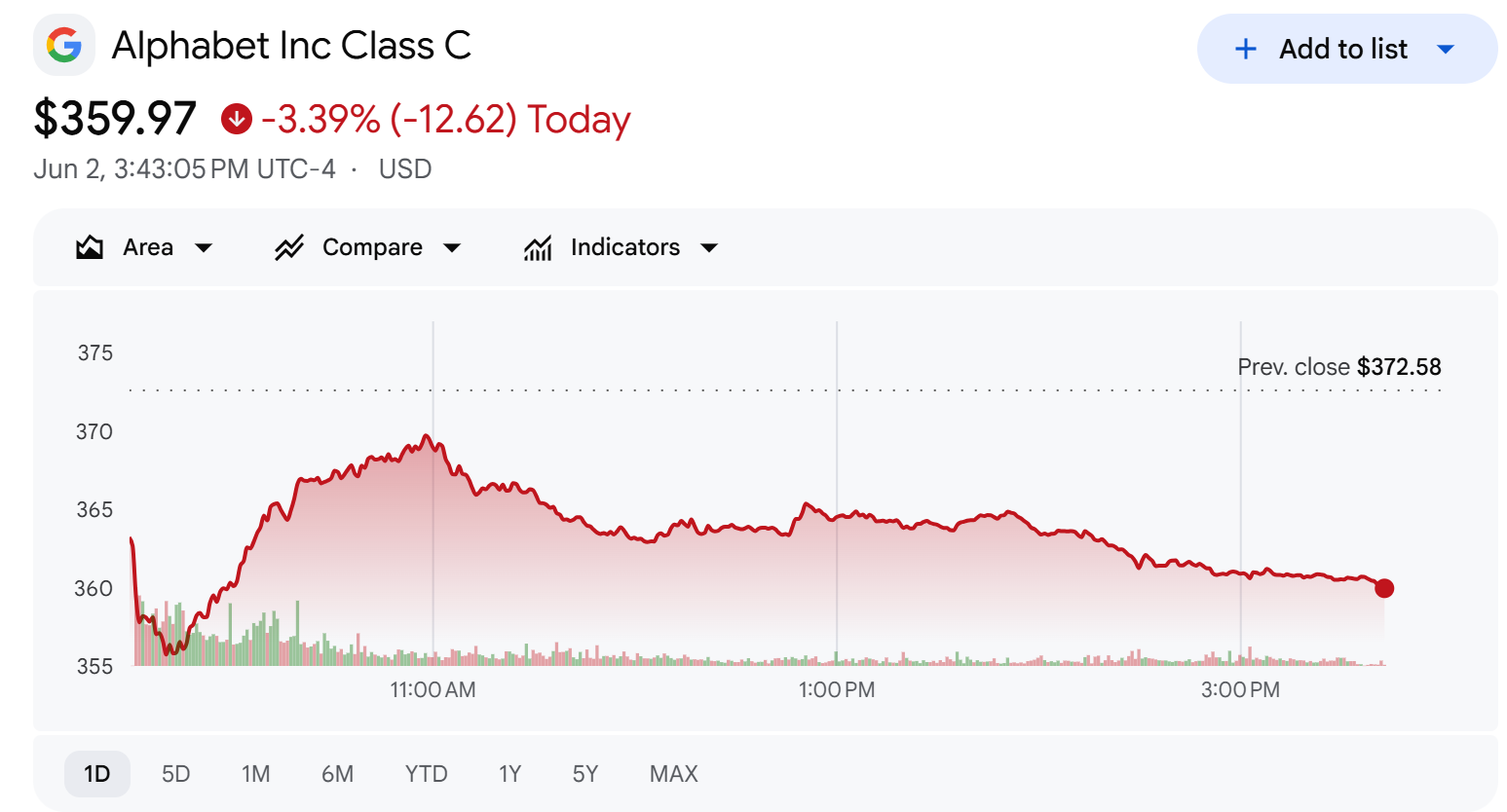
Google stock fell after parent Alphabet (GOOGL) announced an $80 billion equity raise to fund artificial intelligence (AI) infrastructure. The move reverses years of buybacks that steadily shrunk its share count.
Shares slipped after the June 1 announcement, with GOOGL opening down roughly 3.5% on Tuesday. Investors weighed dilution against management’s bet that AI demand justifies the largest fundraising shift the company has undertaken in years.

A Big Reversal for Google Stock Buybacks
Alphabet has spent more than $346 billion repurchasing stock since 2016. Those purchases cut shares outstanding by approximately 13% from a 2019 peak.
The program lifted earnings per share and supported the stock through market volatility.

The new plan reverses that posture. It includes a $30 billion concurrent public offering and a $40 billion at-the-market program. The latter begins in the third quarter.
“Alphabet Inc. (NASDAQ: GOOG, GOOGL) today announced equity offerings totaling $80 billion, in expected aggregate amount, as part of its plan to fund investments in its world-class AI compute infrastructure to meet its unprecedented customer demand,” read an excerpt in the announcement.
Follow us on X to get the latest news as it happens
A $10 billion private placement reflects Berkshire Hathaway’s AI direction under chief Greg Abel.
AI Spending Drives the Reversal
Alphabet now expects 2026 capital expenditures of $180 billion to $190 billion, roughly double 2025 levels.
Another step-up is guided for 2027. Proceeds will fund data centers, custom chips, and the global AI compute buildout supporting Search, Cloud, and Gemini.
The capital intensity has drained Big Tech cash flow across hyperscalers. BlackRock has separately flagged AI capex risks to broader financial markets.
Berkshire agreed to buy $5 billion of Class A stock at $351.81 per share. It will also acquire $5 billion of Class C at $348.20. The anchor commitment did not fully offset dilution concerns.
Markets will now judge whether AI returns ultimately outweigh near-term dilution and the lost buyback support that fueled Alphabet’s rally.
The post Google Shares Sink as AI Boom Forces Alphabet to Go Back on Strategy Critical to its Stock appeared first on BeInCrypto.
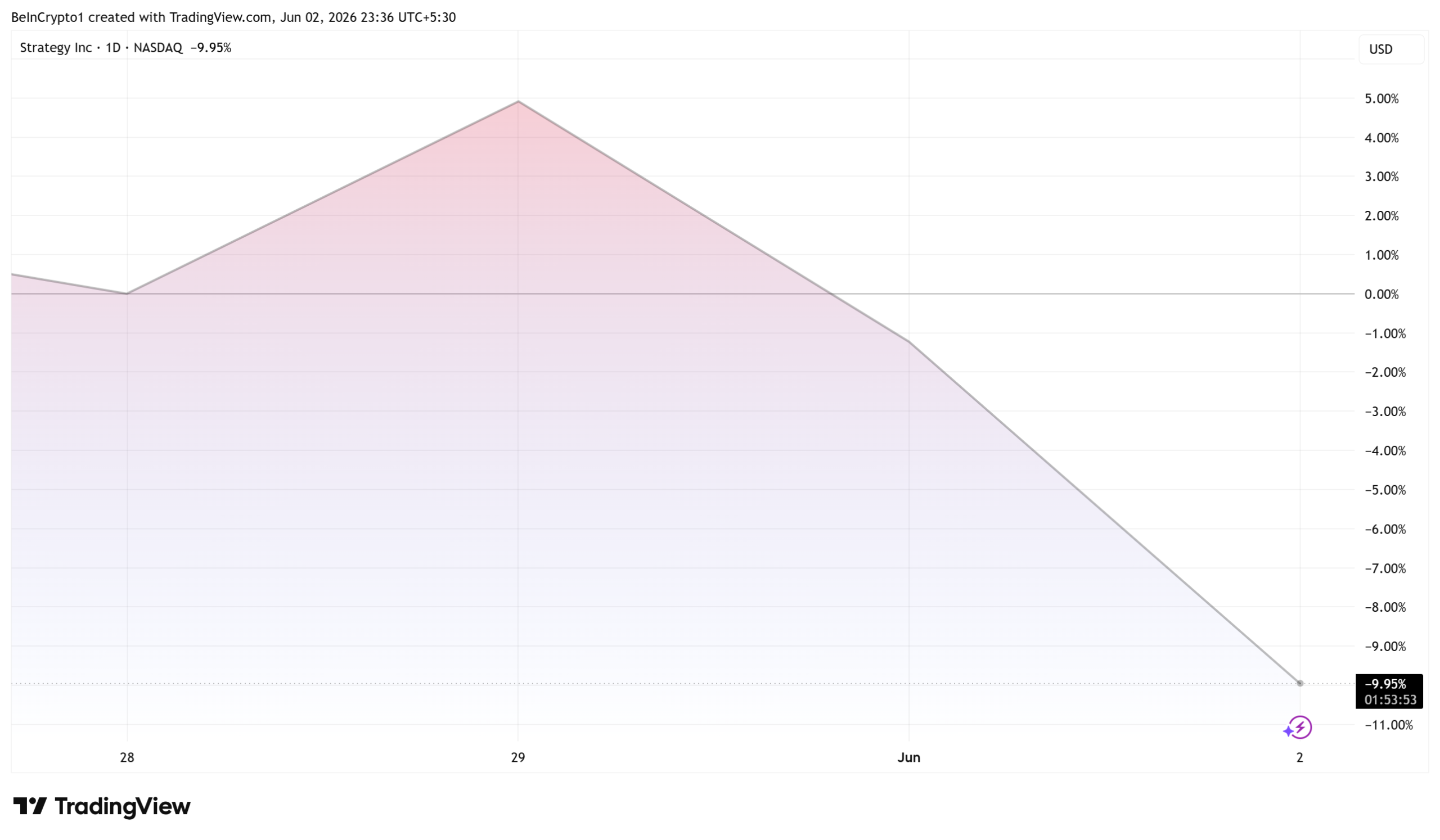
Bitcoin (BTC) and MicroStrategy (MSTR) stock plunged on Tuesday after the company disclosed its first BTC sale in 41 months. The move reignited debate over how much the asset depends on one corporate buyer.
MicroStrategy disclosed in a Form 8-K that it sold 32 BTC for roughly $2.5 million. The sale ran from May 26 to May 31, with proceeds earmarked for preferred stock dividends.
A Tiny MicroStrategy Sale Triggers an Outsized Reaction
The disposal equals about 0.0038% of MicroStrategy’s 843,706 BTC stockpile worth near $63 billion. The position now sits on more than $6 billion in unrealized losses against an average cost of $75,702.
That math did not stop the sell-off. MSTR closed down 9.95% on the day and has shed nearly 70% over the past year. Its market capitalization has fallen from above $160 billion to roughly $48 billion.

Follow us on X to get the latest news as it happens
In the same way, Bitcoin slumped 8.58% to trade near $67,206, extending a slide below $70,000 tied to record ETF outflows.

“On one hand, they only sold 0.004% (literally) of their BTC so it’s pretty histrionic framing to say ‘U-Turn’ and ‘remain solvent’ but on other hand why bother selling such an insignificant amt knowing full well the media/haters will go wild with histrionics and TD dances?” ETF expert Eric Balchunas posed, alluding that the optics were poorly timed, even if the dollar amount was negligible.
Michael Saylor’s Premium Problem
The decision reverses years of messaging from founder Michael Saylor. He once told investors, “Sell a kidney if you must, but keep the bitcoin.”
Deaton, citing the Wall Street Journal, called the move a “U-Turn,” tying it to solvency pressures on Strategy’s STRC preferred dividend obligations.
“The irony is hard to miss: Saylor still appears to have both kidneys,” Deaton quipped.
Balchunas compared the reaction to the 2013 Taper Tantrum. He pushed back on what he sees as fragility in Bitcoin ETF demand.
Bitcoin has grown too reliant on ETFs and the MSTR narrative, he argued. Both should be “icing on cake, not whole cake.”
The argument cuts at the heart of Strategy’s aggressive BTC purchases. If a 0.004% sale can wipe billions off MSTR and pull spot BTC lower, the premium looks fragile.
MicroStrategy’s STRC Depegs from $100 Par
In the same way, analyst Ran Neuner argues STRC’s failure to maintain its $100 peg this month will limit MicroStrategy’s capital raising, reducing Bitcoin purchases and contributing to BTC’s current price dump.

“THE STRC PARTY IS OVER – AND THE MARKET KNOWS IT! I suspect that STRC won’t be effective at all this month. It wont peg to $100 and therefore, Michael Saylor won’t be able to use it to raise. It may not peg for a while… This is one of the reasons Bitcoin is dumping,” crypto analyst Ran Neuner added.
Recent sales of BTC to fund dividends highlight growing pressure on the structure amid market weakness.
For these experts, Bitcoin’s real strength is its status as a hard-money store of value, not its corporate ambassadors.
The post Experts Warn Bitcoin Has a MicroStrategy Problem as BTC and MSTR Stock Sink appeared first on BeInCrypto.
Outpoll introduces a new global prediction market platform that enables users to trade on the outcomes of real-world events. Categories include, but are not limited to, politics, sports, crypto, culture, and more – with a product layer that is centered on professional trading tools, access through a public API, integrated news layer, a native mobile experience, as well as creator-led markets.
It goes without saying that prediction markets have managed to move from niche to mainstream throughout the last two years. Volumes are already in the billions, institutional capital is here, and the prices these markets produce are cited alongside polls and expert forecasts. That said, the trading layer seems to have been slower to keep pace with the actual experience of taking, managing, and exiting positions on these markets.
The Outpoll prediction market platform is one of the venues that aim to close that particular gap.
What Outpoll Is
At its heart, Outpoll brings forward a prediction market – in the structural sense that the category has converged on. Users are able to trade on whether specific events will happen, with positions resolving against defined outcomes.
The mechanics will feel very familiar to those of you who have already used such a platform before, and this is a deliberate choice.
However, what Outpoll changes is the layer above the mechanics. The majority of prediction markets historically offer the same thin interaction. Users have to pick a side, hit the button, hold the position, and then watch the chart, waiting for resolution. Outpoll is built on the assumption that people trading these markets expect more.

Trading Tools, Including The Ones That Have Been Missing
One of the most immediate things that experienced traders will notice is the order ticket. Both limit and market orders are, of course, available, while take-profit and stop-loss can be set on open positions.
These are pretty much the standard features on the majority of other trading venues, with platform-level oversight ensuring orders execute against the published rules.
The practical effect is that you can set a position, protect it, and walk away. You can size into a position at a chosen price with a limit order, define a clear exit on both sides, and let the platform handle execution.
For anyone who has ever held a prediction market position through a violent re-pricing on a 3 AM news headline, the value of this infrastructure is absolutely obvious.
A Public REST and WebSocket API
For those traders who operate through code and not through the UI, the platform will also publish a full public REST and WebSocket API. The use cases here are those that matter for active strategies: automating take-profit and stop-loss across a portfolio of positions, monitoring price drift across different markets in real-time, connecting Outpoll to different stacks that traders may already be running, and more.
The platform’s help center includes a dedicated section with API guides, as well as technical reference material, including practical Python examples of working strategies, and so forth.
This matters more than it might appear at a glance. Programmatic access is the channel through which sophisticated capital tends to arrive in any new market, and the presence of a real, usable API is one of the more reliable signals about who a platform expects its users to be.
Creator-Led Markets
One of the more distinctive structural choices that Outpoll is taking is its creator-led markets platform. Approved community leaders, subject-matter experts, and channel owners will be able to launch and curate their own prediction markets for their audiences.
The majority of prediction markets tend to be operated top-down. This means that the platform is in charge of deciding which markets exist, and users participate. Outpoll wants to open that layer to creators, while also keeping platform-level oversight on resolution and quality. A creator who covers a specific sport, political beat, or cultural niche is capable of extending the conversation they already have with their audience into a market where that audience can engage with directly.
For users who follow specific niches, this changes the texture of the platform. The market list reflects the actual distribution of attention online – not just the events a central team finds tractable to list. The result is broader topical coverage than a centrally-curated catalog can typically support, with markets often run by people deeply familiar with the underlying domain.

News, Sitting Next to the Markets
Prediction markets are news-driven more than most other venues. The events these markets price move on headlines – political developments, geopolitical shifts, macroeconomic prints, cultural moments – and the gap between consuming a relevant headline and acting on it is the friction the trader pays for.
Within the Outpoll platform, a dedicated news section sits directly inside the trading interface, aggregating relevant world news in one place. The intended path is straightforward: a development relevant to a market becomes immediately visible to a trader watching the platform, with a position one click away. No tab switching, no fragmented context, no gap between consuming the information and acting on it.
It is the kind of workflow detail that’s easy to overlook in a feature list and noticeable once a user has actually traded with it – because once one workflow runs without context-switching, the friction of every other workflow becomes obvious.

Native Mobile Experience
In today’s world, a considerable share of trading on prediction markets happens on phones. Moreover, this tends to happen in direct response to news, which are also consumed mostly on phones. Outpoll launches with a native Android application that is available on Google Play, whereas the iOS app is coming later in the autumn.
The order ticket, position management, charting, and notifications all behave the way they should on the mobile device. This might be a small thing on paper, but it’s a noticeable step in practice when the market resolves while you might be away from your desk.
Funding and Trading
Outpoll is designed with support for deposits in multiple currencies with in-app conversion. Users are able to fund their account in their preferred crypto asset, and the platform will handle the conversion to USDC, which is the primary settlement asset for trading. This happens without the necessity for an additional swap before depositing.
All markets are fully collateralized at the contract level, with the resolution rules and authoritative sources published before each market is live. The trading fees are approximately 0.1% per trade, which seems to be in line with industry norms.

In Conclusion
To wrap it up, Outpoll does offer some interesting features, and it stands out for the following:
- Offers TP/SL orders, multiple other types, and a public API.
- Creator-led markets program combines community-launched initiatives with platform-level oversight.
- Native Android app with iOS app in the making.
- Positioned for serious prediction market traders, casual users, and creators/audience-driven market communities.
Disclaimer: The above article is sponsored content; it’s written by a third party. CryptoPotato doesn’t endorse or assume responsibility for the content, advertising, products, quality, accuracy, or other materials on this page. Nothing in it should be construed as financial advice. Readers are strongly advised to verify the information independently and carefully before engaging with any company or project mentioned and to do their own research. Investing in cryptocurrencies carries a risk of capital loss, and readers are also advised to consult a professional before making any decisions that may or may not be based on the above-sponsored content.
Readers are also advised to read CryptoPotato’s full disclaimer.
The post Outpoll: A New Paradigm in Prediction Markets appeared first on CryptoPotato.


MoneyGram launched MGUSD on Tuesday, a U.S. dollar-backed stablecoin native to the Stellar blockchain, making the 85-year-old remittance operator the first global cash-payments network to issue its own dollar token on a public chain. The company announced the launch from Dallas and Amsterdam at 5… Read the full story at The Defiant

A coalition of senior Democrats on three key U.S. committees has pressed the Labor Department to pause its plans to allow digital assets and other “alternative assets” to be held within Americans’ retirement accounts. In a letter circulated to Acting Labor Secretary Keith Sonderling, Sen. Bernie Sanders, Sen. Elizabeth Warren, and Rep. Bobby Scott urged the department to rescind the March proposal that would permit private equity, digital assets, private credit, and other non-traditional holdings in 401(k) plans.
The lawmakers argued that extending retirement plan exposure to volatile assets such as cryptocurrencies would heighten risk for workers’ savings, citing a lack of robust regulation and safeguards in the crypto sector. They asserted that protections typically afforded to public securities may not be available for crypto assets, potentially leaving investors less shielded from fraud and mismanagement. The letter also framed the move in the broader context of evolving securities-law applications to crypto and the adequacy of current guardrails in protecting retirement plan participants.
The policy proposal was announced by the Labor Department in March and sits within a broader policy push that some lawmakers view as shifting toward broader access to alternative investments. The debate unfolds against a backdrop of high U.S. retirement assets; the Investment Company Institute has reported that Americans held about $10.1 trillion in 401(k) plans as of December 31.
Key takeaways
- The Labor Department’s March proposal would expand 401(k) eligibility to include private equity, digital assets, private credit, and other alternative assets, prompting scrutiny from lawmakers.
- Top Democrats warn that this shift would expose retirement accounts to volatile assets and may rely on insufficient regulatory safeguards, raising investor-protection concerns.
- The letter emphasizes that securities laws’ application to crypto assets is still evolving, and protections available for traditional public securities may not be fully available for digital assets.
- Lawmakers tie the policy to broader ethics and enforcement debates, pointing to perceived conflicts of interest and ongoing discussions around crypto-focused legislation such as the CLARITY Act.
- The policy context includes a recent executive-order-driven push to democratize access to alternative assets, highlighting a potential cross-cut of regulatory approaches and oversight.
Policy proposal and context
The Labor Department’s March proposal envisions allowing a wider range of asset classes in retirement plans, extending beyond traditional equities and fixed income to include alternatives such as private equity and digital assets. Proponents argue that expanding access could broaden diversification and retirement outcomes for workers. Opponents, however, contend that retirement plan fiduciaries would face heightened fiduciary duties and potential conflicts of interest when selecting highly complex, less transparent assets. The policy aligns with a broader government agenda that, in 2025, included an executive order directing agencies to “democratize access to alternative assets,” explicitly mentioning crypto among the instruments to be considered in this framework. As of the end of the last reported period, the 401(k) asset base remains substantial, underscoring the potential scale of any regulatory shift.
Regulatory risk and investor protections
Central to the debate is how crypto assets would be treated under securities laws as they sit within retirement accounts. The lawmakers’ letter contends that the current enforcement posture across major financial regulators, including the Securities and Exchange Commission, has weakened protections for crypto investors. They warn that the application of securities laws to crypto assets is still “rapidly evolving,” and that key investor safeguards associated with traditional public securities may not be available for digital assets. This evolving regulatory landscape raises questions about disclosure, custodial standards, liquidity, valuation, and risk management for plan sponsors and fiduciaries responsible for selecting and monitoring investments in a multi-asset retirement lineup.
Implications for plans, sponsors, and market structure
Allowing digital assets and other alternatives in 401(k) plans would impose new governance and compliance demands on plan sponsors, investment committees, and third-party administrators. Fiduciaries would need to evaluate custody arrangements, due diligence processes, valuation methodologies, operational risk, and ongoing monitoring for assets with limited price discovery and potentially higher fraud risk. Given that a substantial portion of U.S. retirement savings is channeled through 401(k) plans, even incremental changes in eligibility can have outsized implications for risk management practices, disclosure requirements, and regulatory oversight. The conversation also intersects with the broader market structure debate surrounding crypto assets, including how such holdings would interact with banking relationships, KYC/AML requirements, and the appropriate licensing regimes for managers and platforms involved in these assets.
Ethics, conflicts, and broader policy debates
Lawmakers highlighted potential conflicts of interest linked to the current administration’s approach to alternative assets, citing ties to private ventures in the crypto space and a more permissive stance toward crypto within federal policy. The discussion touches on ethics considerations that have shaped legislation such as the CLARITY Act, with Democrats signaling they would not support bills lacking strong ethics provisions. These concerns illustrate how regulatory proposals in the retirement space can become touchpoints for broader debates about regulatory capture, corporate influence, and the balance between investor access and safeguarding public retirement savings.
Looking ahead, policymakers will likely scrutinize how the Labor Department interprets fiduciary duties in the context of alternative assets and how SEC- and CFTC-style oversight would apply to crypto within retirement plans. The intersection of retirement policy, crypto regulation, and ethics rules presents a complex compliance landscape for plan sponsors, asset managers, and financial institutions. Analysts will be watching for any changes to the proposed rule, forthcoming guidance on custody and valuation, and the potential alignment or friction with ongoing federal and cross-border regulatory developments.
Closing perspectives suggest that the evolution of this policy will hinge on clarifying investor protections, establishing robust governance frameworks for plan fiduciaries, and balancing access to innovative asset classes with the safeguarding of long-term retirement security. As the regulatory environment continues to develop, institutions should monitor both domestic enforcement posture and cross-jurisdictional considerations that could influence how such assets are treated in retirement accounts.


A week ago, CoinDesk informed readers of the renewed rotation of funds into dollar equivalents such as tether and USD Coin (USDC) stablecoins as bitcoin pulled back from the early May highs above $80,000. That combination was an early warning sign of potential full-blown risk aversion in the crypto market.
Those early warning signs have now turned into a full-blown trend.
Bitcoin has dropped about 12% over the past week to around $66,800, pulling the broader crypto market lower with it, CoinDesk data show. Bitcoin’s dominance rate, or its share of the total crypto market, has fallen to 58.5%, reversing gains that had pushed it as high as 61.2% in April and early May.
At the same time, tether , the world’s largest dollar-pegged stablecoin, has seen its dominance jump to 8.30%, the highest level since late February. USD Coin (USDC) has also climbed back to levels last seen in early April.
While the two stablecoins still make up just 11% of the overall market, which is paltry compared to bitcoin, their rising share signals a clear flight to dollar liquidity inside crypto. And that shift is getting harder to ignore, as BTC loses ground.
This pattern has played out in previous market swoons, including the sharp sell-off from over $90,000 to nearly $60,000 in January and February.
Bitcoin isn’t alone in the sell-off. Ether (ETH), XRP, and Solana (SOL) have each dropped 8-11% over the past week. Other coins such as BCH, SUI, and RAO have plunged nearly 20%. All of this is seemingly feeding a clear flight into the dollar equivalents.
Interestingly, traditional markets are showing no such flight to the dollar. The Nasdaq and S&P 500 are both trading near record highs, while the U.S. Dollar Index, which measures the greenback against a basket of major currencies, remains stuck in a tight range between 98.50 and 99.50.
Crypto World
Galaxy Launches Institutional OTC Prediction-Markets Desk With $10M Arca Trade on the CLARITY Act


Galaxy, the Nasdaq-listed digital assets firm with a $12 billion market cap, launched an institutional over-the-counter prediction-markets desk on Tuesday, kicking it off with a $10 million event swap on Kalshi that lets crypto hedge fund Arca position itself on the passage of the Digital Asset… Read the full story at The Defiant
Crypto World
Ethereum Researchers Lay Out Post-Quantum Key Registry as First Concrete Migration Step


A team of Ethereum researchers published a design plan on Monday to start protecting the network's validators from future quantum computers. Led by Thomas Coratger, it is the first concrete proposal to move Ethereum's roughly 1 million validators off the cryptography they rely on today — the same… Read the full story at The Defiant

David Beckham to get Hollywood Walk of Fame star

The Trump White House is ready to regulate AI, but it’s exactly the wrong body to do so, and its control could become a problem

#money #millionaire #viralvideo #motivation #realwaystomakemoneyfromhome #success #viral



-

 NewsBeat7 days ago
Israel says it has killed new Hamas military leader in Gaza City airstrikes
-

 Tech7 days ago
NASA taps Blue Origin to deliver lunar rovers for Moon Base initiative
-

 News Videos5 days ago
This is BROKEN! INSANE 5x MONEY CAR WASH WEEK! The NEW GTA Online UPDATE Today! (GTA5 New Update)
-
 Tech4 days ago
SpaceX just won a second Golden Dome contract. This one is $4.16 billion.
-

 Tech5 days ago
Waymo dominates autonomous vehicle registrations as Tesla trails behind
-
 News Videos4 days ago
SHE IS KILLING XRP!!! WATCH URGENT AND ACT FAST
-
 NewsBeat4 days ago
FIRST NIGHT REVIEW: Take That bring the Circus back to life in spectacular sun-soaked style
-

 Business1 day ago
Jade Biosciences, Inc. (JBIO) Discusses Positive Interim Results From JADE101 Phase I Healthy Volunteer Study and Development Plans Transcript
-

 Tech7 days ago
The Samsung pay deal is the moment Korean unions changed register
-
Crypto World4 days ago
CFTC Has Approved the First Regulated Bitcoin Perpetual Contract in the U.S.
-
Crypto World7 days ago
SpaceX’s $2 Trillion IPO: Why Tech Giants Nvidia (NVDA), Apple (AAPL), and Microsoft (MSFT) May Face Pressure
-
 Entertainment7 days ago
The Most Misunderstood Sci-Fi Horror Movie of the Last 10 Years Just Took Over Netflix
-
 NewsBeat4 days ago
Novak Djokovic v Joao Fonseca LIVE: French Open latest scores and results after Jannik Sinner’s shocking collapse
-
 Crypto World4 days ago
Snowflake (SNOW) Stock Rallies on Strong Q1 Results and AI Product Growth
-
 Entertainment4 days ago
Weak ‘Supergirl’ Box Office Tracking Amid Milly Alcock Backlash
-

 Business4 days ago
Demand Conditions Improve In Chemicals Sector In April 2026
-

 Business4 days ago
Is the Spurs Phenom Already Better Than Prime Diesel?
-
 Crypto World4 days ago
MicroStrategy Moves $30 Million in BTC to Coinbase Prime: Is the Bitcoin Sell-Off Already Here?
-
 NewsBeat7 days ago
Energy price cap set for major rise from July as millions face higher bills
-
 Entertainment7 days ago
Adam Sandler’s Recent Outing Sparks Fashion Debate
You must be logged in to post a comment Login