
Crypto World
Oil Prices Decline as US Confirms Complete Iranian Naval Blockade Amid Diplomatic Push

Key Takeaways
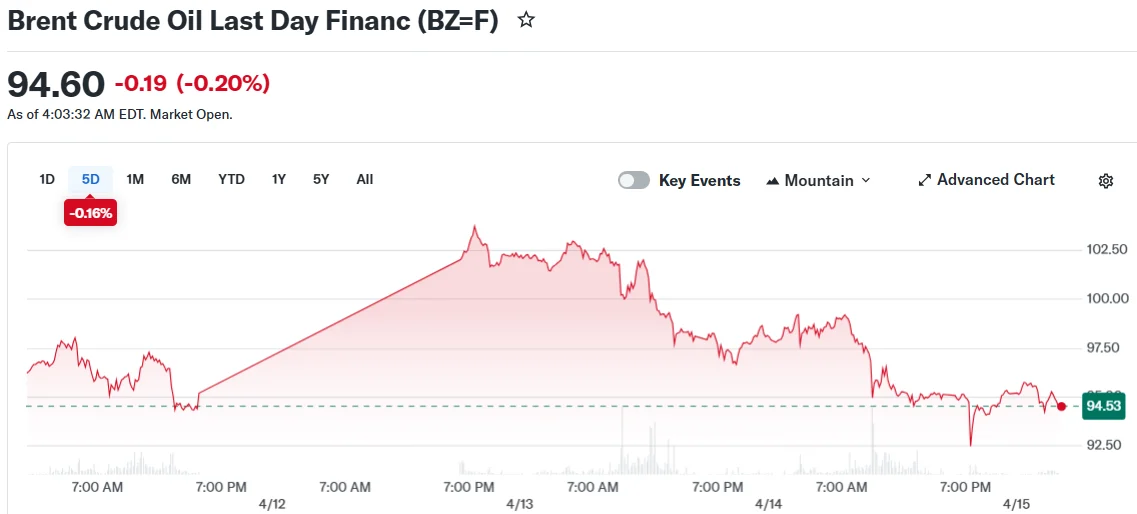
- Brent crude declined beneath $95 following Tuesday’s 4.6% plunge; WTI hovers around $91
- US Central Command confirms Iran’s naval blockade has been completely operationalized
- President Trump indicates Iran conflict is “very close to over,” expects additional negotiations imminently
- Tehran reportedly weighing suspension of Hormuz transit to prevent direct engagement with American naval presence
- International Energy Agency and OPEC reduce demand projections; Japan prepares emergency reserve releases for May
Crude oil markets have experienced significant volatility throughout the week as market participants assess contradictory developments: a completely operational US naval embargo against Iran alongside increasing indications that diplomatic negotiations may recommence shortly.
Brent crude experienced a 4.6% decline on Tuesday, settling beneath the $95 per barrel threshold. West Texas Intermediate descended to approximately $91. Markets witnessed partial stabilization during Asian trading hours Wednesday following US Central Command’s confirmation of the blockade’s full implementation.

Admiral Brad Cooper announced that American military forces have “completely halted economic trade going into and out of Iran by sea.” President Trump subsequently posted on social media platforms, asserting the US has positioned Iran in a “chokehold” and suggesting the nation may exhaust its storage capabilities.
The maritime embargo commenced merely forty-eight hours following unsuccessful ceasefire discussions in Pakistan. Washington is currently accelerating efforts to arrange a subsequent negotiation round before the existing ceasefire agreement lapses next week.
Speaking with the New York Post, Trump indicated that renewed discussions could materialize “over the next two days.” In separate remarks to Fox Business anchor Maria Bartiromo, he characterized the conflict as “very close to over.”
One diplomatic option under consideration involves reconvening in Pakistan for continued negotiations, although alternative venues remain under evaluation.
Meanwhile, Iranian officials are reportedly contemplating a voluntary suspension of shipments traversing the Strait of Hormuz to circumvent direct confrontation with the American naval deployment, according to sources with knowledge of the deliberations.
Asian Markets Face Supply Disruption
The Strait of Hormuz facilitates approximately 20% of global oil supply. Since hostilities commenced in late February, Iran has obstructed virtually all maritime traffic through this critical waterway.
Analysts at ANZ calculated that no fewer than 10 million barrels daily have been eliminated from markets due to the ongoing conflict. They observed that regardless of potential worst-case escalation scenarios, constrained supply conditions alone provide sufficient support for elevated Brent pricing.
Japanese authorities are arranging a secondary release from national petroleum reserves beginning in early May. Refineries throughout the Asia-Pacific basin may additionally face operational curtailments, diminishing availability of jet fuel and diesel products.
Both the International Energy Agency and OPEC have revised their petroleum demand forecasts downward, attributing the adjustments to elevated prices constraining consumer consumption.
Market Expert Perspectives
Dilin Wu from Pepperstone Group projected that crude oil will likely trade within a range exhibiting a “softer bias” near-term as markets digest the pivot toward diplomatic resolution. He emphasized that even with de-escalation, physical supply restoration would lag substantially due to logistical constraints surrounding Hormuz.
ANZ suggested that should escalation risks diminish, Middle Eastern production could experience a phased recovery, with 2 to 3 million barrels per day potentially restored within the initial four-week period.
Rebecca Babin, senior energy trader at CIBC Private Wealth Group, observed that markets are “leaning toward a normalization of flows by the end of April.”
The American Petroleum Institute disclosed that US crude stockpiles increased 6.1 million barrels during the previous week, which would constitute the eighth consecutive weekly accumulation if validated by official government data releasing Wednesday.
The Trump administration additionally confirmed plans to allow a waiver permitting restricted Iranian crude purchases to lapse this weekend.


Crypto World
Bitcoin Price Prediction: BTC Just Hit $81,000 for the First Time Since January But the Next 72 Hours May Decide Everything

Bitcoin price is trading near $81,000 as bulls and bears fight over a critical inflection point, and the next 72 hours could define Q2’s trajectory.
After briefly reclaiming $81,000 for the first time since January, BTC has since pulled back, staying right under it.
The catalyst that lit the initial fuse? A convergence of $2.44 billion in April ETF inflows, geopolitical relief from Trump’s Project Freedom escort operation through the Strait of Hormuz, and a short squeeze that forced leveraged bears to cover quickly.
The April ETF print was the strongest monthly inflow figure since October 2025, capped by roughly $630 million in net spot BTC ETF inflows on May 1 alone.
A brief scare hit when Iran’s Fars news agency falsely reported a missile strike on a U.S. warship, sending BTC from $80,594 to $79,000 in minutes before prices recovered on the denial.
JUST IN — Walter Da2nd' Nibbleston (@NibbsWaltz224) May 4, 2026


 Iran releases first footage that shows Two Iranian missiles hits multiple U.S. military ship or Frigates near Jask Island.
  A first DIRECT STRIKE ON U.S. FORCES.#USA #Iran #News #War pic.twitter.com/6r35TIQwWN
With macro volatility still elevated and BTC consolidating near a technically sensitive zone, the question of where price goes next is anything but settled.
Discover: The best crypto to diversify your portfolio with
Bitcoin Price Prediction: Can BTC Reclaim $85,000, or Is $78,000 Support About to Crack?
BTC is sitting in a classic compression zone, and the lack of volume is the biggest signal right now. Neither buyers nor sellers have conviction, which usually means a larger move is coming.
The key level is $78K. As long as BTC holds above it, the structure stays intact and keeps the path open toward $85K–$88K.

Above, $80K is now a contested level. It has flipped from resistance to support, but it is not fully confirmed yet, so it needs to hold on to pullbacks.
More likely short term, BTC keeps ranging between $78K and $83K while the market waits for a catalyst.
If $78K breaks on a daily close, downside opens quickly toward $74K–$75K.
So this is a low-conviction setup, not bearish enough to collapse, not bullish enough to run, just building pressure for a decisive move.
Discover: Best Crypto to Get Right Now
The post Bitcoin Price Prediction: BTC Just Hit $81,000 for the First Time Since January But the Next 72 Hours May Decide Everything appeared first on Cryptonews.
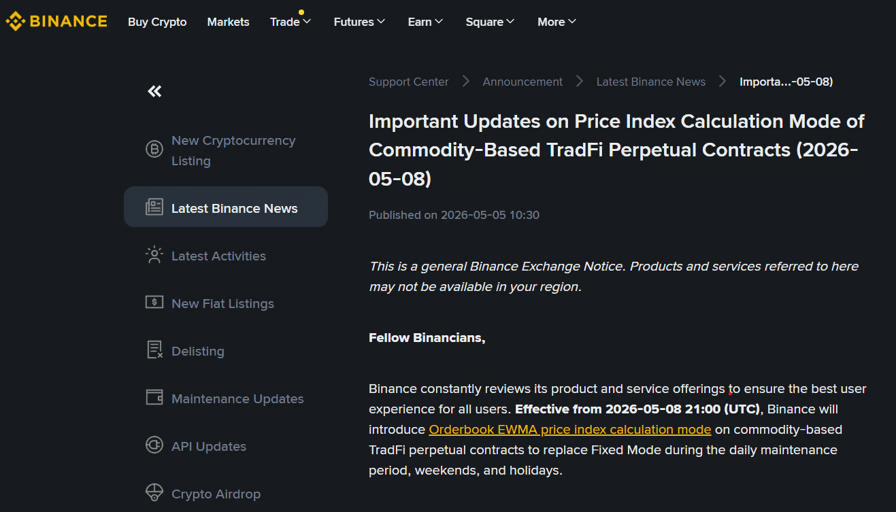
Binance will change how it calculates benchmark prices for commodity-based perpetual futures during off-hours, a move that could affect margin and liquidation levels during weekends, holidays and maintenance periods, according to an exchange notice published Tuesday. The update will take effect on Friday at 9:00 pm UTC.
The exchange will replace its current fixed pricing method with an Orderbook EWMA model for commodity-based traditional finance (TradFi) perpetual contracts. EWMA, or exponential weighted moving average, uses orderbook data that is smoothed over time rather than relying on a fixed reference price during periods of lower activity.
Binance said the change will apply during daily maintenance windows as well as weekends and holidays, when trading activity is typically reduced.
A Binance spokesperson told Cointelegraph the fixed mode was designed for lower-liquidity periods, but stronger volumes and deeper orderbooks have made a shift toward more flexible price discovery a “natural progression,” reflecting the growth of its TradFi perpetuals business.
The change applies to commodity-based TradFi perpetuals including gold, silver, platinum, palladium, copper, crude oil, Brent crude and natural gas contracts. It will also apply to future commodity-based TradFi perpetuals listed on Binance Futures.
Related: Binance revamps Launchpool, streamlines the BNB experience
EWMA model replaces fixed pricing
It will also extend to any similar commodity-based TradFi perpetual contracts listed in the future. The index price generated under this methodology is used to calculate margin and liquidation levels, meaning traders may see changes in how positions are marked and how liquidations are triggered during off-hours compared with the previous fixed-mode system.
The spokesperson said the exchange is not changing weekend margin requirements, but liquidation behavior outside regular hours will become more aligned with crypto perpetuals, with pricing more directly tied to exchange liquidity. The EWMA model also smooths transitions between off-hours and regular trading to maintain price continuity.
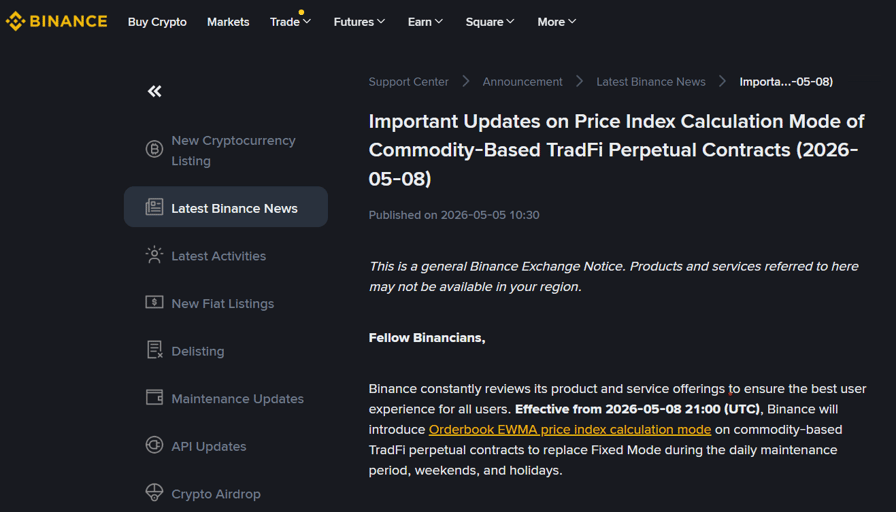
Update on price index calculation mode of commodity-based TradFi perps. Source: Binance
Industry pricing models
Other crypto derivatives venues use index pricing methodologies that incorporate multiple market inputs and orderbook-weighted components during periods of low liquidity or heightened volatility to reduce liquidation distortions, including Bybit’s index price calculation framework.
Bybit’s model aggregates prices from multiple external spot exchanges and applies weighting mechanisms to help smooth short-term dislocations.
The Binance spokesperson said the change applies only to commodity-based TradFi perpetual contracts, where underlying markets close outside regular hours. Crypto perpetuals trade continuously, and the existing framework remains appropriate. Equity-based TradFi perpetual contracts will continue to use the current fixed pricing method for now.
Asia Express: North Korea denies crypto hacks, Upbit’s bank tests Ripple


Miami Beach, FL — Brad Garlinghouse, Ripple’s CEO, has been closely following the U.S. Senate’s progress on the crypto market structure bill, and he said it’s not a “done deal” as the next two weeks may be pivotal for the legislation’s chances.
“If it doesn’t happen then, I think the likelihood is going to drop precipitously,” Garlinghouse said Tuesday at Consensus 2026 in Miami. But he said he still thinks it’s likely to happen, and the next moment will be the scheduling of the Senate Banking Committee’s long-awaited hearing to “mark up” the bill and advance it to the next stage.
Senators at the center of the negotiations over the Digital Asset Market Clarity Act revealed last week the latest compromise language on a major sticking point — stablecoin yield — that is expected to allow the banking panel to schedule the hearing.
“Do I think it’s perfect? Hell, no,” Garlinghouse said. “There’s tradeoffs and compromises, but I do think clarity is better than chaos.”
The stablecoin compromise aims for a balance that allows crypto firms to pursue certain rewards programs without offering yield-bearing stablecoin accounts that resemble banks’ interest-bearing deposits that fuel U.S. lending. Crypto insiders have generally agreed that it’s acceptable, but a coalition of banking groups said this week that the deal “falls short.”
The Ripple CEO said the importance of the Clarity Act lies in the permanence of backing crypto-friendly policies already being established at the U.S. Securities and Exchange Commission by Chairman Paul Atkins, who replaced a crypto-resistance predecessor, Gary Gensler. Without a law, Atkins’ successor can simply change those policies.
“There will be another Paul Atkins after Paul who we don’t know which side of this argument they’re going to fall on,” Garlinghouse said. “Hopefully, the trend line has moved far enough we don’t go back, no matter what, but codified into law means you kind of can’t go back.”
Also at Consensus, Garlinghouse predicted that the stablecoin market will reach $3 trillion by 2031. Ripple Labs launched its own stablecoin, , in 2024. The current market is at about $320 billion, led by Tether’s USDT.
Crypto World
Bitcoin Price Prediction Faces Strategy Earnings Pause While Whales Buy 270,000 BTC and Pepeto Presale Goes Viral, Here Is What You Need To Know
The bitcoin price prediction for May 2026 depends on what happens after Strategy reports Q1 earnings on May 5, according to CoinDesk. Michael Saylor paused weekly Bitcoin buys for only the second time this year, but told followers on X that purchases resume next week.
The bitcoin price prediction sits at a turning point because BTC trades near $80,286 after touching $80,393, its highest since January. The market is consolidating before the breakout every cycle produces after the halving. April 2024 halving, twelve months of sideways, then the move that reprices everything. The traders who position during the pause capture the full return.
While Strategy holds 818,334 BTC at $75,537 cost basis, Pepeto raised $9.89M from wallets not waiting for any earnings report. The presale fills because exchange tools are built, the Binance listing is approaching, and the bitcoin price prediction debate is exactly the distraction that lets early buyers enter.
CoinDesk reported Strategy paused its weekly Bitcoin buys ahead of Tuesday Q1 earnings, stopping a pattern that moved $5.5 billion into BTC last quarter alone. But whale wallets bought 270,000 BTC over the past 30 days and exchange reserves dropped to a seven year low not seen since December 2017, right before BTC broke $20,000 for the first time.
When the largest corporate buyer pauses but whales speed up buying and exchange supply hits multi year lows, the bitcoin price prediction signals the breakout is forming, and presale entries positioned with exchange tools capture the move before charts confirm it.
The Consolidation Before the Breakout Is Where the Biggest Returns Get Built
Pepeto: The Presale Filling Faster Than the Bitcoin Price Prediction Can Move BTC From $80,286
Every Bitcoin cycle follows the same sequence, and every time it happens, the majority miss the best entry because they wait for confirmation that arrives after the move started. April 2024 was the halving. May 2026 is month thirteen. The bitcoin price prediction is entering the phase where the chart breaks higher, and the wallets positioned before that move keep the return late arrivals pay for.
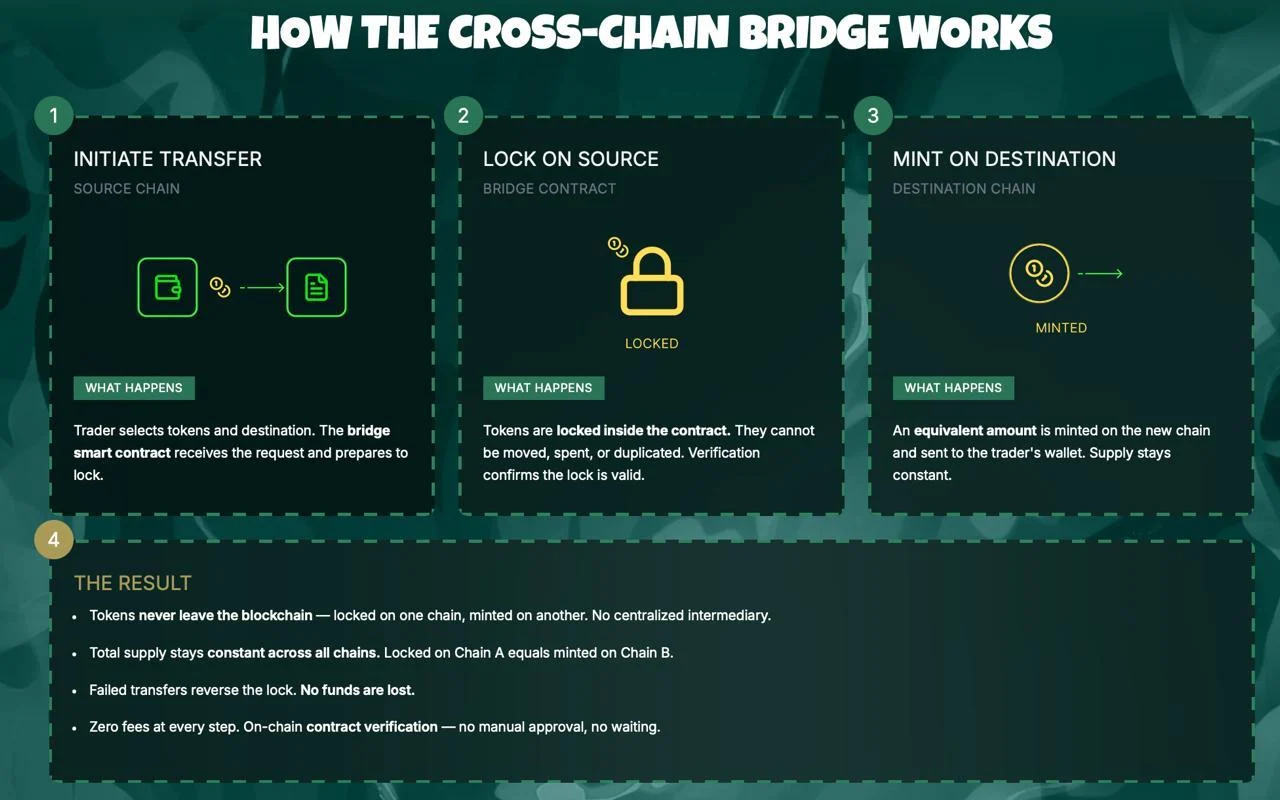
Pepeto raised $9.89M during this consolidation window because the exchange already runs. The cross chain bridge connects Ethereum, BNB Chain, and Solana so traders stop paying triple fees, PepetoSwap removes trading costs so every position keeps full value, and before your capital touches anything the risk scoring system reads every contract for hidden drains. Every line of code passed the SolidProof audit, and the cofounder who built the original Pepe token to $7 billion leads the team.
Tracking the bitcoin price prediction means watching BTC go from $80,286 toward $150,000, a decent return over months on an asset that needs hundreds of billions to move 90%. One Binance listing event is where presale wallets collect the return the BTC target takes all year to deliver.
At $0.0000001868 with 175% APY compounding daily, the math favors wallets inside. The entry disappears after the listing, and the gap between entering now and entering after the breakout is the gap between making the return and paying for it.
Bitcoin (BTC) Price at $80,286 as Halving Cycle Points to Breakout
BTC hit $80,393 on May 4 before pulling back to $80,286, its highest since January, according to CoinMarketCap. Strategy holds 818,334 BTC at $75,537 cost basis, whales bought 270,000 BTC in 30 days, and exchange reserves sit at a seven year low.
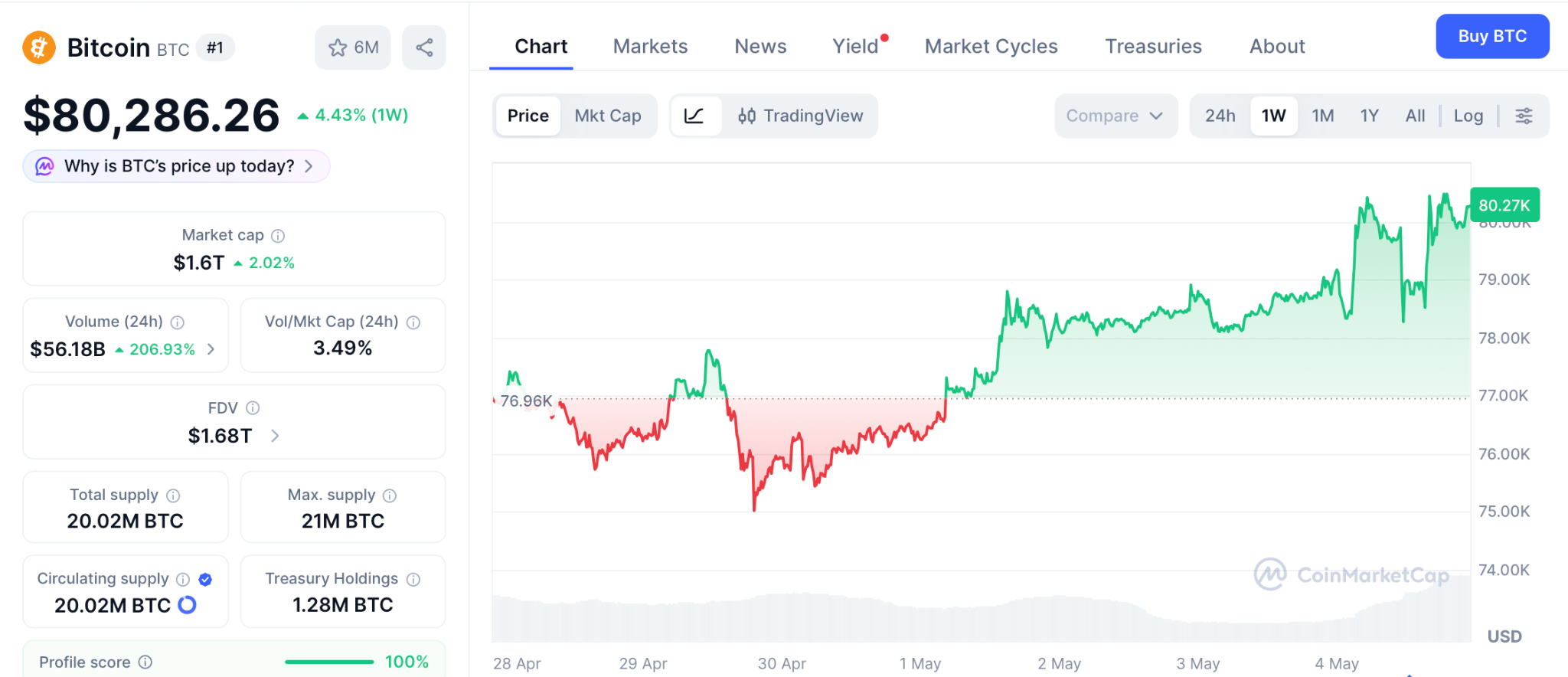
The all time high of $126,198 from October 2025 sits 58% above, Standard Chartered targets $150,000, and BTC needs to close above the 200 day moving average at $82,228 to confirm the bitcoin price prediction breakout.
Conclusion
Strategy paused its buys, but whales bought 270,000 BTC in a single month and exchange reserves hit a seven year low. The bitcoin price prediction signals the breakout is forming, and the consolidation window where the biggest entries get built is closing fast.
Pepeto crossed $9.89M while the market debated earnings, the Binance listing is approaching, 175% APY compounds daily, and stages fill faster each round. The wallets entering right now are buying at a number the market will never see again after the listing. Visit Pepeto and enter the presale before the breakout arrives and the entry you see today becomes the most expensive hesitation of this cycle.
Click To Visit Pepeto Website To Enter The Presale

FAQs
What is the bitcoin price prediction after Strategy pauses buys ahead of earnings?
The bitcoin price prediction targets $150,000 by year end as BTC trades near $80,286 with whales buying 270,000 BTC in 30 days and exchange reserves at a seven year low. Pepeto at $9.89M raised with a Binance listing approaching offers the returns BTC at $1.33 trillion cannot match, visit Pepeto.
Why is Pepeto filling during Bitcoin consolidation?
Pepeto is filling because the exchange tools are built, the SolidProof audit cleared every contract, and the Binance listing is approaching. At $9.89M raised and 175% APY staking, early wallets compound returns daily before the listing reprices the token permanently.
Disclaimer: This is a Press Release provided by a third party who is responsible for the content. Please conduct your own research before taking any action based on the content.
Crypto World
How SHRMiner AI cloud mining is reshaping how to easily earn $9,997 in passive income in 2026

Disclosure: This article does not represent investment advice. The content and materials featured on this page are for educational purposes only.
AI cloud mining expands access as SHRMiner lowers barriers to crypto mining participation in 2026.
Summary
- Cloud mining platforms like SHRMiner lower barriers, enabling easy entry into crypto mining.
- SHRMiner uses AI and smart contracts to simplify mining with real-time tracking.
- With low entry and flexible contracts, SHRMiner offers accessible, automated crypto earning options.
As the global technological landscape continues to evolve in 2026, more and more people are exploring passive income opportunities in the digital economy. Technologies such as smart contracts, cloud mining, and cross-chain asset deployment are gradually reshaping how individuals interact with cryptocurrencies.
Blockchain-based cloud mining platforms are rapidly emerging, providing users with a more user-friendly and convenient alternative. Compared to traditional mining, which requires high hardware investment, complex maintenance, and a high technical barrier, cloud mining lowers the barrier to entry, allowing ordinary users to easily enter the crypto ecosystem. The deep integration of the blockchain ecosystem is opening up new and sustainable passive income avenues for the public.
One of the most notable developments is the rise of the SHRMiner AI-driven cloud mining platform. This platform streamlines the mining process by leveraging automation, smart contracts, and AI-driven resource allocation. These eliminate physical barriers, enabling users to participate in mining activities with extremely low barriers to entry.

Why investing in SHRMiner is worthwhile
Zero entry barrier: Register to receive a free $15 computing power reward, earning $0.60 daily.
Access all miner information in real-time via the mobile app control panel.
Fully own your hardware: No third-party risk.
Mining, tracking earnings, and reinvesting: All operations are handled by the same platform.
A new landscape in the mining industry: Secure, flexible, and profitable.
With SHRMiner, users don’t need to be a technical expert or pay exorbitant electricity bills. You can directly invest in high-performance mining: completely transparent, with stable daily earnings.
SHRMiner offers a variety of high-yield cloud mining contract options to meet the investment preferences and financial goals of different users. Whether seeking flexible short-term returns or valuing stable long-term returns, users can find a suitable option on the platform.
Intelligently allocated, high-yield mining contracts allow wealth growth to begin today.
Contract profit example:
| Contract Name | Price | Profit | Days | Principal + Total Return |
| New User Experience Agreement | $100 | $4 | 2 | $100+$8 |
| Bitdeer Sealminer A2 Pro | $500 | $6.25 | 5 | $500.00 + $31.25 |
| Litecoin Miner L9 | $1000.00 | $13.00 | 10 | $1000.00 + $130 |
| Bitcoin Miner S21 XP Imm | $5000.00 | $70.00 | 25 | $5000.00 + $1750 |
| Bitcoin Miner S21e XP Hyd | $10000.00 | $150.00 | 35 | $10000.00 + $5250 |
| ANTSPACE HW5 | $50000.00 | $900.00 | 45 | $50000.00 + $40500 |
For example, by leasing the hash power of an ANTSPACE HW5 mining rig, users can earn $900 in Bitcoin rewards daily. They can track earnings in real time through the control panel.
Click here for more contract details.
Easy mining: Located in an affordable location with modern infrastructure
SHRMiner is a service provider that allows users to easily get started with cryptocurrency mining. The company operates 150 highly specialized data centers in regions with extremely low electricity costs, such as the US, Europe, and the UAE. It allows you to profit from mining Bitcoin or altcoins without any technical knowledge.
Is SHRMiner legal? What about its transparency, security, and trustworthiness?
Given the skepticism surrounding cryptocurrency mining websites, it’s natural to ask: Is SHRMiner legitimate?
- The company is registered in the UK and holds a UK operating license, ensuring compliance and transparency.
- There are no extra service fees or hidden charges.
- Supports mining in multiple currencies: Earn XRP, BTC, ETH, DOGE, USDC, USDT, SOL, LTC, BCH and other mainstream cryptocurrencies.
- 100% remote access; track earnings in real time via the SHRMiner application or platform website without hardware requirements.
- Protected by McAfee® and Cloudflare® security, ensuring the safety of user account funds.
- We offer 100% uptime guarantee and 24/7 online technical support.
Conclusion: Is SHR Miner a good passive income tool?
The answer is yes — its advantage lies precisely in its AI-driven cloud mining. It offers a sustainable, transparent, and minimally invasive way to generate passive income through legitimate Bitcoin mining infrastructure, setting it apart from other Bitcoin mining applications.
For those wondering if Bitcoin mining will be profitable in 2026, SHR Miner would be a wise choice for earning passive income.
For more details, please visit the official platform or download the mobile application.
Disclosure: This content is provided by a third party. Neither crypto.news nor the author of this article endorses any product mentioned on this page. Users should conduct their own research before taking any action related to the company.
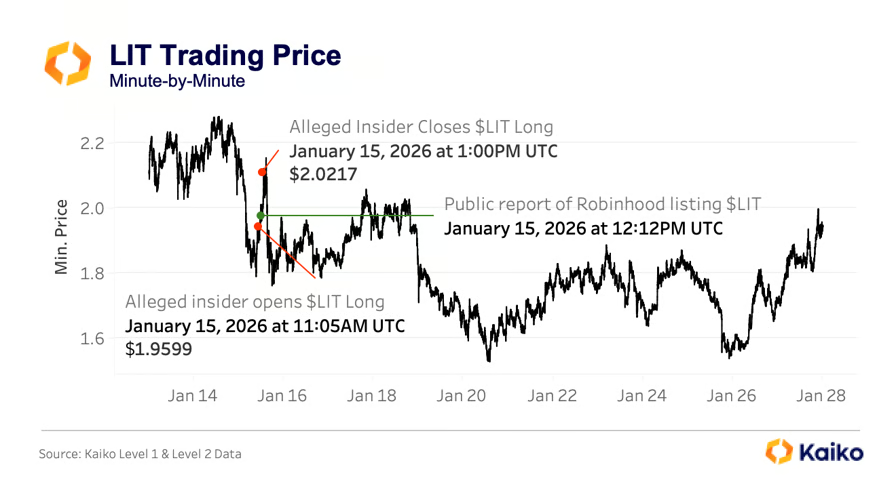
Open interest in perpetual futures markets and onchain trading patterns suggest some traders may have positioned ahead of Robinhood crypto listing announcements, according to a Monday report from analytics provider Kaiko.
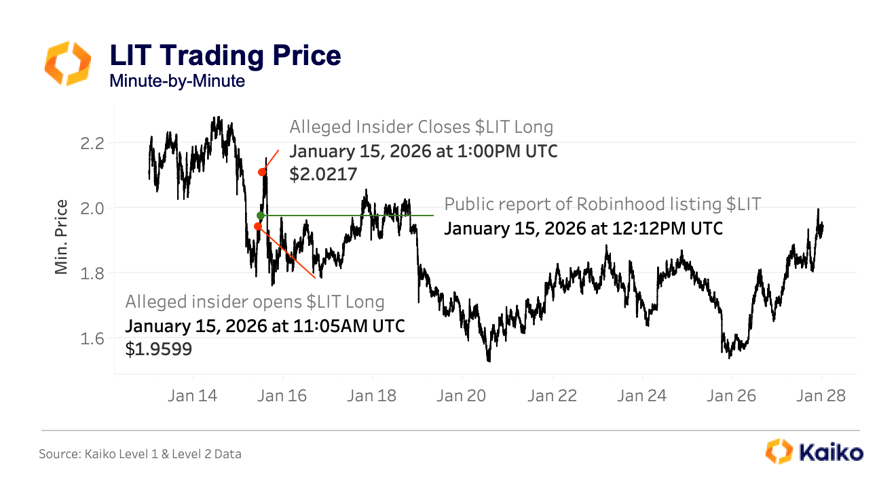
One of the clearest examples was wallet address ‘0xa1E,’ which Kaiko said opened a long position on Lighter (LIT) on decentralized exchange Hyperliquid at 11:05 am UTC on Jan. 15, about an hour before Robinhood announced the token’s listing at 12:12 pm The wallet closed the position at 1:00 pm, shortly after the announcement.
Kaiko said the same address later opened a short position on a HOOD-linked perpetual contract on April 28, hours before Robinhood reported first-quarter revenue that missed analyst expectations. The trader closed the short later that day after HOOD moved lower.
The trading patterns raise questions about whether some market participants had access to non-public listing information or had developed a reliable method for detecting public signals before announcements. Kaiko also said sophisticated traders may have been reacting to funding-rate spikes, volume increases and open-interest changes rather than inside information.
Multiple other wallets made similar moves just before a listing was made public, raising the question of whether “more than one participant had access to the same information ahead of the announcement,” wrote Laurens Fraussen, a research analyst at Kaiko.
LIT trading price, listing time, minute-by-minute. Source: Kaiko
Hyperliquid data points to unusual pre-listing trades
Kaiko pointed to multiple cryptocurrency listings that led to a surge in open interest and funding rates just ahead of Robinhood’s public listing announcements, including Zcash (ZEC), Synthetix (SNX) and the Near Protocol (NEAR) tokens, among other assets.
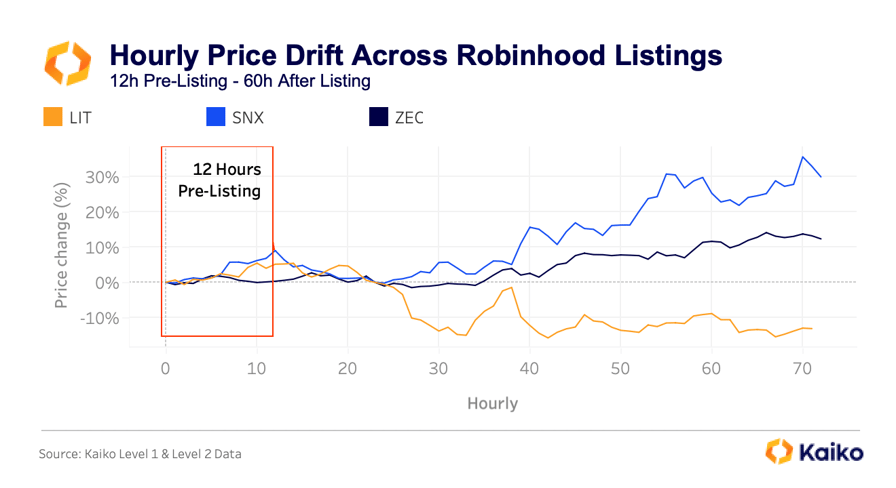
Hourly price drift ahead of Robinhood listing announcements for LIT, SNX and ZEC. Source: Kaiko
All three tokens recorded a pre-announcement price drift, with each coin averaging abnormal returns in the hours leading up to and following the listing announcement, explained the report.
Related: Crypto VC funding plunges to $659M in April, hits near two-year low
While the data raises concerning signs of potential insider activity, it may also indicate that some of the smartest traders are positioning based on funding or volume increases, Kaiko’s Fraussen told Cointelegraph.
“Traders that know how microstructure works could have noticed the funding spikes, increase in volumes and open interest spikes, and position based on that.”
Still, derivatives metrics show that this type of positioning was statistically consistent and repeated across multiple asset listings, reflecting either “privileged access to Robinhood’s listing pipeline” or an “exceptionally reliable front-running methodology built on public signals.”
Magazine: Bitcoiners eye ‘sell in May,’ SBF’s bid for new trial shut down: Hodler’s Digest, April 26 – May 2


Disclosure: This article does not represent investment advice. The content and materials featured on this page are for educational purposes only.
AJC Mining’s free cloud mining service gives global users an easy way to join the crypto market and explore higher earning opportunities amid Bitcoin’s latest rally.
Summary
- AJC Mining offers a simple, hardware-free way to explore Bitcoin and crypto mining online.
- With no setup or technical skills needed, AJC Mining makes mining accessible to beginners.
- AJC Mining enables 24/7 cloud mining with an easy dashboard and daily tracking.
The global cryptocurrency market is entering a new wave of momentum as Bitcoin recently climbed above the $80,000 level, supported by strong Bitcoin ETF inflows and renewed optimism around U.S. crypto legislation. Market reports showed that Bitcoin ETFs recorded approximately $629.37 million in inflows, while crypto-related stocks also rallied after progress on a bipartisan U.S. digital asset market structure bill.
As Bitcoin returns to the center of global investor attention, more users are looking for simple ways to participate in the digital asset economy. One of the fastest-growing search trends is cloud mining, especially among users searching for Bitcoin cloud mining, crypto cloud mining, cloud miner, free cloud mining, Bitcoin cloud mining free, and free cloud mining site without deposit.
Against this positive market backdrop, AJC Mining is introducing a smart, automated cloud mining platform designed for users who want easy access to crypto mining without purchasing equipment, managing technical systems, or operating mining machines.
AJC Mining brings cloud mining to everyday users
AJC Mining is a cloud mining platform built for simplicity, accessibility, and automated participation. The platform allows users to explore cryptocurrency mining through an online account system, making it easier for beginners to access mining opportunities without traditional hardware barriers.
Traditional mining often requires expensive mining machines, electricity management, cooling systems, technical configuration, and daily maintenance. AJC Mining simplifies the entire process by offering a cloud-based model where users can participate through digital mining plans and monitor account activity online.
For users searching for a reliable cloud miner experience, AJC Mining provides a streamlined way to explore Bitcoin cloud mining and crypto cloud mining from anywhere.
Why cloud mining is gaining momentum after Bitcoin’s latest rally
Bitcoin’s recent move above $80,000 has created renewed excitement across the crypto sector. Barron’s reported that Bitcoin moved back above $80,000 for the first time since late January 2026, while broader crypto stocks also gained as market confidence improved.
This market strength is helping drive interest in easier crypto participation models. Cloud mining gives users a simple way to join the mining economy without owning physical mining hardware.
Instead of buying ASIC miners or building technical mining systems, users can access mining services through platforms like AJC Mining. This makes cloud mining attractive to beginners, mobile users, and global crypto participants who want a convenient entry point.
Key advantages of AJC Mining
1. No mining equipment required
One of the biggest advantages of AJC Mining is that users do not need to buy mining hardware.
With AJC Mining, users can participate in Bitcoin cloud mining and crypto cloud mining through the platform’s online system. There is no need to purchase ASIC miners, graphics cards, power supplies, cooling devices, or mining accessories.
This makes AJC Mining especially attractive for users who want a lower-barrier way to enter the mining market.
2. No technical experience needed
AJC Mining is designed for users with no mining background.
Users do not need to install mining software, configure mining pools, update firmware, or monitor physical mining machines. The platform provides a simple account dashboard where users can view mining activity, track estimated output, and manage participation options.
This beginner-friendly structure makes AJC Mining suitable for users searching for cloud mining, crypto cloud mining, and a simple cloud miner platform.
3. 24/7 automated cloud mining system
AJC Mining promotes a fully automated cloud mining system that operates 24/7.
The platform is designed to support continuous mining activity and daily account settlement. Users can participate without manually running equipment or managing technical operations.
This automated model helps make cloud mining more convenient for global users who want a simple, online-first mining experience.
4. Free cloud mining for new users
Free cloud mining is one of AJC Mining’s most attractive entry points.
New users may receive a $15 welcome bonus after registration. Eligible users can also participate in daily free cloud mining activity with an estimated daily output of $0.60.
Click to register now and claim a $15 new user bonus.
This makes AJC Mining highly relevant for users searching for:
- free cloud mining
- Bitcoin cloud mining free
- free cloud mining site without deposit
For beginners, the free mining option provides an easy way to experience the platform before choosing additional mining plans.
AJC Mining cloud mining plans and estimated output
AJC Mining offers multiple cloud mining participation options designed for users with different goals and account sizes. The platform’s example plans highlight flexible participation and daily estimated output.
| Contract Name | price | Daily Profit | Contract Term | Principal + Total Returns |
|---|---|---|---|---|
| Daily Check-in Contract | $15 free | $0.6 | 1 jours | Once daily |
| New User Experience Contract | $100 | $4 | 2 jours | $100 + $8 |
| Avalon Miner A15 | $500 | $6.25 | 5 jours | $500 + $31.25 |
| Litecoin Miner L9 | $1000 | $13 | 10 jours | $1000 + $130 |
| Bitcoin Miner S21 XP Imm | $5000 | $70 | 25 jours | $5000 + $1750 |
| Bitcoin Miner S21e XP Hyd | $10000 | $150 | 35 jours | $10000 + $5250 |
| ANTSPACE HW5 | $50000 | $900 | 45 jours | $50000 + $40500 |
These sample scenarios are designed to help users understand AJC Mining’s participation structure and estimated daily output options.
Click to view all cloud mining contracts.
Referral rewards create additional user benefits
AJC Mining also offers referral rewards to users who invite others to join the platform. Click to view affiliate rewards.
The referral mechanism includes:
- Level 1 reward: 3%
- Level 2 reward: 1.5%
This gives users additional participation opportunities within the AJC Mining ecosystem. Users who share the platform with friends, crypto communities, or online networks may access extra rewards based on eligible referral activity.
The combination of cloud mining output and referral rewards makes AJC Mining appealing to users who want a more active role in the platform’s growth.
Daily settlement and withdrawal convenience
AJC Mining highlights daily account settlement, allowing users to view mining activity and estimated output on a regular basis.
The platform also promotes withdrawal options for eligible users, creating a more flexible cloud mining experience. For users who value convenience, daily tracking and account visibility are important features that make the platform easier to use.
This is one reason AJC Mining is positioned as a user-friendly cloud miner platform for global crypto participants.
Why AJC Mining fits the current crypto market trend
The crypto market is becoming more accessible. Bitcoin ETFs have brought institutional capital into the market, while progress around U.S. crypto regulation is helping improve confidence across the digital asset industry. Recent reports showed crypto companies and Bitcoin-related stocks gaining after positive developments around stablecoin and market structure legislation.
At the same time, Bitcoin’s move above $80,000 has renewed public interest in digital assets. As more users search for simple crypto participation methods, cloud mining is becoming a natural entry point.
AJC Mining fits this trend by offering:
- Simple registration
- Free cloud mining opportunities
- No hardware requirements
- No technical setup
- 24/7 automated mining system
- Daily account settlement
- Flexible mining plans
- Referral reward opportunities
For users searching Google for cloud mining, Bitcoin cloud mining, crypto cloud mining, cloud miner, free cloud mining, Bitcoin cloud mining free, and free cloud mining site without deposit, AJC Mining provides a clear and beginner-friendly solution.
AJC Mining and the future of cloud mining
Cloud mining is becoming an important part of the next stage of crypto adoption. As digital assets become more mainstream, users want platforms that are easier to access, simpler to understand, and more convenient to use.
AJC Mining is designed to meet this demand by giving users access to cloud-based mining participation without the complexity of traditional mining.
With Bitcoin gaining renewed market momentum and institutional demand continuing to grow, cloud mining platforms like AJC Mining are positioned to attract users who want a simple way to explore crypto mining online.
Conclusion
Bitcoin’s latest rally above $80,000, strong ETF inflows, and improving crypto market confidence have created a positive environment for cloud mining platforms. As more users search for accessible ways to participate in the digital asset economy, AJC Mining is gaining attention as a smart and beginner-friendly cloud mining platform.
With no mining hardware required, no technical skills needed, 24/7 automated operation, free cloud mining opportunities, daily settlement, flexible plans, and referral rewards, AJC Mining offers a simple path for users exploring Bitcoin cloud mining and crypto cloud mining.
For users looking for cloud mining, cloud miner, free cloud mining, Bitcoin cloud mining free, or a free cloud mining site without a deposit, AJC Mining provides a convenient entry point into the cloud mining market.
For more information, visit the official website and download the mining app.
Disclosure: This content is provided by a third party. Neither crypto.news nor the author of this article endorses any product mentioned on this page. Users should conduct their own research before taking any action related to the company.


Bitcoin miners are turning to AI infrastructure to ramp up revenues, and some treasury firms are joining in on the rotation too.
K Wave Media (KWM), a Nasdaq-listed Korean media and entertainment firm, told the U.S. Securities and Exchange Commission on Monday that it is redirecting up to $485 million in remaining financing capacity away from a planned bitcoin treasury push and into AI infrastructure.
The money will flow into data centers, GPU compute operations and acquisitions across the AI value chain, under an amended agreement with structured equity financier Anson Funds.
The original $500 million facility was set up in June 2025 explicitly to buy bitcoin, part of K Wave’s effort to reposition itself in capital markets at a time when bitcoin treasury announcements were doing more for share prices than the underlying businesses were.
Less than a year later, that thesis has been retired in favor of a sector with newer momentum.
Investors did not love the pivot. K Wave shares closed down 24% on Monday, and are down 4% in premarket trading on Tuesday.
Chief executive Ted Kim termed the redirection as an ambition to become “a meaningful participant in the rapidly growing AI infrastructure sector,” with plans to build a scalable platform across compute and related technologies.
The company is also punting on a corporate rebrand to “Talivar Technologies,” pending shareholder approval at the annual meeting in early July.
The shift fits a pattern that has been quietly building for months.
CoinDesk reported in March that publicly listed bitcoin miners had collectively zoomed toward AI and high-performance computing, signing more than $70 billion in cumulative contracts and shedding over 15,000 BTC from peak treasury levels to finance the transition. Core Scientific sold roughly 1,900 BTC worth $175 million in January. Bitdeer drained its treasury to zero in February. Riot Platforms sold 1,818 BTC worth $162 million in December.
The miners were forced into it, as the weighted-average cash cost to produce one bitcoin among publicly listed miners hit approximately $79,995 in Q4 2025, while bitcoin spent most of 2026 below that figure.
AI infrastructure contracts, meanwhile, promise margins above 85% with multi-year revenue visibility.
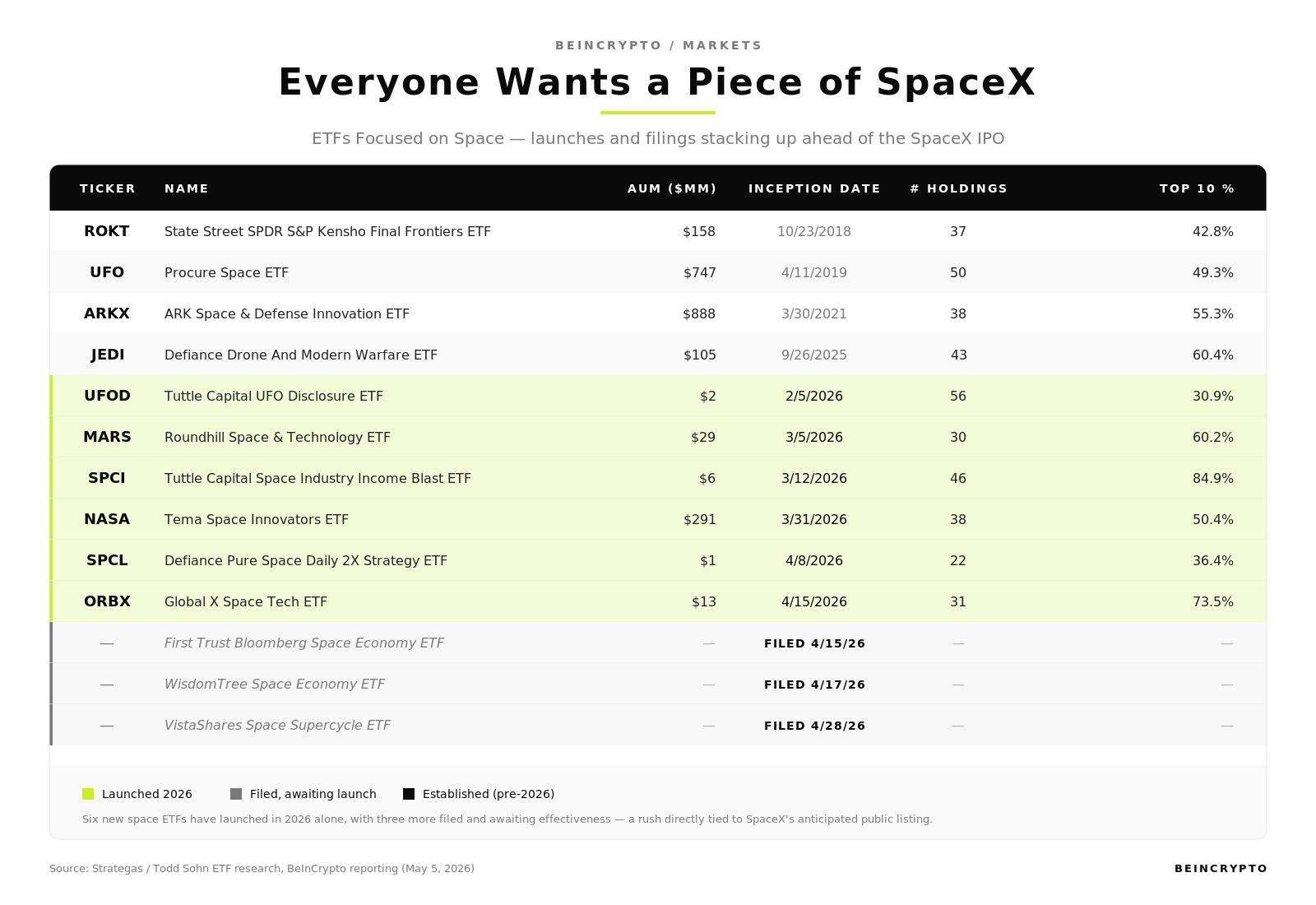
ETF issuers have filed or launched nine space-themed funds in three months, racing to capture flows before SpaceX’s public listing. According to ETF analyst Eric Balchunas, it is a wave bigger than the booms around Facebook or Alibaba.
The buildup ranks among the most aggressive thematic ETF pushes in years. Wall Street is staking branding rights and retail dollars on a single private company expected to set a fundraising record.
Nine New Funds in Three Months
Roundhill Space & Technology ETF (MARS) debuted March 5. Tuttle Capital’s Space Industry Income Blast (SPCI) followed March 12, and Tema’s Space Innovators ETF (NASA) arrived later that month.
April brought Defiance’s Pure Space Daily 2X (SPCL) on April 8 and Global X’s Space Tech ETF (ORBX) in mid-April. First Trust, WisdomTree, and VistaShares filed paperwork for additional space economy products in the same window.

“All this for Space X IPO. Never seen anything like it.. Facebook, Alibaba were big but this is another level,” Balchunas remarked.
A few of these funds offer indirect SpaceX exposure today through private vehicles. Others sit ready to absorb the stock once it lists.
Older entrants are tweaking methodology. The list includes Cathie Wood’s ARK Space & Defense ETF (ARKX), Procure’s UFO, and State Street’s ROKT.
Why Issuers Are Racing
SpaceX confidentially filed its S-1 with the SEC in early April. The company targets a June listing at a valuation potentially exceeding $1.5 trillion.
Elon Musk has floated a retail allocation near 30%, several times the typical IPO carve-out, fueling demand from individual investors.
Existing funds already feel the pull. Procure Space ETF (UFO) drew record inflows of $175 million in the first quarter, its biggest haul since 2019.
Crowding cuts both ways, in the sense that:
- Many new products hold overlapping names, and
- A delayed or weak debut could leave several searching for a thesis.
Crypto exchanges have rolled out synthetic SpaceX tokens, adding speculation to an equity story yet to unfold.
Whether the field consolidates or expands may hinge on the listing’s reception.
The post Space-Themed ETFs are Flooding Wall Street Before Elon Musk’s SpaceX IPO appeared first on BeInCrypto.


Jito Labs, a core infrastructure provider on Solana, has unveiled JTX, a new crypto trading platform aimed at bringing more advanced trading tools to the blockchain.
Announced at the Solana Accelerate conference in Miami, Florida, JTX is the company’s first product built specifically for traders. It allows users to trade tokens on Solana while maintaining self-custody, meaning they have full control of their funds unlike other set ups that have to hand assets over to a centralized exchange like Coinbase or Binance.
JTX is designed to feel more like those centralized platforms, the team shared in a press release with CoinDesk. It is supposed to offer faster trade execution and a range of tools typically used by professional traders, including stop-loss orders, preset trade strategies and detailed market charts powered by TradingView.
The launch comes as trading activity on Solana has surged, Jito Labs claimed, with decentralized exchanges on the network processing over $1 trillion in volume last year. Much of the more sophisticated trading still happens on centralized platforms or other blockchains.
Jito is betting that demand for more advanced, onchain trading will keep growing, with JTX expecting to come out with products like perpetual futures and prediction markets. In addition, a large portion of the revenue generated by JTX will go back to the protocol, benefiting holders of its JTO token.
JTX is currently open for sign-ups via a waitlist, with early access expected soon.
“Solana’s infrastructure is the best in the world, processing more daily transactions than every other blockchain combined,” said Lucas Bruder, the CTO at Jito Labs. “JTX is what happens when we point that at traders who’ve outgrown what’s currently being built for them. It beats a CEX on execution. It doesn’t take your keys. That’s the pitch.”
Read more: Jito Foundation acquires and revives SolanaFloor following shutdown over $27 million exploit
Bitcoin Price Prediction: BTC Just Hit $81,000 for the First Time Since January But the Next 72 Hours May Decide Everything

Why five-time Pro Bowler Alvin Kamara could be done in New Orleans

What’s the difference between IT and OT security?

Manchester United reach agreement with Casemiro over contract clause amid transfer speculation

US brings back mandatory military draft registration

Steven Gerrard disagrees with Gary Neville over ‘shock’ Chelsea and Arsenal claim | Football


-

 Business7 days ago
Most Commercial Energy Audits Miss the Real Losses
-

 NewsBeat2 days ago
Channel 5 – All Creatures Great and Small series 7 new post
-

 Fashion7 days ago
Kylie Jenner’s KHY Enters a New Era with ‘Born in LA’
-
 Tech4 days ago
Trump’s 25% EU auto tariff breaches Turnberry Agreement that also covers semiconductors and digital trade
-
 Sports4 days ago
Paul Scholes issues Marcus Rashford reality check as agreement emerges over Man United star
-

 Business6 days ago
Barclay Brothers Avoid Bankruptcy: HSBC Drops High Court Petitions After IVA Deal
-
 Business6 days ago
Tesla Officially Registers Elon Musk’s Stock: What Investors Need to Know
-

 Tech6 days ago
Texas Instruments made a new flagship graphing calculator: the TI-84 Evo
-

 Business5 days ago
Two Powerball Tickets Split $143 Million Jackpot in Indiana and Kansas
-

 Entertainment5 days ago
Celebrities Who Are Attending the 2026 Met Gala Event
-
Business2 days ago
Winning Numbers Drawn as Jackpot Resets to $20 Million
-

 Entertainment6 days ago
Insider Claims Reason Behind Key & Peele Split
-

 Entertainment4 days ago
Met Gala 2026 Rumored Guest List Is Turning Heads
-
 Crypto World6 days ago
Securitize and Computershare Enable Tokenized Equity Issuance for Over 25,000 U.S.-Listed Stocks
-
 Crypto World5 days ago
CoreWeave (CRWV) Stock Climbs 8% Despite $45M Insider Share Dump
-

 Crypto World6 days ago
Meta (META) starts stablecoin payout to creators in Circle’s USDC on Polygon, Solana via Stripe
-

 Crypto World6 days ago
Gibraltar Proposes Tokenized Funds Regulation to Bolster Compliance
-

 Business7 days ago
Alexandria Real Estate Equities, Inc. (ARE) Q1 2026 Earnings Call Transcript
-

 Business6 days ago
Strait of Hormuz Remains Heavily Restricted on April 29 Amid Iran Conflict
-

 Fashion3 days ago
Mary J. Blige Vegas Residency Looks: Crystal-Embellished Fjolla Haxhismajli, Todd Fisher, and More!
You must be logged in to post a comment Login