
Crypto World
One Dead, 15 People Unaccounted For After Flash Flooding at the Grand Canyon


NPS asked those who know of hikers or backpackers in the inner canyon along the Bright Angel Creek corridor on Saturday, “as well as anyone who had a campground reservation in the affected corridor,” to provide information.
The flash-flood event occurred in Bright Angel Canyon and the Phantom Ranch area on Saturday afternoon at around 2:30 p.m. Arizona is currently in the throes of the monsoon season, and storms poured over the Grand Canyon from early Saturday morning and returned in the evening.
Nearly all footbridges over Bright Angel Creek were destroyed in the floods, the Park Service said, preventing hikers from crossing. NPS is continuing to assess the extent of the damage. Parts of the canyon—Phantom Ranch, Bright Angel Campground, the Phantom Ranch Canteen and cabins, and the entire North Kaibab Trail from the North Kaibab Trailhead to Phantom Ranch—were closed until further notice.
The Transcanyon Waterline, a 12.5-mi. pipeline in the Grand Canyon that carries water for drinking and fire suppression has also been damaged. With that pipeline out of action, the park has a limited water supply and has resorted to conservation measures.

Crypto World
Bitcoin’s Best Month of 2026 Is Digesting: Rising Exchange Reserves Say Setup Getting Riskier

Bitcoin’s rally is digesting, and the coin everyone actually wants exposure to right now is not Bitcoin at all.
BTC is trading at $78,000, still holding onto most of a rally that made August 2026 its strongest month of the year.
The headline number, a roughly 24% August gain that briefly pushed BTC above $80,000, masks a deteriorating internal picture. Binance’s Bitcoin reserves climbed to approximately 687,000 BTC, the highest level recorded in 2026, up sharply from near 617,000 BTC in late April.
Combine that with shrinking exchange stablecoin reserves and thinner dry powder, and the setup looks less like accumulation and more like distribution waiting for a bid.

A macro shock added to the pressure. Hawkish comments from Fed Chair Kevin Warsh at Jackson Hole raised the odds of a September rate hike, sending BTC below $78,000 intraday and dragging Ethereum, Solana, and XRP down alongside it on Friday.
The rally is not dead. It is just digesting. And that digestion is exactly the kind of environment where attention starts drifting toward the Layer 2 building on top of Bitcoin instead.
Can Bitcoin Price Hit $80K Again This Week?
BTC’s weekly range tells a story of chop, not conviction.
The week opened near $77,000, rallied to $81,455, slid to an intraday low of $76,877, and closed around $77,838. Current price of $78,243.77 sits right in the middle of that range.
Total crypto market cap ticked up to roughly $2.63 trillion, but 24-hour volume fell nearly 45% to about $184.44 billion, a classic post-volatility hangover.

Support sits in the $76,800 to $77,000 zone, with resistance clustering at $80,000 to $81,500. Analysts have flagged a hidden bearish divergence on BTC, suggesting reclaiming those highs will not come easy without a reset first.
ETF inflows resuming sends BTC back toward $81,500. Consolidation between $77,000 and $80,000 into September Fed commentary is the base case. A break below $76,800 opens a retest of the low $70,000s.
Standard Chartered’s $100,000 year-end target still stands. Getting there cleanly looks unlikely.
Make Your Prediction Count With $25 For Free on Kalshi
Bitcoin Hyper Targets Early Mover Upside as BTC Tests Key Levels
BTC at $78,243.77 near a 24% monthly gain still means anyone buying now is chasing an asset with a market cap north of $1.5 trillion. The upside math simply doesn’t work the same way twice.
That’s the gap Bitcoin Hyper (HYPER) is built to exploit, a presale positioned as the first Bitcoin Layer 2 with full SVM integration, aiming for execution speeds faster than Solana itself.
The project has raised $33,090,943.21 so far, with tokens priced at $0.0136855 and staking rewards offered at a high APY. Its core pitch: solve Bitcoin’s slow transactions and lack of programmability via a decentralized canonical bridge, while inheriting BTC’s underlying security.
Full presale details and fundraising progress are public, presale tokens carry no guaranteed value and remain high-risk until mainnet delivery. Worth a look for traders comfortable with early-stage exposure: research Bitcoin Hyper directly.
Gain Access to New Bitcoin Layer 2 Early Here
The post Bitcoin’s Best Month of 2026 Is Digesting: Rising Exchange Reserves Say Setup Getting Riskier appeared first on Cryptonews.


Berlin authorities have refused to meet an alleged 30 Bitcoin ransom demand after a cyberattack hit two state agencies, while officials have yet to confirm the amount of data claimed to have been stolen.
Summary
- Hackers reportedly demanded 30 Bitcoin, worth roughly €2 million, after a cyberattack affected two Berlin state agencies.
- The attackers threatened to publish stolen information, while Berlin officials have refused to pay and have not confirmed the reported ransom amount.
- Berlin initially said only public information was compromised but later acknowledged that non-public data had been affected.
- Rhysida reportedly claimed responsibility for the attack and said it obtained sensitive files, though Berlin authorities have not verified the full extent of the alleged theft.
The Berlin Senate Chancellery said it would not disclose details about the attackers, their demands or the information potentially taken from government systems while the investigation remains active. A Senate spokesperson told German news agency dpa that officials could not comment “for investigative reasons” at this stage.
The position leaves several details of the attack unconfirmed by the state government, including reports that the ransomware group Rhysida obtained sensitive files and threatened to publish them unless Berlin paid roughly 2 million euros in Bitcoin.
Berlin has refused the reported 30 Bitcoin demand
Berlin Mayor Kai Wegner confirmed after a special Senate meeting on Friday that the state was facing an extortion attempt following the cyberattack.
“The state of Berlin will not allow itself to be blackmailed,” Wegner said.
He did not publicly identify the attackers or disclose the amount demanded. Interior Senator Iris Spranger joined Wegner in briefing the public following the meeting, while authorities continued examining what information had left government systems.
German magazine Der Spiegel reported that Rhysida was behind the attack, citing information posted by the ransomware group on its dark web leak site. Security sources cited by the publication reportedly identified Rhysida as the group responsible for the extortion attempt.
The attackers demanded 30 BTC and threatened to release the information if Berlin did not pay, according to the report. At current prices, the demand was worth roughly 2 million euros.
Rhysida reportedly claimed to have taken almost six terabytes of data. The alleged files include information from tens of thousands of administrative offense proceedings, contracts, passwords, login credentials, emergency plans and documents related to critical infrastructure.
Berlin authorities have not independently confirmed the amount of data claimed by the group or the full list of compromised records.
The distinction has become important to the official account of the incident because the government’s assessment changed after the attack was discovered. Officials initially said only publicly accessible information had been taken before the Senate Chancellery acknowledged last Wednesday that non-public data was affected.
Cyberattack forced two Berlin agencies off the state network
The attack became public on Aug. 14 and affected Berlin’s Senate Department for Urban Development, Building and Housing and the Senate Department for Mobility, Transport, Climate Protection and the Environment.
Both agencies were temporarily disconnected from Berlin’s state network as officials worked to contain the incident.
The separation lasted for about a week and disrupted some administrative services. German reports said residents were temporarily unable to apply for or receive housing benefits while the affected systems remained isolated.
Investigators are still determining when the intrusion began and how much information left the network. Reports citing the investigation said data may have been extracted between Aug. 7 and Aug. 12, several days before officials detected the attack.
The Berlin State Criminal Police Office and prosecutors are investigating the breach. Wegner said state and federal security authorities were working to identify the perpetrators while officials continued checking which files had been accessed or removed.
Spranger said the attack had not compromised preparations for Berlin’s Sept. 20 state election, describing the election infrastructure as fully secured.
The ransomware case follows another government cyberattack involving a Bitcoin demand reported by crypto.news in July. Hackers took control of Kenyan President William Ruto’s official website and demanded 5 BTC while threatening to disclose unspecified information.
Kenyan authorities temporarily restricted access to the website and opened an investigation. The country’s ICT Authority said at the time that investigators had found no evidence that sensitive information had been accessed, stolen or lost.
Rhysida has operated as a ransomware group since 2023
Rhysida emerged in 2023 and has been linked to attacks against government bodies, healthcare organizations and other institutions in several countries.
The group has previously targeted organizations including the British Library and the Chilean Army. Its operations generally combine network intrusion with demands for payment, while the threat of publishing stolen information can be used to pressure victims.
Bitcoin and other cryptocurrencies have repeatedly featured in ransomware cases because attackers can direct payments to blockchain addresses without using conventional bank accounts.
Public blockchain transactions can still be followed. A crypto.news report on blockchain forensics detailed how investigators can trace cryptocurrency movements between addresses and use transaction patterns and other information to connect funds with services or individuals.
Law enforcement agencies have recovered cryptocurrency from ransomware operations in previous cases. In August 2025, U.S. authorities seized $1.09 million in cryptocurrency linked to the BlackSuit ransomware group alongside four servers and nine domains.
BlackSuit had been linked to more than 450 known U.S. victims and over $370 million in ransom demands since 2022. One victim paid 49.3 BTC in 2023 after an attack, with investigators later recovering part of the payment, according to the Justice Department.
A separate U.S. case in July involved a suspected member of the Scattered Spider hacking group. Federal prosecutors charged 19-year-old Peter Stokes over an alleged corporate intrusion and an unsuccessful $8 million cryptocurrency ransom demand.
The Justice Department said Scattered Spider-linked intrusions had resulted in more than $100 million in ransom payments, with attackers using techniques including phishing and impersonating employees when contacting corporate help desks.
Berlin has not confirmed Rhysida’s data claims
Berlin’s investigation remains focused on establishing the extent of the breach while the government withholds details that officials say could affect the inquiry.
Rhysida’s claims about the stolen material originate from the group’s dark web communications and have not been fully verified by the Berlin government. Officials have confirmed that non-public information was affected, reversing the initial assessment that the compromised material was limited to publicly accessible data.
The Senate Chancellery has not disclosed whether investigators have verified the reported 30 BTC demand, the nearly six terabytes allegedly taken or the individual categories of information Rhysida claims to possess.
Wegner said authorities at the state and federal levels were working to identify the group responsible, while the Berlin State Criminal Police Office and prosecutors continued their investigation into the attack.
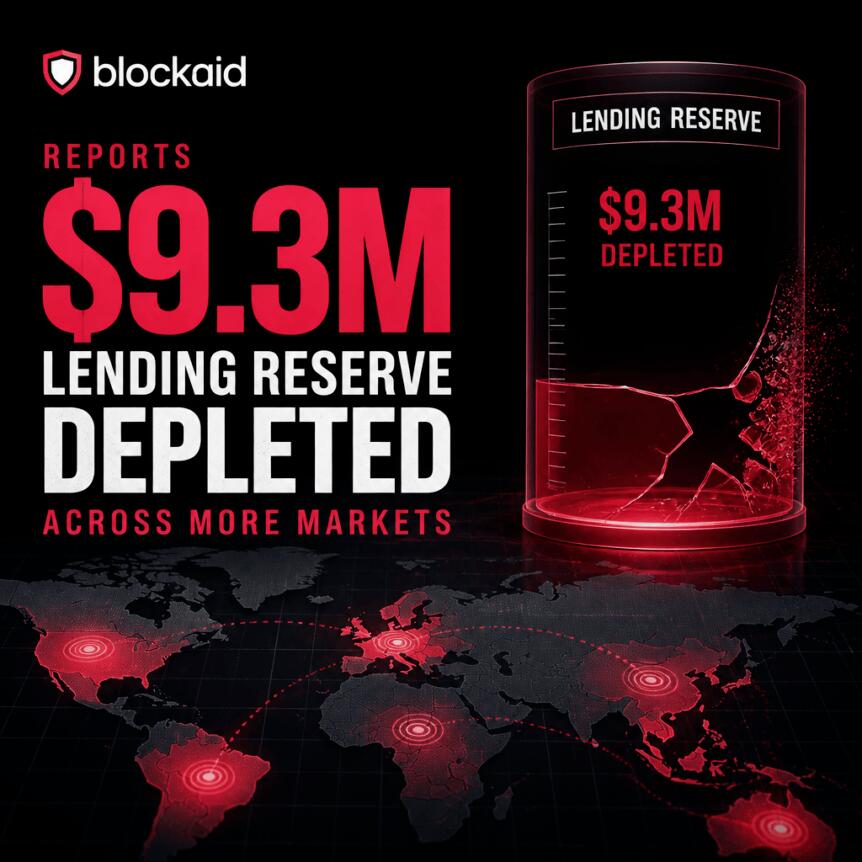
DeFi lending infrastructure has suffered another high-value breach on Flow EVM, with Blockaid reporting that the protocol More Markets lost roughly $9.3 million in assets from a lending reserve. The incident, described in a Monday post by Blockaid on X, centers on an overborrow strategy using a liquid staking token.
Blockaid said the attacker drained about 15.5 million Wrapped Flow (WFLOW) tokens—valued at approximately $9.3 million—from the mFlowWFLOW lending reserve. The exploit reportedly involved Ankr Staked FLOW (ankrFLOW), together with Aave V3’s “efficiency mode” (E-mode), to expand borrowing capacity beyond what the reserve should allow.
Key takeaways
- Blockaid attributes the More Markets Flow EVM reserve drain to an overborrowing approach using Ankr Staked FLOW (ankrFLOW) and Aave V3 E-mode.
- About 15.5 million Wrapped Flow (WFLOW), worth around $9.3 million, were taken from the mFlowWFLOW lending reserve.
- The month-to-date total losses from crypto hacks reached $139.7 million in August, placing the month as the third-largest by stolen value so far in 2026.
- The August figure is sharply lower than July’s $254 million in stolen funds, suggesting either fewer major breaches or reduced impact from exploits.
- Cronos paused its network on Sunday following a separate reported $75 million exploit tied to the Tectonic DeFi lending protocol.
How the More Markets reserve was drained
According to Blockaid’s account of the event, the attacker targeted More Markets’ lending reserve that holds mFlowWFLOW. Blockaid said the stolen amount consisted of 15.5 million Wrapped Flow (WFLOW) tokens, which it valued at approximately $9.3 million based on blockchain data it shared publicly.
Blockaid further claimed that the exploit depended on two linked mechanisms: the use of Ankr Staked FLOW (ankrFLOW) and Aave V3’s E-mode. E-mode is designed to increase borrowing power for specific asset groups when their values are expected to move together—commonly a liquid staking token and its corresponding underlying token.
In practical terms, this means that when the protocol’s configuration treats certain pairs as sufficiently correlated, the borrowing limits can become more permissive. Blockaid’s report indicates the attacker leveraged that increased borrowing power to overextend against the reserve, resulting in the loss of WFLOW tokens from mFlowWFLOW.
E-mode designed for correlation—what this incident suggests
E-mode in Aave V3 is intended to make capital more efficient by rewarding users when asset prices track each other closely. Blockaid’s description of this exploit highlights a recurring risk in DeFi: when an attacker can obtain collateral exposure through a token wrapper or staking derivative, the assumed relationship between the assets may be insufficiently protective during the exploit window.
Blockaid specifically tied the strategy to Ankr Staked FLOW (ankrFLOW) in combination with E-mode for correlated assets. While E-mode is not inherently wrong—its goal is to reflect genuine market linkage—incidents like this underscore that protocols still need robust defenses around liquidation mechanics, borrowing limits, and whether the collateral’s behavior under stress matches the assumptions baked into risk parameters.
For investors and users, the takeaway is not that E-mode should be avoided, but that reliance on correlated asset groups can raise the stakes for monitoring. Protocol teams typically need to ensure that their accounting, oracle choices, and validation logic remain resilient when liquidity conditions change quickly.
Broader hack landscape: August losses mount
Blockaid’s reported loss adds to a fast-moving set of crypto-security events. DefiLlama’s data on hacks shows that total cryptocurrency losses from hacks reached $139.7 million in August, making it the third-largest month by value stolen so far in 2026.
The same DefiLlama dataset cited in the reporting indicates a meaningful change from earlier in the year: July saw approximately $254 million stolen. While August has a lower total than July, the ongoing frequency of incidents—spanning multiple ecosystems and chains—suggests that attackers remain active and that DeFi lending remains a frequent target.
Another DeFi lending event: Cronos halts after Tectonic exploit
Alongside the More Markets issue, the market also digested another major DeFi lending-related disruption. On Sunday, Cronos halted its blockchain network following a reported $75 million exploit targeting the DeFi lending protocol Tectonic.
That earlier incident, reported by Cointelegraph, involved a sizable compromise that prompted an emergency network pause by Cronos. Together, the two stories emphasize how quickly lending platforms can become central points of failure—especially when borrowing configurations intersect with token derivatives and liquidity-linked assumptions.
At the time of publication, More Markets had not publicly confirmed the incident or disclosed whether users suffered losses. Cointelegraph said it contacted Blockaid for more details but did not receive a response by publication, and it was unable to reach More Markets for comment.
Readers should watch for follow-up disclosures from More Markets regarding the affected reserve, whether funds were fully recovered, and any post-incident changes to collateral or E-mode configuration. For the wider DeFi community, the key uncertainty is how closely future risk models will account for real-world token behavior during fast-moving market or liquidity conditions.
Zakura released an open-source cryptography toolkit on Aug. 29 that it says can reduce the time required to construct some private Zcash transactions from more than three seconds to below 200 milliseconds.
Summary
- Zakura Common cuts transaction construction from over three seconds to under 200 milliseconds, developers claim.
- Mobile proof generation improved more than fourteenfold, while desktop benchmarks showed gains exceeding fivefold overall.
- Sinsemilla hashing accelerated more than twenty-onefold, while proof verification improved between fourfold and eightfold overall.
- Wallet developers can adopt the open-source libraries without requiring a coordinated Zcash network upgrade first.
- Zakura version 1.3.0 uses the stack, while Vizor Wallet is among its earliest confirmed adopters.
The toolkit, called Zakura Common, replaces several cryptographic components used by wallets and full nodes. The developers said the changes improve proof generation, transaction verification, wallet scanning and hashing without altering Zcash’s consensus rules.
Zakura released the software under dual MIT and Apache 2.0 licenses. Wallet and node developers can therefore integrate the libraries without waiting for a hard fork or synchronized network upgrade.
Zcash wallets generate privacy proofs faster
Zcash shielded transactions conceal the sender, recipient and transferred amount. A wallet must create a zero-knowledge proof showing that the hidden transaction follows the network’s rules before broadcasting it.
That computation happens on the user’s device. Slow proof generation can therefore delay a payment before validators or nodes begin processing it.
Zakura’s benchmarks showed mobile proof generation running more than 14 times faster under the new stack. Desktop performance improved by more than five times.
The developers said those gains could bring transaction construction below 200 milliseconds “in many cases.” The figure is a benchmark result rather than a guaranteed time for every device, wallet or transaction.
Hardware, operating systems, transaction complexity and wallet implementations may produce different results.
Zakura Common improves more than proof generation
The toolkit also made Sinsemilla hashing more than 21 times faster, according to Zakura. Zcash uses Sinsemilla within its Orchard shielded protocol for cryptographic commitments and related operations.
Trial decryption improved by more than 1.5 times. Wallets use that process while scanning blockchain data to identify shielded transactions belonging to their users.
Zakura also reported fourfold to eightfold gains in zk-SNARK verification. Faster verification could help full nodes validate transactions sooner and reduce the risk of block-processing delays.
“Shielded wallets that use Zakura Common, and full nodes like Zakura itself, all benefit,” Zcash co-founder Sean Bowe said.
The release does not shorten Zcash block production or settlement on its own. It primarily targets the cryptographic work performed before broadcasting and while checking transactions.
Wallet developers can adopt the toolkit immediately
Zakura version 1.3.0 has moved to the new cryptography stack. Vizor Wallet is among the first wallet projects adopting the libraries, according to the development team.
Other wallets must integrate and test Zakura Common before their users receive the same performance gains. Adoption will therefore depend on individual development schedules rather than a single network activation date.
The update arrives as Zcash wallet development becomes more distributed. In January, former Electric Coin Company developers formed CashZ to continue work based on the Zashi wallet code.
Wallet integrations have also expanded access to shielded transfers. A previous ShapeShift wallet integration added Zcash privacy support across its non-custodial platform.
ZEC briefly rose before the broader pullback
ZEC initially rose about 5% following the Zakura Common announcement and traded near $839. The timing indicates a market reaction but does not prove the software release caused the entire move.
CoinGecko subsequently placed ZEC near $829 on Aug. 31, down about 0.8% over 24 hours. The token traded between approximately $808 and $888 during that period.
The next evidence will come from real wallet deployments. Developers will need to confirm whether the benchmark gains persist across consumer devices, larger shielded transactions and different operating environments.
Zakura is also preparing for the proposed NU7 upgrade, which could reduce Zcash block times to about 25 seconds. The team says its current software can already operate under that target, although NU7 requires a separate network governance and activation process.
Crypto World
Live updates: Bitcoin holds $78,000 as yen breaks 160 and rate-hike bets lift the dollar
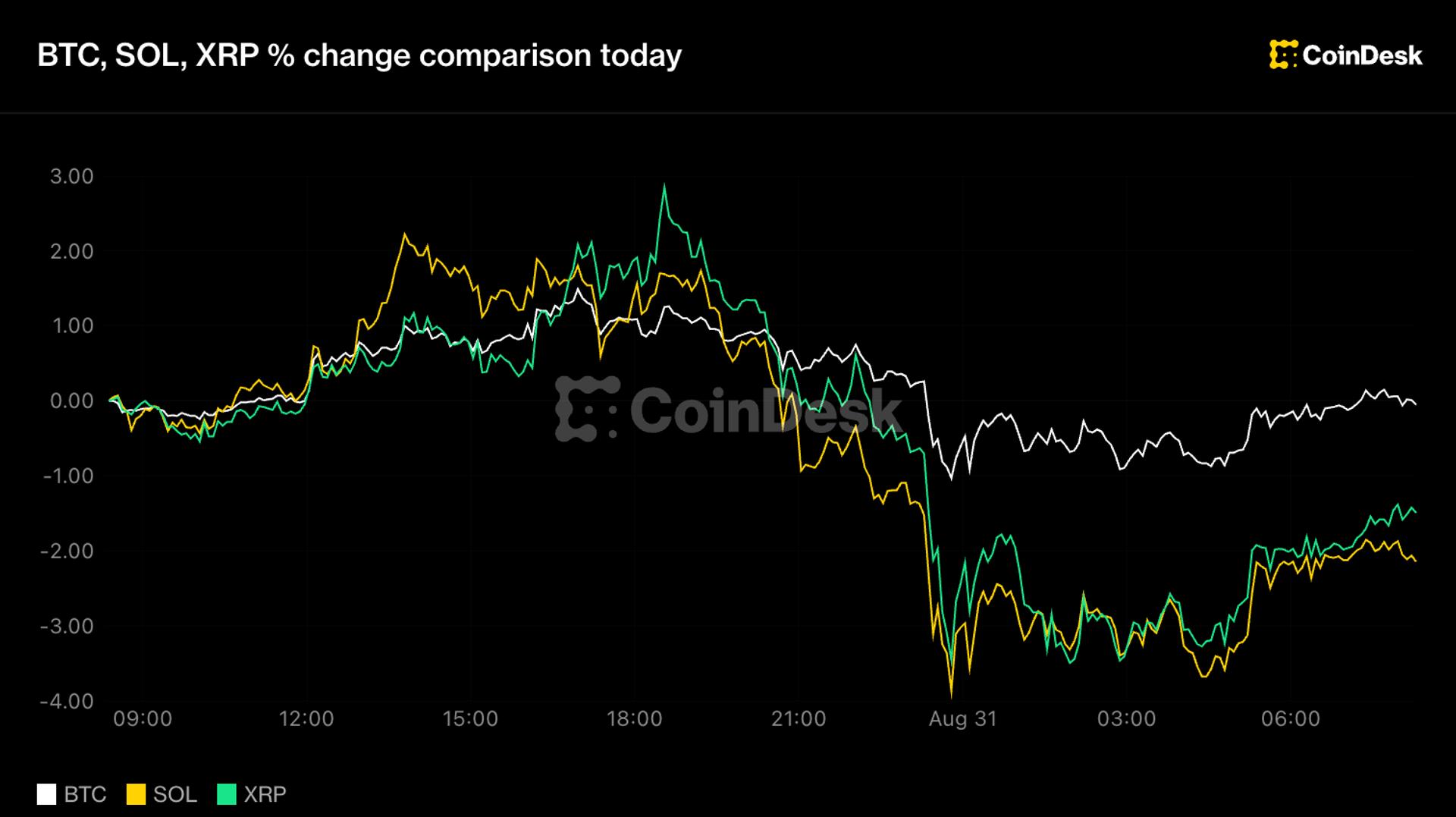
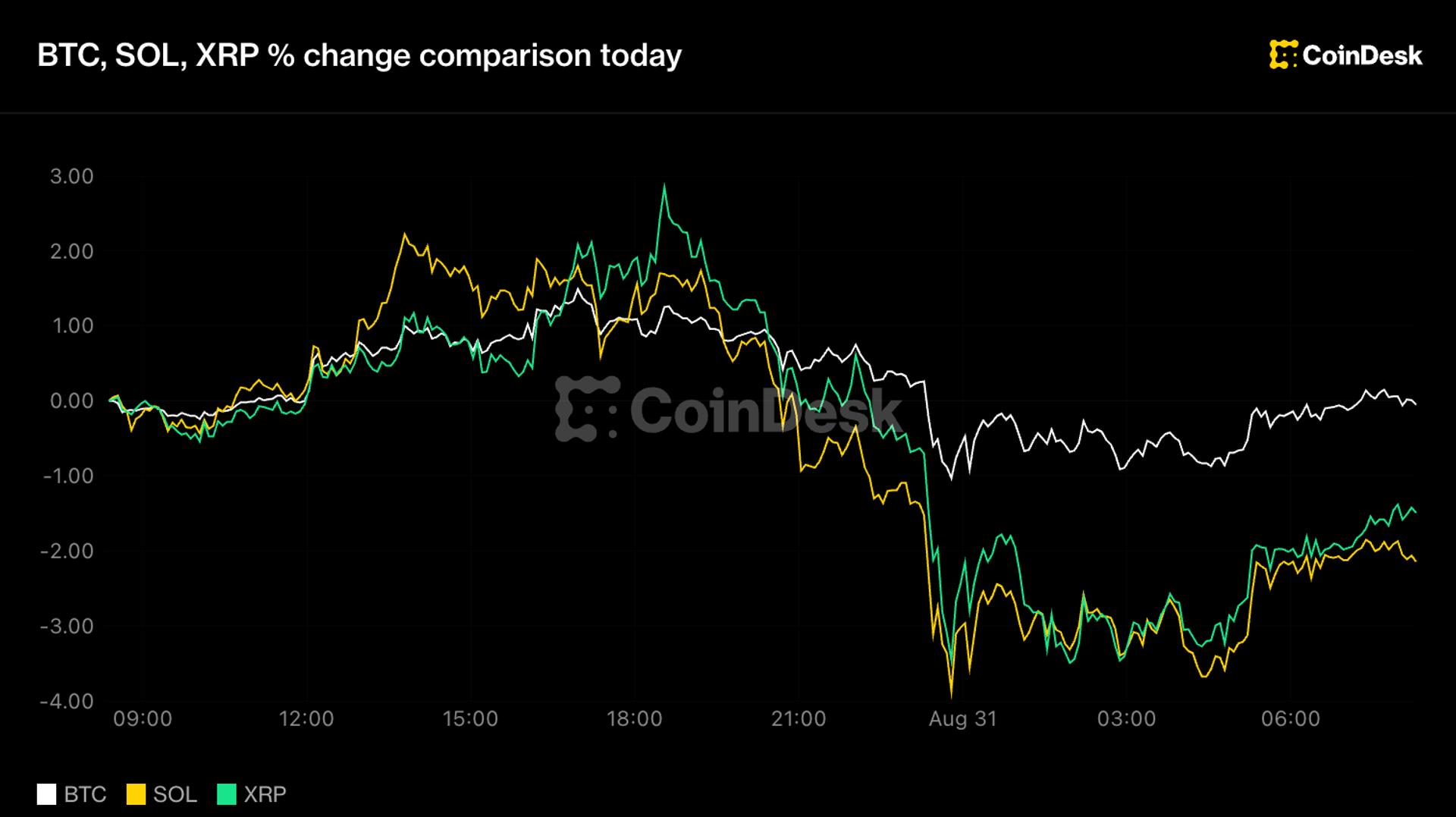
Bitcoin is holding just under $78,000 as August closes. The dollar strength that pushed the yen past its intervention line is the same force capping crypto.


Decentralized finance (DeFi) vault infrastructure protocol More Markets had a lending reserve drained of about $9.3 million in digital assets on Flow EVM, according to Web3 security platform Blockaid.
The attacker drained about 15.5 million Wrapped Flow (WFLOW) tokens, valued by Blockaid at approximately $9.3 million, from the mFlowWFLOW lending reserve, according to blockchain data shared by Blockaid in a Monday X post.
Blockaid said the attacker used Ankr Staked FLOW (ankrFLOW), a liquid staking token, alongside E-mode to overborrow from the reserve.
E-mode, short for efficiency mode, is an Aave V3 feature that increases borrowing power for assets whose prices are expected to move together, such as a liquid staking token and its underlying asset.
The exploit pushed total losses from cryptocurrency hacks to $139.7 million for August, making it the third-largest month by value stolen so far in 2026. However, it marks a significant decrease from $254 million stolen during July, according to DefiLlama data.
On Sunday, Cronos halted its blockchain network after a reported $75 million exploit targeting DeFi lending protocol Tectonic.
More Markets had not publicly confirmed the incident or disclosed whether users suffered losses at the time of publication. Cointelegraph contacted Blockaid for more details but did not receive a response by publication and was unable to reach More Markets for comment.
Related: Humanity Protocol to prioritize operational security following $36M hack


Your look at what’s coming in the week starting Aug. 31.


Ripple recorded another round of RLUSD treasury activity on Aug. 31, including an 11 million-token mint and a separate 11 million-token burn.
Summary
- 11 million RLUSD was minted and 11 million burned at treasury addresses on August 31.
- CoinGecko placed RLUSD’s circulating supply and market capitalization near $2.37 billion on August 31.
- Ripple reported $1.87 billion circulating against $1.98 billion in reserves as of August 20.
- Treasury mints create tokens but do not independently confirm circulation, customer demand or completed issuance.
- Ethereum and XRP Ledger remain RLUSD’s main networks, although Ripple supports several additional blockchain deployments.
The transactions were reported by the Ripple Stablecoin Tracker. They followed several large operations on the XRP Ledger and Ethereum during the final days of August.
CoinGecko placed RLUSD’s circulating supply and market capitalization at approximately $2.37 billion on Aug. 31. The stablecoin continued trading close to its intended $1 peg, meaning supply growth rather than price appreciation drove the higher valuation.
RLUSD minting does not necessarily show net demand
A stablecoin mint creates tokens at an issuer-controlled address. Those tokens may remain in treasury, move to an institutional customer or support transfers between networks.
A mint therefore does not prove that an equivalent amount entered public circulation. Likewise, a burn removes tokens from supply and can accompany customer redemptions, treasury management or network rebalancing.
The matching 11 million-token mint and burn on Aug. 31 illustrate that distinction. Viewed separately, the mint suggests expansion. Considered together, the two transactions produced no net increase from those specific operations.
Ripple did not identify the customer, purpose or economic relationship behind either transaction. The ledger records establish that the transactions occurred, but they do not establish new institutional demand.
As crypto.news previously reported, Ripple minted another 10 million RLUSD on XRPL on Aug. 17. Ripple also did not disclose the receiving customer or intended use of that issuance.
RLUSD supply moved above $2 billion in August
RLUSD crossed $2 billion in market capitalization during August, less than two years after its December 2024 launch. Ripple confirmed the milestone on Aug. 25 and said close to $1 billion had been issued on the XRP Ledger.
In related coverage, RLUSD approached an even split between XRPL and Ethereum when it crossed the threshold. Ethereum held a modestly larger amount at that time.
Available data now show continued supply expansion. CoinGecko reported approximately 2.37 billion circulating tokens on Aug. 31. XRP Ledger trackers placed the network’s portion above 1 billion tokens after several late-August mints.
Ethereum remains another major venue for RLUSD. Ripple has also extended the stablecoin to Base, Ink, Optimism, Unichain and the XRPL EVM sidechain. Public dashboards do not always provide synchronized supply totals for every network, which can produce differences between data providers.
Ripple’s reserve report trails the latest mints
Ripple’s transparency page reported $1.866 billion in circulating RLUSD and $1.981 billion in reserve funds as of Aug. 20. That official snapshot predates the latest issuance and the $2 billion milestone.
Standard Custody & Trust Company, a Ripple subsidiary supervised by the New York State Department of Financial Services, issues RLUSD. Ripple says reserves consist of cash and permitted cash equivalents held in segregated accounts.
Deloitte prepares monthly attestations covering the reported circulation and reserve balances. However, those reports are retrospective. They do not provide real-time confirmation of reserve changes after every mint or burn.
The next attestation should offer a clearer view of whether reserve assets increased alongside the late-August supply expansion.
What happens next for RLUSD
Further treasury transactions will show whether the latest mints move into circulation or are offset by additional burns. Transfers from treasury accounts to exchanges, custodians or institutional counterparties could provide more context, although wallet movements alone may not reveal their purpose.
The next reserve report will be the more important disclosure. It should show whether Ripple maintained reserve assets above circulating liabilities as RLUSD moved beyond $2 billion.
No verified XRP price movement could be directly attributed to the RLUSD transactions. RLUSD growth may add dollar liquidity to the XRP Ledger, but it does not automatically create equivalent demand for XRP.

Amid recent discussions in the crypto space, HTX has drawn significant attention.
Like many other exchanges, regulatory scrutiny has become subjects of discussion on this exchange.
However, activity on the HTX platform presents a contrasting picture.
The HTX 13th Anniversary Carnival is now well into its second half, with more than 120,000 rewards already distributed.

Every day, users set their alarms for 13:13 (UTC+8) to make sure they don’t miss the anniversary red packets. Some are lighting up 9, 11, or 13 Future Gems to unlock rewards, while others have already received their $HTX rewards and shared their wins on social media.
The market has also begun to warm up. Amid price movements in major assets such as BTC, trading activity across both spot and futures markets on the platform has surged.
Furthermore, the 13th Anniversary celebration extends far beyond a single Carnival Month.
Futures traders can participate in the HTX Trading Championship, spot traders can join the Spot Trading Carnival, and users seeking yield opportunities can take part in the HTX Earn Bonanza. In addition, a series of campaigns focused on $HTX, referrals, P2P, and margin trading are being launched in rapid succession.

For users, one way to assess whether an anniversary event is truly engaging is to look beyond its headline prize pool.
Prize pool figures may attract attention, but actual reward distribution is a much more direct measure of the true user experience.
To date, more than 120,000 rewards have been distributed to users.
The anniversary celebration has only just passed its midpoint.
01 | How Are 120,000 Rewards Being Distributed?
For its 13th anniversary, HTX designed a distinctly crypto-native interactive framework.
Thirteen Future Gems correspond to 13 specific tasks.
Rather than forcing users to complete every challenge at once, they can progress step by step, starting with the simplest tasks.
Posting a 13th Anniversary wish, completing a Learn & Earn quiz, and purchasing 50 USDT worth of $HTX are among the early-stage milestones. As users progress, the tasks gradually extend into core areas such as spot and futures trading, Earn, fiat deposits, margin trading, and TradFi.
The second half of the progression introduces higher-tier incentives.
At 9 Gems, you can start drawing rewards and receive up to 130 USDT worth of $HTX. At 11 Gems, you can claim an anniversary red packet every day at 13:13 (UTC+8). Light up all 13 Gems for a chance to win up to 1,300 USDT worth of $HTX and unlock the grand prize.
02 | A Particular 13th Anniversary Period
HTX’s 13th anniversary coincides with a notable period of market and operational backdrop.
There’s a lot of noise in the industry.
Like many other exchanges, HTX is subject to public discussion and scrutiny regarding issues such as regulation and compliance. However, beyond social media commentary, underlying operational metrics provide a far clearer view of the platform’s performance.
According to recent operational statistics disclosed by HTX, the daily average number of deposit and withdrawal orders has remained at tens of thousands since August 23. HTX stated that core services, including spot, futures, deposits, and withdrawals, continue to operate normally.
In addressing market questions, HTX has maintained open communication regarding its operations and platform stability while encouraging continued public observation. Thus far, these external developments have not interrupted the platform’s operations. User trading activity, capital flows, and anniversary events have continued during this period. These operational indicators provide a more concrete basis for assessing the platform.
03|For an Exchange, Money Is More Honest Than a Tweet
A week ago, Justin Sun, Advisor to HTX, responded to external inquiries with a concise statement:
“Everything is fine.”
This is very much in line with his style of expression.
However, whether an exchange holding user assets is genuinely operating normally cannot be determined by a single tweet alone.
Money is more honest than a tweet. Operational data provides a more substantive basis for assessment than statements alone.
Key operational metrics provide a more substantive view: whether deposits and withdrawals proceed smoothly; whether trading activity and liquidity remain stable; and whether platform infrastructure can support increased trading volume when market opportunities emerge. These are the core indicators of an exchange’s operational resilience.
Against this backdrop, the theme of HTX’s 13th anniversary—”Resilience Reveals the Future”—takes on greater significance.
Without recent events, “resilience” might have been nothing more than an anniversary tagline.
Industry narratives frequently reference 13 years of experience, multiple bull and bear cycles, the ability to weather market cycles, and a long-term approach.
Yet operational resilience for an exchange relies on clear fundamentals.
Operational resilience means keeping systems stable during periods of high market volatility, maintaining seamless deposit and withdrawal processing amid external turbulence, addressing issues promptly as they arise, and maintaining system capacity as market volumes recover.
True resilience is not the absence of problems, but the ability to maintain momentum when problems arise.
Routine deposit and withdrawal processing, together with the distribution of 120,000 rewards, does not imply the absence of operational risk, nor does it replace long-term regulatory resolution.
HTX still needs to address the relevant issues and consistently provide verifiable data to users and market participants.
Resilience can help a company navigate periods of uncertainty, but it should not substitute for addressing underlying issues.
At least for now, these external developments have not interrupted the platform’s operations.
The post Navigating the Noise: HTX Turns 13 with Resilience in Action appeared first on BeInCrypto.

XRP has seen a notable improvement in its risk-adjusted returns. The Ripple token’s Sharpe Ratio on Binance has now reached its highest level since August 2025.
The indicator is currently stabilizing at around 0.207, according to CryptoQuant, while the price hovers close to $1.40.
Risk-Reward Profile
Over the past few months, XRP’s Sharpe Ratio stayed around negative or neutral levels and fell significantly during the crypto asset’s broader price decline. The recent increase suggests that returns have improved relative to the amount of volatility investors are facing.
The sharp rise in the Sharpe Ratio also occurred alongside the recovery in XRP’s price, which is up by almost 30% over the past month. This indicates that the recent move was accompanied by stronger risk-adjusted performance rather than being only an isolated price increase, CryptoQuant explained.
However, the indicator’s move to its highest level in a year does not confirm that XRP has entered a steady uptrend. The Sharpe Ratio could reverse quickly if market volatility rises or the token undergoes a significant correction.
Zooming out, institutional demand for XRP-linked investment products was also hard to miss. Last week, US-based spot ETFs pulled in $110.49 million in five days.
CryptoPotato reported that it was the first weekly inflow above $110 million since early December 2025. All five sessions ended in positive territory, and each attracted more than $10 million. Monday saw $13.82 million come in, followed by $23.87 million on Tuesday. Wednesday led the week with $28.14 million, the funds’ strongest single-day showing since January 5.
Another $18.47 million arrived on Thursday, while Friday brought $26.2 million. The latest figures pushed total net inflows across the five ETFs to a record $1.66 billion. Bitwise remains ahead of the other issuers; its ETF now holds slightly more than $600 million in cumulative inflows.
What’s Next?
Regardless of how promising XRP’s setup may appear, a move toward $1.80 or $2 could remain out of reach until the token reclaims $1.54, according to crypto analyst ChartNerd. That level represents both a six-month resistance wall and the weekly 50 EMA. He further explained,
“Just to be clear, and to reaffirm. I am not suggesting XRP can’t push up towards $1.80/$2. I am suggesting we are under resistance, and if we do get the follow through, it will likely open up an even deeper retrace than what we would witness rejecting the weekly 50 EMA at $1.54.”
The post Ripple’s (XRP) Sharpe Ratio Just Did Something It Hasn’t Done In a Year appeared first on CryptoPotato.

Chinese chipmaker CXMT suing US defence department over blacklist

Helch artist behind Windsor Castle graffiti which upset the late Queen dies aged 34
Bitcoin’s Best Month of 2026 Is Digesting: Rising Exchange Reserves Say Setup Getting Riskier





-

 Crypto World5 days ago
SpaceX stock could rise 75% to $240, JPMorgan says
-

 Fashion3 days ago
Weekend Open Thread: Maeve – Corporette.com
-

 Crypto World3 days ago
Bitcoin’s 22% rally now needs real demand to outlast Treasury liquidity boost
-

 Crypto World5 days ago
Warsh Jackson Hole keynote puts financial innovation first
-

 Crypto World6 days ago
A $30 Billion AI Fund Implodes, Now the SEC Is Investigating Wall Street’s Role
-

 Business3 days ago
Salesforce Stock Soars 19% as Blowout Earnings and Agentforce AI Growth Silence Software Skeptics
-

 Crypto World5 days ago
Did Trump Just Move SpaceX Stock With One Truth Social Post?
-

 Crypto World4 days ago
Elon Musk Grok Bot Promise: We Will Make You Whole if AI Loses Your Money
-

 Business3 days ago
Apple Confirms September 9 Keynote and Reveals Its Full Pre-Order Schedule
-

 Business5 days ago
Walmart takes aim at younger shoppers with new fashion brand
-
 NewsBeat5 days ago
Lindsay Clancy jury braces for closing arguments as judge tells court: ‘You’ve heard all the evidence’ – Live updates
-

 Crypto World2 days ago
Bitcoin price tests $82K resistance as Brandt stays long
-

 Business5 days ago
Thailand’s Eastern Economic Corridor Capital City (EECiti): Key Developments and Investment Opportunities
-

 Business2 days ago
Onto Innovation Stock: AI’s Next Bottleneck Is Yield (NYSE:ONTO)
-

 Crypto World4 days ago
NVIDIA revenue hits $96.2B as AI demand doubles
-

 Business7 days ago
Moderna CEO warns China is pouring state money into mRNA technology
-

 Business6 days ago
NVIDIA Stock Drops Nearly 2 Percent to $210 on Seventh Losing Day Ahead of Critical AI Earnings
-

 Business3 days ago
iPhone 18 Pro Pre-Orders Could Shift to Saturday as Apple Reportedly Avoids September 11 Anniversary
-

 NewsBeat5 days ago
Trump’s trade truce with China faces test with Iran effort
-
 Crypto World5 days ago
Nvidia Q2 Earnings Reveal $96.2 Billion Beat, So Why Is NVDA Falling?
You must be logged in to post a comment Login