
Crypto World
Peter Brandt warns Bitcoin could revisit $58K

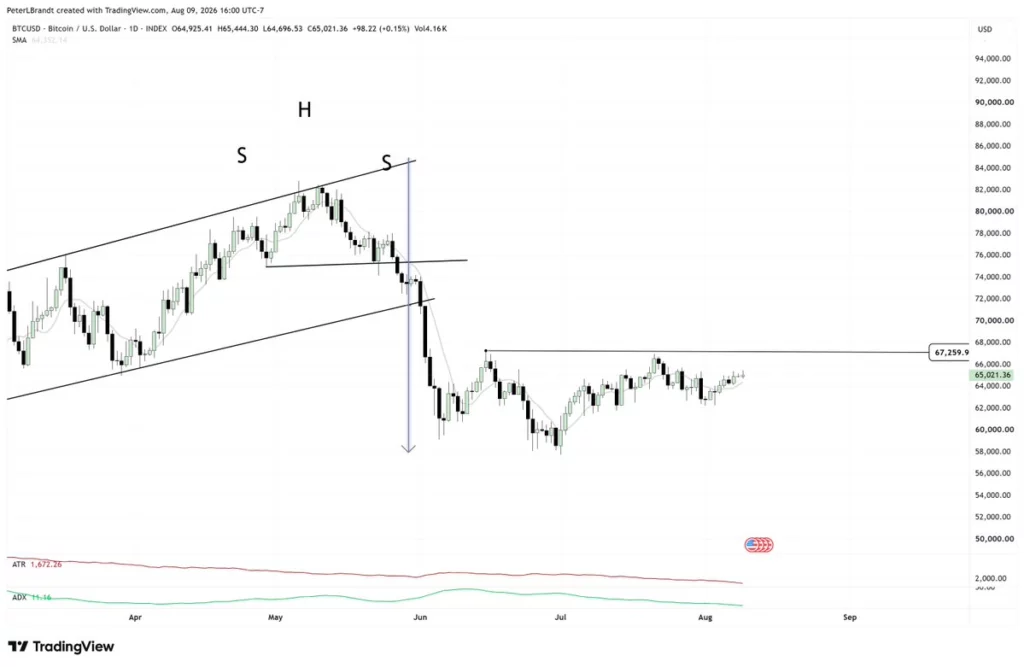
Bitcoin hovered near $65,000 on Aug. 10 as veteran trader Peter Brandt leaned toward another decline, pointing to a large head and shoulders structure that broke down earlier this summer.
Summary
- Bitcoin trades near $65,000 while Peter Brandt says he would currently bet on another decline.
- Brandt’s head and shoulders chart points toward $58,000 if Bitcoin fails to reclaim resistance soon.
- Bitcoin’s daily chart shows ADX near 11.16, signaling weak trend strength during current consolidation conditions.
- U.S. spot Bitcoin ETFs recorded more than $850 million in net inflows across five sessions.
- Lookonchain tracked one whale selling 7,513 BTC worth roughly $486.9 million during three recent weeks.
Brandt said he had not entered a trade, but wrote that “if I were to bet it would be for a decline.”
The cautious view comes as the crypto tries to stabilize above its 54 day moving average while U.S. spot Bitcoin ETFs attract more than $850 million in weekly inflows. That leaves the market caught between improving institutional demand and a technical structure that has not yet cleared resistance around $67,260.
Bitcoin indicators show a weak trend below $67,260
On the supplied BTC/USD daily chart, BTC was trading near $65,021 and remained slightly above its 54 day simple moving average near $64,352. Holding above that average points to stabilization following the June selloff, but price is still below the marked $67,260 resistance area.
The lower indicators reinforce the lack of a strong directional move. Average True Range stood near 1,672, showing that daily price ranges remain relatively wide, while the Average Directional Index was only about 11.16. An ADX reading this low indicates weak trend strength, which fits Bitcoin’s sideways movement after its drop toward the $58,000 to $60,000 area.
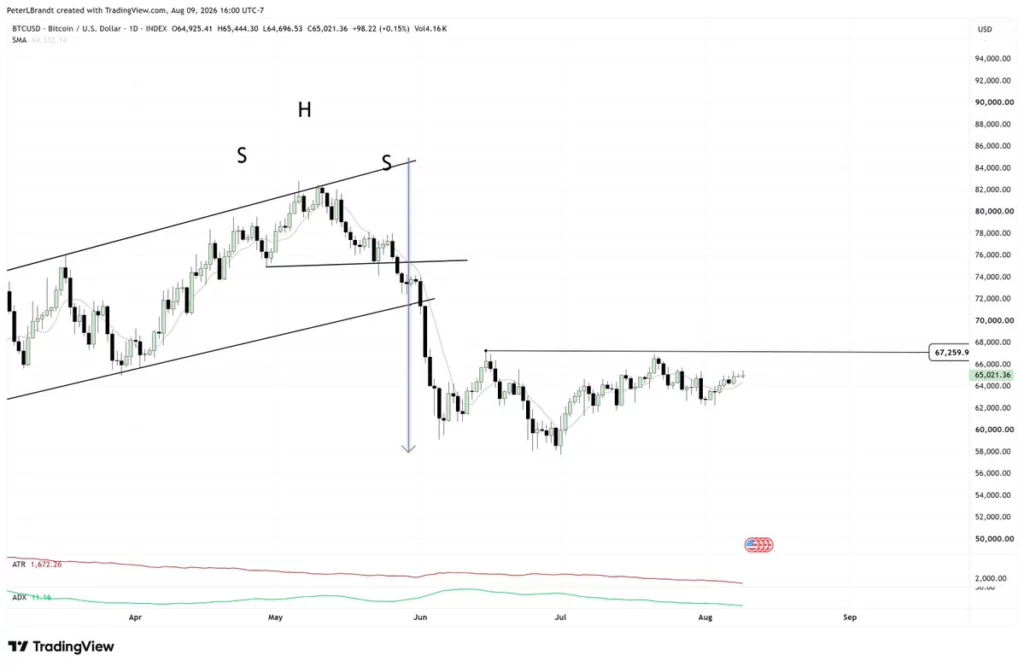
Brandt’s chart shows a head and shoulders structure built between April and June. The neckline around $75,000 has already broken, and his drawn path points toward roughly $58,000. That is a technical scenario rather than a confirmed destination. A sustained move above $67,260 would weaken the immediate bearish setup shown on his chart.
Brandt leans bearish as one large whale keeps selling
Brandt made the uncertainty clear in his Aug. 10 post. “I am not in the bet yet, but if I were to bet it would be for a decline,” he wrote. His wording matters because he is expressing a directional preference rather than announcing an active short position or guaranteeing another selloff.
Selling by at least one large holder adds another source of supply. Lookonchain reported that a whale sold another 1,019 BTC, worth about $66.4 million, and had disposed of 7,513 BTC worth roughly $486.9 million over three weeks. The activity is notable, but one tracked whale should not be treated as proof that Bitcoin whales as a group are selling.
That pressure also lines up with recent onchain analysis showing Bitcoin below the short term holder realized price. CryptoQuant analyst Axel Adler Jr. placed that cost basis at $67,523 on Aug. 8, close to Brandt’s resistance area. As crypto.news reported in recent holder selling analysis, a move toward that level could bring some underwater holders closer to breakeven.
U.S. Bitcoin ETF demand offers a bullish counterweight
ETF demand has moved in the opposite direction. Farside Investors recorded daily net inflows of $170.1 million, $211.5 million, $244.4 million, $137.6 million and $101.7 million from Aug. 3 through Aug. 7. Those figures total about $865.3 million across five sessions.
As crypto.news reported in today’s U.S. CPI preview, Bitcoin nevertheless remained around $65,000 despite the stronger fund demand.
A separate claim circulating Monday connected the stronger ETF flows with the Coldcard wallet breach. Coinkite has confirmed a seed generation weakness affecting several Coldcard firmware versions and warned affected customers to create new seeds and move their BTC.
However, there is currently no verified evidence that the Coldcard incident caused investors to shift directly into Bitcoin ETFs. The timing alone does not establish that relationship. Inrelated Coldcard security coverage, Galaxy Research had confirmed 1,596 BTC stolen across three attack waves, while a suspected fourth wave could bring losses to roughly 2,055 BTC. The higher figure remains unconfirmed.
Bitcoin now faces U.S. CPI and the $67K barrier
The next scheduled macro test arrives Wednesday, Aug. 12. The Bureau of Labor Statistics will release July U.S. consumer price data at 8:30 a.m. ET. Friday’s employment release showed nonfarm payrolls falling by 23,000 in July, while May and June were revised down by a combined 103,000 jobs.
Bitcoin’s short term map is therefore relatively clear. A sustained break above $67,260, followed by the short term holder cost basis around $67,523, would challenge the bearish setup and improve the recovery structure. Failure around that zone would keep the recent consolidation intact and leave the $60,000 region exposed to another test.
Brandt’s roughly $58,000 path should remain attributed as his technical scenario, not a market forecast. For now, ADX near 11 shows little trend strength, ETF inflows remain supportive, and tracked large holder selling is still present. Wednesday’s inflation report could provide the next catalyst for a break from BTC’s current range.
Disclosure: This article does not represent investment advice. The content and materials featured on this page are for educational purposes only.

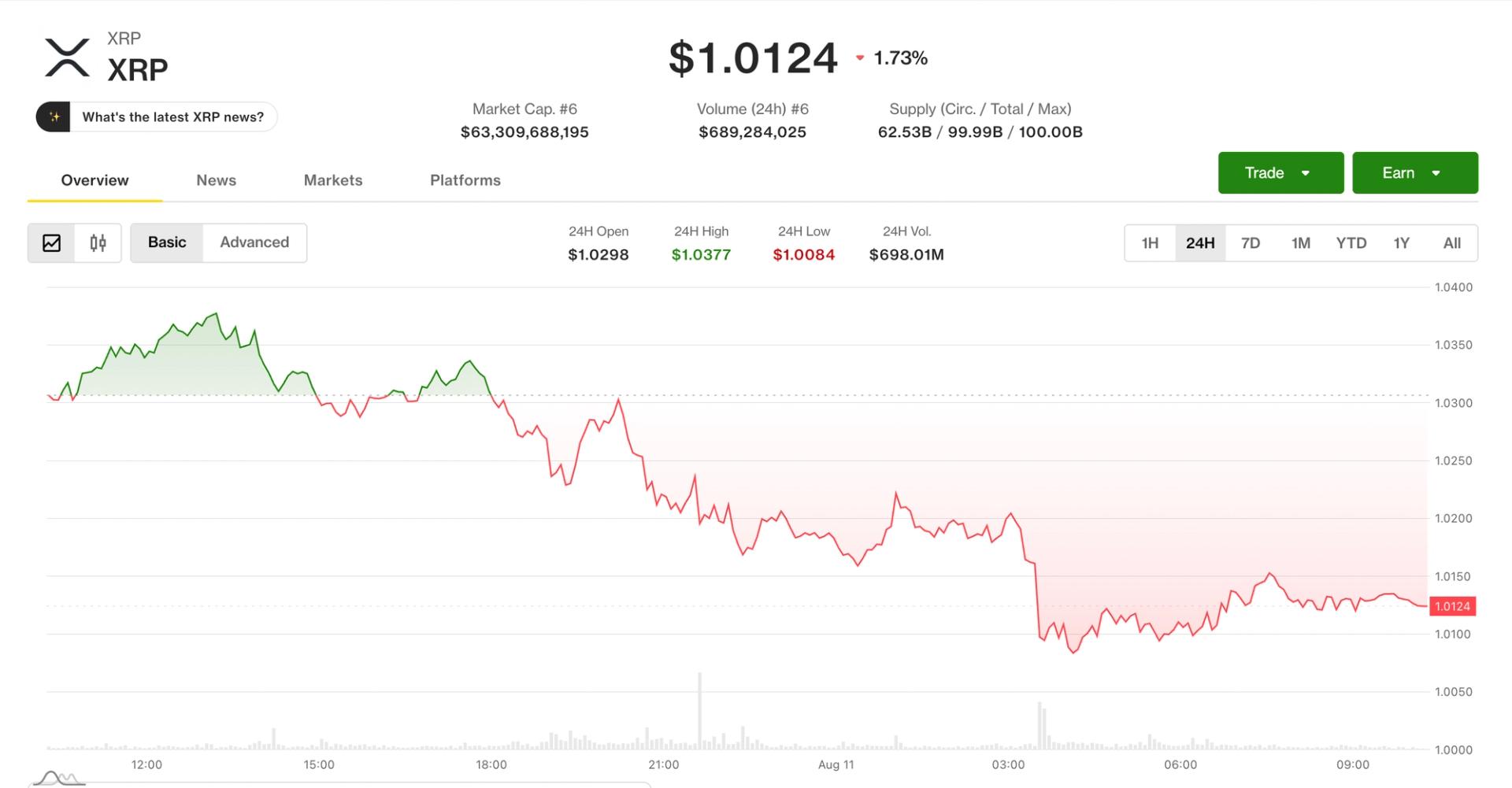
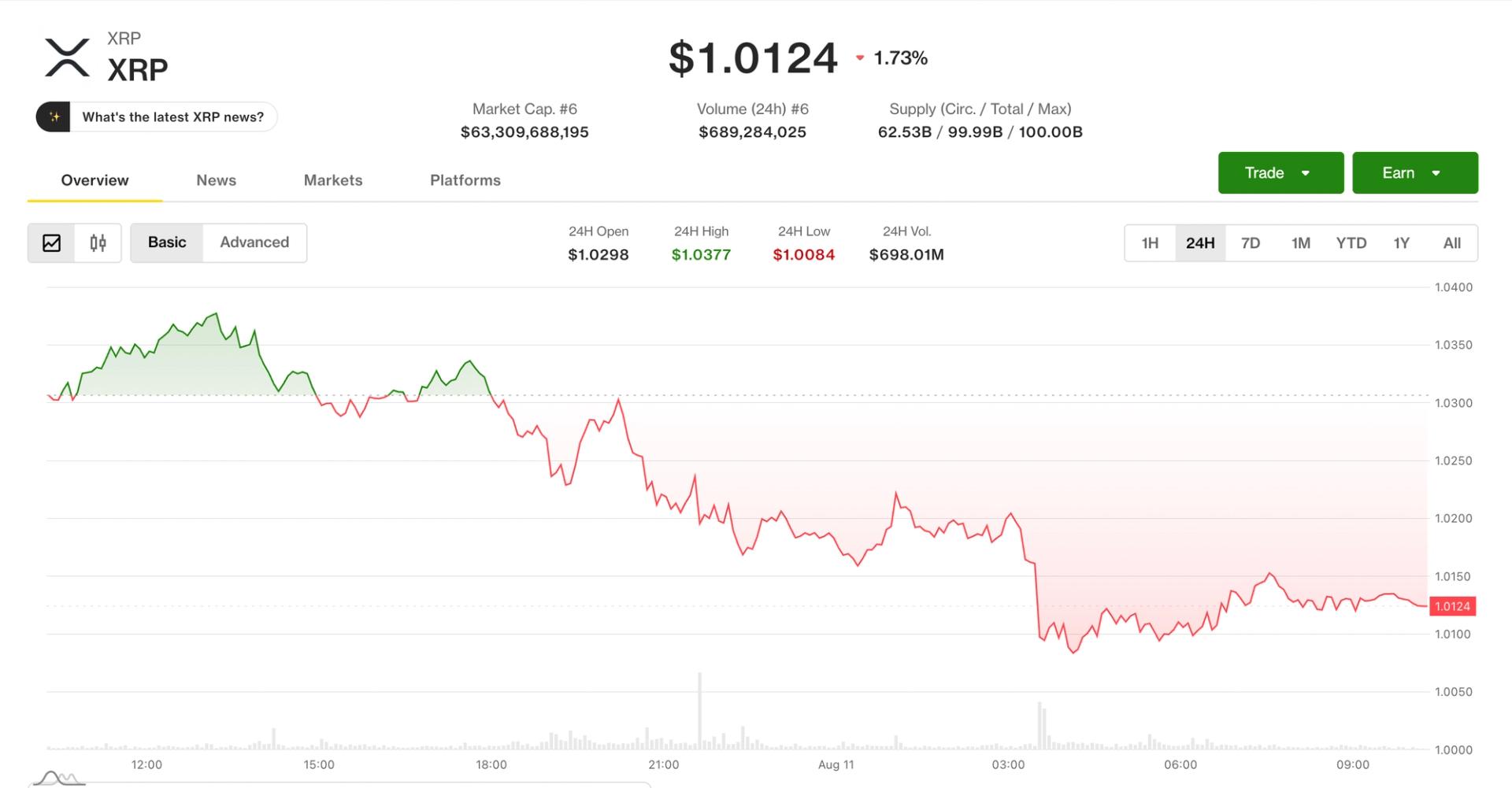
That makes $70,000 the next area to watch, another round number with the 200-day moving average sitting nearby. Clearing it would put bitcoin above the range where buyers and sellers fought through March and April, a move Kuptsikevich said would shift sentiment meaningfully.
Traders are not there yet. The crypto sentiment index sits at 30, in what is known as the fear zone, and has stayed there since mid-July with occasional dips toward extreme fear.
Bonds and oil set the tone in broader markets. U.S. 10-year Treasury yields rose six basis points on Monday to 4.71%, dragging Australian and New Zealand government bonds down with them, with no cash Treasury trading during Asian hours because of a public holiday in Japan.
Brent crude held at $87.73 a barrel after jumping 5% on Monday, when President Donald Trump made fresh demands on Iran and dimmed hopes of a deal to reopen the Strait of Hormuz. Gold rose for a third session above $4,400 an ounce.
Higher oil feeds into the inflation figures due Wednesday at 8:30 a.m. ET, which is why the rally is weighing on assets that do better when rate rises look less likely.
Fund flows had been running the other way until this week. U.S. spot bitcoin funds took in $865 million across five sessions through Aug. 7, before a provisional outflow of $91 million on Monday.


Keel Infrastructure has shut down all of its U.S. Bitcoin mining operations as the former Bitfarms business redirects its American power portfolio toward artificial intelligence and high performance computing data centers.
Summary
- Keel ended all U.S. Bitcoin mining operations on June 29 to prepare sites for HPC.
- Q2 revenue fell 50% yearly to $30 million as mining activity and Bitcoin prices weakened.
- Keel sold 1,085 BTC for $75 million, leaving 1,861 BTC on its balance August 7.
- $819 million in liquidity includes $698 million cash and $121 million in unencumbered Bitcoin reserves.
- U.S. sites in Washington and Pennsylvania have not yet generated any HPC data center revenue.
The company disclosed the transition on Aug. 10 alongside second quarter results showing revenue fell 50% from a year earlier to $30.4 million. Net loss reached about $65 million.
The move brings an end to Bitcoin mining at Keel’s sites in Washington and Pennsylvania, but it does not represent a complete exit from mining worldwide. The Delaware based company continues to operate legacy Bitcoin mining assets in Canada while pursuing approvals to convert more Canadian capacity toward HPC and AI workloads.
Keel Infrastructure ends U.S. Bitcoin mining
Keel’s SEC filing shows that the U.S. withdrawal happened in stages. Bitcoin mining at its Washington State site ended on April 28 as the company began converting the location into an 18 MW HPC data center. Mining then ceased at Panther Creek, Scrubgrass and Sharon in Pennsylvania on June 29.
The change is particularly relevant to Keel’s U.S. operations because the company is now trying to reuse power infrastructure originally built around cryptocurrency mining. Panther Creek and Scrubgrass continued selling electricity after their miners were switched off. They had about 60 MW and 63 MW of energized capacity, respectively, that had not been contracted under an electric supply agreement as of Aug. 7. Sharon is being prepared for a planned 110 MW HPC data center.
Keel has also changed its corporate center of gravity. The former Bitfarms completed its redomiciliation from Canada to the United States on April 1. Keel became a Delaware corporation, a U.S. domestic issuer and the ultimate parent of the Bitfarms business. Its common stock trades on Nasdaq under the KEEL ticker.
Bitcoin sales give Keel more cash for the AI shift
Keel’s latest release also shows its Bitcoin treasury continuing to shrink. Between April 1 and Aug. 7, the company sold 1,085 BTC for roughly $75 million. Its remaining balance stood at 1,861 BTC, valued by the company at approximately $121 million for liquidity purposes.
Management made clear that further disposals are planned. During its earnings presentation, Keel said its “intent is to liquidate our Bitcoin position in 2026.” That remains a management plan rather than a completed transaction, meaning the timing and proceeds from the remaining BTC are still dependent on future sales.
Total liquidity reached approximately $819 million as of Aug. 7, comprising $698 million of unrestricted cash and $121 million of unencumbered Bitcoin. That compares with about $533 million of liquidity reported in May, as previously reported in earlier earnings coverage.
Keel also raised $458 million through 1.25% convertible senior notes due in 2032 during the second quarter. Management said the capital is intended in part to support additional power capacity at its Pennsylvania properties, including Panther Creek and Scrubgrass.
Q2 losses show the cost of leaving Bitcoin mining
The transition is already visible in Keel’s financial results. Revenue from continuing operations fell to $30.4 million from $60.9 million a year earlier. Bitcoin mining revenue alone declined by $29.6 million as the company dealt with lower average Bitcoin prices, higher network difficulty and reduced U.S. mining activity.
The U.S. portion of the decline was substantial. U.S. operations generated 37% of second quarter revenue, down from 51% a year earlier. Revenue from U.S. operations fell by $19.9 million compared with Q2 2025, with Keel citing the Bitcoin market, higher network difficulty and the April shutdown in Washington.
Keel recorded a $141 million operating loss, compared with operating income of about $11 million one year earlier. Net loss was $65 million, while the loss from continuing operations was $64 million. The quarter also included large noncash depreciation charges tied partly to the retirement of mining infrastructure at Panther Creek and Scrubgrass.
General and administrative expenses increased to $31.3 million from $19.4 million. Keel attributed the rise partly to stock compensation, professional costs connected with its U.S. redomiciliation and hiring staff for its expansion into data center development.
The strategy follows a broader move by listed miners to reuse power intensive Bitcoin infrastructure for AI computing. In related broader industry coverage, several miners have redirected capital and electrical capacity toward AI hosting as mining economics weakened during 2026.
What happens next for Keel’s U.S. data centers
The next test is whether Keel can convert retired mining sites into contracted AI infrastructure. As of Aug. 7, the company had not begun HPC operations or recognized HPC data center revenue at the Washington site or its Pennsylvania properties. That makes the current transition primarily a development story rather than an established new revenue stream.
Keel says commercial talks are advancing. Chief executive Ben Gagnon said there were “multiple prospective tenants negotiating for each one” of the company’s three priority sites. However, Keel has not publicly named those prospective tenants or announced a signed customer lease for the sites in its latest results. The customer negotiations therefore remain a company reported commercial process rather than booked revenue.
Permitting is also unfinished. Panther Creek and Sharon have received zoning and land development approvals, while environmental permits remain in progress. Panther Creek has 350 MW of secured utility capacity, and management said its earliest expected ready for service date remains in 2027.
Keel has not abandoned Bitcoin mining everywhere. Its Canadian mining assets remain operational while it pursues further HPC conversions, including a proposed 96 MW data center campus in Sherbrooke, Quebec. Local approval has been obtained for the power transfer, although the change to HPC and AI use remains subject to provincial review.
For Keel, the U.S. pivot has therefore moved beyond planning: the miners are now off, mining equipment has been designated for sale and capital has been raised. The remaining milestones are more difficult to measure in advance. Permits must be completed, tenants must sign contracts, construction must proceed and the former mining sites must begin producing HPC revenue before the new model can be judged on operating performance.
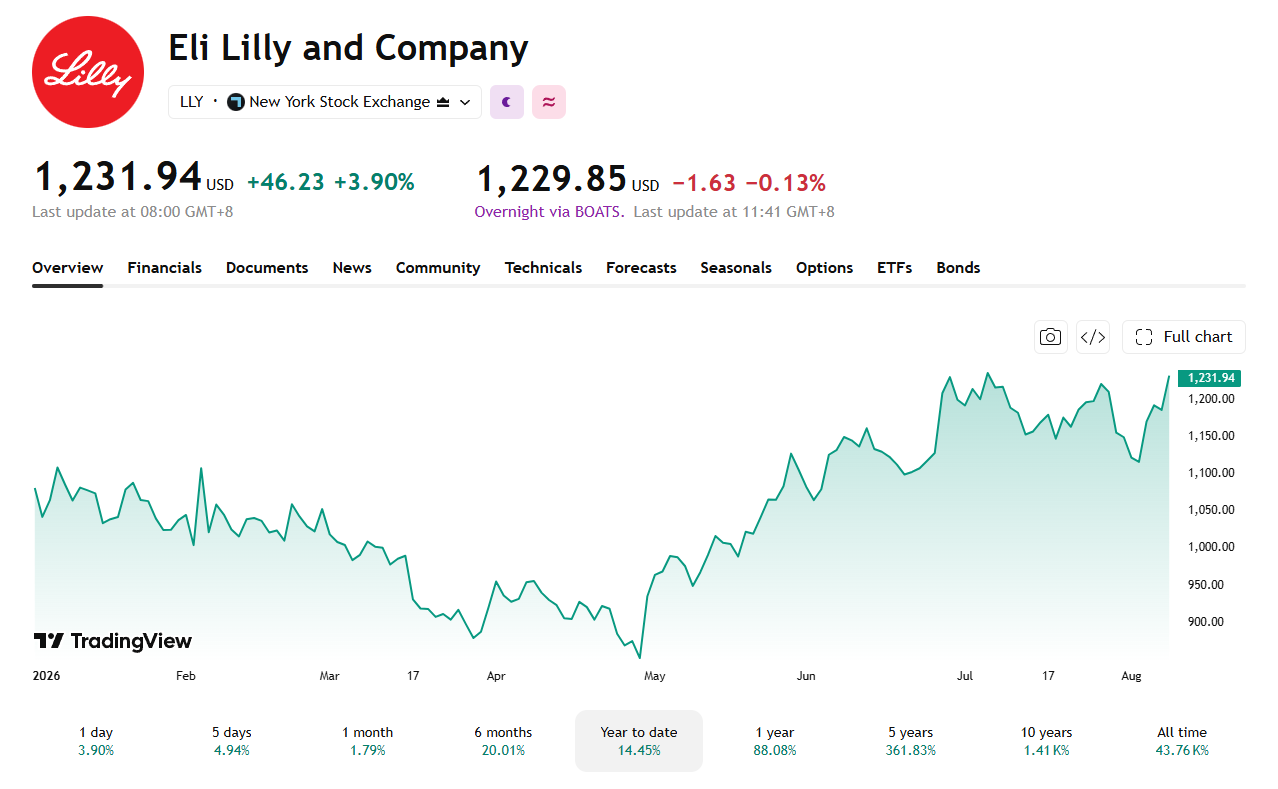
Eli Lilly (LLY) posted a blowout quarter, and Mad Money says the GLP-1 drugmaker’s stock story is far from over.
Jim Cramer and CNBC analyst Jeff Marks called Eli Lilly and Nvidia top momentum stocks.
Why Eli Lilly’s GLP-1 Stock Still Has Room to Run
The comment came during a viewer question about how price targets get set. Cramer raised Eli Lilly and Nvidia’s runs specifically when asking about the process.
Marks, the CNBC Investing Club’s portfolio analyst, said stocks like these need a longer time horizon than most.
“Stocks like that you also have to look out years out in advance, too. Especially in the case of Eli Lilly, where it’s more of towards the end of the decade is where it’s GLP-1 sales.”
— Jeff Marks, CNBC Investing Club portfolio analyst, on Mad Money
Eli Lilly’s second-quarter results back that framing. Revenue hit $23 billion, up 48% year over year. A 60% jump in sales volume offset a 13% drop in realized prices.
Management raised full-year revenue guidance to a range of $85 billion to $87 billion. Mounjaro sales rose 91% to $9.9 billion worldwide. Zepbound’s U.S. revenue grew 44% to $4.9 billion.
Cramer’s other 2026 stock picks lean on similarly durable, multi-year themes rather than short-term trades.
Global GLP-1 Demand Is Still Early
Eli Lilly’s international business is growing even faster than its U.S. business. Revenue outside the U.S. jumped 80% to $8.6 billion in the quarter, while volume surged 113%.

That growth came even as prices outside the U.S. fell 36%. The decline followed Mounjaro’s addition to China’s National Reimbursement Drug List (NRDL), a program covering drug costs under public insurance.
Lower prices widen access for millions of new patients, even as they compress near-term margins. Morgan Stanley expects the global obesity and diabetes drug market to nearly double by 2035.
The firm projects $190 billion in sales, up from $79 billion in 2025. Oral GLP-1 pills and expanding insurance coverage are the main drivers behind that forecast.
For Marks and Cramer, runway and scale are why Eli Lilly’s momentum looks built for years, not quarters.
The post Cramer’s Analyst Says Eli Lilly’s GLP-1 Stock Rally Has Years Left to Run appeared first on BeInCrypto.


Cointelegraph is committed to providing independent, high-quality journalism across the crypto, blockchain, AI, and fintech industries.
All news, reviews, and analyses are produced with full journalistic independence and integrity. For more details on our standards and processes, please read our Editorial Policy.
Crypto World
U.S. SEC sets meeting to propose Reg Crypto to support certain digital assets offerings
“We view this as the first of several rulemakings the SEC will undertake to provide regulatory certainty for crypto assets after the Senate failed before the August recess to advance the Clarity Act on crypto market structure,” TD Cowen analyst Jaret Seiberg wrote in a client note sent after the SEC’s notice.
The proposal is expected to give a path to crypto firms enabling them to raise capital for projects without triggering SEC registration requirements, and the businesses are also expected to be provided an exit path for getting clear of the agency’s jurisdiction when they’re not engaged in hands-on management of the projects anymore.
Before this, Atkins and the agency had rolled through a lengthy series of crypto policy statements meant to clarify its regulatory position on digital assets, but the staff statements have little long-term durability. A formal rulemaking would be more difficult to reverse in the future.
But the rule will likely take further months to develop and finalize. This first stage will come with a comment period — typically two or three months — and be followed by a potentially lengthy rewrite.
Reg Crypto would join some of the other significant steps the agency has taken or is still working on to foster the U.S. crypto industry. One of the major moves was a joint stance with the Commodity Futures Trading Commission on a “taxonomy” to define how they view various crypto assets and which jurisdictions they belong in. The agency is also still working on its tokenized securities approach, which Atkins routinely mentions as one of the SEC’s marquee crypto maneuvers.
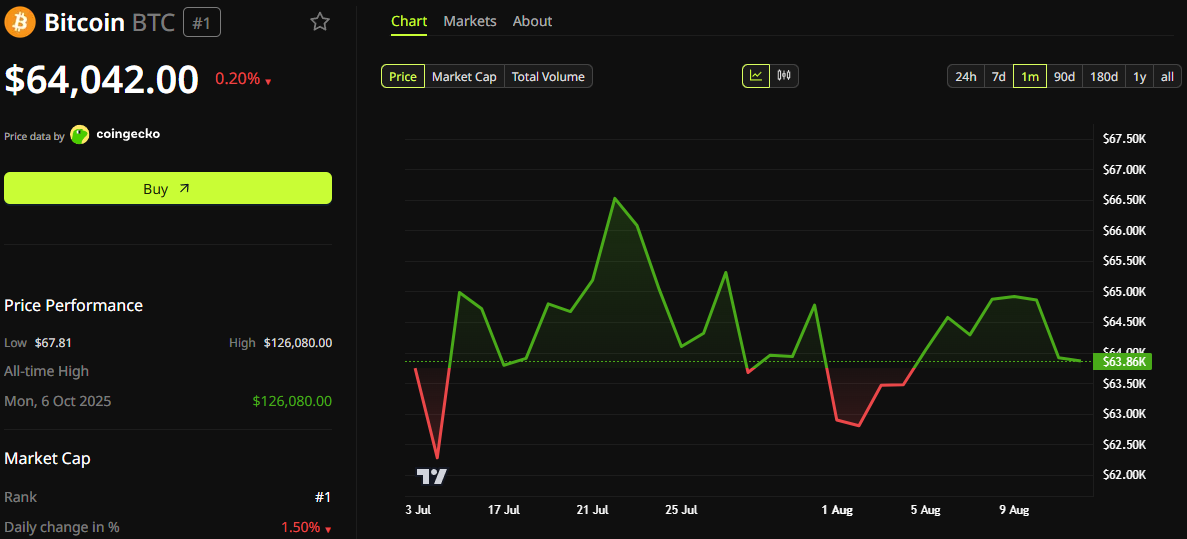
Arthur Hayes says a Fed plan to help Japan defend the yen will print new dollar liquidity, and he argues that liquidity will pump Bitcoin (BTC).
Hayes co-founded BitMEX and now runs the Maelstrom family office. He has built a reputation for macro calls that tie Fed and Treasury policy moves directly to crypto prices.
How A Yen Rescue Becomes Dollar Liquidity
The mechanism he describes is real, though its scale is not yet confirmed. It runs through the Foreign and International Monetary Authorities (FIMA) Repo Facility, a Fed program that lets foreign governments post US Treasuries as collateral for short-term dollar loans, instead of selling those Treasuries outright.
Treasury Secretary Scott Bessent has said Japan holds $1.143 trillion in US Treasuries. Under Hayes’ scenario, Tokyo repos part of that stockpile for dollars, sells the dollars for yen, and reinvests the yen into domestic bonds and stocks.
The Fed’s balance sheet grows to fund each loan, which is functionally similar to printing money, though the Fed frames it as a lending facility rather than quantitative easing (QE).
Hayes’ bet is that these dollars do not stay contained. BTC, in his view, is one of the most liquidity-sensitive assets in the market.

Why The Fed Balance Sheet Matters For Bitcoin
During the pandemic, the Fed’s balance sheet grew from roughly $4.2 trillion to nearly $8.9 trillion by early 2022, an increase of more than $4.6 trillion in asset purchases, according to Federal Reserve research.
Over that stretch, the Bitcoin price ran from under $10,000 to an all-time high near $69,000 in November 2021. Hayes treats that stretch as the template.
There is a second layer. The yen is the world’s cheapest major funding currency, meaning traders borrow yen cheaply to buy other assets. A sudden yen spike forces those trades to unwind fast, which dragged down stocks and crypto together in August 2024.
Hayes argues that routing the rescue through FIMA lets the unwind happen gradually. A sharp Bank of Japan (BOJ) rate hike, by contrast, risks a repeat of that 2024 shock, which he says makes FIMA the friendlier path for BTC.
The Administration Side Checks Out, So Far
Bessent asked the Fed to expand FIMA’s $60 billion lending cap. This was days after the US and Japan jointly intervened to support the yen. He called the facility an important backstop and said he wants its cap raised in the months ahead.
Not everyone agrees FIMA is the right tool. Brad Setser, a former Treasury official, has argued the facility was built to backstop lending in moments of market stress, not to fund currency intervention.
Any cap increase also needs sign-off from the Federal Open Market Committee (FOMC). Fed Chairman Kevin Warsh has not committed to a schedule. Hayes treats the expansion as close to certain. The Fed has not.
Hayes’ own newsletter discloses that Maelstrom is already long Bitcoin, Ether (ETH), and Ethena (ENA). These are the same assets he says this liquidity will lift.
The post Arthur Hayes Says Fed’s Japan Yen Plan Will Pump Bitcoin appeared first on BeInCrypto.


Trump Media said it plans to revamp its digital asset treasury strategy after unrealized losses on crypto and securities helped push the company to a $238 million net loss in the second quarter.
The company reported $190.4 millio n in unrealized losses across its digital assets, pledged digital assets and equity securities in its Q2 earnings release on Monday.
Trump Media said the new framework is intended to preserve its long-term digital asset exposure while managing volatility and improving the productivity of its balance sheet.
Trump Media is the publicly traded company behind Truth Social, Truth+ and financial services brand Truth.Fi. The company is tied to US President Donald Trump, who is the sole beneficiary of a trust that held about 41.1% of Trump Media’s voting power as of Feb. 25, according to its latest annual report.
Related: Trump Media sells Wall Street low-latency access to Trump posts
Its Q2 filing shows the company is already using options to manage Bitcoin volatility and generate premium income, while deploying some BTC through lending and other yield-generating arrangements.
The company also said it plans to direct more resources toward Truth Social, Truth+ and other parts of its media business as part of a broader shift in how it allocates capital.
Trump Media boosts Bitcoin holdings after Q2
Trump Media’s Bitcoin holdings were little changed during the second quarter before the company stepped up its direct Bitcoin exposure in July.
As of June 30, Trump Media held 9,477.16 Bitcoin, down from 9,542.16 BTC at the end of the previous quarter.
Separately, the company had pledged 2,077.34 BTC as collateral for its options strategy. Of its reported holdings, 4,260.73 BTC was serving as collateral for convertible notes.
Related: Strategy turns 1,690 BTC into $108.6M STRC buyback
In July, the company sold Bitcoin-related securities worth $159.6 million and used the proceeds to purchase Bitcoin.
By July 31, Trump Media reported holding approximately 14,139 BTC, including pledged Bitcoin, worth about $890.5 million at the time.
Trump Media flags risks from Bitcoin yield strategy
Trump Media also warned that its efforts to earn additional income from its Bitcoin carry counterparty credit risk and the potential loss of its assets.
The company said it has deployed a portion of its Bitcoin holdings to third parties through lending, placement and other yield-generating arrangements, which it described as relatively new strategies.
Some of those counterparties may not be rated by major credit rating agencies and could default during market downturns, liquidity crises or other financial distress.
If an arrangement is unsecured, the company said it may be unable to recover its Bitcoin if a counterparty becomes insolvent. Trump Media is also limited in its ability to sell or pledge Bitcoin while it is deployed, while counterparties may use those assets at their discretion.
Magazine: Bitcoin will never fall below $60K again: Nansen founder
Indonesian stocks are edging back toward bull-market territory, and one of the rally’s clearest beneficiaries is an AU data center operator whose earnings are compounding regardless of what the rupiah does next.
The Jakarta Composite Index (JCI) has climbed 20% from its early-June low. That rebound follows a rough start to 2026, with the index still down 25% year to date, making it the worst-performing major benchmark globally.
The Rally’s Foundations
Bank Indonesia raised rates by a combined 100 basis points in May and June, MSCI postponed a planned review of the country’s market status until November, and S&P Global Ratings affirmed the sovereign credit rating.
President Prabowo Subianto’s decision to scale back a costly free-meals program has also eased fears of fiscal slippage. Indonesia’s economy grew 5.29% year over year in the second quarter, beating the 5.14% median estimate in a Bloomberg survey.
That backdrop is macro relief, not necessarily a structural bull case.
DCI Indonesia is where the two stories meet.
Where DCI Indonesia Fits
DCI Indonesia is the country’s largest listed data center operator has profited from the AI infrastructure boom and its first-half results show why investors keep buying it through the broader market’s turmoil. Net profit rose 18.7% year over year to Rp732.53 billion ($44 million), while revenue climbed 33.2% to Rp1.77 trillion, driven almost entirely by colocation services, which made up 94.5% of the total.

Just 2.1% of that revenue came from affiliated parties, meaning the growth reflects genuine third-party demand rather than internal deals.
The company has also started parking part of its balance sheet in the Patriot Bond, a debt instrument issued by Danantara, Indonesia’s sovereign wealth fund, carrying a 2% coupon. That holding now accounts for 6.3% of total assets, well above DCI’s historical allocation to marketable securities.
Ai Building in Asia
The demand DCI is capturing lines up with a broader regional shift. Southeast Asia’s AI buildout has increasingly become a physical infrastructure story rather than a software one, according to United Overseas Bank executives, and memory chip demand tied to AI has already driven record profit growth at Samsung elsewhere in the region.
Goldman Sachs, meanwhile, has flagged AI investment as a driver reshaping Asian markets, though it has notably not extended that bullishness to the rupiah.
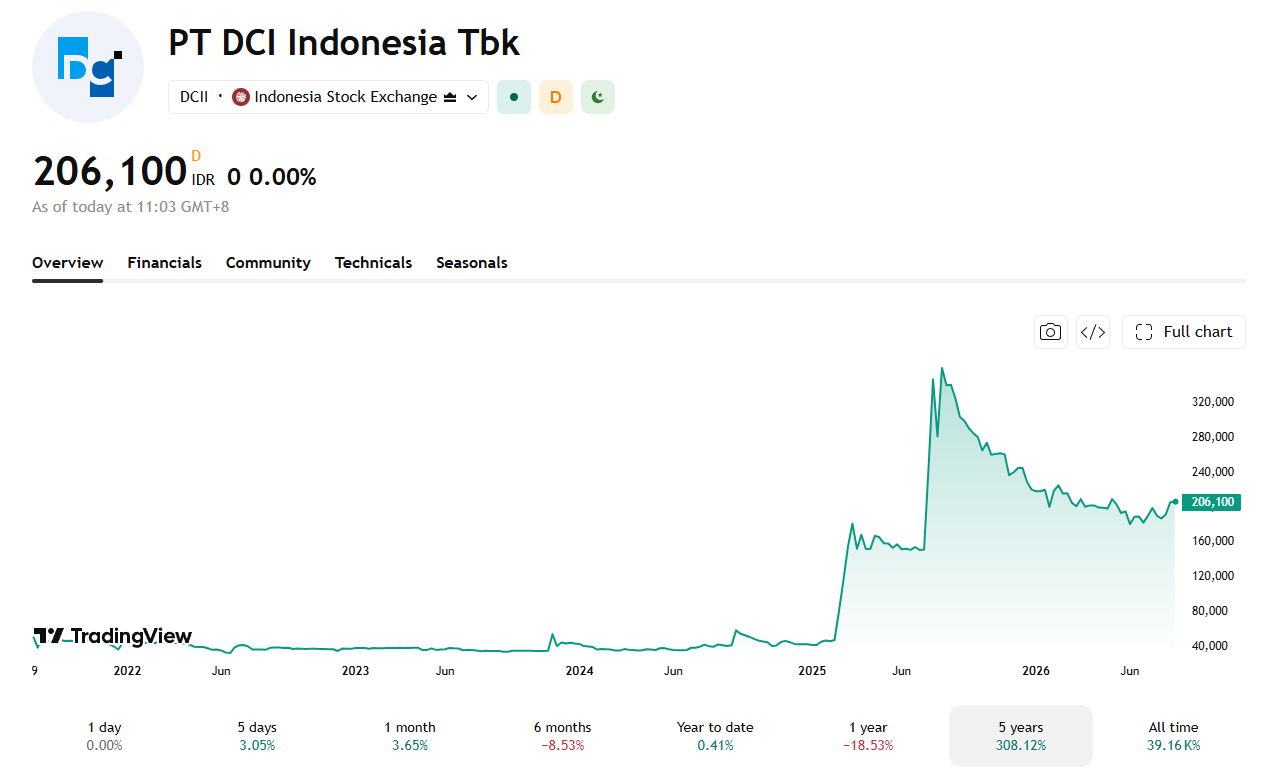
That gap, a regional AI infrastructure boom that Goldman doesn’t yet credit to Indonesia’s currency, is worth watching. DCI’s own share price is still down roughly 18.6% over the past year even after this year’s bounce, meaning its earnings have been growing faster than its stock, the opposite of what tends to happen when a rally is running ahead of fundamentals.
Whether that combination, real profit growth outrunning a cautious share price, is enough to pull more of Jakarta’s market with it is the open question for the rest of 2026.
The post Indonesian Stocks Near Bull Market as DCI Indonesia Profit Jumps 19% appeared first on BeInCrypto.

Trump Media says it will overhaul how it manages its digital-asset treasury after crypto and securities losses contributed to a $238 million net loss in the second quarter. In its Q2 earnings materials, the company attributed $190.4 million in unrealized losses to its mix of digital assets, pledged digital assets, and equity securities, while describing a plan aimed at keeping long-term Bitcoin exposure but reducing balance-sheet volatility.
The publicly traded company—best known as the parent of social platforms Truth Social and Truth+ and the financial services brand Truth.Fi—linked the strategy shift to the need for a more resilient framework. The company noted that the changes are meant to improve the “productivity” of its balance sheet without abandoning its core digital-asset positioning.
Key takeaways
- Trump Media reported $238 million net loss in Q2, with $190.4 million tied to unrealized losses across digital assets, pledged digital assets, and equity securities.
- A new treasury framework is planned to preserve long-term Bitcoin exposure while managing volatility and improving capital efficiency.
- Bitcoin use in hedging and yield activity is already in place, including options-based volatility management and deployments of some BTC to third parties.
- The company increased direct Bitcoin exposure in July, moving from 9,477.16 BTC at quarter-end to about 14,139 BTC by July 31, including pledged BTC.
- Counterparty and liquidity risks are explicitly flagged for Bitcoin-yield strategies, including default risk and limits on selling or pledging deployed BTC.
Why Trump Media is changing its digital-asset plan
Trump Media’s shift comes as investors focus on how publicly traded firms balance crypto exposure with the accounting swings that unrealized losses can create. In its second-quarter reporting, the company said its existing digital-asset and securities positions generated significant unrealized markdowns. Those losses, it said, were part of what drove the quarter’s large net loss figure.
Rather than retreating from Bitcoin, Trump Media emphasized that the revamp is intended to “preserve” long-term exposure while addressing volatility and making the balance sheet work more efficiently. The company also said it plans to direct more resources toward Truth Social, Truth+, and other media operations, framing the treasury shift as part of a broader capital allocation change.
Because the group is tied to former U.S. President Donald Trump, the broader context matters for market watchers. The filing notes that a trust holding roughly 41.1% of Trump Media’s voting power as of Feb. 25 remains the sole beneficiary of Trump Media voting power, according to the company’s latest annual report.
What the Q2 filing says about Bitcoin strategy
Trump Media’s Q2 documentation indicates it is not treating Bitcoin purely as a long-term spot holding. Instead, the company described a framework that already includes options to manage Bitcoin volatility and generate premium income. It also reported using part of its BTC in lending and other yield-style arrangements.
As of June 30, Trump Media held 9,477.16 Bitcoin, down slightly from 9,542.16 BTC at the end of the prior quarter. Separately, it reported pledging 2,077.34 BTC as collateral for its options strategy. The company also said 4,260.73 BTC was serving as collateral for convertible notes.
That structure shows a balancing act: maintaining Bitcoin exposure while ring-fencing assets for derivatives and financing obligations. It also highlights how pledged collateral can constrain a company’s flexibility during drawdowns or liquidity events.
July: Bitcoin-related sales followed by increased BTC exposure
While the second quarter itself left Trump Media’s direct Bitcoin holding relatively stable, the company later stepped up its Bitcoin exposure in July. By July 31, Trump Media said it held approximately 14,139 BTC, including pledged Bitcoin, which it valued at about $890.5 million at the time of reporting.
The path to that increase was tied to an intermediate step: the company said it sold Bitcoin-related securities worth $159.6 million in July and used the proceeds to purchase Bitcoin. This matters because it suggests the company viewed those securities as a temporary component in its capital deployment rather than a permanent replacement for direct BTC exposure.
For readers tracking how non-traditional crypto entrants manage treasury assets, the key takeaway is that Trump Media’s exposure management appears active rather than passive. The company is also maintaining a portfolio where some Bitcoin remains tied up—through pledges and other arrangements—while the headline BTC totals can rise through incremental purchases.
Risks Trump Media says it faces with BTC yield activities
Trump Media’s filings do not just outline how it earns additional income; they also provide a clear warning about the trade-offs. The company stated it deployed a portion of its Bitcoin holdings to third parties via lending, placement, and other yield-generating arrangements, describing these as relatively new strategies.
According to the company, some counterparties may not be rated by major credit rating agencies. That increases the risk that counterparties could default during periods such as market downturns, liquidity crises, or other financial stress.
Trump Media also warned that if an arrangement is unsecured, it may be unable to recover its Bitcoin in the event a counterparty becomes insolvent. It added that its ability to sell or pledge Bitcoin can be limited while assets are deployed, and that counterparties may use the assets at their discretion.
These disclosures are especially relevant when paired with the company’s decision to revamp its treasury strategy. The new framework is positioned as a way to maintain long-term exposure and reduce volatility, but the filings indicate the risk is not only market-driven. It is also operational and credit-driven—tied to whether deployed Bitcoin is recoverable and how counterparties behave under stress.
In other words, the company is trying to enhance balance-sheet performance while accepting that yield-style BTC deployments can introduce new failure modes that typical spot holding does not.
What investors should watch next
Trump Media has flagged both accounting volatility from unrealized losses and credit/liquidity risk from its Bitcoin-yield counterparties. Going forward, investors will likely focus on how the company implements its revamped treasury framework—particularly whether it changes the share of Bitcoin deployed to third parties versus retained as pledged collateral or held directly, and how those choices affect reported results in subsequent quarters.


Bitcoin’s elite holders are quietly loading up again.
The number of wallets holding at least 10,000 BTC has climbed back to 90, a six-month high, according to analytics firm Santiment. Over the past eight weeks alone, the count of these “whale” wallets has risen by six, a 7.1% increase.
The move builds on a broader accumulation trend first flagged four days ago. Since July 29, wallets in the 10–10,000 BTC range (whales and sharks) have accumulated BTC worth $1.5 billion. Santiment noted at the time that the pattern of larger players accumulating while smaller holders sell raised the odds of a move above $70,000 versus a drop below $60,000.
Meanwhile, “micro” wallets have been steadily shrinking throughout August. Santiment links this divergence to two recent catalysts of uncertainty and doubt: The Coldcard hardware-wallet exploit, which drained roughly $120 million worth of bitcoin, and continued delays to the U.S. Clarity Act, the long-awaited crypto market-structure bill that the Senate has now pushed to September.
These trends point to a classic supply rotation, with coins shifting from smaller holders into the wallets of the largest investors, the so-called “strong hands.”

Three chefs settle debate on storing mayonnaise in fridge or cupboard
Australia’s central bank keeps interest rates at 4.35%

Ripple-linked token leads drop as traders eye $70,000 bitcoin


-

 Fashion3 days ago
Weekend Open Thread: Mattifying Sunscreen
-

 Fashion4 days ago
Frugal Friday’s Workwear Report: Cap-Sleeve Pointelle Crewneck Sweater
-

 Sports5 days ago
Jordan Coyle & Cordiamo take Laya Arena Stakes at RDS
-

 News Videos3 days ago
Can Astrology Help Find Gold and Silver Trends? A Financial Astrology Guide
-
 Business5 days ago
US stocks: Dow closes at record on Mideast optimism; SpaceX, AMD drag Nasdaq
-

 Politics5 days ago
Reform UK And Greens Sink To Lowest Favourability Ratings To Date
-

 Tech6 days ago
OpenAI, Anthropic AI agents targeted real people and systems in cyber tests
-

 Business6 days ago
Nvidia Stock Climbs 2.5% as Chip Sector Rally Builds Ahead of AMD Earnings, Nvidia’s Own Report Looms
-

 Crypto World7 days ago
Polymarket targets $20 billion valuation as competition heats up in prediction market sector
-

 Business5 days ago
Supply chain issues impact Ingredion
-
 Crypto World7 days ago
CLARITY Act Senate Vote Locked In, But 60-Vote Hurdle Looms Large
-

 Tech3 days ago
Rinn Pharma & Biopharma to join NordicPharmaTrain network
-
 Crypto World6 days ago
Dow and S&P 500 Hit Records on AI Earnings: When Will the Bubble Burst?
-

 Business2 days ago
How to Start a Cleaning Business: A Step-by-Step Guide
-

 Business2 days ago
Datadog: Best Of Breed For Multiple Reasons
-

 Business2 days ago
BDC Weekly Review: Private BDC Q2 Numbers Are Strong
-
 Crypto World6 days ago
Dollar Index Trapped at 100 as Hawkish Fed Meets Official Selling
-

 Business6 days ago
McDonald’s (MCD) Q2 2026 earnings
-
Crypto World7 days ago
Trump Administration Plans Ban on New Chinese AI Data Center Components: Report
-

 Fashion6 days ago
The Bright Side of Black and White
You must be logged in to post a comment Login