

Crypto World
Polymarket Eyes Japan Entry Amid Global Crypto Regulatory Scrutiny


Polymarket, a global prediction market platform, is pursuing a launch in Japan as regulators worldwide tighten scrutiny of the sector. Bloomberg reported that Polymarket has appointed Mike Eidlin—formerly the head of Japan at crypto firm Jupiter—to lead its local efforts and to push for regulatory authorization to operate prediction markets in the country. The company is aiming for government approval by 2030, signaling a long-range strategy to tap what it views as a sizeable, underpenetrated market.
The expansion plans come amid a broader tightening of regulatory oversight affecting prediction markets globally, with Polymarket and peers such as Kalshi facing increased scrutiny in multiple jurisdictions. Authorities in several regions have moved to curb or constrain access to these platforms, underscoring the compliance and licensing challenges inherent in cross-border operation.
Key takeaways
- Polymarket has named Mike Eidlin, the head of its Japan efforts at Jupiter, to spearhead a regulatory-entry push in Japan, with an aspirational timeline targeting 2030 for authorization, according to Bloomberg.
- Japan’s online betting regime is highly restrictive, permitting wagering only on select government-authorized activities such as horse racing and public lotteries, creating a substantial regulatory hurdle for prediction markets.
- Polymarket already maintains a prominent Japan-focused presence on social media, with a Tokyo-facing account amassing more than 53,000 followers, though the country remains within a roster of 35 restricted jurisdictions for the platform.
- Trading activity on Polymarket has cooled amid global regulatory pressure and rising competition from Kalshi, with notional volume dipping in recent months while Kalshi’s volume has risen.
- Global access to Polymarket has tightened, with about 34 countries blocking the platform and several others restricting access to “close-only” participation; India has stepped up enforcement against online betting platforms, signaling heightened regulatory risk for operators.
Polymarket’s Japan push: leadership, timelines, and regulatory strategy
Bloomberg’s reporting indicates that Polymarket has engaged a local executive to navigate Japan’s regulatory labyrinth and to lobby for formal authorization to offer prediction markets in the country. The appointment of Mike Eidlin—who previously led Polymarket’s Japan-focused operations—signals a deliberate, policy-oriented approach to market-entry that prioritizes licensing over rapid deployment. Polymarket publicly framed its objective as evaluating opportunities to expand access globally in ways that align with local rules, while acknowledging the complexity of obtaining regulatory approval in a jurisdiction with stringent gambling laws.
Industry observers note that achieving a formal green light in Japan would require a carefully designed compliance framework, licensing arrangements, and ongoing regulatory engagement. The 2030 target suggests a phased approach, likely beginning with pilot arrangements or restricted product offerings before any broader rollout. This strategy reflects a common pattern for cross-border entrants seeking to balance innovation with a robust regulatory posture in high-scrutiny markets.
Polymarket did not provide a response by publication time to requests for comment. The company’s efforts in Japan should be understood within a wider context of regulatory crosswinds affecting prediction markets, including U.S. and European discussions around licensing, consumer protections, and AML/KYC compliance standards. As noted in coverage surrounding the sector, the path to authorization in any jurisdiction is contingent on aligning product design, disclosure, and enforcement practices with local laws and regulatory expectations.
For context, Cointelegraph has highlighted that the sector is under tightening scrutiny, with enforcement actions and policy changes shaping how prediction markets operate and are accessed by users across borders. These regulatory dynamics underscore the importance of a careful, policy-driven approach to any expansion plan.
Japan’s gambling regime and market-entry hurdles
Japan imposes strict limits on online gambling, permitting wagering only on government-approved activities such as horse racing and public lotteries. This framework creates a formidable starting point for any platform seeking to host prediction-market-style products, which traditionally blur lines between gaming and forecasting.
Regulatory risk is further amplified by penalties associated with online betting violations. Recent enforcement trends and public reporting indicate that violations can attract fines and potential imprisonment for repeat offenses, underscoring the seriousness with which authorities treat online gambling and related activities.
Polymarket has acknowledged “meaningful organic interest from users” in Japan and across Asia, while reiterating its commitment to expanding access in ways that are compliant and locally appropriate. The country’s regulatory posture suggests that any entry will require significant adaptation to product design, risk controls, and licensing requirements to meet local standards. Additionally, Polymarket’s country-access policy lists Japan among 35 restricted jurisdictions, including the United States, indicating a cautious stance toward direct participation from certain regions. Past reporting also suggested that users in restricted regions may access the platform via circumventions such as VPNs, highlighting ongoing enforcement and the broader challenges of cross-border compliance.
In terms of market visibility, Polymarket’s Japan-focused social media presence—measured by follower count on X (formerly Twitter)—is notable, with the account reportedly exceeding 53,000 followers. This level of digital engagement operates as a signal of interest but does not substitute for regulatory authorization, licensing, or consumer-protection compliance in the local market.
Global regulatory pressure and market dynamics for prediction platforms
Polymarket’s trading volumes have faced headwinds as scrutiny over prediction markets has intensified. Data from market analytics platforms show a decline in Polymarket’s monthly notional trading volume in recent periods, contrasted with a rising trajectory for rival Kalshi. This divergence reflects a broader shift in the competitive and regulatory landscape, where operators contend with both enforcement actions and evolving licensing regimes across jurisdictions.
Access restrictions have grown more pervasive on a global basis. Start Polymarket tracks a roster of roughly 34 blocked countries, with additional markets applying “close-only” restrictions that limit participation in certain product categories. Meanwhile, India has emerged as a focal point of regulatory action, with authorities reportedly preparing blocking orders against Kalshi following earlier steps against Polymarket, signaling a heightened enforcement posture in one of the world’s fastest-growing digital markets.
These enforcement and market-structure dynamics have important implications for banks, exchanges, and institutional users. The need for robust KYC/AML controls, licensing compliance, and cross-border regulatory coordination becomes central to any platform seeking to operate internationally. For jurisdictions contemplating new regimes, the policy alignment considerations extend to licensing pathways, data-sharing arrangements, and compliance monitoring frameworks that can withstand multijurisdictional scrutiny.
From a policy and historical context, the broader debate around prediction markets continues to intersect with legitimate concerns about consumer protection, market integrity, and the potential for harmful use cases. Regulators are weighing how to balance innovation with safeguards, a calculus that directly affects how platforms design products, obtain licenses, and interact with financial and gaming authorities. As this sector evolves, institutional readers should monitor developments in major markets, including potential regulatory milestones in Japan, the United States, and the European Union, where ongoing discussions around licensing and cross-border access could redefine operating models for prediction markets.
Looking ahead, policymakers and industry participants will need to navigate a complex mix of jurisdiction-specific licensing requirements, AML/KYC standards, and consumer-protection regimes. The trajectory of Polymarket’s efforts in Japan, combined with ongoing global enforcement activity, suggests that the next several years will bring continued regulatory clarity—and potential restrictions—that will shape how prediction markets operate within compliant, bankable, and institutionally acceptable frameworks.
Closing perspective: as regulatory expectations sharpen, the feasibility of a major, globally accessible prediction-market footprint hinges on disciplined licensing, rigorous compliance, and transparent product governance. The 2030 timeline for Japan remains contingent on legal developments, regulatory alignment, and the ability of the operator to demonstrate robust safeguards and enforceable user protections in a highly regulated environment.

Ethereum remains under significant pressure across higher and lower timeframes after losing several major technical levels in quick succession. While the recent rebound from the local bottom around $1.5K has provided some short-term relief, the broader structure still favors sellers unless ETH can reclaim a series of key resistance zones overhead.
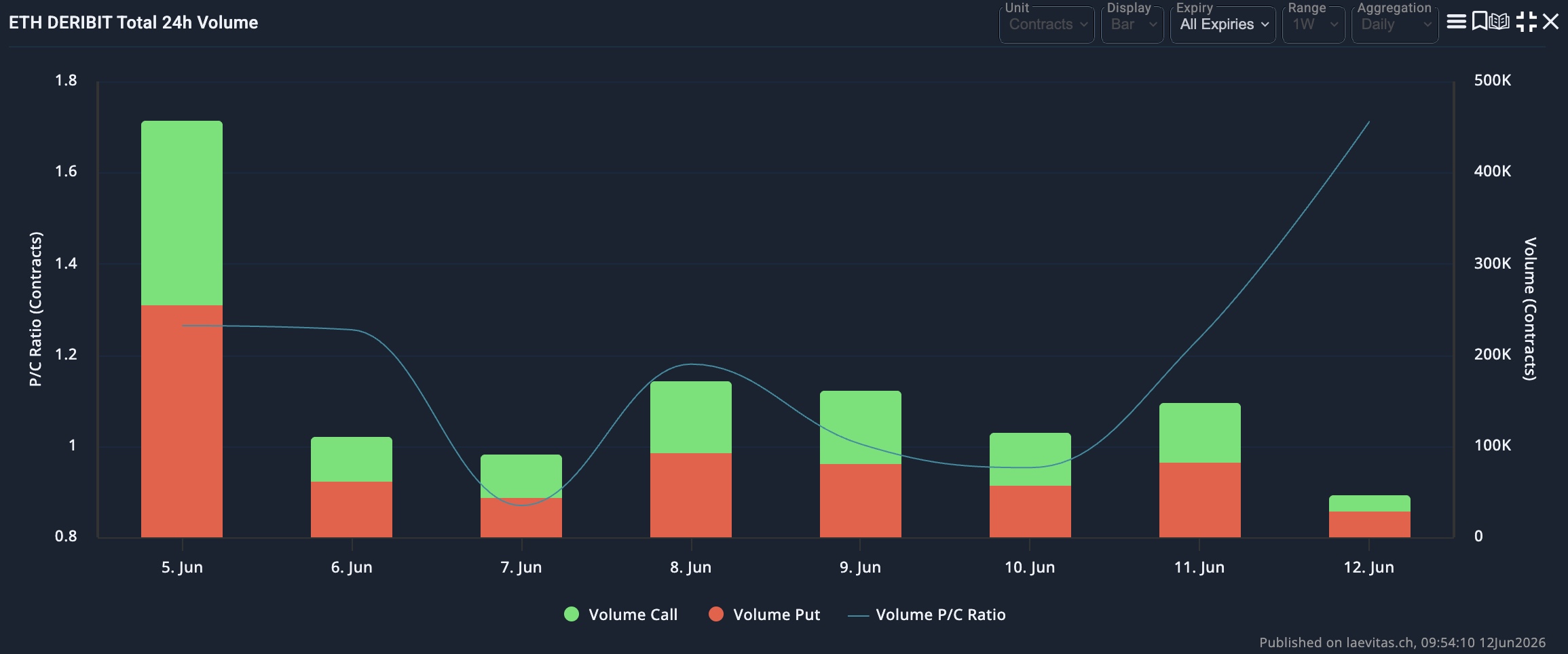
Moreover, the rising put/call ratio suggests increasing caution and demand for downside hedging among options participants, rather than growing bullish exposure.
Ethereum Price Analysis: The Daily Chart
The daily chart shows a decisive breakdown from a multi-month bearish flag that had been developing since February. After repeatedly finding support along the rising lower trendline, ETH eventually lost the structure and accelerated lower in a clean, measured move.
The sell-off began when the price was rejected from the long-term descending trendline near the $2.4k level, which also pushed the asset below the 100-day moving average. The 100-day moving average, currently around $2.1K, has now flipped into resistance. Meanwhile, the 200-day moving average remains significantly higher near $2.4K. This indicates the overall strength of the broader downtrend.
Following the breakdown, ETH sliced through the major support zone at roughly $1.8K. This area previously acted as a strong demand region and is now likely to serve as resistance against any recovery attempt. A bearish Fair Value Gap (FVG) was also formed at approximately the $1.9k area, which creates another supply zone where sellers may re-enter the market in case of a retest.
The recent decline eventually found demand around the $1.5K support region, which triggered a relief bounce. However, despite recovering from the lows, ETH remains trapped beneath the former support area and has yet to invalidate the bearish breakdown.
As long as the price remains below the $1.8K-$1.9K resistance cluster, the broader outlook remains cautious. While the RSI has also rebounded from oversold conditions, it still remains below bullish territory. It indicates that momentum has improved but has not yet shifted decisively in favor of buyers.
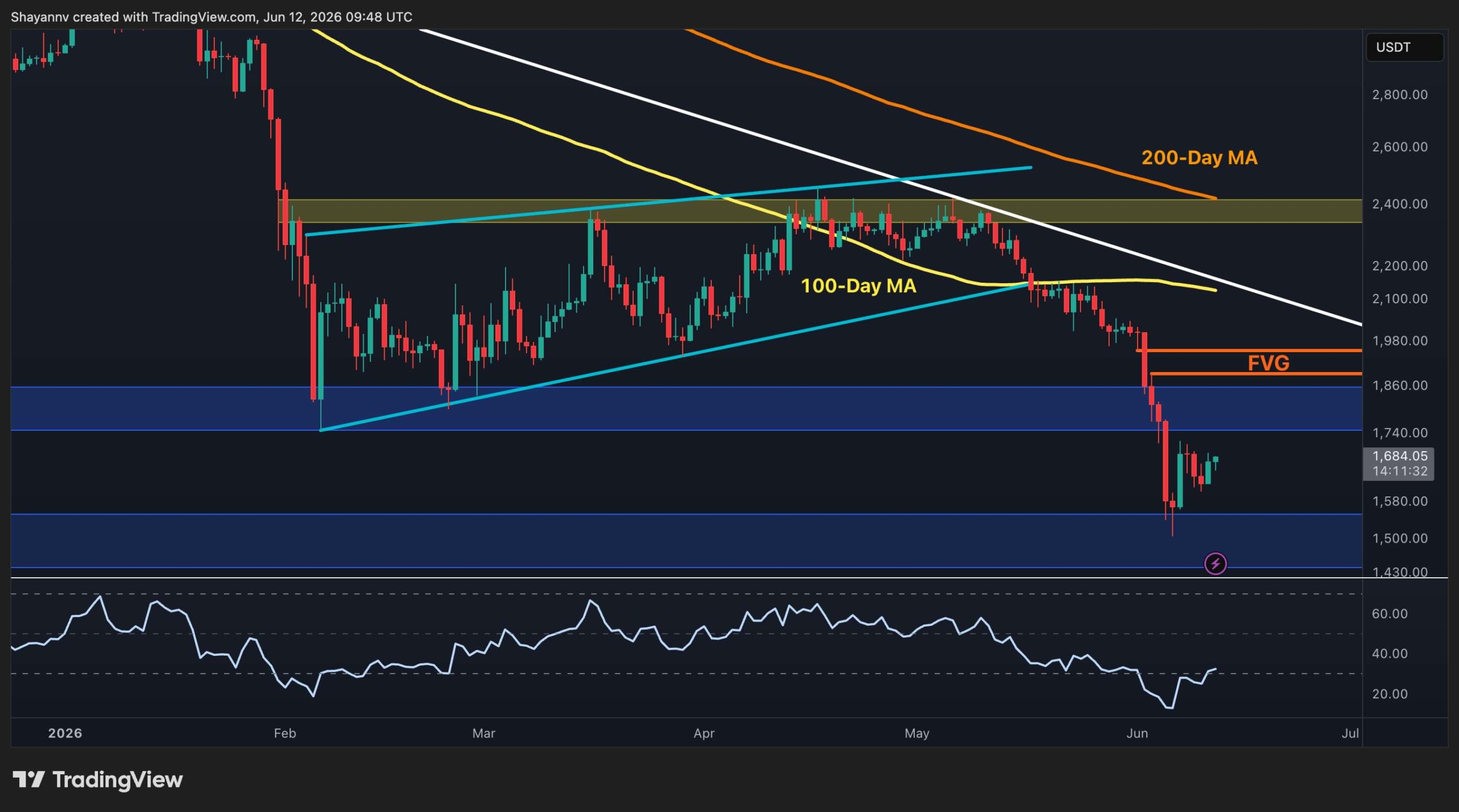
ETH/USDT 4-Hour Chart
On the 4-hour timeframe, ETH experienced a sharp impulsive decline from the $2K region before finding support at the $1.5K demand zone. The bounce that followed appears corrective rather than impulsive, indicating that buyers have not yet regained control of the trend.
The market is currently trading around $1.68K while remaining below the 0.5 Fibonacci retracement level at approximately $1.76K. Above that, a dense resistance cluster exists between the 0.618 and 0.786 retracement levels, stretching from roughly $1.8K to $1.9K.
This Fibonacci zone aligns closely with a key bearish order block formed during the recent sell-off, making it a critical battleground. Any recovery into this range could attract renewed selling pressure from market participants looking to exit losing positions.
On the downside, the $1.5K support area remains the most important level. Losing this area would likely increase the probability of another leg lower and confirm that the recent rebound was merely a temporary pause within the broader downtrend.
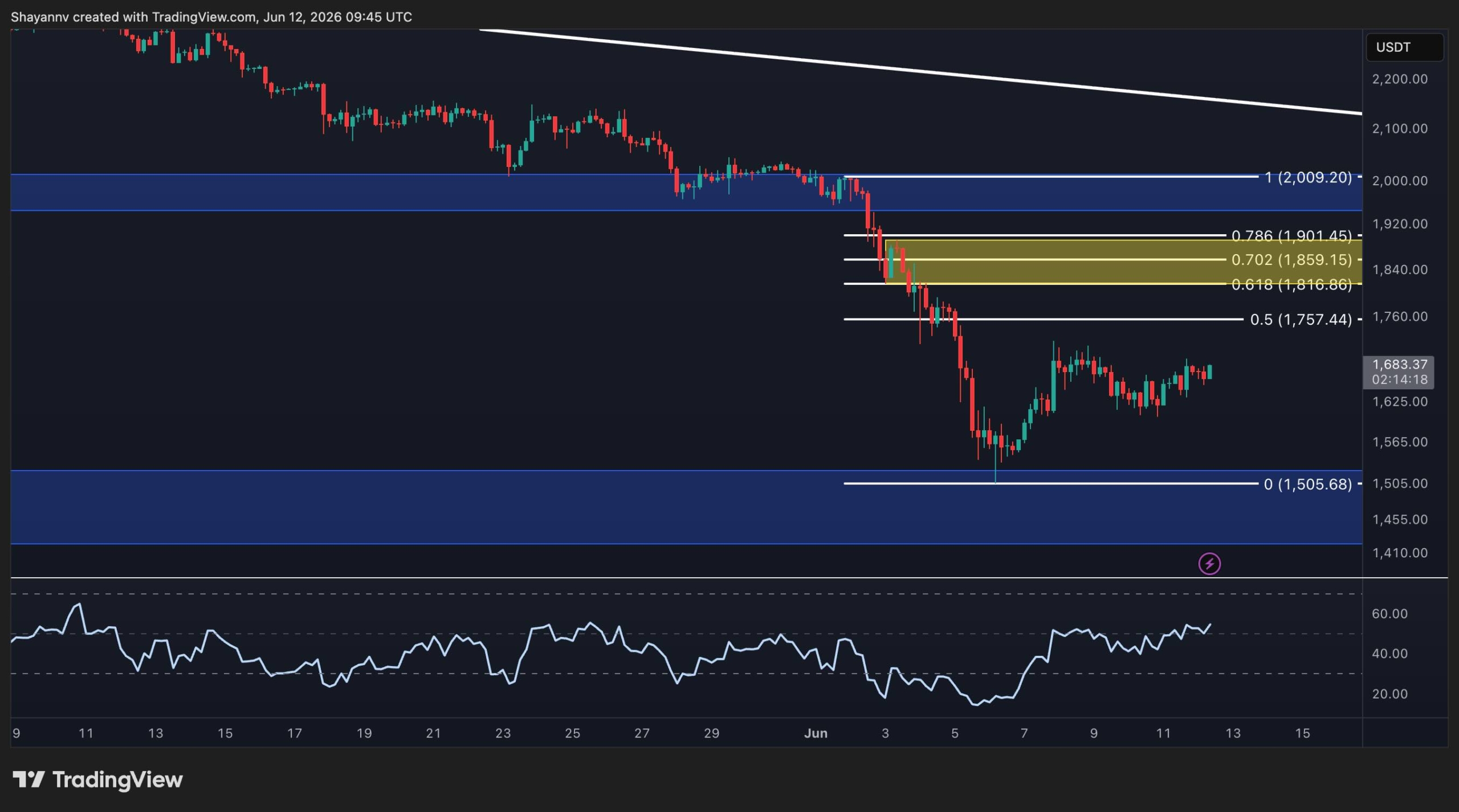
Sentiment Analysis
The derivatives chart highlights recent week’s ETH options activity on Deribit through the Put/Call volume ratio. Earlier in the week, the ratio declined below 1, which indicated that call volume was beginning to outpace put volume. This is a classic sign of improving trader sentiment.
More recently, however, the ratio has surged sharply toward 1.7 while overall daily volume remains relatively subdued. This suggests a significant increase in put activity relative to calls. Therefore, there is growing demand for downside protection despite ETH’s short-term rebound.
The divergence between recovering price action and rising put demand shows that options traders remain cautious about the sustainability of the current bounce. In other words, while spot buyers have stepped in around $1.5K, derivatives participants are still hedging against the possibility of another downside move.
For sentiment to improve meaningfully, ETH would likely need to reclaim the $1.8K-$2K resistance region while the put/call ratio begins trending lower again. Until then, the options market suggests that traders remain defensive despite the recent recovery attempt.
The post Ethereum Price Analysis: ETH’s Next Rally Attempt Hinges on This Key Level appeared first on CryptoPotato.


Charles Hoskinson thinks he can solve Cardano’s spiralling social reputation by muting everyone on X and increasing censorship on Discord.
The problem with the Cardano (ADA) community, he explained yesterday, isn’t the 50% decline in ADA year-to-date, its 75% decline over the last year, or its 94% collapse over the last five years.
Nor is the problem Cardano’s graveyard of failed initiatives, ongoing forensics into early ADA sales, or the canceled Cardano summit.
The problem is mean tweets and drama on X.
Hoskinson posted on Thursday that he’s plotting a “great migration” of the Cardano community off X and onto a censored, i.e. “well-moderated,” Discord server.
In this great new Discord, thanks to moderators’ speech censorship, members will be able to “leave behind the drama, lies, endless rage, and embittered people.”
Such people aren’t on Discord, presumably, or at least won’t be speaking within Hoskinson’s well-moderated channels.
Hoskinson spoke with EMURGO chief executive Phillip Pon, appointed last year, about building this great server.
Future Ask Me Anything sessions will pull questions from Hoskinson’s new Discord, but he admitted that he’ll keep livestreaming on X because the audience is large and therefore worthwhile for its reach.
Read more: Cardano crisis: senior dev quits after Hoskinson calls in the feds
Cardano’s new ‘well-moderated’ Discord server
Even though most people will remain on X, Hoskinson’s “happy, positive” channels will be the place for “real conversations,” — provided those conversations comply with his moderators’ discretion.
In early June, analytics platform TapTools, a fixture of Cardano ecosystem, announced it was winding down.
The 2026 Cardano Summit was scrapped after the governance community voted down its treasury funding. Hoskinson himself expects more Cardano projects to struggle in the current bear market.
Protos has documented the founder’s combative streak before, including a senior developer resigning after Hoskinson backed an FBI investigation into a stake pool operator and dismissed the fallout as “complete bulls*** and ridiculous.”
Within hours, the bizarre announcement about Hoskinson’s “well-moderated” Discord server was trending on X, the platform he wants everyone to abandon, racking up tens of thousands of views about a man who would prefer to have censorship power over the conversation.
Got a tip? Send us an email securely via Protos Leaks. For more informed news and investigations, follow us on X, Bluesky, and Google News, or subscribe to our YouTube channel.

Metaplanet announced on Friday that it has agreed to acquire Siiibo Securities in a 2.1 billion yen ($13.1 million) deal to form a securities arm.
The Tokyo-listed Bitcoin (BTC) treasury company said it entered into a share transfer agreement to acquire 100% of the Japanese securities company, a licensed financial instruments business operator. After closing, expected in July, Siiibo Securities will become a wholly owned subsidiary and be renamed Metaplanet Securities.
Metaplanet CEO Simon Gerovich said the acquisition is the first step in Project Nova, the company’s strategy to build a Bitcoin-centric financial ecosystem in Japan.
“We will develop and distribute Bitcoin-related yield products directly to Japanese investors, supported by the 40,177 BTC on our balance sheet,” he wrote.
The company said Siiibo’s licensing, corporate bond platform and customer base would allow Metaplanet to develop income-oriented products like BTC-linked bonds, while giving it direct access to investors seeking yield in Japan.
Metaplanet’s Bitcoin stash has a net asset value of 457.6 billion yen (about $2.8 billion), making it the largest publicly listed BTC holder in Japan and the third-largest in the world, according to data tracker Bitcoin Treasuries.
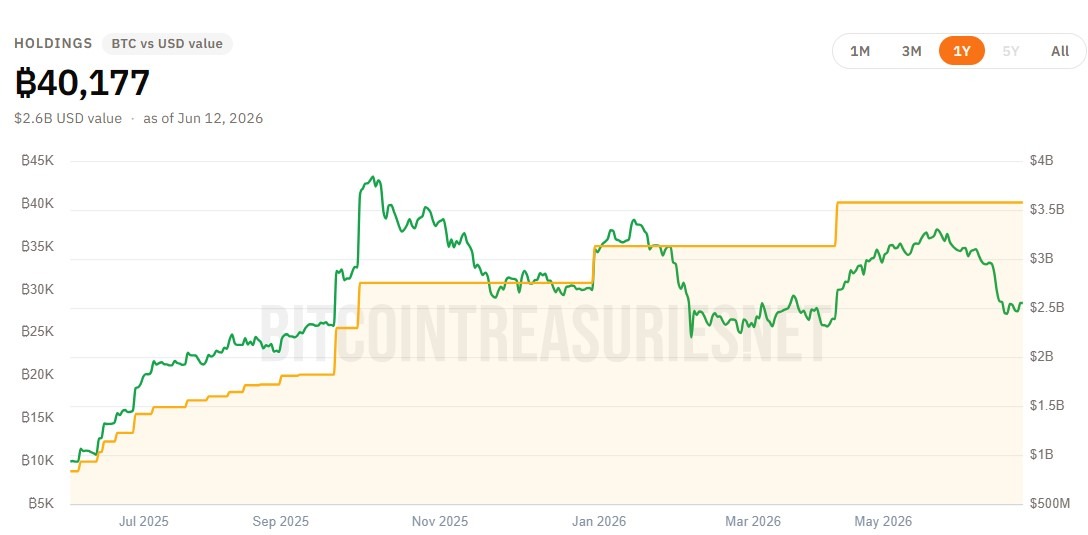
Metaplanet’s Bitcoin treasury holdings. Source: Bitcoin Treasuries
Japanese firms prepare for crypto’s move into finance
Metaplanet’s securities push adds it to a growing list of Japanese financial and crypto firms positioning themselves ahead of a regulatory shift that could bring digital assets closer to the country’s traditional financial markets.
Japan’s Lower House reportedly passed a bill on Thursday that would bring crypto assets under the country’s financial instruments framework, potentially opening a path to crypto exchange-traded funds and more favorable tax treatment for digital assets.
Related: Japan approves bill to classify crypto as financial instruments
Japan’s market infrastructure firms are also testing how digital assets could fit into existing capital markets. In April, the Japan Securities Clearing Corporation, part of Japan Exchange Group, said it would launch a proof of concept with Mizuho, Nomura and Digital Asset to test the use of Japanese government bonds as digital collateral on the Canton Network.
SBI Shinsei Bank is reportedly preparing a deposit-linked crypto rewards service that would allow customers to receive vouchers redeemable for Bitcoin, Ether or XRP through SBI VC Trade. SBI’s broader group has also been expanding across crypto exchange services, stablecoin lending and planned securities products, including investment trusts and ETFs tied to crypto assets.
Magazine: Does ‘Paper Bitcoin’ mean there’s an unlimited supply of BTC?
Crypto World
AVAX Price Prediction: Treasury Stock Tumbles 38% on Nasdaq Debut as Crypto Proxy Trade Unravels
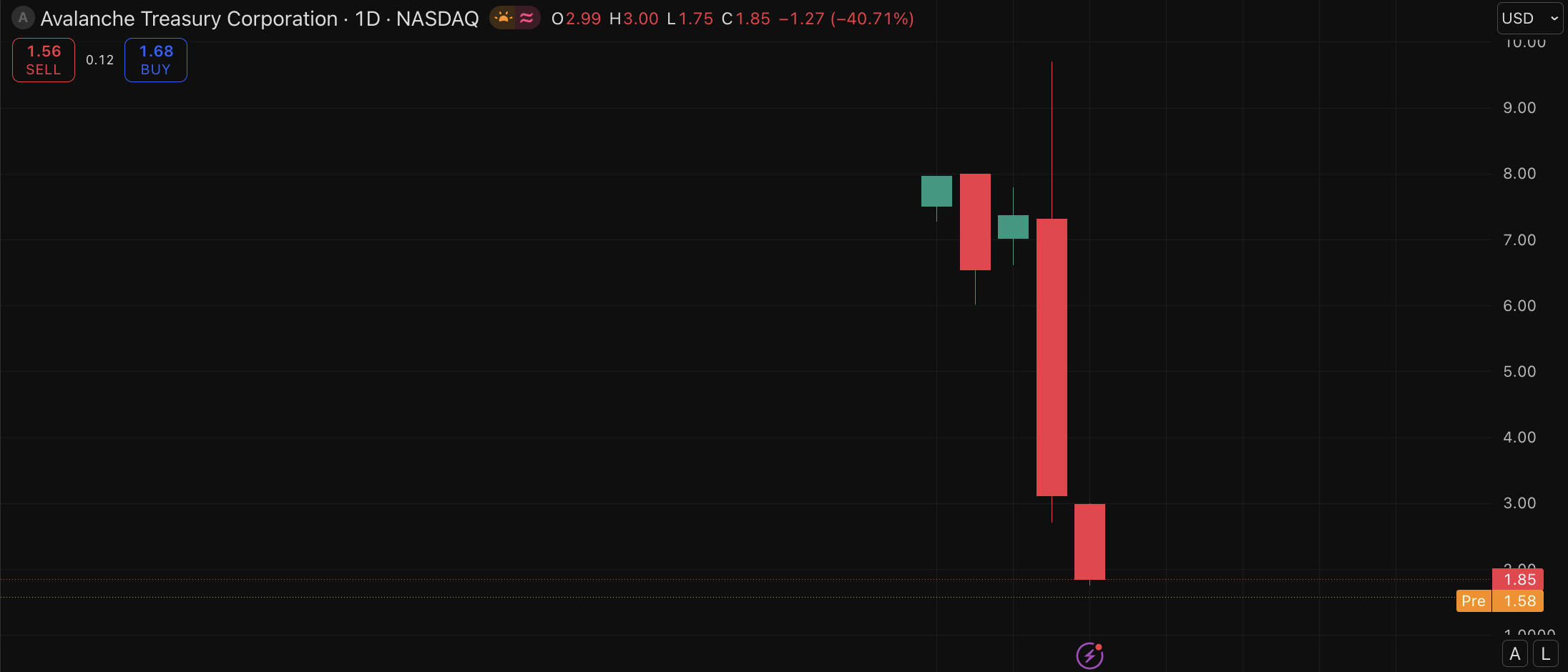
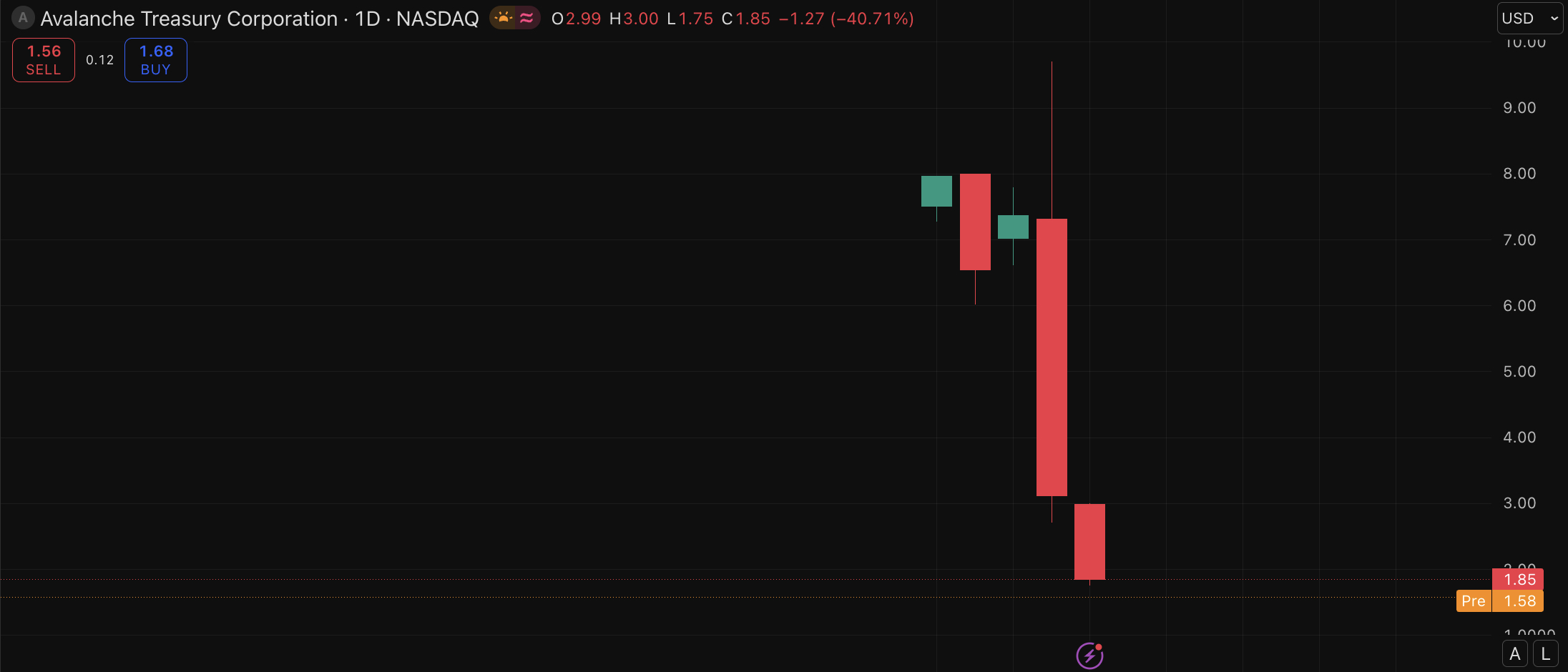
Avalanche Treasury Co. opened at $2.99 on Nasdaq Thursday and closed at $1.85, a 38% wipeout on its first session under the ticker AVAT. The intraday low hit $1.75. That is a brutal verdict from a market that was offered a 0.77x mNAV entry, a ~23% structural discount to buying AVAX outright. Why has this happened? Is AVAX price prediction really that bearish?
The underlying asset is not helping. AVAX trades at $6.6, down 33% over the past month, and sits more than 95% below its all-time high. The digital asset treasury vehicle launched into one of the worst altcoin environments in two years.
AVAT reached public markets through a $675 million SPAC merger with Mountain Lake Acquisition Corp., a deal announced in October 2025. The company positions itself not as a passive token accumulator but as an active crypto treasury deploying capital across the Avalanche ecosystem.
Discover: The Best Crypto to Diversify Your Portfolio
The SPAC Structure and the Pitch
At launch, AVAT held approximately 15 million AVAX tokens, 3.5% of the circulating supply, against an initial treasury capital of $460 million. The company secured an exclusive arrangement with the Avalanche Foundation for discounted AVAX purchases and an 18-month priority on Foundation token sales to U.S. institutional crypto vehicles.
CEO Bart Smith, a former Susquehanna and AllianceBernstein executive, frames AVAT explicitly as an institutional crypto operating business rather than a simple proxy hold. His own words:
It is not a bet on price. We believe it is an investment into Avalanche that represents meaningful potential for the repositioning of institutional finance.”
The gap between that and a close of $1.85 is wide enough to drive a truck through. AVAX’s spot price at $6.6 means the treasury’s mark-to-market value moved sharply against the company before it executed a single ecosystem investment. The ‘active allocator’ pitch requires time and deal flow to validate.
AVAX Price Prediction: $6.6, a Structure That Needs a Floor
AVAX at $6.6 is down 33% over 30 days. Once a top 10 crypto by market cap, is now ranked 33rd. On the lower time frame, the critical floor to watch is the $6.00 level; a weekly close below that figure opens a test of the $5.20–$5.40 zone, the last significant demand cluster before the token enters price discovery territory not seen since late 2020.
Resistance is stacked at the $7.80 level, the range where AVAX consolidated briefly in May before the latest leg lower. A reclaim of $8.50 on sustained volume would shift the short-term structure from broken to neutral. Heavier resistance clusters near $10.50, which corresponds to the 2025 accumulation band and would require a meaningful reversal in broader altcoin sentiment to challenge.

The RSI on the weekly timeframe remains in oversold territory, consistent with the conditions that preceded AVAX’s 2023 recovery, but that historical parallel requires macro conditions to cooperate in a way they have not yet signaled. The structure is broken at the current levels. A close above $8.20 is the minimum requirement to argue otherwise.
Discover: The Best Token Presales
The post AVAX Price Prediction: Treasury Stock Tumbles 38% on Nasdaq Debut as Crypto Proxy Trade Unravels appeared first on Cryptonews.

CoinDesk Indices presents its daily market update, highlighting the performance of leaders and laggards in the CoinDesk 20 Index.
The CoinDesk 20 is currently trading at 1711.6, down 0.3% (-4.68) since 4 p.m. ET on Thursday.
Ten of 20 assets are trading higher.

Leaders: NEAR (+2.7%) and ADA (+1.0%).
Laggards: CRO (-1.4%) and ETH (-1.0%).
The CoinDesk 20 is a broad-based index traded on multiple platforms in several regions globally.
This Friday, we examine Ethereum, Ripple, Cardano, Binance Coin, and Hyperliquid in greater detail.
Ethereum (ETH)
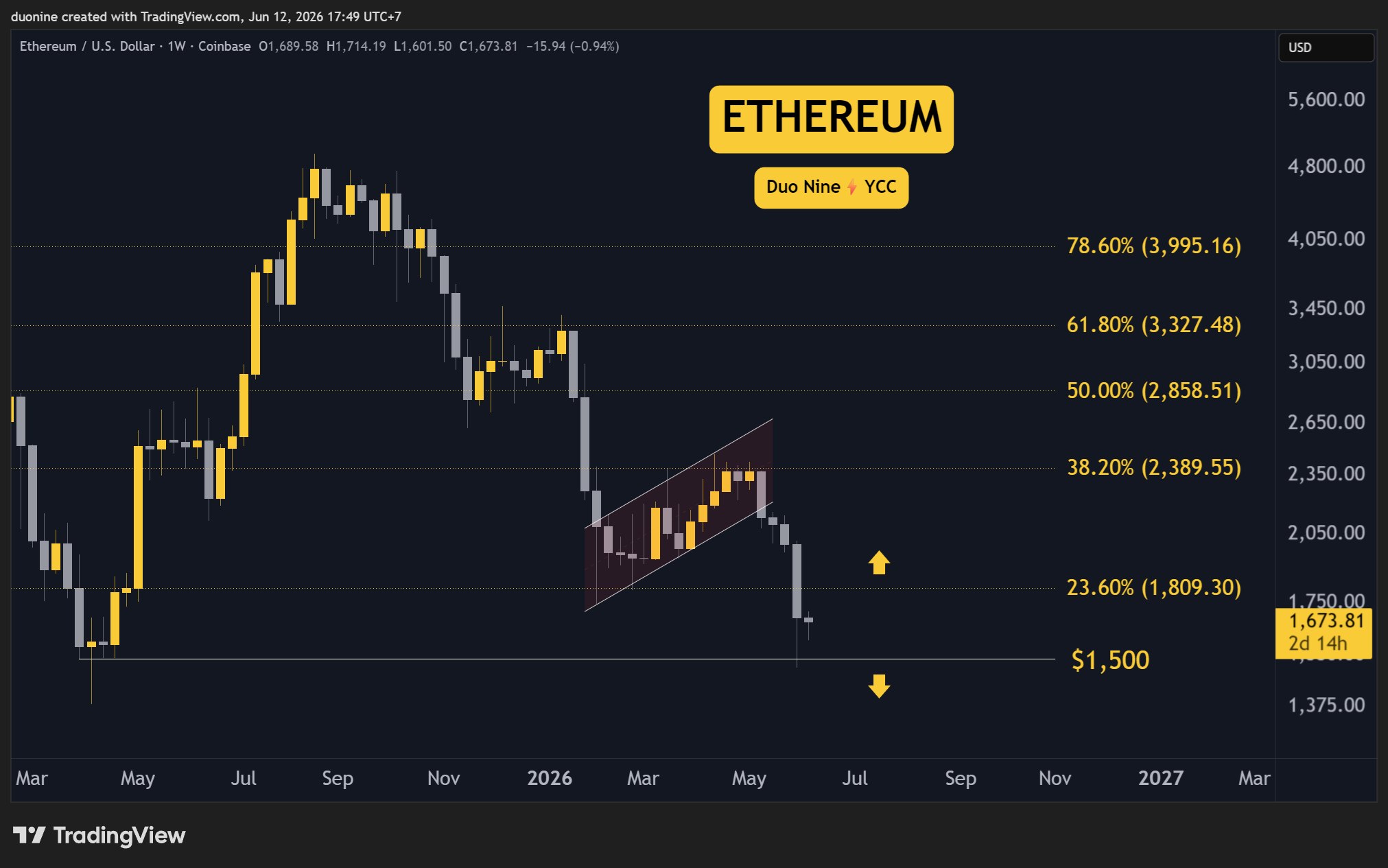
This week, Ethereum remained flat as it hovered above the key support at $1,500. Sellers seem to be taking a break after the price crashed by 37% since early May.
Buyers are likely to be quite active at this key support since this level held well in the past and was the pivot point from where ETH reached almost $5,000 in August 2025.
Looking ahead, Ethereum is approaching a critical junction. If it can hold here, it will be a sign of strength and may push the price into a relief rally. However, any weakness at $1,500 could spell disaster for the asset if it makes a lower low. That would encourage sellers to return in force.
Ripple (XRP)
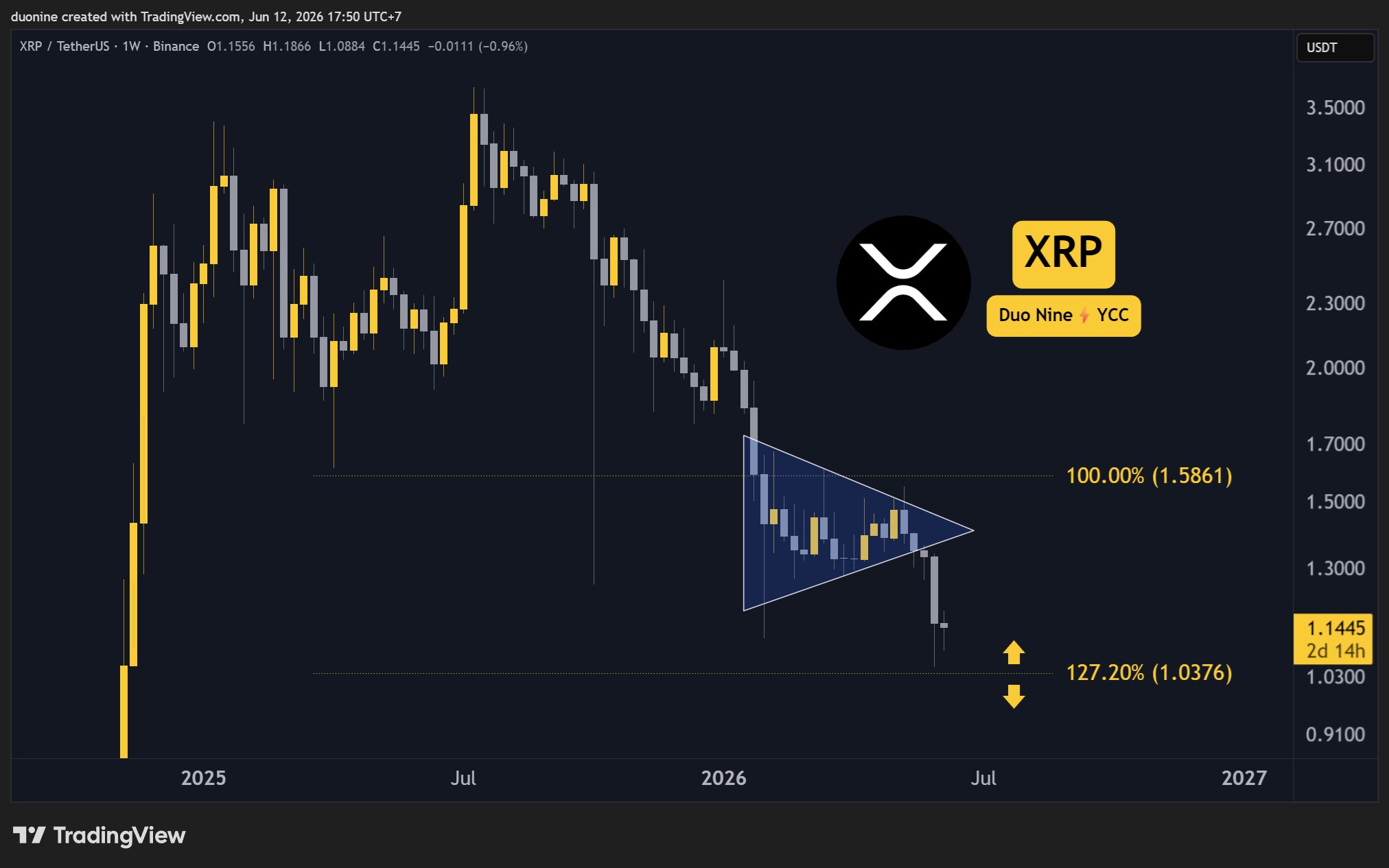
XRP closed the week with a modest 1% gain. While this is not much, the more important development is that the support at $1 continues to hold well despite a recent attempt by sellers to break it.
However, the battle is not over, and a new test of this key psychological level seems likely. If buyers can defend against a second attempt at a breakdown, XRP could see renewed interest.
Looking ahead, the most important levels on this chart are found at $1 and $1.3, with the latter acting as a key resistance. That level will have to break if bullish momentum is to form in the future.
Cardano (ADA)
Surprisingly, ADA had a good week with a 4% gain. While this was not enough to recover the loss of support at $0.24, which is now acting as resistance, it did allow for a brief relief.
So far, $0.15 appears to be holding well as support and managed to stop sellers from totally dominating the chart. However, the overall bias remains bearish on ADA, as it has been consistently making lower lows since 2025.
Looking ahead, the loss of the support at $0.24 was a major defeat for bulls, and it may take a long time until it can be recovered. That’s because, so far, Cardano’s token does not give any signs of finding a bottom.

Binance Coin (BNB)
Binance Coin is up 2% this week and managed to hold well above the key support at $580. This level has been tested several times in 2026, and sellers were always turned away once the price arrived there.
Equally, BNB also failed to break the key resistance at $690, which has kept the price in check throughout 2026. It could be argued that this cryptocurrency has been moving sideways all year between $580 and $690.
Looking ahead, Binance Coin’s price action shows no decisive trend in 2026. Until one of the key levels is broken, it is unlikely that the asset will do any significant moves.

Hyperliquid (HYPE)
HYPE is down 4% this week after the bullish momentum lost steam at $75. Since that all-time high, sellers took over the price action and managed to send it all the way to the key support at $52, which was recently tested.
At the time of this post, sellers confirmed $63 as resistance and may revisit the support at $52. Such a re-test could be interpreted as weakness in the price action. Nevertheless, unless HYPE falls from its ascending channel, it’s too early to turn bearish long-term.
Looking ahead, this correction was expected and is normal. The question is whether the support at $52 will hold. Failure there could send HYPE in a more aggressive correction that may revisit the $40s.

The post Crypto Price Analysis Jun-12: ETH, XRP, ADA, BNB, and HYPE appeared first on CryptoPotato.

A Swiss investor said KuCoin has yet to pay a Seychelles Supreme Court award of more than $2 million after the exchange declared his tokens “abandoned.”
In a Dec. 11, 2025, ruling, the Supreme Court of Seychelles declared that Didier Rabl is the “sole proprietor and owner” of approximately 21 million CoinPoker (CHP) tokens previously held for him on KuCoin. The court also ordered three Seychelles-incorporated KuCoin entities to pay him over 2 million USDt (USDT) plus $10,000 in moral damages, according to documents reviewed by Cointelegraph.
The ruling could have implications for how cryptocurrency exchanges handle delisted assets, with the court finding that KuCoin did not become the beneficial owner of Rabl’s tokens and remained obligated to safeguard the assets and honor lawful withdrawal requests.
KuCoin’s Seychelles entities did not appear or defend the case.
Copies of emails reviewed by Cointelegraph show that KuCoin sent Rabl a series of delisting notices in 2021, warning that withdrawals of CHP would close on July 28 of that year. The emails stated that any unwithdrawn funds would be deemed “abandoned” with “no rights to claim back.”
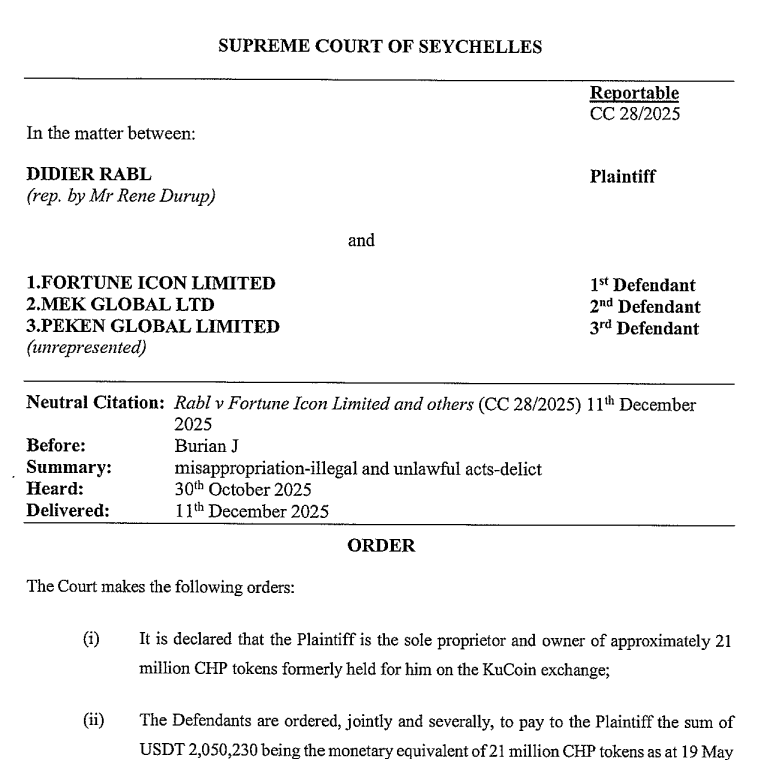
Court Order. Source: Seychelles Supreme Court
The court found that all the emails “remained unread and unanswered” and that KuCoin delisted CHP “without making any further attempt to notify the Plaintiff by post, telephone, or any alternative means.”
Seychelles FSA confirms receipt of KuCoin judgment
The court held that a unilateral delisting email with “deemed to have abandoned” wording was not sufficient to remove a customer’s rights to tokens already in their account when no such forfeiture term was in the original contract.
Related: Dubai regulator orders KuCoin entities to stop unlicensed operations
KuCoin’s terms of use at the time gave the platform broad powers to suspend or terminate accounts and to limit its liability, but did not explicitly state that unwithdrawn tokens after a delisting become KuCoin’s property.
A blockchain analysis report shared with Cointelegraph traced movements of the legacy Ethereum CHP token and identified an address labeled “KuCoin 6” on Etherscan that holds 21,000,000.0509 CHP, or about 5.9% of the total supply.
The Supreme Court directed its Registrar to serve the judgment on Seychelles’ Financial Services Authority (FSA).
In a written response to Cointelegraph, an FSA spokesperson confirmed it had received the judgment and said Mek Global Ltd, the KuCoin-linked company that applied for a virtual asset service provider (VASP) licence, had its application rejected on June 4, 2025, and was required to cease all business conducted in or from Seychelles.
The FSA also published a public statement noting that Peken Global Limited, one of the defendants in the case, opted to migrate its services outside Seychelles following the rejection of the application.
Under Seychelles’ Virtual Asset Service Providers Act, licensed exchanges are required to segregate client assets and maintain them at a 100% reserve, the spokesperson said.
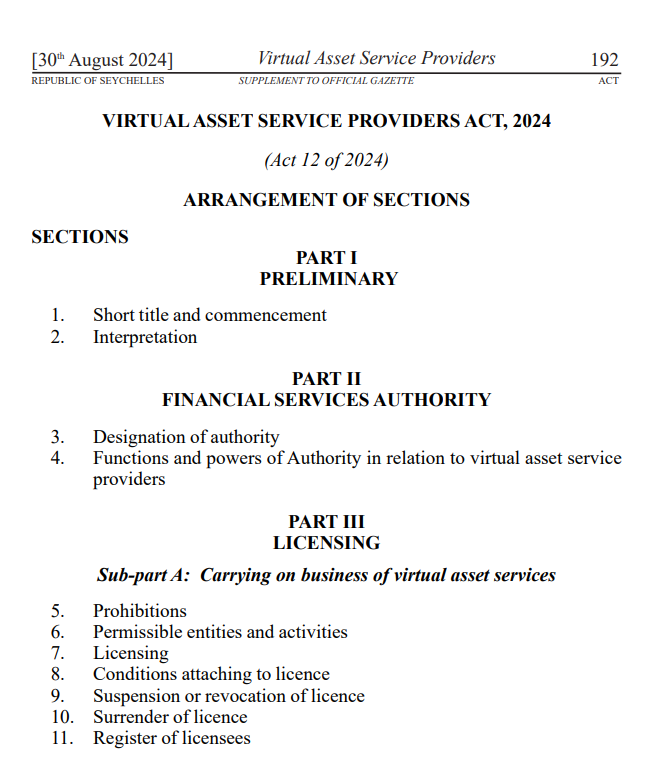
Source: Seychelles Ministry of Finance
Legal expert highlights limits of ex parte judgment
Joshua Chu, co-chair of the Hong Kong Web3 Association, and a lawyer who has handled Seychelles-related arbitration, told Cointelegraph, “It should be noted from the outset that this judgment was decided entirely ex parte,” pointing out that KuCoin’s entities “never appeared, never defended, and never submitted to jurisdiction.” Justice N. Burian’s decision is “first instance only,” he said, with “no binding force outside Seychelles.”
Related: KuCoin fully rolls out KIA, a crypto-native AI built to simplify the crypto experience
Chu said the court proceeded on the basis that the exchange-customer relationship was “at minimum contractual, obliging the exchange to safeguard the assets and to honor lawful withdrawal instructions.”
In principle, a VASP’s unexplained failure to comply with a final Supreme Court order concerning customer assets would sit uneasily with standards of integrity, cooperation with courts and regulators, and respect for client property, Chu said. He added that “a defendant in future contested proceedings could argue that its factual assumptions are incomplete,” and that the consequences would depend on any appellate process.
Rabl told Cointelegraph he has not received any payment from the Seychelles entities named in the judgment and is preparing additional legal action in Seychelles aimed at enforcing the award and potentially seeking additional damages.
KuCoin did not respond to multiple requests for comment from Cointelegraph.
Asia Express: North Korea denies crypto hacks, Upbit’s bank tests Ripple
Crypto World
LBank Pay Expands to Support BTC, ETH and 20+ Crypto Assets, Launches 20,000 USDT Campaign

[PRESS RELEASE – Singapore, Singapore, June 12th, 2026]
LBank, the leading global cryptocurrency exchange, has announced a major upgrade to LBank Pay, its integrated crypto payment solution. Effective June 11, 2026, LBank Pay now supports direct payments in over 20 major crypto assets, including BTC, ETH, SOL, DOGE, TON, and PEPE — removing the need to convert holdings into USDT before transacting and opening a new chapter for everyday crypto payments.
The first batch of newly supported assets spans multiple core sectors, including blue-chip cryptocurrencies (BTC, ETH), high-performance blockchain ecosystems (SOL, BNB, TON, SUI, XRP, ADA, AVAX, TRX, HYPE), community-driven assets (DOGE, PEPE, PI), AI tokens (TAO, NEAR), as well as RWA and gold-backed assets (XAUT, PAXG, ONDO), further expanding the range of crypto assets available for real-world payments.
The upgrade introduces three core enhancements: support for direct multi-asset payments to eliminate conversion friction, comprehensive coverage across Layer 1 blue-chip assets, Layer 2 ecosystems, and high-momentum meme tokens, and millisecond-level settlement powered by LBank’s liquidity engine and risk control network. Users only need to update to the latest version of the LBank App and, when scanning a merchant QR code, select “Available Assets” to switch currencies and complete payments in a more seamless and efficient way.
To celebrate the expansion, LBank Pay is launching a Lucky Draw campaign from June 11 to June 21, 2026 (UTC+8), with a prize pool worth 20,000 USDT. All KYC-verified users are eligible to participate by completing tasks including deposits, LBank Pay payments, token holdings, and friend referrals. Each draw offers chances to win USDT cash, futures experience bonuses, position vouchers, cashback coupons, and jackpot prizes.
“Crypto adoption ultimately depends on usability,” said Eric He, Community Angel Officer and Risk Control Adviser at LBank. “With every upgrade, we continue to lower the barrier between crypto assets and real-world use cases. Our goal is not only to make crypto a financial instrument for trading, but also to enable it to become a seamless payment medium that users can use in everyday life. LBank Pay is an important step in building this bridge.”
Over the years, LBank has continuously expanded its ecosystem across trading, payments, asset management, and financial innovation. Previously, the platform has launched features such as “Fiat Deposit” for fiat currency deposits and “Buy Crypto with Fiat Balance,” enabling users to purchase cryptocurrencies directly using their fiat balances, continuously optimizing the end-to-end experience from fiat to crypto assets and providing global users with a smoother, one-stop trading and payment solution.
Looking ahead, LBank plans to further expand the range of supported payment assets, strengthen merchant partnerships, and integrate additional payment scenarios across global markets. By continuously improving accessibility and efficiency, LBank remains committed to building a more open, seamless, and user-centric crypto economy.
About LBank
Founded in 2015, LBank is a leading global cryptocurrency exchange serving over 20 million registered users in 160 countries and regions. With a daily trading volume exceeding $10.5 billion and 10 years of safety with zero security incidents, LBank is dedicated to providing a comprehensive and user-friendly trading experience. Through innovative trading solutions, the platform has enabled users to achieve average returns of over 130% on newly listed assets.
LBank has listed over 300 mainstream coins and more than 50 high-potential gems. Ranked No. 1 in 100x Gems, Highest Gains, and Meme Share, LBank leads the market with the fastest altcoin listings, unmatched liquidity, and industry-first trading guarantees, making it the go-to platform for crypto investors worldwide.
Users Can Follow LBank for Updates:
Website: https://www.lbank.com/
Twitter: https://twitter.com/LBank_Exchange
Telegram: https://t.me/LBank_en
Instagram: https://www.instagram.com/lbank_exchange
LinkedIn: https://www.linkedin.com/company/lbank
For media requests, users can contact:
Email: press@lbank.com
The post LBank Pay Expands to Support BTC, ETH and 20+ Crypto Assets, Launches 20,000 USDT Campaign appeared first on CryptoPotato.

Velvet price has surged more than 1,400% over the past week as traders pile into the token ahead of SpaceX’s highly anticipated public debut, pushing the project into one of the strongest rallies in the crypto market.
Summary
- VELVET became one of the week’s top-performing cryptocurrencies after launching pre-IPO trading exposure to SpaceX and other private tech firms.
- Demand accelerated after Velvet integrated with Trade.xyz and launched synthetic markets for SpaceX, OpenAI, and Anthropic.
- Technical indicators show VELVET trading in an overshoot zone, with $1.95 and the psychological $2 level emerging as the next key targets.
According to data from CoinGecko, Velvet (VELVET) price surged more than 125% on June 12, reaching an intraday high of $1.83 and bringing its weekly advance to over 1,400%. The rally has pushed the token’s market capitalization to roughly $745 million even as the protocol holds less than $1 million in total value locked, a gap that points to speculation rather than underlying usage.
Behind the surge is growing interest in Velvet’s newly launched pre-IPO trading markets. In a June 11 X post, Velvet promoted synthetic exposure to SpaceX through its SPCX market, telling users they could trade the company before its expected stock market debut.
The platform also offers leveraged exposure to private companies including OpenAI and Anthropic, tapping into a theme that has attracted significant attention from both crypto traders and traditional market investors.
Pre-IPO markets have fueled speculative demand
Interest in the project accelerated after Velvet announced an integration with Trade.xyz on June 3. According to the company, the partnership allows users to access crypto, stocks, commodities, research tools, and trade execution through a single platform rather than separate applications.
The announcement coincided with VELVET’s breakout above a long-standing resistance zone near $0.20 and $0.22. Since then, traders have increasingly treated the token as a proxy bet on demand for tokenized market access and pre-IPO investing opportunities.
Velvet futures data points to leverage playing a major role in the rally. Open interest reportedly surged to nearly $94 million within days as speculative activity intensified. At the same time, trading volumes exceeded $108 million, while a wave of short liquidations added further buying pressure.
A liquidity squeeze was also seen developing across spot markets. With a relatively small circulating supply available on exchanges, aggressive buying activity collided with thin order books, helping propel the token higher as momentum traders entered the market.
Technical indicators keep the $2 target in focus
Velvet price action on the four-hour chart shows VELVET entering an overshoot zone after breaking above the Murrey Math 8/8 resistance level near $1.56.
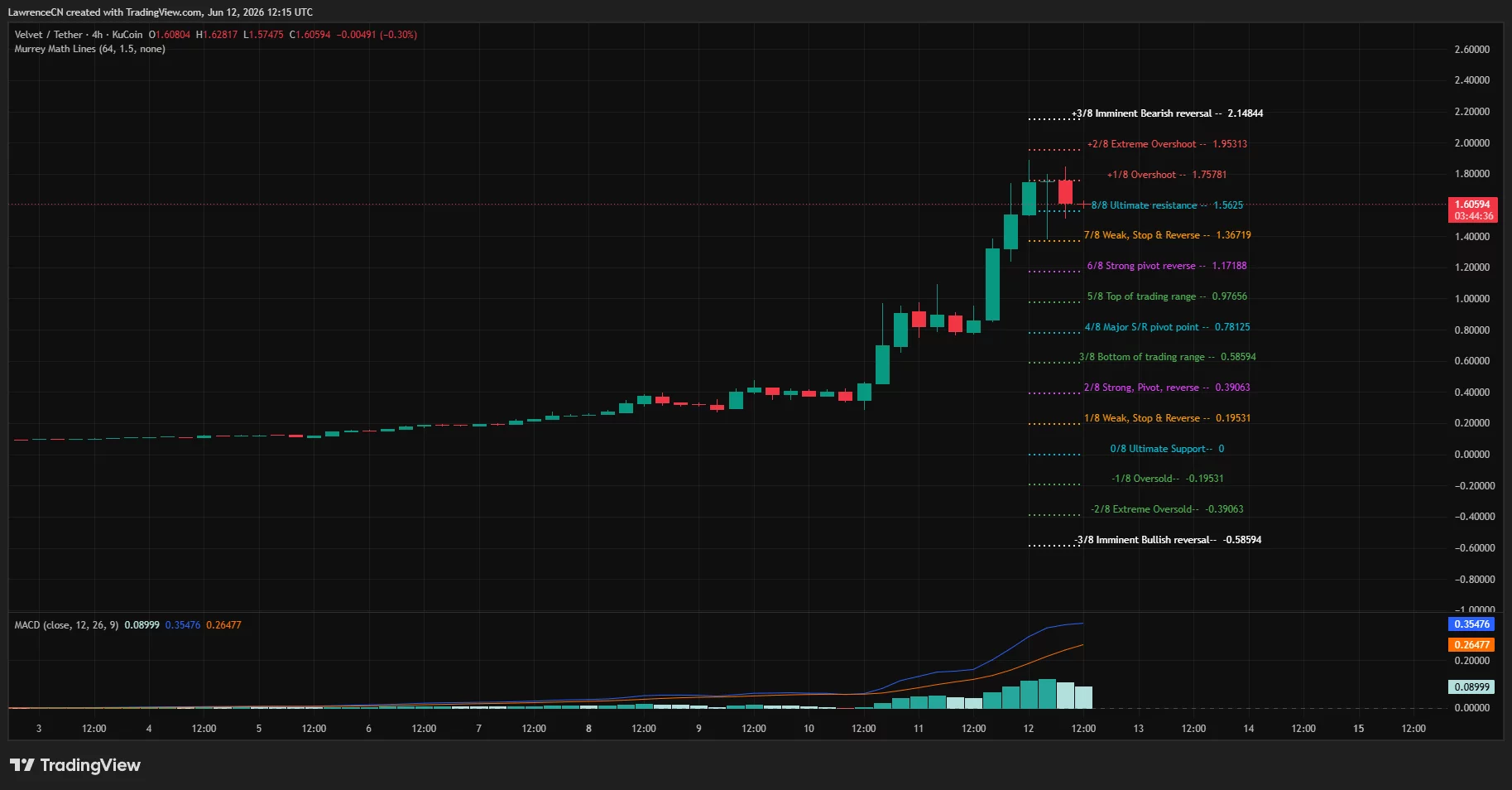
The token recently reached the +1/8 overshoot level around $1.76 before pulling back slightly. Based on the same framework, the next major resistance sits near the +2/8 extreme overshoot level at $1.95, placing the psychological $2 mark within reach if buying pressure continues.
Momentum indicators remain supportive despite increasingly stretched conditions. The four-hour MACD remains in bullish territory, with the MACD line holding above the signal line and positive histogram readings indicating buyers still control the trend.
On the downside, the first key support sits near $1.56, while a deeper correction could expose the 7/8 Murrey Math support around $1.37.
What is Velvet?
Velvet is a decentralized trading and asset management platform focused on bringing multiple financial markets into a single on-chain environment.
The project allows users to access cryptocurrency markets, tokenized assets, yield products, and leveraged perpetual contracts through one ecosystem. More recently, Velvet expanded into synthetic pre-IPO markets, enabling traders to gain exposure to private companies such as SpaceX, OpenAI, and Anthropic before traditional public listings.
According to the project, its integration with Trade.xyz connects research, execution, and market access tools across multiple asset classes. The VELVET token serves as the native asset of the ecosystem and has become a focal point for traders following the launch of the platform’s pre-IPO trading products.
Whether the rally can extend toward $2 may depend less on protocol fundamentals and more on continued demand for SpaceX-related speculation.
With the company’s public debut dominating investor attention and synthetic pre-IPO markets attracting fresh trading activity, VELVET remains one of the market’s most closely watched momentum plays.
Disclosure: This article does not represent investment advice. The content and materials featured on this page are for educational purposes only.

Key Highlights
- Oracle lands $395.8M cloud HR modernization contract from OPM
- ORCL stock gains in pre-market trading following earnings-related selloff
- Federal government selects Oracle Cloud HCM to consolidate 100+ HR platforms
- Platform expected to deliver 90%+ cost savings for taxpayers
- Federal HR 2.0 initiative expands Oracle’s government sector footprint
Oracle (ORCL) shares experienced a minor recovery in pre-market trading following a significant post-earnings pullback. The stock dropped 8.53% to settle at $184.10 during regular trading, before climbing 0.74% to $185.37 in early morning activity. A newly announced $395.8 million federal government contract has redirected investor focus toward Oracle’s expanding cloud infrastructure.
Major Federal HR Modernization Award Goes to Oracle
The U.S. Office of Personnel Management has selected Oracle for a $395.8 million HRIT Modernization Core HCM initiative. This agreement establishes the federal government’s first unified human resources management system spanning all agencies. Oracle Fusion Cloud Human Capital Management will serve as the foundation for this comprehensive platform.
This unified solution will consolidate over 100 fragmented HR systems currently operating throughout federal departments. OPM anticipates the initiative will eliminate redundancy while enhancing workforce data quality and accessibility. The agency projects taxpayer savings exceeding 90% compared to current operational expenses.
This deployment represents a cornerstone of OPM’s Federal HR 2.0 strategy. The program establishes a single authoritative source for federal workforce administration. Approximately two million civilian employees across U.S. Executive Branch agencies will utilize the platform.
Oracle’s Cloud HCM Platform at the Forefront
Oracle Cloud HCM will deliver comprehensive functionality including position administration, personnel transaction processing, employee record management, and advanced workforce analytics. The platform also features self-service capabilities for both employees and supervisors. Additionally, it will integrate seamlessly with existing payroll, retirement administration, and benefits management systems.
Federal HR infrastructure currently exists as scattered, independent systems across multiple agencies. This fragmentation creates data inconsistencies, duplicated efforts, and delayed service provision. The consolidated platform is designed to enhance interagency collaboration while bolstering security protocols and operational performance.
OPM chose Oracle following an extensive competitive evaluation process. The selection criteria incorporated feedback from multiple agencies and comprehensive testing against governmental requirements. Oracle will deploy a FedRAMP-authorized cloud environment specifically designed for federal HR functions.
Government Contract Reinforces Oracle’s Cloud Market Position
This federal engagement represents a significant addition to Oracle’s cloud application customer base. The contract broadens the company’s involvement in public sector digital transformation projects. Oracle now occupies a more prominent position in critical workforce management technology infrastructure.
Oracle Fusion Cloud Applications encompass enterprise resource planning, human capital management, supply chain management, and customer experience solutions. These integrated platforms enable organizations to streamline financial operations, business processes, personnel administration, and customer relationship activities. The applications incorporate artificial intelligence features that automate routine tasks and enhance strategic planning.
The OPM engagement demonstrates ongoing appetite for enterprise-scale cloud migration initiatives within the public sector. Government agencies increasingly prioritize integrated systems that deliver operational efficiency and superior data governance. This latest contract firmly establishes Oracle’s cloud software offerings as central components of a transformative federal modernization program.

What happened to the cast of “Little House on the Prairie”: See the stars after they left Walnut Grove

BBC and STV World Cup coverage gets major upgrade ahead of Scotland game

Facebook and MessengerDown? Facebook Experience Widespread Outages Affecting Users Globally


-

 Fashion7 days ago
Weekend Open Thread: Evereve – Corporette.com
-
 Entertainment6 days ago
The Best Mystery Series of All Time Is Surging on Streaming 30 Years After It Ended
-

 NewsBeat5 days ago
Alexander Zverev wins the French Open to finally earn a 1st Grand Slam title
-

 Crypto World4 days ago
Anatomy of the June crypto crash: Fed, Iran, Saylor
-

 Tech6 days ago
Suspicious Polyfill login prompts pop up on Toshiba, Muji websites
-
Crypto World6 days ago
Senator Cynthia Lummis Calls CLARITY Act the Most Consequential Financial Legislation of This Generation
-

 Tech5 days ago
Microsoft unveils seven homegrown AI models in new bid for ‘long term self-sufficiency’
-
 NewsBeat5 days ago
Alexander Zverev conquers demons and outlasts Flavio Cobolli to win French Open for first major title
-

 Crypto World22 hours ago
Oppenheimer backs SpaceX as $70 billion retail frenzy builds
-

 Crypto World21 hours ago
Markets Rally as SpaceX IPO Looms Amid Iran Tensions and Inflation Surge
-

 Tech7 days ago
Von der Leyen’s AI envoy pick draws conflict-of-interest fire
-

 Business4 days ago
High Stakes for Wembanyama as New York Pushes for 3-0 Lead
-

 Tech6 days ago
Hackers now exploit SolarWinds Serv-U flaw to crash servers
-
 Business6 days ago
The Pain Points Taking a Fragile Tech Rally Down a Notch
-

 Tech7 days ago
Meta steals a tactic from Tesla and builds data centers in tents
-
 Crypto World4 days ago
Eli Lilly (LLY) Stock Surges 4% Following Breakthrough Sleep Apnea Trial Results
-

 Tech5 days ago
Notion restores access to Anthropic after service disruption
-

 Crypto World5 days ago
Trump’s AI Ownership Plan Could Benefit Anthropic at OpenAI’s Expense
-
 Sports3 days ago
Bangladesh beat Australia after 20 years in ODIs, register only their second win over six-time world champions | Cricket News
-
 Business5 days ago
The investment to transform historic St Helen’s ground in Swansea
You must be logged in to post a comment Login