

Crypto World
Polymarket moves to list parlays while SEC seeks public input on prediction market ETFs



Prediction market provider Polymarket filed to list parlays in sports event contracts in the U.S. on Wednesday, according to a self-certification filing with the Commodity Futures Trading Commission.
Polymarket filed to list “combinatorial outcome contracts” on Wednesday, describing these event contracts — the official term for prediction markets — as combining two or more underlying contracts. Moreover, all of the underlying contracts would have to settle to the specific outcome that the user sets.
“Every outcome must be satisfied for the Contract to resolve to $1.00. The Contract resolves to $1.00 if and only if every leg is satisfied. If any single leg is not satisfied, the Contract resolves to $0.00, regardless of the outcomes of any remaining unsettled legs,” the filing said.
Because the contract is self-certified, Polymarket is not so much asking for explicit permission to list these contracts as it is telling the CFTC that it intends to list these products. The document said it would list them “no earlier than May 21, 2026.”
Another exhibit was filed but with Polymarket asking the CFTC to hold this exhibit as confidential due to possible trade secrets or commercial information, according to a second document.
Exchange-traded funds
The Securities and Exchange Commission, which doesn’t directly oversee prediction markets, is looking into what an exchange-traded fund (ETF) around prediction markets might look like, Chairman Paul Atkins said in a statement on Wednesday.
ETFs boost capital formation and investor choice, he said, noting that ETF assets have tripled in the past seven years.
“Novel products raise novel questions, and I appreciate the willingness fund sponsors have shown in delaying the effectiveness of a number of novel ETFs, including event contract ETFs, while we consider the implications,” he said. “To ensure we do this in a transparent and thoughtful manner, I have instructed the staff to seek input from the public on how the Commission should respond to recent market changes.”
Prediction markets have drawn immense scrutiny in Congress and the courts over the past few months, particularly as they’ve expanded into sports leagues. State regulators and gambling firms argue that sports-related prediction markets are infringing on states’ rights to regulate and tax gambling products, since prediction market providers are regulated at the federal level.
The CFTC, for its part, maintains that these products are properly overseen by it under the Commodity Exchange Act. The U.S. Supreme Court is widely expected to take up the issue at some point.
In the meantime, lawmakers are reviewing prediction markets as well, though it’s unclear if a bill will be introduced to address them at this point.
Read more: Prediction markets firms take heat in Senate Commerce hearing scrutinizing surge



Federal prosecutors have charged two alleged operators of a cryptocurrency laundering service that processed more than $389 million in transactions and received over 10,000 Bitcoin since launching in 2021.
Summary
- U.S. prosecutors charged two alleged AudiA6 operators after tracing more than $389 million in cryptocurrency transactions through the laundering service.
- Authorities said the network received over 10,000 Bitcoin since 2021, including funds linked to darknet markets, ransomware groups and cybercrime services.
- An international operation led to arrests in Georgia, server seizures across multiple countries, and the freezing of cryptocurrency assets.
According to the U.S. Attorney’s Office for the Eastern District of Pennsylvania, Ukrainian national Ruslan Igorevich Tkachuk, 37, and Russian national Alexander Vladimirovich Ledenev, 25, were arrested in Batumi, Georgia, on Wednesday and are awaiting extradition to the United States.
The criminal complaint accuses the pair of serving as senior members of AudiA6, a cryptocurrency laundering network that prosecutors say helped customers conceal the origins of digital assets linked to criminal activity. Prosecutors also allege that both men managed the Dark2Web cybercrime forum, where AudiA6 promoted its services to users seeking to move illicit funds through cryptocurrency.
Court documents cited by the U.S. Attorney’s Office state that an advertisement posted on Dark2Web offered to disguise the source of traceable cryptocurrency in exchange for fees of up to 5% of the amount being laundered.
Blockchain analysis conducted during the investigation found that approximately 10,333 Bitcoin had been deposited into wallets controlled by AudiA6 since 2021, according to prosecutors.
Authorities said about 393.39 BTC came directly from known darknet marketplaces, ransomware groups, cybercrime services and other identified illicit sources, while the remaining deposits were traced indirectly to criminal activity.
International operation targets laundering infrastructure
Details released by prosecutors show the arrests formed part of a coordinated operation involving the U.S. Secret Service, Internal Revenue Service Criminal Investigation, Europol and Eurojust, alongside law enforcement agencies from Australia, Canada, France, Georgia, Germany, Iceland, Japan, Poland, Switzerland and the United Kingdom.
Investigators carried out searches at three properties and targeted servers and domains located across the United States, Iceland, Germany and France. Authorities also blocked Telegram accounts allegedly used by the network, froze cryptocurrency assets and seized electronic devices linked to the investigation.
At the same time, law enforcement agencies replaced both the clear web and dark web infrastructure connected to AudiA6 and the Dark2Web forum with seizure notices.
For Tkachuk and Ledenev, prosecutors have filed one count of conspiracy to launder monetary instruments and one count of sting money laundering. The charges remain allegations, and both defendants are presumed innocent unless proven guilty in court.
The case adds to a series of enforcement actions targeting cryptocurrency laundering services and darknet-linked funds. In May, the U.S. Department of Justice charged German citizen Owe Martin Andresen over an alleged laundering scheme tied to Dream Market, a darknet marketplace that ceased operations in 2019.
According to the DOJ, Andresen allegedly moved funds from dormant Dream Market administrator wallets before converting part of the proceeds into gold bars.
Prosecutors in that case said more than $2 million was laundered between August 2023 and April 2025, while searches uncovered approximately $1.7 million in gold bars and information linked to crypto wallets and bank accounts holding another $1.2 million in suspected proceeds.


In today’s newsletter, Joshua de Vos, from CoinDesk Research, analyzes May’s crypto outflows to explain what current market signals mean.
Then, in “Ask an Expert,” Bryan Courchesne from DAiM addresses how investors can navigate the current market environment.
Crypto ETFs: May Breakdown and What’s Next
May ended two consecutive months of net inflows, with global crypto ETP flows swinging back to heavy redemptions. According to TrackInsight data, global digital-asset investment products recorded $2.39 billion in net outflows, against $1.79 billion of net inflows in April, as total assets under management fell to $141.1 billion from $158.7 billion a month earlier. U.S.-listed vehicles accounted for almost the entire redemption, while flows outside the U.S., which had already cooled in April, turned modestly negative.
The CoinDesk 20 Index (CD20), which captures a diversified cross-section of the top 20 digital assets, fell 1.11% in May after gaining 5.45% in April. The more concentrated CoinDesk 5 Index (CD5) declined 3.73% and bitcoin itself fell 3.56%, a sharp reversal from April, when bitcoin (up 11.87%) and the CD5 (up 9.91%) led a broad rally. The return hierarchy also inverted: large caps led in April, whereas in May the broad index outperformed, indicating that large-cap assets bore the brunt of the decline while diversified exposure offered relative shelter.
According to data from TrackInsight, outflows were concentrated in bitcoin — and ether-linked instruments globally, while parts of the altcoin market, led by XRP, Hyperliquid and Solana, drew net inflows, a divergence that widened over the month.
Largest ETF Gainers, Globally (by May Net Flows)
- NEOS Bitcoin High Income ETF (BTCI): +$141.8 million; $1.24 billion AUM
- Bitwise Solana Staking ETF (BSOL): +$79.3 million; $672.2 million AUM
- Morgan Stanley Bitcoin Trust (MSBT): +$73.9 million; $260.1 million AUM
- Bitwise Hyperliquid ETF (BHYP): +$62.0 million; $71.1 million AUM
- iShares Staked Ethereum Trust ETF (ETHB): +$56.1 million; $584.3 million AUM
- 21Shares Hyperliquid ETF (THYP): +$49.7 million; $61.6 million AUM
- NEOS Boosted Bitcoin High Income ETF (XBCI): +$42.8 million; $71.8 million AUM
- Franklin XRP ETF (XRPZ): +$38.7 ,million; $273.8 million AUM
- iShares Bitcoin ETP (IB1T): +$33.1 million; $1.06 billion AUM
U.S.-listed products continued to dominate the global crypto ETF market in May. Despite net outflows of $2.37 billion, American-domiciled ETFs closed the month with $119.2 billion in AUM, retaining roughly 84.5% of the $141.1 billion global market, broadly in line with April’s 85.1%.
May’s headline outflow ended two months of inflows and was overwhelmingly a U.S., large-cap reversal. The gainers list, by contrast, was dominated by income, staking and newly launched products. With the CoinDesk 20 down just 1.11% against a 3.73% fall in the large-cap CD5, diversified and altcoin exposures showed a relative resilience that the flow data corroborated. That resilience has since been overwhelmed: by early June, Bitcoin had fallen to around $62,000, and the major indices were down a further 15% or more, leaving no sign that May’s outflows marked a bottom and pointing to intensifying pressure into June.
Read more: May’s global ETP recap and May’s U.S.-focused ETF recap.
– Joshua de Vos, research team lead, CoinDesk
Ask an Expert
Q: Bitcoin’s RSI recently dropped into the low 40s. Why is that significant?
Bitcoin’s Relative Strength Index (RSI) has fallen into the low 40s on key timeframes, which is a relatively rare occurrence. Similar readings were seen in February 2020 and during the March 2020 COVID crash. In both cases, those oversold conditions preceded powerful recoveries and substantial long-term gains. While no indicator guarantees future performance, historically these periods have often represented attractive accumulation opportunities for long-term investors.
Q: Does this signal present an opportunity today?
Potentially, yes. For investors who remain focused on bitcoin and have a long-term time horizon, periods of market pessimism have historically offered some of the best entry points. The challenge is that buying often feels hardest when sentiment is negative, which is exactly why many investors miss these opportunities.
Q: What advice would you give investors who struggle to evaluate crypto projects?
If you cannot confidently assess factors such as real-world usage, security, tokenomics, decentralization and adoption metrics, simplifying your approach may be the best option. Bitcoin remains the most established digital asset, with the strongest network effects, the clearest store-of-value thesis, institutional support through ETFs and a proven ability to survive multiple market cycles.
Q: How can investors separate credible advice from noise?
A: Look for analysts and advisors with verifiable experience, a track record of being right more often than not, and a history of evidence-based commentary. Be skeptical of anonymous influencers, paid promoters and personalities whose primary business model appears to be generating engagement. In many cases, the difference between successful investing and costly mistakes comes down to ignoring the attention machine.
Q: What’s the key takeaway from today’s market environment?
This RSI setup could prove to be another important moment in bitcoin’s history. While no outcome is guaranteed, bitcoin has repeatedly rewarded patience, discipline and long-term conviction. Investors focused on fundamentals may view current conditions as an opportunity, while those still waiting for unrealistic altcoin narratives to play out risk missing another bitcoin-led recovery.
– Bryan Courchesne, founder, DAiM
Keep Reading
- Japan’s three largest banks, MUFG, SMBC and Mizuho, plan to jointly issue a stablecoin by March 2027.
- The stablecoin market cap hit a new all-time high of $320 billion while the total market cap of tokenized real-world assets reached $28.9 billion: read the latest research.
Looking for more? Receive the latest crypto news from coindesk.com and market updates from coindesk.com/institutions.


- KuCoin launches Crypto Cup with up to 1.4 million USDT rewards.
- The campaign spans trading, payments, earning, and mining products.
- Event follows PROOF campaign’s 1.8 billion USDT trading success.
KuCoin has launched a new global football-themed cryptocurrency campaign, offering users the chance to compete for a reward pool of up to 1.4 million USDT across its ecosystem.
The campaign, called KuCoin Crypto Cup, runs from June 11 to July 20, 2026, and is designed to connect multiple areas of the platform, including trading, payments, asset management, and mining rewards.
The initiative comes as cryptocurrency platforms increasingly seek to expand digital asset use cases beyond trading and into broader financial and everyday applications.
According to KuCoin, the campaign is inspired by the energy and competition of the global football season and aims to provide users with multiple participation paths across different products and services.
Building on the momentum of PROOF
KuCoin Crypto Cup follows the company’s recent PROOF campaign, which generated more than 1.8 billion USDT in total trading volume and attracted over 120,000 participants.
One of the most notable elements of that campaign was the Tomorrowland Grand Raffle Draw.
KuCoin said the promotion attracted more than 47,000 participants and generated over 1 billion USDT in trading volume.
The exchange said the campaign demonstrated how digital asset engagement could be linked to globally recognized cultural events.
By combining cryptocurrency participation with access to exclusive Tomorrowland experiences, the initiative sought to create deeper engagement among users.
KuCoin is now applying a similar approach to its latest football-themed promotion.
The company described the initiative as being built around the message: “One Trophy on the Field. Up to 1,400,000 USDT for Every Type of Trader.”
A multi-product ecosystem campaign
Unlike campaigns focused solely on trading activity, KuCoin Crypto Cup integrates several products across the platform into a single user journey.
The campaign includes participation opportunities through Futures, VIP Premier +, KuCoin Pay, KuCard, Spot, Margin, Earn and KuMining.
KuCoin said the initiative is designed to bring together market access, trading opportunities, real-world crypto utility, asset management tools and mining-related rewards under one campaign structure.
The company added that the program is intended to support different types of users rather than focusing exclusively on high-volume traders.
Participation opportunities span active trading, everyday spending, asset management and mining-related activities.
According to KuCoin, the campaign reflects its broader objective of making digital assets more accessible, useful and rewarding for users around the world.
Rewards across the football season
The campaign will follow a football-inspired structure, progressing through stages ranging from the Group Stage to the Final Whistle.
During the event, users can participate in team trading competitions, individual challenges, lucky draws, spending activities, milestone tasks and KuMining reward programs.
The largest reward categories include a 500,000 USDT Futures main tournament and a 500,000 USDT VIP Premier + reward pool.
Additional incentives include up to 150,000 USDT in Spot and Margin rewards, Earn rate-up coupons, cash rewards, KuMining hardware incentives, hashrate rewards and purchase-based rewards.
Users can also access cashback opportunities through KuCoin Pay and KuCard.
Eligible users can participate in KuCoin Crypto Cup through the platform during the campaign period, with detailed reward rules and eligibility requirements available through the exchange.
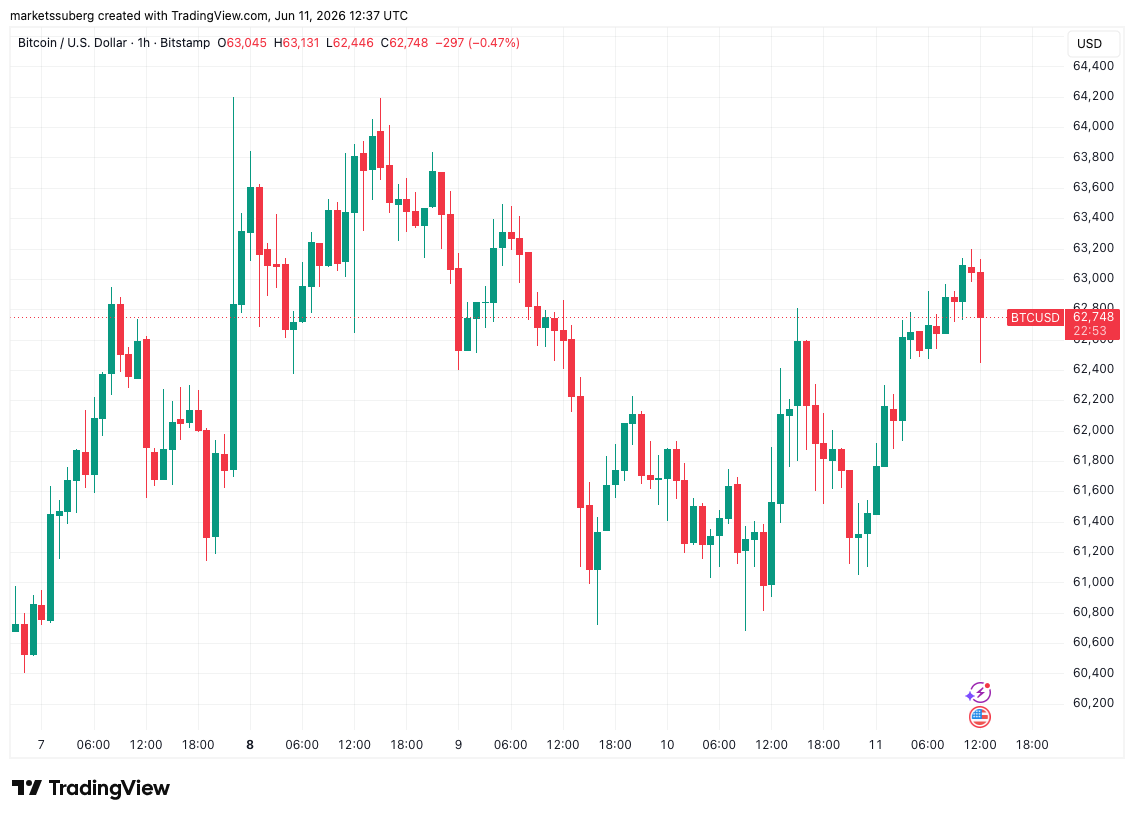
Bitcoin (BTC) returned to $63,000 on Thursday as crypto shook off news that Iran had closed a key global oil route.
Key points:
- Bitcoin sees volatility but hits intraday highs despite surging US inflation and another Strait of Hormuz closure.
- Oil rebounds as the US promises fresh attacks on Iranian infrastructure on Thursday.
- Bitcoin upside targets focus on the remaining gaps in CME Group’s futures market.
Iran and PPI inflation spark new risk-asset headwinds
Data from TradingView showed BTC/USD hitting local highs of $63,200 on Bitstamp, up more than 2.5% on the day.
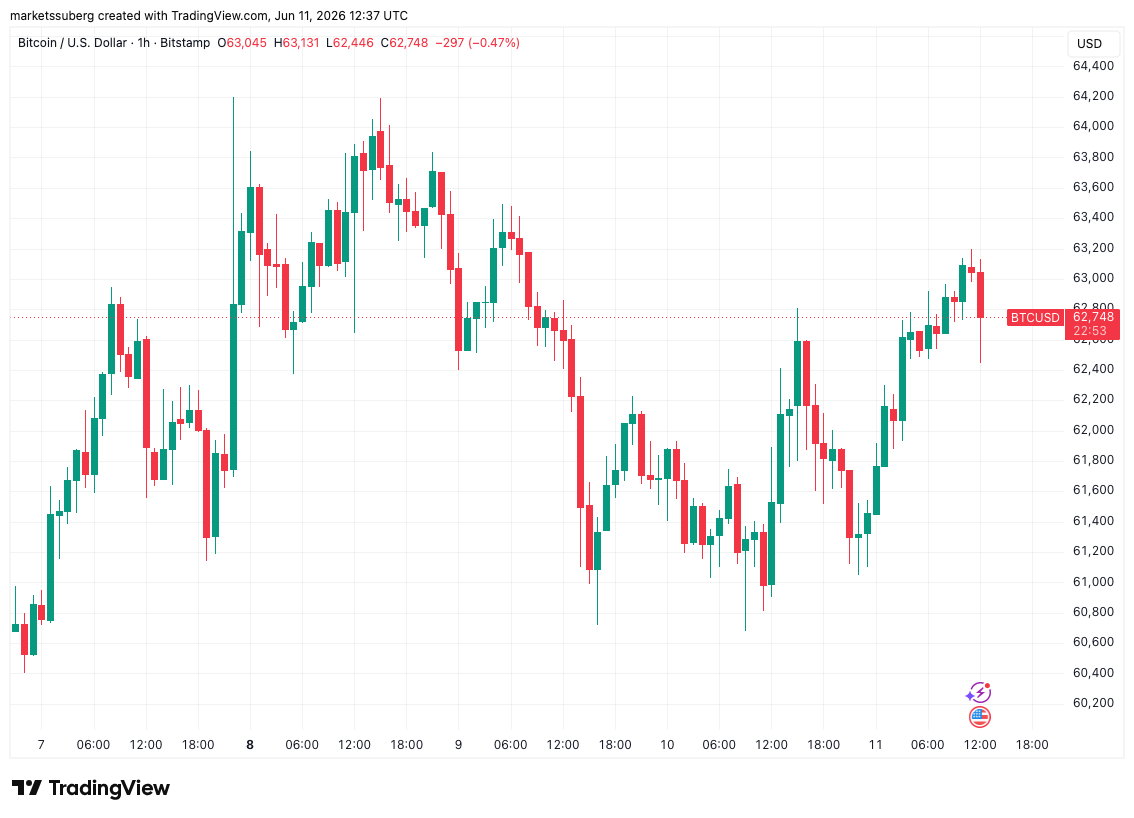
BTC/USD one-hour chart. Source: Cointelegraph/TradingView
Crypto rebounded despite growing geopolitical tensions and the threat they pose to inflation trends worldwide. Reports referred to Iran closing the Strait of Hormuz “until further notice” following attacks on US infrastructure in the Gulf states.
US WTI crude oil jumped above $91 per barrel following the news.
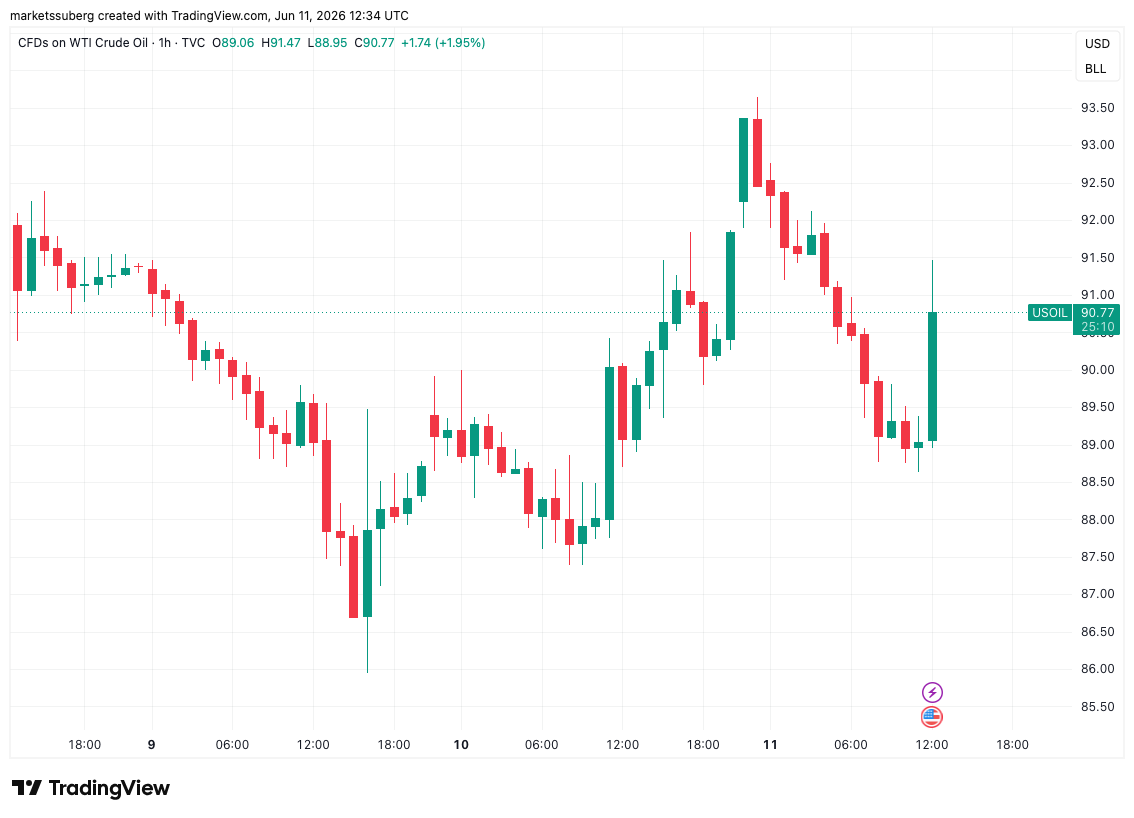
CFDs on WTI crude oil one-hour chart. Source: Cointelegraph/TradingView
US President Donald Trump additionally warned that Iran would be hit “very hard” on Thursday evening.
“At some point in the not too distant future, we will be taking Kharg Island, and other oil infrastructure points, and assume total control of their Oil and Gas Markets, much like we have with Venezuela, which is working out brilliantly for both Venezuela and the United States of America,” he wrote in a post on Truth Social.
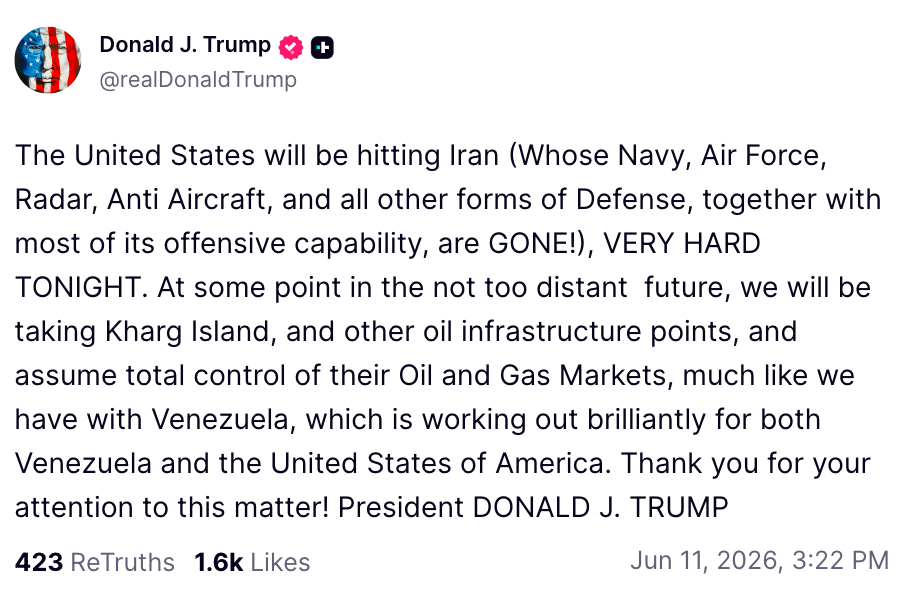
Source: Truth Social
The day prior, Trump stated that Washington “controls” Hormuz, with around 100 million barrels of oil transiting as a result.
In its latest analysis, trading company QCP Capital explained that markets were “being forced to price both military escalation risk and potential energy disruption risk at the same time.”
“That combination leaves risk assets in an awkward position,” it wrote in a Market Color bulletin on Wednesday.
“Investors may not be panicking, but they are clearly less willing to lean into exposure when the next headline could pull the market in either direction.”
Thursday’s US Producer Price Index (PPI) print, meanwhile, kept up pressure on crypto and risk assets.
The Bureau of Labor Statistics (BLS) confirmed that year-on-year, PPI was up by the most in nearly four years, continuing a trend from recent months.
“For the 12 months ended in May, prices for final demand less foods, energy, and trade services moved up 5.1 percent, the largest 12-month rise since jumping 5.5 percent in October 2022,” an official press release stated.
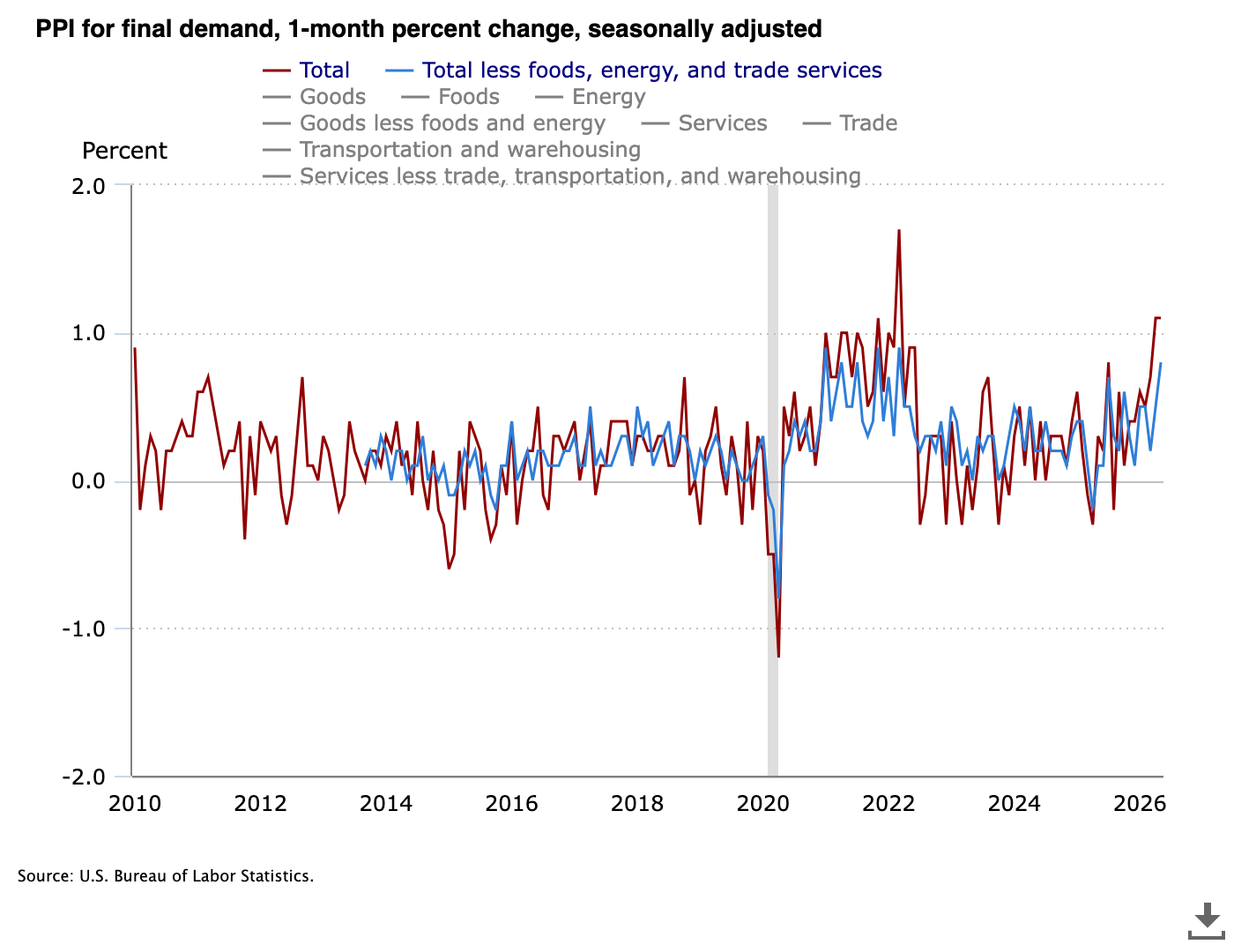
US PPI one-month % change. Source: BLS
On Wednesday, the May print of the US Consumer Price Index (CPI) came in at 4.2% year-on-year, its highest rate of increase since April 2023.
A press release from the BLS showed that the upside was being primarily driven by energy costs.
“The energy index increased 23.5 percent for the 12 months ending May,” it reported.
CME gaps still form BTC price upside targets
In Bitcoin circles, attention continued to focus on preserving $60,000 support, with a springboard for bulls still out of reach.
Related: BTC price bottom not due until Q4? Five things to know in Bitcoin this week
“It’s quite simple for Bitcoin,” crypto trader and analyst Michaël van de Poppe told X followers on the day.
“Break through the areas at $63.3K and $65.8K and we’ll be looking at a lot more upside.”
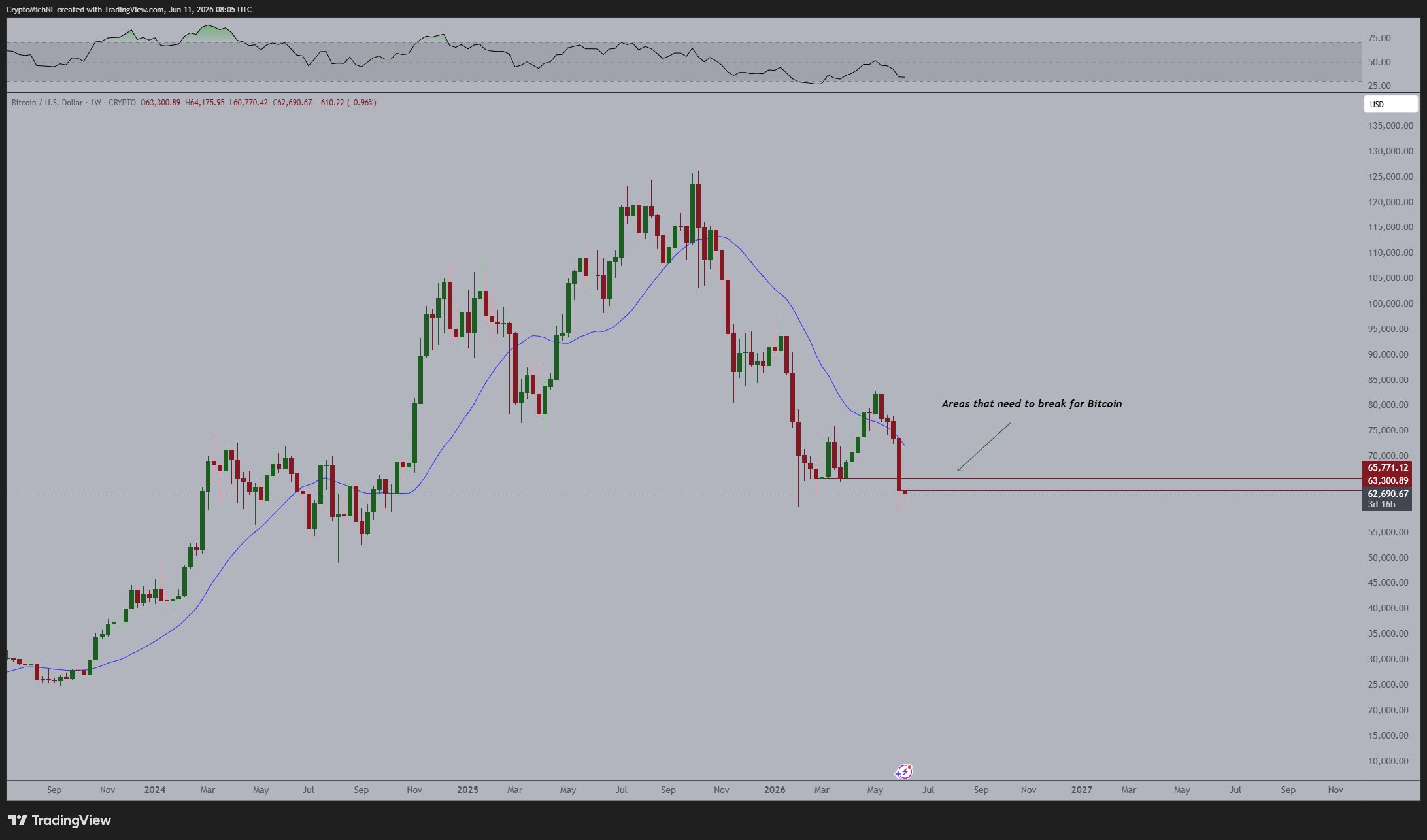
BTC/USD one-week chart. Source: Michaël van de Poppe/X
Van de Poppe gave upside targets that matched the outstanding CME futures gaps between $75,000 and $80,000, should price manage to break higher.
ChatGPT AI just did something most pundits are too scared to do. It filled out the entire 2026 World Cup group stage, top two in all 12 groups, no hedging, no “it depends,” just twelve clean verdicts.
So let me walk you through what the machine is thinking, because it is a fascinating mix of playing it ice cold and then suddenly getting a little brave.
Start with the easy stuff, the picks nobody is going to argue with. Mexico to top Group A. Brazil to stroll through Group C. Germany, Belgium, the Netherlands all winning their groups.
These are the layups. Picking Brazil to win a group is like predicting the sun comes up, and ChatGPT AI knows it, so it pockets the obvious and moves on. No ego here, no trying to look clever by fading a giant. When a team is that far ahead, you take it and you shut up.
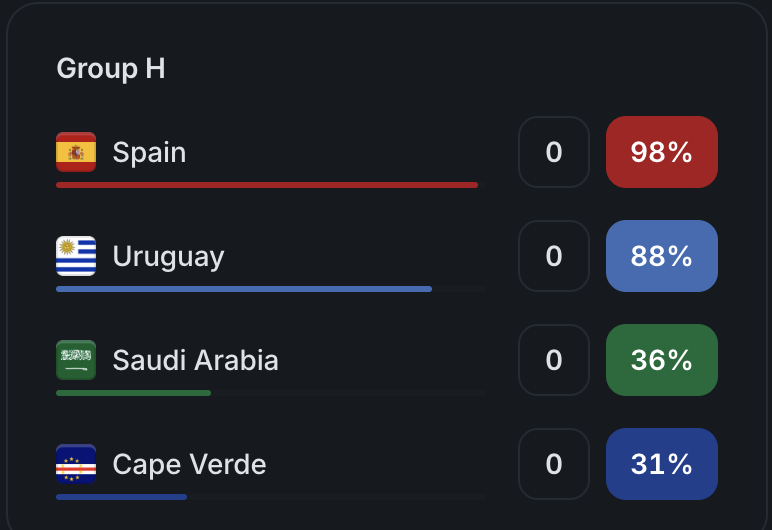
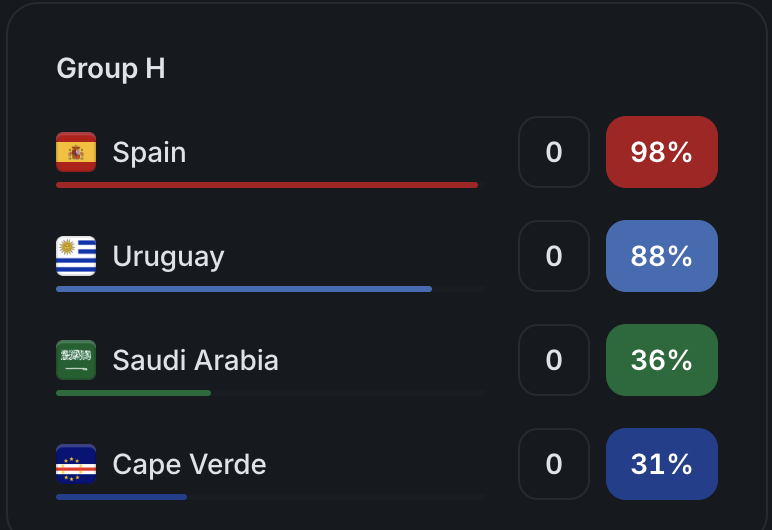
Then there is Spain, which is the pick the AI is most sure about on the entire card. And honestly, fair enough. This is a team riding a ridiculous unbeaten run, and the machine slots them first with Uruguay trailing in second.
Spain is the heaviest group favorite on the board, priced around 98% on Polymarket to win Group H. ChatGPT AI did not blink. Spain first, Uruguay second, next group please.
Discover: The Best Crypto to Diversify Your Portfolio
The Robot Finally Grows A Spine
Now we get to the good part, because a prediction card with zero surprises is boring, and the AI clearly knows that too.
Group I is where it raised an eyebrow. France to win, obviously, no genius required there. But for second place it snubbed Norway and Erling Haaland, one of the scariest strikers alive, in favor of Senegal.
That is a genuinely bold shout. The market actually leans the other way, but ChatGPT AI is betting that Senegal’s pace and power travels better than a Norway side that leans heavily on its stars.
It is the kind of call that looks brilliant if it lands and gets you roasted if it does not. Respect the conviction.
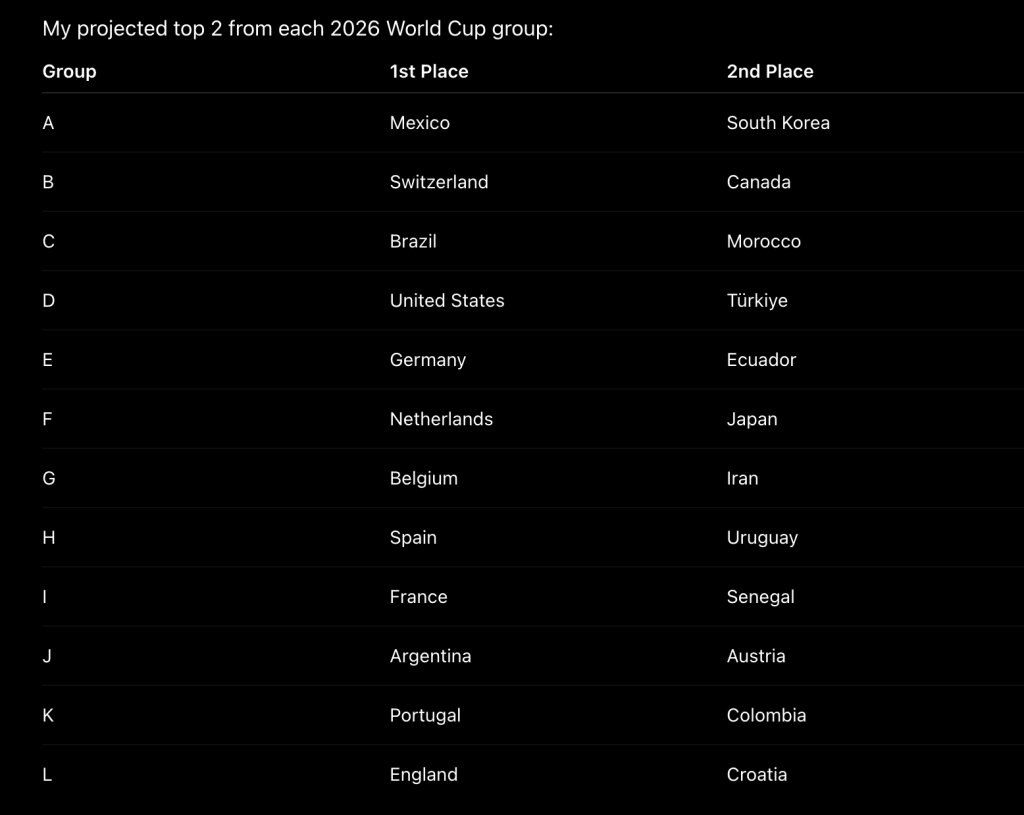
Group D is the other one that makes you sit up. The AI took the United States first and Turkiye second, which tells you it believes in the home crowd lifting the hosts over the line.
This is the tightest group on the whole card, basically a coin toss between those two, and the machine planted its flag on the Americans. A patriotic little lean, or just cold logic about home advantage. Either way, it committed.
Group B has a similar flavor. Switzerland gets the top spot, which is sensible, but then the AI hands second place to co-hosts Canada ahead of more established names.
You can almost feel it weighting the home soil factor again, betting that playing in front of your own fans is worth a few extra points. It is a theme across this card. ChatGPT AI clearly thinks hosting matters in 2026.
Discover: The Best Token Presales
What The Full World Cup ChatGPT Card Tells You About Its Brain
The back third is where it goes chalk again, and smartly so. Argentina, Portugal, England all winning their groups, each paired with a solid, unsurprising runner-up.
Portugal getting the nod is a nice tip of the cap to Cristiano Ronaldo rolling into a record sixth World Cup, the old king still expected to drag his team through.
England over a fading-but-stubborn Croatia. Argentina barely breaking a sweat in Group J. These are the picks of an AI that has decided not to overthink the easy ones.
So here is the personality that comes through. ChatGPT AI is not a chaos merchant. It is not out here predicting Haiti shocks the world or Curacao goes on a run.
It backed the favorite to win all 12 groups, which is the move of something that trusts the form book over fairy tales. But it is not a total robot either.
It found two or three spots, Senegal over Norway, the host nations sneaking into second, where it trusted a hunch over the obvious answer. That blend is what makes the card fun. Mostly disciplined, occasionally daring, and confident enough to put a number next to every single group without flinching.
The post Sam Altman ChatGPT AI Predicts Suprising World Cup Group Stage Winners appeared first on Cryptonews.
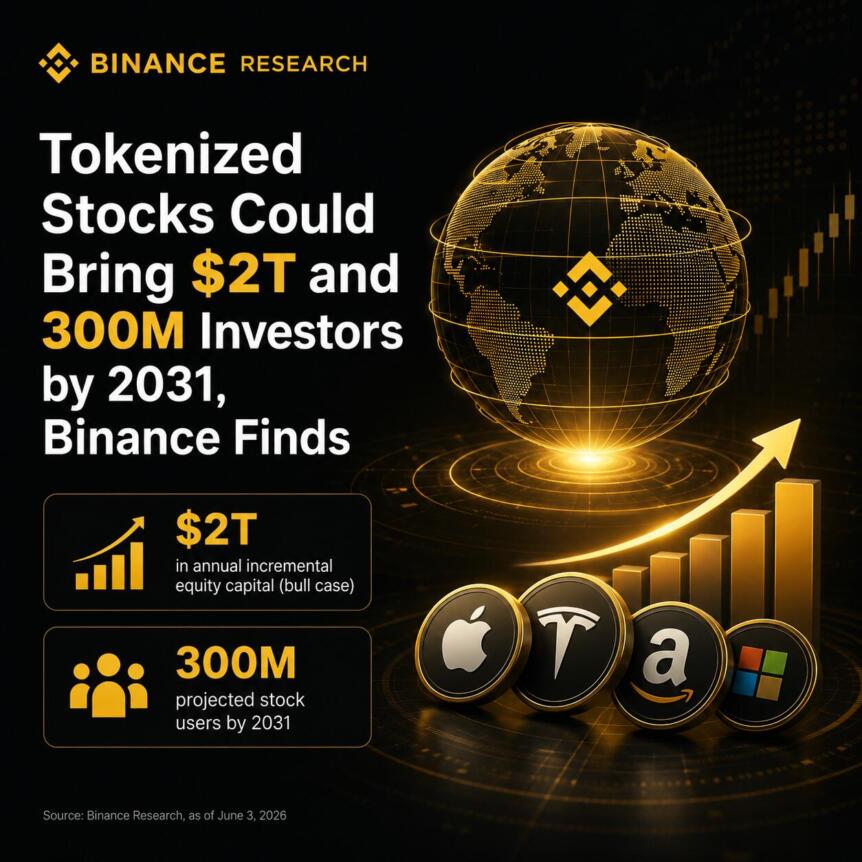
Binance research outlines the potential scale of tokenized equities
Binance Research, the analytics arm of Binance, has released a market commentary arguing that tokenized equities and fractional stock ownership facilitated by crypto exchanges could meaningfully expand global equity participation. In a base-case projection the report estimates crypto platforms could channel as much as US$2 trillion in additional capital and bring close to 300 million new investors into global equity markets by 2031. A bullish scenario sees annual incremental flows rising to US$5 trillion within five years.
Those figures, if realised, would represent a significant reconfiguration of access to the world’s largest equity pools. Binance’s analysis points to a persistent participation gap: most jurisdictions outside the United States have equity ownership rates well below 20 percent of the population, even though US-listed companies account for a large share of global market capitalisation. The report frames tokenization and fractionalisation as mechanisms that can lower entry barriers for investors in regions where traditional brokerage, custody and settlement frictions have limited participation.
Key findings and underlying drivers
Binance Research highlights several elements that could accelerate adoption of tokenized equities:
Market access and fractional ownership: Tokenized shares can be divided into fractional units, enabling investors with limited disposable income to buy exposure to high-priced US names. The report notes early demand concentrated in emerging markets, where brokerage access and local market infrastructure traditionally constrain retail participation.
Settlement using stablecoins: The commentary emphasises stablecoins as an attractive settlement layer for 24/7 cross-border equity exposure. Binance’s analysis suggests stablecoin-based off-ramps can reduce average transaction costs that are otherwise incurred in fiat conversions and bank correspondence, potentially making cross-border trading more cost-effective.
New product types and trading activity: The research points to growth in TradFi-linked perpetuals and other derivatives denominated in stablecoins, which have moved from negligible volumes to a measurable share of stablecoin trading. Such instruments may provide synthetics and leverage that appeal to a broad spectrum of crypto-native and new retail participants.
Context: why tokenization matters now
Tokenization is receiving renewed attention as exchanges expand product suites beyond spot crypto. For investors outside major financial centres, access to US-listed equities—often the most liquid and deep market—can be limited by account requirements, currency controls, and high brokerage fees. Tokenized stocks aim to address these frictions by combining blockchain-based recordkeeping, fractionalisation and crypto-native rails for settlement.
Industry observers point out that the technological feasibility of tokenized assets has improved, but adoption hinges on legal recognition, custody arrangements and interoperability with existing clearing and settlement systems. The pace at which regulators, custodians and exchanges align on standards will shape whether the projected capital flows materialise.
Implications for markets, infrastructure and regulators
If tokenized equities scale as Binance Research models, the effects could be wide-ranging:
Liquidity and price discovery: Increased participation from new retail cohorts could deepen liquidity for certain stocks, but could also fragment trading across on-chain and off-chain venues. Fragmentation may complicate consolidated market data and surveillance.
Settlement and counterparty risk: Relying on stablecoins for settlement introduces operational dependencies on crypto liquidity and the issuers of those coins. Proper custody, redemption processes and reserve transparency will be critical to limit settlement risk.
Regulatory and compliance challenges: Cross-border tokenized trading raises questions around securities law, investor protection, taxation and anti-money laundering controls. National regulators may differ on whether tokenized shares are treated as direct holdings, synthetic exposure or brokered products, which will affect onboarding and disclosure requirements.
Competition and business model shifts: Traditional brokers and custodians could face competition from exchanges offering integrated crypto-plus-equities accounts. That shift could squeeze fee margins in some markets while prompting incumbents to enhance digital, low-cost access options.
What to watch next
Several variables will determine the trajectory of tokenized equities:
Regulatory clarity: Jurisdictions that set clear rules for custody, transferability and investor protections will likely attract platforms and issuers.
Custody and interoperability standards: Industry-wide standards for reconciliation between tokenised ledgers and traditional registries will be important to reduce settlement mismatches.
Stablecoin regulation and market infrastructure: The role of stablecoins as a settlement medium will depend on regulatory acceptance, issuer transparency, and robust liquidity in cross-border corridors.
Conclusion
Binance Research’s estimates underscore the scale of the opportunity proponents see in tokenized equities: broader access to US markets for investors in underserved regions, lower transaction costs through crypto rails, and new product types built on fractional ownership. Realising that potential, however, will require coordinated progress on custody, legal recognition and market oversight. The coming months and years will be a test of whether tokenization can move from niche experiments to mainstream plumbing for global equity flows.


Michael Saylor spent nearly seven minutes at the BTC Prague 2026 conference this week explaining the meaning of the term “multiple-to-Net Asset Value” or “mNAV.”
However, the clip of Saylor’s rambling response went viral for the wrong reason. Almost nobody could follow the answer.
The length and complexity of the definition was also humorous given that Saylor is the founder of Strategy (formerly MicroStrategy), a DAT that publishes its mNAV on its homepage: 1.18x.
How can the answer be precisely 1.18x, yet be so difficult to define?
The first problem? There is no NAV.
Debt-laden companies with payables and other obligations don’t have “NAV” in the first place, which is a controlled term reserved for regulated funds.
Nonetheless, crypto investors likened “NAV” to the value of the crypto holdings at a digital asset treasury (DAT) company.
According to Strategy’s website, the company owns $52.9 billion worth of bitcoin (BTC), and Strategy’s enterprise value is $62.1 billion. Therefore, Strategy has a 1.18x multiple above its $52.9 billion “NAV,” which isn’t really a NAV, but well, whatever.
And it would be whatever, if only the reality were that simple. In fact, it gets worse.
Indeed, at BTC Prague 2026 on Wednesday, Twenty One executive Jack Mallers asked Saylor to define mNAV. Like Saylor, Mallers is a leader of a publicly-traded DAT but remains a little confused about what mNAV really means.
A Bitcoin media outlet posted the exchange with a blunt caption: “Saylor gives nearly a 10-minute answer when Jack Mallers asks him to define mNAV.”
The recording started trending immediately on X, earning hundreds of thousands of combined views.
Mallers’ question, and Saylor’s barely comprehensible response, were as authentic as they were funny. Trying to calm the virality, Mallers wrote, “Pretty basic questions and I was asking them genuinely. How is that shade?”
For example, he asked Saylor how Strategy counts out-of-the-money convertibles. He also wanted an example of a “dilutive” transaction, since Saylor insists swapping equity for dollars isn’t necessarily dilutive.
Read more: Strategy’s bitcoin premium vanishes as mNAV crashes to 1x
A personal definition of mNAV
Even the most basic metric is one that Saylor needs multiple paragraphs to explain.
From the stage, he described mNAV as the equity market cap:
- adjusted for net debt
- adjusted for the notional value of preferred equity
- divided by the BTC value
- adjusted for disclaimers and definitions on 8-Ks
- adjusted for quarterly SEC filings.
He also spoke at length about subsequent amendments, and other figures across Strategy.com.
Indeed, By the end of his answer, Saylor had delivered more of a reading list than a definition.
However, this complexity isn’t accidental. It distracts from the number itself, which keeps going down.
The simple version or “basic mNAV,” market cap divided by the USD value of crypto holdings, has slid below 1x at Strategy after enjoying months in the 2-4x range when sentiment was far better.
The more flattering version of mNAV, enterprise value mNAV, remains slightly higher than 1x — but not by much.
‘Is not equivalent to net asset value or NAV or any similar metric’
The deepest irony sits in Strategy’s own filings. The company concedes that its “BTC NAV” isn’t actually related to net asset value, despite the NAV acronym standing for the words “net asset value.”
It warned that the label “is not equivalent to ‘net asset value’ or ‘NAV’ or any similar metric in the traditional financial context.”
In other words, one of the most popular terms in the DAT industry is nonsensical.
Basic mNAV numbers keep falling below 1x across the sector, so those are no good anymore. The more flattering enterprise value mNAV variants are dangerously close to sub-1x territory, so those are hardly confidence-inspiring either.
Unfortunately, explaining all of these realities eats up valuable minutes of stage time and leaves an inquisitive mind exhausted.
Protos has previously catalogued Saylor’s habit of inventing terminology. That habit continued with his performance this week.
A number everyone can understand: A $9 billion unrealized loss
Fortunately, real prices simplify all of this wordplay to a simple matter of dollars and cents. Strategy holds 845,256 BTC worth about $53 billion against a cost basis near $64 billion.
That leaves the company with a $9 billion unrealized loss on its multi-year BTC investment.
MSTR, the company’s common stock, closed yesterday down 24% year-to-date and down 70% over the past 12 months.
That’s math that anyone can understand.
On the other hand, when defining a term at the core of a valuation decision needs seven minutes and hundreds of pages of follow-up reading assignments, the problem might not be the audience.
A metric like mNAV that requires that much explanation is saying something with the convoluted explanations themselves.
Got a tip? Send us an email securely via Protos Leaks. For more informed news and investigations, follow us on X, Bluesky, and Google News, or subscribe to our YouTube channel.


South Korean police have booked Bithumb CEO Lee Jae-won on suspicion of bribery after he allegedly agreed to give a politician’s son a job in exchange for legislative favors.
That’s according to Yonhap media, which reports police began their investigation on June 11.
Lee was allegedly asked by the lawmaker Kim Byung-ki, who was on the National Assembly’s Political Affairs Committee, to hire his son while sharing a drink together at a restaurant in November 2024.
In addition to this, Kim allegedly requested that Bithumb hire an aide who worked in Kim’s office.
Authorities suspect that Kim then used his legislative powers to draw attention to “monopoly issues” around Bithumb rival Dunamu.
Read more: Bithumb chief bribed to list crypto, prosecutors claim
The revelations were reportedly made by a former aide who worked for Kim, and police suspect that the legislative scrutiny was intensified in return for his son’s job.
Kim’s son was reportedly hired in January 2025 and worked at Bithumb for roughly six months. Kim is also suspected of acquiring preferential treatment for his son’s university transfer and receiving suspicious political funds.
Bithumb a magnet for police raids
Police carried out a search warrant against Bithumb last February over Kim’s suspected involvement in the bribery case regarding his son’s employment.
Then, on June 8, another raid was carried out, with Lee being named a suspect in the case.
Indeed, Bithumb has been raided multiple times over the years. Its former CEO, Kim Dae-sik, allegedly misappropriated $2 million worth of won to buy an apartment. This led to another raid last year.
In 2023, another series of raids were carried out against the company and fellow crypto exchange Upbit. This followed suspicions over a South Korean lawmaker’s $4.5 million worth of crypto holdings and how he obtained them.
Another raid was carried out in 2023 against Lee Sang-jun, the chief exec of Bithumb’s parent company. In this case, he was suspected of accepting financial bribes in exchange for specific cryptocurrency listings.
Got a tip? Send us an email securely via Protos Leaks. For more informed news and investigations, follow us on X, Bluesky, and Google News, or subscribe to our YouTube channel.

Microsoft Copilot AI just predicts XRP price for a near-term breakout, eyeing a push toward $1.40 to $1.55 over the next 15 days.
With XRP price sitting at $1.11 right now, that is a 26% to 40% move, and the whole setup hinges on one level clearing first.
The core thesis is that $1.25 is the gate. Everything bullish is lining up underneath it, whale accumulation, record ETF inflows, and regulatory momentum from the CLARITY Act all building pressure.
But none of it matters until price actually clears $1.25 resistance. That is the line that separates a real breakout from another fakeout, and the read is that the bias is tilted toward it finally breaking.

The bull case stacks three drivers together. Whales are accumulating at these levels, ETF inflows are hitting record pace, and the CLARITY Act is pushing regulatory clarity forward.
Combine that with XRP sitting in a coiled spot, and you get the setup for a push toward $1.40 to $1.55 inside 15 days. The key trigger is a clean break above $1.25. Clear that, and the momentum opens the door to the upper target fast.

The bear case is short-term and shallow. If Bitcoin weakness drags on or XRP fails to clear that $1.25 ceiling, price could slip back to retest the $1.00 to $0.95 support zone. That is the pullback scenario, not a collapse.
The likely middle path is consolidation in the $1.20 to $1.30 range while the market decides, but even then, the bias stays tilted toward a rally rather than a deeper flush.
Discover: The best pre-launch token sales
XRP Price Prediction: The 1 Dollar 25 Cent Gate That Decides Everything
Now the chart. XRP is on the 4-hour, and the price sits at $1.11 after a steady slide from the $2.00 region back in early February.
The structure is a clear downtrend on this timeframe, a run of lower highs and lower lows that just carved a fresh local low near $1.04 before this small bounce. Pattern-wise, this is a falling channel now trying to base out near the lows.
Key support sits at $1.05, with the next floor near $1.00 and deeper demand around $0.95. Resistance stacks at $1.25, then $1.40, and the heavier zone at $1.55.
RSI is reading 44.57 with its signal line at 43.61. So momentum is sitting just above its average and climbing back toward the middle of the range.
That tight gap of about 1 point with RSI over the signal is an early sign buyers are starting to wake up after the flush.
A push above 50 would confirm momentum is flipping in their favor. Tie it together, and the chart is trying to stabilize right where the bull case wants it. Clear $1.25 first, and the path toward that $1.40 to $1.55 target opens up, but lose $1.05, and the $0.95 retest comes into play.
Discover: The best crypto to diversify your portfolio with
Here is Why Copilot AI Predicts For LiquidChain is Bullis
Sitting at resistance waiting for a breakout is not positioning. It is standing in line.
Bitcoin, Ethereum, and XRP have been pressing against the same ceilings for weeks. The catalyst that unlocks the next leg is perpetually one data print away. The institutional inflows are perpetually next quarter. Every large-cap trader waiting for a breakout is waiting on a decision that belongs to someone else’s balance sheet.
Early-stage infrastructure plays by completely different rules, Copilot AI predicts. Capital that would vanish as statistical noise at Bitcoin’s scale moves a small undiscovered project by multiples.
The asymmetric return lives in one place only: the gap between what something is genuinely worth and what the market currently thinks it is worth. That gap exists because the project has not been found yet. The moment it gets found, the gap is gone.
Cross-chain fragmentation has been extracting value from DeFi participants since the first bridge went live and nobody has eliminated it. Bitcoin, Ethereum, and Solana were engineered as independent systems with no shared architecture and no intent to interoperate.
Every transaction that crosses those boundaries pays the price of that design in fees, slippage, and execution failures. Bridges were supposed to be the solution. They became the mechanism through which the problem collects its fee.
LiquidChain eliminates the fee entirely. Three networks inside a single execution layer. One deployment reaches all of them. No cross-chain tax on any interaction anywhere.
Copilot AI flagged it as worth watching. The presale is at $0.01454 with just over $835,000 raised.
Execution is unproven. Adoption is unknown. Established assets offer a predictable ride toward a ceiling that is already fully visible. LiquidChain is an entry point that disappears once the market finds it.
Explore the LiquidChain Presale
The post Microsoft Copilot AI Predicts Decisive XRP Price in The Next 15 Days appeared first on Cryptonews.
Japan’s Lower House reportedly passed a bill that would bring crypto assets under the country’s financial instruments framework, potentially opening a path to exchange-traded funds (ETFs) and lower tax treatment for digital assets.
The bill would move crypto assets closer to the regulatory treatment of stocks and bonds by subjecting them to stricter trading rules, Bloomberg reported on Thursday. The legislation is expected to take effect next year after going through the Upper House.
The proposed changes could lower the capital gains tax on crypto assets like Bitcoin (BTC) and Ether (ETH) from a current maximum of 55% to a 20% flat rate, in line with stocks and bonds. The tax change is expected to take effect in 2028.
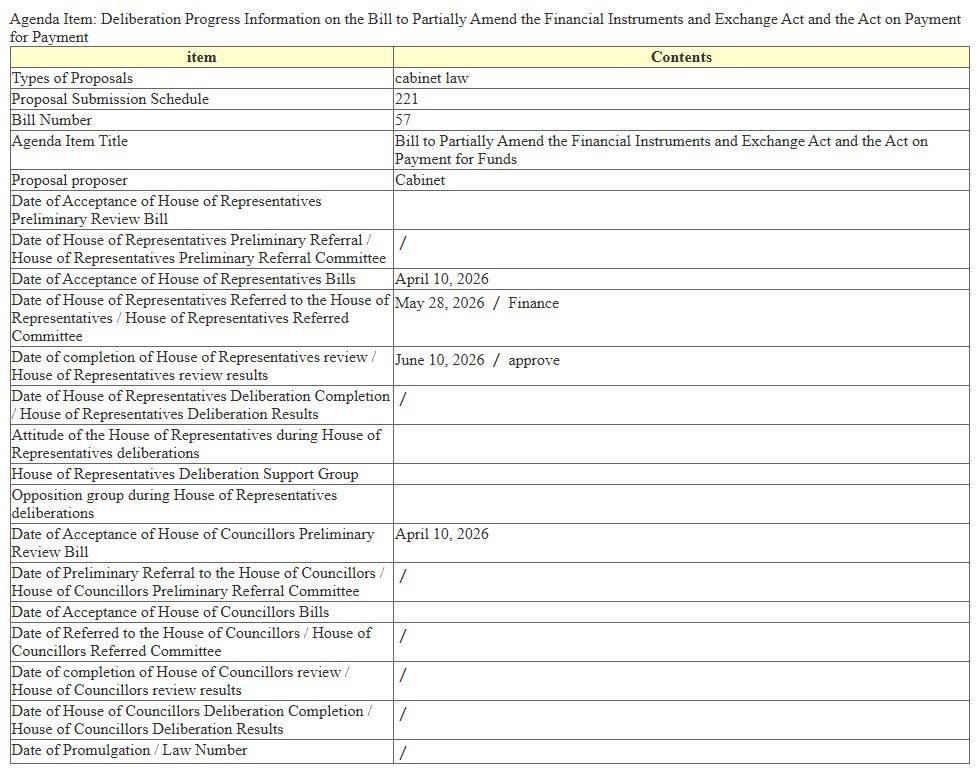
Official records showed the bill had cleared the Committee on Financial Affairs on June 10, although the bill-tracking page had not yet updated the plenary vote field at the time of writing.
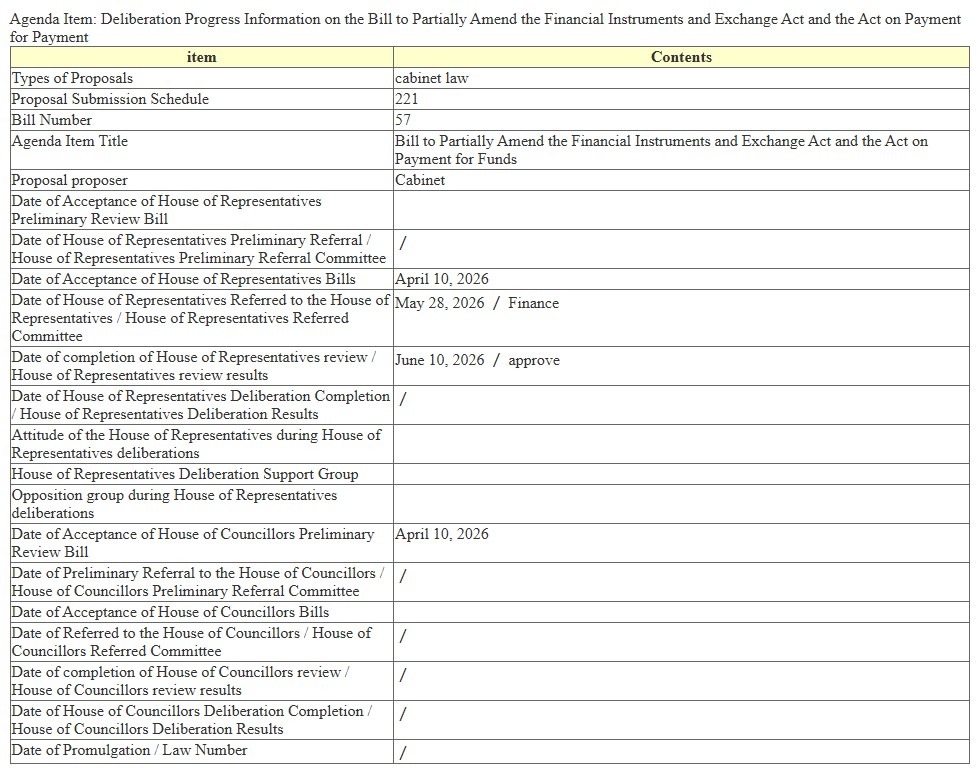
Status of the bill on the House of Representatives website. Source: House of Representatives of Japan
Japan shifts crypto into a financial-market framework
The latest parliamentary advance follows months of signals that Japan was preparing to shift crypto from a payment-focused regime into a financial-market framework.
In November 2025, media outlet Asahi Shimbun reported that the Financial Services Agency (FSA) had decided to apply the Financial Instruments and Exchange Act to crypto, including Bitcoin (BTC), Ether (ETH) and other tokens handled by local exchanges.
Related: SBI Shinsei links bank deposits to crypto rewards in Japan: Nikkei
FSA materials dated April 2026 said the proposal would move crypto-asset transaction rules from the Payment Services Act to the Financial Instruments and Exchange Act.
The FSA said the bill would treat crypto assets as financial products separate from securities, while introducing disclosure rules, tighter exchange oversight, insider trading restrictions and stronger penalties for unregistered operators.
The proposed framework would also require crypto-asset transaction business operators to publish information on the assets they handle, while issuers of certain assets would face disclosure requirements when conducting offerings or secondary distributions.
The shift could also open the door to crypto-tracking ETFs in Japan, giving local investors a regulated route to digital asset exposure beyond crypto exchanges and listed companies with token holdings, Bloomberg reported.
Magazine: Vietnam preps crypto pilot, HK pushes tokenization: Asia Express
Inside Bel-Air Country Club, glitzy host site of Curtis Cup this week

Coram raises $35M to turn cameras into AI detectives

XRP TODAY !!!!! ANY MINUTE FROM NOW ON !!!!!



-

 Fashion6 days ago
Weekend Open Thread: Evereve – Corporette.com
-
 Crypto World6 days ago
Jensen Huang Approves Samsung, SK Hynix, and Micron for NVIDIA (NVDA) HBM4 Memory Supply
-
 Entertainment5 days ago
The Best Mystery Series of All Time Is Surging on Streaming 30 Years After It Ended
-

 Crypto World3 days ago
Anatomy of the June crypto crash: Fed, Iran, Saylor
-

 NewsBeat4 days ago
Alexander Zverev wins the French Open to finally earn a 1st Grand Slam title
-

 Tech6 days ago
Suspicious Polyfill login prompts pop up on Toshiba, Muji websites
-
 Crypto World5 days ago
Senator Cynthia Lummis Calls CLARITY Act the Most Consequential Financial Legislation of This Generation
-

 Tech4 days ago
Microsoft unveils seven homegrown AI models in new bid for ‘long term self-sufficiency’
-

 Tech6 days ago
Microsoft launches MXC, an OS-level sandbox for AI agents, with OpenAI and Nvidia already on board
-

 Business6 days ago
(VIDEO) Justin Bieber Delivers Surprise Happy Birthday Serenade to Diners at Los Angeles Mexican Restaurant
-
 Business5 days ago
The Pain Points Taking a Fragile Tech Rally Down a Notch
-

 Business3 days ago
High Stakes for Wembanyama as New York Pushes for 3-0 Lead
-
 Crypto World3 days ago
Eli Lilly (LLY) Stock Surges 4% Following Breakthrough Sleep Apnea Trial Results
-

 Tech6 days ago
Von der Leyen’s AI envoy pick draws conflict-of-interest fire
-

 Tech6 days ago
Meta steals a tactic from Tesla and builds data centers in tents
-
Crypto World6 days ago
LBank Surpasses 25 Million Users Worldwide as AFA Partnership Continues to Drive Global Growth
-

 Tech5 days ago
Hackers now exploit SolarWinds Serv-U flaw to crash servers
-

 Crypto World4 days ago
Trump’s AI Ownership Plan Could Benefit Anthropic at OpenAI’s Expense
-
 NewsBeat4 days ago
Alexander Zverev conquers demons and outlasts Flavio Cobolli to win French Open for first major title
-
 Sports2 days ago
Bangladesh beat Australia after 20 years in ODIs, register only their second win over six-time world champions | Cricket News
You must be logged in to post a comment Login