

Crypto World
Polymarket Partners With Nasdaq to Launch Private Company Prediction Markets


Polymarket has launched a new category of prediction markets tied to private companies, allowing users to trade on questions related to pre-IPO companies — a move that could bring greater price discovery to private markets, where valuation data is often limited and opaque.
The new offering, announced Tuesday, was developed in partnership with Nasdaq Private Market, a platform that facilitates secondary trading in shares of privately held companies. Nasdaq Private Market will provide the underlying data and market infrastructure for the contracts.
The markets are designed to reflect expectations around events such as fundraising rounds, valuation changes and other corporate milestones involving startups and late-stage private companies. The launch expands Polymarket’s product lineup beyond its core markets focused on politics, macroeconomic events and public companies.

Source: Cointelegraph
The move is part of Polymarket’s effort to broaden its appeal to financially oriented users and extend prediction markets into private capital markets, where pricing information is often less accessible and less transparent than in public equities.
Polymarket said the rise of so-called unicorns — privately held startups valued at $1 billion or more — has increased demand for market-based forecasting tools tied to private companies. The platform noted that there are nearly 1,600 unicorns worldwide with a combined valuation exceeding $5 trillion, despite access to these companies remaining largely limited to private investors.
Related: Jump Trading eyes Kalshi, Polymarket stakes as institutional interest grows: Report
Prediction markets draw growing institutional interest
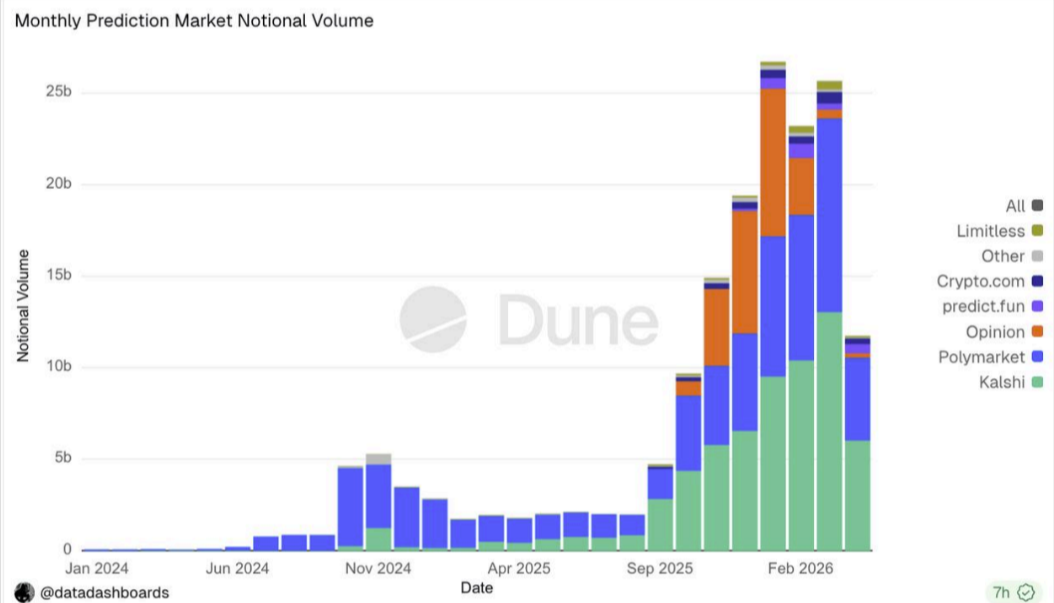
Polymarket’s partnership with Nasdaq Private Market reflects the broader institutionalization of prediction markets, as private company data and event-based contracts gain traction among professional investors.
Retail traders still account for the vast majority of activity. An April report by Bitget Wallet and Polymarket found that retail traders generated 80% of prediction market volume.
Prediction market trading volume in March. Source: Bitget Wallet
Still, Wall Street analysts say institutional participation is increasing as the US regulatory environment becomes more supportive and market infrastructure improves.
Bernstein recently pointed to the first institutional block trade on Kalshi as a milestone for the sector. Block trades are privately negotiated transactions, typically executed by large investors to move significant positions without disrupting the broader market.
Related: SEC delays prediction market ETFs over mechanics and risk concerns: Report



Strike has launched a Bitcoin-backed loan product built to remove margin calls and price-based liquidations.
Summary
- Strike says its new Bitcoin-backed loans remove price liquidations while keeping payment duties in place.
- Borrowers avoid margin calls, but missed payments can still lead Strike to sell collateral.
- The product targets Bitcoin holders who need cash but do not want forced selling.
Jack Mallers, Strike’s founder and chief executive, said the new product protects borrowers from forced selling when Bitcoin falls. He described the offer as a “volatility-proof” loan that lets users borrow dollars while keeping their BTC posted as collateral.
The launch follows Strike’s first Bitcoin-backed loan product, which arrived in May 2025. As previously reported, Strike issued more than $10 million in BTC-backed loans within two days of that launch.
No margin calls, but not risk-free
The new product removes price-triggered actions tied to loan-to-value levels. Mallers said, “No margin calls. No price liquidations. No matter how far bitcoin falls, your bitcoin doesn’t move.”
That structure differs from many crypto lending products, where a sharp price drop can force borrowers to add collateral or face liquidation. Strike says borrowers can keep their collateral untouched if they make payments on time.
The protection has limits. If a borrower misses an interest or maturity payment, Strike gives a 10-day window to pay or contact the company. If the borrower does not respond or settle the overdue amount, Strike may sell part of the Bitcoin collateral.
Mallers also warned users about the difference between price risk and payment risk. “That’s why we call it ‘volatility-proof,’ not ‘liquidation-proof,’” he said.
Higher cost funds the protection
The new loan carries a higher cost than Strike’s standard Bitcoin-backed loans. The annual percentage rate can reach 14.2%, based on a 2.95 percentage-point premium above Strike’s standard loan range.
Strike’s standard loan product has charged rates between 7.75% and 11.25%, depending on terms and payment choice. The “volatility-proof” version also uses a shorter six-month term and a maximum initial loan-to-value ratio of 45%.
In simple terms, a borrower who posts $100,000 in Bitcoin can borrow up to $45,000. The lower borrowing limit and higher rate give Strike more room to manage the risk of sharp BTC price moves.
Mallers said the added cost supports hedging. “The secret sauce is that we’re taking the extra charge that we’re giving you guys and we’re putting it on extra hedges in the market to protect all of us,” he said.
Bitcoin lending market searches for trust
The launch comes while crypto lenders keep testing ways to make Bitcoin-backed credit easier to use. A Ledn research report found that 88% of surveyed crypto holders would consider a crypto-backed loan, while only 14% currently use one.
Ledn and Protocol Theory called that gap a trust problem, not only a demand problem. Market volatility, fear of liquidation, and low confidence in lenders have limited wider use.
Other firms also continue to build crypto-backed lending products. As crypto.news previously reported, Coinbase launched crypto-backed loans in the U.K. through Morpho on Base, allowing users to borrow up to $5 million in USDC against Bitcoin, Ethereum, and cbETH.
Strike’s new product tries to address one of the main fears in Bitcoin lending: forced selling during market crashes. It does not remove repayment risk. Borrowers still need to pay on time, and the higher rate makes the product costly for users who need longer-term credit.

The U.S. Commodity Futures Trading Commission (CFTC) has filed a federal lawsuit against Trevor Vernon, a North Carolina man, and his company, Argent Capital Management, alleging they operated a crypto-involved commodity pool that defrauded investors of more than $14 million.
In its complaint filed Tuesday, the CFTC alleges Vernon solicited $14.8 million from at least 60 investors between March 2022 and February 2026 by presenting himself as a successful trader, while investors’ funds were allegedly used to generate “consistent and catastrophic losses.” The CFTC described the alleged misconduct as “akin to a Ponzi scheme,” and said it included trading in Bitcoin and Ether alongside equity index futures and related options.
Key takeaways
- The CFTC lawsuit alleges an investor-raising scheme tied to a commodity pool featuring both crypto and equity index derivatives.
- The agency claims investors were solicited with false performance messaging while losses were allegedly hidden, including through alleged misappropriation of funds.
- The complaint asserts Vernon violated federal commodities laws by failing to register the pool as required.
- The CFTC is seeking permanent restrictions on Vernon, along with potential disgorgement, penalties, and restitution.
A rare CFTC action in crypto underscores regulator focus
Crypto enforcement by the CFTC is comparatively infrequent, and the agency has faced ongoing scrutiny from some lawmakers about whether it has adequate resources to oversee a sector that has grown quickly and operates across multiple regulatory frameworks. This case stands out because it blends traditional commodities derivatives—such as equity index futures and options—together with cryptocurrency trading.
According to the CFTC’s lawsuit, the pool used a mix of instruments that the agency alleges were central to both returns claims and investor solicitation. The regulator’s emphasis on the commodity-pool structure is important: it signals that, where crypto is combined with derivatives and investor pooling, the CFTC may pursue conduct that fits within its commodities jurisdiction.
The allegations: hidden losses and misappropriated funds
Central to the CFTC’s claims is what it describes as Vernon’s pattern of misleading investors and obscuring the pool’s performance. The complaint alleges Vernon made false statements to both existing and prospective investors, including through quarterly account updates and monthly performance emails.
The CFTC alleges that trading across the pool—including crypto holdings such as Bitcoin and Ether, which the agency asserted were commodities—along with equity index futures and options resulted in losses exceeding $8.6 million. The regulator says Vernon did not disclose these losses to investors.
In addition, the CFTC claims Vernon misappropriated investor funds in a way it characterizes as similar to a Ponzi scheme—using money from investors, according to the agency, to pay earlier participants in order to conceal the underlying losses. The complaint states that at least $3 million was misappropriated for investor payments in that alleged manner.
The lawsuit also alleges personal misuse of funds: it claims Vernon misappropriated $136,000 for private air travel. The CFTC’s framing suggests it views the alleged conduct as not only misrepresentation but also improper diversion of pooled investor capital.
Registration failures and purported regulator misstatements
Beyond fraud-related allegations, the CFTC says Argent Capital Management failed to register with the agency as required under federal commodities law. Registration obligations are frequently a focal point in CFTC enforcement because they determine whether an operator is meeting baseline regulatory requirements for offering and running commodity-related investment products.
The complaint further alleges Vernon made false statements to the CFTC in January concerning issues the agency later raised in its lawsuit. The CFTC says Vernon’s conduct violated multiple legal requirements, not just investor communications and trading results.
Overall, the CFTC charged Vernon with seven counts relating to fraud, failure to register, and making false statements. Those counts reflect a broader enforcement approach that targets both how investors were recruited and how the pool was managed, including compliance steps that the regulator says were not followed.
What the CFTC is asking the court to do
In addition to seeking monetary remedies, the CFTC asked the court for injunctive relief aimed at preventing future misconduct. The regulator is requesting a permanent ban on Vernon from registration and trading, as well as disgorgement, penalties, and restitution.
These requests matter for investors and market participants because they signal the CFTC’s view that the alleged conduct warrants more than an order limited to the specific pool. A permanent prohibition and restitution-focused relief are typically designed to reduce the risk of repeat behavior and to address, to the extent possible, the financial harm described in the complaint.
More broadly, the case may also influence how firms and individuals structure “commodity pool” offerings that involve crypto trading or claim crypto-related performance. If the allegations reflect actual conduct proven in court, it would highlight how the CFTC may treat certain crypto activities as part of a broader commodities-and-derivatives framework—especially when an operator solicits outside capital and markets results while allegedly failing to disclose losses.
What to watch next
Readers should watch how the court responds to the CFTC’s requested remedies and whether the case proceeds on the specific theories of jurisdiction and alleged misappropriation outlined in the complaint. Until factual issues are resolved, the key uncertainty remains the extent to which Vernon and Argent Capital Management can rebut the CFTC’s claims regarding hidden losses, alleged investor misrepresentations, and compliance failures.
The Core Team behind the controversial project continues to improve the user experience, and the latest set of updates is focused on the Pi App Studio.
However, it appears that the native token’s current situation cannot be positively influenced by any of these, as it has plunged once again to a fresh all-time low less than 10 days after the previous one.
What’s New on Pi App Studio
Ever since it released the Pi App Studio last year, the team has doubled down on improving the general experience, especially by introducing AI-related features. In its latest blog post on the matter, they outlined two major updates, one with AI functions and the other focused on backend support.
The latter enables persistent user experiences for newly created applications through the Pi App Studio. Consequently, devs who have created their own apps can “save and retrieve user-specific data across sessions.” According to the team, this would enable “experiences that continue even after users leave and return.”
The second big improvement is indeed centered on incorporating more artificial intelligence functions: an AI-assisted App Planning Phase. It allows devs to crystallize their initial idea into a more complete app concept in a “more interactive and dynamic way.”
Pi App Studio has released two updates to help creators build more engaging and useful app experiences.
1. Backend support enables persistent user experiences for newly created App Studio apps: Apps can save and retrieve user-specific data across sessions, enabling experiences… pic.twitter.com/IOoiSsgKeH
— Pi Network (@PiCoreTeam) July 7, 2026
The Pi App Studio updates now follow previous notable announcements from the team, such as unveiling SoloHost, Pi Sign-in, and PiVerify during Pi2Day on June 28.
PI Sees New ATL
No matter what kind of new updates the team is trying to introduce, the project’s native token just can’t catch a more permanent break. It has marked numerous all-time lows during this bear cycle in the past year, and the latest arrived hours ago.
PI flirted with the $0.11 support for several days, but the broader market’s retreat has pushed it south hard. The token is down by over 7% in the past day, while most of the market has slipped by 1-2%, and charted a new low of $0.1033 (according to CoinGecko). It has lost 10% weekly, but the macro scale is a lot more painful, showing a 96.5% drop from the all-time high in February 2025.

The post Pi Network Unveils 2 Major Updates but PI Token Dumps to a New All-Time Low appeared first on CryptoPotato.


The yen is trading near its weakest level in four decades, and Japanese companies are moving crypto onto their balance sheets to escape it.
SBI VC Trade on Tuesday said corporate demand for bitcoin and XRP is climbing as the currency’s slide pushes firms to diversify reserves beyond cash, with the exchange’s registered accounts passing 2 million, roughly double its 2025 count.
Hedge funds have turned the most bearish on the yen since 2007, boosting bets on further losses to nearly 138,000 contracts as of June 30, per CFTC data. The dollar buys around 162 yen as of Asian morning hours Wednesday.
The driver is the interest-rate gap between a hawkish U.S. Fed and a Bank of Japan still far behind it, the same gap that makes holding yen cash a losing position and sends firms looking for harder assets.
SBI, the crypto arm of Tokyo-based SBI Holdings, noted demand for its corporate service has grown alongside companies that hand out bitcoin or XRP through shareholder-perk programs.
The move fits a pattern the market has watched all month. A weak yen has fed the carry trade, where investors borrow cheaply in yen to buy higher-returning assets elsewhere, and some of that flow is now reaching crypto through regulated Japanese channels rather than offshore ones.
Bitcoin traded near $62,650 on Tuesday, up 6.1% on the week, per CoinDesk data.


Secret Network is seeking to move SCRT from Cosmos to Arbitrum, citing security risks, weaker liquidity, and older code.
Summary
- Secret says AI makes older bridge code easier to scan, attack, and exploit over time.
- The proposed Arbitrum move follows a $4.7 million Axelar-Secret bridge exploit tied to legacy integration.
- SCRT holders face a Sept. 1 snapshot, with non-native or contract-held balances excluded from claims.
In a July 7 governance post, the privacy-focused blockchain said the plan would create a new ERC-20 SCRT token on Arbitrum through a one-time snapshot on Sept. 1. The team said native and staked SCRT balances would count, while sSCRT, bridged SCRT, contract-held tokens, and IBC assets would not qualify.
The proposal has not passed yet. The team said the move needs a community vote, and the migration will not proceed if holders reject it.
AI exploit risk drives security concerns
The team said security sits at the center of the proposal. It pointed to the recent Axelar-Secret IBC bridge exploit, which crypto.news previously reported led Axelar to disable Secret Network bridge routes after about $4.7 million in bridged assets were taken.
Secret said the exploit did not touch native SCRT, its core privacy protocol, or its confidential compute model. Still, it said the event showed the risk of old bridge paths and under-maintained code in a smaller ecosystem.
“The security risk is the part we take most seriously,” the team said. It also warned that “with AI, the cost of attacking stale code is falling across the board,” as models get better at reading contracts and finding weak points.
Cosmos liquidity pressure adds to case
Secret Network said Cosmos was the right home in 2020 because appchains, IBC, wallets, and infrastructure had stronger momentum. It now says the market has changed, with lower liquidity and fewer builders staying in the ecosystem.
Moreover, Anoma co-founder Christopher Goes warned in January that Cosmos was facing deep stress as projects such as Penumbra, Osmosis, and Noble reduced work, explored exits, or shifted resources elsewhere.
DefiLlama data shows Secret has about $1.32 million in DeFi TVL, while Cosmos chains have about $2 billion. By comparison, L2Beat lists Arbitrum One as the largest Ethereum scaling network by total value secured, with about $17.4 billion.
SCRT holders face snapshot rules
If the proposal passes, SCRT Labs plans to end official support for the Cosmos-based Secret L1 on Sept. 1. The old chain could keep producing blocks if enough validators continue running it, but that would depend on third-party support.
The team also said it will release Secret’s source code under a permissive open-source license. It proposed reducing inflation to 5% from 9% after the move, while keeping SCRT as the governance token.
Users would need to move certain assets before the snapshot. The proposal asks holders to convert eligible balances back to native or staked SCRT and move IBC assets back to their home chains.
SCRT holders reacted poorly to the proposal. CoinGecko data showed the token trading near $0.041, down about 25% in 24 hours and more than 99% below its 2021 peak.


The Commodity Futures Trading Commission (CFTC) has sued Trevor L. Vernon and his firm, Argent Capital Management, over an alleged $14 million fraud involving a commodity pool that traded stock index futures, options, and crypto assets.
The agency filed its complaint in the US District Court for the Western District of North Carolina. It accuses the two defendants of hiding heavy losses while telling investors their money kept growing.
Inside the Alleged Crypto Fraud Scheme
The complaint covers conduct from at least March 2022 through February 2026. Across that span, the defendants raised money from at least 60 participants, according to the filing.
Vernon marketed himself as a skilled trader and claimed the pool was highly profitable. In reality, his trades resulted in steady and substantial losses, the CFTC alleges.
The defendants sent monthly emails and quarterly updates that showed rising account balances. Those gains never existed, the agency says.
Vernon also reportedly misappropriated pool money. He allegedly paid earlier investors with funds from new ones, a hallmark of a Ponzi scheme.
The filing further cites several registration violations under the Commodity Exchange Act (CEA).
“In addition, the complaint alleges Vernon knowingly made false statements during sworn testimony taken as part of the Commission’s investigation,” the CFTC said.
Follow us on X to get the latest news as it happens
The CFTC wants restitution, disgorgement, civil penalties, and permanent trading and registration bans. It also seeks a court order stopping Vernon from further violations.
The case fits a broader CFTC push against retail fraud. In March, enforcement director David Miller named Ponzi schemes and commodity pool fraud among the agency’s top priorities.
Subscribe to our YouTube channel to watch leaders and journalists provide expert insights
The post Argent Capital Founder Faces CFTC Charges Over Alleged $14 Million Fraud appeared first on BeInCrypto.

Crypto traders have “flipped their expectations several times” in just one month, reported analytics provider Santiment on Wednesday.
The crowd was heavily bearish for most of June, calling for lower prices as Bitcoin slipped to $58,000. However, they’ve flipped bullish now as BTC rebounded towards $64,000, said Santiment before adding:
“These fast mood swings show how reactive retail sentiment can be when price starts moving.”
Markets Move Opposite to Crowds
Crypto typically moves opposite to what the crowd is most loudly expecting, “because markets tend to punish crowded trades.” This can be seen in action today as markets have retreated 1.5% with Bitcoin falling below $63,000 on Wednesday morning in Asia.
“Optimism doesn’t mean the rally is over, but when traders quickly shift back to calling for higher prices, it’s a sign bulls may need a cool-off before the next cleaner leg up,” said Santiment.
TL;DR: Crowd turns bullish as Bitcoin & altcoins rebound
Metrics Used: Social Trends Query
Link to chart: https://t.co/3mqlUdE4ym
— Santiment Intelligence (@SantimentData) July 7, 2026
The market dip followed renewed strikes on Iran by the US following the attack on commercial ships in the Strait of Hormuz.
“US Central Command forces have begun launching a series of powerful strikes against Iran to impose heavy costs for targeting and attacking commercial shipping crewed by innocent civilians in an international waterway,” stated Centcom.
CryptoQuant analyst ‘Darkfost’ said on Tuesday that the apparent demand for Bitcoin has stayed negative for almost the entire year.
“The dynamic remains unchanged and perfectly illustrates the current weakness in Bitcoin demand,” despite the recent rally, he said.
Currently, Bitcoin remains in a “risk-off regime,” said analyst Axel Adler Jr.
“Inter-exchange flow through Coinbase Advanced is still weak, and momentum is not yet showing a sustained reversal higher,” he added.
Bitcoin Price Outlook
The renewed attacks in the Middle East have doused the flames of the recent rally, with markets losing $50 billion over the past 12 hours.
Bitcoin fell to an intraday low of $62,600 during Wednesday morning trading in Asia, down 2.3% from its intraday high of just over $64,000 late on Tuesday.
Ether has followed suit, falling from $1,800 to $1,750 at the time of writing, while most of the altcoins are back in the red again.
The post Rapid Retail Mood Swings Signal Caution as BTC Retreats Amid Iran Strikes appeared first on CryptoPotato.


The Trump administration has approved a broad rollout of OpenAI’s advanced GPT-5.6 model. OpenAI has announced that the wider release will happen on Thursday, July 8, after additional testing and government meetings.
AI models have been under increased scrutiny of late, with Anthropic’s Fable 5 released and then recalled at the direction of the Trump administration.
A Staggered Rollout Reaches Its Next Stage
OpenAI agreed to a staggered GPT-5.6 release last month at the government’s request, limiting initial access to a small group of vetted partners. The company later confirmed that most users still lacked access even after its official unveiling in June.
The reported Commerce Department clearance would lift those restrictions and open the model to a wider audience by Thursday. The scope of the additional testing and the officials involved in the review have not been disclosed.
Approval Follows Warming Ties With Washington
The clearance arrives as OpenAI pursues closer ties with the administration. Chief executive Sam Altman has floated a 5% equity stake proposal for the US government.
Altman has shared the idea with senior administration officials since the start of Trump’s second term. Those officials reportedly include Treasury Secretary Scott Bessent and Commerce Secretary Howard Lutnick, per the Financial Times.
Trump has signaled openness to such arrangements.
“There are concepts where pieces could be given to the American public, where the American public essentially becomes a partner,” the President said.
The administration made a similar reversal last month. It lifted export controls on Anthropic models, under the Mythos umbrella, reflecting a broader pattern of shifting federal decisions on frontier AI access.
The post Trump Administration Approves Rollout of OpenAI’s GPT-5.6 appeared first on BeInCrypto.


The CFTC has sued a North Carolina man and his company over an alleged commodity pool fraud tied to crypto and futures trading.
Summary
- CFTC says Argent Capital solicited $14.8 million while hiding losses from at least 60 investors.
- The complaint links Bitcoin, Ether, futures, options, false statements, registration failures, and alleged misused funds.
- The case lands as CFTC faces wider questions over crypto oversight, resources, and derivatives rules.
In a July 7 press release, the Commodity Futures Trading Commission said it filed a civil enforcement action against Trevor Vernon and Argent Capital Management LLC. The agency said the pool traded equity index futures, options on equity index futures, Bitcoin, Ether, and other crypto assets.
The complaint says Vernon and Argent Capital solicited more than $14 million from at least 60 participants from March 2022 to February 2026. The CFTC said Vernon told investors he was a successful trader and claimed the pool had strong gains.
Agency says losses were hidden
The agency said those claims did not match the trading record. In its complaint, the agency said Vernon’s trading produced “consistent and catastrophic losses” for pool participants.
The regulator said Vernon and Argent Capital sent monthly emails and quarterly updates that showed rising account balances from gains that did not exist. The agency said the pool lost more than $8.6 million through trading, while investors received false reports about performance.
The agency also alleged that Vernon misused pool money. It said about $3 million went to payments to existing participants in a way “akin to a Ponzi scheme.” The complaint also says Vernon used about $136,000 for private air travel.
CFTC seeks bans and penalties
The lawsuit includes seven counts tied to fraud, registration failures, and false statements to the regulator. The agency said Argent Capital Management failed to register as required under federal commodities law.
The agency also said Vernon made false statements during sworn testimony in January while the agency investigated the matter. The regulator asked the court for restitution, disgorgement, civil penalties, and permanent trading and registration bans.
The CFTC’s complaint treats Bitcoin and Ether as commodities. That position fits the agency’s long-running effort to assert authority over parts of the crypto market, especially where crypto appears in derivatives, pooled trading, or fraud cases.
The court has not ruled on the claims. The CFTC’s filing starts a civil case, and Vernon and Argent Capital will have a chance to answer the complaint in federal court.
Case lands during wider CFTC debate
The action comes as the agency faces broader attention over crypto oversight. CME Group moved to sue the CFTC over the agency’s approval of U.S. crypto perpetual futures, arguing the products should be treated as swaps.
The agency is also under pressure from lawmakers over prediction markets. As crypto.news reported, Senators Adam Schiff and John Curtis asked the CFTC to review Polymarket advertising claims and questioned whether the regulator has enough authority and resources for consumer protection.
The Argent Capital case is different from those market-structure disputes. It centers on alleged investor fraud, false reporting, registration failures, and misuse of money. Still, it adds another crypto-linked matter to the CFTC’s docket at a time when the agency may receive broader power over digital commodities under proposed U.S. market rules.
As previously reported, crypto.news also covered the CFTC’s decision to scrap its no-deny settlement rule. That change gave defendants more room to dispute agency claims after settling enforcement cases.


Ctrl Wallet will permanently shut down on August 3, 2026, disabling transfers, swaps, and in-app activity.
The company announced the closure on July 7 and pulled the app from major stores the same day. Anyone who has already installed it can keep every feature until August 2.
What the Ctrl Wallet Shutdown Means for Users
Ctrl says the wallet stays fully operational until August 2. Until that date, holders can continue normal use, including sending, receiving, and swapping tokens, as well as exporting their recovery phrase.
From August 3, the only remaining function is exporting a recovery phrase.
“We strongly recommend exporting your recovery phrase as soon as possible, as we cannot guarantee how long the app will remain accessible on your device,” the team said.
Ctrl recommends two paths before the deadline. Users can export their 12-word or 24-word recovery phrase, or move funds to another wallet or exchange.
The platform did not explain why it is shutting down. However, the decision comes after a June security issue that, according to the team, affected a small number of Cardano (ADA) wallets on the platform.
Follow us on X to get the latest news as it happens
Ctrl’s exit is not an isolated case. RootData counts 79 crypto projects that closed, entered bankruptcy, or went dark through 2026.
The tally spans wallets, DeFi protocols, NFT platforms, and more, pointing to pressure that spans the sector rather than a single corner of it.
What remains unclear is how long the app will stay usable after August 3. Ctrl said it cannot guarantee continued access.
Subscribe to our YouTube channel to watch leaders and journalists provide expert insights
The post Ctrl Wallet Winds Down as Crypto Project Shutdowns Mount in 2026 appeared first on BeInCrypto.

Duke Wellington’s brings in the community with World Cup

How to Solve Puzzle Number 1123 Fast

Strike Bitcoin loans remove margin calls


-

 Fashion4 days ago
Weekend Open Thread: High Hopes
-
 NewsBeat3 days ago
Taylor Swift and Travis Kelce wedding staffer hilariously struggles to keep her cool while checking in megastars
-

 Fashion2 days ago
Open Thread: What Great Books Have You Read Recently?
-
 Crypto World7 days ago
Airdrop Registration Becomes Key Focus For Remittix As RTX Launch Updates Approach
-

 Politics5 days ago
The House | “Reframing the debate from a binary discussion of winners and losers”: Yuan Yang reviews ‘We Are Not Machines’
-

 Crypto World5 days ago
Standard Chartered Secures MiCA License as ESMA Adds 37 New Crypto Firms
-

 Business1 day ago
AXT Shares Jump Nearly 14% as Semiconductor Materials Maker Rebounds on AI-Linked Indium Phosphide Demand
-

 Sports7 days ago
Broncos roster: OL Ben Powers (No. 74) entering final year of contract
-

 Crypto World6 days ago
Binance stock trading tops $1B in first month after launch
-
Crypto World1 day ago
SK hynix (000660.KS) Stock Dips as $28B Nasdaq ADR Offering Drives AI Memory Expansion
-

 Crypto World6 days ago
Alibaba-affiliate Ant Group enters the humanoid robot market with 12 deals
-

 Crypto World3 days ago
South Africa proposes crypto tax guidance under existing rules
-

 News Videos2 days ago
Best Time to Enter Small Caps Right Now? Another Bull Run? | Financially Free
-

 News Videos1 day ago
Whats Hidden Inside This Cash Register? #treasure #reselling #money
-

 Tech3 days ago
Lenovo laptops are now shipping with YMTC SSDs, a sign of Chinese NAND entering the mainstream
-

 Business6 days ago
Meta Platforms Stock Jumps 7% Today as Bloomberg Reports Company Plans to Enter the Cloud Business
-
 NewsBeat6 days ago
New exhibition reflects five decades of movement between island of Ireland and GB
-

 Business5 days ago
What a 10 Percent Drop Means for Buyers, Sellers and Renters
-

 Crypto World5 days ago
Binance Re-Enters Philippines As EU MiCA Rules Restrict Access
-

 News Videos2 days ago
Avoid entering in FOMO #bitcoin #cryptocurrency #trading #scalping
You must be logged in to post a comment Login