
Crypto World
Polymarket pushes for MiFID status as Europe weighs prediction market rules


Polymarket has stepped up talks with European and UK regulators as the prediction market platform seeks financial services oversight for its contracts instead of being regulated primarily under national gambling laws.
Summary
- Polymarket is holding talks with regulators in the EU and UK as it seeks to have its prediction contracts regulated under financial services rules.
- The company is pursuing MiFID treatment in Europe while regulators in France, Germany, Italy and the UK continue to classify many prediction markets under gambling rules.
- ESMA has warned about insider trading risks in prediction markets, while the FCA continues to restrict retail access to binary options over concerns about speculation and consumer harm.
- Polymarket’s regulatory push comes as the company seeks new funding at a valuation above $20 billion and works to expand its international operations.
According to the Financial Times, the New York based company has held discussions with regulators in London, Brussels and several European Union jurisdictions as it works toward securing a European license. People familiar with the discussions said Polymarket wants its contracts treated more like derivatives under financial services rules.
The effort comes as the company pursues international expansion while raising capital at a valuation exceeding $20 billion. Polymarket has argued that supervision under financial markets rules would provide a more suitable framework for its products than the gambling regimes currently applied to prediction markets in several European countries.
Polymarket seeks MiFID treatment for prediction markets
Polymarket has been engaging with the European Securities and Markets Authority and the European Commission, according to people familiar with the matter. Discussions have extended to individual national regulators as the company examines possible licensing routes within Europe.
ESMA chair Verena Ross met two U.S. based members of Polymarket’s legal team in June, accompanied by a Paris based lawyer from A&O Shearman and a Brussels based lobbyist from Hanbury Strategy. Polymarket executives met UK Financial Conduct Authority chief executive Nikhil Rathi the following day.
The company is seeking to convince European authorities that its contracts can operate under the Markets in Financial Instruments Directive, or MiFID, which sets rules for investment firms and financial instruments across the EU.
Such a classification would not automatically give Polymarket unrestricted access to European retail customers. ESMA warned in July that some event based contracts could already qualify as financial instruments under MiFID II, meaning existing EU restrictions on binary options could apply when the products meet the relevant definition.
Polymarket has continued discussions despite the regulatory hurdles.
“As we grow our presence and expand globally, we are committed to engaging early and openly with policymakers and regulators,” the company said.
As part of the effort, Polymarket joined trade group Blockchain For Europe this month and has started discussions with other European industry organizations, according to a person familiar with the matter.
European regulators have treated Polymarket differently
Polymarket’s push for financial regulation faces a fragmented European market where authorities have taken different approaches to event contracts.
National gambling regulators in countries including France, Germany and Italy have maintained that prediction markets require local gambling licenses. Retail access to many of the products remains restricted across Europe, although some users continue accessing overseas platforms through virtual private networks.
France has already taken direct action against Polymarket. French authorities ordered internet providers to restrict access to the platform after treating it as an unauthorized gambling service.
Similar action followed elsewhere in Europe. In July, the Czech Ministry of Finance ordered internet service providers to block Polymarket after authorities classified the service as an unauthorized internet game. Czech regulators said the platform had to comply with the country’s gambling framework regardless of how its contracts were described.
ESMA has taken a separate approach by examining whether certain prediction contracts can fall within existing financial market legislation. Its July guidance said firms offering event based contracts must assess whether individual products qualify as financial instruments under MiFID II.
The distinction depends partly on the structure and underlying event of a contract. Prediction markets allow users to trade positions tied to outcomes across financial markets, sporting events, elections, economic decisions, entertainment awards and weather.
ESMA has remained cautious about loosening existing protections for retail investors. The regulator warned this month that prediction markets face risks involving insider trading, an issue that has drawn scrutiny as trading volumes and the range of available contracts have increased.
UK rules split contracts between two regulators
Britain presents another regulatory hurdle because oversight depends on what event determines a contract’s outcome.
The FCA considers prediction contracts linked to financial events and certain climate outcomes to fall within its regulatory perimeter. Political and sports markets, which account for significant activity across platforms such as Polymarket and Kalshi, would instead come under the Gambling Commission.
Britain has prohibited the sale of binary options to retail consumers since 2019. The FCA has maintained that the products can be highly speculative, resemble gambling and expose consumers to significant potential losses.
However, the regulator has recently discussed whether its treatment of retail financial prediction markets should change. As crypto.news previously reported, the FCA has held talks with trading platforms about potentially reopening access to certain financial prediction products for retail investors.
No formal rule change has been announced. As of September, the FCA had not published a consultation, proposed rule or implementation timetable that would allow Polymarket or another platform to offer financial event contracts broadly to British retail customers.
Gambling regulators have maintained a different position for contracts outside the FCA’s perimeter. Political and sports prediction markets would require the appropriate gambling authorization in the UK, creating separate regulatory routes depending on the event being traded.
Polymarket valuation has climbed during regulatory push
Polymarket’s European lobbying effort comes while the company seeks another major financing round.
The platform has been discussing approximately $1 billion in new funding at a valuation above $20 billion. A proposed round led by Donald Trump Jr. linked 1789 Capital would value Polymarket at $21 billion, with the investment firm planning to contribute roughly $300 million.
1789 Capital had previously invested approximately $200 million in the company, while Intercontinental Exchange has emerged as another major backer. ICE, the parent of the New York Stock Exchange, invested $1 billion in Polymarket in October 2025 and disclosed another $600 million investment in March 2026.
The company has pursued regulated market access in the United States alongside those investments. Its U.S. operation runs through QCX, a Commodity Futures Trading Commission designated contract market acquired by Polymarket as part of its return to the American market.
European expansion remains subject to a different set of rules. Polymarket is seeking financial services treatment at the same time that national gambling authorities continue to require local licenses for many of its products, while existing EU and UK restrictions could limit retail access even when some contracts qualify as financial instruments.
ESMA and the FCA declined to comment on Polymarket’s latest regulatory discussions.

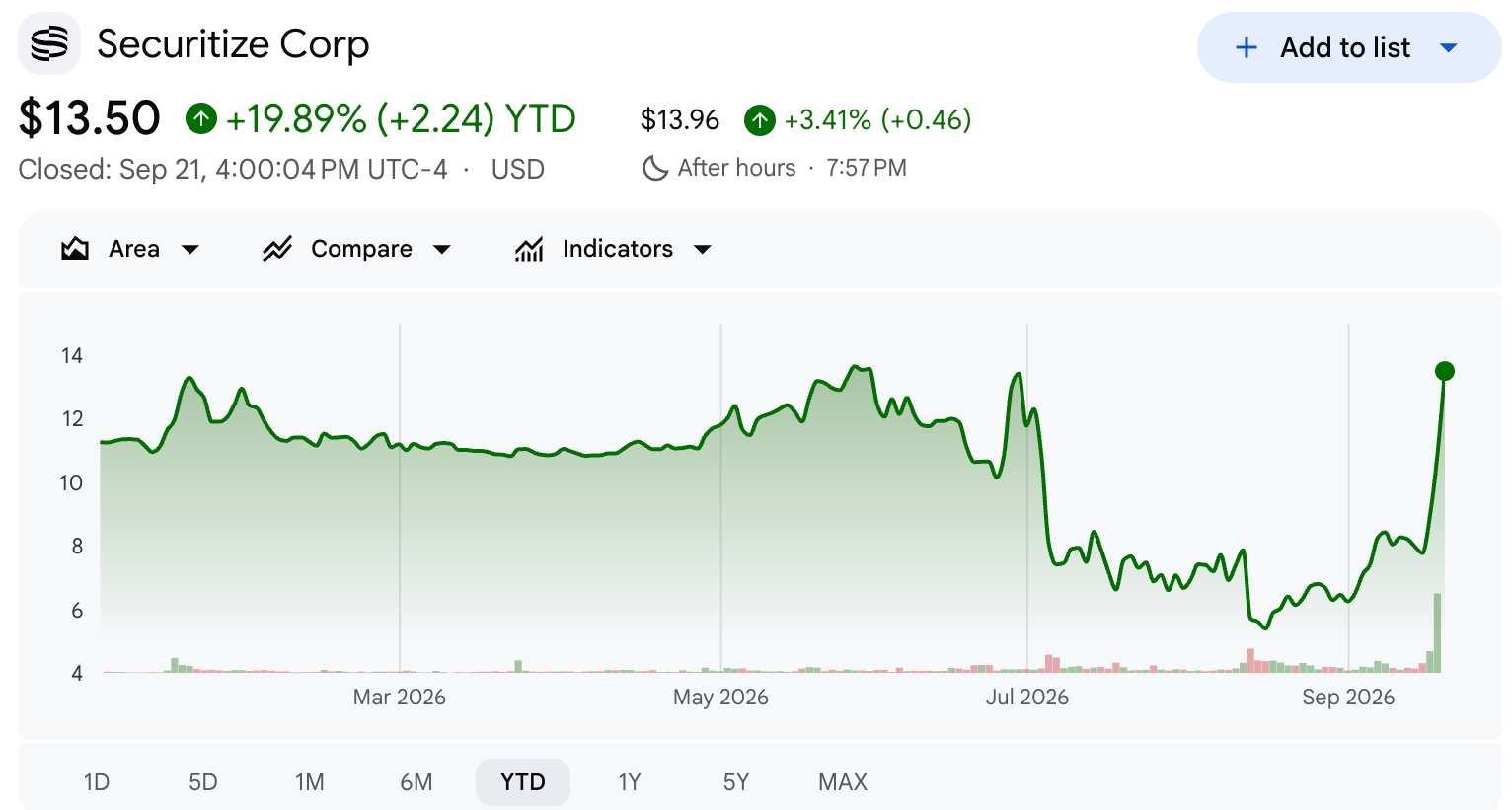
Securitize stock could nearly double over the next year, according to Cantor Fitzgerald. The firm set a $21.20 price target, marking a 95% upside from Friday’s close of $10.86.
Cantor opened coverage on Monday at an overweight rating, putting a Wall Street number on a company that turns stocks and funds into blockchain tokens.
A $39 Billion Start in a $319 Trillion Market
Analyst Gareth Gacetta placed Securitize near the start of a long runway. Cantor estimates roughly $39 billion in assets are sitting onchain today, equal to 0.01% of the $319 trillion held in traditional financial assets.
“Tokenization is the largest overhaul financial infrastructure has seen over the past century, and Securitize is the public company covering most of that lifecycle, issuing, registering, custodying, distributing, and enabling trading of the asset under a single roof,” Gacetta said.
Gacetta added that if the world goes onchain, a large share of it goes onchain through Securitize. Independent data supports the position, if not yet the scale.
RWA.xyz ranks Securitize as the largest tokenization platform by distributed asset value at $4.64 billion, ahead of Ondo’s $3.63 billion.
The tracker counts 1,877 holders across 26 tokenized assets, while monthly transfer volume reached $1.12 billion, up 178% from a month earlier.
Follow us on X to get the latest news as it happens
The Rally Started With a Rule Change
Cantor’s note landed on a stock already moving. The Securities and Exchange Commission (SEC) announced a temporary order on Thursday. The regulator has drawn a path for select venues to issue tokenized representations of publicly traded US equities.
The ruling had already lifted the shares 14%. Monday’s initiation added to that momentum. The stock closed at $13.50, a gain of about 24% on the day, and traded near $13.96 after hours.

The rally also ate into the call itself. Measured from Monday’s close rather than Friday’s, $21.20 implies roughly 57% upside. Securitize is up 19.89% so far this year, with substantial ground covered in the past four sessions.
Subscribe to our YouTube channel to watch leaders and journalists provide expert insights
The post Cantor Fitzgerald Flags 95% Upside in the Firm Putting Stocks Onchain appeared first on BeInCrypto.

Cardano has gained support in the x402 software stack, allowing developers to build applications and AI agents that can pay for online services using ADA and Cardano native tokens.
Summary
- Cardano has joined the x402 software stack, giving developers tools to build AI agents and apps that can pay for online services using ADA and native tokens.
- The initial release supports TypeScript, while Python support is planned and the payment facilitator has completed a real transaction on Cardano preprod.
- The facilitator has not yet been tested on mainnet, meaning the release does not show AI agents already making commercial ADA payments at scale.
- Solana and XRP Ledger already support x402 as blockchain networks compete to provide payment infrastructure for autonomous software.
According to documentation from the Cardano Foundation’s x402 implementation, developers now have the client, server and payment facilitator components needed to handle x402 transactions on the network, although the facilitator has so far completed an end to end transaction only on Cardano’s pre production network.
Cardano x402 support opens ADA to machine payments
The integration brings Cardano into an internet payment standard designed to let software purchase digital resources without going through a conventional checkout process.
x402 uses the HTTP “402 Payment Required” response, an existing web status code that had largely remained unused for payments. When an application or AI agent requests a paid resource, the service can return the price, accepted asset and payment instructions as part of the same internet request.
The client then prepares and signs the required transaction. A facilitator can verify the payment, submit it to the blockchain and confirm settlement before the requested service is delivered.
In practice, an autonomous agent researching a subject could purchase a single dataset, API request or piece of computing capacity when required instead of creating an account or signing up for a recurring subscription.
The model has been gaining ground as developers experiment with ways for autonomous software to pay for resources. A crypto.news guide to agentic payments published in June explained that x402 can let agents purchase data, computing resources and online services directly through web requests.
Coinbase originally introduced x402 in 2025 before the protocol was moved into an open standards effort. Its development has since attracted participation from companies across payments, cloud computing and blockchain infrastructure.
Cardano’s implementation gives developers another blockchain option when building services around the standard, alongside networks that already have x402 infrastructure.
Cardano developers build payment and settlement tools
Cardano Foundation engineers started their work with a specification accepted in June before developing the software required to make the payment process function across the network.
The implementation includes client side tools for initiating payments and server components that allow an online resource to request them. A separate facilitator handles payment verification and settlement.
Under the x402 model, the facilitator can check whether a signed payment satisfies the requirements set by the resource provider and submit the transaction to Cardano. The service does not need to hold the payer’s private keys to perform that role.
The first developer release supports TypeScript, while Python support is planned for a later stage.
A Cardano Foundation facilitator repository states that its implementation has been tested end to end on Cardano preprod using a real onchain transaction. The software has not yet been run against Cardano mainnet, leaving the current rollout at the infrastructure and testing stage rather than showing large scale commercial ADA payments by autonomous agents.
Developers can still begin incorporating the available software into applications while the mainnet infrastructure is prepared.
Other blockchain projects have already moved further into live deployments. Casper, for example, launched an x402 facilitator on mainnet in June as part of a toolkit designed for autonomous agents.
x402 adoption has expanded across crypto networks
Coinbase has continued building products around the protocol since introducing x402, while several blockchain networks have pursued their own integrations.
In July, Coinbase Business added support for USDC payments initiated by AI agents through x402. The company introduced developer tools at the same time that allow online services to add x402 payment acceptance.
Amazon Web Services had moved into the same area earlier in 2026. Amazon Bedrock AgentCore Payments integrated Coinbase x402 in May, allowing AI agents to pay for compatible services in USDC.
The system gave developers access to services covering search, data and backend infrastructure while letting agents make payments without requiring a person to complete each transaction.
XRP Ledger has emerged as another network testing the model at higher transaction volumes. AI related x402 activity on XRPL passed 1 million payments by July, alongside the launch of a Ripple backed hub bringing together agent tools, payment services and developer resources.
Subsequent data put the network above 1.4 million AI agent transactions, although transaction counts alone do not establish how many independent agents or commercial services are responsible for the activity.
Base and Solana have recorded significant x402 usage as well. Coinbase said in September that its developer platform had processed more than 100 million x402 payments across the two networks, while direct x402 functionality for some of its agent products remained under development.
ADA joins the competition for agent payment activity
Cardano’s entry gives developers the ability to build x402 payment flows around ADA and tokens issued on the network, placing its assets within the same machine payment framework being tested elsewhere in the crypto market.
The current implementation, however, does not establish that autonomous agents are already using ADA to purchase commercial services at scale.
Its facilitator documentation says the software has completed a real transaction on Cardano preprod but has not been exercised against mainnet. The implementation includes verification and settlement endpoints that check signed payments and submit valid transactions to the network.
Development has come as x402 usage increasingly extends beyond experimental agent transactions. Online services can use the protocol to charge individually for data, computing capacity, application programming interfaces and other digital resources, creating a pay per use model that software can interact with directly.
Some implementations have already turned that model into live services. The Graph enabled x402 payments for its Graph Gateway in May, allowing developers and AI agents to purchase individual onchain data queries using USDC.
Cardano’s available tooling now provides the pieces needed for developers to construct similar payment flows on its network. The facilitator has been implemented and tested on preprod, while a mainnet deployment remains a separate step that has not yet been completed.
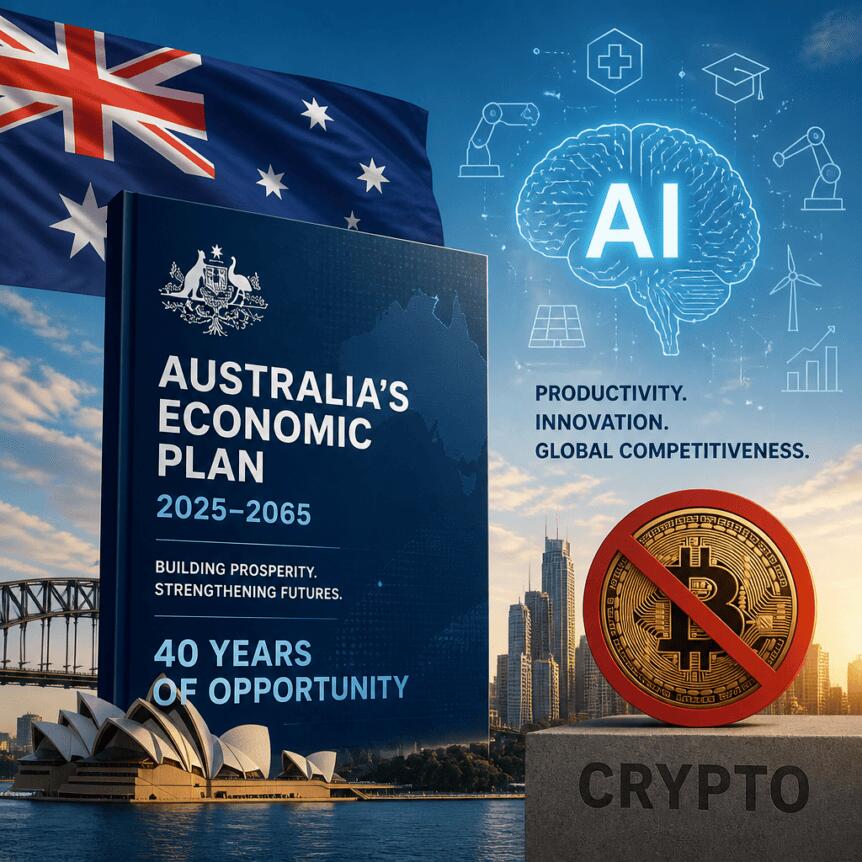
Australia’s latest Intergenerational Report, outlining economic trends expected to shape the country over the next 40 years, spotlights artificial intelligence and four other large-scale transitions—but it notably does not mention crypto or digital assets. The Treasury’s assessment arrives as policymakers elsewhere in Australia continue to probe tokenization and “financial infrastructure” upgrades that could support the kind of automated systems now being discussed in AI policy.
Released by the Australian Treasury on Monday, the report argues that “agentic” AI—systems that can act more autonomously and coordinate tasks—has become significantly more capable and widely used, including outperforming humans on some benchmarks. In an emailed response, Coinbase Australia country director John O’Loghlen said the outlook’s focus on AI overlooks what he called the financial infrastructure those agents would require.
Key takeaways
- The Australian Treasury’s 40-year Intergenerational Report highlights agentic AI as a major economic transition, but does not reference crypto or digital assets.
- Coinbase Australia’s John O’Loghlen criticized the omission, arguing the report fails to address the financial rails needed for AI-driven agents.
- Treasury’s parallel “Financial Innovation Strategy” links agentic systems to faster, interoperable, programmable payment infrastructure.
- O’Loghlen pointed to regulatory clarity from the Digital Asset Platform framework while urging similar rules for stablecoin stored-value and tokenized markets.
Intergenerational planning: AI in, crypto out
The Intergenerational Report identifies five transitions expected to have a profound impact on Australia’s economy: geopolitical conflicts, an aging population, a shift to clean energy, industrial transformation toward services, and—prominently—new technology driven by artificial intelligence.
In the AI section, Treasury describes agentic AI systems as having advanced rapidly, becoming “significantly” more capable, more autonomous, and more widely used. The report also characterizes these systems as having surpassed human-level performance on some benchmarks, positioning AI not just as an incremental tool but as an operational shift that could change how economic activity is organized.
Yet the report’s scope, as presented in the public text summarized in the coverage, leaves out any explicit discussion of digital assets. That absence matters for market participants because policy roadmaps can influence how regulators prioritize infrastructure reforms, licensing categories, and interoperability standards—areas that have become central to tokenized finance.
Criticism from the industry: “the rails” for AI agents
Coinbase Australia country director John O’Loghlen responded directly to the omission. According to his emailed comments, the Intergenerational Report makes clear that Australia’s prosperity over the next 40 years depends on adopting new technology and boosting productivity, but “completely misses the financial infrastructure those agents will need.”
He also noted that previous Intergenerational Reports have not addressed digital assets, suggesting the new omission is consistent with a longer pattern rather than a one-off oversight. Still, the timing is notable: the same period has seen Australian institutions increase attention to tokenized finance and financial infrastructure upgrades.
One example referenced in the coverage is a digital finance estimate from Australia’s Digital Finance Cooperative Research Centre, which projected that digital finance innovations could generate 24 billion Australian dollars (about $17.1 billion) in annual economic gains. While that figure is not tied to the Intergenerational Report’s conclusions directly, it strengthens the argument that tokenization-related policy has been moving alongside AI-focused planning.
Why the “Financial Innovation Strategy” matters for tokenized payments
Even though the Intergenerational Report does not mention crypto, Treasury has addressed tokenized finance indirectly through a separate publication: its “Financial Innovation Strategy,” released on Sept. 3. In that document, Treasury discusses how agentic systems could reshape transaction patterns by increasing automated and machine-to-machine payments.
According to the coverage, the strategy links these changes to the need for payment systems that are real-time, interoperable, and programmable. That is precisely the set of capabilities that developers and regulators often associate with tokenized payment networks—especially in contexts involving stablecoins, automated treasury flows, and composable financial services.
For investors and builders, this split between high-level macro planning and more technical financial-infrastructure policy is a meaningful signal. It suggests that while the Intergenerational Report frames “the why” of economic transformation, the operational groundwork may be covered elsewhere through targeted regulatory strategies and frameworks.
Regulatory momentum: from digital asset frameworks to stablecoins
In his comments, O’Loghlen argued that Australia has already moved in the right direction by building regulatory clarity. He referenced progress “in recent years,” including the Digital Asset Platform framework, which he said has provided necessary regulatory clarity.
However, he said the next step is not just to expand AI capability—it is to extend regulatory focus to the infrastructure that enables tokenized value transfer. In particular, O’Loghlen called for similar attention to the “tokenized stored-value facility framework” for stablecoins and clearer rules for tokenized markets.
The emphasis on “rails” is where the two parts of the story connect. Treasury’s financial strategy highlights interoperable, programmable payment systems as agentic AI increases automated transactions. O’Loghlen’s response argues that without defined rules for stablecoins and tokenized markets, the financial plumbing required for these systems may lag behind the pace of AI adoption.
In other words, the omission in the Intergenerational Report may be more than a wording choice. It can reflect how policymakers categorize digital assets—sometimes as a technical subset of financial innovation rather than a macro-economic driver—while the separate regulatory documents attempt to translate those capabilities into practical infrastructure standards.
Readers should watch whether Treasury’s financial-infrastructure agenda builds out toward stablecoin stored-value facilities and tokenized market rules, and whether future high-level economic reporting begins to integrate digital assets more explicitly alongside AI-driven automation. The immediate uncertainty is not whether agentic systems will increase demand for machine-to-machine payments, but how quickly the legal and technical frameworks for tokenized settlement can keep pace with that demand.
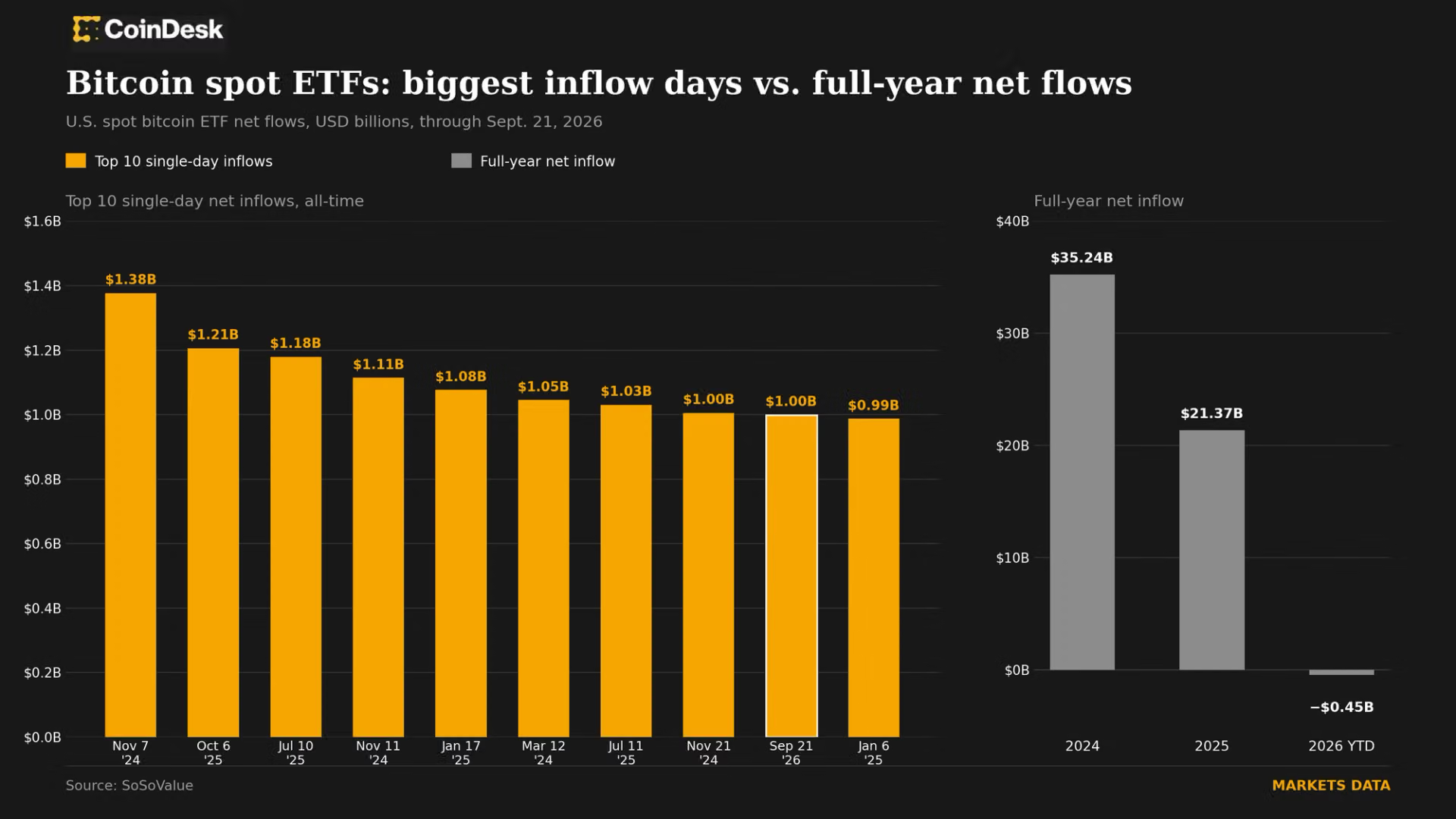
US spot Bitcoin ETFs drew nearly $1 billion on Monday, their largest daily inflow since October 2025, as Bitcoin briefly climbed above $87,000.
Bitcoin is rising, and spot exchange-traded funds (ETFs) listed in the U.S. are pulling in money at a pace that rivals the period when the cryptocurrency traded at record highs.
On Monday, the ETFs registered a net inflow of $998.95 million, the largest since Oct. 6, 2025, according to data from SoSoValue. That was the day bitcoin hit a record high of roughly $126,200.
Monday’s inflow was also the ninth-largest since the ETFs began trading on Jan. 11, 2024. The flow was led by BlackRock’s IBIT, which pulled in $381.37 million, followed by Ark’s ARKB at $289.12 million and Fidelity’s FBTC at $238.84 million.
The inflow, the first three-day streak of gains for two weeks, reads as a vote of confidence from institutions, coming just days after bitcoin absorbed a one-two punch of a failed Senate cloture vote on the Clarity Act and a Fed interest-rate increase.
The inflow has taken the month-to-date tally to $1.31 billion, following August’s $3.52 billion inflow. That suggests strong institutional interest in the cryptocurrency despite tensions in the wider macroeconomy, particularly fiscal debt concerns across the advanced world.

Whitehat operators have moved 52.37 BTC linked to the July Coldcard wallet exploit into an address associated with a recovery trust created to return rescued Bitcoin to verified owners.
Summary
- Whitehat operators moved 52.37 BTC linked to Coldcard exploit wallets into a recovery trust address.
- The transfer represented 2.8% of tracked exploit funds, according to Galaxy Digital researcher Alex Thorn.
- Crypto Recovery Trust says verified owners can submit claims and provide evidence for returned assets.
- Coinkite says patched firmware fixes future seed generation but cannot repair already weakened wallet seeds.
- Current recommended Coldcard firmware is version 5.6.2 for Mk4/Mk5 and 1.5.2Q for Q devices respectively.
Galaxy Digital Head of Research Alex Thorn said the Bitcoin came from the tracked Wave 2 cluster and footprints labeled AA, AU and AX, with the consolidation recorded in Bitcoin block 967,948. Thorn said the amount represented 2.8% of the exploit funds his team was tracking.
The destination transaction carried an OP_RETURN message pointing to “claim:cryptorecoverytrust dot com,” according to Thorn. Galaxy Research separately identified activity in the same block involving 20 inputs and 480 outputs and published transaction ID 38b524ccb8ca260ec705ab980982144857c477658fa39591870ee8cb09bcea47.
Coldcard recovery moves rescued Bitcoin into a trust
The transfer places part of the recovered Bitcoin under the Crypto Recovery Trust, a Wyoming statutory trust established to hold digital assets recovered from compromised wallets while ownership claims are checked.
Crypto Recovery Trust states that its role is to reunite recovered assets with their rightful owners through a formal claims process. Its website identifies the legal entity as the Recovered Digital Asset Statutory Trust of Wyoming and names Agentic Trace LLC as trustee.
The Digital Asset Recovery Trust, or DART, had already disclosed recovery work connected with the Coldcard incident before the latest consolidation. DART reported that it and independent whitehat researchers had secured just over 50 BTC from vulnerable addresses as of Aug. 17, moving the funds before malicious actors could reach them.
DART said recovered Bitcoin was placed in the trust instead of researcher-controlled wallets or operational accounts. Its process includes blockchain analysis, proof-of-ownership checks and sanctions screening before assets can be returned. Funds involving competing claims, sanctions restrictions or criminal proceedings may follow separate legal procedures.
The Sept. 21 movement provides a newer on-chain view of those recovery efforts. Thorn tied the 52.37 BTC specifically to previously identified exploit clusters, while describing them as whitehat-controlled funds. His 2.8% calculation refers to Galaxy’s tracked exploit total and should not be read as an official Coinkite loss figure.
Coldcard exploit began with a seed-generation flaw
The Coldcard incident began July 30 after attackers exploited weakened Bitcoin wallet seeds created by affected firmware. Coinkite’s current incident record explains that a firmware integration defect caused the seed-generation path to resolve to MicroPython’s Yasmarang software pseudorandom generator instead of the intended hardware random number generator.
Attackers did not need to remotely control the hardware wallets. Coinkite says they regenerated vulnerable private keys offline after the reduced randomness made affected seed phrases easier to search. The company describes the incident as a firmware seed-generation failure, not a remote takeover of Coldcard devices.
Independent technical research has traced the weakness to firmware changes dating from 2021. One public investigation estimated that older Mk3 devices could produce roughly 40 bits of effective entropy under affected conditions, while Mk4, Mk5 and Q models retained approximately 72 bits instead of the intended security level.
Early losses were smaller than the totals later associated with multiple attack waves. As crypto.news previously reported, the Coldcard firmware build error and first-wave Bitcoin losses involved roughly 594 BTC taken from around 500 wallets within approximately 25 minutes.
Later tracking identified additional wallets and attack waves. A separate crypto.news investigation into the five-year Coldcard entropy flaw and four attack waves estimated 1,816 BTC had moved from more than 5,200 addresses as analysts expanded the identified scope.
Loss estimates therefore vary depending on which attack waves, clusters and recovery transactions are included. Coinkite’s current security status page does not publish a single definitive total for all stolen Bitcoin.
Coinkite says firmware updates cannot repair old seeds
Coinkite released emergency fixes on July 31 for affected firmware lines. The company’s download archive shows Mk4/Mk5 version 5.6.0 and Q version 1.5.0Q as the first standard releases correcting future seed generation, while separate patches covered older Mk2/Mk3 devices and Edge firmware.
Security work continued after the initial patch. Current recommended standard releases are Mk4/Mk5 5.6.2 and Q 1.5.2Q, both issued Sept. 3. Edge users are directed to 6.6.1X for Mk4/Mk5 and 6.6.1QX for Q.
Coinkite stresses that installing fixed firmware does not change an existing seed. A wallet generated under vulnerable firmware can remain exposed even after the device receives the latest update because the weakness exists in the seed itself.
Users with affected seeds are instructed to generate a corrected replacement seed and migrate funds, unless they meet the company’s stated independent-dice exception. Coinkite says at least 50 fair, independent and privately recorded six-sided dice rolls added under the relevant workflow provide at least 128 bits of additional entropy, though users uncertain about the conditions are told to migrate.
Victims can submit ownership claims to the recovery trust
The recovery process now centers on verifying who controlled addresses from which whitehats swept Bitcoin. Crypto Recovery Trust lets claimants search for recovery information, track a submitted claim and provide additional supporting evidence through its website.
DART says the trust was structured to segregate recovered Bitcoin from researcher and operating funds while ownership is established. Attorneys from Steptoe’s national security practice advise the trustee, according to DART’s disclosure, because some returned assets may require sanctions, law-enforcement or competing-ownership reviews.
The whitehat researchers involved in DART’s earlier recovery work did not request a bounty, according to the organization. DART said other vulnerable assets and possible recovery leads remained under review after its August tally, leaving open the possibility that further Coldcard-linked funds could enter the claims process.
For wallets that still rely on seeds created under affected Coldcard firmware, Coinkite’s current instructions remain unchanged: install and verify a fixed firmware release, create a new seed under the corrected process, and move funds away from the vulnerable seed.
Anchorage Digital has selected LayerZero as its preferred interoperability partner for bank-issued stablecoins, with the Sept. 21 announcement naming Tether’s USAT as the first token to use LayerZero’s OFT standard.
Summary
- Anchorage Digital selected LayerZero to provide interoperability for stablecoins issued through its federally chartered bank.
- USAT is the first Anchorage-issued stablecoin launching with LayerZero’s OFT interoperability standard for cross-chain transfers.
- LayerZero says its OFT standard can connect assets across more than 170 supported blockchain networks.
- USDPT, USDGO and fUSD are among Anchorage-issued stablecoins expected to gain LayerZero interoperability over time.
- Anchorage remains supervised by the OCC, which granted its national trust bank charter in 2021.
LayerZero said stablecoins issued through Anchorage Digital Bank, N.A. will use its cross-chain infrastructure as the companies develop connections spanning Ethereum, EVM-compatible networks and Solana. The partnership covers Anchorage’s issuance platform, which currently supports tokens linked to Tether, Western Union, OSL Group and Falcon Finance.
Anchorage Digital makes LayerZero its stablecoin rail
Under the arrangement, LayerZero will serve as what the companies describe as the “preferred interoperability layer” for eligible stablecoins issued by Anchorage Digital Bank. The bank remains responsible for regulated issuance, while LayerZero supplies the messaging and token infrastructure needed to connect supported blockchain deployments.
LayerZero’s OFT, or Omnichain Fungible Token, standard lets issuers maintain a unified token supply while extending an asset to multiple blockchains. LayerZero explains that issuers retain control over their token contracts and can decide which chains to support, along with the security configuration used for cross-chain messages.
The company says its infrastructure currently reaches more than 170 blockchains. In a separate September update, LayerZero reported that its OFT standard had processed $280 billion in lifetime transfers and handled 87% of cross-chain transfer volume. Both figures are LayerZero’s own network statistics.
Access to 170-plus networks does not mean each Anchorage stablecoin will immediately trade on every connected chain. OFT issuers select individual deployments and configure pathways between supported networks. LayerZero’s announcement says future Anchorage-issued assets “will be designed to move seamlessly” across leading ecosystems but does not provide a deployment schedule for each token.
USAT becomes the first Anchorage-issued OFT token
Tether’s USAT is the first stablecoin in Anchorage Digital Bank’s issuance portfolio confirmed to launch with LayerZero interoperability. Tether introduced the U.S.-regulated dollar token in January, with Anchorage Digital Bank serving as issuer under the federal stablecoin framework. Tether itself is not the legal issuer of USAT.
As previously reported, Tether’s U.S.-regulated USAT launch through Anchorage Digital created a separate domestic product from the company’s global USDT stablecoin. USAT began on Ethereum before expanding to Celo, where it became available as a native asset during the summer.
Anchorage Digital Bank publishes monthly reserve attestations for USAT. Its first January report recorded 17.5 million redeemable tokens outstanding and $17.6 million of supporting reserve assets. The report identified Ethereum contract 0x07041776f5007aca2a54844f50503a18a72a8b68 as the original USAT contract.
LayerZero has an existing relationship with Tether infrastructure outside USAT. Tether announced an investment in LayerZero Labs in February, while LayerZero’s OFT system already powers USDT0, the omnichain version of USDT. In related coverage, USDT0’s LayerZero-based cross-chain architecture uses a unified supply model instead of separate bridge liquidity pools.
USDPT, USDGO and fUSD remain part of the rollout
Western Union’s USDPT sits among the other stablecoins named in the Anchorage-LayerZero announcement. Western Union launched USDPT on Solana in May as a U.S. dollar-backed payment token issued by Anchorage Digital Bank. The payment company designed it for settlement within its global network.
As crypto.news reported, Western Union’s USDPT launch on Solana was followed by a Bybit integration in June and a USDPT-backed Stablecard product in August. Anchorage currently publishes monthly USDPT reserve attestations covering May through July.
OSL Group’s USDGO is another Anchorage-issued stablecoin included in the partnership. USDGO launched on Solana with an initial $50 million mint in February. OSL reported that circulation passed $500 million in June, while a more recent Anchorage update says the token has since exceeded $1 billion in market capitalization after roughly six months.
Earlier crypto.news coverage documented USDGO passing $500 million in circulating supply, with Anchorage acting as issuer and OSL handling branding and distribution. Anchorage says reserves are backed 1:1 by high-quality liquid assets and covered by monthly independent attestations.
Falcon Finance’s fUSD completes the group named in LayerZero’s announcement. Falcon states that fUSD is issued by Anchorage Digital Bank for institutional treasury, settlement and collateral uses, with current contracts on Ethereum and BNB Chain. Its reserve model includes cash, short-dated U.S. Treasuries and qualifying money-market exposure.
The Falcon Finance fUSD launch with Anchorage Digital Bank took place in May. Falcon operates a separate rewards program for eligible institutions, while Anchorage handles issuance and reserve management.
LayerZero has not announced exact activation dates for USDPT, USDGO or fUSD OFT routes under the Anchorage agreement.
Anchorage operates under federal bank supervision
Anchorage Digital Bank received its national trust bank charter after the Office of the Comptroller of the Currency approved its conversion from a South Dakota trust company in January 2021. The charter placed the bank under OCC supervision and came with capital, liquidity and compliance requirements.
The OCC issued a BSA/AML consent order against the bank in April 2022 after finding deficiencies in its compliance program. The regulator later terminated that order on Aug. 18, 2025, stating continued enforcement was no longer required.
Federal records show the OCC subsequently terminated Anchorage’s original 2021 operating agreement in February 2026. The bank continues to operate as Anchorage Digital Bank, National Association, and appears on the OCC’s list of nationally chartered trust banks.
LayerZero’s institutional stablecoin work extends beyond Anchorage. Earlier this month, BDACS chose its OFT system for KRW1, and crypto.news reported on the KRW1 stablecoin’s LayerZero cross-chain expansion across networks including Ethereum, Avalanche and Circle’s Arc.
For Anchorage-issued stablecoins, LayerZero has confirmed USAT as the first asset using the new interoperability arrangement. The companies have not published individual launch dates, destination-chain lists or contract addresses for planned OFT deployments involving USDPT, USDGO and fUSD.

Hana Bank has signed an agreement with Upbit Global to develop Travel Rule infrastructure for digital asset transfers, extending its work with South Korea’s crypto sector into transaction compliance and transfer technology.
Summary
- Hana Bank and Upbit Global will jointly develop and test Travel Rule infrastructure for secure digital asset transfers and regulatory compliance.
- The partnership will examine sender and recipient verification, secure information transmission and links between banks and virtual asset service providers.
- Upbit Global will bring technology from its VerifyVASP Travel Rule solution, while Hana Bank plans to draw on its foreign exchange, payments and settlement infrastructure.
- Hana Bank has been expanding its digital asset business through projects spanning custody, stablecoins, tokenized assets and partnerships with crypto companies.
DigitalToday reported on Sept. 22 that the two companies signed a memorandum of understanding at Hana Bank’s headquarters in Euljiro, Seoul, covering technical cooperation on digital asset transfers and systems designed to meet regulatory requirements.
The agreement will focus on technology needed to verify information about people sending and receiving digital assets, securely transmit the required data between service providers and connect financial institutions with virtual asset businesses in South Korea and overseas.
Upbit Global already operates Travel Rule technology through its subsidiary VerifyVASP. The system verifies sender and recipient information during virtual asset transfers while transmitting data required for compliance and protecting personal information.
Hana Bank and Upbit Global will test Travel Rule technology
Travel Rule requirements require virtual asset service providers to obtain and retain information about senders and recipients when processing covered transfers. Relevant information must then be securely passed to the service provider on the other side of a transaction.
Hana Bank and Upbit Global plan to jointly review how those requirements can be applied when digital assets move between different types of financial service providers.
Technical work will cover sender and recipient verification as well as secure information transmission. The companies intend to research and test infrastructure that could support transfers involving banks and domestic or overseas virtual asset service providers.
Regulatory information sharing forms another part of the agreement. Hana Bank and Upbit Global plan to respond jointly to changes in digital asset laws, regulations and institutional requirements while exchanging information related to compliance.
Travel Rule controls are already embedded in South Korea’s crypto transfer infrastructure. Upbit applies restrictions to deposits from exchanges that do not meet its Travel Rule requirements, while transfers involving personal wallets can require ownership verification.
The exchange has continued to apply those controls as it expands the assets available on its platform. In August, for example, its rules for incoming token transfers allowed the exchange to request evidence on the source of large deposits, while transfers from noncompliant exchanges could remain uncredited until additional checks were completed.
Hana Bank has expanded its digital asset business
The latest agreement adds another technical project to Hana Bank’s growing digital asset operations.
Hana Bank plans to use its experience in foreign exchange, payments and settlement to identify financial services that could be built around digital assets, according to DigitalToday.
The bank already has direct financial exposure to the company behind Upbit. In May, Hana agreed to acquire a 6.55% stake in Dunamu, Upbit’s operator, from Kakao Investments for roughly 1.003 trillion won, equivalent to around $670 million at the time.
Crypto.news previously reported that the Dunamu stake purchase drew scrutiny from South Korea’s Financial Services Commission over rules separating banking and commercial businesses. The planned transaction would make Hana Bank Dunamu’s fourth largest shareholder.
Hana Financial Group had separately reached a strategic agreement with Dunamu to develop a financial model connecting traditional banking and digital assets. Hana Financial TI had completed a proof of concept for a Korean won backed stablecoin using the XRP Ledger as part of the group’s blockchain work.
Digital asset custody is another area where the group has built infrastructure. Hana began working with BitGo on custody services in 2023 and later became a shareholder in BitGo Korea alongside SK Telecom.
BitGo Korea secured registration as a virtual asset service provider in August 2026. Hana holds a 25% stake in the business, with its role built around contributing financial sector experience to the custody venture. The registered custody business offers another connection between Hana’s banking operations and regulated digital asset infrastructure.
Korean banks are building stablecoin and settlement systems
Hana’s work with Upbit Global comes as South Korean financial institutions test several models for using blockchain in payments, settlement and regulated financial products.
In March, Hana Financial Group signed a memorandum of understanding with Standard Chartered Group covering digital asset initiatives. Their cooperation included potential work on stablecoins, tokenized deposits, custody and payment infrastructure, drawing on the two groups’ financial networks and technology capabilities.
Hana has separately worked with KB Financial Group and Shinhan Financial Group on infrastructure that could support Korean won pegged stablecoins and related digital payment systems. The Standard Chartered partnership expanded that work into cooperation with an international banking group.
Other South Korean financial companies are testing how blockchain assets could fit into existing settlement systems. Eugene Investment & Securities signed an agreement with blockchain company BEATOZ on Sept. 21 to test stablecoins for tokenized securities subscriptions.
The planned proof of concept will examine whether subscription, payment and settlement can be handled within one blockchain based process. Eugene built a tokenized securities platform in 2024 and is participating in Hana Financial Group’s consortium working on a won denominated stablecoin.
South Korea is preparing to bring tokenized securities into its regulated capital markets framework from February 2027. The first phase is expected to cover selected privately pooled money market funds, institutional bonds, certain unlisted shares and publicly offered fractional investment securities.
The stablecoin settlement trial will use Eugene’s existing tokenized securities issuance infrastructure to examine how stablecoins could be incorporated into that process.
South Korean authorities are still working through rules for other parts of the digital asset market. The Bank of Korea has supported a bank led structure for won denominated stablecoin issuance, while lawmakers and regulators have continued discussions over issuer requirements, reserves and supervisory responsibilities.
Hana Bank said its agreement with Upbit Global creates a cooperation model between a traditional financial institution and the virtual asset industry built around regulatory standards including anti money laundering requirements.

Australia’s Treasury has placed artificial intelligence among five transitions expected to reshape the economy through 2065–66, while digital assets are absent from the report’s five headline themes.
Summary
- Australia’s 2026 Intergenerational Report identifies artificial intelligence as one of five major long-term economic transitions.
- Treasury says agentic AI systems are becoming more autonomous, capable and widely used across society.
- Crypto receives no focus in the 40-year outlook despite separate government digital finance initiatives underway.
- Australia’s Financial Innovation Strategy links AI agents with real-time, interoperable and programmable payment infrastructure needs.
- DFCRC estimates full digital finance adoption could generate A$24 billion in annual Australian economic gains.
Treasury published the seventh Intergenerational Report on Sept. 21, covering Australia’s economic and federal budget outlook for the next 40 years. The report identifies the AI revolution, geopolitical fragmentation, the energy transition, population aging and the country’s continuing move toward a services economy as its major transitions.
The government expects Australia’s economy to more than double in size by 2065–66, while real income per person is projected to rise 55%. Average annual economic growth is expected to slow as population growth and workforce expansion lose pace, leaving productivity as a larger part of the long-run growth equation.
Australia places AI among five long-term transitions
Artificial intelligence receives a dedicated place in the latest outlook, a change from the previous 2023 Intergenerational Report. Treasurer Jim Chalmers said AI represented the most dramatic technological change since that earlier report and would become a defining influence on the economy over the coming four decades.
Treasury’s analysis covers automation, changing skill requirements and the potential for AI to alter how existing jobs are performed. The report does not assume that every productivity gain will arrive automatically, with investment, technology adoption, skills and regulatory settings remaining part of its long-term economic assumptions.
Agentic AI receives particular attention. Treasury describes newer systems as increasingly capable of acting with less direct human involvement, while AI performance has surpassed human benchmarks in several tasks. The government’s separate financial innovation work defines agentic systems as software capable of taking actions, making recommendations or performing tasks for people and businesses.
Chalmers described the “AI revolution” as the biggest economic transformation of the current era during the report’s release. Treasury retained a long-run productivity assumption of 1.2% a year, while acknowledging that AI could change productivity, investment and labor-market outcomes in ways that remain difficult to quantify decades in advance.
Crypto sits outside the report’s five headline themes
Digital assets do not appear among the five transitions Treasury selected to organize its 40-year outlook. Coinbase Australia country director John O’Loghlen criticized the omission in comments supplied to Cointelegraph, arguing that future AI agents will require financial systems capable of supporting automated economic activity.
“The Intergenerational Report makes it clear that Australia’s prosperity over the next 40 years will depend heavily on our ability to adopt new technology and lift productivity,” O’Loghlen said. He argued that the report’s AI focus leaves out the financial infrastructure autonomous agents could use when making payments or conducting transactions.
The absence of crypto from the five-transition framework does not mean the Australian government has excluded digital assets from current economic policy. Treasury released a separate Financial Innovation Strategy on Sept. 3 that explicitly addresses digital assets, stablecoins, tokenization, digital money and AI-enabled financial services. Treasury described the strategy as a framework for coordinating government, regulators and industry as financial technology develops.
The strategy states that Australia has legislated a licensing framework for digital asset platforms and tokenized custody platforms, scheduled to begin on April 9, 2027. Payment reforms are expected to regulate payment stablecoins as tokenized stored-value facilities. Regulators will continue assessing legal and operational questions involving tokenized markets as those systems move toward commercial use.
As previously reported, Australia’s new digital asset licensing framework begins in April 2027, while businesses covered by existing financial-services requirements face separate licensing obligations under current law.
Treasury links AI agents with programmable payments
The Financial Innovation Strategy makes a direct connection between AI and payment infrastructure that is not central to the Intergenerational Report. Treasury states that advances in agentic systems could increase automated and machine-to-machine transactions.
Such activity could create demand for payment and settlement systems capable of real-time execution, interoperability and programmable services, according to the strategy. Treasury cautions that fully autonomous financial agents remain largely experimental and have not reached the reliability required for most real-world financial applications.
O’Loghlen said stablecoins and tokenized markets could become part of the rails used by agentic finance, while calling for clearer rules covering tokenized stored-value facilities. His comments represent Coinbase’s policy position, not a Treasury forecast that AI agents will necessarily use crypto assets.
Work elsewhere in the payments industry provides current examples of that model. Crypto.news has covered AI agents using stablecoins for automated payments through Visa-linked testing, while separate projects have explored programmatic machine payments through blockchain infrastructure.
Australia’s own payments planning has moved in a similar technical direction. As previously reported, Australia’s payment rails are being assessed for stablecoin interoperability, including possible connections between bank money and tokenized forms of value.
RBA keeps tokenized finance on its policy agenda
The Reserve Bank of Australia has continued developing its tokenized-finance work separately from the Intergenerational Report. In May, the RBA and Digital Finance Cooperative Research Centre released the final findings from Project Acacia, which tested 20 wholesale tokenized asset use cases across issuance, trading and settlement.
Tests covered different settlement assets, including existing central-bank balances, a pilot wholesale CBDC, commercial-bank deposit tokens and stablecoins. The project found possible efficiency, functionality and resilience benefits but identified questions involving legal certainty, settlement design, infrastructure and regulation that require more work.
DFCRC research estimates that full adoption of digital finance could generate as much as A$24 billion in annual economic gains for Australia. The estimate covers tokenized real-world assets, payments and other digital-finance applications and remains a modeled economic estimate, not realized economic output.
Crypto.news previously covered Australia’s estimated A$24 billion tokenization opportunity when the RBA moved from experimental work toward discussions about market implementation.
In September, the RBA opened another consultation examining how its Reserve Bank Information and Transfer System and Fast Settlement Service could support tokenized markets. The central bank is considering settlement between traditional accounts and tokenized private money, potential stablecoin access to central-bank reserves and future designs for tokenized reserves.
The RBA set Oct. 30, 2026 as the deadline for submissions to that consultation. Regulators plan to use the responses when assessing future RITS capabilities, while the government’s Financial Innovation Strategy schedules a digital financial market infrastructure sandbox for the second half of 2027.

Billionaire venture capitalist Tim Draper has urged Apple and Meta to hold Bitcoin on their balance sheets, arguing that leaving major corporate reserves entirely outside BTC creates financial risk.
Summary
- Tim Draper says Apple and Meta should hold Bitcoin as protection against future monetary instability.
- Apple reported $146.5 billion in cash and marketable securities without disclosing Bitcoin holdings in June.
- Meta reported $90.3 billion in cash and marketable securities without disclosing Bitcoin holdings in June.
- Microsoft shareholders rejected a Bitcoin treasury assessment in 2024, with only 0.55% recorded voting support.
- Meta shareholders rejected their 2025 Bitcoin treasury assessment after its board recommended voting against it.
Bitcoin Magazine published the comments on Sept. 21 following a 30-minute interview in which Draper called it “irresponsible” for large technology companies to maintain no Bitcoin exposure. He tied his position to U.S. government spending and warned that the fiscal path could eventually produce either hyperinflation or interest rates high enough to create problems for banks.
Draper’s comments represent his investment view, not a company policy change at Apple or Meta. Neither company’s most recent quarterly filing discloses Bitcoin among its treasury assets.
Tim Draper wants companies to keep operating cash in Bitcoin
During the interview, Draper argued that businesses should maintain roughly four weeks of operating expenses in Bitcoin, while individuals should consider holding around six months of expenses in BTC. He said governments should maintain Bitcoin exposure as a hedge against problems in traditional monetary systems.
His argument extends beyond a conventional inflation hedge. Draper said corporate boards with no Bitcoin exposure could leave companies vulnerable if banks holding their cash fail. Bitcoin, in his view, provides an alternative asset held outside the conventional banking structure.
Draper has long promoted Bitcoin as part of a decentralized financial system. In the latest interview, he linked blockchain technology with artificial intelligence, smart contracts and software automation, arguing that technological development could reduce dependence on payment intermediaries, accountants and other centralized service providers.
His monetary forecast remains highly uncertain. No official U.S. projection says hyperinflation is inevitable, and current fiscal data do not establish such an outcome. Treasury figures do, however, show continued large federal deficits.
Data sourced from the U.S. Treasury showed a $167 billion federal deficit in August. During the first 11 months of fiscal 2026, federal outlays reached roughly $6.8 trillion against around $4.8 trillion in receipts, producing a cumulative deficit close to $2 trillion.
Those figures document current borrowing requirements but do not confirm Draper’s prediction that the fiscal path must end in hyperinflation or a banking crisis.
Apple and Meta still disclose no Bitcoin treasury holdings
Apple’s latest quarterly filing provides a clear view of the scale of the balance sheet Draper wants partly exposed to Bitcoin.
Apple reported $39.54 billion in cash and cash equivalents as of June 27, alongside $22.86 billion of current marketable securities and $84.12 billion of non-current marketable securities. Together, those categories totaled approximately $146.5 billion.
The filing lists cash, money-market funds, U.S. Treasury securities, government agency securities, corporate securities and other conventional investments. A search of the Form 10-Q produced no reference to Bitcoin.
Apple’s February 2026 annual shareholder meeting did not feature a Bitcoin treasury proposal. Its five voting items covered directors, its auditor, executive compensation, a director stock plan and a shareholder proposal concerning China.
Meta’s latest filing presents a similar picture. Meta reported $15.46 billion of cash and cash equivalents and $74.80 billion in marketable securities as of June 30, giving it approximately $90.3 billion across the two categories.
Its disclosed portfolio included money-market funds, U.S. government securities, agency debt, corporate debt and marketable equities. Meta’s latest Form 10-Q contains no reference to Bitcoin.
Meta and Microsoft shareholders previously rejected Bitcoin proposals
Meta has already faced a formal shareholder request to consider Bitcoin.
A 2025 shareholder proposal asked the board to prepare an assessment of whether adding Bitcoin to Meta’s treasury would serve shareholder interests. The company’s board recommended voting against the proposal, saying its existing treasury management process already considered multiple investable asset classes.
As crypto.news previously reported, the Meta Bitcoin treasury proposal was submitted by Ethan Peck on behalf of a family trust. The proposal argued that holding conventional cash and bonds could reduce purchasing power and asked Meta to assess Bitcoin as another reserve asset.
Shareholders rejected the proposal at Meta’s May 28, 2025 annual meeting. Meta recorded 3,916,871 votes in favor, compared with 4,980,828,562 against and 8,857,588 abstentions.
Microsoft encountered a similar campaign months earlier. Its shareholders rejected an assessment of investing in Bitcoin at the December 2024 annual meeting after the board recommended voting against the measure.
The SEC filing showed only 0.55% of votes supported the proposal, with 28.23 million shares voting for it and more than 5.14 billion voting against.
Crypto.news covered the Microsoft shareholder rejection of a Bitcoin treasury assessment after the vote. Microsoft had argued that its treasury team already evaluated a range of investment assets and did not need the requested assessment.
Draper keeps his $250,000 Bitcoin forecast
Draper used the latest interview to repeat another long-standing position: his $250,000 Bitcoin price target. Bitcoin Magazine reported that he now connects the target with future Bitcoin halvings and the resulting reduction in new supply.
The $250,000 level remains Draper’s forecast and is not supported by any guaranteed timeline. His previous Bitcoin price calls have frequently carried dates that passed before the target was reached.
Corporate adoption remains uneven. Some listed companies have built business models around holding Bitcoin, while large technology groups continue to keep most liquid reserves in cash, government securities and other traditional instruments.
The corporate Bitcoin treasury model has expanded enough to create a separate class of public companies whose valuations are closely tied to their crypto reserves. At the same time, several treasury companies have faced pressure when Bitcoin prices fell or financing costs increased.
Strategy remains the best-known corporate adopter, though its treasury strategy has changed during 2026 as it manages financing obligations and liquidity. Recent crypto.news reporting documented Strategy’s move from constant accumulation toward active Bitcoin treasury management after the company began selling portions of its holdings.
Draper did not say Apple or Meta had entered discussions to acquire Bitcoin, nor did he disclose conversations with either company about changing treasury policy. His Sept. 21 comments were an investment recommendation made during the Bitcoin Magazine interview.

Newcastle city councillors claim city must become North East ‘capital’

Malta’s 15% tax regime explained: who can benefit

Cantor Fitzgerald Flags 95% Upside in the Firm Putting Stocks Onchain

Weekend Open Thread – Corporette.com

Weekend Open Thread: Talbots – Corporette.com

Memory prices are slowing because buyers ran out of money

How Much Was It Going To Cost? | Financial Audit #CalebHammer #FinancialAudit #Money #Debt

Americans are addicted to debt watch this #finance #wealth #financialfreedom

This NEW CHASM-STALKER Might Be the BEST MONEY ROD in Fisch!
-
 Fashion4 days ago
Weekend Open Thread: Talbots – Corporette.com
-

 Tech1 day ago
Researchers escape OpenAI Codex sandbox to run commands on host
-

 Crypto World6 days ago
Robinhood engineers charged over $50K crypto scheme
-

 Crypto World3 days ago
Circle launches Arc Studio AI agent for building onchain apps
-
 NewsBeat3 days ago
Trump says US has reached an agreement to take permanent control of Greenland’s security
-

 Crypto World3 days ago
Bitcoin price breaks channel as RSI climbs to 63
-

 Crypto World1 day ago
Who Needs CLARITY Anyway? ARB Could See 70X Increase: Hodler’s Digest
-

 Crypto World5 days ago
US Charges Robinhood Engineers Over Crypto Listing Trades
-

 Crypto World6 days ago
What Is the Status of the U.S.-Iran Peace Talks? Here's What Both Sides Are Saying
-

 Crypto World3 days ago
Trading Bitcoin on Robinhood? Why 2% Spread Has Traders Worried
-

 Tech6 days ago
Webb’s IC 348 Mosaic Includes Two-Jupiter Dwarfs, Twin Jets, and a Nursery Still Making Worlds
-

 Crypto World3 days ago
World Money launches in 150+ countries with Stripe
-

 Crypto World4 days ago
Silver prices recover quickly, hitting weekly high today
-

 Entertainment6 days ago
Big Brother Update: Melody Explodes at Drew as Illness Sweeps BB28 House
-

 Crypto World4 days ago
Mortgage and refinance interest rates today, Thursday, September 17, 2026
-
 NewsBeat4 days ago
US was ‘on brink of war’ with China over false AI report of nukes moving in Middle East
-

 Crypto World1 day ago
Bitcoin price holds above $81K as key catalysts line up
-

 Tech4 days ago
GPT-6 Astra Reached the Nether in Minecraft, Lost Its Stash to a Creeper, and Farmed Potatoes for Hours
-

 Business6 days ago
Federal Reserve expected to hike interest rates 25 basis points at FOMC meeting
-

 Crypto World3 days ago
CFTC sends crypto market structure rulemaking to White House
You must be logged in to post a comment Login